


smg
Shepherd Model Gateway
Stars: 59
Shepherd Model Gateway (SMG) is a high-performance model-routing gateway designed for large-scale LLM deployments. It centralizes worker lifecycle management, balances traffic across various backends, and offers enterprise-ready control over history storage, MCP tooling, and privacy-sensitive workflows. SMG maximizes GPU utilization, supports multiple backends, is built for speed with native Rust and gRPC pipelines, provides enterprise control features like rate limiting and privacy boundaries, and offers full observability with metrics and tracing. The tool supports various APIs and features multiple routing policies, gRPC pipeline integration, MCP tool integration, high availability mesh networking, chat history storage options, WASM plugins, and resilience mechanisms like circuit breakers and rate limiting.
README:






High-performance model-routing gateway for large-scale LLM deployments. Centralizes worker lifecycle management, balances traffic across HTTP/gRPC/OpenAI-compatible backends, and provides enterprise-ready control over history storage, MCP tooling, and privacy-sensitive workflows.
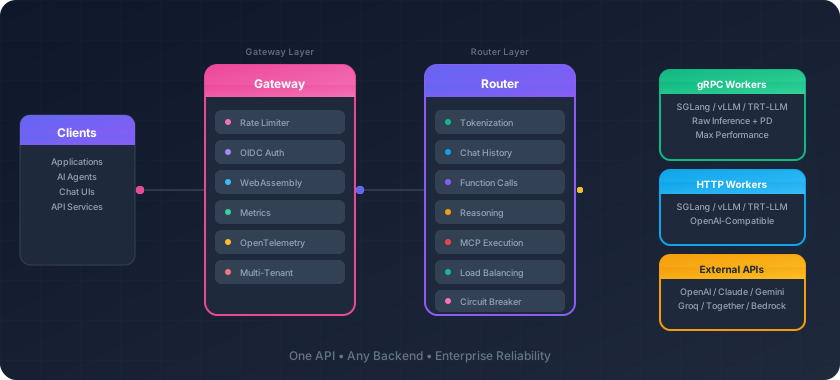
| 🚀 Maximize GPU Utilization | Cache-aware routing understands your inference engine's KV cache state—whether SGLang, vLLM, or TensorRT-LLM—to reuse prefixes and reduce redundant computation. |
| 🔌 One API, Any Backend | Route to self-hosted models (SGLang, vLLM, TensorRT-LLM) or cloud providers (OpenAI, Anthropic, Gemini, Bedrock, and more) through a single unified endpoint. |
| ⚡ Built for Speed | Native Rust with gRPC pipelines, sub-millisecond routing decisions, and zero-copy tokenization. Circuit breakers and automatic failover keep things running. |
| 🔒 Enterprise Control | Multi-tenant rate limiting with OIDC, WebAssembly plugins for custom logic, and a privacy boundary that keeps conversation history within your infrastructure. |
| 📊 Full Observability | 40+ Prometheus metrics, OpenTelemetry tracing, and structured JSON logs with request correlation—know exactly what's happening at every layer. |
API Coverage: OpenAI Chat/Completions/Embeddings, Responses API for agents, Anthropic Messages, and MCP tool execution.
Install — pick your preferred method:
# Docker
docker pull lightseekorg/smg:latest

# Python
pip install smg

# Rust
cargo install smg
Run — point SMG at your inference workers:
# Single worker
smg --worker-urls http://localhost:8000

# Multiple workers with cache-aware routing
smg --worker-urls http://gpu1:8000 http://gpu2:8000 --policy cache_aware

# With high availability mesh
smg --worker-urls http://gpu1:8000 --ha-mesh --seeds 10.0.0.2:30001,10.0.0.3:30001
Use — send requests to the gateway:
curl http://localhost:30000/v1/chat/completions \
  -H "Content-Type: application/json" \
  -d '{"model": "llama3", "messages": [{"role": "user", "content": "Hello!"}]}'
That's it. SMG is now load-balancing requests across your workers.
| Self-Hosted | Cloud Providers |
|---|---|
| vLLM | OpenAI |
| SGLang | Anthropic |
| TensorRT-LLM | Google Gemini |
| Ollama | AWS Bedrock |
| Any OpenAI-compatible server | Azure OpenAI |
| Feature | Description |
|---|---|
| 8 Routing Policies | cache_aware, round_robin, power_of_two, consistent_hashing, prefix_hash, manual, random, bucket |
| gRPC Pipeline | Native gRPC with streaming, reasoning extraction, and tool call parsing |
| MCP Integration | Connect external tool servers via Model Context Protocol |
| High Availability | Mesh networking with SWIM protocol for multi-node deployments |
| Chat History | Pluggable storage: PostgreSQL, Oracle, Redis, or in-memory |
| WASM Plugins | Extend with custom WebAssembly logic |
| Resilience | Circuit breakers, retries with backoff, rate limiting |
| Getting Started | Installation and first steps |
| Architecture | How SMG works |
| Configuration | CLI reference and options |
| API Reference | OpenAI-compatible endpoints |
| Kubernetes Setup | In-cluster discovery and production setup |
We welcome contributions! See Contributing Guide for details.
For Tasks:
Click tags to check more tools for each tasksFor Jobs:
Alternative AI tools for smg
Similar Open Source Tools
smg
Shepherd Model Gateway (SMG) is a high-performance model-routing gateway designed for large-scale LLM deployments. It centralizes worker lifecycle management, balances traffic across various backends, and offers enterprise-ready control over history storage, MCP tooling, and privacy-sensitive workflows. SMG maximizes GPU utilization, supports multiple backends, is built for speed with native Rust and gRPC pipelines, provides enterprise control features like rate limiting and privacy boundaries, and offers full observability with metrics and tracing. The tool supports various APIs and features multiple routing policies, gRPC pipeline integration, MCP tool integration, high availability mesh networking, chat history storage options, WASM plugins, and resilience mechanisms like circuit breakers and rate limiting.
BharatMLStack
BharatMLStack is a comprehensive, production-ready machine learning infrastructure platform designed to democratize ML capabilities across India and beyond. It provides a robust, scalable, and accessible ML stack empowering organizations to build, deploy, and manage machine learning solutions at massive scale. It includes core components like Horizon, Trufflebox UI, Online Feature Store, Go SDK, Python SDK, and Numerix, offering features such as control plane, ML management console, real-time features, mathematical compute engine, and more. The platform is production-ready, cloud agnostic, and offers observability through built-in monitoring and logging.
neurolink
NeuroLink is an Enterprise AI SDK for Production Applications that serves as a universal AI integration platform unifying 13 major AI providers and 100+ models under one consistent API. It offers production-ready tooling, including a TypeScript SDK and a professional CLI, for teams to quickly build, operate, and iterate on AI features. NeuroLink enables switching providers with a single parameter change, provides 64+ built-in tools and MCP servers, supports enterprise features like Redis memory and multi-provider failover, and optimizes costs automatically with intelligent routing. It is designed for the future of AI with edge-first execution and continuous streaming architectures.
holmesgpt
HolmesGPT is an AI agent designed for troubleshooting and investigating issues in cloud environments. It utilizes AI models to analyze data from various sources, identify root causes, and provide remediation suggestions. The tool offers integrations with popular cloud providers, observability tools, and on-call systems, enabling users to streamline the troubleshooting process. HolmesGPT can automate the investigation of alerts and tickets from external systems, providing insights back to the source or communication platforms like Slack. It supports end-to-end automation and offers a CLI for interacting with the AI agent. Users can customize HolmesGPT by adding custom data sources and runbooks to enhance investigation capabilities. The tool prioritizes data privacy, ensuring read-only access and respecting RBAC permissions. HolmesGPT is a CNCF Sandbox Project and is distributed under the Apache 2.0 License.
auto-dev
AutoDev Xiuper is an AI-native, multi-agent development platform built on Kotlin Multiplatform. It covers all seven phases of the software development lifecycle and runs on 8+ platforms. The platform provides a unified architecture for writing code once and running it anywhere, with specialized agents for each phase of development. It supports various devices including IntelliJ IDEA, VS Code, CLI, Web, Desktop, Android, iOS, and Server. The platform also offers features like Multi-LLM support, DevIns language for workflow automation, MCP Protocol for extensible tool ecosystem, and code intelligence for multiple programming languages.
eko
Eko is a lightweight and flexible command-line tool for managing environment variables in your projects. It allows you to easily set, get, and delete environment variables for different environments, making it simple to manage configurations across development, staging, and production environments. With Eko, you can streamline your workflow and ensure consistency in your application settings without the need for complex setup or configuration files.

motia
Motia is an AI agent framework designed for software engineers to create, test, and deploy production-ready AI agents quickly. It provides a code-first approach, allowing developers to write agent logic in familiar languages and visualize execution in real-time. With Motia, developers can focus on business logic rather than infrastructure, offering zero infrastructure headaches, multi-language support, composable steps, built-in observability, instant APIs, and full control over AI logic. Ideal for building sophisticated agents and intelligent automations, Motia's event-driven architecture and modular steps enable the creation of GenAI-powered workflows, decision-making systems, and data processing pipelines.
llumen
Llumen is a self-hosted interface optimized for modest hardware like Raspberry Pi, old laptops, and minimal VPS. It offers privacy without complexity, providing essential features with minimal resource demands. Users can enjoy sub-second cold starts, real-time token streaming, various chat modes, rich media support, and a universal API for OpenAI-compatible providers. The tool has a small footprint with a binary size of around 17MB and RAM usage under 128MB. Llumen aims to simplify the setup process and offer a user-friendly experience for individuals seeking a privacy-focused solution.
Athena-Public
Project Athena is a Linux OS designed for AI Agents, providing memory, persistence, scheduling, and governance for AI models. It offers a comprehensive memory layer that survives across sessions, models, and IDEs, allowing users to own their data and port it anywhere. The system is built bottom-up through 1,079+ sessions, focusing on depth and compounding knowledge. Athena features a trilateral feedback loop for cross-model validation, a Model Context Protocol server with 9 tools, and a robust security model with data residency options. The repository structure includes an SDK package, examples for quickstart, scripts, protocols, workflows, and deep documentation. Key concepts cover architecture, knowledge graph, semantic memory, and adaptive latency. Workflows include booting, reasoning modes, planning, research, and iteration. The project has seen significant content expansion, viral validation, and metrics improvements.
LocalAI
LocalAI is a free and open-source OpenAI alternative that acts as a drop-in replacement REST API compatible with OpenAI (Elevenlabs, Anthropic, etc.) API specifications for local AI inferencing. It allows users to run LLMs, generate images, audio, and more locally or on-premises with consumer-grade hardware, supporting multiple model families and not requiring a GPU. LocalAI offers features such as text generation with GPTs, text-to-audio, audio-to-text transcription, image generation with stable diffusion, OpenAI functions, embeddings generation for vector databases, constrained grammars, downloading models directly from Huggingface, and a Vision API. It provides a detailed step-by-step introduction in its Getting Started guide and supports community integrations such as custom containers, WebUIs, model galleries, and various bots for Discord, Slack, and Telegram. LocalAI also offers resources like an LLM fine-tuning guide, instructions for local building and Kubernetes installation, projects integrating LocalAI, and a how-tos section curated by the community. It encourages users to cite the repository when utilizing it in downstream projects and acknowledges the contributions of various software from the community.
squirrelscan
Squirrelscan is a website audit tool designed for SEO, performance, and security audits. It offers 230+ rules across 21 categories, AI-native design for Claude Code and AI workflows, smart incremental crawling, and multiple output formats. It provides E-E-A-T auditing, crawl history tracking, and is developer-friendly with a CLI. Users can run audits in the terminal, integrate with AI coding agents, or pipe output to AI assistants. The tool is available for macOS, Linux, Windows, npm, and npx installations, and is suitable for autonomous AI workflows.
rag-web-ui
RAG Web UI is an intelligent dialogue system based on RAG (Retrieval-Augmented Generation) technology. It helps enterprises and individuals build intelligent Q&A systems based on their own knowledge bases. By combining document retrieval and large language models, it delivers accurate and reliable knowledge-based question-answering services. The system is designed with features like intelligent document management, advanced dialogue engine, and a robust architecture. It supports multiple document formats, async document processing, multi-turn contextual dialogue, and reference citations in conversations. The architecture includes a backend stack with Python FastAPI, MySQL + ChromaDB, MinIO, Langchain, JWT + OAuth2 for authentication, and a frontend stack with Next.js, TypeScript, Tailwind CSS, Shadcn/UI, and Vercel AI SDK for AI integration. Performance optimization includes incremental document processing, streaming responses, vector database performance tuning, and distributed task processing. The project is licensed under the Apache-2.0 License and is intended for learning and sharing RAG knowledge only, not for commercial purposes.
LitServe
LitServe is a high-throughput serving engine designed for deploying AI models at scale. It generates an API endpoint for models, handles batching, streaming, and autoscaling across CPU/GPUs. LitServe is built for enterprise scale with a focus on minimal, hackable code-base without bloat. It supports various model types like LLMs, vision, time-series, and works with frameworks like PyTorch, JAX, Tensorflow, and more. The tool allows users to focus on model performance rather than serving boilerplate, providing full control and flexibility.
pai-opencode
PAI-OpenCode is a complete port of Daniel Miessler's Personal AI Infrastructure (PAI) to OpenCode, an open-source, provider-agnostic AI coding assistant. It brings modular capabilities, dynamic multi-agent orchestration, session history, and lifecycle automation to personalize AI assistants for users. With support for 75+ AI providers, PAI-OpenCode offers dynamic per-task model routing, full PAI infrastructure, real-time session sharing, and multiple client options. The tool optimizes cost and quality with a 3-tier model strategy and a 3-tier research system, allowing users to switch presets for different routing strategies. PAI-OpenCode's architecture preserves PAI's design while adapting to OpenCode, documented through Architecture Decision Records (ADRs).
deepfabric
DeepFabric is a CLI tool and SDK designed for researchers and developers to generate high-quality synthetic datasets at scale using large language models. It leverages a graph and tree-based architecture to create diverse and domain-specific datasets while minimizing redundancy. The tool supports generating Chain of Thought datasets for step-by-step reasoning tasks and offers multi-provider support for using different language models. DeepFabric also allows for automatic dataset upload to Hugging Face Hub and uses YAML configuration files for flexibility in dataset generation.
auto-dev
AutoDev is an AI-powered coding wizard that supports multiple languages, including Java, Kotlin, JavaScript/TypeScript, Rust, Python, Golang, C/C++/OC, and more. It offers a range of features, including auto development mode, copilot mode, chat with AI, customization options, SDLC support, custom AI agent integration, and language features such as language support, extensions, and a DevIns language for AI agent development. AutoDev is designed to assist developers with tasks such as auto code generation, bug detection, code explanation, exception tracing, commit message generation, code review content generation, smart refactoring, Dockerfile generation, CI/CD config file generation, and custom shell/command generation. It also provides a built-in LLM fine-tune model and supports UnitEval for LLM result evaluation and UnitGen for code-LLM fine-tune data generation.
For similar tasks
smg
Shepherd Model Gateway (SMG) is a high-performance model-routing gateway designed for large-scale LLM deployments. It centralizes worker lifecycle management, balances traffic across various backends, and offers enterprise-ready control over history storage, MCP tooling, and privacy-sensitive workflows. SMG maximizes GPU utilization, supports multiple backends, is built for speed with native Rust and gRPC pipelines, provides enterprise control features like rate limiting and privacy boundaries, and offers full observability with metrics and tracing. The tool supports various APIs and features multiple routing policies, gRPC pipeline integration, MCP tool integration, high availability mesh networking, chat history storage options, WASM plugins, and resilience mechanisms like circuit breakers and rate limiting.
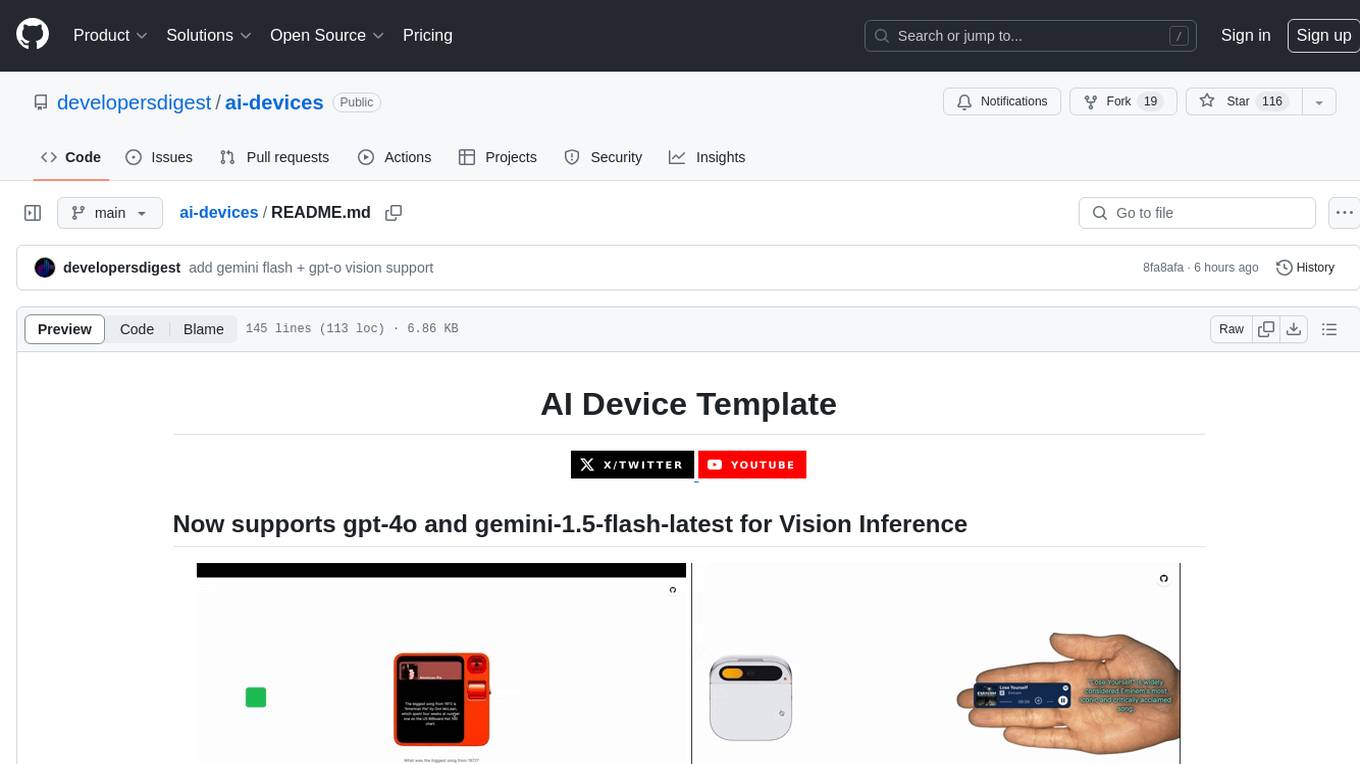
ai-devices
AI Devices Template is a project that serves as an AI-powered voice assistant utilizing various AI models and services to provide intelligent responses to user queries. It supports voice input, transcription, text-to-speech, image processing, and function calling with conditionally rendered UI components. The project includes customizable UI settings, optional rate limiting using Upstash, and optional tracing with Langchain's LangSmith for function execution. Users can clone the repository, install dependencies, add API keys, start the development server, and deploy the application. Configuration settings can be modified in `app/config.tsx` to adjust settings and configurations for the AI-powered voice assistant.
QA-Pilot
QA-Pilot is an interactive chat project that leverages online/local LLM for rapid understanding and navigation of GitHub code repository. It allows users to chat with GitHub public repositories using a git clone approach, store chat history, configure settings easily, manage multiple chat sessions, and quickly locate sessions with a search function. The tool integrates with `codegraph` to view Python files and supports various LLM models such as ollama, openai, mistralai, and localai. The project is continuously updated with new features and improvements, such as converting from `flask` to `fastapi`, adding `localai` API support, and upgrading dependencies like `langchain` and `Streamlit` to enhance performance.
autoflow
AutoFlow is an open source graph rag based knowledge base tool built on top of TiDB Vector and LlamaIndex and DSPy. It features a Perplexity-style Conversational Search page and an Embeddable JavaScript Snippet for easy integration into websites. The tool allows for comprehensive coverage and streamlined search processes through sitemap URL scraping.
telegram-summary-bot
Telegram group summary bot is a tool designed to help users manage large group chats on Telegram by summarizing and searching messages. It allows users to easily read and search through messages in groups with high message volume. The bot stores chat history in a database and provides features such as summarizing messages, searching for specific words, answering questions based on group chat, and checking bot status. Users can deploy their own instance of the bot to avoid limitations on message history and interactions with other bots. The tool is free to use and integrates with services like Cloudflare Workers and AI Gateway for enhanced functionality.
For similar jobs
llm-resource
llm-resource is a comprehensive collection of high-quality resources for Large Language Models (LLM). It covers various aspects of LLM including algorithms, training, fine-tuning, alignment, inference, data engineering, compression, evaluation, prompt engineering, AI frameworks, AI basics, AI infrastructure, AI compilers, LLM application development, LLM operations, AI systems, and practical implementations. The repository aims to gather and share valuable resources related to LLM for the community to benefit from.
LitServe
LitServe is a high-throughput serving engine designed for deploying AI models at scale. It generates an API endpoint for models, handles batching, streaming, and autoscaling across CPU/GPUs. LitServe is built for enterprise scale with a focus on minimal, hackable code-base without bloat. It supports various model types like LLMs, vision, time-series, and works with frameworks like PyTorch, JAX, Tensorflow, and more. The tool allows users to focus on model performance rather than serving boilerplate, providing full control and flexibility.
how-to-optim-algorithm-in-cuda
This repository documents how to optimize common algorithms based on CUDA. It includes subdirectories with code implementations for specific optimizations. The optimizations cover topics such as compiling PyTorch from source, NVIDIA's reduce optimization, OneFlow's elementwise template, fast atomic add for half data types, upsample nearest2d optimization in OneFlow, optimized indexing in PyTorch, OneFlow's softmax kernel, linear attention optimization, and more. The repository also includes learning resources related to deep learning frameworks, compilers, and optimization techniques.
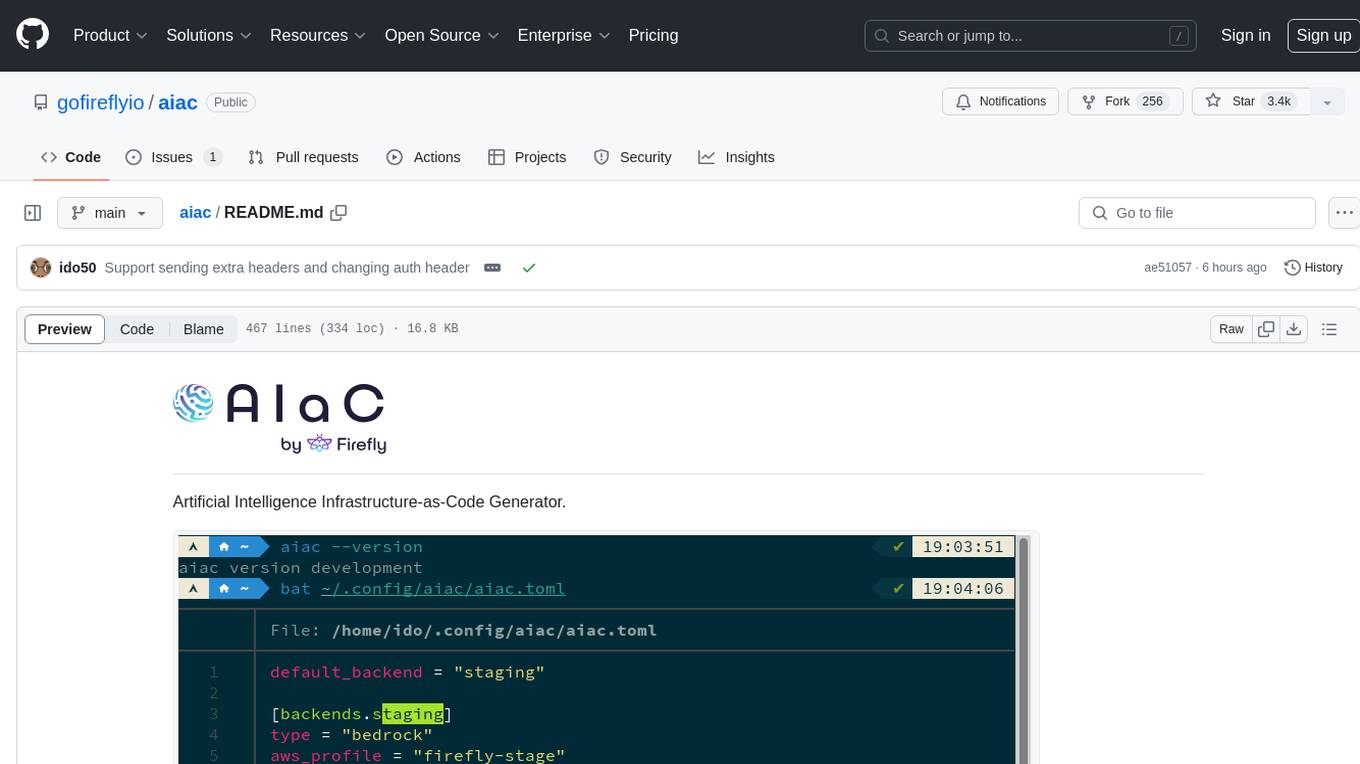
aiac
AIAC is a library and command line tool to generate Infrastructure as Code (IaC) templates, configurations, utilities, queries, and more via LLM providers such as OpenAI, Amazon Bedrock, and Ollama. Users can define multiple 'backends' targeting different LLM providers and environments using a simple configuration file. The tool allows users to ask a model to generate templates for different scenarios and composes an appropriate request to the selected provider, storing the resulting code to a file and/or printing it to standard output.
ENOVA
ENOVA is an open-source service for Large Language Model (LLM) deployment, monitoring, injection, and auto-scaling. It addresses challenges in deploying stable serverless LLM services on GPU clusters with auto-scaling by deconstructing the LLM service execution process and providing configuration recommendations and performance detection. Users can build and deploy LLM with few command lines, recommend optimal computing resources, experience LLM performance, observe operating status, achieve load balancing, and more. ENOVA ensures stable operation, cost-effectiveness, efficiency, and strong scalability of LLM services.
jina
Jina is a tool that allows users to build multimodal AI services and pipelines using cloud-native technologies. It provides a Pythonic experience for serving ML models and transitioning from local deployment to advanced orchestration frameworks like Docker-Compose, Kubernetes, or Jina AI Cloud. Users can build and serve models for any data type and deep learning framework, design high-performance services with easy scaling, serve LLM models while streaming their output, integrate with Docker containers via Executor Hub, and host on CPU/GPU using Jina AI Cloud. Jina also offers advanced orchestration and scaling capabilities, a smooth transition to the cloud, and easy scalability and concurrency features for applications. Users can deploy to their own cloud or system with Kubernetes and Docker Compose integration, and even deploy to JCloud for autoscaling and monitoring.
vidur
Vidur is a high-fidelity and extensible LLM inference simulator designed for capacity planning, deployment configuration optimization, testing new research ideas, and studying system performance of models under different workloads and configurations. It supports various models and devices, offers chrome trace exports, and can be set up using mamba, venv, or conda. Users can run the simulator with various parameters and monitor metrics using wandb. Contributions are welcome, subject to a Contributor License Agreement and adherence to the Microsoft Open Source Code of Conduct.
AI-System-School
AI System School is a curated list of research in machine learning systems, focusing on ML/DL infra, LLM infra, domain-specific infra, ML/LLM conferences, and general resources. It provides resources such as data processing, training systems, video systems, autoML systems, and more. The repository aims to help users navigate the landscape of AI systems and machine learning infrastructure, offering insights into conferences, surveys, books, videos, courses, and blogs related to the field.