


paddler
Open-source LLM load balancer and serving platform for self-hosting LLMs at scale 🏓🦙 Alternative to projects like llm-d, Docker Model Runner, etc but with less moving parts and simple deployments built around ggml ecosystem. Runs on CPU and GPU.
Stars: 1460
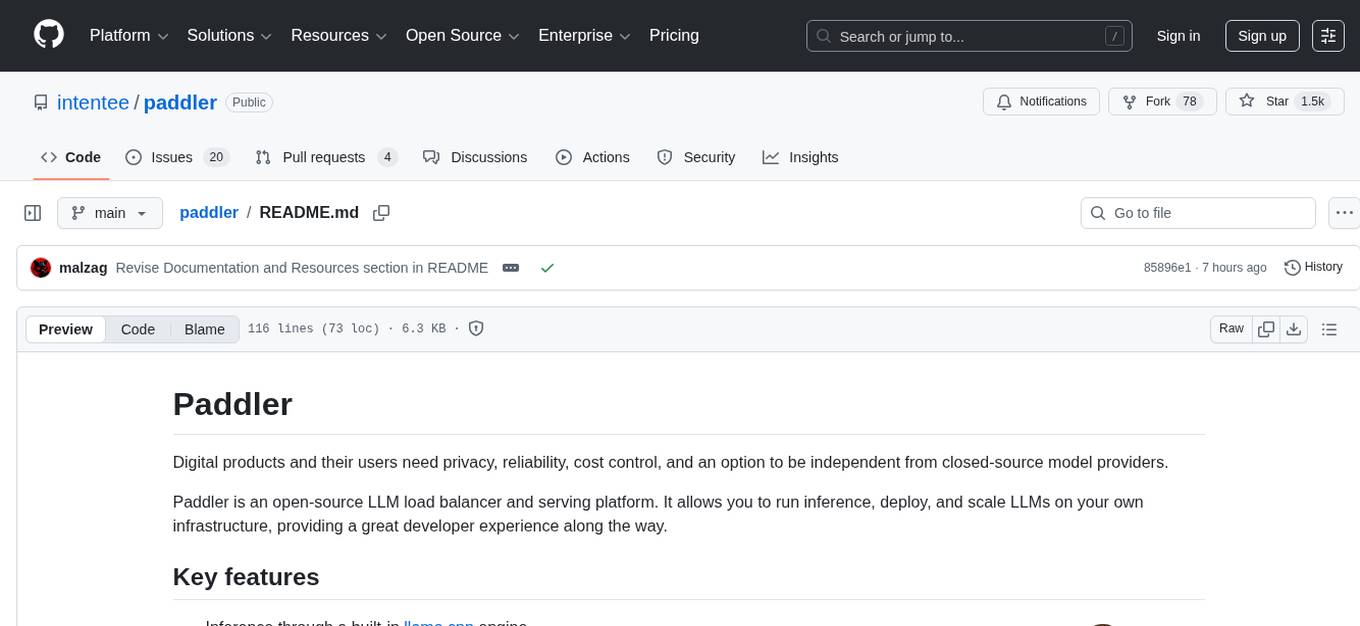
Paddler is an open-source LLM load balancer and serving platform designed for digital products and users who prioritize privacy, reliability, cost control, and independence from closed-source model providers. It allows running inference, deploying, and scaling LLMs on personal infrastructure, offering a seamless developer experience. Key features include inference through llama.cpp engine, LLM-specific load balancing, dynamic model swapping, request buffering, and built-in web admin panel for management and monitoring. Paddler is suitable for product teams needing LLM inference, DevOps/LLMOps teams deploying LLMs at scale, organizations handling sensitive data, and product leaders aiming for predictable LLM costs and reliable model performance.
README:
Digital products and their users need privacy, reliability, cost control, and an option to be independent from closed-source model providers.
Paddler is an open-source LLM load balancer and serving platform. It allows you to run inference, deploy, and scale LLMs on your own infrastructure, providing a great developer experience along the way.
- Inference through a built-in llama.cpp engine
- LLM-specific load balancing
- Works through agents that can be added dynamically, allowing integration with autoscaling tools
- Request buffering, enabling scaling from zero hosts
- Dynamic model swapping
- Built-in web admin panel for management, monitoring, and testing
- Observability metrics
- Product teams that need LLM inference and embeddings in their features
- DevOps/LLMOps teams that need to run and deploy LLMs at scale
- Organizations handling sensitive data with high compliance and privacy requirements (medical, financial, etc.)
- Organizations wanting to achieve predictable LLM costs instead of being exposed to per-token pricing
- Product leaders who need reliable model performance to maintain a consistent user experience of their AI-based features
Paddler is self-contained in a single binary file, so all you need to do to start using it is obtain the paddler binary and make it available in your system.
You can obtain the binary by:
- Option 1: Downloading the latest release from our GitHub releases
- Option 2: Or building Paddler from source (MSRV is 1.88.0)
Once you have made the binary available in your system, you can start using Paddler. The entire Paddler functionality is available through the paddler command (running paddler --help will list all available commands).
There are only two deployable components, the balancer (which distributes the incoming requests), and the agent (which generates tokens and embeddings through slots).
To start the balancer, run:
paddler balancer --inference-addr 127.0.0.1:8061 --management-addr 127.0.0.1:8060 --web-admin-panel-addr 127.0.0.1:8062The --web-admin-panel-addr flag is optional, but it will allow you to view your setup in a web browser.
And to start an agent with, for example, 4 slots, run:
paddler agent --management-addr 127.0.0.1:8060 --slots 4Read more about the installation and setting up a basic cluster.
- Visit our documentation page to install Paddler and get started with it.
- API documentation is also available.
- Video overview
- FOSEDM 2026 talk - From Infrastructure to Production: A Year of Self-Hosted LLMs.
For questions or community conversations, use GitHub issues with the question label or join our Discord server. All contributions are welcome.
Paddler is built for an easy setup. It comes as a self-contained binary with only two deployable components, the balancer and the agents.
The balancer exposes the following:
- Inference service (used by applications that connect to it to obtain tokens or embeddings)
- Management service, which manages the Paddler's setup internally
- Web admin panel that lets you view and test your Paddler setup
Agents are usually deployed on separate instances. They further distribute the incoming requests to slots, which are responsible for generating tokens and embeddings.
Paddler uses a built-in llama.cpp engine for inference, but has its own implementation of llama.cpp slots, which keep their own context and KV cache.
Paddler comes with a built-in web admin panel.
You can use it to monitor your Paddler fleet:
Add and update your model and customize the chat template and inference parameters:
And use a GUI to test the inference:
- Setup a basic LLM cluster
- Use Paddler's web admin panel
- Generate tokens and embeddings
- Use function calling
- Create a multi agent fleet
- Go beyond a single device
All code in the project is human-reviewed, and most is handcrafted. We have been experimenting with using AI to generate some code, and so far, we only had success with vibe-coding an HTTP client, that connects to the core library.
If you successfully generate something, you can submit it. We will still need to review it, so make sure you understand what you are doing.
You can try, though. :) We have even added AGENTS.md with some code style and other basic instructions.
We initially wanted to use Raft consensus algorithm (thus Paddler, because it paddles on a Raft), but eventually dropped that idea. The name stayed, though.
Later, people started sending us the "that's a paddlin'" clip from The Simpsons, and we just embraced it.
For Tasks:
Click tags to check more tools for each tasksFor Jobs:
Alternative AI tools for paddler
Similar Open Source Tools
paddler
Paddler is an open-source LLM load balancer and serving platform designed for digital products and users who prioritize privacy, reliability, cost control, and independence from closed-source model providers. It allows running inference, deploying, and scaling LLMs on personal infrastructure, offering a seamless developer experience. Key features include inference through llama.cpp engine, LLM-specific load balancing, dynamic model swapping, request buffering, and built-in web admin panel for management and monitoring. Paddler is suitable for product teams needing LLM inference, DevOps/LLMOps teams deploying LLMs at scale, organizations handling sensitive data, and product leaders aiming for predictable LLM costs and reliable model performance.
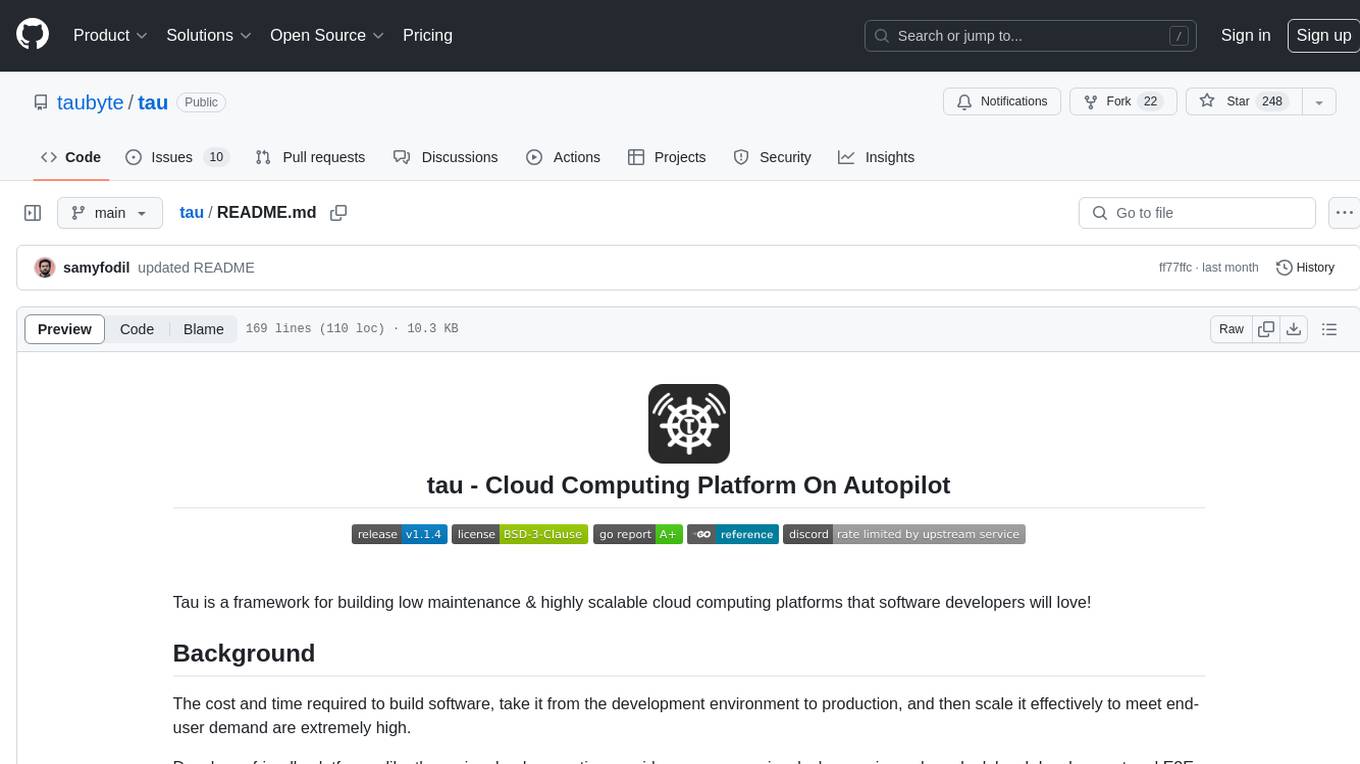
tau
Tau is a framework for building low maintenance & highly scalable cloud computing platforms that software developers will love. It aims to solve the high cost and time required to build, deploy, and scale software by providing a developer-friendly platform that offers autonomy and flexibility. Tau simplifies the process of building and maintaining a cloud computing platform, enabling developers to achieve 'Local Coding Equals Global Production' effortlessly. With features like auto-discovery, content-addressing, and support for WebAssembly, Tau empowers users to create serverless computing environments, host frontends, manage databases, and more. The platform also supports E2E testing and can be extended using a plugin system called orbit.
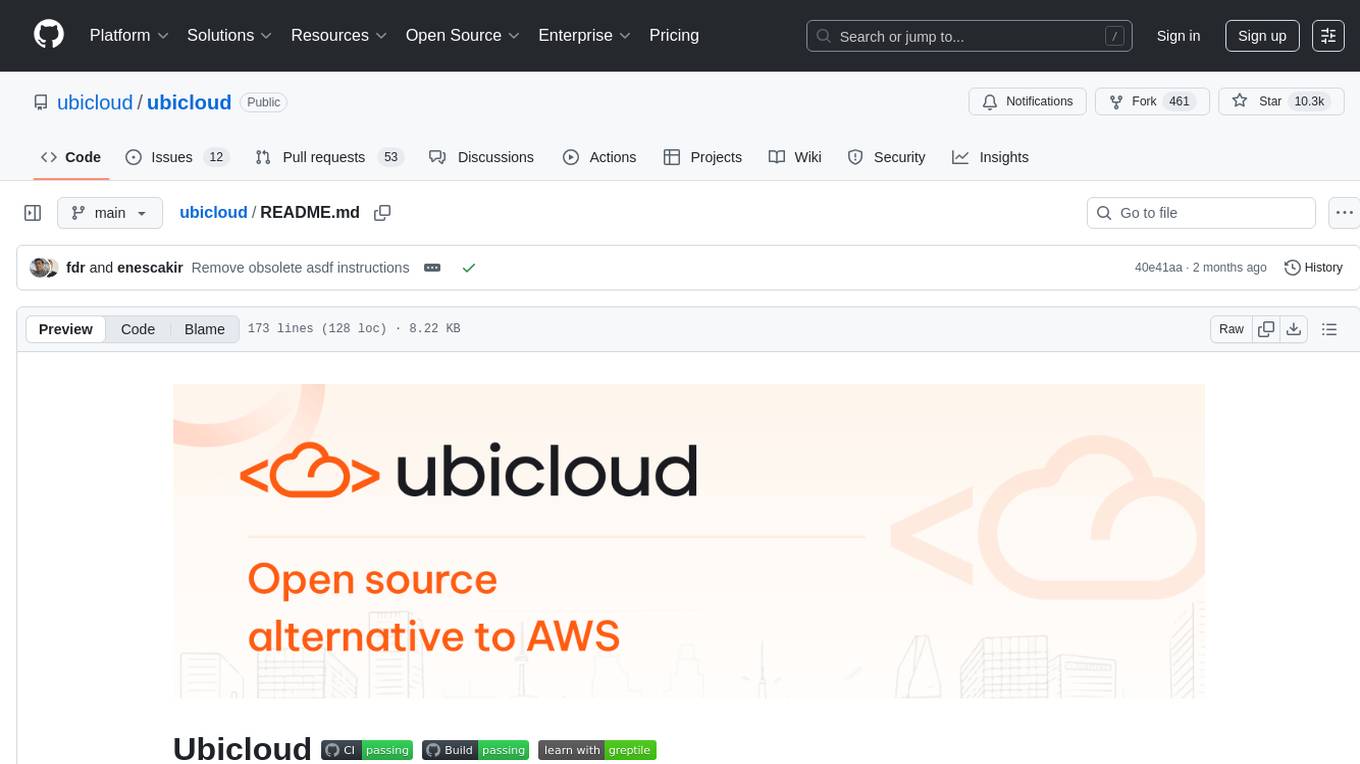
ubicloud
Ubicloud is an open source cloud platform that provides Infrastructure as a Service (IaaS) features on bare metal providers like Hetzner, Leaseweb, and AWS Bare Metal. Users can either set it up themselves on these providers or use the managed service offered by Ubicloud. The platform allows users to cloudify bare metal Linux machines, provision and manage cloud resources, and offers an open source alternative to traditional cloud providers, reducing costs and returning control of infrastructure to the users.
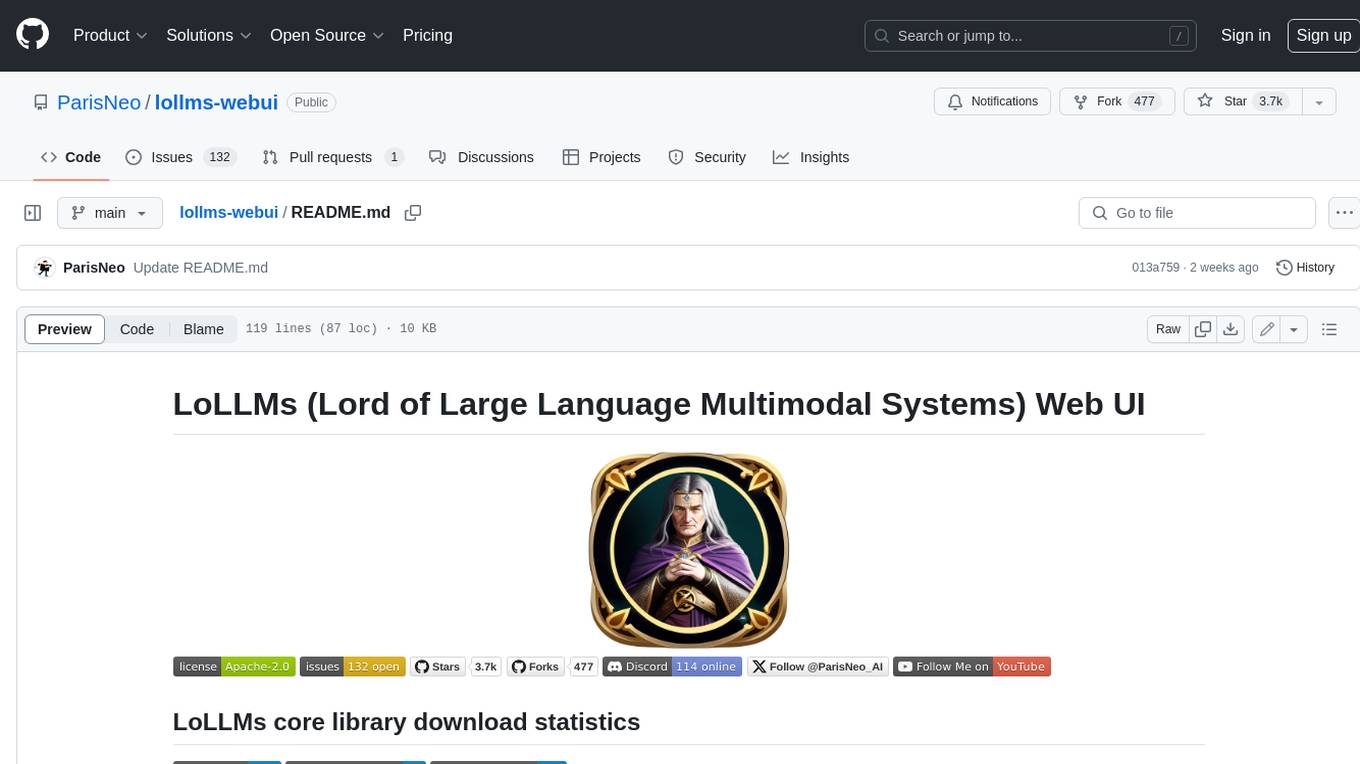
lollms-webui
LoLLMs WebUI (Lord of Large Language Multimodal Systems: One tool to rule them all) is a user-friendly interface to access and utilize various LLM (Large Language Models) and other AI models for a wide range of tasks. With over 500 AI expert conditionings across diverse domains and more than 2500 fine tuned models over multiple domains, LoLLMs WebUI provides an immediate resource for any problem, from car repair to coding assistance, legal matters, medical diagnosis, entertainment, and more. The easy-to-use UI with light and dark mode options, integration with GitHub repository, support for different personalities, and features like thumb up/down rating, copy, edit, and remove messages, local database storage, search, export, and delete multiple discussions, make LoLLMs WebUI a powerful and versatile tool.
lumigator
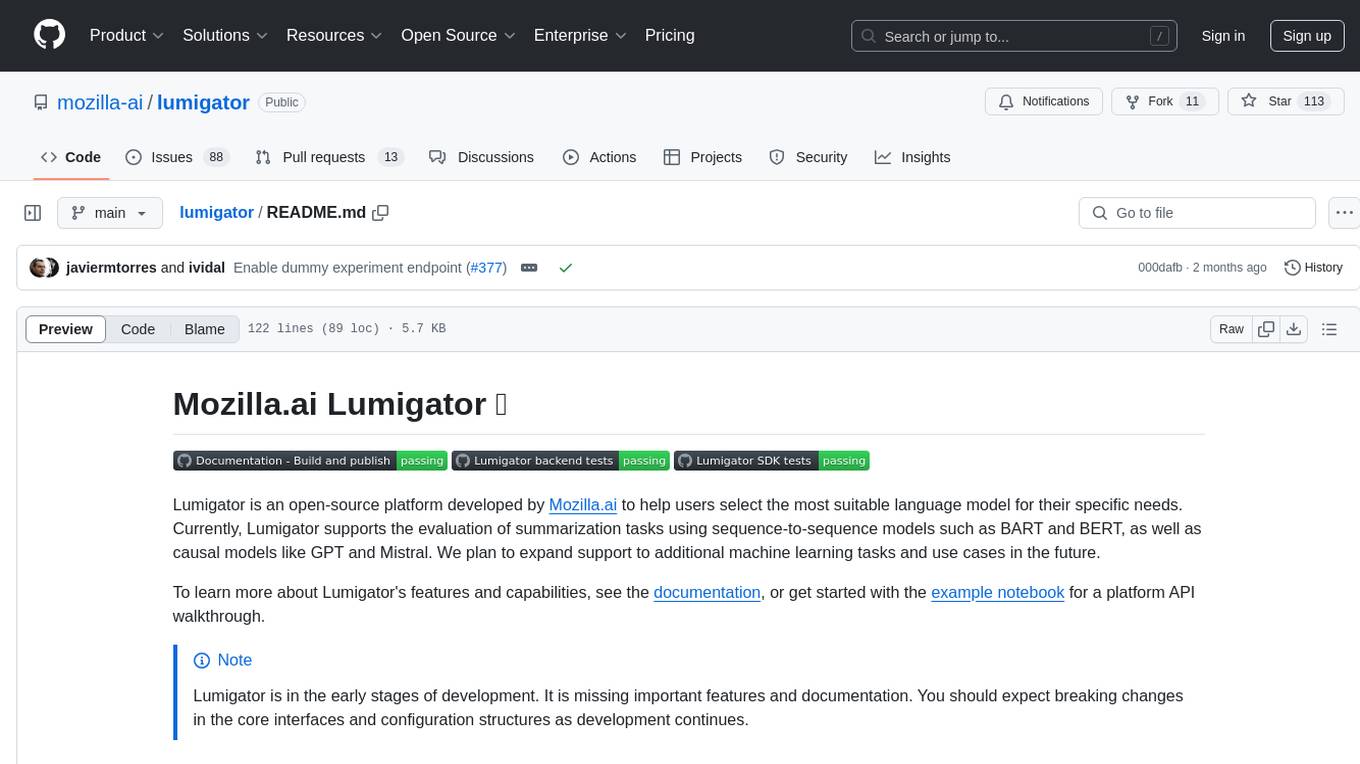
Lumigator is an open-source platform developed by Mozilla.ai to help users select the most suitable language model for their specific needs. It supports the evaluation of summarization tasks using sequence-to-sequence models such as BART and BERT, as well as causal models like GPT and Mistral. The platform aims to make model selection transparent, efficient, and empowering by providing a framework for comparing LLMs using task-specific metrics to evaluate how well a model fits a project's needs. Lumigator is in the early stages of development and plans to expand support to additional machine learning tasks and use cases in the future.
Heat
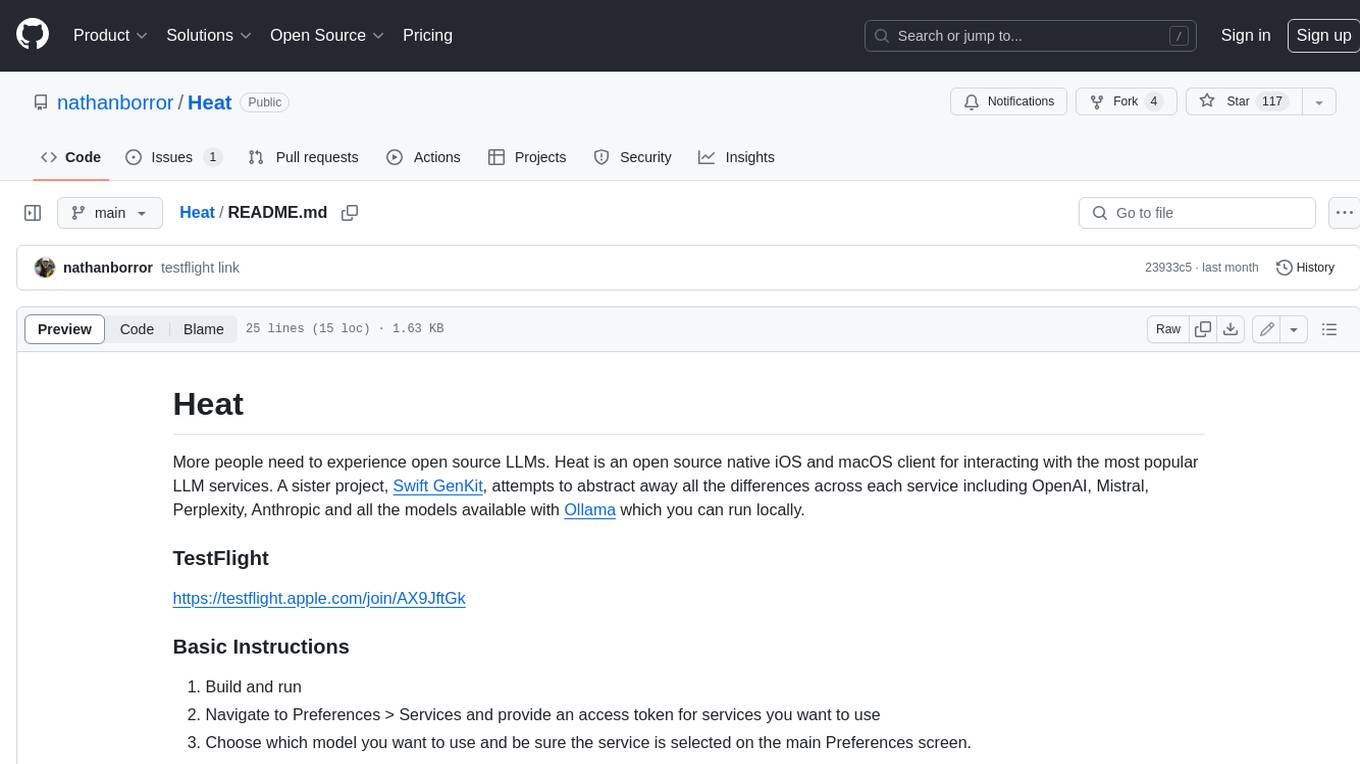
Heat is an open source native iOS and macOS client for interacting with the most popular LLM services. A sister project, Swift GenKit, attempts to abstract away all the differences across each service including OpenAI, Mistral, Perplexity, Anthropic and all the models available with Ollama which you can run locally.
morphik-core
Morphik is an AI-native toolset designed to help developers integrate context into their AI applications by providing tools to store, represent, and search unstructured data. It offers features such as multimodal search, fast metadata extraction, and integrations with existing tools. Morphik aims to address the challenges of traditional AI approaches that struggle with visually rich documents and provide a more comprehensive solution for understanding and processing complex data.
autoMate
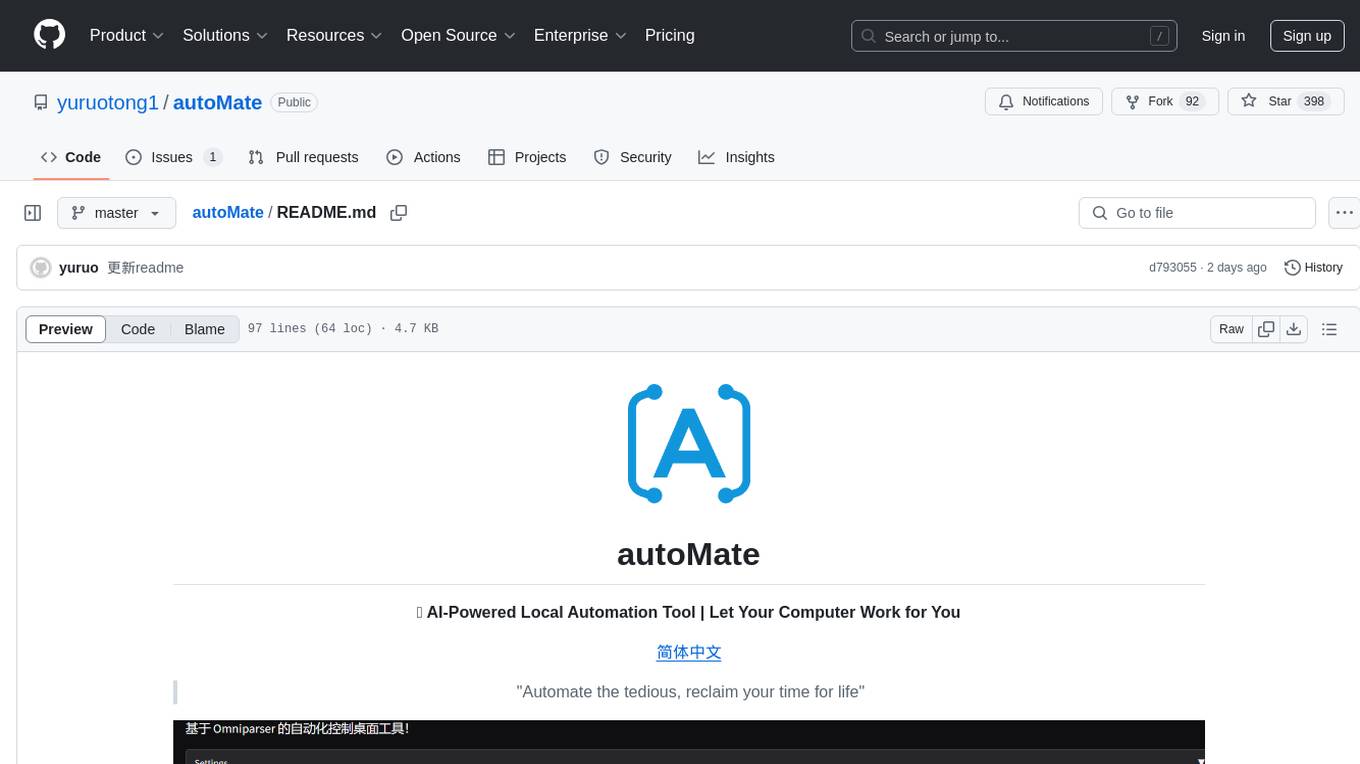
autoMate is an AI-powered local automation tool designed to help users automate repetitive tasks and reclaim their time. It leverages AI and RPA technology to operate computer interfaces, understand screen content, make autonomous decisions, and support local deployment for data security. With natural language task descriptions, users can easily automate complex workflows without the need for programming knowledge. The tool aims to transform work by freeing users from mundane activities and allowing them to focus on tasks that truly create value, enhancing efficiency and liberating creativity.
wandb
Weights & Biases (W&B) is a platform that helps users build better machine learning models faster by tracking and visualizing all components of the machine learning pipeline, from datasets to production models. It offers tools for tracking, debugging, evaluating, and monitoring machine learning applications. W&B provides integrations with popular frameworks like PyTorch, TensorFlow/Keras, Hugging Face Transformers, PyTorch Lightning, XGBoost, and Sci-Kit Learn. Users can easily log metrics, visualize performance, and compare experiments using W&B. The platform also supports hosting options in the cloud or on private infrastructure, making it versatile for various deployment needs.
materialize
Materialize is a real-time data integration platform that creates and continually updates consistent views of transactional data from across your organization. Its SQL interface democratizes the ability to serve and access live data. Materialize can be deployed anywhere your infrastructure runs. Use Materialize to deliver fresh context for AI/RAG pipelines, power operational dashboards, and create more dynamic customer experiences without building time-consuming custom data pipelines. Materialize focuses on providing correct and consistent answers with minimal latency, and does not ask you to accept either approximate answers or eventual consistency. Materialize answers a query with the correct result on a specific version of your data. Materialize recasts SQL queries as dataflows, which can react efficiently to changes in your data as they happen. Materialize supports a large fraction of PostgreSQL features and is actively expanding support for more built-in PostgreSQL functions. Materialize can read data directly from PostgreSQL or MySQL replication stream, from Kafka, or from SaaS applications via webhooks. Once data is in, define views and perform reads via the PostgreSQL protocol. Materialize supports a comprehensive variety of SQL features, all using the PostgreSQL dialect and protocol. Materialize can incrementally maintain views in the presence of arbitrary inserts, updates, and deletes. Materialize supports recursion that enables incrementally updating tree and graph structures. Materialize is primarily written in Rust.
motleycrew
Motleycrew is an ultimate framework for building multi-agent AI systems, allowing users to mix and match AI agents and tools from popular frameworks, design advanced workflows, and leverage dynamic knowledge graphs with simplicity and elegance. It acts as a conductor orchestrating a symphony of AI agents and tools, providing building blocks for creating AI systems and enabling users to focus on high-level design while taking care of the rest. The framework offers integration with various tools, flexibility in providing agents with tools or other agents, advanced flow design capabilities, and built-in observability and caching features.
council
Council is an open-source platform designed for the rapid development and deployment of customized generative AI applications using teams of agents. It extends the LLM tool ecosystem by providing advanced control flow and scalable oversight for AI agents. Users can create sophisticated agents with predictable behavior by leveraging Council's powerful approach to control flow using Controllers, Filters, Evaluators, and Budgets. The framework allows for automated routing between agents, comparing, evaluating, and selecting the best results for a task. Council aims to facilitate packaging and deploying agents at scale on multiple platforms while enabling enterprise-grade monitoring and quality control.
AIlice
AIlice is a fully autonomous, general-purpose AI agent that aims to create a standalone artificial intelligence assistant, similar to JARVIS, based on the open-source LLM. AIlice achieves this goal by building a "text computer" that uses a Large Language Model (LLM) as its core processor. Currently, AIlice demonstrates proficiency in a range of tasks, including thematic research, coding, system management, literature reviews, and complex hybrid tasks that go beyond these basic capabilities. AIlice has reached near-perfect performance in everyday tasks using GPT-4 and is making strides towards practical application with the latest open-source models. We will ultimately achieve self-evolution of AI agents. That is, AI agents will autonomously build their own feature expansions and new types of agents, unleashing LLM's knowledge and reasoning capabilities into the real world seamlessly.
Robyn
Robyn is an experimental, semi-automated and open-sourced Marketing Mix Modeling (MMM) package from Meta Marketing Science. It uses various machine learning techniques to define media channel efficiency and effectivity, explore adstock rates and saturation curves. Built for granular datasets with many independent variables, especially suitable for digital and direct response advertisers with rich data sources. Aiming to democratize MMM, make it accessible for advertisers of all sizes, and contribute to the measurement landscape.
magic
Magic Cloud is a software development automation platform based on AI, Low-Code, and No-Code. It allows dynamic code creation and orchestration using Hyperlambda, generative AI, and meta programming. The platform includes features like CRUD generation, No-Code AI, Hyperlambda programming language, AI agents creation, and various components for software development. Magic is suitable for backend development, AI-related tasks, and creating AI chatbots. It offers high-level programming capabilities, productivity gains, and reduced technical debt.
engine-core
Engine Core is a project that demonstrates a pattern for enabling Large Language Models (LLMs) to undertake tasks with a dynamic system prompt and a collection of tool functions known as chat strategies. These strategies allow for the dynamic alteration of chat history, system prompts, and available tools on every run. The project includes example strategies such as demoStrategy, backendStrategy, and shellStrategy. Additionally, LLM integrations like Anthropic or OpenAI have been extracted into adapters to enable running the same app code and strategies while switching foundation models.
For similar tasks
ai-gateway
LangDB AI Gateway is an open-source enterprise AI gateway built in Rust. It provides a unified interface to all LLMs using the OpenAI API format, focusing on high performance, enterprise readiness, and data control. The gateway offers features like comprehensive usage analytics, cost tracking, rate limiting, data ownership, and detailed logging. It supports various LLM providers and provides OpenAI-compatible endpoints for chat completions, model listing, embeddings generation, and image generation. Users can configure advanced settings, such as rate limiting, cost control, dynamic model routing, and observability with OpenTelemetry tracing. The gateway can be run with Docker Compose and integrated with MCP tools for server communication.
devopness
Devopness is a tool that simplifies the management of cloud applications and multi-cloud infrastructure for both AI agents and humans. It provides role-based access control, permission management, cost control, and visibility into DevOps and CI/CD workflows. The tool allows provisioning and deployment to major cloud providers like AWS, Azure, DigitalOcean, and GCP. Devopness aims to make software deployment and cloud infrastructure management accessible and affordable to all involved in software projects.
llamafarm
LlamaFarm is a comprehensive AI framework that empowers users to build powerful AI applications locally, with full control over costs and deployment options. It provides modular components for RAG systems, vector databases, model management, prompt engineering, and fine-tuning. Users can create differentiated AI products without needing extensive ML expertise, using simple CLI commands and YAML configs. The framework supports local-first development, production-ready components, strategy-based configuration, and deployment anywhere from laptops to the cloud.
huf
HUF is an AI-native engine designed to centralize intelligence and execution into a single engine, enabling AI to operate inside real business systems. It offers multi-provider AI connectivity, intelligent tools, knowledge grounding, event-driven execution, visual workflow builder, full auditability, and cost control. HUF can be used as AI infrastructure for products, internal intelligence platform, automation & orchestration engine, embedded AI layer for SaaS, and enterprise AI control plane. Core capabilities include agent system, knowledge management, trigger system, visual flow builder, and observability. The tech stack includes Frappe Framework, Python 3.10+, LiteLLM, SQLite FTS5, React 18, TypeScript, Tailwind CSS, and MariaDB.
paddler
Paddler is an open-source LLM load balancer and serving platform designed for digital products and users who prioritize privacy, reliability, cost control, and independence from closed-source model providers. It allows running inference, deploying, and scaling LLMs on personal infrastructure, offering a seamless developer experience. Key features include inference through llama.cpp engine, LLM-specific load balancing, dynamic model swapping, request buffering, and built-in web admin panel for management and monitoring. Paddler is suitable for product teams needing LLM inference, DevOps/LLMOps teams deploying LLMs at scale, organizations handling sensitive data, and product leaders aiming for predictable LLM costs and reliable model performance.
ai-on-gke
This repository contains assets related to AI/ML workloads on Google Kubernetes Engine (GKE). Run optimized AI/ML workloads with Google Kubernetes Engine (GKE) platform orchestration capabilities. A robust AI/ML platform considers the following layers: Infrastructure orchestration that support GPUs and TPUs for training and serving workloads at scale Flexible integration with distributed computing and data processing frameworks Support for multiple teams on the same infrastructure to maximize utilization of resources
ray
Ray is a unified framework for scaling AI and Python applications. It consists of a core distributed runtime and a set of AI libraries for simplifying ML compute, including Data, Train, Tune, RLlib, and Serve. Ray runs on any machine, cluster, cloud provider, and Kubernetes, and features a growing ecosystem of community integrations. With Ray, you can seamlessly scale the same code from a laptop to a cluster, making it easy to meet the compute-intensive demands of modern ML workloads.
labelbox-python
Labelbox is a data-centric AI platform for enterprises to develop, optimize, and use AI to solve problems and power new products and services. Enterprises use Labelbox to curate data, generate high-quality human feedback data for computer vision and LLMs, evaluate model performance, and automate tasks by combining AI and human-centric workflows. The academic & research community uses Labelbox for cutting-edge AI research.
For similar jobs
llm-resource
llm-resource is a comprehensive collection of high-quality resources for Large Language Models (LLM). It covers various aspects of LLM including algorithms, training, fine-tuning, alignment, inference, data engineering, compression, evaluation, prompt engineering, AI frameworks, AI basics, AI infrastructure, AI compilers, LLM application development, LLM operations, AI systems, and practical implementations. The repository aims to gather and share valuable resources related to LLM for the community to benefit from.
LitServe
LitServe is a high-throughput serving engine designed for deploying AI models at scale. It generates an API endpoint for models, handles batching, streaming, and autoscaling across CPU/GPUs. LitServe is built for enterprise scale with a focus on minimal, hackable code-base without bloat. It supports various model types like LLMs, vision, time-series, and works with frameworks like PyTorch, JAX, Tensorflow, and more. The tool allows users to focus on model performance rather than serving boilerplate, providing full control and flexibility.
how-to-optim-algorithm-in-cuda
This repository documents how to optimize common algorithms based on CUDA. It includes subdirectories with code implementations for specific optimizations. The optimizations cover topics such as compiling PyTorch from source, NVIDIA's reduce optimization, OneFlow's elementwise template, fast atomic add for half data types, upsample nearest2d optimization in OneFlow, optimized indexing in PyTorch, OneFlow's softmax kernel, linear attention optimization, and more. The repository also includes learning resources related to deep learning frameworks, compilers, and optimization techniques.
aiac
AIAC is a library and command line tool to generate Infrastructure as Code (IaC) templates, configurations, utilities, queries, and more via LLM providers such as OpenAI, Amazon Bedrock, and Ollama. Users can define multiple 'backends' targeting different LLM providers and environments using a simple configuration file. The tool allows users to ask a model to generate templates for different scenarios and composes an appropriate request to the selected provider, storing the resulting code to a file and/or printing it to standard output.
ENOVA
ENOVA is an open-source service for Large Language Model (LLM) deployment, monitoring, injection, and auto-scaling. It addresses challenges in deploying stable serverless LLM services on GPU clusters with auto-scaling by deconstructing the LLM service execution process and providing configuration recommendations and performance detection. Users can build and deploy LLM with few command lines, recommend optimal computing resources, experience LLM performance, observe operating status, achieve load balancing, and more. ENOVA ensures stable operation, cost-effectiveness, efficiency, and strong scalability of LLM services.
jina
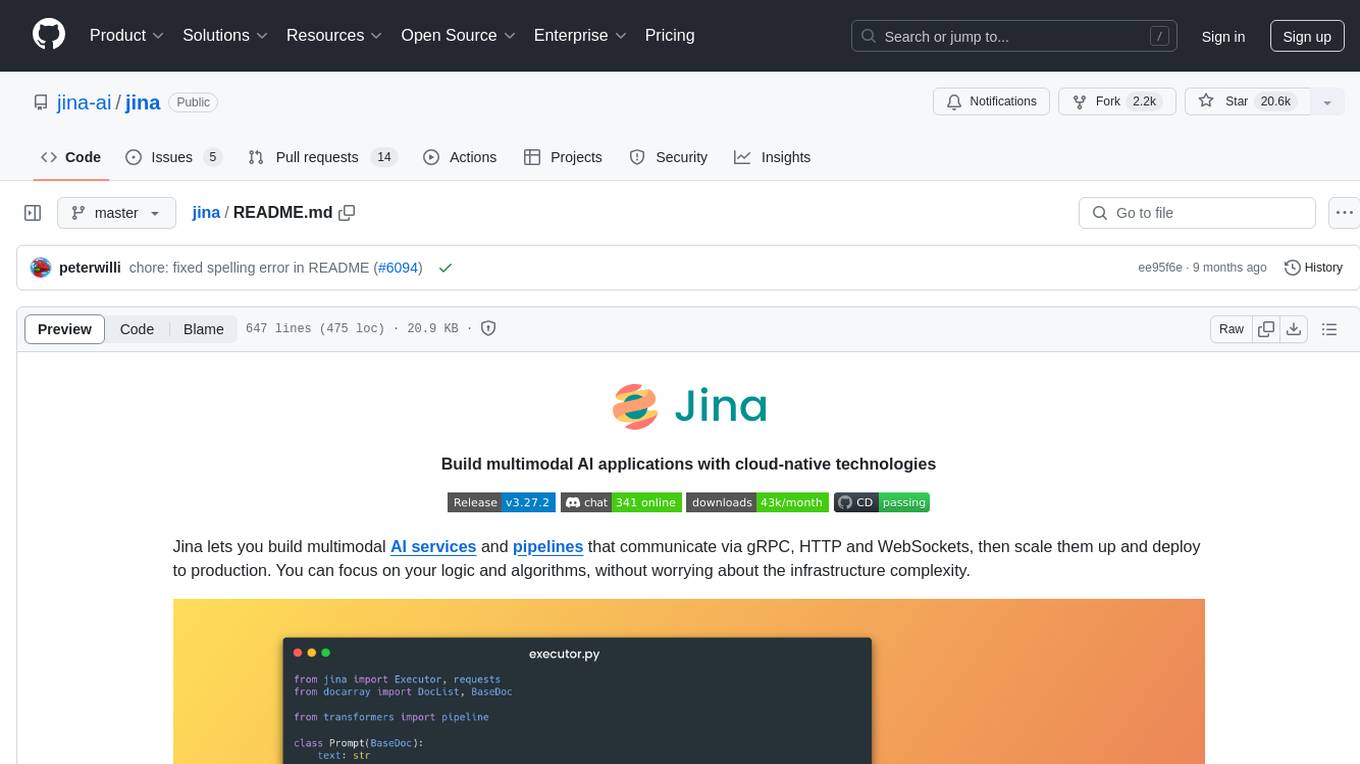
Jina is a tool that allows users to build multimodal AI services and pipelines using cloud-native technologies. It provides a Pythonic experience for serving ML models and transitioning from local deployment to advanced orchestration frameworks like Docker-Compose, Kubernetes, or Jina AI Cloud. Users can build and serve models for any data type and deep learning framework, design high-performance services with easy scaling, serve LLM models while streaming their output, integrate with Docker containers via Executor Hub, and host on CPU/GPU using Jina AI Cloud. Jina also offers advanced orchestration and scaling capabilities, a smooth transition to the cloud, and easy scalability and concurrency features for applications. Users can deploy to their own cloud or system with Kubernetes and Docker Compose integration, and even deploy to JCloud for autoscaling and monitoring.
vidur
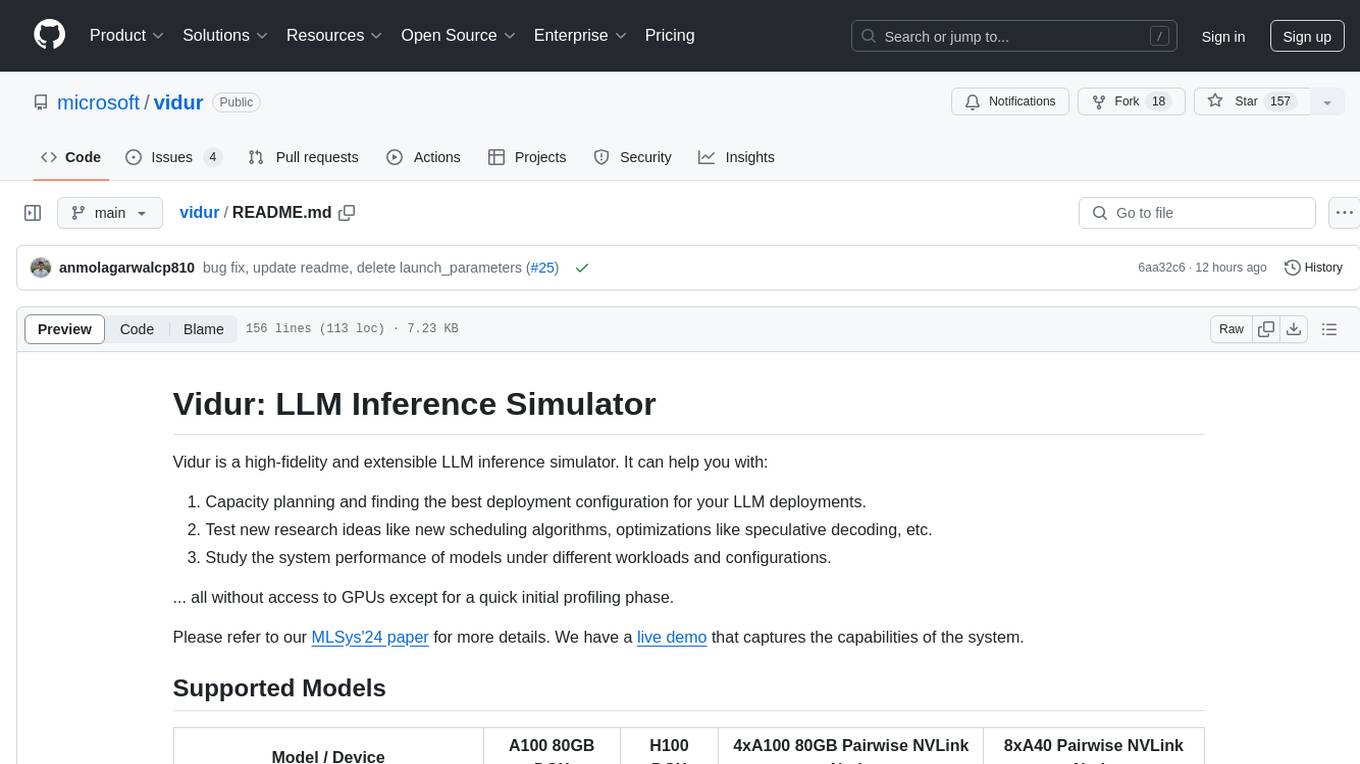
Vidur is a high-fidelity and extensible LLM inference simulator designed for capacity planning, deployment configuration optimization, testing new research ideas, and studying system performance of models under different workloads and configurations. It supports various models and devices, offers chrome trace exports, and can be set up using mamba, venv, or conda. Users can run the simulator with various parameters and monitor metrics using wandb. Contributions are welcome, subject to a Contributor License Agreement and adherence to the Microsoft Open Source Code of Conduct.
AI-System-School
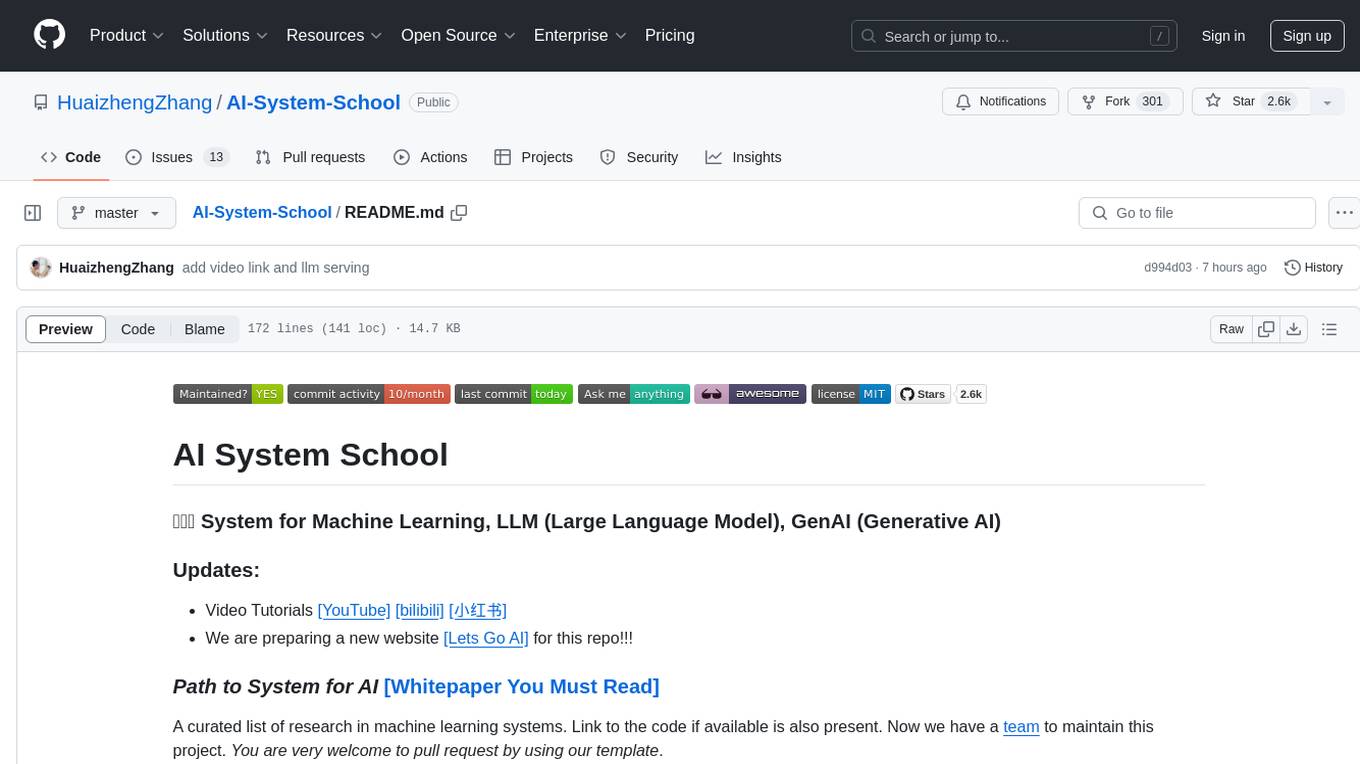
AI System School is a curated list of research in machine learning systems, focusing on ML/DL infra, LLM infra, domain-specific infra, ML/LLM conferences, and general resources. It provides resources such as data processing, training systems, video systems, autoML systems, and more. The repository aims to help users navigate the landscape of AI systems and machine learning infrastructure, offering insights into conferences, surveys, books, videos, courses, and blogs related to the field.