


ai-deadlines
⏰ AI conference deadline countdowns
Stars: 233
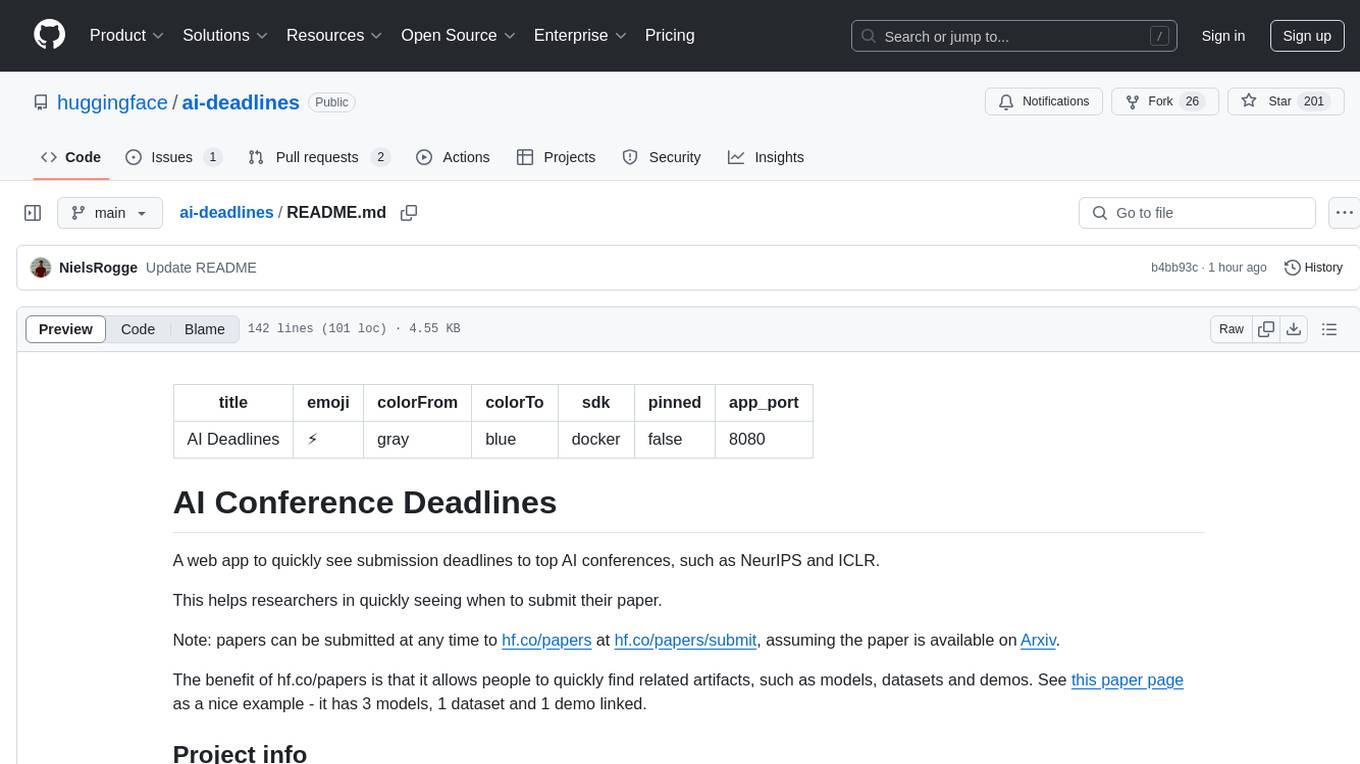
AI Deadlines is a web app that displays submission deadlines for top AI conferences like NeurIPS and ICLR. It helps researchers know when to submit their papers. The data is fetched from a GitHub repository and updated automatically using a CRON job. The project is based on an existing repository and features a new UI. Users can contribute by updating conference deadlines in the provided YAML file. The app can be run locally with Node.js and npm or deployed using Docker. It is built with Vite, TypeScript, React, shadcn-ui, and Tailwind CSS. The project is licensed under MIT.
README:
A web app to quickly see submission deadlines to top AI conferences, such as NeurIPS and ICLR.
This helps researchers in quickly seeing when to submit their paper.
Note: papers can be submitted at any time to hf.co/papers at hf.co/papers/submit, assuming the paper is available on Arxiv.
The benefit of hf.co/papers is that it allows people to quickly find related artifacts, such as models, datasets and demos. See this paper page as a nice example - it has 3 models, 1 dataset and 1 demo linked.
This project is entirely based on the awesome https://github.com/paperswithcode/ai-deadlines. As that repository is no longer maintained, we decided to make an up-to-date version along with a new UI. It was bootstrapped using Lovable and Cursor.
New data is fetched from https://github.com/ccfddl/ccf-deadlines/tree/main/conference/AI thanks to this comment.
A CRON job (set up as a Github action) automatically updates the data present at src/data/conferences.yml.
URL: https://huggingface.co/spaces/huggingface/ai-deadlines
Contributions are very welcome!
To keep things minimal, we mainly focus on top-tier conferences in AI.
To add or update a deadline:
- Fork the repository
- Update src/data/conferences.yml
- Make sure it has the
title,year,id,link,deadline,timezone,date,city,country,tagsattributes- See available timezone strings here.
- Optionally add a
venue,noteandabstract_deadlinein case this info is known - Optionally add
hindex(refers to h5-index from here) - Example:
- title: BestConf
  year: 2022
  id: bestconf22  # title as lower case + last two digits of year
  full_name: Best Conference for Anything  # full conference name
  link: link-to-website.com
  deadline: YYYY-MM-DD HH:SS
  abstract_deadline: YYYY-MM-DD HH:SS
  timezone: Asia/Seoul
  city: Incheon
  country: South Korea
  venue: Incheon Conference Centre, South Korea
  date: September, 18-22, 2022
  start: YYYY-MM-DD
  end: YYYY-MM-DD
  paperslink: link-to-full-paper-list.com
  pwclink: link-to-papers-with-code.com
  hindex: 100.0
  tags:
  - machine learning
  note: Important
- Send a pull request to update src/data/conferences.yml.
If you want to work locally using your own IDE, you can clone this repo and push changes.
The only requirement is having Node.js & npm installed - install with nvm
Follow these steps:
# Step 1: Clone the repository using the project's Git URL.
git clone https://github.com/huggingface/ai-deadlines

# Step 2: Navigate to the project directory.
cd ai-deadlines

# Step 3: Install the necessary dependencies.
npm i

# Step 4: Start the development server with auto-reloading and an instant preview.
npm run dev
This runs the app at http://localhost:8080/.
First build the Docker image as follows:
docker build -t ai-deadlines .Next it can be run as follows:
docker run -it -p 8080:8080 ai-deadlinesYou can see it in your web browser at http://localhost:8080/.
One way to deploy this on a cloud is by using Artifact Registry (for hosting the Docker image) and Cloud Run (a serverless service by Google to run Docker containers). See this YouTube video for a nice intro.
Make sure to:
- create a Google Cloud project
- set up a billing account
- have the gcloud SDK installed.
To deploy, simply run:
gcloud auth login
gcloud auth application-default login
gcloud run deploy --source .This project is built with:
- Vite
- TypeScript
- React
- shadcn-ui
- Tailwind CSS
This project is licensed under MIT.
Feel free to just open an issue. Otherwise contact @nielsrogge
For Tasks:
Click tags to check more tools for each tasksFor Jobs:
Alternative AI tools for ai-deadlines
Similar Open Source Tools
ai-deadlines
AI Deadlines is a web app that displays submission deadlines for top AI conferences like NeurIPS and ICLR. It helps researchers know when to submit their papers. The data is fetched from a GitHub repository and updated automatically using a CRON job. The project is based on an existing repository and features a new UI. Users can contribute by updating conference deadlines in the provided YAML file. The app can be run locally with Node.js and npm or deployed using Docker. It is built with Vite, TypeScript, React, shadcn-ui, and Tailwind CSS. The project is licensed under MIT.
PrAIvateSearch
PrAIvateSearch is a NextJS web application that aims to implement similar features to SearchGPT in an open-source, local, and private way. It allows users to search the web using their own AI model. The application provides a user-friendly interface for interacting with the AI model and accessing search results. PrAIvateSearch is designed to be easy to install and use, with detailed instructions provided in the readme file. The project is in beta stage and welcomes contributions from the community to improve and enhance its functionality. Users are encouraged to support the project through funding to help it grow and continue to be maintained as an open-source tool under the MIT license.
1backend
1Backend is a flexible and scalable platform designed for running AI models on private servers and handling high-concurrency workloads. It provides a ChatGPT-like interface for users and a network-accessible API for machines, serving as a general-purpose backend framework. The platform offers on-premise ChatGPT alternatives, a microservices-first web framework, out-of-the-box services like file uploads and user management, infrastructure simplification acting as a container orchestrator, reverse proxy, multi-database support with its own ORM, and AI integration with platforms like LlamaCpp and StableDiffusion.
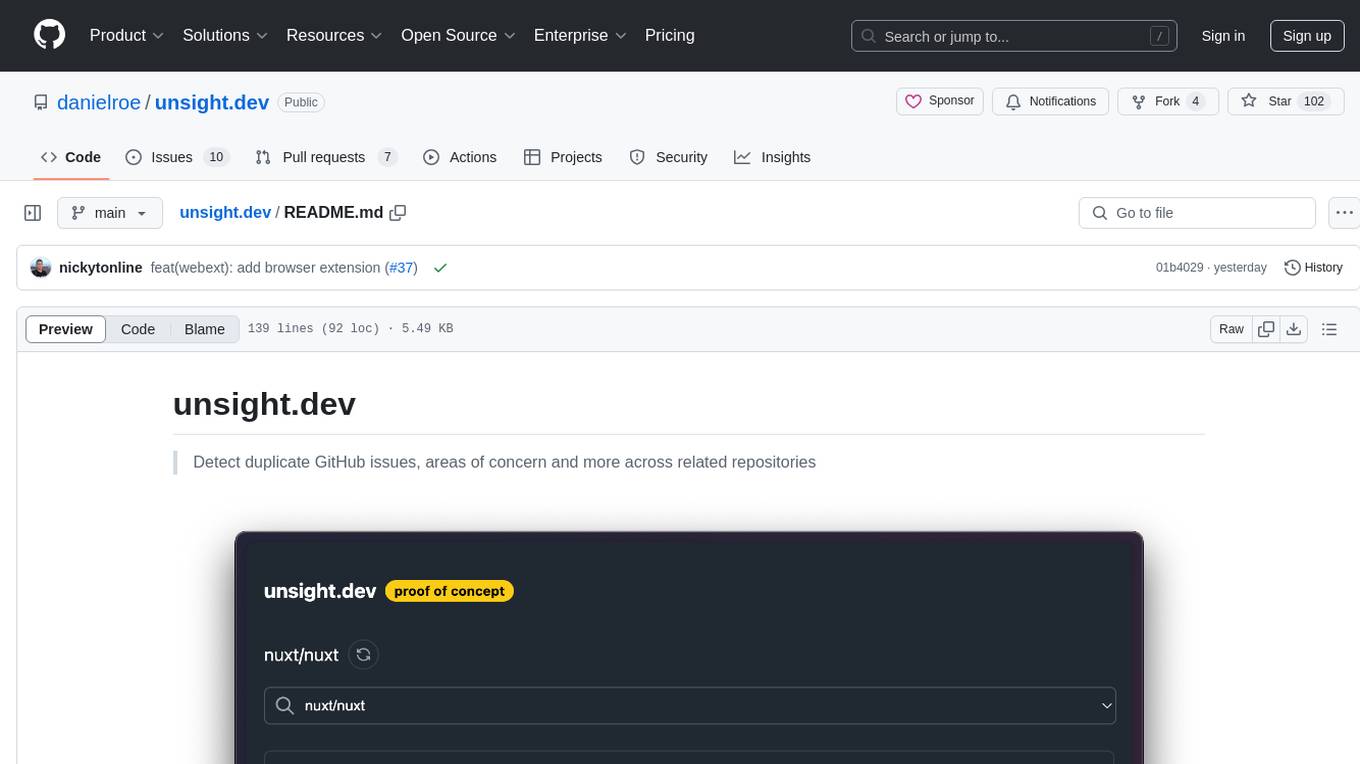
unsight.dev
unsight.dev is a tool built on Nuxt that helps detect duplicate GitHub issues and areas of concern across related repositories. It utilizes Nitro server API routes, GitHub API, and a GitHub App, along with UnoCSS. The tool is deployed on Cloudflare with NuxtHub, using Workers AI, Workers KV, and Vectorize. It also offers a browser extension soon to be released. Users can try the app locally for tweaking the UI and setting up a full development environment as a GitHub App.
buildware-ai
Buildware is a tool designed to help developers accelerate their code shipping process by leveraging AI technology. Users can build a code instruction system, submit an issue, and receive an AI-generated pull request. The tool is created by Mckay Wrigley and Tyler Bruno at Takeoff AI. Buildware offers a simple setup process involving cloning the repository, installing dependencies, setting up environment variables, configuring a database, and obtaining a GitHub Personal Access Token (PAT). The tool is currently being updated to include advanced features such as Linear integration, local codebase mode, and team support.
qrev
QRev is an open-source alternative to Salesforce, offering AI agents to scale sales organizations infinitely. It aims to provide digital workers for various sales roles or a superagent named Qai. The tech stack includes TypeScript for frontend, NodeJS for backend, MongoDB for app server database, ChromaDB for vector database, SQLite for AI server SQL relational database, and Langchain for LLM tooling. The tool allows users to run client app, app server, and AI server components. It requires Node.js and MongoDB to be installed, and provides detailed setup instructions in the README file.
Kuebiko
Kuebiko is a Twitch Chat Bot that reads twitch chat and generates text-to-speech responses using Google Cloud API and OpenAI's GPT-3 text completion model. It allows users to set up their own VTuber AI similar to 'Neuro-Sama'. The project is built with Python and requires setting up various API keys and configurations to enable the bot functionality. Users can customize the voice of their VTuber and route audio using VBAudio Cable. Kuebiko provides a unique way to interact with viewers through chat responses and captions in OBS.
verifAI
VerifAI is a document-based question-answering system that addresses hallucinations in generative large language models and search engines. It retrieves relevant documents, generates answers with references, and verifies answers for accuracy. The engine uses generative search technology and a verification model to ensure no misinformation. VerifAI supports various document formats and offers user registration with a React.js interface. It is open-source and designed to be user-friendly, making it accessible for anyone to use.
CyberScraper-2077
CyberScraper 2077 is an advanced web scraping tool powered by AI, designed to extract data from websites with precision and style. It offers a user-friendly interface, supports multiple data export formats, operates in stealth mode to avoid detection, and promises lightning-fast scraping. The tool respects ethical scraping practices, including robots.txt and site policies. With upcoming features like proxy support and page navigation, CyberScraper 2077 is a futuristic solution for data extraction in the digital realm.
openorch
OpenOrch is a daemon that transforms servers into a powerful development environment, running AI models, containers, and microservices. It serves as a blend of Kubernetes and a language-agnostic backend framework for building applications on fixed-resource setups. Users can deploy AI models and build microservices, managing applications while retaining control over infrastructure and data.
agnai
Agnaistic is an AI roleplay chat tool that allows users to interact with personalized characters using their favorite AI services. It supports multiple AI services, persona schema formats, and features such as group conversations, user authentication, and memory/lore books. Agnaistic can be self-hosted or run using Docker, and it provides a range of customization options through its settings.json file. The tool is designed to be user-friendly and accessible, making it suitable for both casual users and developers.
langchainjs-quickstart-demo
Discover the journey of building a generative AI application using LangChain.js and Azure. This demo explores the development process from idea to production, using a RAG-based approach for a Q&A system based on YouTube video transcripts. The application allows to ask text-based questions about a YouTube video and uses the transcript of the video to generate responses. The code comes in two versions: local prototype using FAISS and Ollama with LLaMa3 model for completion and all-minilm-l6-v2 for embeddings, and Azure cloud version using Azure AI Search and GPT-4 Turbo model for completion and text-embedding-3-large for embeddings. Either version can be run as an API using the Azure Functions runtime.
AI-on-the-edge-device-docs
This repository contains documentation for the AI on the Edge Device Project. Users can edit Markdown documents in the 'docs' folder, create Pull Requests to merge changes, and Github Actions will regenerate the documentation on the 'gh-pages' branch. The documentation includes parameter documentation, template generation for new parameters, formatting options like boxes using the admonition extension, and local testing instructions using MkDocs.
WindowsAgentArena
Windows Agent Arena (WAA) is a scalable Windows AI agent platform designed for testing and benchmarking multi-modal, desktop AI agents. It provides researchers and developers with a reproducible and realistic Windows OS environment for AI research, enabling testing of agentic AI workflows across various tasks. WAA supports deploying agents at scale using Azure ML cloud infrastructure, allowing parallel running of multiple agents and delivering quick benchmark results for hundreds of tasks in minutes.
todoist-ai
Library for connecting AI agents to Todoist, enabling them to access and modify a Todoist account on the user's behalf. Tools can be used through an MCP server or integrated into other projects for AI conversational interfaces. Reusable tools allow for complete workflows, balancing flexibility and efficiency for LLMs. Early-stage project with more tools planned. Designed to provide a small set of tools for various AI interfaces.
ai
Leverage AI to generate pull request descriptions based on the diff & commit messages. Install the Chrome Extension to get started. The project uses Node.js and NPM. It provides developer documentation and usage guide. The extension can be installed on Chromium-based browsers by loading the unpacked `dist` directory. The core team includes Brian Douglas, Divyansh Singh, and Anush Shetty. Contributors can open issues and find good first issues in the Discord channel. The project uses @open-sauced/conventional-commit for commit utility and semantic-release for generating changelogs and releases. Join the community in Discord, watch videos on the YouTube Channel, and find resources on the Dev.to org. Licensed under MIT © Open Sauced.
For similar tasks
ai-deadlines
AI Deadlines is a web app that displays submission deadlines for top AI conferences like NeurIPS and ICLR. It helps researchers know when to submit their papers. The data is fetched from a GitHub repository and updated automatically using a CRON job. The project is based on an existing repository and features a new UI. Users can contribute by updating conference deadlines in the provided YAML file. The app can be run locally with Node.js and npm or deployed using Docker. It is built with Vite, TypeScript, React, shadcn-ui, and Tailwind CSS. The project is licensed under MIT.
holoinsight
HoloInsight is a cloud-native observability platform that provides low-cost and high-performance monitoring services for cloud-native applications. It offers deep insights through real-time log analysis and AI integration. The platform is designed to help users gain a comprehensive understanding of their applications' performance and behavior in the cloud environment. HoloInsight is easy to deploy using Docker and Kubernetes, making it a versatile tool for monitoring and optimizing cloud-native applications. With a focus on scalability and efficiency, HoloInsight is suitable for organizations looking to enhance their observability and monitoring capabilities in the cloud.
metaso-free-api
Metaso AI Free service supports high-speed streaming output, secret tower AI super network search (full network or academic as well as concise, in-depth, research three modes), zero-configuration deployment, multi-token support. Fully compatible with ChatGPT interface. It also has seven other free APIs available for use. The tool provides various deployment options such as Docker, Docker-compose, Render, Vercel, and native deployment. Users can access the tool for chat completions and token live checks. Note: Reverse API is unstable, it is recommended to use the official Metaso AI website to avoid the risk of banning. This project is for research and learning purposes only, not for commercial use.
tribe
Tribe AI is a low code tool designed to rapidly build and coordinate multi-agent teams. It leverages the langgraph framework to customize and coordinate teams of agents, allowing tasks to be split among agents with different strengths for faster and better problem-solving. The tool supports persistent conversations, observability, tool calling, human-in-the-loop functionality, easy deployment with Docker, and multi-tenancy for managing multiple users and teams.
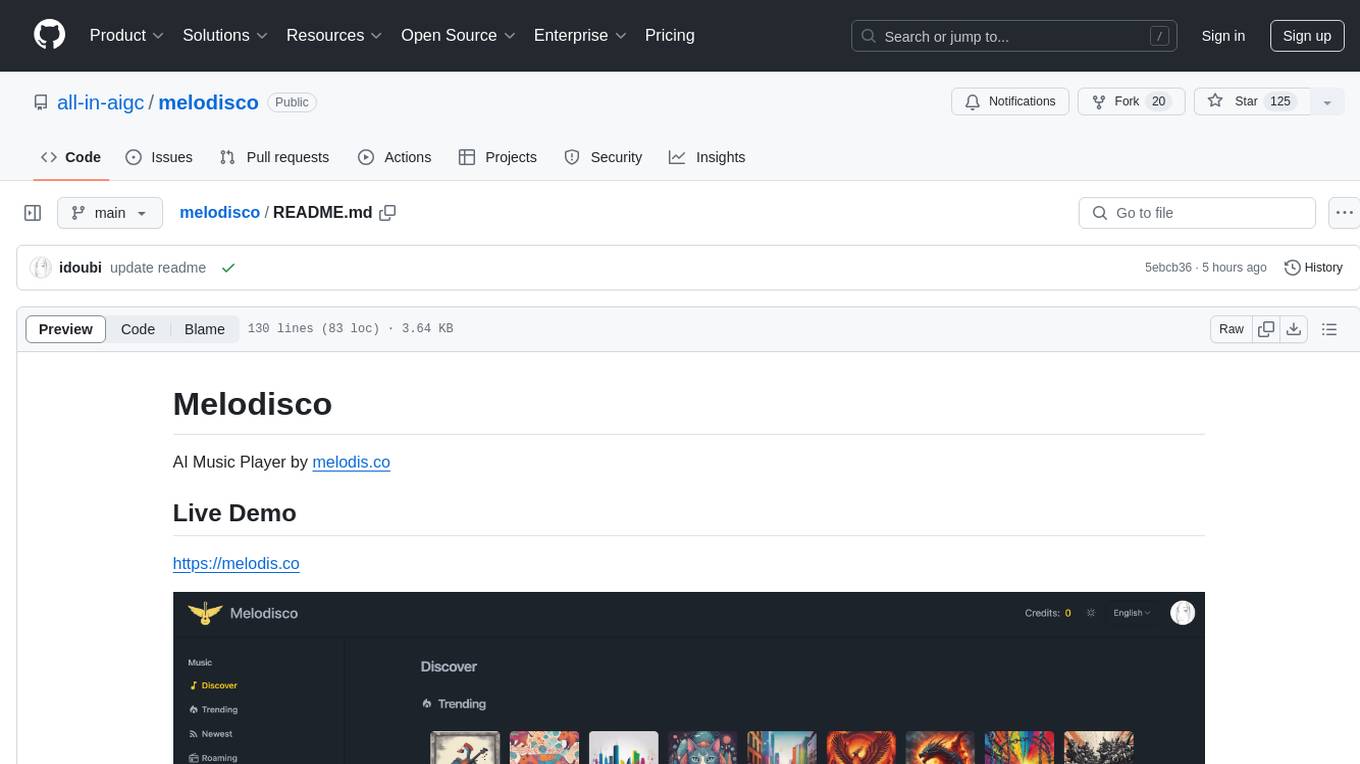
melodisco
Melodisco is an AI music player that allows users to listen to music and manage playlists. It provides a user-friendly interface for music playback and organization. Users can deploy Melodisco with Vercel or Docker for easy setup. Local development instructions are provided for setting up the project environment. The project credits various tools and libraries used in its development, such as Next.js, Tailwind CSS, and Stripe. Melodisco is a versatile tool for music enthusiasts looking for an AI-powered music player with features like authentication, payment integration, and multi-language support.
KB-Builder
KB Builder is an open-source knowledge base generation system based on the LLM large language model. It utilizes the RAG (Retrieval-Augmented Generation) data generation enhancement method to provide users with the ability to enhance knowledge generation and quickly build knowledge bases based on RAG. It aims to be the central hub for knowledge construction in enterprises, offering platform-based intelligent dialogue services and document knowledge base management functionality. Users can upload docx, pdf, txt, and md format documents and generate high-quality knowledge base question-answer pairs by invoking large models through the 'Parse Document' feature.
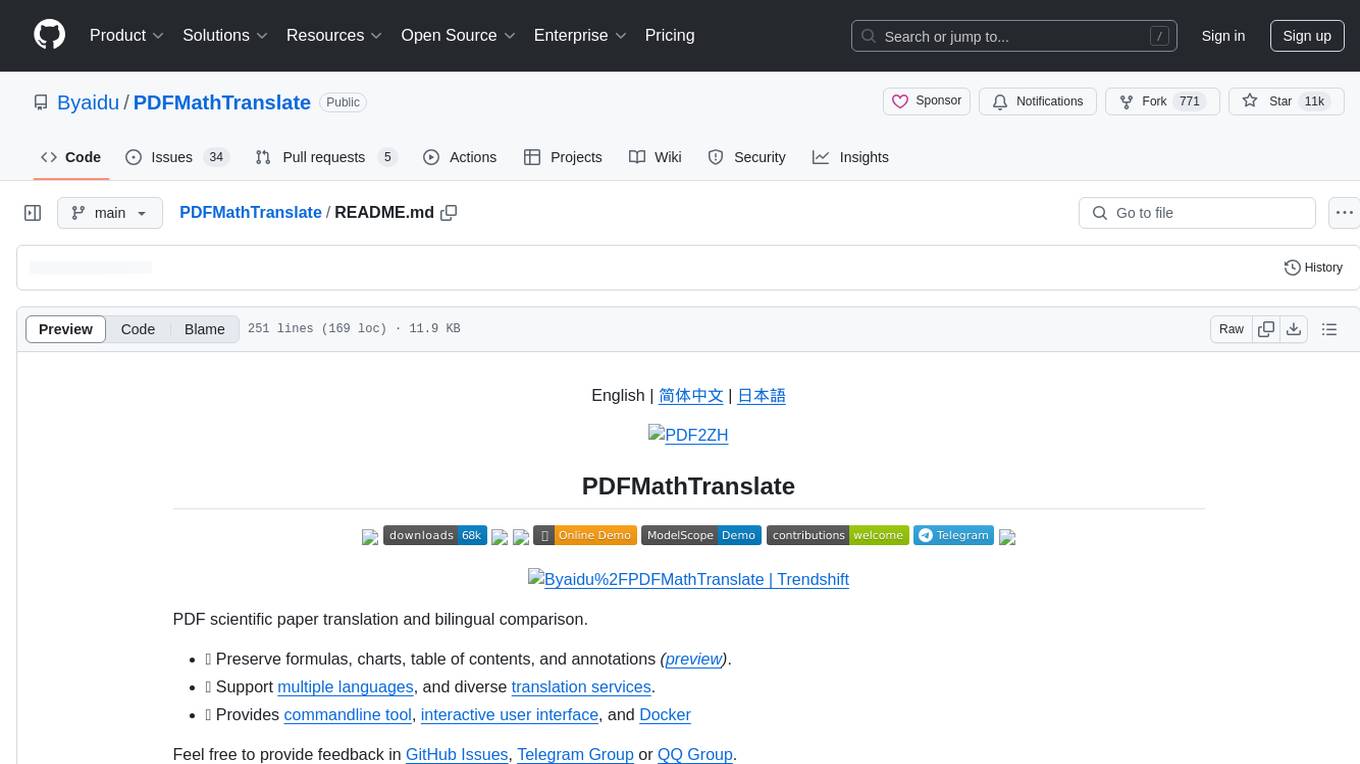
PDFMathTranslate
PDFMathTranslate is a tool designed for translating scientific papers and conducting bilingual comparisons. It preserves formulas, charts, table of contents, and annotations. The tool supports multiple languages and diverse translation services. It provides a command-line tool, interactive user interface, and Docker deployment. Users can try the application through online demos. The tool offers various installation methods including command-line, portable, graphic user interface, and Docker. Advanced options allow users to customize translation settings. Additionally, the tool supports secondary development through APIs for Python and HTTP. Future plans include parsing layout with DocLayNet based models, fixing page rotation and format issues, supporting non-PDF/A files, and integrating plugins for Zotero and Obsidian.
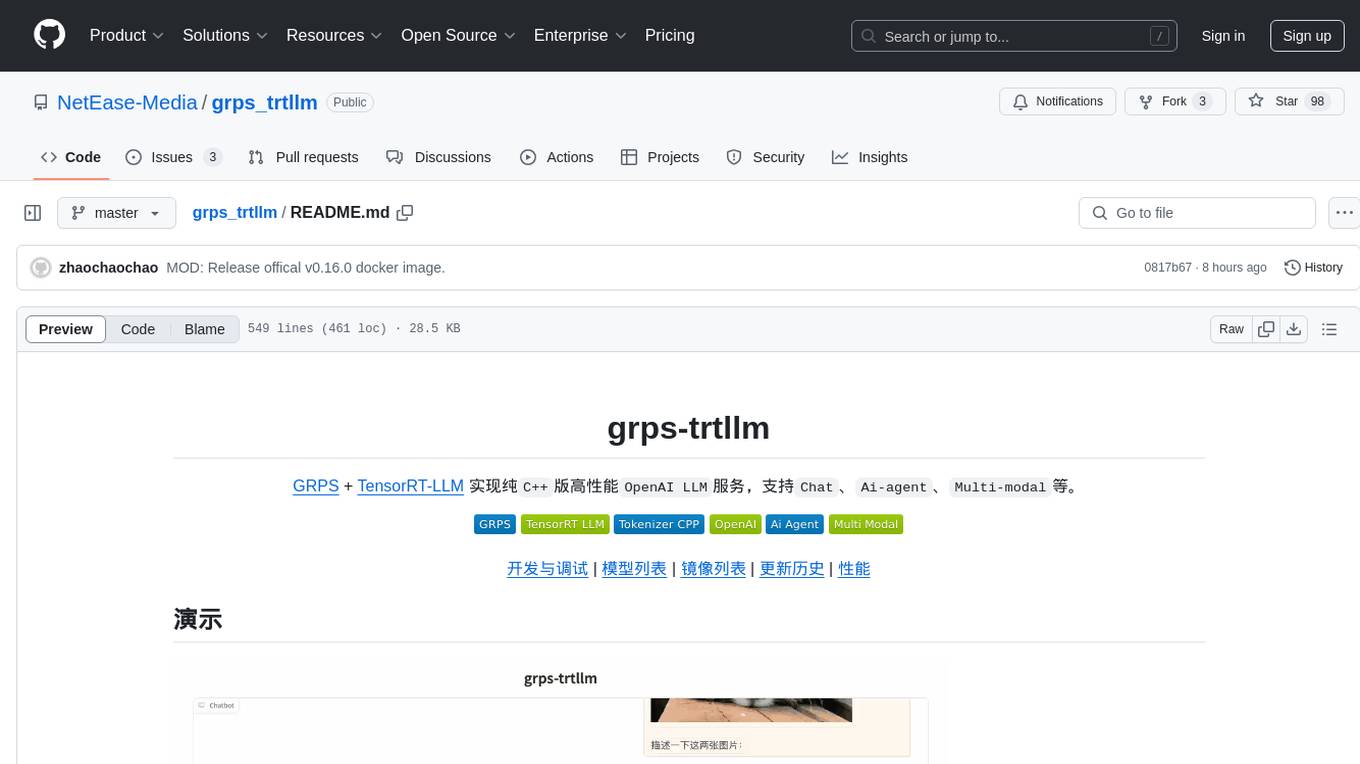
grps_trtllm
The grps-trtllm repository is a C++ implementation of a high-performance OpenAI LLM service, combining GRPS and TensorRT-LLM. It supports functionalities like Chat, Ai-agent, and Multi-modal. The repository offers advantages over triton-trtllm, including a complete LLM service implemented in pure C++, integrated tokenizer supporting huggingface and sentencepiece, custom HTTP functionality for OpenAI interface, support for different LLM prompt styles and result parsing styles, integration with tensorrt backend and opencv library for multi-modal LLM, and stable performance improvement compared to triton-trtllm.
For similar jobs
asreview
The ASReview project implements active learning for systematic reviews, utilizing AI-aided pipelines to assist in finding relevant texts for search tasks. It accelerates the screening of textual data with minimal human input, saving time and increasing output quality. The software offers three modes: Oracle for interactive screening, Exploration for teaching purposes, and Simulation for evaluating active learning models. ASReview LAB is designed to support decision-making in any discipline or industry by improving efficiency and transparency in screening large amounts of textual data.
NewEraAI-Papers
The NewEraAI-Papers repository provides links to collections of influential and interesting research papers from top AI conferences, along with open-source code to promote reproducibility and provide detailed implementation insights beyond the scope of the article. Users can stay up to date with the latest advances in AI research by exploring this repository. Contributions to improve the completeness of the list are welcomed, and users can create pull requests, open issues, or contact the repository owner via email to enhance the repository further.
cltk
The Classical Language Toolkit (CLTK) is a Python library that provides natural language processing (NLP) capabilities for pre-modern languages. It offers a modular processing pipeline with pre-configured defaults and supports almost 20 languages. Users can install the latest version using pip and access detailed documentation on the official website. The toolkit is designed to meet the unique needs of researchers working with historical languages, filling a void in the NLP landscape that often neglects non-spoken languages and different research goals.
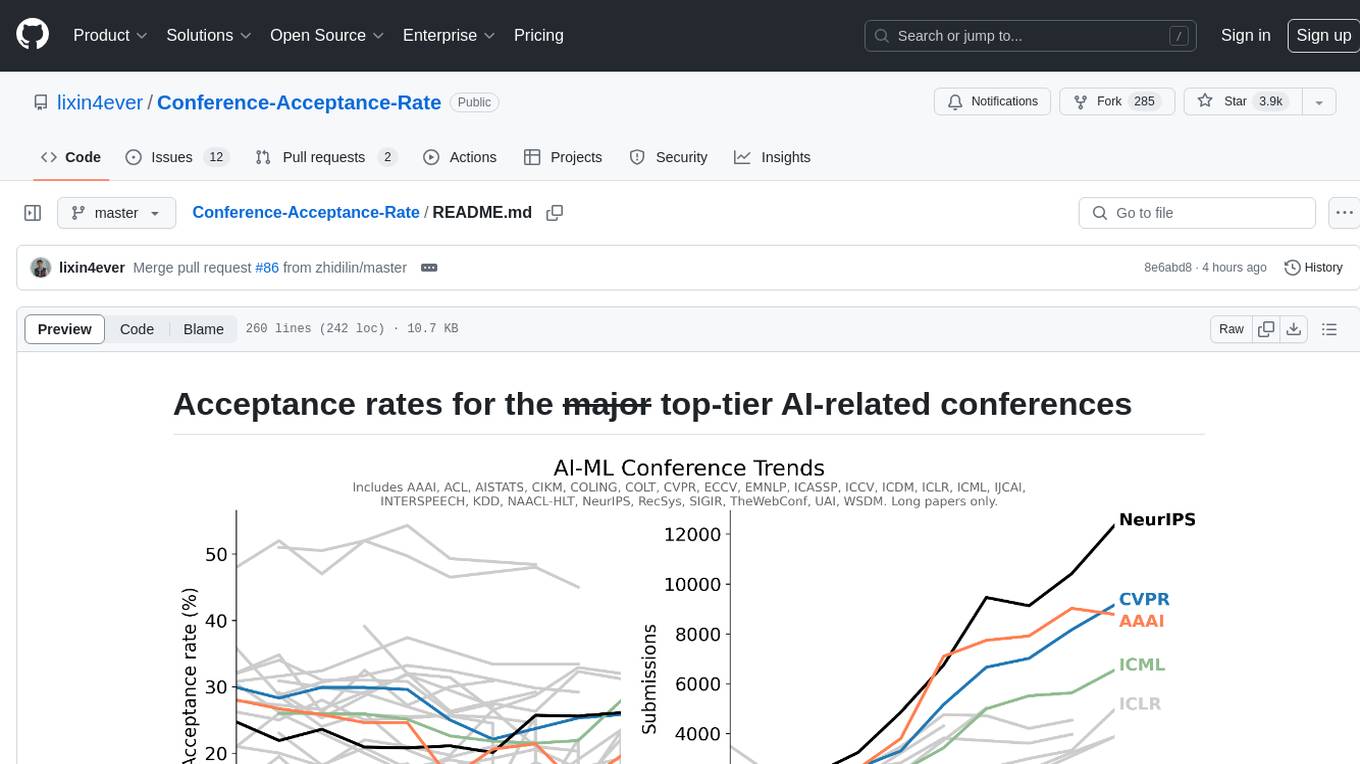
Conference-Acceptance-Rate
The 'Conference-Acceptance-Rate' repository provides acceptance rates for top-tier AI-related conferences in the fields of Natural Language Processing, Computational Linguistics, Computer Vision, Pattern Recognition, Machine Learning, Learning Theory, Artificial Intelligence, Data Mining, Information Retrieval, Speech Processing, and Signal Processing. The data includes acceptance rates for long papers and short papers over several years for each conference, allowing researchers to track trends and make informed decisions about where to submit their work.
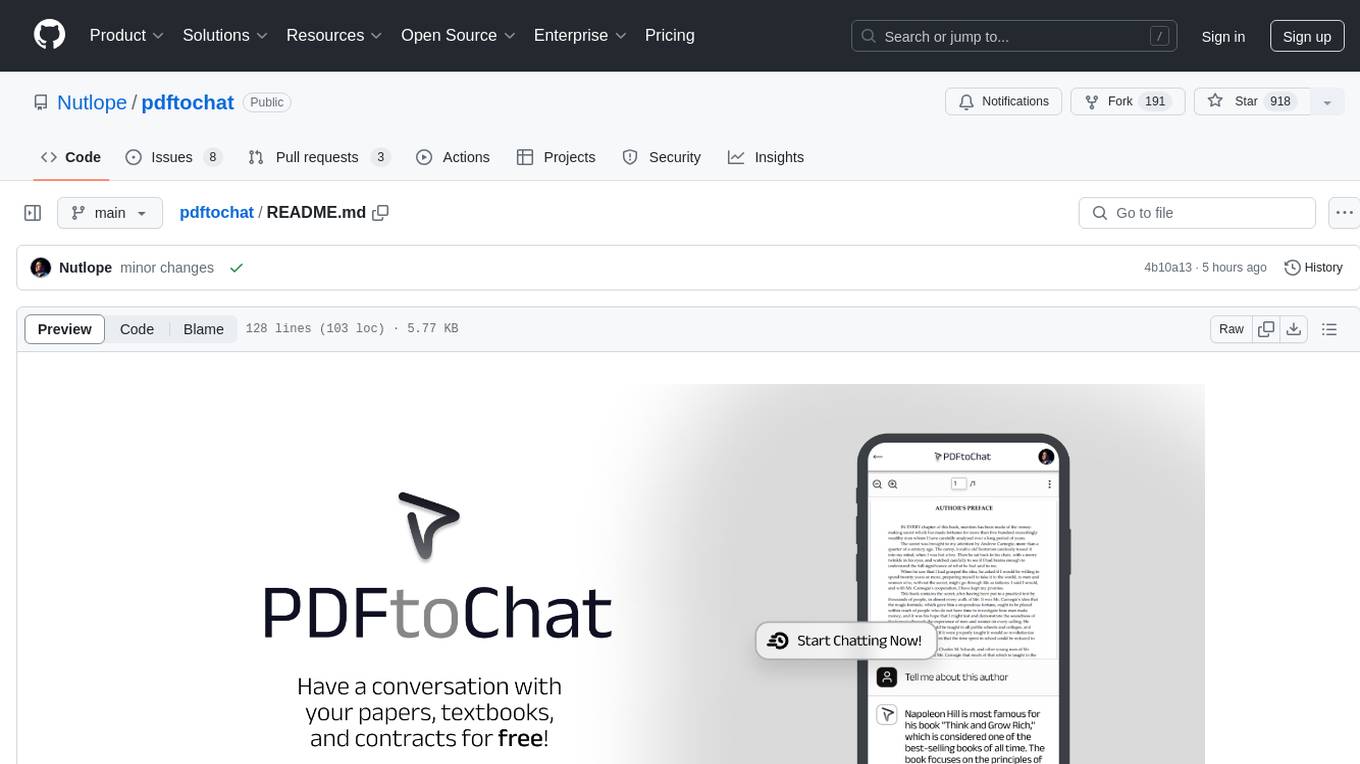
pdftochat
PDFToChat is a tool that allows users to chat with their PDF documents in seconds. It is powered by Together AI and Pinecone, utilizing a tech stack including Next.js, Mixtral, M2 Bert, LangChain.js, MongoDB Atlas, Bytescale, Vercel, Clerk, and Tailwind CSS. Users can deploy the tool to Vercel or any other host by setting up Together.ai, MongoDB Atlas database, Bytescale, Clerk, and Vercel. The tool enables users to interact with PDFs through chat, with future tasks including adding features like trash icon for deleting PDFs, exploring different embedding models, implementing auto scrolling, improving replies, benchmarking accuracy, researching chunking and retrieval best practices, adding demo video, upgrading to Next.js 14, adding analytics, customizing tailwind prose, saving chats in postgres DB, compressing large PDFs, implementing custom uploader, session tracking, error handling, and support for images in PDFs.
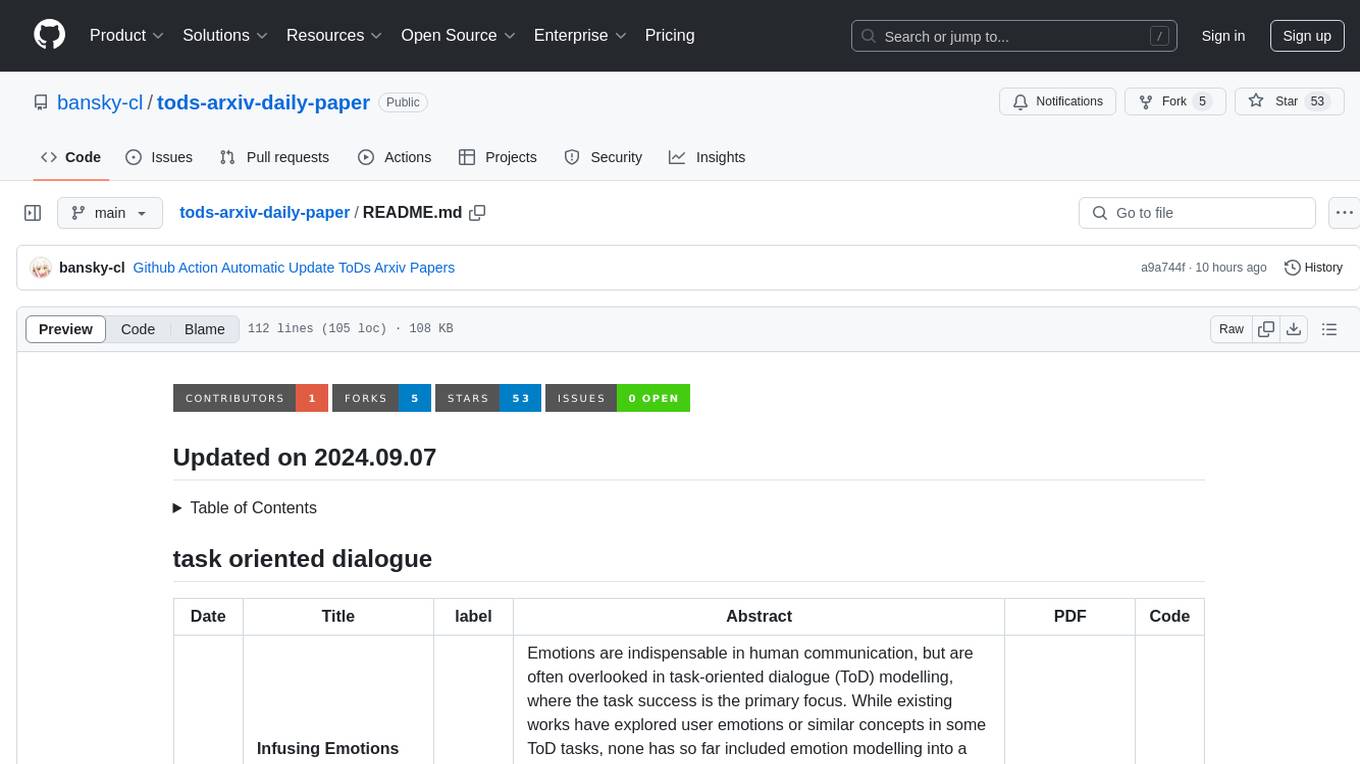
tods-arxiv-daily-paper
This repository provides a tool for fetching and summarizing daily papers from the arXiv repository. It allows users to stay updated with the latest research in various fields by automatically retrieving and summarizing papers on a daily basis. The tool simplifies the process of accessing and digesting academic papers, making it easier for researchers and enthusiasts to keep track of new developments in their areas of interest.
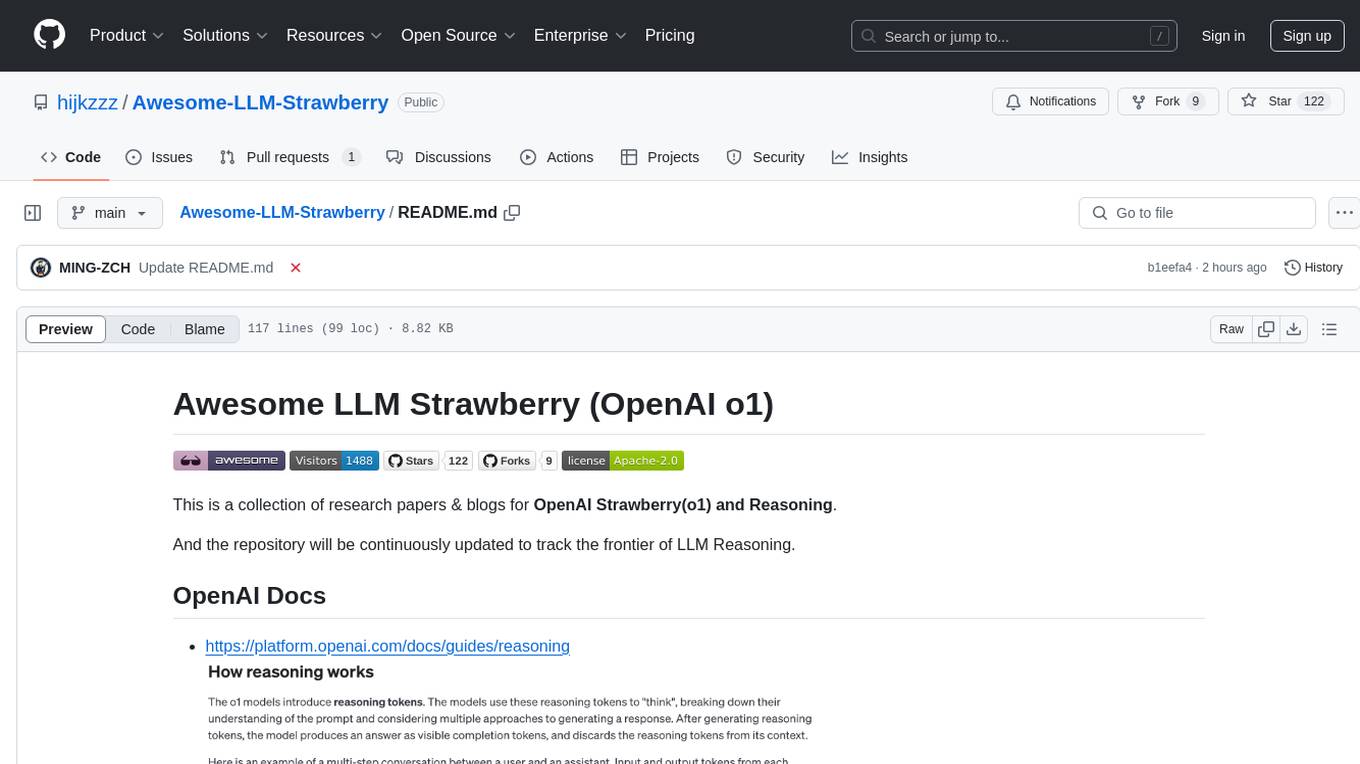
Awesome-LLM-Strawberry
Awesome LLM Strawberry is a collection of research papers and blogs related to OpenAI Strawberry(o1) and Reasoning. The repository is continuously updated to track the frontier of LLM Reasoning.
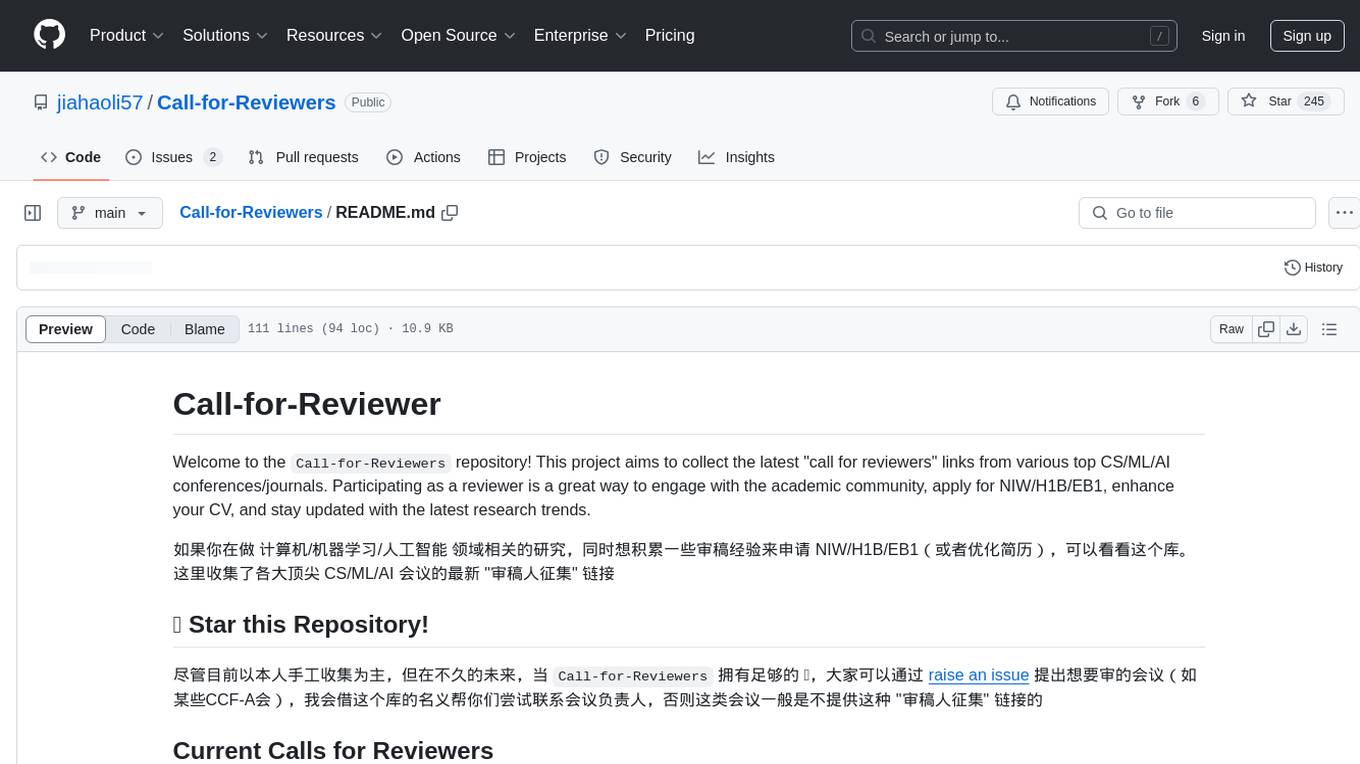
Call-for-Reviewers
The `Call-for-Reviewers` repository aims to collect the latest 'call for reviewers' links from various top CS/ML/AI conferences/journals. It provides an opportunity for individuals in the computer/ machine learning/ artificial intelligence fields to gain review experience for applying for NIW/H1B/EB1 or enhancing their CV. The repository helps users stay updated with the latest research trends and engage with the academic community.