


cad-recode
CAD-Recode: Reverse Engineering CAD Code from Point Clouds
Stars: 85
CAD-Recode is a 3D CAD reverse engineering method implemented in Python using the CadQuery library. It transforms point clouds into 3D CAD models by leveraging a pre-trained model and additional linear layers. The repository includes an inference demo for users to generate CAD models from point clouds. CAD-Recode has achieved state-of-the-art performance in CAD reconstruction benchmarks such as DeepCAD, Fusion360, and CC3D. Researchers and engineers can utilize this tool to reverse engineer CAD code from point clouds efficiently.
README:
🤗 Model v1, v1.5 🤗 ZeroGPU Space v1 🤗 Dataset v1, v1.5
News:
- 🚀 March, 2025. We update CAD-Recode to v1.5. More details in changelog.
- 🔥 December, 2024. CAD-Recode is state-of-the-art in three CAD reconstruction benchmarks:
DeepCAD
Fusion360
CC3D



This repository contains an implementation of CAD-Recode, a 3D CAD reverse engineering method introduced in our paper:
CAD-Recode: Reverse Engineering CAD Code from Point Clouds
Danila Rukhovich, Elona Dupont, Dimitrios Mallis, Kseniya Cherenkova, Anis Kacem, Djamila Aouada
Univesity of Luxembourg
https://arxiv.org/abs/2412.14042
CAD-Recode transforms point cloud to 3D CAD model in form of Python code (CadQuery library). CAD-Recode is trained upon Qwen2-1.5B, keeping original tokenizer, and adding a single additional linear layer. In this repo we provide simple inference demo. Install python packages according to our Dockerfile and run demo.ipynb in jupyter.
If you find this work useful for your research, please cite our paper:
@article{rukhovich2024cadrecode,
  title={CAD-Recode: Reverse Engineering CAD Code from Point Clouds},
  author={Danila Rukhovich, Elona Dupont, Dimitrios Mallis, Kseniya Cherenkova, Anis Kacem, Djamila Aouada},
  journal={arXiv preprint arXiv:2412.14042},
  year={2024}
}
For Tasks:
Click tags to check more tools for each tasksFor Jobs:
Alternative AI tools for cad-recode
Similar Open Source Tools
cad-recode
CAD-Recode is a 3D CAD reverse engineering method implemented in Python using the CadQuery library. It transforms point clouds into 3D CAD models by leveraging a pre-trained model and additional linear layers. The repository includes an inference demo for users to generate CAD models from point clouds. CAD-Recode has achieved state-of-the-art performance in CAD reconstruction benchmarks such as DeepCAD, Fusion360, and CC3D. Researchers and engineers can utilize this tool to reverse engineer CAD code from point clouds efficiently.

AceCoder
AceCoder is a tool that introduces a fully automated pipeline for synthesizing large-scale reliable tests used for reward model training and reinforcement learning in the coding scenario. It curates datasets, trains reward models, and performs RL training to improve coding abilities of language models. The tool aims to unlock the potential of RL training for code generation models and push the boundaries of LLM's coding abilities.
enhance_llm
The enhance_llm repository contains three main parts: 1. Vector model domain fine-tuning based on llama_index and qwen fine-tuning BGE vector model. 2. Large model domain fine-tuning based on PEFT fine-tuning qwen1.5-7b-chat, with sft and dpo. 3. High-order retrieval enhanced generation (RAG) system based on the above domain work, implementing a two-stage RAG system. It includes query rewriting, recall reordering, retrieval reordering, multi-turn dialogue, and more. The repository also provides hardware and environment configurations along with star history and licensing information.
qgate-model
QGate-Model is a machine learning meta-model with synthetic data, designed for MLOps and feature store. It is independent of machine learning solutions, with definitions in JSON and data in CSV/parquet formats. This meta-model is useful for comparing capabilities and functions of machine learning solutions, independently testing new versions of machine learning solutions, and conducting various types of tests (unit, sanity, smoke, system, regression, function, acceptance, performance, shadow, etc.). It can also be used for external test coverage when internal test coverage is not available or weak.
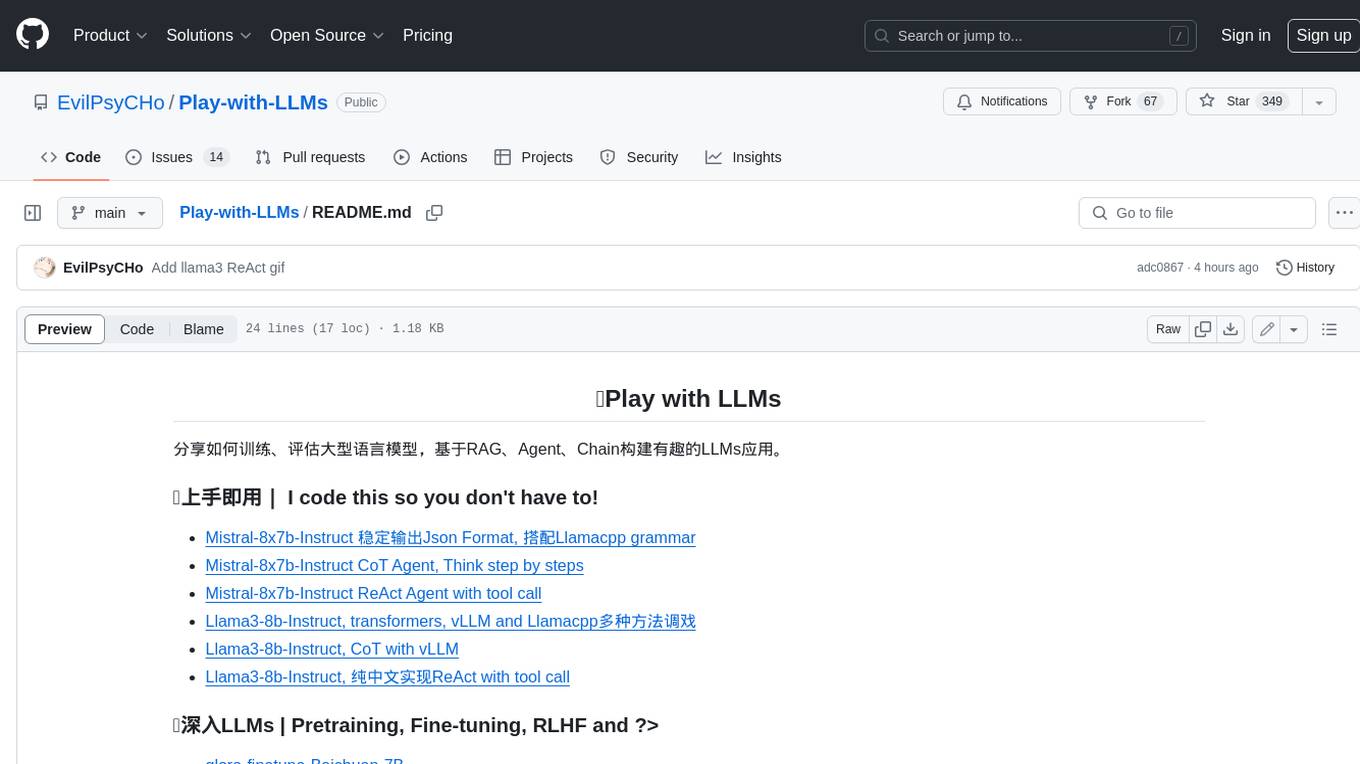
Play-with-LLMs
This repository provides a comprehensive guide to training, evaluating, and building applications with Large Language Models (LLMs). It covers various aspects of LLMs, including pretraining, fine-tuning, reinforcement learning from human feedback (RLHF), and more. The repository also includes practical examples and code snippets to help users get started with LLMs quickly and easily.
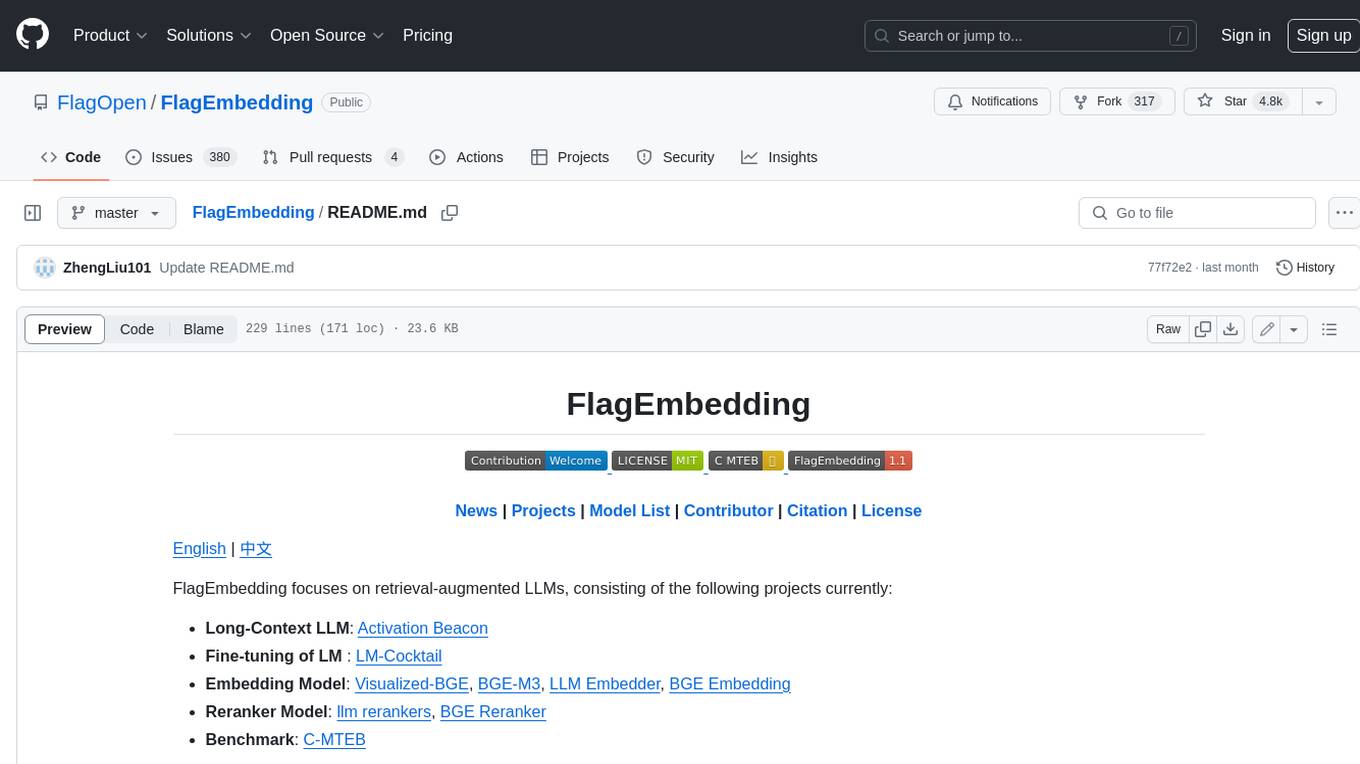
FlagEmbedding
FlagEmbedding focuses on retrieval-augmented LLMs, consisting of the following projects currently: * **Long-Context LLM** : Activation Beacon * **Fine-tuning of LM** : LM-Cocktail * **Embedding Model** : Visualized-BGE, BGE-M3, LLM Embedder, BGE Embedding * **Reranker Model** : llm rerankers, BGE Reranker * **Benchmark** : C-MTEB
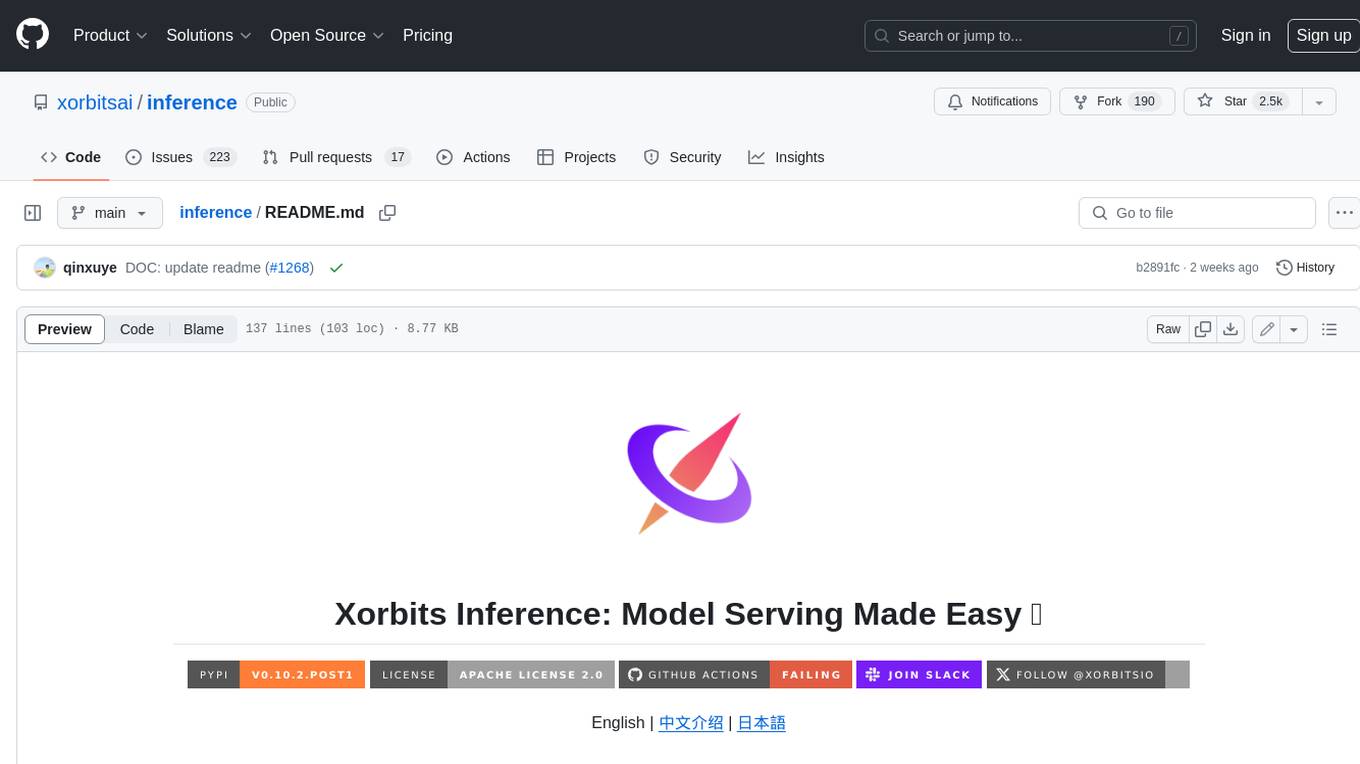
inference
Xorbits Inference (Xinference) is a powerful and versatile library designed to serve language, speech recognition, and multimodal models. With Xorbits Inference, you can effortlessly deploy and serve your or state-of-the-art built-in models using just a single command. Whether you are a researcher, developer, or data scientist, Xorbits Inference empowers you to unleash the full potential of cutting-edge AI models.
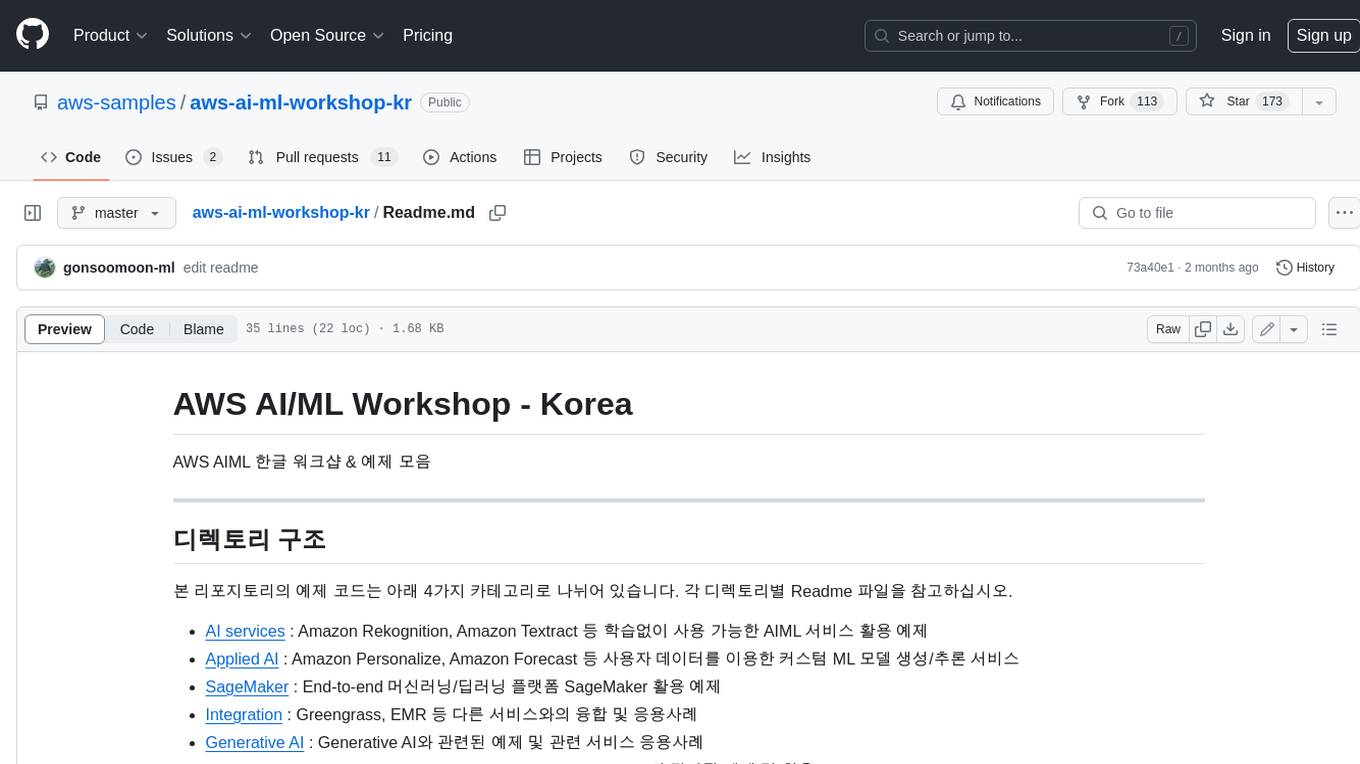
aws-ai-ml-workshop-kr
AWS AI/ML Workshop & example collection in Korean. The example codes in this repository are divided into 4 categories: AI services, Applied AI, SageMaker, Integration, Generative AI, and AWS Neuron. Each directory has its own Readme file. This repository also provides useful information for self-studying SageMaker.
Open-R1
Open-R1 is an open-source library for training a hyper-personalized DeepSeek-R1-like model using minimal compute resources. It provides the flexibility to use your own data and aims to streamline the model training process. The project is licensed under Apache 2.0 and acknowledges contributions from various open-source contributors, including Hugging Face and Vicuna.
agents-towards-production
Agents Towards Production is an open-source playbook for building production-ready GenAI agents that scale from prototype to enterprise. Tutorials cover stateful workflows, vector memory, real-time web search APIs, Docker deployment, FastAPI endpoints, security guardrails, GPU scaling, browser automation, fine-tuning, multi-agent coordination, observability, evaluation, and UI development.
LightLLM
LightLLM is a lightweight library for linear and logistic regression models. It provides a simple and efficient way to train and deploy machine learning models for regression tasks. The library is designed to be easy to use and integrate into existing projects, making it suitable for both beginners and experienced data scientists. With LightLLM, users can quickly build and evaluate regression models using a variety of algorithms and hyperparameters. The library also supports feature engineering and model interpretation, allowing users to gain insights from their data and make informed decisions based on the model predictions.
CodeGeeX4
CodeGeeX4-ALL-9B is an open-source multilingual code generation model based on GLM-4-9B, offering enhanced code generation capabilities. It supports functions like code completion, code interpreter, web search, function call, and repository-level code Q&A. The model has competitive performance on benchmarks like BigCodeBench and NaturalCodeBench, outperforming larger models in terms of speed and performance.
OpenCatEsp32
OpenCat code running on BiBoard, a high-performance ESP32 quadruped robot development board. The board is mainly designed for developers and engineers working on multi-degree-of-freedom (MDOF) Multi-legged robots with up to 12 servos.
parallax
Parallax is a fully decentralized inference engine developed by Gradient. It allows users to build their own AI cluster for model inference across distributed nodes with varying configurations and physical locations. Core features include hosting local LLM on personal devices, cross-platform support, pipeline parallel model sharding, paged KV cache management, continuous batching for Mac, dynamic request scheduling, and routing for high performance. The backend architecture includes P2P communication powered by Lattica, GPU backend powered by SGLang and vLLM, and MAC backend powered by MLX LM.
ERNIE
ERNIE 4.5 is a family of large-scale multimodal models with 10 distinct variants, including Mixture-of-Experts (MoE) models with 47B and 3B active parameters. The models feature a novel heterogeneous modality structure supporting parameter sharing across modalities while allowing dedicated parameters for each individual modality. Trained with optimal efficiency using PaddlePaddle deep learning framework, ERNIE 4.5 models achieve state-of-the-art performance across text and multimodal benchmarks, enhancing multimodal understanding without compromising performance on text-related tasks. The open-source development toolkits for ERNIE 4.5 offer industrial-grade capabilities, resource-efficient training and inference workflows, and multi-hardware compatibility.
For similar tasks
cad-recode
CAD-Recode is a 3D CAD reverse engineering method implemented in Python using the CadQuery library. It transforms point clouds into 3D CAD models by leveraging a pre-trained model and additional linear layers. The repository includes an inference demo for users to generate CAD models from point clouds. CAD-Recode has achieved state-of-the-art performance in CAD reconstruction benchmarks such as DeepCAD, Fusion360, and CC3D. Researchers and engineers can utilize this tool to reverse engineer CAD code from point clouds efficiently.
Lidar_AI_Solution
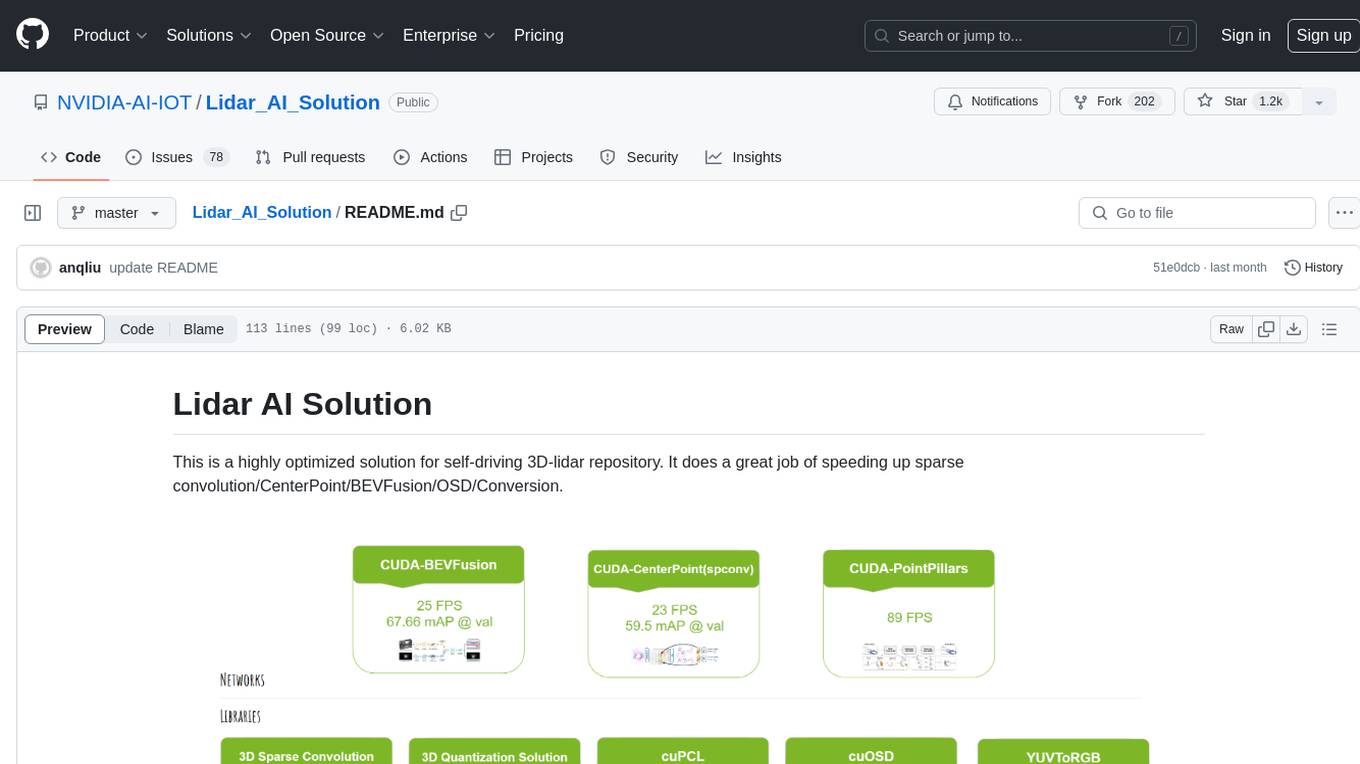
Lidar AI Solution is a highly optimized repository for self-driving 3D lidar, providing solutions for sparse convolution, BEVFusion, CenterPoint, OSD, and Conversion. It includes CUDA and TensorRT implementations for various tasks such as 3D sparse convolution, BEVFusion, CenterPoint, PointPillars, V2XFusion, cuOSD, cuPCL, and YUV to RGB conversion. The repository offers easy-to-use solutions, high accuracy, low memory usage, and quantization options for different tasks related to self-driving technology.
Magick
Magick is a groundbreaking visual AIDE (Artificial Intelligence Development Environment) for no-code data pipelines and multimodal agents. Magick can connect to other services and comes with nodes and templates well-suited for intelligent agents, chatbots, complex reasoning systems and realistic characters.
metaflow
Metaflow is a user-friendly library designed to assist scientists and engineers in developing and managing real-world data science projects. Initially created at Netflix, Metaflow aimed to enhance the productivity of data scientists working on diverse projects ranging from traditional statistics to cutting-edge deep learning. For further information, refer to Metaflow's website and documentation.
SciMLBenchmarks.jl
SciMLBenchmarks.jl holds webpages, pdfs, and notebooks showing the benchmarks for the SciML Scientific Machine Learning Software ecosystem, including: * Benchmarks of equation solver implementations * Speed and robustness comparisons of methods for parameter estimation / inverse problems * Training universal differential equations (and subsets like neural ODEs) * Training of physics-informed neural networks (PINNs) * Surrogate comparisons, including radial basis functions, neural operators (DeepONets, Fourier Neural Operators), and more The SciML Bench suite is made to be a comprehensive open source benchmark from the ground up, covering the methods of computational science and scientific computing all the way to AI for science.
katib
Katib is a Kubernetes-native project for automated machine learning (AutoML). Katib supports Hyperparameter Tuning, Early Stopping and Neural Architecture Search. Katib is the project which is agnostic to machine learning (ML) frameworks. It can tune hyperparameters of applications written in any language of the users’ choice and natively supports many ML frameworks, such as TensorFlow, Apache MXNet, PyTorch, XGBoost, and others. Katib can perform training jobs using any Kubernetes Custom Resources with out of the box support for Kubeflow Training Operator, Argo Workflows, Tekton Pipelines and many more.
X-AnyLabeling
X-AnyLabeling is a robust annotation tool that seamlessly incorporates an AI inference engine alongside an array of sophisticated features. Tailored for practical applications, it is committed to delivering comprehensive, industrial-grade solutions for image data engineers. This tool excels in swiftly and automatically executing annotations across diverse and intricate tasks.
backend.ai
Backend.AI is a streamlined, container-based computing cluster platform that hosts popular computing/ML frameworks and diverse programming languages, with pluggable heterogeneous accelerator support including CUDA GPU, ROCm GPU, TPU, IPU and other NPUs. It allocates and isolates the underlying computing resources for multi-tenant computation sessions on-demand or in batches with customizable job schedulers with its own orchestrator. All its functions are exposed as REST/GraphQL/WebSocket APIs.
For similar jobs
cad-recode
CAD-Recode is a 3D CAD reverse engineering method implemented in Python using the CadQuery library. It transforms point clouds into 3D CAD models by leveraging a pre-trained model and additional linear layers. The repository includes an inference demo for users to generate CAD models from point clouds. CAD-Recode has achieved state-of-the-art performance in CAD reconstruction benchmarks such as DeepCAD, Fusion360, and CC3D. Researchers and engineers can utilize this tool to reverse engineer CAD code from point clouds efficiently.
spear
SPEAR (Simulator for Photorealistic Embodied AI Research) is a powerful tool for training embodied agents. It features 300 unique virtual indoor environments with 2,566 unique rooms and 17,234 unique objects that can be manipulated individually. Each environment is designed by a professional artist and features detailed geometry, photorealistic materials, and a unique floor plan and object layout. SPEAR is implemented as Unreal Engine assets and provides an OpenAI Gym interface for interacting with the environments via Python.
openvino
OpenVINO™ is an open-source toolkit for optimizing and deploying AI inference. It provides a common API to deliver inference solutions on various platforms, including CPU, GPU, NPU, and heterogeneous devices. OpenVINO™ supports pre-trained models from Open Model Zoo and popular frameworks like TensorFlow, PyTorch, and ONNX. Key components of OpenVINO™ include the OpenVINO™ Runtime, plugins for different hardware devices, frontends for reading models from native framework formats, and the OpenVINO Model Converter (OVC) for adjusting models for optimal execution on target devices.
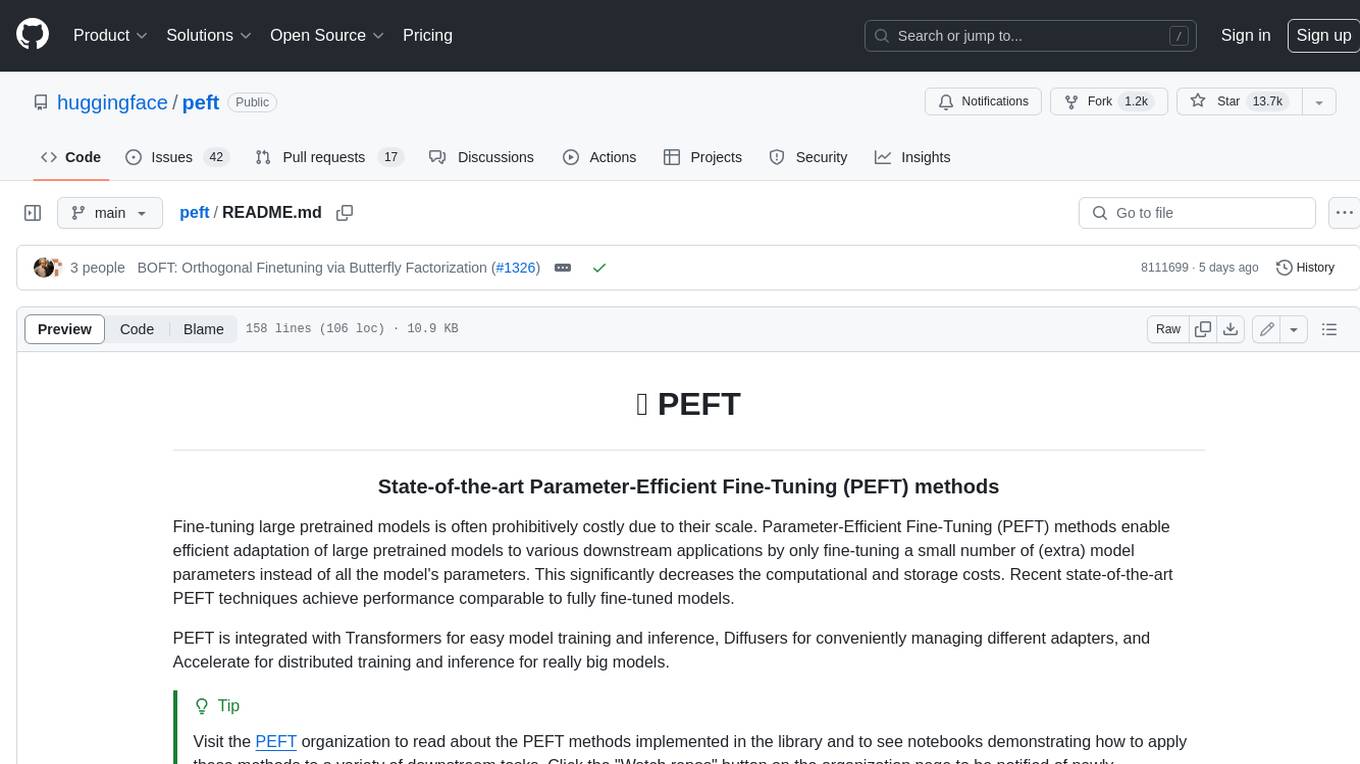
peft
PEFT (Parameter-Efficient Fine-Tuning) is a collection of state-of-the-art methods that enable efficient adaptation of large pretrained models to various downstream applications. By only fine-tuning a small number of extra model parameters instead of all the model's parameters, PEFT significantly decreases the computational and storage costs while achieving performance comparable to fully fine-tuned models.
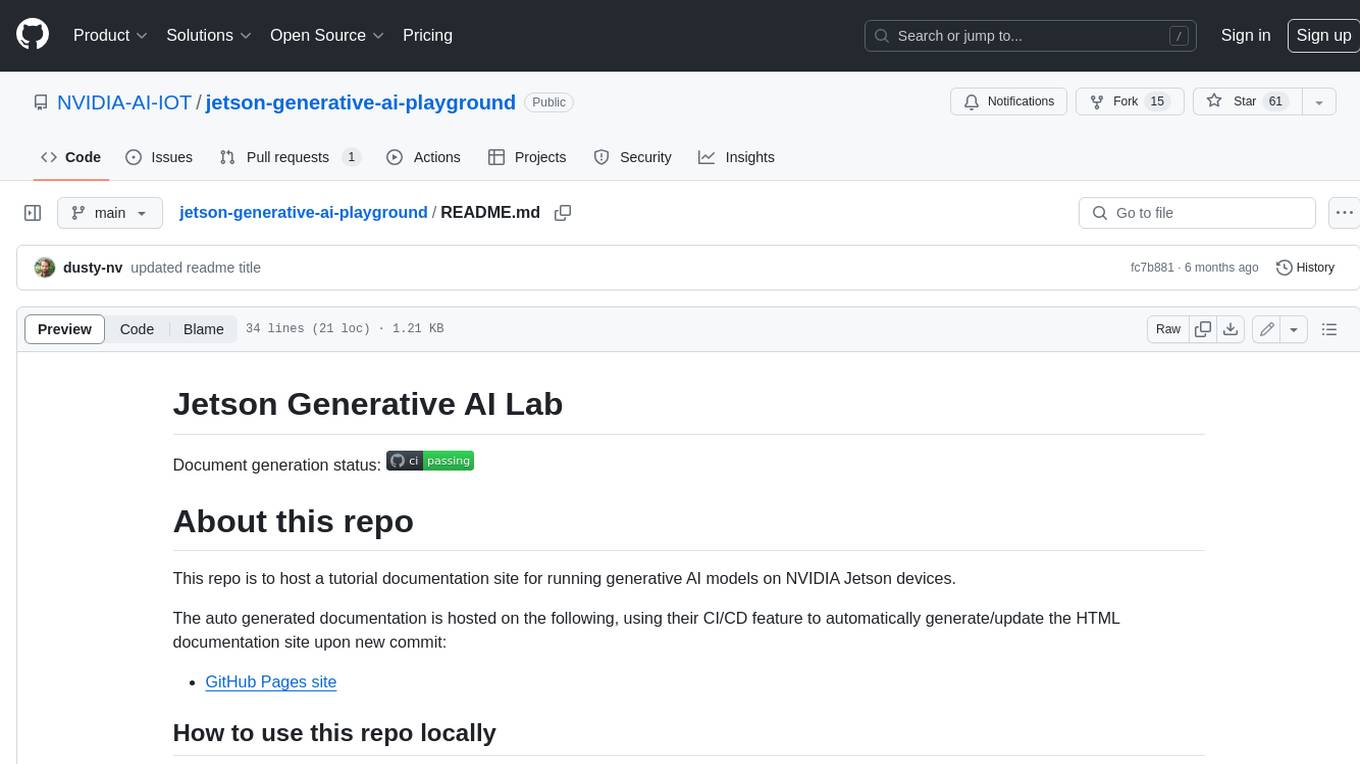
jetson-generative-ai-playground
This repo hosts tutorial documentation for running generative AI models on NVIDIA Jetson devices. The documentation is auto-generated and hosted on GitHub Pages using their CI/CD feature to automatically generate/update the HTML documentation site upon new commits.
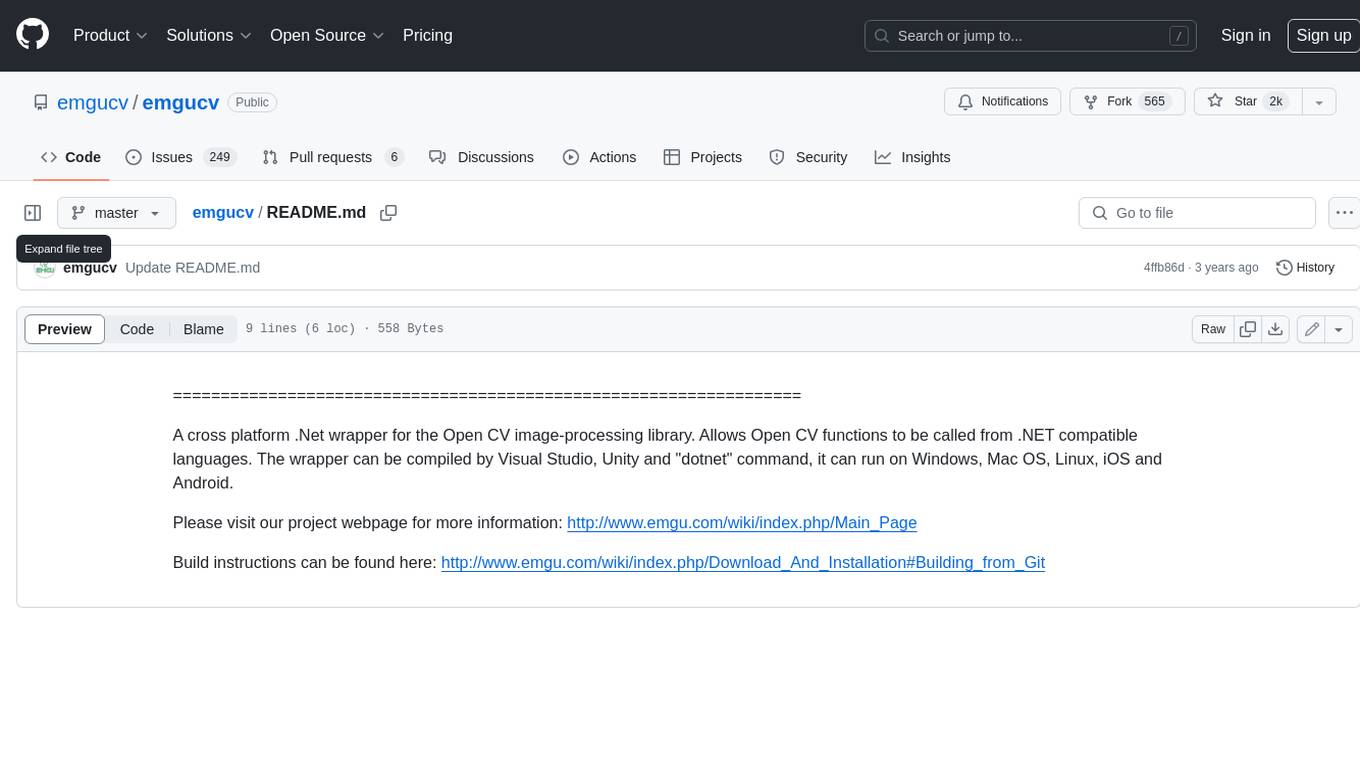
emgucv
Emgu CV is a cross-platform .Net wrapper for the OpenCV image-processing library. It allows OpenCV functions to be called from .NET compatible languages. The wrapper can be compiled by Visual Studio, Unity, and "dotnet" command, and it can run on Windows, Mac OS, Linux, iOS, and Android.
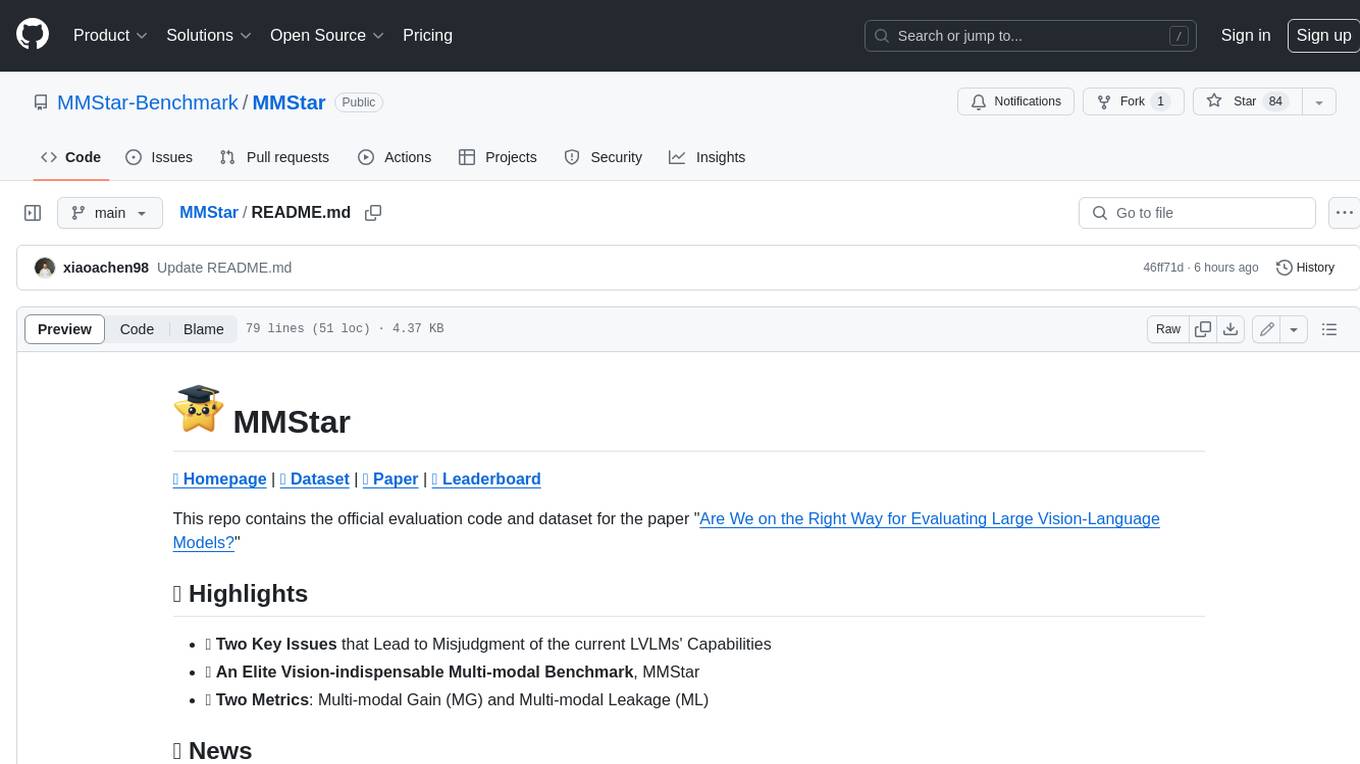
MMStar
MMStar is an elite vision-indispensable multi-modal benchmark comprising 1,500 challenge samples meticulously selected by humans. It addresses two key issues in current LLM evaluation: the unnecessary use of visual content in many samples and the existence of unintentional data leakage in LLM and LVLM training. MMStar evaluates 6 core capabilities across 18 detailed axes, ensuring a balanced distribution of samples across all dimensions.
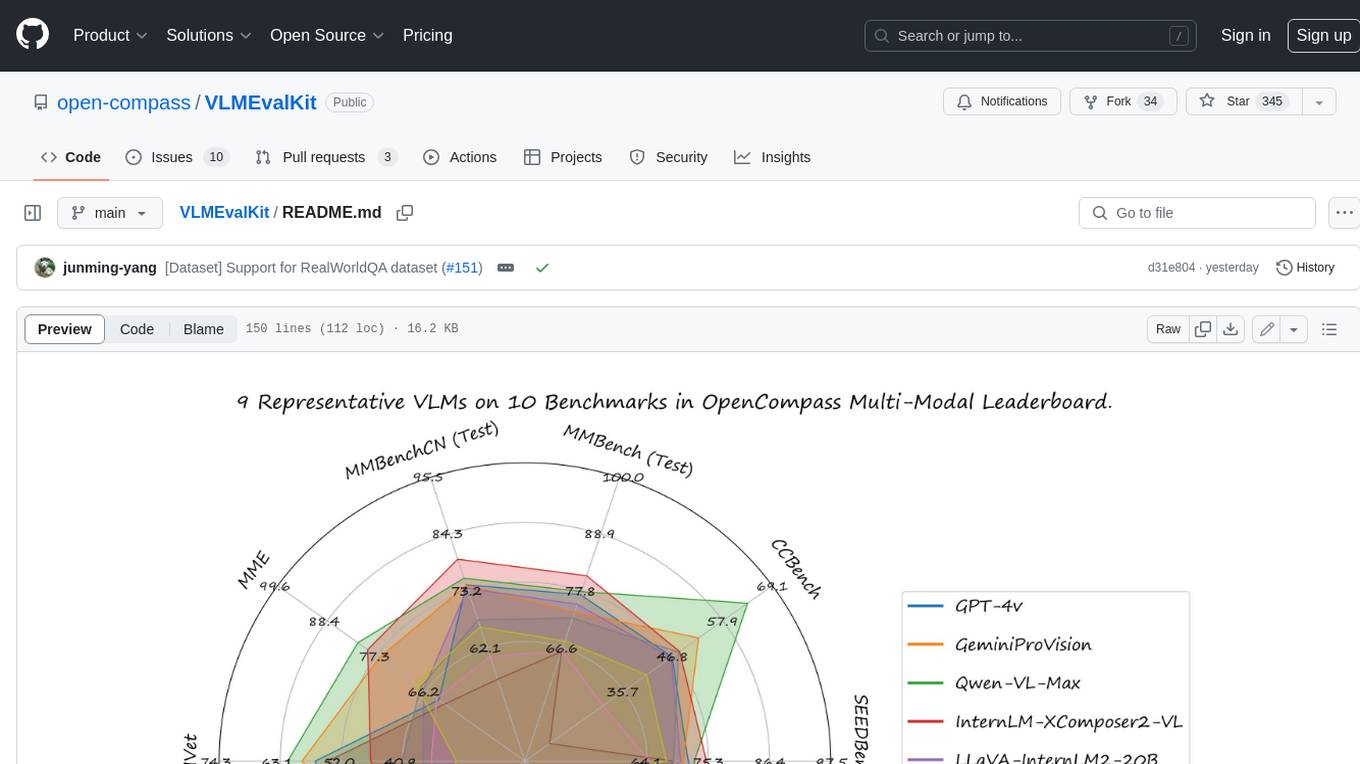
VLMEvalKit
VLMEvalKit is an open-source evaluation toolkit of large vision-language models (LVLMs). It enables one-command evaluation of LVLMs on various benchmarks, without the heavy workload of data preparation under multiple repositories. In VLMEvalKit, we adopt generation-based evaluation for all LVLMs, and provide the evaluation results obtained with both exact matching and LLM-based answer extraction.