


kor
LLM(😽)
Stars: 1599
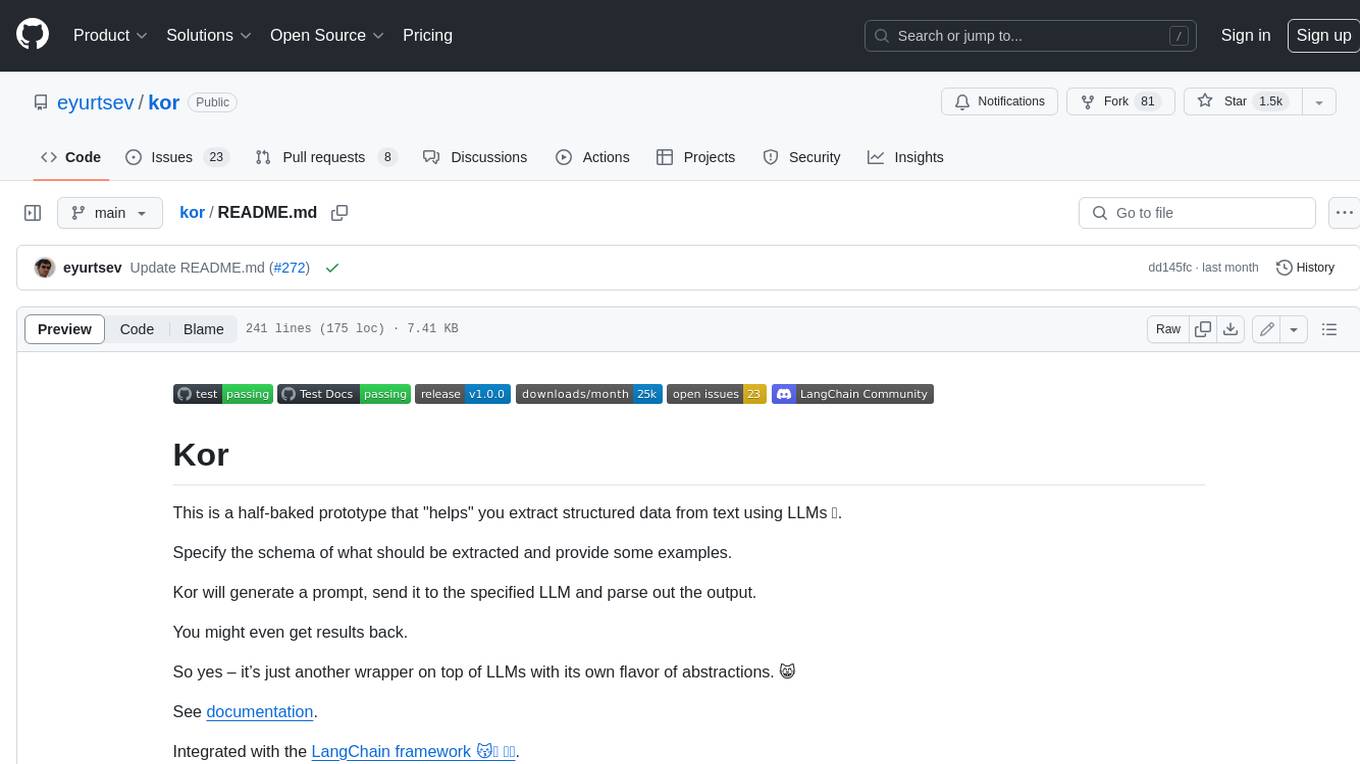
Kor is a prototype tool designed to help users extract structured data from text using Language Models (LLMs). It generates prompts, sends them to specified LLMs, and parses the output. The tool works with the parsing approach and is integrated with the LangChain framework. Kor is compatible with pydantic v2 and v1, and schema is typed checked using pydantic. It is primarily used for extracting information from text based on provided reference examples and schema documentation. Kor is designed to work with all good-enough LLMs regardless of their support for function/tool calling or JSON modes.
README:





This is a half-baked prototype that "helps" you extract structured data from text using LLMs 🧩.
Specify the schema of what should be extracted and provide some examples.
Kor will generate a prompt, send it to the specified LLM and parse out the output.
You might even get results back.
So yes – it’s just another wrapper on top of LLMs with its own flavor of abstractions. 😸
See documentation.
Integrated with the LangChain framework 😽💗 🦜🔗.
There are 3 different approaches for extracting information using LLMs:
- prompt based/parsing
- function/tool calling
- JSON mode
Please see the LangChain extraction use case docs for an overview.
Kor has a pretty good implementation of the parsing approach. The approach works with all good-enough LLMs regardless of whether they support function/tool calling or JSON modes.
Extraction quality is principally driven by providing good reference examples and good schema documentation.
Please see guidelines here and here.
-
korcompatible with both pydantic v2 and v1. - pydantic v2 had significant breaking changes w/ respect to v1,
kormajor version bump was used as a precaution.
Main things to watch out for:
- Use a
defaultvalue for any Optional fields if using pydantic v2 for validation.
class MusicRequest(BaseModel):
    song: Optional[List[str]] = Field(
        default=None,
        description="The song(s) that the user would like to be played."
)-
Kor schema is typed checked using pydantic. Pydantic v2 is stricter, and may catch issues that were hiding in existing user code that was using the
korlibrary. -
Serialization has not yet been implemented with pydantic v2.
from langchain.chat_models import ChatOpenAI
from kor import create_extraction_chain, Object, Text

llm = ChatOpenAI(
    model_name="gpt-3.5-turbo",
    temperature=0,
    max_tokens=2000,
    model_kwargs = {
        'frequency_penalty':0,
        'presence_penalty':0,
        'top_p':1.0
    }
)

schema = Object(
    id="player",
    description=(
        "User is controlling a music player to select songs, pause or start them or play"
        " music by a particular artist."
    ),
    attributes=[
        Text(
            id="song",
            description="User wants to play this song",
            examples=[],
            many=True,
        ),
        Text(
            id="album",
            description="User wants to play this album",
            examples=[],
            many=True,
        ),
        Text(
            id="artist",
            description="Music by the given artist",
            examples=[("Songs by paul simon", "paul simon")],
            many=True,
        ),
        Text(
            id="action",
            description="Action to take one of: `play`, `stop`, `next`, `previous`.",
            examples=[
                ("Please stop the music", "stop"),
                ("play something", "play"),
                ("play a song", "play"),
                ("next song", "next"),
            ],
        ),
    ],
    many=False,
)

chain = create_extraction_chain(llm, schema, encoder_or_encoder_class='json')
chain.invoke("play songs by paul simon and led zeppelin and the doors")['data']{'player': {'artist': ['paul simon', 'led zeppelin', 'the doors']}}- See documentation here pydantic.
class Action(enum.Enum):
    play = "play"
    stop = "stop"
    previous = "previous"
    next_ = "next"


class MusicRequest(BaseModel):
    song: Optional[List[str]] = Field(
        default=None,
        description="The song(s) that the user would like to be played."
    )
    album: Optional[List[str]] = Field(
        default=None,
        description="The album(s) that the user would like to be played."
    )
    artist: Optional[List[str]] = Field(
        default=None,
        description="The artist(s) whose music the user would like to hear.",
        examples=[("Songs by paul simon", "paul simon")],
    )
    action: Optional[Action] = Field(
        default=None,
        description="The action that should be taken; one of `play`, `stop`, `next`, `previous`",
        examples=[
            ("Please stop the music", "stop"),
            ("play something", "play"),
            ("play a song", "play"),
            ("next song", "next"),
        ],
    )

schema, validator = from_pydantic(MusicRequest)
chain = create_extraction_chain(
    llm, schema, encoder_or_encoder_class="json", validator=validator
)
chain.invoke("stop the music now")["validated_data"]MusicRequest(song=None, album=None, artist=None, action=<Action.stop: 'stop'>)Kor is tested against python 3.8, 3.9, 3.10, 3.11.
pip install korIdeas of some things that could be done with Kor.
- Extract data from text that matches an extraction schema.
- Power an AI assistant with skills by precisely understanding a user request.
- Provide natural language access to an existing API.
Prototype! So the API is not expected to be stable!
- Making mistakes! Plenty of them!
- Slow! It uses large prompts with examples, and works best with the larger slower LLMs.
- Crashing for long enough pieces of text! Context length window could become limiting when working with large forms or long text inputs.
The expectation is that as LLMs improve some of these issues will be mitigated.
Kor has no limitations. (Just kidding.)
Take a look at the section above and at the compatibility section.
Open an issue, and let's discuss!
Fast to type and sufficiently unique.
If you have any ideas or feature requests, please open an issue and share!
See CONTRIBUTING.md for more information.
Probabilistically speaking this package is unlikely to work for your use case.
So here are some great alternatives:
For Tasks:
Click tags to check more tools for each tasksFor Jobs:
Alternative AI tools for kor
Similar Open Source Tools
kor
Kor is a prototype tool designed to help users extract structured data from text using Language Models (LLMs). It generates prompts, sends them to specified LLMs, and parses the output. The tool works with the parsing approach and is integrated with the LangChain framework. Kor is compatible with pydantic v2 and v1, and schema is typed checked using pydantic. It is primarily used for extracting information from text based on provided reference examples and schema documentation. Kor is designed to work with all good-enough LLMs regardless of their support for function/tool calling or JSON modes.
cappr
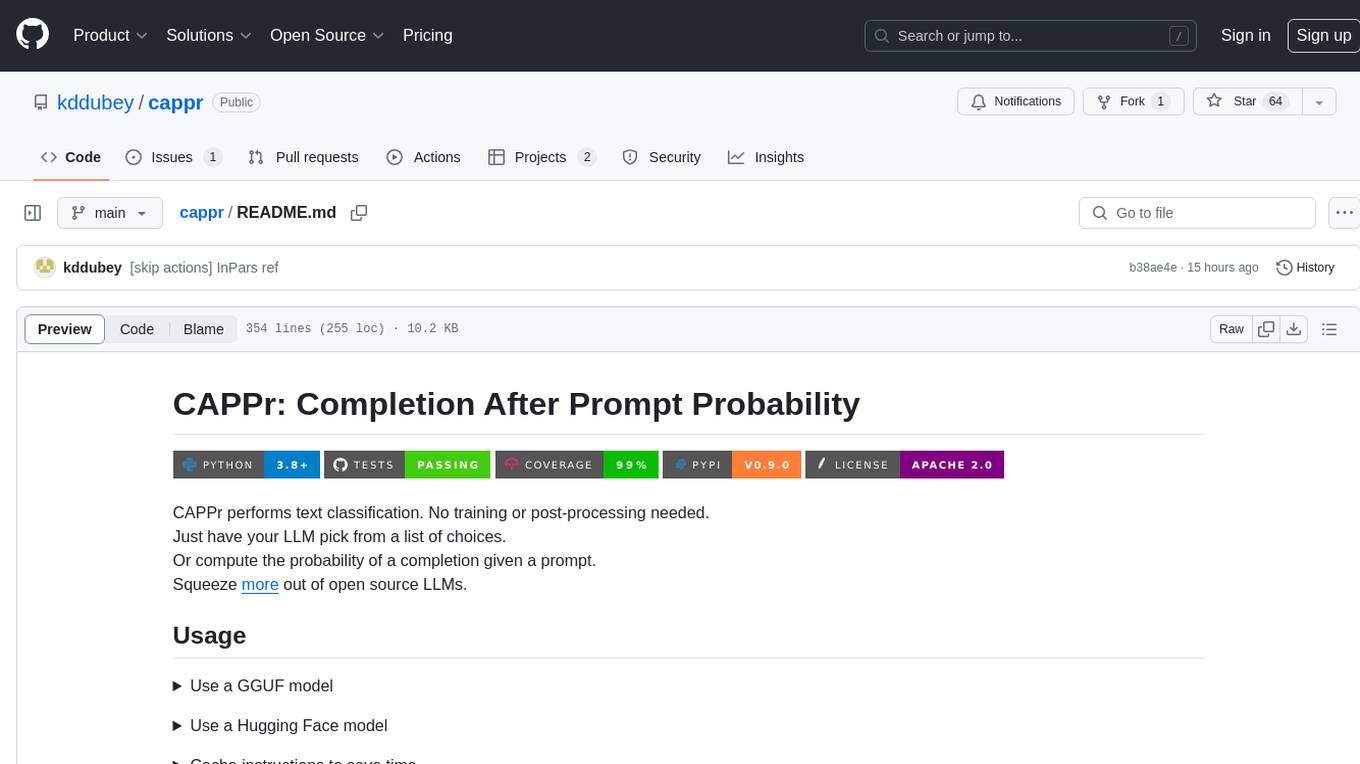
CAPPr is a tool for text classification that does not require training or post-processing. It allows users to have their language models pick from a list of choices or compute the probability of a completion given a prompt. The tool aims to help users get more out of open source language models by simplifying the text classification process. CAPPr can be used with GGUF models, Hugging Face models, models from the OpenAI API, and for tasks like caching instructions, extracting final answers from step-by-step completions, and running predictions in batches with different sets of completions.
memobase
Memobase is a user profile-based memory system designed to enhance Generative AI applications by enabling them to remember, understand, and evolve with users. It provides structured user profiles, scalable profiling, easy integration with existing LLM stacks, batch processing for speed, and is production-ready. Users can manage users, insert data, get memory profiles, and track user preferences and behaviors. Memobase is ideal for applications that require user analysis, tracking, and personalized interactions.
langevals
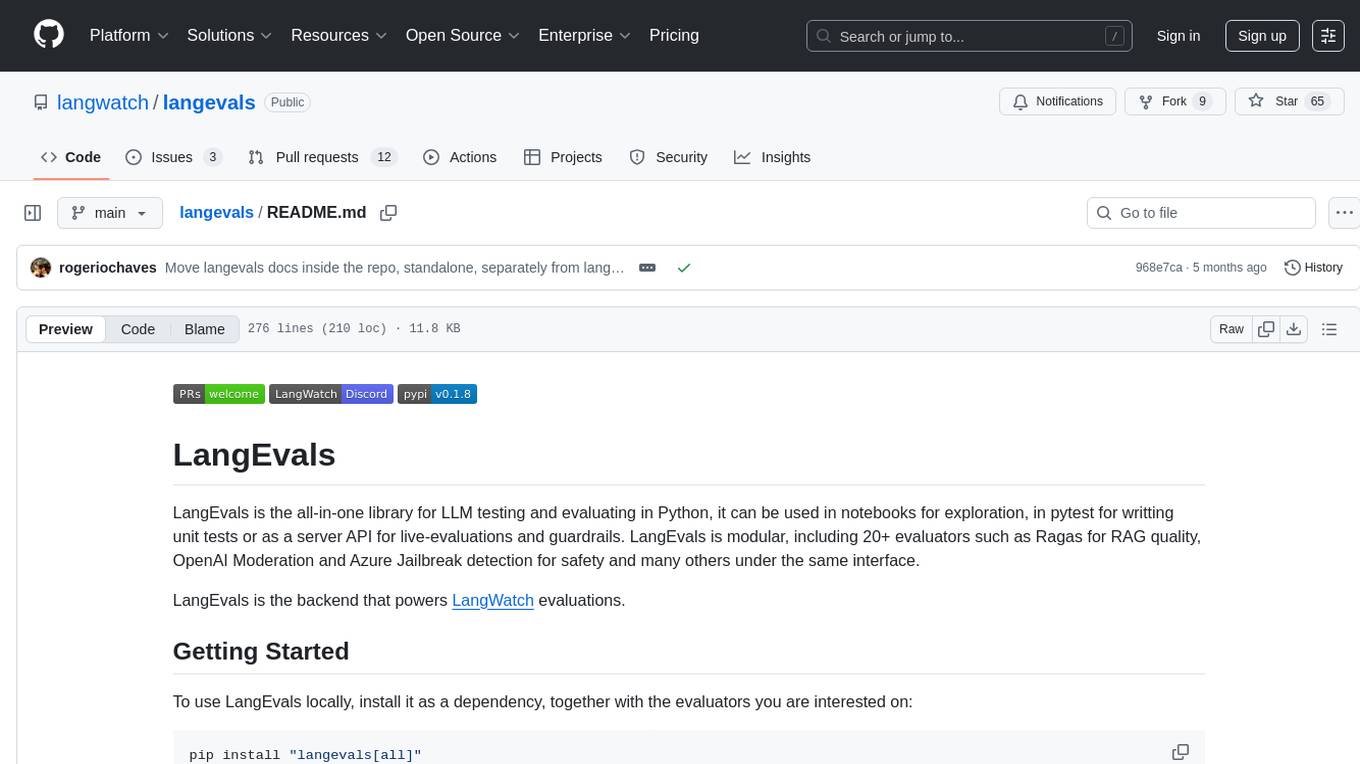
LangEvals is an all-in-one Python library for testing and evaluating LLM models. It can be used in notebooks for exploration, in pytest for writing unit tests, or as a server API for live evaluations and guardrails. The library is modular, with 20+ evaluators including Ragas for RAG quality, OpenAI Moderation, and Azure Jailbreak detection. LangEvals powers LangWatch evaluations and provides tools for batch evaluations on notebooks and unit test evaluations with PyTest. It also offers LangEvals evaluators for LLM-as-a-Judge scenarios and out-of-the-box evaluators for language detection and answer relevancy checks.
openai
An open-source client package that allows developers to easily integrate the power of OpenAI's state-of-the-art AI models into their Dart/Flutter applications. The library provides simple and intuitive methods for making requests to OpenAI's various APIs, including the GPT-3 language model, DALL-E image generation, and more. It is designed to be lightweight and easy to use, enabling developers to focus on building their applications without worrying about the complexities of dealing with HTTP requests. Note that this is an unofficial library as OpenAI does not have an official Dart library.
chatmemory
ChatMemory is a simple yet powerful long-term memory manager that facilitates communication between AI and users. It organizes conversation data into history, summary, and knowledge entities, enabling quick retrieval of context and generation of clear, concise answers. The tool leverages vector search on summaries/knowledge and detailed history to provide accurate responses. It balances speed and accuracy by using lightweight retrieval and fallback detailed search mechanisms, ensuring efficient memory management and response generation beyond mere data retrieval.
npcsh
`npcsh` is a python-based command-line tool designed to integrate Large Language Models (LLMs) and Agents into one's daily workflow by making them available and easily configurable through the command line shell. It leverages the power of LLMs to understand natural language commands and questions, execute tasks, answer queries, and provide relevant information from local files and the web. Users can also build their own tools and call them like macros from the shell. `npcsh` allows users to take advantage of agents (i.e. NPCs) through a managed system, tailoring NPCs to specific tasks and workflows. The tool is extensible with Python, providing useful functions for interacting with LLMs, including explicit coverage for popular providers like ollama, anthropic, openai, gemini, deepseek, and openai-like providers. Users can set up a flask server to expose their NPC team for use as a backend service, run SQL models defined in their project, execute assembly lines, and verify the integrity of their NPC team's interrelations. Users can execute bash commands directly, use favorite command-line tools like VIM, Emacs, ipython, sqlite3, git, pipe the output of these commands to LLMs, or pass LLM results to bash commands.
llm-strategy
The 'llm-strategy' repository implements the Strategy Pattern using Large Language Models (LLMs) like OpenAI’s GPT-3. It provides a decorator 'llm_strategy' that connects to an LLM to implement abstract methods in interface classes. The package uses doc strings, type annotations, and method/function names as prompts for the LLM and can convert the responses back to Python data. It aims to automate the parsing of structured data by using LLMs, potentially reducing the need for manual Python code in the future.
Toolio
Toolio is an OpenAI-like HTTP server API implementation that supports structured LLM response generation, making it conform to a JSON schema. It is useful for reliable tool calling and agentic workflows based on schema-driven output. Toolio is based on the MLX framework for Apple Silicon, specifically M1/M2/M3/M4 Macs. It allows users to host MLX-format LLMs for structured output queries and provides a command line client for easier usage of tools. The tool also supports multiple tool calls and the creation of custom tools for specific tasks.

motorhead
Motorhead is a memory and information retrieval server for LLMs. It provides three simple APIs to assist with memory handling in chat applications using LLMs. The first API, GET /sessions/:id/memory, returns messages up to a maximum window size. The second API, POST /sessions/:id/memory, allows you to send an array of messages to Motorhead for storage. The third API, DELETE /sessions/:id/memory, deletes the session's message list. Motorhead also features incremental summarization, where it processes half of the maximum window size of messages and summarizes them when the maximum is reached. Additionally, it supports searching by text query using vector search. Motorhead is configurable through environment variables, including the maximum window size, whether to enable long-term memory, the model used for incremental summarization, the server port, your OpenAI API key, and the Redis URL.
vinagent
Vinagent is a lightweight and flexible library designed for building smart agent assistants across various industries. It provides a simple yet powerful foundation for creating AI-powered customer service bots, data analysis assistants, or domain-specific automation agents. With its modular tool system, users can easily extend their agent's capabilities by integrating a wide range of tools that are self-contained, well-documented, and can be registered dynamically. Vinagent allows users to scale and adapt their agents to new tasks or environments effortlessly.
VedAstro
VedAstro is an open-source Vedic astrology tool that provides accurate astrological predictions and data. It offers a user-friendly website, a chat API, an open API, a JavaScript SDK, a Swiss Ephemeris API, and a machine learning table generator. VedAstro is free to use and is constantly being updated with new features and improvements.
uzu-swift
Swift package for uzu, a high-performance inference engine for AI models on Apple Silicon. Deploy AI directly in your app with zero latency, full data privacy, and no inference costs. Key features include a simple, high-level API, specialized configurations for performance boosts, broad model support, and an observable model manager. Easily set up projects, obtain an API key, choose a model, and run it with corresponding identifiers. Examples include chat, speedup with speculative decoding, chat with dynamic context, chat with static context, summarization, classification, cloud, and structured output. Troubleshooting available via Discord or email. Licensed under MIT.
azure-functions-openai-extension
Azure Functions OpenAI Extension is a project that adds support for OpenAI LLM (GPT-3.5-turbo, GPT-4) bindings in Azure Functions. It provides NuGet packages for various functionalities like text completions, chat completions, assistants, embeddings generators, and semantic search. The project requires .NET 6 SDK or greater, Azure Functions Core Tools v4.x, and specific settings in Azure Function or local settings for development. It offers features like text completions, chat completion, assistants with custom skills, embeddings generators for text relatedness, and semantic search using vector databases. The project also includes examples in C# and Python for different functionalities.
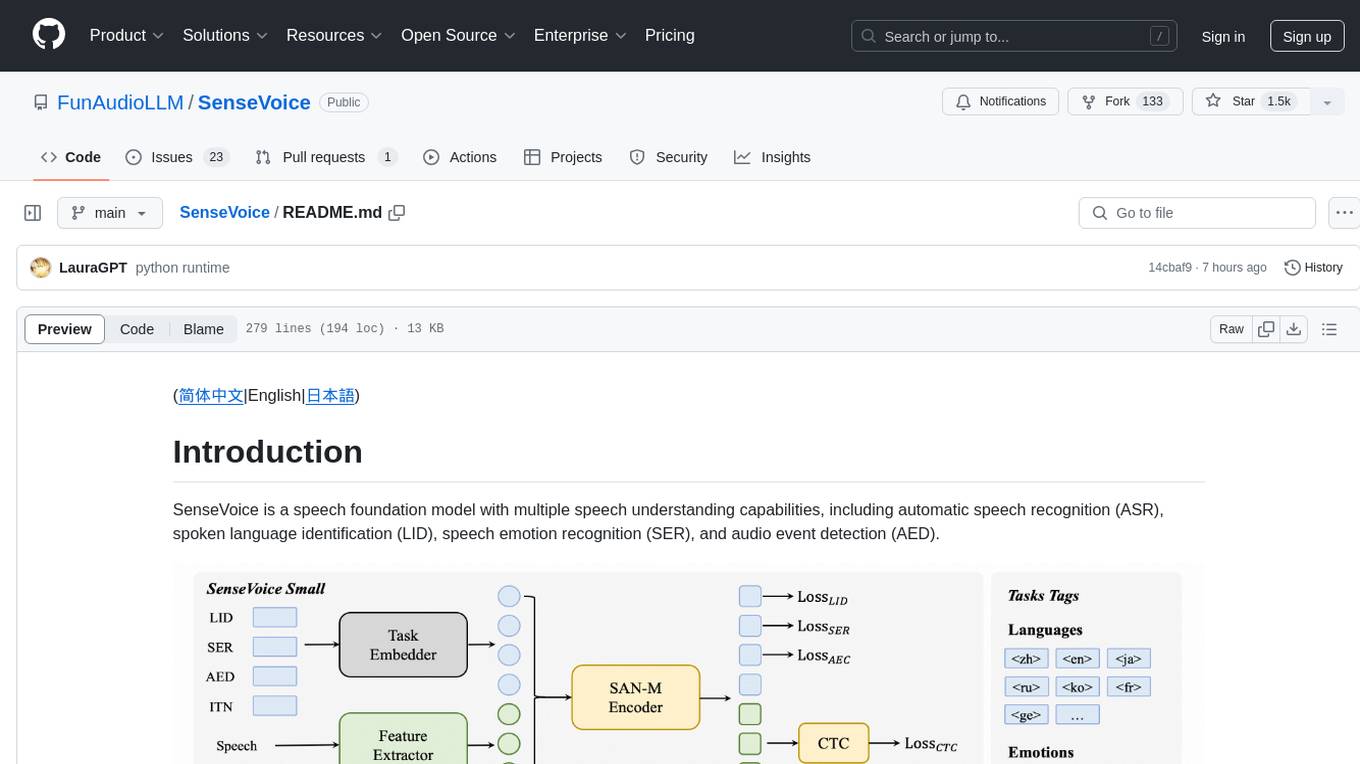
SenseVoice
SenseVoice is a speech foundation model focusing on high-accuracy multilingual speech recognition, speech emotion recognition, and audio event detection. Trained with over 400,000 hours of data, it supports more than 50 languages and excels in emotion recognition and sound event detection. The model offers efficient inference with low latency and convenient finetuning scripts. It can be deployed for service with support for multiple client-side languages. SenseVoice-Small model is open-sourced and provides capabilities for Mandarin, Cantonese, English, Japanese, and Korean. The tool also includes features for natural speech generation and fundamental speech recognition tasks.
LLM-Blender
LLM-Blender is a framework for ensembling large language models (LLMs) to achieve superior performance. It consists of two modules: PairRanker and GenFuser. PairRanker uses pairwise comparisons to distinguish between candidate outputs, while GenFuser merges the top-ranked candidates to create an improved output. LLM-Blender has been shown to significantly surpass the best LLMs and baseline ensembling methods across various metrics on the MixInstruct benchmark dataset.
For similar tasks
extractor
Extractor is an AI-powered data extraction library for Laravel that leverages OpenAI's capabilities to effortlessly extract structured data from various sources, including images, PDFs, and emails. It features a convenient wrapper around OpenAI Chat and Completion endpoints, supports multiple input formats, includes a flexible Field Extractor for arbitrary data extraction, and integrates with Textract for OCR functionality. Extractor utilizes JSON Mode from the latest GPT-3.5 and GPT-4 models, providing accurate and efficient data extraction.
NeMo-Guardrails
NeMo Guardrails is an open-source toolkit for easily adding _programmable guardrails_ to LLM-based conversational applications. Guardrails (or "rails" for short) are specific ways of controlling the output of a large language model, such as not talking about politics, responding in a particular way to specific user requests, following a predefined dialog path, using a particular language style, extracting structured data, and more.
kor
Kor is a prototype tool designed to help users extract structured data from text using Language Models (LLMs). It generates prompts, sends them to specified LLMs, and parses the output. The tool works with the parsing approach and is integrated with the LangChain framework. Kor is compatible with pydantic v2 and v1, and schema is typed checked using pydantic. It is primarily used for extracting information from text based on provided reference examples and schema documentation. Kor is designed to work with all good-enough LLMs regardless of their support for function/tool calling or JSON modes.
awesome-llm-json
This repository is an awesome list dedicated to resources for using Large Language Models (LLMs) to generate JSON or other structured outputs. It includes terminology explanations, hosted and local models, Python libraries, blog articles, videos, Jupyter notebooks, and leaderboards related to LLMs and JSON generation. The repository covers various aspects such as function calling, JSON mode, guided generation, and tool usage with different providers and models.
tensorzero
TensorZero is an open-source platform that helps LLM applications graduate from API wrappers into defensible AI products. It enables a data & learning flywheel for LLMs by unifying inference, observability, optimization, and experimentation. The platform includes a high-performance model gateway, structured schema-based inference, observability, experimentation, and data warehouse for analytics. TensorZero Recipes optimize prompts and models, and the platform supports experimentation features and GitOps orchestration for deployment.
stagehand
Stagehand is an AI web browsing framework that simplifies and extends web automation using three simple APIs: act, extract, and observe. It aims to provide a lightweight, configurable framework without complex abstractions, allowing users to automate web tasks reliably. The tool generates Playwright code based on atomic instructions provided by the user, enabling natural language-driven web automation. Stagehand is open source, maintained by the Browserbase team, and supports different models and model providers for flexibility in automation tasks.
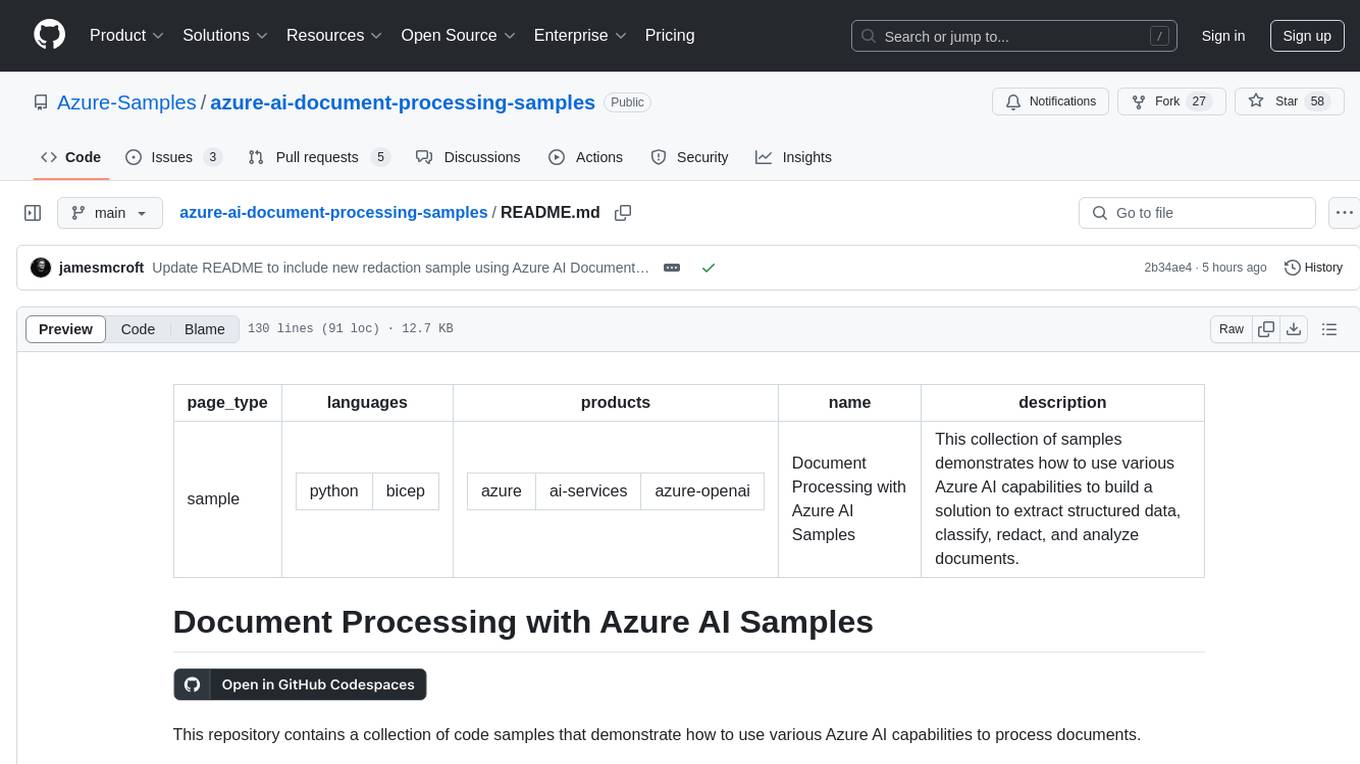
azure-ai-document-processing-samples
This repository contains a collection of code samples that demonstrate how to use various Azure AI capabilities to process documents. The samples help engineering teams establish techniques with Azure AI Foundry, Azure OpenAI, Azure AI Document Intelligence, and Azure AI Language services to build solutions for extracting structured data, classifying, and analyzing documents. The techniques simplify custom model training, improve reliability in document processing, and simplify document processing workflows by providing reusable code and patterns that can be easily modified and evaluated for most use cases.
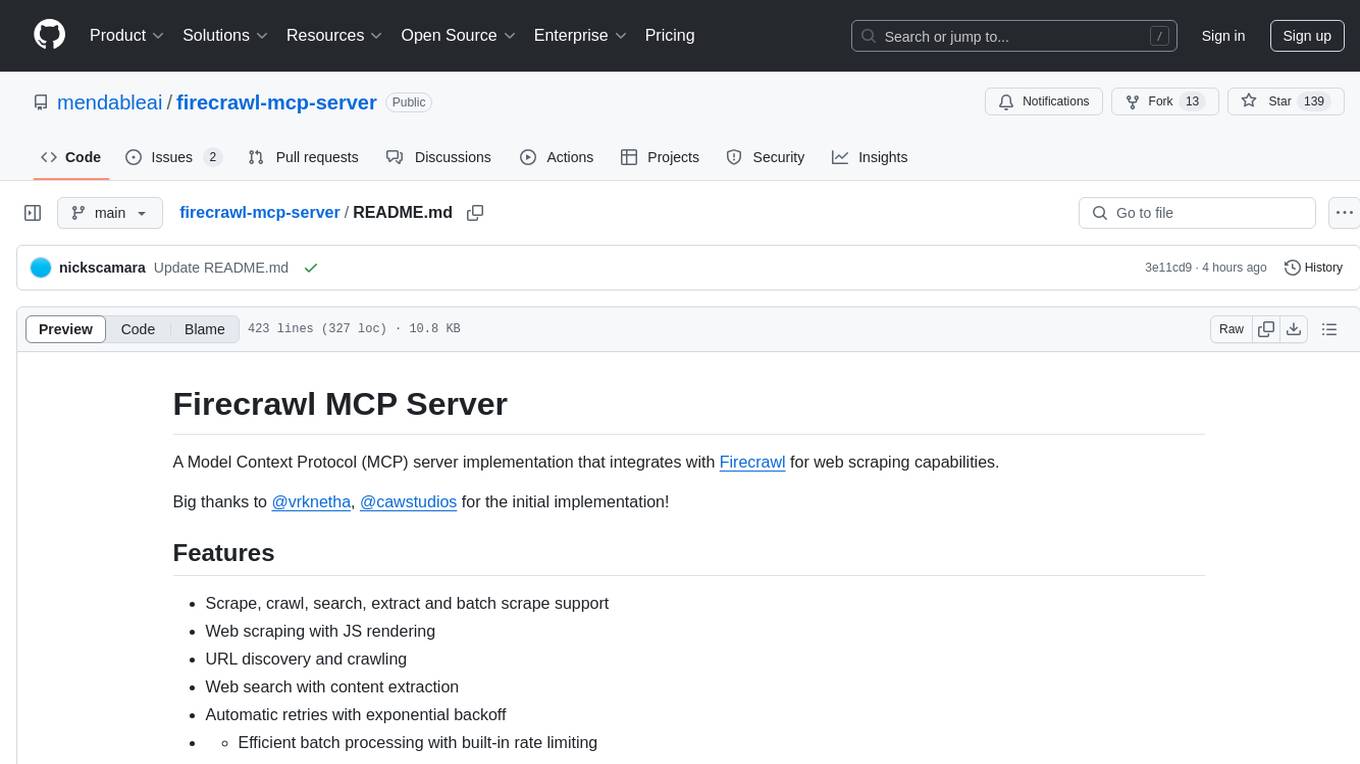
firecrawl-mcp-server
Firecrawl MCP Server is a Model Context Protocol (MCP) server implementation that integrates with Firecrawl for web scraping capabilities. It supports features like scrape, crawl, search, extract, and batch scrape. It provides web scraping with JS rendering, URL discovery, web search with content extraction, automatic retries with exponential backoff, credit usage monitoring, comprehensive logging system, support for cloud and self-hosted FireCrawl instances, mobile/desktop viewport support, and smart content filtering with tag inclusion/exclusion. The server includes configurable parameters for retry behavior and credit usage monitoring, rate limiting and batch processing capabilities, and tools for scraping, batch scraping, checking batch status, searching, crawling, and extracting structured information from web pages.
For similar jobs
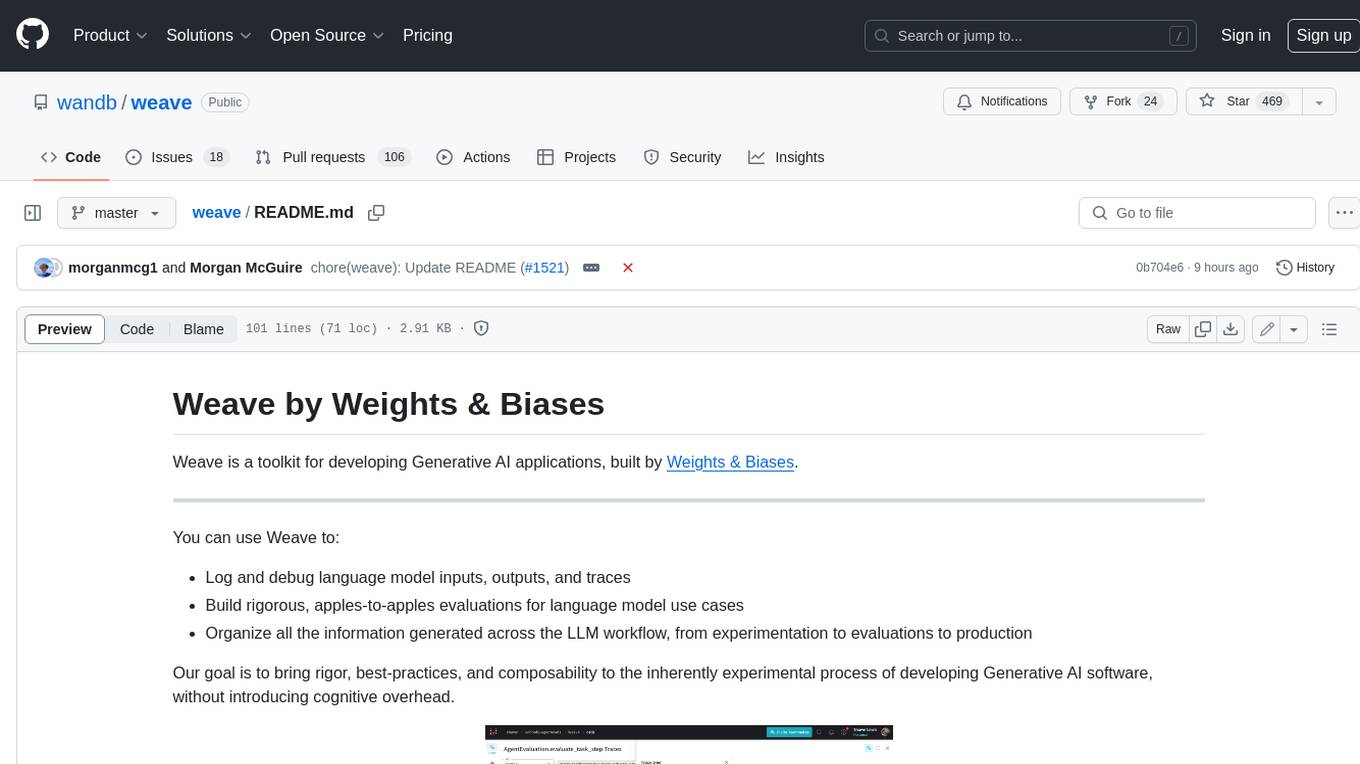
weave
Weave is a toolkit for developing Generative AI applications, built by Weights & Biases. With Weave, you can log and debug language model inputs, outputs, and traces; build rigorous, apples-to-apples evaluations for language model use cases; and organize all the information generated across the LLM workflow, from experimentation to evaluations to production. Weave aims to bring rigor, best-practices, and composability to the inherently experimental process of developing Generative AI software, without introducing cognitive overhead.
LLMStack
LLMStack is a no-code platform for building generative AI agents, workflows, and chatbots. It allows users to connect their own data, internal tools, and GPT-powered models without any coding experience. LLMStack can be deployed to the cloud or on-premise and can be accessed via HTTP API or triggered from Slack or Discord.
VisionCraft
The VisionCraft API is a free API for using over 100 different AI models. From images to sound.
kaito
Kaito is an operator that automates the AI/ML inference model deployment in a Kubernetes cluster. It manages large model files using container images, avoids tuning deployment parameters to fit GPU hardware by providing preset configurations, auto-provisions GPU nodes based on model requirements, and hosts large model images in the public Microsoft Container Registry (MCR) if the license allows. Using Kaito, the workflow of onboarding large AI inference models in Kubernetes is largely simplified.
PyRIT
PyRIT is an open access automation framework designed to empower security professionals and ML engineers to red team foundation models and their applications. It automates AI Red Teaming tasks to allow operators to focus on more complicated and time-consuming tasks and can also identify security harms such as misuse (e.g., malware generation, jailbreaking), and privacy harms (e.g., identity theft). The goal is to allow researchers to have a baseline of how well their model and entire inference pipeline is doing against different harm categories and to be able to compare that baseline to future iterations of their model. This allows them to have empirical data on how well their model is doing today, and detect any degradation of performance based on future improvements.
tabby
Tabby is a self-hosted AI coding assistant, offering an open-source and on-premises alternative to GitHub Copilot. It boasts several key features: * Self-contained, with no need for a DBMS or cloud service. * OpenAPI interface, easy to integrate with existing infrastructure (e.g Cloud IDE). * Supports consumer-grade GPUs.
spear
SPEAR (Simulator for Photorealistic Embodied AI Research) is a powerful tool for training embodied agents. It features 300 unique virtual indoor environments with 2,566 unique rooms and 17,234 unique objects that can be manipulated individually. Each environment is designed by a professional artist and features detailed geometry, photorealistic materials, and a unique floor plan and object layout. SPEAR is implemented as Unreal Engine assets and provides an OpenAI Gym interface for interacting with the environments via Python.
Magick
Magick is a groundbreaking visual AIDE (Artificial Intelligence Development Environment) for no-code data pipelines and multimodal agents. Magick can connect to other services and comes with nodes and templates well-suited for intelligent agents, chatbots, complex reasoning systems and realistic characters.