


compl-ai
An open-source compliance-centered evaluation framework for Generative AI models
Stars: 179
COMPL-AI is a compliance-centered evaluation framework for LLMs created by ETH Zurich, INSAIT, and LatticeFlow AI. It includes a technical interpretation of the EU AI Act and an open-source benchmarking suite. The framework offers tailored benchmarks covering various technical aspects of the EU AI Act, a public Hugging Face leaderboard, and support for multiple providers. Users can run evaluations using a custom CLI tool and contribute to expanding benchmark coverage. The framework is undergoing updates to enhance coverage over the EU AI Act principles and technical requirements, with a focus on risk management, data quality, and cybersecurity measures.
README:

ETH Zurich, INSAIT and LatticeFlow AI.


The COMPL-AI framework includes a technical interpretation of the EU AI Act and an open-source benchmarking suite (this repo). The key features are:
- Built on the Inspect evaluation framework
- Tailored set of benchmarks to provide coverage over technical parts of EU AI Act (29 and growing)
- A public Hugging Face leaderboard of our latest evaluation results
- Extensive set of supported providers (API, Cloud, Local).
- A custom eval CLI (run
complai --helpfor usage)
Community contributions for benchmarks and new mappings are welcome! We are actively looking to expand our EU AI Act and Code of Practice technical interpretation and benchmark coverage. See the contributing section below.
To run an evaluation yourself, please follow the instructions below (or contact us through compl-ai.org).
# Clone and create a virtual environment
git clone https://github.com/compl-ai/compl-ai.git
cd compl-ai
uv sync
source .venv/bin/activate

# Set your API key
export OPENAI_API_KEY=your_key

# Run 5 samples on a single benchmark
complai eval openai/gpt-5-nano --tasks mmlu_pro --limit 5

# Or run the full framework
complai eval openai/gpt-5-nano
You can then view a detailed sample-level log of your results with the Inspect AI VS Code extension, or in your browser with:
inspect view
complai COMMAND --help
complai list
complai eval <provider>/<model> -t <task_name> -l <n_samples>
# Remote API
complai eval openai/gpt-4o-mini
complai eval anthropic/claude-sonnet-4-0

# Locally with HF backend, set cuda device (use mps for macOS)
complai eval hf/Qwen/Qwen3-8B -t mmlu_pro -M device=cuda:0

# Using vLLM backend, evaluate specific sample and cap number of sandboxes for agentic benchmarks
complai eval vllm/Qwen/Qwen3-8B -t swe_bench_verified --sample-id django__django-11848 --max-sandboxes 1

# Use task configuration file or CLI task args (CLI args take precedence)
complai eval openai/gpt-5-nano --task-config default_config.yaml -T mmlu_pro:num_fewshot=5

# Retry (if eval failed) with existing log directory or specify custom log directory (supports S3 URLs)
complai eval openai/gpt-5-nano --log-dir path/to/logdir
COMPL-AI supports task-specific configuration via YAML or JSON files. See default_config.yaml for a reference of all configurable parameters. You can:
- Use the default config as a template:
cp default_config.yaml my_config.yaml - Modify the tasks and parameters you want
- Pass it to any eval:
complai eval <model> --task-config my_config.yaml
See the Providers section for more information on different providers.
COMPL-AI can auto-load models (COMPLAI_MODEL), API keys (OPENAI_API_KEY), and many other configurations (COMPLAI_LOG_DIR) from your local .env file. Values provided in the CLI take precedence over .env vars.
The current version of the framework is published here.
We are currently in the process of renewing our coverage of the EU AI Act by updating the set of benchmarks, thus the supported set of benchmark may differ from this original mapping. The goals of this update are:
- To increase coverage over the EU AI Act principles
- To increase coverage over technical requirements
- Adding support for the Code of Practice, namely the Safety and Security chapter.
- Adding the notion of
riskalong sidetechnical requirements - Refreshing the supported benchmarks to ensure they remain challenging for frontier models (addressing saturation, contamination, and other benchmark quality issues).
As part of our update, the renewed benchmarking suite is now built on the UK Security Institute’s Inspect Framework, which offers improved ease of use and greater overall consistency. This means that several benchmarks are now evaluated differently (e.g. full-text answers instead of logits for multiple-choice questions) reflecting more modern and opinionated approaches to LLM evaluation. Thus, benchmark scores from the v1 and v2 suites, even for the same benchmark, should not be considered directly comparable.
COMPL-AI is primarily structured to provide coverage over 6 core EU AI Act principles:
- Human Agency and Oversight: AI systems should be supervised by people, not by automation alone, to prevent harmful outcomes and allow for human intervention.
- Technical Robustness and Safety: AI systems must be safe and secure, implementing risk management, data quality, and - cybersecurity measures to prevent undue risks.
- Privacy and Data Governance: The Act sets rules for the quality and governance of data used in AI, emphasizing the protection of personal and sensitive information.
- Transparency: Users should understand when they are interacting with an AI system and how it functions, fostering trust and enabling accountability.
- Diversity, Non-Discrimination, and Fairness: AI systems should be designed and used to uphold human rights, including fairness and equality, and avoid biases that could lead to discrimination.
- Societal and Environmental Well-being: AI systems should be developed in a way that benefits society and the environment, avoiding negative impacts on fundamental rights and democratic values.
You can see a list of all technical requirements and their respective benchmarks using complai list:
-
Capabilities, Performance, and Limitations
- aime_2025, arc_challenge, gpqa_diamond, hle, ifbench, include, livebench_coding, mmlu_pro, swe_bench_verified
-
Representation — Absence of Bias
- bbq, bold, cab
-
Interpretability
- bigbench_calibration, triviaqa_calibration
-
Robustness and Predictability
- boolq_contrast, forecast_consistency, imdb_contrast, mmlu_pro_robustness, self_check_consistency
-
Fairness — Absence of Discrimination
- decoding_trust, fairllm
-
Disclosure of AI
- human_deception
-
Cyberattack Resilience
- instruction_goal_hijacking, llm_rules, strong_reject
-
Societal Alignment
- mask, simpleqa_verified, truthfulqa
-
Harmful Content and Toxicity
- realtoxicityprompts
We welcome contributions! When contributing, please make sure to activate pre-commit hooks to ensure code quality and consistency. You can install pre-commit hooks with:
pip install pre-commit
pre-commit install
To run tests, run the following command:
make test
This project is licensed under the Apache 2.0 License - see LICENSE for details.
Please cite our work as follows:
@article{complai24,
      title={COMPL-AI Framework: A Technical Interpretation and LLM Benchmarking Suite for the EU Artificial Intelligence Act},
      author={Philipp Guldimann and Alexander Spiridonov and Robin Staab and Nikola Jovanovi\'{c} and Mark Vero and Velko Vechev and Anna Gueorguieva and Mislav Balunovi\'{c} and Nikola Konstantinov and Pavol Bielik and Petar Tsankov and Martin Vechev},
      year={2024},
      eprint={2410.07959},
      primaryClass={cs.CL},
      url={https://arxiv.org/abs/2410.07959},
}
For Tasks:
Click tags to check more tools for each tasksFor Jobs:
Alternative AI tools for compl-ai
Similar Open Source Tools
compl-ai
COMPL-AI is a compliance-centered evaluation framework for LLMs created by ETH Zurich, INSAIT, and LatticeFlow AI. It includes a technical interpretation of the EU AI Act and an open-source benchmarking suite. The framework offers tailored benchmarks covering various technical aspects of the EU AI Act, a public Hugging Face leaderboard, and support for multiple providers. Users can run evaluations using a custom CLI tool and contribute to expanding benchmark coverage. The framework is undergoing updates to enhance coverage over the EU AI Act principles and technical requirements, with a focus on risk management, data quality, and cybersecurity measures.
AIF360
The AI Fairness 360 toolkit is an open-source library designed to detect and mitigate bias in machine learning models. It provides a comprehensive set of metrics, explanations, and algorithms for bias mitigation in various domains such as finance, healthcare, and education. The toolkit supports multiple bias mitigation algorithms and fairness metrics, and is available in both Python and R. Users can leverage the toolkit to ensure fairness in AI applications and contribute to its development for extensibility.
iLLM-TSC
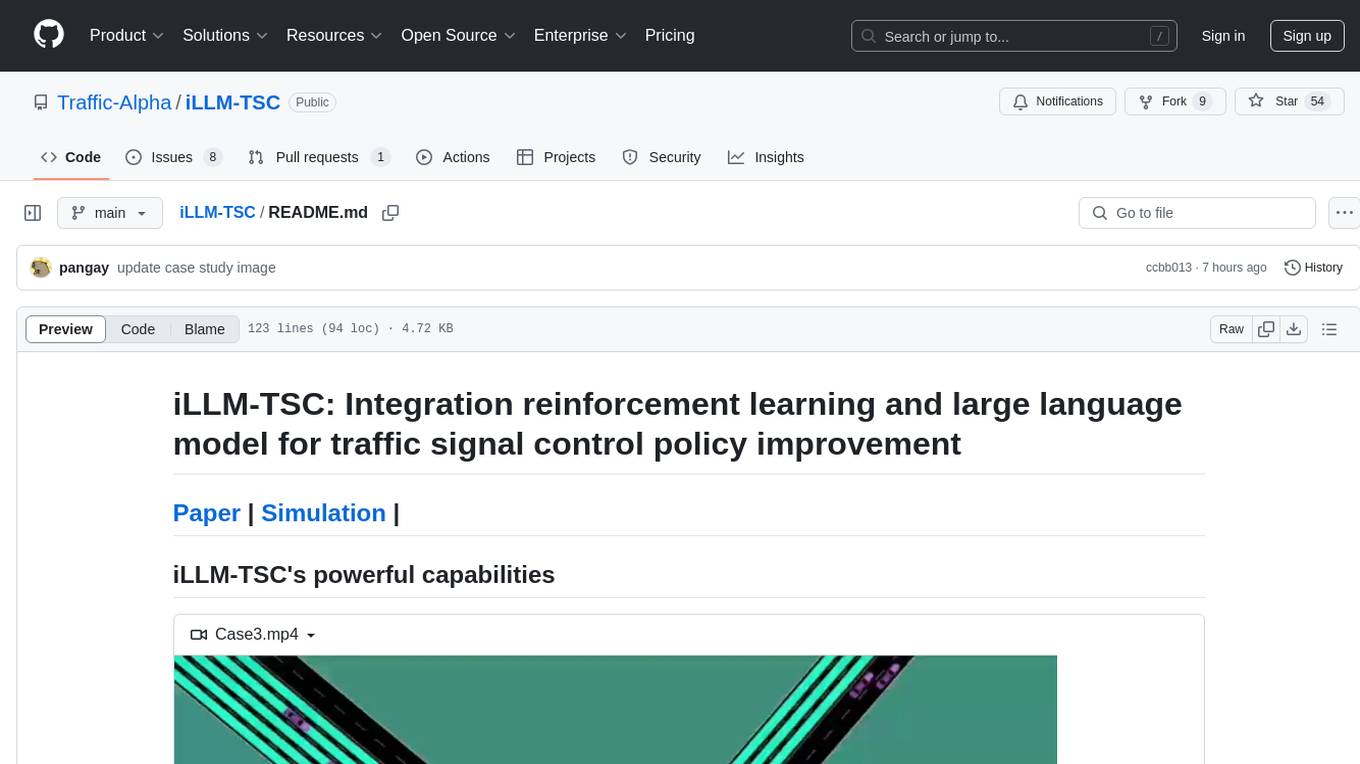
iLLM-TSC is a framework that integrates reinforcement learning and large language models for traffic signal control policy improvement. It refines RL decisions based on real-world contexts and provides reasonable actions when RL agents make erroneous decisions. The framework includes cases where the large language model provides explanations and recommendations for RL agent actions, such as prioritizing emergency vehicles at intersections. Users can install and run the framework locally to train RL models and evaluate the combined RL+LLM approach.
hackingBuddyGPT
hackingBuddyGPT is a framework for testing LLM-based agents for security testing. It aims to create common ground truth by creating common security testbeds and benchmarks, evaluating multiple LLMs and techniques against those, and publishing prototypes and findings as open-source/open-access reports. The initial focus is on evaluating the efficiency of LLMs for Linux privilege escalation attacks, but the framework is being expanded to evaluate the use of LLMs for web penetration-testing and web API testing. hackingBuddyGPT is released as open-source to level the playing field for blue teams against APTs that have access to more sophisticated resources.
crewAI
crewAI is a cutting-edge framework for orchestrating role-playing, autonomous AI agents. By fostering collaborative intelligence, CrewAI empowers agents to work together seamlessly, tackling complex tasks. It provides a flexible and structured approach to AI collaboration, enabling users to define agents with specific roles, goals, and tools, and assign them tasks within a customizable process. crewAI supports integration with various LLMs, including OpenAI, and offers features such as autonomous task delegation, flexible task management, and output parsing. It is open-source and welcomes contributions, with a focus on improving the library based on usage data collected through anonymous telemetry.
R1-Searcher
R1-searcher is a tool designed to incentivize the search capability in large reasoning models (LRMs) via reinforcement learning. It enables LRMs to invoke web search and obtain external information during the reasoning process by utilizing a two-stage outcome-supervision reinforcement learning approach. The tool does not require instruction fine-tuning for cold start and is compatible with existing Base LLMs or Chat LLMs. It includes training code, inference code, model checkpoints, and a detailed technical report.
council
Council is an open-source platform designed for the rapid development and deployment of customized generative AI applications using teams of agents. It extends the LLM tool ecosystem by providing advanced control flow and scalable oversight for AI agents. Users can create sophisticated agents with predictable behavior by leveraging Council's powerful approach to control flow using Controllers, Filters, Evaluators, and Budgets. The framework allows for automated routing between agents, comparing, evaluating, and selecting the best results for a task. Council aims to facilitate packaging and deploying agents at scale on multiple platforms while enabling enterprise-grade monitoring and quality control.
aligner
Aligner is a model-agnostic alignment tool designed to efficiently correct responses from large language models. It redistributes initial answers to align with human intentions, improving performance across various LLMs. The tool can be applied with minimal training, enhancing upstream models and reducing hallucination. Aligner's 'copy and correct' method preserves the base structure while enhancing responses. It achieves significant performance improvements in helpfulness, harmlessness, and honesty dimensions, with notable success in boosting Win Rates on evaluation leaderboards.
codebase-context-spec
The Codebase Context Specification (CCS) project aims to standardize embedding contextual information within codebases to enhance understanding for both AI and human developers. It introduces a convention similar to `.env` and `.editorconfig` files but focused on documenting code for both AI and humans. By providing structured contextual metadata, collaborative documentation guidelines, and standardized context files, developers can improve code comprehension, collaboration, and development efficiency. The project includes a linter for validating context files and provides guidelines for using the specification with AI assistants. Tooling recommendations suggest creating memory systems, IDE plugins, AI model integrations, and agents for context creation and utilization. Future directions include integration with existing documentation systems, dynamic context generation, and support for explicit context overriding.
watchtower
AIShield Watchtower is a tool designed to fortify the security of AI/ML models and Jupyter notebooks by automating model and notebook discoveries, conducting vulnerability scans, and categorizing risks into 'low,' 'medium,' 'high,' and 'critical' levels. It supports scanning of public GitHub repositories, Hugging Face repositories, AWS S3 buckets, and local systems. The tool generates comprehensive reports, offers a user-friendly interface, and aligns with industry standards like OWASP, MITRE, and CWE. It aims to address the security blind spots surrounding Jupyter notebooks and AI models, providing organizations with a tailored approach to enhancing their security efforts.
radicalbit-ai-monitoring
The Radicalbit AI Monitoring Platform provides a comprehensive solution for monitoring Machine Learning and Large Language models in production. It helps proactively identify and address potential performance issues by analyzing data quality, model quality, and model drift. The repository contains files and projects for running the platform, including UI, API, SDK, and Spark components. Installation using Docker compose is provided, allowing deployment with a K3s cluster and interaction with a k9s container. The platform documentation includes a step-by-step guide for installation and creating dashboards. Community engagement is encouraged through a Discord server. The roadmap includes adding functionalities for batch and real-time workloads, covering various model types and tasks.
promptflow
**Prompt flow** is a suite of development tools designed to streamline the end-to-end development cycle of LLM-based AI applications, from ideation, prototyping, testing, evaluation to production deployment and monitoring. It makes prompt engineering much easier and enables you to build LLM apps with production quality.
gromacs_copilot
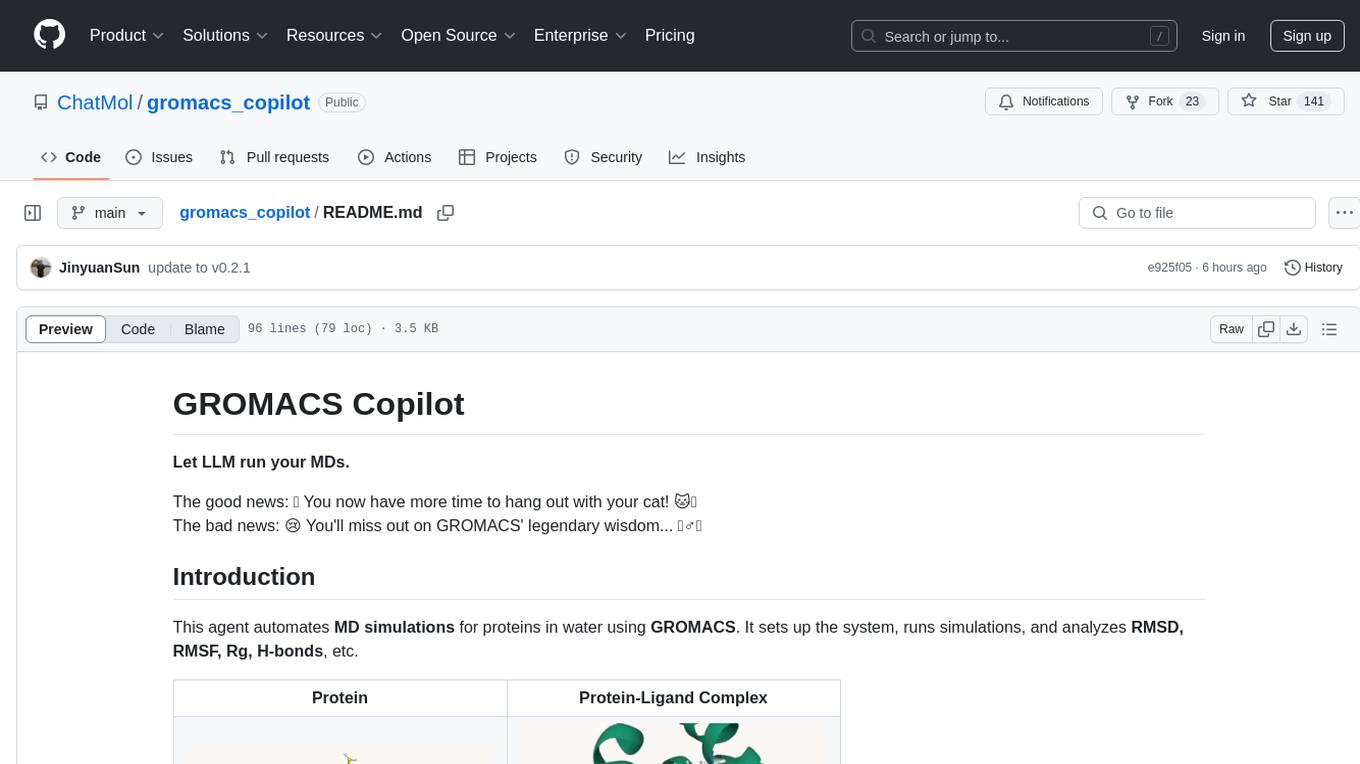
GROMACS Copilot is an agent designed to automate molecular dynamics simulations for proteins in water using GROMACS. It handles system setup, simulation execution, and result analysis automatically, providing outputs such as RMSD, RMSF, Rg, and H-bonds. Users can interact with the agent through prompts and API keys from DeepSeek and OpenAI. The tool aims to simplify the process of running MD simulations, allowing users to focus on other tasks while it handles the technical aspects of the simulations.
easydist
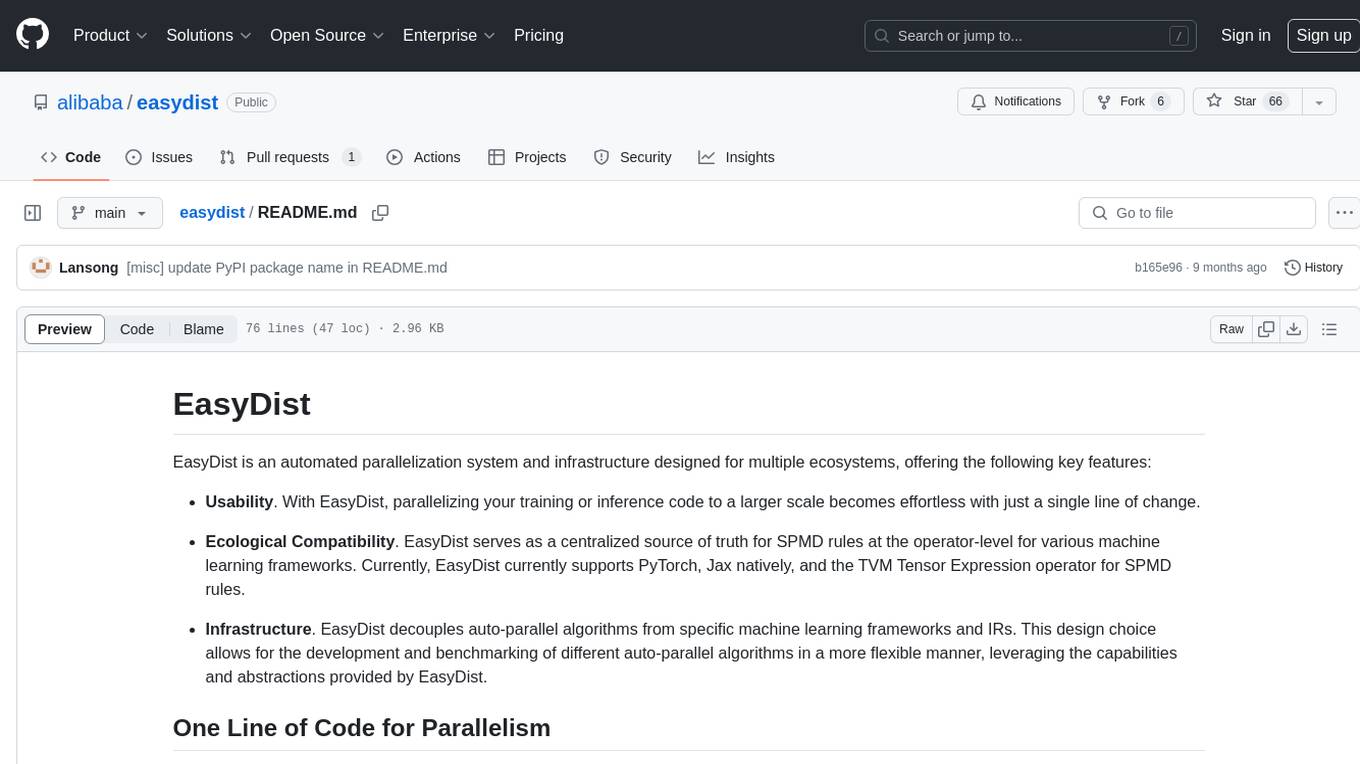
EasyDist is an automated parallelization system and infrastructure designed for multiple ecosystems. It offers usability by making parallelizing training or inference code effortless with just a single line of change. It ensures ecological compatibility by serving as a centralized source of truth for SPMD rules at the operator-level for various machine learning frameworks. EasyDist decouples auto-parallel algorithms from specific frameworks and IRs, allowing for the development and benchmarking of different auto-parallel algorithms in a flexible manner. The architecture includes MetaOp, MetaIR, and the ShardCombine Algorithm for SPMD sharding rules without manual annotations.
uAgents
uAgents is a Python library developed by Fetch.ai that allows for the creation of autonomous AI agents. These agents can perform various tasks on a schedule or take action on various events. uAgents are easy to create and manage, and they are connected to a fast-growing network of other uAgents. They are also secure, with cryptographically secured messages and wallets.
SwiftSage
SwiftSage is a tool designed for conducting experiments in the field of machine learning and artificial intelligence. It provides a platform for researchers and developers to implement and test various algorithms and models. The tool is particularly useful for exploring new ideas and conducting experiments in a controlled environment. SwiftSage aims to streamline the process of developing and testing machine learning models, making it easier for users to iterate on their ideas and achieve better results. With its user-friendly interface and powerful features, SwiftSage is a valuable tool for anyone working in the field of AI and ML.
For similar tasks
compl-ai
COMPL-AI is a compliance-centered evaluation framework for LLMs created by ETH Zurich, INSAIT, and LatticeFlow AI. It includes a technical interpretation of the EU AI Act and an open-source benchmarking suite. The framework offers tailored benchmarks covering various technical aspects of the EU AI Act, a public Hugging Face leaderboard, and support for multiple providers. Users can run evaluations using a custom CLI tool and contribute to expanding benchmark coverage. The framework is undergoing updates to enhance coverage over the EU AI Act principles and technical requirements, with a focus on risk management, data quality, and cybersecurity measures.
LLMEvaluation
The LLMEvaluation repository is a comprehensive compendium of evaluation methods for Large Language Models (LLMs) and LLM-based systems. It aims to assist academics and industry professionals in creating effective evaluation suites tailored to their specific needs by reviewing industry practices for assessing LLMs and their applications. The repository covers a wide range of evaluation techniques, benchmarks, and studies related to LLMs, including areas such as embeddings, question answering, multi-turn dialogues, reasoning, multi-lingual tasks, ethical AI, biases, safe AI, code generation, summarization, software performance, agent LLM architectures, long text generation, graph understanding, and various unclassified tasks. It also includes evaluations for LLM systems in conversational systems, copilots, search and recommendation engines, task utility, and verticals like healthcare, law, science, financial, and others. The repository provides a wealth of resources for evaluating and understanding the capabilities of LLMs in different domains.
labelbox-python
Labelbox is a data-centric AI platform for enterprises to develop, optimize, and use AI to solve problems and power new products and services. Enterprises use Labelbox to curate data, generate high-quality human feedback data for computer vision and LLMs, evaluate model performance, and automate tasks by combining AI and human-centric workflows. The academic & research community uses Labelbox for cutting-edge AI research.
promptfoo
Promptfoo is a tool for testing and evaluating LLM output quality. With promptfoo, you can build reliable prompts, models, and RAGs with benchmarks specific to your use-case, speed up evaluations with caching, concurrency, and live reloading, score outputs automatically by defining metrics, use as a CLI, library, or in CI/CD, and use OpenAI, Anthropic, Azure, Google, HuggingFace, open-source models like Llama, or integrate custom API providers for any LLM API.
vespa
Vespa is a platform that performs operations such as selecting a subset of data in a large corpus, evaluating machine-learned models over the selected data, organizing and aggregating it, and returning it, typically in less than 100 milliseconds, all while the data corpus is continuously changing. It has been in development for many years and is used on a number of large internet services and apps which serve hundreds of thousands of queries from Vespa per second.
python-aiplatform
The Vertex AI SDK for Python is a library that provides a convenient way to use the Vertex AI API. It offers a high-level interface for creating and managing Vertex AI resources, such as datasets, models, and endpoints. The SDK also provides support for training and deploying custom models, as well as using AutoML models. With the Vertex AI SDK for Python, you can quickly and easily build and deploy machine learning models on Vertex AI.
ScandEval
ScandEval is a framework for evaluating pretrained language models on mono- or multilingual language tasks. It provides a unified interface for benchmarking models on a variety of tasks, including sentiment analysis, question answering, and machine translation. ScandEval is designed to be easy to use and extensible, making it a valuable tool for researchers and practitioners alike.
opencompass
OpenCompass is a one-stop platform for large model evaluation, aiming to provide a fair, open, and reproducible benchmark for large model evaluation. Its main features include: * Comprehensive support for models and datasets: Pre-support for 20+ HuggingFace and API models, a model evaluation scheme of 70+ datasets with about 400,000 questions, comprehensively evaluating the capabilities of the models in five dimensions. * Efficient distributed evaluation: One line command to implement task division and distributed evaluation, completing the full evaluation of billion-scale models in just a few hours. * Diversified evaluation paradigms: Support for zero-shot, few-shot, and chain-of-thought evaluations, combined with standard or dialogue-type prompt templates, to easily stimulate the maximum performance of various models. * Modular design with high extensibility: Want to add new models or datasets, customize an advanced task division strategy, or even support a new cluster management system? Everything about OpenCompass can be easily expanded! * Experiment management and reporting mechanism: Use config files to fully record each experiment, and support real-time reporting of results.
For similar jobs
LLM-and-Law
This repository is dedicated to summarizing papers related to large language models with the field of law. It includes applications of large language models in legal tasks, legal agents, legal problems of large language models, data resources for large language models in law, law LLMs, and evaluation of large language models in the legal domain.
start-llms
This repository is a comprehensive guide for individuals looking to start and improve their skills in Large Language Models (LLMs) without an advanced background in the field. It provides free resources, online courses, books, articles, and practical tips to become an expert in machine learning. The guide covers topics such as terminology, transformers, prompting, retrieval augmented generation (RAG), and more. It also includes recommendations for podcasts, YouTube videos, and communities to stay updated with the latest news in AI and LLMs.
aiverify
AI Verify is an AI governance testing framework and software toolkit that validates the performance of AI systems against internationally recognised principles through standardised tests. It offers a new API Connector feature to bypass size limitations, test various AI frameworks, and configure connection settings for batch requests. The toolkit operates within an enterprise environment, conducting technical tests on common supervised learning models for tabular and image datasets. It does not define AI ethical standards or guarantee complete safety from risks or biases.
Awesome-LLM-Watermark
This repository contains a collection of research papers related to watermarking techniques for text and images, specifically focusing on large language models (LLMs). The papers cover various aspects of watermarking LLM-generated content, including robustness, statistical understanding, topic-based watermarks, quality-detection trade-offs, dual watermarks, watermark collision, and more. Researchers have explored different methods and frameworks for watermarking LLMs to protect intellectual property, detect machine-generated text, improve generation quality, and evaluate watermarking techniques. The repository serves as a valuable resource for those interested in the field of watermarking for LLMs.
LLM-LieDetector
This repository contains code for reproducing experiments on lie detection in black-box LLMs by asking unrelated questions. It includes Q/A datasets, prompts, and fine-tuning datasets for generating lies with language models. The lie detectors rely on asking binary 'elicitation questions' to diagnose whether the model has lied. The code covers generating lies from language models, training and testing lie detectors, and generalization experiments. It requires access to GPUs and OpenAI API calls for running experiments with open-source models. Results are stored in the repository for reproducibility.
graphrag
The GraphRAG project is a data pipeline and transformation suite designed to extract meaningful, structured data from unstructured text using LLMs. It enhances LLMs' ability to reason about private data. The repository provides guidance on using knowledge graph memory structures to enhance LLM outputs, with a warning about the potential costs of GraphRAG indexing. It offers contribution guidelines, development resources, and encourages prompt tuning for optimal results. The Responsible AI FAQ addresses GraphRAG's capabilities, intended uses, evaluation metrics, limitations, and operational factors for effective and responsible use.
langtest
LangTest is a comprehensive evaluation library for custom LLM and NLP models. It aims to deliver safe and effective language models by providing tools to test model quality, augment training data, and support popular NLP frameworks. LangTest comes with benchmark datasets to challenge and enhance language models, ensuring peak performance in various linguistic tasks. The tool offers more than 60 distinct types of tests with just one line of code, covering aspects like robustness, bias, representation, fairness, and accuracy. It supports testing LLMS for question answering, toxicity, clinical tests, legal support, factuality, sycophancy, and summarization.
Awesome-Jailbreak-on-LLMs
Awesome-Jailbreak-on-LLMs is a collection of state-of-the-art, novel, and exciting jailbreak methods on Large Language Models (LLMs). The repository contains papers, codes, datasets, evaluations, and analyses related to jailbreak attacks on LLMs. It serves as a comprehensive resource for researchers and practitioners interested in exploring various jailbreak techniques and defenses in the context of LLMs. Contributions such as additional jailbreak-related content, pull requests, and issue reports are welcome, and contributors are acknowledged. For any inquiries or issues, contact [email protected]. If you find this repository useful for your research or work, consider starring it to show appreciation.