


llm-metadata
A lightweight interface for accessing and integrating LLM metadata, enabling applications to seamlessly discover, query, and integrate large language model information.
Stars: 80
LLM Metadata is a lightweight static API designed for discovering and integrating LLM metadata. It provides a high-throughput friendly, static-by-default interface that serves static JSON via GitHub Pages. The sources for the metadata include models.dev/api.json and contributions from the basellm community. The tool allows for easy rebuilding on change and offers various scripts for compiling TypeScript, building the API, and managing the project. It also supports internationalization for both documentation and API, enabling users to add new languages and localize capability labels and descriptions. The tool follows an auto-update policy based on a configuration file and allows for directory-based overrides for providers and models, facilitating customization and localization of metadata.
README:
A lightweight static API for discovering and integrating LLM metadata. Live: GitHub Pages · Cloudflare Pages
High-throughput friendly, static-by-default interface: rebuild on change; serve static JSON via GitHub Pages.
Sources: models.dev/api.json + basellm community contributions.
Requirement: Node.js 18+ (with native fetch).
npm install
npm run build
Outputs: dist/api/
Scripts:
-
npm run build— Compile TypeScript and build API (no-op if nothing changes) -
npm run build:force— Force rebuild all files -
npm run check— Dry-run for change detection (CI use) -
npm run clean— Remove.cacheanddist -
npm run compile— Compile TypeScript only -
npm run dev— Watch mode compilation
Docs i18n is driven by i18n/docs/*.json and i18n/locales.json with mkdocs-static-i18n; API i18n is driven by i18n/api/*.json and overrides in data/overrides/**.
i18n/
  locales.json          # language list (source of truth)
  docs/
    en.json             # UI strings for docs (fallback)
    zh.json
    ja.json
  api/
    en.json             # capability labels + default description template
    zh.json
    ja.json
docs/
  en/ index.md data.md
  zh/ index.md data.md
  ja/ index.md data.md
- Add to
i18n/locales.json:
{
  "locales": [
    { "locale": "en", "default": true },
    { "locale": "zh" },
    { "locale": "ja" },
    { "locale": "fr" }
  ]
}- Create
i18n/docs/fr.json(copy fromen.jsonand translate keys) - Create
i18n/api/fr.json(translate capability labels and optional default description template) - Add
docs/fr/index.md(landing) and an emptydocs/fr/data.md(will be generated) - Optional: in
mkdocs.ymladd nav_translations forfr - Build:
npm run build
- Capability labels come from
i18n/api/<locale>.jsonand are applied to:- explicit
model.tags - boolean capabilities: tools/files/reasoning/temperature/open_weights
- modalities-derived tags: vision/audio
- explicit
- Localized API datasets are written to:
dist/api/i18n/<locale>/all.json-
dist/api/i18n/<locale>/providers.json,index.json - per-provider/model files under
dist/api/i18n/<locale>/{providers,models}/...
- NewAPI payloads:
- English (stable):
dist/api/newapi/{vendors.json,models.json} - Localized:
dist/api/i18n/<locale>/newapi/{vendors.json,models.json}
- English (stable):
- Default description template (fallback to English):
-
i18n/api/<locale>.json→defaults.model_description, placeholders:${modelName},${providerId} - If a model's description equals the English default, localized builds replace it with the locale template
-
- Strings from
i18n/docs/<locale>.json; missing keys fall back toen.json - Build docs pages
docs/<locale>/data.mdautomatically onnpm run build - Preview docs:
pip install -r requirements.txtthenmkdocs serve
- Manual: edit
data/**and push to main; CI builds and publishes - Automatic: scheduled fetch; incremental updates for models allowed by policy
GitHub Actions triggers:
-
pushtoscripts/**,data/**, etc. -
workflow_dispatchmanual run -
scheduleevery 6 hours
Config: data/policy.json (default auto=true). Example:
{
  "providers": {
    "deepseek": { "auto": true },
    "xai": { "auto": true }
  },
  "models": {
    "deepseek/deepseek-reasoner": { "auto": false },
    "xai/grok-4": { "auto": true }
  }
}
If a model sets auto=false, automatic builds will not overwrite its existing static file (first build still generates it).
Use a directory-based layout. Put small JSON fragments under the following paths and they will be deep-merged during build:
data/
  overrides/
    providers/
      <providerId>.json            # provider-level overrides (e.g., lobeIcon, iconURL, name, api, doc)
    models/
      <providerId>/<modelId>.json  # model-level overrides (description, limit, modalities, cost, flags)
    i18n/
      providers/<providerId>.json  # optional: localized name/description for providers
      models/<providerId>/<modelId>.json  # optional: localized name/description for models
Examples
Provider icon override (data/overrides/providers/openai.json):
{
  "lobeIcon": "OpenAI.Color"
}
Model override (data/overrides/models/openai/gpt-4o.json):
{
  "description": "Optimized multimodal model with strong reasoning.",
  "limit": { "context": 131072, "output": 8192 },
  "modalities": { "input": ["text", "image"], "output": ["text"] },
  "reasoning": true,
  "tool_call": true,
  "attachment": false
}
Notes
- Deep-merge applies; unspecified fields are preserved.
- Model override allowlist (sanitization):
id,name,description,reasoning,tool_call,attachment,temperature,knowledge,release_date,last_updated,open_weights,modalities,limit,cost. - Build reads overrides from
data/overrides/**.
For Tasks:
Click tags to check more tools for each tasksFor Jobs:
Alternative AI tools for llm-metadata
Similar Open Source Tools
llm-metadata
LLM Metadata is a lightweight static API designed for discovering and integrating LLM metadata. It provides a high-throughput friendly, static-by-default interface that serves static JSON via GitHub Pages. The sources for the metadata include models.dev/api.json and contributions from the basellm community. The tool allows for easy rebuilding on change and offers various scripts for compiling TypeScript, building the API, and managing the project. It also supports internationalization for both documentation and API, enabling users to add new languages and localize capability labels and descriptions. The tool follows an auto-update policy based on a configuration file and allows for directory-based overrides for providers and models, facilitating customization and localization of metadata.
capsule
Capsule is a secure and durable runtime for AI agents, designed to coordinate tasks in isolated environments. It allows for long-running workflows, large-scale processing, autonomous decision-making, and multi-agent systems. Tasks run in WebAssembly sandboxes with isolated execution, resource limits, automatic retries, and lifecycle tracking. It enables safe execution of untrusted code within AI agent systems.
mcp-ui
mcp-ui is a collection of SDKs that bring interactive web components to the Model Context Protocol (MCP). It allows servers to define reusable UI snippets, render them securely in the client, and react to their actions in the MCP host environment. The SDKs include @mcp-ui/server (TypeScript) for generating UI resources on the server, @mcp-ui/client (TypeScript) for rendering UI components on the client, and mcp_ui_server (Ruby) for generating UI resources in a Ruby environment. The project is an experimental community playground for MCP UI ideas, with rapid iteration and enhancements.
sonarqube-mcp-server
The SonarQube MCP Server is a Model Context Protocol (MCP) server that enables seamless integration with SonarQube Server or Cloud for code quality and security. It supports the analysis of code snippets directly within the agent context. The server provides various tools for analyzing code, managing issues, accessing metrics, and interacting with SonarQube projects. It also supports advanced features like dependency risk analysis, enterprise portfolio management, and system health checks. The server can be configured for different transport modes, proxy settings, and custom certificates. Telemetry data collection can be disabled if needed.
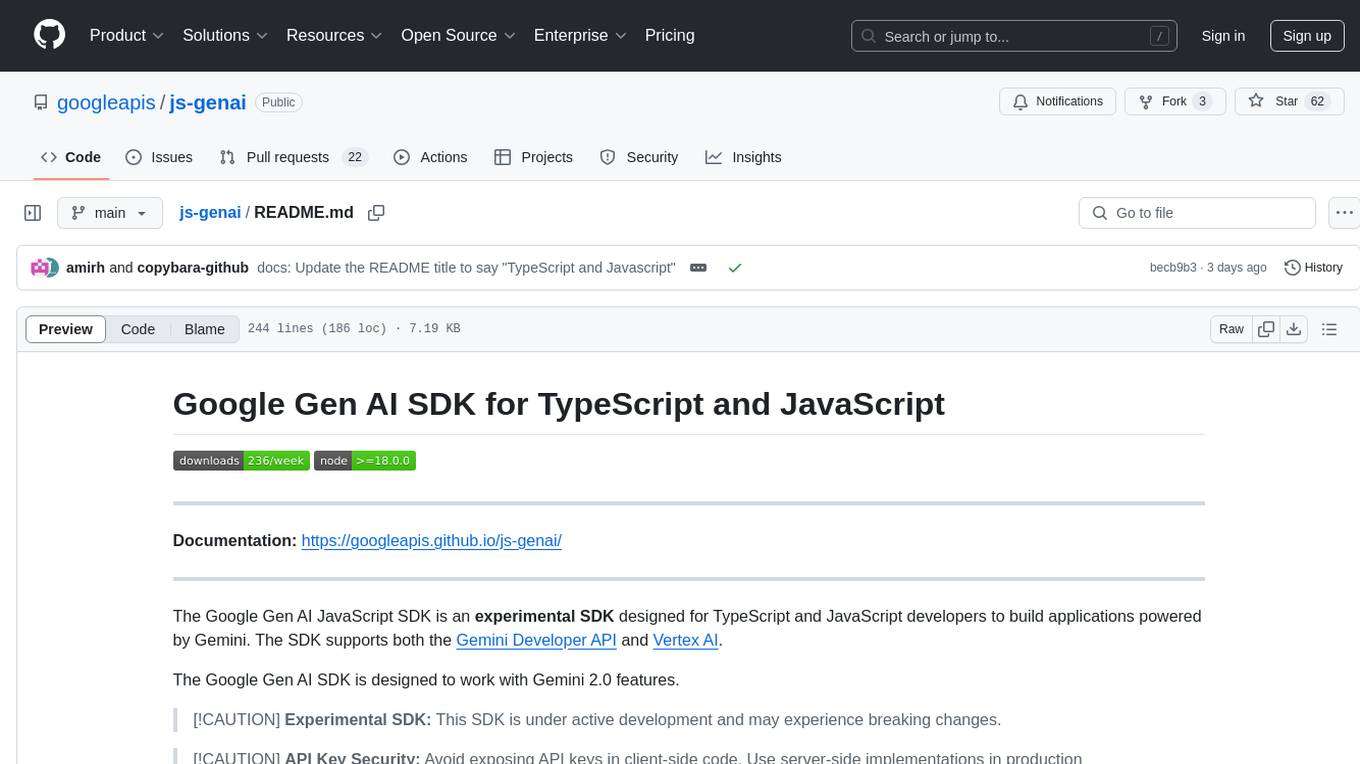
js-genai
The Google Gen AI JavaScript SDK is an experimental SDK for TypeScript and JavaScript developers to build applications powered by Gemini. It supports both the Gemini Developer API and Vertex AI. The SDK is designed to work with Gemini 2.0 features. Users can access API features through the GoogleGenAI classes, which provide submodules for querying models, managing caches, creating chats, uploading files, and starting live sessions. The SDK also allows for function calling to interact with external systems. Users can find more samples in the GitHub samples directory.
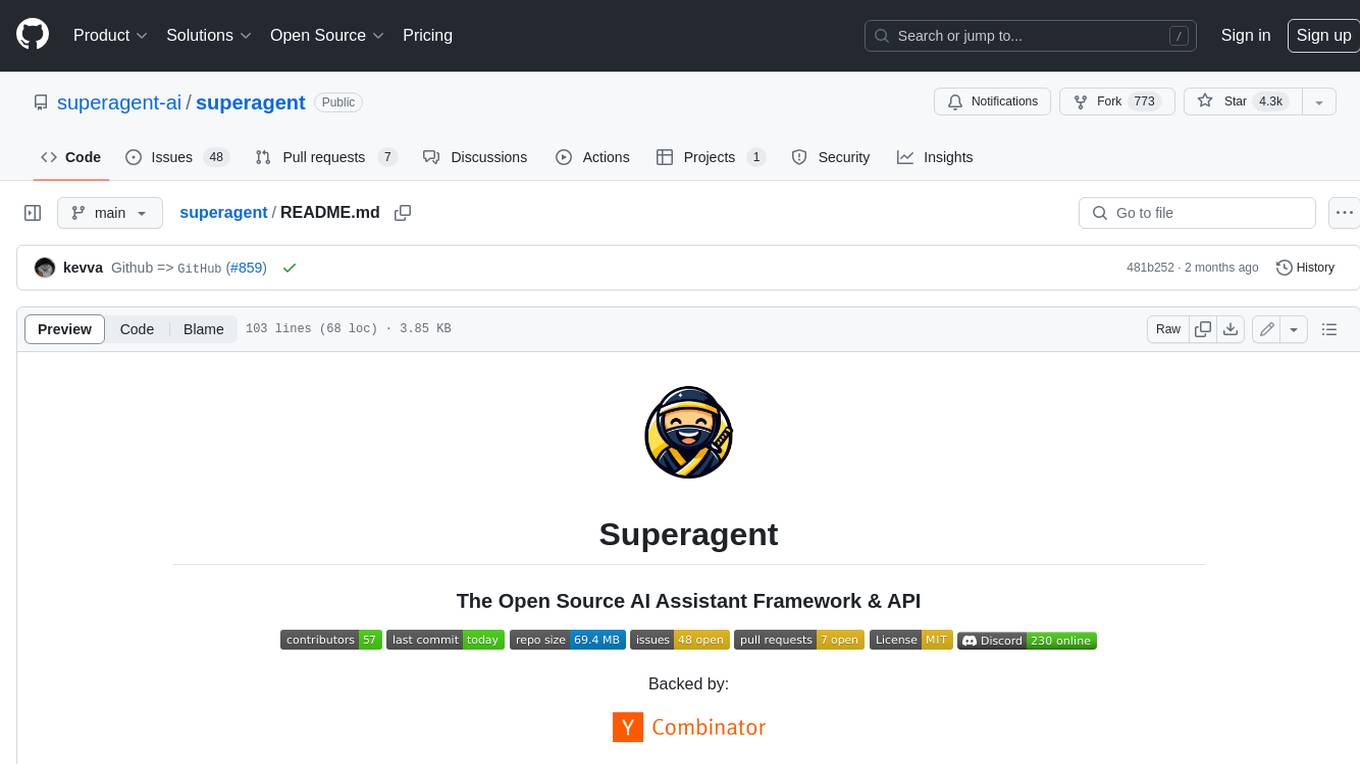
superagent
Superagent is an open-source AI assistant framework and API that allows developers to add powerful AI assistants to their applications. These assistants use large language models (LLMs), retrieval augmented generation (RAG), and generative AI to help users with a variety of tasks, including question answering, chatbot development, content generation, data aggregation, and workflow automation. Superagent is backed by Y Combinator and is part of YC W24.
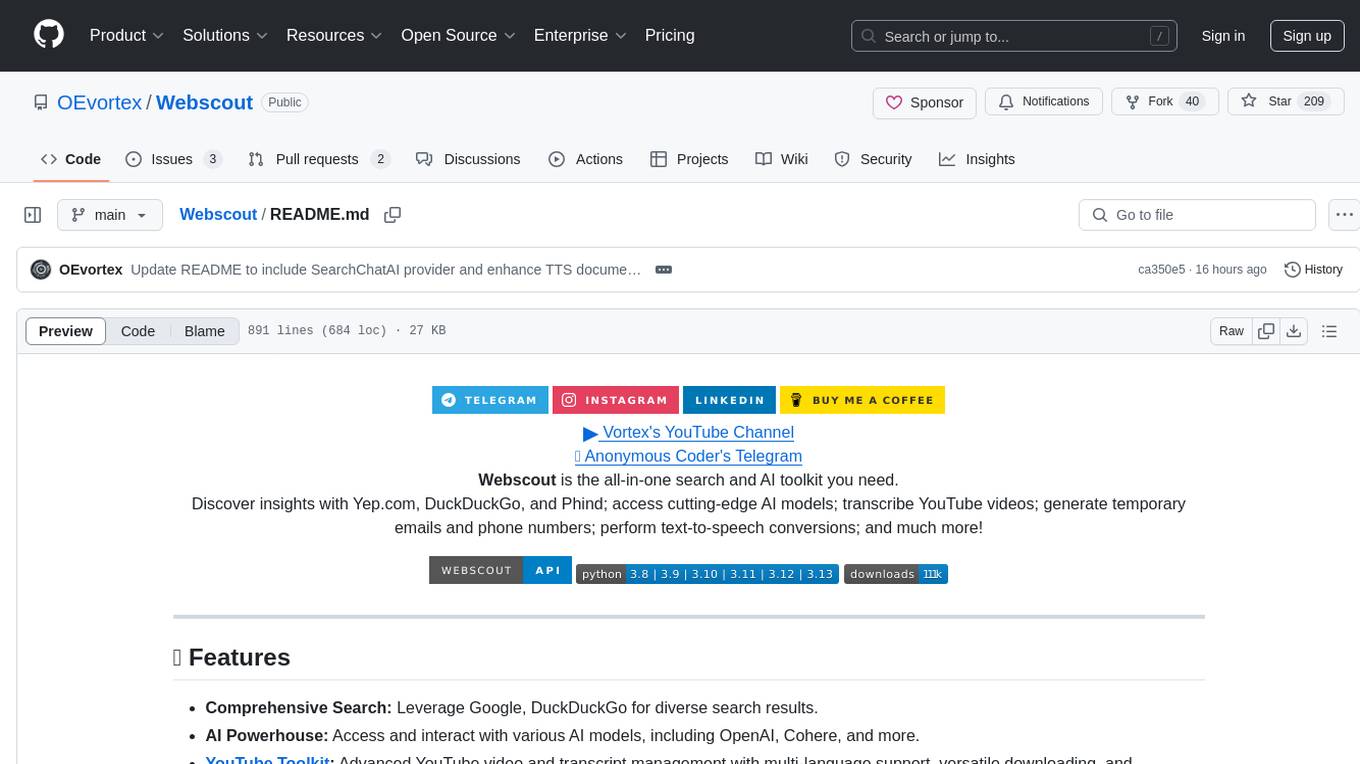
Webscout
Webscout is an all-in-one Python toolkit for web search, AI interaction, digital utilities, and more. It provides access to diverse search engines, cutting-edge AI models, temporary communication tools, media utilities, developer helpers, and powerful CLI interfaces through a unified library. With features like comprehensive search leveraging Google and DuckDuckGo, AI powerhouse for accessing various AI models, YouTube toolkit for video and transcript management, GitAPI for GitHub data extraction, Tempmail & Temp Number for privacy, Text-to-Speech conversion, GGUF conversion & quantization, SwiftCLI for CLI interfaces, LitPrinter for styled console output, LitLogger for logging, LitAgent for user agent generation, Text-to-Image generation, Scout for web parsing and crawling, Awesome Prompts for specialized tasks, Weather Toolkit, and AI Search Providers.
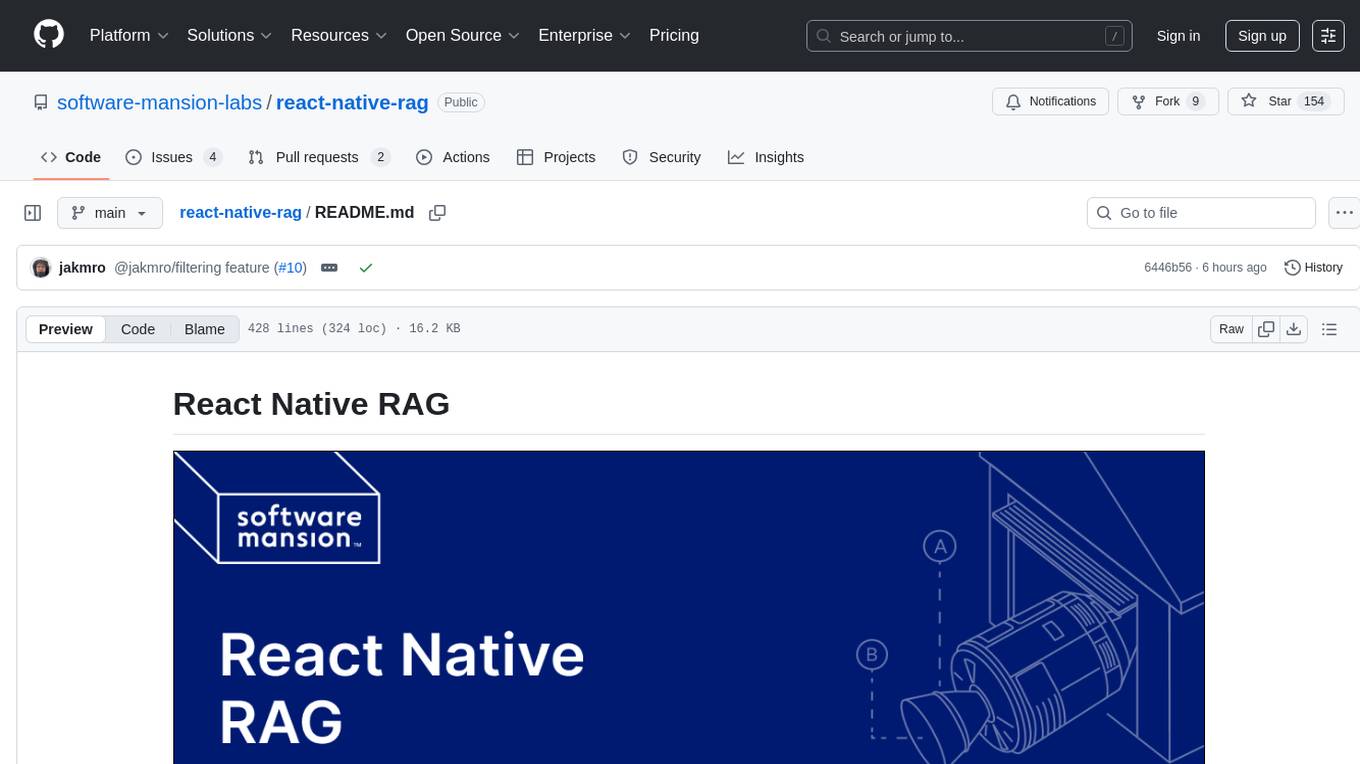
react-native-rag
React Native RAG is a library that enables private, local RAGs to supercharge LLMs with a custom knowledge base. It offers modular and extensible components like `LLM`, `Embeddings`, `VectorStore`, and `TextSplitter`, with multiple integration options. The library supports on-device inference, vector store persistence, and semantic search implementation. Users can easily generate text responses, manage documents, and utilize custom components for advanced use cases.
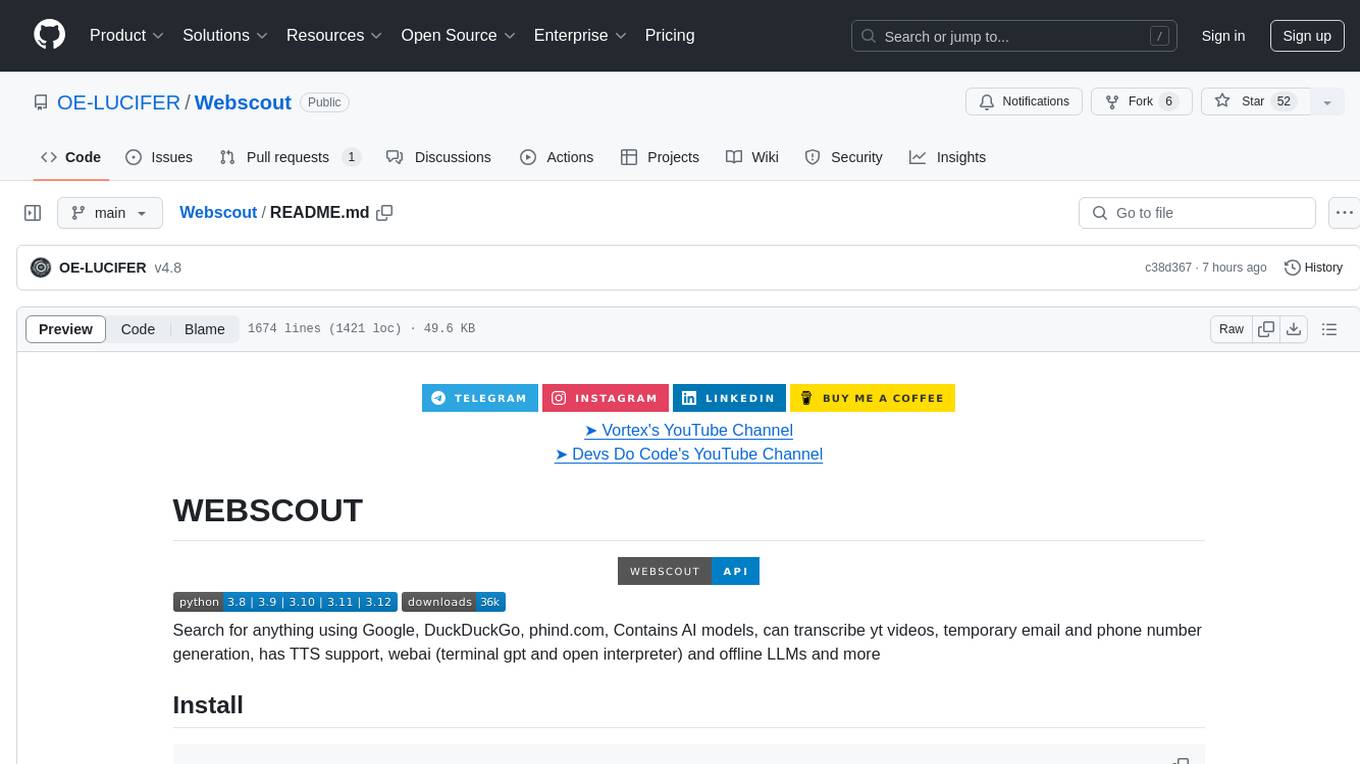
Webscout
WebScout is a versatile tool that allows users to search for anything using Google, DuckDuckGo, and phind.com. It contains AI models, can transcribe YouTube videos, generate temporary email and phone numbers, has TTS support, webai (terminal GPT and open interpreter), and offline LLMs. It also supports features like weather forecasting, YT video downloading, temp mail and number generation, text-to-speech, advanced web searches, and more.
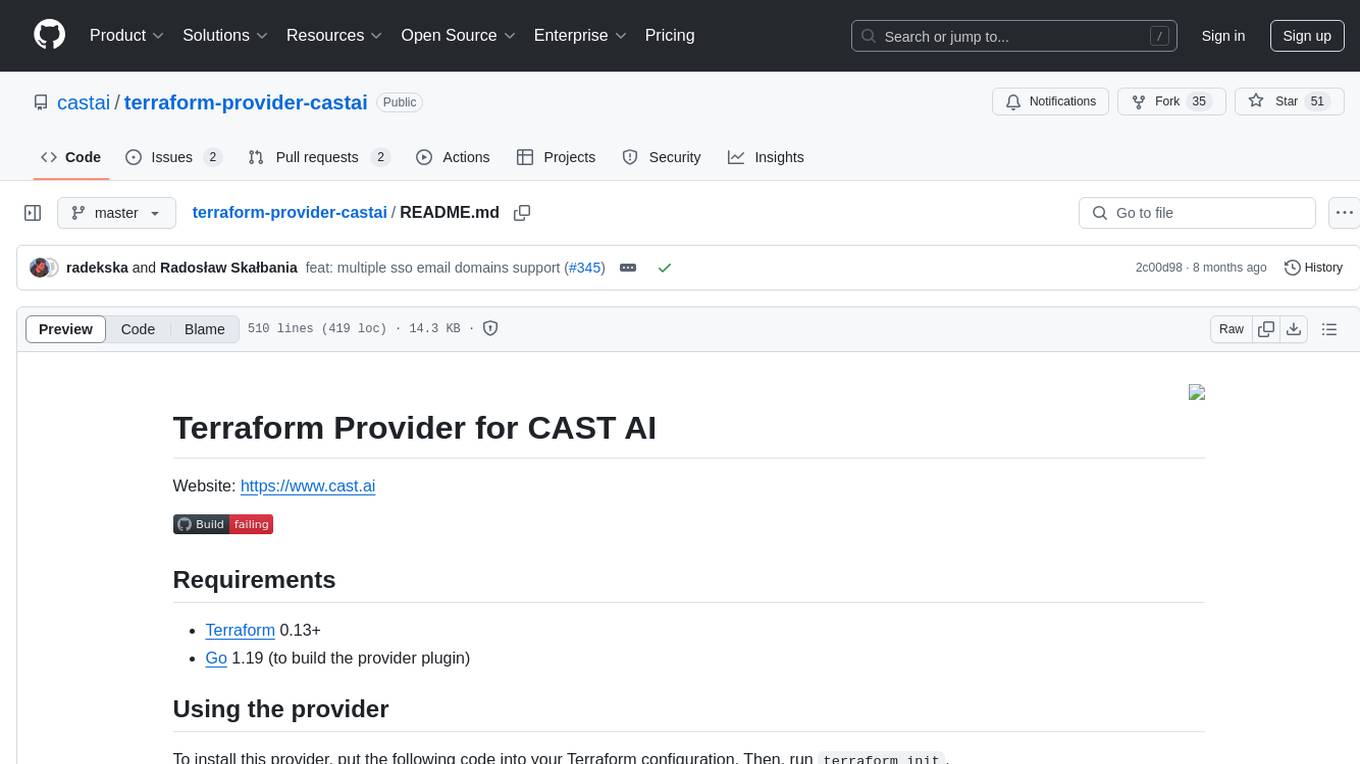
terraform-provider-castai
Terraform Provider for CAST AI is a tool that allows users to manage their CAST AI resources using Terraform. It provides a seamless integration between Terraform and CAST AI platform, enabling users to define and manage their infrastructure as code. The provider supports various features such as setting up cluster configurations, managing node templates, and configuring autoscaler policies. Users can easily install the provider, pass API keys, and leverage the provider's functionalities to automate the deployment and management of their CAST AI resources.
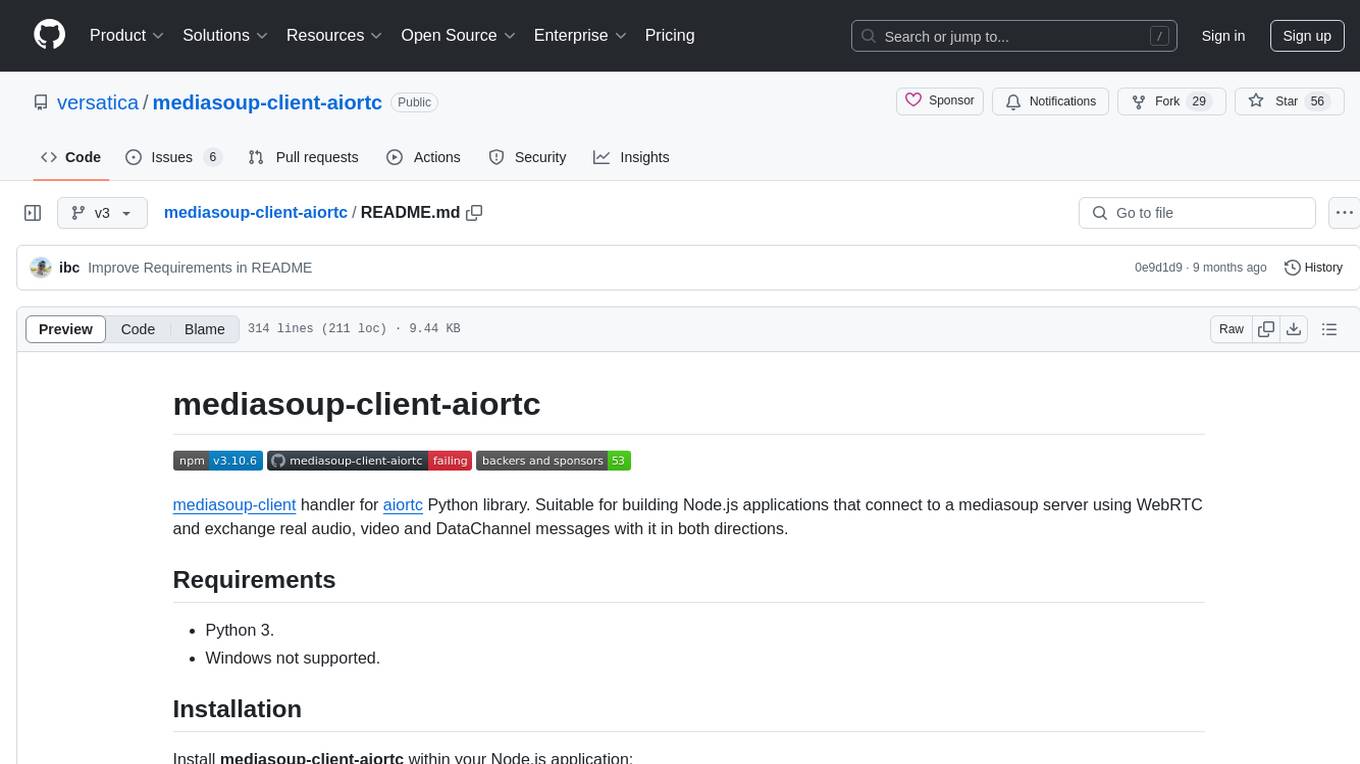
mediasoup-client-aiortc
mediasoup-client-aiortc is a handler for the aiortc Python library, allowing Node.js applications to connect to a mediasoup server using WebRTC for real-time audio, video, and DataChannel communication. It facilitates the creation of Worker instances to manage Python subprocesses, obtain audio/video tracks, and create mediasoup-client handlers. The tool supports features like getUserMedia, handlerFactory creation, and event handling for subprocess closure and unexpected termination. It provides custom classes for media stream and track constraints, enabling diverse audio/video sources like devices, files, or URLs. The tool enhances WebRTC capabilities in Node.js applications through seamless Python subprocess communication.
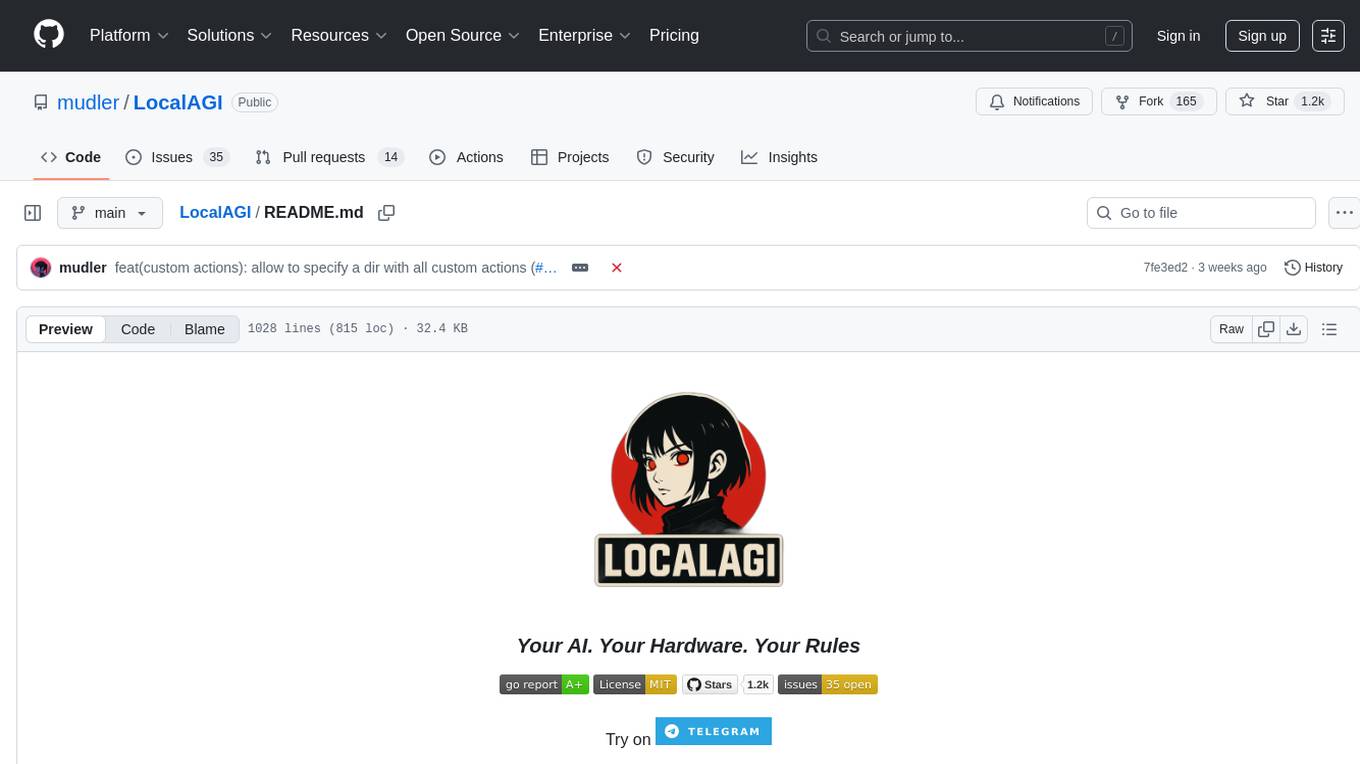
LocalAGI
LocalAGI is a powerful, self-hostable AI Agent platform that allows you to design AI automations without writing code. It provides a complete drop-in replacement for OpenAI's Responses APIs with advanced agentic capabilities. With LocalAGI, you can create customizable AI assistants, automations, chat bots, and agents that run 100% locally, without the need for cloud services or API keys. The platform offers features like no-code agents, web-based interface, advanced agent teaming, connectors for various platforms, comprehensive REST API, short & long-term memory capabilities, planning & reasoning, periodic tasks scheduling, memory management, multimodal support, extensible custom actions, fully customizable models, observability, and more.
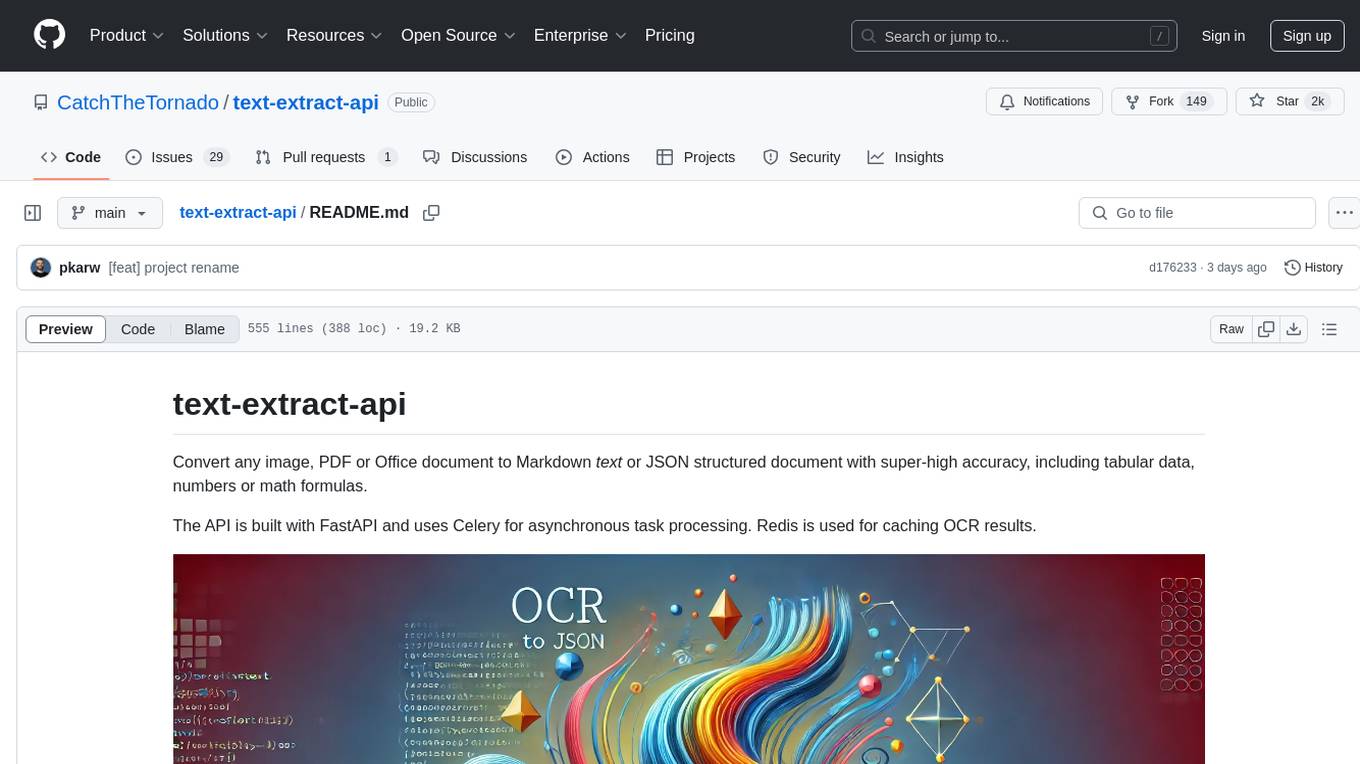
text-extract-api
The text-extract-api is a powerful tool that allows users to convert images, PDFs, or Office documents to Markdown text or JSON structured documents with high accuracy. It is built using FastAPI and utilizes Celery for asynchronous task processing, with Redis for caching OCR results. The tool provides features such as PDF/Office to Markdown and JSON conversion, improving OCR results with LLama, removing Personally Identifiable Information from documents, distributed queue processing, caching using Redis, switchable storage strategies, and a CLI tool for task management. Users can run the tool locally or on cloud services, with support for GPU processing. The tool also offers an online demo for testing purposes.
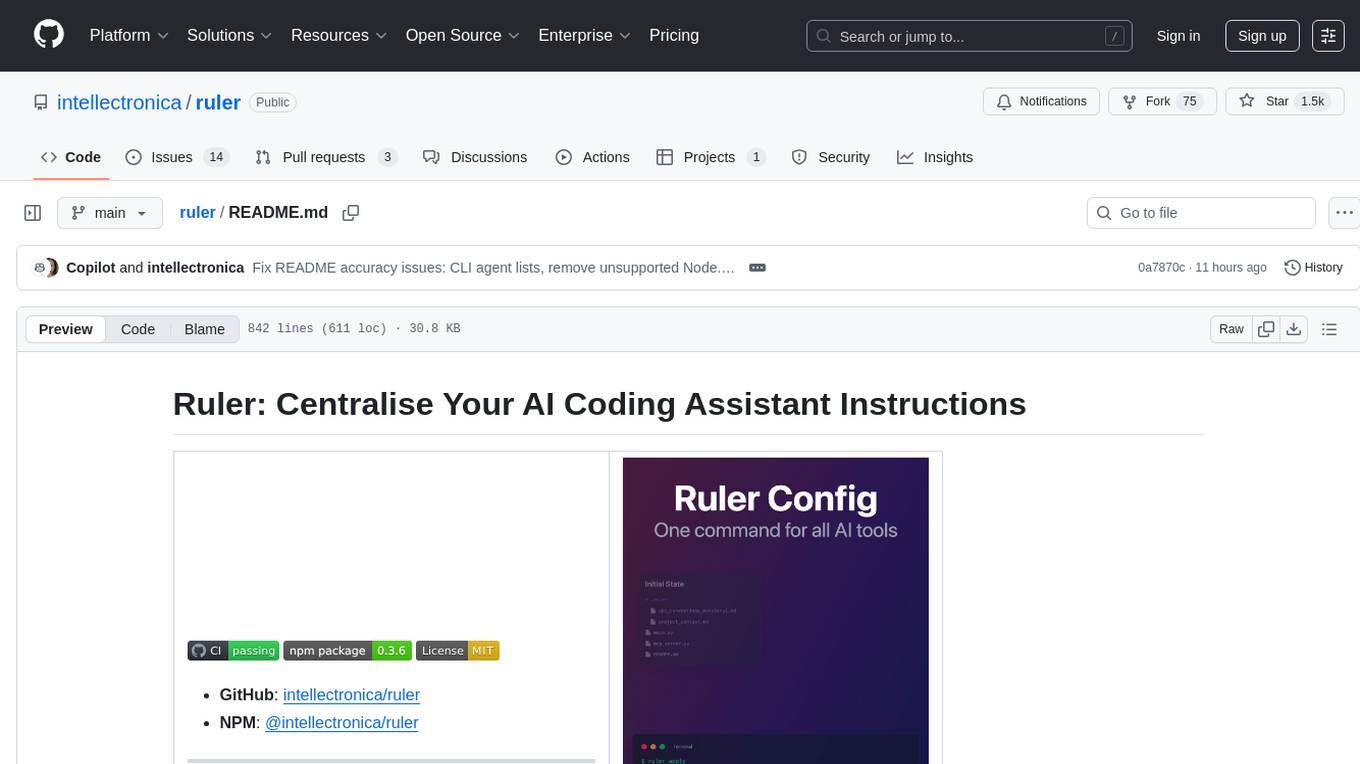
ruler
Ruler is a tool designed to centralize AI coding assistant instructions, providing a single source of truth for managing instructions across multiple AI coding tools. It helps in avoiding inconsistent guidance, duplicated effort, context drift, onboarding friction, and complex project structures by automatically distributing instructions to the right configuration files. With support for nested rule loading, Ruler can handle complex project structures with context-specific instructions for different components. It offers features like centralised rule management, nested rule loading, automatic distribution, targeted agent configuration, MCP server propagation, .gitignore automation, and a simple CLI for easy configuration management.
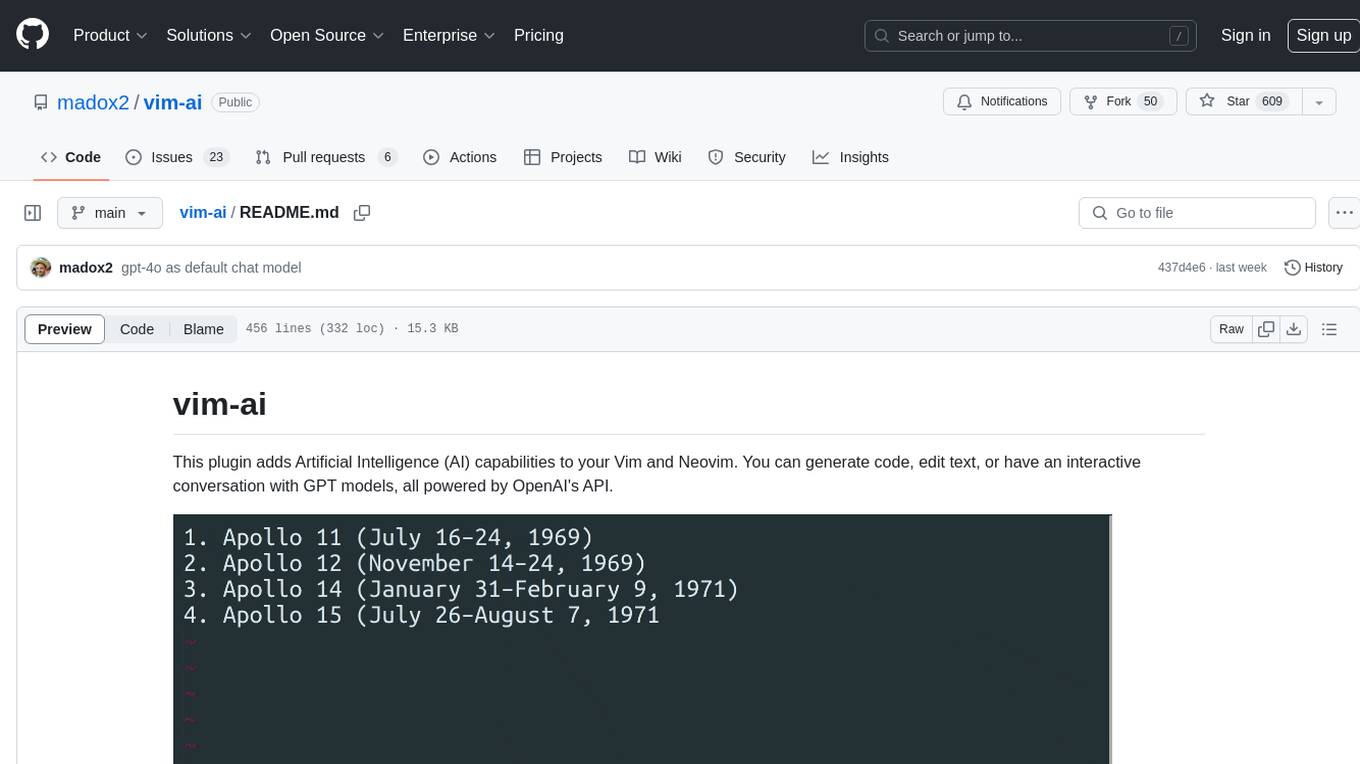
vim-ai
vim-ai is a plugin that adds Artificial Intelligence (AI) capabilities to Vim and Neovim. It allows users to generate code, edit text, and have interactive conversations with GPT models powered by OpenAI's API. The plugin uses OpenAI's API to generate responses, requiring users to set up an account and obtain an API key. It supports various commands for text generation, editing, and chat interactions, providing a seamless integration of AI features into the Vim text editor environment.
For similar tasks
kork
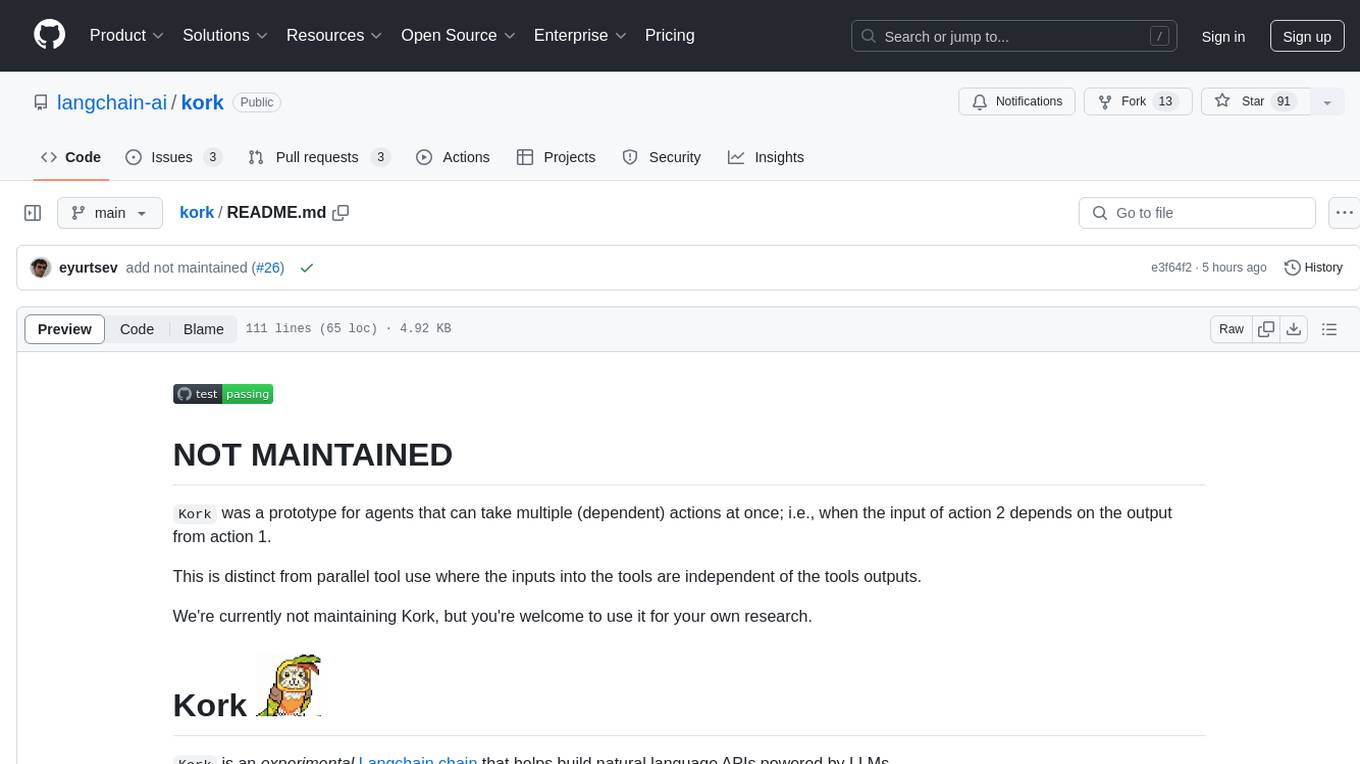
Kork is an experimental Langchain chain that helps build natural language APIs powered by LLMs. It allows assembling a natural language API from python functions, generating a prompt for correct program writing, executing programs safely, and controlling the kind of programs LLMs can generate. The language is limited to variable declarations, function invocations, and arithmetic operations, ensuring predictability and safety in production settings.
llm-metadata
LLM Metadata is a lightweight static API designed for discovering and integrating LLM metadata. It provides a high-throughput friendly, static-by-default interface that serves static JSON via GitHub Pages. The sources for the metadata include models.dev/api.json and contributions from the basellm community. The tool allows for easy rebuilding on change and offers various scripts for compiling TypeScript, building the API, and managing the project. It also supports internationalization for both documentation and API, enabling users to add new languages and localize capability labels and descriptions. The tool follows an auto-update policy based on a configuration file and allows for directory-based overrides for providers and models, facilitating customization and localization of metadata.
For similar jobs
sweep
Sweep is an AI junior developer that turns bugs and feature requests into code changes. It automatically handles developer experience improvements like adding type hints and improving test coverage.
teams-ai
The Teams AI Library is a software development kit (SDK) that helps developers create bots that can interact with Teams and Microsoft 365 applications. It is built on top of the Bot Framework SDK and simplifies the process of developing bots that interact with Teams' artificial intelligence capabilities. The SDK is available for JavaScript/TypeScript, .NET, and Python.
ai-guide
This guide is dedicated to Large Language Models (LLMs) that you can run on your home computer. It assumes your PC is a lower-end, non-gaming setup.
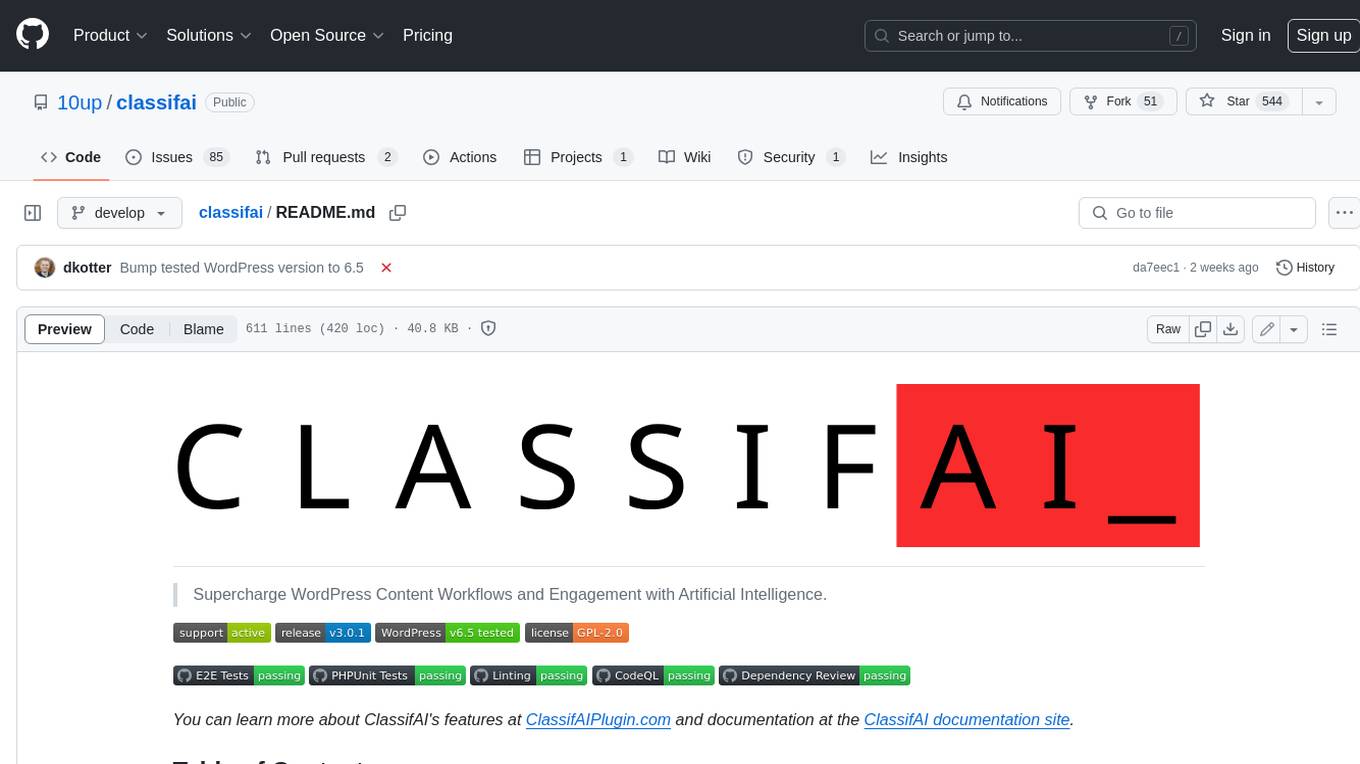
classifai
Supercharge WordPress Content Workflows and Engagement with Artificial Intelligence. Tap into leading cloud-based services like OpenAI, Microsoft Azure AI, Google Gemini and IBM Watson to augment your WordPress-powered websites. Publish content faster while improving SEO performance and increasing audience engagement. ClassifAI integrates Artificial Intelligence and Machine Learning technologies to lighten your workload and eliminate tedious tasks, giving you more time to create original content that matters.
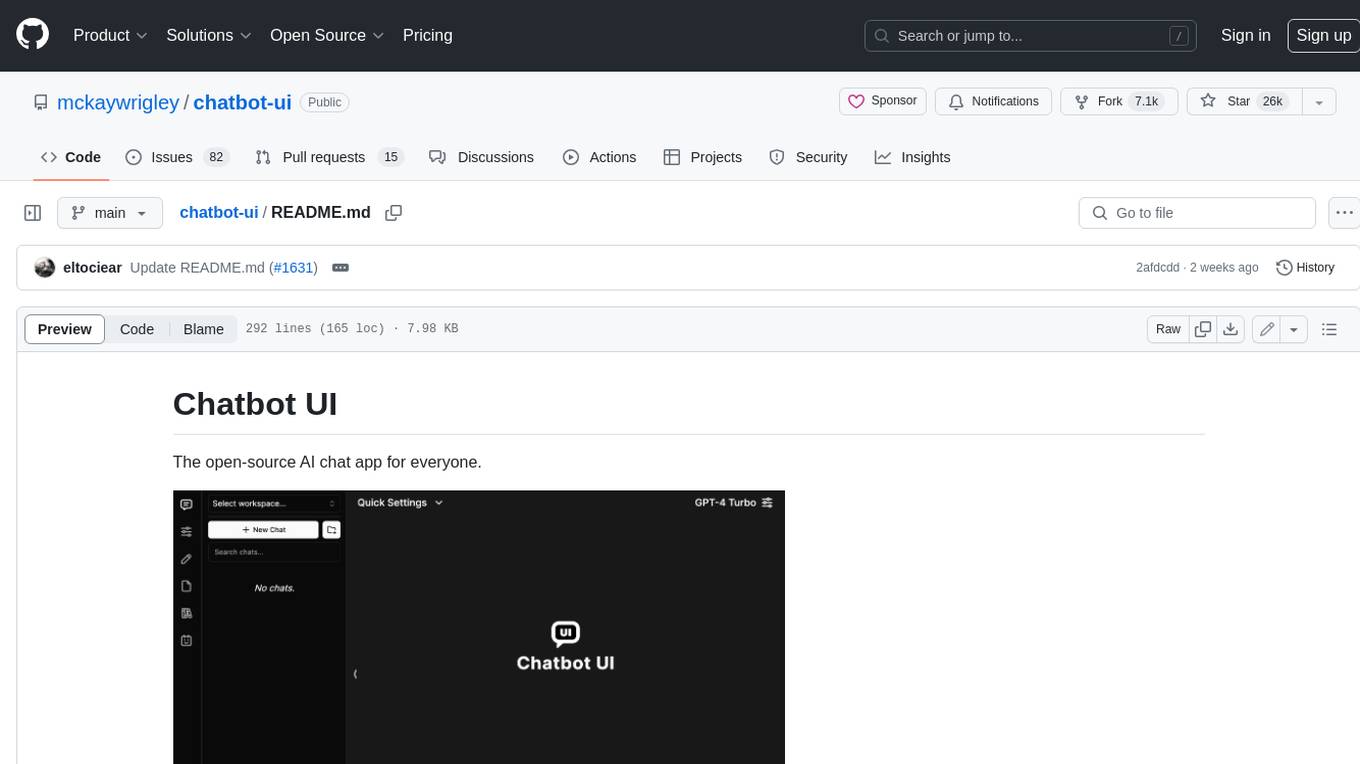
chatbot-ui
Chatbot UI is an open-source AI chat app that allows users to create and deploy their own AI chatbots. It is easy to use and can be customized to fit any need. Chatbot UI is perfect for businesses, developers, and anyone who wants to create a chatbot.
BricksLLM
BricksLLM is a cloud native AI gateway written in Go. Currently, it provides native support for OpenAI, Anthropic, Azure OpenAI and vLLM. BricksLLM aims to provide enterprise level infrastructure that can power any LLM production use cases. Here are some use cases for BricksLLM: * Set LLM usage limits for users on different pricing tiers * Track LLM usage on a per user and per organization basis * Block or redact requests containing PIIs * Improve LLM reliability with failovers, retries and caching * Distribute API keys with rate limits and cost limits for internal development/production use cases * Distribute API keys with rate limits and cost limits for students
uAgents
uAgents is a Python library developed by Fetch.ai that allows for the creation of autonomous AI agents. These agents can perform various tasks on a schedule or take action on various events. uAgents are easy to create and manage, and they are connected to a fast-growing network of other uAgents. They are also secure, with cryptographically secured messages and wallets.
griptape
Griptape is a modular Python framework for building AI-powered applications that securely connect to your enterprise data and APIs. It offers developers the ability to maintain control and flexibility at every step. Griptape's core components include Structures (Agents, Pipelines, and Workflows), Tasks, Tools, Memory (Conversation Memory, Task Memory, and Meta Memory), Drivers (Prompt and Embedding Drivers, Vector Store Drivers, Image Generation Drivers, Image Query Drivers, SQL Drivers, Web Scraper Drivers, and Conversation Memory Drivers), Engines (Query Engines, Extraction Engines, Summary Engines, Image Generation Engines, and Image Query Engines), and additional components (Rulesets, Loaders, Artifacts, Chunkers, and Tokenizers). Griptape enables developers to create AI-powered applications with ease and efficiency.