


izwi
Local first speech AI engine for transcription, TTS, and voice workflows.
Stars: 132
Izwi is a local-first audio inference engine for text-to-speech (TTS), automatic speech recognition (ASR), and voice AI workflows. It operates on your machine without relying on cloud services or API keys, ensuring data privacy. Izwi offers core capabilities such as real-time voice conversations with AI, generating natural speech from text, converting audio to text accurately, identifying multiple speakers, voice cloning, creating custom voices, word-level audio-text alignment, and text-based AI conversations. The server provides OpenAI-compatible API routes under `/v1`.
README:

Local-first audio inference engine for TTS, ASR, and voice AI workflows.
Website • Documentation • Releases • Getting Started

Izwi is a privacy-focused audio AI platform that runs entirely on your machine. No cloud services, no API keys, no data leaving your device.
Core capabilities:
- Voice Mode — Real-time voice conversations with AI
- Text-to-Speech — Generate natural speech from text
- Speech Recognition — Convert audio to text with high accuracy
- Speaker Diarization — Identify and separate multiple speakers
- Voice Cloning — Clone any voice from a short audio sample
- Voice Design — Create custom voices from text descriptions
- Forced Alignment — Word-level audio-text alignment
- Chat — Text-based AI conversations
The server exposes OpenAI-compatible API routes under /v1.
Download the latest .dmg from GitHub Releases:
- Open the
.dmgfile - Drag Izwi.app to Applications
- Launch Izwi
wget https://github.com/agentem-ai/izwi/releases/latest/download/izwi_amd64.deb
sudo dpkg -i izwi_amd64.debDownload and run the installer from GitHub Releases.
Full installation guides: macOS • Linux • Windows • From Source
izwi serveOpen http://localhost:8080 in your browser.
izwi pull Qwen3-TTS-12Hz-0.6B-Baseizwi tts "Hello from Izwi!" --output hello.wavizwi pull Qwen3-ASR-0.6B
izwi transcribe audio.wavLong-form ASR is handled automatically: Izwi now chunks long recordings, stitches overlapping transcripts, and returns a full transcript instead of only the first model window.
Optional tuning knobs:
IZWI_ASR_CHUNK_TARGET_SECS=24
IZWI_ASR_CHUNK_MAX_SECS=30
IZWI_ASR_CHUNK_OVERLAP_SECS=3| Category | Models |
|---|---|
| TTS | Qwen3-TTS (0.6B, 1.7B), LFM2-Audio |
| ASR | Qwen3-ASR (0.6B, 1.7B), Parakeet TDT |
| Diarization | Sortformer 4-speaker |
| Chat | Qwen3 (0.6B, 1.7B), Gemma 3 (1B, 4B) |
| Alignment | Qwen3-ForcedAligner |
Run izwi list to see all available models.
Full model documentation: Models Guide
| Resource | Link |
|---|---|
| Getting Started | izwiai.com/docs/getting-started |
| Installation | izwiai.com/docs/installation |
| Features | izwiai.com/docs/features |
| CLI Reference | izwiai.com/docs/cli |
| Models | izwiai.com/docs/models |
| Troubleshooting | izwiai.com/docs/troubleshooting |
Apache 2.0
- Qwen3-TTS by Alibaba
- Parakeet by NVIDIA
- Gemma by Google
- LFM2-Audio by Liquid AI
- HuggingFace Hub for model hosting
For Tasks:
Click tags to check more tools for each tasksFor Jobs:
Alternative AI tools for izwi
Similar Open Source Tools
izwi
Izwi is a local-first audio inference engine for text-to-speech (TTS), automatic speech recognition (ASR), and voice AI workflows. It operates on your machine without relying on cloud services or API keys, ensuring data privacy. Izwi offers core capabilities such as real-time voice conversations with AI, generating natural speech from text, converting audio to text accurately, identifying multiple speakers, voice cloning, creating custom voices, word-level audio-text alignment, and text-based AI conversations. The server provides OpenAI-compatible API routes under `/v1`.
recognizer
Recognizer is a Python library for speech recognition. It provides a simple interface to transcribe speech from audio files or live audio input. The library supports multiple speech recognition engines, including Google Speech Recognition, Sphinx, and Wit.ai. Recognizer is easy to use and can be integrated into various applications to enable voice commands, transcription, and speech-to-text functionality.
push-2-talk
PushToTalk is a high-performance desktop voice input tool with large language model (LLM) capabilities. It supports two working modes: dictation mode and AI assistant mode. The tool offers features like real-time transcription, LLM intelligent post-processing, custom hotkeys, multiple ASR engines support, visual feedback, audio feedback, history records, system tray support, automatic updates, multiple configuration management, personal glossary, automatic glossary learning, LLM configuration center, theme switching, mute during recording, VAD silence detection, AGC automatic gain, multi-screen support, and more.
Applio
Applio is a VITS-based Voice Conversion tool focused on simplicity, quality, and performance. It features a user-friendly interface, cross-platform compatibility, and a range of customization options. Applio is suitable for various tasks such as voice cloning, voice conversion, and audio editing. Its key features include a modular codebase, hop length implementation, translations in over 30 languages, optimized requirements, streamlined installation, hybrid F0 estimation, easy-to-use UI, optimized code and dependencies, plugin system, overtraining detector, model search, enhancements in pretrained models, voice blender, accessibility improvements, new F0 extraction methods, output format selection, hashing system, model download system, TTS enhancements, split audio, Discord presence, Flask integration, and support tab.
RWKV_APP
RWKV App is an experimental application that enables users to run Large Language Models (LLMs) offline on their edge devices. It offers a privacy-first, on-device LLM experience for everyday devices. Users can engage in multi-turn conversations, text-to-speech, visual understanding, and more, all without requiring an internet connection. The app supports switching between different models, running locally without internet, and exploring various AI tasks such as chat, speech generation, and visual understanding. It is built using Flutter and Dart FFI for cross-platform compatibility and efficient communication with the C++ inference engine. The roadmap includes integrating features into the RWKV Chat app, supporting more model weights, hardware, operating systems, and devices.
Rodel.Agent
Rodel Agent is a Windows desktop application that integrates chat, text-to-image, text-to-speech, and machine translation services, providing users with a comprehensive desktop AI experience. The application supports mainstream AI services and aims to enhance user interaction through various AI functionalities.
OpenAI
OpenAI is a Swift community-maintained implementation over OpenAI public API. It is a non-profit artificial intelligence research organization founded in San Francisco, California in 2015. OpenAI's mission is to ensure safe and responsible use of AI for civic good, economic growth, and other public benefits. The repository provides functionalities for text completions, chats, image generation, audio processing, edits, embeddings, models, moderations, utilities, and Combine extensions.
py-gpt
Py-GPT is a Python library that provides an easy-to-use interface for OpenAI's GPT-3 API. It allows users to interact with the powerful GPT-3 model for various natural language processing tasks. With Py-GPT, developers can quickly integrate GPT-3 capabilities into their applications, enabling them to generate text, answer questions, and more with just a few lines of code.
llama.ui
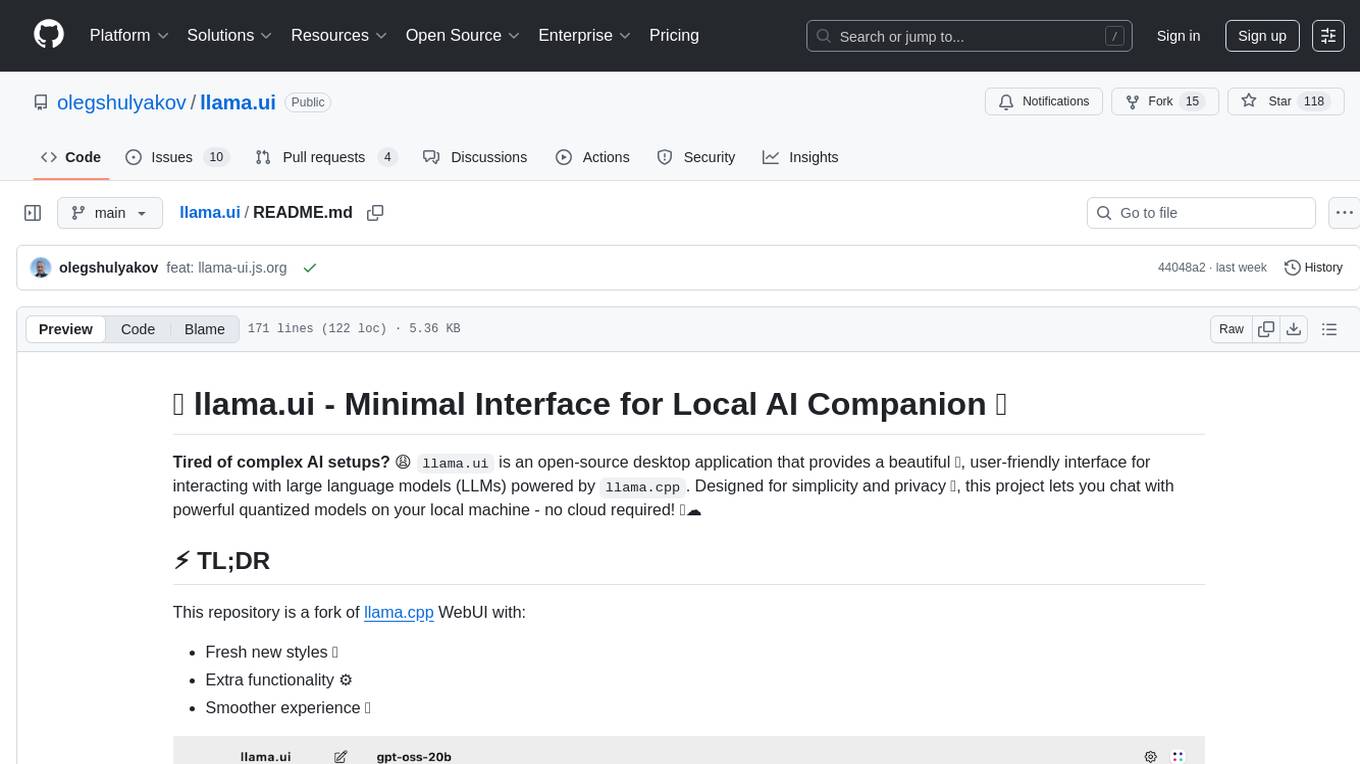
llama.ui is an open-source desktop application that provides a beautiful, user-friendly interface for interacting with large language models powered by llama.cpp. It is designed for simplicity and privacy, allowing users to chat with powerful quantized models on their local machine without the need for cloud services. The project offers multi-provider support, conversation management with indexedDB storage, rich UI components including markdown rendering and file attachments, advanced features like PWA support and customizable generation parameters, and is privacy-focused with all data stored locally in the browser.
GEN-AI
GEN-AI is a versatile Python library for implementing various artificial intelligence algorithms and models. It provides a wide range of tools and functionalities to support machine learning, deep learning, natural language processing, computer vision, and reinforcement learning tasks. With GEN-AI, users can easily build, train, and deploy AI models for diverse applications such as image recognition, text classification, sentiment analysis, object detection, and game playing. The library is designed to be user-friendly, efficient, and scalable, making it suitable for both beginners and experienced AI practitioners.
baibot
Baibot is a versatile chatbot framework designed to simplify the process of creating and deploying chatbots. It provides a user-friendly interface for building custom chatbots with various functionalities such as natural language processing, conversation flow management, and integration with external APIs. Baibot is highly customizable and can be easily extended to suit different use cases and industries. With Baibot, developers can quickly create intelligent chatbots that can interact with users in a seamless and engaging manner, enhancing user experience and automating customer support processes.
AIaW
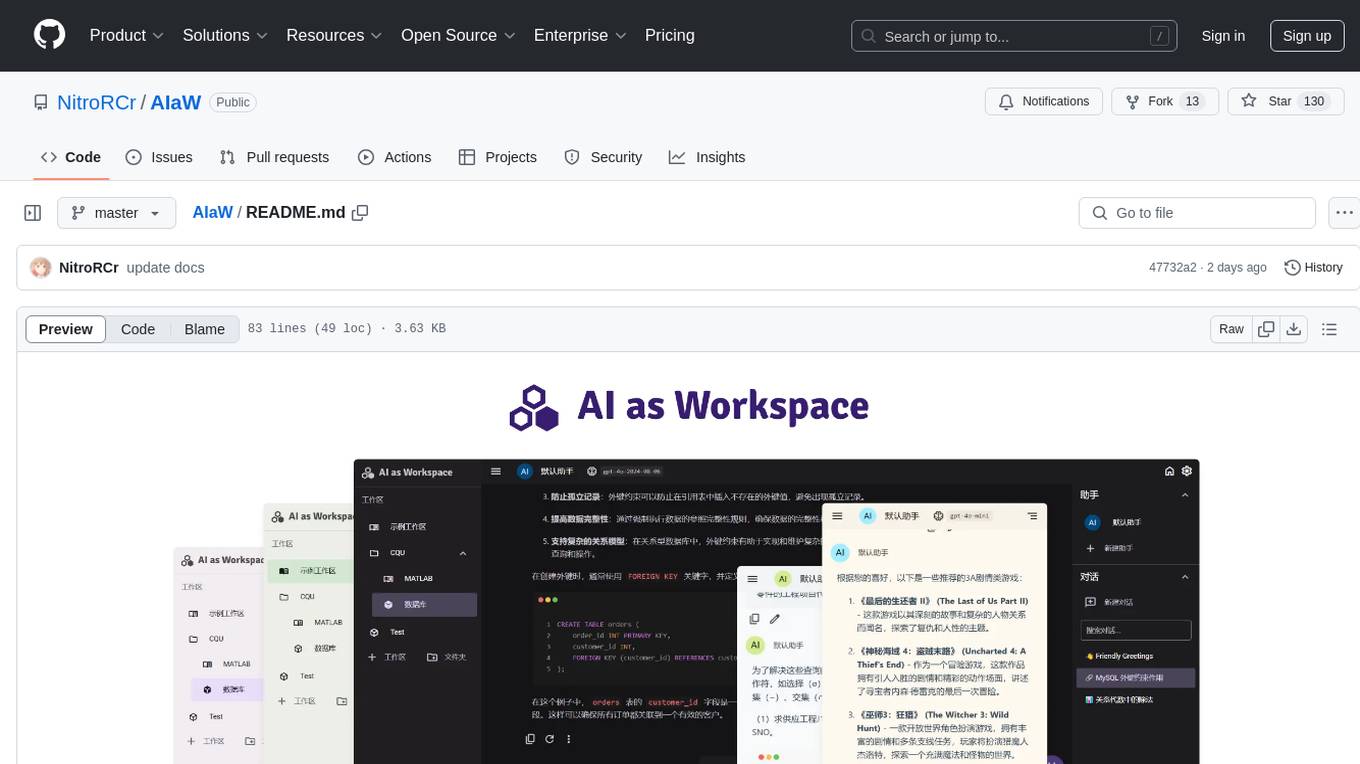
AIaW is a next-generation LLM client with full functionality, lightweight, and extensible. It supports various basic functions such as streaming transfer, image uploading, and latex formulas. The tool is cross-platform with a responsive interface design. It supports multiple service providers like OpenAI, Anthropic, and Google. Users can modify questions, regenerate in a forked manner, and visualize conversations in a tree structure. Additionally, it offers features like file parsing, video parsing, plugin system, assistant market, local storage with real-time cloud sync, and customizable interface themes. Users can create multiple workspaces, use dynamic prompt word variables, extend plugins, and benefit from detailed design elements like real-time content preview, optimized code pasting, and support for various file types.
blurr
Panda is a proactive, on-device AI agent for Android that autonomously understands natural language commands and operates your phone's UI to achieve them. It acts as a personal operator, handling complex, multi-step tasks across different applications. With intelligent UI automation, high-quality voice, and personalized local memory, Panda simplifies interactions with technology. Built on Kotlin, Panda's architecture includes Eyes & Hands for physical device connection, The Brain for reasoning, and The Agent for execution. The project is a proof-of-concept aiming to become an indispensable assistant.
llm
The 'llm' package for Emacs provides an interface for interacting with Large Language Models (LLMs). It abstracts functionality to a higher level, concealing API variations and ensuring compatibility with various LLMs. Users can set up providers like OpenAI, Gemini, Vertex, Claude, Ollama, GPT4All, and a fake client for testing. The package allows for chat interactions, embeddings, token counting, and function calling. It also offers advanced prompt creation and logging capabilities. Users can handle conversations, create prompts with placeholders, and contribute by creating providers.
simple-ai
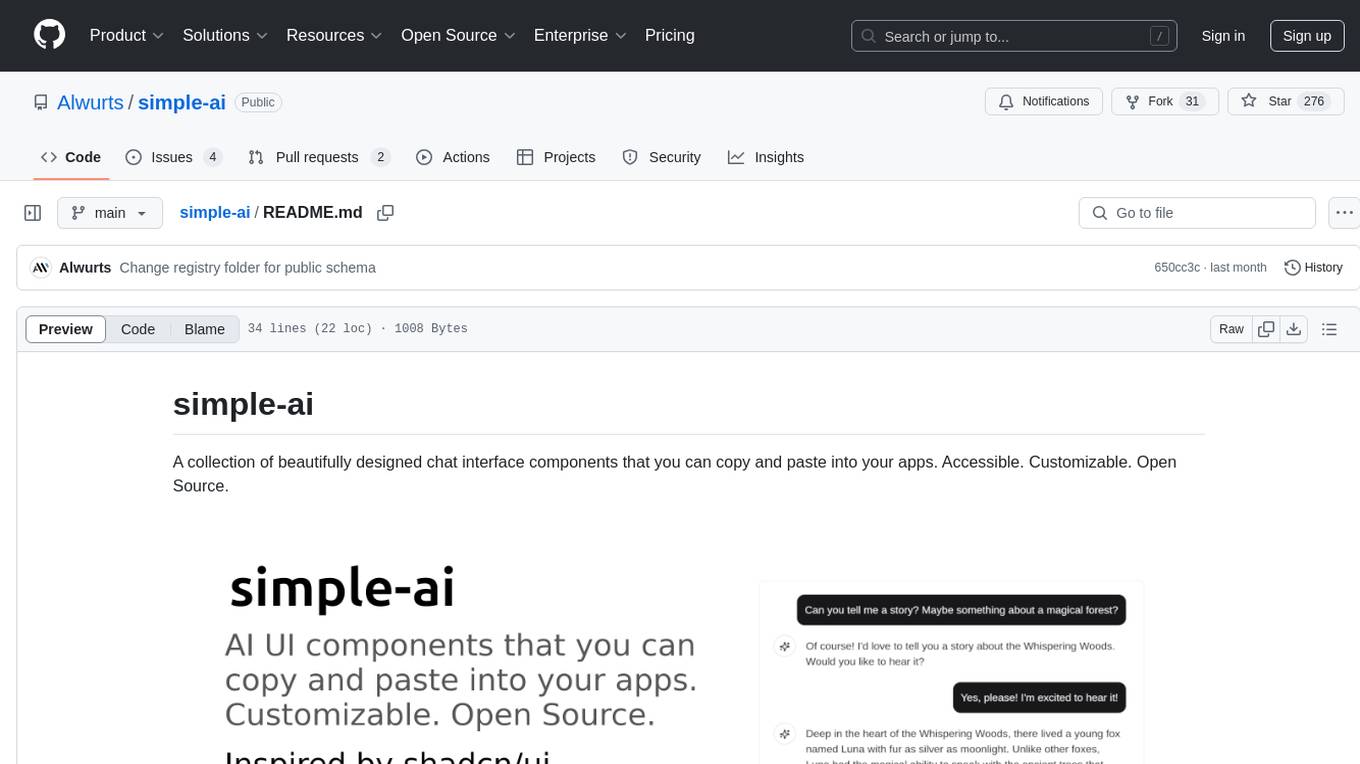
Simple AI is a lightweight Python library for implementing basic artificial intelligence algorithms. It provides easy-to-use functions and classes for tasks such as machine learning, natural language processing, and computer vision. With Simple AI, users can quickly prototype and deploy AI solutions without the complexity of larger frameworks.
nexa-sdk
Nexa SDK is a comprehensive toolkit supporting ONNX and GGML models for text generation, image generation, vision-language models (VLM), and text-to-speech (TTS) capabilities. It offers an OpenAI-compatible API server with JSON schema mode and streaming support, along with a user-friendly Streamlit UI. Users can run Nexa SDK on any device with Python environment, with GPU acceleration supported. The toolkit provides model support, conversion engine, inference engine for various tasks, and differentiating features from other tools.
For similar tasks
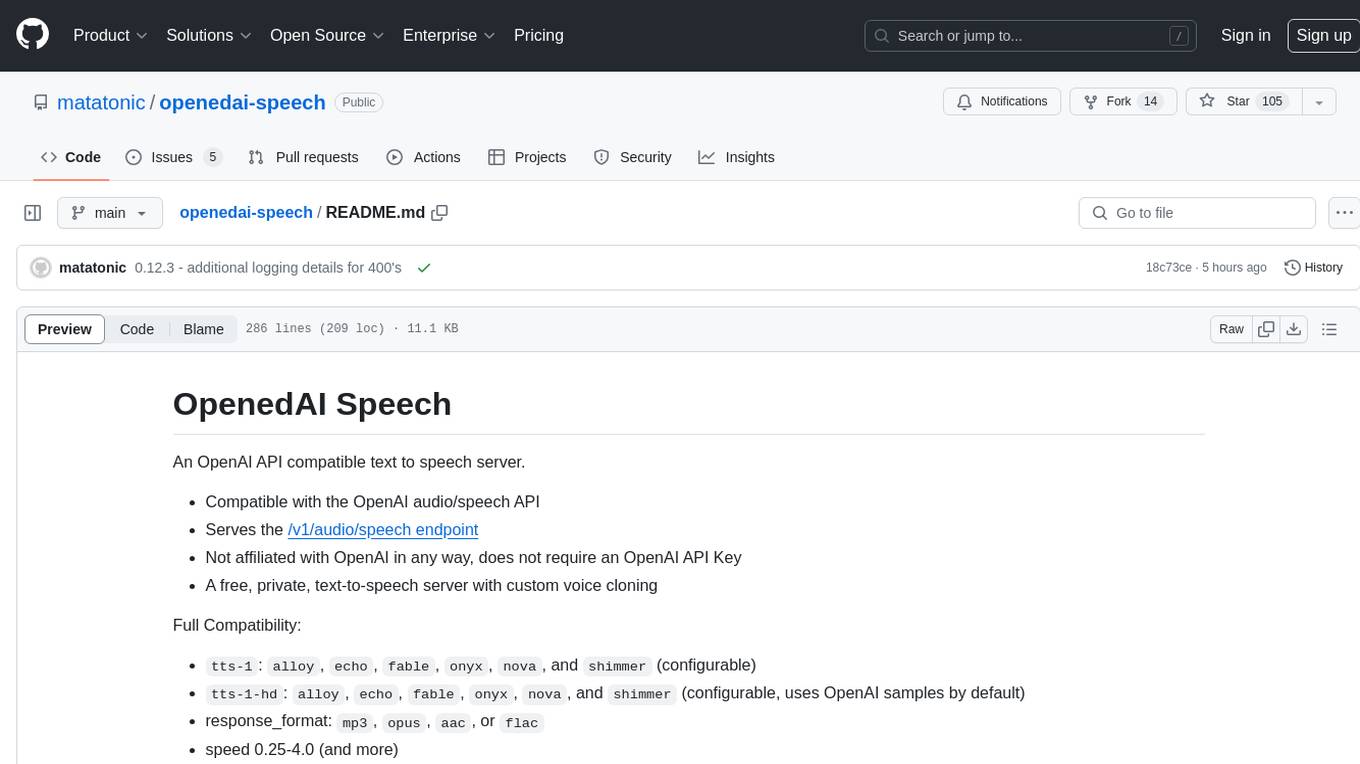
openedai-speech
OpenedAI Speech is a free, private text-to-speech server compatible with the OpenAI audio/speech API. It offers custom voice cloning and supports various models like tts-1 and tts-1-hd. Users can map their own piper voices and create custom cloned voices. The server provides multilingual support with XTTS voices and allows fixing incorrect sounds with regex. Recent changes include bug fixes, improved error handling, and updates for multilingual support. Installation can be done via Docker or manual setup, with usage instructions provided. Custom voices can be created using Piper or Coqui XTTS v2, with guidelines for preparing audio files. The tool is suitable for tasks like generating speech from text, creating custom voices, and multilingual text-to-speech applications.
izwi
Izwi is a local-first audio inference engine for text-to-speech (TTS), automatic speech recognition (ASR), and voice AI workflows. It operates on your machine without relying on cloud services or API keys, ensuring data privacy. Izwi offers core capabilities such as real-time voice conversations with AI, generating natural speech from text, converting audio to text accurately, identifying multiple speakers, voice cloning, creating custom voices, word-level audio-text alignment, and text-based AI conversations. The server provides OpenAI-compatible API routes under `/v1`.
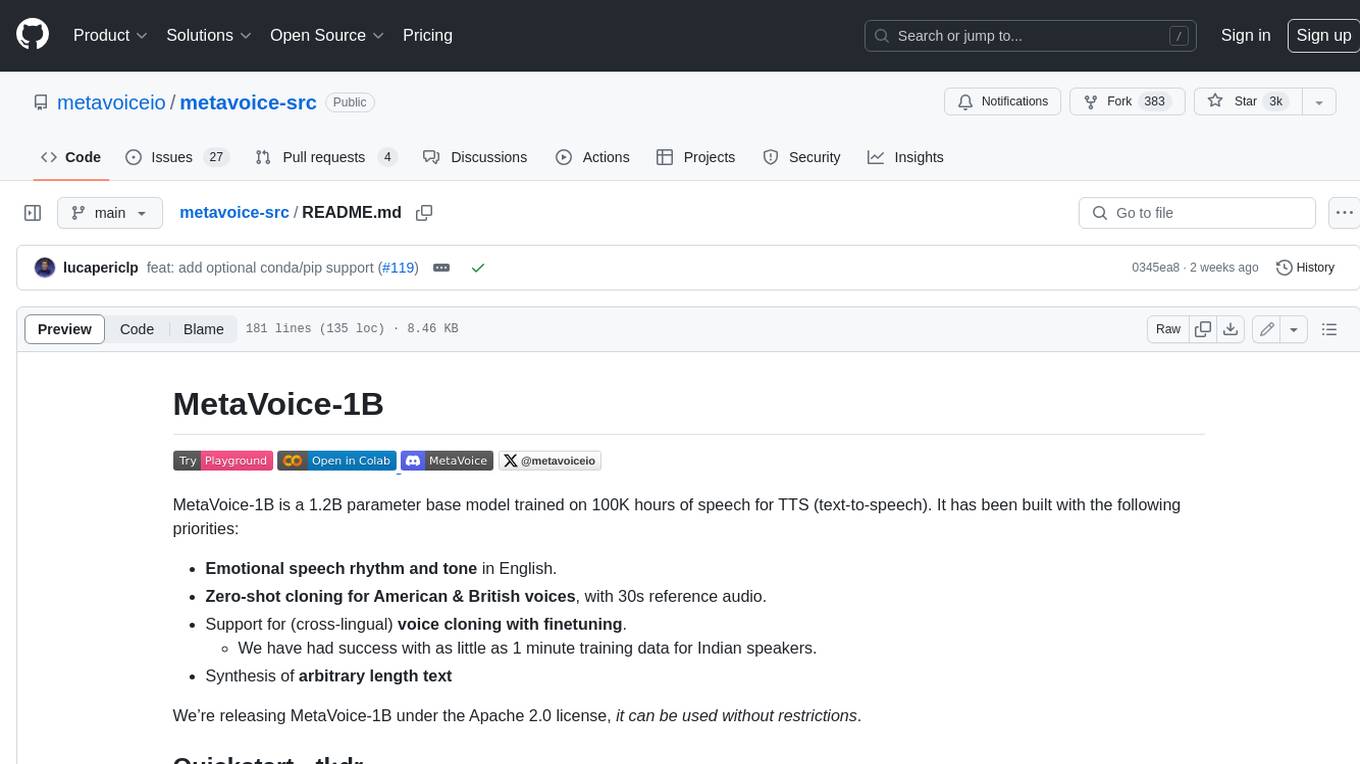
metavoice-src
MetaVoice-1B is a 1.2B parameter base model trained on 100K hours of speech for TTS (text-to-speech). It has been built with the following priorities: * Emotional speech rhythm and tone in English. * Zero-shot cloning for American & British voices, with 30s reference audio. * Support for (cross-lingual) voice cloning with finetuning. * We have had success with as little as 1 minute training data for Indian speakers. * Synthesis of arbitrary length text
modelfusion
ModelFusion is an abstraction layer for integrating AI models into JavaScript and TypeScript applications, unifying the API for common operations such as text streaming, object generation, and tool usage. It provides features to support production environments, including observability hooks, logging, and automatic retries. You can use ModelFusion to build AI applications, chatbots, and agents. ModelFusion is a non-commercial open source project that is community-driven. You can use it with any supported provider. ModelFusion supports a wide range of models including text generation, image generation, vision, text-to-speech, speech-to-text, and embedding models. ModelFusion infers TypeScript types wherever possible and validates model responses. ModelFusion provides an observer framework and logging support. ModelFusion ensures seamless operation through automatic retries, throttling, and error handling mechanisms. ModelFusion is fully tree-shakeable, can be used in serverless environments, and only uses a minimal set of dependencies.
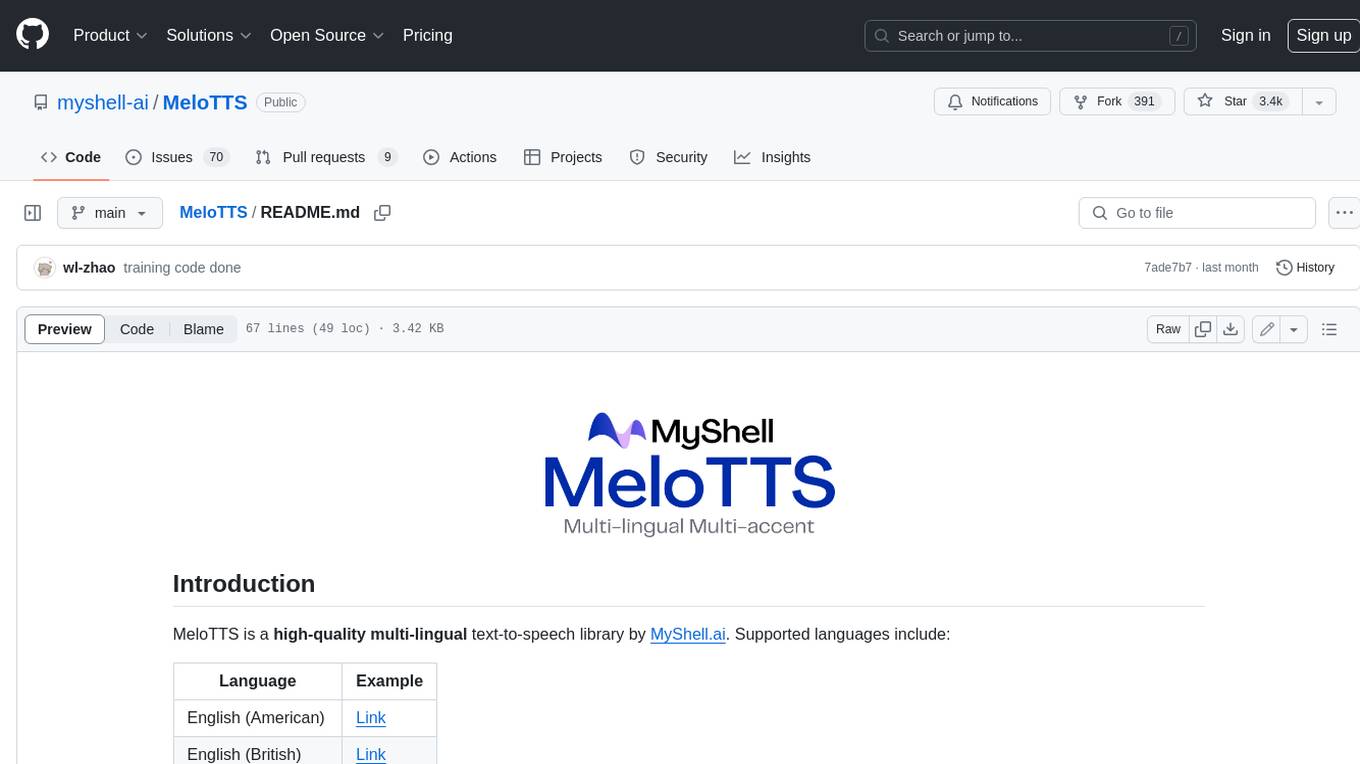
MeloTTS
MeloTTS is a high-quality multi-lingual text-to-speech library by MyShell.ai. It supports various languages including English (American, British, Indian, Australian), Spanish, French, Chinese, Japanese, and Korean. The Chinese speaker also supports mixed Chinese and English. The library is fast enough for CPU real-time inference and offers features like using without installation, local installation, and training on custom datasets. The Python API and model cards are available in the repository and on HuggingFace. The community can join the Discord channel for discussions and collaboration opportunities. Contributions are welcome, and the library is under the MIT License. MeloTTS is based on TTS, VITS, VITS2, and Bert-VITS2.
call-gpt
Call GPT is a voice application that utilizes Deepgram for Speech to Text, elevenlabs for Text to Speech, and OpenAI for GPT prompt completion. It allows users to chat with ChatGPT on the phone, providing better transcription, understanding, and speaking capabilities than traditional IVR systems. The app returns responses with low latency, allows user interruptions, maintains chat history, and enables GPT to call external tools. It coordinates data flow between Deepgram, OpenAI, ElevenLabs, and Twilio Media Streams, enhancing voice interactions.
MARS5-TTS
MARS5 is a novel English speech model (TTS) developed by CAMB.AI, featuring a two-stage AR-NAR pipeline with a unique NAR component. The model can generate speech for various scenarios like sports commentary and anime with just 5 seconds of audio and a text snippet. It allows steering prosody using punctuation and capitalization in the transcript. Speaker identity is specified using an audio reference file, enabling 'deep clone' for improved quality. The model can be used via torch.hub or HuggingFace, supporting both shallow and deep cloning for inference. Checkpoints are provided for AR and NAR models, with hardware requirements of 750M+450M params on GPU. Contributions to improve model stability, performance, and reference audio selection are welcome.
cgft-llm
The cgft-llm repository is a collection of video tutorials and documentation for implementing large models. It provides guidance on topics such as fine-tuning llama3 with llama-factory, lightweight deployment and quantization using llama.cpp, speech generation with ChatTTS, introduction to Ollama for large model deployment, deployment tools for vllm and paged attention, and implementing RAG with llama-index. Users can find detailed code documentation and video tutorials for each project in the repository.
For similar jobs
promptflow
**Prompt flow** is a suite of development tools designed to streamline the end-to-end development cycle of LLM-based AI applications, from ideation, prototyping, testing, evaluation to production deployment and monitoring. It makes prompt engineering much easier and enables you to build LLM apps with production quality.
deepeval
DeepEval is a simple-to-use, open-source LLM evaluation framework specialized for unit testing LLM outputs. It incorporates various metrics such as G-Eval, hallucination, answer relevancy, RAGAS, etc., and runs locally on your machine for evaluation. It provides a wide range of ready-to-use evaluation metrics, allows for creating custom metrics, integrates with any CI/CD environment, and enables benchmarking LLMs on popular benchmarks. DeepEval is designed for evaluating RAG and fine-tuning applications, helping users optimize hyperparameters, prevent prompt drifting, and transition from OpenAI to hosting their own Llama2 with confidence.
MegaDetector
MegaDetector is an AI model that identifies animals, people, and vehicles in camera trap images (which also makes it useful for eliminating blank images). This model is trained on several million images from a variety of ecosystems. MegaDetector is just one of many tools that aims to make conservation biologists more efficient with AI. If you want to learn about other ways to use AI to accelerate camera trap workflows, check out our of the field, affectionately titled "Everything I know about machine learning and camera traps".
leapfrogai
LeapfrogAI is a self-hosted AI platform designed to be deployed in air-gapped resource-constrained environments. It brings sophisticated AI solutions to these environments by hosting all the necessary components of an AI stack, including vector databases, model backends, API, and UI. LeapfrogAI's API closely matches that of OpenAI, allowing tools built for OpenAI/ChatGPT to function seamlessly with a LeapfrogAI backend. It provides several backends for various use cases, including llama-cpp-python, whisper, text-embeddings, and vllm. LeapfrogAI leverages Chainguard's apko to harden base python images, ensuring the latest supported Python versions are used by the other components of the stack. The LeapfrogAI SDK provides a standard set of protobuffs and python utilities for implementing backends and gRPC. LeapfrogAI offers UI options for common use-cases like chat, summarization, and transcription. It can be deployed and run locally via UDS and Kubernetes, built out using Zarf packages. LeapfrogAI is supported by a community of users and contributors, including Defense Unicorns, Beast Code, Chainguard, Exovera, Hypergiant, Pulze, SOSi, United States Navy, United States Air Force, and United States Space Force.
llava-docker
This Docker image for LLaVA (Large Language and Vision Assistant) provides a convenient way to run LLaVA locally or on RunPod. LLaVA is a powerful AI tool that combines natural language processing and computer vision capabilities. With this Docker image, you can easily access LLaVA's functionalities for various tasks, including image captioning, visual question answering, text summarization, and more. The image comes pre-installed with LLaVA v1.2.0, Torch 2.1.2, xformers 0.0.23.post1, and other necessary dependencies. You can customize the model used by setting the MODEL environment variable. The image also includes a Jupyter Lab environment for interactive development and exploration. Overall, this Docker image offers a comprehensive and user-friendly platform for leveraging LLaVA's capabilities.

carrot
The 'carrot' repository on GitHub provides a list of free and user-friendly ChatGPT mirror sites for easy access. The repository includes sponsored sites offering various GPT models and services. Users can find and share sites, report errors, and access stable and recommended sites for ChatGPT usage. The repository also includes a detailed list of ChatGPT sites, their features, and accessibility options, making it a valuable resource for ChatGPT users seeking free and unlimited GPT services.
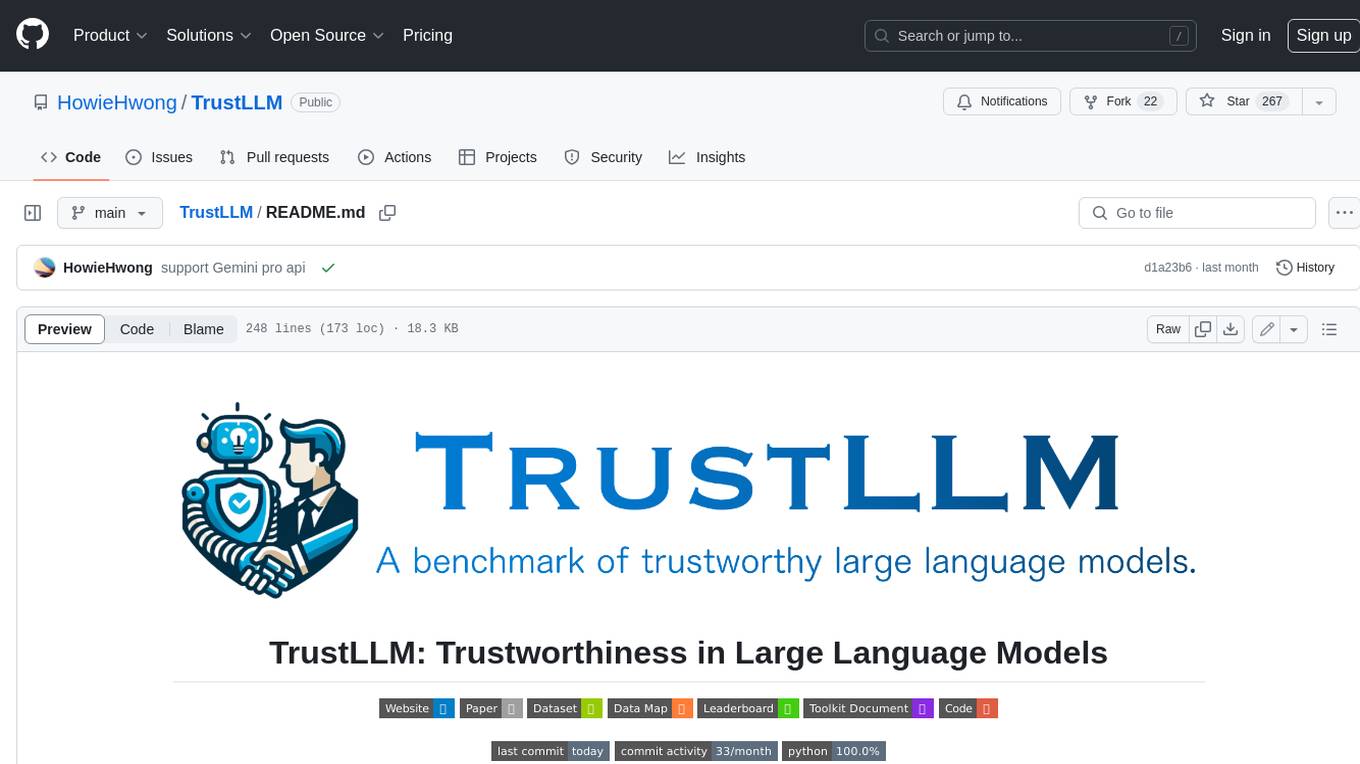
TrustLLM
TrustLLM is a comprehensive study of trustworthiness in LLMs, including principles for different dimensions of trustworthiness, established benchmark, evaluation, and analysis of trustworthiness for mainstream LLMs, and discussion of open challenges and future directions. Specifically, we first propose a set of principles for trustworthy LLMs that span eight different dimensions. Based on these principles, we further establish a benchmark across six dimensions including truthfulness, safety, fairness, robustness, privacy, and machine ethics. We then present a study evaluating 16 mainstream LLMs in TrustLLM, consisting of over 30 datasets. The document explains how to use the trustllm python package to help you assess the performance of your LLM in trustworthiness more quickly. For more details about TrustLLM, please refer to project website.
AI-YinMei
AI-YinMei is an AI virtual anchor Vtuber development tool (N card version). It supports fastgpt knowledge base chat dialogue, a complete set of solutions for LLM large language models: [fastgpt] + [one-api] + [Xinference], supports docking bilibili live broadcast barrage reply and entering live broadcast welcome speech, supports Microsoft edge-tts speech synthesis, supports Bert-VITS2 speech synthesis, supports GPT-SoVITS speech synthesis, supports expression control Vtuber Studio, supports painting stable-diffusion-webui output OBS live broadcast room, supports painting picture pornography public-NSFW-y-distinguish, supports search and image search service duckduckgo (requires magic Internet access), supports image search service Baidu image search (no magic Internet access), supports AI reply chat box [html plug-in], supports AI singing Auto-Convert-Music, supports playlist [html plug-in], supports dancing function, supports expression video playback, supports head touching action, supports gift smashing action, supports singing automatic start dancing function, chat and singing automatic cycle swing action, supports multi scene switching, background music switching, day and night automatic switching scene, supports open singing and painting, let AI automatically judge the content.