


blurr
AI agents can now use real Android, just like a human.
Stars: 464
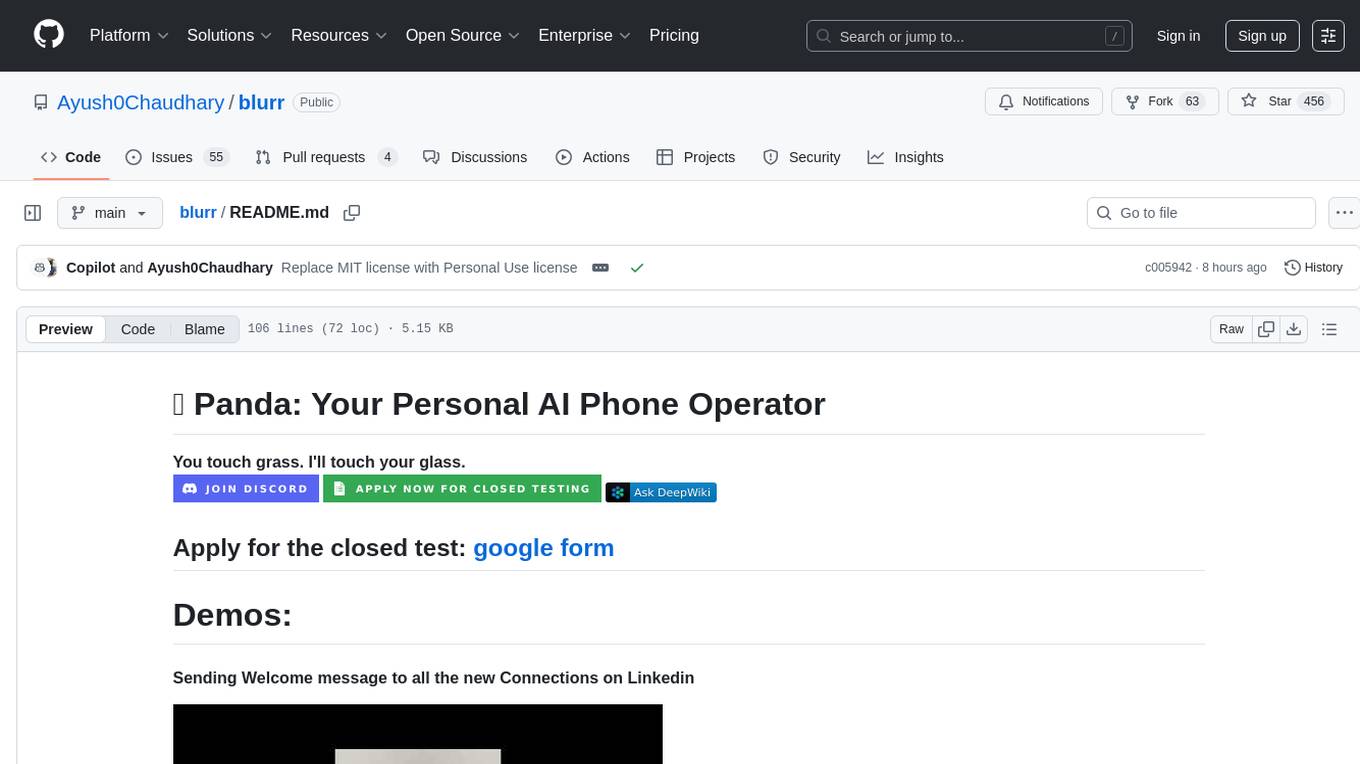
Panda is a proactive, on-device AI agent for Android that autonomously understands natural language commands and operates your phone's UI to achieve them. It acts as a personal operator, handling complex, multi-step tasks across different applications. With intelligent UI automation, high-quality voice, and personalized local memory, Panda simplifies interactions with technology. Built on Kotlin, Panda's architecture includes Eyes & Hands for physical device connection, The Brain for reasoning, and The Agent for execution. The project is a proof-of-concept aiming to become an indispensable assistant.
README:



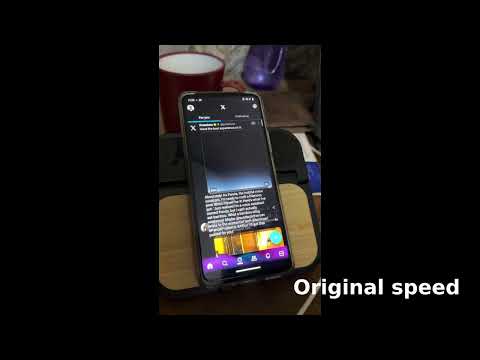

https://github.com/user-attachments/assets/cf76bb00-2bf4-4274-acad-d9f4c0d47188
Panda is a proactive, on-device AI agent for Android that autonomously understands natural language commands and operates your phone's UI to achieve them. Inspired by the need to make modern technology more accessible, Panda acts as your personal operator, capable of handling complex, multi-step tasks across different applications.



- 🧠 Intelligent UI Automation: Panda sees the screen, understands the context of UI elements, and performs actions like tapping, swiping, and typing to navigate apps and complete tasks.
- 📢 High Qaulity voice: Panda have high quality voice by GCS's Chirp
- 💾 Persistent & Personalized local Memory:
⚠️ Temporarily Disabled - Panda memory is turned off as of yet. Memory functionality will be restored in a future update.
Panda is built on a sophisticated multi-agent system written entirely in Kotlin. This architecture separates responsibilities, allowing for more complex and reliable reasoning.
- Eyes & Hands (The Actuator): The Android Accessibility Service serves as the agent's physical connection to the device, providing the low-level ability to read the screen element hierarchy and programmatically perform touch gestures.
- The Brain (The LLM): All high-level reasoning, planning, and analysis are powered by LLM models. This is where decisions are made.
-
The Agent:
- Operator: This is executor with Notepad.
- Android Studio (latest version recommended)
- An Android device or emulator with API level 26+
- Some Gemini keys, sample ENV
sdk.dir=
GEMINI_API_KEYS=
-
Clone the repository:
git clone [https://github.com/ayush0chaudhary/blurr.git](https://github.com/ayush0chaudhary/blurr.git) cd blurr -
Set up API Keys: This project uses a
local.propertiesfile to securely handle API keys. This file is included in.gitignoreand should never be committed.- Create a file named
local.propertiesin the root directory of the project. - Add your API keys to this file in the following format:
 sdk.dir=
 GEMINI_API_KEYS=<add 2-3 keys working here>
 TAVILY_API=<not-req><add randome string>
 MEM0_API=<not-req><add randome string>
 PICOVOICE_ACCESS_KEY=<not-req><add randome string>
 GOOGLE_TTS_API_KEY=<req> (issue will fix this)
 GCLOUD_GATEWAY_PICOVOICE_KEY=<not needed><add randome string>
 GCLOUD_GATEWAY_URL=<not needed><add randome string>
 GCLOUD_PROXY_URL=<not needed><add randome string>
 GCLOUD_PROXY_URL_KEY=<not needed><add randome string>
 REVENUE_CAT_PUBLIC_URL=<not needed> <add randome string>
 REVENUECAT_API_KEY=<not needed> <add randome string>
- Create a file named
-
Build & Run:
- Open the project in Android Studio.
- Let Gradle sync all the dependencies.
- Run the app on your selected device or emulator.
-
Enable Accessibility Service:
- On the first run, the app will prompt you to grant Accessibility permission.
- Click "Grant Access" and enable the "Panda" service in your phone's settings. This is required for the agent to see and control the screen.
Panda is currently a powerful proof-of-concept, and the roadmap is focused on making it a truly indispensable assistant.
- [ ] NOT UPDATED: List not updated
Contributions are welcome! If you have ideas for new features or improvements, feel free to open an issue or submit a pull request.
This project is licensed under a Personal Use License - see the LICENSE file for details.
Personal & Educational Use: Free to use, modify, and distribute for personal, educational, and non-commercial purposes.
Commercial Use: Requires a separate commercial license. Please contact Panda AI for commercial licensing terms.
https://github.com/user-attachments/assets/b577072e-2f7f-42d2-9054-3a11160cf87d
Write you api key in in local.properties, more keys you use, better is the speed 😉
adb logcat | grep GeminiApi
For Tasks:
Click tags to check more tools for each tasksFor Jobs:
Alternative AI tools for blurr
Similar Open Source Tools
blurr
Panda is a proactive, on-device AI agent for Android that autonomously understands natural language commands and operates your phone's UI to achieve them. It acts as a personal operator, handling complex, multi-step tasks across different applications. With intelligent UI automation, high-quality voice, and personalized local memory, Panda simplifies interactions with technology. Built on Kotlin, Panda's architecture includes Eyes & Hands for physical device connection, The Brain for reasoning, and The Agent for execution. The project is a proof-of-concept aiming to become an indispensable assistant.
llama.ui
llama.ui is an open-source desktop application that provides a beautiful, user-friendly interface for interacting with large language models powered by llama.cpp. It is designed for simplicity and privacy, allowing users to chat with powerful quantized models on their local machine without the need for cloud services. The project offers multi-provider support, conversation management with indexedDB storage, rich UI components including markdown rendering and file attachments, advanced features like PWA support and customizable generation parameters, and is privacy-focused with all data stored locally in the browser.
cedar-OS
Cedar OS is an open-source framework that bridges the gap between AI agents and React applications, enabling the creation of AI-native applications where agents can interact with the application state like users. It focuses on providing intuitive and powerful ways for humans to interact with AI through features like full state integration, real-time streaming, voice-first design, and flexible architecture. Cedar OS offers production-ready chat components, agentic state management, context-aware mentions, voice integration, spells & quick actions, and fully customizable UI. It differentiates itself by offering a true AI-native architecture, developer-first experience, production-ready features, and extensibility. Built with TypeScript support, Cedar OS is designed for developers working on ambitious AI-native applications.
awesome-pi-agent
Awesome Pi Agent is a versatile and powerful tool for building intelligent agents on Raspberry Pi. It provides a framework for developing AI-powered applications that can interact with the physical world through sensors and actuators. With a focus on simplicity and extensibility, this tool enables users to create a wide range of smart devices, from home automation systems to robotics projects. The agent can be easily customized and integrated with various AI algorithms and libraries, making it suitable for both beginners and advanced users interested in exploring the intersection of AI and IoT technologies.
openchamber
OpenChamber is a web and desktop interface for the OpenCode AI coding agent, designed to work alongside the OpenCode TUI. The project was built entirely with AI coding agents under supervision, serving as a proof of concept that AI agents can create usable software. It offers features like integrated terminal, Git operations with AI commit message generation, smart tool visualization, permission management, multi-agent runs, task tracker UI, model selection UX, UI scaling controls, session auto-cleanup, and memory optimizations. OpenChamber provides cross-device continuity, remote access, and a visual alternative for developers preferring GUI workflows.
Awesome-Vibe-Coding
Awesome-Vibe-Coding is a curated list of Vibe Coding open-source projects, tools, and learning resources. It includes a comprehensive collection of AI-powered development toolkits, IDEs, extensions, platforms, and cloud-based agents for modern software development. The repository also covers development standards, MCP servers, agent communication protocols, agent SDKs, supporting tools, vibe coding projects, and learning resources. The project aims to showcase the power of AI-assisted development and provide a resource hub for developers interested in Vibe Coding practices.
baibot
Baibot is a versatile chatbot framework designed to simplify the process of creating and deploying chatbots. It provides a user-friendly interface for building custom chatbots with various functionalities such as natural language processing, conversation flow management, and integration with external APIs. Baibot is highly customizable and can be easily extended to suit different use cases and industries. With Baibot, developers can quickly create intelligent chatbots that can interact with users in a seamless and engaging manner, enhancing user experience and automating customer support processes.
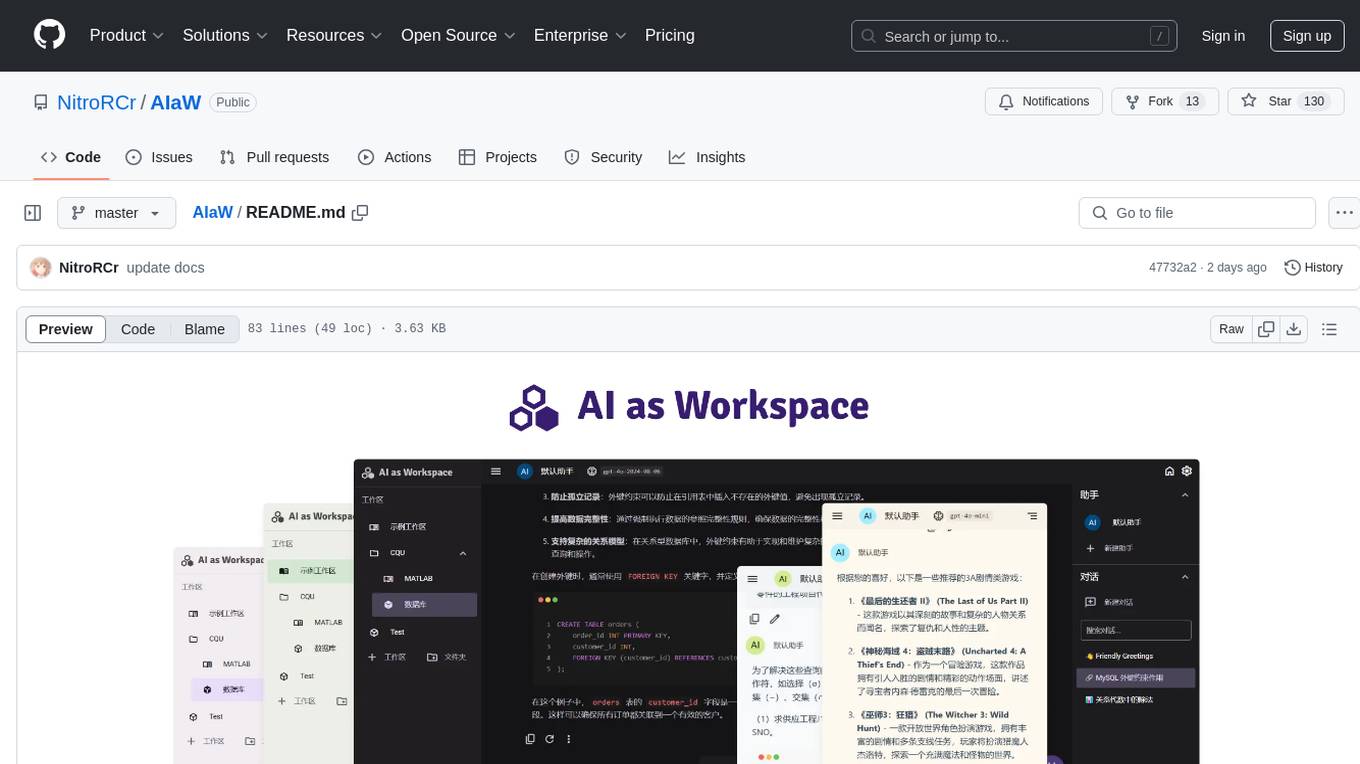
AIaW
AIaW is a next-generation LLM client with full functionality, lightweight, and extensible. It supports various basic functions such as streaming transfer, image uploading, and latex formulas. The tool is cross-platform with a responsive interface design. It supports multiple service providers like OpenAI, Anthropic, and Google. Users can modify questions, regenerate in a forked manner, and visualize conversations in a tree structure. Additionally, it offers features like file parsing, video parsing, plugin system, assistant market, local storage with real-time cloud sync, and customizable interface themes. Users can create multiple workspaces, use dynamic prompt word variables, extend plugins, and benefit from detailed design elements like real-time content preview, optimized code pasting, and support for various file types.
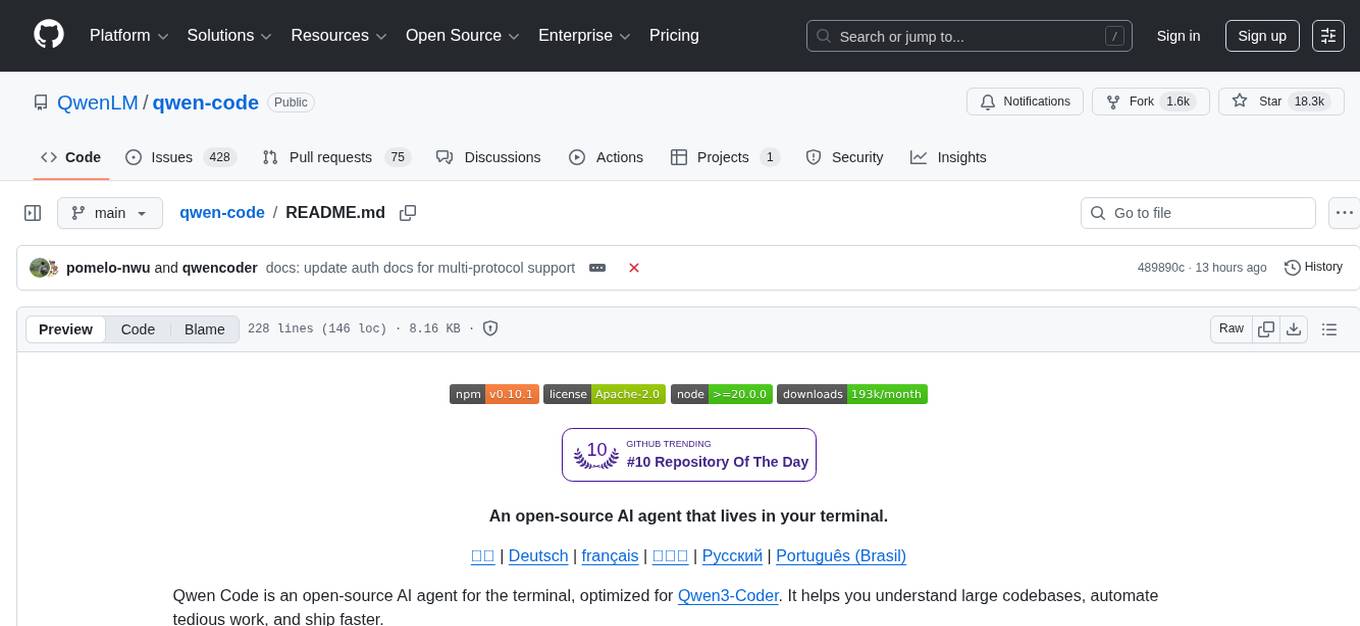
qwen-code
Qwen Code is an open-source AI agent optimized for Qwen3-Coder, designed to help users understand large codebases, automate tedious work, and expedite the shipping process. It offers an agentic workflow with rich built-in tools, a terminal-first approach with optional IDE integration, and supports both OpenAI-compatible API and Qwen OAuth authentication methods. Users can interact with Qwen Code in interactive mode, headless mode, IDE integration, and through a TypeScript SDK. The tool can be configured via settings.json, environment variables, and CLI flags, and offers benchmark results for performance evaluation. Qwen Code is part of an ecosystem that includes AionUi and Gemini CLI Desktop for graphical interfaces, and troubleshooting guides are available for issue resolution.
chatmcp
Chatmcp is a chatbot framework for building conversational AI applications. It provides a flexible and extensible platform for creating chatbots that can interact with users in a natural language. With Chatmcp, developers can easily integrate chatbot functionality into their applications, enabling users to communicate with the system through text-based conversations. The framework supports various natural language processing techniques and allows for the customization of chatbot behavior and responses. Chatmcp simplifies the development of chatbots by providing a set of pre-built components and tools that streamline the creation process. Whether you are building a customer support chatbot, a virtual assistant, or a chat-based game, Chatmcp offers the necessary features and capabilities to bring your conversational AI ideas to life.
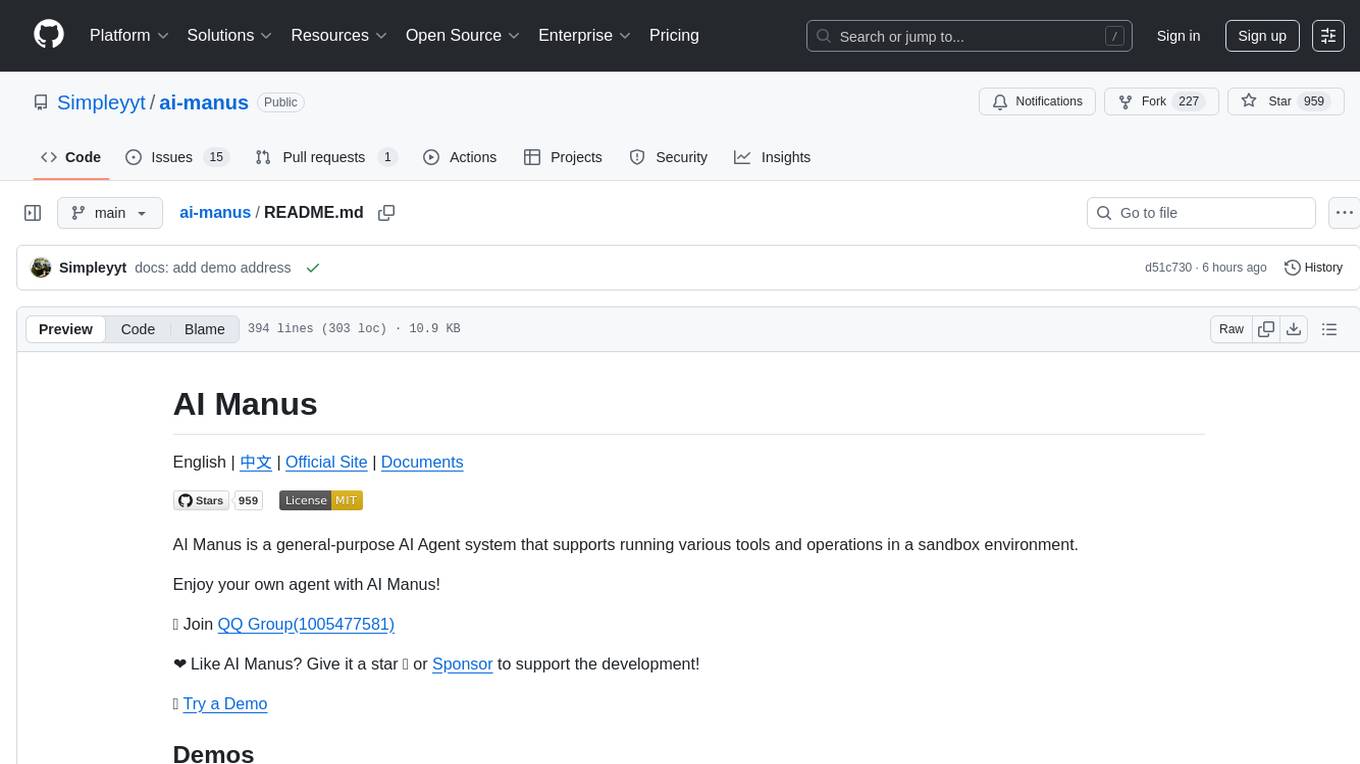
ai-manus
AI Manus is a general-purpose AI Agent system that supports running various tools and operations in a sandbox environment. It offers deployment with minimal dependencies, supports multiple tools like Terminal, Browser, File, Web Search, and messaging tools, allocates separate sandboxes for tasks, manages session history, supports stopping and interrupting conversations, file upload and download, and is multilingual. The system also provides user login and authentication. The project primarily relies on Docker for development and deployment, with model capability requirements and recommended Deepseek and GPT models.
pilot
Pilot is an AI tool designed to streamline the process of handling tickets from GitHub, Linear, Jira, or Asana. It plans the implementation, writes the code, runs tests, and opens a PR for you to review and merge. With features like Autopilot, Epic Decomposition, Self-Review, and more, Pilot aims to automate the ticket handling process and reduce the time spent on prioritizing and completing tasks. It integrates with various platforms, offers intelligence features, and provides real-time visibility through a dashboard. Pilot is free to use, with costs associated with Claude API usage. It is designed for bug fixes, small features, refactoring, tests, docs, and dependency updates, but may not be suitable for large architectural changes or security-critical code.
ultracontext
UltraContext is a context API for AI agents that simplifies controlling what agents see by allowing users to replace messages, compact or offload context, replay decisions, and roll back mistakes with a single API call. It provides versioned context out of the box with full history and zero complexity. The tool aims to address the issue of context rot in large language models by providing a simple API with automatic versioning, time-travel capabilities, schema-free data storage, framework-agnostic compatibility, and fast performance. UltraContext is designed to streamline the process of managing context for AI agents, enabling users to focus on solving interesting problems rather than spending time gluing context together.
intelligent-app-workshop
Welcome to the envisioning workshop designed to help you build your own custom Copilot using Microsoft's Copilot stack. This workshop aims to rethink user experience, architecture, and app development by leveraging reasoning engines and semantic memory systems. You will utilize Azure AI Foundry, Prompt Flow, AI Search, and Semantic Kernel. Work with Miyagi codebase, explore advanced capabilities like AutoGen and GraphRag. This workshop guides you through the entire lifecycle of app development, including identifying user needs, developing a production-grade app, and deploying on Azure with advanced capabilities. By the end, you will have a deeper understanding of leveraging Microsoft's tools to create intelligent applications.
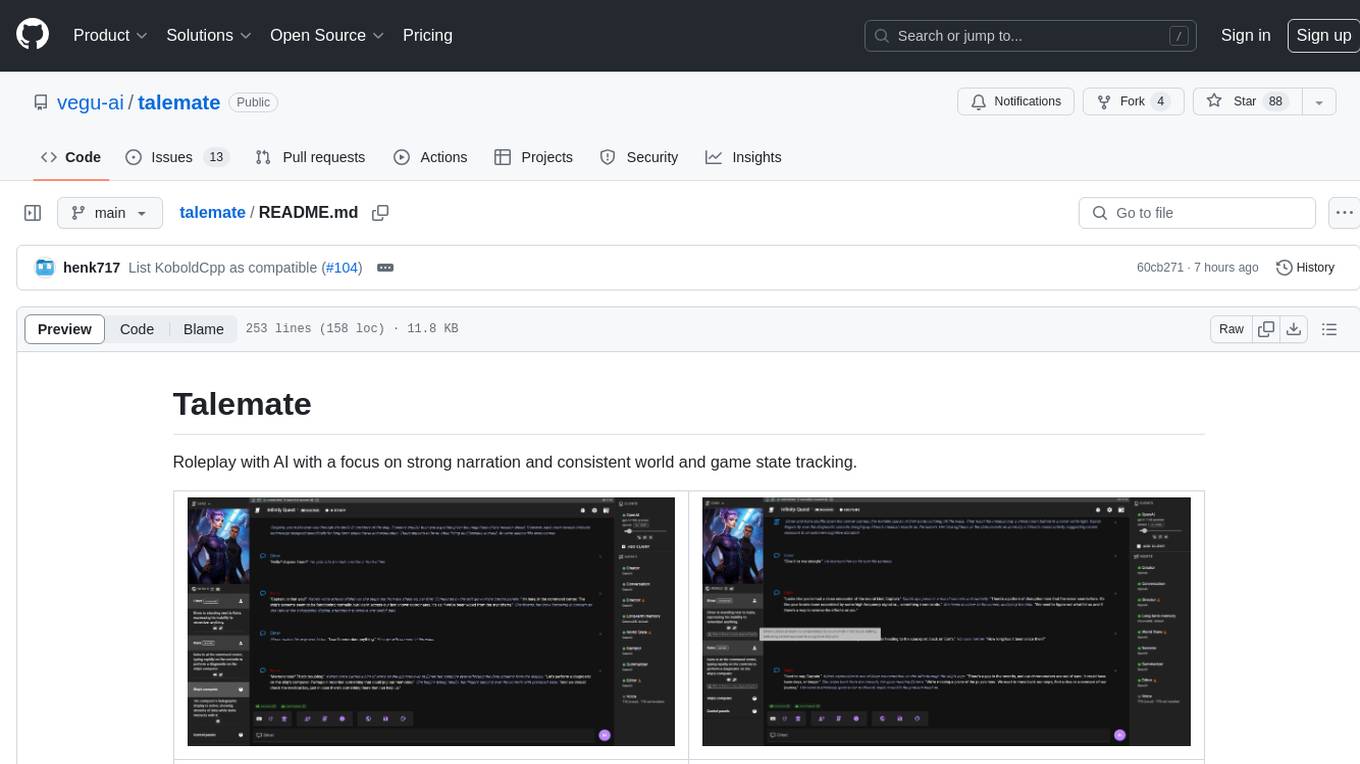
talemate
Talemate is a roleplay tool that allows users to interact with AI agents for dialogue, narration, summarization, direction, editing, world state management, character/scenario creation, text-to-speech, and visual generation. It supports multiple AI clients and APIs, offers long-term memory using ChromaDB, and provides tools for managing NPCs, AI-assisted character creation, and scenario creation. Users can customize prompts using Jinja2 templates and benefit from a modern, responsive UI. The tool also integrates with Runpod for enhanced functionality.
spacebot
Spacebot is an AI agent designed for teams, communities, and multi-user environments. It splits the monolith into specialized processes that delegate tasks, allowing it to handle concurrent conversations, execute tasks, and respond to multiple users simultaneously. Built for Discord, Slack, and Telegram, Spacebot can run coding sessions, manage files, automate web browsing, and search the web. Its memory system is structured and graph-connected, enabling productive knowledge synthesis. With capabilities for task execution, messaging, memory management, scheduling, model routing, and extensible skills, Spacebot offers a comprehensive solution for collaborative work environments.
For similar tasks
IBRAHIM-AI-10.10
BMW MD is a simple WhatsApp user BOT created by Ibrahim Tech. It allows users to scan pairing codes or QR codes to connect to WhatsApp and deploy the bot on Heroku. The bot can be used to perform various tasks such as sending messages, receiving messages, and managing contacts. It is released under the MIT License and contributions are welcome.
WeChatMsg
WeChatMsg is a tool designed to help users manage and analyze their WeChat data. It aims to provide users with the ability to preserve their precious memories and create a personalized AI companion. The tool allows users to extract and export various types of data from WeChat, such as text, images, contacts, and more. Additionally, it offers features like analyzing chat data and generating visual annual reports. WeChatMsg is built on the idea of empowering users to take control of their data and foster emotional connections through technology.

J.A.R.V.I.S.
J.A.R.V.I.S.1.0 is an advanced virtual assistant tool designed to assist users in various tasks. It provides a wide range of functionalities including voice commands, task automation, information retrieval, and communication management. With its intuitive interface and powerful capabilities, J.A.R.V.I.S.1.0 aims to enhance productivity and streamline daily activities for users.
Panora
Panora is an open-source unified API tool that allows users to easily integrate and interact with various software platforms. It provides features like Magic Links for data access, Custom Fields for specific data points, Passthrough Requests for interacting with other platforms, and Webhooks for receiving normalized data. The tool supports integrations with CRM, Ticketing, ATS, HRIS, File Storage, Ecommerce, and more. Users can easily manage contacts, deals, notes, engagements, tasks, users, companies, and other data across different platforms. Panora aims to simplify data management and streamline workflows for businesses.
jiwu-mall-chat-tauri
Jiwu Chat Tauri APP is a desktop chat application based on Nuxt3 + Tauri + Element Plus framework. It provides a beautiful user interface with integrated chat and social functions. It also supports AI shopping chat and global dark mode. Users can engage in real-time chat, share updates, and interact with AI customer service through this application.
JiwuChat
JiwuChat is a lightweight multi-platform chat application built on Tauri2 and Nuxt3, with various real-time messaging features, AI group chat bots (such as 'iFlytek Spark', 'KimiAI' etc.), WebRTC audio-video calling, screen sharing, and AI shopping functions. It supports seamless cross-device communication, covering text, images, files, and voice messages, also supporting group chats and customizable settings. It provides light/dark mode for efficient social networking.
blurr
Panda is a proactive, on-device AI agent for Android that autonomously understands natural language commands and operates your phone's UI to achieve them. It acts as a personal operator, handling complex, multi-step tasks across different applications. With intelligent UI automation, high-quality voice, and personalized local memory, Panda simplifies interactions with technology. Built on Kotlin, Panda's architecture includes Eyes & Hands for physical device connection, The Brain for reasoning, and The Agent for execution. The project is a proof-of-concept aiming to become an indispensable assistant.
Call
Call is an open-source AI-native alternative to Google Meet and Zoom, offering video calling, team collaboration, contact management, meeting scheduling, AI-powered features, security, and privacy. It is cross-platform, web-based, mobile responsive, and supports offline capabilities. The tech stack includes Next.js, TypeScript, Tailwind CSS, Mediasoup-SFU, React Query, Zustand, Hono, PostgreSQL, Drizzle ORM, Better Auth, Turborepo, Docker, Vercel, and Rate Limiting.
For similar jobs
sweep
Sweep is an AI junior developer that turns bugs and feature requests into code changes. It automatically handles developer experience improvements like adding type hints and improving test coverage.
teams-ai
The Teams AI Library is a software development kit (SDK) that helps developers create bots that can interact with Teams and Microsoft 365 applications. It is built on top of the Bot Framework SDK and simplifies the process of developing bots that interact with Teams' artificial intelligence capabilities. The SDK is available for JavaScript/TypeScript, .NET, and Python.
ai-guide
This guide is dedicated to Large Language Models (LLMs) that you can run on your home computer. It assumes your PC is a lower-end, non-gaming setup.
classifai
Supercharge WordPress Content Workflows and Engagement with Artificial Intelligence. Tap into leading cloud-based services like OpenAI, Microsoft Azure AI, Google Gemini and IBM Watson to augment your WordPress-powered websites. Publish content faster while improving SEO performance and increasing audience engagement. ClassifAI integrates Artificial Intelligence and Machine Learning technologies to lighten your workload and eliminate tedious tasks, giving you more time to create original content that matters.
chatbot-ui
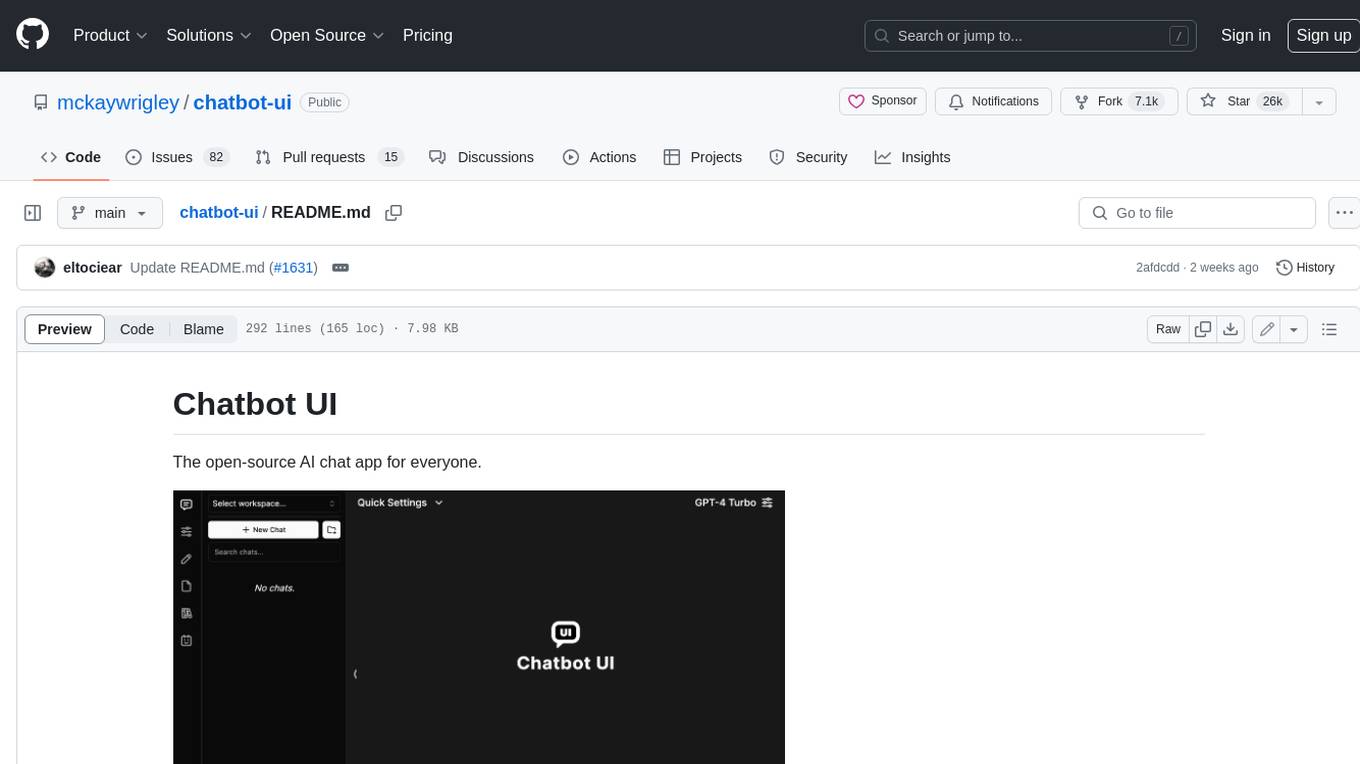
Chatbot UI is an open-source AI chat app that allows users to create and deploy their own AI chatbots. It is easy to use and can be customized to fit any need. Chatbot UI is perfect for businesses, developers, and anyone who wants to create a chatbot.
BricksLLM
BricksLLM is a cloud native AI gateway written in Go. Currently, it provides native support for OpenAI, Anthropic, Azure OpenAI and vLLM. BricksLLM aims to provide enterprise level infrastructure that can power any LLM production use cases. Here are some use cases for BricksLLM: * Set LLM usage limits for users on different pricing tiers * Track LLM usage on a per user and per organization basis * Block or redact requests containing PIIs * Improve LLM reliability with failovers, retries and caching * Distribute API keys with rate limits and cost limits for internal development/production use cases * Distribute API keys with rate limits and cost limits for students
uAgents
uAgents is a Python library developed by Fetch.ai that allows for the creation of autonomous AI agents. These agents can perform various tasks on a schedule or take action on various events. uAgents are easy to create and manage, and they are connected to a fast-growing network of other uAgents. They are also secure, with cryptographically secured messages and wallets.
griptape
Griptape is a modular Python framework for building AI-powered applications that securely connect to your enterprise data and APIs. It offers developers the ability to maintain control and flexibility at every step. Griptape's core components include Structures (Agents, Pipelines, and Workflows), Tasks, Tools, Memory (Conversation Memory, Task Memory, and Meta Memory), Drivers (Prompt and Embedding Drivers, Vector Store Drivers, Image Generation Drivers, Image Query Drivers, SQL Drivers, Web Scraper Drivers, and Conversation Memory Drivers), Engines (Query Engines, Extraction Engines, Summary Engines, Image Generation Engines, and Image Query Engines), and additional components (Rulesets, Loaders, Artifacts, Chunkers, and Tokenizers). Griptape enables developers to create AI-powered applications with ease and efficiency.