


OpenScribe
OpenScribe is an open-source AI scribe that records patient encounters and generates structured clinical notes automatically. You keep full control over data, workflows, and patient privacy with no vendor lock-in.
Stars: 63
OpenScribe is an open-source AI medical scribe tool designed to assist clinicians in recording patient encounters, transcribing audio, and generating structured draft clinical notes using large language models (LLMs). The tool offers a default web deployment path with local Whisper transcription and Anthropic Claude note generation. It is currently in early development (v0.x) and not suitable for clinical practice yet, intended for evaluation, testing, and development purposes only. The project aims to provide a local-first, privacy-conscious, and modular alternative to cloud-dependent clinical documentation tools.
README:

Open-source AI medical scribe for recording encounters and generating structured clinical notes.



OpenScribe is a free MIT license open source AI Medical Scribe that helps clinicians record patient encounters, transcribe audio, and generate structured draft clinical notes using LLMs. The default web deployment path is mixed mode: local Whisper transcription + Anthropic Claude note generation. A fully local desktop path is also available forked from StenoAI.
This software is currently in early development (v0.x) and is NOT suitable for clinical practice yet. It is intended for evaluation, testing, and development purposes only.
- HIPAA Compliant version is currently in the works. Join the Discord for more information when the version is launched.

node --version  # Check you have Node.js 18+
# If not installed: brew install node if version < 18: brew upgrade node  (macOS) or download latest from nodejs.org
npm install -g pnpmgit clone https://github.com/sammargolis/OpenScribe.git
cd OpenScribe
pnpm installCreate env defaults:
pnpm run setup # Auto-generates .env.local with secure storage keyEdit apps/web/.env.local and add:
TRANSCRIPTION_PROVIDER=whisper_local
WHISPER_LOCAL_MODEL=tiny.en
ANTHROPIC_API_KEY=sk-ant-YOUR_KEY_HERE
# NEXT_PUBLIC_SECURE_STORAGE_KEY is auto-generated, don't modify
OPENAI_API_KEY is optional unless you switch to TRANSCRIPTION_PROVIDER=whisper_openai.
pnpm dev:local # One command: Whisper local server + web appOptional desktop app path:
pnpm electron:devOpenScribe supports three workflows. Mixed web mode is the default path.
- Transcription: local Whisper server (
pnpm whisper:server) with default modeltiny.en - Notes: larger model (default Claude in web path)
- Start everything with one command:
pnpm dev:local - Configure with
TRANSCRIPTION_PROVIDER=whisper_localinapps/web/.env.local - Setup guide
- Transcription: local Whisper backend in
local-only/openscribe-backend - Notes: local Ollama models (
llama3.2:*,gemma3:4b) - No cloud inference in this path
- Setup guide
- Transcription: OpenAI Whisper API
- Notes: Anthropic Claude (or other hosted LLM)
- Requires API keys in
apps/web/.env.local
OpenAI (transcription): platform.openai.com/api-keys - Sign up → API Keys → Create new secret key
Anthropic (note generation): console.anthropic.com/settings/keys - Sign up → API Keys → Create Key
Both services offer $5 free credits for new accounts
git pull origin main  # Pull latest changes
pnpm install          # Update dependencies

# If you encounter issues after updating:
rm -rf node_modules pnpm-lock.yaml && pnpm installOpenScribe exists to provide a simple, open-source alternative to cloud dependent clinical documentation tools. The project is built on core principles:
- Local-first storage: Encounter data is stored locally in the browser by default
- Privacy-conscious: No analytics or telemetry in the web app; external model calls are explicit and configurable
- Modular: Components can be swapped or extended (e.g., different LLM providers, transcription services)
This repo now includes a fully local, text-only MedGemma scribe workflow in
packages/pipeline/medgemma-scribe. It requires pre-transcribed text and
does not perform speech-to-text. See
packages/pipeline/medgemma-scribe/README.md for setup and usage.
- GitHub: sammargolis/OpenScribe
- Maintainer: @sammargolis
- Architecture: architecture.md
- Tests: packages/llm, packages/pipeline
- Core recording, transcription, and note generation
- AES-GCM encrypted local storage
- Browser-based audio capture
- Error handling improvements
- Comprehensive test coverage
- Basic audit logging
Physical Controls:
- User responsibility (device security, physical access)
- Package app to be able to run 100% locally with transciption model and small 7b model for note generation
- Multiple LLM providers (Anthropic, local models)
- Custom note templates
- Optional cloud sync (user-controlled)
- Multi-language support
- Mobile app
- EHR integration
- RCM integration
See architecture.md for complete details.
┌─────────────────────────────────────────────────────────┐
│                    UI Layer (Next.js)                   │
│  ┌──────────────┐              ┌─────────────────────┐  │
│  │ Encounter    │              │  Workflow States    │  │
│  │ Sidebar      │◄────────────►│  - Idle             │  │
│  │              │              │  - Recording        │  │
│  │              │              │  - Processing       │  │
│  │              │              │  - Note Editor      │  │
│  └──────────────┘              └─────────────────────┘  │
└─────────────────────────────────────────────────────────┘
                          │
                          ▼
┌─────────────────────────────────────────────────────────┐
│              Processing Pipeline                        │
│  ┌──────────┐   ┌──────────┐   ┌──────────┐   ┌─────┐   │
│  │  Audio   │──►│Transcribe│──►│   LLM    │──►│Note │   │
│  │  Ingest  │   │ (Whisper)│   │          │   │Core │   │
│  └──────────┘   └──────────┘   └──────────┘   └─────┘   │
│       │                                           │     │
│       └───────────────┐         ┌─────────────────┘     │
└───────────────────────┼─────────┼───────────────────────┘
                        ▼         ▼
┌─────────────────────────────────────────────────────────┐
│                  Storage Layer                          │
│  ┌──────────────────────────────────────────────────┐   │
│  │  Encrypted LocalStorage (AES-GCM)                │   │
│  │  - Encounters (patient data, transcripts, notes) │   │
│  │  - Metadata (timestamps, status)                 │   │
│  │  - Audio (in-memory only, not persisted)         │   │
│  └──────────────────────────────────────────────────┘   │
└─────────────────────────────────────────────────────────┘
Key Components:
-
UI Layer: React components in
apps/web/using Next.js App Router - Audio Ingest: Browser MediaRecorder API → WebM/MP4 blob
-
Transcription (default web path): local Whisper server (
whisper.cppviapywhispercpp, modeltiny.en) -
LLM (default web path): Anthropic Claude via
packages/llm -
Fully local desktop path: Whisper + Ollama via
local-only/openscribe-backend -
Cloud fallback path: OpenAI Whisper API + hosted provider via
packages/llm - Note Core: Structured clinical note generation and validation
- Storage: AES-GCM encrypted browser localStorage
Monorepo Structure:
-
apps/web/– Next.js frontend + Electron renderer -
packages/pipeline/– Audio ingest, transcription, assembly, evaluation -
packages/ui/– Shared React components -
packages/storage/– Encrypted storage + encounter management -
packages/llm/– Provider-agnostic LLM client -
packages/shell/– Electron main process -
config/– Shared configuration files -
build/– Build artifacts
Storage: AES-GCM encrypted localStorage. Audio processed in-memory, not persisted.
Transmission: In the default mixed mode, audio stays local for transcription and transcript text is sent to Anthropic Claude over HTTPS/TLS for note generation. If TRANSCRIPTION_PROVIDER=whisper_openai, audio is sent to OpenAI Whisper over HTTPS/TLS. The application enforces HTTPS-only connections and displays a security warning if accessed over HTTP in production builds.
No Tracking: Zero analytics, telemetry, or cloud sync
Use Responsibility
- All AI notes are drafts requiring review
- Ensure regulatory compliance for your use case
- For production deployments serving PHI, ensure the application is accessed via HTTPS or served from localhost only
HIPAA Compliance: OpenScribe includes foundational privacy/security features, but this alone does not make the application HIPAA-compliant. Below is what is already built, followed by a checklist a health system must complete to operate compliantly.
Built (foundational rails)
- AES-GCM encrypted localStorage for PHI at rest in the browser
- Audio processed in-memory and not persisted
- TLS/HTTPS for external API calls (Whisper, Claude)
- No analytics/telemetry or cloud sync by default (local-first)
- HTTPS-only enforcement in production with HTTP warning
Health System Checklist (required to run compliantly)
- Execute BAAs with all PHI-touching vendors (e.g., OpenAI, Anthropic, hosting providers)
- Perform and document HIPAA Security Rule risk analysis and remediation plan
- Implement access controls (SSO/MFA, least-privilege, session timeouts)
- Establish audit logging, log review processes, and retention policies
- Define data retention, backup, and secure deletion procedures for PHI
- Configure device, endpoint, and physical safeguards (disk encryption, MDM, secure workstations)
- Document policies and procedures (incident response, breach notification, sanctions)
- Train workforce on HIPAA/privacy/security requirements
- Establish key management and secret rotation procedures
- Validate network/security posture (secure deployment, vulnerability management)
No EHR Integration: Standalone tool
Browser Storage Limits: ~5-10MB typical
No Warranty: Provided as-is under MIT License
Contributions welcome! See CONTRIBUTING.md for detailed guidelines.
Quick Start:
- Fork the repository
- Create a feature branch
- Make changes with tests
- Submit a PR
Portions of this project include or were derived from code in:
StenoAI – https://github.com/ruzin/stenoai
Copyright (c) 2025 Skrape Limited
Licensed under the MIT License.
All third-party code remains subject to its original license terms.
MIT
MIT License

Copyright (c) 2026 Sam Margolis

Permission is hereby granted, free of charge, to any person obtaining a copy
of this software and associated documentation files (the "Software"), to deal
in the Software without restriction, including without limitation the rights
to use, copy, modify, merge, publish, distribute, sublicense, and/or sell
copies of the Software, and to permit persons to whom the Software is
furnished to do so, subject to the following conditions:

The above copyright notice and this permission notice shall be included in all
copies or substantial portions of the Software.

THE SOFTWARE IS PROVIDED "AS IS", WITHOUT WARRANTY OF ANY KIND, EXPRESS OR
IMPLIED, INCLUDING BUT NOT LIMITED TO THE WARRANTIES OF MERCHANTABILITY,
FITNESS FOR A PARTICULAR PURPOSE AND NONINFRINGEMENT. IN NO EVENT SHALL THE
AUTHORS OR COPYRIGHT HOLDERS BE LIABLE FOR ANY CLAIM, DAMAGES OR OTHER
LIABILITY, WHETHER IN AN ACTION OF CONTRACT, TORT OR OTHERWISE, ARISING FROM,
OUT OF OR IN CONNECTION WITH THE SOFTWARE OR THE USE OR OTHER DEALINGS IN THE
SOFTWARE.
OpenScribe
GitHub: https://github.com/sammargolis/OpenScribe
Maintainer: Sam Margolis (@sammargolis)
For Tasks:
Click tags to check more tools for each tasksFor Jobs:
Alternative AI tools for OpenScribe
Similar Open Source Tools
OpenScribe
OpenScribe is an open-source AI medical scribe tool designed to assist clinicians in recording patient encounters, transcribing audio, and generating structured draft clinical notes using large language models (LLMs). The tool offers a default web deployment path with local Whisper transcription and Anthropic Claude note generation. It is currently in early development (v0.x) and not suitable for clinical practice yet, intended for evaluation, testing, and development purposes only. The project aims to provide a local-first, privacy-conscious, and modular alternative to cloud-dependent clinical documentation tools.
LuaN1aoAgent
LuaN1aoAgent is a next-generation Autonomous Penetration Testing Agent powered by Large Language Models (LLMs). It breaks through the limitations of traditional automated scanning tools by integrating the P-E-R Agent Collaboration Framework with Causal Graph Reasoning technology. LuaN1ao simulates the thinking patterns of human security experts, elevating penetration testing from automated tools to an autonomous agent. The tool offers core innovations like the P-E-R Agent Collaboration Framework, Causal Graph Reasoning, and Plan-on-Graph Dynamic Task Planning. It provides capabilities for tool integration, knowledge enhancement, web visualization, and Human-in-the-Loop mode. LuaN1aoAgent is designed for authorized security testing and educational purposes only, with strict usage restrictions and technical risk warnings.

QodeAssist
QodeAssist is an AI-powered coding assistant plugin for Qt Creator, offering intelligent code completion and suggestions for C++ and QML. It leverages large language models like Ollama to enhance coding productivity with context-aware AI assistance directly in the Qt development environment. The plugin supports multiple LLM providers, extensive model-specific templates, and easy configuration for enhanced coding experience.
pasal
Pasal.id is the first open, AI-native platform for Indonesian law, providing access to real Indonesian legal data through a REST API and a web app. It offers full-text legal search, structured reading, grounded AI tools, public JSON endpoints, crowd-sourced corrections, amendment tracking, and a bilingual UI. The platform is powered by Opus 4.6, ensuring accuracy through a self-improving correction flywheel. Key features include a grounded legal access server, multimodal verification agent, self-improving feedback loop, human-in-the-loop safety, and Claude Code as a development tool. The technical depth includes SQL migrations, search optimization, append-only revision audit trail, transaction-safe mutations, row-level security, input sanitization, ISR with on-demand revalidation, atomic job claiming, and coverage of 11 regulation types from 1945 to 2026.
ClawX
ClawX bridges the gap between powerful AI agents and everyday users by providing a desktop interface for OpenClaw AI agents. It offers an accessible, beautiful desktop experience for automating workflows, managing AI-powered channels, and scheduling intelligent tasks. ClawX comes pre-configured with best-practice model providers, supports multi-language settings, and allows fine-tuning of advanced configurations via Settings → Advanced → Developer Mode.
Memoh
Memoh is a multi-member, structured long-memory, containerized AI agent system platform that allows users to create AI bots for communication via platforms like Telegram, Discord, and Lark. Each bot operates in its own isolated container with a memory system for file editing, command execution, and self-building. Memoh offers a secure, flexible, and scalable solution for multi-bot management, distinguishing and remembering requests from multiple users and bots.
helix
HelixML is a private GenAI platform that allows users to deploy the best of open AI in their own data center or VPC while retaining complete data security and control. It includes support for fine-tuning models with drag-and-drop functionality. HelixML brings the best of open source AI to businesses in an ergonomic and scalable way, optimizing the tradeoff between GPU memory and latency.
Shannon
Shannon is a battle-tested infrastructure for AI agents that solves problems at scale, such as runaway costs, non-deterministic failures, and security concerns. It offers features like intelligent caching, deterministic replay of workflows, time-travel debugging, WASI sandboxing, and hot-swapping between LLM providers. Shannon allows users to ship faster with zero configuration multi-agent setup, multiple AI patterns, time-travel debugging, and hot configuration changes. It is production-ready with features like WASI sandbox, token budget control, policy engine (OPA), and multi-tenancy. Shannon helps scale without breaking by reducing costs, being provider agnostic, observable by default, and designed for horizontal scaling with Temporal workflow orchestration.
OpenFlux
OpenFlux is an open-source AI Agent desktop client that offers multi-LLM support, long-term memory capabilities, browser automation, and tool orchestration. It features multi-agent routing, support for various LLM models, long-term memory with conversation distillation, browser automation using Playwright, a MCP tool ecosystem, voice interaction, sandbox isolation for safe code execution, desktop control, and remote access. The tool is built on Tauri v2 with a Rust backend and TypeScript frontend, providing high performance and a small footprint. It serves as the desktop entry point in the Enterprise AI Assistant ecosystem, working alongside NexusAI to create a complete AI workflow system.
mesh
MCP Mesh is an open-source control plane for MCP traffic that provides a unified layer for authentication, routing, and observability. It replaces multiple integrations with a single production endpoint, simplifying configuration management. Built for multi-tenant organizations, it offers workspace/project scoping for policies, credentials, and logs. With core capabilities like MeshContext, AccessControl, and OpenTelemetry, it ensures fine-grained RBAC, full tracing, and metrics for tools and workflows. Users can define tools with input/output validation, access control checks, audit logging, and OpenTelemetry traces. The project structure includes apps for full-stack MCP Mesh, encryption, observability, and more, with deployment options ranging from Docker to Kubernetes. The tech stack includes Bun/Node runtime, TypeScript, Hono API, React, Kysely ORM, and Better Auth for OAuth and API keys.
clawd-cursor
Clawd Cursor is an AI Desktop Agent that operates on a Smart 3-Layer Pipeline. It can work with any AI provider, run with local models for free, and acts as a self-healing doctor. The tool offers features like Install/Uninstall commands, Auto OpenClaw registration, Dashboard favorites, Credential detection, and Doctor UX. It integrates with OpenClaw to allow desktop control through natural language. Users can interact with Clawd Cursor through a Web Dashboard, browser foreground focus, and smart task handoff. The tool's 5-layer pipeline ensures efficient task execution, with different layers handling various aspects of the tasks. Clawd Cursor also provides self-healing capabilities to adapt at runtime in case of model failures or API rate limitations.
open-computer-use
Open Computer Use is an open-source platform that enables AI agents to control computers through browser automation, terminal access, and desktop interaction. It is designed for developers to create autonomous AI workflows. The platform allows agents to browse the web, run terminal commands, control desktop applications, orchestrate multi-agents, stream execution, and is 100% open-source and self-hostable. It provides capabilities similar to Anthropic's Claude Computer Use but is fully open-source and extensible.

gpt-all-star
GPT-All-Star is an AI-powered code generation tool designed for scratch development of web applications with team collaboration of autonomous AI agents. The primary focus of this research project is to explore the potential of autonomous AI agents in software development. Users can organize their team, choose leaders for each step, create action plans, and work together to complete tasks. The tool supports various endpoints like OpenAI, Azure, and Anthropic, and provides functionalities for project management, code generation, and team collaboration.
FinMem-LLM-StockTrading
This repository contains the Python source code for FINMEM, a Performance-Enhanced Large Language Model Trading Agent with Layered Memory and Character Design. It introduces FinMem, a novel LLM-based agent framework devised for financial decision-making, encompassing three core modules: Profiling, Memory with layered processing, and Decision-making. FinMem's memory module aligns closely with the cognitive structure of human traders, offering robust interpretability and real-time tuning. The framework enables the agent to self-evolve its professional knowledge, react agilely to new investment cues, and continuously refine trading decisions in the volatile financial environment. It presents a cutting-edge LLM agent framework for automated trading, boosting cumulative investment returns.
codemap
Codemap is a project brain tool designed to provide instant architectural context for AI projects without consuming excessive tokens. It offers features such as tree visualization, file filtering, dependency flow analysis, and remote repository support. Codemap can be integrated with Claude for automatic context at session start and supports multi-agent handoff for seamless collaboration between different tools. The tool is powered by ast-grep and supports 18 languages for dependency analysis, making it versatile for various project types.
aiohomematic
AIO Homematic (hahomematic) is a lightweight Python 3 library for controlling and monitoring HomeMatic and HomematicIP devices, with support for third-party devices/gateways. It automatically creates entities for device parameters, offers custom entity classes for complex behavior, and includes features like caching paramsets for faster restarts. Designed to integrate with Home Assistant, it requires specific firmware versions for HomematicIP devices. The public API is defined in modules like central, client, model, exceptions, and const, with example usage provided. Useful links include changelog, data point definitions, troubleshooting, and developer resources for architecture, data flow, model extension, and Home Assistant lifecycle.
For similar tasks
OpenScribe
OpenScribe is an open-source AI medical scribe tool designed to assist clinicians in recording patient encounters, transcribing audio, and generating structured draft clinical notes using large language models (LLMs). The tool offers a default web deployment path with local Whisper transcription and Anthropic Claude note generation. It is currently in early development (v0.x) and not suitable for clinical practice yet, intended for evaluation, testing, and development purposes only. The project aims to provide a local-first, privacy-conscious, and modular alternative to cloud-dependent clinical documentation tools.
LocalAI
LocalAI is a free and open-source OpenAI alternative that acts as a drop-in replacement REST API compatible with OpenAI (Elevenlabs, Anthropic, etc.) API specifications for local AI inferencing. It allows users to run LLMs, generate images, audio, and more locally or on-premises with consumer-grade hardware, supporting multiple model families and not requiring a GPU. LocalAI offers features such as text generation with GPTs, text-to-audio, audio-to-text transcription, image generation with stable diffusion, OpenAI functions, embeddings generation for vector databases, constrained grammars, downloading models directly from Huggingface, and a Vision API. It provides a detailed step-by-step introduction in its Getting Started guide and supports community integrations such as custom containers, WebUIs, model galleries, and various bots for Discord, Slack, and Telegram. LocalAI also offers resources like an LLM fine-tuning guide, instructions for local building and Kubernetes installation, projects integrating LocalAI, and a how-tos section curated by the community. It encourages users to cite the repository when utilizing it in downstream projects and acknowledges the contributions of various software from the community.
local_multimodal_ai_chat
Local Multimodal AI Chat is a hands-on project that teaches you how to build a multimodal chat application. It integrates different AI models to handle audio, images, and PDFs in a single chat interface. This project is perfect for anyone interested in AI and software development who wants to gain practical experience with these technologies.
openai-cf-workers-ai
OpenAI for Workers AI is a simple, quick, and dirty implementation of OpenAI's API on Cloudflare's new Workers AI platform. It allows developers to use the OpenAI SDKs with the new LLMs without having to rewrite all of their code. The API currently supports completions, chat completions, audio transcription, embeddings, audio translation, and image generation. It is not production ready but will be semi-regularly updated with new features as they roll out to Workers AI.
ruby-openai
Use the OpenAI API with Ruby! 🤖🩵 Stream text with GPT-4, transcribe and translate audio with Whisper, or create images with DALL·E... Hire me | 🎮 Ruby AI Builders Discord | 🐦 Twitter | 🧠 Anthropic Gem | 🚂 Midjourney Gem ## Table of Contents * Ruby OpenAI * Table of Contents * Installation * Bundler * Gem install * Usage * Quickstart * With Config * Custom timeout or base URI * Extra Headers per Client * Logging * Errors * Faraday middleware * Azure * Ollama * Counting Tokens * Models * Examples * Chat * Streaming Chat * Vision * JSON Mode * Functions * Edits * Embeddings * Batches * Files * Finetunes * Assistants * Threads and Messages * Runs * Runs involving function tools * Image Generation * DALL·E 2 * DALL·E 3 * Image Edit * Image Variations * Moderations * Whisper * Translate * Transcribe * Speech * Errors * Development * Release * Contributing * License * Code of Conduct
deepgram-js-sdk
Deepgram JavaScript SDK. Power your apps with world-class speech and Language AI models.
Whisper-WebUI
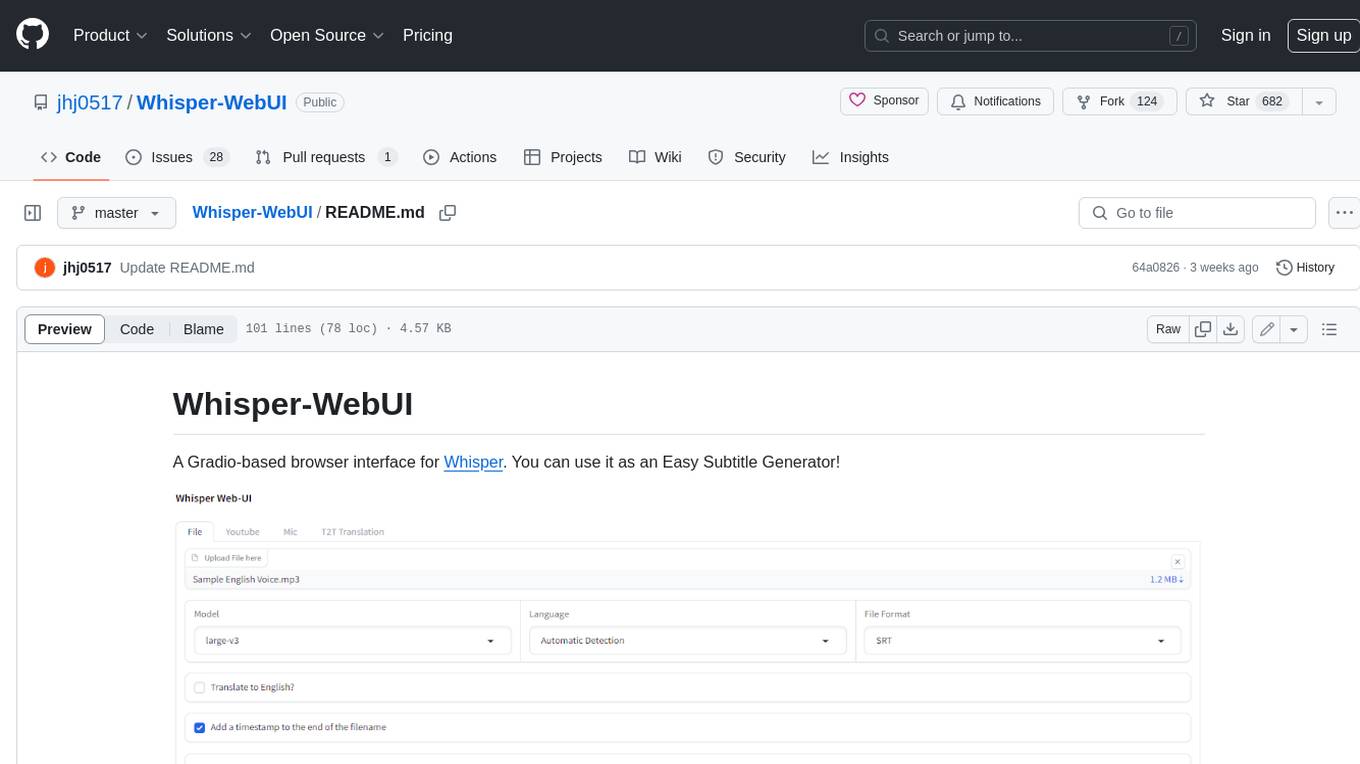
Whisper-WebUI is a Gradio-based browser interface for Whisper, serving as an Easy Subtitle Generator. It supports generating subtitles from various sources such as files, YouTube, and microphone. The tool also offers speech-to-text and text-to-text translation features, utilizing Facebook NLLB models and DeepL API. Users can translate subtitle files from other languages to English and vice versa. The project integrates faster-whisper for improved VRAM usage and transcription speed, providing efficiency metrics for optimized whisper models. Additionally, users can choose from different Whisper models based on size and language requirements.
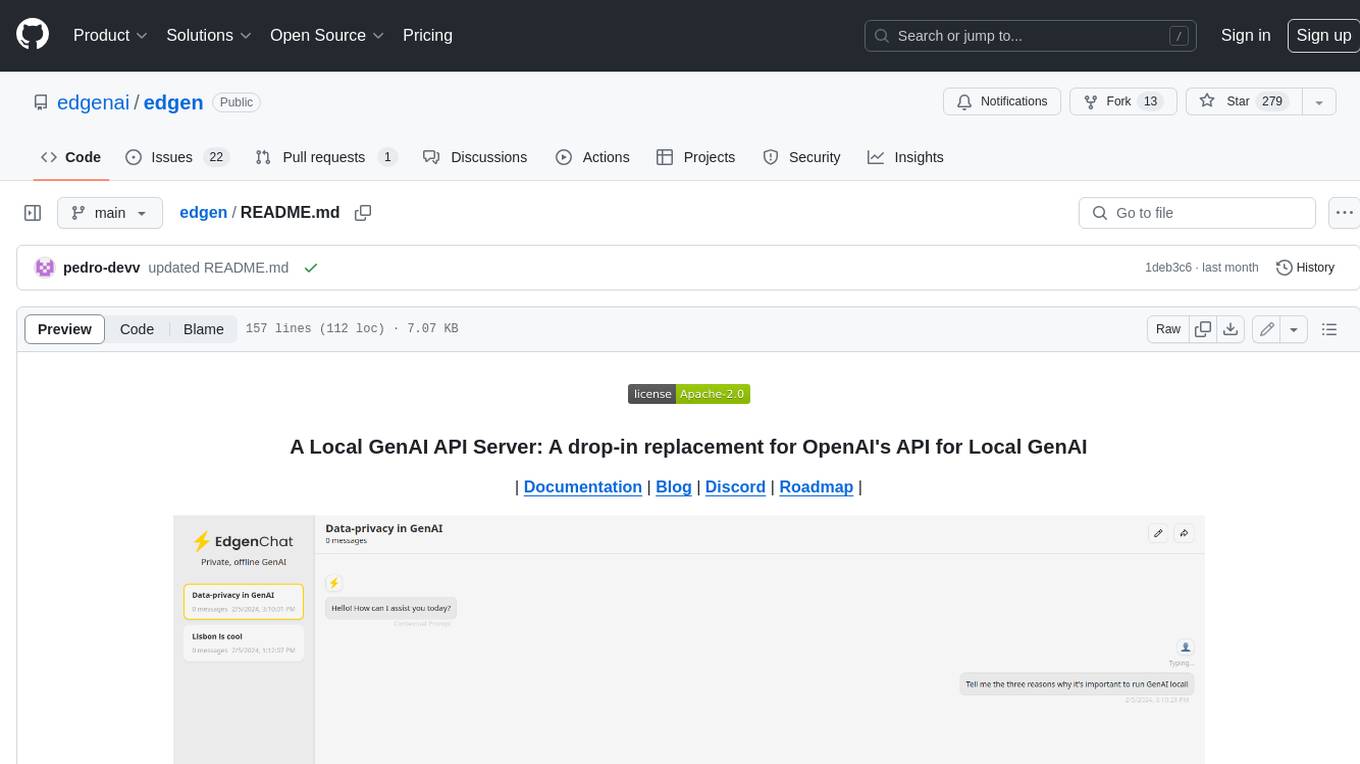
edgen
Edgen is a local GenAI API server that serves as a drop-in replacement for OpenAI's API. It provides multi-endpoint support for chat completions and speech-to-text, is model agnostic, offers optimized inference, and features model caching. Built in Rust, Edgen is natively compiled for Windows, MacOS, and Linux, eliminating the need for Docker. It allows users to utilize GenAI locally on their devices for free and with data privacy. With features like session caching, GPU support, and support for various endpoints, Edgen offers a scalable, reliable, and cost-effective solution for running GenAI applications locally.
For similar jobs
OpenScribe
OpenScribe is an open-source AI medical scribe tool designed to assist clinicians in recording patient encounters, transcribing audio, and generating structured draft clinical notes using large language models (LLMs). The tool offers a default web deployment path with local Whisper transcription and Anthropic Claude note generation. It is currently in early development (v0.x) and not suitable for clinical practice yet, intended for evaluation, testing, and development purposes only. The project aims to provide a local-first, privacy-conscious, and modular alternative to cloud-dependent clinical documentation tools.
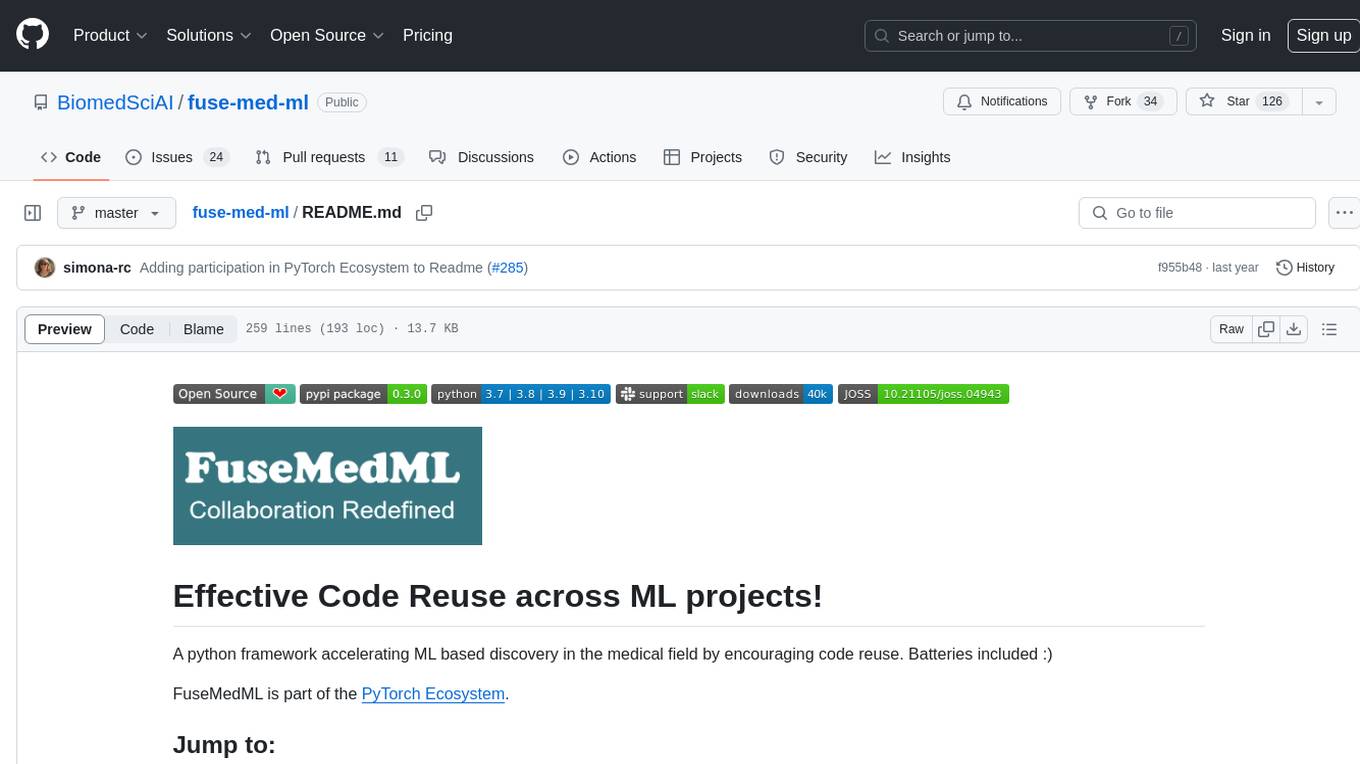
fuse-med-ml
FuseMedML is a Python framework designed to accelerate machine learning-based discovery in the medical field by promoting code reuse. It provides a flexible design concept where data is stored in a nested dictionary, allowing easy handling of multi-modality information. The framework includes components for creating custom models, loss functions, metrics, and data processing operators. Additionally, FuseMedML offers 'batteries included' key components such as fuse.data for data processing, fuse.eval for model evaluation, and fuse.dl for reusable deep learning components. It supports PyTorch and PyTorch Lightning libraries and encourages the creation of domain extensions for specific medical domains.
MedLLMsPracticalGuide
This repository serves as a practical guide for Medical Large Language Models (Medical LLMs) and provides resources, surveys, and tools for building, fine-tuning, and utilizing LLMs in the medical domain. It covers a wide range of topics including pre-training, fine-tuning, downstream biomedical tasks, clinical applications, challenges, future directions, and more. The repository aims to provide insights into the opportunities and challenges of LLMs in medicine and serve as a practical resource for constructing effective medical LLMs.
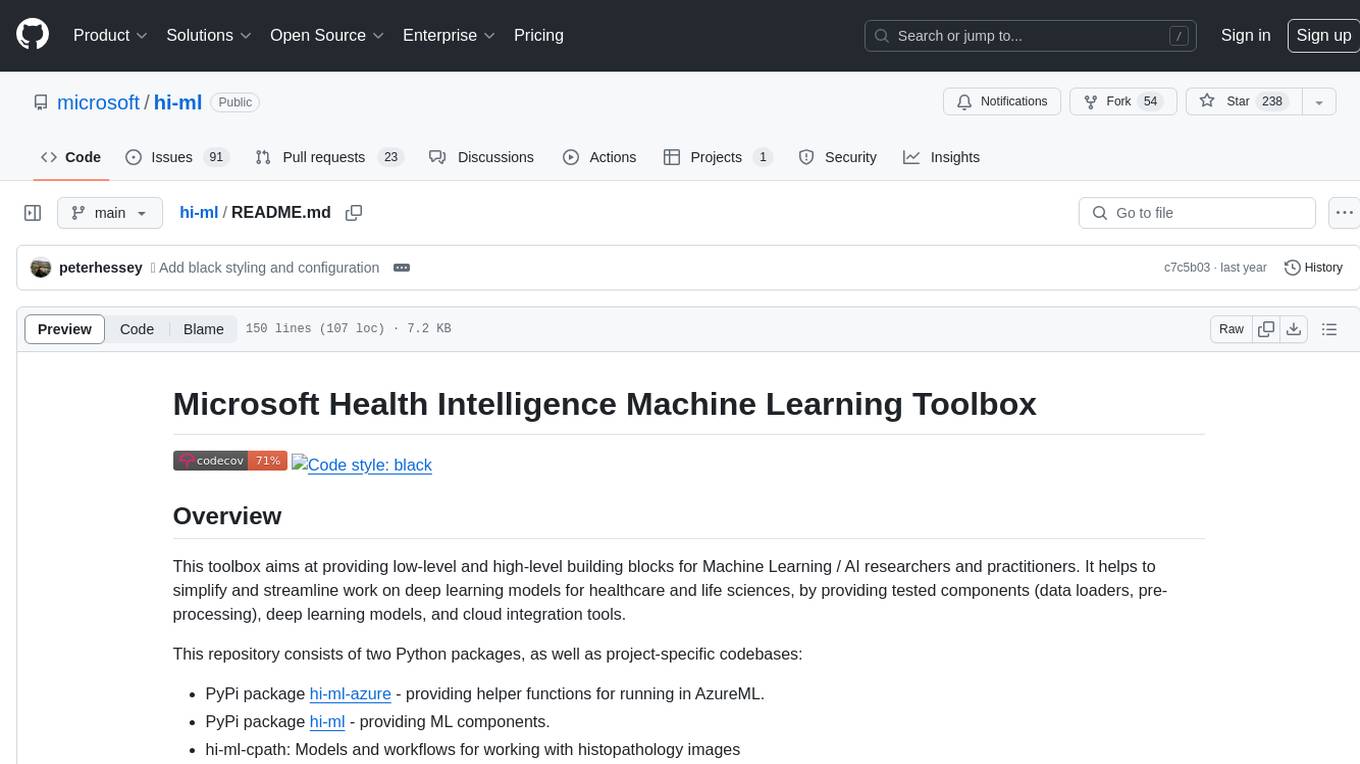
hi-ml
The Microsoft Health Intelligence Machine Learning Toolbox is a repository that provides low-level and high-level building blocks for Machine Learning / AI researchers and practitioners. It simplifies and streamlines work on deep learning models for healthcare and life sciences by offering tested components such as data loaders, pre-processing tools, deep learning models, and cloud integration utilities. The repository includes two Python packages, 'hi-ml-azure' for helper functions in AzureML, 'hi-ml' for ML components, and 'hi-ml-cpath' for models and workflows related to histopathology images.
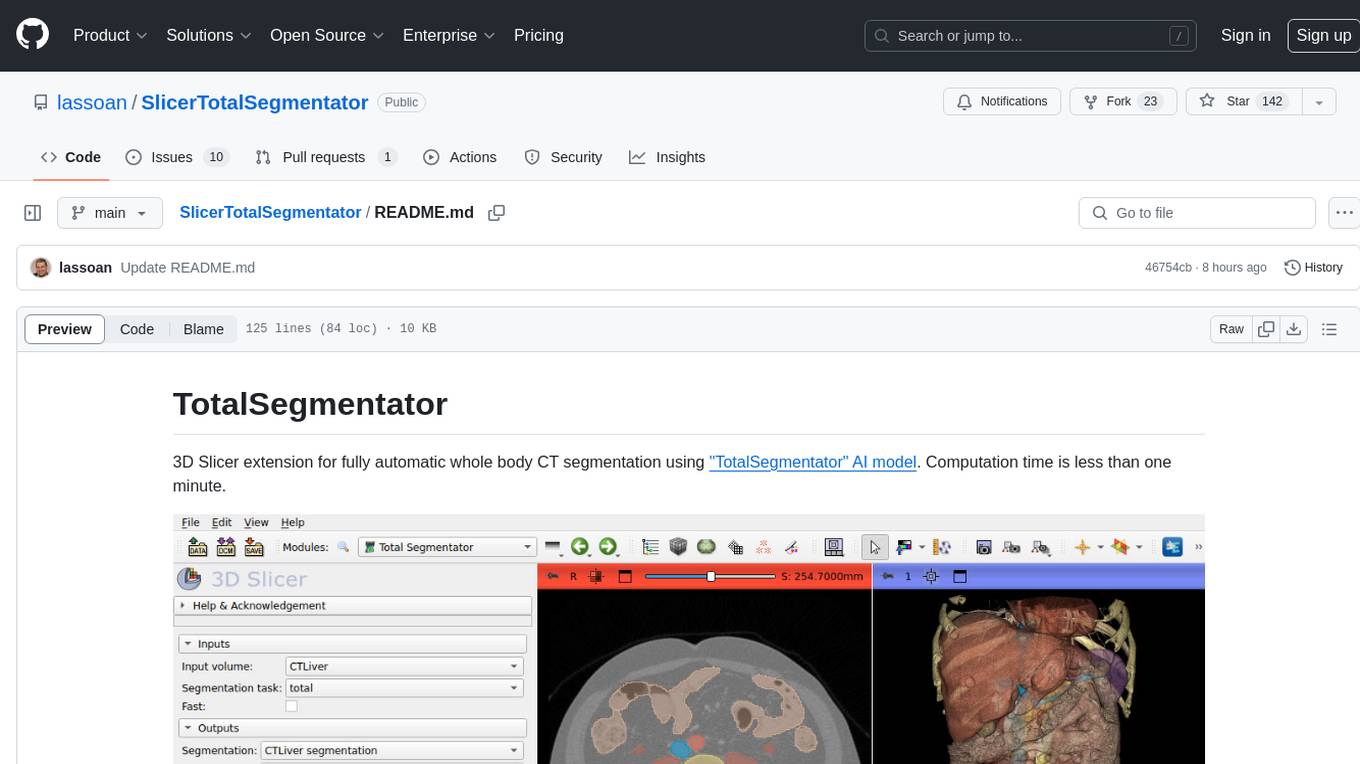
SlicerTotalSegmentator
TotalSegmentator is a 3D Slicer extension designed for fully automatic whole body CT segmentation using the 'TotalSegmentator' AI model. The computation time is less than one minute, making it efficient for research purposes. Users can set up GPU acceleration for faster segmentation. The tool provides a user-friendly interface for loading CT images, creating segmentations, and displaying results in 3D. Troubleshooting steps are available for common issues such as failed computation, GPU errors, and inaccurate segmentations. Contributions to the extension are welcome, following 3D Slicer contribution guidelines.
machine-learning-research
The 'machine-learning-research' repository is a comprehensive collection of resources related to mathematics, machine learning, deep learning, artificial intelligence, data science, and various scientific fields. It includes materials such as courses, tutorials, books, podcasts, communities, online courses, papers, and dissertations. The repository covers topics ranging from fundamental math skills to advanced machine learning concepts, with a focus on applications in healthcare, genetics, computational biology, precision health, and AI in science. It serves as a valuable resource for individuals interested in learning and researching in the fields of machine learning and related disciplines.
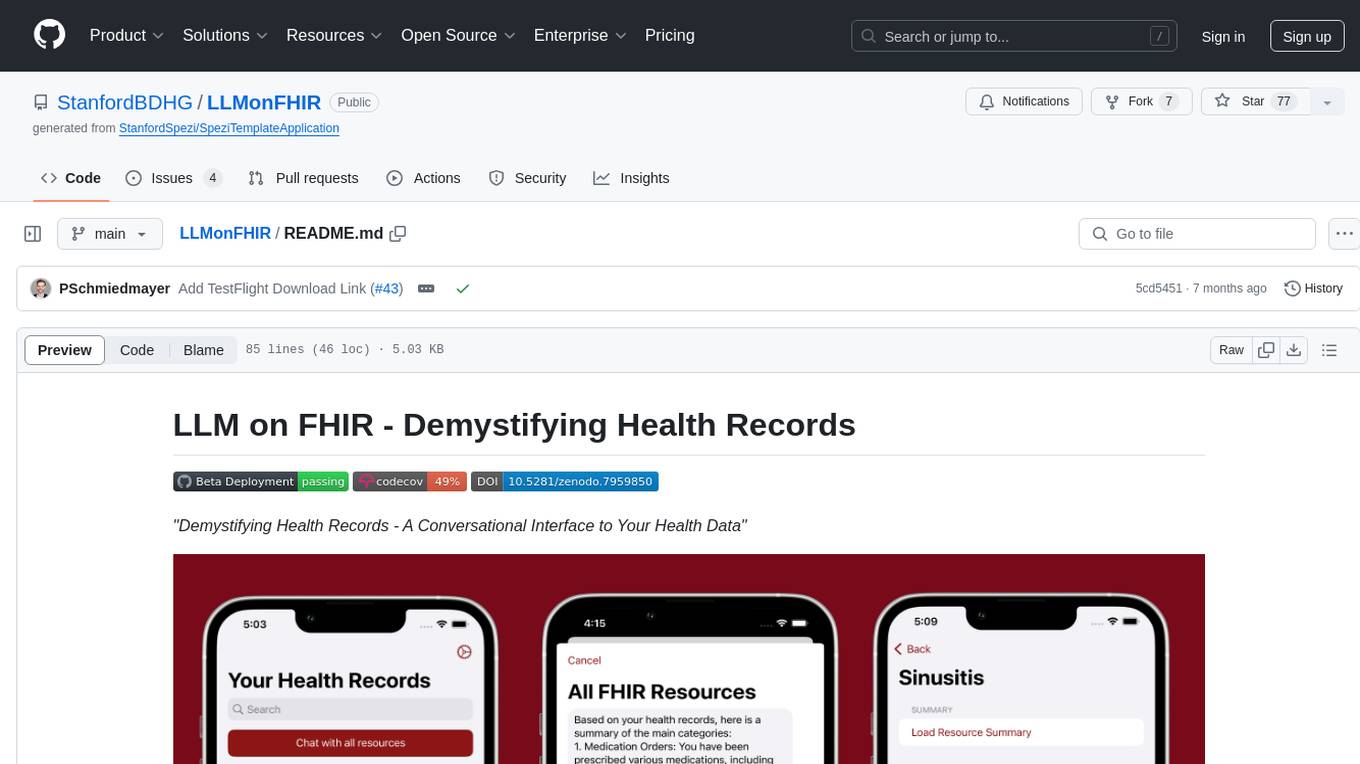
LLMonFHIR
LLMonFHIR is an iOS application that utilizes large language models (LLMs) to interpret and provide context around patient data in the Fast Healthcare Interoperability Resources (FHIR) format. It connects to the OpenAI GPT API to analyze FHIR resources, supports multiple languages, and allows users to interact with their health data stored in the Apple Health app. The app aims to simplify complex health records, provide insights, and facilitate deeper understanding through a conversational interface. However, it is an experimental app for informational purposes only and should not be used as a substitute for professional medical advice. Users are advised to verify information provided by AI models and consult healthcare professionals for personalized advice.
HuatuoGPT-II
HuatuoGPT2 is an innovative domain-adapted medical large language model that excels in medical knowledge and dialogue proficiency. It showcases state-of-the-art performance in various medical benchmarks, surpassing GPT-4 in expert evaluations and fresh medical licensing exams. The open-source release includes HuatuoGPT2 models in 7B, 13B, and 34B versions, training code for one-stage adaptation, partial pre-training and fine-tuning instructions, and evaluation methods for medical response capabilities and professional pharmacist exams. The tool aims to enhance LLM capabilities in the Chinese medical field through open-source principles.