


OSMO
The developer-first platform for scaling complex Physical AI workloads across heterogeneous compute—unifying training GPUs, simulation clusters, and edge devices in a simple YAML
Stars: 96
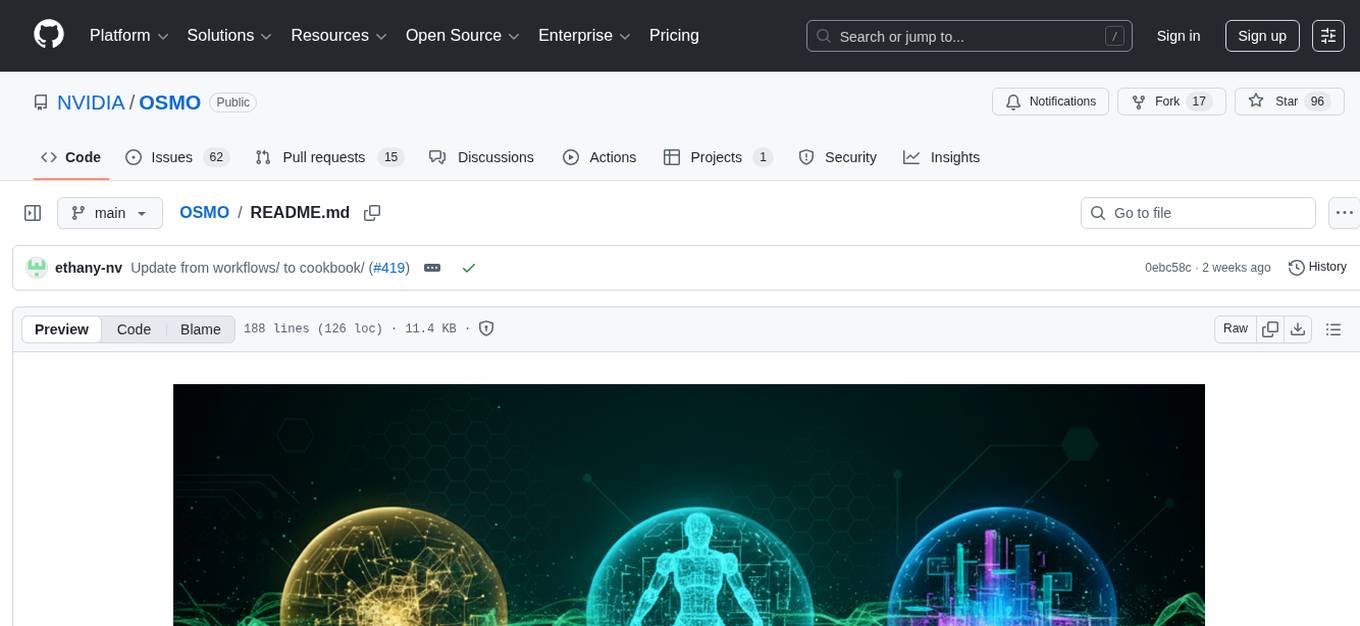
OSMO is a workflow orchestration tool purpose-built for physical AI development. It allows users to manage workflows, version datasets, develop on backend nodes remotely, and run workflows seamlessly on any cloud environment. OSMO enables users to build data factories, train neural networks, train robot policies with reinforcement learning, evaluate models, test robots in simulation, and automate workflows on CI/CD systems. It simplifies orchestrating tasks across heterogeneous Kubernetes clusters, managing dependencies and resource allocation.
README:





Get Started | Documentation | Community | Roadmap
Use OSMO to manage your workflows, version your datasets and even remotely develop on a backend node. Using OSMO's backend configuration, run your workflows seamlessly on any cloud environment. Build a data factory to manage your synthetic and real robot data, train neural networks with experiment tracking, train robot policies with reinforcement learning, evaluate your models and publish the results, test the robot in simulation with software or hardware in loop (HIL) and automate your workflows on any CI/CD systems

Write once, run anywhere. Focus on building robots, not managing infrastructure.
# Your entire physical AI pipeline in a YAML file
workflow:
  tasks:
  - name: simulation
    image: nvcr.io/nvidia/isaac-sim
    platform: rtx-pro-6000          # Runs on NVIDIA RTX PRO 6000 GPUs

  - name: train-policy
    image: nvcr.io/nvidia/pytorch
    platform: gb200                 # Runs on NVIDIA GB200 GPUs
    resources:
      gpu: 8
    inputs:                         # Feed the output of simulation task into training
    - task: simulation

  - name: evaluate-thor
    image: my-ros-app
    platform: jetson-agx-thor       # Runs on NVIDIA Jetson AGX Thor
    inputs:
    - task: train-policy            # Feed the output of the training task into eval
    outputs:
    - dataset:
name: thor-benchmark # Save the output benchmark into a dataset- ✅ Zero-Code Workflows – Write workflows in YAML and iterate, not Python scripts
- ✅ Truly Portable – Same workflow runs on laptop (Docker/KIND) or cloud (EKS/AKS/GKE)
- ✅ Interactive Development – Launch VSCode, Jupyter, or SSH & develop remotely on cloud
- ✅ Smart Storage – Content-addressable datasets with deduplication save 10-100x on storage
- ✅ Infrastructure-Agnostic – Workflows never reference specific infrastructure—scale transparently
Scale infrastructure independently. Add compute backends without disrupting developers.
- ✅ Centralized Control Plane – Single pane of glass for heterogeneous compute across clouds and regions
- ✅ Plug-and-Play Backends – Register new Kubernetes clusters dynamically via CLI
- ✅ Geographic Distribution – Deploy compute wherever it's available—cloud, on-prem, edge
- ✅ Zero-Downtime Changes – Scale GPU compute clusters without affecting users or their workflows
Physical AI development uniquely requires orchestrating three types of compute working together:
| 🧠 Training | 🌐 Simulation | 🤖 Edge |
|---|---|---|
| GB200, H100 | L40, RTX Pro | Jetson AGX Thor |
| Deep learning & RL | Physics & Sensor Rendering | Hardware-in-the-Loop |
| Cloud | Cloud | On Premise |
Traditionally, orchestrating workflows across these heterogeneous systems requires custom scripts, infrastructure expertise, and separate tooling for each environment.
OSMO solves this Three Computer Problem for robotics by orchestrating your entire Physical AI pipeline — from training to simulation to hardware testing all in a simple YAML. No custom scripts, no infrastructure expertise required. OSMO orchestrates tasks across heterogeneous Kubernetes clusters, managing dependencies and resource allocation. By solving this fundamental problem, OSMO brings us one step closer towards making Physical AI a reality.

| What You Can Do | Example |
|---|---|
| Interactively develop on remote GPU nodes with VSCode, SSH, or Jupyter notebooks | Interactive Workflows |
| Generate synthetic data at scale using Isaac Sim or custom simulation environments | Isaac Sim SDG |
| Train models with diverse datasets across distributed GPU clusters | Model Training |
| Train policies for robots using data-parallel reinforcement learning | Reinforcement Learning |
| Validate models in simulation with hardware-in-the-loop testing | Hardware In The Loop |
| Transform and post-process data for iterative improvement | Working with Data |
| Benchmark system software on actual robot hardware (NVIDIA Jetson, custom platforms) | Hardware Testing |
OSMO is production-grade and proven at scale. Originally developed to power Physical AI workloads at NVIDIA—including Project GR00T, Isaac Lab, Isaac Dexterity, Isaac Sim, and Isaac ROS—it orchestrates thousands of GPU-hours daily across heterogeneous compute spanning cloud training clusters to edge devices.
Now open-source and ready for your robotics workflows. Whether you're building humanoid robots, autonomous vehicles, or warehouse automation systems, OSMO provides the same enterprise-grade orchestration used in production at scale.
Select one of the deployment options below depending on your needs and environment to get started

| Resource | Description |
|---|---|
| 🚀 Local Deployment | Run it locally on your workstation in 10 minutes |
| ⚡ Brev Deployment | Run it on a Brev instance with a GPU in 10 minutes |
| 🛠️ Cloud Deployment | Deploy production grade on cloud providers |
| 📘 User Guide | Tutorials, workflows, and how-to guides for developers |
| 💡 Cookbook | Robotics workflow examples |
| 💻 Getting Started | Install command-line interface to get started |
Join the community. We welcome contributions, feedback, and collaboration from developers and AI teams worldwide.
🐛 Report Issues – Bugs, feature requests or technical help
🤝 Contributing Guide - How to develop OSMO and make contributions
| Capability | How It Works |
|---|---|
| Simplified Authentication & Authorization | Use your existing identity provider without additional infrastructure. Connect directly to Azure AD, Okta, Google Workspace, or any OAuth 2.0 provider. Manage teams and permissions through simple CLI commands (osmo group ...). Share credentials at the pool level—eliminate repetitive individual user configuration. |
| One-Click Cloud Deployment | Deploy production-grade OSMO in minutes. Launch from Azure Marketplace or AWS Marketplace with pre-configured templates. Skip complex Kubernetes setup with automated infrastructure provisioning—no deep cloud or Kubernetes expertise required. |
| Native Cloud Integration | Simplify credential management when running in the cloud. Automatic IAM integration for Azure and AWS environments provides seamless access to cloud storage (S3, Azure Blob) and container registries—no manual credential configuration needed. |
| Feature | What It Enables |
|---|---|
| Python-Native Workflows | Define workflows programmatically for developers who prefer code over YAML. Use Python APIs to build dynamic workflows with loops, conditionals, and complex logic that integrate seamlessly with existing Python ML/robotics frameworks. |
| Load-Aware Multi-Backend Scheduling | Automatically optimize cost and performance across compute backends. OSMO selects the best cluster/pool for each workflow based on current utilization, reducing wait times and maximizing cluster efficiency without manual routing. |
| High-Performance Data Caching | Faster data access and broader storage compatibility. Transparent cluster-local caching reduces data transfer time for frequently used datasets, with support for high-performance filesystems (Lustre, NFS) alongside object storage (S3, GCS, Azure). |
| Dynamically Changing Workflows | Adjust workflow scale on-the-fly without restarts or interruptions. Scale running workflows up or down based on changing resource needs, modify parameters without rescheduling tasks, and respond to real-time requirements (e.g., add more GPUs mid-training, reduce simulation parallelism). |
Built with 💚 by NVIDIA Robotics Team
Making Physical AI a reality, one workflow at a time.
For Tasks:
Click tags to check more tools for each tasksFor Jobs:
Alternative AI tools for OSMO
Similar Open Source Tools
OSMO
OSMO is a workflow orchestration tool purpose-built for physical AI development. It allows users to manage workflows, version datasets, develop on backend nodes remotely, and run workflows seamlessly on any cloud environment. OSMO enables users to build data factories, train neural networks, train robot policies with reinforcement learning, evaluate models, test robots in simulation, and automate workflows on CI/CD systems. It simplifies orchestrating tasks across heterogeneous Kubernetes clusters, managing dependencies and resource allocation.
wanwu
Wanwu AI Agent Platform is an enterprise-grade one-stop commercially friendly AI agent development platform designed for business scenarios. It provides enterprises with a safe, efficient, and compliant one-stop AI solution. The platform integrates cutting-edge technologies such as large language models and business process automation to build an AI engineering platform covering model full life-cycle management, MCP, web search, AI agent rapid development, enterprise knowledge base construction, and complex workflow orchestration. It supports modular architecture design, flexible functional expansion, and secondary development, reducing the application threshold of AI technology while ensuring security and privacy protection of enterprise data. It accelerates digital transformation, cost reduction, efficiency improvement, and business innovation for enterprises of all sizes.

WeKnora
WeKnora is a document understanding and semantic retrieval framework based on large language models (LLM), designed specifically for scenarios with complex structures and heterogeneous content. The framework adopts a modular architecture, integrating multimodal preprocessing, semantic vector indexing, intelligent recall, and large model generation reasoning to build an efficient and controllable document question-answering process. The core retrieval process is based on the RAG (Retrieval-Augmented Generation) mechanism, combining context-relevant segments with language models to achieve higher-quality semantic answers. It supports various document formats, intelligent inference, flexible extension, efficient retrieval, ease of use, and security and control. Suitable for enterprise knowledge management, scientific literature analysis, product technical support, legal compliance review, and medical knowledge assistance.
xllm
xLLM is an efficient LLM inference framework optimized for Chinese AI accelerators, enabling enterprise-grade deployment with enhanced efficiency and reduced cost. It adopts a service-engine decoupled inference architecture, achieving breakthrough efficiency through technologies like elastic scheduling, dynamic PD disaggregation, multi-stream parallel computing, graph fusion optimization, and global KV cache management. xLLM supports deployment of mainstream large models on Chinese AI accelerators, empowering enterprises in scenarios like intelligent customer service, risk control, supply chain optimization, ad recommendation, and more.
learn-low-code-agentic-ai
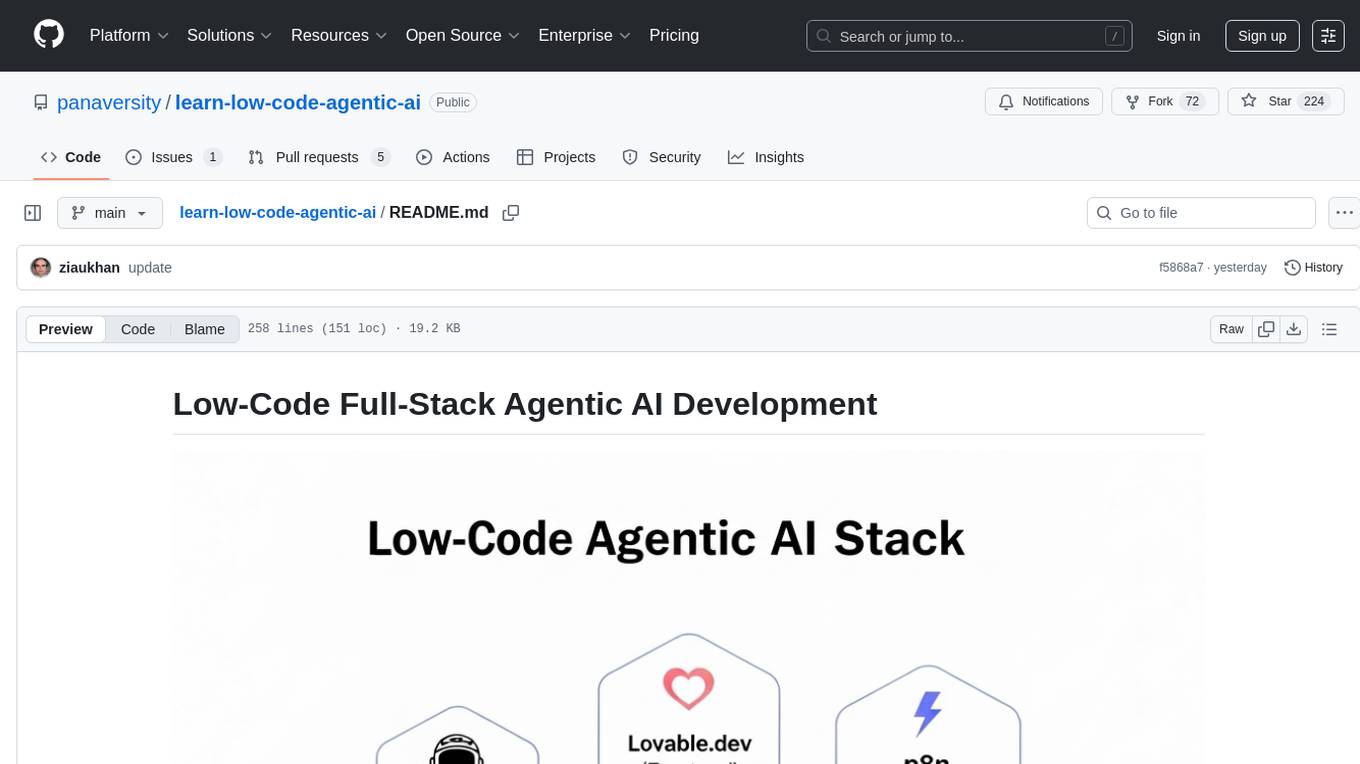
This repository is dedicated to learning about Low-Code Full-Stack Agentic AI Development. It provides material for building modern AI-powered applications using a low-code full-stack approach. The main tools covered are UXPilot for UI/UX mockups, Lovable.dev for frontend applications, n8n for AI agents and workflows, Supabase for backend data storage, authentication, and vector search, and Model Context Protocol (MCP) for integration. The focus is on prompt and context engineering as the foundation for working with AI systems, enabling users to design, develop, and deploy AI-driven full-stack applications faster, smarter, and more reliably.
runtime
Exosphere is a lightweight runtime designed to make AI agents resilient to failure and enable infinite scaling across distributed compute. It provides a powerful foundation for building and orchestrating AI applications with features such as lightweight runtime, inbuilt failure handling, infinite parallel agents, dynamic execution graphs, native state persistence, and observability. Whether you're working on data pipelines, AI agents, or complex workflow orchestrations, Exosphere offers the infrastructure backbone to make your AI applications production-ready and scalable.
aibrix
AIBrix is an open-source initiative providing essential building blocks for scalable GenAI inference infrastructure. It delivers a cloud-native solution optimized for deploying, managing, and scaling large language model (LLM) inference, tailored to enterprise needs. Key features include High-Density LoRA Management, LLM Gateway and Routing, LLM App-Tailored Autoscaler, Unified AI Runtime, Distributed Inference, Distributed KV Cache, Cost-efficient Heterogeneous Serving, and GPU Hardware Failure Detection.

EpicStaff
EpicStaff is a powerful project management tool designed to streamline team collaboration and task management. It provides a user-friendly interface for creating and assigning tasks, tracking progress, and communicating with team members in real-time. With features such as task prioritization, deadline reminders, and file sharing capabilities, EpicStaff helps teams stay organized and productive. Whether you're working on a small project or managing a large team, EpicStaff is the perfect solution to keep everyone on the same page and ensure project success.
databend
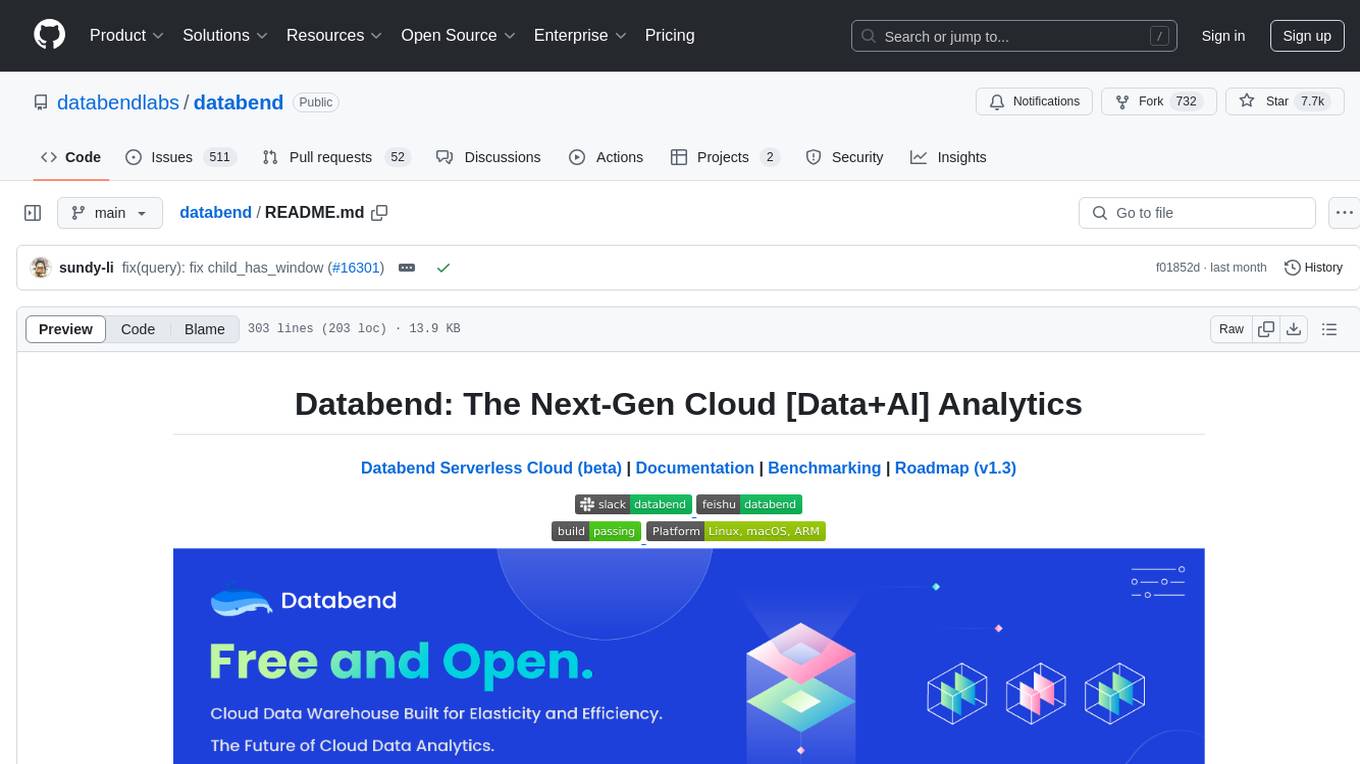
Databend is an open-source cloud data warehouse built in Rust, offering fast query execution and data ingestion for complex analysis of large datasets. It integrates with major cloud platforms, provides high performance with AI-powered analytics, supports multiple data formats, ensures data integrity with ACID transactions, offers flexible indexing options, and features community-driven development. Users can try Databend through a serverless cloud or Docker installation, and perform tasks such as data import/export, querying semi-structured data, managing users/databases/tables, and utilizing AI functions.
flow-like
Flow-Like is an enterprise-grade workflow operating system built upon Rust for uncompromising performance, efficiency, and code safety. It offers a modular frontend for apps, a rich set of events, a node catalog, a powerful no-code workflow IDE, and tools to manage teams, templates, and projects within organizations. With typed workflows, users can create complex, large-scale workflows with clear data origins, transformations, and contracts. Flow-Like is designed to automate any process through seamless integration of LLM, ML-based, and deterministic decision-making instances.
netdata
Netdata is an open-source, real-time infrastructure monitoring platform that provides instant insights, zero configuration deployment, ML-powered anomaly detection, efficient monitoring with minimal resource usage, and secure & distributed data storage. It offers real-time, per-second updates and clear insights at a glance. Netdata's origin story involves addressing the limitations of existing monitoring tools and led to a fundamental shift in infrastructure monitoring. It is recognized as the most energy-efficient tool for monitoring Docker-based systems according to a study by the University of Amsterdam.
Streamline-Analyst
Streamline Analyst is a cutting-edge, open-source application powered by Large Language Models (LLMs) designed to revolutionize data analysis. This Data Analysis Agent effortlessly automates tasks such as data cleaning, preprocessing, and complex operations like identifying target objects, partitioning test sets, and selecting the best-fit models based on your data. With Streamline Analyst, results visualization and evaluation become seamless. It aims to expedite the data analysis process, making it accessible to all, regardless of their expertise in data analysis. The tool is built to empower users to process data and achieve high-quality visualizations with unparalleled efficiency, and to execute high-performance modeling with the best strategies. Future enhancements include Natural Language Processing (NLP), neural networks, and object detection utilizing YOLO, broadening its capabilities to meet diverse data analysis needs.
accelerated-intelligent-document-processing-on-aws
Accelerated Intelligent Document Processing on AWS is a scalable, serverless solution for automated document processing and information extraction using AWS services. It combines OCR capabilities with generative AI to convert unstructured documents into structured data at scale. The solution features a serverless architecture built on AWS technologies, modular processing patterns, advanced classification support, few-shot example support, custom business logic integration, high throughput processing, built-in resilience, cost optimization, comprehensive monitoring, web user interface, human-in-the-loop integration, AI-powered evaluation, extraction confidence assessment, and document knowledge base query. The architecture uses nested CloudFormation stacks to support multiple document processing patterns while maintaining common infrastructure for queueing, tracking, and monitoring.
heurist-agent-framework
Heurist Agent Framework is a flexible multi-interface AI agent framework that allows processing text and voice messages, generating images and videos, interacting across multiple platforms, fetching and storing information in a knowledge base, accessing external APIs and tools, and composing complex workflows using Mesh Agents. It supports various platforms like Telegram, Discord, Twitter, Farcaster, REST API, and MCP. The framework is built on a modular architecture and provides core components, tools, workflows, and tool integration with MCP support.
JamAIBase
JamAI Base is an open-source platform integrating SQLite and LanceDB databases with managed memory and RAG capabilities. It offers built-in LLM, vector embeddings, and reranker orchestration accessible through a spreadsheet-like UI and REST API. Users can transform static tables into dynamic entities, facilitate real-time interactions, manage structured data, and simplify chatbot development. The tool focuses on ease of use, scalability, flexibility, declarative paradigm, and innovative RAG techniques, making complex data operations accessible to users with varying technical expertise.
AGiXT
AGiXT is a dynamic Artificial Intelligence Automation Platform engineered to orchestrate efficient AI instruction management and task execution across a multitude of providers. Our solution infuses adaptive memory handling with a broad spectrum of commands to enhance AI's understanding and responsiveness, leading to improved task completion. The platform's smart features, like Smart Instruct and Smart Chat, seamlessly integrate web search, planning strategies, and conversation continuity, transforming the interaction between users and AI. By leveraging a powerful plugin system that includes web browsing and command execution, AGiXT stands as a versatile bridge between AI models and users. With an expanding roster of AI providers, code evaluation capabilities, comprehensive chain management, and platform interoperability, AGiXT is consistently evolving to drive a multitude of applications, affirming its place at the forefront of AI technology.
For similar tasks
autogen
AutoGen is a framework that enables the development of LLM applications using multiple agents that can converse with each other to solve tasks. AutoGen agents are customizable, conversable, and seamlessly allow human participation. They can operate in various modes that employ combinations of LLMs, human inputs, and tools.
tracecat
Tracecat is an open-source automation platform for security teams. It's designed to be simple but powerful, with a focus on AI features and a practitioner-obsessed UI/UX. Tracecat can be used to automate a variety of tasks, including phishing email investigation, evidence collection, and remediation plan generation.
ciso-assistant-community
CISO Assistant is a tool that helps organizations manage their cybersecurity posture and compliance. It provides a centralized platform for managing security controls, threats, and risks. CISO Assistant also includes a library of pre-built frameworks and tools to help organizations quickly and easily implement best practices.
ck
Collective Mind (CM) is a collection of portable, extensible, technology-agnostic and ready-to-use automation recipes with a human-friendly interface (aka CM scripts) to unify and automate all the manual steps required to compose, run, benchmark and optimize complex ML/AI applications on any platform with any software and hardware: see online catalog and source code. CM scripts require Python 3.7+ with minimal dependencies and are continuously extended by the community and MLCommons members to run natively on Ubuntu, MacOS, Windows, RHEL, Debian, Amazon Linux and any other operating system, in a cloud or inside automatically generated containers while keeping backward compatibility - please don't hesitate to report encountered issues here and contact us via public Discord Server to help this collaborative engineering effort! CM scripts were originally developed based on the following requirements from the MLCommons members to help them automatically compose and optimize complex MLPerf benchmarks, applications and systems across diverse and continuously changing models, data sets, software and hardware from Nvidia, Intel, AMD, Google, Qualcomm, Amazon and other vendors: * must work out of the box with the default options and without the need to edit some paths, environment variables and configuration files; * must be non-intrusive, easy to debug and must reuse existing user scripts and automation tools (such as cmake, make, ML workflows, python poetry and containers) rather than substituting them; * must have a very simple and human-friendly command line with a Python API and minimal dependencies; * must require minimal or zero learning curve by using plain Python, native scripts, environment variables and simple JSON/YAML descriptions instead of inventing new workflow languages; * must have the same interface to run all automations natively, in a cloud or inside containers. CM scripts were successfully validated by MLCommons to modularize MLPerf inference benchmarks and help the community automate more than 95% of all performance and power submissions in the v3.1 round across more than 120 system configurations (models, frameworks, hardware) while reducing development and maintenance costs.
zenml
ZenML is an extensible, open-source MLOps framework for creating portable, production-ready machine learning pipelines. By decoupling infrastructure from code, ZenML enables developers across your organization to collaborate more effectively as they develop to production.
clearml
ClearML is a suite of tools designed to streamline the machine learning workflow. It includes an experiment manager, MLOps/LLMOps, data management, and model serving capabilities. ClearML is open-source and offers a free tier hosting option. It supports various ML/DL frameworks and integrates with Jupyter Notebook and PyCharm. ClearML provides extensive logging capabilities, including source control info, execution environment, hyper-parameters, and experiment outputs. It also offers automation features, such as remote job execution and pipeline creation. ClearML is designed to be easy to integrate, requiring only two lines of code to add to existing scripts. It aims to improve collaboration, visibility, and data transparency within ML teams.
devchat
DevChat is an open-source workflow engine that enables developers to create intelligent, automated workflows for engaging with users through a chat panel within their IDEs. It combines script writing flexibility, latest AI models, and an intuitive chat GUI to enhance user experience and productivity. DevChat simplifies the integration of AI in software development, unlocking new possibilities for developers.
LLM-Finetuning-Toolkit
LLM Finetuning toolkit is a config-based CLI tool for launching a series of LLM fine-tuning experiments on your data and gathering their results. It allows users to control all elements of a typical experimentation pipeline - prompts, open-source LLMs, optimization strategy, and LLM testing - through a single YAML configuration file. The toolkit supports basic, intermediate, and advanced usage scenarios, enabling users to run custom experiments, conduct ablation studies, and automate fine-tuning workflows. It provides features for data ingestion, model definition, training, inference, quality assurance, and artifact outputs, making it a comprehensive tool for fine-tuning large language models.
For similar jobs
promptflow
**Prompt flow** is a suite of development tools designed to streamline the end-to-end development cycle of LLM-based AI applications, from ideation, prototyping, testing, evaluation to production deployment and monitoring. It makes prompt engineering much easier and enables you to build LLM apps with production quality.
deepeval
DeepEval is a simple-to-use, open-source LLM evaluation framework specialized for unit testing LLM outputs. It incorporates various metrics such as G-Eval, hallucination, answer relevancy, RAGAS, etc., and runs locally on your machine for evaluation. It provides a wide range of ready-to-use evaluation metrics, allows for creating custom metrics, integrates with any CI/CD environment, and enables benchmarking LLMs on popular benchmarks. DeepEval is designed for evaluating RAG and fine-tuning applications, helping users optimize hyperparameters, prevent prompt drifting, and transition from OpenAI to hosting their own Llama2 with confidence.
MegaDetector
MegaDetector is an AI model that identifies animals, people, and vehicles in camera trap images (which also makes it useful for eliminating blank images). This model is trained on several million images from a variety of ecosystems. MegaDetector is just one of many tools that aims to make conservation biologists more efficient with AI. If you want to learn about other ways to use AI to accelerate camera trap workflows, check out our of the field, affectionately titled "Everything I know about machine learning and camera traps".
leapfrogai
LeapfrogAI is a self-hosted AI platform designed to be deployed in air-gapped resource-constrained environments. It brings sophisticated AI solutions to these environments by hosting all the necessary components of an AI stack, including vector databases, model backends, API, and UI. LeapfrogAI's API closely matches that of OpenAI, allowing tools built for OpenAI/ChatGPT to function seamlessly with a LeapfrogAI backend. It provides several backends for various use cases, including llama-cpp-python, whisper, text-embeddings, and vllm. LeapfrogAI leverages Chainguard's apko to harden base python images, ensuring the latest supported Python versions are used by the other components of the stack. The LeapfrogAI SDK provides a standard set of protobuffs and python utilities for implementing backends and gRPC. LeapfrogAI offers UI options for common use-cases like chat, summarization, and transcription. It can be deployed and run locally via UDS and Kubernetes, built out using Zarf packages. LeapfrogAI is supported by a community of users and contributors, including Defense Unicorns, Beast Code, Chainguard, Exovera, Hypergiant, Pulze, SOSi, United States Navy, United States Air Force, and United States Space Force.
llava-docker
This Docker image for LLaVA (Large Language and Vision Assistant) provides a convenient way to run LLaVA locally or on RunPod. LLaVA is a powerful AI tool that combines natural language processing and computer vision capabilities. With this Docker image, you can easily access LLaVA's functionalities for various tasks, including image captioning, visual question answering, text summarization, and more. The image comes pre-installed with LLaVA v1.2.0, Torch 2.1.2, xformers 0.0.23.post1, and other necessary dependencies. You can customize the model used by setting the MODEL environment variable. The image also includes a Jupyter Lab environment for interactive development and exploration. Overall, this Docker image offers a comprehensive and user-friendly platform for leveraging LLaVA's capabilities.

carrot
The 'carrot' repository on GitHub provides a list of free and user-friendly ChatGPT mirror sites for easy access. The repository includes sponsored sites offering various GPT models and services. Users can find and share sites, report errors, and access stable and recommended sites for ChatGPT usage. The repository also includes a detailed list of ChatGPT sites, their features, and accessibility options, making it a valuable resource for ChatGPT users seeking free and unlimited GPT services.
TrustLLM
TrustLLM is a comprehensive study of trustworthiness in LLMs, including principles for different dimensions of trustworthiness, established benchmark, evaluation, and analysis of trustworthiness for mainstream LLMs, and discussion of open challenges and future directions. Specifically, we first propose a set of principles for trustworthy LLMs that span eight different dimensions. Based on these principles, we further establish a benchmark across six dimensions including truthfulness, safety, fairness, robustness, privacy, and machine ethics. We then present a study evaluating 16 mainstream LLMs in TrustLLM, consisting of over 30 datasets. The document explains how to use the trustllm python package to help you assess the performance of your LLM in trustworthiness more quickly. For more details about TrustLLM, please refer to project website.
AI-YinMei
AI-YinMei is an AI virtual anchor Vtuber development tool (N card version). It supports fastgpt knowledge base chat dialogue, a complete set of solutions for LLM large language models: [fastgpt] + [one-api] + [Xinference], supports docking bilibili live broadcast barrage reply and entering live broadcast welcome speech, supports Microsoft edge-tts speech synthesis, supports Bert-VITS2 speech synthesis, supports GPT-SoVITS speech synthesis, supports expression control Vtuber Studio, supports painting stable-diffusion-webui output OBS live broadcast room, supports painting picture pornography public-NSFW-y-distinguish, supports search and image search service duckduckgo (requires magic Internet access), supports image search service Baidu image search (no magic Internet access), supports AI reply chat box [html plug-in], supports AI singing Auto-Convert-Music, supports playlist [html plug-in], supports dancing function, supports expression video playback, supports head touching action, supports gift smashing action, supports singing automatic start dancing function, chat and singing automatic cycle swing action, supports multi scene switching, background music switching, day and night automatic switching scene, supports open singing and painting, let AI automatically judge the content.