


memsearch
A Markdown-first memory system, a standalone library for any AI agent. Inspired by OpenClaw.
Stars: 188
Memsearch is a tool that allows users to give their AI agents persistent memory in a few lines of code. It enables users to write memories as markdown and search them semantically. Inspired by OpenClaw's markdown-first memory architecture, Memsearch is pluggable into any agent framework. The tool offers features like smart deduplication, live sync, and a ready-made Claude Code plugin for building agent memory.
README:

OpenClaw's memory, everywhere.







https://github.com/user-attachments/assets/31de76cc-81a8-4462-a47d-bd9c394d33e3
💡 Give your AI agents persistent memory in a few lines of code. Write memories as markdown, search them semantically. Inspired by OpenClaw's markdown-first memory architecture. Pluggable into any agent framework.
- 📝 Markdown is the source of truth — human-readable,
git-friendly, zero vendor lock-in. Your memories are just.mdfiles - ⚡ Smart dedup — SHA-256 content hashing means unchanged content is never re-embedded
- 🔄 Live sync — File watcher auto-indexes changes to the vector DB, deletes stale chunks when files are removed
- 🧩 Ready-made Claude Code plugin — a drop-in example of agent memory built on memsearch
pip install memsearchOptional embedding providers
pip install "memsearch[google]"      # Google Gemini
pip install "memsearch[voyage]"      # Voyage AI
pip install "memsearch[ollama]"      # Ollama (local)
pip install "memsearch[local]"       # sentence-transformers (local, no API key)
pip install "memsearch[all]" # Everythingfrom memsearch import MemSearch
mem = MemSearch(paths=["./memory"])
await mem.index() # index markdown files
results = await mem.search("Redis config", top_k=3) # semantic search
print(results[0]["content"], results[0]["score"]) # content + similarity🚀 Full example — agent with memory (OpenAI) — click to expand
import asyncio
from datetime import date
from pathlib import Path
from openai import OpenAI
from memsearch import MemSearch

MEMORY_DIR = "./memory"
llm = OpenAI()                                        # your LLM client
mem = MemSearch(paths=[MEMORY_DIR])                    # memsearch handles the rest

def save_memory(content: str):
    """Append a note to today's memory log (OpenClaw-style daily markdown)."""
    p = Path(MEMORY_DIR) / f"{date.today()}.md"
    p.parent.mkdir(parents=True, exist_ok=True)
    with open(p, "a") as f:
        f.write(f"\n{content}\n")

async def agent_chat(user_input: str) -> str:
    # 1. Recall — search past memories for relevant context
    memories = await mem.search(user_input, top_k=3)
    context = "\n".join(f"- {m['content'][:200]}" for m in memories)

    # 2. Think — call LLM with memory context
    resp = llm.chat.completions.create(
        model="gpt-4o-mini",
        messages=[
            {"role": "system", "content": f"You have these memories:\n{context}"},
            {"role": "user", "content": user_input},
        ],
    )
    answer = resp.choices[0].message.content

    # 3. Remember — save this exchange and index it
    save_memory(f"## {user_input}\n{answer}")
    await mem.index()

    return answer

async def main():
    # Seed some knowledge
    save_memory("## Team\n- Alice: frontend lead\n- Bob: backend lead")
    save_memory("## Decision\nWe chose Redis for caching over Memcached.")
    await mem.index()  # or mem.watch() to auto-index in the background

    # Agent can now recall those memories
    print(await agent_chat("Who is our frontend lead?"))
    print(await agent_chat("What caching solution did we pick?"))

asyncio.run(main())
💜 Anthropic Claude example — click to expand
pip install memsearch anthropicimport asyncio
from datetime import date
from pathlib import Path
from anthropic import Anthropic
from memsearch import MemSearch
MEMORY_DIR = "./memory"
llm = Anthropic()
mem = MemSearch(paths=[MEMORY_DIR])
def save_memory(content: str):
p = Path(MEMORY_DIR) / f"{date.today()}.md"
p.parent.mkdir(parents=True, exist_ok=True)
with open(p, "a") as f:
f.write(f"\n{content}\n")
async def agent_chat(user_input: str) -> str:
# 1. Recall
memories = await mem.search(user_input, top_k=3)
context = "\n".join(f"- {m['content'][:200]}" for m in memories)
# 2. Think — call Claude with memory context
resp = llm.messages.create(
model="claude-sonnet-4-5-20250929",
max_tokens=1024,
system=f"You have these memories:\n{context}",
messages=[{"role": "user", "content": user_input}],
)
answer = resp.content[0].text
# 3. Remember
save_memory(f"## {user_input}\n{answer}")
await mem.index()
return answer
async def main():
save_memory("## Team\n- Alice: frontend lead\n- Bob: backend lead")
await mem.index()
print(await agent_chat("Who is our frontend lead?"))
asyncio.run(main())🦙 Ollama (fully local, no API key) — click to expand
pip install "memsearch[ollama]"
ollama pull nomic-embed-text          # embedding model
ollama pull llama3.2                  # chat model
import asyncio
from datetime import date
from pathlib import Path
from ollama import chat
from memsearch import MemSearch
MEMORY_DIR = "./memory"
mem = MemSearch(paths=[MEMORY_DIR], embedding_provider="ollama")
def save_memory(content: str):
p = Path(MEMORY_DIR) / f"{date.today()}.md"
p.parent.mkdir(parents=True, exist_ok=True)
with open(p, "a") as f:
f.write(f"\n{content}\n")
async def agent_chat(user_input: str) -> str:
# 1. Recall
memories = await mem.search(user_input, top_k=3)
context = "\n".join(f"- {m['content'][:200]}" for m in memories)
# 2. Think — call Ollama locally
resp = chat(
model="llama3.2",
messages=[
{"role": "system", "content": f"You have these memories:\n{context}"},
{"role": "user", "content": user_input},
],
)
answer = resp.message.content
# 3. Remember
save_memory(f"## {user_input}\n{answer}")
await mem.index()
return answer
async def main():
save_memory("## Team\n- Alice: frontend lead\n- Bob: backend lead")
await mem.index()
print(await agent_chat("Who is our frontend lead?"))
asyncio.run(main())memsearch index ./memory/ # index markdown files
memsearch search "how to configure Redis caching" # semantic search
memsearch watch ./memory/ # auto-index on file changes
memsearch compact # LLM-powered memory summarization
memsearch config init # interactive config wizard
memsearch stats # show index statistics📖 Full command reference with all flags and examples → CLI Reference
Markdown is the source of truth — the vector store is just a derived index, rebuildable anytime.
  ┌─── Search ─────────────────────────────────────────────────────────┐
  │                                                                    │
  │  "how to configure Redis?"                                         │
  │        │                                                           │
  │        ▼                                                           │
  │   ┌──────────┐     ┌─────────────────┐     ┌──────────────────┐   │
  │   │  Embed   │────▶│ Cosine similarity│────▶│ Top-K results    │   │
  │   │  query   │     │ (Milvus)        │     │ with source info │   │
  │   └──────────┘     └─────────────────┘     └──────────────────┘   │
  │                                                                    │
  └────────────────────────────────────────────────────────────────────┘

  ┌─── Ingest ─────────────────────────────────────────────────────────┐
  │                                                                    │
  │  MEMORY.md                                                         │
  │  memory/2026-02-09.md     ┌──────────┐     ┌────────────────┐     │
  │  memory/2026-02-08.md ───▶│ Chunker  │────▶│ Dedup          │     │
  │                           │(heading, │     │(chunk_hash PK) │     │
  │                           │paragraph)│     └───────┬────────┘     │
  │                           └──────────┘             │              │
  │                                             new chunks only       │
  │                                                    ▼              │
  │                                            ┌──────────────┐       │
  │                                            │  Embed &     │       │
  │                                            │  Milvus upsert│      │
  │                                            └──────────────┘       │
  │                                                                    │
  └────────────────────────────────────────────────────────────────────┘

  ┌─── Watch ──────────────────────────────────────────────────────────┐
  │  File watcher (1500ms debounce) ──▶ auto re-index / delete stale  │
  └────────────────────────────────────────────────────────────────────┘

  ┌─── Compact ─────────────────────────────────────────────────────────┐
  │  Retrieve chunks ──▶ LLM summarize ──▶ write memory/YYYY-MM-DD.md │
  └────────────────────────────────────────────────────────────────────┘
🔒 The entire pipeline runs locally by default — your data never leaves your machine unless you choose a remote backend or a cloud embedding provider.
memsearch ships with a Claude Code plugin — a real-world example of agent memory in action. It gives Claude automatic persistent memory across sessions: every session is summarized to markdown, every prompt triggers a semantic search, and a background watcher keeps the index in sync. No commands to learn, no manual saving — just install and go.
# 1. Install the memsearch CLI
pip install memsearch

# 2. Set your embedding API key (OpenAI is the default provider)
export OPENAI_API_KEY="sk-..."

# 3. In Claude Code, add the marketplace and install the plugin
/plugin marketplace add zilliztech/memsearch
/plugin install memsearch

# 4. Restart Claude Code for the plugin to take effect, then start chatting!
claude
📖 Architecture, hook details, and development mode → Claude Code Plugin docs
Settings are resolved in priority order (lowest → highest):
-
Built-in defaults → 2. Global
~/.memsearch/config.toml→ 3. Project.memsearch.toml→ 4. CLI flags
API keys for embedding/LLM providers are read from standard environment variables (OPENAI_API_KEY, GOOGLE_API_KEY, VOYAGE_API_KEY, ANTHROPIC_API_KEY, etc.).
📖 Config wizard, TOML examples, and all settings → Getting Started — Configuration
| Provider | Install | Default Model |
|---|---|---|
| OpenAI |
memsearch (included) |
text-embedding-3-small |
memsearch[google] |
gemini-embedding-001 |
|
| Voyage | memsearch[voyage] |
voyage-3-lite |
| Ollama | memsearch[ollama] |
nomic-embed-text |
| Local | memsearch[local] |
all-MiniLM-L6-v2 |
📖 Provider setup and env vars → CLI Reference — Embedding Provider Reference
memsearch supports three deployment modes — just change milvus_uri:
| Mode | milvus_uri |
Best for |
|---|---|---|
| Milvus Lite (default) | ~/.memsearch/milvus.db |
Personal use, dev — zero config |
| Milvus Server | http://localhost:19530 |
Multi-agent, team environments |
| Zilliz Cloud | https://in03-xxx.api.gcp-us-west1.zillizcloud.com |
Production, fully managed |
📖 Code examples and setup details → Getting Started — Milvus Backends
- Documentation — Getting Started, CLI Reference, Architecture
- Claude Code Plugin — hook details, progressive disclosure, comparison with claude-mem
- OpenClaw — the memory architecture that inspired memsearch
- Milvus — the vector database powering memsearch
- Changelog — release history
Bug reports, feature requests, and pull requests are welcome on GitHub. For questions and discussions, join us on Discord.
For Tasks:
Click tags to check more tools for each tasksFor Jobs:
Alternative AI tools for memsearch
Similar Open Source Tools
memsearch
Memsearch is a tool that allows users to give their AI agents persistent memory in a few lines of code. It enables users to write memories as markdown and search them semantically. Inspired by OpenClaw's markdown-first memory architecture, Memsearch is pluggable into any agent framework. The tool offers features like smart deduplication, live sync, and a ready-made Claude Code plugin for building agent memory.
vibium
Vibium is a browser automation infrastructure designed for AI agents, providing a single binary that manages browser lifecycle, WebDriver BiDi protocol, and an MCP server. It offers zero configuration, AI-native capabilities, and is lightweight with no runtime dependencies. It is suitable for AI agents, test automation, and any tasks requiring browser interaction.
myclaw
myclaw is a personal AI assistant built on agentsdk-go that offers a CLI agent for single message or interactive REPL mode, full orchestration with channels, cron, and heartbeat, support for various messaging channels like Telegram, Feishu, WeCom, WhatsApp, and a web UI, multi-provider support for Anthropic and OpenAI models, image recognition and document processing, scheduled tasks with JSON persistence, long-term and daily memory storage, custom skill loading, and more. It provides a comprehensive solution for interacting with AI models and managing tasks efficiently.
aiohomematic
AIO Homematic (hahomematic) is a lightweight Python 3 library for controlling and monitoring HomeMatic and HomematicIP devices, with support for third-party devices/gateways. It automatically creates entities for device parameters, offers custom entity classes for complex behavior, and includes features like caching paramsets for faster restarts. Designed to integrate with Home Assistant, it requires specific firmware versions for HomematicIP devices. The public API is defined in modules like central, client, model, exceptions, and const, with example usage provided. Useful links include changelog, data point definitions, troubleshooting, and developer resources for architecture, data flow, model extension, and Home Assistant lifecycle.
openakita
OpenAkita is a self-evolving AI Agent framework that autonomously learns new skills, performs daily self-checks and repairs, accumulates experience from task execution, and persists until the task is done. It auto-generates skills, installs dependencies, learns from mistakes, and remembers preferences. The framework is standards-based, multi-platform, and provides a Setup Center GUI for intuitive installation and configuration. It features self-learning and evolution mechanisms, a Ralph Wiggum Mode for persistent execution, multi-LLM endpoints, multi-platform IM support, desktop automation, multi-agent architecture, scheduled tasks, identity and memory management, a tool system, and a guided wizard for setup.
boxlite
BoxLite is an embedded, lightweight micro-VM runtime designed for AI agents running OCI containers with hardware-level isolation. It is built for high concurrency with no daemon required, offering features like lightweight VMs, high concurrency, hardware isolation, embeddability, and OCI compatibility. Users can spin up 'Boxes' to run containers for AI agent sandboxes and multi-tenant code execution scenarios where Docker alone is insufficient and full VM infrastructure is too heavy. BoxLite supports Python, Node.js, and Rust with quick start guides for each, along with features like CPU/memory limits, storage options, networking capabilities, security layers, and image registry configuration. The tool provides SDKs for Python and Node.js, with Go support coming soon. It offers detailed documentation, examples, and architecture insights for users to understand how BoxLite works under the hood.
Shannon
Shannon is a battle-tested infrastructure for AI agents that solves problems at scale, such as runaway costs, non-deterministic failures, and security concerns. It offers features like intelligent caching, deterministic replay of workflows, time-travel debugging, WASI sandboxing, and hot-swapping between LLM providers. Shannon allows users to ship faster with zero configuration multi-agent setup, multiple AI patterns, time-travel debugging, and hot configuration changes. It is production-ready with features like WASI sandbox, token budget control, policy engine (OPA), and multi-tenancy. Shannon helps scale without breaking by reducing costs, being provider agnostic, observable by default, and designed for horizontal scaling with Temporal workflow orchestration.
ai-factory
AI Factory is a CLI tool and skill system that streamlines AI-powered development by handling context setup, skill installation, and workflow configuration. It supports multiple AI coding agents, offers spec-driven development, and integrates with popular tech stacks like Next.js, Laravel, Django, and Express. The tool ensures zero configuration, best practices adherence, community skills utilization, and multi-agent support. Users can create plans, tasks, and commits for structured feature development, bug fixes, and self-improvement. Security is a priority with mandatory two-level scans for external skills. The tool's learning loop generates patches from bug fixes to enhance future implementations.
observers
Observers is a lightweight library for AI observability that provides support for various generative AI APIs and storage backends. It allows users to track interactions with AI models and sync observations to different storage systems. The library supports OpenAI, Hugging Face transformers, AISuite, Litellm, and Docling for document parsing and export. Users can configure different stores such as Hugging Face Datasets, DuckDB, Argilla, and OpenTelemetry to manage and query their observations. Observers is designed to enhance AI model monitoring and observability in a user-friendly manner.
mesh
MCP Mesh is an open-source control plane for MCP traffic that provides a unified layer for authentication, routing, and observability. It replaces multiple integrations with a single production endpoint, simplifying configuration management. Built for multi-tenant organizations, it offers workspace/project scoping for policies, credentials, and logs. With core capabilities like MeshContext, AccessControl, and OpenTelemetry, it ensures fine-grained RBAC, full tracing, and metrics for tools and workflows. Users can define tools with input/output validation, access control checks, audit logging, and OpenTelemetry traces. The project structure includes apps for full-stack MCP Mesh, encryption, observability, and more, with deployment options ranging from Docker to Kubernetes. The tech stack includes Bun/Node runtime, TypeScript, Hono API, React, Kysely ORM, and Better Auth for OAuth and API keys.
solo-server
Solo Server is a lightweight server designed for managing hardware-aware inference. It provides seamless setup through a simple CLI and HTTP servers, an open model registry for pulling models from platforms like Ollama and Hugging Face, cross-platform compatibility for effortless deployment of AI models on hardware, and a configurable framework that auto-detects hardware components (CPU, GPU, RAM) and sets optimal configurations.
kweaver
KWeaver is an open-source ecosystem for building, deploying, and running decision intelligence AI applications. It adopts ontology as the core methodology for business knowledge networks, with DIP as the core platform, aiming to provide elastic, agile, and reliable enterprise-grade decision intelligence to further unleash productivity. The DIP platform includes key subsystems such as ADP, Decision Agent, DIP Studio, and AI Store.
blendsql
BlendSQL is a superset of SQLite designed for problem decomposition and hybrid question-answering with Large Language Models (LLMs). It allows users to blend operations over heterogeneous data sources like tables, text, and images, combining the structured and interpretable reasoning of SQL with the generalizable reasoning of LLMs. Users can oversee all calls (LLM + SQL) within a unified query language, enabling tasks such as building LLM chatbots for travel planning and answering complex questions by injecting 'ingredients' as callable functions.
tinyclaw
TinyClaw is a lightweight wrapper around Claude Code that connects WhatsApp via QR code, processes messages sequentially, maintains conversation context, runs 24/7 in tmux, and is ready for multi-channel support. Its key innovation is the file-based queue system that prevents race conditions and enables multi-channel support. TinyClaw consists of components like whatsapp-client.js for WhatsApp I/O, queue-processor.js for message processing, heartbeat-cron.sh for health checks, and tinyclaw.sh as the main orchestrator with a CLI interface. It ensures no race conditions, is multi-channel ready, provides clean responses using claude -c -p, and supports persistent sessions. Security measures include local storage of WhatsApp session and queue files, channel-specific authentication, and running Claude with user permissions.
AgentX
AgentX is a next-generation open-source AI agent development framework and runtime platform. It provides an event-driven runtime with a simple framework and minimal UI. The platform is ready-to-use and offers features like multi-user support, session persistence, real-time streaming, and Docker readiness. Users can build AI Agent applications with event-driven architecture using TypeScript for server-side (Node.js) and client-side (Browser/React) development. AgentX also includes comprehensive documentation, core concepts, guides, API references, and various packages for different functionalities. The architecture follows an event-driven design with layered components for server-side and client-side interactions.
Agentic-ADK
Agentic ADK is an Agent application development framework launched by Alibaba International AI Business, based on Google-ADK and Ali-LangEngine. It is used for developing, constructing, evaluating, and deploying powerful, flexible, and controllable complex AI Agents. ADK aims to make Agent development simpler and more user-friendly, enabling developers to more easily build, deploy, and orchestrate various Agent applications ranging from simple tasks to complex collaborations.
For similar tasks
memsearch
Memsearch is a tool that allows users to give their AI agents persistent memory in a few lines of code. It enables users to write memories as markdown and search them semantically. Inspired by OpenClaw's markdown-first memory architecture, Memsearch is pluggable into any agent framework. The tool offers features like smart deduplication, live sync, and a ready-made Claude Code plugin for building agent memory.
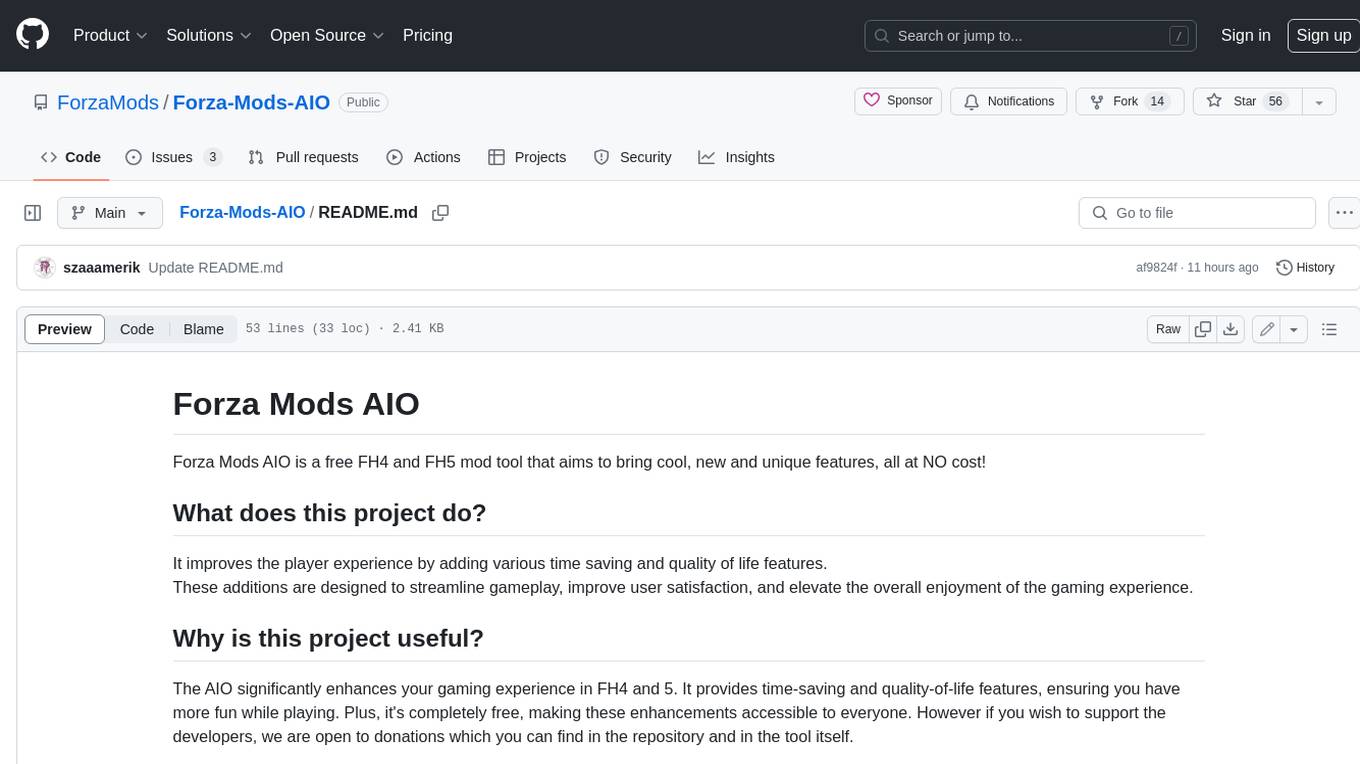
Forza-Mods-AIO
Forza Mods AIO is a free and open-source tool that enhances the gaming experience in Forza Horizon 4 and 5. It offers a range of time-saving and quality-of-life features, making gameplay more enjoyable and efficient. The tool is designed to streamline various aspects of the game, improving user satisfaction and overall enjoyment.
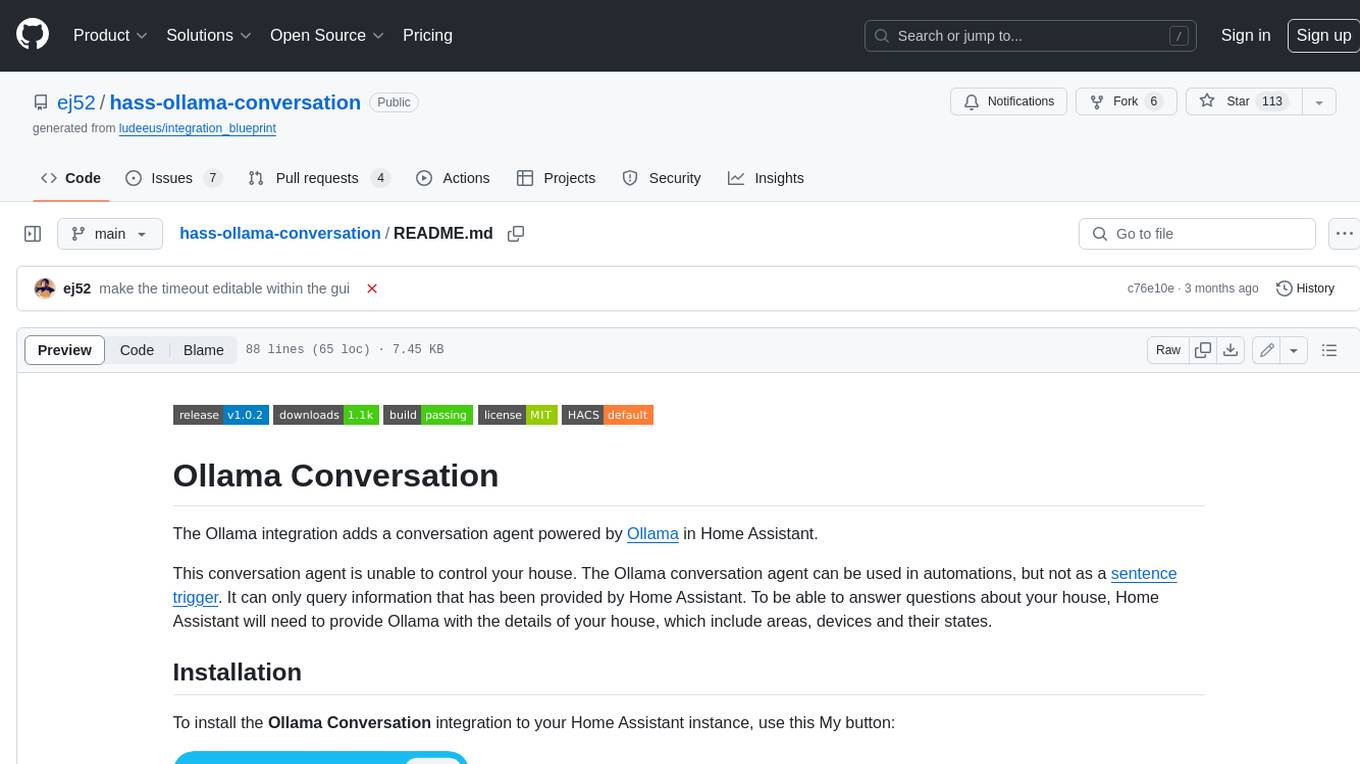
hass-ollama-conversation
The Ollama Conversation integration adds a conversation agent powered by Ollama in Home Assistant. This agent can be used in automations to query information provided by Home Assistant about your house, including areas, devices, and their states. Users can install the integration via HACS and configure settings such as API timeout, model selection, context size, maximum tokens, and other parameters to fine-tune the responses generated by the AI language model. Contributions to the project are welcome, and discussions can be held on the Home Assistant Community platform.
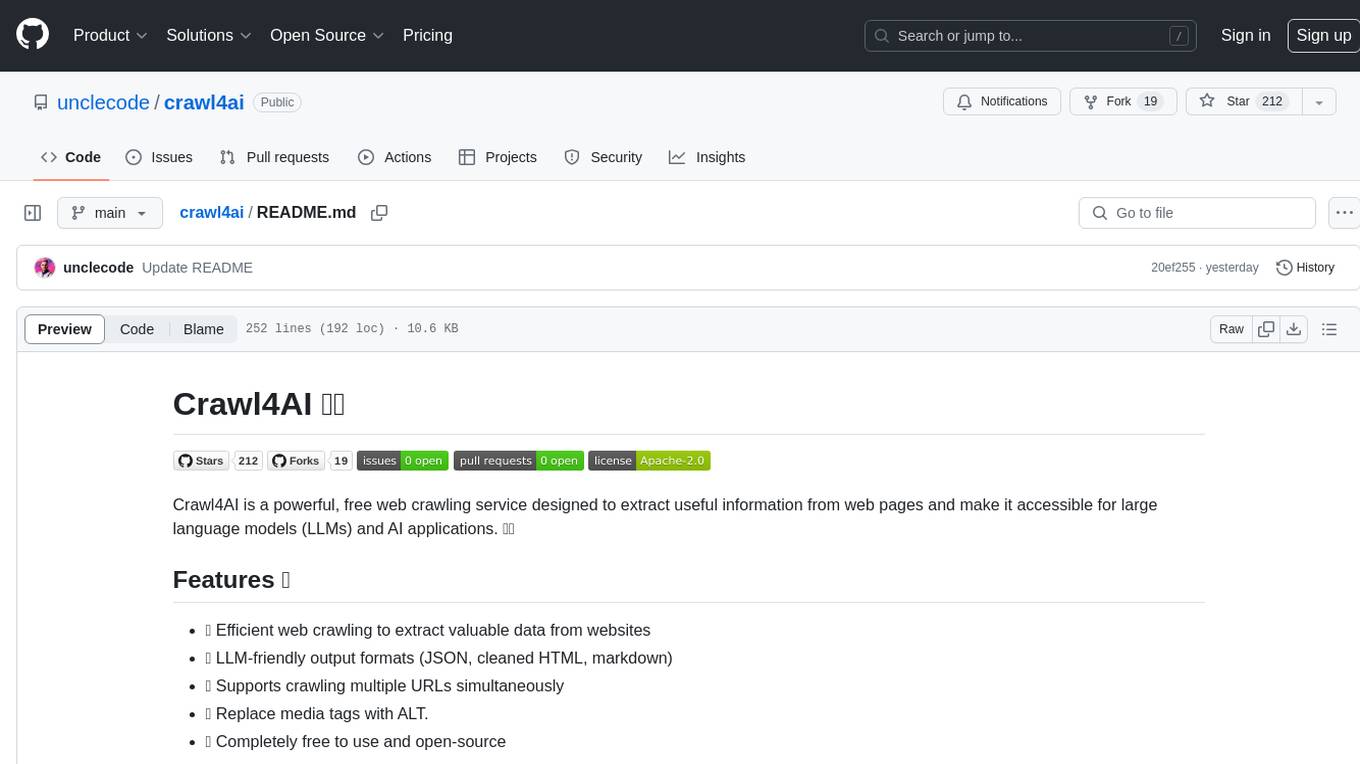
crawl4ai
Crawl4AI is a powerful and free web crawling service that extracts valuable data from websites and provides LLM-friendly output formats. It supports crawling multiple URLs simultaneously, replaces media tags with ALT, and is completely free to use and open-source. Users can integrate Crawl4AI into Python projects as a library or run it as a standalone local server. The tool allows users to crawl and extract data from specified URLs using different providers and models, with options to include raw HTML content, force fresh crawls, and extract meaningful text blocks. Configuration settings can be adjusted in the `crawler/config.py` file to customize providers, API keys, chunk processing, and word thresholds. Contributions to Crawl4AI are welcome from the open-source community to enhance its value for AI enthusiasts and developers.
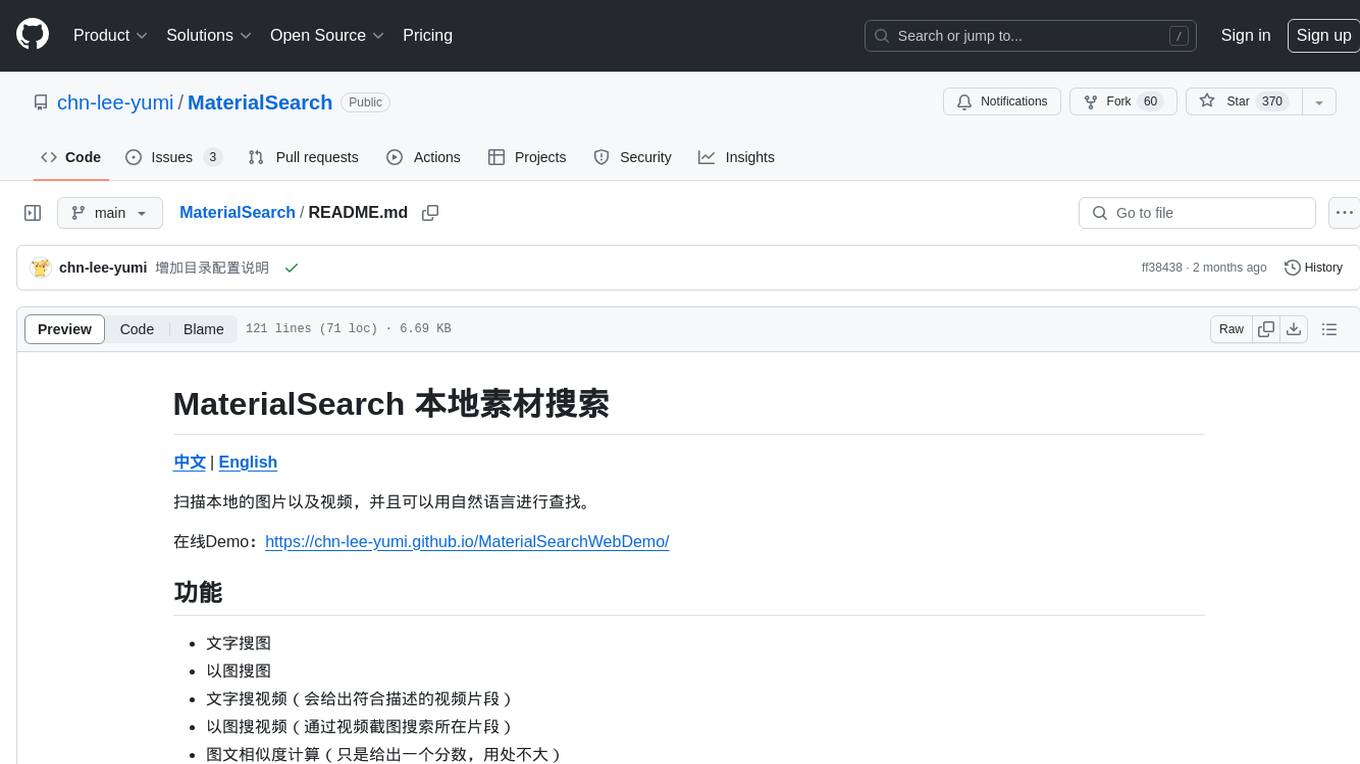
MaterialSearch
MaterialSearch is a tool for searching local images and videos using natural language. It provides functionalities such as text search for images, image search for images, text search for videos (providing matching video clips), image search for videos (searching for the segment in a video through a screenshot), image-text similarity calculation, and Pexels video search. The tool can be deployed through the source code or Docker image, and it supports GPU acceleration. Users can configure the tool through environment variables or a .env file. The tool is still under development, and configurations may change frequently. Users can report issues or suggest improvements through issues or pull requests.
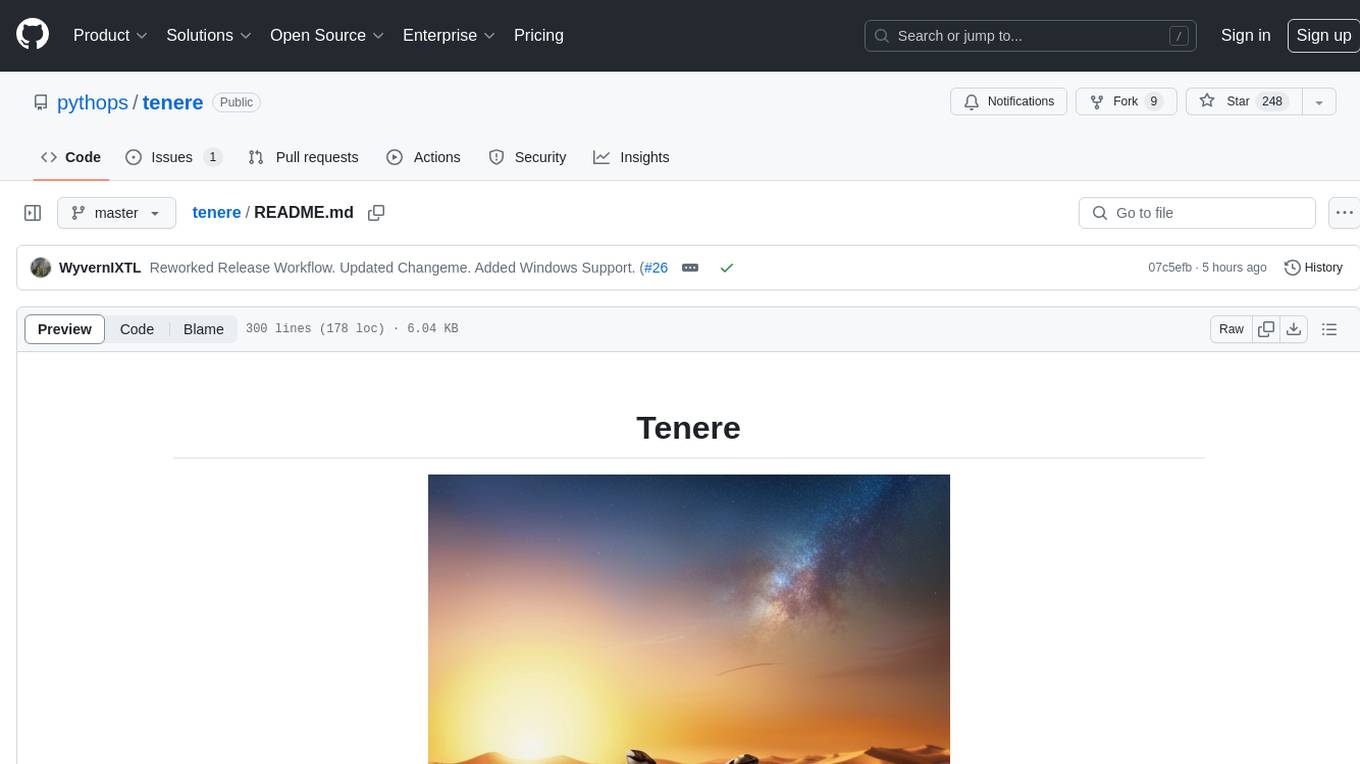
tenere
Tenere is a TUI interface for Language Model Libraries (LLMs) written in Rust. It provides syntax highlighting, chat history, saving chats to files, Vim keybindings, copying text from/to clipboard, and supports multiple backends. Users can configure Tenere using a TOML configuration file, set key bindings, and use different LLMs such as ChatGPT, llama.cpp, and ollama. Tenere offers default key bindings for global and prompt modes, with features like starting a new chat, saving chats, scrolling, showing chat history, and quitting the app. Users can interact with the prompt in different modes like Normal, Visual, and Insert, with various key bindings for navigation, editing, and text manipulation.
openkore
OpenKore is a custom client and intelligent automated assistant for Ragnarok Online. It is a free, open source, and cross-platform program (Linux, Windows, and MacOS are supported). To run OpenKore, you need to download and extract it or clone the repository using Git. Configure OpenKore according to the documentation and run openkore.pl to start. The tool provides a FAQ section for troubleshooting, guidelines for reporting issues, and information about botting status on official servers. OpenKore is developed by a global team, and contributions are welcome through pull requests. Various community resources are available for support and communication. Users are advised to comply with the GNU General Public License when using and distributing the software.
QA-Pilot
QA-Pilot is an interactive chat project that leverages online/local LLM for rapid understanding and navigation of GitHub code repository. It allows users to chat with GitHub public repositories using a git clone approach, store chat history, configure settings easily, manage multiple chat sessions, and quickly locate sessions with a search function. The tool integrates with `codegraph` to view Python files and supports various LLM models such as ollama, openai, mistralai, and localai. The project is continuously updated with new features and improvements, such as converting from `flask` to `fastapi`, adding `localai` API support, and upgrading dependencies like `langchain` and `Streamlit` to enhance performance.
For similar jobs
sweep
Sweep is an AI junior developer that turns bugs and feature requests into code changes. It automatically handles developer experience improvements like adding type hints and improving test coverage.
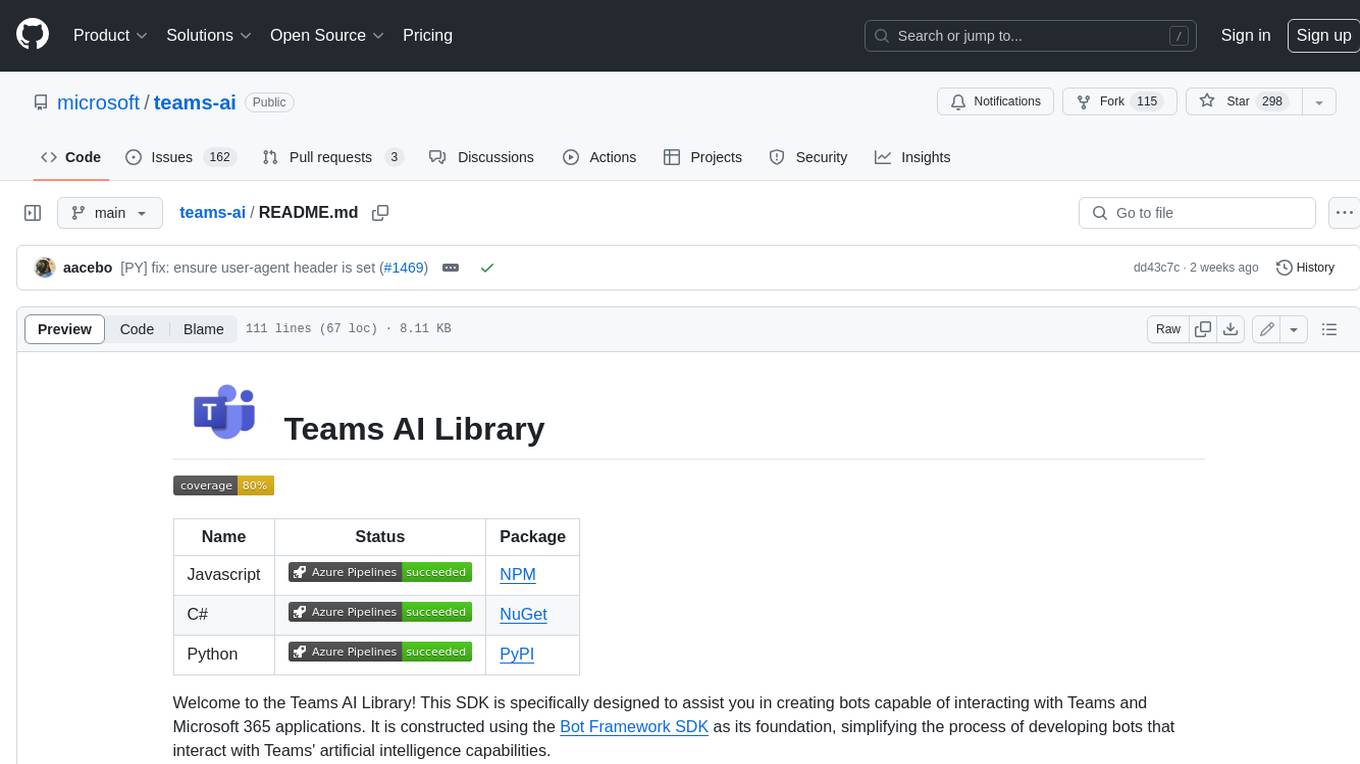
teams-ai
The Teams AI Library is a software development kit (SDK) that helps developers create bots that can interact with Teams and Microsoft 365 applications. It is built on top of the Bot Framework SDK and simplifies the process of developing bots that interact with Teams' artificial intelligence capabilities. The SDK is available for JavaScript/TypeScript, .NET, and Python.
ai-guide
This guide is dedicated to Large Language Models (LLMs) that you can run on your home computer. It assumes your PC is a lower-end, non-gaming setup.
classifai
Supercharge WordPress Content Workflows and Engagement with Artificial Intelligence. Tap into leading cloud-based services like OpenAI, Microsoft Azure AI, Google Gemini and IBM Watson to augment your WordPress-powered websites. Publish content faster while improving SEO performance and increasing audience engagement. ClassifAI integrates Artificial Intelligence and Machine Learning technologies to lighten your workload and eliminate tedious tasks, giving you more time to create original content that matters.
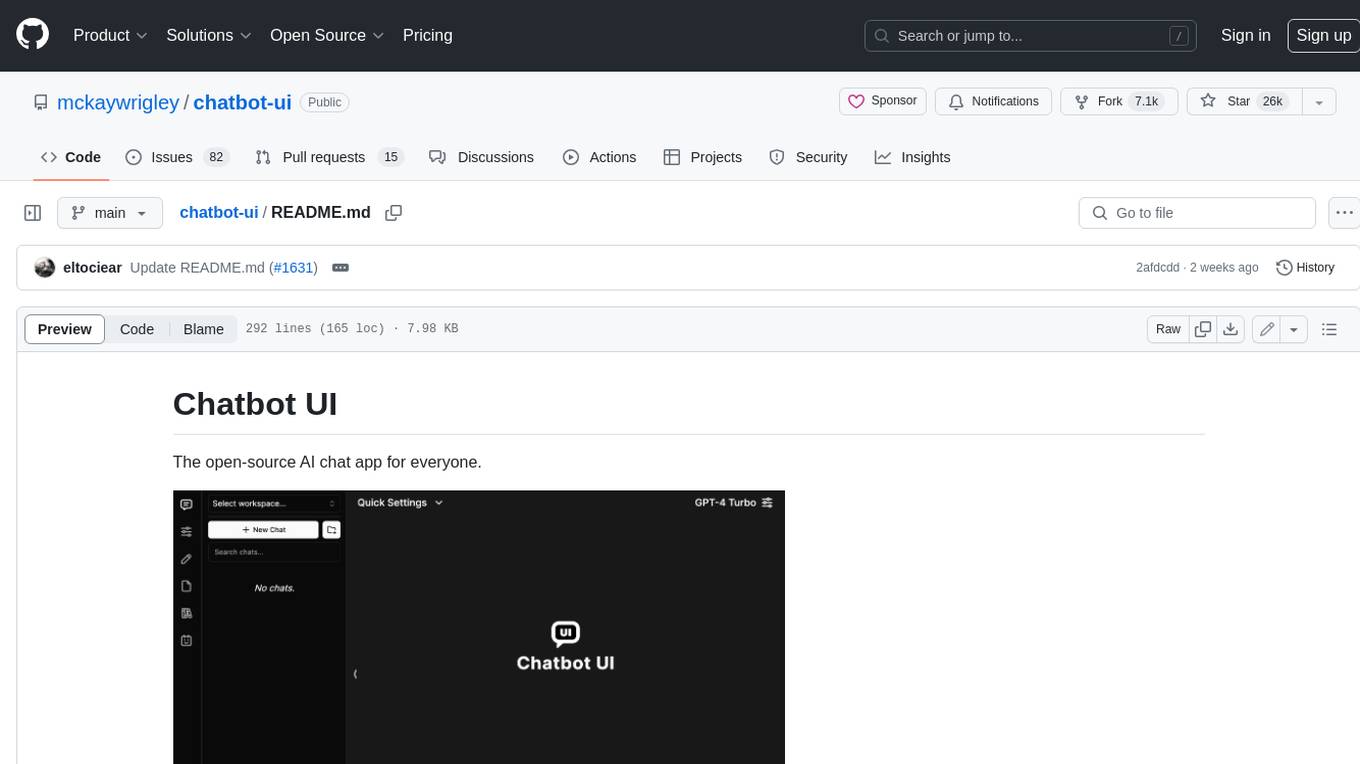
chatbot-ui
Chatbot UI is an open-source AI chat app that allows users to create and deploy their own AI chatbots. It is easy to use and can be customized to fit any need. Chatbot UI is perfect for businesses, developers, and anyone who wants to create a chatbot.
BricksLLM
BricksLLM is a cloud native AI gateway written in Go. Currently, it provides native support for OpenAI, Anthropic, Azure OpenAI and vLLM. BricksLLM aims to provide enterprise level infrastructure that can power any LLM production use cases. Here are some use cases for BricksLLM: * Set LLM usage limits for users on different pricing tiers * Track LLM usage on a per user and per organization basis * Block or redact requests containing PIIs * Improve LLM reliability with failovers, retries and caching * Distribute API keys with rate limits and cost limits for internal development/production use cases * Distribute API keys with rate limits and cost limits for students
uAgents
uAgents is a Python library developed by Fetch.ai that allows for the creation of autonomous AI agents. These agents can perform various tasks on a schedule or take action on various events. uAgents are easy to create and manage, and they are connected to a fast-growing network of other uAgents. They are also secure, with cryptographically secured messages and wallets.
griptape
Griptape is a modular Python framework for building AI-powered applications that securely connect to your enterprise data and APIs. It offers developers the ability to maintain control and flexibility at every step. Griptape's core components include Structures (Agents, Pipelines, and Workflows), Tasks, Tools, Memory (Conversation Memory, Task Memory, and Meta Memory), Drivers (Prompt and Embedding Drivers, Vector Store Drivers, Image Generation Drivers, Image Query Drivers, SQL Drivers, Web Scraper Drivers, and Conversation Memory Drivers), Engines (Query Engines, Extraction Engines, Summary Engines, Image Generation Engines, and Image Query Engines), and additional components (Rulesets, Loaders, Artifacts, Chunkers, and Tokenizers). Griptape enables developers to create AI-powered applications with ease and efficiency.