


gaia-ui
Beautifully designed components for building AI Agents 🌎
Stars: 112
A collection of production-ready UI components designed specifically for building AI assistants and chatbots. These components are battle-tested in production at GAIA, designed to handle edge cases and real-world scenarios, accessible, responsive, and performant. The library focuses on quality over quantity, offering components that solve real problems better than existing alternatives. Users can easily add components to their projects using the provided commands, and the library is actively being developed and refined for better compatibility and smaller bundle sizes.
README:


A collection of production-ready UI components designed specifically for building AI assistants and chatbots. These are the components we use at GAIA, now available for anyone building conversational interfaces.
Building a great chat or assistant interface requires more than just generic UI components. We've spent countless hours refining these components to handle the unique challenges of conversational UIs.
Instead of reinventing the wheel, use the same battle-tested components that power GAIA.
Quality Over Quantity - We focus on shipping production-ready components that solve real problems. Each component is:
- ✅ Battle-tested in production at GAIA
- ✅ Designed to handle edge cases and real-world scenarios
- ✅ Accessible, responsive, and performant
- ✅ Solving problems better than existing alternatives
You won't find generic components that duplicate what's already available. If we're shipping it, it's because we use it in production and it adds genuine value to the ecosystem.
Add components to your project:
npx @heygaia/ui add navbar-menuAdd multiple components at once:
npx @heygaia/ui add raised-button chat-bubble tool-calls-sectionYou can also use the shadcn CLI directly with the full registry URL:
npx shadcn@latest add https://ui.heygaia.io/r/navbar-menu.jsonOr configure the @heygaia namespace in your components.json:
{
  "registries": {
    "@heygaia": "https://ui.heygaia.io/r/{name}.json"
  }
}
Then use namespace syntax:
npx shadcn@latest add @heygaia/navbar-menuThis registry uses standard shadcn/ui base components. Install them separately:
npx shadcn@latest add button tooltip avatar dropdown-menu popover skeleton- Component Docs - Live examples and API reference
- Contributing Guide - Complete guide for adding components
- Roadmap - See what's coming next
GAIA UI is in beta. We're actively migrating components from our internal GAIA codebase, replacing HeroUI with shadcn/ui for better compatibility and smaller bundle sizes. The library is stable and used in production, but APIs may change as we refine components before v1.0.
Join our growing community of users and contributors:
-
Discord — Chat with the team and other users.
-
Twitter — Get the latest news and updates.
-
GitHub — Report issues and contribute.


We welcome contributions! Whether you're fixing bugs, improving documentation, or adding new components, we'd love your help.
Quick start for contributors:
- Fork the repository
- Create your component in
registry/new-york/ui/ - Add entry to
registry.jsonand runpnpm run registry:build - Test locally with
npx shadcn@latest add http://localhost:3000/r/[component-name].json - Submit a pull request
# Install dependencies
pnpm install

# Run dev server
pnpm run dev

# Build registry
pnpm run registry:build

# Type check
pnpm run type- Next.js 15 - For the documentation and registry
- Tailwind CSS v4 - For styling
- TypeScript - For type safety
- Radix UI - For accessible primitives
- Framer Motion - For animations
- shadcn CLI - For component installation
MIT License - feel free to use these components in your projects!
Made with ❤️ by




For Tasks:
Click tags to check more tools for each tasksFor Jobs:
Alternative AI tools for gaia-ui
Similar Open Source Tools
gaia-ui
A collection of production-ready UI components designed specifically for building AI assistants and chatbots. These components are battle-tested in production at GAIA, designed to handle edge cases and real-world scenarios, accessible, responsive, and performant. The library focuses on quality over quantity, offering components that solve real problems better than existing alternatives. Users can easily add components to their projects using the provided commands, and the library is actively being developed and refined for better compatibility and smaller bundle sizes.
Devon
Devon is an open-source pair programmer tool designed to facilitate collaborative coding sessions. It provides features such as multi-file editing, codebase exploration, test writing, bug fixing, and architecture exploration. The tool supports Anthropic, OpenAI, and Groq APIs, with plans to add more models in the future. Devon is community-driven, with ongoing development goals including multi-model support, plugin system for tool builders, self-hostable Electron app, and setting SOTA on SWE-bench Lite. Users can contribute to the project by developing core functionality, conducting research on agent performance, providing feedback, and testing the tool.
noether
Noether is Emmi AI's open software framework for Engineering AI. It is built on transformer building blocks, delivering the full engineering stack for building, training, and operating industrial simulation models across engineering verticals. The framework eliminates the need for component re-engineering or an in-house deep learning team. Noether features a modular transformer architecture optimized for physical systems, hardware agnostic execution across CPU, MPS, and NVIDIA GPUs, industrial-grade design for high-fidelity simulations, and built-in support for Multi-GPU and SLURM cluster environments.
preswald
Preswald is a full-stack platform for building, deploying, and managing interactive data applications in Python. It simplifies the process by combining ingestion, storage, transformation, and visualization into one lightweight SDK. With Preswald, users can connect to various data sources, customize app themes, and easily deploy apps locally. The platform focuses on code-first simplicity, end-to-end coverage, and efficiency by design, making it suitable for prototyping internal tools or deploying production-grade apps with reduced complexity and cost.
AiR
AiR is an AI tool built entirely in Rust that delivers blazing speed and efficiency. It features accurate translation and seamless text rewriting to supercharge productivity. AiR is designed to assist non-native speakers by automatically fixing errors and polishing language to sound like a native speaker. The tool is under heavy development with more features on the horizon.
pebble
Pebbling is an open-source protocol for agent-to-agent communication, enabling AI agents to collaborate securely using Decentralised Identifiers (DIDs) and mutual TLS (mTLS). It provides a lightweight communication protocol built on JSON-RPC 2.0, ensuring reliable and secure conversations between agents. Pebbling allows agents to exchange messages safely, connect seamlessly regardless of programming language, and communicate quickly and efficiently. It is designed to pave the way for the next generation of collaborative AI systems, promoting secure and effortless communication between agents across different environments.
next-money
Next Money Stripe Starter is a SaaS Starter project that empowers your next project with a stack of Next.js, Prisma, Supabase, Clerk Auth, Resend, React Email, Shadcn/ui, and Stripe. It seamlessly integrates these technologies to accelerate your development and SaaS journey. The project includes frameworks, platforms, UI components, hooks and utilities, code quality tools, and miscellaneous features to enhance the development experience. Created by @koyaguo in 2023 and released under the MIT license.
browser-use
Browser Use is a tool designed to make websites accessible for AI agents. It provides an easy way to connect AI agents with the browser, enabling users to perform tasks such as extracting vision and HTML elements, managing multiple tabs, and executing custom actions. The tool supports various language models and allows users to parallelize multiple agents for efficient processing. With features like self-correction and the ability to register custom actions, Browser Use offers a versatile solution for interacting with web content using AI technology.
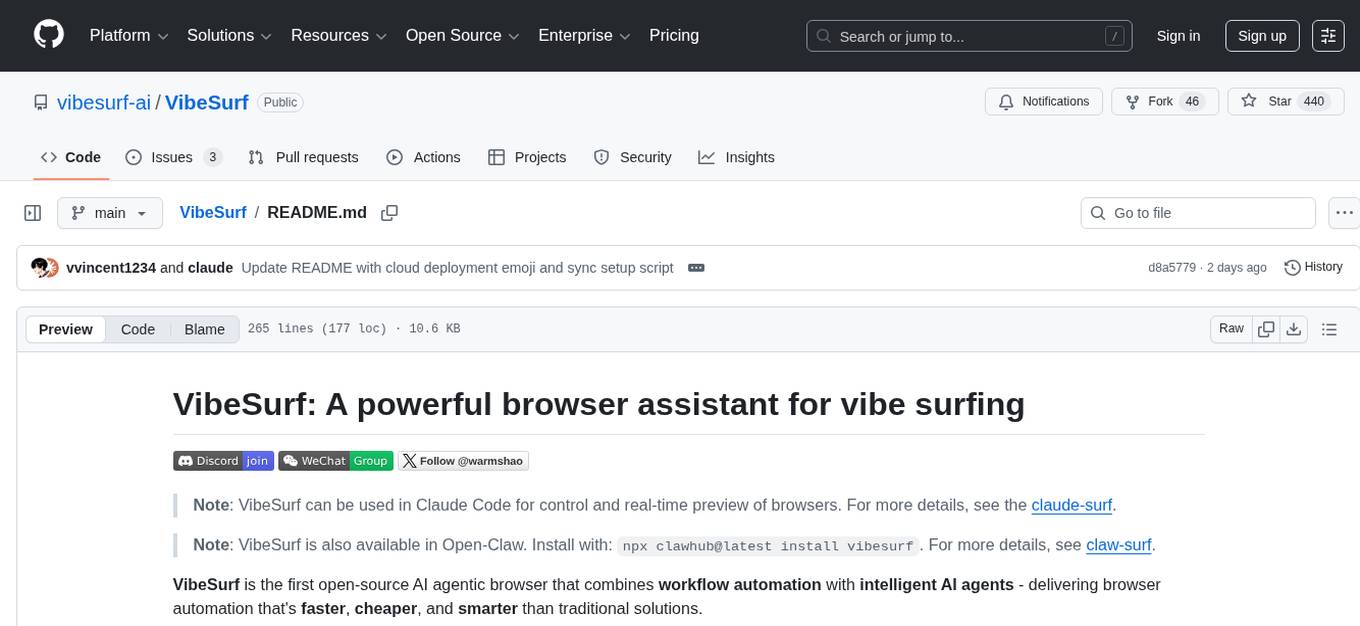
VibeSurf
VibeSurf is an open-source AI agentic browser that combines workflow automation with intelligent AI agents, offering faster, cheaper, and smarter browser automation. It allows users to create revolutionary browser workflows, run multiple AI agents in parallel, perform intelligent AI automation tasks, maintain privacy with local LLM support, and seamlessly integrate as a Chrome extension. Users can save on token costs, achieve efficiency gains, and enjoy deterministic workflows for consistent and accurate results. VibeSurf also provides a Docker image for easy deployment and offers pre-built workflow templates for common tasks.
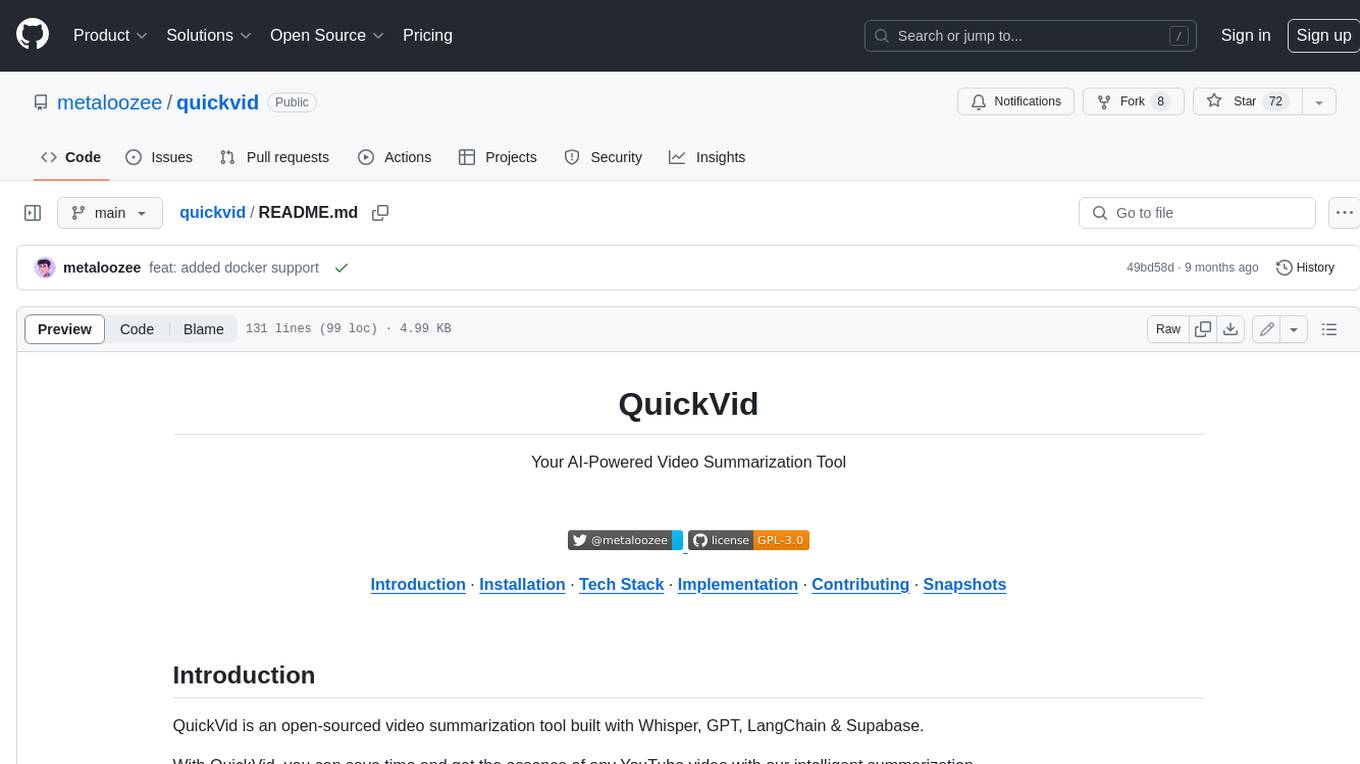
quickvid
QuickVid is an open-source video summarization tool that uses AI to generate summaries of YouTube videos. It is built with Whisper, GPT, LangChain, and Supabase. QuickVid can be used to save time and get the essence of any YouTube video with intelligent summarization.
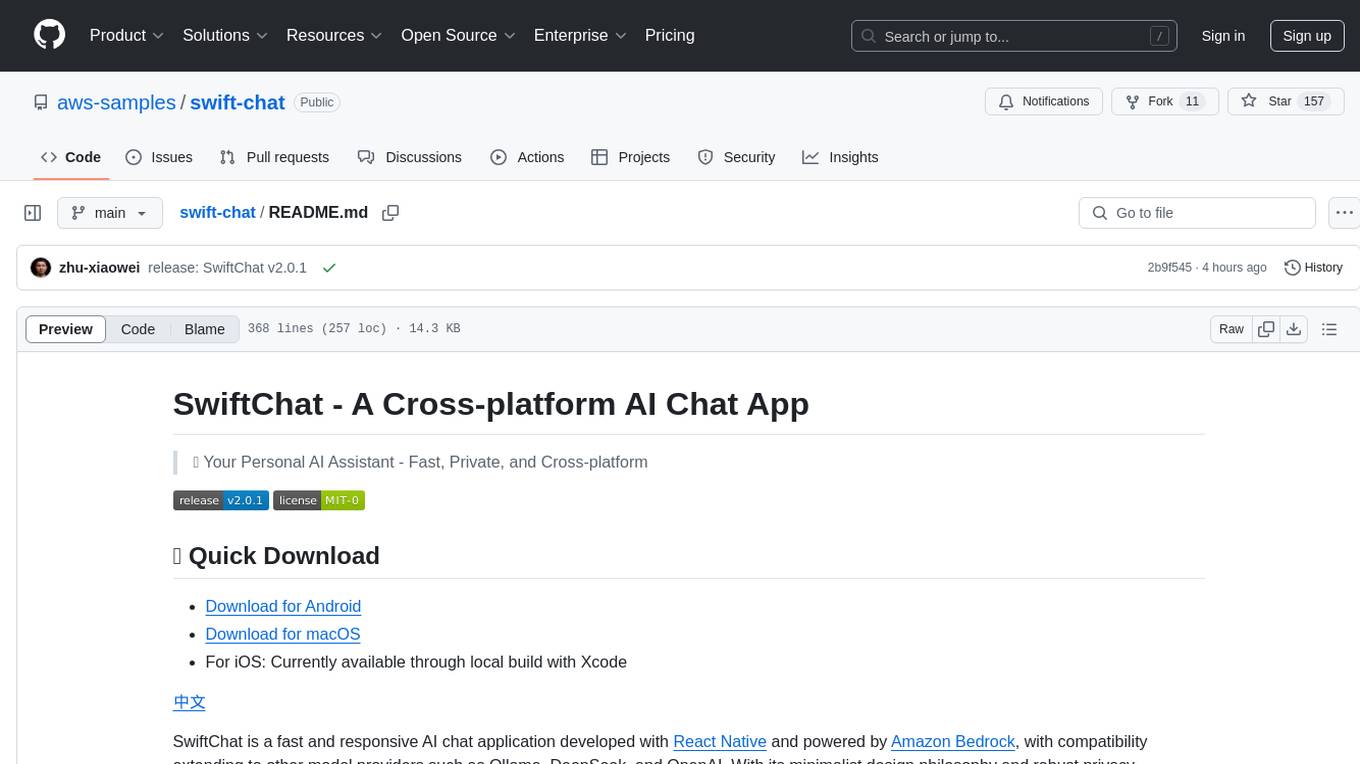
swift-chat
SwiftChat is a fast and responsive AI chat application developed with React Native and powered by Amazon Bedrock. It offers real-time streaming conversations, AI image generation, multimodal support, conversation history management, and cross-platform compatibility across Android, iOS, and macOS. The app supports multiple AI models like Amazon Bedrock, Ollama, DeepSeek, and OpenAI, and features a customizable system prompt assistant. With a minimalist design philosophy and robust privacy protection, SwiftChat delivers a seamless chat experience with various features like rich Markdown support, comprehensive multimodal analysis, creative image suite, and quick access tools. The app prioritizes speed in launch, request, render, and storage, ensuring a fast and efficient user experience. SwiftChat also emphasizes app privacy and security by encrypting API key storage, minimal permission requirements, local-only data storage, and a privacy-first approach.
liveblocks
Liveblocks provides customizable pre-built features for human and AI collaboration, used to make your product multiplayer, engaging, and AI-ready. All without derailing your roadmap. Liveblocks offers ready-to-use features like Comments, Text Editor, AI Copilots, Presence, and Notifications, along with the ability to host and scale local-first sync engines. It also provides packages and SDKs for various libraries and frameworks to add collaborative experiences to your product.
Roo-Code
Roo Code is an AI-powered development tool that integrates with your code editor to help you generate code from natural language descriptions and specifications, refactor and debug existing code, write and update documentation, answer questions about your codebase, automate repetitive tasks, and utilize MCP servers. It offers different modes such as Code, Architect, Ask, Debug, and Custom Modes to adapt to various tasks and workflows. Roo Code provides tutorial and feature videos, documentation, a YouTube channel, a Discord server, a Reddit community, GitHub issues tracking, and a feature request platform. Users can set up and develop Roo Code locally by cloning the repository, installing dependencies, and running the extension in development mode or by automated/manual VSIX installation. The tool uses changesets for versioning and publishing. Please note that Roo Code, Inc. does not make any representations or warranties regarding the tools provided, and users assume all risks associated with their use.
eliza
Eliza is a versatile AI agent operating system designed to support various models and connectors, enabling users to create chatbots, autonomous agents, handle business processes, create video game NPCs, and engage in trading. It offers multi-agent and room support, document ingestion and interaction, retrievable memory and document store, and extensibility to create custom actions and clients. Eliza is easy to use and provides a comprehensive solution for AI agent development.
bytebot
Bytebot is an open-source AI desktop agent that provides a virtual employee with its own computer to complete tasks for users. It can use various applications, download and organize files, log into websites, process documents, and perform complex multi-step workflows. By giving AI access to a complete desktop environment, Bytebot unlocks capabilities not possible with browser-only agents or API integrations, enabling complete task autonomy, document processing, and usage of real applications.
llm-x
LLM X is a ChatGPT-style UI for the niche group of folks who run Ollama (think of this like an offline chat gpt server) locally. It supports sending and receiving images and text and works offline through PWA (Progressive Web App) standards. The project utilizes React, Typescript, Lodash, Mobx State Tree, Tailwind css, DaisyUI, NextUI, Highlight.js, React Markdown, kbar, Yet Another React Lightbox, Vite, and Vite PWA plugin. It is inspired by ollama-ui's project and Perplexity.ai's UI advancements in the LLM UI space. The project is still under development, but it is already a great way to get started with building your own LLM UI.
For similar tasks
gaia-ui
A collection of production-ready UI components designed specifically for building AI assistants and chatbots. These components are battle-tested in production at GAIA, designed to handle edge cases and real-world scenarios, accessible, responsive, and performant. The library focuses on quality over quantity, offering components that solve real problems better than existing alternatives. Users can easily add components to their projects using the provided commands, and the library is actively being developed and refined for better compatibility and smaller bundle sizes.
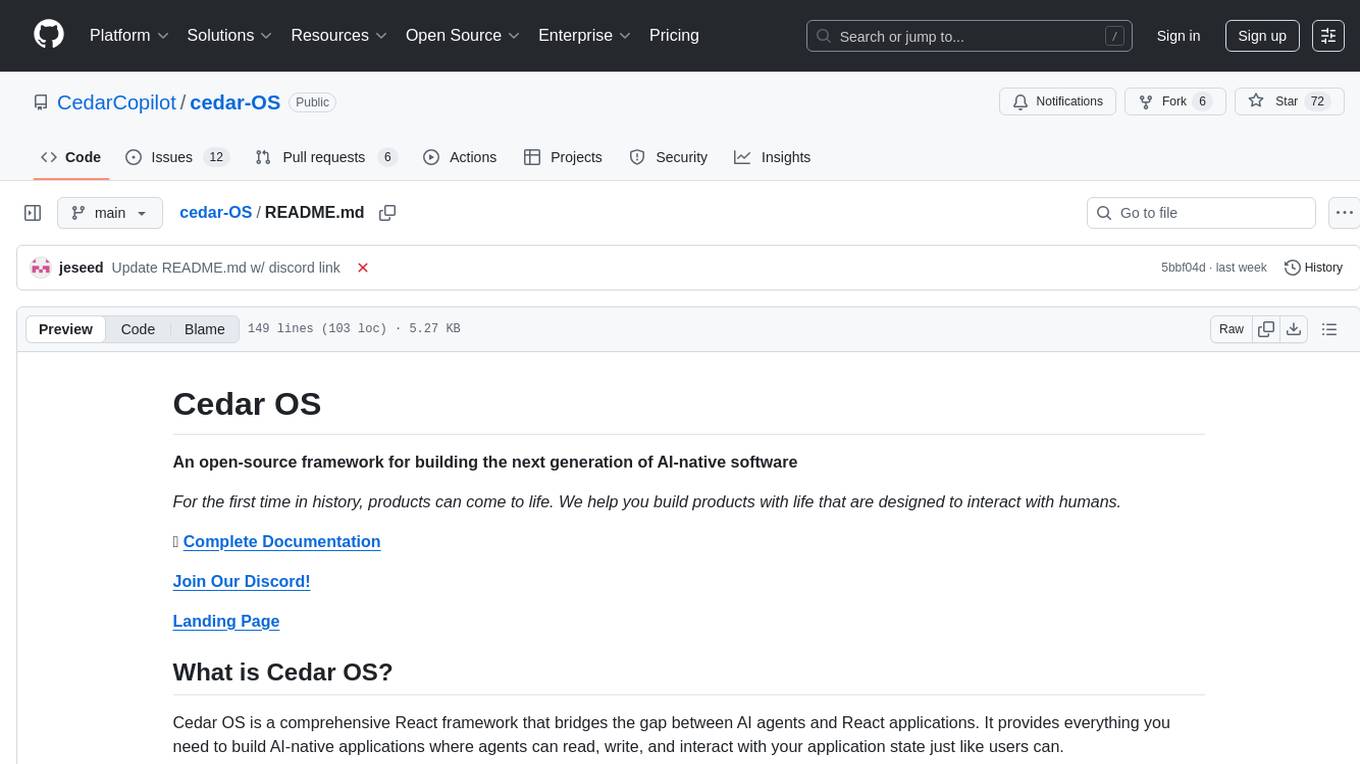
cedar-OS
Cedar OS is an open-source framework that bridges the gap between AI agents and React applications, enabling the creation of AI-native applications where agents can interact with the application state like users. It focuses on providing intuitive and powerful ways for humans to interact with AI through features like full state integration, real-time streaming, voice-first design, and flexible architecture. Cedar OS offers production-ready chat components, agentic state management, context-aware mentions, voice integration, spells & quick actions, and fully customizable UI. It differentiates itself by offering a true AI-native architecture, developer-first experience, production-ready features, and extensibility. Built with TypeScript support, Cedar OS is designed for developers working on ambitious AI-native applications.
cossistant
Cossistant is an open source chat support widget tailored for the React ecosystem. It offers headless components for building customizable chat interfaces, real-time messaging with WebSocket technology, and tools for managing customer conversations. The tool is API-first, self-hosted, developer-friendly with TypeScript support, and provides complete integration flexibility. It uses technologies like Next.js, TailwindCSS, and WebSockets, and supports databases like PlanetScale for production and DBgin for local development. Cossistant is ideal for developers seeking a versatile chat solution that can be easily integrated into their applications.
agency
Agency is a Go library designed for developers to explore Large Language Models (LLMs) and generative AI in a clean, effective, and Go-idiomatic way. It allows users to easily create custom operations, compose operations into processes, and interact with OpenAI API bindings for various tasks such as text completion, image generation, and speech-to-text conversion. The ultimate goal of Agency is to empower users to build autonomous AI systems, from chat interfaces to complex data analysis, with a focus on simplicity, flexibility, and efficiency.
ai-dial
AI DIAL is an open-source project that provides a platform for developing and deploying conversational AI applications. It includes components such as DIAL Core for API exposure, DIAL SDK for development, and DIAL Chat for default UI. The project offers tutorials for launching AI DIAL Chat with different models and applications, along with a user manual and configuration guide. Additionally, there are various open-source repositories related to DIAL, including DIAL Helm for helm chart, DIAL Assistant for model agnostic assistant implementation, and DIAL Analytics Realtime for usage analytics. The project aims to simplify the development and deployment of AI-powered chat applications.
nestia
Nestia is a set of helper libraries for NestJS, providing super-fast/easy decorators, advanced WebSocket routes, Swagger generator, SDK library generator for clients, mockup simulator for client applications, automatic E2E test functions generator, test program utilizing e2e test functions, benchmark program using e2e test functions, super A.I. chatbot by Swagger document, Swagger-UI with online TypeScript editor, and a CLI tool. It enhances performance significantly and offers a collection of typed fetch functions with DTO structures like tRPC, along with a mockup simulator that is fully automated.
For similar jobs
zep
Zep is a long-term memory service for AI Assistant apps. With Zep, you can provide AI assistants with the ability to recall past conversations, no matter how distant, while also reducing hallucinations, latency, and cost. Zep persists and recalls chat histories, and automatically generates summaries and other artifacts from these chat histories. It also embeds messages and summaries, enabling you to search Zep for relevant context from past conversations. Zep does all of this asyncronously, ensuring these operations don't impact your user's chat experience. Data is persisted to database, allowing you to scale out when growth demands. Zep also provides a simple, easy to use abstraction for document vector search called Document Collections. This is designed to complement Zep's core memory features, but is not designed to be a general purpose vector database. Zep allows you to be more intentional about constructing your prompt: 1. automatically adding a few recent messages, with the number customized for your app; 2. a summary of recent conversations prior to the messages above; 3. and/or contextually relevant summaries or messages surfaced from the entire chat session. 4. and/or relevant Business data from Zep Document Collections.
doc2plan
doc2plan is a browser-based application that helps users create personalized learning plans by extracting content from documents. It features a Creator for manual or AI-assisted plan construction and a Viewer for interactive plan navigation. Users can extract chapters, key topics, generate quizzes, and track progress. The application includes AI-driven content extraction, quiz generation, progress tracking, plan import/export, assistant management, customizable settings, viewer chat with text-to-speech and speech-to-text support, and integration with various Retrieval-Augmented Generation (RAG) models. It aims to simplify the creation of comprehensive learning modules tailored to individual needs.
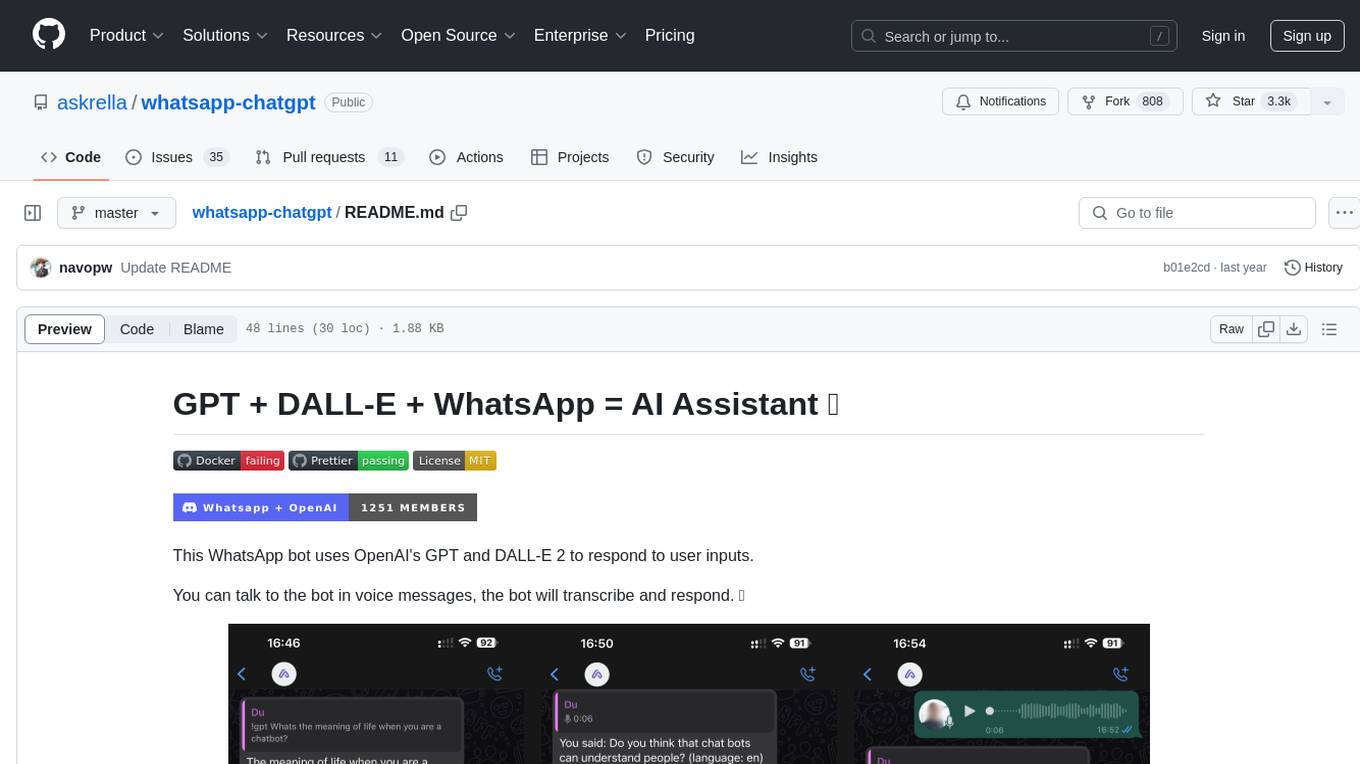
whatsapp-chatgpt
This repository contains a WhatsApp bot that utilizes OpenAI's GPT and DALL-E 2 to respond to user inputs. Users can interact with the bot through voice messages, which are transcribed and responded to. The bot requires Node.js, npm, an OpenAI API key, and a WhatsApp account. It uses Puppeteer to run a real instance of Whatsapp Web to avoid being blocked. However, there is a risk of being blocked by WhatsApp as it does not allow bots or unofficial clients on its platform. The bot is not free to use, and users will be charged by OpenAI for each request made.

OmniSteward
OmniSteward is an AI-powered steward system based on large language models that can interact with users through voice or text to help control smart home devices and computer programs. It supports multi-turn dialogue, tool calling for complex tasks, multiple LLM models, voice recognition, smart home control, computer program management, online information retrieval, command line operations, and file management. The system is highly extensible, allowing users to customize and share their own tools.
chatgpt-wechat
ChatGPT-WeChat is a personal assistant application that can be safely used on WeChat through enterprise WeChat without the risk of being banned. The project is open source and free, with no paid sections or external traffic operations except for advertising on the author's public account '积木成楼'. It supports various features such as secure usage on WeChat, multi-channel customer service message integration, proxy support, session management, rapid message response, voice and image messaging, drawing capabilities, private data storage, plugin support, and more. Users can also develop their own capabilities following the rules provided. The project is currently in development with stable versions available for use.
mcp-agent
mcp-agent is a simple, composable framework designed to build agents using the Model Context Protocol. It handles the lifecycle of MCP server connections and implements patterns for building production-ready AI agents in a composable way. The framework also includes OpenAI's Swarm pattern for multi-agent orchestration in a model-agnostic manner, making it the simplest way to build robust agent applications. It is purpose-built for the shared protocol MCP, lightweight, and closer to an agent pattern library than a framework. mcp-agent allows developers to focus on the core business logic of their AI applications by handling mechanics such as server connections, working with LLMs, and supporting external signals like human input.
Gmail-MCP-Server
Gmail AutoAuth MCP Server is a Model Context Protocol (MCP) server designed for Gmail integration in Claude Desktop. It supports auto authentication and enables AI assistants to manage Gmail through natural language interactions. The server provides comprehensive features for sending emails, reading messages, managing labels, searching emails, and batch operations. It offers full support for international characters, email attachments, and Gmail API integration. Users can install and authenticate the server via Smithery or manually with Google Cloud Project credentials. The server supports both Desktop and Web application credentials, with global credential storage for convenience. It also includes Docker support and instructions for cloud server authentication.
Operit
Operit AI is a fully functional AI assistant application for mobile devices, running independently on Android devices with powerful tool invocation capabilities. It offers over 40 built-in tools for file system operations, HTTP requests, system operations, UI automation, and media processing. The app combines these tools with rich plugins to enable a wide range of tasks, from simple to complex, providing a comprehensive experience of a smartphone AI assistant.