


pgmpy
Python library for Causal AI
Stars: 3152
pgmpy is a Python library for causal and probabilistic modeling using graphical models. It provides a uniform API for building, learning, and analyzing models, such as Bayesian Networks, Dynamic Bayesian Networks, Directed Acyclic Graphs (DAGs), and Structural Equation Models (SEMs). By integrating tools from both probabilistic inference and causal inference, pgmpy enables users to seamlessly transition between predictive and causal analyses. Key features include causal discovery/structure learning, causal validation, parameter learning, probabilistic inference, causal inference, and simulations. The library offers resources such as example notebooks, tutorial notebooks, blog posts, documentation, bug reports, and feature requests.
README:
 pgmpy is a Python library for causal and probabilistic modeling using graphical models. It provides a uniform API for building, learning, and analyzing models, such as Bayesian Networks, Dynamic Bayesian Networks, Directed Acyclic Graphs (DAGs), and Structural Equation Models (SEMs). By integrating tools from both probabilistic inference and causal inference, pgmpy enables users to seamlessly transition between predictive and causal analyses.
| Documentation · Examples . Tutorials | |
|---|---|
| Open Source |  |
| Tutorials |  |
| Community |
 
|
| CI/CD |
  
|
| Code |
   
|
| Downloads |
  )
|
| Supported By |
 
|
| Feature | Description |
|---|---|
| Causal Discovery / Structure Learning | Learn the model structure from data, with optional integration of expert knowledge. |
| Causal Validation | Assess how compatible the causal structure is with the data. |
| Parameter Learning | Estimate model parameters (e.g., conditional probability distributions) from observed data. |
| Probabilistic Inference | Compute posterior distributions conditioned on observed evidence. |
| Causal Inference | Compute interventional and counterfactual distributions using do-calculus. |
| Simulations | Generate synthetic data under specified evidence or interventions. |
- Example Notebooks: Examples
- Tutorial Notebooks: Tutorials
- Blog Posts: Medium
- Documentation: Website
- Bug Reports and Feature Requests: GitHub Issues
- Questions: discord · Stack Overflow
pgmpy is available on both PyPI and anaconda. To install from PyPI, use:
pip install pgmpyTo install from conda-forge, use:
conda install conda-forge::pgmpyfrom pgmpy.utils import get_example_model
# Load a Discrete Bayesian Network and simulate data.
discrete_bn = get_example_model("alarm")
alarm_df = discrete_bn.simulate(n_samples=100)
# Learn a network from simulated data.
from pgmpy.estimators import PC
dag = PC(data=alarm_df).estimate(ci_test="chi_square", return_type="dag")
# Learn the parameters from the data.
from pgmpy.models import DiscreteBayesianNetwork
discrete_bn = DiscreteBayesianNetwork(dag.edges())
discrete_bn.add_nodes_from(dag.nodes())
dag_fitted = discrete_bn.fit(alarm_df)
dag_fitted.get_cpds()
# Drop a column and predict using the learned model.
evidence_df = alarm_df.drop(columns=["FIO2"], axis=1)
pred_FIO2 = dag_fitted.predict(evidence_df)from pgmpy.utils import get_example_model
# Load an example Gaussian Bayesian Network and simulate data
gaussian_bn = get_example_model("ecoli70")
ecoli_df = gaussian_bn.simulate(n_samples=100)
# Learn the network from simulated data.
from pgmpy.estimators import PC
dag = PC(data=ecoli_df).estimate(ci_test="pearsonr", return_type="dag")
# Learn the parameters from the data.
from pgmpy.models import LinearGaussianBayesianNetwork
gaussian_bn = LinearGaussianBayesianNetwork(dag.edges())
dag_fitted = gaussian_bn.fit(ecoli_df)
dag_fitted.get_cpds()
# Drop a column and predict using the learned model.
evidence_df = ecoli_df.drop(columns=["ftsJ"], axis=1)
pred_ftsJ = dag_fitted.predict(evidence_df)from pgmpy.global_vars import config
config.set_backend("torch")
import pyro.distributions as dist
from pgmpy.models import FunctionalBayesianNetwork
from pgmpy.factors.hybrid import FunctionalCPD
# Create a Bayesian Network with mixture of discrete and continuous variables.
func_bn = FunctionalBayesianNetwork(
[
("x1", "w"),
("x2", "w"),
("x1", "y"),
("x2", "y"),
("w", "y"),
("y", "z"),
("w", "z"),
("y", "c"),
("w", "c"),
]
)
# Define the Functional CPDs for each node and add them to the model.
cpd_x1 = FunctionalCPD("x1", fn=lambda _: dist.Normal(0.0, 1.0))
cpd_x2 = FunctionalCPD("x2", fn=lambda _: dist.Normal(0.5, 1.2))
# Continuous mediator: w = 0.7*x1 - 0.3*x2 + ε
cpd_w = FunctionalCPD(
"w",
fn=lambda parents: dist.Normal(0.7 * parents["x1"] - 0.3 * parents["x2"], 0.5),
parents=["x1", "x2"],
)
# Bernoulli target with logistic link: y ~ Bernoulli(sigmoid(-0.7 + 1.5*x1 + 0.8*x2 + 1.2*w))
cpd_y = FunctionalCPD(
"y",
fn=lambda parents: dist.Bernoulli(
logits=(-0.7 + 1.5 * parents["x1"] + 0.8 * parents["x2"] + 1.2 * parents["w"])
),
parents=["x1", "x2", "w"],
)
# Downstream Bernoulli influenced by y and w
cpd_z = FunctionalCPD(
"z",
fn=lambda parents: dist.Bernoulli(
logits=(-1.2 + 0.8 * parents["y"] + 0.2 * parents["w"])
),
parents=["y", "w"],
)
# Continuous outcome depending on y and w: c = 0.2 + 0.5*y + 0.3*w + ε
cpd_c = FunctionalCPD(
"c",
fn=lambda parents: dist.Normal(0.2 + 0.5 * parents["y"] + 0.3 * parents["w"], 0.7),
parents=["y", "w"],
)
func_bn.add_cpds(cpd_x1, cpd_x2, cpd_w, cpd_y, cpd_z, cpd_c)
func_bn.check_model()
# Simulate data from the model
df_func = func_bn.simulate(n_samples=1000, seed=123)
# For learning and inference in Functional Bayesian Networks, please refer to the example notebook: https://github.com/pgmpy/pgmpy/blob/dev/examples/Functional_Bayesian_Network_Tutorial.ipynbWe welcome all contributions --not just code-- to pgmpy. Please refer out contributing guide for more details. We also offer mentorship for new contributors and maintain a list of potential mentored projects. If you are interested in contributing to pgmpy, please join our discord server and introduce yourself. We will be happy to help you get started.
For Tasks:
Click tags to check more tools for each tasksFor Jobs:
Alternative AI tools for pgmpy
Similar Open Source Tools
pgmpy
pgmpy is a Python library for causal and probabilistic modeling using graphical models. It provides a uniform API for building, learning, and analyzing models, such as Bayesian Networks, Dynamic Bayesian Networks, Directed Acyclic Graphs (DAGs), and Structural Equation Models (SEMs). By integrating tools from both probabilistic inference and causal inference, pgmpy enables users to seamlessly transition between predictive and causal analyses. Key features include causal discovery/structure learning, causal validation, parameter learning, probabilistic inference, causal inference, and simulations. The library offers resources such as example notebooks, tutorial notebooks, blog posts, documentation, bug reports, and feature requests.
exstruct
ExStruct is an Excel structured extraction engine that reads Excel workbooks and outputs structured data as JSON, including cells, table candidates, shapes, charts, smartart, merged cell ranges, print areas/views, auto page-break areas, and hyperlinks. It offers different output modes, formula map extraction, table detection tuning, CLI rendering options, and graceful fallback in case Excel COM is unavailable. The tool is designed to fit LLM/RAG pipelines and provides benchmark reports for accuracy and utility. It supports various formats like JSON, YAML, and TOON, with optional extras for rendering and full extraction targeting Windows + Excel environments.
retinify
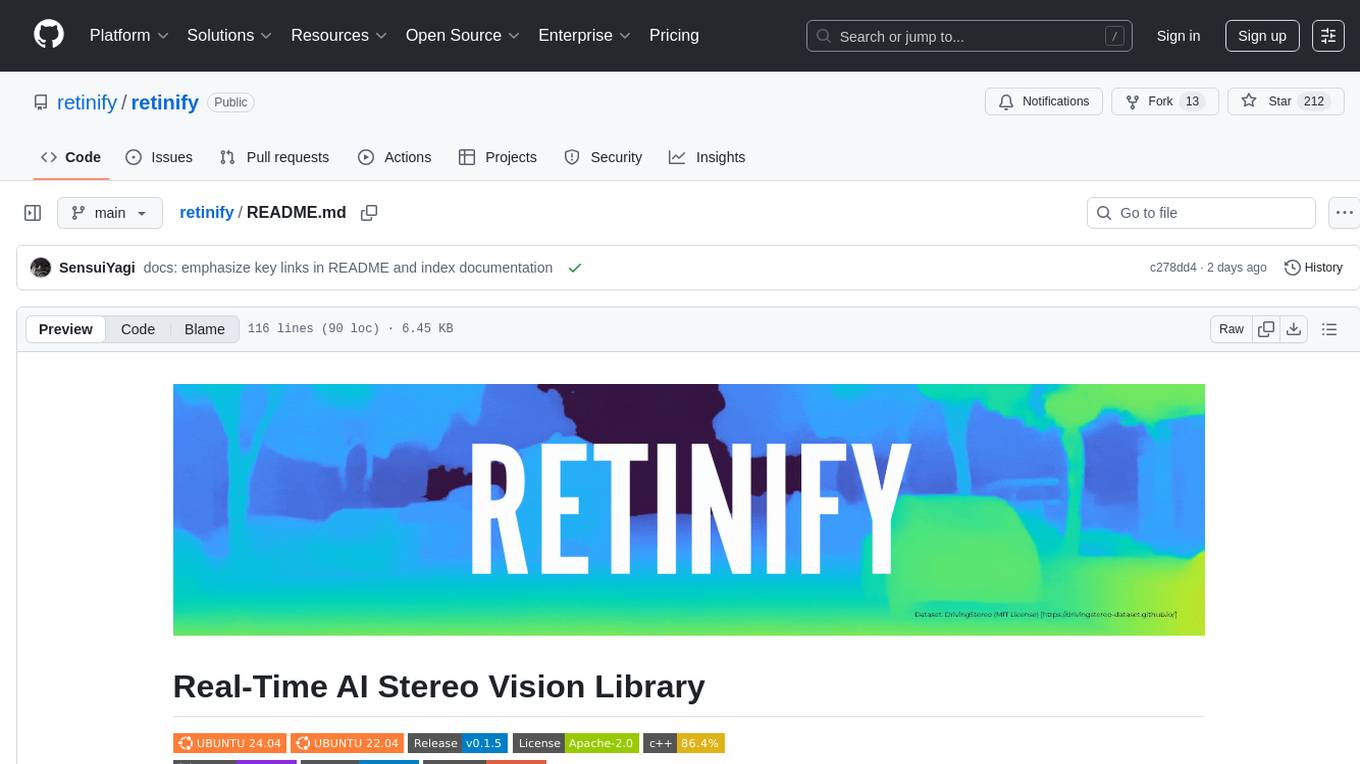
Retinify is an advanced AI-powered stereo vision library designed for robotics, enabling real-time, high-precision 3D perception by leveraging GPU and NPU acceleration. It is open source under Apache-2.0 license, offers high precision 3D mapping and object recognition, runs computations on GPU for fast performance, accepts stereo images from any rectified camera setup, is cost-efficient using minimal hardware, and has minimal dependencies on CUDA Toolkit, cuDNN, and TensorRT. The tool provides a pipeline for stereo matching and supports various image data types independently of OpenCV.
auto-round
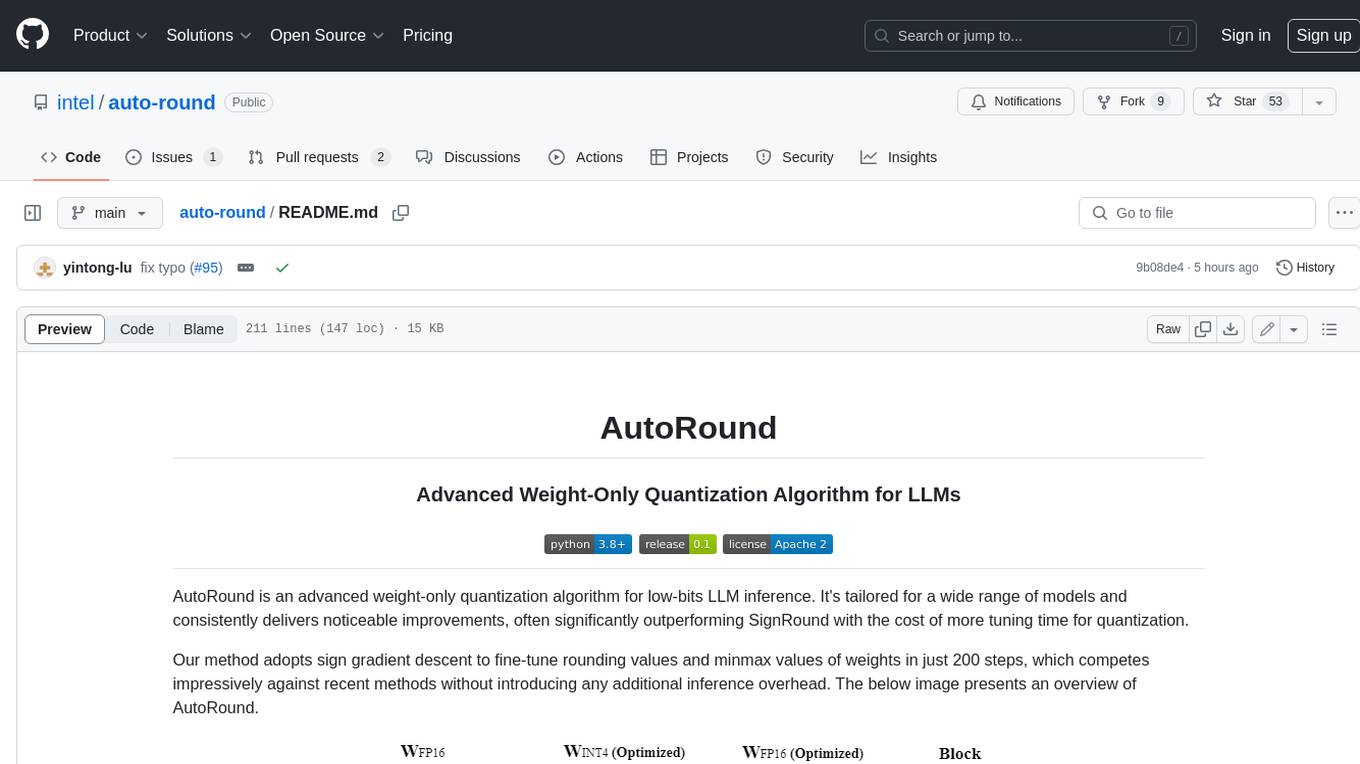
AutoRound is an advanced weight-only quantization algorithm for low-bits LLM inference. It competes impressively against recent methods without introducing any additional inference overhead. The method adopts sign gradient descent to fine-tune rounding values and minmax values of weights in just 200 steps, often significantly outperforming SignRound with the cost of more tuning time for quantization. AutoRound is tailored for a wide range of models and consistently delivers noticeable improvements.
zenu
ZeNu is a high-performance deep learning framework implemented in pure Rust, featuring a pure Rust implementation for safety and performance, GPU performance comparable to PyTorch with CUDA support, a simple and intuitive API, and a modular design for easy extension. It supports various layers like Linear, Convolution 2D, LSTM, and optimizers such as SGD and Adam. ZeNu also provides device support for CPU and CUDA (NVIDIA GPU) with CUDA 12.3 and cuDNN 9. The project structure includes main library, automatic differentiation engine, neural network layers, matrix operations, optimization algorithms, CUDA implementation, and other support crates. Users can find detailed implementations like MNIST classification, CIFAR10 classification, and ResNet implementation in the examples directory. Contributions to ZeNu are welcome under the MIT License.
mindnlp
MindNLP is an open-source NLP library based on MindSpore. It provides a platform for solving natural language processing tasks, containing many common approaches in NLP. It can help researchers and developers to construct and train models more conveniently and rapidly. Key features of MindNLP include: * Comprehensive data processing: Several classical NLP datasets are packaged into a friendly module for easy use, such as Multi30k, SQuAD, CoNLL, etc. * Friendly NLP model toolset: MindNLP provides various configurable components. It is friendly to customize models using MindNLP. * Easy-to-use engine: MindNLP simplified complicated training process in MindSpore. It supports Trainer and Evaluator interfaces to train and evaluate models easily. MindNLP supports a wide range of NLP tasks, including: * Language modeling * Machine translation * Question answering * Sentiment analysis * Sequence labeling * Summarization MindNLP also supports industry-leading Large Language Models (LLMs), including Llama, GLM, RWKV, etc. For support related to large language models, including pre-training, fine-tuning, and inference demo examples, you can find them in the "llm" directory. To install MindNLP, you can either install it from Pypi, download the daily build wheel, or install it from source. The installation instructions are provided in the documentation. MindNLP is released under the Apache 2.0 license. If you find this project useful in your research, please consider citing the following paper: @misc{mindnlp2022, title={{MindNLP}: a MindSpore NLP library}, author={MindNLP Contributors}, howpublished = {\url{https://github.com/mindlab-ai/mindnlp}}, year={2022} }
GraphGen
GraphGen is a framework for synthetic data generation guided by knowledge graphs. It enhances supervised fine-tuning for large language models (LLMs) by generating synthetic data based on a fine-grained knowledge graph. The tool identifies knowledge gaps in LLMs, prioritizes generating QA pairs targeting high-value knowledge, incorporates multi-hop neighborhood sampling, and employs style-controlled generation to diversify QA data. Users can use LLaMA-Factory and xtuner for fine-tuning LLMs after data generation.
pytorch-lightning
PyTorch Lightning is a framework for training and deploying AI models. It provides a high-level API that abstracts away the low-level details of PyTorch, making it easier to write and maintain complex models. Lightning also includes a number of features that make it easy to train and deploy models on multiple GPUs or TPUs, and to track and visualize training progress. PyTorch Lightning is used by a wide range of organizations, including Google, Facebook, and Microsoft. It is also used by researchers at top universities around the world. Here are some of the benefits of using PyTorch Lightning: * **Increased productivity:** Lightning's high-level API makes it easy to write and maintain complex models. This can save you time and effort, and allow you to focus on the research or business problem you're trying to solve. * **Improved performance:** Lightning's optimized training loops and data loading pipelines can help you train models faster and with better performance. * **Easier deployment:** Lightning makes it easy to deploy models to a variety of platforms, including the cloud, on-premises servers, and mobile devices. * **Better reproducibility:** Lightning's logging and visualization tools make it easy to track and reproduce training results.
langchain-rust
LangChain Rust is a library for building applications with Large Language Models (LLMs) through composability. It provides a set of tools and components that can be used to create conversational agents, document loaders, and other applications that leverage LLMs. LangChain Rust supports a variety of LLMs, including OpenAI, Azure OpenAI, Ollama, and Anthropic Claude. It also supports a variety of embeddings, vector stores, and document loaders. LangChain Rust is designed to be easy to use and extensible, making it a great choice for developers who want to build applications with LLMs.
qianfan-starter
WenXin-Starter is a spring-boot-starter for Baidu's 'WenXin Workshop' large model, facilitating quick integration of Baidu's AI capabilities. It provides complete integration with WenXin Workshop's official API documentation, supports WenShengTu, built-in conversation memory, and supports conversation streaming. It also supports QPS control for individual models and queuing mechanism, with upcoming plugin support.
openai-scala-client
This is a no-nonsense async Scala client for OpenAI API supporting all the available endpoints and params including streaming, chat completion, vision, and voice routines. It provides a single service called OpenAIService that supports various calls such as Models, Completions, Chat Completions, Edits, Images, Embeddings, Batches, Audio, Files, Fine-tunes, Moderations, Assistants, Threads, Thread Messages, Runs, Run Steps, Vector Stores, Vector Store Files, and Vector Store File Batches. The library aims to be self-contained with minimal dependencies and supports API-compatible providers like Azure OpenAI, Azure AI, Anthropic, Google Vertex AI, Groq, Grok, Fireworks AI, OctoAI, TogetherAI, Cerebras, Mistral, Deepseek, Ollama, FastChat, and more.
island-ai
island-ai is a TypeScript toolkit tailored for developers engaging with structured outputs from Large Language Models. It offers streamlined processes for handling, parsing, streaming, and leveraging AI-generated data across various applications. The toolkit includes packages like zod-stream for interfacing with LLM streams, stream-hooks for integrating streaming JSON data into React applications, and schema-stream for JSON streaming parsing based on Zod schemas. Additionally, related packages like @instructor-ai/instructor-js focus on data validation and retry mechanisms, enhancing the reliability of data processing workflows.
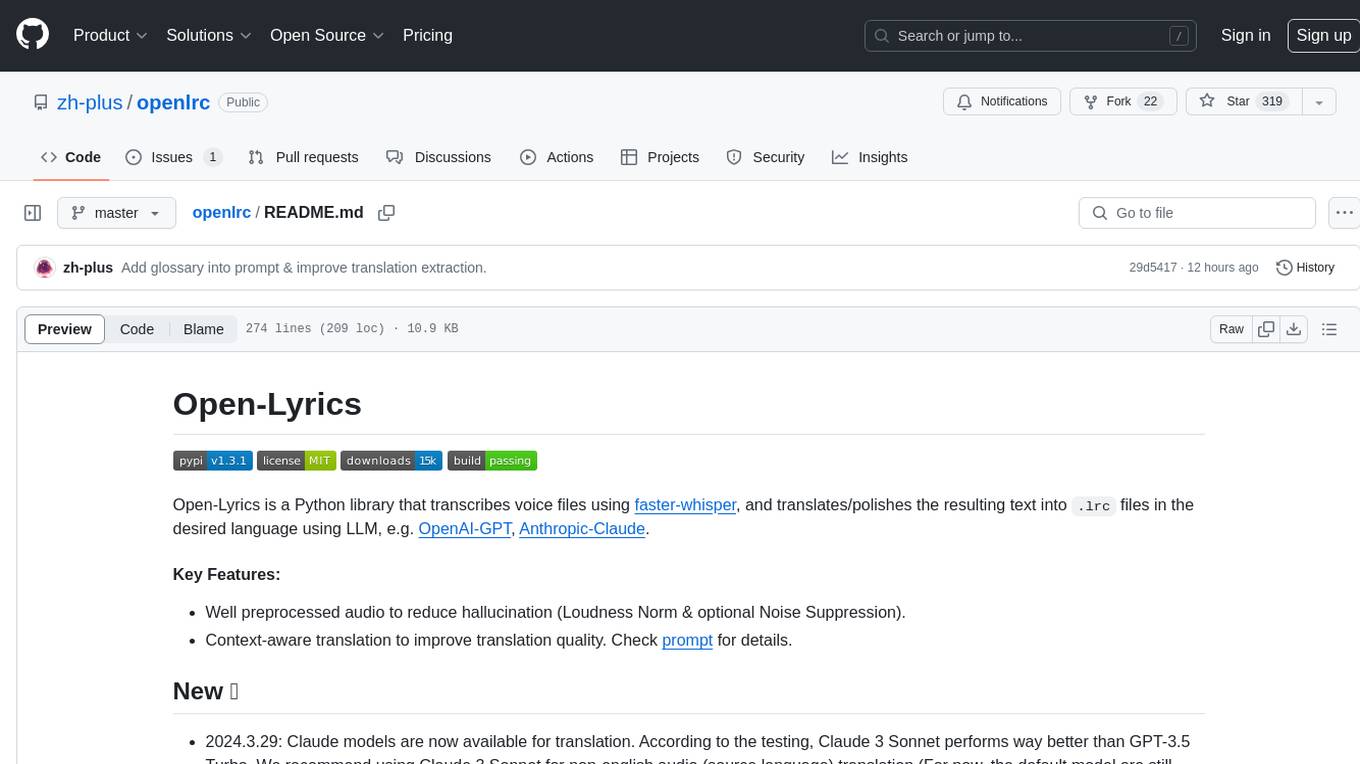
openlrc
Open-Lyrics is a Python library that transcribes voice files using faster-whisper and translates/polishes the resulting text into `.lrc` files in the desired language using LLM, e.g. OpenAI-GPT, Anthropic-Claude. It offers well preprocessed audio to reduce hallucination and context-aware translation to improve translation quality. Users can install the library from PyPI or GitHub and follow the installation steps to set up the environment. The tool supports GUI usage and provides Python code examples for transcription and translation tasks. It also includes features like utilizing context and glossary for translation enhancement, pricing information for different models, and a list of todo tasks for future improvements.
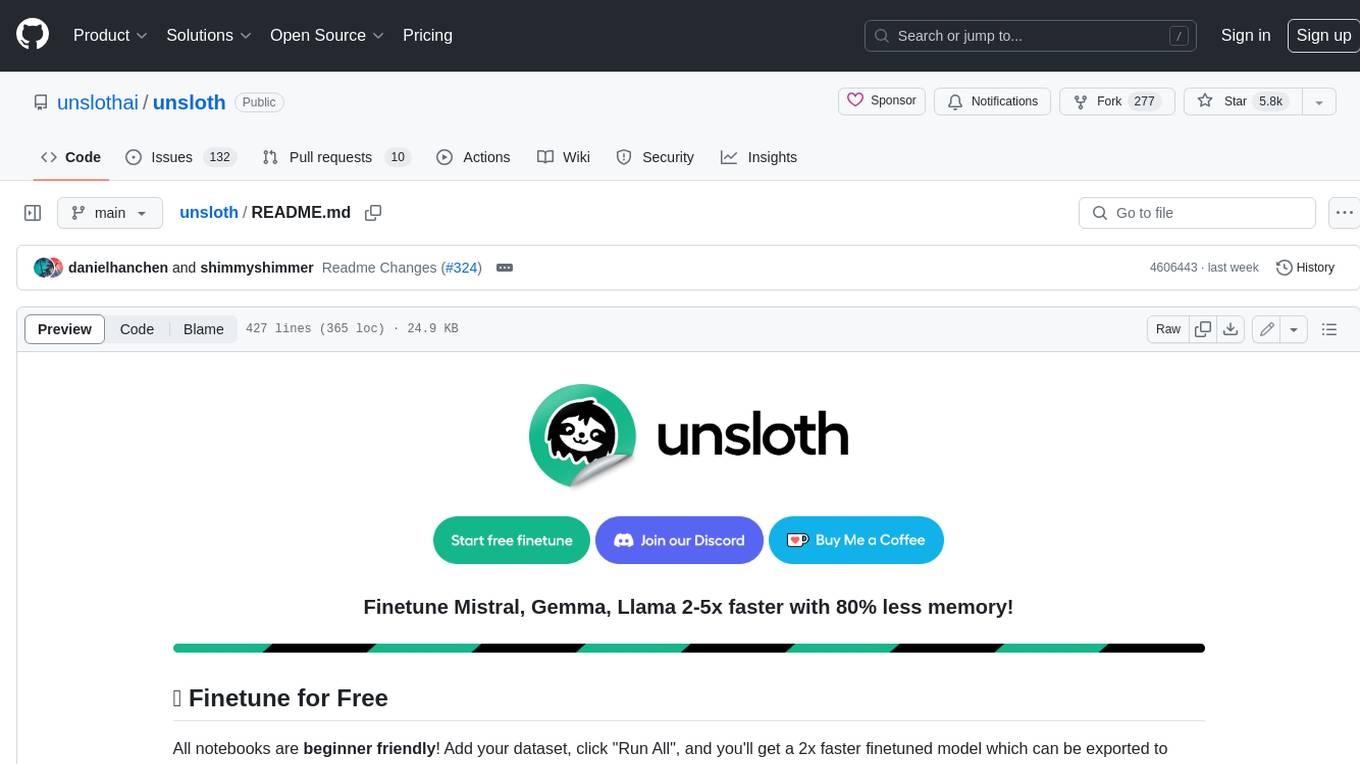
unsloth
Unsloth is a tool that allows users to fine-tune large language models (LLMs) 2-5x faster with 80% less memory. It is a free and open-source tool that can be used to fine-tune LLMs such as Gemma, Mistral, Llama 2-5, TinyLlama, and CodeLlama 34b. Unsloth supports 4-bit and 16-bit QLoRA / LoRA fine-tuning via bitsandbytes. It also supports DPO (Direct Preference Optimization), PPO, and Reward Modelling. Unsloth is compatible with Hugging Face's TRL, Trainer, Seq2SeqTrainer, and Pytorch code. It is also compatible with NVIDIA GPUs since 2018+ (minimum CUDA Capability 7.0).
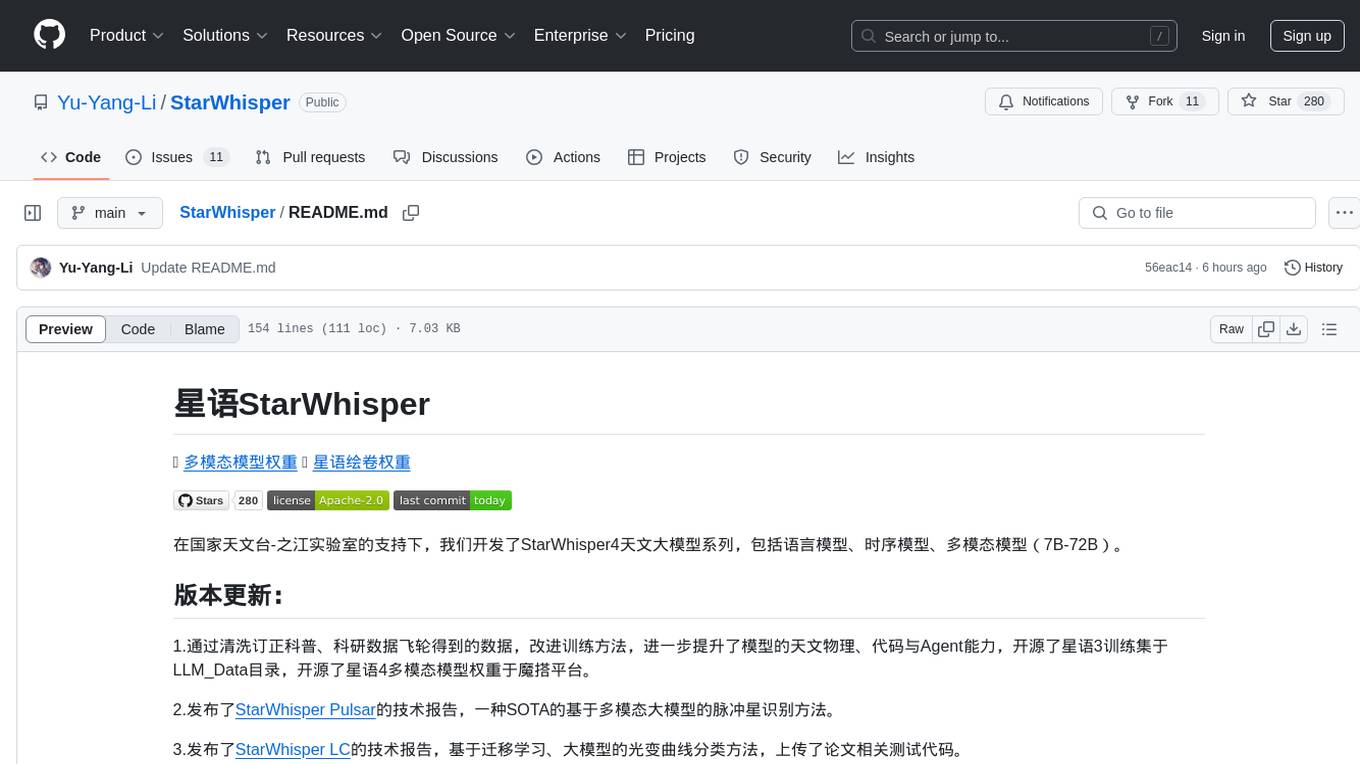
StarWhisper
StarWhisper is a multi-modal model repository developed under the support of the National Astronomical Observatory-Zhijiang Laboratory. It includes language models, temporal models, and multi-modal models ranging from 7B to 72B. The repository provides pre-trained models and technical reports for tasks such as pulsar identification, light curve classification, and telescope control. It aims to integrate astronomical knowledge using large models and explore the possibilities of solving specific astronomical problems through multi-modal approaches.
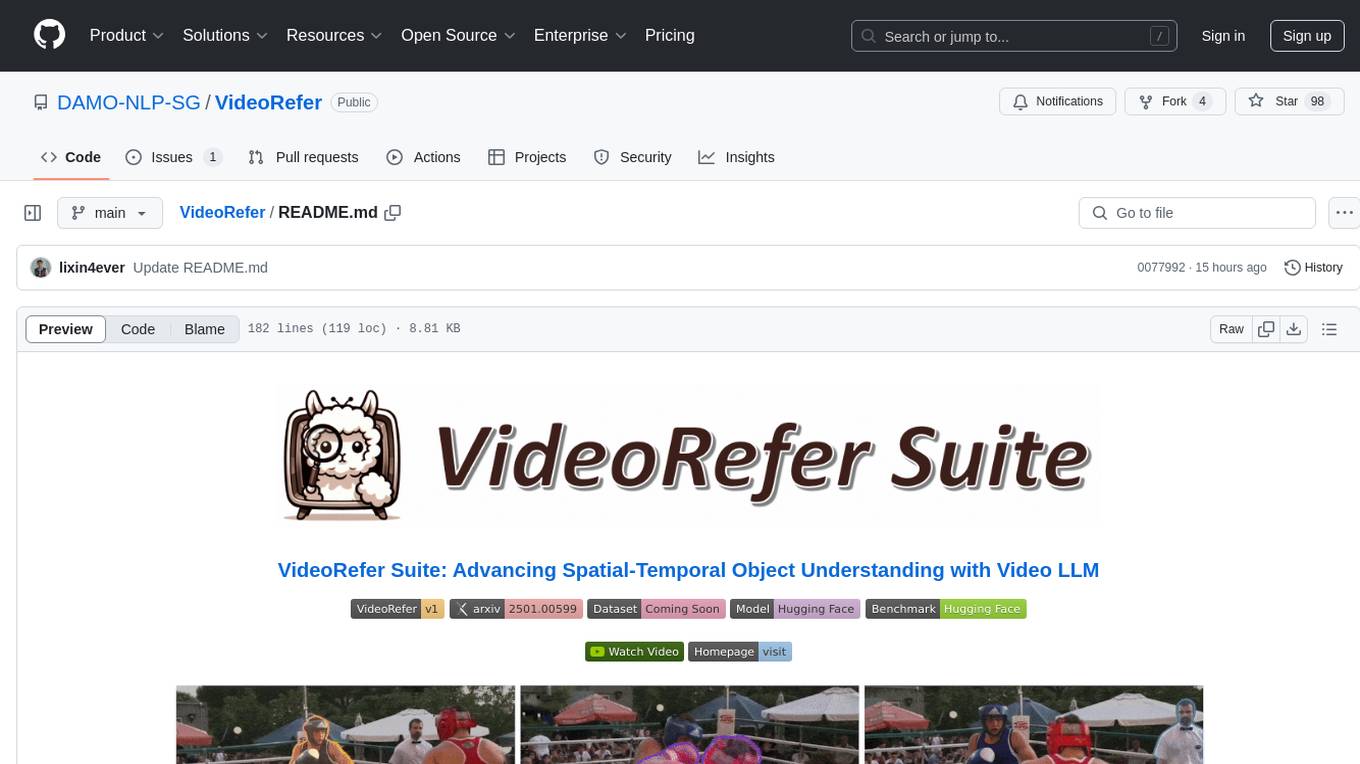
VideoRefer
VideoRefer Suite is a tool designed to enhance the fine-grained spatial-temporal understanding capabilities of Video Large Language Models (Video LLMs). It consists of three primary components: Model (VideoRefer) for perceiving, reasoning, and retrieval for user-defined regions at any specified timestamps, Dataset (VideoRefer-700K) for high-quality object-level video instruction data, and Benchmark (VideoRefer-Bench) to evaluate object-level video understanding capabilities. The tool can understand any object within a video.
For similar tasks
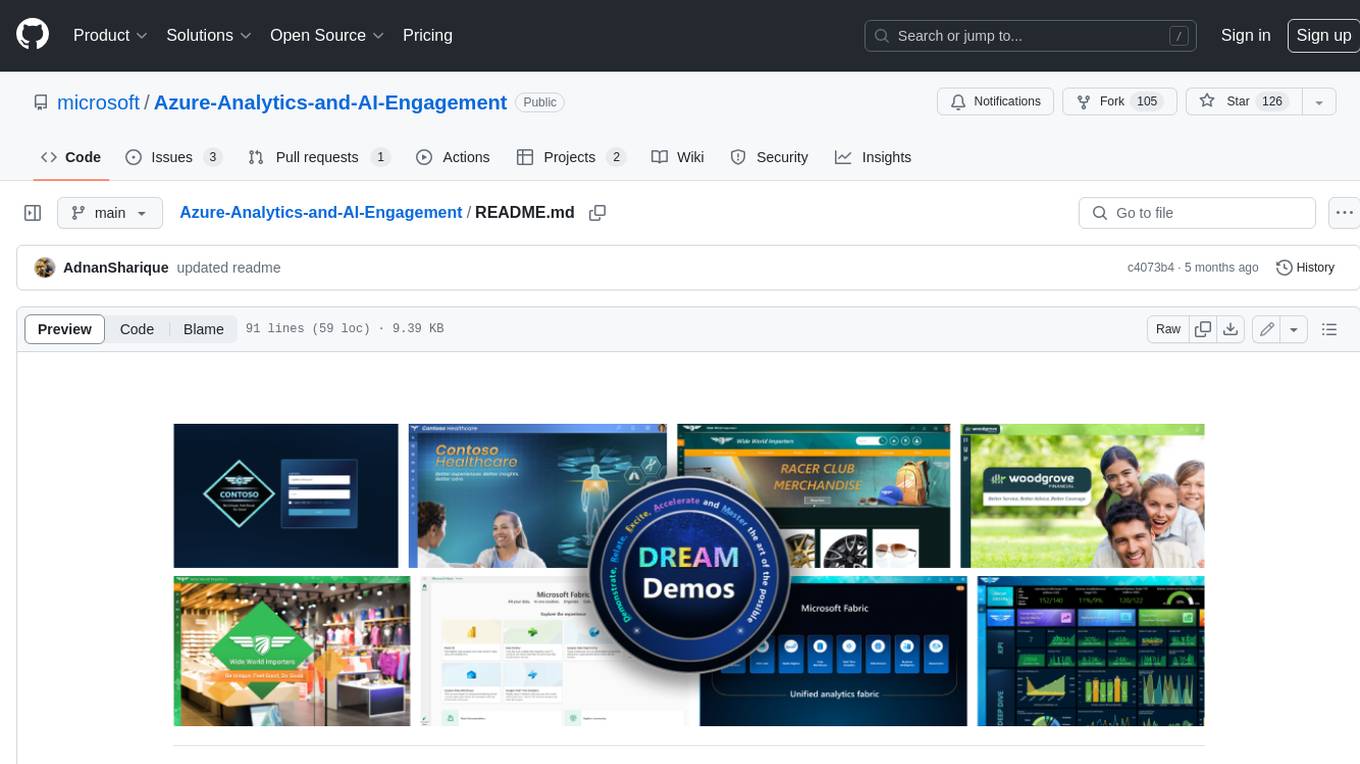
Azure-Analytics-and-AI-Engagement
The Azure-Analytics-and-AI-Engagement repository provides packaged Industry Scenario DREAM Demos with ARM templates (Containing a demo web application, Power BI reports, Synapse resources, AML Notebooks etc.) that can be deployed in a customer’s subscription using the CAPE tool within a matter of few hours. Partners can also deploy DREAM Demos in their own subscriptions using DPoC.
sorrentum
Sorrentum is an open-source project that aims to combine open-source development, startups, and brilliant students to build machine learning, AI, and Web3 / DeFi protocols geared towards finance and economics. The project provides opportunities for internships, research assistantships, and development grants, as well as the chance to work on cutting-edge problems, learn about startups, write academic papers, and get internships and full-time positions at companies working on Sorrentum applications.
tidb
TiDB is an open-source distributed SQL database that supports Hybrid Transactional and Analytical Processing (HTAP) workloads. It is MySQL compatible and features horizontal scalability, strong consistency, and high availability.

zep-python
Zep is an open-source platform for building and deploying large language model (LLM) applications. It provides a suite of tools and services that make it easy to integrate LLMs into your applications, including chat history memory, embedding, vector search, and data enrichment. Zep is designed to be scalable, reliable, and easy to use, making it a great choice for developers who want to build LLM-powered applications quickly and easily.
telemetry-airflow
This repository codifies the Airflow cluster that is deployed at workflow.telemetry.mozilla.org (behind SSO) and commonly referred to as "WTMO" or simply "Airflow". Some links relevant to users and developers of WTMO: * The `dags` directory in this repository contains some custom DAG definitions * Many of the DAGs registered with WTMO don't live in this repository, but are instead generated from ETL task definitions in bigquery-etl * The Data SRE team maintains a WTMO Developer Guide (behind SSO)
mojo
Mojo is a new programming language that bridges the gap between research and production by combining Python syntax and ecosystem with systems programming and metaprogramming features. Mojo is still young, but it is designed to become a superset of Python over time.
pandas-ai
PandasAI is a Python library that makes it easy to ask questions to your data in natural language. It helps you to explore, clean, and analyze your data using generative AI.
databend
Databend is an open-source cloud data warehouse that serves as a cost-effective alternative to Snowflake. With its focus on fast query execution and data ingestion, it's designed for complex analysis of the world's largest datasets.
For similar jobs
lollms-webui
LoLLMs WebUI (Lord of Large Language Multimodal Systems: One tool to rule them all) is a user-friendly interface to access and utilize various LLM (Large Language Models) and other AI models for a wide range of tasks. With over 500 AI expert conditionings across diverse domains and more than 2500 fine tuned models over multiple domains, LoLLMs WebUI provides an immediate resource for any problem, from car repair to coding assistance, legal matters, medical diagnosis, entertainment, and more. The easy-to-use UI with light and dark mode options, integration with GitHub repository, support for different personalities, and features like thumb up/down rating, copy, edit, and remove messages, local database storage, search, export, and delete multiple discussions, make LoLLMs WebUI a powerful and versatile tool.
Azure-Analytics-and-AI-Engagement
The Azure-Analytics-and-AI-Engagement repository provides packaged Industry Scenario DREAM Demos with ARM templates (Containing a demo web application, Power BI reports, Synapse resources, AML Notebooks etc.) that can be deployed in a customer’s subscription using the CAPE tool within a matter of few hours. Partners can also deploy DREAM Demos in their own subscriptions using DPoC.
minio
MinIO is a High Performance Object Storage released under GNU Affero General Public License v3.0. It is API compatible with Amazon S3 cloud storage service. Use MinIO to build high performance infrastructure for machine learning, analytics and application data workloads.
mage-ai
Mage is an open-source data pipeline tool for transforming and integrating data. It offers an easy developer experience, engineering best practices built-in, and data as a first-class citizen. Mage makes it easy to build, preview, and launch data pipelines, and provides observability and scaling capabilities. It supports data integrations, streaming pipelines, and dbt integration.
AiTreasureBox
AiTreasureBox is a versatile AI tool that provides a collection of pre-trained models and algorithms for various machine learning tasks. It simplifies the process of implementing AI solutions by offering ready-to-use components that can be easily integrated into projects. With AiTreasureBox, users can quickly prototype and deploy AI applications without the need for extensive knowledge in machine learning or deep learning. The tool covers a wide range of tasks such as image classification, text generation, sentiment analysis, object detection, and more. It is designed to be user-friendly and accessible to both beginners and experienced developers, making AI development more efficient and accessible to a wider audience.
tidb
TiDB is an open-source distributed SQL database that supports Hybrid Transactional and Analytical Processing (HTAP) workloads. It is MySQL compatible and features horizontal scalability, strong consistency, and high availability.
airbyte
Airbyte is an open-source data integration platform that makes it easy to move data from any source to any destination. With Airbyte, you can build and manage data pipelines without writing any code. Airbyte provides a library of pre-built connectors that make it easy to connect to popular data sources and destinations. You can also create your own connectors using Airbyte's no-code Connector Builder or low-code CDK. Airbyte is used by data engineers and analysts at companies of all sizes to build and manage their data pipelines.
labelbox-python
Labelbox is a data-centric AI platform for enterprises to develop, optimize, and use AI to solve problems and power new products and services. Enterprises use Labelbox to curate data, generate high-quality human feedback data for computer vision and LLMs, evaluate model performance, and automate tasks by combining AI and human-centric workflows. The academic & research community uses Labelbox for cutting-edge AI research.