


symbiotic-ai
A symbiotic AI agent that remembers everything, challenges you, and extends your cognition.
Stars: 662
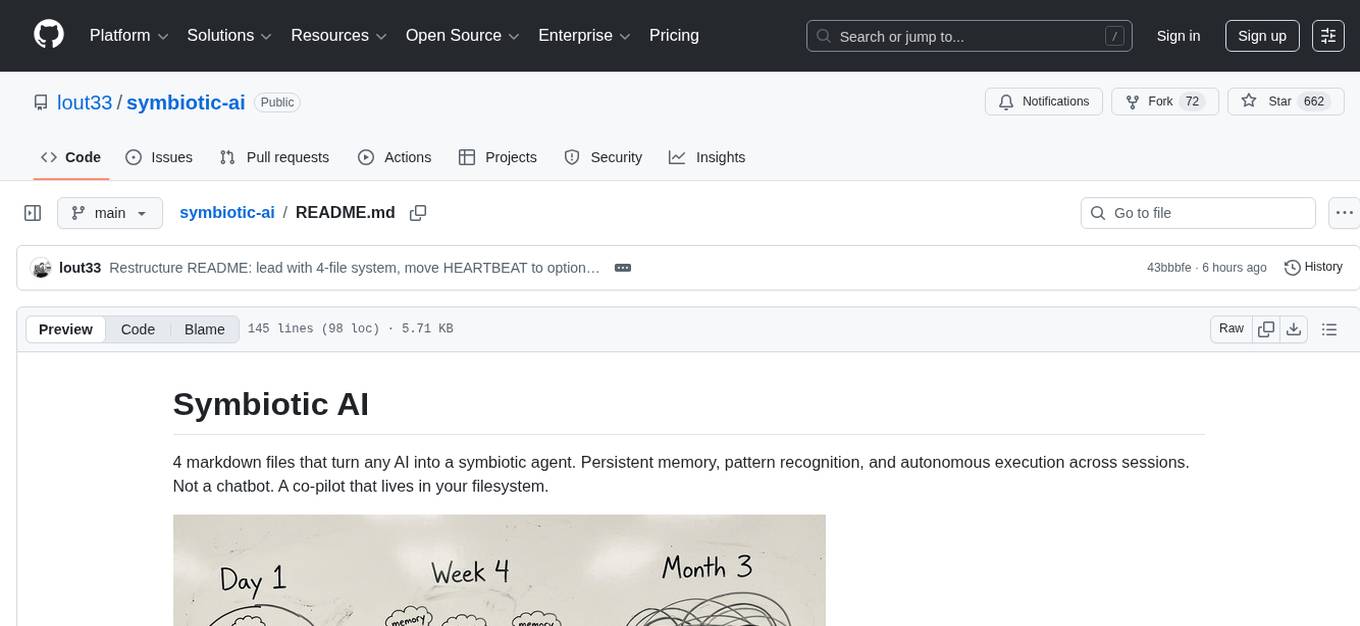
Symbiotic AI is a tool that transforms any AI into a symbiotic agent by providing persistent memory, pattern recognition, and autonomous execution across sessions. It is not a chatbot but rather a co-pilot that resides in your filesystem. The system consists of four markdown files that define the agent's personality, user profile, agent operations, and current state. By updating these files, the agent gains insights and evolves based on real context about the user. Symbiotic AI challenges users, remembers information across sessions, takes actions such as writing code and researching, and evolves over time to provide personalized insights and advice.
README:
4 markdown files that turn any AI into a symbiotic agent. Persistent memory, pattern recognition, and autonomous execution across sessions. Not a chatbot. A co-pilot that lives in your filesystem.

4 files. That's it.
| File | Purpose | Changes |
|---|---|---|
SOUL.md |
Agent personality, identity, values, how it thinks and talks | Monthly |
USER.md |
Your profile: identity, psychology, wiring, mission, energy patterns | Monthly |
AGENTS.md |
How the agent operates: protocols, tools, patterns, interventions | Weekly |
NOW.md |
Current state: tasks, queue, log, active projects, deadlines | Daily |
The agent reads all 4 at session start. Updates NOW.md as you work. The system gets smarter the longer you use it -- not because of AI improvements, but because the files accumulate real context about you.
It challenges you. From a real conversation:
AI: "You find something valuable -> People want it -> You feel repulsed by the exchange -> You give it away for free -> You have no money -> Repeat. That's not idealism. That's self-punishment."
It remembers. Persistent memory across sessions. Patterns, quotes, history stored in your files.
It acts. Writes code, researches, creates files. Not just advice.
It evolves. After 100+ sessions, your files contain hard-won insights about what works for you specifically. No generic advice. Your patterns, your bugs, your wins.
curl -fsSL https://raw.githubusercontent.com/lout33/symbiotic-ai/main/install.sh | bashOr clone and open with your AI coding tool:
git clone https://github.com/lout33/symbiotic-ai
cd symbiotic-ai- Week 1-2: Fill in SOUL.md (who is the agent?), USER.md (who are you?), AGENTS.md (basic rules), NOW.md (what are you doing?)
- Month 1: The agent starts noticing your patterns. NOW.md log grows. You learn what works.
- Month 2+: Optional files appear as needed. Milestones accumulate naturally.
- Ongoing: SOUL.md and USER.md get refined as you learn more about yourself and what agent personality works.
In NOW.md, the agent maintains a dated log of patterns, quotes, and insights:
### Jan 10
- Avoided user call. Rescheduled twice. Pattern: building = safe, talking = scary.

### Jan 15
- Had first user call. Quote: 'I've been building what I think they want instead of asking'

### Feb 1
- Pattern confirmed: 3 weeks on feature nobody asked for. This is the 3rd time.
| Command | What it does |
|---|---|
/start-day |
Morning kickoff. Sets MIT for the day. |
/check-day |
Quick accountability check-in. |
/end-day |
Evening review. Captures wins, lessons. |
/reflect |
Deep reflection. Surfaces patterns. Creates journal entry. |
Commands work manually or scheduled via cron. See commands/README.md.
The system grows with you. Just create the file. The agent discovers and uses it.
| File | Purpose | When to Add |
|---|---|---|
WINS.md |
Shipped projects, milestones, pattern breaks | When you need evidence you're making progress |
IDEAS.md |
Quick idea capture | When ideas come faster than you can act |
COMMITMENTS.md |
Said vs Did tracking | When you notice patterns of not following through |
JOURNAL.md |
Longer-form reflections | When sessions aren't enough depth |
LOG_ARCHIVE.md |
Archived memory logs from NOW.md | When NOW.md gets too long |
Optional. Your AI monitors your screen activity, compares it against your tasks in NOW.md, and pings you on Telegram when you drift.
[14:30] DOING: VS Code - building landing page components
SHOULD: Ship landing page
Flow state. Keep going.
[15:15] DOING: YouTube - watching programming streams (45 min)
SHOULD: Ship landing page
You know what you should be doing.
Powered by OpenClaw + what-did-i-do screen tracker. Setup guide
One directory, multiple interfaces:
| Framework | Config | Best For |
|---|---|---|
| OpenClaw | Set workspace in ~/.openclaw/openclaw.json
|
HEARTBEAT, Telegram, scheduled check-ins |
| Claude Code |
~/.claude/CLAUDE.md (concatenate the 4 files) |
Deep coding sessions |
| opencode |
~/.config/opencode/ or project root |
Terminal-based sessions |
| Question | Answer |
|---|---|
| "Will this change next week?" | Yes -> NOW.md. No -> the stable file it belongs to. |
| "Is this about the agent or the user?" | Agent -> SOUL.md. User -> USER.md. |
| "Is this a protocol or personality?" | Protocol -> AGENTS.md. Personality -> SOUL.md. |
| "Not sure?" | Put it in NOW.md. Move it later. |
Symbiotic > Assistive. Challenge > Validate. Memory compounds. Ship ugly.
| Project | What it does |
|---|---|
| OpenClaw | Personal AI assistant runtime. Powers HEARTBEAT, Telegram, cron. |
| what-did-i-do | Passive screen tracker with Gemini Vision |
| writing-style-skill | Make AI write like you |
Created by @lout33

For Tasks:
Click tags to check more tools for each tasksFor Jobs:
Alternative AI tools for symbiotic-ai
Similar Open Source Tools
symbiotic-ai
Symbiotic AI is a tool that transforms any AI into a symbiotic agent by providing persistent memory, pattern recognition, and autonomous execution across sessions. It is not a chatbot but rather a co-pilot that resides in your filesystem. The system consists of four markdown files that define the agent's personality, user profile, agent operations, and current state. By updating these files, the agent gains insights and evolves based on real context about the user. Symbiotic AI challenges users, remembers information across sessions, takes actions such as writing code and researching, and evolves over time to provide personalized insights and advice.
PostTrainBench
PostTrainBench is a benchmark designed to measure the ability of command-line interface (CLI) agents to post-train pre-trained large language models (LLMs). The agents are tasked with improving the performance of a base LLM on a given benchmark using an evaluation script and 10 hours on an H100 GPU. The benchmark scores are computed after post-training, and the setup evaluates an agent's capability to conduct AI research and development. The repository provides a platform for collaborative contributions to expand tasks and agent scaffolds, with the potential for co-authorship on research papers.
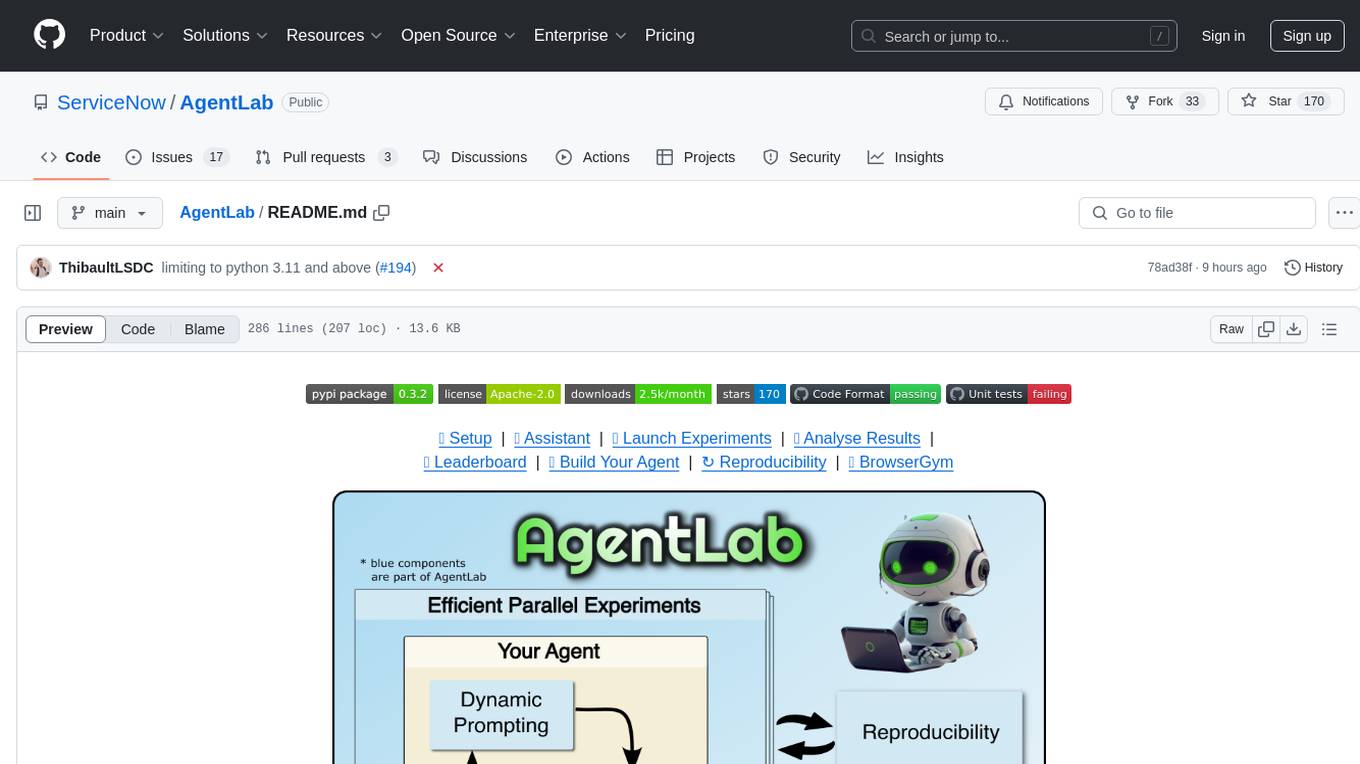
AgentLab
AgentLab is an open, easy-to-use, and extensible framework designed to accelerate web agent research. It provides features for developing and evaluating agents on various benchmarks supported by BrowserGym. The framework allows for large-scale parallel agent experiments using ray, building blocks for creating agents over BrowserGym, and a unified LLM API for OpenRouter, OpenAI, Azure, or self-hosted using TGI. AgentLab also offers reproducibility features, a unified LeaderBoard, and supports multiple benchmarks like WebArena, WorkArena, WebLinx, VisualWebArena, AssistantBench, GAIA, Mind2Web-live, and MiniWoB.
AgentGym
AgentGym is a framework designed to help the AI community evaluate and develop generally-capable Large Language Model-based agents. It features diverse interactive environments and tasks with real-time feedback and concurrency. The platform supports 14 environments across various domains like web navigating, text games, house-holding tasks, digital games, and more. AgentGym includes a trajectory set (AgentTraj) and a benchmark suite (AgentEval) to facilitate agent exploration and evaluation. The framework allows for agent self-evolution beyond existing data, showcasing comparable results to state-of-the-art models.
AI-Toolbox
AI-Toolbox is a C++ library aimed at representing and solving common AI problems, with a focus on MDPs, POMDPs, and related algorithms. It provides an easy-to-use interface that is extensible to many problems while maintaining readable code. The toolbox includes tutorials for beginners in reinforcement learning and offers Python bindings for seamless integration. It features utilities for combinatorics, polytopes, linear programming, sampling, distributions, statistics, belief updating, data structures, logging, seeding, and more. Additionally, it supports bandit/normal games, single agent MDP/stochastic games, single agent POMDP, and factored/joint multi-agent scenarios.
katrain
KaTrain is a tool designed for analyzing games and playing go with AI feedback from KataGo. Users can review their games to find costly moves, play against AI with immediate feedback, play against weakened AI versions, and generate focused SGF reviews. The tool provides various features such as previews, tutorials, installation instructions, and configuration options for KataGo. Users can play against AI, receive instant feedback on moves, explore variations, and request in-depth analysis. KaTrain also supports distributed training for contributing to KataGo's strength and training bigger models. The tool offers themes customization, FAQ section, and opportunities for support and contribution through GitHub issues and Discord community.
LLamaSharp
LLamaSharp is a cross-platform library to run 🦙LLaMA/LLaVA model (and others) on your local device. Based on llama.cpp, inference with LLamaSharp is efficient on both CPU and GPU. With the higher-level APIs and RAG support, it's convenient to deploy LLM (Large Language Model) in your application with LLamaSharp.
ChatGPT-Telegram-Bot
ChatGPT Telegram Bot is a Telegram bot that provides a smooth AI experience. It supports both Azure OpenAI and native OpenAI, and offers real-time (streaming) response to AI, with a faster and smoother experience. The bot also has 15 preset bot identities that can be quickly switched, and supports custom bot identities to meet personalized needs. Additionally, it supports clearing the contents of the chat with a single click, and restarting the conversation at any time. The bot also supports native Telegram bot button support, making it easy and intuitive to implement required functions. User level division is also supported, with different levels enjoying different single session token numbers, context numbers, and session frequencies. The bot supports English and Chinese on UI, and is containerized for easy deployment.
flowgen
FlowGen is a tool built for AutoGen, a great agent framework from Microsoft and a lot of contributors. It provides intuitive visual tools that streamline the construction and oversight of complex agent-based workflows, simplifying the process for creators and developers. Users can create Autoflows, chat with agents, and share flow templates. The tool is fully dockerized and supports deployment on Railway.app. Contributions to the project are welcome, and the platform uses semantic-release for versioning and releases.
Large-Language-Models-play-StarCraftII
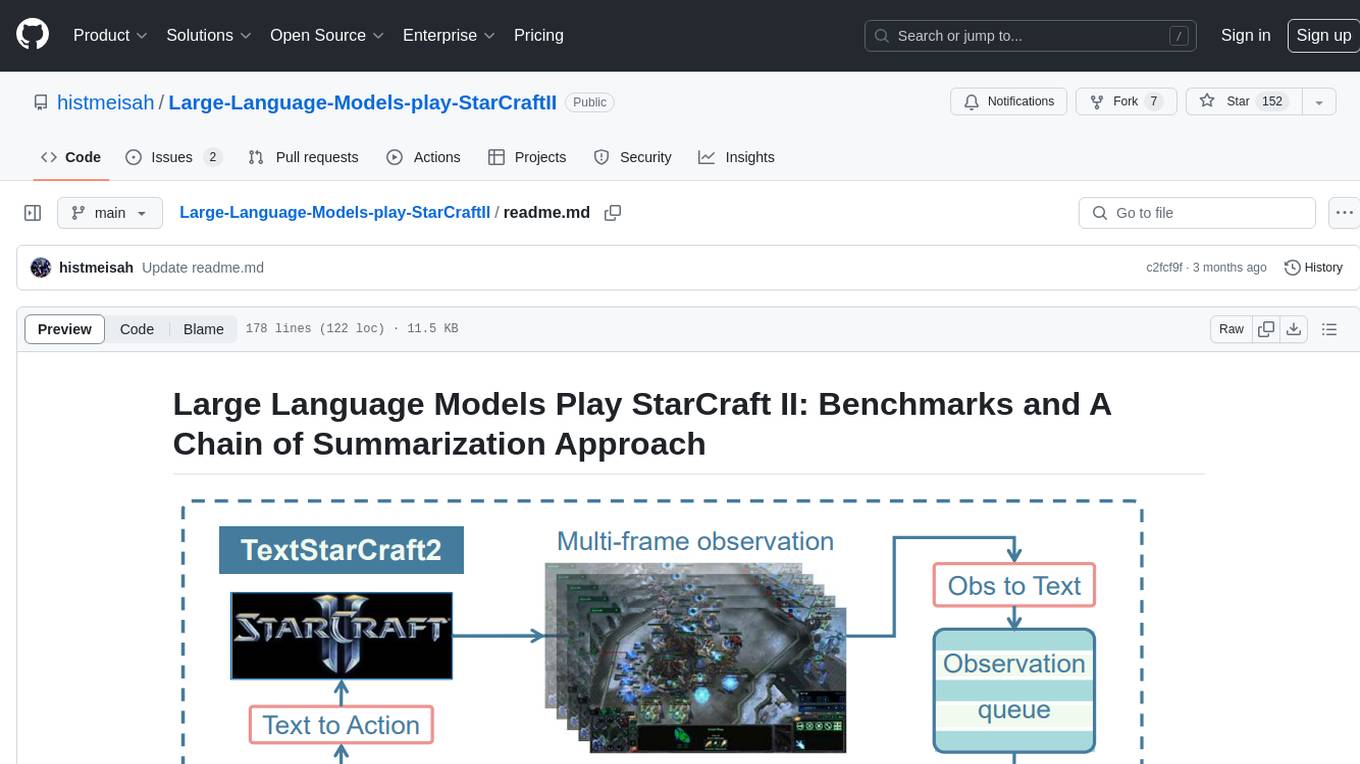
Large Language Models Play StarCraft II is a project that explores the capabilities of large language models (LLMs) in playing the game StarCraft II. The project introduces TextStarCraft II, a textual environment for the game, and a Chain of Summarization method for analyzing game information and making strategic decisions. Through experiments, the project demonstrates that LLM agents can defeat the built-in AI at a challenging difficulty level. The project provides benchmarks and a summarization approach to enhance strategic planning and interpretability in StarCraft II gameplay.
ProactiveAgent
Proactive Agent is a project aimed at constructing a fully active agent that can anticipate user's requirements and offer assistance without explicit requests. It includes a data collection and generation pipeline, automatic evaluator, and training agent. The project provides datasets, evaluation scripts, and prompts to finetune LLM for proactive agent. Features include environment sensing, assistance annotation, dynamic data generation, and construction pipeline with a high F1 score on the test set. The project is intended for coding, writing, and daily life scenarios, distributed under Apache License 2.0.
skilld
Skilld is a tool that generates AI agent skills from NPM dependencies, allowing users to enhance their agent's knowledge with the latest best practices and avoid deprecated patterns. It provides version-aware, local-first, and optimized skills for your codebase by extracting information from existing docs, changelogs, issues, and discussions. Skilld aims to bridge the gap between agent training data and the latest conventions, offering a semantic search feature, LLM-enhanced sections, and prompt injection sanitization. It operates locally without the need for external servers, providing a curated set of skills tied to your actual package versions.
mage-ai
Mage is an open-source data pipeline tool for transforming and integrating data. It offers an easy developer experience, engineering best practices built-in, and data as a first-class citizen. Mage makes it easy to build, preview, and launch data pipelines, and provides observability and scaling capabilities. It supports data integrations, streaming pipelines, and dbt integration.
llm-python
A set of instructional materials, code samples and Python scripts featuring LLMs (GPT etc) through interfaces like llamaindex, langchain, Chroma (Chromadb), Pinecone etc. Mainly used to store reference code for my LangChain tutorials on YouTube.
weblinx
WebLINX is a Python library and dataset for real-world website navigation with multi-turn dialogue. The repository provides code for training models reported in the WebLINX paper, along with a comprehensive API to work with the dataset. It includes modules for data processing, model evaluation, and utility functions. The modeling directory contains code for processing, training, and evaluating models such as DMR, LLaMA, MindAct, Pix2Act, and Flan-T5. Users can install specific dependencies for HTML processing, video processing, model evaluation, and library development. The evaluation module provides metrics and functions for evaluating models, with ongoing work to improve documentation and functionality.
cambrian
Cambrian-1 is a fully open project focused on exploring multimodal Large Language Models (LLMs) with a vision-centric approach. It offers competitive performance across various benchmarks with models at different parameter levels. The project includes training configurations, model weights, instruction tuning data, and evaluation details. Users can interact with Cambrian-1 through a Gradio web interface for inference. The project is inspired by LLaVA and incorporates contributions from Vicuna, LLaMA, and Yi. Cambrian-1 is licensed under Apache 2.0 and utilizes datasets and checkpoints subject to their respective original licenses.
For similar tasks
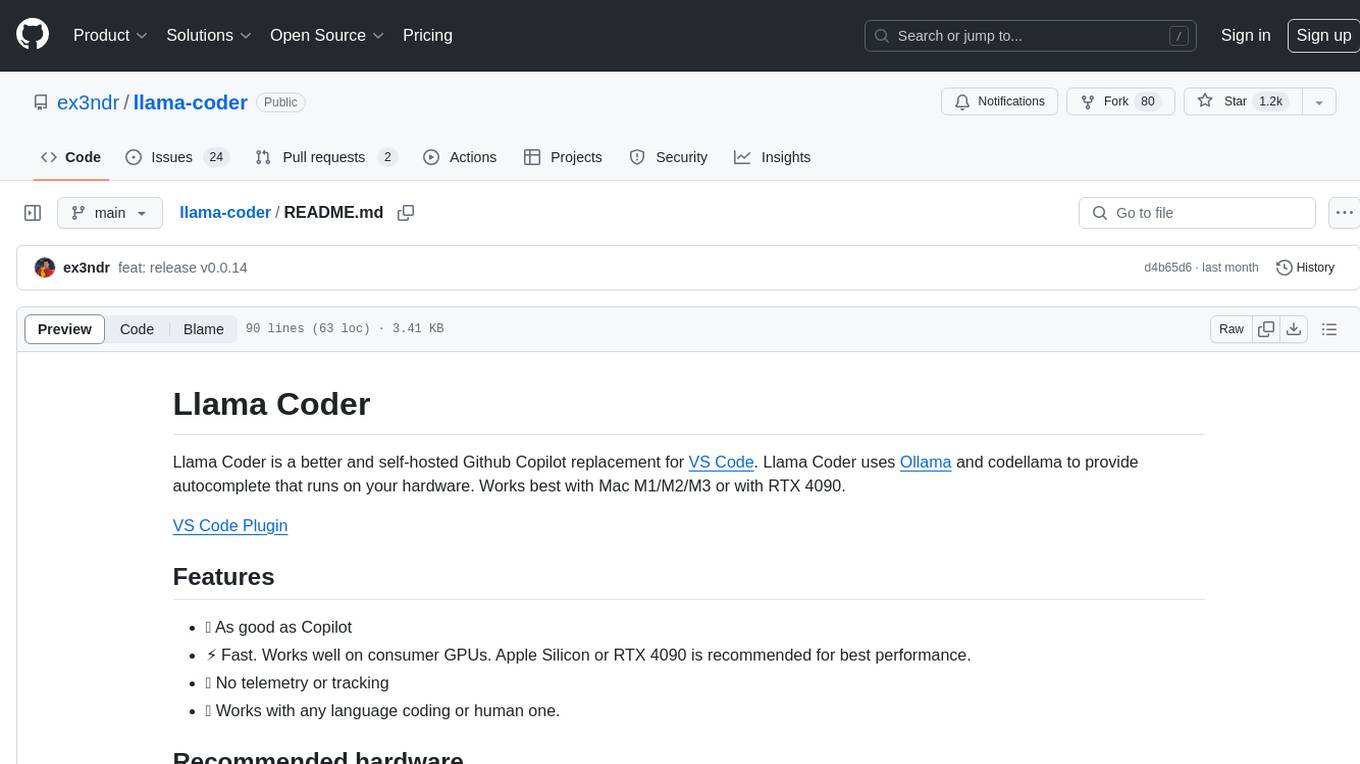
llama-coder
Llama Coder is a self-hosted Github Copilot replacement for VS Code that provides autocomplete using Ollama and Codellama. It works best with Mac M1/M2/M3 or RTX 4090, offering features like fast performance, no telemetry or tracking, and compatibility with any coding language. Users can install Ollama locally or on a dedicated machine for remote usage. The tool supports different models like stable-code and codellama with varying RAM/VRAM requirements, allowing users to optimize performance based on their hardware. Troubleshooting tips and a changelog are also provided for user convenience.
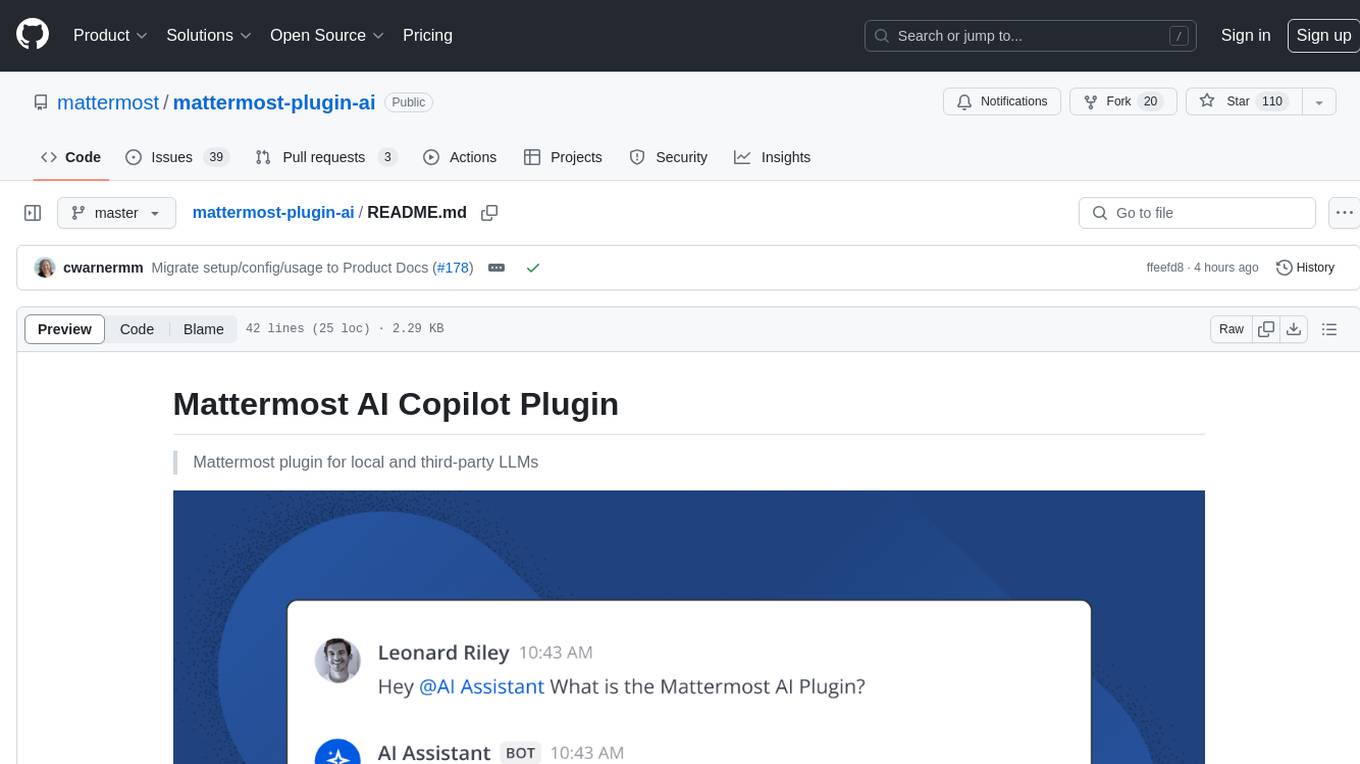
mattermost-plugin-ai
The Mattermost AI Copilot Plugin is an extension that adds functionality for local and third-party LLMs within Mattermost v9.6 and above. It is currently experimental and allows users to interact with AI models seamlessly. The plugin enhances the user experience by providing AI-powered assistance and features for communication and collaboration within the Mattermost platform.
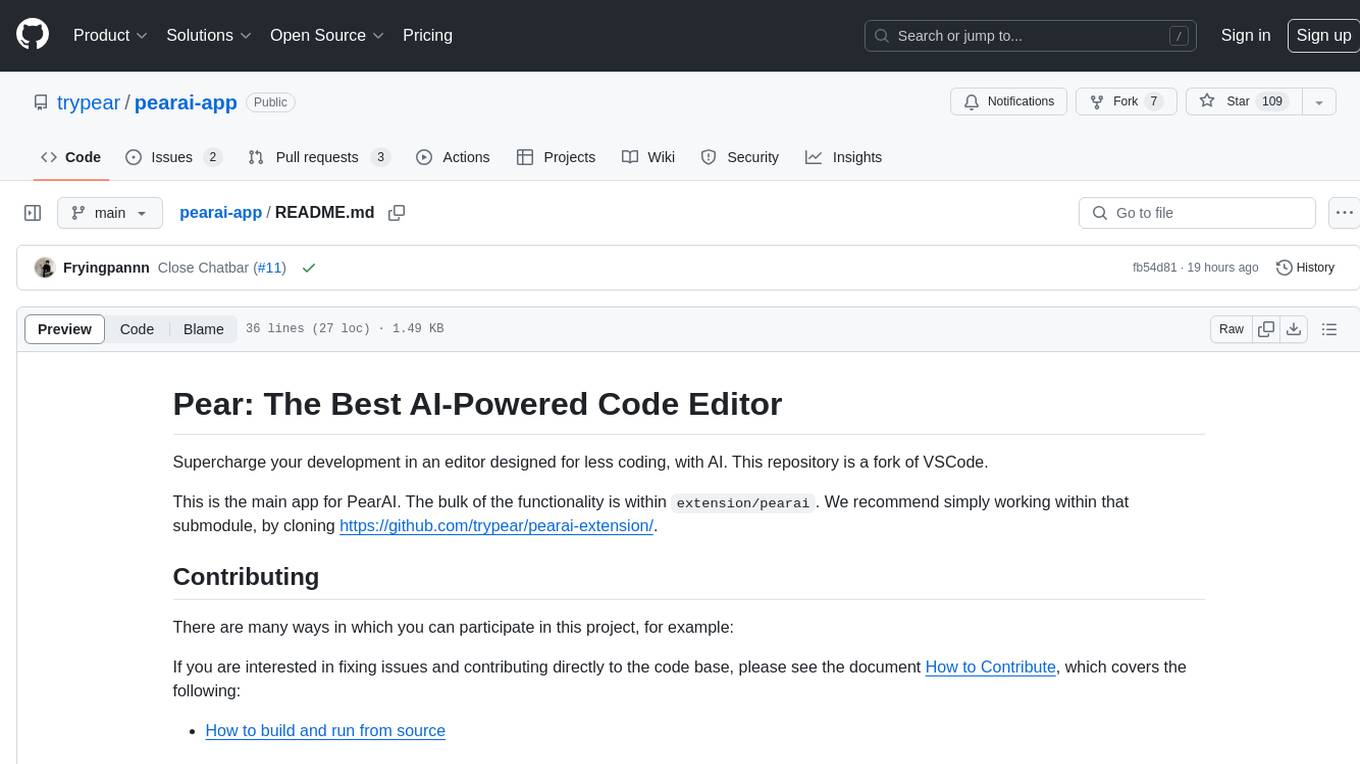
pearai-app
PearAI is an AI-powered code editor designed to enhance development by reducing the amount of coding required. It is a fork of VSCode and the main functionality lies within the 'extension/pearai' submodule. Users can contribute to the project by fixing issues, submitting bugs and feature requests, reviewing source code changes, and improving documentation. The tool aims to streamline the coding process and provide an efficient environment for developers to work in.
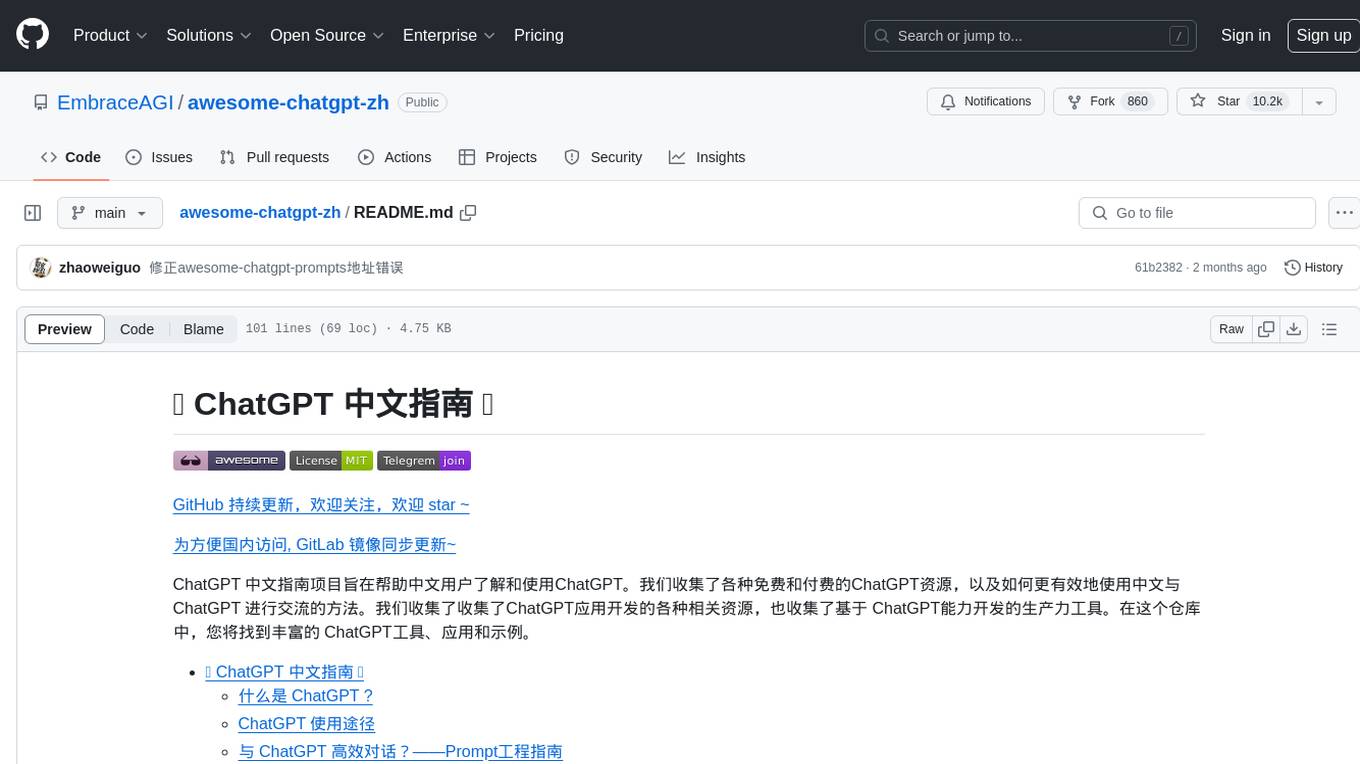
awesome-chatgpt-zh
The Awesome ChatGPT Chinese Guide project aims to help Chinese users understand and use ChatGPT. It collects various free and paid ChatGPT resources, as well as methods to communicate more effectively with ChatGPT in Chinese. The repository contains a rich collection of ChatGPT tools, applications, and examples.
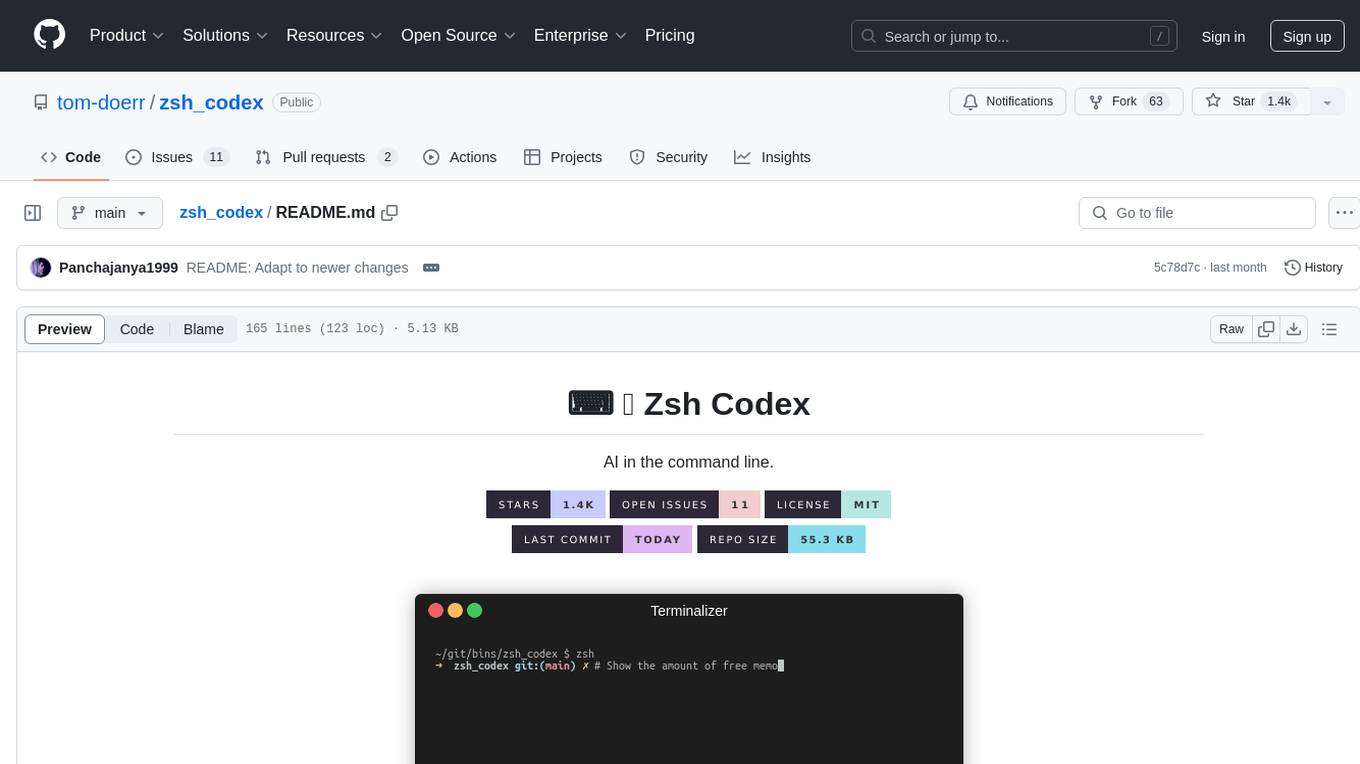
zsh_codex
Zsh Codex is a ZSH plugin that enables AI-powered code completion in the command line. It supports both OpenAI's Codex and Google's Generative AI (Gemini), providing advanced language model capabilities for coding tasks directly in the terminal. Users can easily install the plugin and configure it to enhance their coding experience with AI assistance.
CoPilot
TigerGraph CoPilot is an AI assistant that combines graph databases and generative AI to enhance productivity across various business functions. It includes three core component services: InquiryAI for natural language assistance, SupportAI for knowledge Q&A, and QueryAI for GSQL code generation. Users can interact with CoPilot through a chat interface on TigerGraph Cloud and APIs. CoPilot requires LLM services for beta but will support TigerGraph's LLM in future releases. It aims to improve contextual relevance and accuracy of answers to natural-language questions by building knowledge graphs and using RAG. CoPilot is extensible and can be configured with different LLM providers, graph schemas, and LangChain tools.
ai-toolkit
AI Toolkit is a collection of community created scripts that leverage AI to improve your life. It includes tools like AI CLI for generating terminal commands from natural language queries, AI Commit for generating commit messages using LLMs, and Research Assistant for researching and summarizing information from multiple sources.
pearai-submodule
PearAI Submodule / Extension is the source code for the bulk of PearAI's functionality, bundled as a VSCode / PearAI extension. It allows users to easily understand code sections, refactor functions, and ask questions by mentioning a file. The tool aims to enhance coding experience and productivity within the VSCode environment.
For similar jobs
sweep
Sweep is an AI junior developer that turns bugs and feature requests into code changes. It automatically handles developer experience improvements like adding type hints and improving test coverage.
teams-ai
The Teams AI Library is a software development kit (SDK) that helps developers create bots that can interact with Teams and Microsoft 365 applications. It is built on top of the Bot Framework SDK and simplifies the process of developing bots that interact with Teams' artificial intelligence capabilities. The SDK is available for JavaScript/TypeScript, .NET, and Python.
ai-guide
This guide is dedicated to Large Language Models (LLMs) that you can run on your home computer. It assumes your PC is a lower-end, non-gaming setup.
classifai
Supercharge WordPress Content Workflows and Engagement with Artificial Intelligence. Tap into leading cloud-based services like OpenAI, Microsoft Azure AI, Google Gemini and IBM Watson to augment your WordPress-powered websites. Publish content faster while improving SEO performance and increasing audience engagement. ClassifAI integrates Artificial Intelligence and Machine Learning technologies to lighten your workload and eliminate tedious tasks, giving you more time to create original content that matters.
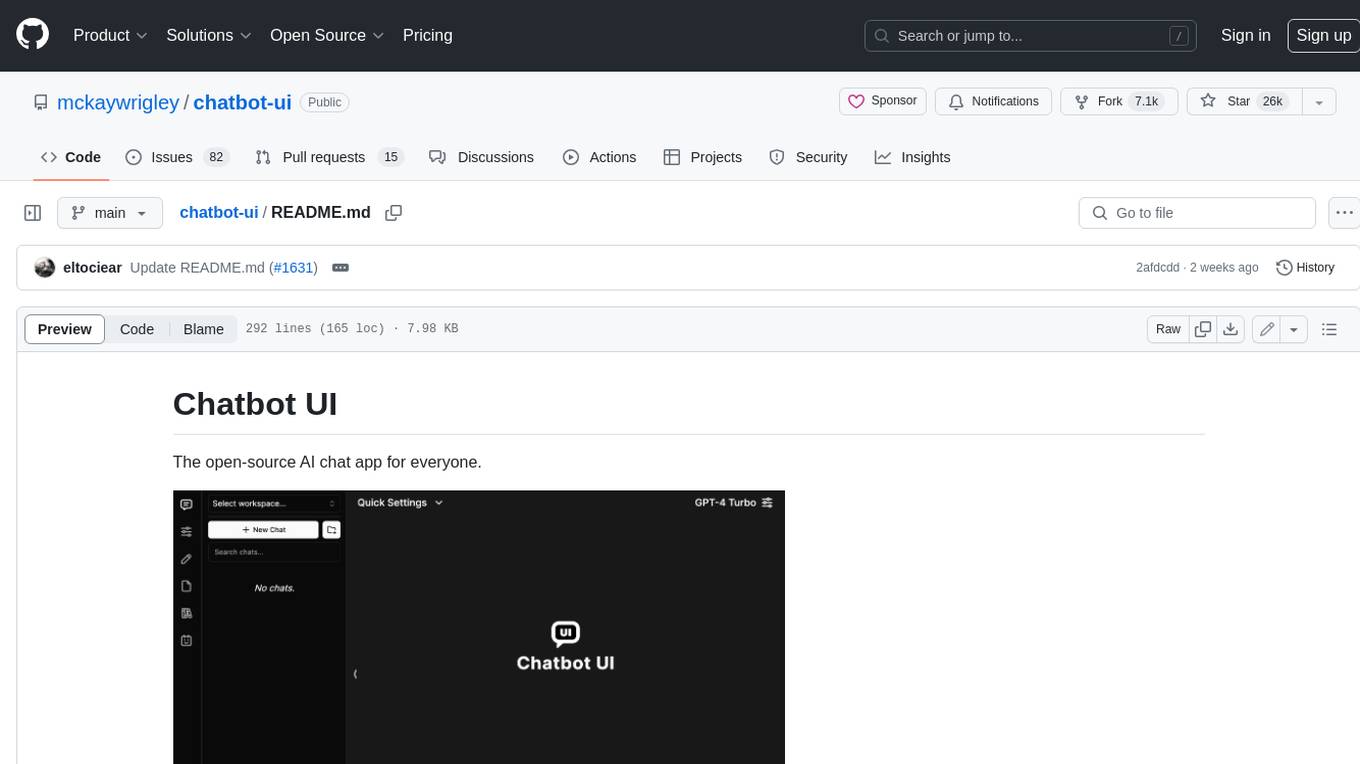
chatbot-ui
Chatbot UI is an open-source AI chat app that allows users to create and deploy their own AI chatbots. It is easy to use and can be customized to fit any need. Chatbot UI is perfect for businesses, developers, and anyone who wants to create a chatbot.
BricksLLM
BricksLLM is a cloud native AI gateway written in Go. Currently, it provides native support for OpenAI, Anthropic, Azure OpenAI and vLLM. BricksLLM aims to provide enterprise level infrastructure that can power any LLM production use cases. Here are some use cases for BricksLLM: * Set LLM usage limits for users on different pricing tiers * Track LLM usage on a per user and per organization basis * Block or redact requests containing PIIs * Improve LLM reliability with failovers, retries and caching * Distribute API keys with rate limits and cost limits for internal development/production use cases * Distribute API keys with rate limits and cost limits for students
uAgents
uAgents is a Python library developed by Fetch.ai that allows for the creation of autonomous AI agents. These agents can perform various tasks on a schedule or take action on various events. uAgents are easy to create and manage, and they are connected to a fast-growing network of other uAgents. They are also secure, with cryptographically secured messages and wallets.
griptape
Griptape is a modular Python framework for building AI-powered applications that securely connect to your enterprise data and APIs. It offers developers the ability to maintain control and flexibility at every step. Griptape's core components include Structures (Agents, Pipelines, and Workflows), Tasks, Tools, Memory (Conversation Memory, Task Memory, and Meta Memory), Drivers (Prompt and Embedding Drivers, Vector Store Drivers, Image Generation Drivers, Image Query Drivers, SQL Drivers, Web Scraper Drivers, and Conversation Memory Drivers), Engines (Query Engines, Extraction Engines, Summary Engines, Image Generation Engines, and Image Query Engines), and additional components (Rulesets, Loaders, Artifacts, Chunkers, and Tokenizers). Griptape enables developers to create AI-powered applications with ease and efficiency.