


LayerSkip
Code for "LayerSkip: Enabling Early Exit Inference and Self-Speculative Decoding", ACL 2024
Stars: 255
LayerSkip is an implementation enabling early exit inference and self-speculative decoding. It provides a code base for running models trained using the LayerSkip recipe, offering speedup through self-speculative decoding. The tool integrates with Hugging Face transformers and provides checkpoints for various LLMs. Users can generate tokens, benchmark on datasets, evaluate tasks, and sweep over hyperparameters to optimize inference speed. The tool also includes correctness verification scripts and Docker setup instructions. Additionally, other implementations like gpt-fast and Native HuggingFace are available. Training implementation is a work-in-progress, and contributions are welcome under the CC BY-NC license.
README:





This code base is the implementation of LayerSkip: Enabling Early Exit Inference and Self-Speculative Decoding.
- [2024/11] 🤗 LayerSkip has been integrated into Hugging Face
transformers.
- Clone repo:
$ git clone [email protected]:facebookresearch/LayerSkip.git
$ cd LayerSkip- Setup environment:
$ conda create --name layer_skip python=3.10
$ conda activate layer_skip

$ pip install -r requirements.txt-
Access models: In order to observe speedup, you need to access LLMs that have been trained using the LayerSkip recipe. We provide 6 checkpoints on HuggingFace of different Llama models continually pretrained using the LayerSkip recipe:
In order to access each model:
- Visit the model's corresponding link above, make sure you are logged on the HuggingFace website with your account.
- Fill the request form and submit it. Approval may take a while and you should receive an email notification to notify you that permission to the model is granted.
- Follow the steps here to obtain a user access token.
- In the command-line run
huggingface-cli login, and you will be prompted to provide the token you have obtained in Step 3.
Once you run those steps, the commands below to run the LayerSkip checkpoints should work.
To run one of our models in interactive mode using regular autoregressive decoding:
$ torchrun generate.py --model facebook/layerskip-llama2-7B \
    --sample True \
    --max_steps 512
In order to observe speedup, you need to use self-speculative decoding to generate tokens, and specify --exit_layer, the layer the draft stage to exit at, and --num_speculations, the number of draft tokens:
$ torchrun generate.py --model facebook/layerskip-llama2-7B \
    --sample True \
    --max_steps 512 \
    --generation_strategy self_speculative \
    --exit_layer 8 \
    --num_speculations 6
Tips:
- You may change
--modelto any HuggingFace model but in order to observe speedup with self-speculative decoding, use a model trained using the LayerSkip recipe, such as those we have open sourced on HuggingFace. - By default we enable sampling. You may change the sampling behaviour using the
--sample,--temperature,--top_p, and--top_karguments. - You may run
python generate.py --helpfor details on different command-line arguments.
To benchmark on a dataset:
$ torchrun benchmark.py --model facebook/layerskip-llama2-7B \
    --dataset cnn_dm_summarization \
    --num_samples 100 \
    --generation_strategy self_speculative \
    --exit_layer 8 \
    --num_speculations 6 \
    --output_dir ./logs
Tips:
- You can specify different tasks by modifying the
--datasetargument:-
cnn_dm_summarization: CNN/DM Summarization -
xsum_summarization: XSUM Summarization -
cnn_dm_lm: CNN/DM Language Modeling (given the first few words of an article, generate the remaining article) -
human_eval: HumanEval Coding
-
- By default, the tasks run as 0-shot. You can change to any specified
n-shot by specifying the--n_shotargument. - By default we enable sampling, while the results reported in the paper were greedy decoding without sampling. You may change the sampling behaviour using the
--sample,--temperature,--top_p, and--top_karguments. - You may run
python benchmark.py --helpfor details on different command-line arguments.
We have integrated our generation scripts with Eleuther Language Model Evaluation Harness to enable a large number of tasks and properly post-process generated text.
$ torchrun eval.py --model facebook/layerskip-llama2-7B \
    --tasks gsm8k \
    --limit 10 \
    --generation_strategy self_speculative \
    --exit_layer 8 \
    --num_speculations 6 \
    --output_dir ./logs
Tips:
- Note that with speculative decoding we can only obtain speedups from generation tasks (e.g.,
gsm8korcnn_dailymail), while classificaton tasks, i.e., multiple choice question tasks (e.g.,piqa,social_iqa) or True/False question tasks (e.g.,boolq) will not lead to speedup. - You can specify arbitrary number of tasks supported by Eleuther Evaluation Harness using the
--tasksargument. To get a list of all of possible tasks, check this link. - Similar to the
generate.pyandbenchmark.pyscripts, you may specify different models, datasets, and sampling parameters - You may run
python benchmark.py --helpfor details on different command-line arguments.
Our inference hyperparameters, exit_layer and num_speculations determine the speedup during inference:
-
exit_layer:- smaller means a faster but less accurate draft stage
- larger means a more accurate but slower draft stage
-
num_speculations:- smaller means higher acceptance rate but verification stage will amortize less the draft stage
- learger means verification stage will better amortize the draft stage but acceptance rate decreases
The optimal combination of exit_layer and num_speculations may change with the model, dataset and sampling parameters. Hence, we provided a script to sweep over a grid of different exit_layer and num_speculations:
$ torchrun sweep.py --model facebook/layerskip-llama2-7B \
    --dataset human_eval \
    --generation_strategy self_speculative \
    --num_samples 150 \
    --max_steps 256 \
    --output_dir ./logs/ \
    --sample False
This will create a CSV file in the directory specified in the --outpu_dir argument.
Tips:
- Similar to the
generate.pyandbenchmark.pyscripts, you may specify different models, datasets, and sampling parameters - You may run
python sweep.py --helpfor details on different command-line arguments.
In order to verify that the generated tokens of our self-speculative decoding algorithm are correct, we have created a script to compare the outputs of autoregressive decoding with self-speculative decoding. Note that the outputs we can only guarantee equivalence when there is no sampling (i.e., --sample False):
$ torchrun correctness.py --model facebook/layerskip-llama2-7B \
    --dataset human_eval \
    --generation_strategy self_speculative \
    --num_speculations 6 \
    --exit_layer 4 \
    --num_samples 10 \
    --sample False \
--output_dir ./logsKindy check DOCKER.md to setup the project using docker
We also have other implementations of LayerSkip inference:
-
gpt-fast: gpt-fast is a simple and efficient pytorch-native transformer text generation. We have implemented LayerSkip in the gpt-fast codebase to enable compouding it with other optimizations such as
torch.compile(), quantization, and tensor parallelism. - Native HuggingFace: in the model card of each of our HuggingFace models, we have provided simple code snippets that leverages HuggingFace speculative decoding capabilities using a simple trick to clone the earlier layers of the main model without cloning its weights. Although this implementation is simple and does not require implementing other functions or importing other libraries, it does not share the KV cache or execution between the draft and verification stages.
Our training implementation is work-in-progress. You can check this pull request for details and discussions.
To run unit/integration tests:
$ pytest ./tests/
LayerSkip is licensed under CC-by-NC license. Refer to the LICENSE file in the top level directory.
We welcome contributions to LayerSkip. If you are interested in contributing please see this document.
If you use LayerSkip in your research, please use the following BibTex entry:
@misc{layerskip,
    title={LayerSkip: Enabling Early Exit Inference and Self-Speculative Decoding},
    author={Mostafa Elhoushi and Akshat Shrivastava and Diana Liskovich and Basil Hosmer and Bram Wasti and Liangzhen Lai and Anas Mahmoud and Bilge Acun and Saurabh Agarwal and Ahmed Roman and Ahmed A Aly and Beidi Chen and Carole-Jean Wu},
    booktitle = "Proceedings of the 62nd Annual Meeting of the Association for Computational Linguistics (Volume 1: Long Papers)",
    month = aug,
    year = "2024",
    address = "Bangkok, Thailand",
    publisher = "Association for Computational Linguistics",
    url = "https://aclanthology.org/2024.acl-long.681",
    doi = "10.18653/v1/2024.acl-long.681",
    pages = "12622--12642",
}
For Tasks:
Click tags to check more tools for each tasksFor Jobs:
Alternative AI tools for LayerSkip
Similar Open Source Tools
LayerSkip
LayerSkip is an implementation enabling early exit inference and self-speculative decoding. It provides a code base for running models trained using the LayerSkip recipe, offering speedup through self-speculative decoding. The tool integrates with Hugging Face transformers and provides checkpoints for various LLMs. Users can generate tokens, benchmark on datasets, evaluate tasks, and sweep over hyperparameters to optimize inference speed. The tool also includes correctness verification scripts and Docker setup instructions. Additionally, other implementations like gpt-fast and Native HuggingFace are available. Training implementation is a work-in-progress, and contributions are welcome under the CC BY-NC license.
garak
Garak is a vulnerability scanner designed for LLMs (Large Language Models) that checks for various weaknesses such as hallucination, data leakage, prompt injection, misinformation, toxicity generation, and jailbreaks. It combines static, dynamic, and adaptive probes to explore vulnerabilities in LLMs. Garak is a free tool developed for red-teaming and assessment purposes, focusing on making LLMs or dialog systems fail. It supports various LLM models and can be used to assess their security and robustness.
garak
Garak is a free tool that checks if a Large Language Model (LLM) can be made to fail in a way that is undesirable. It probes for hallucination, data leakage, prompt injection, misinformation, toxicity generation, jailbreaks, and many other weaknesses. Garak's a free tool. We love developing it and are always interested in adding functionality to support applications.
MultiPL-E
MultiPL-E is a system for translating unit test-driven neural code generation benchmarks to new languages. It is part of the BigCode Code Generation LM Harness and allows for evaluating Code LLMs using various benchmarks. The tool supports multiple versions with improvements and new language additions, providing a scalable and polyglot approach to benchmarking neural code generation. Users can access a tutorial for direct usage and explore the dataset of translated prompts on the Hugging Face Hub.
paper-qa
PaperQA is a minimal package for question and answering from PDFs or text files, providing very good answers with in-text citations. It uses OpenAI Embeddings to embed and search documents, and includes a process of embedding docs, queries, searching for top passages, creating summaries, using an LLM to re-score and select relevant summaries, putting summaries into prompt, and generating answers. The tool can be used to answer specific questions related to scientific research by leveraging citations and relevant passages from documents.
probsem
ProbSem is a repository that provides a framework to leverage large language models (LLMs) for assigning context-conditional probability distributions over queried strings. It supports OpenAI engines and HuggingFace CausalLM models, and is flexible for research applications in linguistics, cognitive science, program synthesis, and NLP. Users can define prompts, contexts, and queries to derive probability distributions over possible completions, enabling tasks like cloze completion, multiple-choice QA, semantic parsing, and code completion. The repository offers CLI and API interfaces for evaluation, with options to customize models, normalize scores, and adjust temperature for probability distributions.
eval-dev-quality
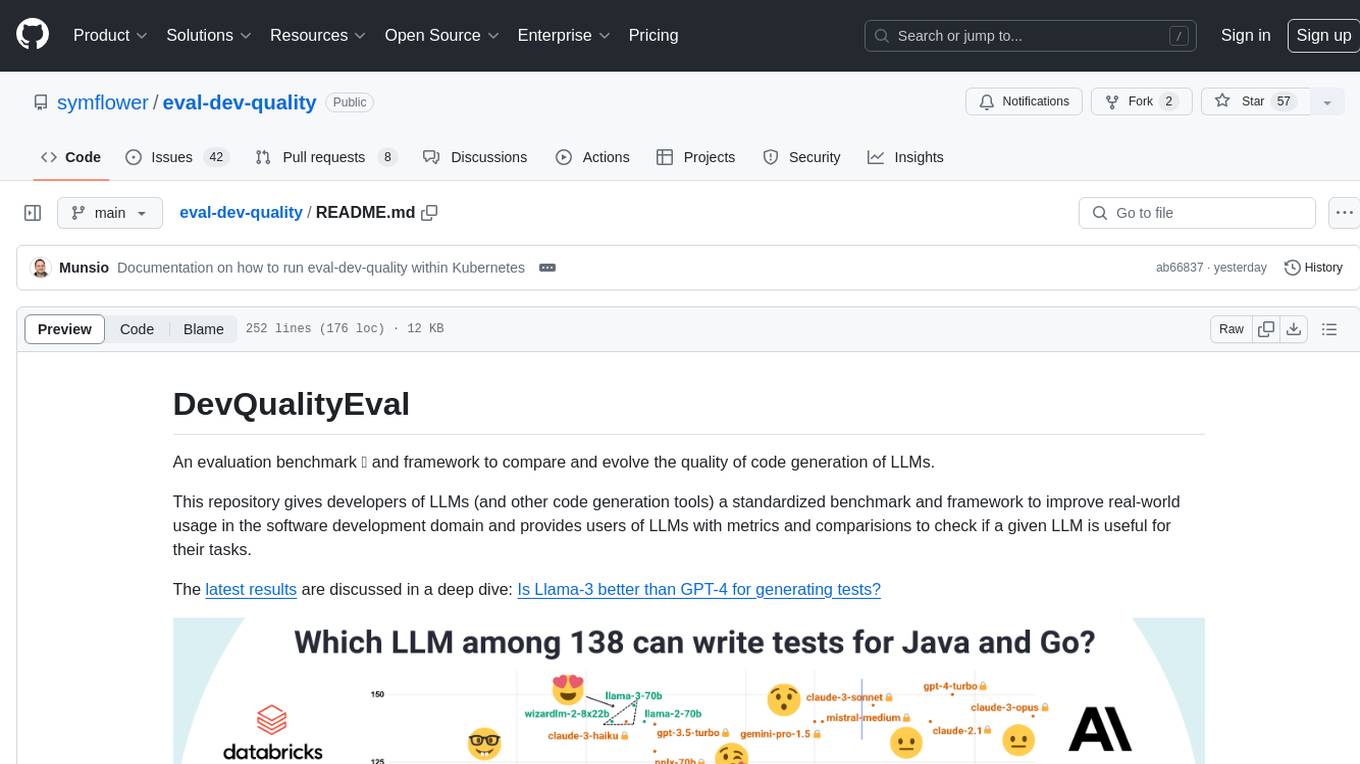
DevQualityEval is an evaluation benchmark and framework designed to compare and improve the quality of code generation of Language Model Models (LLMs). It provides developers with a standardized benchmark to enhance real-world usage in software development and offers users metrics and comparisons to assess the usefulness of LLMs for their tasks. The tool evaluates LLMs' performance in solving software development tasks and measures the quality of their results through a point-based system. Users can run specific tasks, such as test generation, across different programming languages to evaluate LLMs' language understanding and code generation capabilities.
py-vectara-agentic
The `vectara-agentic` Python library is designed for developing powerful AI assistants using Vectara and Agentic-RAG. It supports various agent types, includes pre-built tools for domains like finance and legal, and enables easy creation of custom AI assistants and agents. The library provides tools for summarizing text, rephrasing text, legal tasks like summarizing legal text and critiquing as a judge, financial tasks like analyzing balance sheets and income statements, and database tools for inspecting and querying databases. It also supports observability via LlamaIndex and Arize Phoenix integration.
LeanCopilot
Lean Copilot is a tool that enables the use of large language models (LLMs) in Lean for proof automation. It provides features such as suggesting tactics/premises, searching for proofs, and running inference of LLMs. Users can utilize built-in models from LeanDojo or bring their own models to run locally or on the cloud. The tool supports platforms like Linux, macOS, and Windows WSL, with optional CUDA and cuDNN for GPU acceleration. Advanced users can customize behavior using Tactic APIs and Model APIs. Lean Copilot also allows users to bring their own models through ExternalGenerator or ExternalEncoder. The tool comes with caveats such as occasional crashes and issues with premise selection and proof search. Users can get in touch through GitHub Discussions for questions, bug reports, feature requests, and suggestions. The tool is designed to enhance theorem proving in Lean using LLMs.

OlympicArena
OlympicArena is a comprehensive benchmark designed to evaluate advanced AI capabilities across various disciplines. It aims to push AI towards superintelligence by tackling complex challenges in science and beyond. The repository provides detailed data for different disciplines, allows users to run inference and evaluation locally, and offers a submission platform for testing models on the test set. Additionally, it includes an annotation interface and encourages users to cite their paper if they find the code or dataset helpful.
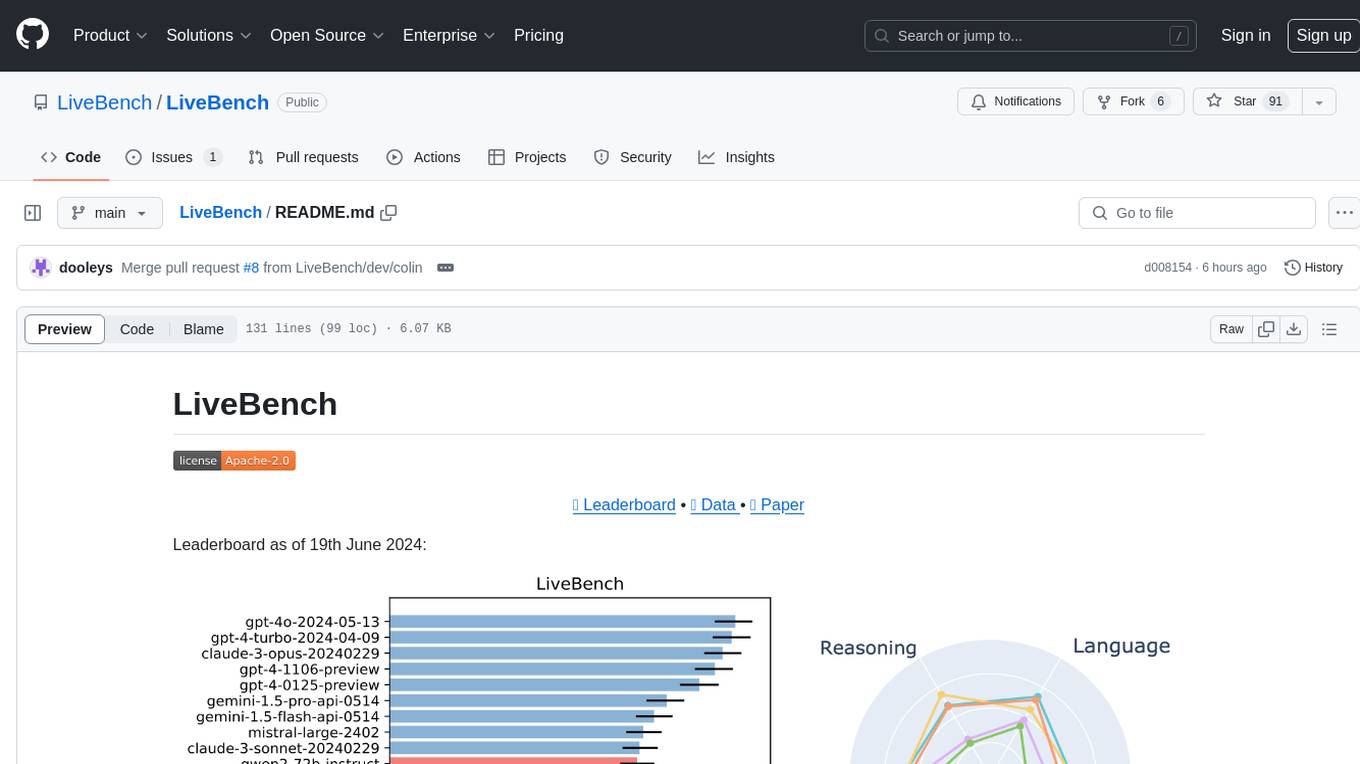
LiveBench
LiveBench is a benchmark tool designed for Language Model Models (LLMs) with a focus on limiting contamination through monthly new questions based on recent datasets, arXiv papers, news articles, and IMDb movie synopses. It provides verifiable, objective ground-truth answers for accurate scoring without an LLM judge. The tool offers 18 diverse tasks across 6 categories and promises to release more challenging tasks over time. LiveBench is built on FastChat's llm_judge module and incorporates code from LiveCodeBench and IFEval.
debug-gym
debug-gym is a text-based interactive debugging framework designed for debugging Python programs. It provides an environment where agents can interact with code repositories, use various tools like pdb and grep to investigate and fix bugs, and propose code patches. The framework supports different LLM backends such as OpenAI, Azure OpenAI, and Anthropic. Users can customize tools, manage environment states, and run agents to debug code effectively. debug-gym is modular, extensible, and suitable for interactive debugging tasks in a text-based environment.
mlx-lm
MLX LM is a Python package designed for generating text and fine-tuning large language models on Apple silicon using MLX. It offers integration with the Hugging Face Hub for easy access to thousands of LLMs, support for quantizing and uploading models to the Hub, low-rank and full model fine-tuning capabilities, and distributed inference and fine-tuning with `mx.distributed`. Users can interact with the package through command line options or the Python API, enabling tasks such as text generation, chatting with language models, model conversion, streaming generation, and sampling. MLX LM supports various Hugging Face models and provides tools for efficient scaling to long prompts and generations, including a rotating key-value cache and prompt caching. It requires macOS 15.0 or higher for optimal performance.
sage
Sage is a tool that allows users to chat with any codebase, providing a chat interface for code understanding and integration. It simplifies the process of learning how a codebase works by offering heavily documented answers sourced directly from the code. Users can set up Sage locally or on the cloud with minimal effort. The tool is designed to be easily customizable, allowing users to swap components of the pipeline and improve the algorithms powering code understanding and generation.
safety-tooling
This repository, safety-tooling, is designed to be shared across various AI Safety projects. It provides an LLM API with a common interface for OpenAI, Anthropic, and Google models. The aim is to facilitate collaboration among AI Safety researchers, especially those with limited software engineering backgrounds, by offering a platform for contributing to a larger codebase. The repo can be used as a git submodule for easy collaboration and updates. It also supports pip installation for convenience. The repository includes features for installation, secrets management, linting, formatting, Redis configuration, testing, dependency management, inference, finetuning, API usage tracking, and various utilities for data processing and experimentation.
vector-inference
This repository provides an easy-to-use solution for running inference servers on Slurm-managed computing clusters using vLLM. All scripts in this repository run natively on the Vector Institute cluster environment. Users can deploy models as Slurm jobs, check server status and performance metrics, and shut down models. The repository also supports launching custom models with specific configurations. Additionally, users can send inference requests and set up an SSH tunnel to run inference from a local device.
For similar tasks
LayerSkip
LayerSkip is an implementation enabling early exit inference and self-speculative decoding. It provides a code base for running models trained using the LayerSkip recipe, offering speedup through self-speculative decoding. The tool integrates with Hugging Face transformers and provides checkpoints for various LLMs. Users can generate tokens, benchmark on datasets, evaluate tasks, and sweep over hyperparameters to optimize inference speed. The tool also includes correctness verification scripts and Docker setup instructions. Additionally, other implementations like gpt-fast and Native HuggingFace are available. Training implementation is a work-in-progress, and contributions are welcome under the CC BY-NC license.
nagato-ai
Nagato-AI is an intuitive AI Agent library that supports multiple LLMs including OpenAI's GPT, Anthropic's Claude, Google's Gemini, and Groq LLMs. Users can create agents from these models and combine them to build an effective AI Agent system. The library is named after the powerful ninja Nagato from the anime Naruto, who can control multiple bodies with different abilities. Nagato-AI acts as a linchpin to summon and coordinate AI Agents for specific missions. It provides flexibility in programming and supports tools like Coordinator, Researcher, Critic agents, and HumanConfirmInputTool.
LLMSpeculativeSampling
This repository implements speculative sampling for large language model (LLM) decoding, utilizing two models - a target model and an approximation model. The approximation model generates token guesses, corrected by the target model, resulting in improved efficiency. It includes implementations of Google's and Deepmind's versions of speculative sampling, supporting models like llama-7B and llama-1B. The tool is designed for fast inference from transformers via speculative decoding.

LLamaWorker
LLamaWorker is a HTTP API server developed to provide an OpenAI-compatible API for integrating Large Language Models (LLM) into applications. It supports multi-model configuration, streaming responses, text embedding, chat templates, automatic model release, function calls, API key authentication, and test UI. Users can switch models, complete chats and prompts, manage chat history, and generate tokens through the test UI. Additionally, LLamaWorker offers a Vulkan compiled version for download and provides function call templates for testing. The tool supports various backends and provides API endpoints for chat completion, prompt completion, embeddings, model information, model configuration, and model switching. A Gradio UI demo is also available for testing.
LLMDebugger
This repository contains the code and dataset for LDB, a novel debugging framework that enables Large Language Models (LLMs) to refine their generated programs by tracking the values of intermediate variables throughout the runtime execution. LDB segments programs into basic blocks, allowing LLMs to concentrate on simpler code units, verify correctness block by block, and pinpoint errors efficiently. The tool provides APIs for debugging and generating code with debugging messages, mimicking how human developers debug programs.
For similar jobs
sweep
Sweep is an AI junior developer that turns bugs and feature requests into code changes. It automatically handles developer experience improvements like adding type hints and improving test coverage.
teams-ai
The Teams AI Library is a software development kit (SDK) that helps developers create bots that can interact with Teams and Microsoft 365 applications. It is built on top of the Bot Framework SDK and simplifies the process of developing bots that interact with Teams' artificial intelligence capabilities. The SDK is available for JavaScript/TypeScript, .NET, and Python.

ai-guide
This guide is dedicated to Large Language Models (LLMs) that you can run on your home computer. It assumes your PC is a lower-end, non-gaming setup.
classifai
Supercharge WordPress Content Workflows and Engagement with Artificial Intelligence. Tap into leading cloud-based services like OpenAI, Microsoft Azure AI, Google Gemini and IBM Watson to augment your WordPress-powered websites. Publish content faster while improving SEO performance and increasing audience engagement. ClassifAI integrates Artificial Intelligence and Machine Learning technologies to lighten your workload and eliminate tedious tasks, giving you more time to create original content that matters.
chatbot-ui
Chatbot UI is an open-source AI chat app that allows users to create and deploy their own AI chatbots. It is easy to use and can be customized to fit any need. Chatbot UI is perfect for businesses, developers, and anyone who wants to create a chatbot.
BricksLLM
BricksLLM is a cloud native AI gateway written in Go. Currently, it provides native support for OpenAI, Anthropic, Azure OpenAI and vLLM. BricksLLM aims to provide enterprise level infrastructure that can power any LLM production use cases. Here are some use cases for BricksLLM: * Set LLM usage limits for users on different pricing tiers * Track LLM usage on a per user and per organization basis * Block or redact requests containing PIIs * Improve LLM reliability with failovers, retries and caching * Distribute API keys with rate limits and cost limits for internal development/production use cases * Distribute API keys with rate limits and cost limits for students
uAgents
uAgents is a Python library developed by Fetch.ai that allows for the creation of autonomous AI agents. These agents can perform various tasks on a schedule or take action on various events. uAgents are easy to create and manage, and they are connected to a fast-growing network of other uAgents. They are also secure, with cryptographically secured messages and wallets.
griptape
Griptape is a modular Python framework for building AI-powered applications that securely connect to your enterprise data and APIs. It offers developers the ability to maintain control and flexibility at every step. Griptape's core components include Structures (Agents, Pipelines, and Workflows), Tasks, Tools, Memory (Conversation Memory, Task Memory, and Meta Memory), Drivers (Prompt and Embedding Drivers, Vector Store Drivers, Image Generation Drivers, Image Query Drivers, SQL Drivers, Web Scraper Drivers, and Conversation Memory Drivers), Engines (Query Engines, Extraction Engines, Summary Engines, Image Generation Engines, and Image Query Engines), and additional components (Rulesets, Loaders, Artifacts, Chunkers, and Tokenizers). Griptape enables developers to create AI-powered applications with ease and efficiency.