


jido_ai
Jido Actions and Skills for interacting with LLMs
Stars: 117
Jido.AI is an AI integration layer for the Jido ecosystem, providing a toolkit for building intelligent agents with LLMs. It implements reasoning strategies for tool use, multi-step reasoning, and complex planning to enhance results from language models.
README:
AI integration layer for the Jido ecosystem - LLM orchestration and reasoning strategies for building intelligent agents in Elixir.
Jido.AI provides a comprehensive toolkit for building intelligent agents with LLMs. It implements proven reasoning strategies for tool use, multi-step reasoning, and complex planning - all designed to get better results from language models.
# Quick example: ReAct agent with tool use
defmodule MyApp.Agent do
  use Jido.AI.ReActAgent,
    name: "my_agent",
    tools: [MyApp.Actions.Calculator, MyApp.Actions.Search],
    model: :fast
end

{:ok, pid} = Jido.AgentServer.start(agent: MyApp.Agent)
{:ok, response} = MyApp.Agent.ask_sync(pid, "What is 15 * 23?")def deps do
[
{:jido, "~> 2.0"},
{:jido_ai, "~> 2.0"}
]
endConfigure your LLM provider (see Configuration Guide):
# config/config.exs
config :jido_ai, :models,
  anthropic: [
    api_key: System.get_env("ANTHROPIC_API_KEY")
  ],
  openai: [
    api_key: System.get_env("OPENAI_API_KEY")
]Strategies are agent patterns that determine how an LLM approaches a problem. They are the foundation of building intelligent agents with Jido.AI.
| Strategy | Pattern | Best For | Guide |
|---|---|---|---|
| ReAct | Reason-Act loop | Tool-using agents | Guide |
| Chain-of-Thought | Sequential reasoning | Multi-step problems | Guide |
| Tree-of-Thoughts | Explore multiple paths | Complex planning | Guide |
| Graph-of-Thoughts | Networked reasoning | Interconnected concepts | Guide |
| Adaptive | Strategy selection | Variable problem types | Guide |
When to use which strategy:
- ReAct - When your agent needs to use tools or APIs
- Chain-of-Thought - For multi-step reasoning and math problems
- Tree-of-Thoughts - When exploring multiple solution paths is beneficial
- Graph-of-Thoughts - For problems with interconnected concepts
- Adaptive - When you need dynamic strategy selection based on the problem
# ReAct agent with tools
defmodule MyApp.Agent do
  use Jido.AI.ReActAgent,
    name: "my_agent",
    tools: [MyApp.Actions.Calculator, MyApp.Actions.Search],
    model: :fast
end

# Chain-of-Thought agent for step-by-step reasoning
defmodule MyApp.Reasoner do
  use Jido.AI.CoTAgent,
    name: "reasoner",
    model: :fast
end

{:ok, pid} = Jido.AgentServer.start(agent: MyApp.Reasoner)
{:ok, result} = MyApp.Reasoner.think_sync(pid, "Solve: 3 cats catch 3 mice in 3 minutes...")- Overview - Library introduction and concepts
- Strategies - Reasoning strategies
- Architecture Overview - System design
- Strategies - Strategy implementation
- State Machines - Pure state machine pattern
- Directives - Declarative side effects
- Signals - Event-driven communication
- Tool System - Tool registry and execution
- Skills - Modular agent capabilities
- Configuration - Model aliases and providers
-
examples/strategies/react_agent.md- ReAct strategy example -
examples/strategies/chain_of_thought.md- Chain-of-Thought example -
examples/strategies/tree_of_thoughts.md- Tree-of-Thoughts example -
examples/strategies/adaptive_strategy.md- Adaptive strategy example
Use these references as the production baseline for ReAct:
lib/jido_ai/agents/examples/weather_agent.exexamples/strategies/react_agent.mdguides/user/03_react_observability.md
Not sure which technique to use? Start here:
Building an agent?
├─ Need to use tools/APIs?
│  └─ Use ReAct Strategy
├─ Multi-step reasoning?
│  └─ Use Chain-of-Thought
└─ Complex planning?
   └─ Use Tree-of-Thoughts
Contributions are welcome! Please see CONTRIBUTING.md for guidelines.
Apache-2.0 - See LICENSE.md for details.
For Tasks:
Click tags to check more tools for each tasksFor Jobs:
Alternative AI tools for jido_ai
Similar Open Source Tools
jido_ai
Jido.AI is an AI integration layer for the Jido ecosystem, providing a toolkit for building intelligent agents with LLMs. It implements reasoning strategies for tool use, multi-step reasoning, and complex planning to enhance results from language models.
empirica
Empirica is an epistemic self-awareness framework for AI agents to understand their knowledge boundaries. It introduces epistemic vectors to measure knowledge state and uncertainty, enabling honest communication. The tool emerged from 600+ real working sessions across various AI systems, providing cognitive infrastructure for distinguishing between confident knowledge and guessing. Empirica's 13 foundational vectors cover engagement, domain knowledge depth, execution capability, information access, understanding clarity, coherence, signal-to-noise ratio, information richness, working state, progress rate, task completion level, work significance, and explicit doubt tracking. It is applicable across industries like software development, research, healthcare, legal, education, and finance, aiding in tasks such as code review, hypothesis testing, diagnostic confidence, case analysis, learning assessment, and risk assessment.
EnvScaler
EnvScaler is an automated, scalable framework that creates tool-interactive environments for training LLM agents. It consists of SkelBuilder for environment description mining and quality inspection, ScenGenerator for synthesizing multiple environment scenarios, and modules for supervised fine-tuning and reinforcement learning. The tool provides data, models, and evaluation guides for users to build, generate scenarios, collect training data, train models, and evaluate performance. Users can interact with environments, build environments from scratch, and improve LLMs' task-solving abilities in complex environments.
DeepResearch
Tongyi DeepResearch is an agentic large language model with 30.5 billion total parameters, designed for long-horizon, deep information-seeking tasks. It demonstrates state-of-the-art performance across various search benchmarks. The model features a fully automated synthetic data generation pipeline, large-scale continual pre-training on agentic data, end-to-end reinforcement learning, and compatibility with two inference paradigms. Users can download the model directly from HuggingFace or ModelScope. The repository also provides benchmark evaluation scripts and information on the Deep Research Agent Family.
EvoAgentX
EvoAgentX is an open-source framework for building, evaluating, and evolving LLM-based agents or agentic workflows in an automated, modular, and goal-driven manner. It enables developers and researchers to move beyond static prompt chaining or manual workflow orchestration by introducing a self-evolving agent ecosystem. The framework includes features such as agent workflow autoconstruction, built-in evaluation, self-evolution engine, plug-and-play compatibility, comprehensive built-in tools, memory module support, and human-in-the-loop interactions.
LLMTSCS
LLMLight is a novel framework that employs Large Language Models (LLMs) as decision-making agents for Traffic Signal Control (TSC). The framework leverages the advanced generalization capabilities of LLMs to engage in a reasoning and decision-making process akin to human intuition for effective traffic control. LLMLight has been demonstrated to be remarkably effective, generalizable, and interpretable against various transportation-based and RL-based baselines on nine real-world and synthetic datasets.
MassGen
MassGen is a cutting-edge multi-agent system that leverages the power of collaborative AI to solve complex tasks. It assigns a task to multiple AI agents who work in parallel, observe each other's progress, and refine their approaches to converge on the best solution to deliver a comprehensive and high-quality result. The system operates through an architecture designed for seamless multi-agent collaboration, with key features including cross-model/agent synergy, parallel processing, intelligence sharing, consensus building, and live visualization. Users can install the system, configure API settings, and run MassGen for various tasks such as question answering, creative writing, research, development & coding tasks, and web automation & browser tasks. The roadmap includes plans for advanced agent collaboration, expanded model, tool & agent integration, improved performance & scalability, enhanced developer experience, and a web interface.
RepoMaster
RepoMaster is an AI agent that leverages GitHub repositories to solve complex real-world tasks. It transforms how coding tasks are solved by automatically finding the right GitHub tools and making them work together seamlessly. Users can describe their tasks, and RepoMaster's AI analysis leads to auto discovery and smart execution, resulting in perfect outcomes. The tool provides a web interface for beginners and a command-line interface for advanced users, along with specialized agents for deep search, general assistance, and repository tasks.
pollinations
pollinations.ai is an open-source generative AI platform based in Berlin, empowering community projects with accessible text, image, video, and audio generation APIs. It offers a unified API endpoint for various AI generation needs, including text, images, audio, and video. The platform provides features like image generation using models such as Flux, GPT Image, Seedream, and Kontext, video generation with Seedance and Veo, and audio generation with text-to-speech and speech-to-text capabilities. Users can access the platform through a web interface or API, and authentication is managed through API keys. The platform is community-driven, transparent, and ethical, aiming to make AI technology open, accessible, and interconnected while fostering innovation and responsible development.
dotclaude
A sophisticated multi-agent configuration system for Claude Code that provides specialized agents and command templates to accelerate code review, refactoring, security audits, tech-lead-guidance, and UX evaluations. It offers essential commands, directory structure details, agent system overview, command templates, usage patterns, collaboration philosophy, sync management, advanced usage guidelines, and FAQ. The tool aims to streamline development workflows, enhance code quality, and facilitate collaboration between developers and AI agents.
GPTSwarm
GPTSwarm is a graph-based framework for LLM-based agents that enables the creation of LLM-based agents from graphs and facilitates the customized and automatic self-organization of agent swarms with self-improvement capabilities. The library includes components for domain-specific operations, graph-related functions, LLM backend selection, memory management, and optimization algorithms to enhance agent performance and swarm efficiency. Users can quickly run predefined swarms or utilize tools like the file analyzer. GPTSwarm supports local LM inference via LM Studio, allowing users to run with a local LLM model. The framework has been accepted by ICML2024 and offers advanced features for experimentation and customization.
octocode-mcp
Octocode is a methodology and platform that empowers AI assistants with the skills of a Senior Staff Engineer. It transforms how AI interacts with code by moving from 'guessing' based on training data to 'knowing' based on deep, evidence-based research. The ecosystem includes the Manifest for Research Driven Development, the MCP Server for code interaction, Agent Skills for extending AI capabilities, a CLI for managing agent capabilities, and comprehensive documentation covering installation, core concepts, tutorials, and reference materials.
superduperdb
SuperDuperDB is a Python framework for integrating AI models, APIs, and vector search engines directly with your existing databases, including hosting of your own models, streaming inference and scalable model training/fine-tuning. Build, deploy and manage any AI application without the need for complex pipelines, infrastructure as well as specialized vector databases, and moving our data there, by integrating AI at your data's source: - Generative AI, LLMs, RAG, vector search - Standard machine learning use-cases (classification, segmentation, regression, forecasting recommendation etc.) - Custom AI use-cases involving specialized models - Even the most complex applications/workflows in which different models work together SuperDuperDB is **not** a database. Think `db = superduper(db)`: SuperDuperDB transforms your databases into an intelligent platform that allows you to leverage the full AI and Python ecosystem. A single development and deployment environment for all your AI applications in one place, fully scalable and easy to manage.
agentica
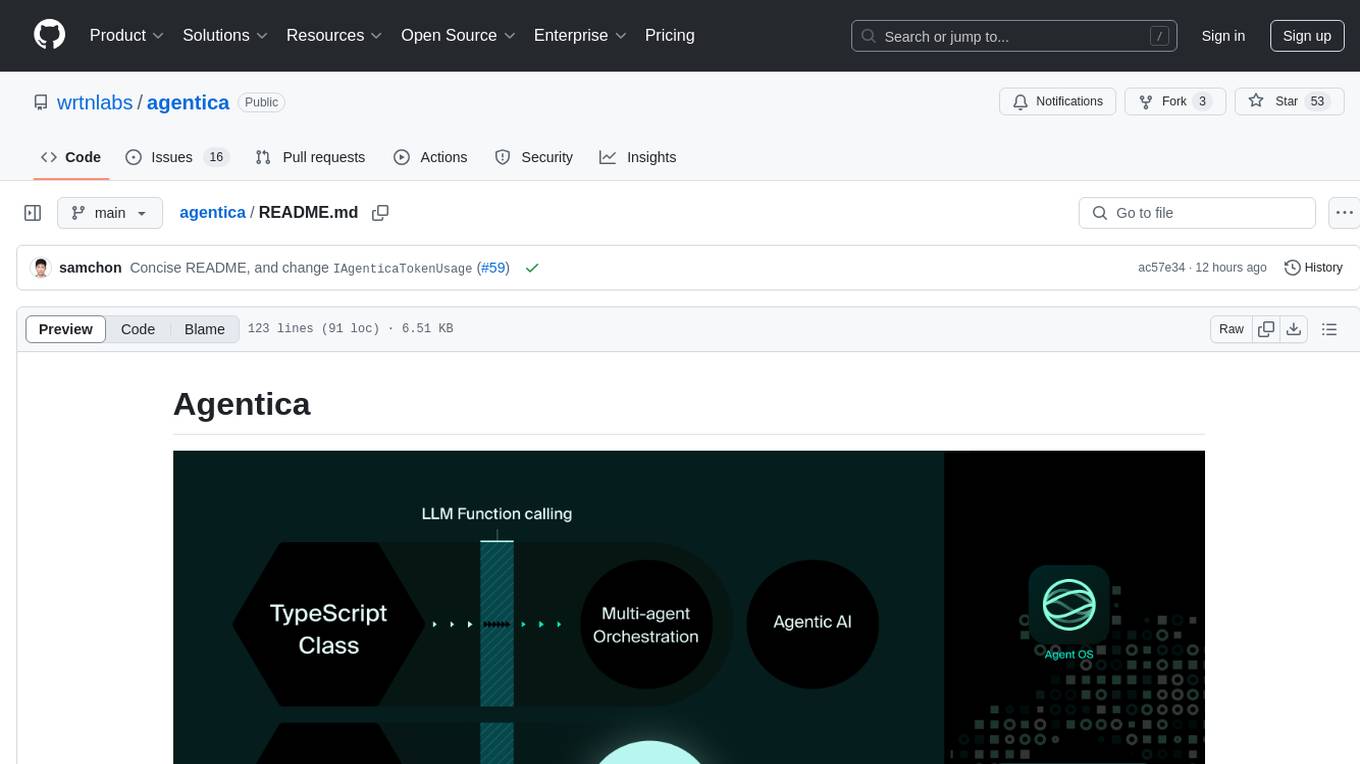
Agentica is a specialized Agentic AI library focused on LLM Function Calling. Users can provide Swagger/OpenAPI documents or TypeScript class types to Agentica for seamless functionality. The library simplifies AI development by handling various tasks effortlessly.
OpenViking
OpenViking is an open-source Context Database designed specifically for AI Agents. It aims to solve challenges in agent development by unifying memories, resources, and skills in a filesystem management paradigm. The tool offers tiered context loading, directory recursive retrieval, visualized retrieval trajectory, and automatic session management. Developers can interact with OpenViking like managing local files, enabling precise context manipulation and intuitive traceable operations. The tool supports various model services like OpenAI and Volcengine, enhancing semantic retrieval and context understanding for AI Agents.
For similar tasks
OpenAGI
OpenAGI is an AI agent creation package designed for researchers and developers to create intelligent agents using advanced machine learning techniques. The package provides tools and resources for building and training AI models, enabling users to develop sophisticated AI applications. With a focus on collaboration and community engagement, OpenAGI aims to facilitate the integration of AI technologies into various domains, fostering innovation and knowledge sharing among experts and enthusiasts.
GPTSwarm
GPTSwarm is a graph-based framework for LLM-based agents that enables the creation of LLM-based agents from graphs and facilitates the customized and automatic self-organization of agent swarms with self-improvement capabilities. The library includes components for domain-specific operations, graph-related functions, LLM backend selection, memory management, and optimization algorithms to enhance agent performance and swarm efficiency. Users can quickly run predefined swarms or utilize tools like the file analyzer. GPTSwarm supports local LM inference via LM Studio, allowing users to run with a local LLM model. The framework has been accepted by ICML2024 and offers advanced features for experimentation and customization.
AgentForge
AgentForge is a low-code framework tailored for the rapid development, testing, and iteration of AI-powered autonomous agents and Cognitive Architectures. It is compatible with a range of LLM models and offers flexibility to run different models for different agents based on specific needs. The framework is designed for seamless extensibility and database-flexibility, making it an ideal playground for various AI projects. AgentForge is a beta-testing ground and future-proof hub for crafting intelligent, model-agnostic autonomous agents.
atomic_agents
Atomic Agents is a modular and extensible framework designed for creating powerful applications. It follows the principles of Atomic Design, emphasizing small and single-purpose components. Leveraging Pydantic for data validation and serialization, the framework offers a set of tools and agents that can be combined to build AI applications. It depends on the Instructor package and supports various APIs like OpenAI, Cohere, Anthropic, and Gemini. Atomic Agents is suitable for developers looking to create AI agents with a focus on modularity and flexibility.
LongRoPE
LongRoPE is a method to extend the context window of large language models (LLMs) beyond 2 million tokens. It identifies and exploits non-uniformities in positional embeddings to enable 8x context extension without fine-tuning. The method utilizes a progressive extension strategy with 256k fine-tuning to reach a 2048k context. It adjusts embeddings for shorter contexts to maintain performance within the original window size. LongRoPE has been shown to be effective in maintaining performance across various tasks from 4k to 2048k context lengths.
ax
Ax is a Typescript library that allows users to build intelligent agents inspired by agentic workflows and the Stanford DSP paper. It seamlessly integrates with multiple Large Language Models (LLMs) and VectorDBs to create RAG pipelines or collaborative agents capable of solving complex problems. The library offers advanced features such as streaming validation, multi-modal DSP, and automatic prompt tuning using optimizers. Users can easily convert documents of any format to text, perform smart chunking, embedding, and querying, and ensure output validation while streaming. Ax is production-ready, written in Typescript, and has zero dependencies.
Awesome-AI-Agents
Awesome-AI-Agents is a curated list of projects, frameworks, benchmarks, platforms, and related resources focused on autonomous AI agents powered by Large Language Models (LLMs). The repository showcases a wide range of applications, multi-agent task solver projects, agent society simulations, and advanced components for building and customizing AI agents. It also includes frameworks for orchestrating role-playing, evaluating LLM-as-Agent performance, and connecting LLMs with real-world applications through platforms and APIs. Additionally, the repository features surveys, paper lists, and blogs related to LLM-based autonomous agents, making it a valuable resource for researchers, developers, and enthusiasts in the field of AI.
CodeFuse-muAgent
CodeFuse-muAgent is a Multi-Agent framework designed to streamline Standard Operating Procedure (SOP) orchestration for agents. It integrates toolkits, code libraries, knowledge bases, and sandbox environments for rapid construction of complex Multi-Agent interactive applications. The framework enables efficient execution and handling of multi-layered and multi-dimensional tasks.
For similar jobs
sweep
Sweep is an AI junior developer that turns bugs and feature requests into code changes. It automatically handles developer experience improvements like adding type hints and improving test coverage.
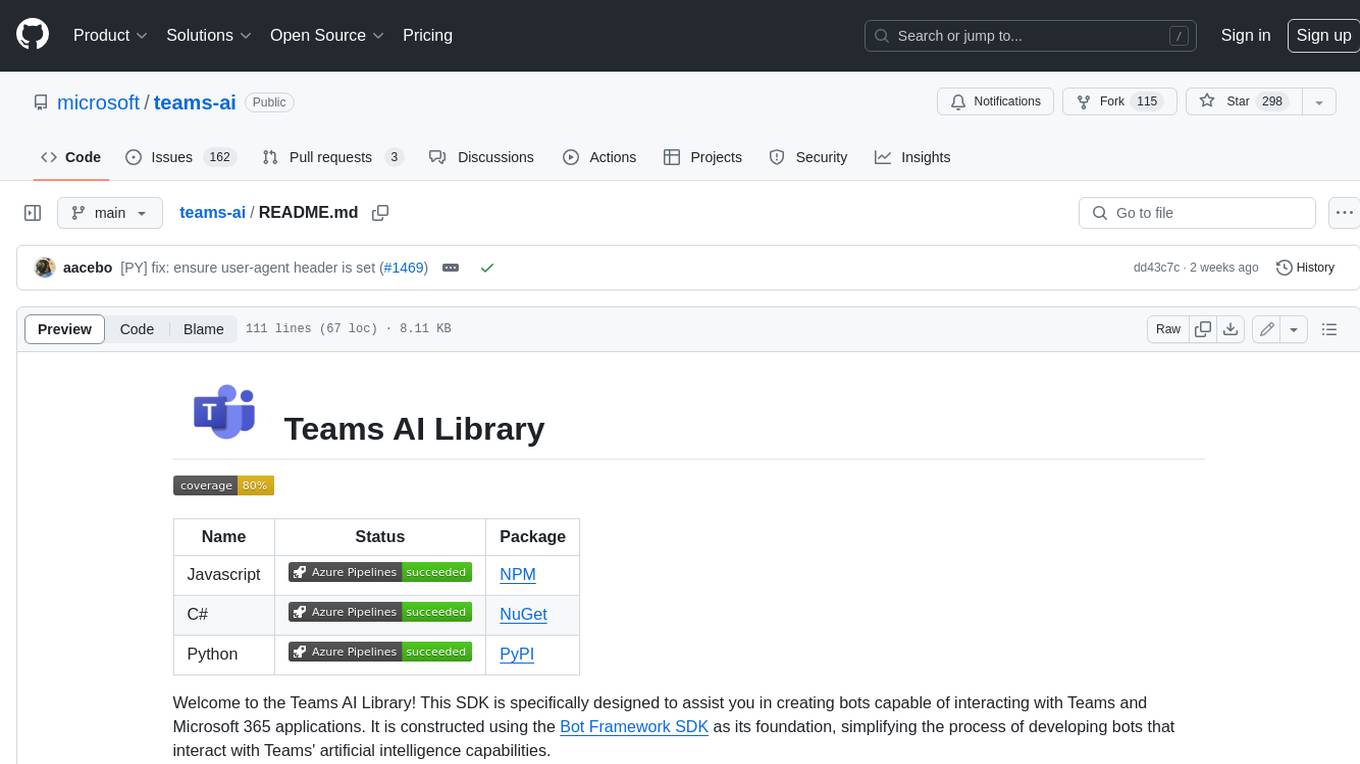
teams-ai
The Teams AI Library is a software development kit (SDK) that helps developers create bots that can interact with Teams and Microsoft 365 applications. It is built on top of the Bot Framework SDK and simplifies the process of developing bots that interact with Teams' artificial intelligence capabilities. The SDK is available for JavaScript/TypeScript, .NET, and Python.
ai-guide
This guide is dedicated to Large Language Models (LLMs) that you can run on your home computer. It assumes your PC is a lower-end, non-gaming setup.
classifai
Supercharge WordPress Content Workflows and Engagement with Artificial Intelligence. Tap into leading cloud-based services like OpenAI, Microsoft Azure AI, Google Gemini and IBM Watson to augment your WordPress-powered websites. Publish content faster while improving SEO performance and increasing audience engagement. ClassifAI integrates Artificial Intelligence and Machine Learning technologies to lighten your workload and eliminate tedious tasks, giving you more time to create original content that matters.
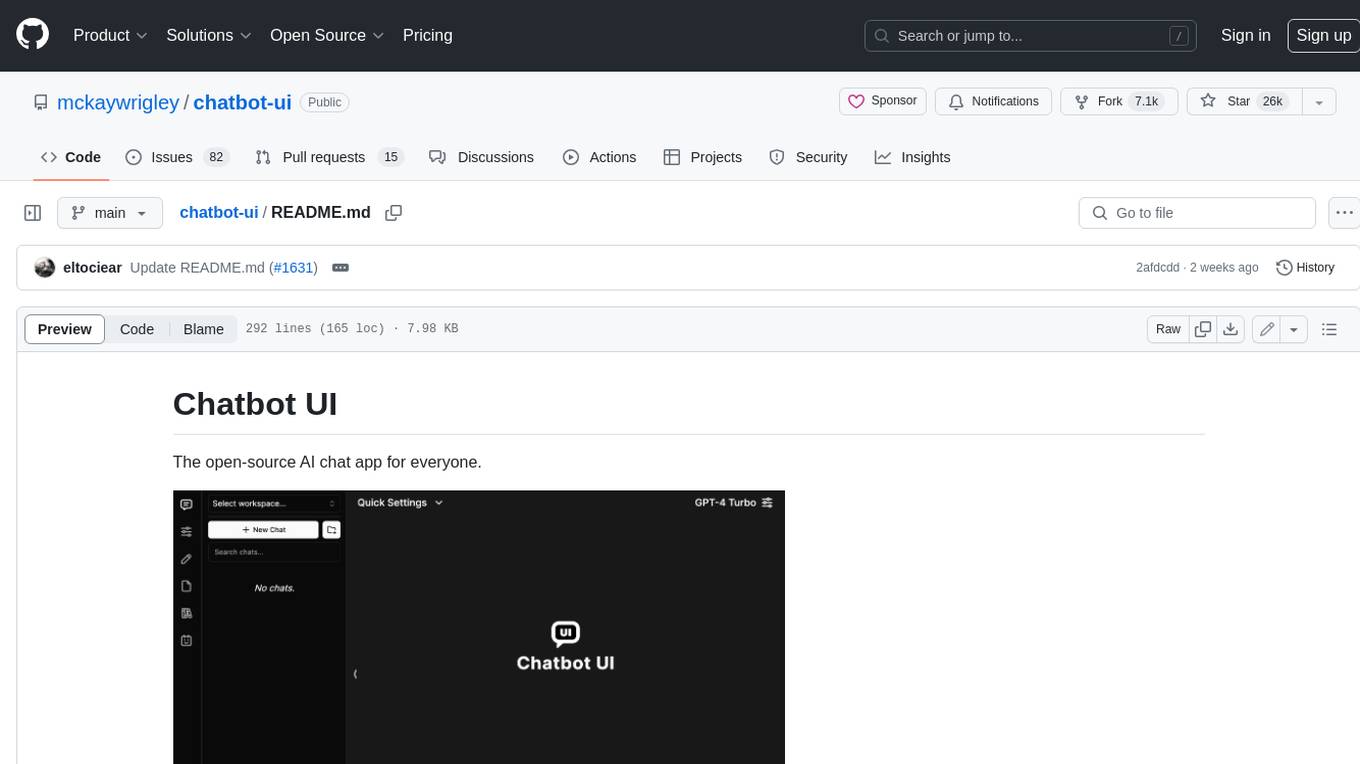
chatbot-ui
Chatbot UI is an open-source AI chat app that allows users to create and deploy their own AI chatbots. It is easy to use and can be customized to fit any need. Chatbot UI is perfect for businesses, developers, and anyone who wants to create a chatbot.
BricksLLM
BricksLLM is a cloud native AI gateway written in Go. Currently, it provides native support for OpenAI, Anthropic, Azure OpenAI and vLLM. BricksLLM aims to provide enterprise level infrastructure that can power any LLM production use cases. Here are some use cases for BricksLLM: * Set LLM usage limits for users on different pricing tiers * Track LLM usage on a per user and per organization basis * Block or redact requests containing PIIs * Improve LLM reliability with failovers, retries and caching * Distribute API keys with rate limits and cost limits for internal development/production use cases * Distribute API keys with rate limits and cost limits for students
uAgents
uAgents is a Python library developed by Fetch.ai that allows for the creation of autonomous AI agents. These agents can perform various tasks on a schedule or take action on various events. uAgents are easy to create and manage, and they are connected to a fast-growing network of other uAgents. They are also secure, with cryptographically secured messages and wallets.
griptape
Griptape is a modular Python framework for building AI-powered applications that securely connect to your enterprise data and APIs. It offers developers the ability to maintain control and flexibility at every step. Griptape's core components include Structures (Agents, Pipelines, and Workflows), Tasks, Tools, Memory (Conversation Memory, Task Memory, and Meta Memory), Drivers (Prompt and Embedding Drivers, Vector Store Drivers, Image Generation Drivers, Image Query Drivers, SQL Drivers, Web Scraper Drivers, and Conversation Memory Drivers), Engines (Query Engines, Extraction Engines, Summary Engines, Image Generation Engines, and Image Query Engines), and additional components (Rulesets, Loaders, Artifacts, Chunkers, and Tokenizers). Griptape enables developers to create AI-powered applications with ease and efficiency.