


Awesome-Segment-Anything
A collection of project, papers, and source code for Meta AI's Segment Anything Model (SAM) and related studies.
Stars: 321
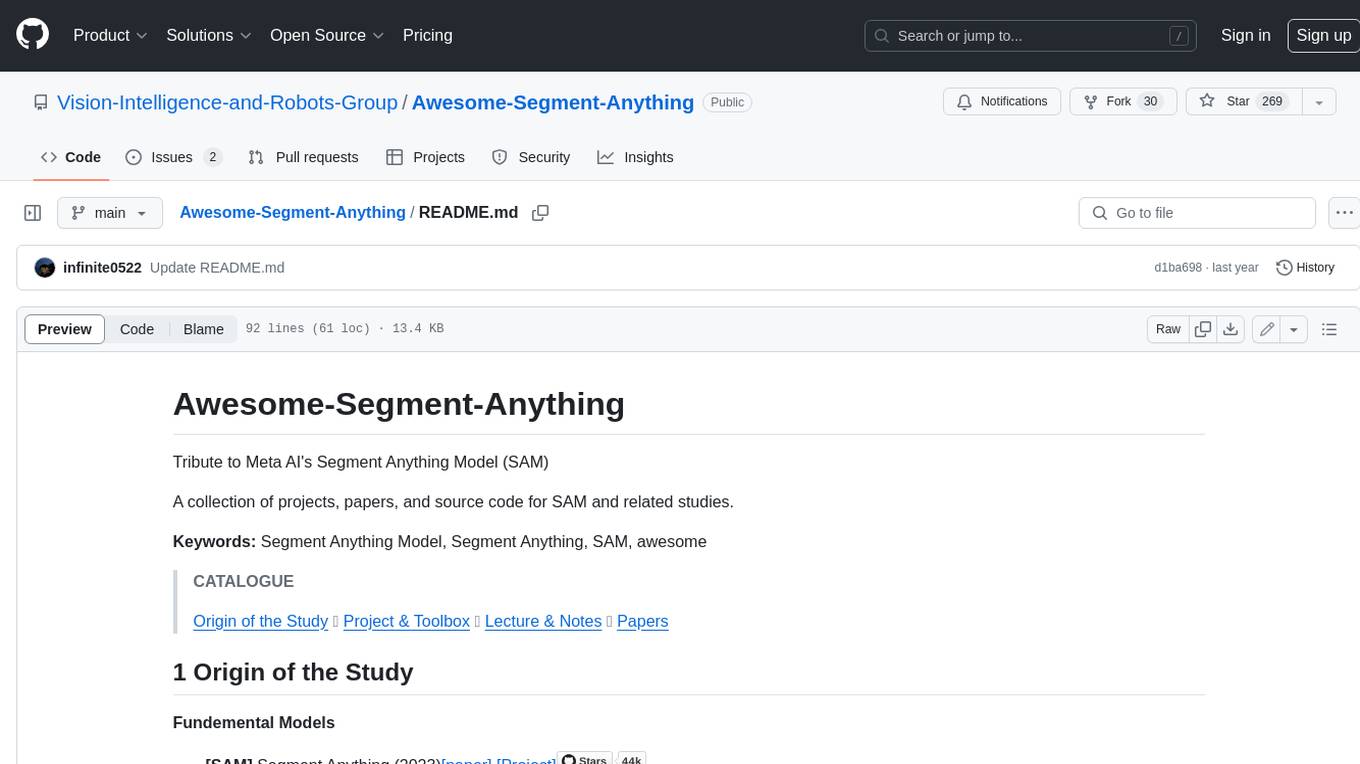
The Segment Anything Model (SAM) is a powerful tool that allows users to segment any object in an image with just a few clicks. This makes it a great tool for a variety of tasks, such as object detection, tracking, and editing. SAM is also very easy to use, making it a great option for both beginners and experienced users.
README:
Tribute to Meta AI's Segment Anything Model (SAM)
A collection of projects, papers, and source code for SAM and related studies.
Keywords: Segment Anything Model, Segment Anything, SAM, awesome
CATALOGUE
Origin of the Study 💗 Project & Toolbox 💗 Lecture & Notes 💗 Papers
Fundemental Models


-
[Awesome Segment-Anything Extensions] Awesome Segment-Anything Extensions [paper][code]
-
[Awesome Anything] A curated list of general AI methods for Anything [paper][code]
-
[Awesome Segment Anything] Awesome Segment Anything [paper][code]


| Preview | Project |
|---|---|
 |
[Grounded-Segment-Anything] Grounded-Segment-Anything(DINO + SAM) [paper][code]
|
 |
[Grounded Segment Anything: From Objects to Parts] Support text prompt input(GLIP/VLPart + SAM)[paper][code]
|
 |
[Semantic-Segment-Anything] A pipeline on top of SAM to predict semantic category for each mask [paper][code]
|
 |
[GroundedSAM-zero-shot-anomaly-detection] Segment any anomaly[papaer][code]
|
 |
[EditAnything] EditAnything [paper][code]
|
 |
[sd-webui-segment-anything] extension for helping stable diffusion webui with inpainting [paper][code]
|
 |
[SALT] Segment Anything Labelling Tool [paper][code]
|
 |
[SAM-CLIP] Segment Anything CLIP [paper][code]
|
 |
[Prompt-Segment-Anything] An implementation of SAM[parper][code]
|
 |
[Count-Anything] Few-shot SAM Counting[parper][code]
|
 |
[SegGPT: Vision Foundation Models] One touch for segmentation in all images (SAM+SegGPT)[paper][code]
|
 |
[napari-segment-anything] Image viewer plugin of SAM[paper][code]
|
 |
[OCR-SAM] SAM is applied to OCR [paper][code]
|
 |
[SegDrawer] Simple static web-based mask drawer[paper][code]
|
 |
[Magic Copy] Extract and copy foreground objects using SAM[paper][code]
|
 |
[Track-Anything] Video object tracking and segmentation based on SAM[paper][code]
|
 ] ] |
[SAM-Track] Video object tracking and segmentation based on SAM[paper][code]
|
 |
[Count Anything] Count any object[paper][code]
|
 |
[Inpaint Anything] Inpaint Anything [paper][code]
|
 |
[Transfer-Any-Style] Transfer-Any-Style[paper][code]
|
 |
[Anything-3D] Anything-3D [paper][code] 
|
 |
[SEEM] Segment Everything Everywhere All at Once [paper][code] 
|
 |
[Caption-Anything] Generate descriptive captions for any object [paper][code] 
|
 |
[Caption-Anything] Generate descriptive captions for any object [paper][code] 
|
 |
[Image.txt] Transform Image Into Unique Paragraph [paper][code] 
|
 |
[3D-Box via Segment Anything] Extend the scope to 3D world [paper][code] 
|
 |
[SegmentAnyRGBD] Segment rendered depth images based on SAM [paper] [code] 
|
How to | roboflow how-to-segment-anything-with-sam [blog]
-
[Zero-shot Segmentation] Segment Anything Model (SAM) for Digital Pathology: Assess Zero-shot Segmentation on Whole Slide Imaging[paper][code]
-
[generic segmentation] Segment Anything Is Not Always Perfect: An Investigation of SAM on Different Real-world Applications [paper][code]
-
[Medical Image segmentation] SAMM (Segment Any Medical Model): A 3D Slicer Integration to SAM [paper][code]
-
[Medical Image segmentation] SAM.MD: Zero-shot medical image segmentation capabilities of the Segment Anything Model [paper] [code]
-
[Camouflaged Object Segmentation] SAM Struggles in Concealed Scenes -- Empirical Study on "Segment Anything"[paper][code]
-
[Brain Extraction] Brain Extraction comparing Segment Anything Model (SAM) and FSL Brain Extraction Tool[paper][code]

-
[Camouflaged Object Detection] Can SAM Segment Anything? When SAM Meets Camouflaged Object Detection[paper][code]
-
[Multi-Object Tracking] CO-MOT[paper][code]

- [CLIP] CLIP Surgery for Better Explainability with Enhancement in Open-Vocabulary Tasks [paper][code]
Click here to check the daily-updated paper list!
For Tasks:
Click tags to check more tools for each tasksFor Jobs:
Alternative AI tools for Awesome-Segment-Anything
Similar Open Source Tools
Awesome-Segment-Anything
The Segment Anything Model (SAM) is a powerful tool that allows users to segment any object in an image with just a few clicks. This makes it a great tool for a variety of tasks, such as object detection, tracking, and editing. SAM is also very easy to use, making it a great option for both beginners and experienced users.
Awesome-LLMOps
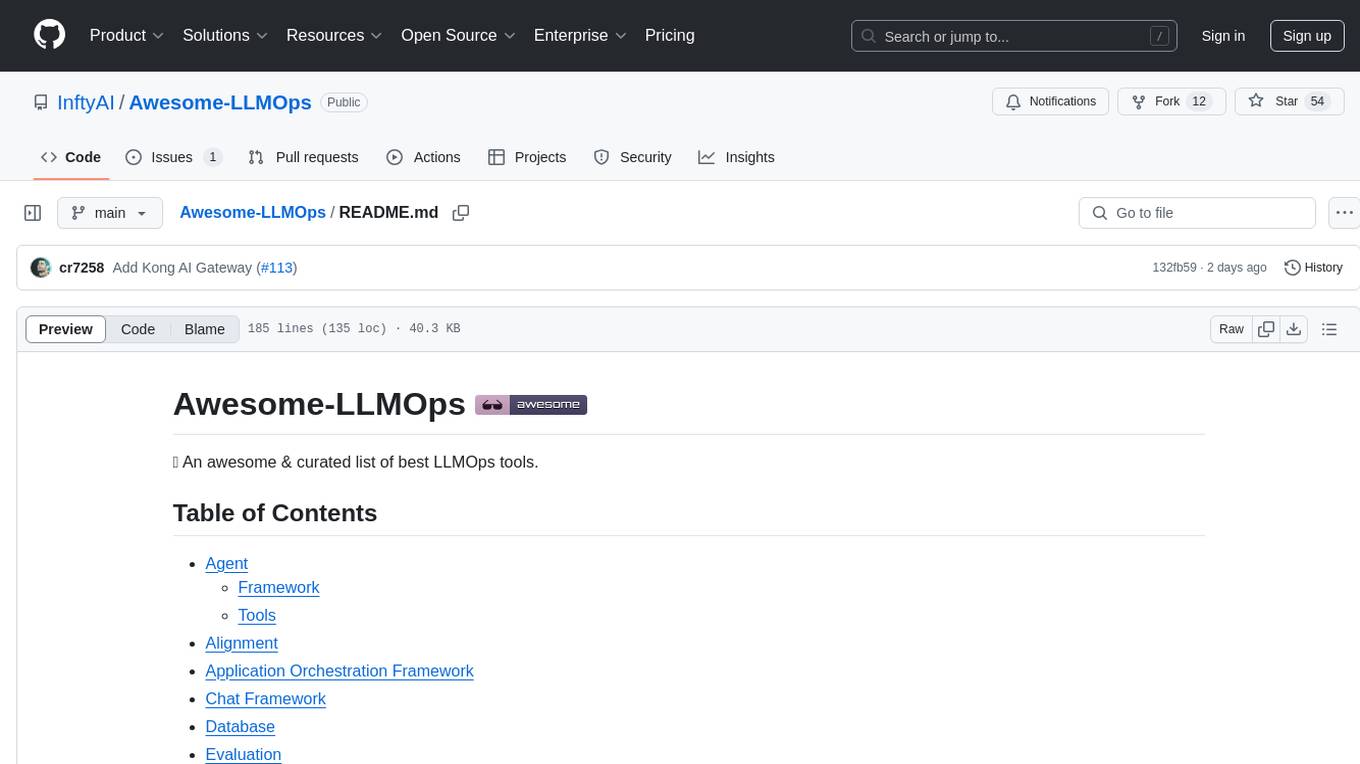
Awesome-LLMOps is a curated list of the best LLMOps tools, providing a comprehensive collection of frameworks and tools for building, deploying, and managing large language models (LLMs) and AI agents. The repository includes a wide range of tools for tasks such as building multimodal AI agents, fine-tuning models, orchestrating applications, evaluating models, and serving models for inference. It covers various aspects of the machine learning operations (MLOps) lifecycle, from training to deployment and observability. The tools listed in this repository cater to the needs of developers, data scientists, and machine learning engineers working with large language models and AI applications.
koko-aio-slang
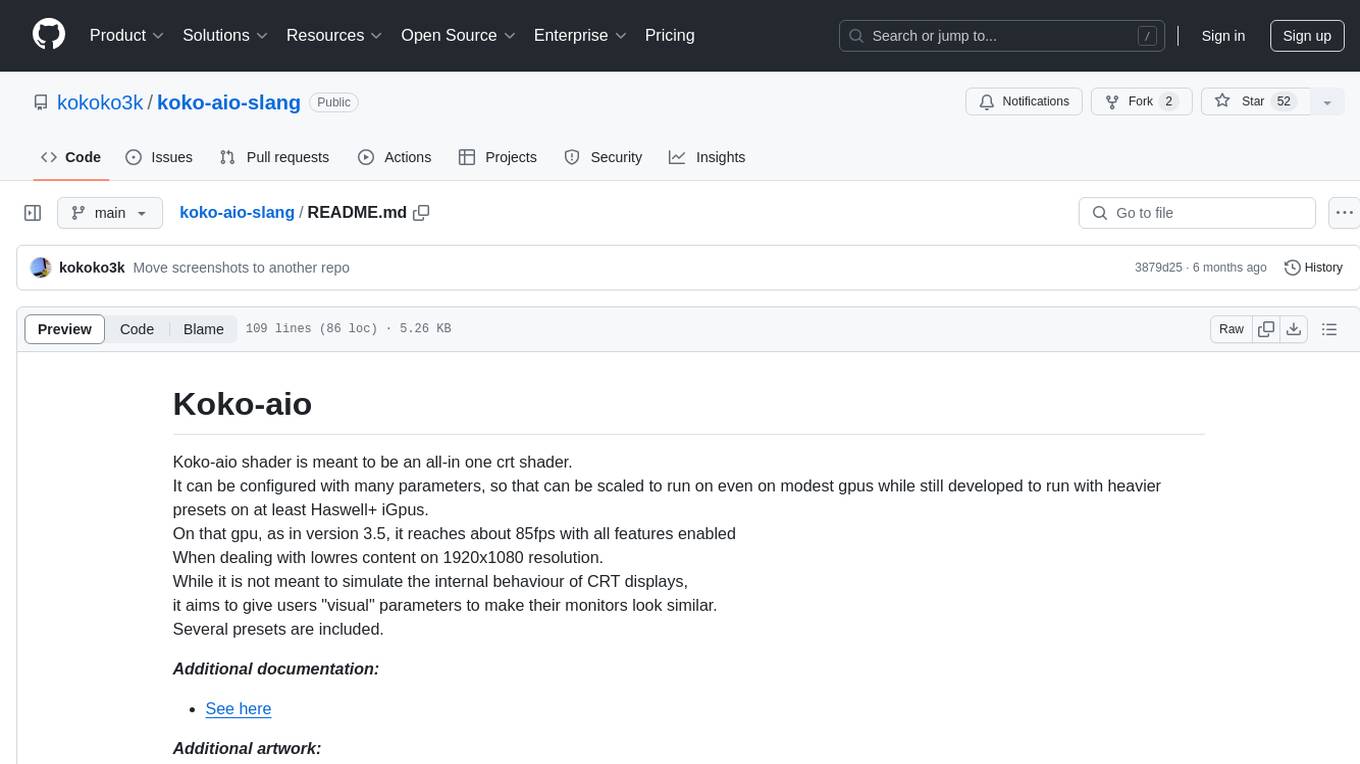
Koko-aio shader is an all-in-one CRT shader tool that can be configured with various parameters to run on different GPUs. It aims to provide visual parameters to make monitors look similar to CRT displays without simulating their internal behavior. The tool includes features such as color corrections, B/W display colorization, antialiasing, noise effects, deconvergence, blurring/sharpening, interlacing, phosphor glow, and more. It also supports ambient lighting, vignette, integer scaling, and various image effects. Koko-aio is designed to enhance the visual experience of low-res content on high-resolution displays.
gitmesh
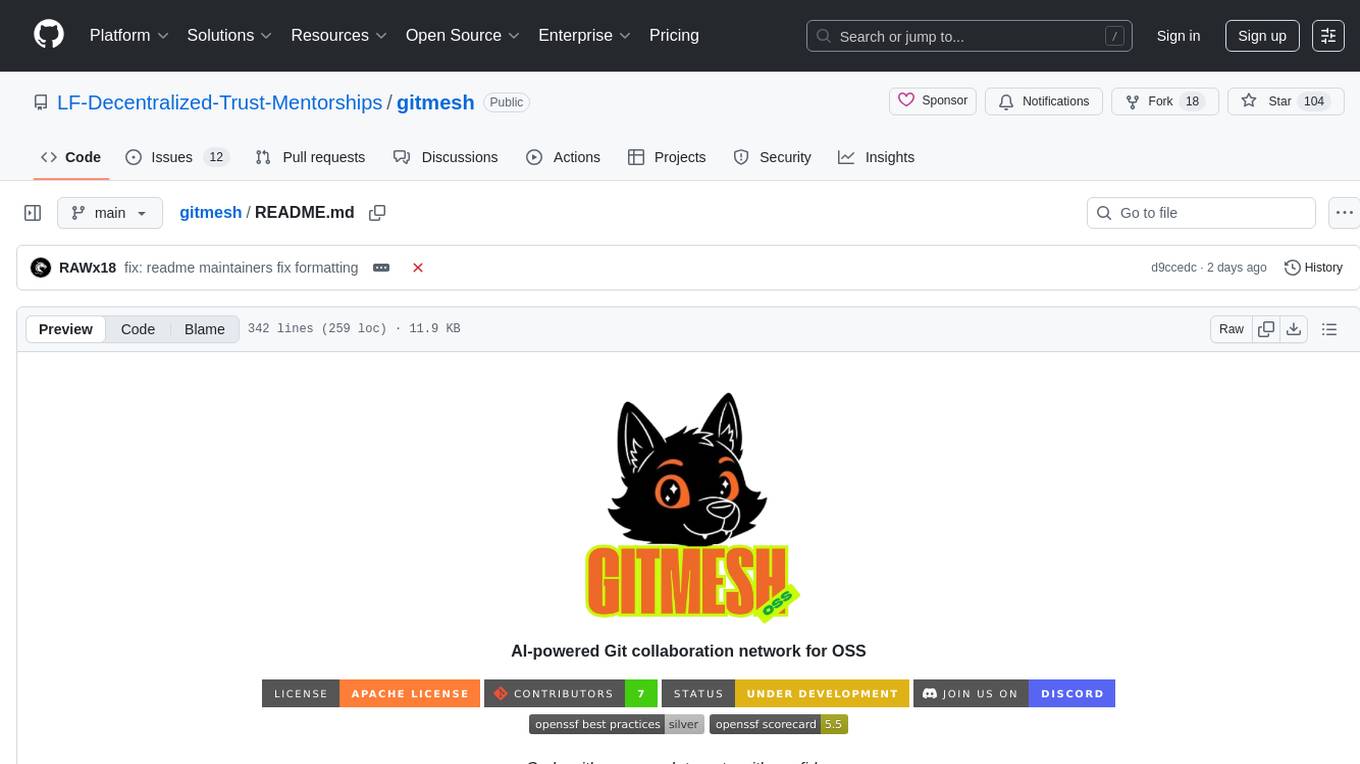
GitMesh is an AI-powered Git collaboration network designed to address contributor dropout in open source projects. It offers real-time branch-level insights, intelligent contributor-task matching, and automated workflows. The platform transforms complex codebases into clear contribution journeys, fostering engagement through gamified rewards and integration with open source support programs. GitMesh's mascot, Meshy/Mesh Wolf, symbolizes agility, resilience, and teamwork, reflecting the platform's ethos of efficiency and power through collaboration.
MirrorFlow
MirrorFlow is an end-to-end toolchain for dialogue data processing, cleaning/extraction, trainable samples generation, fine-tuning/distillation, and usage with evaluation. It supports two main routes: 'Digital Self' for fine-tuning chat records to mimic user expression habits and 'GPT-4o Style Alignment' for aligning output structures, clarification methods, refusal habits, and tool invocation behavior.
llama.cpp
llama.cpp is a C++ implementation of LLaMA, a large language model from Meta. It provides a command-line interface for inference and can be used for a variety of tasks, including text generation, translation, and question answering. llama.cpp is highly optimized for performance and can be run on a variety of hardware, including CPUs, GPUs, and TPUs.
VideoRefer
VideoRefer Suite is a tool designed to enhance the fine-grained spatial-temporal understanding capabilities of Video Large Language Models (Video LLMs). It consists of three primary components: Model (VideoRefer) for perceiving, reasoning, and retrieval for user-defined regions at any specified timestamps, Dataset (VideoRefer-700K) for high-quality object-level video instruction data, and Benchmark (VideoRefer-Bench) to evaluate object-level video understanding capabilities. The tool can understand any object within a video.
Awesome-Colorful-LLM
Awesome-Colorful-LLM is a meticulously assembled anthology of vibrant multimodal research focusing on advancements propelled by large language models (LLMs) in domains such as Vision, Audio, Agent, Robotics, and Fundamental Sciences like Mathematics. The repository contains curated collections of works, datasets, benchmarks, projects, and tools related to LLMs and multimodal learning. It serves as a comprehensive resource for researchers and practitioners interested in exploring the intersection of language models and various modalities for tasks like image understanding, video pretraining, 3D modeling, document understanding, audio analysis, agent learning, robotic applications, and mathematical research.
Awesome-Efficient-Agents
This repository, Awesome Efficient Agents, is a curated collection of papers focusing on memory, tool learning, and planning in agentic systems. It provides a comprehensive survey of efficient agent design, emphasizing memory construction, tool learning, and planning strategies. The repository categorizes papers based on memory processes, tool selection, tool calling, tool-integrated reasoning, and planning efficiency. It aims to help readers quickly access representative work in the field of efficient agent design.
LLaMA-Factory
LLaMA Factory is a unified framework for fine-tuning 100+ large language models (LLMs) with various methods, including pre-training, supervised fine-tuning, reward modeling, PPO, DPO and ORPO. It features integrated algorithms like GaLore, BAdam, DoRA, LongLoRA, LLaMA Pro, LoRA+, LoftQ and Agent tuning, as well as practical tricks like FlashAttention-2, Unsloth, RoPE scaling, NEFTune and rsLoRA. LLaMA Factory provides experiment monitors like LlamaBoard, TensorBoard, Wandb, MLflow, etc., and supports faster inference with OpenAI-style API, Gradio UI and CLI with vLLM worker. Compared to ChatGLM's P-Tuning, LLaMA Factory's LoRA tuning offers up to 3.7 times faster training speed with a better Rouge score on the advertising text generation task. By leveraging 4-bit quantization technique, LLaMA Factory's QLoRA further improves the efficiency regarding the GPU memory.

airweave
Airweave is an open-core tool that simplifies the process of making data searchable by unifying apps, APIs, and databases into a vector database with minimal configuration. It offers over 120 integrations, simplicity in syncing data from diverse sources, extensibility through 'sources', 'destinations', and 'embedders', and an async-first approach for large-scale data synchronization. With features like no-code setup, white-labeled multi-tenant support, chunk generators, automated sync, versioning & hashing, multi-source support, and scalability, Airweave provides a comprehensive solution for building applications that require semantic search.
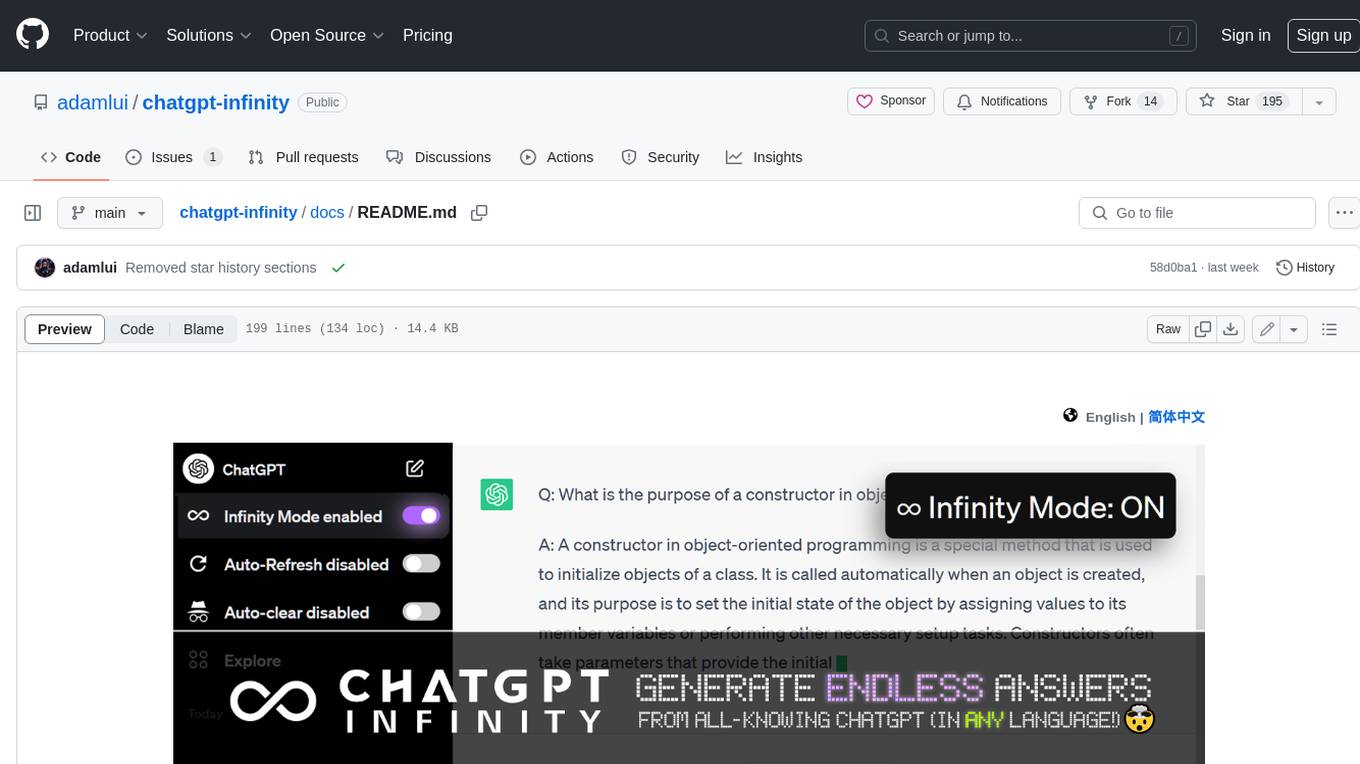
chatgpt-infinity
ChatGPT Infinity is a free and powerful add-on that makes ChatGPT generate infinite answers on any topic. It offers customizable topic selection, multilingual support, adjustable response interval, and auto-scroll feature for a seamless chat experience.
sfdx-hardis
sfdx-hardis is a toolbox for Salesforce DX, developed by Cloudity, that simplifies tasks which would otherwise take minutes or hours to complete manually. It enables users to define complete CI/CD pipelines for Salesforce projects, backup metadata, and monitor any Salesforce org. The tool offers a wide range of commands that can be accessed via the command line interface or through a Visual Studio Code extension. Additionally, sfdx-hardis provides Docker images for easy integration into CI workflows. The tool is designed to be natively compliant with various platforms and tools, making it a versatile solution for Salesforce developers.
Awesome-LLM-RAG-Application
Awesome-LLM-RAG-Application is a repository that provides resources and information about applications based on Large Language Models (LLM) with Retrieval-Augmented Generation (RAG) pattern. It includes a survey paper, GitHub repo, and guides on advanced RAG techniques. The repository covers various aspects of RAG, including academic papers, evaluation benchmarks, downstream tasks, tools, and technologies. It also explores different frameworks, preprocessing tools, routing mechanisms, evaluation frameworks, embeddings, security guardrails, prompting tools, SQL enhancements, LLM deployment, observability tools, and more. The repository aims to offer comprehensive knowledge on RAG for readers interested in exploring and implementing LLM-based systems and products.
NarratoAI
NarratoAI is an automated video narration tool that provides an all-in-one solution for script writing, automated video editing, voice-over, and subtitle generation. It is powered by LLM to enhance efficient content creation. The tool aims to simplify the process of creating film commentary and editing videos by automating various tasks such as script writing and voice-over generation. NarratoAI offers a user-friendly interface for users to easily generate video scripts, edit videos, and customize video parameters. With future plans to optimize story generation processes and support additional large models, NarratoAI is a versatile tool for content creators looking to streamline their video production workflow.
For similar tasks
Awesome-Segment-Anything
The Segment Anything Model (SAM) is a powerful tool that allows users to segment any object in an image with just a few clicks. This makes it a great tool for a variety of tasks, such as object detection, tracking, and editing. SAM is also very easy to use, making it a great option for both beginners and experienced users.
InternLM-XComposer
InternLM-XComposer2 is a groundbreaking vision-language large model (VLLM) based on InternLM2-7B excelling in free-form text-image composition and comprehension. It boasts several amazing capabilities and applications: * **Free-form Interleaved Text-Image Composition** : InternLM-XComposer2 can effortlessly generate coherent and contextual articles with interleaved images following diverse inputs like outlines, detailed text requirements and reference images, enabling highly customizable content creation. * **Accurate Vision-language Problem-solving** : InternLM-XComposer2 accurately handles diverse and challenging vision-language Q&A tasks based on free-form instructions, excelling in recognition, perception, detailed captioning, visual reasoning, and more. * **Awesome performance** : InternLM-XComposer2 based on InternLM2-7B not only significantly outperforms existing open-source multimodal models in 13 benchmarks but also **matches or even surpasses GPT-4V and Gemini Pro in 6 benchmarks** We release InternLM-XComposer2 series in three versions: * **InternLM-XComposer2-4KHD-7B** 🤗: The high-resolution multi-task trained VLLM model with InternLM-7B as the initialization of the LLM for _High-resolution understanding_ , _VL benchmarks_ and _AI assistant_. * **InternLM-XComposer2-VL-7B** 🤗 : The multi-task trained VLLM model with InternLM-7B as the initialization of the LLM for _VL benchmarks_ and _AI assistant_. **It ranks as the most powerful vision-language model based on 7B-parameter level LLMs, leading across 13 benchmarks.** * **InternLM-XComposer2-VL-1.8B** 🤗 : A lightweight version of InternLM-XComposer2-VL based on InternLM-1.8B. * **InternLM-XComposer2-7B** 🤗: The further instruction tuned VLLM for _Interleaved Text-Image Composition_ with free-form inputs. Please refer to Technical Report and 4KHD Technical Reportfor more details.
stable-diffusion-prompt-reader
A simple standalone viewer for reading prompt from Stable Diffusion generated image outside the webui. The tool supports macOS, Windows, and Linux, providing both GUI and CLI functionalities. Users can interact with the tool through drag and drop, copy prompt to clipboard, remove prompt from image, export prompt to text file, edit or import prompt to images, and more. It supports multiple formats including PNG, JPEG, WEBP, TXT, and various tools like A1111's webUI, Easy Diffusion, StableSwarmUI, Fooocus-MRE, NovelAI, InvokeAI, ComfyUI, Draw Things, and Naifu(4chan). Users can download the tool for different platforms and install it via Homebrew Cask or pip. The tool can be used to read, export, remove, and edit prompts from images, providing various modes and options for different tasks.
InternGPT
InternGPT (iGPT) is a pointing-language-driven visual interactive system that enhances communication between users and chatbots by incorporating pointing instructions. It improves chatbot accuracy in vision-centric tasks, especially in complex visual scenarios. The system includes an auxiliary control mechanism to enhance the control capability of the language model. InternGPT features a large vision-language model called Husky, fine-tuned for high-quality multi-modal dialogue. Users can interact with ChatGPT by clicking, dragging, and drawing using a pointing device, leading to efficient communication and improved chatbot performance in vision-related tasks.
java-genai
Java idiomatic SDK for the Gemini Developer APIs and Vertex AI APIs. The SDK provides a Client class for interacting with both APIs, allowing seamless switching between the 2 backends without code rewriting. It supports features like generating content, embedding content, generating images, upscaling images, editing images, and generating videos. The SDK also includes options for setting API versions, HTTP request parameters, client behavior, and response schemas.
llm
llm.rb is a zero-dependency Ruby toolkit for Large Language Models that includes OpenAI, Gemini, Anthropic, xAI (Grok), DeepSeek, Ollama, and LlamaCpp. The toolkit provides full support for chat, streaming, tool calling, audio, images, files, and structured outputs (JSON Schema). It offers a single unified interface for multiple providers, zero dependencies outside Ruby's standard library, smart API design, and optional per-provider process-wide connection pool. Features include chat, agents, media support (text-to-speech, transcription, translation, image generation, editing), embeddings, model management, and more.
For similar jobs
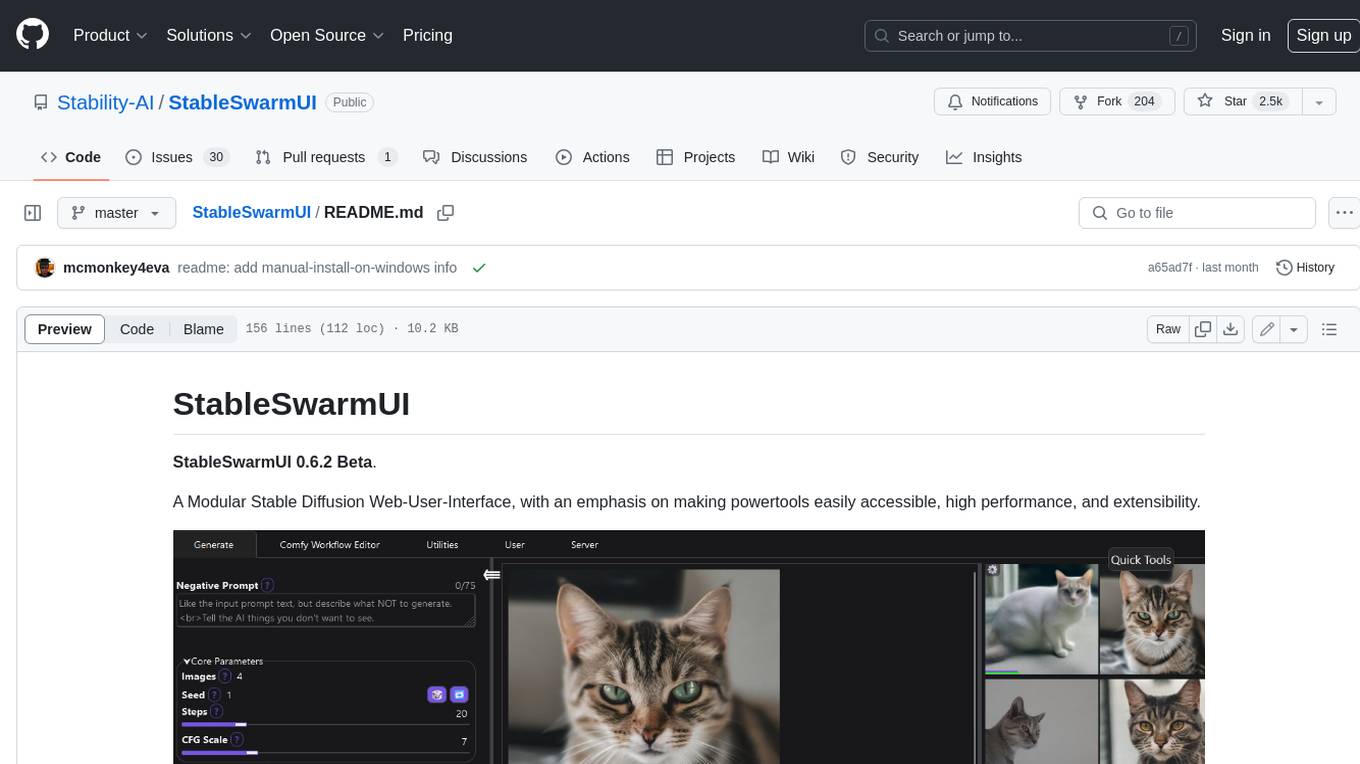
StableSwarmUI
StableSwarmUI is a modular Stable Diffusion web user interface that emphasizes making power tools easily accessible, high performance, and extensible. It is designed to be a one-stop-shop for all things Stable Diffusion, providing a wide range of features and capabilities to enhance the user experience.
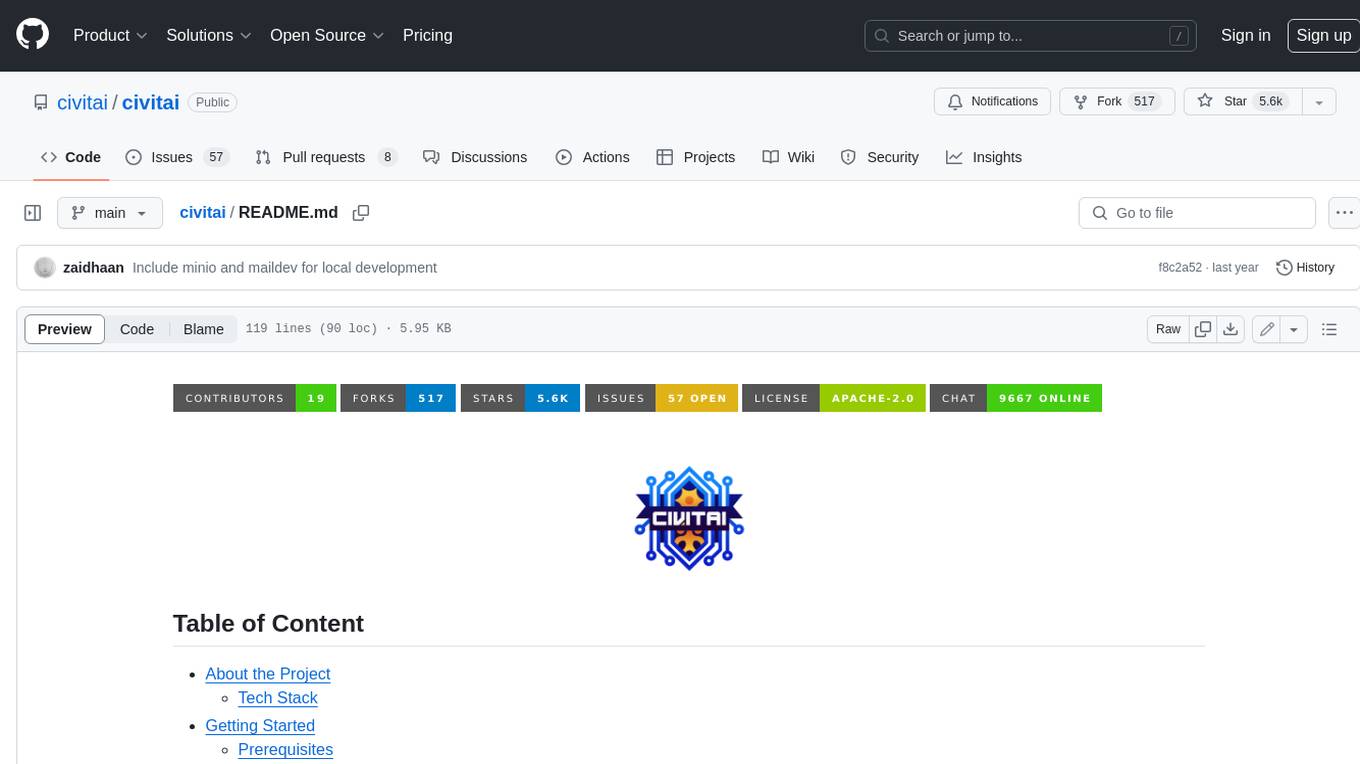
civitai
Civitai is a platform where people can share their stable diffusion models (textual inversions, hypernetworks, aesthetic gradients, VAEs, and any other crazy stuff people do to customize their AI generations), collaborate with others to improve them, and learn from each other's work. The platform allows users to create an account, upload their models, and browse models that have been shared by others. Users can also leave comments and feedback on each other's models to facilitate collaboration and knowledge sharing.
Awesome-Segment-Anything
The Segment Anything Model (SAM) is a powerful tool that allows users to segment any object in an image with just a few clicks. This makes it a great tool for a variety of tasks, such as object detection, tracking, and editing. SAM is also very easy to use, making it a great option for both beginners and experienced users.
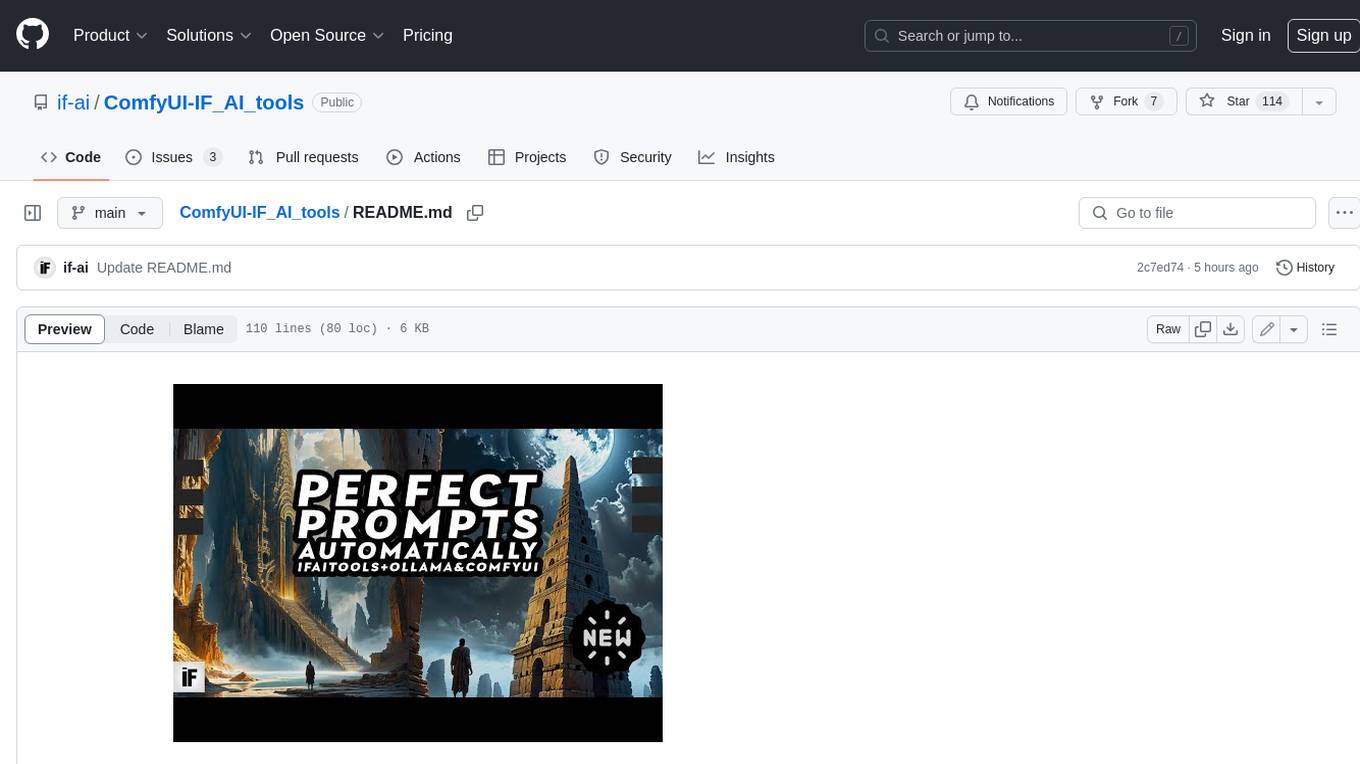
ComfyUI-IF_AI_tools
ComfyUI-IF_AI_tools is a set of custom nodes for ComfyUI that allows you to generate prompts using a local Large Language Model (LLM) via Ollama. This tool enables you to enhance your image generation workflow by leveraging the power of language models.
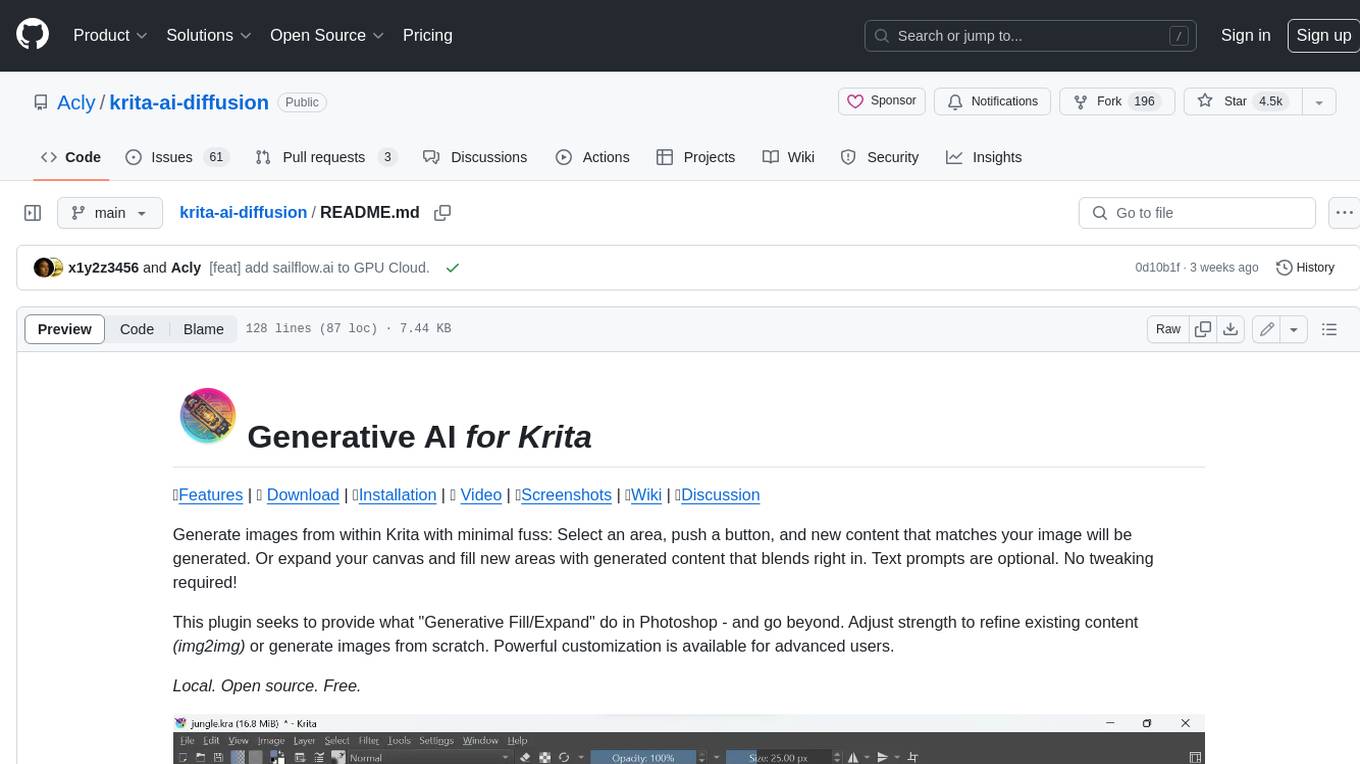
krita-ai-diffusion
Krita-AI-Diffusion is a plugin for Krita that allows users to generate images from within the program. It offers a variety of features, including inpainting, outpainting, generating images from scratch, refining existing content, live painting, and control over image creation. The plugin is designed to fit into an interactive workflow where AI generation is used as just another tool while painting. It is meant to synergize with traditional tools and the layer stack.
ai-toolkit
The AI Toolkit by Ostris is a collection of tools for machine learning, specifically designed for image generation, LoRA (latent representations of attributes) extraction and manipulation, and model training. It provides a user-friendly interface and extensive documentation to make it accessible to both developers and non-developers. The toolkit is actively under development, with new features and improvements being added regularly. Some of the key features of the AI Toolkit include: - Batch Image Generation: Allows users to generate a batch of images based on prompts or text files, using a configuration file to specify the desired settings. - LoRA (lierla), LoCON (LyCORIS) Extractor: Facilitates the extraction of LoRA and LoCON representations from pre-trained models, enabling users to modify and manipulate these representations for various purposes. - LoRA Rescale: Provides a tool to rescale LoRA weights, allowing users to adjust the influence of specific attributes in the generated images. - LoRA Slider Trainer: Enables the training of LoRA sliders, which can be used to control and adjust specific attributes in the generated images, offering a powerful tool for fine-tuning and customization. - Extensions: Supports the creation and sharing of custom extensions, allowing users to extend the functionality of the toolkit with their own tools and scripts. - VAE (Variational Auto Encoder) Trainer: Facilitates the training of VAEs for image generation, providing users with a tool to explore and improve the quality of generated images. The AI Toolkit is a valuable resource for anyone interested in exploring and utilizing machine learning for image generation and manipulation. Its user-friendly interface, extensive documentation, and active development make it an accessible and powerful tool for both beginners and experienced users.
clarifai-python
The Clarifai Python SDK offers a comprehensive set of tools to integrate Clarifai's AI platform to leverage computer vision capabilities like classification , detection ,segementation and natural language capabilities like classification , summarisation , generation , Q&A ,etc into your applications. With just a few lines of code, you can leverage cutting-edge artificial intelligence to unlock valuable insights from visual and textual content.
ailia-models
The collection of pre-trained, state-of-the-art AI models. ailia SDK is a self-contained, cross-platform, high-speed inference SDK for AI. The ailia SDK provides a consistent C++ API across Windows, Mac, Linux, iOS, Android, Jetson, and Raspberry Pi platforms. It also supports Unity (C#), Python, Rust, Flutter(Dart) and JNI for efficient AI implementation. The ailia SDK makes extensive use of the GPU through Vulkan and Metal to enable accelerated computing. # Supported models 323 models as of April 8th, 2024