


Awesome-LLMOps
🎉 An awesome & curated list of best LLMOps tools.
Stars: 155
Awesome-LLMOps is a curated list of the best LLMOps tools, providing a comprehensive collection of frameworks and tools for building, deploying, and managing large language models (LLMs) and AI agents. The repository includes a wide range of tools for tasks such as building multimodal AI agents, fine-tuning models, orchestrating applications, evaluating models, and serving models for inference. It covers various aspects of the machine learning operations (MLOps) lifecycle, from training to deployment and observability. The tools listed in this repository cater to the needs of developers, data scientists, and machine learning engineers working with large language models and AI applications.
README:

🎉 An awesome & curated list of best LLMOps tools.
More than welcome to add a new project by simply opening an issue.
-
Cortex.cpp: Local AI API Platform.
-
DeepSpeed-MII: MII makes low-latency and high-throughput inference possible, powered by DeepSpeed.
-
llama-box: LM inference server implementation based on *.cpp.
-
Nvidia Dynamo: A Datacenter Scale Distributed Inference Serving Framework.
-
ipex-llm: Accelerate local LLM inference and finetuning (LLaMA, Mistral, ChatGLM, Qwen, DeepSeek, Mixtral, Gemma, Phi, MiniCPM, Qwen-VL, MiniCPM-V, etc.) on Intel XPU (e.g., local PC with iGPU and NPU, discrete GPU such as Arc, Flex and Max); seamlessly integrate with llama.cpp, Ollama, HuggingFace, LangChain, LlamaIndex, vLLM, DeepSpeed, Axolotl, etc.
-
LMDeploy: LMDeploy is a toolkit for compressing, deploying, and serving LLMs.
-
LoRAX: Multi-LoRA inference server that scales to 1000s of fine-tuned LLMs.
-
llama.cpp: LLM inference in C/C++.
-
Llumnix: Efficient and easy multi-instance LLM serving.
-
MInference: [NeurIPS'24 Spotlight, ICLR'25] To speed up Long-context LLMs' inference, approximate and dynamic sparse calculate the attention, which reduces inference latency by up to 10x for pre-filling on an A100 while maintaining accuracy.
-
MLC LLM: Universal LLM Deployment Engine with ML Compilation.
-
MLServer: An inference server for your machine learning models, including support for multiple frameworks, multi-model serving and more.
-
Ollama: Get up and running with Llama 3.3, DeepSeek-R1, Phi-4, Gemma 3, and other large language models.
-
OpenLLM: Run any open-source LLMs, such as DeepSeek and Llama, as OpenAI compatible API endpoint in the cloud.
-
OpenVINO: OpenVINO™ is an open source toolkit for optimizing and deploying AI inference.
-
Petals: 🌸 Run LLMs at home, BitTorrent-style. Fine-tuning and inference up to 10x faster than offloading
-
Ratchet: A cross-platform browser ML framework.
-
SGLang: SGLang is a fast serving framework for large language models and vision language models.
-
TinyGrad: You like pytorch? You like micrograd? You love tinygrad! ❤️
-
transformers.js: State-of-the-art Machine Learning for the web. Run 🤗 Transformers directly in your browser, with no need for a server!
-
Triton Inference Server: The Triton Inference Server provides an optimized cloud and edge inferencing solution.
-
Text Generation Inference: Large Language Model Text Generation Inference.
-
vLLM: A high-throughput and memory-efficient inference and serving engine for LLMs.
-
web-llm: High-performance In-browser LLM Inference Engine.
-
Xinference: Replace OpenAI GPT with another LLM in your app by changing a single line of code. Xinference gives you the freedom to use any LLM you need. With Xinference, you're empowered to run inference with any open-source language models, speech recognition models, and multimodal models, whether in the cloud, on-premises, or even on your laptop.
-
zml: Any model. Any hardware. Zero compromise. Built with @ziglang / @openxla / MLIR / @bazelbuild.















































































-
AIBrix: Cost-efficient and pluggable Infrastructure components for GenAI inference.
-
BentoML: The easiest way to serve AI apps and models - Build Model Inference APIs, Job queues, LLM apps, Multi-model pipelines, and more!
-
beta9: Ultrafast serverless GPU inference, sandboxes, and background jobs
-
Kaito: Kubernetes operator for large-model inference and fine-tuning, with GPU auto-provisioning, container-based hosting, and CRD-based orchestration.
-
Kserve: Standardized Serverless ML Inference Platform on Kubernetes.
-
KubeAI: AI Inference Operator for Kubernetes. The easiest way to serve ML models in production. Supports VLMs, LLMs, embeddings, and speech-to-text.
-
llm-d: llm-d is a Kubernetes-native high-performance distributed LLM inference framework
-
llmaz: ☸️ Easy, advanced inference platform for large language models on Kubernetes. 🌟 Star to support our work!
-
Modular: The Modular Platform (includes MAX & Mojo)
-
Mooncake: Mooncake is the serving platform for Kimi, a leading LLM service provided by Moonshot AI.
-
OME: OME is a Kubernetes operator for enterprise-grade management and serving of Large Language Models (LLMs)

































-
Checkpoint Engine: Checkpoint-engine is a simple middleware to update model weights in LLM inference engines
-
LMCache: 10x Faster Long-Context LLM By Smart KV Cache Optimizations.





-
AI Gateway: A blazing fast AI Gateway with integrated guardrails. Route to 200+ LLMs, 50+ AI Guardrails with 1 fast & friendly API.
-
LiteLLM: Python SDK, Proxy Server (LLM Gateway) to call 100+ LLM APIs in OpenAI format - [Bedrock, Azure, OpenAI, VertexAI, Cohere, Anthropic, Sagemaker, HuggingFace, Replicate, Groq].
-
RouteLLM: A framework for serving and evaluating LLM routers - save LLM costs without compromising quality.
-
vLLM Semantic Router: Intelligent Mixture-of-Models Router for Efficient LLM Inference












-
agentgateway: Next Generation Agentic Proxy for AI Agents and MCP servers
-
APISIX: The Cloud-Native API Gateway and AI Gateway with extensive plugin system and AI capabilities.
-
Envoy AI Gateway: Envoy AI Gateway is an open source project for using Envoy Gateway to handle request traffic from application clients to Generative AI services.
-
Higress: 🤖 AI Gateway | AI Native API Gateway.
-
kgateway: The Cloud-Native API Gateway and AI Gateway.
-
Kong: 🦍 The Cloud-Native API Gateway and AI Gateway.
-
gateway-api-inference-extension: Gateway API Inference Extension.





















-
Instructor: structured outputs for llms.
-
Outlines: Structured Text Generation.
-
XGrammar: Fast, Flexible and Portable Structured Generation









-
Vidur: A large-scale simulation framework for LLM inference



-
genai-bench: Genai-bench is a powerful benchmark tool designed for comprehensive token-level performance evaluation of large language model (LLM) serving systems.
-
Inference Benchmark: A model server agnostic inference benchmarking tool that can be used to benchmark LLMs running on differet infrastructure like GPU and TPU. It can also be run on a GKE cluster as a container.
-
Inference Perf: GenAI inference performance benchmarking tool








-
Dify: Production-ready platform for agentic workflow development.
-
FastGPT: FastGPT is a knowledge-based platform built on the LLMs, offers a comprehensive suite of out-of-the-box capabilities such as data processing, RAG retrieval, and visual AI workflow orchestration, letting you easily develop and deploy complex question-answering systems without the need for extensive setup or configuration.
-
Haystack: AI orchestration framework to build customizable, production-ready LLM applications. Connect components (models, vector DBs, file converters) to pipelines or agents that can interact with your data. With advanced retrieval methods, it's best suited for building RAG, question answering, semantic search or conversational agent chatbots.
-
Inference: Turn any computer or edge device into a command center for your computer vision projects.
-
LangChain: 🦜🔗 Build context-aware reasoning applications.
-
LlamaIndex: LlamaIndex is the leading framework for building LLM-powered agents over your data.



















-
Agent Development Kit (ADK): An open-source, code-first Python toolkit for building, evaluating, and deploying sophisticated AI agents with flexibility and control.
-
Agno: Open-source framework for building multi-agent systems with memory, knowledge and reasoning.
-
autogen: A programming framework for agentic AI
-
AutoGPT: AutoGPT is the vision of accessible AI for everyone, to use and to build on. Our mission is to provide the tools, so that you can focus on what matters.
-
CAMEL: 🐫 CAMEL: The first and the best multi-agent framework. Finding the Scaling Law of Agents.
-
crewAI: Framework for orchestrating role-playing, autonomous AI agents. By fostering collaborative intelligence, CrewAI empowers agents to work together seamlessly, tackling complex tasks.
-
fast-agent: Define, Prompt and Test MCP enabled Agents and Workflows
-
Flowise: Build AI Agents, Visually
-
kagent: kagent is a kubernetes native framework for building AI agents.
-
LangGraph: Build resilient language agents as graphs.
-
MetaGPT: 🌟 The Multi-Agent Framework: First AI Software Company, Towards Natural Language Programming.
-
OpenAI Agents SDK: A lightweight, powerful framework for multi-agent workflows.
-
PydanticAI: GenAI Agent Framework, the Pydantic way
-
Qwen-Agent: Agent framework and applications built upon Qwen>=3.0, featuring Function Calling, MCP, Code Interpreter, RAG, Chrome extension, etc.
-
Semantic Kernel: Integrate cutting-edge LLM technology quickly and easily into your apps.
-
Suna: Suna - Open Source Generalist AI Agent
-
Swarm: Educational framework exploring ergonomic, lightweight multi-agent orchestration. Managed by OpenAI Solution team.




















































-
GraphRAG: A modular graph-based Retrieval-Augmented Generation (RAG) system.
-
LightRAG: "LightRAG: Simple and Fast Retrieval-Augmented Generation"
-
quivr: Opiniated RAG for integrating GenAI in your apps 🧠 Focus on your product rather than the RAG. Easy integration in existing products with customisation! Any LLM: GPT4, Groq, Llama. Any Vectorstore: PGVector, Faiss. Any Files. Anyway you want.
-
RAGFlow: RAGFlow is an open-source RAG (Retrieval-Augmented Generation) engine based on deep document understanding.












-
DeepEval: The LLM Evaluation Framework
-
Evidently: Evidently is an open-source ML and LLM observability framework. Evaluate, test, and monitor any AI-powered system or data pipeline. From tabular data to Gen AI. 100+ metrics.
-
Langfuse: 🪢 Open source LLM engineering platform: LLM Observability, metrics, evals, prompt management, playground, datasets. Integrates with OpenTelemetry, Langchain, OpenAI SDK, LiteLLM, and more. 🍊YC W23
-
Helicone: 🧊 Open source LLM observability platform. One line of code to monitor, evaluate, and experiment. YC W23 🍓
-
lunaary: The production toolkit for LLMs. Observability, prompt management and evaluations.
-
OpenLIT: Open source platform for AI Engineering: OpenTelemetry-native LLM Observability, GPU Monitoring, Guardrails, Evaluations, Prompt Management, Vault, Playground. 🚀💻 Integrates with 50+ LLM Providers, VectorDBs, Agent Frameworks and GPUs.
-
phoenix: AI Observability & Evaluation.
-
PostHog: 🦔 PostHog provides open-source web & product analytics, session recording, feature flagging and A/B testing that you can self-host. Get started - free.
-
ragas: Supercharge Your LLM Application Evaluations 🚀
-
Weave: Weave is a toolkit for developing AI-powered applications, built by Weights & Biases.






























-
aider: aider is AI pair programming in your terminal
-
Codex: Lightweight coding agent that runs in your terminal
-
Crush: The glamourous AI coding agent for your favourite terminal 💘
-
Gemini CLI: An open-source AI agent that brings the power of Gemini directly into your terminal.













-
goose: an open source, extensible AI agent that goes beyond code suggestions - install, execute, edit, and test with any LLM
-
Magentic-UI: A research prototype of a human-centered web agent
-
OpenManus: No fortress, purely open ground. OpenManus is Coming.
-
Tongyi Deep Research: Tongyi DeepResearch, the Leading Open-source DeepResearch Agent












-
Continue: ⏩ Create, share, and use custom AI code assistants with our open-source IDE extensions and hub of models, rules, prompts, docs, and other building blocks.
-
Open SWE: An Open-Source Asynchronous Coding Agent
-
SWE-agent: SWE-agent takes a GitHub issue and tries to automatically fix it, using your LM of choice. It can also be employed for offensive cybersecurity or competitive coding challenges. [NeurIPS 2024]
-
Tabby: Self-hosted AI coding assistant.












-
Browser Use: Make websites accessible for AI agents.
-
Graphiti: Build Real-Time Knowledge Graphs for AI Agents.
-
Mem0: The Memory layer for AI Agents.
-
OpenAI CUA: Computer Using Agent Sample App.












-
5ire: 5ire is a cross-platform desktop AI assistant, MCP client. It compatible with major service providers, supports local knowledge base and tools via model context protocol servers.
-
AnythingLLM: The all-in-one Desktop & Docker AI application with built-in RAG, AI agents, No-code agent builder, MCP compatibility, and more.
-
Chat SDK: A full-featured, hackable Next.js AI chatbot built by Vercel
-
Chatbot UI: AI chat for any model.
-
Cherry Studio: 🍒 Cherry Studio is a desktop client that supports for multiple LLM providers. Support deepseek-r1.
-
FastChat: An open platform for training, serving, and evaluating large language models. Release repo for Vicuna and Chatbot Arena.
-
Gradio: Build and share delightful machine learning apps, all in Python. 🌟 Star to support our work!
-
Jan: Jan is an open source alternative to ChatGPT that runs 100% offline on your computer.
-
LLM: Access large language models from the command-line
-
Lobe Chat: 🤯 Lobe Chat - an open-source, modern-design AI chat framework. Supports Multi AI Providers( OpenAI / Claude 3 / Gemini / Ollama / DeepSeek / Qwen), Knowledge Base (file upload / knowledge management / RAG ), Multi-Modals (Plugins/Artifacts) and Thinking. One-click FREE deployment of your private ChatGPT/ Claude / DeepSeek application.
-
NextChat: ✨ Light and Fast AI Assistant. Support: Web | iOS | MacOS | Android | Linux | Windows.
-
opcode: A powerful GUI app and Toolkit for Claude Code - Create custom agents, manage interactive Claude Code sessions, run secure background agents, and more.
-
Open WebUI: User-friendly AI Interface (Supports Ollama, OpenAI API, ...).
-
PrivateGPT: Interact with your documents using the power of GPT, 100% privately, no data leaks.










































-
chroma: the AI-native open-source embedding database.
-
deeplake: Database for AI. Store Vectors, Images, Texts, Videos, etc. Use with LLMs/LangChain. Store, query, version, & visualize any AI data. Stream data in real-time to PyTorch/TensorFlow.
-
Faiss: A library for efficient similarity search and clustering of dense vectors.
-
milvus: Milvus is a high-performance, cloud-native vector database built for scalable vector ANN search.
-
weaviate: Weaviate is an open-source vector database that stores both objects and vectors, allowing for the combination of vector search with structured filtering with the fault tolerance and scalability of a cloud-native database.















-
Daytona: Daytona is a Secure and Elastic Infrastructure for Running AI-Generated Code.
-
E2B: Secure open source cloud runtime for AI apps & AI agents.






-
OpenLLMetry: Open-source observability for your LLM application, based on OpenTelemetry.
-
wandb: The AI developer platform. Use Weights & Biases to train and fine-tune models, and manage models from experimentation to production.






-
AXLearn: An Extensible Deep Learning Library
-
Candle: Minimalist ML framework for Rust.
-
ColossalAI: Making large AI models cheaper, faster and more accessible.
-
DLRover: DLRover: An Automatic Distributed Deep Learning System
-
Ludwig: Low-code framework for building custom LLMs, neural networks, and other AI models.
-
MaxText: A simple, performant and scalable Jax LLM!
-
MLX: MLX: An array framework for Apple silicon.





















-
Axolotl: Go ahead and axolotl questions.
-
EasyLM: Large language models (LLMs) made easy, EasyLM is a one stop solution for pre-training, finetuning, evaluating and serving LLMs in JAX/Flax.
-
LLaMa-Factory: Unified Efficient Fine-Tuning of 100+ LLMs & VLMs (ACL 2024).
-
LMFlow: An Extensible Toolkit for Finetuning and Inference of Large Foundation Models. Large Models for All.
-
maestro: streamline the fine-tuning process for multimodal models: PaliGemma 2, Florence-2, and Qwen2.5-VL.
-
MLX-VLM: MLX-VLM is a package for inference and fine-tuning of Vision Language Models (VLMs) on your Mac using MLX.
-
Swift: Use PEFT or Full-parameter to finetune 450+ LLMs (Qwen2.5, InternLM3, GLM4, Llama3.3, Mistral, Yi1.5, Baichuan2, DeepSeek-R1, ...) and 150+ MLLMs (Qwen2.5-VL, Qwen2-Audio, Llama3.2-Vision, Llava, InternVL2.5, MiniCPM-V-2.6, GLM4v, Xcomposer2.5, Yi-VL, DeepSeek-VL2, Phi3.5-Vision, GOT-OCR2, ...).
-
torchtune: PyTorch native post-training library.
-
Transformer Lab: Open Source Application for Advanced LLM Engineering: interact, train, fine-tune, and evaluate large language models on your own computer.
-
unsloth: Finetune Llama 3.3, DeepSeek-R1 & Reasoning LLMs 2x faster with 70% less memory! 🦥





























-
OpenRLHF: An Easy-to-use, Scalable and High-performance RLHF Framework (70B+ PPO Full Tuning & Iterative DPO & LoRA & RingAttention & RFT).
-
Self-RLHF: Safe RLHF: Constrained Value Alignment via Safe Reinforcement Learning from Human Feedback.




-
AgentBench: A Comprehensive Benchmark to Evaluate LLMs as Agents (ICLR'24).
-
ASQI Engineer: ASQI (AI Solutions Quality Index) Engineer - run containerised AI tests and map to score cards!
-
LiveBench: LiveBench: A Challenging, Contamination-Free LLM Benchmark
-
lm-evaluation-harness: A framework for few-shot evaluation of language models.
-
LongBench: LongBench v2 and LongBench (ACL 2024).
-
MLE-bench: MLE-bench is a benchmark for measuring how well AI agents perform at machine learning engineering
-
OpenCompass: OpenCompass is an LLM evaluation platform, supporting a wide range of models (Llama3, Mistral, InternLM2,GPT-4,LLaMa2, Qwen,GLM, Claude, etc) over 100+ datasets.
-
opik: Debug, evaluate, and monitor your LLM applications, RAG systems, and agentic workflows with comprehensive tracing, automated evaluations, and production-ready dashboards.
-
terminal-bench: A benchmark for LLMs on complicated tasks in the terminal



























-
Flyte: Scalable and flexible workflow orchestration platform that seamlessly unifies data, ML and analytics stacks.
-
Kubeflow: Machine Learning Toolkit for Kubernetes.
-
Metaflow: Build, Deploy and Manage AI/ML Systems.
-
MLflow: Open source platform for the machine learning lifecycle.
-
Polyaxon: MLOps Tools For Managing & Orchestrating The Machine Learning LifeCycle.
-
Ray: Ray is an AI compute engine. Ray consists of a core distributed runtime and a set of AI Libraries for accelerating ML workloads.
-
Seldon-Core: An MLOps framework to package, deploy, monitor and manage thousands of production machine learning models.
-
ZenML: ZenML 🙏: The bridge between ML and Ops. https://zenml.io.
























For Tasks:
Click tags to check more tools for each tasksFor Jobs:
Alternative AI tools for Awesome-LLMOps
Similar Open Source Tools
Awesome-LLMOps
Awesome-LLMOps is a curated list of the best LLMOps tools, providing a comprehensive collection of frameworks and tools for building, deploying, and managing large language models (LLMs) and AI agents. The repository includes a wide range of tools for tasks such as building multimodal AI agents, fine-tuning models, orchestrating applications, evaluating models, and serving models for inference. It covers various aspects of the machine learning operations (MLOps) lifecycle, from training to deployment and observability. The tools listed in this repository cater to the needs of developers, data scientists, and machine learning engineers working with large language models and AI applications.
Awesome-Segment-Anything
The Segment Anything Model (SAM) is a powerful tool that allows users to segment any object in an image with just a few clicks. This makes it a great tool for a variety of tasks, such as object detection, tracking, and editing. SAM is also very easy to use, making it a great option for both beginners and experienced users.
Awesome-LLM-RAG-Application
Awesome-LLM-RAG-Application is a repository that provides resources and information about applications based on Large Language Models (LLM) with Retrieval-Augmented Generation (RAG) pattern. It includes a survey paper, GitHub repo, and guides on advanced RAG techniques. The repository covers various aspects of RAG, including academic papers, evaluation benchmarks, downstream tasks, tools, and technologies. It also explores different frameworks, preprocessing tools, routing mechanisms, evaluation frameworks, embeddings, security guardrails, prompting tools, SQL enhancements, LLM deployment, observability tools, and more. The repository aims to offer comprehensive knowledge on RAG for readers interested in exploring and implementing LLM-based systems and products.
ai_paper
The AI Paper tool is a powerful platform for generating various types of academic papers, including graduation papers, course papers, journal papers, title papers, opening reports, task books, AIGC reduction, and custom literature. It supports unlimited revisions, AI 4.0 technology, AIGC rate reduction, custom references, outlines, feeding of materials, various types of charts and tables, multiple languages, and anonymous mode. The tool offers a wide range of paper formats and supports tasks like writing papers, assignments, internship reports, job planning, and long-form writing.
KouriChat
KouriChat is a project that seamlessly integrates virtual and real interactions, providing eternal gentle bonds. It offers features like WeChat integration, immersive role-playing, intelligent conversation segmentation, emotion-based emojis, image generation, image recognition, voice messages, and more. The project is focused on technical research and learning exchanges, with a strong emphasis on ethical and legal guidelines. Users are required to take full responsibility for their actions, especially minors who should use the tool under supervision. The project architecture includes avatar configurations, data storage, handlers, AI service interfaces, a web UI, and utility libraries.
MirrorFlow
MirrorFlow is an end-to-end toolchain for dialogue data processing, cleaning/extraction, trainable samples generation, fine-tuning/distillation, and usage with evaluation. It supports two main routes: 'Digital Self' for fine-tuning chat records to mimic user expression habits and 'GPT-4o Style Alignment' for aligning output structures, clarification methods, refusal habits, and tool invocation behavior.
amazongpt
AmazonGPT is a userscript that enhances the Amazon shopping experience with AI chat and product/category summaries powered by the latest LLMs. Users can engage with the AI bot on Amazon.com after installing the userscript using a userscript manager. The tool is compatible with various browsers and userscript managers, providing a seamless experience for users looking to leverage AI capabilities while shopping on Amazon. The tool is supported by various dependencies and contributors, ensuring continuous development and improvement. Additionally, the tool is generously funded by Cloudflare for serverless computing.
langchat
LangChat is an enterprise AIGC project solution in the Java ecosystem. It integrates AIGC large model functionality on top of the RBAC permission system to help enterprises quickly customize AI knowledge bases and enterprise AI robots. It supports integration with various large models such as OpenAI, Gemini, Ollama, Azure, Zhifu, Alibaba Tongyi, Baidu Qianfan, etc. The project is developed solely by TyCoding and is continuously evolving. It features multi-modality, dynamic configuration, knowledge base support, advanced RAG capabilities, function call customization, multi-channel deployment, workflows visualization, AIGC client application, and more.
bravegpt
BraveGPT is a userscript that brings the power of ChatGPT to Brave Search. It allows users to engage with a conversational AI assistant directly within their search results, providing instant and personalized responses to their queries. BraveGPT is powered by GPT-4, the latest and most advanced language model from OpenAI, ensuring accurate and comprehensive answers. With BraveGPT, users can ask questions, get summaries, generate creative content, and more, all without leaving the Brave Search interface. The tool is easy to install and use, making it accessible to users of all levels. BraveGPT is a valuable addition to the Brave Search experience, enhancing its capabilities and providing users with a more efficient and informative search experience.
agenta
Agenta is an open-source LLM developer platform for prompt engineering, evaluation, human feedback, and deployment of complex LLM applications. It provides tools for prompt engineering and management, evaluation, human annotation, and deployment, all without imposing any restrictions on your choice of framework, library, or model. Agenta allows developers and product teams to collaborate in building production-grade LLM-powered applications in less time.
duckduckgpt
DuckDuckGPT brings the magic of ChatGPT to DDG (powered by GPT-4!). DuckDuckGPT is a browser extension that allows you to use ChatGPT within DuckDuckGo. This means you can ask ChatGPT questions, get help with tasks, and generate creative content, all without leaving DuckDuckGo. DuckDuckGPT is easy to use. Once you have installed the extension, simply type your question into the DuckDuckGo search bar and hit enter. ChatGPT will then generate a response that will appear below the search results. DuckDuckGPT is a powerful tool that can help you with a wide variety of tasks. Here are just a few examples of what you can use it for: * Get help with research * Write essays and other creative content * Translate languages * Get coding help * Answer trivia questions * And much more! DuckDuckGPT is still in development, but it is already a very powerful tool. As GPT-4 continues to improve, DuckDuckGPT will only get better. So if you are looking for a way to make your DuckDuckGo searches more productive, be sure to give DuckDuckGPT a try.
googlegpt
GoogleGPT is a browser extension that brings the power of ChatGPT to Google Search. With GoogleGPT, you can ask ChatGPT questions and get answers directly in your search results. You can also use GoogleGPT to generate text, translate languages, and more. GoogleGPT is compatible with all major browsers, including Chrome, Firefox, Edge, and Safari.
aituber-kit
AITuber-Kit is a tool that enables users to interact with AI characters, conduct AITuber live streams, and engage in external integration modes. Users can easily converse with AI characters using various LLM APIs, stream on YouTube with AI character reactions, and send messages to server apps via WebSocket. The tool provides settings for API keys, character configurations, voice synthesis engines, and more. It supports multiple languages and allows customization of VRM models and background images. AITuber-Kit follows the MIT license and offers guidelines for adding new languages to the project.
Awesome-Efficient-Agents
This repository, Awesome Efficient Agents, is a curated collection of papers focusing on memory, tool learning, and planning in agentic systems. It provides a comprehensive survey of efficient agent design, emphasizing memory construction, tool learning, and planning strategies. The repository categorizes papers based on memory processes, tool selection, tool calling, tool-integrated reasoning, and planning efficiency. It aims to help readers quickly access representative work in the field of efficient agent design.
goodsKill
The 'goodsKill' project aims to build a complete project framework integrating good technologies and development techniques, mainly focusing on backend technologies. It provides a simulated flash sale project with unified flash sale simulation request interface. The project uses SpringMVC + Mybatis for the overall technology stack, Dubbo3.x for service intercommunication, Nacos for service registration and discovery, and Spring State Machine for data state transitions. It also integrates Spring AI service for simulating flash sale actions.
koko-aio-slang
Koko-aio shader is an all-in-one CRT shader tool that can be configured with various parameters to run on different GPUs. It aims to provide visual parameters to make monitors look similar to CRT displays without simulating their internal behavior. The tool includes features such as color corrections, B/W display colorization, antialiasing, noise effects, deconvergence, blurring/sharpening, interlacing, phosphor glow, and more. It also supports ambient lighting, vignette, integer scaling, and various image effects. Koko-aio is designed to enhance the visual experience of low-res content on high-resolution displays.
For similar tasks
Awesome-LLMOps
Awesome-LLMOps is a curated list of the best LLMOps tools, providing a comprehensive collection of frameworks and tools for building, deploying, and managing large language models (LLMs) and AI agents. The repository includes a wide range of tools for tasks such as building multimodal AI agents, fine-tuning models, orchestrating applications, evaluating models, and serving models for inference. It covers various aspects of the machine learning operations (MLOps) lifecycle, from training to deployment and observability. The tools listed in this repository cater to the needs of developers, data scientists, and machine learning engineers working with large language models and AI applications.
labelbox-python
Labelbox is a data-centric AI platform for enterprises to develop, optimize, and use AI to solve problems and power new products and services. Enterprises use Labelbox to curate data, generate high-quality human feedback data for computer vision and LLMs, evaluate model performance, and automate tasks by combining AI and human-centric workflows. The academic & research community uses Labelbox for cutting-edge AI research.
promptfoo
Promptfoo is a tool for testing and evaluating LLM output quality. With promptfoo, you can build reliable prompts, models, and RAGs with benchmarks specific to your use-case, speed up evaluations with caching, concurrency, and live reloading, score outputs automatically by defining metrics, use as a CLI, library, or in CI/CD, and use OpenAI, Anthropic, Azure, Google, HuggingFace, open-source models like Llama, or integrate custom API providers for any LLM API.
vespa
Vespa is a platform that performs operations such as selecting a subset of data in a large corpus, evaluating machine-learned models over the selected data, organizing and aggregating it, and returning it, typically in less than 100 milliseconds, all while the data corpus is continuously changing. It has been in development for many years and is used on a number of large internet services and apps which serve hundreds of thousands of queries from Vespa per second.
python-aiplatform
The Vertex AI SDK for Python is a library that provides a convenient way to use the Vertex AI API. It offers a high-level interface for creating and managing Vertex AI resources, such as datasets, models, and endpoints. The SDK also provides support for training and deploying custom models, as well as using AutoML models. With the Vertex AI SDK for Python, you can quickly and easily build and deploy machine learning models on Vertex AI.
ScandEval
ScandEval is a framework for evaluating pretrained language models on mono- or multilingual language tasks. It provides a unified interface for benchmarking models on a variety of tasks, including sentiment analysis, question answering, and machine translation. ScandEval is designed to be easy to use and extensible, making it a valuable tool for researchers and practitioners alike.
opencompass
OpenCompass is a one-stop platform for large model evaluation, aiming to provide a fair, open, and reproducible benchmark for large model evaluation. Its main features include: * Comprehensive support for models and datasets: Pre-support for 20+ HuggingFace and API models, a model evaluation scheme of 70+ datasets with about 400,000 questions, comprehensively evaluating the capabilities of the models in five dimensions. * Efficient distributed evaluation: One line command to implement task division and distributed evaluation, completing the full evaluation of billion-scale models in just a few hours. * Diversified evaluation paradigms: Support for zero-shot, few-shot, and chain-of-thought evaluations, combined with standard or dialogue-type prompt templates, to easily stimulate the maximum performance of various models. * Modular design with high extensibility: Want to add new models or datasets, customize an advanced task division strategy, or even support a new cluster management system? Everything about OpenCompass can be easily expanded! * Experiment management and reporting mechanism: Use config files to fully record each experiment, and support real-time reporting of results.
flower
Flower is a framework for building federated learning systems. It is designed to be customizable, extensible, framework-agnostic, and understandable. Flower can be used with any machine learning framework, for example, PyTorch, TensorFlow, Hugging Face Transformers, PyTorch Lightning, scikit-learn, JAX, TFLite, MONAI, fastai, MLX, XGBoost, Pandas for federated analytics, or even raw NumPy for users who enjoy computing gradients by hand.
For similar jobs
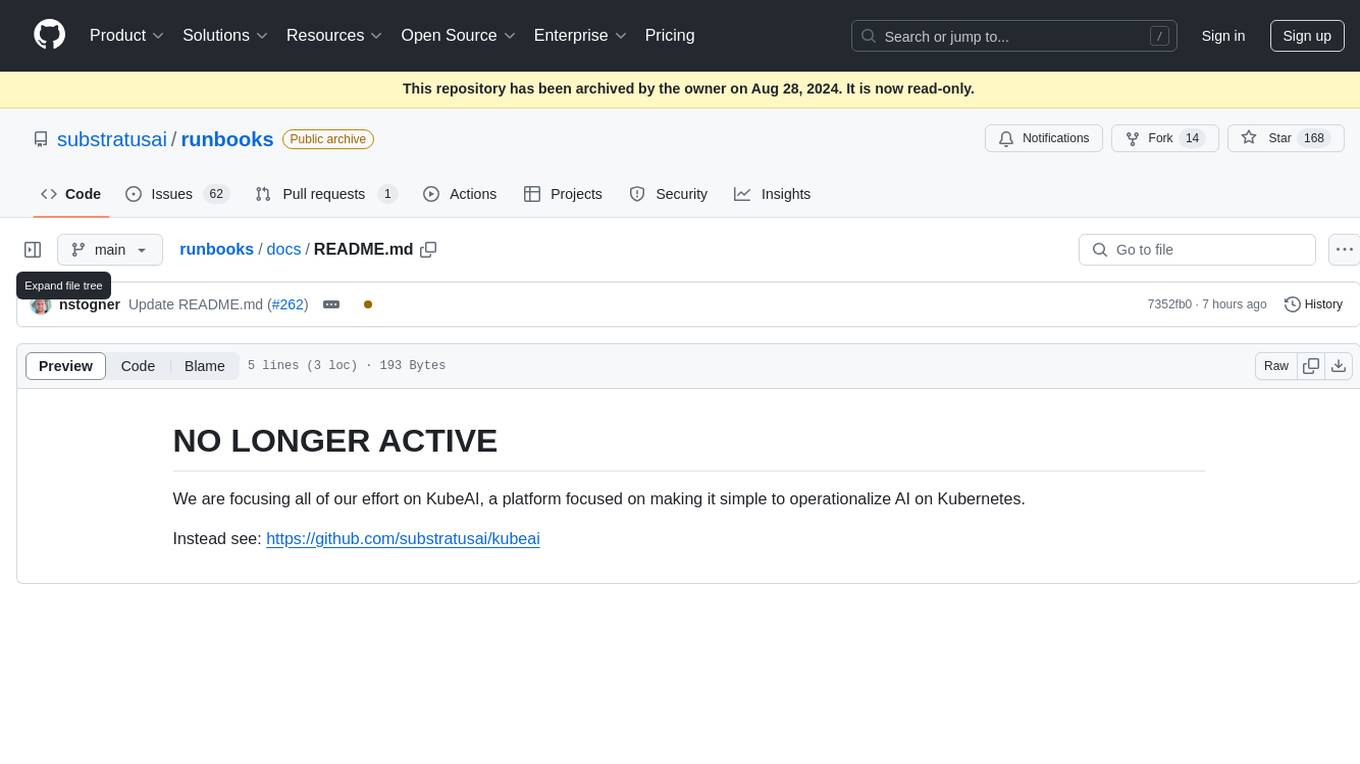
runbooks
Runbooks is a repository that is no longer active. The project has been deprecated in favor of KubeAI, a platform designed to simplify the operationalization of AI on Kubernetes. For more information, please refer to the new repository at https://github.com/substratusai/kubeai.
aiops-modules
AIOps Modules is a collection of reusable Infrastructure as Code (IAC) modules that work with SeedFarmer CLI. The modules are decoupled and can be aggregated using GitOps principles to achieve desired use cases, removing heavy lifting for end users. They must be generic for reuse in Machine Learning and Foundation Model Operations domain, adhering to SeedFarmer Guide structure. The repository includes deployment steps, project manifests, and various modules for SageMaker, Mlflow, FMOps/LLMOps, MWAA, Step Functions, EKS, and example use cases. It also supports Industry Data Framework (IDF) and Autonomous Driving Data Framework (ADDF) Modules.
Awesome-LLMOps
Awesome-LLMOps is a curated list of the best LLMOps tools, providing a comprehensive collection of frameworks and tools for building, deploying, and managing large language models (LLMs) and AI agents. The repository includes a wide range of tools for tasks such as building multimodal AI agents, fine-tuning models, orchestrating applications, evaluating models, and serving models for inference. It covers various aspects of the machine learning operations (MLOps) lifecycle, from training to deployment and observability. The tools listed in this repository cater to the needs of developers, data scientists, and machine learning engineers working with large language models and AI applications.
skyflo
Skyflo.ai is an AI agent designed for Cloud Native operations, providing seamless infrastructure management through natural language interactions. It serves as a safety-first co-pilot with a human-in-the-loop design. The tool offers flexible deployment options for both production and local Kubernetes environments, supporting various LLM providers and self-hosted models. Users can explore the architecture of Skyflo.ai and contribute to its development following the provided guidelines and Code of Conduct. The community engagement includes Discord, Twitter, YouTube, and GitHub Discussions.
AI-CloudOps
AI+CloudOps is a cloud-native operations management platform designed for enterprises. It aims to integrate artificial intelligence technology with cloud-native practices to significantly improve the efficiency and level of operations work. The platform offers features such as AIOps for monitoring data analysis and alerts, multi-dimensional permission management, visual CMDB for resource management, efficient ticketing system, deep integration with Prometheus for real-time monitoring, and unified Kubernetes management for cluster optimization.
kubectl-mcp-server
Control your entire Kubernetes infrastructure through natural language conversations with AI. Talk to your clusters like you talk to a DevOps expert. Debug crashed pods, optimize costs, deploy applications, audit security, manage Helm charts, and visualize dashboards—all through natural language. The tool provides 253 powerful tools, 8 workflow prompts, 8 data resources, and works with all major AI assistants. It offers AI-powered diagnostics, built-in cost optimization, enterprise-ready features, zero learning curve, universal compatibility, visual insights, and production-grade deployment options. From debugging crashed pods to optimizing cluster costs, kubectl-mcp-server is your AI-powered DevOps companion.
weave
Weave is a toolkit for developing Generative AI applications, built by Weights & Biases. With Weave, you can log and debug language model inputs, outputs, and traces; build rigorous, apples-to-apples evaluations for language model use cases; and organize all the information generated across the LLM workflow, from experimentation to evaluations to production. Weave aims to bring rigor, best-practices, and composability to the inherently experimental process of developing Generative AI software, without introducing cognitive overhead.
LLMStack
LLMStack is a no-code platform for building generative AI agents, workflows, and chatbots. It allows users to connect their own data, internal tools, and GPT-powered models without any coding experience. LLMStack can be deployed to the cloud or on-premise and can be accessed via HTTP API or triggered from Slack or Discord.