


Guardrails
NeMo Guardrails is an open-source toolkit for easily adding programmable guardrails to LLM-based conversational systems.
Stars: 5635
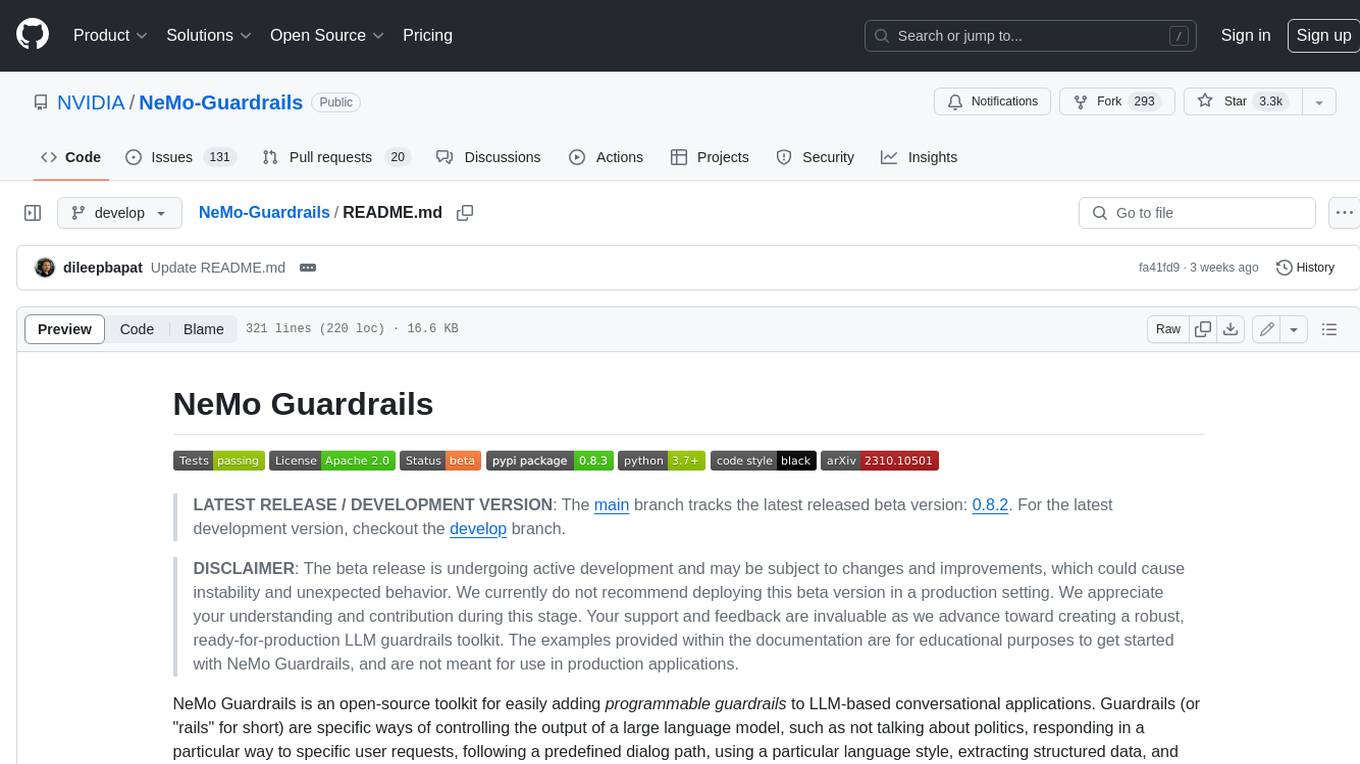
Guardrails is a security tool designed to help developers identify and fix security vulnerabilities in their code. It provides automated scanning and analysis of code repositories to detect potential security issues, such as sensitive data exposure, injection attacks, and insecure configurations. By integrating Guardrails into the development workflow, teams can proactively address security concerns and reduce the risk of security breaches. The tool offers detailed reports and actionable recommendations to guide developers in remediation efforts, ultimately improving the overall security posture of the codebase. Guardrails supports multiple programming languages and frameworks, making it versatile and adaptable to different development environments. With its user-friendly interface and seamless integration with popular version control systems, Guardrails empowers developers to prioritize security without compromising productivity.
README:












LATEST RELEASE / DEVELOPMENT VERSION: The main branch tracks the latest released beta version: 0.20.0. For the latest development version, checkout the develop branch.
✨✨✨
📌 The official NeMo Guardrails documentation has moved to docs.nvidia.com/nemo/guardrails.
✨✨✨
NeMo Guardrails is an open-source toolkit for easily adding programmable guardrails to LLM-based conversational applications. Guardrails (or "rails" for short) are specific ways of controlling the output of a large language model, such as not talking about politics, responding in a particular way to specific user requests, following a predefined dialog path, using a particular language style, extracting structured data, and more.
This paper introduces NeMo Guardrails and contains a technical overview of the system and the current evaluation.
Python 3.10, 3.11, 3.12 or 3.13.
NeMo Guardrails uses annoy which is a C++ library with Python bindings. To install NeMo Guardrails you will need to have the C++ compiler and dev tools installed. Check out the Installation Guide for platform-specific instructions.
To install using pip:
> pip install nemoguardrailsFor more detailed instructions, see the Installation Guide.
NeMo Guardrails enables developers building LLM-based applications to easily add programmable guardrails between the application code and the LLM.

Key benefits of adding programmable guardrails include:
-
Building Trustworthy, Safe, and Secure LLM-based Applications: you can define rails to guide and safeguard conversations; you can choose to define the behavior of your LLM-based application on specific topics and prevent it from engaging in discussions on unwanted topics.
-
Connecting models, chains, and other services securely: you can connect an LLM to other services (a.k.a. tools) seamlessly and securely.
-
Controllable dialog: you can steer the LLM to follow pre-defined conversational paths, allowing you to design the interaction following conversation design best practices and enforce standard operating procedures (e.g., authentication, support).
NeMo Guardrails provides several mechanisms for protecting an LLM-powered chat application against common LLM vulnerabilities, such as jailbreaks and prompt injections. Below is a sample overview of the protection offered by different guardrails configuration for the example ABC Bot included in this repository. For more details, please refer to the LLM Vulnerability Scanning page.

You can use programmable guardrails in different types of use cases:
- Question Answering over a set of documents (a.k.a. Retrieval Augmented Generation): Enforce fact-checking and output moderation.
- Domain-specific Assistants (a.k.a. chatbots): Ensure the assistant stays on topic and follows the designed conversational flows.
- LLM Endpoints: Add guardrails to your custom LLM for safer customer interaction.
- LangChain Chains: If you use LangChain for any use case, you can add a guardrails layer around your chains.
To add programmable guardrails to your application you can use the Python API or a guardrails server (see the Server Guide for more details). Using the Python API is similar to using the LLM directly. Calling the guardrails layer instead of the LLM requires only minimal changes to the code base, and it involves two simple steps:
- Loading a guardrails configuration and creating an
LLMRailsinstance. - Making the calls to the LLM using the
generate/generate_asyncmethods.
from nemoguardrails import LLMRails, RailsConfig

# Load a guardrails configuration from the specified path.
config = RailsConfig.from_path("PATH/TO/CONFIG")
rails = LLMRails(config)

completion = rails.generate(
    messages=[{"role": "user", "content": "Hello world!"}]
)
Sample output:
{"role": "assistant", "content": "Hi! How can I help you?"}The input and output format for the generate method is similar to the Chat Completions API from OpenAI.
NeMo Guardrails is an async-first toolkit as the core mechanics are implemented using the Python async model. The public methods have both a sync and an async version. For example: LLMRails.generate and LLMRails.generate_async.
You can use NeMo Guardrails with multiple LLMs like OpenAI GPT-3.5, GPT-4, LLaMa-2, Falcon, Vicuna, or Mosaic. For more details, check out the Supported LLM Models section in the Configuration Guide.
NeMo Guardrails supports five main types of guardrails:

-
Input rails: applied to the input from the user; an input rail can reject the input, stopping any additional processing, or alter the input (e.g., to mask potentially sensitive data, to rephrase).
-
Dialog rails: influence how the LLM is prompted; dialog rails operate on canonical form messages for details see Colang Guide) and determine if an action should be executed, if the LLM should be invoked to generate the next step or a response, if a predefined response should be used instead, etc.
-
Retrieval rails: applied to the retrieved chunks in the case of a RAG (Retrieval Augmented Generation) scenario; a retrieval rail can reject a chunk, preventing it from being used to prompt the LLM, or alter the relevant chunks (e.g., to mask potentially sensitive data).
-
Execution rails: applied to input/output of the custom actions (a.k.a. tools), that need to be called by the LLM.
-
Output rails: applied to the output generated by the LLM; an output rail can reject the output, preventing it from being returned to the user, or alter it (e.g., removing sensitive data).
A guardrails configuration defines the LLM(s) to be used and one or more guardrails. A guardrails configuration can include any number of input/dialog/output/retrieval/execution rails. A configuration without any configured rails will essentially forward the requests to the LLM.
The standard structure for a guardrails configuration folder looks like this:
.
├── config
│   ├── actions.py
│   ├── config.py
│   ├── config.yml
│   ├── rails.co
│   ├── ...
The config.yml contains all the general configuration options, such as LLM models, active rails, and custom configuration data". The config.py file contains any custom initialization code and the actions.py contains any custom python actions. For a complete overview, see the Configuration Guide.
Below is an example config.yml:
# config.yml
models:
  - type: main
    engine: openai
    model: gpt-3.5-turbo-instruct

rails:
  # Input rails are invoked when new input from the user is received.
  input:
    flows:
      - check jailbreak
      - mask sensitive data on input

  # Output rails are triggered after a bot message has been generated.
  output:
    flows:
      - self check facts
      - self check hallucination
      - activefence moderation on input

  config:
    # Configure the types of entities that should be masked on user input.
    sensitive_data_detection:
      input:
        entities:
          - PERSON
          - EMAIL_ADDRESS
The .co files included in a guardrails configuration contain the Colang definitions (see the next section for a quick overview of what Colang is) that define various types of rails. Below is an example greeting.co file which defines the dialog rails for greeting the user.
define user express greeting
  "Hello!"
  "Good afternoon!"

define flow
  user express greeting
  bot express greeting
  bot offer to help

define bot express greeting
  "Hello there!"

define bot offer to help
  "How can I help you today?"
Below is an additional example of Colang definitions for a dialog rail against insults:
define user express insult
  "You are stupid"

define flow
  user express insult
  bot express calmly willingness to help
To configure and implement various types of guardrails, this toolkit introduces Colang, a modeling language specifically created for designing flexible, yet controllable, dialogue flows. Colang has a python-like syntax and is designed to be simple and intuitive, especially for developers.
Two versions of Colang, 1.0 and 2.0, are supported and Colang 1.0 is the default.
For a brief introduction to the Colang 1.0 syntax, see the Colang 1.0 Language Syntax Guide.
To get started with Colang 2.0, see the Colang 2.0 Documentation.
NeMo Guardrails comes with a set of built-in guardrails.
The built-in guardrails may or may not be suitable for a given production use case. As always, developers should work with their internal application team to ensure guardrails meets requirements for the relevant industry and use case and address unforeseen product misuse.
The library includes guardrails for LLM self-checking (input/output moderation, fact-checking, hallucination detection), NVIDIA safety models (content safety, topic safety), jailbreak and injection detection, and integrations with community models and third-party APIs. For the complete list, see the Guardrails Library documentation.
NeMo Guardrails also comes with a built-in CLI.
$ nemoguardrails --help

Usage: nemoguardrails [OPTIONS] COMMAND [ARGS]...

actions-server    Start a NeMo Guardrails actions server.
chat              Start an interactive chat session.
evaluate          Run an evaluation task.
server Start a NeMo Guardrails server.You can use the NeMo Guardrails CLI to start a guardrails server. The server can load one or more configurations from the specified folder and expose and HTTP API for using them.
nemoguardrails server [--config PATH/TO/CONFIGS] [--port PORT]
For example, to get a chat completion for a sample config, you can use the /v1/chat/completions endpoint:
POST /v1/chat/completions
{
    "config_id": "sample",
    "messages": [{
      "role":"user",
      "content":"Hello! What can you do for me?"
    }]
}
Sample output:
{"role": "assistant", "content": "Hi! How can I help you?"}To start a guardrails server, you can also use a Docker container. NeMo Guardrails provides a Dockerfile that you can use to build a nemoguardrails image. For further information, see the using Docker section.
NeMo Guardrails integrates seamlessly with LangChain. You can easily wrap a guardrails configuration around a LangChain chain (or any Runnable). You can also call a LangChain chain from within a guardrails configuration. For more details, check out the LangChain Integration Documentation
Evaluating the safety of a LLM-based conversational application is a complex task and still an open research question. To support proper evaluation, NeMo Guardrails provides the following:
- An evaluation tool, i.e.
nemoguardrails evaluate, with support for topical rails, fact-checking, moderation (jailbreak and output moderation) and hallucination. - Sample LLM Vulnerability Scanning Reports, e.g, ABC Bot - LLM Vulnerability Scan Results
There are many ways guardrails can be added to an LLM-based conversational application. For example: explicit moderation endpoints (e.g., OpenAI, ActiveFence), critique chains (e.g. constitutional chain), parsing the output (e.g. guardrails.ai), individual guardrails (e.g., LLM-Guard), hallucination detection for RAG applications (e.g., Got It AI, Patronus Lynx).
NeMo Guardrails aims to provide a flexible toolkit that can integrate all these complementary approaches into a cohesive LLM guardrails layer. For example, the toolkit provides out-of-the-box integration with ActiveFence, AlignScore and LangChain chains.
To the best of our knowledge, NeMo Guardrails is the only guardrails toolkit that also offers a solution for modeling the dialog between the user and the LLM. This enables on one hand the ability to guide the dialog in a precise way. On the other hand it enables fine-grained control for when certain guardrails should be used, e.g., use fact-checking only for certain types of questions.
The example rails residing in the repository are excellent starting points. We enthusiastically invite the community to contribute towards making the power of trustworthy, safe, and secure LLMs accessible to everyone. For guidance on setting up a development environment and how to contribute to NeMo Guardrails, see the contributing guidelines.
This toolkit is licensed under the Apache License, Version 2.0.
If you use this work, please cite the EMNLP 2023 paper that introduces it.
@inproceedings{rebedea-etal-2023-nemo,
    title = "{N}e{M}o Guardrails: A Toolkit for Controllable and Safe {LLM} Applications with Programmable Rails",
    author = "Rebedea, Traian  and
      Dinu, Razvan  and
      Sreedhar, Makesh Narsimhan  and
      Parisien, Christopher  and
      Cohen, Jonathan",
    editor = "Feng, Yansong  and
      Lefever, Els",
    booktitle = "Proceedings of the 2023 Conference on Empirical Methods in Natural Language Processing: System Demonstrations",
    month = dec,
    year = "2023",
    address = "Singapore",
    publisher = "Association for Computational Linguistics",
    url = "https://aclanthology.org/2023.emnlp-demo.40",
    doi = "10.18653/v1/2023.emnlp-demo.40",
    pages = "431--445",
}
For Tasks:
Click tags to check more tools for each tasksFor Jobs:
Alternative AI tools for Guardrails
Similar Open Source Tools
Guardrails
Guardrails is a security tool designed to help developers identify and fix security vulnerabilities in their code. It provides automated scanning and analysis of code repositories to detect potential security issues, such as sensitive data exposure, injection attacks, and insecure configurations. By integrating Guardrails into the development workflow, teams can proactively address security concerns and reduce the risk of security breaches. The tool offers detailed reports and actionable recommendations to guide developers in remediation efforts, ultimately improving the overall security posture of the codebase. Guardrails supports multiple programming languages and frameworks, making it versatile and adaptable to different development environments. With its user-friendly interface and seamless integration with popular version control systems, Guardrails empowers developers to prioritize security without compromising productivity.
poml
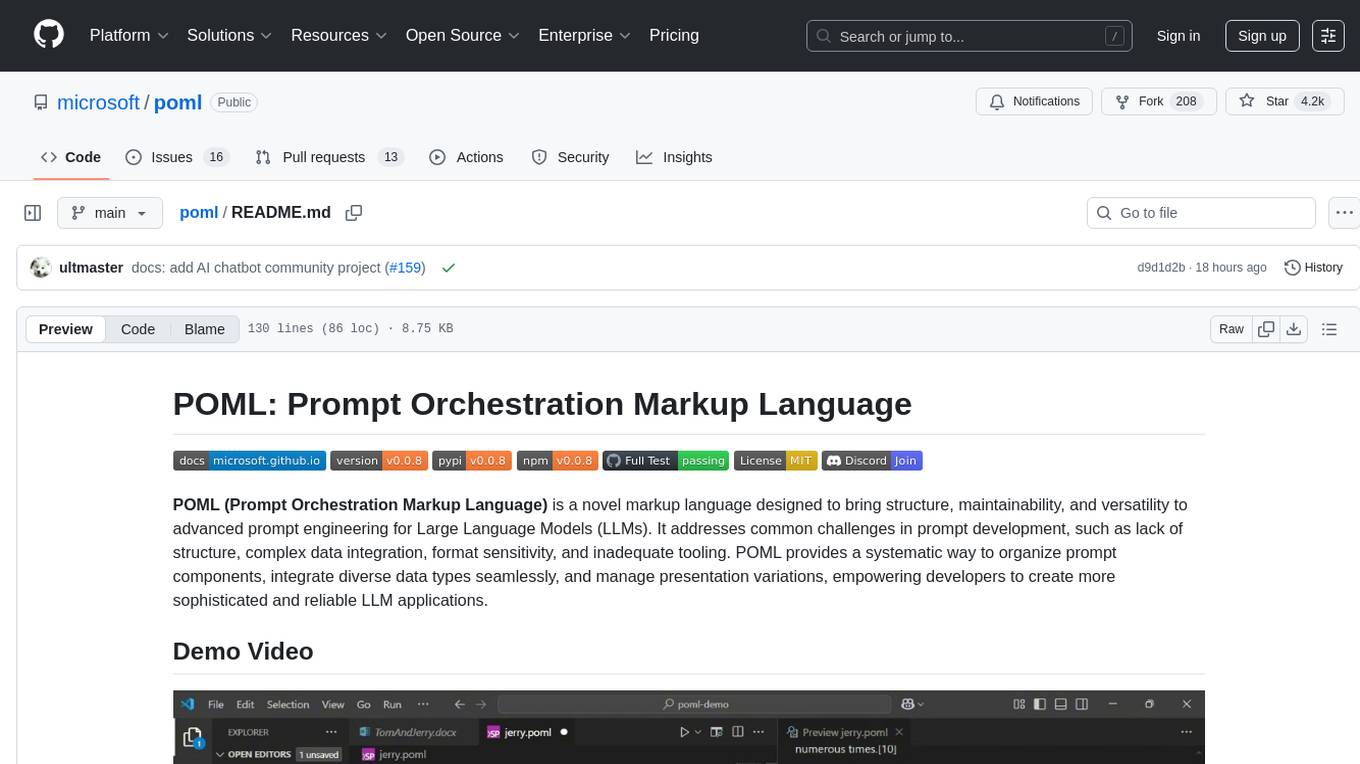
POML (Prompt Orchestration Markup Language) is a novel markup language designed to bring structure, maintainability, and versatility to advanced prompt engineering for Large Language Models (LLMs). It addresses common challenges in prompt development, such as lack of structure, complex data integration, format sensitivity, and inadequate tooling. POML provides a systematic way to organize prompt components, integrate diverse data types seamlessly, and manage presentation variations, empowering developers to create more sophisticated and reliable LLM applications.
neuron-ai
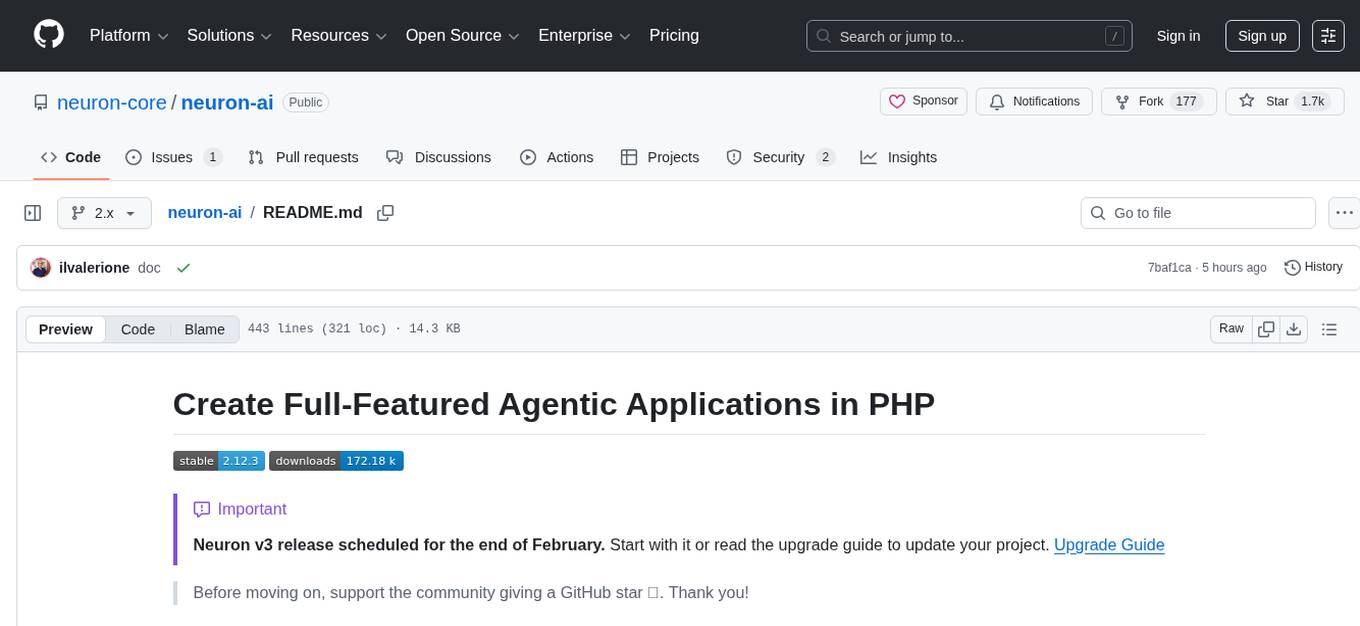
Neuron is a PHP framework for creating and orchestrating AI Agents, providing tools for the entire agentic application development lifecycle. It allows integration of AI entities in existing PHP applications with a powerful and flexible architecture. Neuron offers tutorials and educational content to help users get started using AI Agents in their projects. The framework supports various LLM providers, tools, and toolkits, enabling users to create fully functional agents for tasks like data analysis, chatbots, and structured output. Neuron also facilitates monitoring and debugging of AI applications, ensuring control over agent behavior and decision-making processes.

project_alice
Alice is an agentic workflow framework that integrates task execution and intelligent chat capabilities. It provides a flexible environment for creating, managing, and deploying AI agents for various purposes, leveraging a microservices architecture with MongoDB for data persistence. The framework consists of components like APIs, agents, tasks, and chats that interact to produce outputs through files, messages, task results, and URL references. Users can create, test, and deploy agentic solutions in a human-language framework, making it easy to engage with by both users and agents. The tool offers an open-source option, user management, flexible model deployment, and programmatic access to tasks and chats.
draive
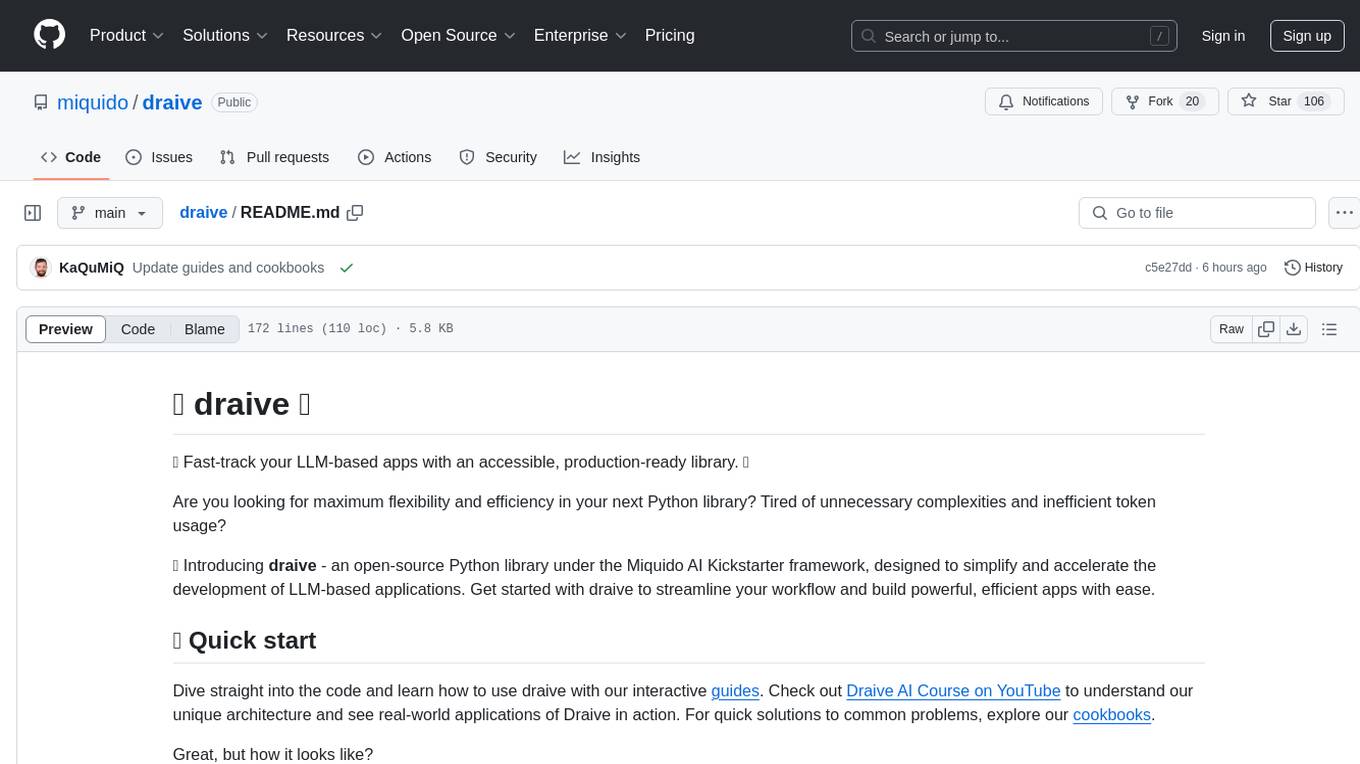
draive is an open-source Python library designed to simplify and accelerate the development of LLM-based applications. It offers abstract building blocks for connecting functionalities with large language models, flexible integration with various AI solutions, and a user-friendly framework for building scalable data processing pipelines. The library follows a function-oriented design, allowing users to represent complex programs as simple functions. It also provides tools for measuring and debugging functionalities, ensuring type safety and efficient asynchronous operations for modern Python apps.
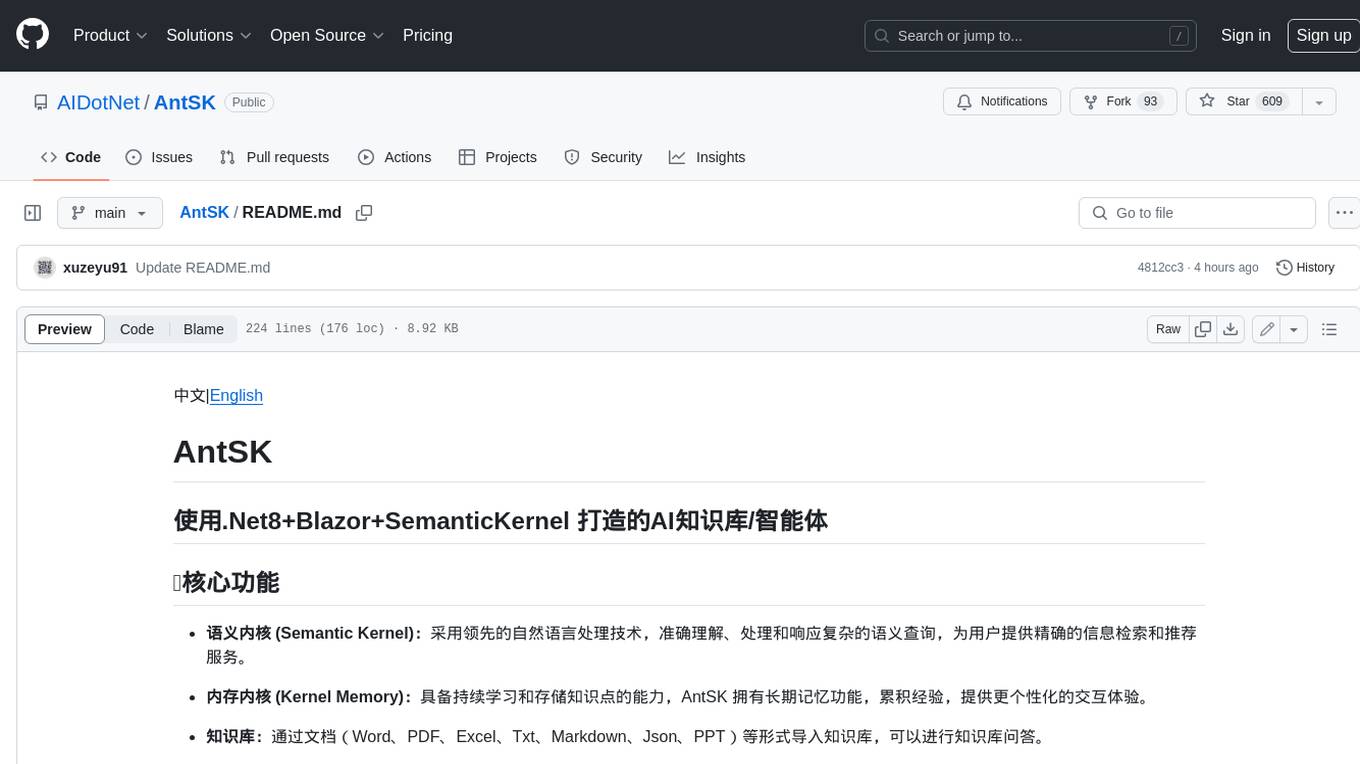
AntSK
AntSK is an AI knowledge base/agent built with .Net8+Blazor+SemanticKernel. It features a semantic kernel for accurate natural language processing, a memory kernel for continuous learning and knowledge storage, a knowledge base for importing and querying knowledge from various document formats, a text-to-image generator integrated with StableDiffusion, GPTs generation for creating personalized GPT models, API interfaces for integrating AntSK into other applications, an open API plugin system for extending functionality, a .Net plugin system for integrating business functions, real-time information retrieval from the internet, model management for adapting and managing different models from different vendors, support for domestic models and databases for operation in a trusted environment, and planned model fine-tuning based on llamafactory.
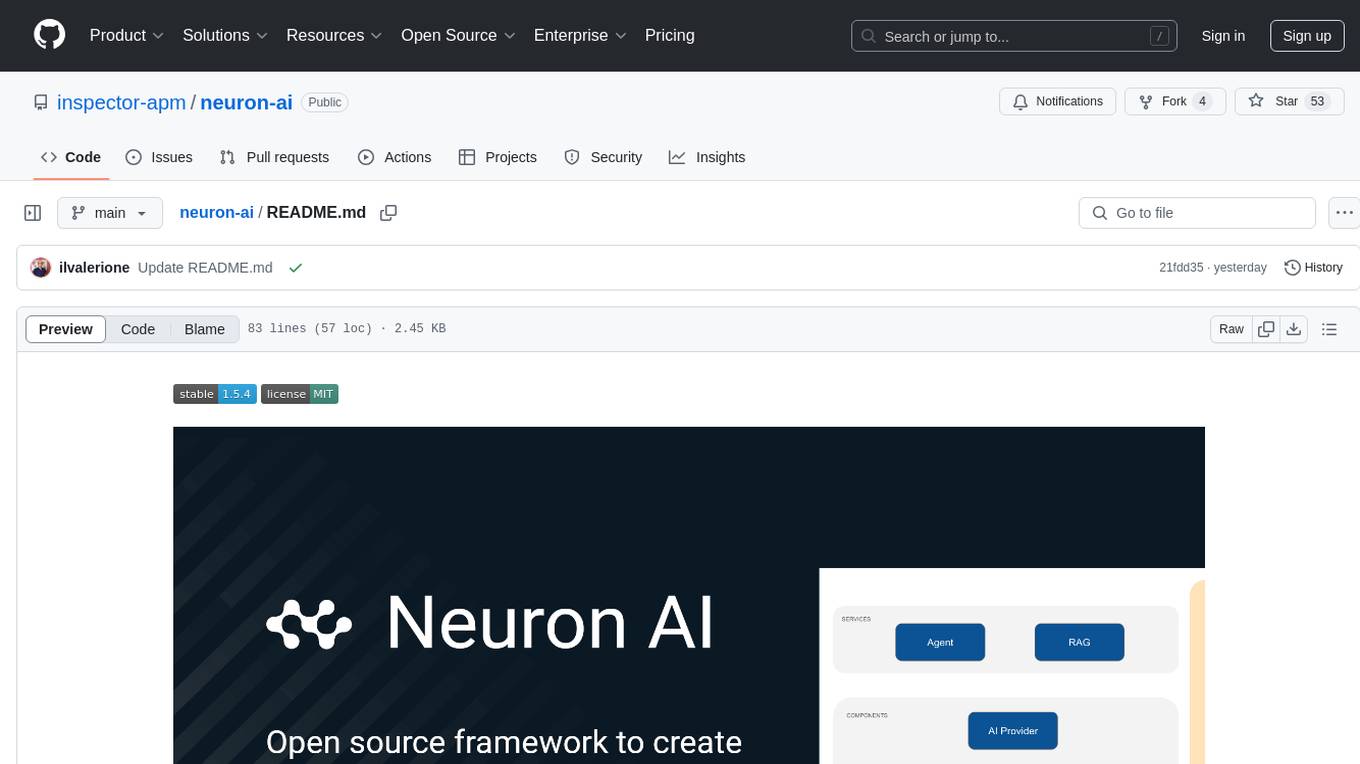
neuron-ai
Neuron AI is a PHP framework that provides an Agent class for creating fully functional agents to perform tasks like analyzing text for SEO optimization. The framework manages advanced mechanisms such as memory, tools, and function calls. Users can extend the Agent class to create custom agents and interact with them to get responses based on the underlying LLM. Neuron AI aims to simplify the development of AI-powered applications by offering a structured framework with documentation and guidelines for contributions under the MIT license.
lmql
LMQL is a programming language designed for large language models (LLMs) that offers a unique way of integrating traditional programming with LLM interaction. It allows users to write programs that combine algorithmic logic with LLM calls, enabling model reasoning capabilities within the context of the program. LMQL provides features such as Python syntax integration, rich control-flow options, advanced decoding techniques, powerful constraints via logit masking, runtime optimization, sync and async API support, multi-model compatibility, and extensive applications like JSON decoding and interactive chat interfaces. The tool also offers library integration, flexible tooling, and output streaming options for easy model output handling.
crewAI
CrewAI is a cutting-edge framework designed to orchestrate role-playing autonomous AI agents. By fostering collaborative intelligence, CrewAI empowers agents to work together seamlessly, tackling complex tasks. It enables AI agents to assume roles, share goals, and operate in a cohesive unit, much like a well-oiled crew. Whether you're building a smart assistant platform, an automated customer service ensemble, or a multi-agent research team, CrewAI provides the backbone for sophisticated multi-agent interactions. With features like role-based agent design, autonomous inter-agent delegation, flexible task management, and support for various LLMs, CrewAI offers a dynamic and adaptable solution for both development and production workflows.
codellm-devkit
Codellm-devkit (CLDK) is a Python library that serves as a multilingual program analysis framework bridging traditional static analysis tools and Large Language Models (LLMs) specialized for code (CodeLLMs). It simplifies the process of analyzing codebases across multiple programming languages, enabling the extraction of meaningful insights and facilitating LLM-based code analysis. The library provides a unified interface for integrating outputs from various analysis tools and preparing them for effective use by CodeLLMs. Codellm-devkit aims to enable the development and experimentation of robust analysis pipelines that combine traditional program analysis tools and CodeLLMs, reducing friction in multi-language code analysis and ensuring compatibility across different tools and LLM platforms. It is designed to seamlessly integrate with popular analysis tools like WALA, Tree-sitter, LLVM, and CodeQL, acting as a crucial intermediary layer for efficient communication between these tools and CodeLLMs. The project is continuously evolving to include new tools and frameworks, maintaining its versatility for code analysis and LLM integration.
guidellm
GuideLLM is a powerful tool for evaluating and optimizing the deployment of large language models (LLMs). By simulating real-world inference workloads, GuideLLM helps users gauge the performance, resource needs, and cost implications of deploying LLMs on various hardware configurations. This approach ensures efficient, scalable, and cost-effective LLM inference serving while maintaining high service quality. Key features include performance evaluation, resource optimization, cost estimation, and scalability testing.
bedrock-claude-chatbot
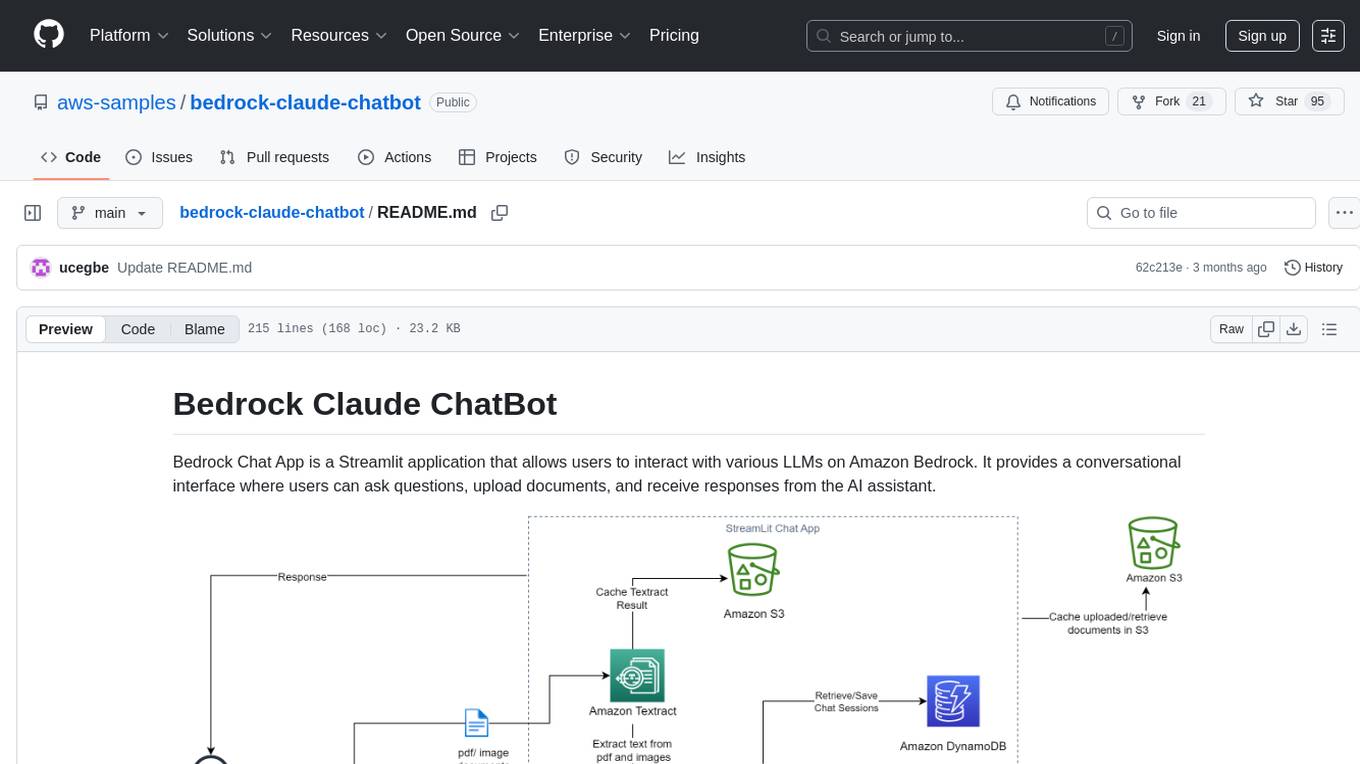
Bedrock Claude ChatBot is a Streamlit application that provides a conversational interface for users to interact with various Large Language Models (LLMs) on Amazon Bedrock. Users can ask questions, upload documents, and receive responses from the AI assistant. The app features conversational UI, document upload, caching, chat history storage, session management, model selection, cost tracking, logging, and advanced data analytics tool integration. It can be customized using a config file and is extensible for implementing specialized tools using Docker containers and AWS Lambda. The app requires access to Amazon Bedrock Anthropic Claude Model, S3 bucket, Amazon DynamoDB, Amazon Textract, and optionally Amazon Elastic Container Registry and Amazon Athena for advanced analytics features.
testzeus-hercules
Hercules is the world’s first open-source testing agent designed to handle the toughest testing tasks for modern web applications. It turns simple Gherkin steps into fully automated end-to-end tests, making testing simple, reliable, and efficient. Hercules adapts to various platforms like Salesforce and is suitable for CI/CD pipelines. It aims to democratize and disrupt test automation, making top-tier testing accessible to everyone. The tool is transparent, reliable, and community-driven, empowering teams to deliver better software. Hercules offers multiple ways to get started, including using PyPI package, Docker, or building and running from source code. It supports various AI models, provides detailed installation and usage instructions, and integrates with Nuclei for security testing and WCAG for accessibility testing. The tool is production-ready, open core, and open source, with plans for enhanced LLM support, advanced tooling, improved DOM distillation, community contributions, extensive documentation, and a bounty program.
RepoAgent
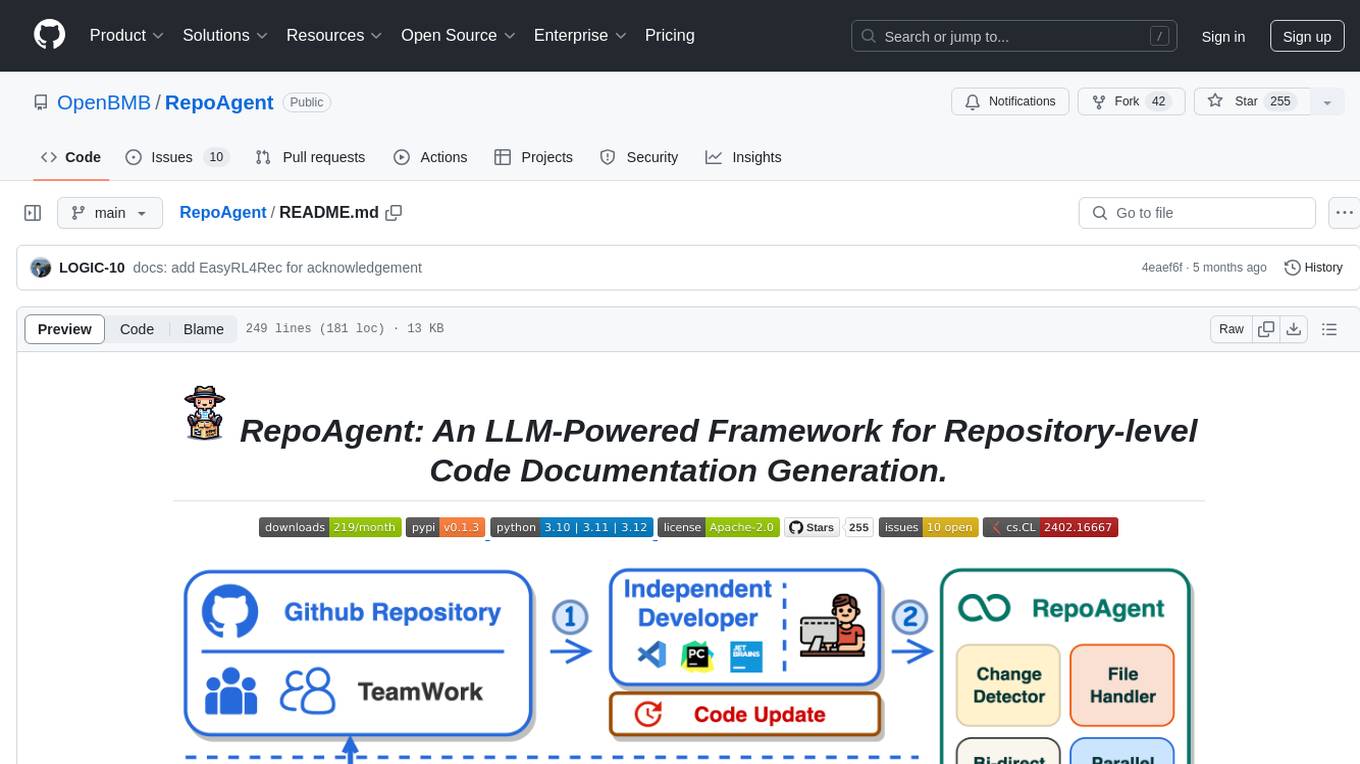
RepoAgent is an LLM-powered framework designed for repository-level code documentation generation. It automates the process of detecting changes in Git repositories, analyzing code structure through AST, identifying inter-object relationships, replacing Markdown content, and executing multi-threaded operations. The tool aims to assist developers in understanding and maintaining codebases by providing comprehensive documentation, ultimately improving efficiency and saving time.
deep-research
Deep Research is a lightning-fast tool that uses powerful AI models to generate comprehensive research reports in just a few minutes. It leverages advanced 'Thinking' and 'Task' models, combined with an internet connection, to provide fast and insightful analysis on various topics. The tool ensures privacy by processing and storing all data locally. It supports multi-platform deployment, offers support for various large language models, web search functionality, knowledge graph generation, research history preservation, local and server API support, PWA technology, multi-key payload support, multi-language support, and is built with modern technologies like Next.js and Shadcn UI. Deep Research is open-source under the MIT License.
llm-ls
llm-ls is a Language Server Protocol (LSP) server that utilizes Large Language Models (LLMs) to enhance the development experience. It aims to serve as a foundation for IDE extensions by simplifying interactions with LLMs, enabling lightweight extension code. The server offers features such as context-based prompt generation, telemetry for retraining, code completion based on AST analysis, and compatibility with various backends like Hugging Face's APIs and llama.cpp server bindings.
For similar tasks
watchtower
AIShield Watchtower is a tool designed to fortify the security of AI/ML models and Jupyter notebooks by automating model and notebook discoveries, conducting vulnerability scans, and categorizing risks into 'low,' 'medium,' 'high,' and 'critical' levels. It supports scanning of public GitHub repositories, Hugging Face repositories, AWS S3 buckets, and local systems. The tool generates comprehensive reports, offers a user-friendly interface, and aligns with industry standards like OWASP, MITRE, and CWE. It aims to address the security blind spots surrounding Jupyter notebooks and AI models, providing organizations with a tailored approach to enhancing their security efforts.
Guardrails
Guardrails is a security tool designed to help developers identify and fix security vulnerabilities in their code. It provides automated scanning and analysis of code repositories to detect potential security issues, such as sensitive data exposure, injection attacks, and insecure configurations. By integrating Guardrails into the development workflow, teams can proactively address security concerns and reduce the risk of security breaches. The tool offers detailed reports and actionable recommendations to guide developers in remediation efforts, ultimately improving the overall security posture of the codebase. Guardrails supports multiple programming languages and frameworks, making it versatile and adaptable to different development environments. With its user-friendly interface and seamless integration with popular version control systems, Guardrails empowers developers to prioritize security without compromising productivity.
LLM-PLSE-paper
LLM-PLSE-paper is a repository focused on the applications of Large Language Models (LLMs) in Programming Language and Software Engineering (PL/SE) domains. It covers a wide range of topics including bug detection, specification inference and verification, code generation, fuzzing and testing, code model and reasoning, code understanding, IDE technologies, prompting for reasoning tasks, and agent/tool usage and planning. The repository provides a comprehensive collection of research papers, benchmarks, empirical studies, and frameworks related to the capabilities of LLMs in various PL/SE tasks.
invariant
Invariant Analyzer is an open-source scanner designed for LLM-based AI agents to find bugs, vulnerabilities, and security threats. It scans agent execution traces to identify issues like looping behavior, data leaks, prompt injections, and unsafe code execution. The tool offers a library of built-in checkers, an expressive policy language, data flow analysis, real-time monitoring, and extensible architecture for custom checkers. It helps developers debug AI agents, scan for security violations, and prevent security issues and data breaches during runtime. The analyzer leverages deep contextual understanding and a purpose-built rule matching engine for security policy enforcement.
OpenRedTeaming
OpenRedTeaming is a repository focused on red teaming for generative models, specifically large language models (LLMs). The repository provides a comprehensive survey on potential attacks on GenAI and robust safeguards. It covers attack strategies, evaluation metrics, benchmarks, and defensive approaches. The repository also implements over 30 auto red teaming methods. It includes surveys, taxonomies, attack strategies, and risks related to LLMs. The goal is to understand vulnerabilities and develop defenses against adversarial attacks on large language models.
Awesome-LLM4Cybersecurity
The repository 'Awesome-LLM4Cybersecurity' provides a comprehensive overview of the applications of Large Language Models (LLMs) in cybersecurity. It includes a systematic literature review covering topics such as constructing cybersecurity-oriented domain LLMs, potential applications of LLMs in cybersecurity, and research directions in the field. The repository analyzes various benchmarks, datasets, and applications of LLMs in cybersecurity tasks like threat intelligence, fuzzing, vulnerabilities detection, insecure code generation, program repair, anomaly detection, and LLM-assisted attacks.
quark-engine
Quark Engine is an AI-powered tool designed for analyzing Android APK files. It focuses on enhancing the detection process for auto-suggestion, enabling users to create detection workflows without coding. The tool offers an intuitive drag-and-drop interface for workflow adjustments and updates. Quark Agent, the core component, generates Quark Script code based on natural language input and feedback. The project is committed to providing a user-friendly experience for designing detection workflows through textual and visual methods. Various features are still under development and will be rolled out gradually.
vulnerability-analysis
The NVIDIA AI Blueprint for Vulnerability Analysis for Container Security showcases accelerated analysis on common vulnerabilities and exposures (CVE) at an enterprise scale, reducing mitigation time from days to seconds. It enables security analysts to determine software package vulnerabilities using large language models (LLMs) and retrieval-augmented generation (RAG). The blueprint is designed for security analysts, IT engineers, and AI practitioners in cybersecurity. It requires NVAIE developer license and API keys for vulnerability databases, search engines, and LLM model services. Hardware requirements include L40 GPU for pipeline operation and optional LLM NIM and Embedding NIM. The workflow involves LLM pipeline for CVE impact analysis, utilizing LLM planner, agent, and summarization nodes. The blueprint uses NVIDIA NIM microservices and Morpheus Cybersecurity AI SDK for vulnerability analysis.
For similar jobs
kaito
Kaito is an operator that automates the AI/ML inference model deployment in a Kubernetes cluster. It manages large model files using container images, avoids tuning deployment parameters to fit GPU hardware by providing preset configurations, auto-provisions GPU nodes based on model requirements, and hosts large model images in the public Microsoft Container Registry (MCR) if the license allows. Using Kaito, the workflow of onboarding large AI inference models in Kubernetes is largely simplified.
ai-on-gke
This repository contains assets related to AI/ML workloads on Google Kubernetes Engine (GKE). Run optimized AI/ML workloads with Google Kubernetes Engine (GKE) platform orchestration capabilities. A robust AI/ML platform considers the following layers: Infrastructure orchestration that support GPUs and TPUs for training and serving workloads at scale Flexible integration with distributed computing and data processing frameworks Support for multiple teams on the same infrastructure to maximize utilization of resources
tidb
TiDB is an open-source distributed SQL database that supports Hybrid Transactional and Analytical Processing (HTAP) workloads. It is MySQL compatible and features horizontal scalability, strong consistency, and high availability.
nvidia_gpu_exporter
Nvidia GPU exporter for prometheus, using `nvidia-smi` binary to gather metrics.
tracecat
Tracecat is an open-source automation platform for security teams. It's designed to be simple but powerful, with a focus on AI features and a practitioner-obsessed UI/UX. Tracecat can be used to automate a variety of tasks, including phishing email investigation, evidence collection, and remediation plan generation.
openinference
OpenInference is a set of conventions and plugins that complement OpenTelemetry to enable tracing of AI applications. It provides a way to capture and analyze the performance and behavior of AI models, including their interactions with other components of the application. OpenInference is designed to be language-agnostic and can be used with any OpenTelemetry-compatible backend. It includes a set of instrumentations for popular machine learning SDKs and frameworks, making it easy to add tracing to your AI applications.
BricksLLM
BricksLLM is a cloud native AI gateway written in Go. Currently, it provides native support for OpenAI, Anthropic, Azure OpenAI and vLLM. BricksLLM aims to provide enterprise level infrastructure that can power any LLM production use cases. Here are some use cases for BricksLLM: * Set LLM usage limits for users on different pricing tiers * Track LLM usage on a per user and per organization basis * Block or redact requests containing PIIs * Improve LLM reliability with failovers, retries and caching * Distribute API keys with rate limits and cost limits for internal development/production use cases * Distribute API keys with rate limits and cost limits for students
kong
Kong, or Kong API Gateway, is a cloud-native, platform-agnostic, scalable API Gateway distinguished for its high performance and extensibility via plugins. It also provides advanced AI capabilities with multi-LLM support. By providing functionality for proxying, routing, load balancing, health checking, authentication (and more), Kong serves as the central layer for orchestrating microservices or conventional API traffic with ease. Kong runs natively on Kubernetes thanks to its official Kubernetes Ingress Controller.