


vLLM-metax
None
Stars: 109
vLLM MetaX is a hardware plugin for running vLLM seamlessly on MetaX GPU, providing near-native CUDA experiences on MetaX Hardware with MACA. It follows the vLLM plugin RFCs by default to ensure hardware features and functionality support on integration of the MetaX GPU with vLLM. The plugin is recommended for supporting the MetaX backend within the vLLM community. Prerequisites include MetaX C-series hardware, Linux OS, Python >= 3.9, < 3.12, vLLM (same version as vllm-metax), and Docker support. The tool currently supports starting on docker images released by the MetaX development community.
README:

| About MetaX | Documentation | #sig-maca |
Latest News 🔥
- [2026/2] Released vllm-metax v0.13.0 🧨 — aligned with vLLM v0.13.0, brings you the latest features and model in v0.13.0!
- [2026/1] Released vllm-metax v0.12.0 😎 — aligned with vLLM v0.12.0, supported more models and improved performance.
- [2026/1] Released vllm-metax v0.11.2 👻 — aligned with vLLM v0.11.2, supported more models and improved performance.
- [2025/11] Released vllm-metax v0.10.2 🎉 — aligned with vLLM v0.10.2, improved model performance, and fixed key decoding bugs.
- [2025/11] We hosted vLLM Beijing Meetup focusing on distributed inference and diverse accelerator support with vLLM! Please find the meetup slides here.
- [2025/08] We hosted vLLM Shanghai Meetup focusing on building, developing, and integrating with vLLM! Please find the meetup slides here.
vLLM MetaX is a hardware plugin for running vLLM seamlessly on MetaX GPU, which is a cuda_alike backend and provided near-native CUDA experiences on MetaX Hardware with MACA.
It is the recommended approach for supporting the MetaX backend within the vLLM community.
The plugin follows the vLLM plugin RFCs by default:
Which ensured the hardware features and functionality support on integration of the MetaX GPU with vLLM.
- Hardware: MetaX C-series
- OS: Linux
- Software:
- Python >= 3.9, < 3.12
- vLLM (the same version as vllm-metax)
- Docker support
vLLM MetaX currently only support starting on docker images release by MetaX develop community which is out of box. (DockerFile for other OS is undertesting)
If you want to develop, debug or test the newest feature on vllm-metax, you may need to build from scratch and follow this source build tutorial.
vllm-metax has three kind of branches.
- master: main branch,catching up with main branch of vLLM upstream.
-
releases/vX.Y.Z: release branch, created when a new version of vLLM is released. For example,
releases/v0.13.0is the release branch for vLLMv0.13.0version. (Same tag name) -
vX.Y.Z-dev: development branch, created with part of new releases of vLLM. For example,
v0.14.0-devis the dev branch for vLLMv0.14.0version.
Below is maintained branches:
| Branch | Status | Note |
|---|---|---|
| master | N/A | trying to support vllm main, no gurantee on functionality |
| v0.15.0-dev | N/A | under testing |
| v0.14.0-dev | N/A | under testing |
| releases/v0.13.0 | Released | related to vllm release v0.13.0 |
| releases/v0.12.0 | Released | related to vllm release v0.12.0 |
| releases/v0.11.2 | Released | related to vllm release v0.11.2 |
| releases/v0.10.2 | Released | related to vllm release v0.10.2 |
Please check here for v0.13.0 details.
Apache License 2.0, as found in the LICENSE file.
For Tasks:
Click tags to check more tools for each tasksFor Jobs:
Alternative AI tools for vLLM-metax
Similar Open Source Tools
vLLM-metax
vLLM MetaX is a hardware plugin for running vLLM seamlessly on MetaX GPU, providing near-native CUDA experiences on MetaX Hardware with MACA. It follows the vLLM plugin RFCs by default to ensure hardware features and functionality support on integration of the MetaX GPU with vLLM. The plugin is recommended for supporting the MetaX backend within the vLLM community. Prerequisites include MetaX C-series hardware, Linux OS, Python >= 3.9, < 3.12, vLLM (same version as vllm-metax), and Docker support. The tool currently supports starting on docker images released by the MetaX development community.
vllm-ascend
vLLM Ascend plugin is a backend plugin designed to run vLLM on the Ascend NPU. It provides a hardware-pluggable interface that allows popular open-source models to run seamlessly on the Ascend NPU. The plugin is recommended within the vLLM community and adheres to the principles of hardware pluggability outlined in the RFC. Users can set up their environment with specific hardware and software prerequisites to utilize this plugin effectively.
beeai-framework
BeeAI Framework is a versatile tool for building production-ready multi-agent systems. It offers flexibility in orchestrating agents, seamless integration with various models and tools, and production-grade controls for scaling. The framework supports Python and TypeScript libraries, enabling users to implement simple to complex multi-agent patterns, connect with AI services, and optimize token usage and resource management.
openrl
OpenRL is an open-source general reinforcement learning research framework that supports training for various tasks such as single-agent, multi-agent, offline RL, self-play, and natural language. Developed based on PyTorch, the goal of OpenRL is to provide a simple-to-use, flexible, efficient and sustainable platform for the reinforcement learning research community. It supports a universal interface for all tasks/environments, single-agent and multi-agent tasks, offline RL training with expert dataset, self-play training, reinforcement learning training for natural language tasks, DeepSpeed, Arena for evaluation, importing models and datasets from Hugging Face, user-defined environments, models, and datasets, gymnasium environments, callbacks, visualization tools, unit testing, and code coverage testing. It also supports various algorithms like PPO, DQN, SAC, and environments like Gymnasium, MuJoCo, Atari, and more.
sdnext
SD.Next is an Image Diffusion implementation with advanced features. It offers multiple UI options, diffusion models, and built-in controls for text, image, batch, and video processing. The tool is multiplatform, supporting Windows, Linux, MacOS, nVidia, AMD, IntelArc/IPEX, DirectML, OpenVINO, ONNX+Olive, and ZLUDA. It provides optimized processing with the latest torch developments, including model compile, quantize, and compress functionalities. SD.Next also features Interrogate/Captioning with various models, queue management, automatic updates, and mobile compatibility.
automatic
Automatic is an Image Diffusion implementation with advanced features. It supports multiple diffusion models, built-in control for text, image, batch, and video processing, and is compatible with various platforms and backends. The tool offers optimized processing with the latest torch developments, built-in support for torch.compile, and multiple compile backends. It also features platform-specific autodetection, queue management, enterprise-level logging, and a built-in installer with automatic updates and dependency management. Automatic is mobile compatible and provides a main interface using StandardUI and ModernUI.
biochatter
Generative AI models have shown tremendous usefulness in increasing accessibility and automation of a wide range of tasks. This repository contains the `biochatter` Python package, a generic backend library for the connection of biomedical applications to conversational AI. It aims to provide a common framework for deploying, testing, and evaluating diverse models and auxiliary technologies in the biomedical domain. BioChatter is part of the BioCypher ecosystem, connecting natively to BioCypher knowledge graphs.
inference
Xorbits Inference (Xinference) is a powerful and versatile library designed to serve language, speech recognition, and multimodal models. With Xorbits Inference, you can effortlessly deploy and serve your or state-of-the-art built-in models using just a single command. Whether you are a researcher, developer, or data scientist, Xorbits Inference empowers you to unleash the full potential of cutting-edge AI models.
EvoAgentX
EvoAgentX is an open-source framework for building, evaluating, and evolving LLM-based agents or agentic workflows in an automated, modular, and goal-driven manner. It enables developers and researchers to move beyond static prompt chaining or manual workflow orchestration by introducing a self-evolving agent ecosystem. The framework includes features such as agent workflow autoconstruction, built-in evaluation, self-evolution engine, plug-and-play compatibility, comprehensive built-in tools, memory module support, and human-in-the-loop interactions.
UI-TARS-desktop
UI-TARS-desktop is a desktop application that provides a native GUI Agent based on the UI-TARS model. It offers features such as natural language control powered by Vision-Language Model, screenshot and visual recognition support, precise mouse and keyboard control, cross-platform support (Windows/MacOS/Browser), real-time feedback and status display, and private and secure fully local processing. The application aims to enhance the user's computer experience, introduce new browser operation features, and support the advanced UI-TARS-1.5 model for improved performance and precise control.
mage-ai
Mage is an open-source data pipeline tool for transforming and integrating data. It offers an easy developer experience, engineering best practices built-in, and data as a first-class citizen. Mage makes it easy to build, preview, and launch data pipelines, and provides observability and scaling capabilities. It supports data integrations, streaming pipelines, and dbt integration.
nuitrack-sdk
Nuitrack™ is an ultimate 3D body tracking solution developed by 3DiVi Inc. It enables body motion analytics applications for virtually any widespread depth sensors and hardware platforms, supporting a wide range of applications from real-time gesture recognition on embedded platforms to large-scale multisensor analytical systems. Nuitrack provides highly-sophisticated 3D skeletal tracking, basic facial analysis, hand tracking, and gesture recognition APIs for UI control. It offers two skeletal tracking engines: classical for embedded hardware and AI for complex poses, providing a human-centric spatial understanding tool for natural and intelligent user engagement.
FlagEmbedding
FlagEmbedding focuses on retrieval-augmented LLMs, consisting of the following projects currently: * **Long-Context LLM** : Activation Beacon * **Fine-tuning of LM** : LM-Cocktail * **Embedding Model** : Visualized-BGE, BGE-M3, LLM Embedder, BGE Embedding * **Reranker Model** : llm rerankers, BGE Reranker * **Benchmark** : C-MTEB
MarkFlowy
MarkFlowy is a lightweight and feature-rich Markdown editor with built-in AI capabilities. It supports one-click export of conversations, translation of articles, and obtaining article abstracts. Users can leverage large AI models like DeepSeek and Chatgpt as intelligent assistants. The editor provides high availability with multiple editing modes and custom themes. Available for Linux, macOS, and Windows, MarkFlowy aims to offer an efficient, beautiful, and data-safe Markdown editing experience for users.
sealos
Sealos is a cloud operating system distribution based on the Kubernetes kernel, designed for a seamless development lifecycle. It allows users to spin up full-stack environments in seconds, effortlessly push releases, and scale production seamlessly. With core features like easy application management, quick database creation, and cloud universality, Sealos offers efficient and economical cloud management with high universality and ease of use. The platform also emphasizes agility and security through its multi-tenancy sharing model. Sealos is supported by a community offering full documentation, Discord support, and active development roadmap.

nyxtext
Nyxtext is a text editor built using Python, featuring Custom Tkinter with the Catppuccin color scheme and glassmorphic design. It follows a modular approach with each element organized into separate files for clarity and maintainability. NyxText is not just a text editor but also an AI-powered desktop application for creatives, developers, and students.
For similar tasks
bee-agent-framework
The Bee Agent Framework is an open-source tool for building, deploying, and serving powerful agentic workflows at scale. It provides AI agents, tools for creating workflows in Javascript/Python, a code interpreter, memory optimization strategies, serialization for pausing/resuming workflows, traceability features, production-level control, and upcoming features like model-agnostic support and a chat UI. The framework offers various modules for agents, llms, memory, tools, caching, errors, adapters, logging, serialization, and more, with a roadmap including MLFlow integration, JSON support, structured outputs, chat client, base agent improvements, guardrails, and evaluation.
vLLM-metax
vLLM MetaX is a hardware plugin for running vLLM seamlessly on MetaX GPU, providing near-native CUDA experiences on MetaX Hardware with MACA. It follows the vLLM plugin RFCs by default to ensure hardware features and functionality support on integration of the MetaX GPU with vLLM. The plugin is recommended for supporting the MetaX backend within the vLLM community. Prerequisites include MetaX C-series hardware, Linux OS, Python >= 3.9, < 3.12, vLLM (same version as vllm-metax), and Docker support. The tool currently supports starting on docker images released by the MetaX development community.
AIHub
AIHub is a client that integrates the capabilities of multiple large models, allowing users to quickly and easily build their own personalized AI assistants. It supports custom plugins for endless possibilities. The tool provides powerful AI capabilities, rich configuration options, customization of AI assistants for text and image conversations, AI drawing, installation of custom plugins, personal knowledge base building, AI calendar generation, support for AI mini programs, and ongoing development of additional features. Users can download the application package from the release section, resolve issues related to macOS app installation, and contribute ideas by submitting issues. The project development involves installation, development, and building processes for different operating systems.
spandrel
Spandrel is a library for loading and running pre-trained PyTorch models. It automatically detects the model architecture and hyperparameters from model files, and provides a unified interface for running models.
Open-DocLLM
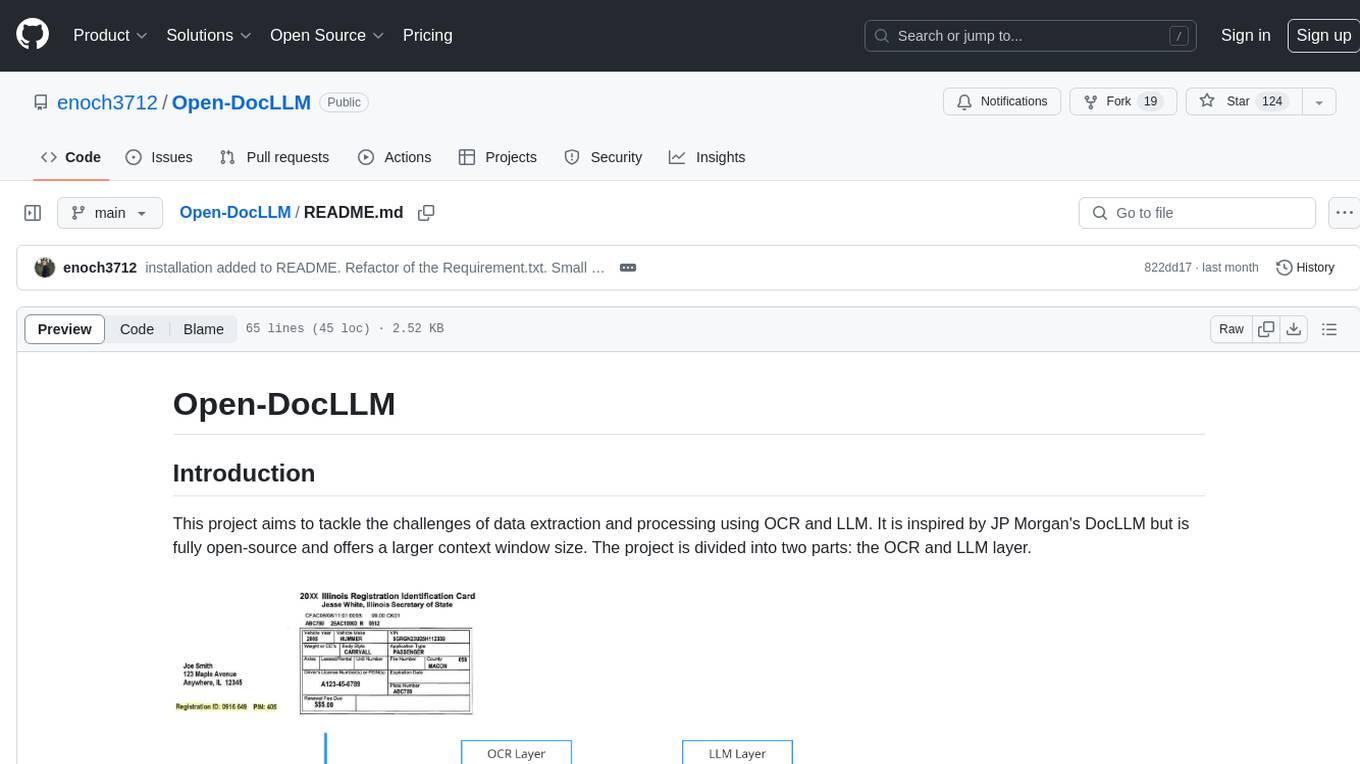
Open-DocLLM is an open-source project that addresses data extraction and processing challenges using OCR and LLM technologies. It consists of two main layers: OCR for reading document content and LLM for extracting specific content in a structured manner. The project offers a larger context window size compared to JP Morgan's DocLLM and integrates tools like Tesseract OCR and Mistral for efficient data analysis. Users can run the models on-premises using LLM studio or Ollama, and the project includes a FastAPI app for testing purposes.
pipeline
Pipeline is a Python library designed for constructing computational flows for AI/ML models. It supports both development and production environments, offering capabilities for inference, training, and finetuning. The library serves as an interface to Mystic, enabling the execution of pipelines at scale and on enterprise GPUs. Users can also utilize this SDK with Pipeline Core on a private hosted cluster. The syntax for defining AI/ML pipelines is reminiscent of sessions in Tensorflow v1 and Flows in Prefect.
promptpanel
Prompt Panel is a tool designed to accelerate the adoption of AI agents by providing a platform where users can run large language models across any inference provider, create custom agent plugins, and use their own data safely. The tool allows users to break free from walled-gardens and have full control over their models, conversations, and logic. With Prompt Panel, users can pair their data with any language model, online or offline, and customize the system to meet their unique business needs without any restrictions.
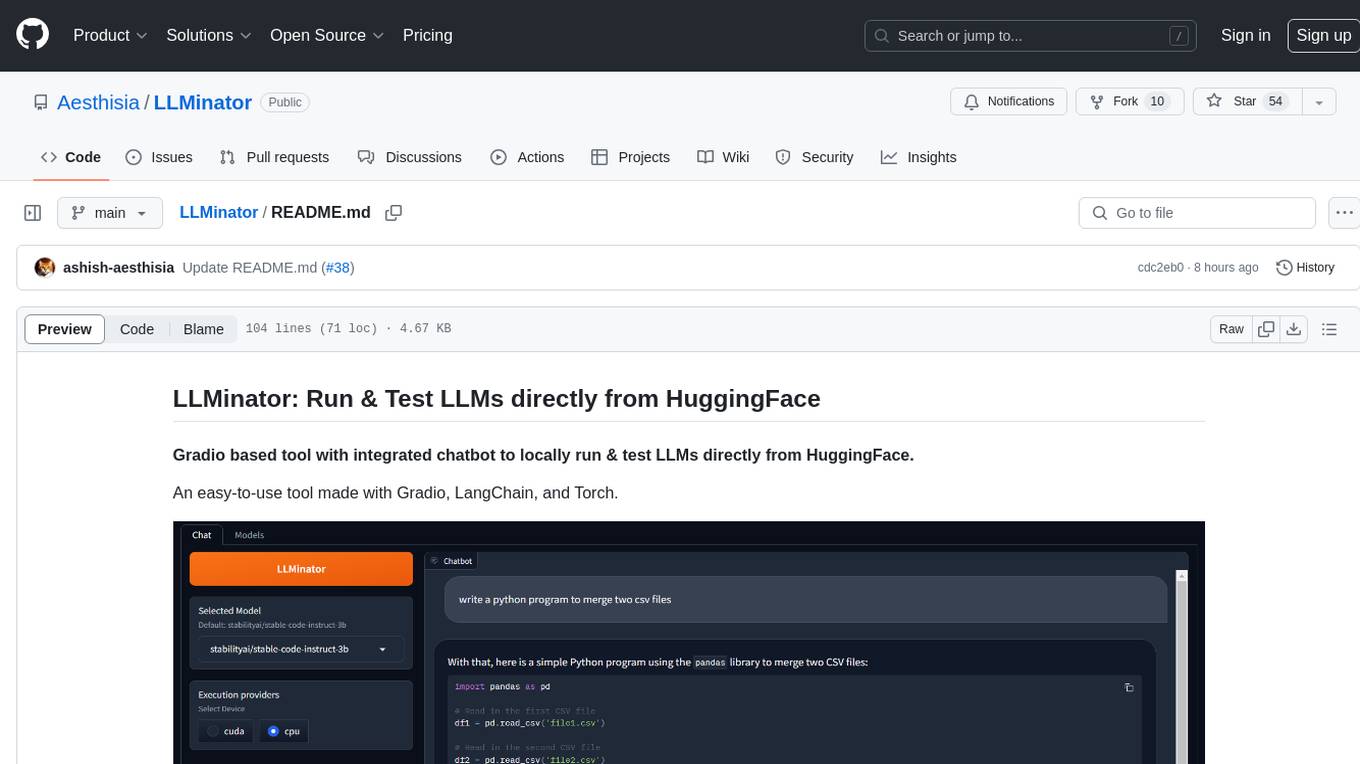
LLMinator
LLMinator is a Gradio-based tool with an integrated chatbot designed to locally run and test Language Model Models (LLMs) directly from HuggingFace. It provides an easy-to-use interface made with Gradio, LangChain, and Torch, offering features such as context-aware streaming chatbot, inbuilt code syntax highlighting, loading any LLM repo from HuggingFace, support for both CPU and CUDA modes, enabling LLM inference with llama.cpp, and model conversion capabilities.
For similar jobs
weave
Weave is a toolkit for developing Generative AI applications, built by Weights & Biases. With Weave, you can log and debug language model inputs, outputs, and traces; build rigorous, apples-to-apples evaluations for language model use cases; and organize all the information generated across the LLM workflow, from experimentation to evaluations to production. Weave aims to bring rigor, best-practices, and composability to the inherently experimental process of developing Generative AI software, without introducing cognitive overhead.
agentcloud
AgentCloud is an open-source platform that enables companies to build and deploy private LLM chat apps, empowering teams to securely interact with their data. It comprises three main components: Agent Backend, Webapp, and Vector Proxy. To run this project locally, clone the repository, install Docker, and start the services. The project is licensed under the GNU Affero General Public License, version 3 only. Contributions and feedback are welcome from the community.
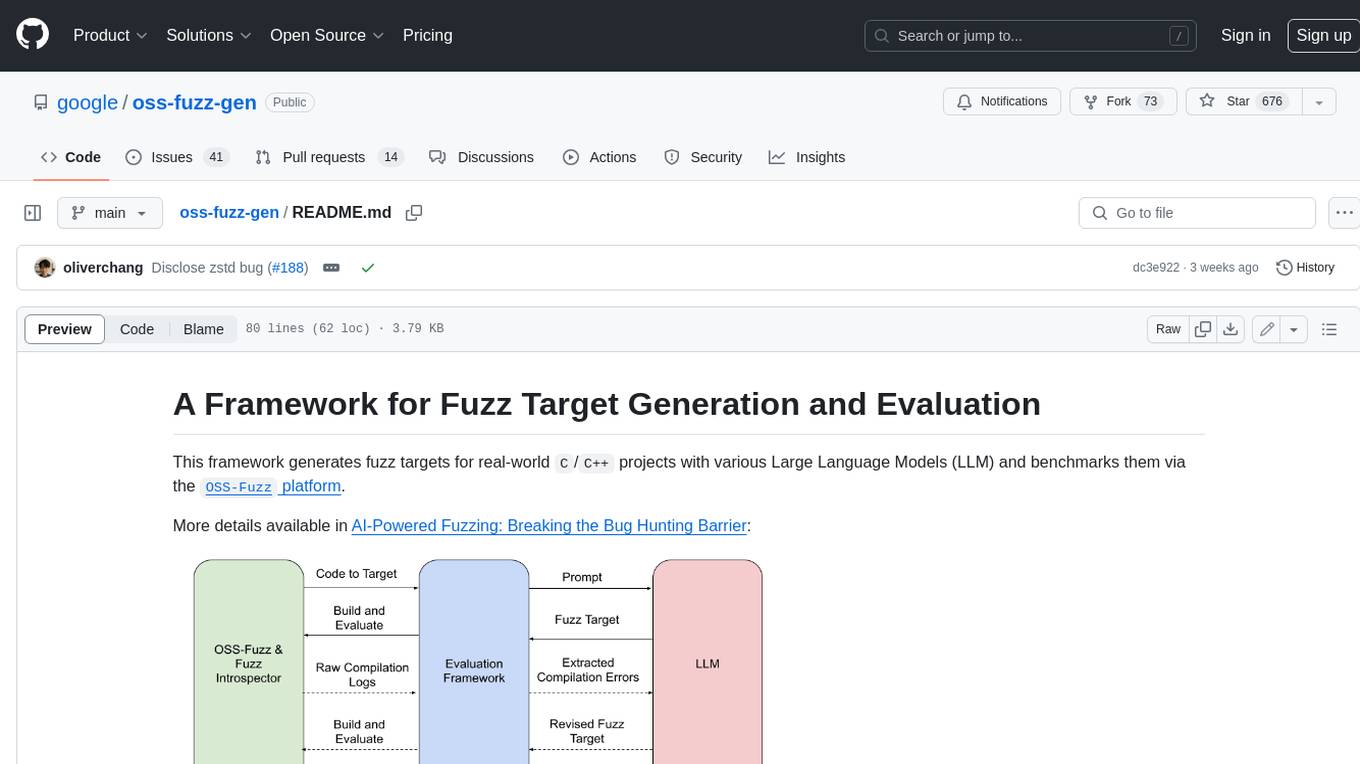
oss-fuzz-gen
This framework generates fuzz targets for real-world `C`/`C++` projects with various Large Language Models (LLM) and benchmarks them via the `OSS-Fuzz` platform. It manages to successfully leverage LLMs to generate valid fuzz targets (which generate non-zero coverage increase) for 160 C/C++ projects. The maximum line coverage increase is 29% from the existing human-written targets.
LLMStack
LLMStack is a no-code platform for building generative AI agents, workflows, and chatbots. It allows users to connect their own data, internal tools, and GPT-powered models without any coding experience. LLMStack can be deployed to the cloud or on-premise and can be accessed via HTTP API or triggered from Slack or Discord.
VisionCraft
The VisionCraft API is a free API for using over 100 different AI models. From images to sound.
kaito
Kaito is an operator that automates the AI/ML inference model deployment in a Kubernetes cluster. It manages large model files using container images, avoids tuning deployment parameters to fit GPU hardware by providing preset configurations, auto-provisions GPU nodes based on model requirements, and hosts large model images in the public Microsoft Container Registry (MCR) if the license allows. Using Kaito, the workflow of onboarding large AI inference models in Kubernetes is largely simplified.
PyRIT
PyRIT is an open access automation framework designed to empower security professionals and ML engineers to red team foundation models and their applications. It automates AI Red Teaming tasks to allow operators to focus on more complicated and time-consuming tasks and can also identify security harms such as misuse (e.g., malware generation, jailbreaking), and privacy harms (e.g., identity theft). The goal is to allow researchers to have a baseline of how well their model and entire inference pipeline is doing against different harm categories and to be able to compare that baseline to future iterations of their model. This allows them to have empirical data on how well their model is doing today, and detect any degradation of performance based on future improvements.
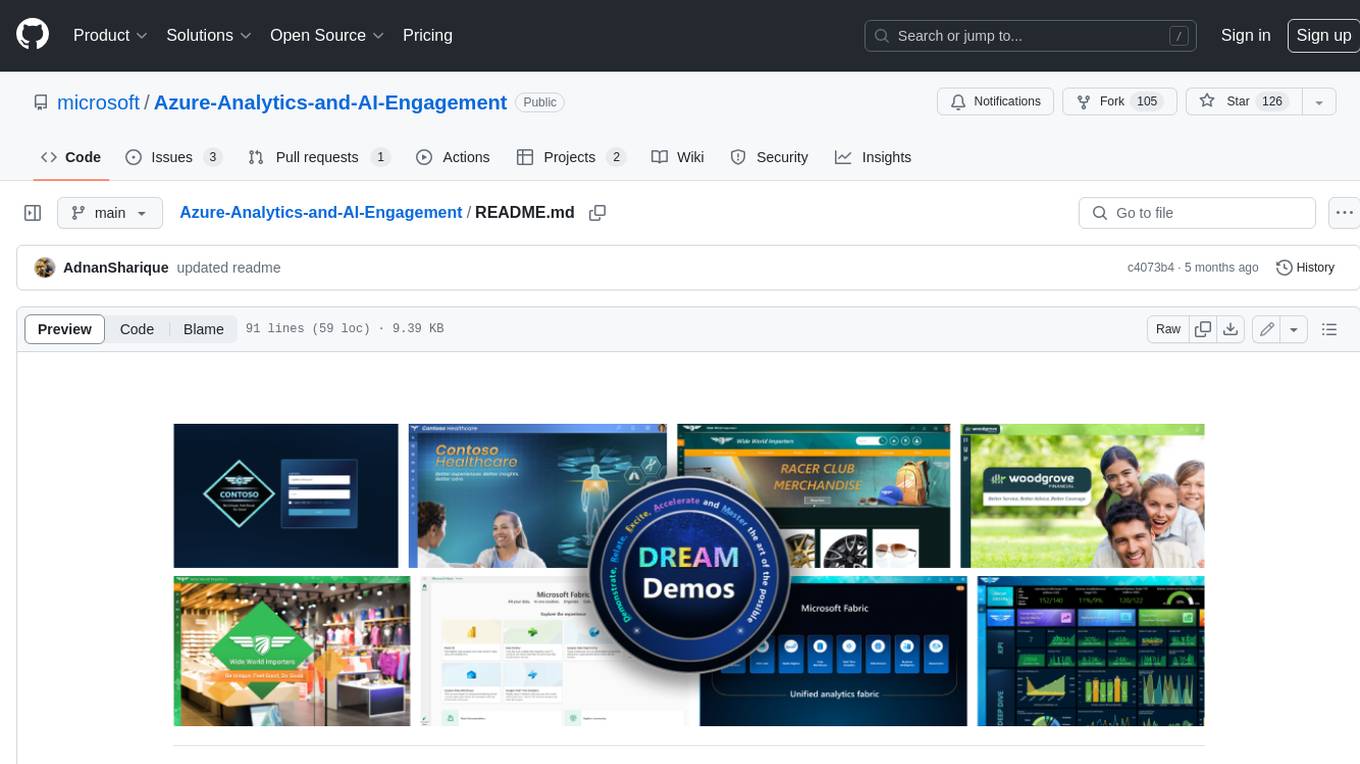
Azure-Analytics-and-AI-Engagement
The Azure-Analytics-and-AI-Engagement repository provides packaged Industry Scenario DREAM Demos with ARM templates (Containing a demo web application, Power BI reports, Synapse resources, AML Notebooks etc.) that can be deployed in a customer’s subscription using the CAPE tool within a matter of few hours. Partners can also deploy DREAM Demos in their own subscriptions using DPoC.