


caracal
🐾 Caracal is pre-execution authority enforcement for AI agents controlling delegated actions with real-time revocation and immutable proof.
Stars: 82
Caracal is a pre-execution authority enforcement system for AI agents and automated software operating in production environments. It enforces a single rule: no action executes unless there is explicit, valid authority for that action at that moment. Caracal offers two interfaces: Caracal Flow for operators, FinOps, and monitoring teams, and Caracal Core for developers, CI/CD engineers, and system architects. Core capabilities include dynamic identity & access, budget enforcement, secure ledger, and agent-native data model. The infrastructure is designed to scale with environments for local and production setups.
README:

Pre-execution authority enforcement for AI agents





Caracal is a pre-execution authority enforcement system for AI agents and automated software operating in production environments. It exists at the exact boundary where decisions turn into irreversible actions such as API calls, database writes, deployments, workflow triggers, financial operations, or any action that can create real impact. Instead of relying on standing credentials, broad roles, or static permissions, Caracal enforces a single rule: no action executes unless there is explicit, valid authority for that action at that moment.
Caracal offers two distinct interfaces depending on your role and requirements.
Target: Operators, FinOps, and Monitoring Teams.
Caracal Flow is the interactive Terminal User Interface (TUI). It provides a visual dashboard for monitoring agent swarms, managing infrastructure, and auditing real-time spend without writing code.
╔═══════════════════════════════════════════════════════════════════╗
║                                                                   ║
║     ██████╗ █████╗ ██████╗  █████╗  ██████╗ █████╗ ██╗            ║
║    ██╔════╝██╔══██╗██╔══██╗██╔══██╗██╔════╝██╔══██╗██║            ║
║    ██║     ███████║██████╔╝███████║██║     ███████║██║            ║
║    ██║     ██╔══██║██╔══██╗██╔══██║██║     ██╔══██║██║            ║
║    ╚██████╗██║  ██║██║  ██║██║  ██║╚██████╗██║  ██║███████╗       ║
║     ╚═════╝╚═╝  ╚═╝╚═╝  ╚═╝╚═╝  ╚═╝ ╚═════╝╚═╝  ╚═╝╚══════╝       ║
║                                                                   ║
║                   C A R A C A L  F L O W                          ║
║              Economic Control Plane for AI Agents                 ║
║                                                                   ║
╚═══════════════════════════════════════════════════════════════════╝
Launch Dashboard:
uv run caracal-flow
Capabilities in Flow:
- Visual Metering: Real-time graphs of token usage and dollar spend.
- One-Click Infrastructure: Toggle between local SQLite and production Docker stacks.
- Policy Management: GUI-based adjustments for agent budget caps.
Target: Developers, CI/CD Engineers, and System Architects.
Caracal Core provides the high-performance CLI and SDK for deep integration. It is designed for users who require programmatic control, custom scripting, or wish to embed economic safety checks directly into agent loops.
Installation:
git clone https://github.com/Garudex-Labs/caracal.git
cd caracal
pip install -e .
CLI Commands:
# Register a new agent identity with a hard budget cap
caracal agents register --name "researcher-01" --budget 50.00 --zone "dev-cluster"

# Generate a dynamic access token for a specific session
caracal auth token --agent "researcher-01" --ttl 3600

# Audit the ledger for specific transactions
caracal ledger audit --agent "researcher-01" --format json
Advanced Configuration:
Power users can override default behaviors by modifying caracal.yaml or setting environment variables for custom identity providers (IdP) and key management systems (KMS).
Dynamic Identity & Access Move beyond static API keys. Caracal issues ephemeral, identity-attested credentials that can be revoked instantly. Authorization happens at the edge where agents interact with their environment.
Budget Enforcement Define hard caps on token usage, dollar spend, and transaction frequency per agent identity. Policies are deterministic and enforced at the gateway level before any cost is incurred.
Secure Ledger An immutable audit trail for every economic decision made by an agent. This system of record allows companies to attribute costs to specific agents, explain outcomes, and ensure compliance.
Agent-Native Data Model Map workloads into logical, ephemeral zones. Spin zones up or down as needed, perfect for dynamic, agent-native workloads that integrate directly into your software development lifecycle.
Caracal is designed to scale with your agent fleet.
| Environment | Database | Messaging | Cache | Use Case |
|---|---|---|---|---|
| Local | SQLite | In-Memory | Local Dict | Zero-setup dev, testing, and Caracal Flow default. |
| Production | PostgreSQL | Kafka | Redis | High-throughput enterprise deployment. |
To enable production mode:
- Open
caracal-flow. - Navigate to Settings & Config > Infrastructure Setup.
- Select Start All Services (provisions containers via Docker).
-
caracal/core/: Business logic for budgeting, identity, and ledger operations. -
caracal/flow/: TUI layer for the visual dashboard. -
caracal/gateway/: Policy enforcement proxy and middleware. -
deploy/: Infrastructure definitions (Docker Compose, Helm).
Caracal is open-source software licensed under the AGPL-3.0. See the LICENSE file for full details.
Developed by Garudex Labs.
For Tasks:
Click tags to check more tools for each tasksFor Jobs:
Alternative AI tools for caracal
Similar Open Source Tools
caracal
Caracal is a pre-execution authority enforcement system for AI agents and automated software operating in production environments. It enforces a single rule: no action executes unless there is explicit, valid authority for that action at that moment. Caracal offers two interfaces: Caracal Flow for operators, FinOps, and monitoring teams, and Caracal Core for developers, CI/CD engineers, and system architects. Core capabilities include dynamic identity & access, budget enforcement, secure ledger, and agent-native data model. The infrastructure is designed to scale with environments for local and production setups.
sidecar
Sidecar is the AI brains of Aide the editor, responsible for creating prompts, interacting with LLM, and ensuring seamless integration of all functionalities. It includes 'tool_box.rs' for handling language-specific smartness, 'symbol/' for smart and independent symbols, 'llm_prompts/' for creating prompts, and 'repomap' for creating a repository map using page rank on code symbols. Users can contribute by submitting bugs, feature requests, reviewing source code changes, and participating in the development workflow.
AgentX
AgentX is a next-generation open-source AI agent development framework and runtime platform. It provides an event-driven runtime with a simple framework and minimal UI. The platform is ready-to-use and offers features like multi-user support, session persistence, real-time streaming, and Docker readiness. Users can build AI Agent applications with event-driven architecture using TypeScript for server-side (Node.js) and client-side (Browser/React) development. AgentX also includes comprehensive documentation, core concepts, guides, API references, and various packages for different functionalities. The architecture follows an event-driven design with layered components for server-side and client-side interactions.
boxlite
BoxLite is an embedded, lightweight micro-VM runtime designed for AI agents running OCI containers with hardware-level isolation. It is built for high concurrency with no daemon required, offering features like lightweight VMs, high concurrency, hardware isolation, embeddability, and OCI compatibility. Users can spin up 'Boxes' to run containers for AI agent sandboxes and multi-tenant code execution scenarios where Docker alone is insufficient and full VM infrastructure is too heavy. BoxLite supports Python, Node.js, and Rust with quick start guides for each, along with features like CPU/memory limits, storage options, networking capabilities, security layers, and image registry configuration. The tool provides SDKs for Python and Node.js, with Go support coming soon. It offers detailed documentation, examples, and architecture insights for users to understand how BoxLite works under the hood.
MCPSpy
MCPSpy is a command-line tool leveraging eBPF technology to monitor Model Context Protocol (MCP) communication at the kernel level. It provides real-time visibility into JSON-RPC 2.0 messages exchanged between MCP clients and servers, supporting Stdio and HTTP transports. MCPSpy offers security analysis, debugging, performance monitoring, compliance assurance, and learning opportunities for understanding MCP communications. The tool consists of eBPF programs, an eBPF loader, an HTTP session manager, an MCP protocol parser, and output handlers for console display and JSONL output.
ai-factory
AI Factory is a CLI tool and skill system that streamlines AI-powered development by handling context setup, skill installation, and workflow configuration. It supports multiple AI coding agents, offers spec-driven development, and integrates with popular tech stacks like Next.js, Laravel, Django, and Express. The tool ensures zero configuration, best practices adherence, community skills utilization, and multi-agent support. Users can create plans, tasks, and commits for structured feature development, bug fixes, and self-improvement. Security is a priority with mandatory two-level scans for external skills. The tool's learning loop generates patches from bug fixes to enhance future implementations.
Shannon
Shannon is a battle-tested infrastructure for AI agents that solves problems at scale, such as runaway costs, non-deterministic failures, and security concerns. It offers features like intelligent caching, deterministic replay of workflows, time-travel debugging, WASI sandboxing, and hot-swapping between LLM providers. Shannon allows users to ship faster with zero configuration multi-agent setup, multiple AI patterns, time-travel debugging, and hot configuration changes. It is production-ready with features like WASI sandbox, token budget control, policy engine (OPA), and multi-tenancy. Shannon helps scale without breaking by reducing costs, being provider agnostic, observable by default, and designed for horizontal scaling with Temporal workflow orchestration.

gpt-all-star
GPT-All-Star is an AI-powered code generation tool designed for scratch development of web applications with team collaboration of autonomous AI agents. The primary focus of this research project is to explore the potential of autonomous AI agents in software development. Users can organize their team, choose leaders for each step, create action plans, and work together to complete tasks. The tool supports various endpoints like OpenAI, Azure, and Anthropic, and provides functionalities for project management, code generation, and team collaboration.
mimiclaw
MimiClaw is a pocket AI assistant that runs on a $5 chip, specifically designed for the ESP32-S3 board. It operates without Linux or Node.js, using pure C language. Users can interact with MimiClaw through Telegram, enabling it to handle various tasks and learn from local memory. The tool is energy-efficient, running on USB power 24/7. With MimiClaw, users can have a personal AI assistant on a chip the size of a thumb, making it convenient and accessible for everyday use.
aichildedu
AICHILDEDU is a microservice-based AI education platform for children that integrates LLMs, image generation, and speech synthesis to provide personalized storybook creation, intelligent conversational learning, and multimedia content generation. It offers features like personalized story generation, educational quiz creation, multimedia integration, age-appropriate content, multi-language support, user management, parental controls, and asynchronous processing. The platform follows a microservice architecture with components like API Gateway, User Service, Content Service, Learning Service, and AI Services. Technologies used include Python, FastAPI, PostgreSQL, MongoDB, Redis, LangChain, OpenAI GPT models, TensorFlow, PyTorch, Transformers, MinIO, Elasticsearch, Docker, Docker Compose, and JWT-based authentication.
claudex
Claudex is an open-source, self-hosted Claude Code UI that runs entirely on your machine. It provides multiple sandboxes, allows users to use their own plans, offers a full IDE experience with VS Code in the browser, and is extensible with skills, agents, slash commands, and MCP servers. Users can run AI agents in isolated environments, view and interact with a browser via VNC, switch between multiple AI providers, automate tasks with Celery workers, and enjoy various chat features and preview capabilities. Claudex also supports marketplace plugins, secrets management, integrations like Gmail, and custom instructions. The tool is configured through providers and supports various providers like Anthropic, OpenAI, OpenRouter, and Custom. It has a tech stack consisting of React, FastAPI, Python, PostgreSQL, Celery, Redis, and more.
tinyclaw
TinyClaw is a lightweight wrapper around Claude Code that connects WhatsApp via QR code, processes messages sequentially, maintains conversation context, runs 24/7 in tmux, and is ready for multi-channel support. Its key innovation is the file-based queue system that prevents race conditions and enables multi-channel support. TinyClaw consists of components like whatsapp-client.js for WhatsApp I/O, queue-processor.js for message processing, heartbeat-cron.sh for health checks, and tinyclaw.sh as the main orchestrator with a CLI interface. It ensures no race conditions, is multi-channel ready, provides clean responses using claude -c -p, and supports persistent sessions. Security measures include local storage of WhatsApp session and queue files, channel-specific authentication, and running Claude with user permissions.
otter-camp
Otter Camp is an open source work management tool designed for AI agent teams. It provides a centralized platform for managing AI agents, ensuring that important context is not lost, enabling quick hiring and firing of agents, maintaining a single pipeline for all work types, keeping context organized within projects, facilitating work review processes, tracking team activities, and offering self-hosted data security. The tool integrates with OpenClaw to run agents and provides a user-friendly interface for managing agent teams efficiently.
solo-server
Solo Server is a lightweight server designed for managing hardware-aware inference. It provides seamless setup through a simple CLI and HTTP servers, an open model registry for pulling models from platforms like Ollama and Hugging Face, cross-platform compatibility for effortless deployment of AI models on hardware, and a configurable framework that auto-detects hardware components (CPU, GPU, RAM) and sets optimal configurations.
httpjail
httpjail is a cross-platform tool designed for monitoring and restricting HTTP/HTTPS requests from processes using network isolation and transparent proxy interception. It provides process-level network isolation, HTTP/HTTPS interception with TLS certificate injection, script-based and JavaScript evaluation for custom request logic, request logging, default deny behavior, and zero-configuration setup. The tool operates on Linux and macOS, creating an isolated network environment for target processes and intercepting all HTTP/HTTPS traffic through a transparent proxy enforcing user-defined rules.
incidentfox
IncidentFox is an open-source AI SRE tool designed to assist in incident response by automatically investigating incidents, finding root causes, and suggesting fixes. It integrates with observability stack, infrastructure, and collaboration tools, forming hypotheses, collecting data, and reasoning through to find root causes. The tool is built for production on-call scenarios, handling log sampling, alert correlation, anomaly detection, and dependency mapping. IncidentFox is highly customizable, Slack-first, and works on various platforms like web UI, GitHub, PagerDuty, and API. It aims to reduce incident resolution time, alert noise, and improve knowledge retention for engineering teams.
For similar tasks
caracal
Caracal is a pre-execution authority enforcement system for AI agents and automated software operating in production environments. It enforces a single rule: no action executes unless there is explicit, valid authority for that action at that moment. Caracal offers two interfaces: Caracal Flow for operators, FinOps, and monitoring teams, and Caracal Core for developers, CI/CD engineers, and system architects. Core capabilities include dynamic identity & access, budget enforcement, secure ledger, and agent-native data model. The infrastructure is designed to scale with environments for local and production setups.
awsome-distributed-training
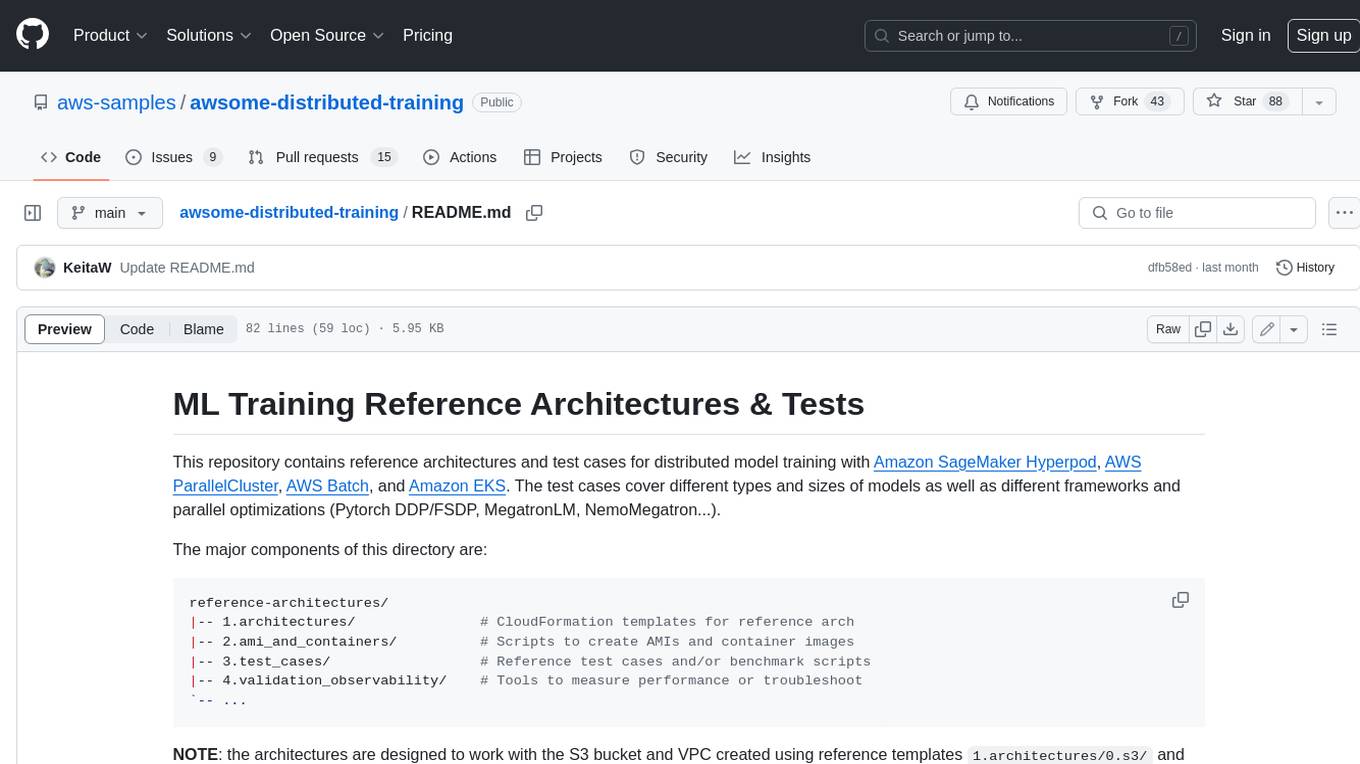
This repository contains reference architectures and test cases for distributed model training with Amazon SageMaker Hyperpod, AWS ParallelCluster, AWS Batch, and Amazon EKS. The test cases cover different types and sizes of models as well as different frameworks and parallel optimizations (Pytorch DDP/FSDP, MegatronLM, NemoMegatron...).
zenml
ZenML is an extensible, open-source MLOps framework for creating portable, production-ready machine learning pipelines. By decoupling infrastructure from code, ZenML enables developers across your organization to collaborate more effectively as they develop to production.
omnia
Omnia is a deployment tool designed to turn servers with RPM-based Linux images into functioning Slurm/Kubernetes clusters. It provides an Ansible playbook-based deployment for Slurm and Kubernetes on servers running an RPM-based Linux OS. The tool simplifies the process of setting up and managing clusters, making it easier for users to deploy and maintain their infrastructure.
devopness
Devopness is a tool that simplifies the management of cloud applications and multi-cloud infrastructure for both AI agents and humans. It provides role-based access control, permission management, cost control, and visibility into DevOps and CI/CD workflows. The tool allows provisioning and deployment to major cloud providers like AWS, Azure, DigitalOcean, and GCP. Devopness aims to make software deployment and cloud infrastructure management accessible and affordable to all involved in software projects.
skyflo
Skyflo.ai is an AI agent designed for Cloud Native operations, providing seamless infrastructure management through natural language interactions. It serves as a safety-first co-pilot with a human-in-the-loop design. The tool offers flexible deployment options for both production and local Kubernetes environments, supporting various LLM providers and self-hosted models. Users can explore the architecture of Skyflo.ai and contribute to its development following the provided guidelines and Code of Conduct. The community engagement includes Discord, Twitter, YouTube, and GitHub Discussions.
action_mcp
Action MCP is a powerful tool for managing and automating your cloud infrastructure. It provides a user-friendly interface to easily create, update, and delete resources on popular cloud platforms. With Action MCP, you can streamline your deployment process, reduce manual errors, and improve overall efficiency. The tool supports various cloud providers and offers a wide range of features to meet your infrastructure management needs. Whether you are a developer, system administrator, or DevOps engineer, Action MCP can help you simplify and optimize your cloud operations.
gemini-android
Gemini-Android is a mobile application that allows users to track their expenses and manage their finances on the go. The app provides a user-friendly interface for adding and categorizing expenses, setting budgets, and generating reports to help users make informed financial decisions. With Gemini-Android, users can easily monitor their spending habits, identify areas for saving, and stay on top of their financial goals.
For similar jobs
sweep
Sweep is an AI junior developer that turns bugs and feature requests into code changes. It automatically handles developer experience improvements like adding type hints and improving test coverage.
teams-ai
The Teams AI Library is a software development kit (SDK) that helps developers create bots that can interact with Teams and Microsoft 365 applications. It is built on top of the Bot Framework SDK and simplifies the process of developing bots that interact with Teams' artificial intelligence capabilities. The SDK is available for JavaScript/TypeScript, .NET, and Python.
ai-guide
This guide is dedicated to Large Language Models (LLMs) that you can run on your home computer. It assumes your PC is a lower-end, non-gaming setup.
classifai
Supercharge WordPress Content Workflows and Engagement with Artificial Intelligence. Tap into leading cloud-based services like OpenAI, Microsoft Azure AI, Google Gemini and IBM Watson to augment your WordPress-powered websites. Publish content faster while improving SEO performance and increasing audience engagement. ClassifAI integrates Artificial Intelligence and Machine Learning technologies to lighten your workload and eliminate tedious tasks, giving you more time to create original content that matters.
chatbot-ui
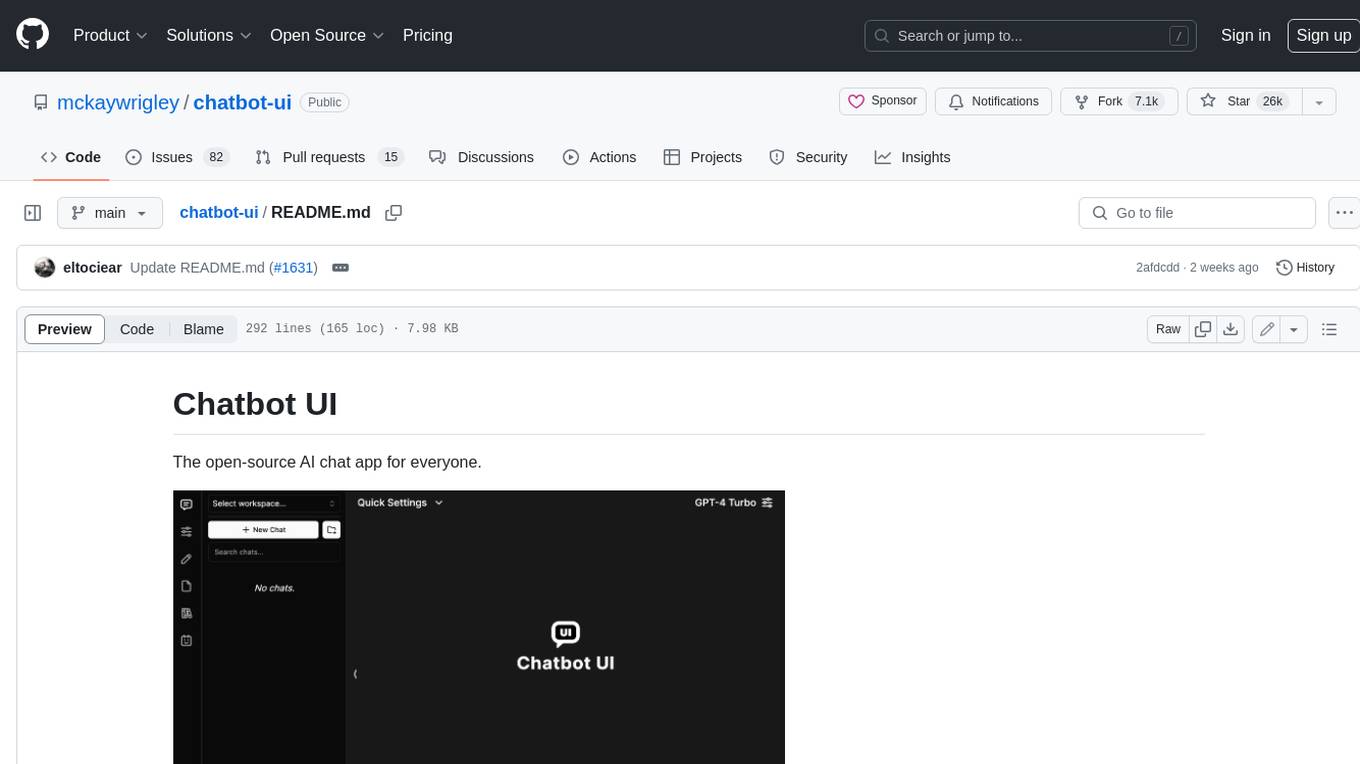
Chatbot UI is an open-source AI chat app that allows users to create and deploy their own AI chatbots. It is easy to use and can be customized to fit any need. Chatbot UI is perfect for businesses, developers, and anyone who wants to create a chatbot.
BricksLLM
BricksLLM is a cloud native AI gateway written in Go. Currently, it provides native support for OpenAI, Anthropic, Azure OpenAI and vLLM. BricksLLM aims to provide enterprise level infrastructure that can power any LLM production use cases. Here are some use cases for BricksLLM: * Set LLM usage limits for users on different pricing tiers * Track LLM usage on a per user and per organization basis * Block or redact requests containing PIIs * Improve LLM reliability with failovers, retries and caching * Distribute API keys with rate limits and cost limits for internal development/production use cases * Distribute API keys with rate limits and cost limits for students
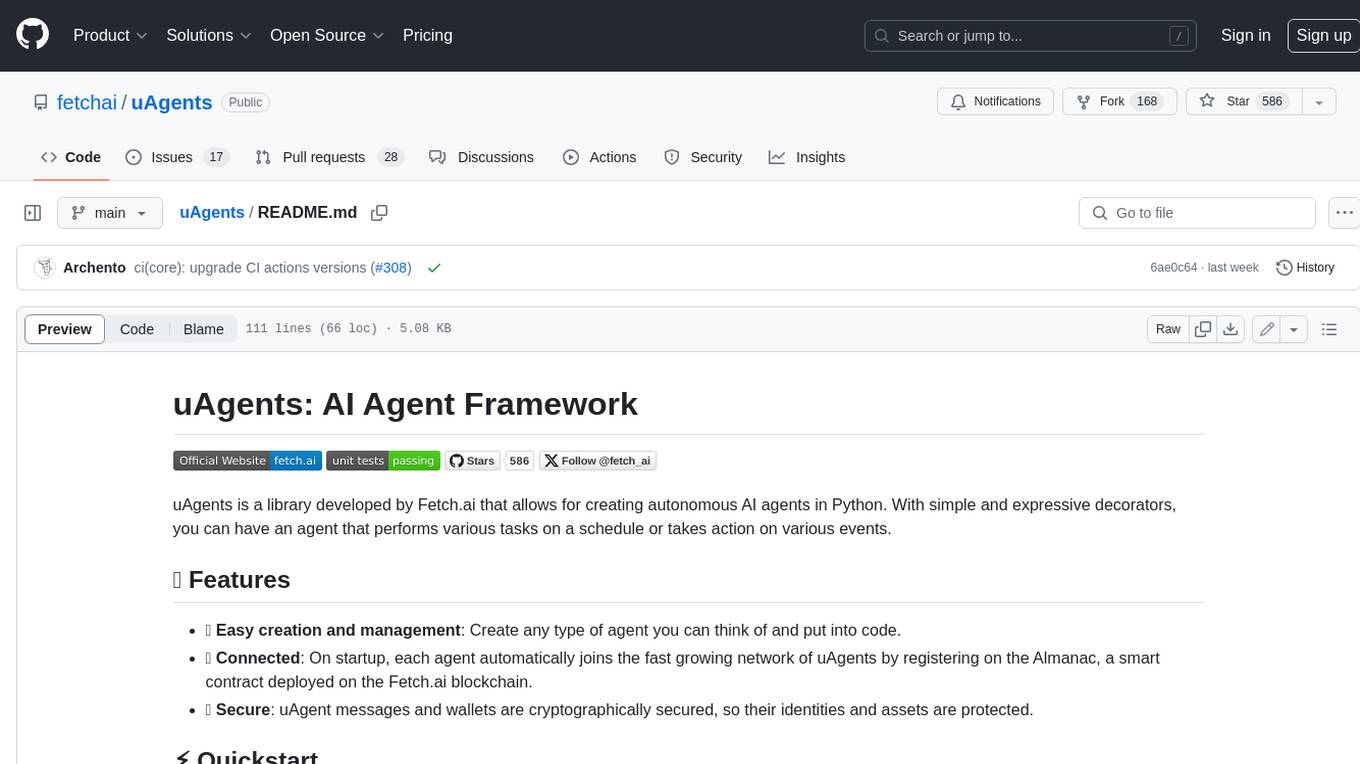
uAgents
uAgents is a Python library developed by Fetch.ai that allows for the creation of autonomous AI agents. These agents can perform various tasks on a schedule or take action on various events. uAgents are easy to create and manage, and they are connected to a fast-growing network of other uAgents. They are also secure, with cryptographically secured messages and wallets.
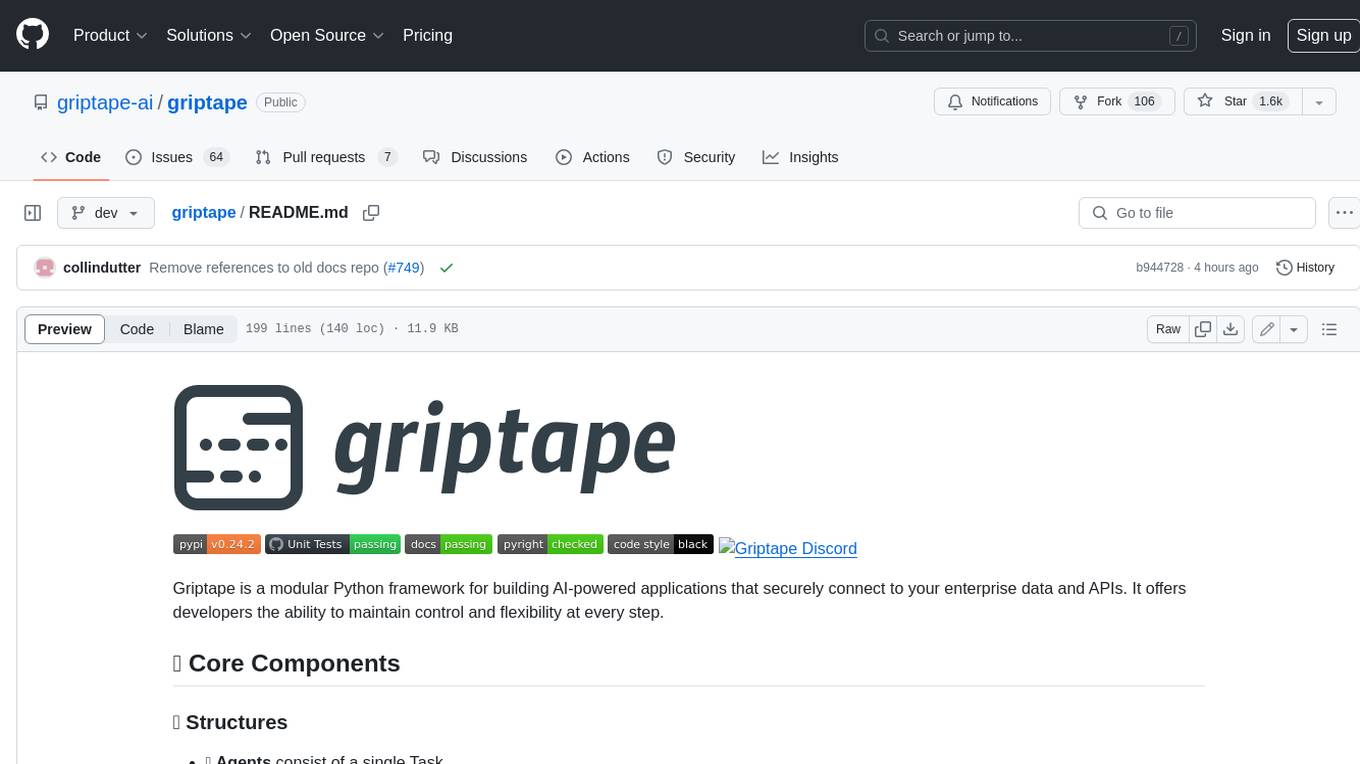
griptape
Griptape is a modular Python framework for building AI-powered applications that securely connect to your enterprise data and APIs. It offers developers the ability to maintain control and flexibility at every step. Griptape's core components include Structures (Agents, Pipelines, and Workflows), Tasks, Tools, Memory (Conversation Memory, Task Memory, and Meta Memory), Drivers (Prompt and Embedding Drivers, Vector Store Drivers, Image Generation Drivers, Image Query Drivers, SQL Drivers, Web Scraper Drivers, and Conversation Memory Drivers), Engines (Query Engines, Extraction Engines, Summary Engines, Image Generation Engines, and Image Query Engines), and additional components (Rulesets, Loaders, Artifacts, Chunkers, and Tokenizers). Griptape enables developers to create AI-powered applications with ease and efficiency.