


skillshare
📚 Sync skills across all AI CLI tools with one command and simplify team sharing. Supporting Claude Code, OpenClaw, OpenCode & more
Stars: 372
One source of truth for AI CLI skills. Sync everywhere with one command — from personal to organization-wide. Stop managing skills tool-by-tool. `skillshare` gives you one shared skill source and pushes it everywhere your AI agents work. Safe by default with non-destructive merge mode. True bidirectional flow with `collect`. Cross-machine ready with Git-native `push`/`pull`. Team + project friendly with global skills for personal workflows and repo-scoped collaboration. Visual control panel with `skillshare ui` for browsing, install, target management, and sync status in one place.
README:








One source of truth for AI CLI skills. Sync everywhere with one command — from personal to organization-wide.
Claude Code, OpenClaw, OpenCode & 40+ more.

Website • Install • Quick Start • Screenshots • Commands • Web UI • Project Skills • Organization Skills • Docs
[!NOTE] Recent Updates
Version Highlights 0.10.0 Web Dashboard — visual skill management via skillshare ui0.9.0 Project-level skills — scope skills to a single repo, share via git 0.8.0 pull→collectrename, clearer command symmetry, refactoring
Stop managing skills tool-by-tool.
skillshare gives you one shared skill source and pushes it everywhere your AI agents work.
-
One command, everywhere: Sync to Claude Code, Codex, Cursor, OpenCode, and more with
skillshare sync. - Safe by default: Non-destructive merge mode keeps CLI-local skills intact while sharing team skills.
-
True bidirectional flow: Pull skills back from targets with
collectso improvements never get trapped in one tool. -
Cross-machine ready: Git-native
push/pullkeeps all your devices aligned. -
Team + project friendly: Use global skills for personal workflows and
.skillshare/for repo-scoped collaboration. -
Visual control panel: Open
skillshare uifor browsing, install, target management, and sync status in one place.
- macOS / Linux:
~/.config/skillshare/skills/ - Windows:
%USERPROFILE%\.config\skillshare\skills\
┌─────────────────────────────────────────────────────────────┐
│                       Source Directory                      │
│                 ~/.config/skillshare/skills/                │
└─────────────────────────────────────────────────────────────┘
                              │ sync
              ┌───────────────┼───────────────┐
              ▼               ▼               ▼
       ┌───────────┐   ┌───────────┐   ┌───────────┐
       │  Claude   │   │  OpenCode │   │ OpenClaw  │   ...
       └───────────┘   └───────────┘   └───────────┘
| Platform | Source Path | Link Type |
|---|---|---|
| macOS/Linux | ~/.config/skillshare/skills/ |
Symlinks |
| Windows | %USERPROFILE%\.config\skillshare\skills\ |
NTFS Junctions (no admin required) |
| Sync | Install Skills |
|---|---|
 |
 |
| Dashboard | Skills |
|---|---|
 |
 |
curl -fsSL https://raw.githubusercontent.com/runkids/skillshare/main/install.sh | shirm https://raw.githubusercontent.com/runkids/skillshare/main/install.ps1 | iexbrew install runkids/tap/skillshareAdd an alias to your shell config (~/.zshrc or ~/.bashrc):
alias ss='skillshare'# macOS/Linux
brew uninstall skillshare # Homebrew
sudo rm /usr/local/bin/skillshare # Manual install
rm -rf ~/.config/skillshare # Config & data (optional)
# Windows (PowerShell)
Remove-Item "$env:LOCALAPPDATA\Programs\skillshare" -Recurse -Force
Remove-Item "$env:USERPROFILE\.config\skillshare" -Recurse -Force # optionalskillshare init --dry-run # Preview setup
skillshare init # Create config, source, and detected targets
skillshare sync # Sync skills to all targets| Command | What it does |
|---|---|
skillshare list |
List skills in source |
skillshare status |
Show sync status for all targets |
skillshare sync |
Sync source skills to all targets |
skillshare diff |
Preview differences before syncing |
skillshare doctor |
Diagnose config/environment issues |
skillshare new <name> |
Create a new skill template |
skillshare install <source> |
Install skill from local path or git source |
skillshare collect [target] |
Import skills from target(s) back to source |
skillshare update <name> |
Update one installed skill/repo |
skillshare update --all |
Update all tracked repos |
skillshare uninstall <name> |
Remove skill from source |
skillshare search <query> |
Search installable skills on GitHub |
skillshare search requires GitHub auth (gh auth login) or GITHUB_TOKEN.
skillshare target list
skillshare target add my-tool ~/.my-tool/skills
skillshare target remove my-toolskillshare backup
skillshare backup --list
skillshare restore <target>skillshare push
skillshare pullskillshare init -p
skillshare new my-skill -p
skillshare install anthropics/skills/skills/pdf -p
skillshare syncProject mode keeps skills in .skillshare/skills/ so they can be committed and shared with the repo.
skillshare install github.com/team/skills --track
skillshare update _team-skills
skillshare syncskillshare ui # Global mode
skillshare ui -p # Project mode (manages .skillshare/)- Opens
http://127.0.0.1:19420 - Requires
skillshare init(orinit -pfor project mode) first - Auto-detects project mode when
.skillshare/config.yamlexists - Runs from the same CLI binary (no extra frontend setup)
For containers/remote hosts:
skillshare ui --host 0.0.0.0 --no-openThen access: http://localhost:19420
Use Docker for reproducible offline testing and an interactive playground.
make test-docker
# or
./scripts/test_docker.shmake test-docker-online
# or
./scripts/test_docker_online.shmake sandbox-up
make sandbox-shell
make sandbox-downInside the playground:
skillshare --help
skillshare init --dry-run
skillshare ui --host 0.0.0.0 --no-open

# Project mode (pre-configured demo project)
cd ~/demo-project
skillshare status
skillshare-ui-p # project mode dashboard on port 19420go build -o bin/skillshare ./cmd/skillshare
go test ./...
go vet ./...
gofmt -w ./cmd ./internal ./testsUsing make:
make build
make test
make lint
make fmt
make check
UI development helpers:
make ui-install
make ui-build
make ui-dev
make build-ui- Docs home: https://skillshare.runkids.cc/docs/
- Commands: https://skillshare.runkids.cc/docs/commands
- Guides: https://skillshare.runkids.cc/docs/guides/
- Troubleshooting: https://skillshare.runkids.cc/docs/troubleshooting/faq
git clone https://github.com/runkids/skillshare.git
cd skillshare
go build -o bin/skillshare ./cmd/skillshare
go test ./...
Issues and PRs are welcome: https://github.com/runkids/skillshare/issues
If you find skillshare useful, consider giving it a ⭐
MIT
For Tasks:
Click tags to check more tools for each tasksFor Jobs:
Alternative AI tools for skillshare
Similar Open Source Tools
skillshare
One source of truth for AI CLI skills. Sync everywhere with one command — from personal to organization-wide. Stop managing skills tool-by-tool. `skillshare` gives you one shared skill source and pushes it everywhere your AI agents work. Safe by default with non-destructive merge mode. True bidirectional flow with `collect`. Cross-machine ready with Git-native `push`/`pull`. Team + project friendly with global skills for personal workflows and repo-scoped collaboration. Visual control panel with `skillshare ui` for browsing, install, target management, and sync status in one place.
sandbox
AIO Sandbox is an all-in-one agent sandbox environment that combines Browser, Shell, File, MCP operations, and VSCode Server in a single Docker container. It provides a unified, secure execution environment for AI agents and developers, with features like unified file system, multiple interfaces, secure execution, zero configuration, and agent-ready MCP-compatible APIs. The tool allows users to run shell commands, perform file operations, automate browser tasks, and integrate with various development tools and services.
multi-agent-shogun
multi-agent-shogun is a system that runs multiple AI coding CLI instances simultaneously, orchestrating them like a feudal Japanese army. It supports Claude Code, OpenAI Codex, GitHub Copilot, and Kimi Code. The system allows you to command your AI army with zero coordination cost, enabling parallel execution, non-blocking workflow, cross-session memory, event-driven communication, and full transparency. It also features skills discovery, phone notifications, pane border task display, shout mode, and multi-CLI support.
mcp-prompts
mcp-prompts is a Python library that provides a collection of prompts for generating creative writing ideas. It includes a variety of prompts such as story starters, character development, plot twists, and more. The library is designed to inspire writers and help them overcome writer's block by offering unique and engaging prompts to spark creativity. With mcp-prompts, users can access a wide range of writing prompts to kickstart their imagination and enhance their storytelling skills.
hub
Hub is an open-source, high-performance LLM gateway written in Rust. It serves as a smart proxy for LLM applications, centralizing control and tracing of all LLM calls and traces. Built for efficiency, it provides a single API to connect to any LLM provider. The tool is designed to be fast, efficient, and completely open-source under the Apache 2.0 license.
VT.ai
VT.ai is a multimodal AI platform that offers dynamic conversation routing with SemanticRouter, multi-modal interactions (text/image/audio), an assistant framework with code interpretation, real-time response streaming, cross-provider model switching, and local model support with Ollama integration. It supports various AI providers such as OpenAI, Anthropic, Google Gemini, Groq, Cohere, and OpenRouter, providing a wide range of core capabilities for AI orchestration.
agentboard
Agentboard is a Web GUI for tmux optimized for agent TUI's like claude and codex. It provides a shared workspace across devices with features such as paste support, touch scrolling, virtual arrow keys, log tracking, and session pinning. Users can interact with tmux sessions from any device through a live terminal stream. The tool allows session discovery, status inference, and terminal I/O streaming for efficient agent management.
DeepTutor
DeepTutor is an AI-powered personalized learning assistant that offers a suite of modules for massive document knowledge Q&A, interactive learning visualization, knowledge reinforcement with practice exercise generation, deep research, and idea generation. The tool supports multi-agent collaboration, dynamic topic queues, and structured outputs for various tasks. It provides a unified system entry for activity tracking, knowledge base management, and system status monitoring. DeepTutor is designed to streamline learning and research processes by leveraging AI technologies and interactive features.
mimiclaw
MimiClaw is a pocket AI assistant that runs on a $5 chip, specifically designed for the ESP32-S3 board. It operates without Linux or Node.js, using pure C language. Users can interact with MimiClaw through Telegram, enabling it to handle various tasks and learn from local memory. The tool is energy-efficient, running on USB power 24/7. With MimiClaw, users can have a personal AI assistant on a chip the size of a thumb, making it convenient and accessible for everyday use.
nono
nono is a secure, kernel-enforced capability shell for running AI agents and any POSIX style process. It leverages OS security primitives to create an environment where unauthorized operations are structurally impossible. It provides protections against destructive commands and securely stores API keys, tokens, and secrets. The tool is agent-agnostic, works with any AI agent or process, and blocks dangerous commands by default. It follows a capability-based security model with defense-in-depth, ensuring secure execution of commands and protecting sensitive data.
httpjail
httpjail is a cross-platform tool designed for monitoring and restricting HTTP/HTTPS requests from processes using network isolation and transparent proxy interception. It provides process-level network isolation, HTTP/HTTPS interception with TLS certificate injection, script-based and JavaScript evaluation for custom request logic, request logging, default deny behavior, and zero-configuration setup. The tool operates on Linux and macOS, creating an isolated network environment for target processes and intercepting all HTTP/HTTPS traffic through a transparent proxy enforcing user-defined rules.
morgana-form
MorGana Form is a full-stack form builder project developed using Next.js, React, TypeScript, Ant Design, PostgreSQL, and other technologies. It allows users to quickly create and collect data through survey forms. The project structure includes components, hooks, utilities, pages, constants, Redux store, themes, types, server-side code, and component packages. Environment variables are required for database settings, NextAuth login configuration, and file upload services. Additionally, the project integrates an AI model for form generation using the Ali Qianwen model API.
lihil
Lihil is a performant, productive, and professional web framework designed to make Python the mainstream programming language for web development. It is 100% test covered and strictly typed, offering fast performance, ergonomic API, and built-in solutions for common problems. Lihil is suitable for enterprise web development, delivering robust and scalable solutions with best practices in microservice architecture and related patterns. It features dependency injection, OpenAPI docs generation, error response generation, data validation, message system, testability, and strong support for AI features. Lihil is ASGI compatible and uses starlette as its ASGI toolkit, ensuring compatibility with starlette classes and middlewares. The framework follows semantic versioning and has a roadmap for future enhancements and features.
OpenSpec
OpenSpec is a tool for spec-driven development, aligning humans and AI coding assistants to agree on what to build before any code is written. It adds a lightweight specification workflow that ensures deterministic, reviewable outputs without the need for API keys. With OpenSpec, stakeholders can draft change proposals, review and align with AI assistants, implement tasks based on agreed specs, and archive completed changes for merging back into the source-of-truth specs. It works seamlessly with existing AI tools, offering shared visibility into proposed, active, or archived work.
Archon
Archon is an AI meta-agent designed to autonomously build, refine, and optimize other AI agents. It serves as a practical tool for developers and an educational framework showcasing the evolution of agentic systems. Through iterative development, Archon demonstrates the power of planning, feedback loops, and domain-specific knowledge in creating robust AI agents.
mcp-debugger
mcp-debugger is a Model Context Protocol (MCP) server that provides debugging tools as structured API calls. It enables AI agents to perform step-through debugging of multiple programming languages using the Debug Adapter Protocol (DAP). The tool supports multi-language debugging with clean adapter patterns, including Python debugging via debugpy, JavaScript (Node.js) debugging via js-debug, and Rust debugging via CodeLLDB. It offers features like mock adapter for testing, STDIO and SSE transport modes, zero-runtime dependencies, Docker and npm packages for deployment, structured JSON responses for easy parsing, path validation to prevent crashes, and AI-aware line context for intelligent breakpoint placement with code context.
For similar tasks
skillshare
One source of truth for AI CLI skills. Sync everywhere with one command — from personal to organization-wide. Stop managing skills tool-by-tool. `skillshare` gives you one shared skill source and pushes it everywhere your AI agents work. Safe by default with non-destructive merge mode. True bidirectional flow with `collect`. Cross-machine ready with Git-native `push`/`pull`. Team + project friendly with global skills for personal workflows and repo-scoped collaboration. Visual control panel with `skillshare ui` for browsing, install, target management, and sync status in one place.
For similar jobs
sweep
Sweep is an AI junior developer that turns bugs and feature requests into code changes. It automatically handles developer experience improvements like adding type hints and improving test coverage.
teams-ai
The Teams AI Library is a software development kit (SDK) that helps developers create bots that can interact with Teams and Microsoft 365 applications. It is built on top of the Bot Framework SDK and simplifies the process of developing bots that interact with Teams' artificial intelligence capabilities. The SDK is available for JavaScript/TypeScript, .NET, and Python.
ai-guide
This guide is dedicated to Large Language Models (LLMs) that you can run on your home computer. It assumes your PC is a lower-end, non-gaming setup.
classifai
Supercharge WordPress Content Workflows and Engagement with Artificial Intelligence. Tap into leading cloud-based services like OpenAI, Microsoft Azure AI, Google Gemini and IBM Watson to augment your WordPress-powered websites. Publish content faster while improving SEO performance and increasing audience engagement. ClassifAI integrates Artificial Intelligence and Machine Learning technologies to lighten your workload and eliminate tedious tasks, giving you more time to create original content that matters.
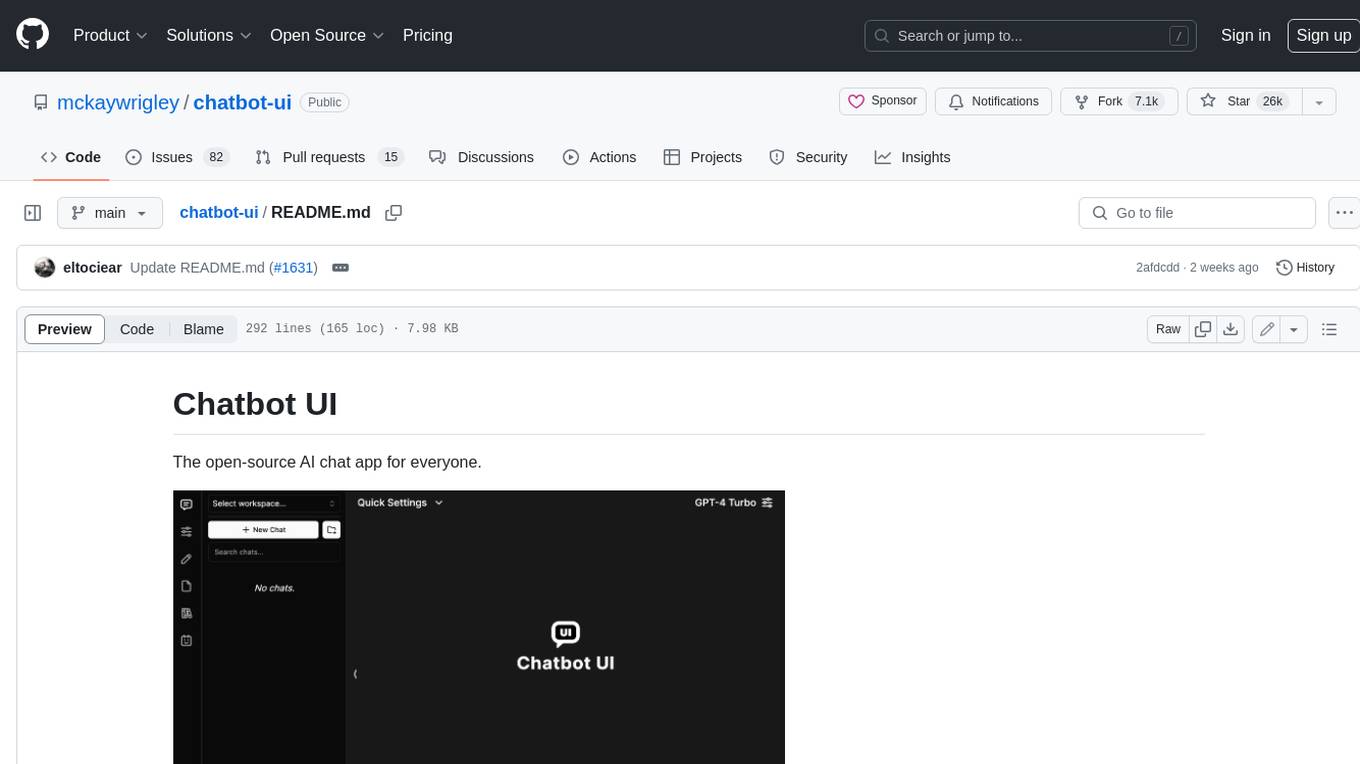
chatbot-ui
Chatbot UI is an open-source AI chat app that allows users to create and deploy their own AI chatbots. It is easy to use and can be customized to fit any need. Chatbot UI is perfect for businesses, developers, and anyone who wants to create a chatbot.
BricksLLM
BricksLLM is a cloud native AI gateway written in Go. Currently, it provides native support for OpenAI, Anthropic, Azure OpenAI and vLLM. BricksLLM aims to provide enterprise level infrastructure that can power any LLM production use cases. Here are some use cases for BricksLLM: * Set LLM usage limits for users on different pricing tiers * Track LLM usage on a per user and per organization basis * Block or redact requests containing PIIs * Improve LLM reliability with failovers, retries and caching * Distribute API keys with rate limits and cost limits for internal development/production use cases * Distribute API keys with rate limits and cost limits for students
uAgents
uAgents is a Python library developed by Fetch.ai that allows for the creation of autonomous AI agents. These agents can perform various tasks on a schedule or take action on various events. uAgents are easy to create and manage, and they are connected to a fast-growing network of other uAgents. They are also secure, with cryptographically secured messages and wallets.
griptape
Griptape is a modular Python framework for building AI-powered applications that securely connect to your enterprise data and APIs. It offers developers the ability to maintain control and flexibility at every step. Griptape's core components include Structures (Agents, Pipelines, and Workflows), Tasks, Tools, Memory (Conversation Memory, Task Memory, and Meta Memory), Drivers (Prompt and Embedding Drivers, Vector Store Drivers, Image Generation Drivers, Image Query Drivers, SQL Drivers, Web Scraper Drivers, and Conversation Memory Drivers), Engines (Query Engines, Extraction Engines, Summary Engines, Image Generation Engines, and Image Query Engines), and additional components (Rulesets, Loaders, Artifacts, Chunkers, and Tokenizers). Griptape enables developers to create AI-powered applications with ease and efficiency.