


monty
A minimal, secure Python interpreter written in Rust for use by AI
Stars: 5302
Monty is a minimal, secure Python interpreter written in Rust for use by AI. It allows safe execution of Python code written by an LLM embedded in your agent, with fast startup times and performance similar to CPython. Monty supports running a subset of Python code, blocking access to the host environment, calling host functions, typechecking, snapshotting interpreter state, controlling resource usage, collecting stdout and stderr, and running async or sync code. It is designed for running code written by agents, providing a sandboxed environment without the complexity of a full container-based solution.
README:





Experimental - This project is still in development, and not ready for the prime time.
A minimal, secure Python interpreter written in Rust for use by AI.
Monty avoids the cost, latency, complexity and general faff of using a full container based sandbox for running LLM generated code.
Instead, it lets you safely run Python code written by an LLM embedded in your agent, with startup times measured in single digit microseconds not hundreds of milliseconds.
What Monty can do:
- Run a reasonable subset of Python code - enough for your agent to express what it wants to do
- Completely block access to the host environment: filesystem, env variables and network access are all implemented via external function calls the developer can control
- Call functions on the host - only functions you give it access to
- Run typechecking - monty supports full modern python type hints and comes with ty included in a single binary to run typechecking
- Be snapshotted to bytes at external function calls, meaning you can store the interpreter state in a file or database, and resume later
- Startup extremely fast (<1μs to go from code to execution result), and has runtime performance that is similar to CPython (generally between 5x faster and 5x slower)
- Be called from Rust, Python, or Javascript - because Monty has no dependencies on cpython, you can use it anywhere you can run Rust
- Control resource usage - Monty can track memory usage, allocations, stack depth, and execution time and cancel execution if it exceeds preset limits
- Collect stdout and stderr and return it to the caller
- Run async or sync code on the host via async or sync code on the host
What Monty cannot do:
- Use the standard library (except a few select modules:
sys,typing,asyncio,dataclasses(soon),json(soon)) - Use third party libraries (like Pydantic), support for external python library is not a goal
- define classes (support should come soon)
- use match statements (again, support should come soon)
In short, Monty is extremely limited and designed for one use case:
To run code written by agents.
For motivation on why you might want to do this, see:
- Codemode from Cloudflare
- Programmatic Tool Calling from Anthropic
- Code Execution with MCP from Anthropic
- Smol Agents from Hugging Face
In very simple terms, the idea of all the above is that LLMs can work faster, cheaper and more reliably if they're asked to write Python (or Javascript) code, instead of relying on traditional tool calling. Monty makes that possible without the complexity of a sandbox or risk of running code directly on the host.
Note: Monty will (soon) be used to implement codemode in Pydantic AI
Monty can be called from Python, JavaScript/TypeScript or Rust.
To install:
uv add pydantic-monty(Or pip install pydantic-monty for the boomers)
Usage:
from typing import Any

import pydantic_monty

code = """
async def agent(prompt: str, messages: Messages):
    while True:
        print(f'messages so far: {messages}')
        output = await call_llm(prompt, messages)
        if isinstance(output, str):
            return output
        messages.extend(output)

await agent(prompt, [])
"""

type_definitions = """
from typing import Any

Messages = list[dict[str, Any]]

async def call_llm(prompt: str, messages: Messages) -> str | Messages:
    raise NotImplementedError()

prompt: str = ''
"""

m = pydantic_monty.Monty(
    code,
    inputs=['prompt'],
    external_functions=['call_llm'],
    script_name='agent.py',
    type_check=True,
    type_check_stubs=type_definitions,
)


Messages = list[dict[str, Any]]


async def call_llm(prompt: str, messages: Messages) -> str | Messages:
    if len(messages) < 2:
        return [{'role': 'system', 'content': 'example response'}]
    else:
        return f'example output, message count {len(messages)}'


async def main():
    output = await pydantic_monty.run_monty_async(
        m,
        inputs={'prompt': 'testing'},
        external_functions={'call_llm': call_llm},
    )
    print(output)
    #> example output, message count 2


if __name__ == '__main__':
    import asyncio

asyncio.run(main())Use start() and resume() to handle external function calls iteratively,
giving you control over each call:
import pydantic_monty

code = """
data = fetch(url)
len(data)
"""

m = pydantic_monty.Monty(code, inputs=['url'], external_functions=['fetch'])

# Start execution - pauses when fetch() is called
result = m.start(inputs={'url': 'https://example.com'})

print(type(result))
#> <class 'pydantic_monty.MontySnapshot'>
print(result.function_name)  # fetch
#> fetch
print(result.args)
#> ('https://example.com',)

# Perform the actual fetch, then resume with the result
result = result.resume(return_value='hello world')

print(type(result))
#> <class 'pydantic_monty.MontyComplete'>
print(result.output)
#> 11Both Monty and MontySnapshot can be serialized to bytes and restored later.
This allows caching parsed code or suspending execution across process boundaries:
import pydantic_monty

# Serialize parsed code to avoid re-parsing
m = pydantic_monty.Monty('x + 1', inputs=['x'])
data = m.dump()

# Later, restore and run
m2 = pydantic_monty.Monty.load(data)
print(m2.run(inputs={'x': 41}))
#> 42

# Serialize execution state mid-flight
m = pydantic_monty.Monty('fetch(url)', inputs=['url'], external_functions=['fetch'])
progress = m.start(inputs={'url': 'https://example.com'})
state = progress.dump()

# Later, restore and resume (e.g., in a different process)
progress2 = pydantic_monty.MontySnapshot.load(state)
result = progress2.resume(return_value='response data')
print(result.output)
#> response datause monty::{MontyRun, MontyObject, NoLimitTracker, StdPrint};
let code = r#"
def fib(n):
if n <= 1:
return n
return fib(n - 1) + fib(n - 2)
fib(x)
"#;
let runner = MontyRun::new(code.to_owned(), "fib.py", vec!["x".to_owned()], vec![]).unwrap();
let result = runner.run(vec![MontyObject::Int(10)], NoLimitTracker, &mut StdPrint).unwrap();
assert_eq!(result, MontyObject::Int(55));MontyRun and RunProgress can be serialized using the dump() and load() methods:
use monty::{MontyRun, MontyObject, NoLimitTracker, StdPrint};

// Serialize parsed code
let runner = MontyRun::new("x + 1".to_owned(), "main.py", vec!["x".to_owned()], vec![]).unwrap();
let bytes = runner.dump().unwrap();

// Later, restore and run
let runner2 = MontyRun::load(&bytes).unwrap();
let result = runner2.run(vec![MontyObject::Int(41)], NoLimitTracker, &mut StdPrint).unwrap();
assert_eq!(result, MontyObject::Int(42));Monty will power code-mode in Pydantic AI. Instead of making sequential tool calls, the LLM writes Python code that calls your tools as functions and Monty executes it safely.
from pydantic_ai import Agent
from pydantic_ai.toolsets.code_mode import CodeModeToolset
from pydantic_ai.toolsets.function import FunctionToolset
from typing_extensions import TypedDict


class WeatherResult(TypedDict):
    city: str
    temp_c: float
    conditions: str


toolset = FunctionToolset()


@toolset.tool
def get_weather(city: str) -> WeatherResult:
    """Get current weather for a city."""
    # your real implementation here
    return {'city': city, 'temp_c': 18, 'conditions': 'partly cloudy'}


@toolset.tool
def get_population(city: str) -> int:
    """Get the population of a city."""
    return {'london': 9_000_000, 'paris': 2_100_000, 'tokyo': 14_000_000}.get(
        city.lower(), 0
    )


toolset = CodeModeToolset(toolset)

agent = Agent(
    'anthropic:claude-sonnet-4-5',
    toolsets=[toolset],
)

result = agent.run_sync(
    'Compare the weather and population of London, Paris, and Tokyo.'
)
print(result.output)There are generally two responses when you show people Monty:
- Oh my god, this solves so many problems, I want it.
- Why not X?
Where X is some alternative technology. Oddly often these responses are combined, suggesting people have not yet found an alternative that works for them, but are incredulous that there's really no good alternative to creating an entire Python implementation from scratch.
I'll try to run through the most obvious alternatives, and why there aren't right for what we wanted.
NOTE: all these technologies are impressive and have widespread uses, this commentary on their limitations for our use case should not be seen as a criticism. Most of these solutions were not conceived with the goal of providing an LLM sandbox, which is why they're not necessary great at it.
| Tech | Language completeness | Security | Start latency | FOSS | Setup complexity | File mounting | Snapshotting |
|---|---|---|---|---|---|---|---|
| Monty | partial | strict | 0.06ms | free / OSS | easy | easy | easy |
| Docker | full | good | 195ms | free / OSS | intermediate | easy | intermediate |
| Pyodide | full | poor | 2800ms | free / OSS | intermediate | easy | hard |
| starlark-rust | very limited | good | 1.7ms | free / OSS | easy | not available? | impossible? |
| WASI / Wasmer | partial, almost full | strict | 66ms | free * | intermediate | easy | intermediate |
| sandboxing service | full | strict | 1033ms | not free | intermediate | hard | intermediate |
| YOLO Python | full | non-existent | 0.1ms / 30ms | free / OSS | easy | easy / scary | hard |
See ./scripts/startup_performance.py for the script used to calculate the startup performance numbers.
Details on each row below:
- Language completeness: No classes (yet), limited stdlib, no third-party libraries
- Security: Explicitly controlled filesystem, network, and env access, strict limits on execution time and memory usage
- Start latency: Starts in microseconds
-
Setup complexity: just
pip install pydantic-montyornpm install @pydantic/monty, ~4.5MB download - File mounting: Strictly controlled, see #85
-
Snapshotting: Monty's pause and resume functionality with
dump()andload()makes it trivial to pause, resume and fork execution
- Language completeness: Full CPython with any library
- Security: Process and filesystem isolation, network policies, but container escapes exist, memory limitation is possible
- Start latency: Container startup overhead (~195ms measured)
-
Setup complexity: Requires Docker daemon, container images, orchestration,
python:3.14-alpineis 50MB - docker can't be installed from PyPI - File mounting: Volume mounts work well
- Snapshotting: Possible with durable execution solutions like Temporal, or snapshotting an image and saving it as a Docker image.
- Language completeness: Full CPython compiled to WASM, almost all libraries available
- Security: Relies on browser/WASM sandbox - not designed for server-side isolation, python code can run arbitrary code in the JS runtime, only deno allows isolation, memory limits are hard/impossible to enforce with deno
- Start latency: WASM runtime loading is slow (~2800ms cold start)
- Setup complexity: Need to load WASM runtime, handle async initialization, pyodide NPM package is ~12MB, deno is ~50MB - Pyodide can't be called with just PyPI packages
- File mounting: Virtual filesystem via browser APIs
- Snapshotting: Possible with durable execution solutions like Temporal presumably, but hard
See starlark-rust.
- Language completeness: Configuration language, not Python - no classes, exceptions, async
- Security: Deterministic and hermetic by design
- Start latency: runs embedded in the process like Monty, hence impressive startup time
- Setup complexity: Usable in python via starlark-pyo3
- File mounting: No file handling by design AFAIK?
- Snapshotting: Impossible AFAIK?
Running Python in WebAssembly via Wasmer.
- Language completeness: Full CPython, pure Python external packages work via mounting, external packages with C bindings don't work
- Security: In principle WebAssembly should provide strong sandboxing guarantees.
- Start latency: The wasmer python package hasn't been updated for 3 years and I couldn't find docs on calling Python in wasmer from Python, so I called it via subprocess. Start latency was 66ms.
- Setup complexity: wasmer download is 100mb, the "python/python" package is 50mb.
-
FOSS: I marked this as "free *" since the cost is zero but not everything seems to be open source. As of 2026-02-10 the
python/pythonwasmer package package has no readme, no license, no source link and no indication of how it's built, the recently uploaded versions show size as "0B" although the download is ~50MB - the build process for the Python binary is not clear and transparent. (If I'm wrong here, please create an issue to correct correct me) - File mounting: Supported
- Snapshotting: Supported via journaling
Services like Daytona, E2B, Modal.
There are similar challenges, more setup complexity but lower network latency for setting up your own sandbox setup with k8s.
- Language completeness: Full CPython with any library
- Security: Professionally managed container isolation
- Start latency: Network round-trip and container startup time. I got ~1s cold start time with Daytona EU from London, Daytona advertise sub 90ms latency, presumably that's for an existing container, not clear if it includes network latency
- FOSS: Pay per execution or compute time, some implementations are open source
- Setup complexity: API integration, auth tokens - fine for startups but generally a non-start for enterprises
- File mounting: Upload/download via API calls
- Snapshotting: Possible with durable execution solutions like Temporal, also the services offer some solutions for this, I think based con docker containers
Running Python directly via exec() (~0.1ms) or subprocess (~30ms).
- Language completeness: Full CPython with any library
- Security: None - full filesystem, network, env vars, system commands
-
Start latency: Near-zero for
exec(), ~30ms for subprocess - Setup complexity: None
- File mounting: Direct filesystem access (that's the problem)
- Snapshotting: Possible with durable execution solutions like Temporal
For Tasks:
Click tags to check more tools for each tasksFor Jobs:
Alternative AI tools for monty
Similar Open Source Tools
monty
Monty is a minimal, secure Python interpreter written in Rust for use by AI. It allows safe execution of Python code written by an LLM embedded in your agent, with fast startup times and performance similar to CPython. Monty supports running a subset of Python code, blocking access to the host environment, calling host functions, typechecking, snapshotting interpreter state, controlling resource usage, collecting stdout and stderr, and running async or sync code. It is designed for running code written by agents, providing a sandboxed environment without the complexity of a full container-based solution.

rl
TorchRL is an open-source Reinforcement Learning (RL) library for PyTorch. It provides pytorch and **python-first** , low and high level abstractions for RL that are intended to be **efficient** , **modular** , **documented** and properly **tested**. The code is aimed at supporting research in RL. Most of it is written in python in a highly modular way, such that researchers can easily swap components, transform them or write new ones with little effort.
sre
SmythOS is an operating system designed for building, deploying, and managing intelligent AI agents at scale. It provides a unified SDK and resource abstraction layer for various AI services, making it easy to scale and flexible. With an agent-first design, developer-friendly SDK, modular architecture, and enterprise security features, SmythOS offers a robust foundation for AI workloads. The system is built with a philosophy inspired by traditional operating system kernels, ensuring autonomy, control, and security for AI agents. SmythOS aims to make shipping production-ready AI agents accessible and open for everyone in the coming Internet of Agents era.
crawl4ai
Crawl4AI is a powerful and free web crawling service that extracts valuable data from websites and provides LLM-friendly output formats. It supports crawling multiple URLs simultaneously, replaces media tags with ALT, and is completely free to use and open-source. Users can integrate Crawl4AI into Python projects as a library or run it as a standalone local server. The tool allows users to crawl and extract data from specified URLs using different providers and models, with options to include raw HTML content, force fresh crawls, and extract meaningful text blocks. Configuration settings can be adjusted in the `crawler/config.py` file to customize providers, API keys, chunk processing, and word thresholds. Contributions to Crawl4AI are welcome from the open-source community to enhance its value for AI enthusiasts and developers.
Scrapling
Scrapling is a high-performance, intelligent web scraping library for Python that automatically adapts to website changes while significantly outperforming popular alternatives. For both beginners and experts, Scrapling provides powerful features while maintaining simplicity. It offers features like fast and stealthy HTTP requests, adaptive scraping with smart element tracking and flexible selection, high performance with lightning-fast speed and memory efficiency, and developer-friendly navigation API and rich text processing. It also includes advanced parsing features like smart navigation, content-based selection, handling structural changes, and finding similar elements. Scrapling is designed to handle anti-bot protections and website changes effectively, making it a versatile tool for web scraping tasks.
logicstamp-context
LogicStamp Context is a static analyzer that extracts deterministic component contracts from TypeScript codebases, providing structured architectural context for AI coding assistants. It helps AI assistants understand architecture by extracting props, hooks, and dependencies without implementation noise. The tool works with React, Next.js, Vue, Express, and NestJS, and is compatible with various AI assistants like Claude, Cursor, and MCP agents. It offers features like watch mode for real-time updates, breaking change detection, and dependency graph creation. LogicStamp Context is a security-first tool that protects sensitive data, runs locally, and is non-opinionated about architectural decisions.

ebook2audiobook
ebook2audiobook is a CPU/GPU converter tool that converts eBooks to audiobooks with chapters and metadata using tools like Calibre, ffmpeg, XTTSv2, and Fairseq. It supports voice cloning and a wide range of languages. The tool is designed to run on 4GB RAM and provides a new v2.0 Web GUI interface for user-friendly interaction. Users can convert eBooks to text format, split eBooks into chapters, and utilize high-quality text-to-speech functionalities. Supported languages include Arabic, Chinese, English, French, German, Hindi, and many more. The tool can be used for legal, non-DRM eBooks only and should be used responsibly in compliance with applicable laws.
req_llm
ReqLLM is a Req-based library for LLM interactions, offering a unified interface to AI providers through a plugin-based architecture. It brings composability and middleware advantages to LLM interactions, with features like auto-synced providers/models, typed data structures, ergonomic helpers, streaming capabilities, usage & cost extraction, and a plugin-based provider system. Users can easily generate text, structured data, embeddings, and track usage costs. The tool supports various AI providers like Anthropic, OpenAI, Groq, Google, and xAI, and allows for easy addition of new providers. ReqLLM also provides API key management, detailed documentation, and a roadmap for future enhancements.
aio-pika
Aio-pika is a wrapper around aiormq for asyncio and humans. It provides a completely asynchronous API, object-oriented API, transparent auto-reconnects with complete state recovery, Python 3.7+ compatibility, transparent publisher confirms support, transactions support, and complete type-hints coverage.
quantalogic
QuantaLogic is a ReAct framework for building advanced AI agents that seamlessly integrates large language models with a robust tool system. It aims to bridge the gap between advanced AI models and practical implementation in business processes by enabling agents to understand, reason about, and execute complex tasks through natural language interaction. The framework includes features such as ReAct Framework, Universal LLM Support, Secure Tool System, Real-time Monitoring, Memory Management, and Enterprise Ready components.
curator
Bespoke Curator is an open-source tool for data curation and structured data extraction. It provides a Python library for generating synthetic data at scale, with features like programmability, performance optimization, caching, and integration with HuggingFace Datasets. The tool includes a Curator Viewer for dataset visualization and offers a rich set of functionalities for creating and refining data generation strategies.
HuixiangDou
HuixiangDou is a **group chat** assistant based on LLM (Large Language Model). Advantages: 1. Design a two-stage pipeline of rejection and response to cope with group chat scenario, answer user questions without message flooding, see arxiv2401.08772 2. Low cost, requiring only 1.5GB memory and no need for training 3. Offers a complete suite of Web, Android, and pipeline source code, which is industrial-grade and commercially viable Check out the scenes in which HuixiangDou are running and join WeChat Group to try AI assistant inside. If this helps you, please give it a star ⭐
LightRAG
LightRAG is a repository hosting the code for LightRAG, a system that supports seamless integration of custom knowledge graphs, Oracle Database 23ai, Neo4J for storage, and multiple file types. It includes features like entity deletion, batch insert, incremental insert, and graph visualization. LightRAG provides an API server implementation for RESTful API access to RAG operations, allowing users to interact with it through HTTP requests. The repository also includes evaluation scripts, code for reproducing results, and a comprehensive code structure.
xFasterTransformer
xFasterTransformer is an optimized solution for Large Language Models (LLMs) on the X86 platform, providing high performance and scalability for inference on mainstream LLM models. It offers C++ and Python APIs for easy integration, along with example codes and benchmark scripts. Users can prepare models in a different format, convert them, and use the APIs for tasks like encoding input prompts, generating token ids, and serving inference requests. The tool supports various data types and models, and can run in single or multi-rank modes using MPI. A web demo based on Gradio is available for popular LLM models like ChatGLM and Llama2. Benchmark scripts help evaluate model inference performance quickly, and MLServer enables serving with REST and gRPC interfaces.
aiodynamo
AsyncIO DynamoDB is an asynchronous pythonic client for DynamoDB, designed for asynchronous apps. It is two times faster than aiobotocore, botocore, or boto3 for operations like query or scan. The library provides a pythonic API with modern Python features, automatically depaginates paginated APIs using asynchronous iterators. The source code is legible and hand-written, allowing for easy inspection and understanding. It offers a pluggable HTTP client, enabling integration with existing asynchronous HTTP clients without additional dependencies or dependency resolution issues.
volga
Volga is a general purpose real-time data processing engine in Python for modern AI/ML systems. It aims to be a Python-native alternative to Flink/Spark Streaming with extended functionality for real-time AI/ML workloads. It provides a hybrid push+pull architecture, Entity API for defining data entities and feature pipelines, DataStream API for general data processing, and customizable data connectors. Volga can run on a laptop or a distributed cluster, making it suitable for building custom real-time AI/ML feature platforms or general data pipelines without relying on third-party platforms.
For similar tasks
monty
Monty is a minimal, secure Python interpreter written in Rust for use by AI. It allows safe execution of Python code written by an LLM embedded in your agent, with fast startup times and performance similar to CPython. Monty supports running a subset of Python code, blocking access to the host environment, calling host functions, typechecking, snapshotting interpreter state, controlling resource usage, collecting stdout and stderr, and running async or sync code. It is designed for running code written by agents, providing a sandboxed environment without the complexity of a full container-based solution.
KubeDoor
KubeDoor is a microservice resource management platform developed using Python and Vue, based on K8S admission control mechanism. It supports unified remote storage, monitoring, alerting, notification, and display for multiple K8S clusters. The platform focuses on resource analysis and control during daily peak hours of microservices, ensuring consistency between resource request rate and actual usage rate.
llm-sandbox
LLM Sandbox is a lightweight and portable sandbox environment designed to securely execute large language model (LLM) generated code in a safe and isolated manner using Docker containers. It provides an easy-to-use interface for setting up, managing, and executing code in a controlled Docker environment, simplifying the process of running code generated by LLMs. The tool supports multiple programming languages, offers flexibility with predefined Docker images or custom Dockerfiles, and allows scalability with support for Kubernetes and remote Docker hosts.
daytona
Daytona is a secure and elastic infrastructure tool designed for running AI-generated code. It offers lightning-fast infrastructure with sub-90ms sandbox creation, separated and isolated runtime for executing AI code with zero risk, massive parallelization for concurrent AI workflows, programmatic control through various APIs, unlimited sandbox persistence, and OCI/Docker compatibility. Users can create sandboxes using Python or TypeScript SDKs, run code securely inside the sandbox, and clean up the sandbox after execution. Daytona is open source under the GNU Affero General Public License and welcomes contributions from developers.
sparka
Sparka AI is a multi-provider AI chat tool that allows users to access various AI models like Claude, GPT-5, Gemini, and Grok through a single interface. It offers features such as document analysis, image generation, code execution, and research tools without the need for multiple subscriptions. The tool is open-source, production-ready, and provides capabilities for collaboration, secure authentication, attachment support, AI-powered image generation, syntax highlighting, resumable streams, chat branching, chat sharing, deep research, code execution, document creation, and web analytics. Built with modern technologies for scalability and performance, Sparka AI integrates with Vercel AI SDK, tRPC, Drizzle ORM, PostgreSQL, Redis, and AI SDK Gateway.
For similar jobs
sweep
Sweep is an AI junior developer that turns bugs and feature requests into code changes. It automatically handles developer experience improvements like adding type hints and improving test coverage.
teams-ai
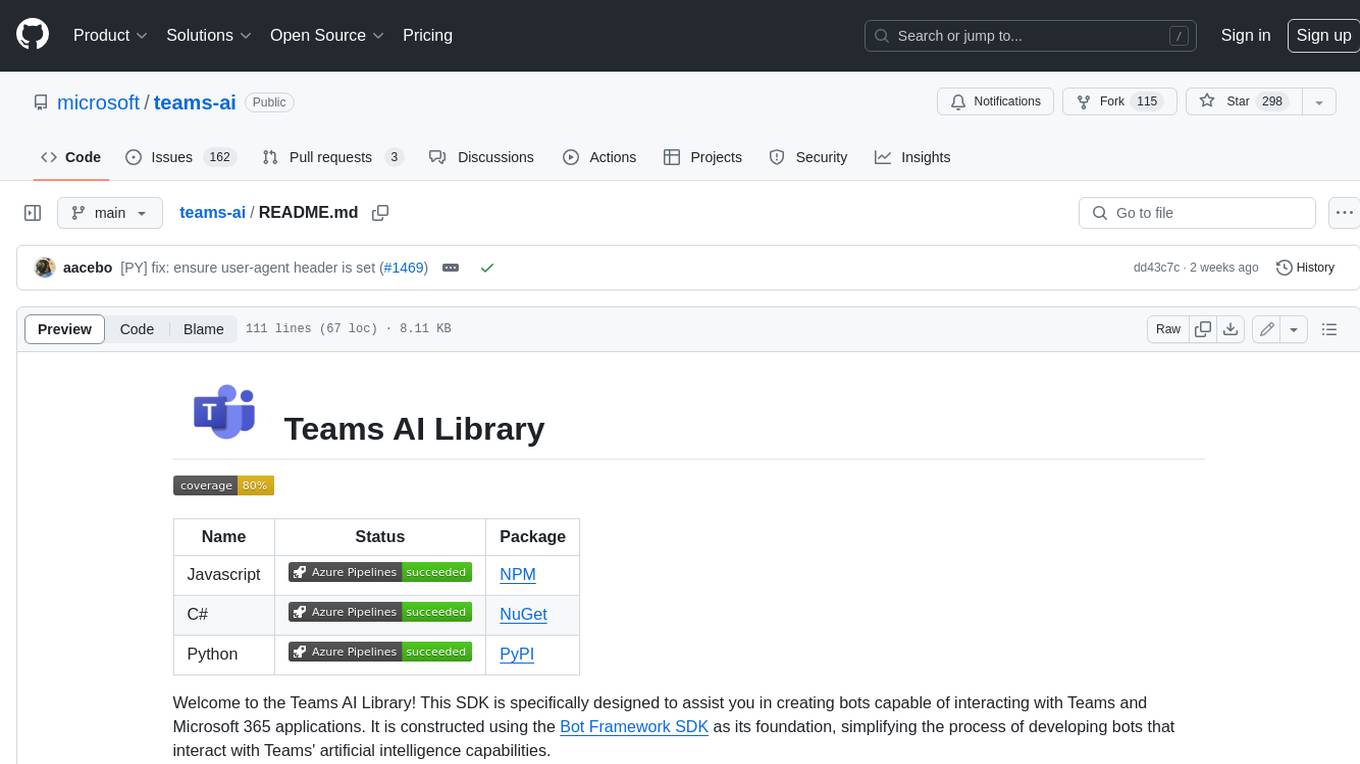
The Teams AI Library is a software development kit (SDK) that helps developers create bots that can interact with Teams and Microsoft 365 applications. It is built on top of the Bot Framework SDK and simplifies the process of developing bots that interact with Teams' artificial intelligence capabilities. The SDK is available for JavaScript/TypeScript, .NET, and Python.
ai-guide
This guide is dedicated to Large Language Models (LLMs) that you can run on your home computer. It assumes your PC is a lower-end, non-gaming setup.
classifai
Supercharge WordPress Content Workflows and Engagement with Artificial Intelligence. Tap into leading cloud-based services like OpenAI, Microsoft Azure AI, Google Gemini and IBM Watson to augment your WordPress-powered websites. Publish content faster while improving SEO performance and increasing audience engagement. ClassifAI integrates Artificial Intelligence and Machine Learning technologies to lighten your workload and eliminate tedious tasks, giving you more time to create original content that matters.
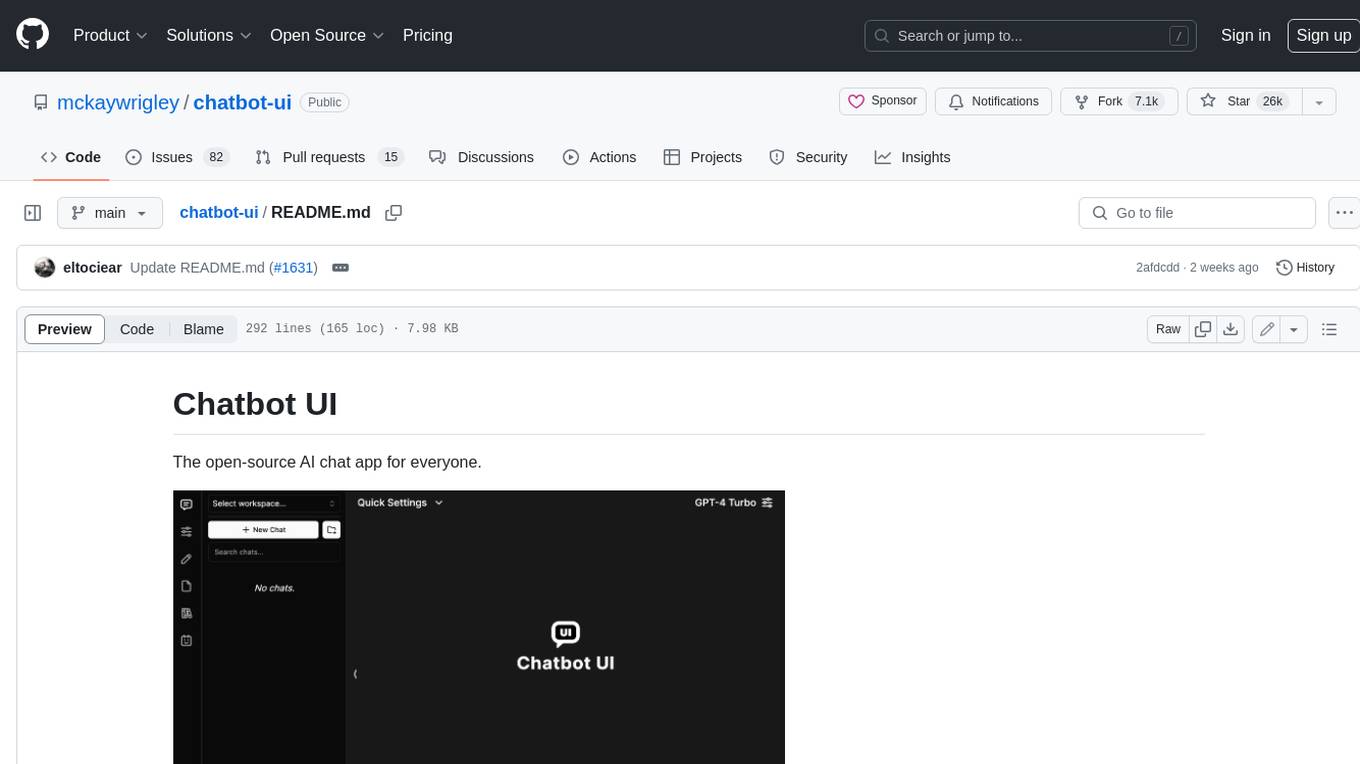
chatbot-ui
Chatbot UI is an open-source AI chat app that allows users to create and deploy their own AI chatbots. It is easy to use and can be customized to fit any need. Chatbot UI is perfect for businesses, developers, and anyone who wants to create a chatbot.
BricksLLM
BricksLLM is a cloud native AI gateway written in Go. Currently, it provides native support for OpenAI, Anthropic, Azure OpenAI and vLLM. BricksLLM aims to provide enterprise level infrastructure that can power any LLM production use cases. Here are some use cases for BricksLLM: * Set LLM usage limits for users on different pricing tiers * Track LLM usage on a per user and per organization basis * Block or redact requests containing PIIs * Improve LLM reliability with failovers, retries and caching * Distribute API keys with rate limits and cost limits for internal development/production use cases * Distribute API keys with rate limits and cost limits for students
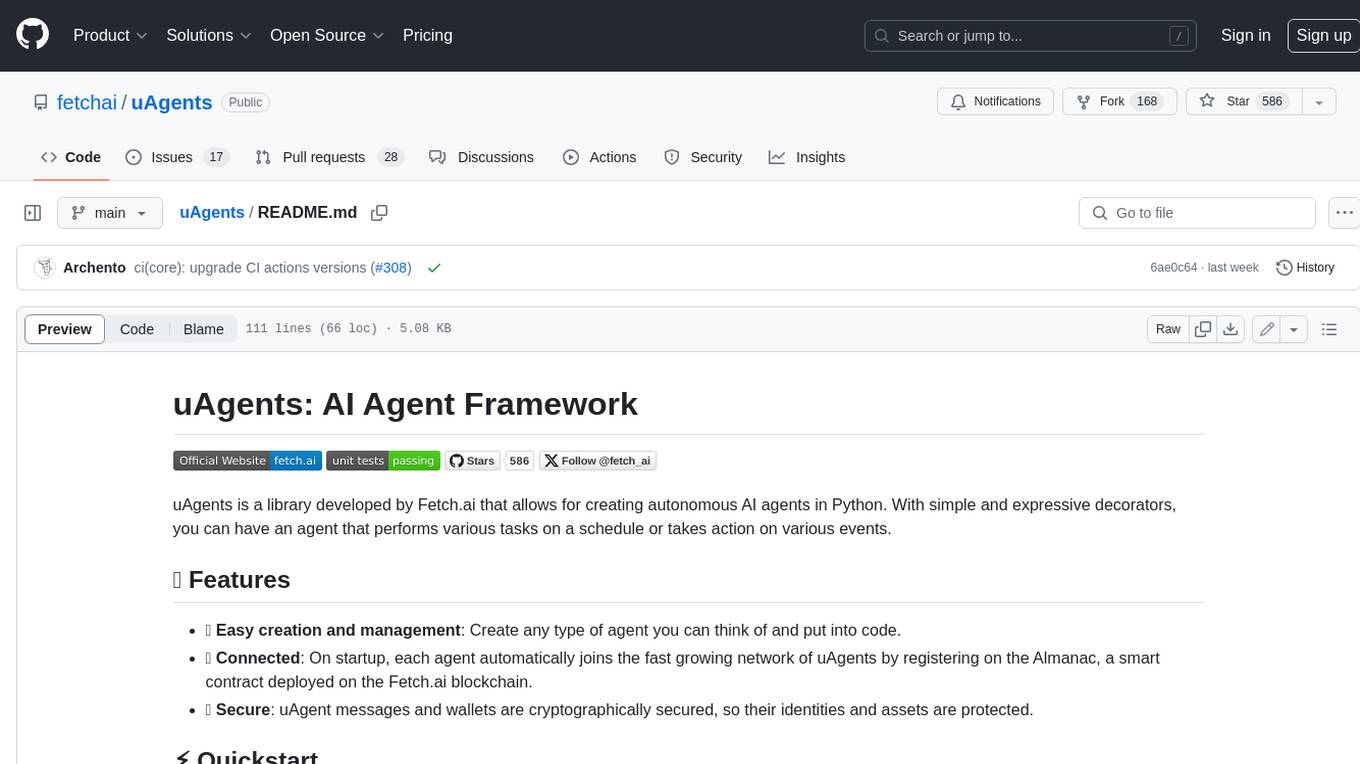
uAgents
uAgents is a Python library developed by Fetch.ai that allows for the creation of autonomous AI agents. These agents can perform various tasks on a schedule or take action on various events. uAgents are easy to create and manage, and they are connected to a fast-growing network of other uAgents. They are also secure, with cryptographically secured messages and wallets.
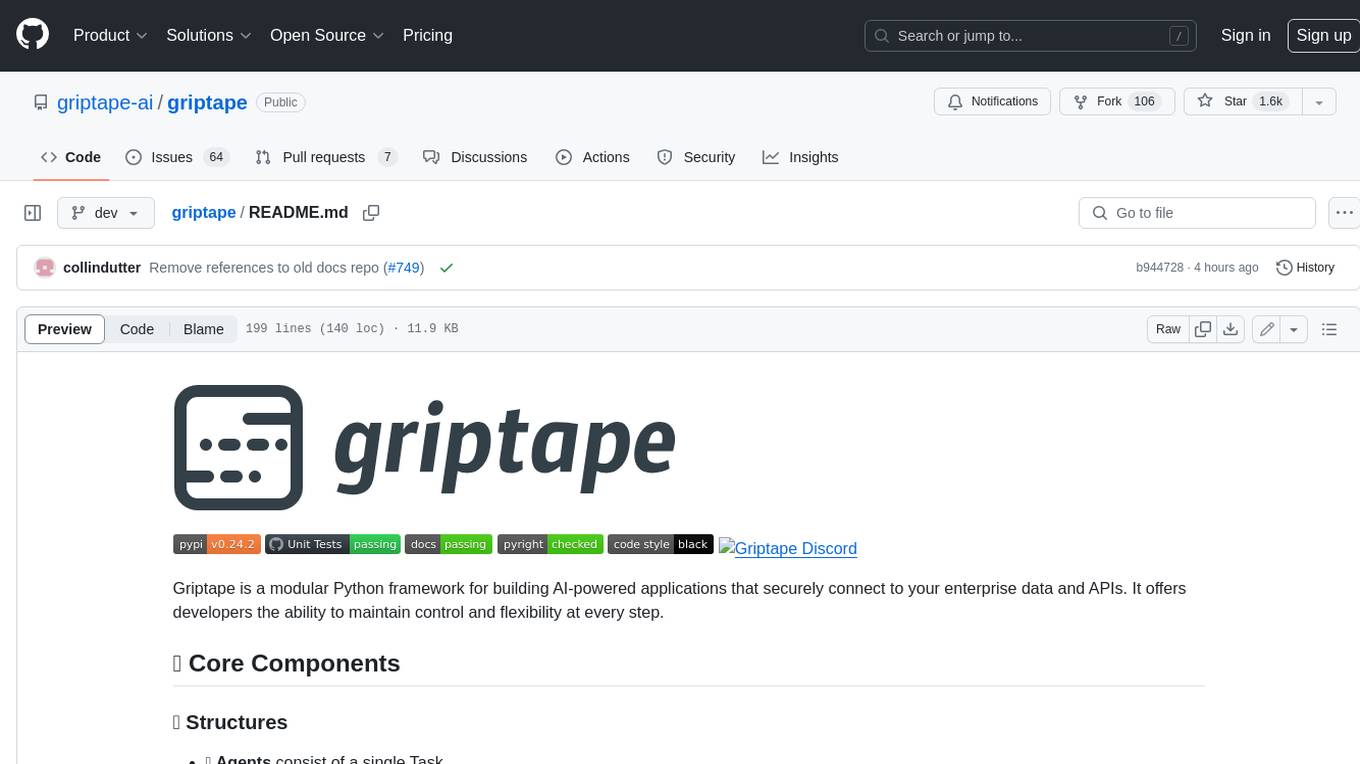
griptape
Griptape is a modular Python framework for building AI-powered applications that securely connect to your enterprise data and APIs. It offers developers the ability to maintain control and flexibility at every step. Griptape's core components include Structures (Agents, Pipelines, and Workflows), Tasks, Tools, Memory (Conversation Memory, Task Memory, and Meta Memory), Drivers (Prompt and Embedding Drivers, Vector Store Drivers, Image Generation Drivers, Image Query Drivers, SQL Drivers, Web Scraper Drivers, and Conversation Memory Drivers), Engines (Query Engines, Extraction Engines, Summary Engines, Image Generation Engines, and Image Query Engines), and additional components (Rulesets, Loaders, Artifacts, Chunkers, and Tokenizers). Griptape enables developers to create AI-powered applications with ease and efficiency.