


Oxide-Lab
Modern desktop application (Rust + Tauri v2 + Svelte 5 + Candle (HF)) for communicating with AI models that runs completely locally on your computer. No subscriptions, no data sent to the internet — just you and your personal AI assistant
Stars: 103
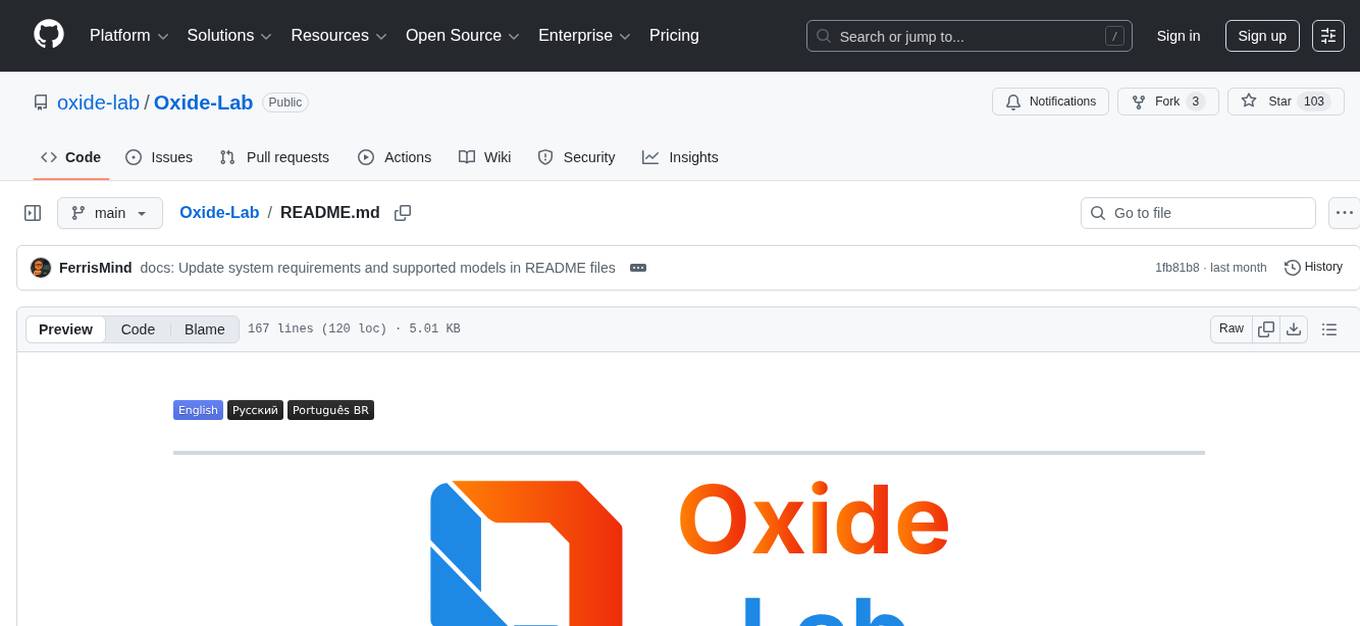
Oxide Lab is a private AI chat desktop application with local LLM support, allowing users to run large language models locally without internet connectivity or external API services. Built with Rust and Tauri v2, it offers a fast and secure chat interface where all inference happens on the user's machine, ensuring data privacy and security. The application supports multiple architectures, model formats, and hardware accelerations, along with streaming text generation and a modern UI built with Svelte and Tailwind CSS.
README:


Private AI chat desktop application with local LLM support.
All inference happens on your machine — no cloud, no data sharing.



- What is this?
- Demo
- Key Features
- Installation & Setup
- How to Start Using
- System Requirements
- Supported Models
- Privacy and Security
- Acknowledgments
- License
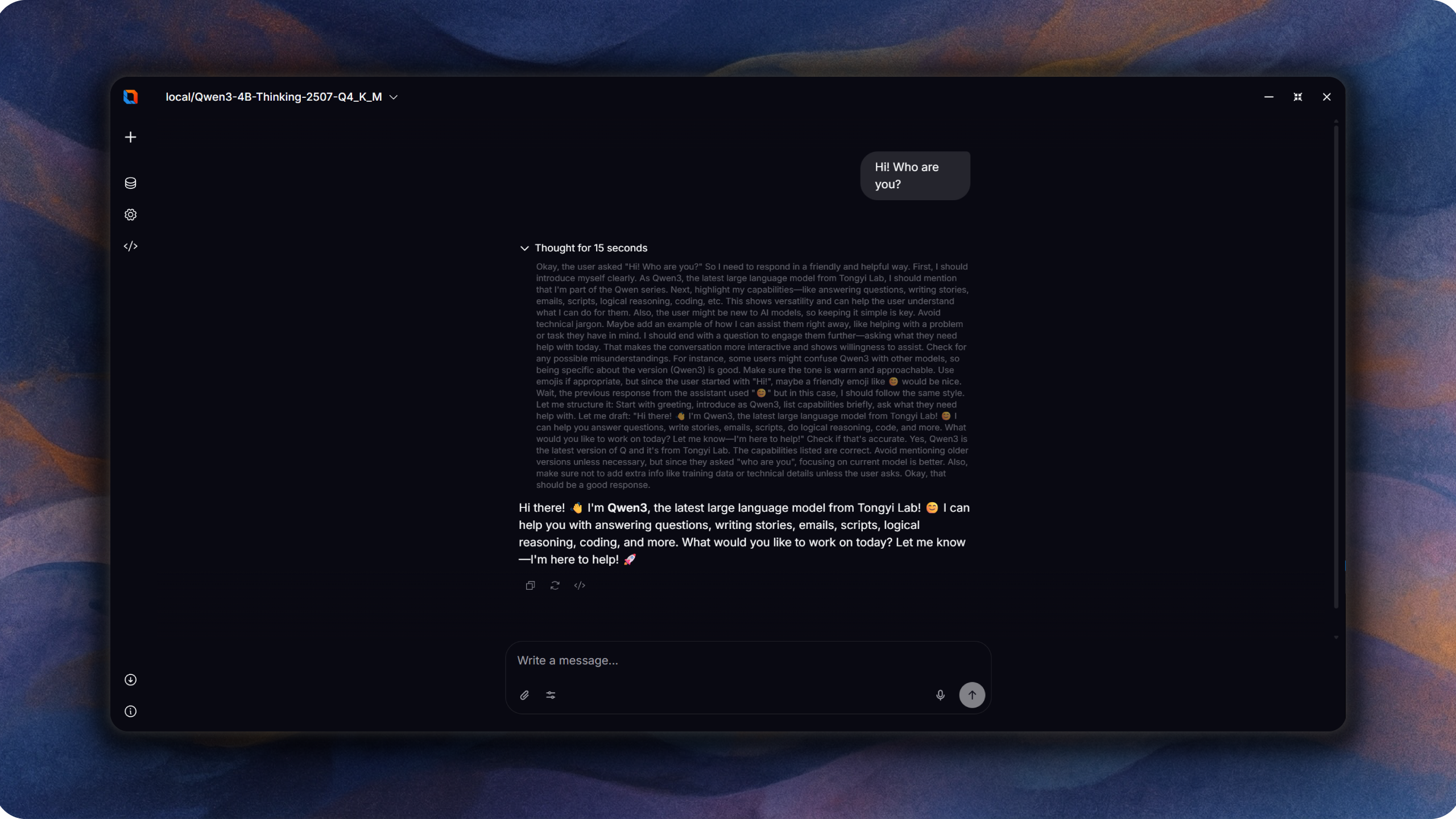
Oxide Lab is a native desktop application for running large language models locally. Built with Rust and Tauri v2, it provides a fast, private chat interface without requiring internet connectivity or external API services.
https://github.com/user-attachments/assets/0b9c8ff9-7793-4108-8b62-b0800cbd855e
https://github.com/user-attachments/assets/27c1f544-69e0-4a91-8fa5-4c21d67cb7c7
https://github.com/user-attachments/assets/ce5337d5-3e63-4263-b6a7-56e6847bbc71
- 100% local inference — your data never leaves your machine
- Multi-architecture support: Llama, Qwen2, Qwen2.5, Qwen3, Qwen3 MoE, Mistral, Mixtral, DeepSeek, Yi, SmolLM2
- GGUF and SafeTensors model formats
- Hardware acceleration: CPU, CUDA (NVIDIA), Metal (Apple Silicon), Intel MKL, Apple Accelerate
- Streaming text generation
- Multi-language UI: English, Russian, Brazilian Portuguese
- Modern interface built with Svelte 5 and Tailwind CSS
- Node.js (for frontend build)
- Rust toolchain (for backend)
- For CUDA: NVIDIA GPU with CUDA toolkit
- For Metal: macOS with Apple Silicon
# Install dependencies
npm install

# Run with CPU backend
npm run tauri:dev:cpu

# Run with CUDA backend (NVIDIA GPU)
npm run tauri:dev:cuda

# Platform-aware development
npm run app:dev# Build with CPU backend
npm run tauri:build:cpu
# Build with CUDA backend
npm run tauri:build:cudanpm run lint # ESLint
npm run lint:fix # ESLint with auto-fix
npm run check # Svelte type checking
npm run format # Prettier formatting
npm run test # Vitest testscargo clippy # Linting
cargo test # Unit tests
cargo audit # Security audit- Build or download the application
- Download a compatible GGUF or SafeTensors model (e.g., from Hugging Face)
- Launch Oxide Lab
- Load your model through the interface
- Start chatting
- Windows, macOS, or Linux
- Minimum 4 GB RAM (8+ GB recommended for larger models)
- For GPU acceleration:
- NVIDIA: CUDA-compatible GPU
- Apple: M1/M2/M3 chip (Metal)
Architectures with full support:
- Llama (1, 2, 3), Mistral, Mixtral, DeepSeek, Yi, SmolLM2, CodeLlama
- Qwen2/2.5, Qwen2.5/2 MoE
- Qwen3, Qwen3 MoE
Formats:
- GGUF (quantized models)
- SafeTensors
- All processing happens locally on your device
- No telemetry or data collection
- No internet connection required for inference
- Content Security Policy (CSP) enforced
This project is built on top of excellent open-source work:
- Candle — ML framework for Rust (HuggingFace)
- Tauri — Desktop application framework
- Svelte — Frontend framework
- Tokenizers — Fast tokenization (HuggingFace)
See THIRD_PARTY_LICENSES.md for full dependency attribution.
Apache-2.0 — see LICENSE
Copyright (c) 2025 FerrisMind
For Tasks:
Click tags to check more tools for each tasksFor Jobs:
Alternative AI tools for Oxide-Lab
Similar Open Source Tools
Oxide-Lab
Oxide Lab is a private AI chat desktop application with local LLM support, allowing users to run large language models locally without internet connectivity or external API services. Built with Rust and Tauri v2, it offers a fast and secure chat interface where all inference happens on the user's machine, ensuring data privacy and security. The application supports multiple architectures, model formats, and hardware accelerations, along with streaming text generation and a modern UI built with Svelte and Tailwind CSS.
openchamber
OpenChamber is a web and desktop interface for the OpenCode AI coding agent, designed to work alongside the OpenCode TUI. The project was built entirely with AI coding agents under supervision, serving as a proof of concept that AI agents can create usable software. It offers features like integrated terminal, Git operations with AI commit message generation, smart tool visualization, permission management, multi-agent runs, task tracker UI, model selection UX, UI scaling controls, session auto-cleanup, and memory optimizations. OpenChamber provides cross-device continuity, remote access, and a visual alternative for developers preferring GUI workflows.
BodhiApp
Bodhi App runs Open Source Large Language Models locally, exposing LLM inference capabilities as OpenAI API compatible REST APIs. It leverages llama.cpp for GGUF format models and huggingface.co ecosystem for model downloads. Users can run fine-tuned models for chat completions, create custom aliases, and convert Huggingface models to GGUF format. The CLI offers commands for environment configuration, model management, pulling files, serving API, and more.
Notate
Notate is a powerful desktop research assistant that combines AI-driven analysis with advanced vector search technology. It streamlines research workflow by processing, organizing, and retrieving information from documents, audio, and text. Notate offers flexible AI capabilities with support for various LLM providers and local models, ensuring data privacy. Built for researchers, academics, and knowledge workers, it features real-time collaboration, accessible UI, and cross-platform compatibility.
moling
MoLing is a computer-use and browser-use MCP Server that implements system interaction through operating system APIs, enabling file system operations such as reading, writing, merging, statistics, and aggregation, as well as the ability to execute system commands. It is a dependency-free local office automation assistant. Requiring no installation of any dependencies, MoLing can be run directly and is compatible with multiple operating systems, including Windows, Linux, and macOS. This eliminates the hassle of dealing with environment conflicts involving Node.js, Python, Docker, and other development environments. Command-line operations are dangerous and should be used with caution. MoLing supports features like file system operations, command-line terminal execution, browser control powered by 'github.com/chromedp/chromedp', and future plans for personal PC data organization, document writing assistance, schedule planning, and life assistant features. MoLing has been tested on macOS but may have issues on other operating systems.
Windows-Use
Windows-Use is a powerful automation agent that interacts directly with the Windows OS at the GUI layer. It bridges the gap between AI agents and Windows to perform tasks such as opening apps, clicking buttons, typing, executing shell commands, and capturing UI state without relying on traditional computer vision models. It enables any large language model (LLM) to perform computer automation instead of relying on specific models for it.
NextChat
NextChat is a well-designed cross-platform ChatGPT web UI tool that supports Claude, GPT4, and Gemini Pro. It offers a compact client for Linux, Windows, and MacOS, with features like self-deployed LLMs compatibility, privacy-first data storage, markdown support, responsive design, and fast loading speed. Users can create, share, and debug chat tools with prompt templates, access various prompts, compress chat history, and use multiple languages. The tool also supports enterprise-level privatization and customization deployment, with features like brand customization, resource integration, permission control, knowledge integration, security auditing, private deployment, and continuous updates.
RWKV-Runner
RWKV Runner is a project designed to simplify the usage of large language models by automating various processes. It provides a lightweight executable program and is compatible with the OpenAI API. Users can deploy the backend on a server and use the program as a client. The project offers features like model management, VRAM configurations, user-friendly chat interface, WebUI option, parameter configuration, model conversion tool, download management, LoRA Finetune, and multilingual localization. It can be used for various tasks such as chat, completion, composition, and model inspection.
sdk-python
Strands Agents is a lightweight and flexible SDK that takes a model-driven approach to building and running AI agents. It supports various model providers, offers advanced capabilities like multi-agent systems and streaming support, and comes with built-in MCP server support. Users can easily create tools using Python decorators, integrate MCP servers seamlessly, and leverage multiple model providers for different AI tasks. The SDK is designed to scale from simple conversational assistants to complex autonomous workflows, making it suitable for a wide range of AI development needs.
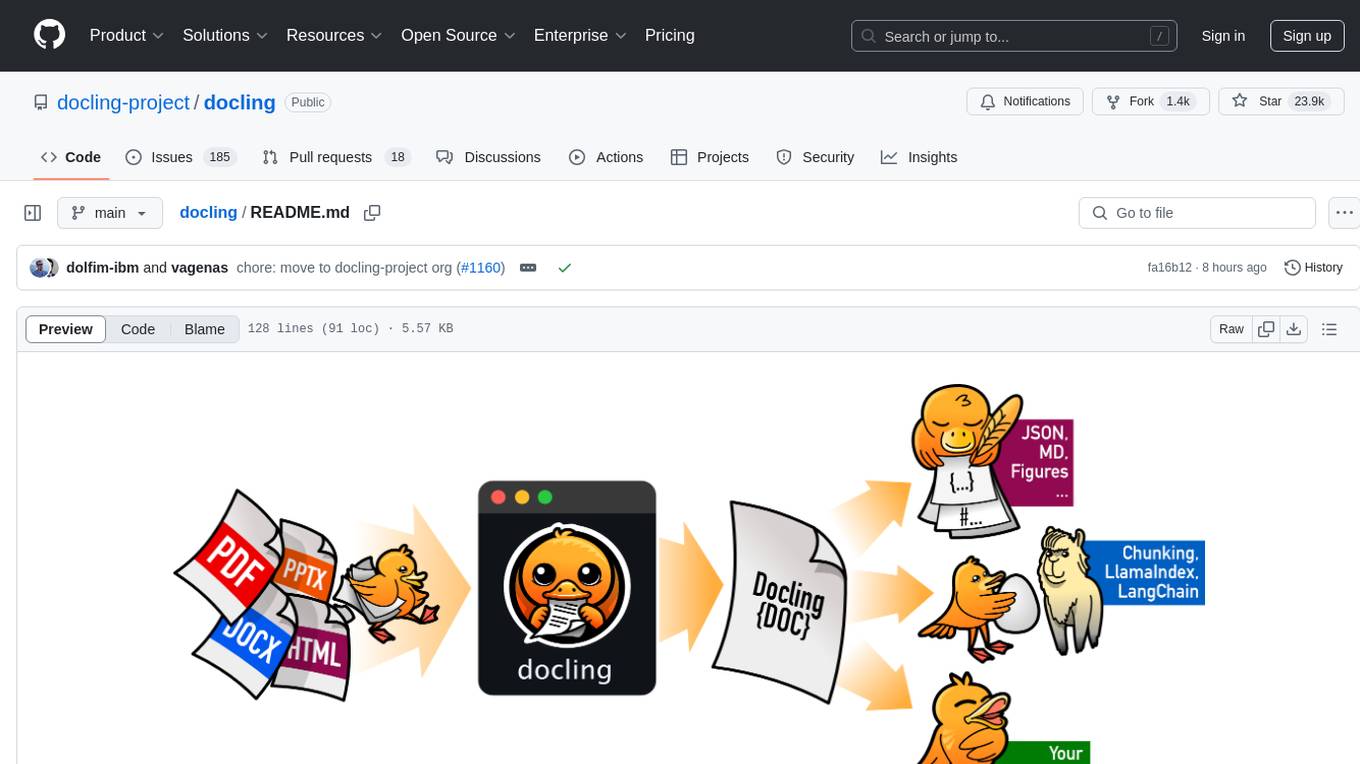
docling
Docling simplifies document processing, parsing diverse formats including advanced PDF understanding, and providing seamless integrations with the general AI ecosystem. It offers features such as parsing multiple document formats, advanced PDF understanding, unified DoclingDocument representation format, various export formats, local execution capabilities, plug-and-play integrations with agentic AI tools, extensive OCR support, and a simple CLI. Coming soon features include metadata extraction, visual language models, chart understanding, and complex chemistry understanding. Docling is installed via pip and works on macOS, Linux, and Windows environments. It provides detailed documentation, examples, integrations with popular frameworks, and support through the discussion section. The codebase is under the MIT license and has been developed by IBM.
xpander.ai
xpander.ai is a Backend-as-a-Service for autonomous agents that abstracts the ops layer, allowing AI engineers to focus on behavior and outcomes. It provides managed agent hosting with version control and CI/CD, a fully managed PostgreSQL memory layer, and a library of 2,000+ functions. The platform features an AI native triggering system that processes inputs from various sources and delivers unified messages to agents. With support for any agent framework or SDK, including Agno and OpenAI, xpander.ai enables users to build intelligent, production-ready AI agents without dealing with infrastructure complexity.
aderyn
Aderyn is a powerful Solidity static analyzer designed to help protocol engineers and security researchers find vulnerabilities in Solidity code bases. It provides off-the-shelf support for Foundry and Hardhat projects, allows for custom frameworks through a configuration file, and generates reports in Markdown, JSON, and Sarif formats. Users can install Aderyn using Cyfrinup, curl, Homebrew, or npm, and quickly identify vulnerabilities in their Solidity code. The tool also offers a VS Code extension for seamless integration with the IDE.
qwen-code
Qwen Code is an open-source AI agent optimized for Qwen3-Coder, designed to help users understand large codebases, automate tedious work, and expedite the shipping process. It offers an agentic workflow with rich built-in tools, a terminal-first approach with optional IDE integration, and supports both OpenAI-compatible API and Qwen OAuth authentication methods. Users can interact with Qwen Code in interactive mode, headless mode, IDE integration, and through a TypeScript SDK. The tool can be configured via settings.json, environment variables, and CLI flags, and offers benchmark results for performance evaluation. Qwen Code is part of an ecosystem that includes AionUi and Gemini CLI Desktop for graphical interfaces, and troubleshooting guides are available for issue resolution.
Shellsage
Shell Sage is an intelligent terminal companion and AI-powered terminal assistant that enhances the terminal experience with features like local and cloud AI support, context-aware error diagnosis, natural language to command translation, and safe command execution workflows. It offers interactive workflows, supports various API providers, and allows for custom model selection. Users can configure the tool for local or API mode, select specific models, and switch between modes easily. Currently in alpha development, Shell Sage has known limitations like limited Windows support and occasional false positives in error detection. The roadmap includes improvements like better context awareness, Windows PowerShell integration, Tmux integration, and CI/CD error pattern database.
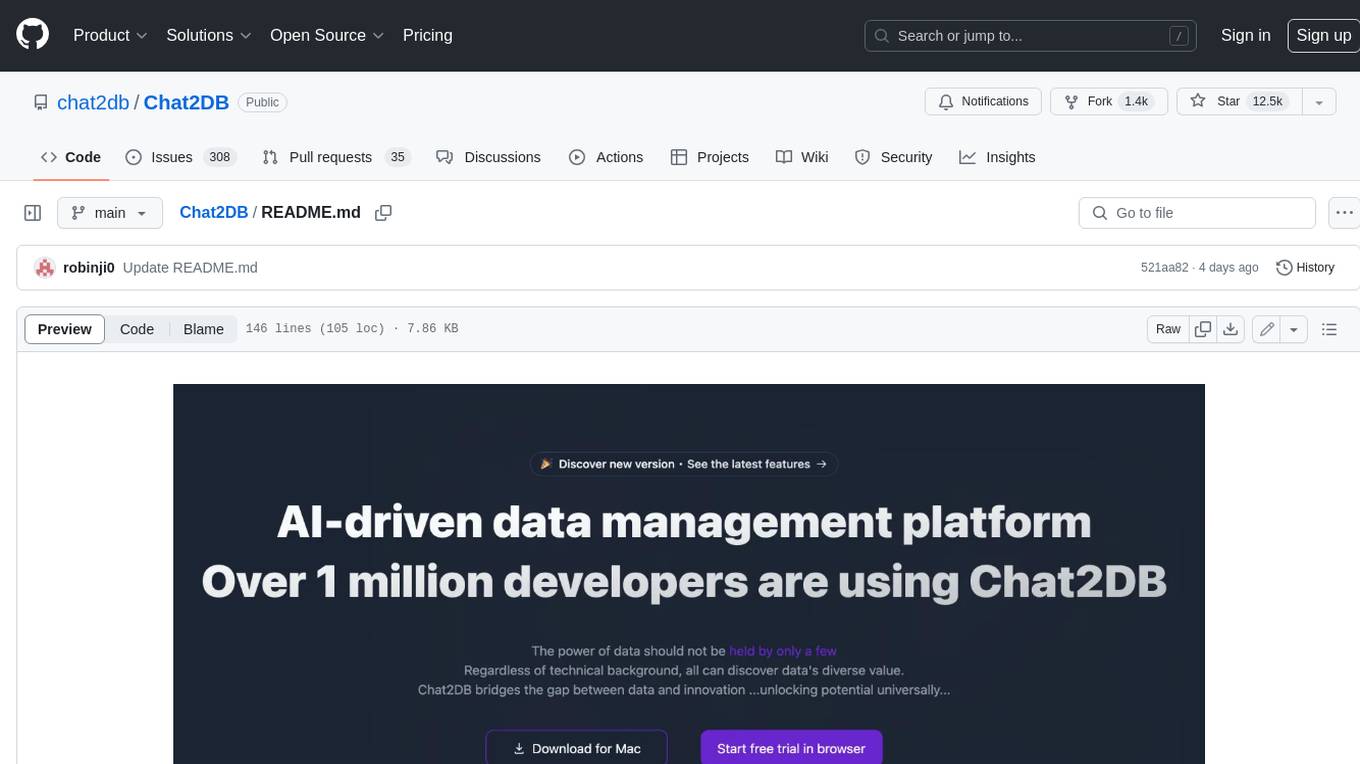
Chat2DB
Chat2DB is an AI-driven data development and analysis platform that enables users to communicate with databases using natural language. It supports a wide range of databases, including MySQL, PostgreSQL, Oracle, SQLServer, SQLite, MariaDB, ClickHouse, DM, Presto, DB2, OceanBase, Hive, KingBase, MongoDB, Redis, and Snowflake. Chat2DB provides a user-friendly interface that allows users to query databases, generate reports, and explore data using natural language commands. It also offers a variety of features to help users improve their productivity, such as auto-completion, syntax highlighting, and error checking.
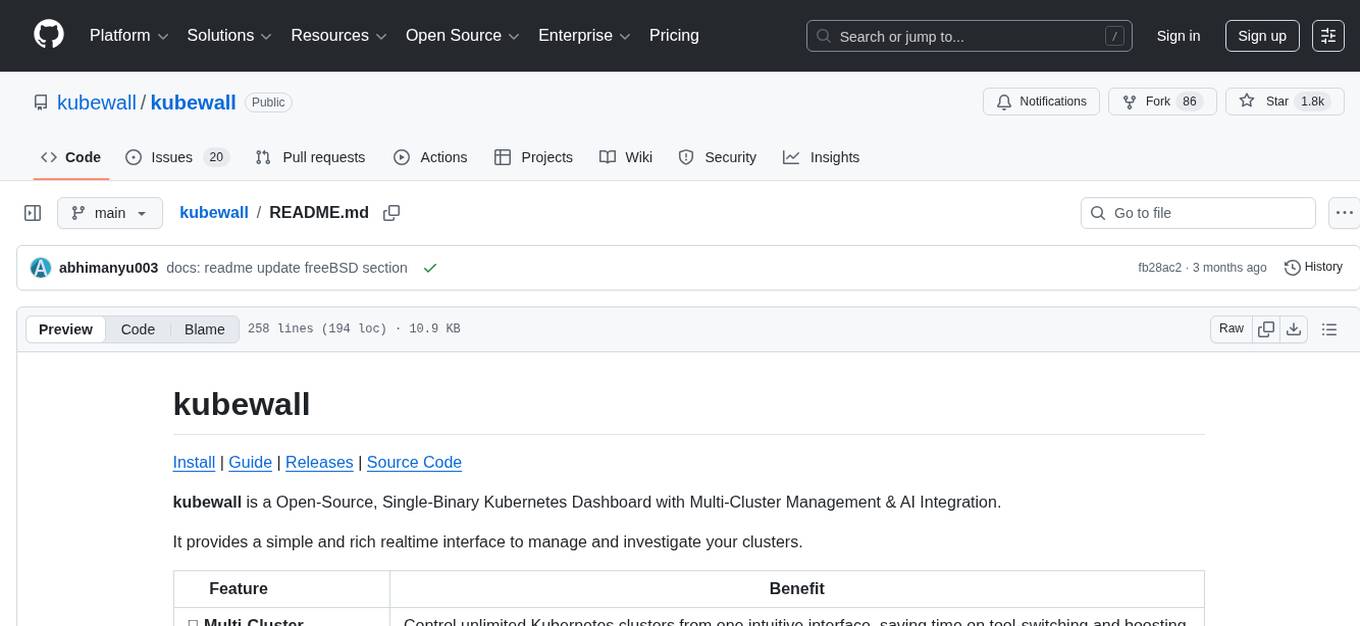
kubewall
kubewall is an open-source, single-binary Kubernetes dashboard with multi-cluster management and AI integration. It provides a simple and rich real-time interface to manage and investigate your clusters. With features like multi-cluster management, AI-powered troubleshooting, real-time monitoring, single-binary deployment, in-depth resource views, browser-based access, search and filter capabilities, privacy by default, port forwarding, live refresh, aggregated pod logs, and clean resource management, kubewall offers a comprehensive solution for Kubernetes cluster management.
For similar tasks
Oxide-Lab
Oxide Lab is a private AI chat desktop application with local LLM support, allowing users to run large language models locally without internet connectivity or external API services. Built with Rust and Tauri v2, it offers a fast and secure chat interface where all inference happens on the user's machine, ensuring data privacy and security. The application supports multiple architectures, model formats, and hardware accelerations, along with streaming text generation and a modern UI built with Svelte and Tailwind CSS.
LLMStack
LLMStack is a no-code platform for building generative AI agents, workflows, and chatbots. It allows users to connect their own data, internal tools, and GPT-powered models without any coding experience. LLMStack can be deployed to the cloud or on-premise and can be accessed via HTTP API or triggered from Slack or Discord.
LocalAI
LocalAI is a free and open-source OpenAI alternative that acts as a drop-in replacement REST API compatible with OpenAI (Elevenlabs, Anthropic, etc.) API specifications for local AI inferencing. It allows users to run LLMs, generate images, audio, and more locally or on-premises with consumer-grade hardware, supporting multiple model families and not requiring a GPU. LocalAI offers features such as text generation with GPTs, text-to-audio, audio-to-text transcription, image generation with stable diffusion, OpenAI functions, embeddings generation for vector databases, constrained grammars, downloading models directly from Huggingface, and a Vision API. It provides a detailed step-by-step introduction in its Getting Started guide and supports community integrations such as custom containers, WebUIs, model galleries, and various bots for Discord, Slack, and Telegram. LocalAI also offers resources like an LLM fine-tuning guide, instructions for local building and Kubernetes installation, projects integrating LocalAI, and a how-tos section curated by the community. It encourages users to cite the repository when utilizing it in downstream projects and acknowledges the contributions of various software from the community.
AiTreasureBox
AiTreasureBox is a versatile AI tool that provides a collection of pre-trained models and algorithms for various machine learning tasks. It simplifies the process of implementing AI solutions by offering ready-to-use components that can be easily integrated into projects. With AiTreasureBox, users can quickly prototype and deploy AI applications without the need for extensive knowledge in machine learning or deep learning. The tool covers a wide range of tasks such as image classification, text generation, sentiment analysis, object detection, and more. It is designed to be user-friendly and accessible to both beginners and experienced developers, making AI development more efficient and accessible to a wider audience.
glide
Glide is a cloud-native LLM gateway that provides a unified REST API for accessing various large language models (LLMs) from different providers. It handles LLMOps tasks such as model failover, caching, key management, and more, making it easy to integrate LLMs into applications. Glide supports popular LLM providers like OpenAI, Anthropic, Azure OpenAI, AWS Bedrock (Titan), Cohere, Google Gemini, OctoML, and Ollama. It offers high availability, performance, and observability, and provides SDKs for Python and NodeJS to simplify integration.

jupyter-ai
Jupyter AI connects generative AI with Jupyter notebooks. It provides a user-friendly and powerful way to explore generative AI models in notebooks and improve your productivity in JupyterLab and the Jupyter Notebook. Specifically, Jupyter AI offers: * An `%%ai` magic that turns the Jupyter notebook into a reproducible generative AI playground. This works anywhere the IPython kernel runs (JupyterLab, Jupyter Notebook, Google Colab, Kaggle, VSCode, etc.). * A native chat UI in JupyterLab that enables you to work with generative AI as a conversational assistant. * Support for a wide range of generative model providers, including AI21, Anthropic, AWS, Cohere, Gemini, Hugging Face, NVIDIA, and OpenAI. * Local model support through GPT4All, enabling use of generative AI models on consumer grade machines with ease and privacy.
langchain_dart
LangChain.dart is a Dart port of the popular LangChain Python framework created by Harrison Chase. LangChain provides a set of ready-to-use components for working with language models and a standard interface for chaining them together to formulate more advanced use cases (e.g. chatbots, Q&A with RAG, agents, summarization, extraction, etc.). The components can be grouped into a few core modules: * **Model I/O:** LangChain offers a unified API for interacting with various LLM providers (e.g. OpenAI, Google, Mistral, Ollama, etc.), allowing developers to switch between them with ease. Additionally, it provides tools for managing model inputs (prompt templates and example selectors) and parsing the resulting model outputs (output parsers). * **Retrieval:** assists in loading user data (via document loaders), transforming it (with text splitters), extracting its meaning (using embedding models), storing (in vector stores) and retrieving it (through retrievers) so that it can be used to ground the model's responses (i.e. Retrieval-Augmented Generation or RAG). * **Agents:** "bots" that leverage LLMs to make informed decisions about which available tools (such as web search, calculators, database lookup, etc.) to use to accomplish the designated task. The different components can be composed together using the LangChain Expression Language (LCEL).

infinity
Infinity is an AI-native database designed for LLM applications, providing incredibly fast full-text and vector search capabilities. It supports a wide range of data types, including vectors, full-text, and structured data, and offers a fused search feature that combines multiple embeddings and full text. Infinity is easy to use, with an intuitive Python API and a single-binary architecture that simplifies deployment. It achieves high performance, with 0.1 milliseconds query latency on million-scale vector datasets and up to 15K QPS.
For similar jobs
sweep
Sweep is an AI junior developer that turns bugs and feature requests into code changes. It automatically handles developer experience improvements like adding type hints and improving test coverage.
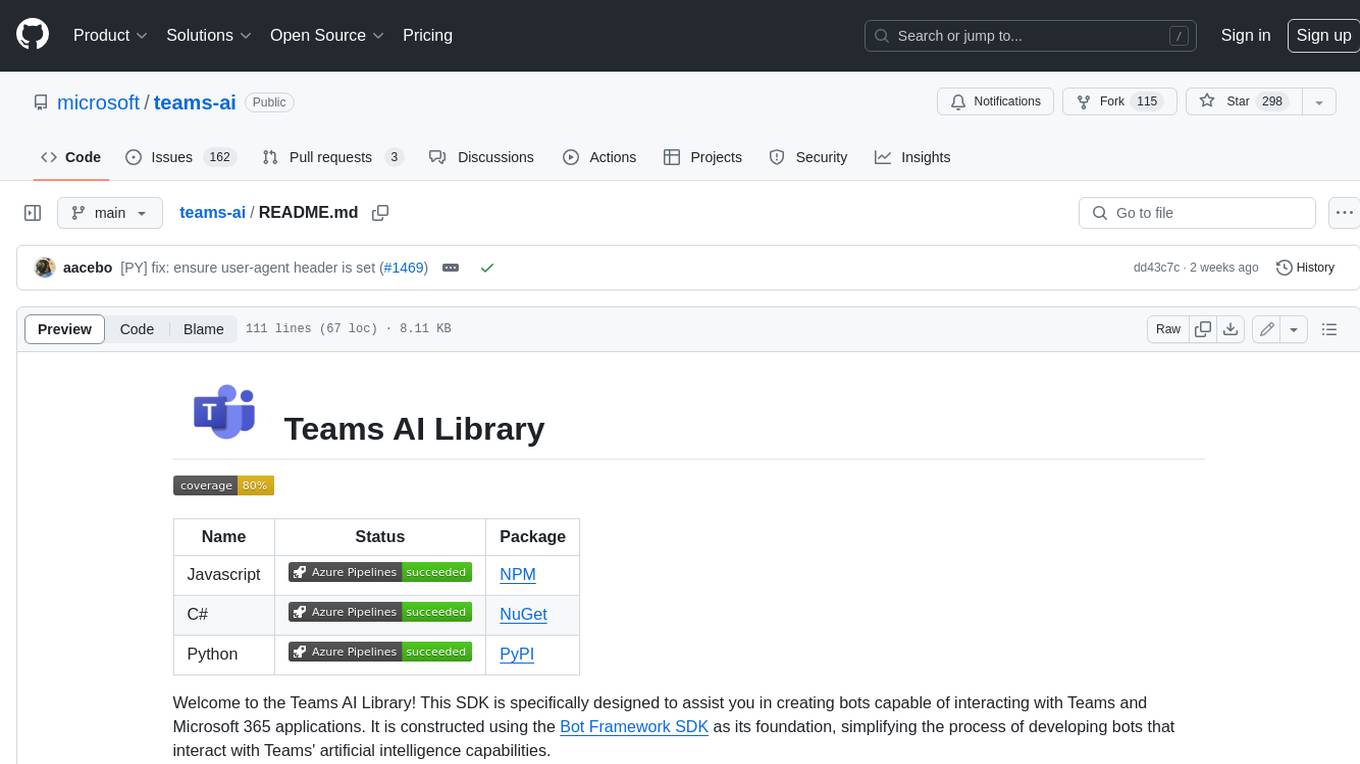
teams-ai
The Teams AI Library is a software development kit (SDK) that helps developers create bots that can interact with Teams and Microsoft 365 applications. It is built on top of the Bot Framework SDK and simplifies the process of developing bots that interact with Teams' artificial intelligence capabilities. The SDK is available for JavaScript/TypeScript, .NET, and Python.
ai-guide
This guide is dedicated to Large Language Models (LLMs) that you can run on your home computer. It assumes your PC is a lower-end, non-gaming setup.
classifai
Supercharge WordPress Content Workflows and Engagement with Artificial Intelligence. Tap into leading cloud-based services like OpenAI, Microsoft Azure AI, Google Gemini and IBM Watson to augment your WordPress-powered websites. Publish content faster while improving SEO performance and increasing audience engagement. ClassifAI integrates Artificial Intelligence and Machine Learning technologies to lighten your workload and eliminate tedious tasks, giving you more time to create original content that matters.
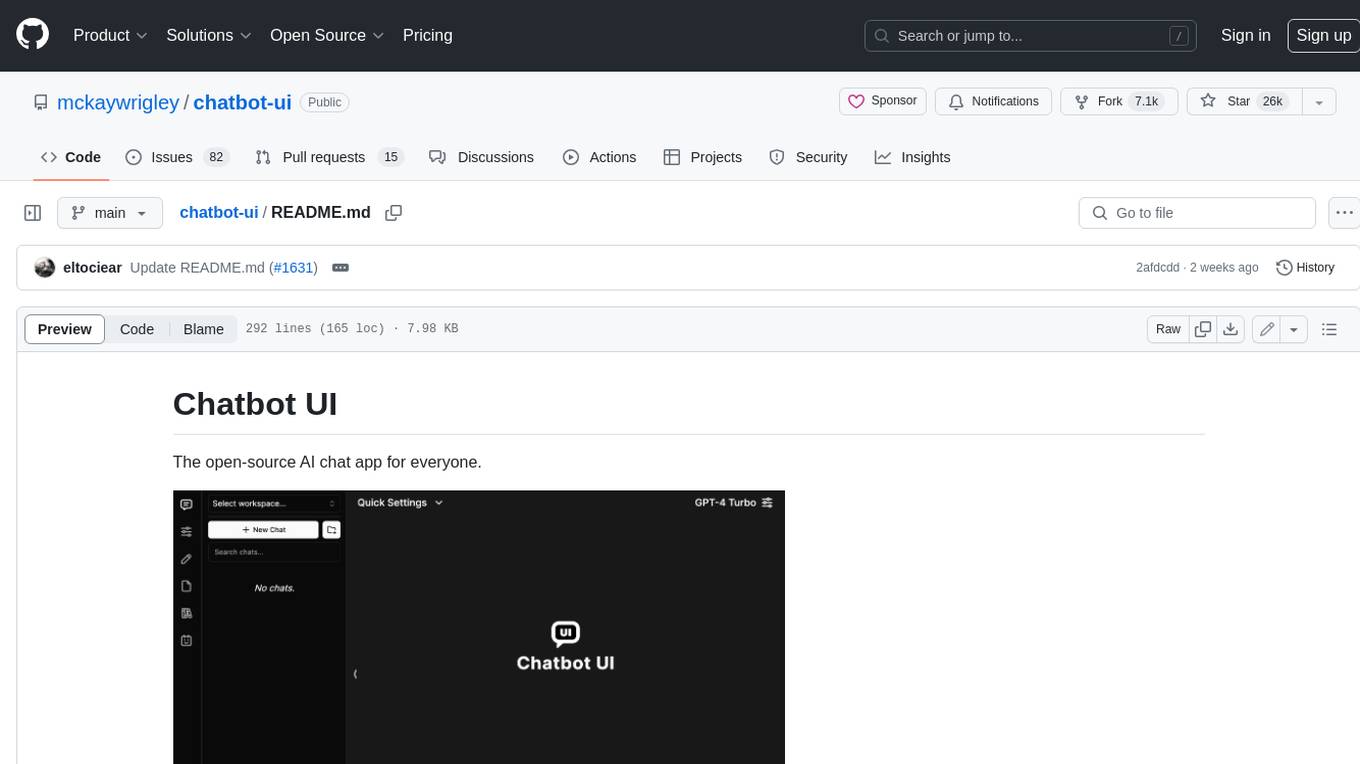
chatbot-ui
Chatbot UI is an open-source AI chat app that allows users to create and deploy their own AI chatbots. It is easy to use and can be customized to fit any need. Chatbot UI is perfect for businesses, developers, and anyone who wants to create a chatbot.
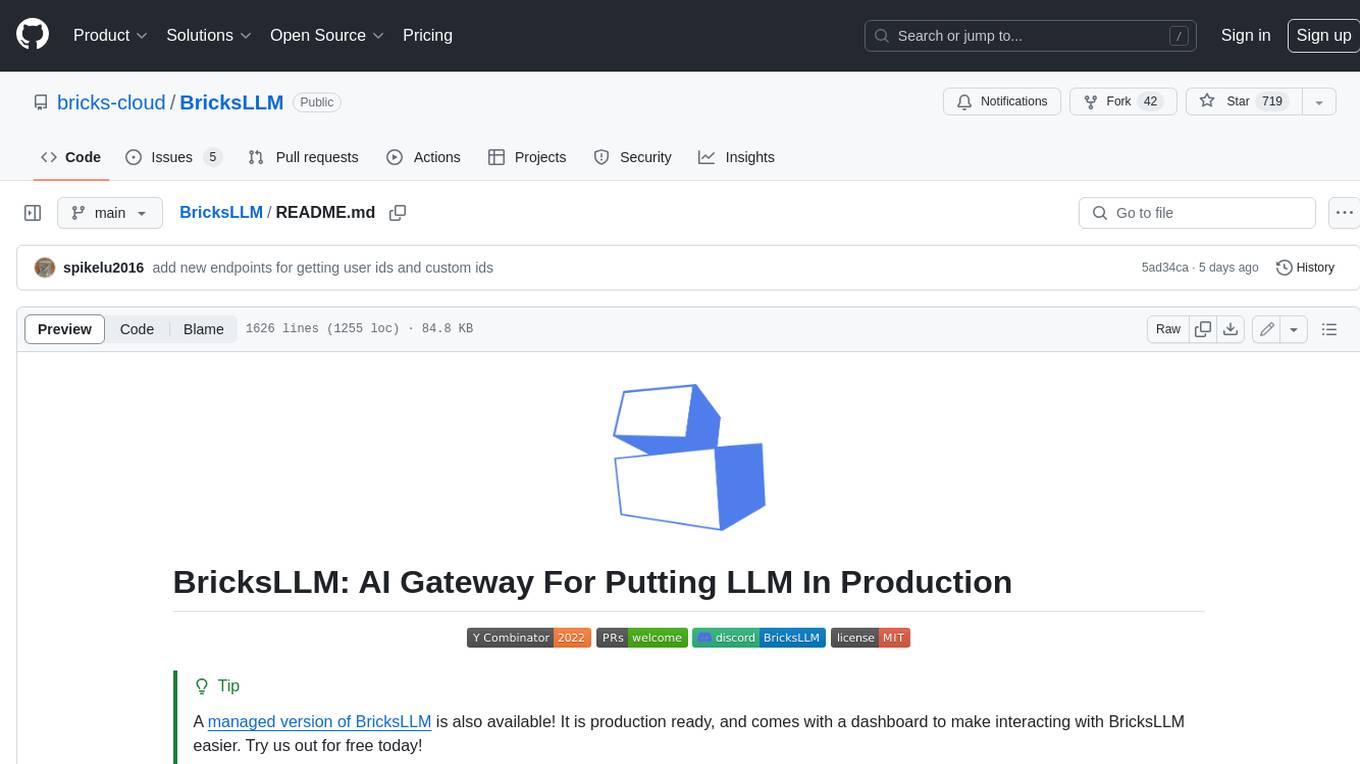
BricksLLM
BricksLLM is a cloud native AI gateway written in Go. Currently, it provides native support for OpenAI, Anthropic, Azure OpenAI and vLLM. BricksLLM aims to provide enterprise level infrastructure that can power any LLM production use cases. Here are some use cases for BricksLLM: * Set LLM usage limits for users on different pricing tiers * Track LLM usage on a per user and per organization basis * Block or redact requests containing PIIs * Improve LLM reliability with failovers, retries and caching * Distribute API keys with rate limits and cost limits for internal development/production use cases * Distribute API keys with rate limits and cost limits for students
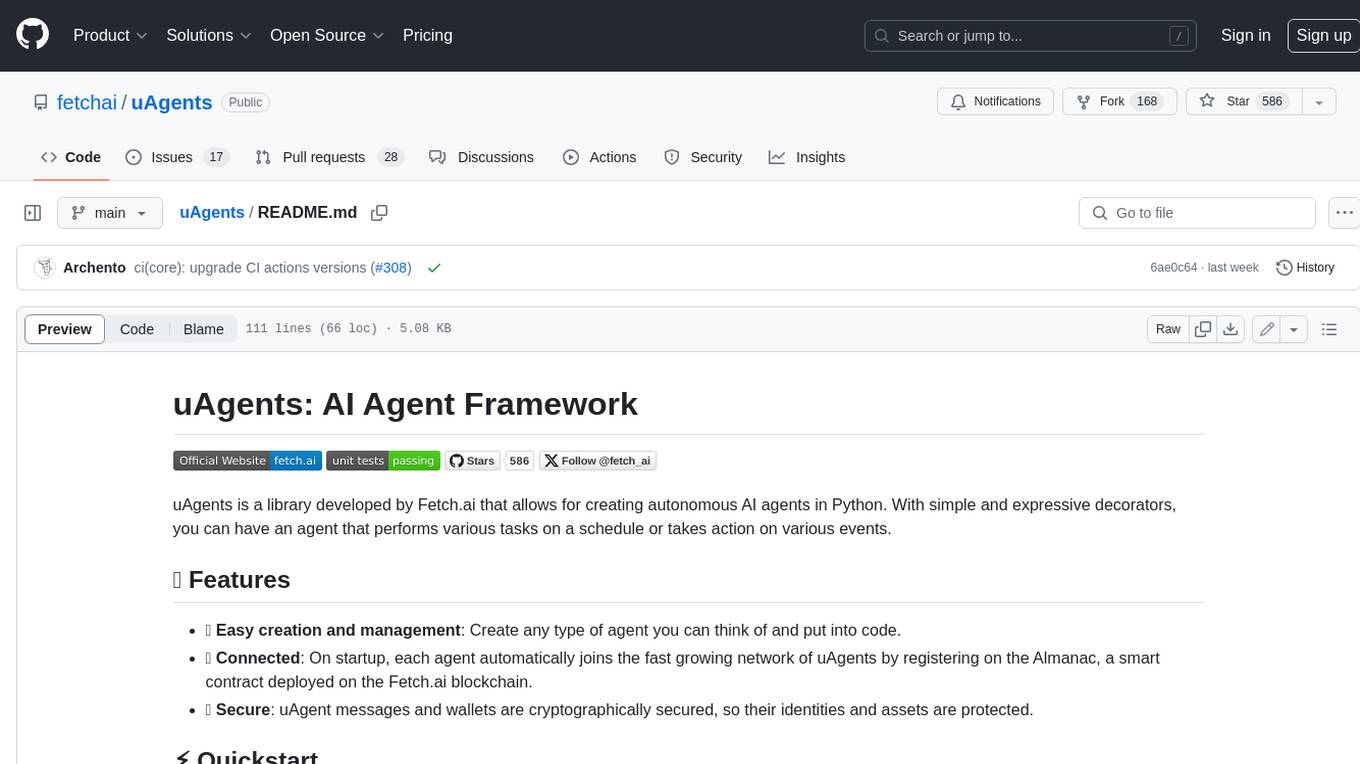
uAgents
uAgents is a Python library developed by Fetch.ai that allows for the creation of autonomous AI agents. These agents can perform various tasks on a schedule or take action on various events. uAgents are easy to create and manage, and they are connected to a fast-growing network of other uAgents. They are also secure, with cryptographically secured messages and wallets.
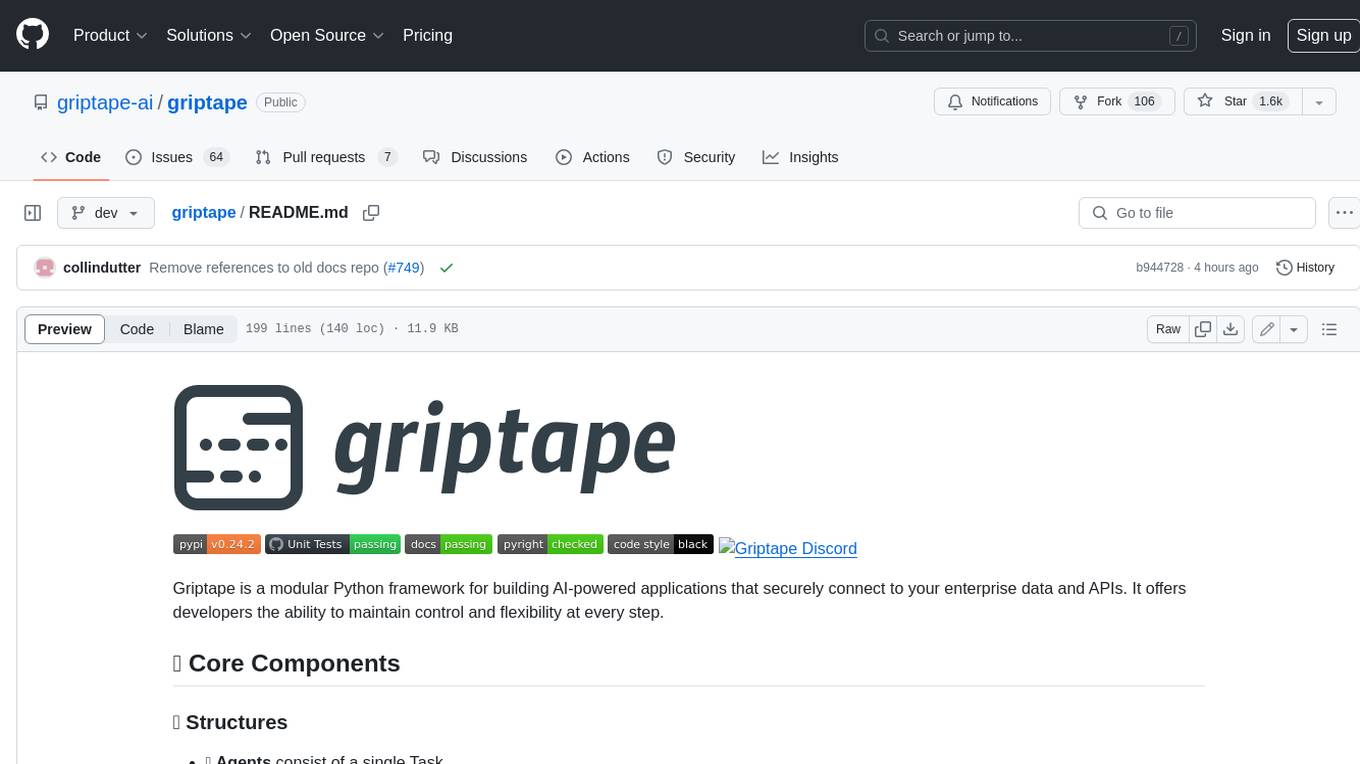
griptape
Griptape is a modular Python framework for building AI-powered applications that securely connect to your enterprise data and APIs. It offers developers the ability to maintain control and flexibility at every step. Griptape's core components include Structures (Agents, Pipelines, and Workflows), Tasks, Tools, Memory (Conversation Memory, Task Memory, and Meta Memory), Drivers (Prompt and Embedding Drivers, Vector Store Drivers, Image Generation Drivers, Image Query Drivers, SQL Drivers, Web Scraper Drivers, and Conversation Memory Drivers), Engines (Query Engines, Extraction Engines, Summary Engines, Image Generation Engines, and Image Query Engines), and additional components (Rulesets, Loaders, Artifacts, Chunkers, and Tokenizers). Griptape enables developers to create AI-powered applications with ease and efficiency.