


MinerU
Transforms complex documents like PDFs into LLM-ready markdown/JSON for your Agentic workflows.
Stars: 54081
MinerU is a tool that converts PDFs into machine-readable formats, allowing for easy extraction into any format. It focuses on solving symbol conversion issues in scientific literature and contributes to technological development. It removes headers, footers, footnotes, and page numbers, preserves document structure, extracts images, tables, and formulas, and supports OCR in 109 languages. MinerU supports various visualization results, runs on CPU/GPU/NPU, and is compatible with Windows, Linux, and Mac platforms.
README:
















-
2026/02/06 2.7.6 Release
- Added support for the domestic computing platforms Kunlunxin and Tecorigin; currently, the domestic computing platforms that have been adapted and supported by the official team and vendors include:
- MinerU continues to support domestic hardware platforms and mainstream chip architectures. With secure and reliable technology, it helps research, government, and enterprise users reach new heights in document digitization!
-
2026/01/30 2.7.4 Release
- Added support for domestic computing platforms IluvatarCorex and Cambricon.
-
2026/01/23 2.7.2 Release
- Added support for domestic computing platforms Hygon, Enflame, and Moore Threads.
- Cross-page table merging optimization, improving merge success rate and merge quality.
-
2026/01/06 2.7.1 Release
- fix bug: #4300
- Updated pdfminer.six dependency version to resolve CVE-2025-64512
- Support automatic correction of input image exif orientation to improve OCR recognition accuracy #4283
-
2025/12/30 2.7.0 Release
- Simplified installation process. No need to separately install
vlmacceleration engine dependencies. Usinguv pip install mineru[all]during installation will install all optional backend dependencies. - Added new
hybridbackend, which combines the advantages ofpipelineandvlmbackends. Built on vlm, it integrates some capabilities of pipeline, adding extra extensibility on top of high accuracy:- Directly extracts text from text PDFs, natively supports multi-language recognition in text PDF scenarios, and greatly reduces parsing hallucinations;
- Supports text recognition in 109 languages for scanned PDF scenarios by specifying OCR language;
- Independent inline formula recognition switch, which can be disabled separately when inline formula recognition is not needed, improving the visual effect of parsing results.
- Simplified engine selection logic for
vlm/hybridbackends. Users only need to specify the backend as*-auto-engine, and the system will automatically select the appropriate engine for inference acceleration based on the current environment, improving usability. - Switched default parsing backend from
pipelinetohybrid-auto-engine, improving out-of-the-box result consistency for new users and avoiding cognitive differences in parsing results. - Added i18n support to gradio application, supporting switching between Chinese and English languages.
- Simplified installation process. No need to separately install
📝 View the complete Changelog for more historical version information
MinerU is a tool that converts PDFs into machine-readable formats (e.g., markdown, JSON), allowing for easy extraction into any format. MinerU was born during the pre-training process of InternLM. We focus on solving symbol conversion issues in scientific literature and hope to contribute to technological development in the era of large models. Compared to well-known commercial products, MinerU is still young. If you encounter any issues or if the results are not as expected, please submit an issue on issue and attach the relevant PDF.
https://github.com/user-attachments/assets/4bea02c9-6d54-4cd6-97ed-dff14340982c
- Remove headers, footers, footnotes, page numbers, etc., to ensure semantic coherence.
- Output text in human-readable order, suitable for single-column, multi-column, and complex layouts.
- Preserve the structure of the original document, including headings, paragraphs, lists, etc.
- Extract images, image descriptions, tables, table titles, and footnotes.
- Automatically recognize and convert formulas in the document to LaTeX format.
- Automatically recognize and convert tables in the document to HTML format.
- Automatically detect scanned PDFs and garbled PDFs and enable OCR functionality.
- OCR supports detection and recognition of 109 languages.
- Supports multiple output formats, such as multimodal and NLP Markdown, JSON sorted by reading order, and rich intermediate formats.
- Supports various visualization results, including layout visualization and span visualization, for efficient confirmation of output quality.
- Supports running in a pure CPU environment, and also supports GPU(CUDA)/NPU(CANN)/MPS acceleration
- Compatible with Windows, Linux, and Mac platforms.
If you encounter any installation issues, please first consult the FAQ. If the parsing results are not as expected, refer to the Known Issues.
The official online version has the same functionality as the client, with a beautiful interface and rich features, requires login to use
A WebUI developed based on Gradio, with a simple interface and only core parsing functionality, no login required
[!WARNING] Pre-installation Notice—Hardware and Software Environment Support
To ensure the stability and reliability of the project, we only optimize and test for specific hardware and software environments during development. This ensures that users deploying and running the project on recommended system configurations will get the best performance with the fewest compatibility issues.
By focusing resources on the mainline environment, our team can more efficiently resolve potential bugs and develop new features.
In non-mainline environments, due to the diversity of hardware and software configurations, as well as third-party dependency compatibility issues, we cannot guarantee 100% project availability. Therefore, for users who wish to use this project in non-recommended environments, we suggest carefully reading the documentation and FAQ first. Most issues already have corresponding solutions in the FAQ. We also encourage community feedback to help us gradually expand support.
| Parsing Backend | pipeline | *-auto-engine | *-http-client | ||
|---|---|---|---|---|---|
| hybrid | vlm | hybrid | vlm | ||
| Backend Features | Good Compatibility | High Hardware Requirements | For OpenAI Compatible Servers2 | ||
| Accuracy1 | 82+ | 90+ | |||
| Operating System | Linux3 / Windows4 / macOS5 | ||||
| Pure CPU Support | ✅ | ❌ | ✅ | ||
| GPU Acceleration | Volta and later architecture GPUs or Apple Silicon | Not Required | |||
| Min VRAM | 6GB | 10GB | 8GB | 3GB | |
| RAM | Min 16GB, Recommended 32GB or more | Min 8GB | |||
| Disk Space | Min 20GB, SSD Recommended | Min 2GB | |||
| Python Version | 3.10-3.13 | ||||
1 Accuracy metrics are the End-to-End Evaluation Overall scores from OmniDocBench (v1.5), based on the latest version of MinerU.
2 Servers compatible with OpenAI API, such as local model servers or remote model services deployed via inference frameworks like vLLM/SGLang/LMDeploy.
3 Linux only supports distributions from 2019 and later.
4 Since the key dependency ray does not support Python 3.13 on Windows, only versions 3.10~3.12 are supported.
5 macOS requires version 14.0 or later.
pip install --upgrade pip
pip install uv
uv pip install -U "mineru[all]"git clone https://github.com/opendatalab/MinerU.git
cd MinerU
uv pip install -e .[all][!TIP]
mineru[all]includes all core features, compatible with Windows / Linux / macOS systems, suitable for most users. If you need to specify the inference framework for the VLM model, or only intend to install a lightweight client on an edge device, please refer to the documentation Extension Modules Installation Guide.
MinerU provides a convenient Docker deployment method, which helps quickly set up the environment and solve some tricky environment compatibility issues. You can get the Docker Deployment Instructions in the documentation.
If your device meets the GPU acceleration requirements in the table above, you can use a simple command line for document parsing:
mineru -p <input_path> -o <output_path>If your device does not meet the GPU acceleration requirements, you can specify the backend as pipeline to run in a pure CPU environment:
mineru -p <input_path> -o <output_path> -b pipelineYou can use MinerU for PDF parsing through various methods such as command line, API, and WebUI. For detailed instructions, please refer to the Usage Guide.
- [x] Reading order based on the model
- [x] Recognition of
indexandlistin the main text - [x] Table recognition
- [x] Heading Classification
- [x] Handwritten Text Recognition
- [x] Vertical Text Recognition
- [x] Latin Accent Mark Recognition
- [x] Code block recognition in the main text
- [x] Chemical formula recognition(mineru.net)
- [ ] Geometric shape recognition
- Reading order is determined by the model based on the spatial distribution of readable content, and may be out of order in some areas under extremely complex layouts.
- Limited support for vertical text.
- Tables of contents and lists are recognized through rules, and some uncommon list formats may not be recognized.
- Code blocks are not yet supported in the layout model.
- Comic books, art albums, primary school textbooks, and exercises cannot be parsed well.
- Table recognition may result in row/column recognition errors in complex tables.
- OCR recognition may produce inaccurate characters in PDFs of lesser-known languages (e.g., diacritical marks in Latin script, easily confused characters in Arabic script).
- Some formulas may not render correctly in Markdown.
- If you encounter any issues during usage, you can first check the FAQ for solutions.
- If your issue remains unresolved, you may also use DeepWiki to interact with an AI assistant, which can address most common problems.
- If you still cannot resolve the issue, you are welcome to join our community via Discord or WeChat to discuss with other users and developers.
Currently, some models in this project are trained based on YOLO. However, since YOLO follows the AGPL license, it may impose restrictions on certain use cases. In future iterations, we plan to explore and replace these with models under more permissive licenses to enhance user-friendliness and flexibility.
- PDF-Extract-Kit
- DocLayout-YOLO
- UniMERNet
- RapidTable
- TableStructureRec
- PaddleOCR
- PaddleOCR2Pytorch
- layoutreader
- xy-cut
- fast-langdetect
- pypdfium2
- pdftext
- pdfminer.six
- pypdf
- magika
- vLLM
- LMDeploy
@misc{niu2025mineru25decoupledvisionlanguagemodel,
      title={MinerU2.5: A Decoupled Vision-Language Model for Efficient High-Resolution Document Parsing},
      author={Junbo Niu and Zheng Liu and Zhuangcheng Gu and Bin Wang and Linke Ouyang and Zhiyuan Zhao and Tao Chu and Tianyao He and Fan Wu and Qintong Zhang and Zhenjiang Jin and Guang Liang and Rui Zhang and Wenzheng Zhang and Yuan Qu and Zhifei Ren and Yuefeng Sun and Yuanhong Zheng and Dongsheng Ma and Zirui Tang and Boyu Niu and Ziyang Miao and Hejun Dong and Siyi Qian and Junyuan Zhang and Jingzhou Chen and Fangdong Wang and Xiaomeng Zhao and Liqun Wei and Wei Li and Shasha Wang and Ruiliang Xu and Yuanyuan Cao and Lu Chen and Qianqian Wu and Huaiyu Gu and Lindong Lu and Keming Wang and Dechen Lin and Guanlin Shen and Xuanhe Zhou and Linfeng Zhang and Yuhang Zang and Xiaoyi Dong and Jiaqi Wang and Bo Zhang and Lei Bai and Pei Chu and Weijia Li and Jiang Wu and Lijun Wu and Zhenxiang Li and Guangyu Wang and Zhongying Tu and Chao Xu and Kai Chen and Yu Qiao and Bowen Zhou and Dahua Lin and Wentao Zhang and Conghui He},
      year={2025},
      eprint={2509.22186},
      archivePrefix={arXiv},
      primaryClass={cs.CV},
      url={https://arxiv.org/abs/2509.22186},
}

@misc{wang2024mineruopensourcesolutionprecise,
      title={MinerU: An Open-Source Solution for Precise Document Content Extraction},
      author={Bin Wang and Chao Xu and Xiaomeng Zhao and Linke Ouyang and Fan Wu and Zhiyuan Zhao and Rui Xu and Kaiwen Liu and Yuan Qu and Fukai Shang and Bo Zhang and Liqun Wei and Zhihao Sui and Wei Li and Botian Shi and Yu Qiao and Dahua Lin and Conghui He},
      year={2024},
      eprint={2409.18839},
      archivePrefix={arXiv},
      primaryClass={cs.CV},
      url={https://arxiv.org/abs/2409.18839},
}

@article{he2024opendatalab,
  title={Opendatalab: Empowering general artificial intelligence with open datasets},
  author={He, Conghui and Li, Wei and Jin, Zhenjiang and Xu, Chao and Wang, Bin and Lin, Dahua},
  journal={arXiv preprint arXiv:2407.13773},
  year={2024}
}- Easy Data Preparation with latest LLMs-based Operators and Pipelines
- Vis3 (OSS browser based on s3)
- LabelU (A Lightweight Multi-modal Data Annotation Tool)
- LabelLLM (An Open-source LLM Dialogue Annotation Platform)
- PDF-Extract-Kit (A Comprehensive Toolkit for High-Quality PDF Content Extraction)
- OmniDocBench (A Comprehensive Benchmark for Document Parsing and Evaluation)
- Magic-HTML (Mixed web page extraction tool)
- Magic-Doc (Fast speed ppt/pptx/doc/docx/pdf extraction tool)
- Dingo: A Comprehensive AI Data Quality Evaluation Tool
For Tasks:
Click tags to check more tools for each tasksFor Jobs:
Alternative AI tools for MinerU
Similar Open Source Tools
MinerU
MinerU is a tool that converts PDFs into machine-readable formats, allowing for easy extraction into any format. It focuses on solving symbol conversion issues in scientific literature and contributes to technological development. It removes headers, footers, footnotes, and page numbers, preserves document structure, extracts images, tables, and formulas, and supports OCR in 109 languages. MinerU supports various visualization results, runs on CPU/GPU/NPU, and is compatible with Windows, Linux, and Mac platforms.
clearml
ClearML is an auto-magical suite of tools designed to streamline AI workflows. It includes modules for experiment management, MLOps/LLMOps, data management, model serving, and more. ClearML offers features like experiment tracking, model serving, orchestration, and automation. It supports various ML/DL frameworks and integrates with Jupyter Notebook and PyCharm for remote debugging. ClearML aims to simplify collaboration, automate processes, and enhance visibility in AI projects.
clearml
ClearML is a suite of tools designed to streamline the machine learning workflow. It includes an experiment manager, MLOps/LLMOps, data management, and model serving capabilities. ClearML is open-source and offers a free tier hosting option. It supports various ML/DL frameworks and integrates with Jupyter Notebook and PyCharm. ClearML provides extensive logging capabilities, including source control info, execution environment, hyper-parameters, and experiment outputs. It also offers automation features, such as remote job execution and pipeline creation. ClearML is designed to be easy to integrate, requiring only two lines of code to add to existing scripts. It aims to improve collaboration, visibility, and data transparency within ML teams.
aiida-core
AiiDA (www.aiida.net) is a workflow manager for computational science with a strong focus on provenance, performance and extensibility. **Features** * **Workflows:** Write complex, auto-documenting workflows in python, linked to arbitrary executables on local and remote computers. The event-based workflow engine supports tens of thousands of processes per hour with full checkpointing. * **Data provenance:** Automatically track inputs, outputs & metadata of all calculations in a provenance graph for full reproducibility. Perform fast queries on graphs containing millions of nodes. * **HPC interface:** Move your calculations to a different computer by changing one line of code. AiiDA is compatible with schedulers like SLURM, PBS Pro, torque, SGE or LSF out of the box. * **Plugin interface:** Extend AiiDA with plugins for new simulation codes (input generation & parsing), data types, schedulers, transport modes and more. * **Open Science:** Export subsets of your provenance graph and share them with peers or make them available online for everyone on the Materials Cloud. * **Open source:** AiiDA is released under the MIT open source license
Kiln
Kiln is an intuitive tool for fine-tuning LLM models, generating synthetic data, and collaborating on datasets. It offers desktop apps for Windows, MacOS, and Linux, zero-code fine-tuning for various models, interactive data generation, and Git-based version control. Users can easily collaborate with QA, PM, and subject matter experts, generate auto-prompts, and work with a wide range of models and providers. The tool is open-source, privacy-first, and supports structured data tasks in JSON format. Kiln is free to use and helps build high-quality AI products with datasets, facilitates collaboration between technical and non-technical teams, allows comparison of models and techniques without code, ensures structured data integrity, and prioritizes user privacy.
deepchecks
Deepchecks is a holistic open-source solution for AI & ML validation needs, enabling thorough testing of data and models from research to production. It includes components for testing, CI & testing management, and monitoring. Users can install and use Deepchecks for testing and monitoring their AI models, with customizable checks and suites for tabular, NLP, and computer vision data. The tool provides visual reports, pythonic/json output for processing, and a dynamic UI for collaboration and monitoring. Deepchecks is open source, with premium features available under a commercial license for monitoring components.
deepchat
DeepChat is a versatile chat tool that supports multiple model cloud services and local model deployment. It offers multi-channel chat concurrency support, platform compatibility, complete Markdown rendering, and easy usability with a comprehensive guide. The tool aims to enhance chat experiences by leveraging various AI models and ensuring efficient conversation management.
openlit
OpenLIT is an OpenTelemetry-native GenAI and LLM Application Observability tool. It's designed to make the integration process of observability into GenAI projects as easy as pie – literally, with just **a single line of code**. Whether you're working with popular LLM Libraries such as OpenAI and HuggingFace or leveraging vector databases like ChromaDB, OpenLIT ensures your applications are monitored seamlessly, providing critical insights to improve performance and reliability.
neptune-client
Neptune is a scalable experiment tracker for teams training foundation models. Log millions of runs, effortlessly monitor and visualize model training, and deploy on your infrastructure. Track 100% of metadata to accelerate AI breakthroughs. Log and display any framework and metadata type from any ML pipeline. Organize experiments with nested structures and custom dashboards. Compare results, visualize training, and optimize models quicker. Version models, review stages, and access production-ready models. Share results, manage users, and projects. Integrate with 25+ frameworks. Trusted by great companies to improve workflow.
MONAI
MONAI is a PyTorch-based, open-source framework for deep learning in healthcare imaging. It provides a comprehensive set of tools for medical image analysis, including data preprocessing, model training, and evaluation. MONAI is designed to be flexible and easy to use, making it a valuable resource for researchers and developers in the field of medical imaging.
db2rest
DB2Rest is a modern low code REST DATA API platform that enables the rapid development of intelligent applications by combining databases, language models, and vector stores. It facilitates context-aware, reasoning applications without vendor lock-in. The tool accelerates application delivery, fosters faster innovation with AI, serves as a secure database gateway, and simplifies integration. It supports various databases like PostgreSQL, MySQL, MS SQL Server, Oracle, MongoDB, and more, with planned support for additional databases. Users can connect on Discord for support and contact [email protected] for inquiries.
lerobot
LeRobot is a state-of-the-art AI library for real-world robotics in PyTorch. It aims to provide models, datasets, and tools to lower the barrier to entry to robotics, focusing on imitation learning and reinforcement learning. LeRobot offers pretrained models, datasets with human-collected demonstrations, and simulation environments. It plans to support real-world robotics on affordable and capable robots. The library hosts pretrained models and datasets on the Hugging Face community page.
MaxKB
MaxKB is a knowledge base Q&A system based on the LLM large language model. MaxKB = Max Knowledge Base, which aims to become the most powerful brain of the enterprise.
Kori
Kori is a unified note-taking app with AI capabilities, providing a consistent experience across Android, iOS, Windows, macOS, and Linux. It supports various formats like Drawing, Markdown, TXT, LaTeX, Mermaid diagrams, and Todo.txt lists. Users can benefit from AI co-writing features, note outline generation, find and replace, note templates, local media support, and export options. The app follows Material Design 3 guidelines, offers comprehensive mouse and keyboard support, and is optimized for different screen sizes and orientations.
pipeshub-ai
Pipeshub-ai is a versatile tool for automating data pipelines in AI projects. It provides a user-friendly interface to design, deploy, and monitor complex data workflows, enabling seamless integration of various AI models and data sources. With Pipeshub-ai, users can easily create end-to-end pipelines for tasks such as data preprocessing, model training, and inference, streamlining the AI development process and improving productivity. The tool supports integration with popular AI frameworks and cloud services, making it suitable for both beginners and experienced AI practitioners.
TaskingAI
TaskingAI brings Firebase's simplicity to **AI-native app development**. The platform enables the creation of GPTs-like multi-tenant applications using a wide range of LLMs from various providers. It features distinct, modular functions such as Inference, Retrieval, Assistant, and Tool, seamlessly integrated to enhance the development process. TaskingAI’s cohesive design ensures an efficient, intelligent, and user-friendly experience in AI application development.
For similar tasks
MinerU
MinerU is a tool that converts PDFs into machine-readable formats, allowing for easy extraction into any format. It focuses on solving symbol conversion issues in scientific literature and contributes to technological development. It removes headers, footers, footnotes, and page numbers, preserves document structure, extracts images, tables, and formulas, and supports OCR in 109 languages. MinerU supports various visualization results, runs on CPU/GPU/NPU, and is compatible with Windows, Linux, and Mac platforms.
MegaParse
MegaParse is a powerful and versatile parser designed to handle various types of documents such as text, PDFs, Powerpoint presentations, and Word documents with no information loss. It is fast, efficient, and open source, supporting a wide range of file formats. MegaParse ensures compatibility with tables, table of contents, headers, footers, and images, making it a comprehensive solution for document parsing.
NekoImageGallery
NekoImageGallery is an online AI image search engine that utilizes the Clip model and Qdrant vector database. It supports keyword search and similar image search. The tool generates 768-dimensional vectors for each image using the Clip model, supports OCR text search using PaddleOCR, and efficiently searches vectors using the Qdrant vector database. Users can deploy the tool locally or via Docker, with options for metadata storage using Qdrant database or local file storage. The tool provides API documentation through FastAPI's built-in Swagger UI and can be used for tasks like image search, text extraction, and vector search.
gemini_multipdf_chat
Gemini PDF Chatbot is a Streamlit-based application that allows users to chat with a conversational AI model trained on PDF documents. The chatbot extracts information from uploaded PDF files and answers user questions based on the provided context. It features PDF upload, text extraction, conversational AI using the Gemini model, and a chat interface. Users can deploy the application locally or to the cloud, and the project structure includes main application script, environment variable file, requirements, and documentation. Dependencies include PyPDF2, langchain, Streamlit, google.generativeai, and dotenv.
screen-pipe
Screen-pipe is a Rust + WASM tool that allows users to turn their screen into actions using Large Language Models (LLMs). It enables users to record their screen 24/7, extract text from frames, and process text and images for tasks like analyzing sales conversations. The tool is still experimental and aims to simplify the process of recording screens, extracting text, and integrating with various APIs for tasks such as filling CRM data based on screen activities. The project is open-source and welcomes contributions to enhance its functionalities and usability.
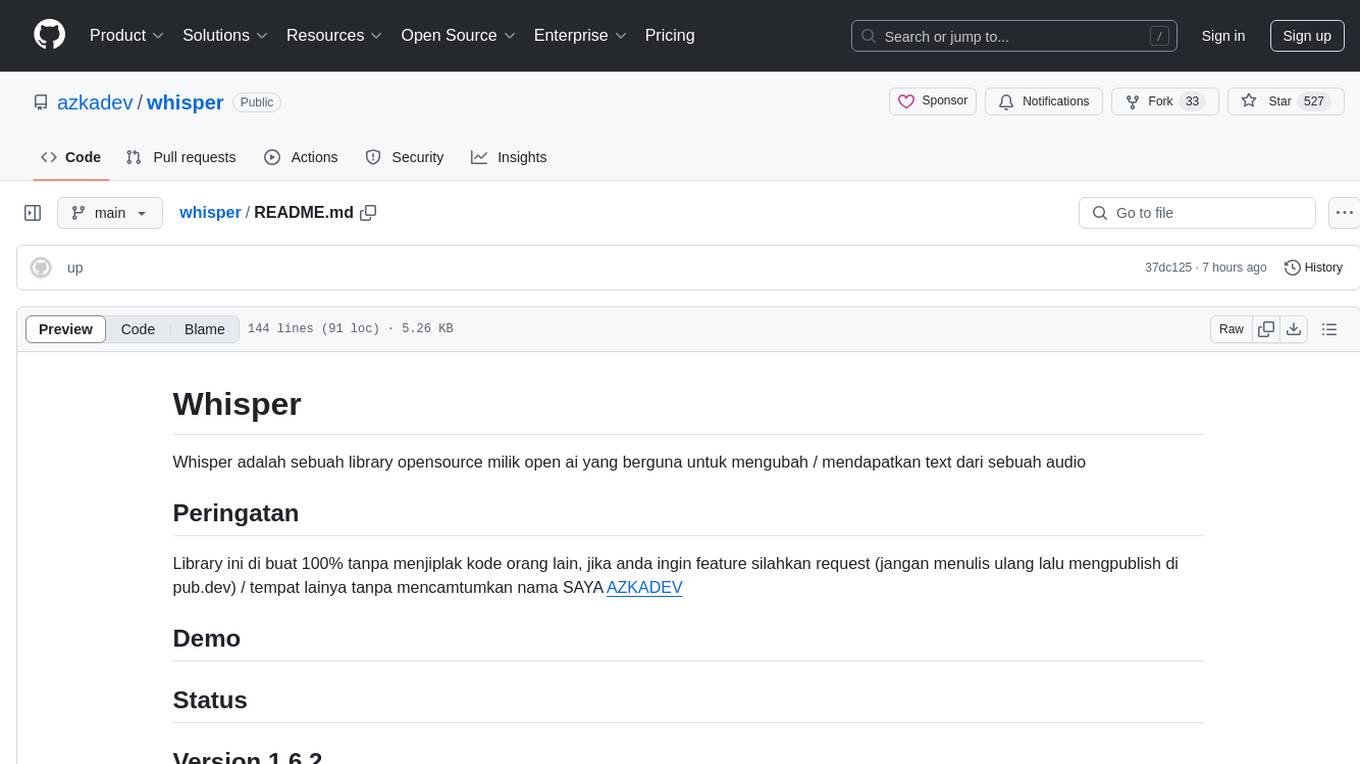
whisper
Whisper is an open-source library by Open AI that converts/extracts text from audio. It is a cross-platform tool that supports real-time transcription of various types of audio/video without manual conversion to WAV format. The library is designed to run on Linux and Android platforms, with plans for expansion to other platforms. Whisper utilizes three frameworks to function: DART for CLI execution, Flutter for mobile app integration, and web/WASM for web application deployment. The tool aims to provide a flexible and easy-to-use solution for transcription tasks across different programs and platforms.
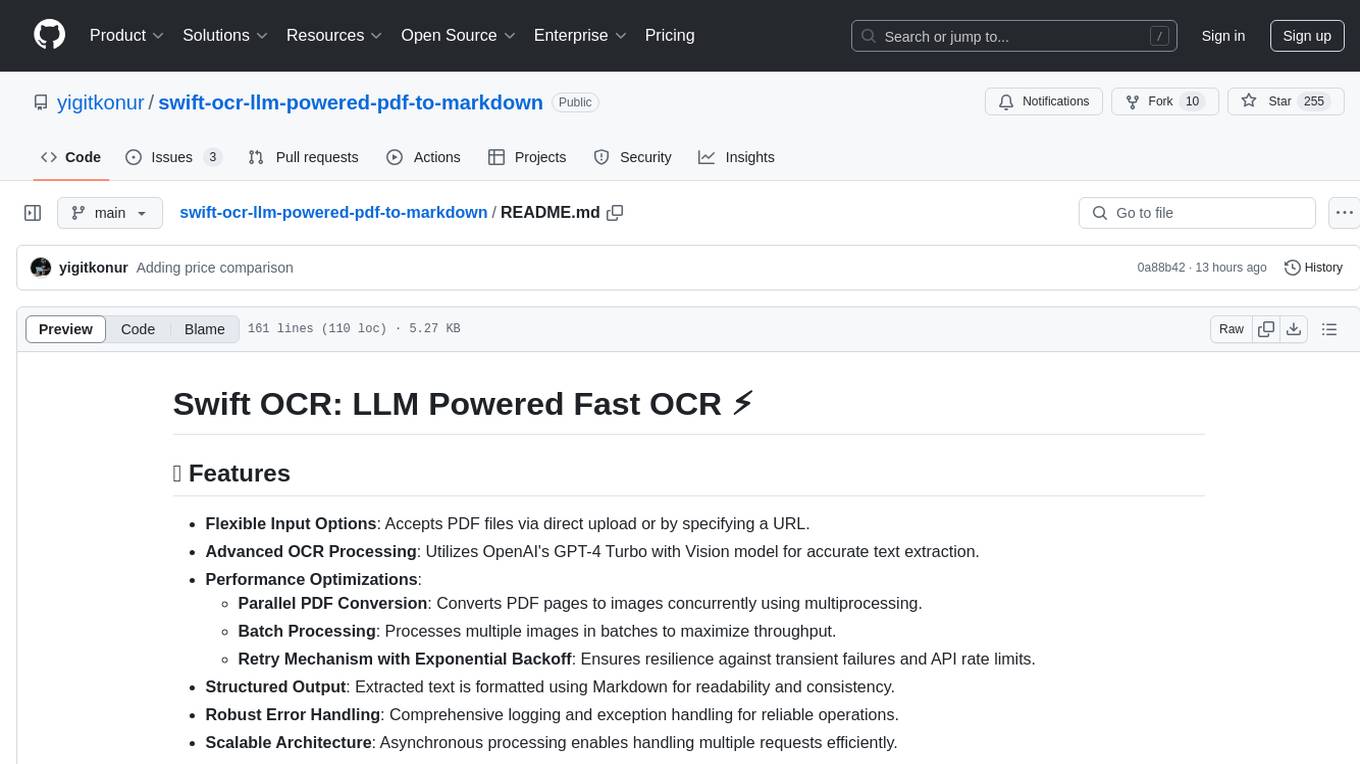
swift-ocr-llm-powered-pdf-to-markdown
Swift OCR is a powerful tool for extracting text from PDF files using OpenAI's GPT-4 Turbo with Vision model. It offers flexible input options, advanced OCR processing, performance optimizations, structured output, robust error handling, and scalable architecture. The tool ensures accurate text extraction, resilience against failures, and efficient handling of multiple requests.
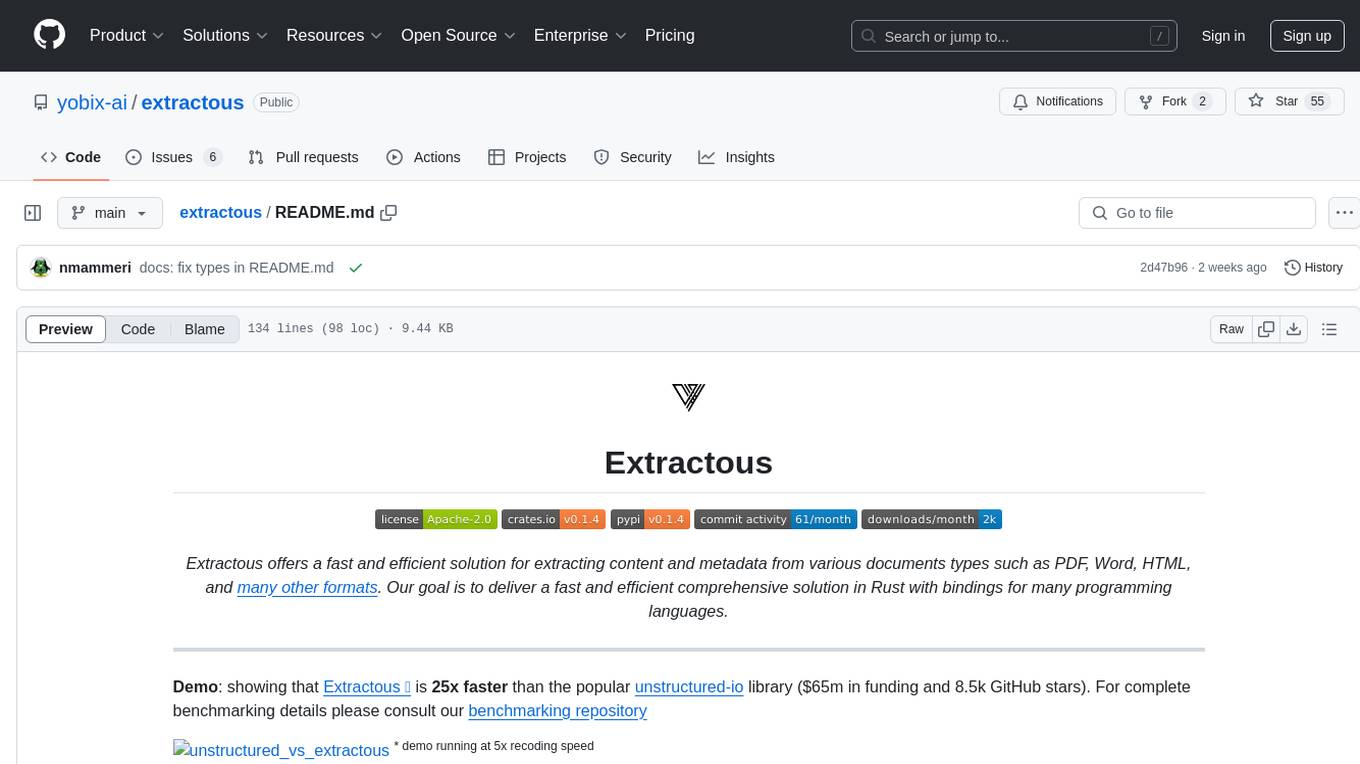
extractous
Extractous offers a fast and efficient solution for extracting content and metadata from various document types such as PDF, Word, HTML, and many other formats. It is built with Rust, providing high performance, memory safety, and multi-threading capabilities. The tool eliminates the need for external services or APIs, making data processing pipelines faster and more efficient. It supports multiple file formats, including Microsoft Office, OpenOffice, PDF, spreadsheets, web documents, e-books, text files, images, and email formats. Extractous provides a clear and simple API for extracting text and metadata content, with upcoming support for JavaScript/TypeScript. It is free for commercial use under the Apache 2.0 License.
For similar jobs
asreview
The ASReview project implements active learning for systematic reviews, utilizing AI-aided pipelines to assist in finding relevant texts for search tasks. It accelerates the screening of textual data with minimal human input, saving time and increasing output quality. The software offers three modes: Oracle for interactive screening, Exploration for teaching purposes, and Simulation for evaluating active learning models. ASReview LAB is designed to support decision-making in any discipline or industry by improving efficiency and transparency in screening large amounts of textual data.
NewEraAI-Papers
The NewEraAI-Papers repository provides links to collections of influential and interesting research papers from top AI conferences, along with open-source code to promote reproducibility and provide detailed implementation insights beyond the scope of the article. Users can stay up to date with the latest advances in AI research by exploring this repository. Contributions to improve the completeness of the list are welcomed, and users can create pull requests, open issues, or contact the repository owner via email to enhance the repository further.
cltk
The Classical Language Toolkit (CLTK) is a Python library that provides natural language processing (NLP) capabilities for pre-modern languages. It offers a modular processing pipeline with pre-configured defaults and supports almost 20 languages. Users can install the latest version using pip and access detailed documentation on the official website. The toolkit is designed to meet the unique needs of researchers working with historical languages, filling a void in the NLP landscape that often neglects non-spoken languages and different research goals.
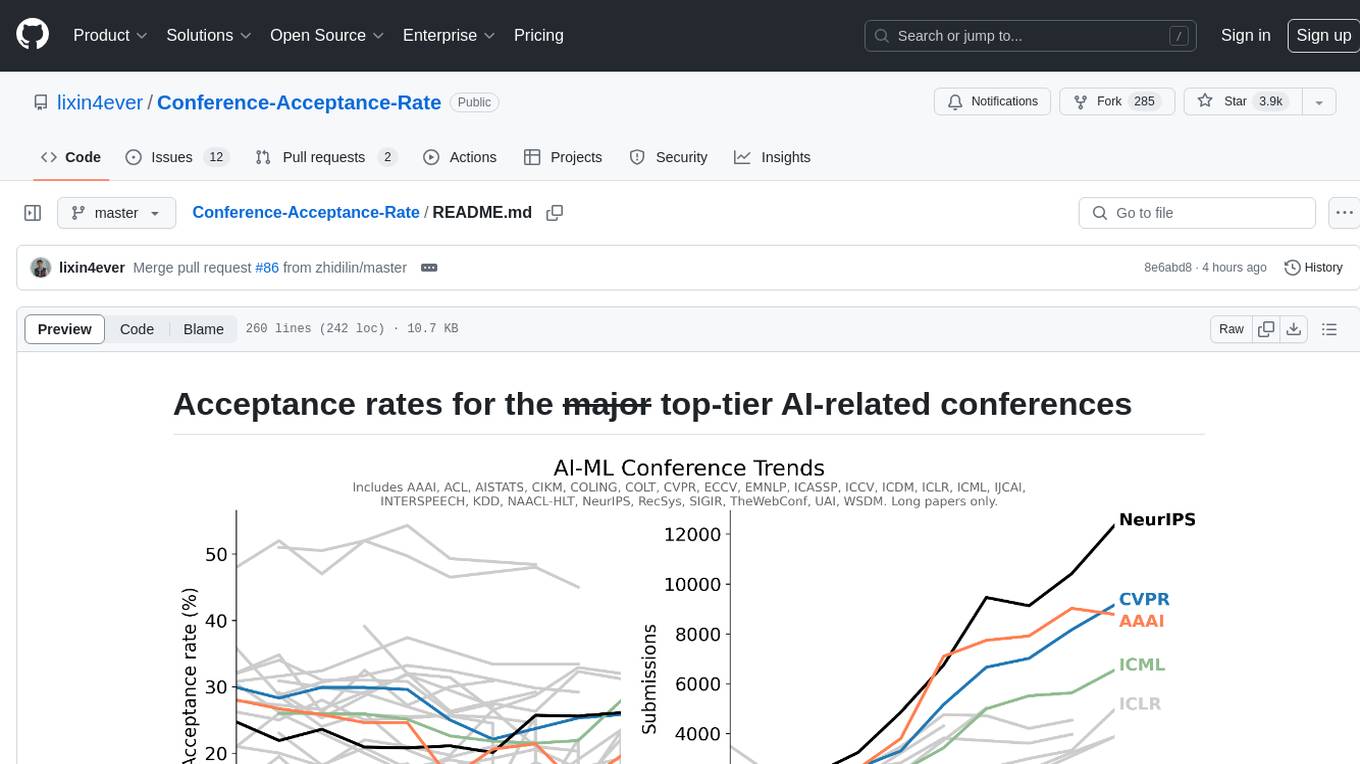
Conference-Acceptance-Rate
The 'Conference-Acceptance-Rate' repository provides acceptance rates for top-tier AI-related conferences in the fields of Natural Language Processing, Computational Linguistics, Computer Vision, Pattern Recognition, Machine Learning, Learning Theory, Artificial Intelligence, Data Mining, Information Retrieval, Speech Processing, and Signal Processing. The data includes acceptance rates for long papers and short papers over several years for each conference, allowing researchers to track trends and make informed decisions about where to submit their work.
pdftochat
PDFToChat is a tool that allows users to chat with their PDF documents in seconds. It is powered by Together AI and Pinecone, utilizing a tech stack including Next.js, Mixtral, M2 Bert, LangChain.js, MongoDB Atlas, Bytescale, Vercel, Clerk, and Tailwind CSS. Users can deploy the tool to Vercel or any other host by setting up Together.ai, MongoDB Atlas database, Bytescale, Clerk, and Vercel. The tool enables users to interact with PDFs through chat, with future tasks including adding features like trash icon for deleting PDFs, exploring different embedding models, implementing auto scrolling, improving replies, benchmarking accuracy, researching chunking and retrieval best practices, adding demo video, upgrading to Next.js 14, adding analytics, customizing tailwind prose, saving chats in postgres DB, compressing large PDFs, implementing custom uploader, session tracking, error handling, and support for images in PDFs.
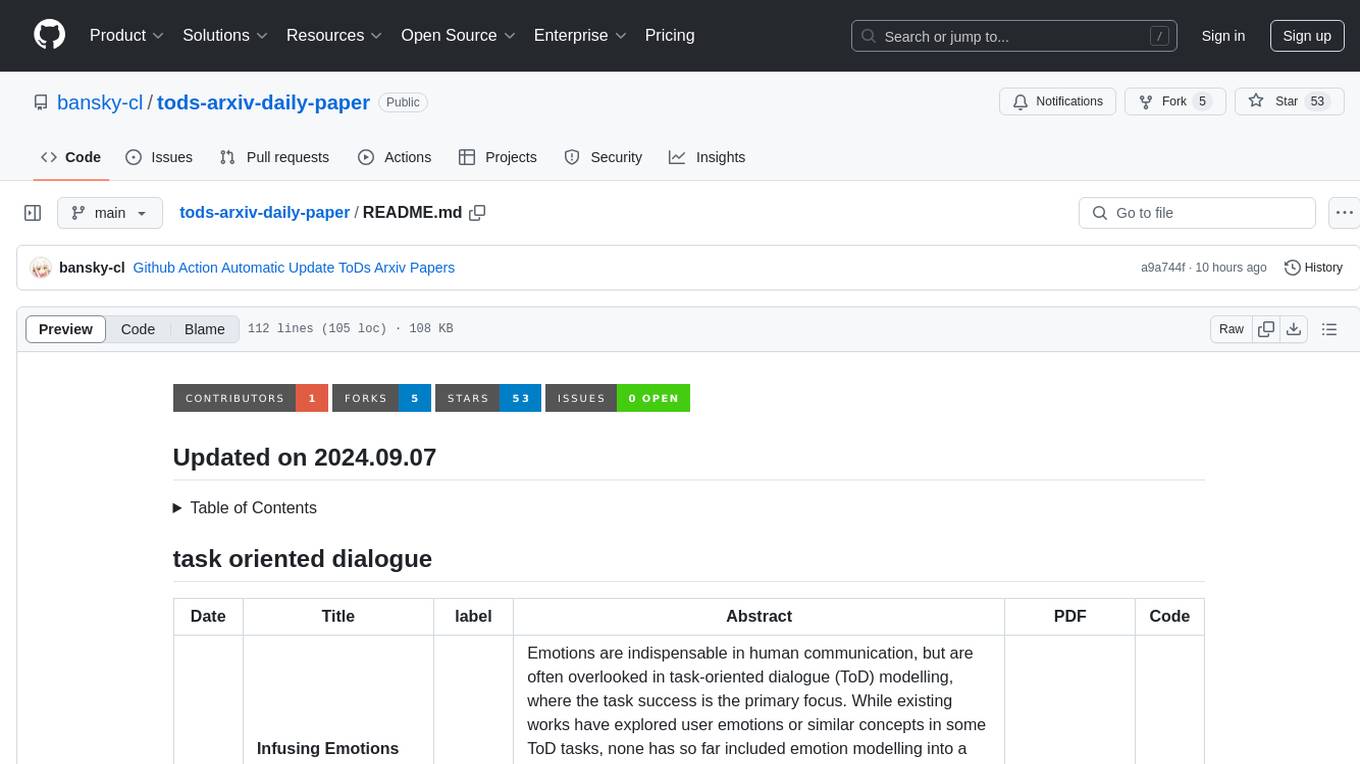
tods-arxiv-daily-paper
This repository provides a tool for fetching and summarizing daily papers from the arXiv repository. It allows users to stay updated with the latest research in various fields by automatically retrieving and summarizing papers on a daily basis. The tool simplifies the process of accessing and digesting academic papers, making it easier for researchers and enthusiasts to keep track of new developments in their areas of interest.
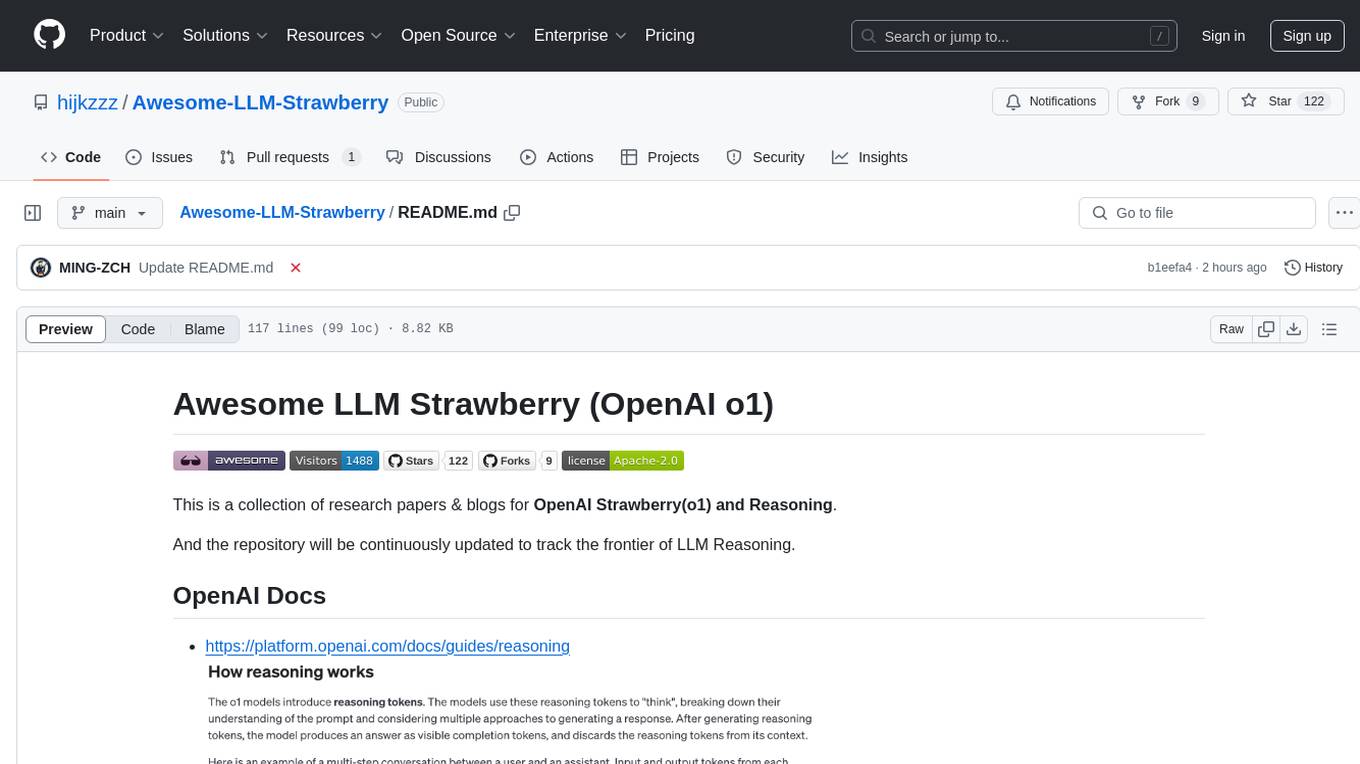
Awesome-LLM-Strawberry
Awesome LLM Strawberry is a collection of research papers and blogs related to OpenAI Strawberry(o1) and Reasoning. The repository is continuously updated to track the frontier of LLM Reasoning.
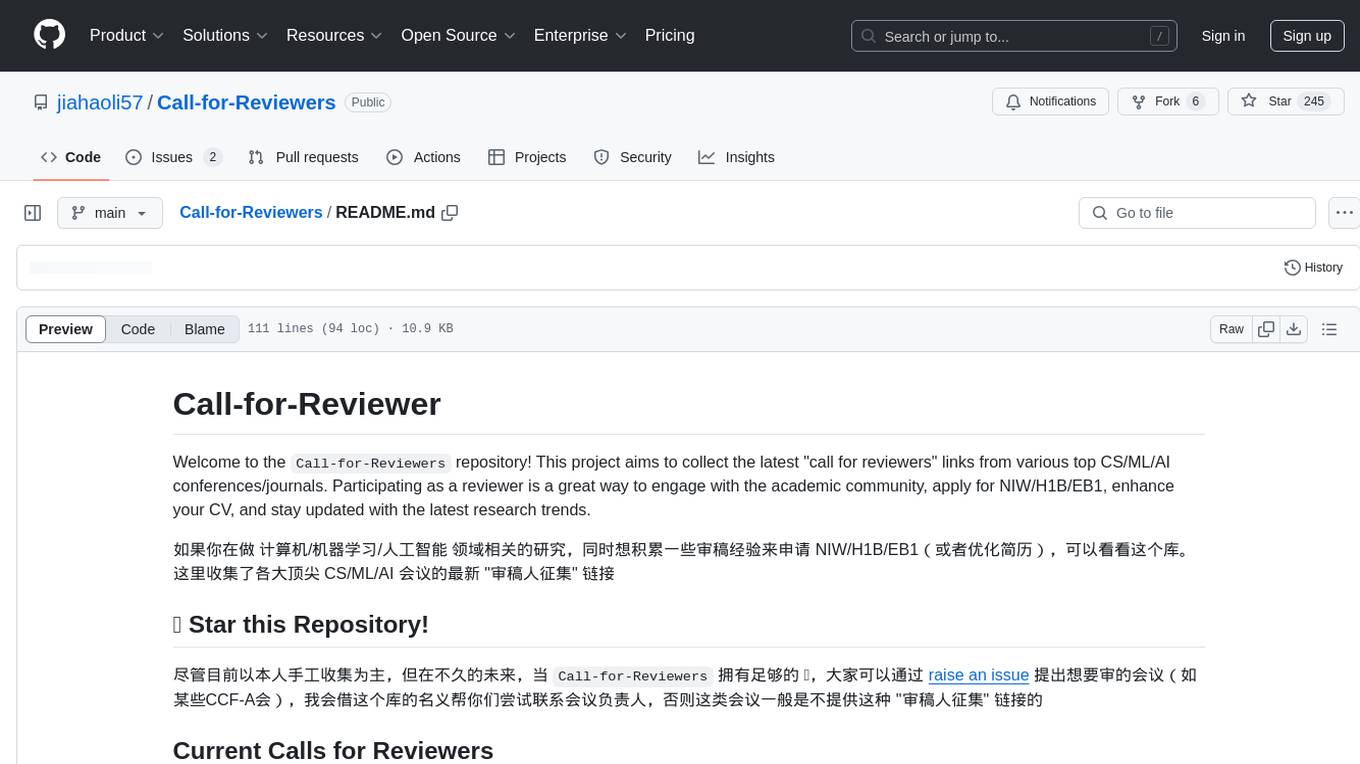
Call-for-Reviewers
The `Call-for-Reviewers` repository aims to collect the latest 'call for reviewers' links from various top CS/ML/AI conferences/journals. It provides an opportunity for individuals in the computer/ machine learning/ artificial intelligence fields to gain review experience for applying for NIW/H1B/EB1 or enhancing their CV. The repository helps users stay updated with the latest research trends and engage with the academic community.