


llama-stack
Composable building blocks to build LLM Apps
Stars: 8260
Llama Stack defines and standardizes core building blocks for AI application development, providing a unified API layer, plugin architecture, prepackaged distributions, developer interfaces, and standalone applications. It offers flexibility in infrastructure choice, consistent experience with unified APIs, and a robust ecosystem with integrated distribution partners. The tool simplifies building, testing, and deploying AI applications with various APIs and environments, supporting local development, on-premises, cloud, and mobile deployments.
README:






Quick Start | Documentation | Colab Notebook | Discord
To try Llama Stack locally, run:
curl -LsSf https://github.com/llamastack/llama-stack/raw/main/scripts/install.sh | bashLlama Stack defines and standardizes the core building blocks that simplify AI application development. It provides a unified set of APIs with implementations from leading service providers. More specifically, it provides:
- Unified API layer for Inference, RAG, Agents, Tools, Safety, Evals.
- Plugin architecture to support the rich ecosystem of different API implementations in various environments, including local development, on-premises, cloud, and mobile.
- Prepackaged verified distributions which offer a one-stop solution for developers to get started quickly and reliably in any environment.
- Multiple developer interfaces like CLI and SDKs for Python, Typescript, iOS, and Android.
- Standalone applications as examples for how to build production-grade AI applications with Llama Stack.
- Flexibility: Developers can choose their preferred infrastructure without changing APIs and enjoy flexible deployment choices.
- Consistent Experience: With its unified APIs, Llama Stack makes it easier to build, test, and deploy AI applications with consistent application behavior.
- Robust Ecosystem: Llama Stack is integrated with distribution partners (cloud providers, hardware vendors, and AI-focused companies) that offer tailored infrastructure, software, and services for deploying Llama models.
For more information, see the Benefits of Llama Stack documentation.
Here is a list of the various API providers and available distributions that can help developers get started easily with Llama Stack. Please checkout for full list
| API Provider | Environments | Agents | Inference | VectorIO | Safety | Post Training | Eval | DatasetIO |
|---|---|---|---|---|---|---|---|---|
| Meta Reference | Single Node | ✅ | ✅ | ✅ | ✅ | ✅ | ✅ | ✅ |
| SambaNova | Hosted | ✅ | ✅ | |||||
| Cerebras | Hosted | ✅ | ||||||
| Fireworks | Hosted | ✅ | ✅ | ✅ | ||||
| AWS Bedrock | Hosted | ✅ | ✅ | |||||
| Together | Hosted | ✅ | ✅ | ✅ | ||||
| Groq | Hosted | ✅ | ||||||
| Ollama | Single Node | ✅ | ||||||
| TGI | Hosted/Single Node | ✅ | ||||||
| NVIDIA NIM | Hosted/Single Node | ✅ | ✅ | |||||
| ChromaDB | Hosted/Single Node | ✅ | ||||||
| Milvus | Hosted/Single Node | ✅ | ||||||
| Qdrant | Hosted/Single Node | ✅ | ||||||
| Weaviate | Hosted/Single Node | ✅ | ||||||
| SQLite-vec | Single Node | ✅ | ||||||
| PG Vector | Single Node | ✅ | ||||||
| PyTorch ExecuTorch | On-device iOS | ✅ | ✅ | |||||
| vLLM | Single Node | ✅ | ||||||
| OpenAI | Hosted | ✅ | ||||||
| Anthropic | Hosted | ✅ | ||||||
| Gemini | Hosted | ✅ | ||||||
| WatsonX | Hosted | ✅ | ||||||
| HuggingFace | Single Node | ✅ | ✅ | |||||
| TorchTune | Single Node | ✅ | ||||||
| NVIDIA NEMO | Hosted | ✅ | ✅ | ✅ | ✅ | ✅ | ||
| NVIDIA | Hosted | ✅ | ✅ | ✅ |
Note: Additional providers are available through external packages. See External Providers documentation.
A Llama Stack Distribution (or "distro") is a pre-configured bundle of provider implementations for each API component. Distributions make it easy to get started with a specific deployment scenario. For example, you can begin with a local setup of Ollama and seamlessly transition to production, with fireworks, without changing your application code. Here are some of the distributions we support:
| Distribution | Llama Stack Docker | Start This Distribution |
|---|---|---|
| Starter Distribution | llamastack/distribution-starter | Guide |
| Meta Reference | llamastack/distribution-meta-reference-gpu | Guide |
| PostgreSQL | llamastack/distribution-postgres-demo |
For full documentation on the Llama Stack distributions see the Distributions Overview page.
Please checkout our Documentation page for more details.
- CLI references
-
llama (server-side) CLI Reference: Guide for using the
llamaCLI to work with Llama models (download, study prompts), and building/starting a Llama Stack distribution. -
llama (client-side) CLI Reference: Guide for using the
llama-stack-clientCLI, which allows you to query information about the distribution.
-
llama (server-side) CLI Reference: Guide for using the
- Getting Started
- Quick guide to start a Llama Stack server.
- Jupyter notebook to walk-through how to use simple text and vision inference llama_stack_client APIs
- The complete Llama Stack lesson Colab notebook of the new Llama 3.2 course on Deeplearning.ai.
- A Zero-to-Hero Guide that guide you through all the key components of llama stack with code samples.
-
Contributing
- Adding a new API Provider to walk-through how to add a new API provider.
- Release Process for information about release schedules and versioning.
Check out our client SDKs for connecting to a Llama Stack server in your preferred language.
| Language | Client SDK | Package |
|---|---|---|
| Python | llama-stack-client-python |  |
| Swift | llama-stack-client-swift |  |
| Typescript | llama-stack-client-typescript |  |
| Kotlin | llama-stack-client-kotlin |  |
You can find more example scripts with client SDKs to talk with the Llama Stack server in our llama-stack-apps repo.
We hold regular community calls to discuss the latest developments and get feedback from the community.
- Date: every Thursday
- Time: 09:00 AM PST (check the Community Event on Discord for the latest details)
Thanks to all of our amazing contributors!
For Tasks:
Click tags to check more tools for each tasksFor Jobs:
Alternative AI tools for llama-stack
Similar Open Source Tools
llama-stack
Llama Stack defines and standardizes core building blocks for AI application development, providing a unified API layer, plugin architecture, prepackaged distributions, developer interfaces, and standalone applications. It offers flexibility in infrastructure choice, consistent experience with unified APIs, and a robust ecosystem with integrated distribution partners. The tool simplifies building, testing, and deploying AI applications with various APIs and environments, supporting local development, on-premises, cloud, and mobile deployments.
cool-ai-stuff
This repository contains an uncensored list of free to use APIs and sites for several AI models. > _This list is mainly managed by @zukixa, the queen of zukijourney, so any decisions may have bias!~_ > > **Scroll down for the sites, APIs come first!** * * * > [!WARNING] > We are not endorsing _any_ of the listed services! Some of them might be considered controversial. We are not responsible for any legal, technical or any other damage caused by using the listed services. Data is provided without warranty of any kind. **Use these at your own risk!** * * * # APIs Table of Contents #### Overview of Existing APIs #### Overview of Existing APIs -- Top LLM Models Available #### Overview of Existing APIs -- Top Image Models Available #### Overview of Existing APIs -- Top Other Features & Models Available #### Overview of Existing APIs -- Available Donator Perks * * * ## API List:* *: This list solely covers all providers I (@zukixa) was able to collect metrics in. Any mistakes are not my responsibility, as I am either banned, or not aware of x API. \ 1: Last Updated 4/14/24 ### Overview of APIs: | Service | # of Users1 | Link | Stablity | NSFW Ok? | Open Source? | Owner(s) | Other Notes | | ----------- | ---------- | ------------------------------------------ | ------------------------------------------ | --------------------------- | ------------------------------------------------------ | -------------------------- | ----------------------------------------------------------------------------------------------------------- | | zukijourney| 4441 | D | High | On /unf/, not /v1/ | ✅, Here | @zukixa | Largest & Oldest GPT-4 API still continuously around. Offers other popular AI-related Bots too. | | Hyzenberg| 1234 | D | High | Forbidden | ❌ | @thatlukinhasguy & @voidiii | Experimental sister API to Zukijourney. Successor to HentAI | | NagaAI | 2883 | D | High | Forbidden | ❌ | @zentixua | Honorary successor to ChimeraGPT, the largest API in history (15k users). | | WebRaftAI | 993 | D | High | Forbidden | ❌ | @ds_gamer | Largest API by model count. Provides a lot of service/hosting related stuff too. | | KrakenAI | 388 | D | High | Discouraged | ❌ | @paninico | It is an API of all time. | | ShuttleAI | 3585 | D | Medium | Generally Permitted | ❌ | @xtristan | Faked GPT-4 Before 1, 2 | | Mandrill | 931 | D | Medium | Enterprise-Tier-Only | ❌ | @fredipy | DALL-E-3 access pioneering API. Has some issues with speed & stability nowadays. | oxygen | 742 | D | Medium | Donator-Only | ❌ | @thesketchubuser | Bri'ish 🤮 & Fren'sh 🤮 | | Skailar | 399 | D | Medium | Forbidden | ❌ | @aquadraws | Service is the personification of the word 'feature creep'. Lots of things announced, not much operational. |
kangaroo
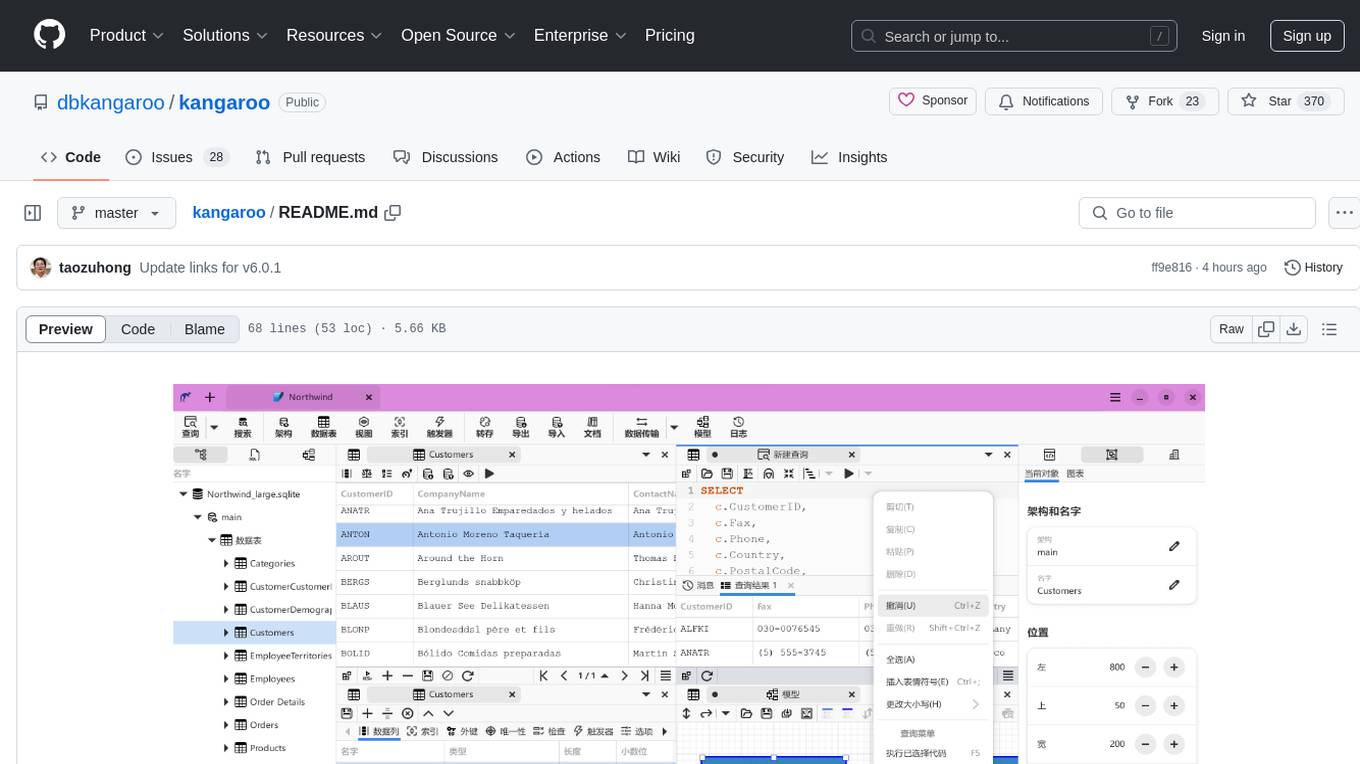
Kangaroo is an AI-powered SQL client and admin tool for popular databases like SQLite, MySQL, PostgreSQL, etc. It supports various functionalities such as table design, query, model, sync, export/import, and more. The tool is designed to be comfortable, fun, and developer-friendly, with features like code intellisense and autocomplete. Kangaroo aims to provide a seamless experience for database management across different operating systems.
gpupixel
GPUPixel is a real-time, high-performance image and video filter library written in C++11 and based on OpenGL/ES. It incorporates a built-in beauty face filter that achieves commercial-grade beauty effects. The library is extremely easy to compile and integrate with a small size, supporting platforms including iOS, Android, Mac, Windows, and Linux. GPUPixel provides various filters like skin smoothing, whitening, face slimming, big eyes, lipstick, and blush. It supports input formats like YUV420P, RGBA, JPEG, PNG, and output formats like RGBA and YUV420P. The library's performance on devices like iPhone and Android is optimized, with low CPU usage and fast processing times. GPUPixel's lib size is compact, making it suitable for mobile and desktop applications.
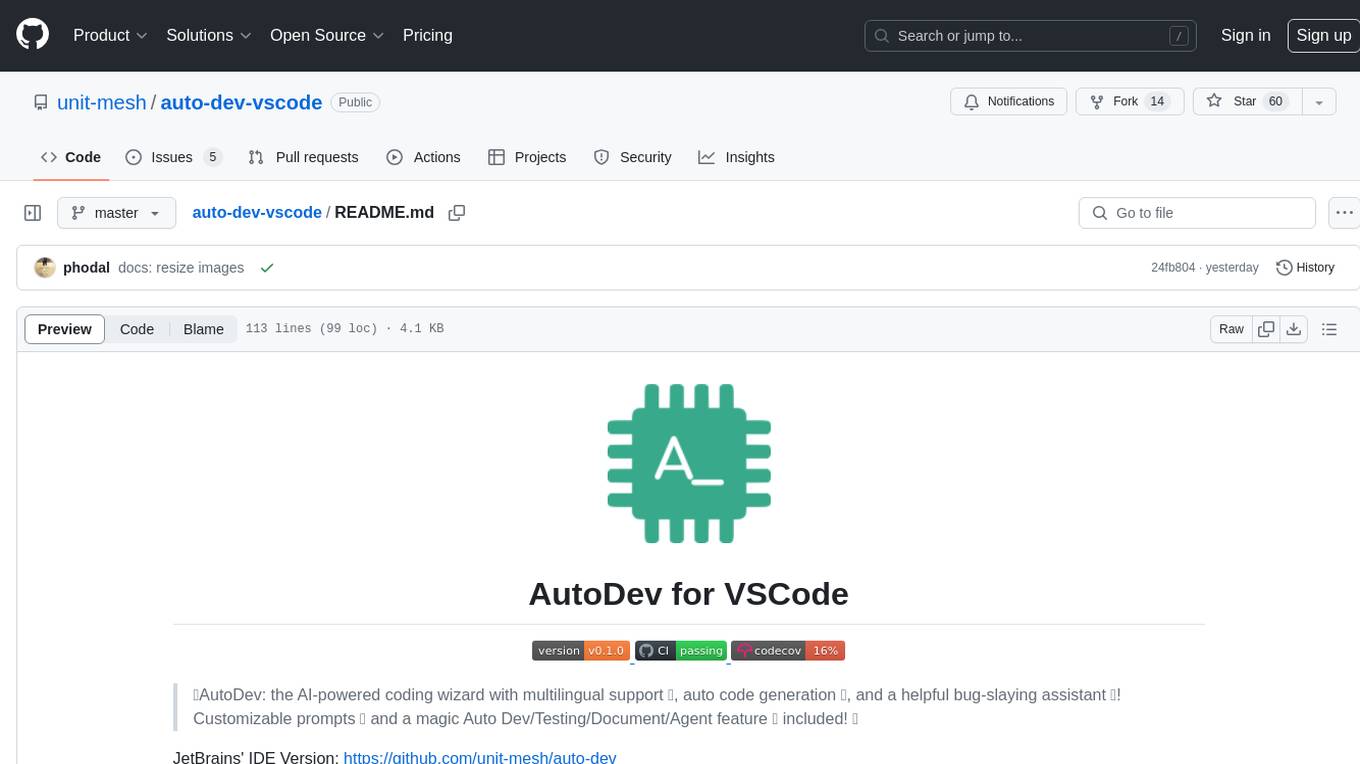
auto-dev-vscode
AutoDev for VSCode is an AI-powered coding wizard with multilingual support, auto code generation, and a bug-slaying assistant. It offers customizable prompts and features like Auto Dev/Testing/Document/Agent. The tool aims to enhance coding productivity and efficiency by providing intelligent assistance and automation capabilities within the Visual Studio Code environment.
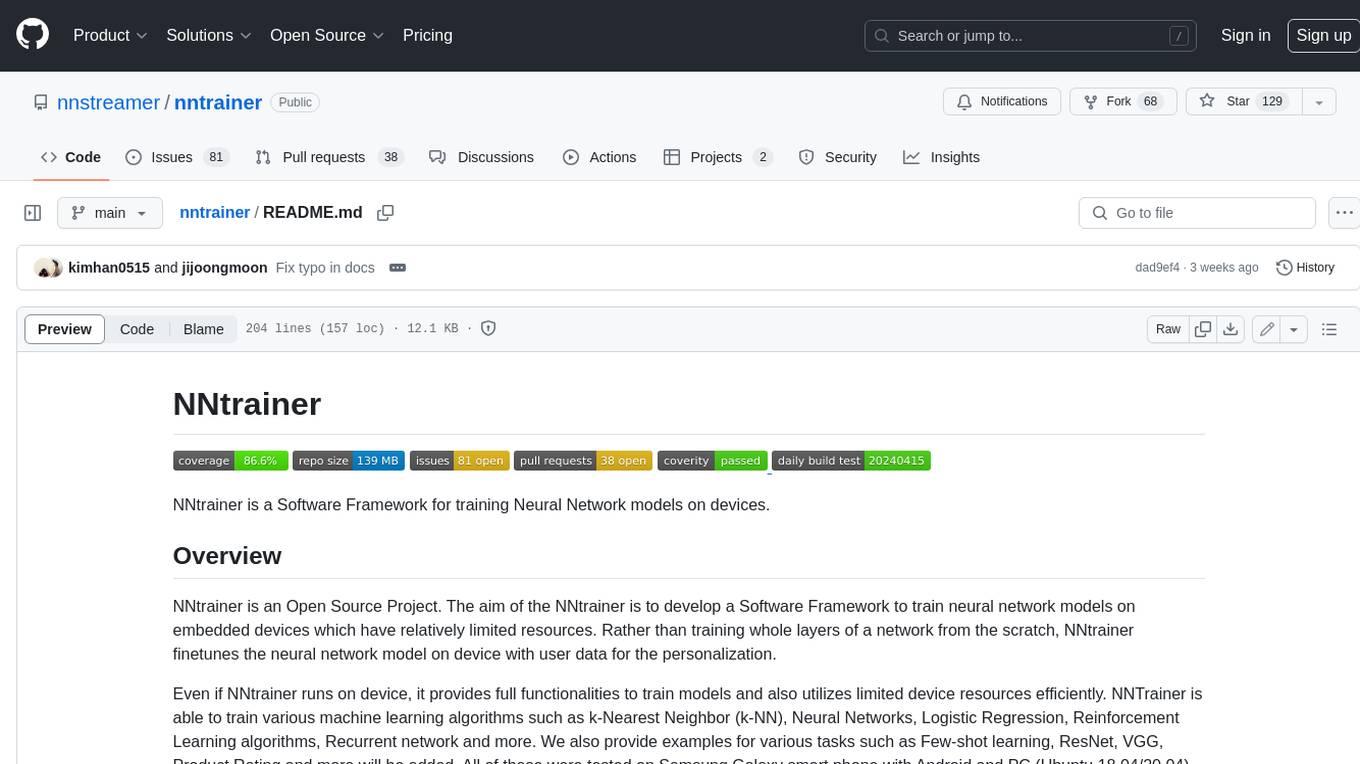
nntrainer
NNtrainer is a software framework for training neural network models on devices with limited resources. It enables on-device fine-tuning of neural networks using user data for personalization. NNtrainer supports various machine learning algorithms and provides examples for tasks such as few-shot learning, ResNet, VGG, and product rating. It is optimized for embedded devices and utilizes CBLAS and CUBLAS for accelerated calculations. NNtrainer is open source and released under the Apache License version 2.0.
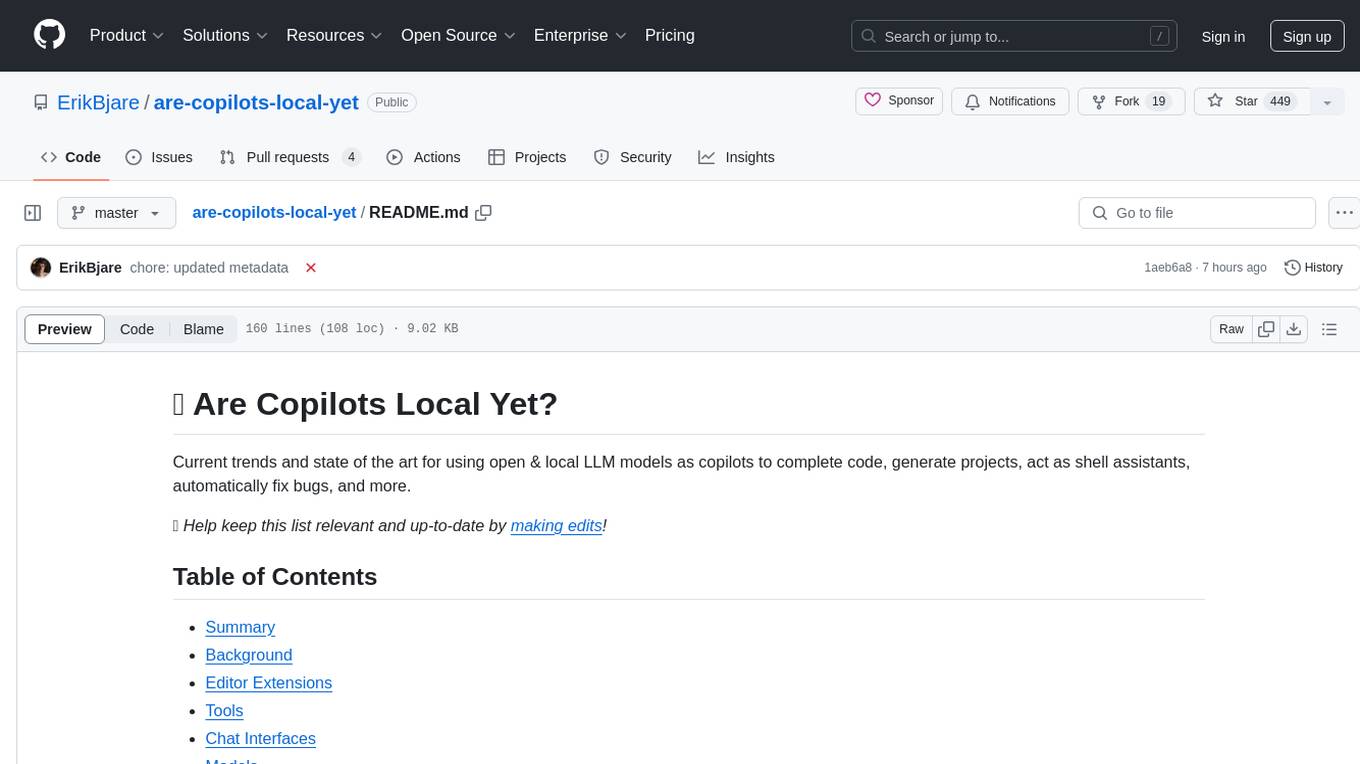
are-copilots-local-yet
Current trends and state of the art for using open & local LLM models as copilots to complete code, generate projects, act as shell assistants, automatically fix bugs, and more. This document is a curated list of local Copilots, shell assistants, and related projects, intended to be a resource for those interested in a survey of the existing tools and to help developers discover the state of the art for projects like these.
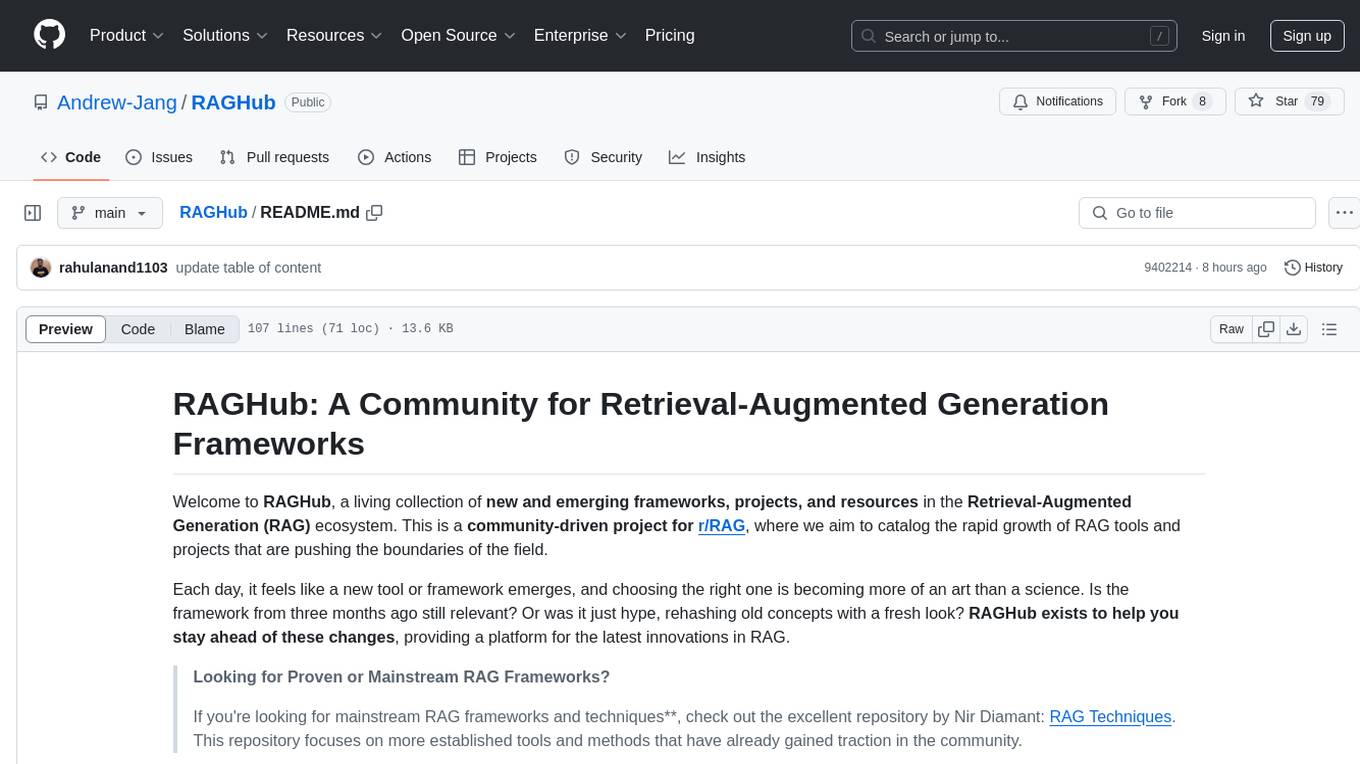
RAGHub
RAGHub is a community-driven project focused on cataloging new and emerging frameworks, projects, and resources in the Retrieval-Augmented Generation (RAG) ecosystem. It aims to help users stay ahead of changes in the field by providing a platform for the latest innovations in RAG. The repository includes information on RAG frameworks, evaluation frameworks, optimization frameworks, citation frameworks, engines, search reranker frameworks, projects, resources, and real-world use cases across industries and professions.
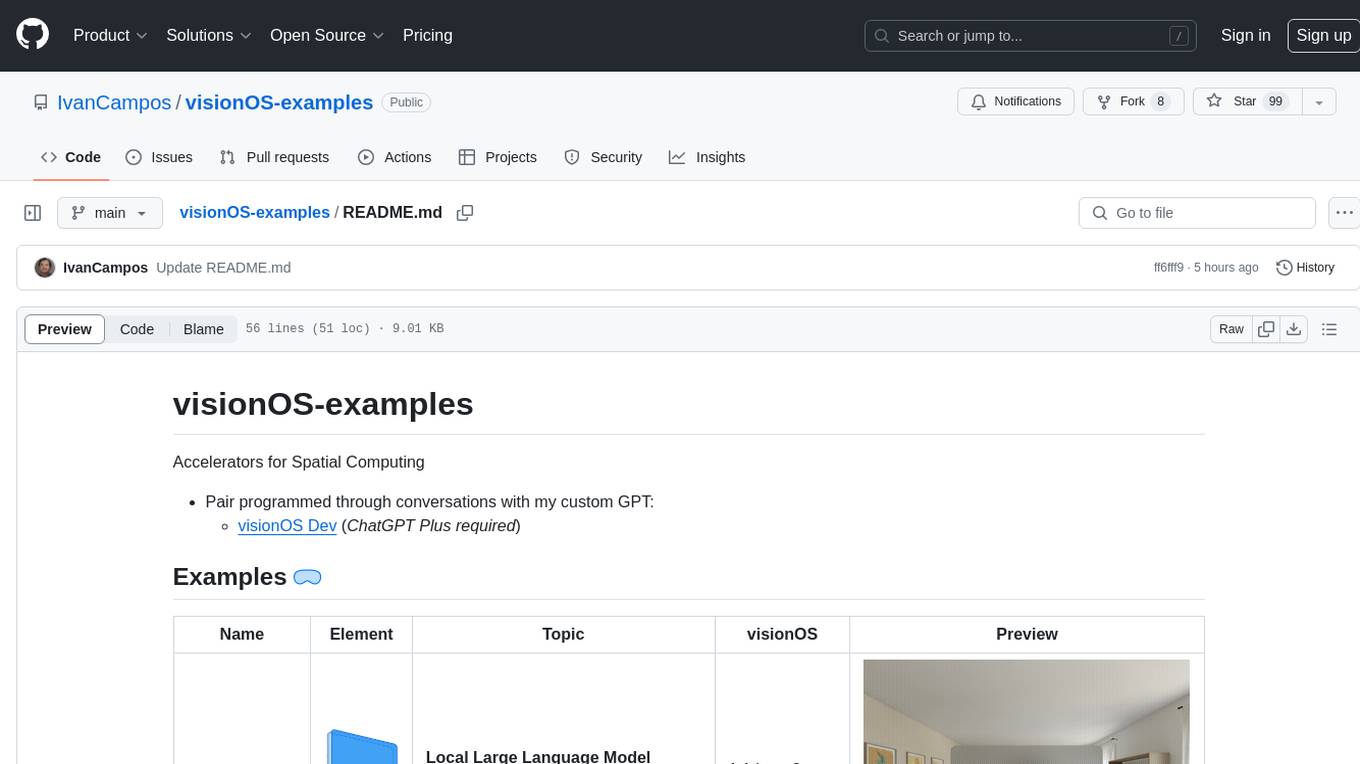
visionOS-examples
visionOS-examples is a repository containing accelerators for Spatial Computing. It includes examples such as Local Large Language Model, Chat Apple Vision Pro, WebSockets, Anchor To Head, Hand Tracking, Battery Life, Countdown, Plane Detection, Timer Vision, and PencilKit for visionOS. The repository showcases various functionalities and features for Apple Vision Pro, offering tools for developers to enhance their visionOS apps with capabilities like hand tracking, plane detection, and real-time cryptocurrency prices.
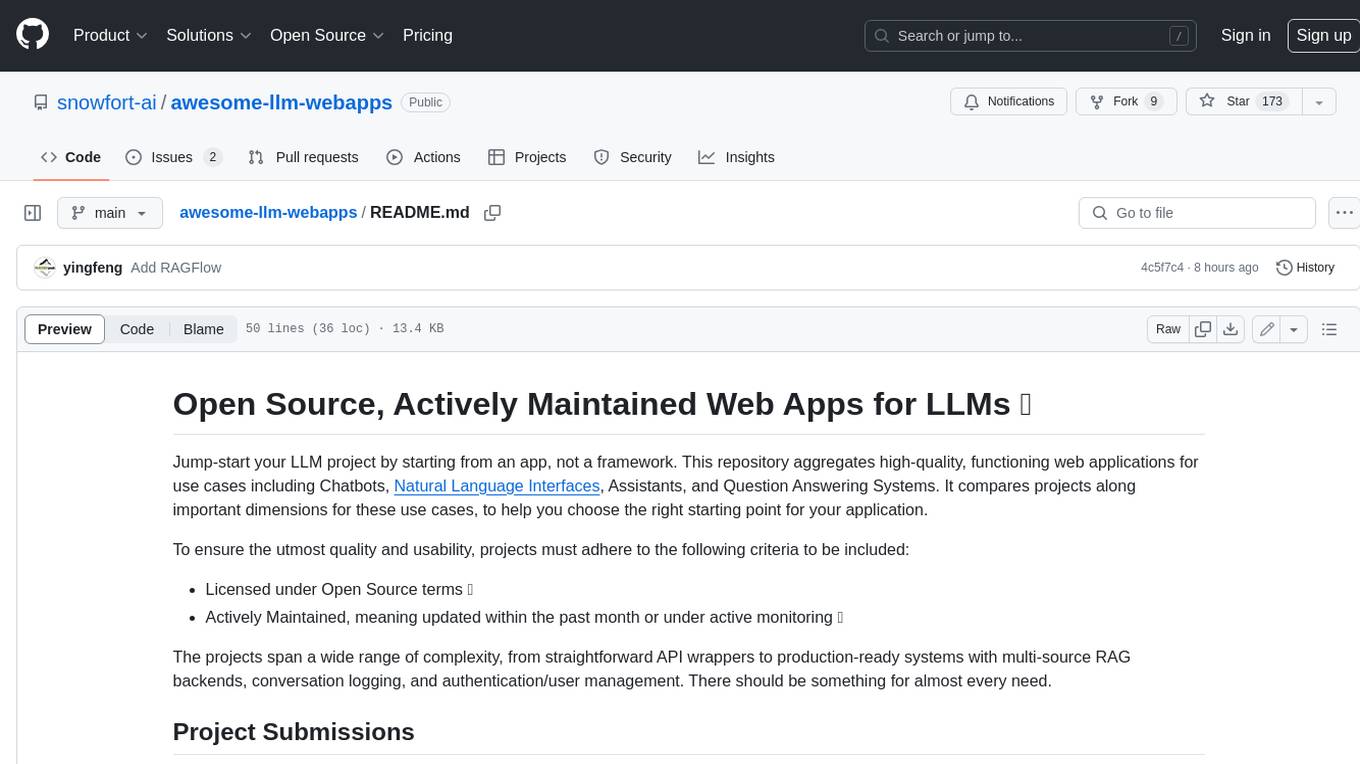
awesome-llm-webapps
This repository is a curated list of open-source, actively maintained web applications that leverage large language models (LLMs) for various use cases, including chatbots, natural language interfaces, assistants, and question answering systems. The projects are evaluated based on key criteria such as licensing, maintenance status, complexity, and features, to help users select the most suitable starting point for their LLM-based applications. The repository welcomes contributions and encourages users to submit projects that meet the criteria or suggest improvements to the existing list.
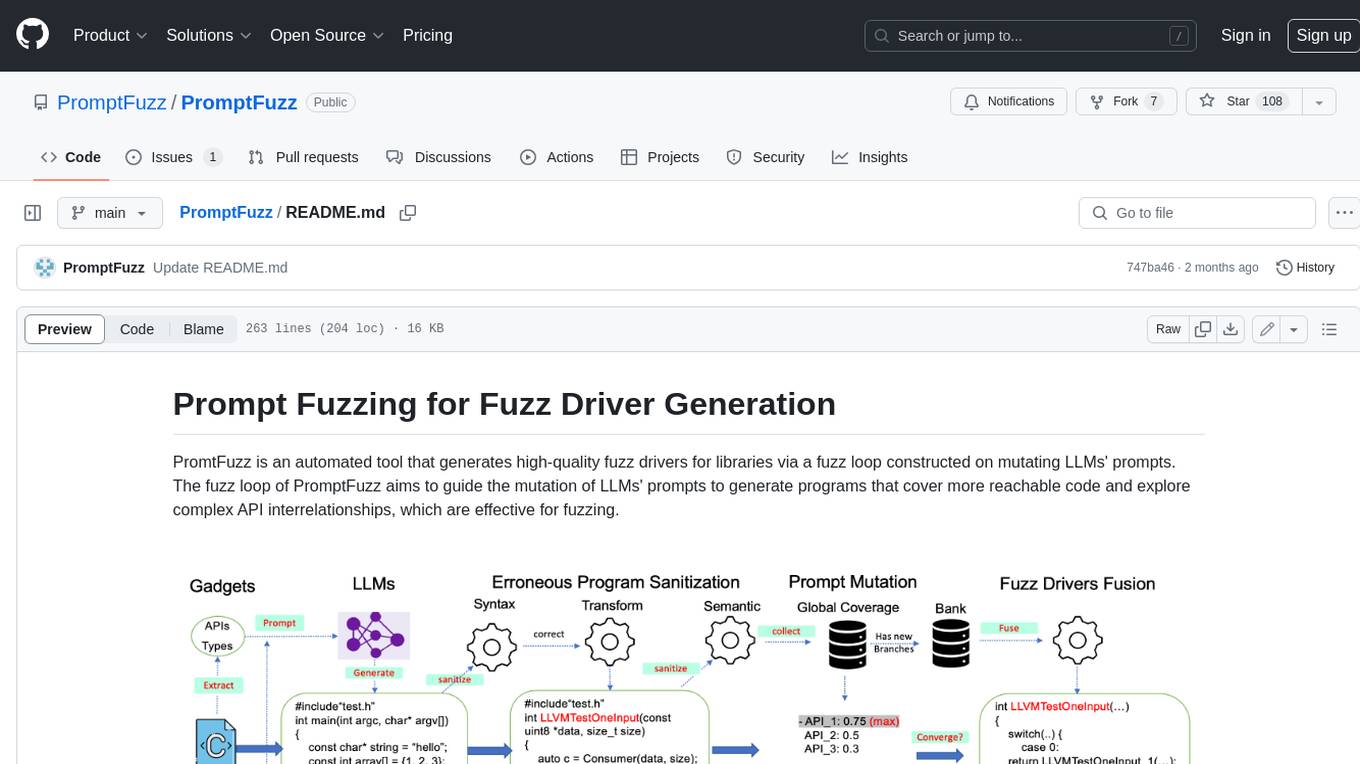
PromptFuzz
**Description:** PromptFuzz is an automated tool that generates high-quality fuzz drivers for libraries via a fuzz loop constructed on mutating LLMs' prompts. The fuzz loop of PromptFuzz aims to guide the mutation of LLMs' prompts to generate programs that cover more reachable code and explore complex API interrelationships, which are effective for fuzzing. **Features:** * **Multiply LLM support** : Supports the general LLMs: Codex, Inocder, ChatGPT, and GPT4 (Currently tested on ChatGPT). * **Context-based Prompt** : Construct LLM prompts with the automatically extracted library context. * **Powerful Sanitization** : The program's syntax, semantics, behavior, and coverage are thoroughly analyzed to sanitize the problematic programs. * **Prioritized Mutation** : Prioritizes mutating the library API combinations within LLM's prompts to explore complex interrelationships, guided by code coverage. * **Fuzz Driver Exploitation** : Infers API constraints using statistics and extends fixed API arguments to receive random bytes from fuzzers. * **Fuzz engine integration** : Integrates with grey-box fuzz engine: LibFuzzer. **Benefits:** * **High branch coverage:** The fuzz drivers generated by PromptFuzz achieved a branch coverage of 40.12% on the tested libraries, which is 1.61x greater than _OSS-Fuzz_ and 1.67x greater than _Hopper_. * **Bug detection:** PromptFuzz detected 33 valid security bugs from 49 unique crashes. * **Wide range of bugs:** The fuzz drivers generated by PromptFuzz can detect a wide range of bugs, most of which are security bugs. * **Unique bugs:** PromptFuzz detects uniquely interesting bugs that other fuzzers may miss. **Usage:** 1. Build the library using the provided build scripts. 2. Export the LLM API KEY if using ChatGPT or GPT4. 3. Generate fuzz drivers using the `fuzzer` command. 4. Run the fuzz drivers using the `harness` command. 5. Deduplicate and analyze the reported crashes. **Future Works:** * **Custom LLMs suport:** Support custom LLMs. * **Close-source libraries:** Apply PromptFuzz to close-source libraries by fine tuning LLMs on private code corpus. * **Performance** : Reduce the huge time cost required in erroneous program elimination.
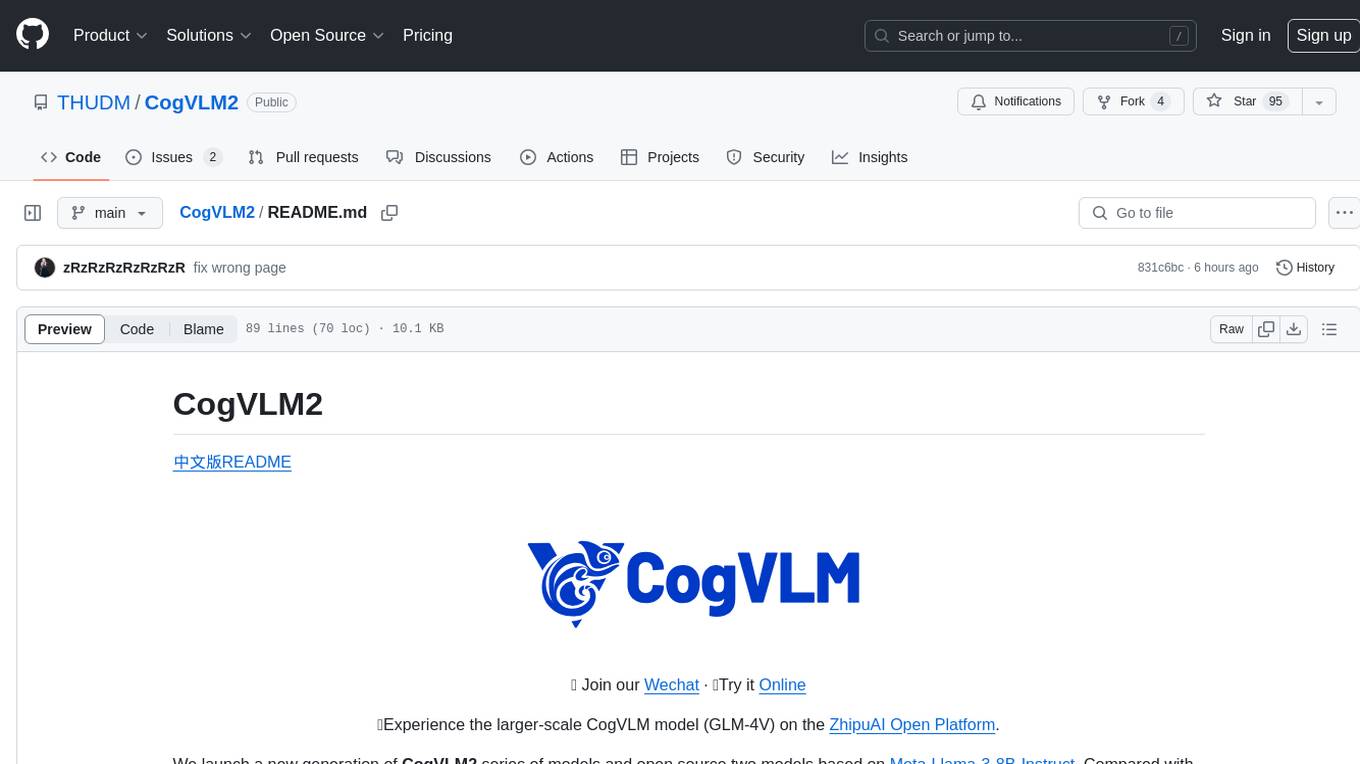
CogVLM2
CogVLM2 is a new generation of open source models that offer significant improvements in benchmarks such as TextVQA and DocVQA. It supports 8K content length, image resolution up to 1344 * 1344, and both Chinese and English languages. The project provides basic calling methods, fine-tuning examples, and OpenAI API format calling examples to help developers quickly get started with the model.
awsome-distributed-training
This repository contains reference architectures and test cases for distributed model training with Amazon SageMaker Hyperpod, AWS ParallelCluster, AWS Batch, and Amazon EKS. The test cases cover different types and sizes of models as well as different frameworks and parallel optimizations (Pytorch DDP/FSDP, MegatronLM, NemoMegatron...).
oumi
Oumi is an open-source platform for building state-of-the-art foundation models, offering tools for data preparation, training, evaluation, and deployment. It supports training and fine-tuning models with various parameters, working with text and multimodal models, synthesizing and curating training data, deploying models efficiently, evaluating models comprehensively, and running on different platforms. Oumi provides a consistent API, reliability, and flexibility for research purposes.
Model-References
The 'Model-References' repository contains examples for training and inference using Intel Gaudi AI Accelerator. It includes models for computer vision, natural language processing, audio, generative models, MLPerf™ training, and MLPerf™ inference. The repository provides performance data and model validation information for various frameworks like PyTorch. Users can find examples of popular models like ResNet, BERT, and Stable Diffusion optimized for Intel Gaudi AI accelerator.
Awesome-LLMs-for-Video-Understanding
Awesome-LLMs-for-Video-Understanding is a repository dedicated to exploring Video Understanding with Large Language Models. It provides a comprehensive survey of the field, covering models, pretraining, instruction tuning, and hybrid methods. The repository also includes information on tasks, datasets, and benchmarks related to video understanding. Contributors are encouraged to add new papers, projects, and materials to enhance the repository.
For similar tasks
sorrentum
Sorrentum is an open-source project that aims to combine open-source development, startups, and brilliant students to build machine learning, AI, and Web3 / DeFi protocols geared towards finance and economics. The project provides opportunities for internships, research assistantships, and development grants, as well as the chance to work on cutting-edge problems, learn about startups, write academic papers, and get internships and full-time positions at companies working on Sorrentum applications.
djl
Deep Java Library (DJL) is an open-source, high-level, engine-agnostic Java framework for deep learning. It is designed to be easy to get started with and simple to use for Java developers. DJL provides a native Java development experience and allows users to integrate machine learning and deep learning models with their Java applications. The framework is deep learning engine agnostic, enabling users to switch engines at any point for optimal performance. DJL's ergonomic API interface guides users with best practices to accomplish deep learning tasks, such as running inference and training neural networks.
craftgen
Craftgen.ai is an innovative AI platform designed for both technical and non-technical users. It's built on a foundation of graph architecture for scalability and the Actor Model for efficient concurrent operations, tailored to both technical and non-technical users. A key aspect of Craftgen.ai is its modular AI approach, allowing users to assemble and customize AI components like building blocks to fit their specific needs. The platform's robustness is enhanced by its event-driven architecture, ensuring reliable data processing and featuring browser web technologies for universal access. Craftgen.ai excels in dynamic tool and workflow generation, with strong offline capabilities for secure environments and plans for desktop application integration. A unique and valuable feature of Craftgen.ai is its marketplace, where users can access a variety of pre-built AI solutions. This marketplace accelerates the deployment of AI tools but also fosters a community of sharing and innovation. Users can contribute to and leverage this repository of solutions, enhancing the platform's versatility and practicality. Craftgen.ai uses JSON schema for industry-standard alignment, enabling seamless integration with any API following the OpenAPI spec. This allows for a broad range of applications, from automating data analysis to streamlining content management. The platform is designed to bridge the gap between advanced AI technology and practical usability. It's a flexible, secure, and intuitive platform that empowers users, from developers seeking to create custom AI solutions to businesses looking to automate routine tasks. Craftgen.ai's goal is to make AI technology an integral, seamless part of everyday problem-solving and innovation, providing a platform where modular AI and a thriving marketplace converge to meet the diverse needs of its users.

Data-Science-EBooks
This repository contains a collection of resources in the form of eBooks related to Data Science, Machine Learning, and similar topics.
BambooAI
BambooAI is a lightweight library utilizing Large Language Models (LLMs) to provide natural language interaction capabilities, much like a research and data analysis assistant enabling conversation with your data. You can either provide your own data sets, or allow the library to locate and fetch data for you. It supports Internet searches and external API interactions.
ai_wiki
This repository provides a comprehensive collection of resources, open-source tools, and knowledge related to quantitative analysis. It serves as a valuable knowledge base and navigation guide for individuals interested in various aspects of quantitative investing, including platforms, programming languages, mathematical foundations, machine learning, deep learning, and practical applications. The repository is well-structured and organized, with clear sections covering different topics. It includes resources on system platforms, programming codes, mathematical foundations, algorithm principles, machine learning, deep learning, reinforcement learning, graph networks, model deployment, and practical applications. Additionally, there are dedicated sections on quantitative trading and investment, as well as large models. The repository is actively maintained and updated, ensuring that users have access to the latest information and resources.

free-for-life
A massive list including a huge amount of products and services that are completely free! ⭐ Star on GitHub • 🤝 Contribute # Table of Contents * APIs, Data & ML * Artificial Intelligence * BaaS * Code Editors * Code Generation * DNS * Databases * Design & UI * Domains * Email * Font * For Students * Forms * Linux Distributions * Messaging & Streaming * PaaS * Payments & Billing * SSL
mslearn-ai-fundamentals
This repository contains materials for the Microsoft Learn AI Fundamentals module. It covers the basics of artificial intelligence, machine learning, and data science. The content includes hands-on labs, interactive learning modules, and assessments to help learners understand key concepts and techniques in AI. Whether you are new to AI or looking to expand your knowledge, this module provides a comprehensive introduction to the fundamentals of AI.
For similar jobs
promptflow
**Prompt flow** is a suite of development tools designed to streamline the end-to-end development cycle of LLM-based AI applications, from ideation, prototyping, testing, evaluation to production deployment and monitoring. It makes prompt engineering much easier and enables you to build LLM apps with production quality.
deepeval
DeepEval is a simple-to-use, open-source LLM evaluation framework specialized for unit testing LLM outputs. It incorporates various metrics such as G-Eval, hallucination, answer relevancy, RAGAS, etc., and runs locally on your machine for evaluation. It provides a wide range of ready-to-use evaluation metrics, allows for creating custom metrics, integrates with any CI/CD environment, and enables benchmarking LLMs on popular benchmarks. DeepEval is designed for evaluating RAG and fine-tuning applications, helping users optimize hyperparameters, prevent prompt drifting, and transition from OpenAI to hosting their own Llama2 with confidence.
MegaDetector
MegaDetector is an AI model that identifies animals, people, and vehicles in camera trap images (which also makes it useful for eliminating blank images). This model is trained on several million images from a variety of ecosystems. MegaDetector is just one of many tools that aims to make conservation biologists more efficient with AI. If you want to learn about other ways to use AI to accelerate camera trap workflows, check out our of the field, affectionately titled "Everything I know about machine learning and camera traps".
leapfrogai
LeapfrogAI is a self-hosted AI platform designed to be deployed in air-gapped resource-constrained environments. It brings sophisticated AI solutions to these environments by hosting all the necessary components of an AI stack, including vector databases, model backends, API, and UI. LeapfrogAI's API closely matches that of OpenAI, allowing tools built for OpenAI/ChatGPT to function seamlessly with a LeapfrogAI backend. It provides several backends for various use cases, including llama-cpp-python, whisper, text-embeddings, and vllm. LeapfrogAI leverages Chainguard's apko to harden base python images, ensuring the latest supported Python versions are used by the other components of the stack. The LeapfrogAI SDK provides a standard set of protobuffs and python utilities for implementing backends and gRPC. LeapfrogAI offers UI options for common use-cases like chat, summarization, and transcription. It can be deployed and run locally via UDS and Kubernetes, built out using Zarf packages. LeapfrogAI is supported by a community of users and contributors, including Defense Unicorns, Beast Code, Chainguard, Exovera, Hypergiant, Pulze, SOSi, United States Navy, United States Air Force, and United States Space Force.
llava-docker
This Docker image for LLaVA (Large Language and Vision Assistant) provides a convenient way to run LLaVA locally or on RunPod. LLaVA is a powerful AI tool that combines natural language processing and computer vision capabilities. With this Docker image, you can easily access LLaVA's functionalities for various tasks, including image captioning, visual question answering, text summarization, and more. The image comes pre-installed with LLaVA v1.2.0, Torch 2.1.2, xformers 0.0.23.post1, and other necessary dependencies. You can customize the model used by setting the MODEL environment variable. The image also includes a Jupyter Lab environment for interactive development and exploration. Overall, this Docker image offers a comprehensive and user-friendly platform for leveraging LLaVA's capabilities.

carrot
The 'carrot' repository on GitHub provides a list of free and user-friendly ChatGPT mirror sites for easy access. The repository includes sponsored sites offering various GPT models and services. Users can find and share sites, report errors, and access stable and recommended sites for ChatGPT usage. The repository also includes a detailed list of ChatGPT sites, their features, and accessibility options, making it a valuable resource for ChatGPT users seeking free and unlimited GPT services.
TrustLLM
TrustLLM is a comprehensive study of trustworthiness in LLMs, including principles for different dimensions of trustworthiness, established benchmark, evaluation, and analysis of trustworthiness for mainstream LLMs, and discussion of open challenges and future directions. Specifically, we first propose a set of principles for trustworthy LLMs that span eight different dimensions. Based on these principles, we further establish a benchmark across six dimensions including truthfulness, safety, fairness, robustness, privacy, and machine ethics. We then present a study evaluating 16 mainstream LLMs in TrustLLM, consisting of over 30 datasets. The document explains how to use the trustllm python package to help you assess the performance of your LLM in trustworthiness more quickly. For more details about TrustLLM, please refer to project website.
AI-YinMei
AI-YinMei is an AI virtual anchor Vtuber development tool (N card version). It supports fastgpt knowledge base chat dialogue, a complete set of solutions for LLM large language models: [fastgpt] + [one-api] + [Xinference], supports docking bilibili live broadcast barrage reply and entering live broadcast welcome speech, supports Microsoft edge-tts speech synthesis, supports Bert-VITS2 speech synthesis, supports GPT-SoVITS speech synthesis, supports expression control Vtuber Studio, supports painting stable-diffusion-webui output OBS live broadcast room, supports painting picture pornography public-NSFW-y-distinguish, supports search and image search service duckduckgo (requires magic Internet access), supports image search service Baidu image search (no magic Internet access), supports AI reply chat box [html plug-in], supports AI singing Auto-Convert-Music, supports playlist [html plug-in], supports dancing function, supports expression video playback, supports head touching action, supports gift smashing action, supports singing automatic start dancing function, chat and singing automatic cycle swing action, supports multi scene switching, background music switching, day and night automatic switching scene, supports open singing and painting, let AI automatically judge the content.