


awesome-claude-code
A curated list of awesome skills, hooks, slash-commands, agent orchestrators, applications, and plugins for Claude Code by Anthropic
Stars: 23207
Awesome Claude Code is a curated list of slash-commands, CLAUDE.md files, CLI tools, and other resources for enhancing your Claude Code workflow. It includes a variety of agent skills, workflows, tooling, hooks, slash-commands, and more to help developers improve their coding experience using Claude Code, a CLI-based coding assistant from Anthropic. The list covers a wide range of topics such as AI development, project management, code analysis, documentation, CI/CD, and domain-specific projects. Whether you are a beginner or an experienced developer, this repository provides valuable resources to enhance your coding skills and workflow with Claude Code.
README:



A curated list of slash-commands, CLAUDE.md files, CLI tools, and other resources for enhancing your Claude Code workflow.
Claude Code is a CLI-based coding assistant from Anthropic that you can access in your terminal or IDE. This list helps the community share knowledge and best practices.

- Book Factory by Robert Guss - A comprehensive pipeline of Skillsthat replicates traditional publishing infrastructure for nonfiction book creation using specialized Claude skills.
-
pre-commit-hooks by aRustyDev - This repository is about pre-commit-hooks in general, but the
CLAUDE.mdand related.claude/documentation is exemplary. Thorough but not verbose. Unlike a lot ofCLAUDE.mdfiles, it doesn't primarily consist in shouting at Claude in all-caps. Great learning resource. Also, hooks. -
Fullstack Dev Skills by jeffallan - A comprehensive Claude Code plugin with 65 specialized skills covering full-stack development across a wide range of specific frameworks. Features 9 project workflow commands for Jira/Confluence integration and, notably, an interesting approach to context engineering via a
/common-groundcommand that surfaces Claude's hidden assumptions about your project. This is a smart thing to do. - read-only-postgres by jawwadfirdousi - Read-only PostgreSQL query skill for Claude Code. Executes SELECT/SHOW/EXPLAIN/WITH queries across configured databases with strict validation, timeouts, and row limits. Supports multiple connections with descriptions for database selection.
- awesome-ralph by Martin Joly - A curated list of resources about Ralph, the AI coding technique that runs AI coding agents in automated loops until specifications are fulfilled.
- ralph-wiggum-bdd by marcindulak - A standalone Bash script for Behavior-Driven Development with Ralph Wiggum Loop. In principle, while running unattended, the script can keep code and requirements in sync, but in practice it still requires interactive human supervision, so it supports both modes. The script is standalone and can be modified and committed into your project.
- Agent Skills 🤖
- Workflows & Knowledge Guides 🧠
- Tooling 🧰
- Status Lines 📊
- Hooks 🪝
- Slash-Commands 🔪
- CLAUDE.md Files 📂
- Alternative Clients 📱
- Official Documentation 🏛️
Agent skills are model-controlled configurations (files, scripts, resources, etc.) that enable Claude Code to perform specialized tasks requiring specific knowledge or capabilities.
- AI Agent, AI Spy by Whittaker & Tiwari - Members from the Signal Foundation with some really great tips and tricks on how to turn your operating system into an instrument of total surveillance, and why some companies are doing this really awesome thing. [warning: YouTube link].
- Book Factory by Robert Guss - A comprehensive pipeline of Skillsthat replicates traditional publishing infrastructure for nonfiction book creation using specialized Claude skills.
- cc-devops-skills by akin-ozer - Immensely detailed set of skills for DevOps Engineers (or anyone who has to deploy code, really). Works with validations, generators, shell scripts and CLI tools to create high quality IaC code for about any platform you've ever struggled painfully to work with. Worth downloading even just as a source of documentation.
- Claude Codex Settings by fatih akyon - A well-organized, well-written set of plugins covering core developer activities, such as working with common cloud platforms like GitHub, Azure, MongoDB, and popular services such as Tavily, Playwright, and more. Clear, not overly-opinionated, and compatible with a few other providers.
- Claude Mountaineering Skills by Dmytro Gaivoronsky - Claude Code skill that automates mountain route research for North American peaks. Aggregates data from 10+ mountaineering sources like Mountaineers.org, PeakBagger.com and SummitPost.com to generate detailed route beta reports with weather, avalanche conditions, and trip reports.
- Codex Skill by klaudworks - Enables users to prompt codex from claude code. Unlike the raw codex mcp server, this skill infers parameters such as model, reasoning effort, sandboxing from your prompt or asks you to specify them. It also simplifies continuing prior codex sessions so that codex can continue with the prior context.
- Compound Engineering Plugin by EveryInc - A very pragmatic set of well-designed agents, skills, and commands, built around a discipline of turning past mistakes and errors into lessons and opportunities for future growth and improvement. Good documentation.
- Context Engineering Kit by Vlad Goncharov - Hand-crafted collection of advanced context engineering techniques and patterns with minimal token footprint focused on improving agent result quality.
- Everything Claude Code by Affaan Mustafa - Top-notch, well-written resources covering "just about everything" from core engineering domains. What's nice about this "everything-" store is most of the resources have significant standalone value and unlike some all-encompassing frameworks, although you can opt in to the author's own specific workflow patterns if you choose, the individual resources offer exemplary patterns in (just about) every Claude Code feature you can find (apologies to the Output Styles devotees).
-
Fullstack Dev Skills by jeffallan - A comprehensive Claude Code plugin with 65 specialized skills covering full-stack development across a wide range of specific frameworks. Features 9 project workflow commands for Jira/Confluence integration and, notably, an interesting approach to context engineering via a
/common-groundcommand that surfaces Claude's hidden assumptions about your project. This is a smart thing to do. - read-only-postgres by jawwadfirdousi - Read-only PostgreSQL query skill for Claude Code. Executes SELECT/SHOW/EXPLAIN/WITH queries across configured databases with strict validation, timeouts, and row limits. Supports multiple connections with descriptions for database selection.
- Superpowers by Jesse Vincent - A strong bundle of core competencies for software engineering, with good coverage of a large portion of the SDLC - from planning, reviewing, testing, debugging... Well written, well organized, and adaptable. The author refers to them as "superpowers", but many of them are just consolidating engineering best practices - which sometimes does feel like a superpower when working with Claude Code.
- Trail of Bits Security Skills by Trail of Bits - A very professional collection of over a dozen security-focused skills for code auditing and vulnerability detection. Includes skills for static analysis with CodeQL and Semgrep, variant analysis across codebases, fix verification, and differential code review.
- TÂCHES Claude Code Resources by TÂCHES - A well-balanced, "down-to-Earth" set of sub agents, skills, and commands, that are well-organized, easy to read, and a healthy focus on "meta"-skills/agents, like "skill-auditor", hook creation, etc. - the kind of things you can adapt to your workflow, and not the other way around.
- Web Assets Generator Skill by Alon Wolenitz - Easily generate web assets from Claude Code including favicons, app icons (PWA), and social media meta images (Open Graph) for Facebook, Twitter, WhatsApp, and LinkedIn. Handles image resizing, text-to-image generation, emojis, and provides proper HTML meta tags.
A workflow is a tightly coupled set of Claude Code-native resources that facilitate specific projects
- AB Method by Ayoub Bensalah - A principled, spec-driven workflow that transforms large problems into focused, incremental missions using Claude Code's specialized sub agents. Includes slash-commands, sub agents, and specialized workflows designed for specific parts of the SDLC.
- Agentic Workflow Patterns by ThibautMelen - A comprehensive and well-documented collection of agentic patterns from Anthropic docs, with colorful Mermaid diagrams and code examples for each pattern. Covers Subagent Orchestration, Progressive Skills, Parallel Tool Calling, Master-Clone Architecture, Wizard Workflows, and more. Also compatible with other providers.
- Blogging Platform Instructions by cloudartisan - Provides a well-structured set of commands for publishing and maintaining a blogging platform, including commands for creating posts, managing categories, and handling media files.
- Claude Code Documentation Mirror by Eric Buess - A mirror of the Anthropic © PBC documentation pages for Claude Code, updated every few hours. Can come in handy when trying to stay on top of the ever-expanding feature-set of Dr. Claw D. Code, Ph.D.
- Claude Code Handbook by nikiforovall - Collection of best practices, tips, and techniques for Claude Code development workflows, enhanced with distributable plugins.
- Claude Code Infrastructure Showcase by diet103 - A remarkably innovative approach to working with Skills, the centerpiece of which being a technique that leverages hooks to ensure that Claude intelligently selects and activates the appropriate Skill given the current context. Well-documented and adaptable to different projects and workflows.
- Claude Code PM by Ran Aroussi - Really comprehensive and feature-packed project-management workflow for Claude Code. Numerous specialized agents, slash-commands, and strong documentation.
- Claude Code Repos Index by Daniel Rosehill - This is either the work of a prolific genius, or a very clever bot (or both), although it hardly matters because the quality is so good - an index of 75+ Claude Code repositories published by the author - and I'm not talking about slop. CMS, system design, deep research, IoT, agentic workflows, server management, personal health... If you spot the lie, let me know, otherwise please check these out.
- Claude Code System Prompts by Piebald AI - All parts of Claude Code's system prompt, including builtin tool descriptions, sub agent prompts (Plan/Explore/Task), utility prompts (CLAUDE.md, compact, Bash cmd, security review, agent creation, etc.). Updated for each Claude Code version.
- Claude Code Tips by ykdojo - A nice variety of 35+ brief but information-dense Claude Code tips covering voice input, system prompt patching, container workflows for risky tasks, conversation cloning(!), multi-model orchestration with Gemini CLI, and plenty more. Nice demos, working scripts, a plugin, I'd say this probably has a little something for everyone.
- Claude CodePro by Max Ritter - Professional development environment for Claude Code with spec-driven workflow, TDD enforcement, cross-session memory, semantic search, quality hooks, and modular rules integration. A bit "heavyweight" but feature-packed and has wide coverage.
-
claude-code-docs by Constantin Shafranski - A mirror of the Anthropic© PBC documentation site for Claude/Code, but with bonus features like full-text search and query-time updates - a nice companion to
claude-code-docsfor up-to-the-minute, fully-indexed information so that Claude Code can read about itself. - ClaudoPro Directory by ghost - Well-crafted, wide selection of Claude Code hooks, slash commands, subagent files, and more, covering a range of specialized tasks and workflows. Better resources than your average "Claude-template-for-everything" site.
- Context Priming by disler - Provides a systematic approach to priming Claude Code with comprehensive project context through specialized commands for different project scenarios and development contexts.
-
Design Review Workflow by Patrick Ellis - A tailored workflow for enabling automated UI/UX design review, including specialized sub agents, slash commands,
CLAUDE.mdexcerpts, and more. Covers a broad range of criteria from responsive design to accessibility. - Laravel TALL Stack AI Development Starter Kit by tott - Transform your Laravel TALL (Tailwind, AlpineJS, Laravel, Livewire) stack development with comprehensive Claude Code configurations that provide intelligent assistance, systematic workflows, and domain expert consultation.
- Learn Claude Code by shareAI-Lab - A really interesting analysis of how coding agents like Claude Code are designed. It attempts to break an agent down into its fundamental parts and reconstruct it with minimal code. Great learning resource. Final product is a rudimentary agent with skills, sub-agents, and a todo-list in roughly a few hundred lines of Python.
- learn-faster-kit by Hugo Lau - A creative educational framework for Claude Code, inspired by the "FASTER" approach to self-teaching. Ships with a variety of agents, slash commands, and tools that enable Claude Code to help you progress at your own pace, employing well-established pedagogical techniques like active learning and spaced repetition.
- n8n_agent by kingler - Amazing comprehensive set of comments for code analysis, QA, design, documentation, project structure, project management, optimization, and many more.
- Project Bootstrapping and Task Management by steadycursor - Provides a structured set of commands for bootstrapping and managing a new project, including meta-commands for creating and editing custom slash-commands.
- Project Management, Implementation, Planning, and Release by scopecraft - Really comprehensive set of commands for all aspects of SDLC.
- Project Workflow System by harperreed - A set of commands that provide a comprehensive workflow system for managing projects, including task management, code review, and deployment processes.
- RIPER Workflow by Tony Narlock - Structured development workflow enforcing separation between Research, Innovate, Plan, Execute, and Review phases. Features consolidated subagents for context-efficiency, branch-aware memory bank, and strict mode enforcement for guided development.
- Shipping Real Code w/ Claude by Diwank - A detailed blog post explaining the author's process for shipping a product with Claude Code, including CLAUDE.md files and other interesting resources.
- Simone by Helmi - A broader project management workflow for Claude Code that encompasses not just a set of commands, but a system of documents, guidelines, and processes to facilitate project planning and execution.
- awesome-ralph by Martin Joly - A curated list of resources about Ralph, the AI coding technique that runs AI coding agents in automated loops until specifications are fulfilled.
- Ralph for Claude Code by Frank Bria - An autonomous AI development framework that enables Claude Code to work iteratively on projects until completion. Features intelligent exit detection, rate limiting, circuit breaker patterns, and comprehensive safety guardrails to prevent infinite loops and API overuse. Built with Bash, integrated with tmux for live monitoring, and includes 75+ comprehensive tests.
- Ralph Wiggum Marketer by Muratcan Koylan - A Claude Code plugin that provides an autonomous AI copywriter, integrating the Ralph loop with customized knowledge bases for market research agents. The agents do the research, Ralph writes the copy, you stay in bed. Whether or not you practice Ralph-Driven Development (RDD), I think these projects are interesting and creative explorations of general agentic patterns.
- ralph-orchestrator by mikeyobrien - Ralph Orchestrator implements the simple but effective "Ralph Wiggum" technique for autonomous task completion, continuously running an AI agent against a prompt file until the task is marked as complete or limits are reached. This implementation provides a robust, well-tested, and feature-complete orchestration system for AI-driven development. Also cited in the Anthropic Ralph plugin documentation.
- ralph-wiggum-bdd by marcindulak - A standalone Bash script for Behavior-Driven Development with Ralph Wiggum Loop. In principle, while running unattended, the script can keep code and requirements in sync, but in practice it still requires interactive human supervision, so it supports both modes. The script is standalone and can be modified and committed into your project.
- The Ralph Playbook by Clayton Farr - A remarkably detailed and comprehensive guide to the Ralph Wiggum technique, featuring well-written theoretical commentary paired with practical guidelines and advice.
Tooling denotes applications that are built on top of Claude Code and consist of more components than slash-commands and
CLAUDE.mdfiles
- cc-sessions by toastdev - An opinionated approach to productive development with Claude Code.
- cc-tools by Josh Symonds - High-performance Go implementation of Claude Code hooks and utilities. Provides smart linting, testing, and statusline generation with minimal overhead.
- ccexp by nyatinte - Interactive CLI tool for discovering and managing Claude Code configuration files and slash commands with a beautiful terminal UI.
-
cchistory by eckardt - Like the shell history command but for your Claude Code sessions. Easily list all Bash or "Bash-mode" (
!) commands Claude Code ran in a session for reference. -
cclogviewer by Brad S. - A humble but handy utility for viewing Claude Code
.jsonlconversation files in a pretty HTML UI. - Claude Code Templates by Daniel Avila - Incredibly awesome collection of resources from every category in this list, presented with a neatly polished UI, great features like usage dashboard, analytics, and everything from slash commands to hooks to agents. An awesome companion for this awesome list.
- Claude Composer by Mike Bannister - A tool that adds small enhancements to Claude Code.
- Claude Hub by Claude Did This - A webhook service that connects Claude Code to GitHub repositories, enabling AI-powered code assistance directly through pull requests and issues. This integration allows Claude to analyze repositories, answer technical questions, and help developers understand and improve their codebase through simple @mentions.
- Claude Session Restore by ZENG3LD - Efficiently restore context from previous Claude Code sessions by analyzing session files and git history. Features multi-factor data collection across numerous Claude Code capacities with time-based filtering. Uses tail-based parsing for efficient handling of large session files up to 2GB. Includes both a CLI tool for manual analysis and a Claude Code skill for automatic session restoration.
- claude-code-tools by Prasad Chalasani - Well-crafted toolset for session continuity, featuring skills/commands to avoid compaction and recover context across sessions with cross-agent handoff between Claude Code and Codex CLI. Includes a fast Rust/Tantivy-powered full-text session search (TUI for humans, skill/CLI for agents), tmux-cli skill + command for interacting with scripts and CLI agents, and safety hooks to block dangerous commands.
- claude-starter-kit by serpro69 - This is a starter template repository designed to provide a complete development environment for Claude-Code with pre-configured MCP servers and tools for AI-powered development workflows. The repository is intentionally minimal, containing only configuration templates for three primary systems: Claude Code, Serena, and Task Master.
- claudekit by Carl Rannaberg - Impressive CLI toolkit providing auto-save checkpointing, code quality hooks, specification generation and execution, and 20+ specialized subagents including oracle (gpt-5), code-reviewer (6-aspect deep analysis), ai-sdk-expert (Vercel AI SDK), typescript-expert and many more for Claude Code workflows.
- Container Use by dagger - Development environments for coding agents. Enable multiple agents to work safely and independently with your preferred stack.
- ContextKit by Cihat Gündüz - A systematic development framework that transforms Claude Code into a proactive development partner. Features 4-phase planning methodology, specialized quality agents, and structured workflows that help AI produce production-ready code on first try.
-
recall by zippoxer - Full-text search your Claude Code sessions. Run
recallin terminal, type to search, Enter to resume. Alternative toclaude --resume. - Rulesync by dyoshikawa - A Node.js CLI tool that automatically generates configs (rules, ignore files, MCP servers, commands, and subagents) for various AI coding agents. Rulesync can convert configs between Claude Code and other AI agents in both directions.
- run-claude-docker by Jonas - A self-contained Docker runner that forwards your current workspace into a safe(r) isolated docker container, where you still have access to your Claude Code settings, authentication, ssh agent, pgp, optionally aws keys etc.
- stt-mcp-server-linux by marcindulak - A push-to-talk speech transcription setup for Linux using a Python MCP server. Runs locally in Docker with no external API calls. Your speech is recorded, transcribed into text, and then sent to Claude running in a Tmux session.
- SuperClaude by SuperClaude-Org - A versatile configuration framework that enhances Claude Code with specialized commands, cognitive personas, and development methodologies, such as "Introspection" and "Orchestration".
- tweakcc by Piebald-AI - Command-line tool to customize your Claude Code styling.
- Vibe-Log by Vibe-Log - Analyzes your Claude Code prompts locally (using CC), provides intelligent session analysis and actionable strategic guidance - works in the statusline and produces very pretty HTML reports as well. Easy to install and remove.
-
viwo-cli by Hal Shin - Run Claude Code in a Docker container with git worktrees as volume mounts to enable safer usage of
--dangerously-skip-permissionsfor frictionless one-shotting prompts. Allows users to spin up multiple instances of Claude Code in the background easily with reduced permission fatigue. - VoiceMode MCP by Mike Bailey - VoiceMode MCP brings natural conversations to Claude Code. It supports any OpenAI API compatible voice services and installs free and open source voice services (Whisper.cpp and Kokoro-FastAPI).
- Claude Code Chat by andrepimenta - An elegant and user-friendly Claude Code chat interface for VS Code.
- claude-code-ide.el by manzaltu - claude-code-ide.el integrates Claude Code with Emacs, like Anthropic’s VS Code/IntelliJ extensions. It shows ediff-based code suggestions, pulls LSP/flymake/flycheck diagnostics, and tracks buffer context. It adds an extensible MCP tool support for symbol refs/defs, project metadata, and tree-sitter AST queries.
- claude-code.el by stevemolitor - An Emacs interface for Claude Code CLI.
- claude-code.nvim by greggh - A seamless integration between Claude Code AI assistant and Neovim.
- Claudix - Claude Code for VSCode by Haleclipse - A VSCode extension that brings Claude Code directly into your editor with interactive chat interface, session management, intelligent file operations, terminal execution, and real-time streaming responses. Built with Vue 3, TypeScript.
- crystal by stravu - A full-fledged desktop application for orchestrating, monitoring, and interacting with Claude Code agents.
- CC Usage by ryoppippi - Handy CLI tool for managing and analyzing Claude Code usage, based on analyzing local Claude Code logs. Presents a nice dashboard regarding cost information, token consumption, etc.
- ccflare by snipeship - Claude Code usage dashboard with a web-UI that would put Tableau to shame. Thoroughly comprehensive metrics, frictionless setup, detailed logging, really really nice UI.
-
ccflare -> better-ccflare by tombii - A well-maintained and feature-enhanced fork of the glorious
ccflareusage dashboard by @snipeship (which at the time of writing has not had an update in a few months).better-ccflarebuilds on this foundation with some performance enhancements, extended provider support, bug fixes, Docker deployment, and more. - Claude Code Usage Monitor by Maciek-roboblog - A real-time terminal-based tool for monitoring Claude Code token usage. It shows live token consumption, burn rate, and predictions for token depletion. Features include visual progress bars, session-aware analytics, and support for multiple subscription plans.
- Claudex by Kunwar Shah - Claudex - A web-based browser for exploring your Claude Code conversation history across projects. Indexes your codebase for full-text search. Nice, easy-to-navigate UI. Simple dashboard interface for high-level analytics, and multiple export options as well. (And completely local w/ no telemetry!).
- viberank by nikshepsvn - A community-driven leaderboard tool that enables developers to visualize, track, and compete based on their Claude Code usage statistics. It features robust data analytics, GitHub OAuth, data validation, and user-friendly CLI/web submission methods.
- Claude Code Flow by ruvnet - This mode serves as a code-first orchestration layer, enabling Claude to write, edit, test, and optimize code autonomously across recursive agent cycles.
- Claude Squad by smtg-ai - Claude Squad is a terminal app that manages multiple Claude Code, Codex (and other local agents including Aider) in separate workspaces, allowing you to work on multiple tasks simultaneously.
- Claude Swarm by parruda - Launch Claude Code session that is connected to a swarm of Claude Code Agents.
- Claude Task Master by eyaltoledano - A task management system for AI-driven development with Claude, designed to work seamlessly with Cursor AI.
- Claude Task Runner by grahama1970 - A specialized tool to manage context isolation and focused task execution with Claude Code, solving the critical challenge of context length limitations and task focus when working with Claude on complex, multi-step projects.
- Happy Coder by GrocerPublishAgent - Spawn and control multiple Claude Codes in parallel from your phone or desktop. Happy Coder runs Claude Code on your hardware, sends push notifications when Claude needs more input or permission, and costs nothing.
- The Agentic Startup by Rudolf Schmidt - Yet Another Claude Orchestrator - a collection of agents, commands, etc., for shipping production code - but I like this because it's comprehensive, well-written, and one of the few resources that actually uses Output Styles! +10 points!
- TSK - AI Agent Task Manager and Sandbox by dtormoen - A Rust CLI tool that lets you delegate development tasks to AI agents running in sandboxed Docker environments. Multiple agents work in parallel, returning git branches for human review.
Status lines - Configurations and customizations for Claude Code's status bar functionality
- CCometixLine - Claude Code Statusline by Haleclipse - A high-performance Claude Code statusline tool written in Rust with Git integration, usage tracking, interactive TUI configuration, and Claude Code enhancement utilities.
- ccstatusline by sirmalloc - A highly customizable status line formatter for Claude Code CLI that displays model info, git branch, token usage, and other metrics in your terminal.
- claude-code-statusline by rz1989s - Enhanced 4-line statusline for Claude Code with themes, cost tracking, and MCP server monitoring.
- claude-powerline by Owloops - A vim-style powerline statusline for Claude Code with real-time usage tracking, git integration, custom themes, and more.
- claudia-statusline by Hagan Franks - High-performance Rust-based statusline for Claude Code with persistent stats tracking, progress bars, and optional cloud sync. Features SQLite-first persistence, git integration, context progress bars, burn rate calculation, XDG-compliant with theme support (dark/light, NO_COLOR).
Hooks are a powerful API for Claude Code that allows users to activate commands and run scripts at different points in Claude's agentic lifecycle.
- Britfix by Talieisin - Claude outputs American spellings by default, which can have an impact on: professional credibility, compliance, documentation, and more. Britfix converts to British English, with a Claude Code hook for automatic conversion as files are written. Context-aware: handles code files intelligently by only converting comments and docstrings, never identifiers or string literals.
- CC Notify by dazuiba - CCNotify provides desktop notifications for Claude Code, alerting you to input needs or task completion, with one-click jumps back to VS Code and task duration display.
- cchooks by GowayLee - A lightweight Python SDK with a clean API and good documentation; simplifies the process of writing hooks and integrating them into your codebase, providing a nice abstraction over the JSON configuration files.
- Claude Code Hook Comms (HCOM) by aannoo - Lightweight CLI tool for real-time communication between Claude Code sub agents using hooks. Enables multi-agent collaboration with @-mention targeting, live dashboard monitoring, and zero-dependency implementation. [NOTE: At the time of posting, this resource is a little unstable - I'm sharing it anyway, because I think it's incredibly promising and creative. I hope by the time you read this, it is production-ready.].
- claude-code-hooks-sdk by beyondcode - A Laravel-inspired PHP SDK for building Claude Code hook responses with a clean, fluent API. This SDK makes it easy to create structured JSON responses for Claude Code hooks using an expressive, chainable interface.
- claude-hooks by John Lindquist - A TypeScript-based system for configuring and customizing Claude Code hooks with a powerful and flexible interface.
- Claudio by Christopher Toth - A no-frills little library that adds delightful OS-native sounds to Claude Code via simple hooks. It really sparks joy.
- TDD Guard by Nizar Selander - A hooks-driven system that monitors file operations in real-time and blocks changes that violate TDD principles.
- TypeScript Quality Hooks by bartolli - Quality check hook for Node.js TypeScript projects with TypeScript compilation. ESLint auto-fixing, and Prettier formatting. Uses SHA256 config caching for < 5ms validation performance during real-time editing.
"Slash Commands are customized, carefully refined prompts that control Claude's behavior in order to perform a specific task"
- /create-hook by Omri Lavi - Slash command for hook creation - intelligently prompts you through the creation process with smart suggestions based on your project setup (TS, Prettier, ESLint...).
- /linux-desktop-slash-commands by Daniel Rosehill - A library of slash commands intended specifically to facilitate common and advanced operations on Linux desktop environments (although many would also be useful on Linux servers). Command groups include hardware benchmarking, filesystem organisation, and security posture validation.
- /analyze-issue by jerseycheese - Fetches GitHub issue details to create comprehensive implementation specifications, analyzing requirements and planning structured approach with clear implementation steps.
- /commit by evmts - Creates git commits using conventional commit format with appropriate emojis, following project standards and creating descriptive messages that explain the purpose of changes.
- /commit-fast by steadycursor - Automates git commit process by selecting the first suggested message, generating structured commits with consistent formatting while skipping manual confirmation and removing Claude co-Contributorship footer.
- /create-pr by toyamarinyon - Streamlines pull request creation by handling the entire workflow: creating a new branch, committing changes, formatting modified files with Biome, and submitting the PR.
- /create-pull-request by liam-hq - Provides comprehensive PR creation guidance with GitHub CLI, enforcing title conventions, following template structure, and offering concrete command examples with best practices.
- /create-worktrees by evmts - Creates git worktrees for all open PRs or specific branches, handling branches with slashes, cleaning up stale worktrees, and supporting custom branch creation for development.
- /fix-github-issue by jeremymailen - Analyzes and fixes GitHub issues using a structured approach with GitHub CLI for issue details, implementing necessary code changes, running tests, and creating proper commit messages.
- /fix-issue by metabase - Addresses GitHub issues by taking issue number as parameter, analyzing context, implementing solution, and testing/validating the fix for proper integration.
- /fix-pr by metabase - Fetches and fixes unresolved PR comments by automatically retrieving feedback, addressing reviewer concerns, making targeted code improvements, and streamlining the review process.
- /husky by evmts - Sets up and manages Husky Git hooks by configuring pre-commit hooks, establishing commit message standards, integrating with linting tools, and ensuring code quality on commits.
- /update-branch-name by giselles-ai - Updates branch names with proper prefixes and formats, enforcing naming conventions, supporting semantic prefixes, and managing remote branch updates.
- /check by rygwdn - Performs comprehensive code quality and security checks, featuring static analysis integration, security vulnerability scanning, code style enforcement, and detailed reporting.
- /code_analysis by kingler - Provides a menu of advanced code analysis commands for deep inspection, including knowledge graph generation, optimization suggestions, and quality evaluation.
- /optimize by to4iki - Analyzes code performance to identify bottlenecks, proposing concrete optimizations with implementation guidance for improved application performance.
- /repro-issue by rzykov - Creates reproducible test cases for GitHub issues, ensuring tests fail reliably and documenting clear reproduction steps for developers.
- /tdd by zscott - Guides development using Test-Driven Development principles, enforcing Red-Green-Refactor discipline, integrating with git workflow, and managing PR creation.
- /tdd-implement by jerseycheese - Implements Test-Driven Development by analyzing feature requirements, creating tests first (red), implementing minimal passing code (green), and refactoring while maintaining tests.
- /context-prime by elizaOS - Primes Claude with comprehensive project understanding by loading repository structure, setting development context, establishing project goals, and defining collaboration parameters.
- /initref by okuvshynov - Initializes reference documentation structure with standard doc templates, API reference setup, documentation conventions, and placeholder content generation.
- /load-llms-txt by ethpandaops - Loads LLM configuration files to context, importing specific terminology, model configurations, and establishing baseline terminology for AI discussions.
- /load_coo_context by Mjvolk3 - References specific files for sparse matrix operations, explains transform usage, compares with previous approaches, and sets data formatting context for development.
- /load_dango_pipeline by Mjvolk3 - Sets context for model training by referencing pipeline files, establishing working context, and preparing for pipeline work with relevant documentation.
- /prime by yzyydev - Sets up initial project context by viewing directory structure and reading key files, creating standardized context with directory visualization and key documentation focus.
- /rsi by ddisisto - Reads all commands and key project files to optimize AI-assisted development by streamlining the process, loading command context, and setting up for better development workflow.
- /add-to-changelog by berrydev-ai - Adds new entries to changelog files while maintaining format consistency, properly documenting changes, and following established project standards for version tracking.
- /create-docs by jerseycheese - Analyzes code structure and purpose to create comprehensive documentation detailing inputs/outputs, behavior, user interaction flows, and edge cases with error handling.
- /docs by slunsford - Generates comprehensive documentation that follows project structure, documenting APIs and usage patterns with consistent formatting for better user understanding.
- /explain-issue-fix by hackdays-io - Documents solution approaches for GitHub issues, explaining technical decisions, detailing challenges overcome, and providing implementation context for better understanding.
- /update-docs by Consiliency - Reviews current documentation status, updates implementation progress, reviews phase documents, and maintains documentation consistency across the project.
- /release by kelp - Manages software releases by updating changelogs, reviewing README changes, evaluating version increments, and documenting release changes for better version tracking.
- /run-ci by hackdays-io - Activates virtual environments, runs CI-compatible check scripts, iteratively fixes errors, and ensures all tests pass before completion.
- /create-command by scopecraft - Guides Claude through creating new custom commands with proper structure by analyzing requirements, templating commands by category, enforcing command standards, and creating supporting documentation.
- /create-plan by taddyorg - Generates comprehensive product requirement documents outlining detailed specifications, requirements, and features following standardized document structure and format. (Removed from origin)
- /create-prp by Wirasm - Creates product requirement plans by reading PRP methodology, following template structure, creating comprehensive requirements, and structuring product definitions for development.
- /do-issue by jerseycheese - Implements GitHub issues with manual review points, following a structured approach with issue number parameter and offering alternative automated mode for efficiency.
-
/prd-generator by Denis Redozubov - A Claude Code plugin that generates comprehensive Product Requirements Documents (PRDs) from conversation context. Invoke
/create-prdafter discussing requirements and it produces a complete PRD with all standard sections including Executive Summary, User Stories, MVP Scope, Architecture, Success Criteria, and Implementation Phases. - /project_hello_w_name by disler - Creates customizable greeting components with name input, demonstrating argument passing, component reusability, state management, and user input handling.
- /todo by chrisleyva - A convenient command to quickly manage project todo items without leaving the Claude Code interface, featuring due dates, sorting, task prioritization, and comprehensive todo list management.
- /fixing_go_in_graph by Mjvolk3 - Focuses on Gene Ontology annotation integration in graph databases, handling multiple data sources, addressing graph representation issues, and ensuring correct data incorporation.
- /mermaid by GaloyMoney - Generates Mermaid diagrams from SQL schema files, creating entity relationship diagrams with table properties, validating diagram compilation, and ensuring complete entity coverage.
- /review_dcell_model by Mjvolk3 - Reviews old Dcell implementation files, comparing with newer Dango model, noting changes over time, and analyzing refactoring approaches for better code organization.
- /use-stepper by zuplo - Reformats documentation to use React Stepper component, transforming heading formats, applying proper indentation, and maintaining markdown compatibility with admonition formatting.
CLAUDE.mdfiles are files that contain important guidelines and context-specific information or instructions that help Claude Code to better understand your project and your coding standards
- AI IntelliJ Plugin by didalgolab - Provides comprehensive Gradle commands for IntelliJ plugin development with platform-specific coding patterns, detailed package structure guidelines, and clear internationalization standards.
- AWS MCP Server by alexei-led - Features multiple Python environment setup options with detailed code style guidelines, comprehensive error handling recommendations, and security considerations for AWS CLI interactions.
- DroidconKotlin by touchlab - Delivers comprehensive Gradle commands for cross-platform Kotlin Multiplatform development with clear module structure and practical guidance for dependency injection.
- EDSL by expectedparrot - Offers detailed build and test commands with strict code style enforcement, comprehensive testing requirements, and standardized development workflow using Black and mypy. (Removed from origin)
- Giselle by giselles-ai - Provides detailed build and test commands using pnpm and Vitest with strict code formatting requirements and comprehensive naming conventions for code consistency.
- HASH by hashintel - Features comprehensive repository structure breakdown with strong emphasis on coding standards, detailed Rust documentation guidelines, and systematic PR review process.
- Inkline by inkline - Structures development workflow using pnpm with emphasis on TypeScript and Vue 3 Composition API, detailed component creation process, and comprehensive testing recommendations.
- JSBeeb by mattgodbolt - Provides development guide for JavaScript BBC Micro emulator with build and testing instructions, architecture documentation, and debugging workflows.
- Lamoom Python by LamoomAI - Serves as reference for production prompt engineering library with load balancing of AI Models, API documentation, and usage patterns with examples.
- LangGraphJS by langchain-ai - Offers comprehensive build and test commands with detailed TypeScript style guidelines, layered library architecture, and monorepo structure using yarn workspaces.
- Metabase by metabase - Details workflow for REPL-driven development in Clojure/ClojureScript with emphasis on incremental development, testing, and step-by-step approach for feature implementation.
- SG Cars Trends Backend by sgcarstrends - Provides comprehensive structure for TypeScript monorepo projects with detailed commands for development, testing, deployment, and AWS/Cloudflare integration.
- SPy by spylang - Enforces strict coding conventions with comprehensive testing guidelines, multiple code compilation options, and backend-specific test decorators for targeted filtering.
- TPL by KarpelesLab - Details Go project conventions with comprehensive error handling recommendations, table-driven testing approach guidelines, and modernization suggestions for latest Go features.
- AVS Vibe Developer Guide by Layr-Labs - Structures AI-assisted EigenLayer AVS development workflow with consistent naming conventions for prompt files and established terminology standards for blockchain concepts.
- Comm by CommE2E - Serves as a development reference for E2E-encrypted messaging applications with code organization architecture, security implementation details, and testing procedures.
- Course Builder by badass-courses - Enables real-time multiplayer capabilities for collaborative course creation with diverse tech stack integration and monorepo architecture using Turborepo.
- Cursor Tools by eastlondoner - Creates a versatile AI command interface supporting multiple providers and models with flexible command options and browser automation through "Stagehand" feature.
- Guitar by soramimi - Serves as development guide for Guitar Git GUI Client with build commands for various platforms, code style guidelines for contributing, and project structure explanation.
- Network Chronicles by Fimeg - Presents detailed implementation plan for AI-driven game characters with technical specifications for LLM integration, character guidelines, and service discovery mechanics.
- Pareto Mac by ParetoSecurity - Serves as development guide for Mac security audit tool with build instructions, contribution guidelines, testing procedures, and workflow documentation.
-
pre-commit-hooks by aRustyDev - This repository is about pre-commit-hooks in general, but the
CLAUDE.mdand related.claude/documentation is exemplary. Thorough but not verbose. Unlike a lot ofCLAUDE.mdfiles, it doesn't primarily consist in shouting at Claude in all-caps. Great learning resource. Also, hooks. - SteadyStart by steadycursor - Clear and direct instructives about style, permissions, Claude's "role", communications, and documentation of Claude Code sessions for other team members to stay abreast.
- Basic Memory by basicmachines-co - Presents an innovative AI-human collaboration framework with Model Context Protocol for bidirectional LLM-markdown communication and flexible knowledge structure for complex projects.
- claude-code-mcp-enhanced by grahama1970 - Provides detailed and emphatic instructions for Claude to follow as a coding agent, with testing guidance, code examples, and compliance checks.
Alternative Clients are alternative UIs and front-ends for interacting with Claude Code, either on mobile or on the desktop.
- Claudable by Ethan Park - Claudable is an open-source web builder that leverages local CLI agents, such as Claude Code and Cursor Agent, to build and deploy products effortlessly.
- Omnara by Ishaan Sehgal - A command center for AI agents that syncs Claude Code sessions across terminal, web, and mobile. Allows for remote monitoring, human-in-the-loop interaction, and team collaboration.
Links to some of Anthropic's terrific documentation and resources regarding Claude Code
- Anthropic Documentation by Anthropic - The official documentation for Claude Code, including installation instructions, usage guidelines, API references, tutorials, examples, loads of information that I won't list individually. Like Claude Code, the documentation is frequently updated.
- Anthropic Quickstarts by Anthropic - Offers comprehensive development guides for three distinct AI-powered demo projects with standardized workflows, strict code style guidelines, and containerization instructions.
- Claude Code GitHub Actions by Anthropic - Official GitHub Actions integration for Claude Code with examples and documentation for automating AI-powered workflows in CI/CD pipelines.
Contributing 🔝
Recommending a resource for the list is very simple, and the automated system handles everything for you. Please do not open a PR to submit a recommendation - the only person who is allowed to submit PRs to this repo is Claude.
Make sure that you have read the CONTRIBUTING.md document and CODE_OF_CONDUCT.md before you submit a recommendation.
For suggestions about the repository itself, please open a repository enhancement issue.
This project is released with a Code of Conduct. By participating, you agree to abide by its terms. And although I take strong measures to uphold the quality and safety of this list, I take no responsibility or liability for anything that might happen as a result of these third-party resources.

This list is licensed under Creative Commons CC BY-NC-ND 4.0 - this means you are welcome to fork, clone, copy and redistribute the list, provided you include appropriate attribution; however you are not permitted to distribute any modified versions or to use it for any commercial purposes. This is to prevent disregard for the licenses of the authors whose resources are listed here. Please note that all resources included in this list have their own license terms.
For Tasks:
Click tags to check more tools for each tasksFor Jobs:
Alternative AI tools for awesome-claude-code
Similar Open Source Tools
awesome-claude-code
Awesome Claude Code is a curated list of slash-commands, CLAUDE.md files, CLI tools, and other resources for enhancing your Claude Code workflow. It includes a variety of agent skills, workflows, tooling, hooks, slash-commands, and more to help developers improve their coding experience using Claude Code, a CLI-based coding assistant from Anthropic. The list covers a wide range of topics such as AI development, project management, code analysis, documentation, CI/CD, and domain-specific projects. Whether you are a beginner or an experienced developer, this repository provides valuable resources to enhance your coding skills and workflow with Claude Code.
CodeFuse-muAgent
CodeFuse-muAgent is a Multi-Agent framework designed to streamline Standard Operating Procedure (SOP) orchestration for agents. It integrates toolkits, code libraries, knowledge bases, and sandbox environments for rapid construction of complex Multi-Agent interactive applications. The framework enables efficient execution and handling of multi-layered and multi-dimensional tasks.
llama-github
Llama-github is a powerful tool that helps retrieve relevant code snippets, issues, and repository information from GitHub based on queries. It empowers AI agents and developers to solve coding tasks efficiently. With features like intelligent GitHub retrieval, repository pool caching, LLM-powered question analysis, and comprehensive context generation, llama-github excels at providing valuable knowledge context for development needs. It supports asynchronous processing, flexible LLM integration, robust authentication options, and logging/error handling for smooth operations and troubleshooting. The vision is to seamlessly integrate with GitHub for AI-driven development solutions, while the roadmap focuses on empowering LLMs to automatically resolve complex coding tasks.
nocobase
NocoBase is an extensible AI-powered no-code platform that offers total control, infinite extensibility, and AI collaboration. It enables teams to adapt quickly and reduce costs without the need for years of development or wasted resources. With NocoBase, users can deploy the platform in minutes and have complete control over their projects. The platform is data model-driven, allowing for unlimited possibilities by decoupling UI and data structure. It integrates AI capabilities seamlessly into business systems, enabling roles such as translator, analyst, researcher, or assistant. NocoBase provides a simple and intuitive user experience with a 'what you see is what you get' approach. It is designed for extension through its plugin-based architecture, allowing users to customize and extend functionalities easily.
AgentUp
AgentUp is an active development tool that provides a developer-first agent framework for creating AI agents with enterprise-grade infrastructure. It allows developers to define agents with configuration, ensuring consistent behavior across environments. The tool offers secure design, configuration-driven architecture, extensible ecosystem for customizations, agent-to-agent discovery, asynchronous task architecture, deterministic routing, and MCP support. It supports multiple agent types like reactive agents and iterative agents, making it suitable for chatbots, interactive applications, research tasks, and more. AgentUp is built by experienced engineers from top tech companies and is designed to make AI agents production-ready, secure, and reliable.
coze-studio
Coze Studio is an all-in-one AI agent development tool that offers the most convenient AI agent development environment, from development to deployment. It provides core technologies for AI agent development, complete app templates, and build frameworks. Coze Studio aims to simplify creating, debugging, and deploying AI agents through visual design and build tools, enabling powerful AI app development and customized business logic. The tool is developed using Golang for the backend, React + TypeScript for the frontend, and follows microservices architecture based on domain-driven design principles.
aitour26-WRK541-real-world-code-migration-with-github-copilot-agent-mode
Microsoft AI Tour 2026 WRK541 is a workshop focused on real-world code migration using GitHub Copilot Agent Mode. The session is designed for technologists interested in applying AI pair-programming techniques to challenging tasks like migrating or translating code between different programming languages. Participants will learn advanced GitHub Copilot techniques, differences between Python and C#, JSON serialization and deserialization in C#, developing and validating endpoints, integrating Swagger/OpenAPI documentation, and writing unit tests with MSTest. The workshop aims to help users gain hands-on experience in using GitHub Copilot for real-world code migration scenarios.
llmops-promptflow-template
LLMOps with Prompt flow is a template and guidance for building LLM-infused apps using Prompt flow. It provides centralized code hosting, lifecycle management, variant and hyperparameter experimentation, A/B deployment, many-to-many dataset/flow relationships, multiple deployment targets, comprehensive reporting, BYOF capabilities, configuration-based development, local prompt experimentation and evaluation, endpoint testing, and optional Human-in-loop validation. The tool is customizable to suit various application needs.
awesome-algorand
Awesome Algorand is a curated list of resources related to the Algorand Blockchain, including official resources, wallets, blockchain explorers, portfolio trackers, learning resources, development tools, DeFi platforms, nodes & consensus participation, subscription management, security auditing services, blockchain bridges, oracles, name services, community resources, Algorand Request for Comments, metrics and analytics services, decentralized voting tools, and NFT marketplaces. The repository provides a comprehensive collection of tools, tutorials, protocols, and platforms for developers, users, and enthusiasts interested in the Algorand ecosystem.
agentUniverse
agentUniverse is a multi-agent framework based on large language models, providing flexible capabilities for building individual agents. It focuses on collaborative pattern components to solve problems in various fields and integrates domain experience. The framework supports LLM model integration and offers various pattern components like PEER and DOE. Users can easily configure models and set up agents for tasks. agentUniverse aims to assist developers and enterprises in constructing domain-expert-level intelligent agents for seamless collaboration.
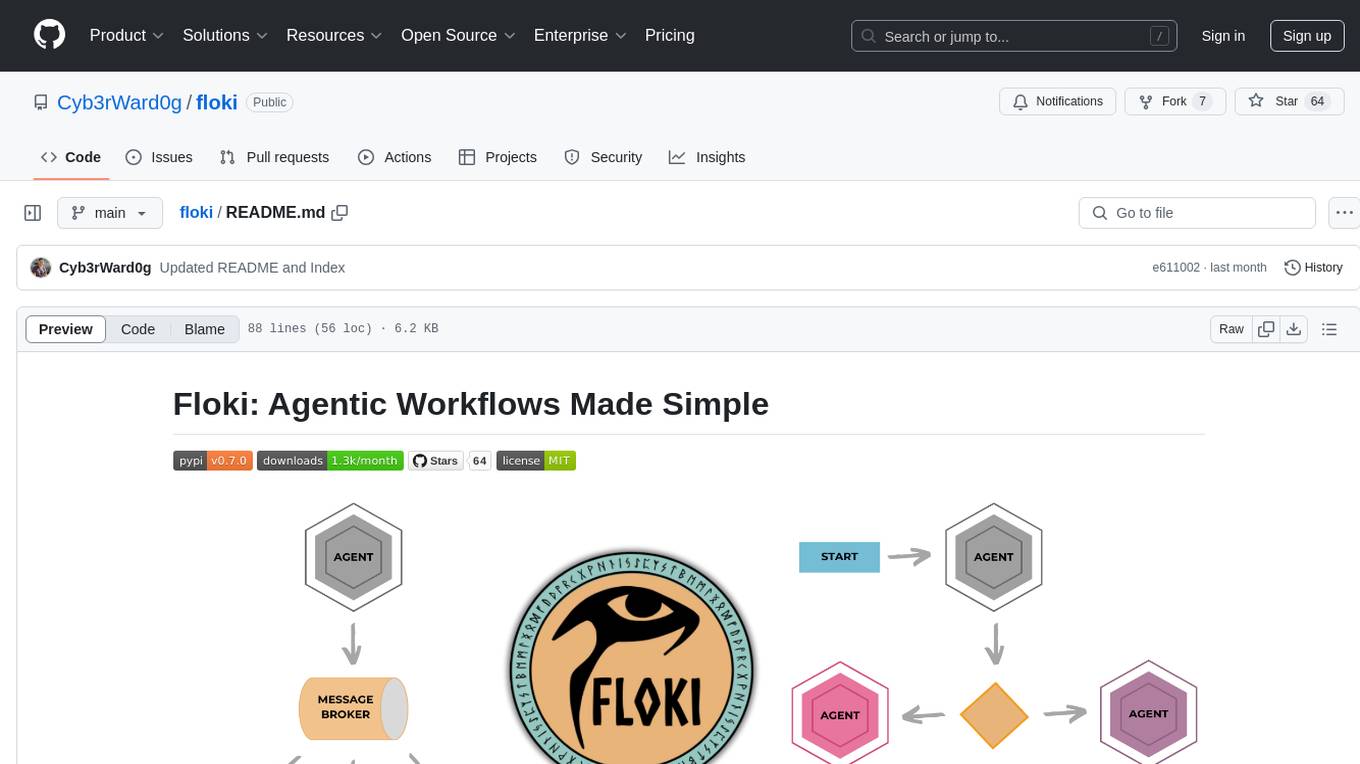
floki
Floki is an open-source framework for researchers and developers to experiment with LLM-based autonomous agents. It provides tools to create, orchestrate, and manage agents while seamlessly connecting to LLM inference APIs. Built on Dapr, Floki leverages a unified programming model that simplifies microservices and supports both deterministic workflows and event-driven interactions. By bringing together these features, Floki provides a powerful way to explore agentic workflows and the components that enable multi-agent systems to collaborate and scale, all powered by Dapr.
agentUniverse
agentUniverse is a multi-agent framework based on large language models, providing flexible capabilities for building individual agents. It focuses on multi-agent collaborative patterns, integrating domain experience to help agents solve problems in various fields. The framework includes pattern components like PEER and DOE for event interpretation, industry analysis, and financial report generation. It offers features for agent construction, multi-agent collaboration, and domain expertise integration, aiming to create intelligent applications with professional know-how.
agentUniverse
agentUniverse is a framework for developing applications powered by multi-agent based on large language model. It provides essential components for building single agent and multi-agent collaboration mechanism for customizing collaboration patterns. Developers can easily construct multi-agent applications and share pattern practices from different fields. The framework includes pre-installed collaboration patterns like PEER and DOE for complex task breakdown and data-intensive tasks.
miyagi
Project Miyagi showcases Microsoft's Copilot Stack in an envisioning workshop aimed at designing, developing, and deploying enterprise-grade intelligent apps. By exploring both generative and traditional ML use cases, Miyagi offers an experiential approach to developing AI-infused product experiences that enhance productivity and enable hyper-personalization. Additionally, the workshop introduces traditional software engineers to emerging design patterns in prompt engineering, such as chain-of-thought and retrieval-augmentation, as well as to techniques like vectorization for long-term memory, fine-tuning of OSS models, agent-like orchestration, and plugins or tools for augmenting and grounding LLMs.
CSGHub
CSGHub is an open source, trustworthy large model asset management platform that can assist users in governing the assets involved in the lifecycle of LLM and LLM applications (datasets, model files, codes, etc). With CSGHub, users can perform operations on LLM assets, including uploading, downloading, storing, verifying, and distributing, through Web interface, Git command line, or natural language Chatbot. Meanwhile, the platform provides microservice submodules and standardized OpenAPIs, which could be easily integrated with users' own systems. CSGHub is committed to bringing users an asset management platform that is natively designed for large models and can be deployed On-Premise for fully offline operation. CSGHub offers functionalities similar to a privatized Huggingface(on-premise Huggingface), managing LLM assets in a manner akin to how OpenStack Glance manages virtual machine images, Harbor manages container images, and Sonatype Nexus manages artifacts.
For similar tasks
github-pr-summary
github-pr-summary is a bot designed to summarize GitHub Pull Requests, helping open source contributors make faster decisions. It automatically summarizes commits and changed files in PRs, triggered by new commits or a magic trigger phrase. Users can deploy their own code review bot in 3 steps: create a bot from their GitHub repo, configure it to review PRs, and connect to GitHub for access to the target repo. The bot runs on flows.network using Rust and WasmEdge Runtimes. It utilizes ChatGPT/4 to review and summarize PR content, posting the result back as a comment on the PR. The bot can be used on multiple repos by creating new flows and importing the source code repo, specifying the target repo using flow config. Users can also change the magic phrase to trigger a review from a PR comment.
Code-Review-GPT-Gitlab
A project that utilizes large models to help with Code Review on Gitlab, aimed at improving development efficiency. The project is customized for Gitlab and is developing a Multi-Agent plugin for collaborative review. It integrates various large models for code security issues and stays updated with the latest Code Review trends. The project architecture is designed to be powerful, flexible, and efficient, with easy integration of different models and high customization for developers.
kodus-ai
Kodus AI is an open-source AI agent designed to review code like a real teammate, providing personalized, context-aware code reviews to help teams catch bugs, enforce best practices, and maintain a clean codebase. It seamlessly integrates with Git workflows, learns team coding patterns, and offers custom review policies. Kodus supports all programming languages with semantic and AST analysis, enhancing code review accuracy and providing actionable feedback. The tool is available in Cloud and Self-Hosted editions, offering features like self-hosting, unlimited users, custom integrations, and advanced compliance support.
holon
Holon is a tool that runs AI coding agents headlessly to automate the process of turning issues into PR-ready patches and summaries. It provides a sandboxed execution environment with standardized artifacts, allowing for deterministic and repeatable runs. Users can easily create or update PRs, manage state persistence, and customize agent bundles. Holon can be used locally or in CI environments, offering seamless integration with GitHub Actions.
awesome-claude-code
Awesome Claude Code is a curated list of slash-commands, CLAUDE.md files, CLI tools, and other resources for enhancing your Claude Code workflow. It includes a variety of agent skills, workflows, tooling, hooks, slash-commands, and more to help developers improve their coding experience using Claude Code, a CLI-based coding assistant from Anthropic. The list covers a wide range of topics such as AI development, project management, code analysis, documentation, CI/CD, and domain-specific projects. Whether you are a beginner or an experienced developer, this repository provides valuable resources to enhance your coding skills and workflow with Claude Code.
pr-agent
PR-Agent is a tool that helps to efficiently review and handle pull requests by providing AI feedbacks and suggestions. It supports various commands such as generating PR descriptions, providing code suggestions, answering questions about the PR, and updating the CHANGELOG.md file. PR-Agent can be used via CLI, GitHub Action, GitHub App, Docker, and supports multiple git providers and models. It emphasizes real-life practical usage, with each tool having a single GPT-4 call for quick and affordable responses. The PR Compression strategy enables effective handling of both short and long PRs, while the JSON prompting strategy allows for modular and customizable tools. PR-Agent Pro, the hosted version by CodiumAI, provides additional benefits such as full management, improved privacy, priority support, and extra features.
shell_gpt
ShellGPT is a command-line productivity tool powered by AI large language models (LLMs). This command-line tool offers streamlined generation of shell commands, code snippets, documentation, eliminating the need for external resources (like Google search). Supports Linux, macOS, Windows and compatible with all major Shells like PowerShell, CMD, Bash, Zsh, etc.
gpt-pilot
GPT Pilot is a core technology for the Pythagora VS Code extension, aiming to provide the first real AI developer companion. It goes beyond autocomplete, helping with writing full features, debugging, issue discussions, and reviews. The tool utilizes LLMs to generate production-ready apps, with developers overseeing the implementation. GPT Pilot works step by step like a developer, debugging issues as they arise. It can work at any scale, filtering out code to show only relevant parts to the AI during tasks. Contributions are welcome, with debugging and telemetry being key areas of focus for improvement.
For similar jobs
promptflow
**Prompt flow** is a suite of development tools designed to streamline the end-to-end development cycle of LLM-based AI applications, from ideation, prototyping, testing, evaluation to production deployment and monitoring. It makes prompt engineering much easier and enables you to build LLM apps with production quality.
deepeval
DeepEval is a simple-to-use, open-source LLM evaluation framework specialized for unit testing LLM outputs. It incorporates various metrics such as G-Eval, hallucination, answer relevancy, RAGAS, etc., and runs locally on your machine for evaluation. It provides a wide range of ready-to-use evaluation metrics, allows for creating custom metrics, integrates with any CI/CD environment, and enables benchmarking LLMs on popular benchmarks. DeepEval is designed for evaluating RAG and fine-tuning applications, helping users optimize hyperparameters, prevent prompt drifting, and transition from OpenAI to hosting their own Llama2 with confidence.
MegaDetector
MegaDetector is an AI model that identifies animals, people, and vehicles in camera trap images (which also makes it useful for eliminating blank images). This model is trained on several million images from a variety of ecosystems. MegaDetector is just one of many tools that aims to make conservation biologists more efficient with AI. If you want to learn about other ways to use AI to accelerate camera trap workflows, check out our of the field, affectionately titled "Everything I know about machine learning and camera traps".
leapfrogai
LeapfrogAI is a self-hosted AI platform designed to be deployed in air-gapped resource-constrained environments. It brings sophisticated AI solutions to these environments by hosting all the necessary components of an AI stack, including vector databases, model backends, API, and UI. LeapfrogAI's API closely matches that of OpenAI, allowing tools built for OpenAI/ChatGPT to function seamlessly with a LeapfrogAI backend. It provides several backends for various use cases, including llama-cpp-python, whisper, text-embeddings, and vllm. LeapfrogAI leverages Chainguard's apko to harden base python images, ensuring the latest supported Python versions are used by the other components of the stack. The LeapfrogAI SDK provides a standard set of protobuffs and python utilities for implementing backends and gRPC. LeapfrogAI offers UI options for common use-cases like chat, summarization, and transcription. It can be deployed and run locally via UDS and Kubernetes, built out using Zarf packages. LeapfrogAI is supported by a community of users and contributors, including Defense Unicorns, Beast Code, Chainguard, Exovera, Hypergiant, Pulze, SOSi, United States Navy, United States Air Force, and United States Space Force.
llava-docker
This Docker image for LLaVA (Large Language and Vision Assistant) provides a convenient way to run LLaVA locally or on RunPod. LLaVA is a powerful AI tool that combines natural language processing and computer vision capabilities. With this Docker image, you can easily access LLaVA's functionalities for various tasks, including image captioning, visual question answering, text summarization, and more. The image comes pre-installed with LLaVA v1.2.0, Torch 2.1.2, xformers 0.0.23.post1, and other necessary dependencies. You can customize the model used by setting the MODEL environment variable. The image also includes a Jupyter Lab environment for interactive development and exploration. Overall, this Docker image offers a comprehensive and user-friendly platform for leveraging LLaVA's capabilities.

carrot
The 'carrot' repository on GitHub provides a list of free and user-friendly ChatGPT mirror sites for easy access. The repository includes sponsored sites offering various GPT models and services. Users can find and share sites, report errors, and access stable and recommended sites for ChatGPT usage. The repository also includes a detailed list of ChatGPT sites, their features, and accessibility options, making it a valuable resource for ChatGPT users seeking free and unlimited GPT services.
TrustLLM
TrustLLM is a comprehensive study of trustworthiness in LLMs, including principles for different dimensions of trustworthiness, established benchmark, evaluation, and analysis of trustworthiness for mainstream LLMs, and discussion of open challenges and future directions. Specifically, we first propose a set of principles for trustworthy LLMs that span eight different dimensions. Based on these principles, we further establish a benchmark across six dimensions including truthfulness, safety, fairness, robustness, privacy, and machine ethics. We then present a study evaluating 16 mainstream LLMs in TrustLLM, consisting of over 30 datasets. The document explains how to use the trustllm python package to help you assess the performance of your LLM in trustworthiness more quickly. For more details about TrustLLM, please refer to project website.
AI-YinMei
AI-YinMei is an AI virtual anchor Vtuber development tool (N card version). It supports fastgpt knowledge base chat dialogue, a complete set of solutions for LLM large language models: [fastgpt] + [one-api] + [Xinference], supports docking bilibili live broadcast barrage reply and entering live broadcast welcome speech, supports Microsoft edge-tts speech synthesis, supports Bert-VITS2 speech synthesis, supports GPT-SoVITS speech synthesis, supports expression control Vtuber Studio, supports painting stable-diffusion-webui output OBS live broadcast room, supports painting picture pornography public-NSFW-y-distinguish, supports search and image search service duckduckgo (requires magic Internet access), supports image search service Baidu image search (no magic Internet access), supports AI reply chat box [html plug-in], supports AI singing Auto-Convert-Music, supports playlist [html plug-in], supports dancing function, supports expression video playback, supports head touching action, supports gift smashing action, supports singing automatic start dancing function, chat and singing automatic cycle swing action, supports multi scene switching, background music switching, day and night automatic switching scene, supports open singing and painting, let AI automatically judge the content.