


agentUniverse
agentUniverse is a LLM multi-agent framework that allows developers to easily build multi-agent applications.
Stars: 2099

agentUniverse is a multi-agent framework based on large language models, providing flexible capabilities for building individual agents. It focuses on collaborative pattern components to solve problems in various fields and integrates domain experience. The framework supports LLM model integration and offers various pattern components like PEER and DOE. Users can easily configure models and set up agents for tasks. agentUniverse aims to assist developers and enterprises in constructing domain-expert-level intelligent agents for seamless collaboration.
README:
Language version: English | 中文 | 日本語





agentUniverse is a multi-agent framework based on large language models. It provides flexible and easily extensible capabilities for building individual agents. The core of agentUniverse is a rich set of multi-agent collaborative pattern components (serving as a collaborative pattern factory), which allows agents to perform their respective duties and maximize their capabilities when solving problems in different fields; at the same time, agentUniverse focuses on the integration of domain experience, helping you smoothly integrate domain experience into the work of intelligent agents.🎉🎉🎉
🌈🌈🌈agentUniverse originates from the real-world financial business practices of AntGroup (https://github.com/antgroup), dedicated to assisting developers and enterprises in effortlessly constructing domain-expert-level intelligent agents that collaborate to accomplish tasks.

We look forward to your practice and communication and sharing of Patterns in different fields through the community. This framework has already placed many useful components that have been tested in real business scenarios in terms of multi-agent cooperation, and will continue to be enriched in the future. The pattern components that are currently open for use include:
- PEER pattern component: This pattern uses agents with different responsibilities—Plan, Execute, Express, and Review—to break down complex problems into manageable steps, execute the steps in sequence, and iteratively improve based on feedback, enhancing the performance of reasoning and analysis tasks. Typical use cases: Event interpretation, industry analysis.
- DOE pattern component: This pattern employs three agents—Data-fining, Opinion-inject, and Express—to improve the effectiveness of tasks that are data-intensive, require high computational precision, and incorporate expert opinions. Typical use cases: Financial report generation.
More patterns are coming soon...
The LLM model integration can be accomplished with simple configuration, currently agentUniverse supported models include:
| - | Vendors | Models |
|---|---|---|
| Qwen | qwen3 Series(qwen3-235b-a22b、qwen3-32b、qwen3-30b-a3b, etc.) 、qwen2.5-72b-instruct、qwq-32b-preview、qwen-max、… | |
| Deepseek | deepseek-r1、deepseek-v3、deepseek-r1-distill-qwen-32b、… | |
| OpenAI | GPT-4o、GPT-4o mini、OpenAI o1、OpenAI o3-mini、… | |
| Claude | claude 3.7 sonnet 、Claude 3.5 Sonnet、Claude 3 Opus、… | |
| Gemini | Gemini 2.5 Pro、Gemini 2.0 Flash、Gemini 2.0 Flash Thinking、Gemini 1.5 Pro、… | |
| Llama | llama3.3-70b-instruct、llama3.2-3b-instruct、llama3.2-1b-instruct、… | |
| KIMI | moonshot-v1-128k、moonshot-v1-32k、moonshot-v1-8k、… | |
| WenXin | ERNIE 4.5 Turbo、ERNIE 4.5、ERNIE 4.0 Turbo、ERNIE 4.0、ERNIE 3.5、… | |
| chatglm | chatglm3-6b、chatglm-6b-v2、… | |
| BaiChuan | baichuan2-turbo、baichuan2-13b-chat-v1、… | |
| Doubao | Doubao-pro-128k、Doubao-pro-32k、Doubao-lite-128k、… |
For example, to use deepseek model, you can simply set DEEPSEEK_API_KEY value in the custom_key.toml file, and set the llm_model name in the agent configuration file to 'default_deepseek_llm' and you're all set. For more information about llm configuration, please refer to switch-the-llm.
- Quick Start
- How to build an agent application
- Setup the visual agentic workflow platform
- Why use agentUniverse
- Sample Apps
- Documents
- Support
Using pip:
pip install agentUniverseRun your first example, and you can quickly experience the performance of the agents (or agent groups) built by agentUniverse through the tutorial.
Please refer to the document for detail steps: Run the first example 。
Setup the standard project: agentUniverse Standard Project
You can learn how to quickly build a single agent by reading the Quick Guide to Build Single Agent. This will help you understand how to enhance your agent's capabilities using tools, knowledge bases, RAG technologies, and more. Additionally, you will grasp the basic application development processes for agents, including configuration, testing, optimizing, deployment, and performance evaluation.
You can further understand how to break down intelligent capabilities into multiple agents in complex task scenarios and enhance your task performance through collaboration by referring to the Building Typical Multi-Agent App chapter.
You can learn how to create effective agent patterns into templates through the chapter Creating and Using Agent Templates. This will greatly enhance the efficiency of constructing subsequent agents and facilitate dissemination.
You can learn how to quickly use or publish MCP servers in agentUniverse framework by referring to How to Use MCP Servers and How to Publish MCP Servers.
agentUniverse provides a standardized observability framework for agent applications. Based on the OpenTelemetry protocol, it enables comprehensive data collection and monitoring of critical components such as agents, LLMs, and tools, facilitating full lifecycle tracking of agents. You can learn how to utilize these observability capabilities in the Agent Application Observability section.
You can learn more advanced techniques in the agent application building process through other documents in the Get_Start, such as how to add a memory module into the intelligent agent process and how to effectively manage prompts within the project.
agentUniverse provides a visual canvas platform for creating agentic workflow. Follow these steps for a quick start:
Using pip
pip install magent-ui ruamel.yamlOne-click Run
Run product_application.py in sample_apps/workflow_agent_app/bootstrap/platform for quick startup.
For more details, refer to [Quick Start for Product Platform](docs/guidebook/en/How-to/Guide to Visual Agentic Workflow Platform/Product_Platform_Quick_Start.md) and the [Advanced Guide](docs/guidebook/en/How-to/Guide to Visual Agentic Workflow Platform/Product_Platform_Advancement_Guide.md).
This feature is jointly developed by difizen and agentUniverse.

The core of agentUniverse provides all the essential components needed to build a single intelligent agent, the collaboration mechanisms between multiple agents, and allows for the injection of expert knowledge. The enables developers to effortlessly create intelligent applications equipped with professional know-how.
agentUniverse offers several multi-agent collaboration model components that have been validated in real-world industries. Among these, the "PEER" model stands out as one of the most distinctive.
The PEER model utilizes agents with four distinct responsibilities: Planning, Executing, Expressing, and Reviewing. This structure allows for the decomposition and step-by-step execution of complex problems and enables autonomous iteration based on evaluation feedback, ultimately enhancing performance in reasoning and analytical tasks. This model is particularly effective in scenarios that require multi-step decomposition and in-depth analysis, such as event interpretation, macroeconomic analysis, and the feasibility analysis of business proposals.
The PEER model has achieved impressive results, and the latest research findings and experimental data can be found in the following literature.
Based on the above introduction, we summarize the main features of agentUniverse as follow:
Flexible and Extensible Agent Construction Capability: It provides all the essential components necessary for building agents, all of which support customization to tailor user-specific agents.
Rich and Effective Multi-Agent Collaboration Models: It offers collaborative models such as PEER (Plan/Execute/Express/Review) and DOE (Data-finding/Opinion-inject/Express), which have been validated in the industry. Users can also customize and orchestrate new models to facilitate organic collaboration among multiple agents.
Easy Integration of Domain Expertise: It offers capabilities for domain prompts, knowledge construction, and management, enabling the orchestration and injection of domain-level SOPs, aligning agents with expert-level domain knowledge.
💡 For additional features: see the section on key features of agentUniverse for more details.
🚩 Python Code Generation and Execution Agent
🚩 Discussion Group Based on Multi-Turn Multi-Agent Mode
🚩 Financial Event Analysis Based on PEER Multi-Agent Mode
🚩 Andrew Ng's Reflexive Workflow Translation Agent Replication
🔗 Zhi Xiao Zhu-AI Assistant for Financial Professionals
Zhi Xiao Zhu AI Assistant: Designed to facilitate the development of large models in rigorous industries to enhance the productively of investment research experts
Zhi Xiao Zhu AI Assistant an efficient solution for the practical application of large models in rigorous industries. It is built upon the Finix model, which emphasizes precise applications, and leverages the agentUniverse intelligent agent framework, known for its professional customization capabilities. This solution targets a range of professional AI business assistants related to investment research, ESG (environmental, social, and governance), finance, earnings reports, and other specialized domains. It has been extensively validated in large-scale scenarios at Ant Group, significantly improving expert efficiency.
💡 For more detailed information, please refer to the User Guide.
💡 Please consult the API Reference for technical details.
😊 We recommend submitting your queries using GitHub Issues, we typically respond within 2 business days.
😊 Join our Discord Channel to interact with us.
😊 Email:
ID: @agentuniverse_
The PEER multi-agent framework build in agentUniverse project is supported by the following research achievements.
BibTeX formatted
@misc{wang2024peerexpertizingdomainspecifictasks,
      title={PEER: Expertizing Domain-Specific Tasks with a Multi-Agent Framework and Tuning Methods},
      author={Yiying Wang and Xiaojing Li and Binzhu Wang and Yueyang Zhou and Han Ji and Hong Chen and Jinshi Zhang and Fei Yu and Zewei Zhao and Song Jin and Renji Gong and Wanqing Xu},
      year={2024},
      eprint={2407.06985},
      archivePrefix={arXiv},
      primaryClass={cs.AI},
      url={https://arxiv.org/abs/2407.06985},
}
Overview: This document introduces in detailed the mechanisms and principles underlying the PEER multi-agent framework. The experimental section assigned scores across seven dimensions: completeness, relevance, conciseness, factualness, logicality, structure, and comprehensiveness, with a maximum score of 5 points for each dimension. On average, the PEER model scored higher in each evaluation dimension compared to BabyAGI, and show notable advantages particularly in completeness, relevance, logicality, structure, and comprehensiveness. Furthermore, when tested with the GPT-3.5 Turbo (16k) model, the PEER model achieved a superior accuracy rate of 83% compared to BabyAGI, and with the GPT-4 model, it achieved an accuracy rate of 81%. For more details, please refer to the document. 🔗https://arxiv.org/pdf/2407.06985
This project is partially built upon excellent open-source projects such as Langchain, Pydantic, Gunicorn, Flask, SQLAlchemy, chromadb, etc. (The detailed dependency list can be found in pyproject.toml). We would like to express our heartfelt gratitude to the related projects and their contributors. 🙏🙏🙏
For Tasks:
Click tags to check more tools for each tasksFor Jobs:
Alternative AI tools for agentUniverse
Similar Open Source Tools
agentUniverse
agentUniverse is a multi-agent framework based on large language models, providing flexible capabilities for building individual agents. It focuses on collaborative pattern components to solve problems in various fields and integrates domain experience. The framework supports LLM model integration and offers various pattern components like PEER and DOE. Users can easily configure models and set up agents for tasks. agentUniverse aims to assist developers and enterprises in constructing domain-expert-level intelligent agents for seamless collaboration.
agentUniverse
agentUniverse is a multi-agent framework based on large language models, providing flexible capabilities for building individual agents. It focuses on multi-agent collaborative patterns, integrating domain experience to help agents solve problems in various fields. The framework includes pattern components like PEER and DOE for event interpretation, industry analysis, and financial report generation. It offers features for agent construction, multi-agent collaboration, and domain expertise integration, aiming to create intelligent applications with professional know-how.
agentUniverse
agentUniverse is a framework for developing applications powered by multi-agent based on large language model. It provides essential components for building single agent and multi-agent collaboration mechanism for customizing collaboration patterns. Developers can easily construct multi-agent applications and share pattern practices from different fields. The framework includes pre-installed collaboration patterns like PEER and DOE for complex task breakdown and data-intensive tasks.
CodeFuse-muAgent
CodeFuse-muAgent is a Multi-Agent framework designed to streamline Standard Operating Procedure (SOP) orchestration for agents. It integrates toolkits, code libraries, knowledge bases, and sandbox environments for rapid construction of complex Multi-Agent interactive applications. The framework enables efficient execution and handling of multi-layered and multi-dimensional tasks.
AgentUp
AgentUp is an active development tool that provides a developer-first agent framework for creating AI agents with enterprise-grade infrastructure. It allows developers to define agents with configuration, ensuring consistent behavior across environments. The tool offers secure design, configuration-driven architecture, extensible ecosystem for customizations, agent-to-agent discovery, asynchronous task architecture, deterministic routing, and MCP support. It supports multiple agent types like reactive agents and iterative agents, making it suitable for chatbots, interactive applications, research tasks, and more. AgentUp is built by experienced engineers from top tech companies and is designed to make AI agents production-ready, secure, and reliable.
csghub
CSGHub is an open source platform for managing large model assets, including datasets, model files, and codes. It offers functionalities similar to a privatized Huggingface, managing assets in a manner akin to how OpenStack Glance manages virtual machine images. Users can perform operations such as uploading, downloading, storing, verifying, and distributing assets through various interfaces. The platform provides microservice submodules and standardized OpenAPIs for easy integration with users' systems. CSGHub is designed for large models and can be deployed On-Premise for offline operation.
agentsociety
AgentSociety is an advanced framework designed for building agents in urban simulation environments. It integrates LLMs' planning, memory, and reasoning capabilities to generate realistic behaviors. The framework supports dataset-based, text-based, and rule-based environments with interactive visualization. It includes tools for interviews, surveys, interventions, and metric recording tailored for social experimentation.
coze-studio
Coze Studio is an all-in-one AI agent development tool that offers the most convenient AI agent development environment, from development to deployment. It provides core technologies for AI agent development, complete app templates, and build frameworks. Coze Studio aims to simplify creating, debugging, and deploying AI agents through visual design and build tools, enabling powerful AI app development and customized business logic. The tool is developed using Golang for the backend, React + TypeScript for the frontend, and follows microservices architecture based on domain-driven design principles.
MemoryBear
MemoryBear is a next-generation AI memory system developed by RedBear AI, focusing on overcoming limitations in knowledge storage and multi-agent collaboration. It empowers AI with human-like memory capabilities, enabling deep knowledge understanding and cognitive collaboration. The system addresses challenges such as knowledge forgetting, memory gaps in multi-agent collaboration, and semantic ambiguity during reasoning. MemoryBear's core features include memory extraction engine, graph storage, hybrid search, memory forgetting engine, self-reflection engine, and FastAPI services. It offers a standardized service architecture for efficient integration and invocation across applications.
langchain
LangChain is a framework for building LLM-powered applications that simplifies AI application development by chaining together interoperable components and third-party integrations. It helps developers connect LLMs to diverse data sources, swap models easily, and future-proof decisions as technology evolves. LangChain's ecosystem includes tools like LangSmith for agent evals, LangGraph for complex task handling, and LangGraph Platform for deployment and scaling. Additional resources include tutorials, how-to guides, conceptual guides, a forum, API reference, and chat support.
GenAI_Agents
GenAI Agents is a comprehensive repository for developing and implementing Generative AI (GenAI) agents, ranging from simple conversational bots to complex multi-agent systems. It serves as a valuable resource for learning, building, and sharing GenAI agents, offering tutorials, implementations, and a platform for showcasing innovative agent creations. The repository covers a wide range of agent architectures and applications, providing step-by-step tutorials, ready-to-use implementations, and regular updates on advancements in GenAI technology.
nocobase
NocoBase is an extensible AI-powered no-code platform that offers total control, infinite extensibility, and AI collaboration. It enables teams to adapt quickly and reduce costs without the need for years of development or wasted resources. With NocoBase, users can deploy the platform in minutes and have complete control over their projects. The platform is data model-driven, allowing for unlimited possibilities by decoupling UI and data structure. It integrates AI capabilities seamlessly into business systems, enabling roles such as translator, analyst, researcher, or assistant. NocoBase provides a simple and intuitive user experience with a 'what you see is what you get' approach. It is designed for extension through its plugin-based architecture, allowing users to customize and extend functionalities easily.
SuperKnowa
SuperKnowa is a fast framework to build Enterprise RAG (Retriever Augmented Generation) Pipelines at Scale, powered by watsonx. It accelerates Enterprise Generative AI applications to get prod-ready solutions quickly on private data. The framework provides pluggable components for tackling various Generative AI use cases using Large Language Models (LLMs), allowing users to assemble building blocks to address challenges in AI-driven text generation. SuperKnowa is battle-tested from 1M to 200M private knowledge base & scaled to billions of retriever tokens.
asreview
The ASReview project implements active learning for systematic reviews, utilizing AI-aided pipelines to assist in finding relevant texts for search tasks. It accelerates the screening of textual data with minimal human input, saving time and increasing output quality. The software offers three modes: Oracle for interactive screening, Exploration for teaching purposes, and Simulation for evaluating active learning models. ASReview LAB is designed to support decision-making in any discipline or industry by improving efficiency and transparency in screening large amounts of textual data.
motleycrew
Motleycrew is an ultimate framework for building multi-agent AI systems, allowing users to mix and match AI agents and tools from popular frameworks, design advanced workflows, and leverage dynamic knowledge graphs with simplicity and elegance. It acts as a conductor orchestrating a symphony of AI agents and tools, providing building blocks for creating AI systems and enabling users to focus on high-level design while taking care of the rest. The framework offers integration with various tools, flexibility in providing agents with tools or other agents, advanced flow design capabilities, and built-in observability and caching features.
CSGHub
CSGHub is an open source, trustworthy large model asset management platform that can assist users in governing the assets involved in the lifecycle of LLM and LLM applications (datasets, model files, codes, etc). With CSGHub, users can perform operations on LLM assets, including uploading, downloading, storing, verifying, and distributing, through Web interface, Git command line, or natural language Chatbot. Meanwhile, the platform provides microservice submodules and standardized OpenAPIs, which could be easily integrated with users' own systems. CSGHub is committed to bringing users an asset management platform that is natively designed for large models and can be deployed On-Premise for fully offline operation. CSGHub offers functionalities similar to a privatized Huggingface(on-premise Huggingface), managing LLM assets in a manner akin to how OpenStack Glance manages virtual machine images, Harbor manages container images, and Sonatype Nexus manages artifacts.
For similar tasks
agentUniverse
agentUniverse is a multi-agent framework based on large language models, providing flexible capabilities for building individual agents. It focuses on collaborative pattern components to solve problems in various fields and integrates domain experience. The framework supports LLM model integration and offers various pattern components like PEER and DOE. Users can easily configure models and set up agents for tasks. agentUniverse aims to assist developers and enterprises in constructing domain-expert-level intelligent agents for seamless collaboration.
FinRobot
FinRobot is an open-source AI agent platform designed for financial applications using large language models. It transcends the scope of FinGPT, offering a comprehensive solution that integrates a diverse array of AI technologies. The platform's versatility and adaptability cater to the multifaceted needs of the financial industry. FinRobot's ecosystem is organized into four layers, including Financial AI Agents Layer, Financial LLMs Algorithms Layer, LLMOps and DataOps Layers, and Multi-source LLM Foundation Models Layer. The platform's agent workflow involves Perception, Brain, and Action modules to capture, process, and execute financial data and insights. The Smart Scheduler optimizes model diversity and selection for tasks, managed by components like Director Agent, Agent Registration, Agent Adaptor, and Task Manager. The tool provides a structured file organization with subfolders for agents, data sources, and functional modules, along with installation instructions and hands-on tutorials.
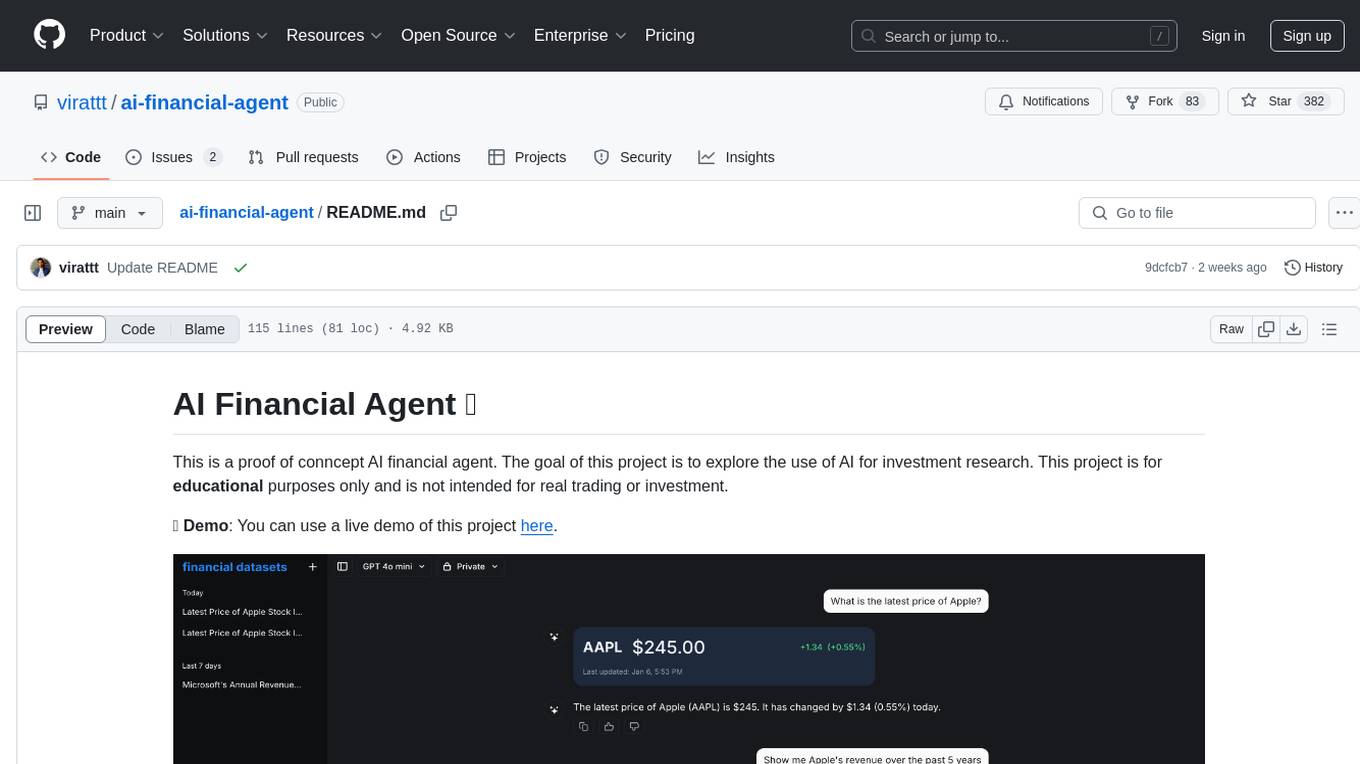
ai-financial-agent
AI Financial Agent is a proof of concept project exploring the use of AI for investment research. It provides an AI SDK with a unified API for generating text and structured objects, along with access to real-time and historical stock market data optimized for AI financial agents. The project includes features like dynamic chat interfaces, support for multiple model providers, and styling with Tailwind CSS. Users can deploy their own version of the AI Financial Agent using Vercel and GitHub integration.
For similar jobs
sweep
Sweep is an AI junior developer that turns bugs and feature requests into code changes. It automatically handles developer experience improvements like adding type hints and improving test coverage.
teams-ai
The Teams AI Library is a software development kit (SDK) that helps developers create bots that can interact with Teams and Microsoft 365 applications. It is built on top of the Bot Framework SDK and simplifies the process of developing bots that interact with Teams' artificial intelligence capabilities. The SDK is available for JavaScript/TypeScript, .NET, and Python.
ai-guide
This guide is dedicated to Large Language Models (LLMs) that you can run on your home computer. It assumes your PC is a lower-end, non-gaming setup.
classifai
Supercharge WordPress Content Workflows and Engagement with Artificial Intelligence. Tap into leading cloud-based services like OpenAI, Microsoft Azure AI, Google Gemini and IBM Watson to augment your WordPress-powered websites. Publish content faster while improving SEO performance and increasing audience engagement. ClassifAI integrates Artificial Intelligence and Machine Learning technologies to lighten your workload and eliminate tedious tasks, giving you more time to create original content that matters.
chatbot-ui
Chatbot UI is an open-source AI chat app that allows users to create and deploy their own AI chatbots. It is easy to use and can be customized to fit any need. Chatbot UI is perfect for businesses, developers, and anyone who wants to create a chatbot.
BricksLLM
BricksLLM is a cloud native AI gateway written in Go. Currently, it provides native support for OpenAI, Anthropic, Azure OpenAI and vLLM. BricksLLM aims to provide enterprise level infrastructure that can power any LLM production use cases. Here are some use cases for BricksLLM: * Set LLM usage limits for users on different pricing tiers * Track LLM usage on a per user and per organization basis * Block or redact requests containing PIIs * Improve LLM reliability with failovers, retries and caching * Distribute API keys with rate limits and cost limits for internal development/production use cases * Distribute API keys with rate limits and cost limits for students
uAgents
uAgents is a Python library developed by Fetch.ai that allows for the creation of autonomous AI agents. These agents can perform various tasks on a schedule or take action on various events. uAgents are easy to create and manage, and they are connected to a fast-growing network of other uAgents. They are also secure, with cryptographically secured messages and wallets.
griptape
Griptape is a modular Python framework for building AI-powered applications that securely connect to your enterprise data and APIs. It offers developers the ability to maintain control and flexibility at every step. Griptape's core components include Structures (Agents, Pipelines, and Workflows), Tasks, Tools, Memory (Conversation Memory, Task Memory, and Meta Memory), Drivers (Prompt and Embedding Drivers, Vector Store Drivers, Image Generation Drivers, Image Query Drivers, SQL Drivers, Web Scraper Drivers, and Conversation Memory Drivers), Engines (Query Engines, Extraction Engines, Summary Engines, Image Generation Engines, and Image Query Engines), and additional components (Rulesets, Loaders, Artifacts, Chunkers, and Tokenizers). Griptape enables developers to create AI-powered applications with ease and efficiency.