


microgpt-c
Zero-dependency C99 GPT-2 engine for edge AI. Sub-1M parameter models train on-device in seconds. Organelle Pipeline Architecture (OPA) coordinates specialised micro-models — 91% win rates on 11 logic games with 30K–160K parameters. Composition beats capacity.
Stars: 71
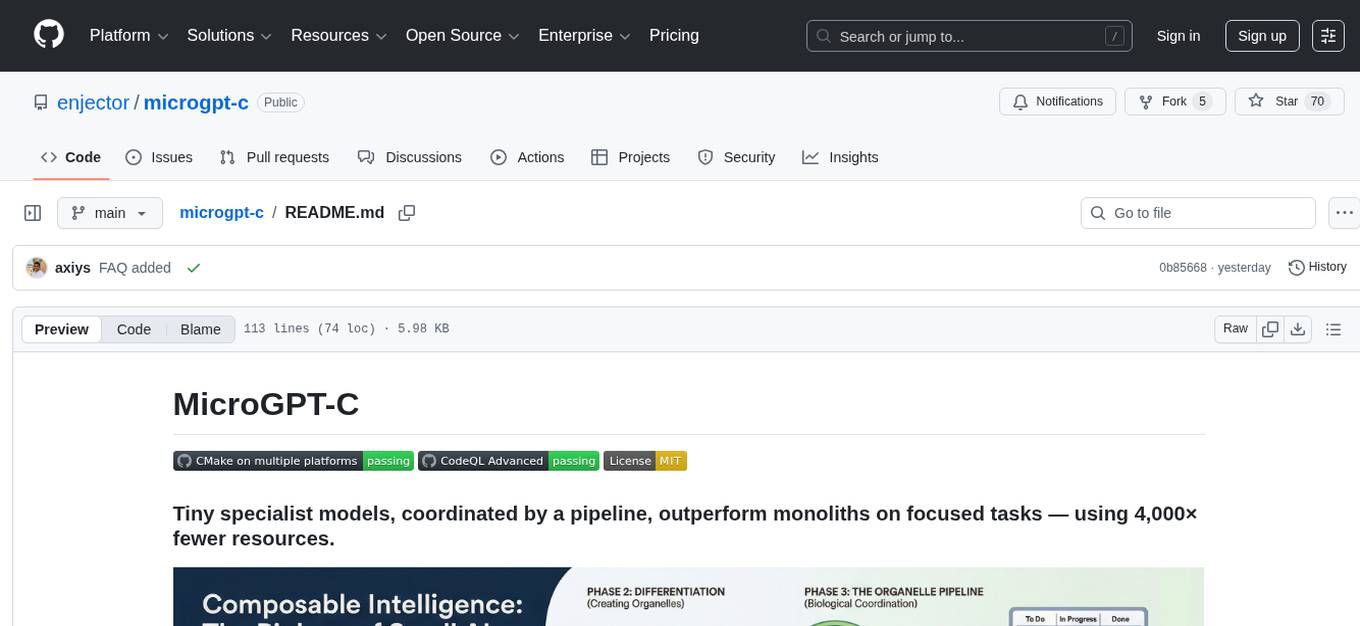
MicroGPT-C is a project that focuses on tiny specialist models working together to outperform monoliths on specific tasks. It is a C port of a Python GPT model, rewritten in pure C99 with zero dependencies. The project explores the concept of coordinated intelligence through 'organelles' that differentiate based on training data, resulting in improved performance across logic games and real-world data experiments.
README:


This project started as a C port of Andrej Karpathy's microGPT.py — a ~200 line Python GPT that trains a character-level Transformer from scratch. We rewrote it in pure C99 with zero dependencies, and as you'd expect from C, it's much faster.
Then we asked a bigger question: can tiny models actually be intelligent?
Not by making them bigger — the industry already does that. Instead, by making them work together. We took the same ~460K parameter engine and trained it on different tasks: one becomes a planner, another becomes a player, another becomes a judge. Each one starts as the same blank "stem cell" and differentiates based on its training data.
We call them organelles — like the specialised structures inside a biological cell.
The result surprised us. A single organelle playing Connect-4 wins about 55% of the time. But when a planner and player coordinate through a shared protocol, the system hits 90% — even though the individual models are still wrong half the time. The pipeline catches the mistakes. The coordination is the intelligence.
We've now tested this across 11 logic games, from Tic-Tac-Toe to Sudoku, with models ranging from 30K to 460K parameters. The pattern holds: right-sized specialists working together consistently outperform a single larger model working alone.
Then we asked: does it work on real-world data?
We ran two experiments back-to-back — a lottery prediction pipeline (negative control) and a market regime detection pipeline (positive test). The lottery model hit an entropy floor at 0.50 loss — it learned nothing, because lottery draws are random. The market model reached 0.03–0.06 loss and 57% accuracy on unseen data (2.8× the random baseline) — because cross-asset correlations are real, learnable signal.
Same engine. Same architecture. One learns, one can't. That's the proof.
The full research journey — from character-level Transformer to VM-based code generation — is documented in Composable Intelligence at the Edge (16 chapters, online version).
git clone https://github.com/enjector/microgpt-c.git
cd microgpt-c
mkdir build && cd build
cmake ..
cmake --build . --config Release

# Train a name generator in < 1 second (4K params)
./names_demo

# Train Shakespeare text generation (840K params, character-level)
./shakespeare_demo

# Train Shakespeare word-level generation (510K params, ~40K tok/s inference, 2 min training)
./shakespeare_word_demo

# Run a multi-organelle game pipeline (88% win rate)
./connect4_demo
All 11 game experiments, 2 real-world data experiments (lottery + markets), 3 pretrained checkpoints, 97 unit tests, and 22 benchmarks are included. See the full list in experiments/organelles/.
All benchmarks on Apple M2 Max (dev machine), single-threaded unless noted. Models are 360KB–5.4MB and compile anywhere with a C99 compiler. Edge device testing is a future research stage. See PERFORMANCE.md for full details.
| Engine | Params | Training | Inference | Notes |
|---|---|---|---|---|
| Character-level (Shakespeare) | 841K | 28K tok/s | 16K tok/s | 14 min, 12 threads |
| Word-level (Shakespeare) | 510K | 12.5K tok/s | 40K tok/s | 2 min, 12 threads |
| VM engine (dispatch) | — | — | 3.7–5.8M ops/s | Single-threaded |
| Micro-benchmark (tiny model) | 6.5K | 642K tok/s | 1.55M infer/s | Float32, 1 thread |
vs. Karpathy's microgpt.py: ~1,000× faster training, ~700× faster inference (expected for C vs Python; the real contribution is the orchestration layer).
All games: trained organelle vs random opponent, 100 evaluation games each. Full details in ORGANELLE_GAMES.md.
| Game | Organelles | Params | Size | Total | Training | Result |
|---|---|---|---|---|---|---|
| Pentago | 2 | 92K | 1.1 MB | 2.2 MB | ~9 min | 91% win |
| 8-Puzzle | 5 | 460K | 5.4 MB | 27 MB | ~7 min | 90% solve |
| Connect-4 | 2 | 460K | 5.4 MB | 10.8 MB | ~21 min | 88% win |
| Tic-Tac-Toe | 2 | 460K | 5.4 MB | 10.8 MB | ~17 min | 87% w+d |
| Mastermind | 2 | 92K | 1.1 MB | 2.2 MB | ~8 min | 79% solve |
| Sudoku | 2 | 160K | 1.9 MB | 3.8 MB | ~3 min | 78% solve |
| Othello | 2 | 92K | 1.1 MB | 2.2 MB | ~8 min | 70% win |
| Klotski | 2 | 30K | 360 KB | 720 KB | ~36 sec | 62% solve |
| Red Donkey | 2 | 30K | 360 KB | 720 KB | ~38 sec | 12% solve |
| Lights Out | 2 | 160K | 1.9 MB | 3.8 MB | ~4 min | 10% solve |
| Hex | 2 | 92K | 1.1 MB | 2.2 MB | ~3 min | 4% win |
| Experiment | Organelles | Params | Size | Training | Result | Interpretation |
|---|---|---|---|---|---|---|
| Market regime | 3 | 615K | 7.1 MB | ~10 min | 57% holdout (2.8× baseline) | Learnable signal |
| Lottery | 2 | 163K | 1.9 MB | ~5 min | Random wins | Negative control ✓ |
| Topic | Link |
|---|---|
| ❓ FAQ | FAQ.md |
| 🧬 The stem cell philosophy | VISION.md |
| 💡 Why this matters | VALUE_PROPOSITION.md |
| 🗺️ Roadmap | ROADMAP.md |
| 📖 Book: Composable Intelligence at the Edge | PDF · Online · Chapters |
| 🏆 Game leaderboard (11 games) | ORGANELLE_GAMES.md |
| 📈 Market regime detection (57% holdout) | markets/README.md |
| 🎲 Lottery experiment (entropy baseline) | lottery/README.md |
| 🔬 Pipeline architecture (white paper) | ORGANELLE_PIPELINE.md |
| 🧠 Reasoning conclusion | ORGANELLE_REASONING_CONCLUSION.md |
| 📚 Using as a library | LIBRARY_GUIDE.md |
| ⚡ Performance & benchmarks | PERFORMANCE.md |
| 🔧 Build options (Metal, BLAS, INT8, SIMD) | BUILD_OPTIONS.md |
| 🤝 Contributing | CONTRIBUTING.md |
| 📋 Data licensing | DATA_LICENSE.md |
- C99 compiler (GCC, Clang, MSVC)
- CMake 3.10+
- No other dependencies
Optional: Git LFS for pretrained checkpoints (git lfs pull).
MicroGPT-C runs entirely on-device with no telemetry, no cloud calls, and no data collection. Small models trained on narrow corpora inherit the biases of that corpus — be aware of this when deploying. High confidence means the model has seen similar patterns, not that the output is correct. Always validate through deterministic checks (the Judge pattern) or human review for safety-critical applications.
See CONTRIBUTING.md for ethics guidelines.
This project was built transparently with human–AI collaboration — the same philosophy of coordinated intelligence that MicroGPT-C explores.
| Role | Member |
|---|---|
| 🧭 Principal Research Manager | Ajay Soni — research direction, validation, and decisions |
| 💻 Engineering & Documentation | Claude — coding, documentation, and junior research |
| 🔬 Senior Research Assistant | Grok — in-depth analysis and insights |
| 🎨 Senior Research Assistant | Gemini — creative synthesis and validation |
| 📚 Community Education | NotebookLM — accessible explanations and education materials |
MIT — see LICENSE.
For Tasks:
Click tags to check more tools for each tasksFor Jobs:
Alternative AI tools for microgpt-c
Similar Open Source Tools
microgpt-c
MicroGPT-C is a project that focuses on tiny specialist models working together to outperform monoliths on specific tasks. It is a C port of a Python GPT model, rewritten in pure C99 with zero dependencies. The project explores the concept of coordinated intelligence through 'organelles' that differentiate based on training data, resulting in improved performance across logic games and real-world data experiments.
IDvs.MoRec
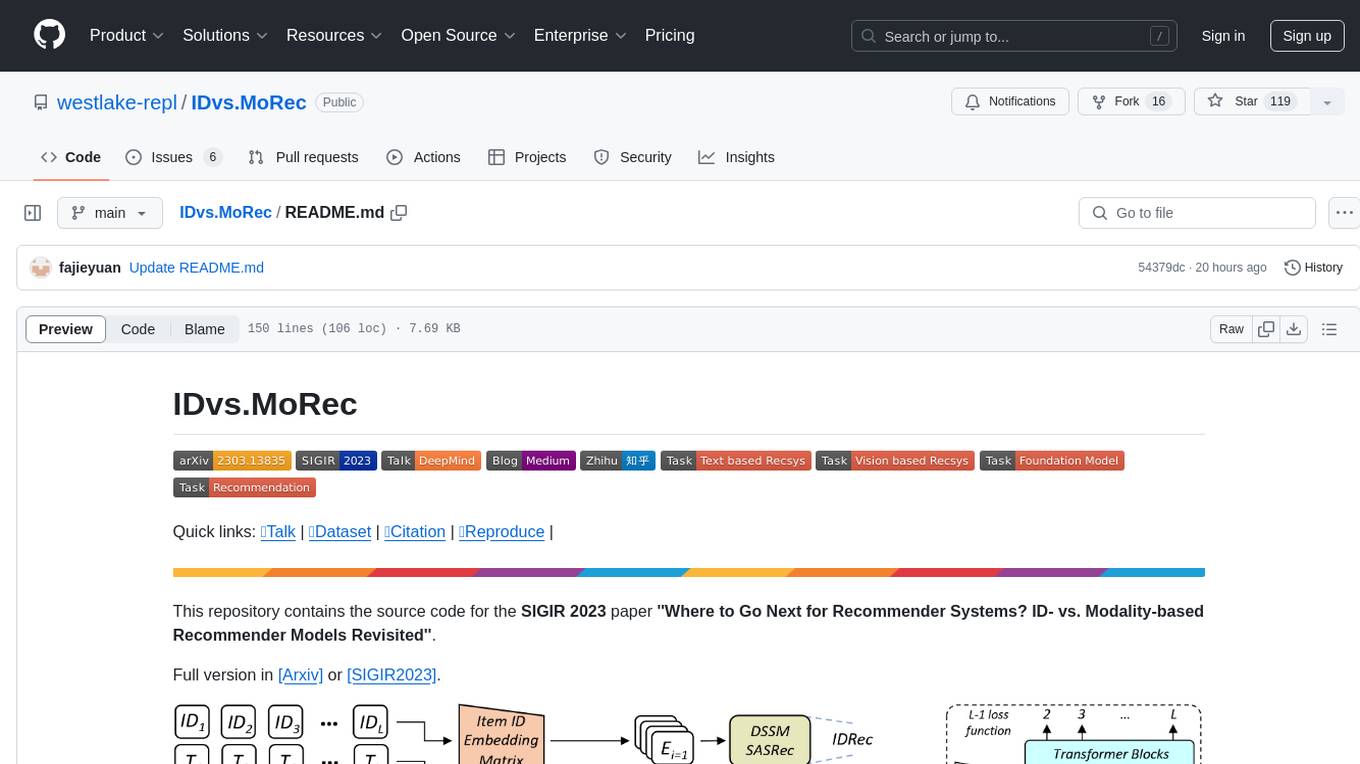
This repository contains the source code for the SIGIR 2023 paper 'Where to Go Next for Recommender Systems? ID- vs. Modality-based Recommender Models Revisited'. It provides resources for evaluating foundation, transferable, multi-modal, and LLM recommendation models, along with datasets, pre-trained models, and training strategies for IDRec and MoRec using in-batch debiased cross-entropy loss. The repository also offers large-scale datasets, code for SASRec with in-batch debias cross-entropy loss, and information on joining the lab for research opportunities.
Xwin-LM
Xwin-LM is a powerful and stable open-source tool for aligning large language models, offering various alignment technologies like supervised fine-tuning, reward models, reject sampling, and reinforcement learning from human feedback. It has achieved top rankings in benchmarks like AlpacaEval and surpassed GPT-4. The tool is continuously updated with new models and features.
pai-opencode
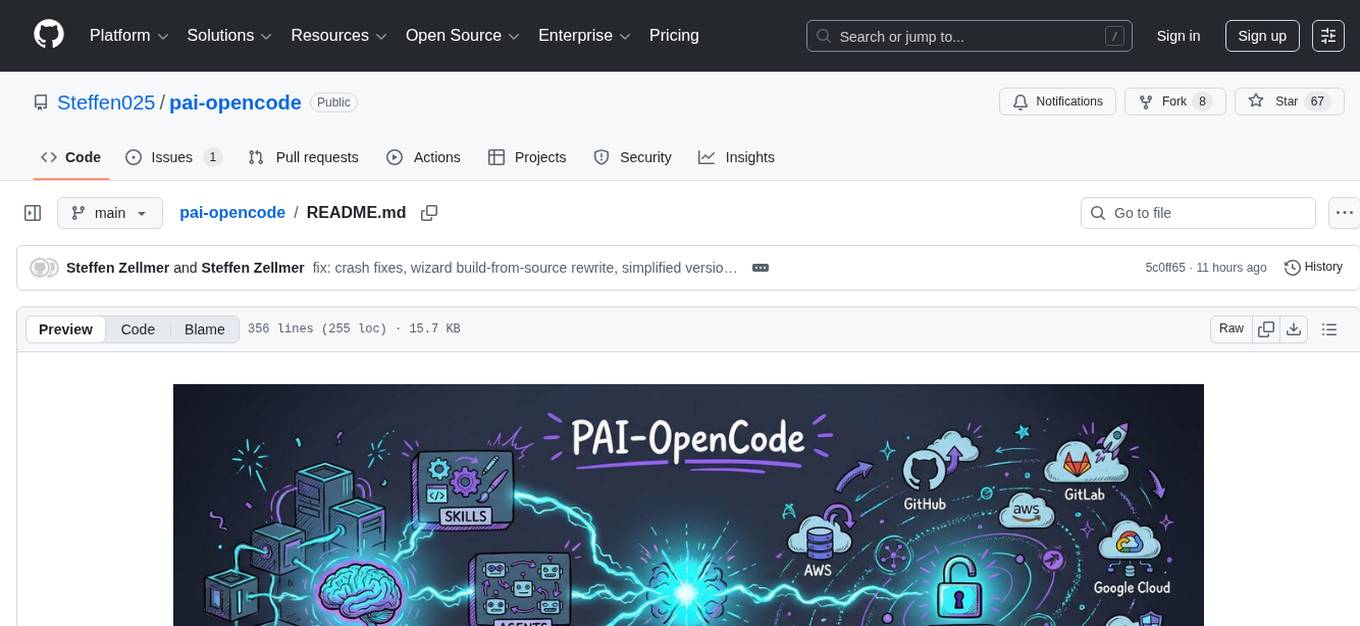
PAI-OpenCode is a complete port of Daniel Miessler's Personal AI Infrastructure (PAI) to OpenCode, an open-source, provider-agnostic AI coding assistant. It brings modular capabilities, dynamic multi-agent orchestration, session history, and lifecycle automation to personalize AI assistants for users. With support for 75+ AI providers, PAI-OpenCode offers dynamic per-task model routing, full PAI infrastructure, real-time session sharing, and multiple client options. The tool optimizes cost and quality with a 3-tier model strategy and a 3-tier research system, allowing users to switch presets for different routing strategies. PAI-OpenCode's architecture preserves PAI's design while adapting to OpenCode, documented through Architecture Decision Records (ADRs).
LlamaV-o1
LlamaV-o1 is a Large Multimodal Model designed for spontaneous reasoning tasks. It outperforms various existing models on multimodal reasoning benchmarks. The project includes a Step-by-Step Visual Reasoning Benchmark, a novel evaluation metric, and a combined Multi-Step Curriculum Learning and Beam Search Approach. The model achieves superior performance in complex multi-step visual reasoning tasks in terms of accuracy and efficiency.
qserve
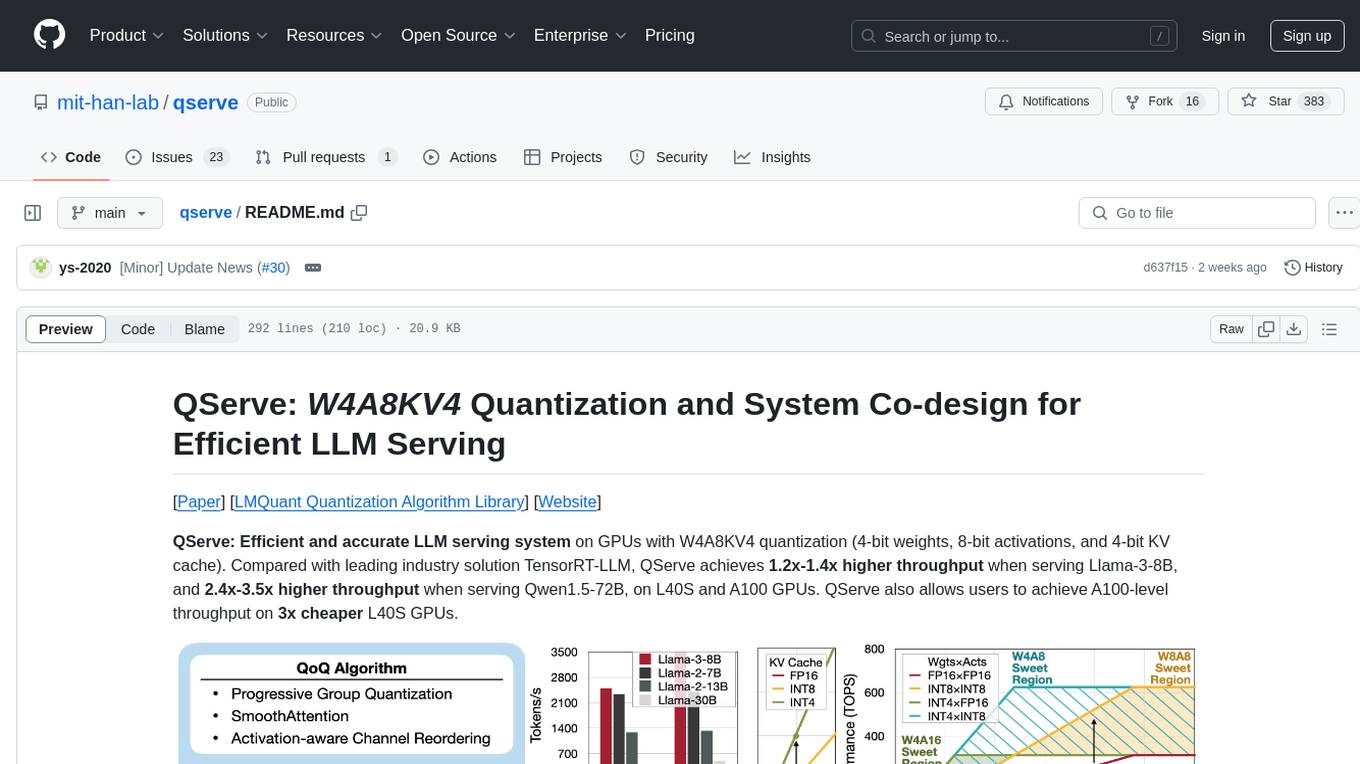
QServe is a serving system designed for efficient and accurate Large Language Models (LLM) on GPUs with W4A8KV4 quantization. It achieves higher throughput compared to leading industry solutions, allowing users to achieve A100-level throughput on cheaper L40S GPUs. The system introduces the QoQ quantization algorithm with 4-bit weight, 8-bit activation, and 4-bit KV cache, addressing runtime overhead challenges. QServe improves serving throughput for various LLM models by implementing compute-aware weight reordering, register-level parallelism, and fused attention memory-bound techniques.
UniCoT
Uni-CoT is a unified reasoning framework that extends Chain-of-Thought (CoT) principles to the multimodal domain, enabling Multimodal Large Language Models (MLLMs) to perform interpretable, step-by-step reasoning across both text and vision. It decomposes complex multimodal tasks into structured, manageable steps that can be executed sequentially or in parallel, allowing for more scalable and systematic reasoning.
ts-bench
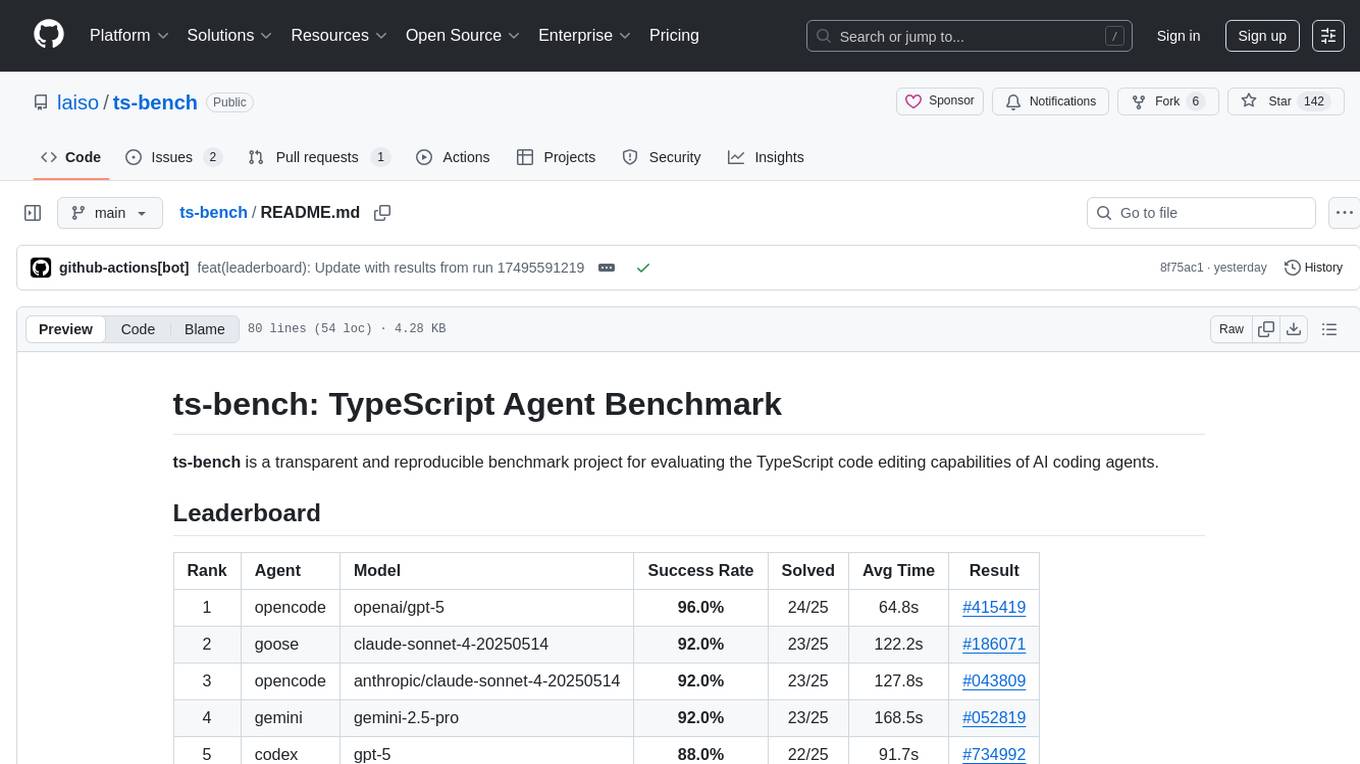
TS-Bench is a performance benchmarking tool for TypeScript projects. It provides detailed insights into the performance of TypeScript code, helping developers optimize their projects. With TS-Bench, users can measure and compare the execution time of different code snippets, functions, or modules. The tool offers a user-friendly interface for running benchmarks and analyzing the results. TS-Bench is a valuable asset for developers looking to enhance the performance of their TypeScript applications.
Athena-Public
Project Athena is a Linux OS designed for AI Agents, providing memory, persistence, scheduling, and governance for AI models. It offers a comprehensive memory layer that survives across sessions, models, and IDEs, allowing users to own their data and port it anywhere. The system is built bottom-up through 1,079+ sessions, focusing on depth and compounding knowledge. Athena features a trilateral feedback loop for cross-model validation, a Model Context Protocol server with 9 tools, and a robust security model with data residency options. The repository structure includes an SDK package, examples for quickstart, scripts, protocols, workflows, and deep documentation. Key concepts cover architecture, knowledge graph, semantic memory, and adaptive latency. Workflows include booting, reasoning modes, planning, research, and iteration. The project has seen significant content expansion, viral validation, and metrics improvements.
TrustLLM
TrustLLM is a comprehensive study of trustworthiness in LLMs, including principles for different dimensions of trustworthiness, established benchmark, evaluation, and analysis of trustworthiness for mainstream LLMs, and discussion of open challenges and future directions. Specifically, we first propose a set of principles for trustworthy LLMs that span eight different dimensions. Based on these principles, we further establish a benchmark across six dimensions including truthfulness, safety, fairness, robustness, privacy, and machine ethics. We then present a study evaluating 16 mainstream LLMs in TrustLLM, consisting of over 30 datasets. The document explains how to use the trustllm python package to help you assess the performance of your LLM in trustworthiness more quickly. For more details about TrustLLM, please refer to project website.
END-TO-END-GENERATIVE-AI-PROJECTS
The 'END TO END GENERATIVE AI PROJECTS' repository is a collection of awesome industry projects utilizing Large Language Models (LLM) for various tasks such as chat applications with PDFs, image to speech generation, video transcribing and summarizing, resume tracking, text to SQL conversion, invoice extraction, medical chatbot, financial stock analysis, and more. The projects showcase the deployment of LLM models like Google Gemini Pro, HuggingFace Models, OpenAI GPT, and technologies such as Langchain, Streamlit, LLaMA2, LLaMAindex, and more. The repository aims to provide end-to-end solutions for different AI applications.
EVE
EVE is an official PyTorch implementation of Unveiling Encoder-Free Vision-Language Models. The project aims to explore the removal of vision encoders from Vision-Language Models (VLMs) and transfer LLMs to encoder-free VLMs efficiently. It also focuses on bridging the performance gap between encoder-free and encoder-based VLMs. EVE offers a superior capability with arbitrary image aspect ratio, data efficiency by utilizing publicly available data for pre-training, and training efficiency with a transparent and practical strategy for developing a pure decoder-only architecture across modalities.
HuatuoGPT-II
HuatuoGPT2 is an innovative domain-adapted medical large language model that excels in medical knowledge and dialogue proficiency. It showcases state-of-the-art performance in various medical benchmarks, surpassing GPT-4 in expert evaluations and fresh medical licensing exams. The open-source release includes HuatuoGPT2 models in 7B, 13B, and 34B versions, training code for one-stage adaptation, partial pre-training and fine-tuning instructions, and evaluation methods for medical response capabilities and professional pharmacist exams. The tool aims to enhance LLM capabilities in the Chinese medical field through open-source principles.
spark-nlp
Spark NLP is a state-of-the-art Natural Language Processing library built on top of Apache Spark. It provides simple, performant, and accurate NLP annotations for machine learning pipelines that scale easily in a distributed environment. Spark NLP comes with 36000+ pretrained pipelines and models in more than 200+ languages. It offers tasks such as Tokenization, Word Segmentation, Part-of-Speech Tagging, Named Entity Recognition, Dependency Parsing, Spell Checking, Text Classification, Sentiment Analysis, Token Classification, Machine Translation, Summarization, Question Answering, Table Question Answering, Text Generation, Image Classification, Image to Text (captioning), Automatic Speech Recognition, Zero-Shot Learning, and many more NLP tasks. Spark NLP is the only open-source NLP library in production that offers state-of-the-art transformers such as BERT, CamemBERT, ALBERT, ELECTRA, XLNet, DistilBERT, RoBERTa, DeBERTa, XLM-RoBERTa, Longformer, ELMO, Universal Sentence Encoder, Llama-2, M2M100, BART, Instructor, E5, Google T5, MarianMT, OpenAI GPT2, Vision Transformers (ViT), OpenAI Whisper, and many more not only to Python and R, but also to JVM ecosystem (Java, Scala, and Kotlin) at scale by extending Apache Spark natively.
sktime
sktime is a Python library for time series analysis that provides a unified interface for various time series learning tasks such as classification, regression, clustering, annotation, and forecasting. It offers time series algorithms and tools compatible with scikit-learn for building, tuning, and validating time series models. sktime aims to enhance the interoperability and usability of the time series analysis ecosystem by empowering users to apply algorithms across different tasks and providing interfaces to related libraries like scikit-learn, statsmodels, tsfresh, PyOD, and fbprophet.
For similar tasks
microgpt-c
MicroGPT-C is a project that focuses on tiny specialist models working together to outperform monoliths on specific tasks. It is a C port of a Python GPT model, rewritten in pure C99 with zero dependencies. The project explores the concept of coordinated intelligence through 'organelles' that differentiate based on training data, resulting in improved performance across logic games and real-world data experiments.
VisionCraft
The VisionCraft API is a free API for using over 100 different AI models. From images to sound.
llama-on-lambda
This project provides a proof of concept for deploying a scalable, serverless LLM Generative AI inference engine on AWS Lambda. It leverages the llama.cpp project to enable the usage of more accessible CPU and RAM configurations instead of limited and expensive GPU capabilities. By deploying a container with the llama.cpp converted models onto AWS Lambda, this project offers the advantages of scale, minimizing cost, and maximizing compute availability. The project includes AWS CDK code to create and deploy a Lambda function leveraging your model of choice, with a FastAPI frontend accessible from a Lambda URL. It is important to note that you will need ggml quantized versions of your model and model sizes under 6GB, as your inference RAM requirements cannot exceed 9GB or your Lambda function will fail.
haystack-core-integrations
This repository contains integrations to extend the capabilities of Haystack version 2.0 and onwards. The code in this repo is maintained by deepset, see each integration's `README` file for details around installation, usage and support.
LLM-FineTuning-Large-Language-Models
This repository contains projects and notes on common practical techniques for fine-tuning Large Language Models (LLMs). It includes fine-tuning LLM notebooks, Colab links, LLM techniques and utils, and other smaller language models. The repository also provides links to YouTube videos explaining the concepts and techniques discussed in the notebooks.
RWKV-LM
RWKV is an RNN with Transformer-level LLM performance, which can also be directly trained like a GPT transformer (parallelizable). And it's 100% attention-free. You only need the hidden state at position t to compute the state at position t+1. You can use the "GPT" mode to quickly compute the hidden state for the "RNN" mode. So it's combining the best of RNN and transformer - **great performance, fast inference, saves VRAM, fast training, "infinite" ctx_len, and free sentence embedding** (using the final hidden state).
awesome-transformer-nlp
This repository contains a hand-curated list of great machine (deep) learning resources for Natural Language Processing (NLP) with a focus on Generative Pre-trained Transformer (GPT), Bidirectional Encoder Representations from Transformers (BERT), attention mechanism, Transformer architectures/networks, Chatbot, and transfer learning in NLP.
mlc-llm
MLC LLM is a high-performance universal deployment solution that allows native deployment of any large language models with native APIs with compiler acceleration. It supports a wide range of model architectures and variants, including Llama, GPT-NeoX, GPT-J, RWKV, MiniGPT, GPTBigCode, ChatGLM, StableLM, Mistral, and Phi. MLC LLM provides multiple sets of APIs across platforms and environments, including Python API, OpenAI-compatible Rest-API, C++ API, JavaScript API and Web LLM, Swift API for iOS App, and Java API and Android App.
For similar jobs
weave
Weave is a toolkit for developing Generative AI applications, built by Weights & Biases. With Weave, you can log and debug language model inputs, outputs, and traces; build rigorous, apples-to-apples evaluations for language model use cases; and organize all the information generated across the LLM workflow, from experimentation to evaluations to production. Weave aims to bring rigor, best-practices, and composability to the inherently experimental process of developing Generative AI software, without introducing cognitive overhead.
LLMStack
LLMStack is a no-code platform for building generative AI agents, workflows, and chatbots. It allows users to connect their own data, internal tools, and GPT-powered models without any coding experience. LLMStack can be deployed to the cloud or on-premise and can be accessed via HTTP API or triggered from Slack or Discord.
VisionCraft
The VisionCraft API is a free API for using over 100 different AI models. From images to sound.
kaito
Kaito is an operator that automates the AI/ML inference model deployment in a Kubernetes cluster. It manages large model files using container images, avoids tuning deployment parameters to fit GPU hardware by providing preset configurations, auto-provisions GPU nodes based on model requirements, and hosts large model images in the public Microsoft Container Registry (MCR) if the license allows. Using Kaito, the workflow of onboarding large AI inference models in Kubernetes is largely simplified.
PyRIT
PyRIT is an open access automation framework designed to empower security professionals and ML engineers to red team foundation models and their applications. It automates AI Red Teaming tasks to allow operators to focus on more complicated and time-consuming tasks and can also identify security harms such as misuse (e.g., malware generation, jailbreaking), and privacy harms (e.g., identity theft). The goal is to allow researchers to have a baseline of how well their model and entire inference pipeline is doing against different harm categories and to be able to compare that baseline to future iterations of their model. This allows them to have empirical data on how well their model is doing today, and detect any degradation of performance based on future improvements.
tabby
Tabby is a self-hosted AI coding assistant, offering an open-source and on-premises alternative to GitHub Copilot. It boasts several key features: * Self-contained, with no need for a DBMS or cloud service. * OpenAPI interface, easy to integrate with existing infrastructure (e.g Cloud IDE). * Supports consumer-grade GPUs.
spear
SPEAR (Simulator for Photorealistic Embodied AI Research) is a powerful tool for training embodied agents. It features 300 unique virtual indoor environments with 2,566 unique rooms and 17,234 unique objects that can be manipulated individually. Each environment is designed by a professional artist and features detailed geometry, photorealistic materials, and a unique floor plan and object layout. SPEAR is implemented as Unreal Engine assets and provides an OpenAI Gym interface for interacting with the environments via Python.
Magick
Magick is a groundbreaking visual AIDE (Artificial Intelligence Development Environment) for no-code data pipelines and multimodal agents. Magick can connect to other services and comes with nodes and templates well-suited for intelligent agents, chatbots, complex reasoning systems and realistic characters.