


skylos
High-precision Python SAST & Dead Code Remover. Finds unused functions, secrets, and security flaws with hybrid static analysis + local LLM agents. Privacy-first & low noise. MCP server for SAST too. Docs: https://docs.skylos.dev/
Stars: 317
Skylos is a privacy-first SAST tool for Python, TypeScript, and Go that bridges the gap between traditional static analysis and AI agents. It detects dead code, security vulnerabilities (SQLi, SSRF, Secrets), and code quality issues with high precision. Skylos uses a hybrid engine (AST + optional Local/Cloud LLM) to eliminate false positives, verify via runtime, find logic bugs, and provide context-aware audits. It offers automated fixes, end-to-end remediation, and 100% local privacy. The tool supports taint analysis, secrets detection, vulnerability checks, dead code detection and cleanup, agentic AI and hybrid analysis, codebase optimization, operational governance, and runtime verification.
README:









⭐ If Skylos saves you time (or has helped you in any way), please star the repo — it helps a lot.
💬 Join the Discord (support + contributors): https://discord.gg/Ftn9t9tErf
Skylos is a privacy-first SAST tool for Python, TypeScript, and Go that bridges the gap between traditional static analysis and AI agents. It detects dead code, security vulnerabilities (SQLi, SSRF, Secrets), and code quality issues with high precision.
Unlike standard linters (like Vulture or Bandit) that struggle with dynamic Python patterns, Skylos uses a hybrid engine (AST + optional Local/Cloud LLM). This allows it to:
-
Eliminate False Positives: Distinguishes between truly dead code and framework magic (e.g.,
pytest.fixture,FastAPIroutes). -
Verify via Runtime: Optional
--tracemode validates findings against actual runtime execution. - Find Logic Bugs: Goes beyond linting to find deep logic errors that regex-based tools miss.
# Generate a GitHub Actions workflow in 30 seconds
skylos cicd init

# Commit and push to activate
git add .github/workflows/skylos.yml && git push
What you get:
- Automatic dead code detection on every PR
- Security vulnerability scanning (SQLi, secrets, dangerous patterns)
- Quality gate that fails builds on critical issues
- Inline PR review comments with file:line links
- GitHub Annotations visible in the "Files Changed" tab
No configuration needed - works out of the box with sensible defaults. See CI/CD section for customization.
- Quick Start
- Features
- Installation
- Skylos vs Vulture
- Projects Using Skylos
- How It Works
- Agent Analysis
- CI/CD
- MCP Server
- Baseline Tracking
- Gating
- VS Code Extension
- Integration and Ecosystem
- Auditing and Precision
- Coverage Integration
- Filtering
- CLI Options
- FAQ
- Limitations and Troubleshooting
- Contributing
- Roadmap
- License
- Contact
| Objective | Command | Outcome |
|---|---|---|
| Hunt Dead Code | skylos . |
Prune unreachable functions and unused imports |
| Precise Hunt | skylos . --trace |
Cross-reference with runtime data |
| Audit Risk & Quality | skylos . --secrets --danger --quality |
Security leaks, taint tracking, code rot |
| Detect Unused Pytest Fixtures | skylos . --pytest-fixtures |
Find unused @pytest.fixture across tests + conftest |
| AI-Powered Analysis | skylos agent analyze . --model gpt-4.1 |
Hybrid static + LLM analysis with project context |
| AI Audit | skylos agent security-audit . |
Deep LLM review with interactive file selection |
| Automated Repair | skylos agent analyze . --fix |
Let the LLM fix what it found |
| Auto-Remediate | skylos agent remediate . --auto-pr |
Scan, fix, test, and open a PR — end to end |
| PR Review | skylos agent review |
Analyze only git-changed files |
| Local LLM | skylos agent analyze . --base-url http://localhost:11434/v1 --model codellama |
Use Ollama/LM Studio (no API key needed) |
| Secure the Gate | skylos --gate |
Block risky code from merging |
| Whitelist | skylos whitelist 'handle_*' |
Suppress known dynamic patterns |
| 🚀 Setup CI/CD | skylos cicd init |
Generate GitHub Actions workflow in 30 seconds |
| Quality Gate (CI) | skylos cicd gate -i results.json |
Fail builds when issues found |
| PR Review (CI) | skylos cicd review -i results.json |
Post inline comments on PRs |
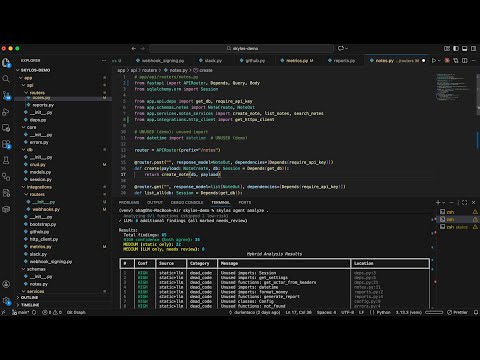
Backup (GitHub): https://github.com/duriantaco/skylos/discussions/82
- Taint Analysis: Traces untrusted input from API endpoints to databases to prevent SQL Injection and XSS.
- Secrets Detection: Hunts down hardcoded API keys (AWS, Stripe, OpenAI) and private credentials before commit.
-
Vulnerability Checks: Flags dangerous patterns like
eval(), unsafepickle, and weak cryptography.
- Find Unused Code: Identifies unreachable functions, orphan classes, and unused imports with confidence scoring.
- Smart Tracing: Distinguishes between truly dead code and dynamic frameworks (Flask/Django routes, Pytest fixtures).
- Safe Pruning: Uses LibCST to safely remove dead code without breaking syntax.
- Context-Aware Audits: Combines static analysis speed with LLM reasoning to validate findings and filter noise.
-
Automated Fixes:
skylos agent fixautonomously patches security flaws and removes dead code. -
End-to-End Remediation:
skylos agent remediatescans, fixes, tests, and opens PRs — fully autonomous DevOps agent. - 100% Local Privacy: Supports Ollama and Local LLMs so your code never leaves your machine.
- CST-safe removals: Uses LibCST to remove selected imports or functions (handles multiline imports, aliases, decorators, async etc..)
- Logic Awareness: Deep integration for Python frameworks (Django, Flask, FastAPI) and TypeScript (Tree-sitter) to identify active routes and dependencies.
-
Granular Filtering: Skip lines tagged with
# pragma: no skylos,# pragma: no cover, or# noqa
-
Coverage Integration: Auto-detects
.skylos-tracefiles to verify dead code with runtime data -
Quality Gates: Enforces hard thresholds for complexity, nesting, and security risk via
pyproject.tomlto block non-compliant PRs -
Interactive CLI: Manually verify and remove/comment-out findings through an
inquirer-based terminal interface - Security-Audit Mode: Leverages an independent reasoning loop to identify security vulnerabilities
-
Unused Fixture Detection: Finds unused
@pytest.fixturedefinitions intest_*.pyandconftest.py - Cross-file Resolution: Tracks fixtures used across modules, not just within the same file
| Language | Parser | Dead Code | Security | Quality |
|---|---|---|---|---|
| Python | AST | ✅ | ✅ | ✅ |
| TypeScript/TSX | Tree-sitter | ✅ | ✅ | ✅ |
| Go | Standalone binary | ✅ | - | - |
No Node.js required — TypeScript parser is built-in via Tree-sitter. Languages are auto-detected by file extension. Mixed-language repos (e.g. Python + TypeScript) work out of the box.
| Rule | ID | What It Catches |
|---|---|---|
| Dead Code | ||
| Functions | - | Unused functions, arrow functions, and overloads |
| Classes | - | Unused classes, interfaces, enums, and type aliases |
| Imports | - | Unused named, default, and namespace imports |
| Methods | - | Unused methods (lifecycle methods excluded) |
| Security | ||
| eval() | SKY-D501 |
eval() usage |
| innerHTML | SKY-D502 | Unsafe innerHTML assignment |
| document.write | SKY-D503 | XSS via document.write()
|
| new Function() | SKY-D504 | Equivalent to eval()
|
| setTimeout string | SKY-D505 |
setTimeout/setInterval with string argument |
| child_process.exec | SKY-D506 | Command injection via child_process.exec()
|
| outerHTML | SKY-D507 | Unsafe outerHTML assignment |
| Quality | ||
| Complexity | SKY-Q601 | Cyclomatic complexity exceeds threshold |
| Nesting depth | SKY-Q602 | Too many nested levels |
| Function length | SKY-Q603 | Function exceeds line limit |
| Too many params | SKY-Q604 | Function has too many parameters |
TypeScript dead code detection tracks: callbacks, type annotations, generics, decorators, inheritance (extends), object shorthand, spread, re-exports, and typeof references. Benchmarked at 95% recall with 0 false positives on alive code.
## from pypi
pip install skylos

## or from source
git clone https://github.com/duriantaco/skylos.git
cd skylos

pip install .After installation, we recommend:
-
Set up CI/CD (30 seconds):
skylos cicd init
git add .github/workflows/skylos.yml && git push
This will automatically scan every PR for dead code and security issues.
-
Run your first scan:
skylos .                              # Dead code only
skylos . --danger --secrets           # Include security checks
-
Try AI-powered analysis:
skylos agent analyze . --model gpt-4.1 -
Add a badge to your README:
[](https://github.com/duriantaco/skylos)
Shows others you maintain clean, secure code!
See all commands in the Quick Start table
We benchmarked Skylos against Vulture (the standard for dead code detection) on a realistic FastAPI application containing dynamic patterns, framework wiring, and hidden dependencies.
The Results (Confidence Level 20 / Aggressive Mode):
| Feature | Skylos | Vulture | Impact |
|---|---|---|---|
| Recall | 100% | 82.8% | Skylos found all dead code; Vulture missed ~17%. |
| Precision | 76.3% | 55.8% | Vulture flagged 2x more false positives (noise). |
| True Positives | 29 | 24 | Skylos detected 5 more actual dead functions. |
| False Negatives | 0 | 5 | Skylos missed nothing. |
Key Takeaway: Skylos provides significantly higher coverage (Recall) with far less noise (Precision) than traditional tools.
See the full methodology and breakdown in BENCHMARK.md.
Show you're maintaining clean, secure code! Add your project:

Featured Projects:
| Project | Description | Badge |
|---|---|---|
| Skylos | Python SAST & dead code detection |  |
| Your project here | Add yours! |
Why share?
- Show commitment to code quality
- Get a backlink to your project
- Join the community of quality-focused developers
Skylos builds a reference graph of your entire codebase - who defines what, who calls what, across all files.
Parse all files -> Build definition map -> Track references -> Find orphans (zero refs = dead)
Static analysis often struggles with Python's dynamic nature (e.g., getattr, pytest.fixture). Skylos minimizes false positives through:
- Confidence Scoring: Grades findings (High/Medium/Low) so you only see what matters.
- Hybrid Verification: Uses LLM reasoning to double-check static findings before reporting.
-
Runtime Tracing: Optional
--tracemode validates "dead" code against actual runtime execution.
| Confidence | Meaning | Action |
|---|---|---|
| 100 | Definitely unused | Safe to delete |
| 60 | Probably unused (default threshold) | Review first |
| 40 | Maybe unused (framework helpers) | Likely false positive |
| 20 | Possibly unused (decorated/routes) | Almost certainly used |
| 0 | Show everything | Debug mode |
skylos . -c 60  # Default: high-confidence findings only
skylos . -c 30  # Include framework helpers
skylos . -c 0 # EverythingWhen Skylos sees Flask, Django, or FastAPI imports, it adjusts scoring automatically:
| Pattern | Handling |
|---|---|
@app.route, @router.get
|
Entry point → marked as used |
@pytest.fixture |
Treated as a pytest entrypoint, but can be reported as unused if never referenced |
@celery.task |
Entry point → marked as used |
getattr(mod, "func") |
Tracks dynamic reference |
getattr(mod, f"handle_{x}") |
Tracks pattern handle_*
|
Tests call code in weird ways that look like dead code. By default, Skylos excludes:
| Detected By | Examples |
|---|---|
| Path |
/tests/, /test/, *_test.py
|
| Imports |
pytest, unittest, mock
|
| Decorators |
@pytest.fixture, @patch
|
# These are auto-excluded (confidence set to 0)
/project/tests/test_user.py
/project/test/helper.py

# These are analyzed normally
/project/user.py
/project/test_data.py  # Doesn't end with _test.py
Want test files included? Use --include-folder tests.
When ambiguous, we'd rather miss dead code than flag live code as dead.
Framework endpoints are called externally (HTTP, signals). Name resolution handles aliases. When things get unclear, we err on the side of caution.
Skylos can detect pytest fixtures that are defined but never used.
skylos . --pytest-fixturesThis includes fixtures inside conftest.py, since conftest.py is the standard place to store shared test fixtures.
Skylos uses a hybrid architecture that combines static analysis with LLM reasoning:
| Approach | Recall | Precision | Logic Bugs |
|---|---|---|---|
| Static only | Low | High | ❌ |
| LLM only | High | Medium | ✅ |
| Hybrid | Highest | High | ✅ |
Research shows LLMs find vulnerabilities that static analysis misses, while static analysis validates LLM suggestions. However, LLM is extremely prone to false positives in dead code because it doesn't actually do real symbol resolution.
Note: Take dead code output from LLM solely with caution
| Command | Description |
|---|---|
skylos agent analyze PATH |
Hybrid analysis with full project context |
skylos agent security-audit PATH |
Security audit with interactive file selection |
skylos agent fix PATH |
Generate fix for specific issue |
skylos agent review |
Analyze only git-changed files |
skylos agent remediate PATH |
End-to-end: scan, fix, test, and create PR |
Skylos supports cloud and local LLM providers:
# Cloud - OpenAI (auto-detected from model name)
skylos agent analyze . --model gpt-4.1

# Cloud - Anthropic (auto-detected from model name)
skylos agent analyze . --model claude-sonnet-4-20250514

# Local - Ollama
skylos agent analyze . \
  --provider openai \
  --base-url http://localhost:11434/v1 \
--model qwen2.5-coder:7bNote: You can use the --model flag to specify the model that you want. We support Gemini, Groq, Anthropic, ChatGPT and Mistral.
Skylos can use API keys from (1) skylos key, or (2) environment variables.
skylos key
# opens a menu:
# - list keys
# - add key (openai / anthropic / google / groq / mistral / ...)
# - remove keySet defaults to avoid repeating flags:
# API Keys
export OPENAI_API_KEY="sk-..."
export ANTHROPIC_API_KEY="sk-ant-..."

# Default to local Ollama
export SKYLOS_LLM_PROVIDER=openai
export SKYLOS_LLM_BASE_URL=http://localhost:11434/v1| Category | Examples |
|---|---|
| Hallucinations | Calls to functions that don't exist |
| Logic bugs | Off-by-one, incorrect conditions, missing edge cases |
| Business logic | Auth bypasses, broken access control |
| Context issues | Problems requiring understanding of intent |
# Install Ollama
curl -fsSL https://ollama.com/install.sh | sh

# Pull a code model
ollama pull qwen2.5-coder:7b

# Use with Skylos
skylos agent analyze ./src \
  --provider openai \
  --base-url http://localhost:11434/v1 \
--model qwen2.5-coder:7bThe remediation agent automates the full fix lifecycle. It scans your project, prioritizes findings, generates fixes via the LLM, validates each fix by running your test suite, and optionally opens a PR.
# Preview what would be fixed (safe, no changes)
skylos agent remediate . --dry-run

# Fix up to 5 critical/high issues, validate with tests
skylos agent remediate . --max-fixes 5 --severity high

# Full auto: fix, test, create PR
skylos agent remediate . --auto-pr --model gpt-4.1

# Use a custom test command
skylos agent remediate . --test-cmd "pytest test/ -x"
Safety guardrails:
- Dry run by default — use
--dry-runto preview without touching files - Fixes that break tests are automatically reverted
- Low-confidence fixes are skipped
- After applying a fix, Skylos re-scans to confirm the finding is actually gone
-
--auto-pralways works on a new branch, never touches main -
--max-fixesprevents runaway changes (default 10)
| Model | Provider | Use Case |
|---|---|---|
gpt-4.1 |
OpenAI | Best accuracy |
claude-sonnet-4-20250514 |
Anthropic | Best reasoning |
qwen2.5-coder:7b |
Ollama | Fast local analysis |
codellama:13b |
Ollama | Better local accuracy |
Run Skylos in your CI pipeline with quality gates, GitHub annotations, and PR review comments.
# Auto-generate a GitHub Actions workflow
skylos cicd init

# Commit and activate
git add .github/workflows/skylos.yml && git push
That's it! Your next PR will have:
- Dead code detection
- Security scanning (SQLi, SSRF, secrets)
- Quality checks
- Inline PR comments with clickable file:line links
- Quality gate that fails builds on critical issues
Generates a ready-to-use GitHub Actions workflow.
skylos cicd init
skylos cicd init --triggers pull_request schedule
skylos cicd init --analysis security quality
skylos cicd init --python-version 3.11
skylos cicd init --llm --model gpt-4.1
skylos cicd init --no-baseline
skylos cicd init -o .github/workflows/security.ymlChecks findings against your quality gate. Exits 0 (pass) or 1 (fail). Uses the same check_gate() as skylos . --gate.
skylos . --danger --quality --secrets --json > results.json 2>/dev/null
skylos cicd gate --input results.json
skylos cicd gate --input results.json --strict
skylos cicd gate --input results.json --summary
You can also use the main CLI directly:
skylos . --gate --summaryConfigure thresholds in pyproject.toml:
[tool.skylos.gate]
fail_on_critical = true
max_critical = 0
max_high = 5
max_security = 10
max_quality = 10Emits GitHub Actions annotations (::error, ::warning, ::notice). Uses the same _emit_github_annotations() as skylos . --github, with sorting and a 50-annotation cap.
skylos cicd annotate --input results.json
skylos cicd annotate --input results.json --severity high
skylos cicd annotate --input results.json --max 30

skylos . --githubPosts inline PR review comments and a summary via gh CLI. Only comments on lines changed in the PR.
skylos cicd review --input results.json
skylos cicd review --input results.json --pr 20
skylos cicd review --input results.json --summary-only
skylos cicd review --input results.json --max-comments 10
skylos cicd review --input results.json --diff-base origin/develop
In GitHub Actions, PR number and repo are auto-detected. Requires GH_TOKEN.
The gate and annotation logic lives in the core Skylos modules (gatekeeper.py and cli.py). The cicd commands are convenience wrappers that read from a JSON file and call the same functions:
skylos cicd command |
Calls |
|---|---|
gate |
gatekeeper.run_gate_interaction(summary=True) |
annotate |
cli._emit_github_annotations(max_annotations=50) |
review |
New — cicd/review.py (PR comments via gh api) |
init |
New — cicd/workflow.py (YAML generation) |
-
Run analysis once, consume many times — use
--json > results.json 2>/dev/nullthen pass--input results.jsonto each subcommand. -
Baseline — run
skylos baseline .to snapshot existing findings, then--baselinein CI to only flag new issues. -
Local testing — all commands work locally.
gateandannotateprint to stdout.reviewrequiresghCLI.
Skylos exposes its analysis capabilities as an MCP (Model Context Protocol) server, allowing AI assistants like Claude Desktop to scan your codebase directly.
pip install skylosAdd to your Claude Desktop config (~/.config/claude/claude_desktop_config.json on Linux, ~/Library/Application Support/Claude/claude_desktop_config.json on macOS):
{
  "mcpServers": {
    "skylos": {
      "command": "python",
      "args": ["-m", "skylos_mcp.server"]
    }
  }
}| Tool | Description |
|---|---|
analyze |
Dead code detection (unused functions, imports, classes, variables) |
security_scan |
Security vulnerability scan (--danger equivalent) |
quality_check |
Code quality and complexity analysis (--quality equivalent) |
secrets_scan |
Hardcoded secrets detection (--secrets equivalent) |
remediate |
End-to-end: scan, generate LLM fixes, validate with tests |
| Resource | URI | Description |
|---|---|---|
| Latest result | skylos://results/latest |
Most recent analysis run |
| Result by ID | skylos://results/{run_id} |
Specific analysis run |
| List results | skylos://results |
All stored analysis runs |
Once configured, you can ask Claude:
- "Scan my project for security issues" → calls
security_scan - "Check code quality in src/" → calls
quality_check - "Find hardcoded secrets" → calls
secrets_scan - "Fix security issues in my project" → calls
remediate
Baseline tracking lets you snapshot existing findings so CI only flags new issues introduced by a PR.
# Create baseline from current state
skylos baseline .

# Run analysis, only show findings NOT in the baseline
skylos . --danger --secrets --quality --baseline

# In CI: compare against baseline
skylos . --danger --baseline --gate
The baseline is stored in .skylos/baseline.json. Commit this file to your repo so CI can use it.
Real-time AI-powered code analysis directly in your editor.

- Search "Skylos" in VS Code marketplace or run:
ext install oha.skylos-vscode-extension- Make sure the CLI is installed:
pip install skylos- (Optional) Add your API key for AI features in VS Code Settings →
skylos.openaiApiKeyorskylos.anthropicApiKey
| Layer | Trigger | What It Does |
|---|---|---|
| Static Analysis | On save | Runs Skylos CLI for dead code, secrets, dangerous patterns |
| AI Watcher | On idle (2s) | Sends changed functions to GPT-4/Claude for bug detection |
- Real-time Analysis: Detects bugs as you type — no save required
- CodeLens Buttons: "Fix with AI" and "Dismiss" appear inline on error lines
- Streaming Fixes: See fix progress in real-time
- Smart Caching: Only re-analyzes functions that actually changed
- Multi-Provider: Choose between OpenAI and Anthropic
- MCP Server Support: Connect Skylos directly to Claude Desktop or any MCP client to chat with your codebase.
- CI/CD Agents: Autonomous bots that scan, fix, test, and open PRs automatically in your pipeline.
- Hybrid Verification: Eliminates false positives by verifying static findings with LLM reasoning.
| Setting | Default | Description |
|---|---|---|
skylos.aiProvider |
"openai" |
"openai" or "anthropic"
|
skylos.openaiApiKey |
"" |
Your OpenAI API key |
skylos.anthropicApiKey |
"" |
Your Anthropic API key |
skylos.idleMs |
2000 |
Wait time before AI analysis (ms) |
skylos.runOnSave |
true |
Run Skylos CLI on save |
skylos.enableSecrets |
true |
Scan for hardcoded secrets |
skylos.enableDanger |
true |
Flag dangerous patterns |
| Action | Result |
|---|---|
| Save a Python file | Skylos CLI scans the workspace |
| Type and pause | AI analyzes changed functions |
| Click "Fix with AI" | Generates fix with diff preview |
Cmd+Shift+P -> "Skylos: Scan Workspace" |
Full project scan |
- Static analysis runs 100% locally
- AI features send only changed function code to your configured provider
- We DO NOT collect any telemetry or data
Install from VS Code Marketplace
Block bad code before it merges. Configure thresholds, run locally, then automate in CI.
skylos initCreates [tool.skylos] in your pyproject.toml:
[tool.skylos]
# Quality thresholds
complexity = 10
nesting = 3
max_args = 5
max_lines = 50
ignore = []
model = "gpt-4.1"

# Language overrides (optional)
[tool.skylos.languages.typescript]
complexity = 15
nesting = 4

# Gate policy
[tool.skylos.gate]
fail_on_critical = true
max_security = 0      # Zero tolerance
max_quality = 10      # Allow up to 10 warnings
strict = falseRun scans locally with exit codes:
skylos . --danger --gate- Exit code
0= passed - Exit code
1= failed
Use in any CI system:
name: Skylos Quality Gate

on:
  pull_request:
    branches: [main, master]

jobs:
  skylos:
    runs-on: ubuntu-latest
    steps:
      - uses: actions/checkout@v4
      - uses: actions/setup-python@v5
        with:
          python-version: '3.11'
      - run: pip install skylos
      - run: skylos . --danger --gate
Limitation: Anyone with repo access can delete or modify this workflow.
Server-controlled GitHub checks that cannot be bypassed by developers.
pip install skylos
skylos sync setup- Developer opens PR → GitHub App creates required check ("Queued")
- Scan runs → Results upload to Skylos server
- Server updates check → Pass ✅ or Fail ❌
- Developer cannot merge until check passes
| Feature | Free | Pro |
|---|---|---|
| Local scans | ✅ | ✅ |
--gate exit codes |
✅ | ✅ |
| GitHub Actions | ✅ (DIY) | ✅ (auto) |
| Developer can bypass? | Yes | No |
| Server-controlled check | ❌ | ✅ |
| Slack/Discord alerts | ❌ | ✅ |
- Dashboard -> Settings -> Install GitHub App
- Select your repository
- In GitHub repo settings:
- Settings -> Branches -> Add rule ->
main - Require status checks
- Select "Skylos Quality Gate"
- Settings -> Branches -> Add rule ->
Repo Settings → Secrets → Actions → New secret
- Name:
SKYLOS_TOKEN - Value: (from Dashboard → Settings)
Skylos is designed to live everywhere your code does—from your IDE to your deployment pipeline.
| Environment | Tool | Use Case |
|---|---|---|
| VS Code | Skylos Extension | Real-time guarding. Highlights code rot and risks on-save. |
| Web UI | skylos run |
Launch a local dashboard at localhost:5090 for visual auditing. |
| CI/CD | GitHub Actions / Pre-commit | Automated gates that audit every PR before it merges. |
| Quality Gate | skylos --gate |
Block deployment if security or complexity thresholds are exceeded. |
Control how you consume the watchdog's findings.
| Flag | Format | Primary Use |
|---|---|---|
--table |
Rich Table | Classic Rich table output instead of TUI. |
--tree |
Logic Tree | Visualizes code hierarchy and structural dependencies. |
--json |
Machine Raw | Piping results to jq, custom scripts, or log aggregators. |
--sarif |
SARIF | GitHub Code Scanning, IDE integration |
-o, --output |
File Export | Save the audit report directly to a file instead of stdout. |
By default, Skylos finds dead code. Enable additional scans with flags.
Tracks tainted data from user input to dangerous sinks.
skylos . --danger| Rule | ID | What It Catches |
|---|---|---|
| Injection | ||
| SQL injection | SKY-D211 | cur.execute(f"SELECT * FROM users WHERE name='{name}'") |
| SQL raw query | SKY-D217 |
sqlalchemy.text(), pandas.read_sql(), Django .raw() with tainted input |
| Command injection | SKY-D212 |
os.system(), subprocess(shell=True) with tainted input |
| SSRF | SKY-D216 | requests.get(request.args["url"]) |
| Path traversal | SKY-D215 | open(request.args.get("p")) |
| XSS (mark_safe) | SKY-D226 | Untrusted content passed to mark_safe() / Markup()
|
| XSS (template) | SKY-D227 | Inline template with autoescape disabled |
| XSS (HTML build) | SKY-D228 | HTML built from unescaped user input |
| Open redirect | SKY-D230 | User-controlled URL passed to redirect()
|
| Dangerous Calls | ||
| eval() | SKY-D201 | Dynamic code execution via eval()
|
| exec() | SKY-D202 | Dynamic code execution via exec()
|
| os.system() | SKY-D203 | OS command execution |
| pickle.load | SKY-D204 | Unsafe deserialization |
| yaml.load | SKY-D206 |
yaml.load() without SafeLoader |
| Weak hash (MD5) | SKY-D207 | hashlib.md5() |
| Weak hash (SHA1) | SKY-D208 | hashlib.sha1() |
| shell=True | SKY-D209 |
subprocess with shell=True
|
| TLS disabled | SKY-D210 |
requests with verify=False
|
| Unsafe deserialization | SKY-D233 |
marshal.loads, shelve.open, jsonpickle.decode, dill
|
| Web Security | ||
| CORS misconfiguration | SKY-D231 | Wildcard origins, credential leaks, overly permissive headers |
| JWT vulnerabilities | SKY-D232 |
algorithms=['none'], missing verification, weak secrets |
| Mass assignment | SKY-D234 | Django Meta.fields = '__all__' exposes all model fields |
| Supply Chain | ||
| Hallucinated dependency | SKY-D222 | Imported package doesn't exist on PyPI (CRITICAL) |
| Undeclared dependency | SKY-D223 | Import not declared in requirements.txt / pyproject.toml |
| MCP Security | ||
| Tool description poisoning | SKY-D240 | Prompt injection in MCP tool metadata |
| Unauthenticated transport | SKY-D241 | SSE/HTTP MCP server without auth middleware |
| Permissive resource URI | SKY-D242 | Path traversal via MCP resource URI template |
| Network-exposed MCP | SKY-D243 | MCP server bound to 0.0.0.0 without auth |
| Hardcoded secrets in MCP | SKY-D244 | Secrets in MCP tool parameter defaults |
Full list in DANGEROUS_CODE.md.
Detects hardcoded credentials.
skylos . --secretsProviders: GitHub, GitLab, AWS, Stripe, Slack, Google, SendGrid, Twilio, private keys.
Flags functions that are hard to maintain.
skylos . --quality| Rule | ID | What It Catches |
|---|---|---|
| Complexity | ||
| Cyclomatic complexity | SKY-Q301 | Too many branches/loops (default: >10) |
| Deep nesting | SKY-Q302 | Too many nested levels (default: >3) |
| Async Blocking | SKY-Q401 | Detects blocking calls inside async functions that kill server throughput |
| God class | SKY-Q501 | Class has too many methods/attributes |
| Coupling (CBO) | SKY-Q701 | High inter-class coupling (7 dependency types: inheritance, type hints, instantiation, attribute access, imports, decorators, protocol/ABC) |
| Cohesion (LCOM) | SKY-Q702 | Low class cohesion — disconnected method groups that should be split (LCOM1/4/5 metrics with Union-Find) |
| Architecture | ||
| Distance from Main Sequence | SKY-Q802 | Module far from ideal balance of abstractness vs instability |
| Zone warning | SKY-Q803 | Module in Zone of Pain (rigid) or Zone of Uselessness (throwaway) |
| DIP violation | SKY-Q804 | Stable module depends on unstable module (Dependency Inversion Principle) |
| Structure | ||
| Too many arguments | SKY-C303 | Functions with >5 args |
| Function too long | SKY-C304 | Functions >50 lines |
| Logic | ||
| Mutable default | SKY-L001 |
def foo(x=[]) - causes state leaks |
| Bare except | SKY-L002 |
except: swallows SystemExit |
| Dangerous comparison | SKY-L003 |
x == None instead of x is None
|
| Anti-pattern try block | SKY-L004 | Nested try, or try wrapping too much logic |
| Unused exception var | SKY-L005 |
except Error as e: where e is never referenced |
| Inconsistent return | SKY-L006 | Function returns both values and None
|
| Performance | ||
| Memory load | SKY-P401 |
.read() / .readlines() loads entire file |
| Pandas no chunk | SKY-P402 |
read_csv() without chunksize
|
| Nested loop | SKY-P403 | O(N²) complexity |
| Unreachable | ||
| Unreachable Code | SKY-UC001 |
if False: or else after always-true |
| Empty | ||
| Empty File | SKY-E002 | Empty File |
To ignore a specific rule:
# pyproject.toml
[tool.skylos]
ignore = ["SKY-P403"]  # Allow nested loops
Tune thresholds and disable rules in pyproject.toml:
[tool.skylos]
# Adjust thresholds
complexity = 15        # Default: 10
nesting = 4            # Default: 3
max_args = 7           # Default: 5
max_lines = 80 These flags work on the main skylos command for quick operations:
# LLM-powered audit (single file)
skylos . --audit

# Auto-fix with LLM
skylos . --fix

# Specify model
skylos . --audit --model claude-haiku-4-5-20251001
Note: For full project context and better results, use
skylos agent analyzeinstead.
skylos . --danger --secrets --quality  # All static scans
skylos agent analyze . --fix # Full AI-assisted cleanupStatic analysis can't see everything. Python's dynamic nature means patterns like getattr(), plugin registries, and string-based dispatch look like dead code—but they're not.
Smart tracing solves this. By running your tests with sys.settrace(), Skylos records every function that actually gets called.
# Run tests with call tracing, then analyze
skylos . --trace

# Trace data is saved to .skylos_trace
skylos .| Analysis Type | Accuracy | What It Catches |
|---|---|---|
| Static only | 70-85% | Direct calls, imports, decorators |
| + Framework rules | 85-95% | Django/Flask routes, pytest fixtures |
+ --trace
|
95-99% | Dynamic dispatch, plugins, registries |
# Static analysis will think this is dead because there's no direct call visible
def handle_login():
    return "Login handler"

# But it is actually called dynamically at runtime
action = request.args.get("action")
func = getattr(module, f"handle_{action}")
func() # here | Without Tracing | With --trace
|
|---|---|
handle_login flagged as dead |
handle_login marked as used |
| Situation | Command |
|---|---|
| Have pytest/unittest tests | skylos . --trace |
| No tests |
skylos . (static only) |
| CI with cached trace |
skylos . (reuses .skylos_trace) |
These patterns are invisible to static analysis but caught with --trace:
# 1. Dynamic dispatch
func = getattr(module, f"handle_{action}")
func()

# 2. Plugin or registry patterns
PLUGINS = []
def register(f):
  PLUGINS.append(f)
return f

@register
def my_plugin(): ...

# 3. Visitor patterns
class MyVisitor(ast.NodeVisitor):
    def visit_FunctionDef(self, node): ...  # Called via getattr

# 4. String-based access
globals()["my_" + "func"]()
locals()[func_name]()- Tracing only adds information. Low test coverage won't create false positives. It just means some dynamic patterns may still be flagged.
-
Commit
.skylos_traceto reuse trace data in CI without re-running tests. - Tests don't need to pass. Tracing records what executes, regardless of pass/fail status.
Control what Skylos analyzes and what it ignores.
Silence specific findings with comments:
# Ignore dead code detection on this line
def internal_hook():  # pragma: no skylos
    pass

# this also works
def another():  # pragma: no cover
    pass

def yet_another():  # noqa
passBy default, Skylos excludes: __pycache__, .git, .pytest_cache, .mypy_cache, .tox, htmlcov, .coverage, build, dist, *.egg-info, venv, .venv
# See what's excluded by default
skylos --list-default-excludes

# Add more exclusions
skylos . --exclude-folder vendor --exclude-folder generated

# Force include an excluded folder
skylos . --include-folder venv

# Scan everything (no exclusions)
skylos . --no-default-excludesDisable rules globally in pyproject.toml:
[tool.skylos]
ignore = [
    "SKY-P403",   # Allow nested loops
    "SKY-L003",   # Allow == None
    "SKY-S101",   # Allow hardcoded secrets (not recommended)
]| Want to... | Do this |
|---|---|
| Skip one line | # pragma: no skylos |
| Skip one secret | # skylos: ignore[SKY-S101] |
| Skip a folder | --exclude-folder NAME |
| Skip a rule globally |
ignore = ["SKY-XXX"] in pyproject.toml |
| Include excluded folder | --include-folder NAME |
| Scan everything | --no-default-excludes |
Suppress false positives permanently without inline comments cluttering your code.
# Add a pattern
skylos whitelist 'handle_*'

# Add with reason
skylos whitelist dark_logic --reason "Called via globals() in dispatcher"

# View current whitelist
skylos whitelist --show# Single line
def dynamic_handler(): # skylos: ignore
pass
# Also works
def another(): # noqa: skylos
pass
# Block ignore
# skylos: ignore-start
def block_one():
pass
def block_two():
pass
# skylos: ignore-end[tool.skylos.whitelist]
# Glob patterns
names = [
"handle_*",
"visit_*",
"*Plugin",
]
# With reasons (shows in --show output)
[tool.skylos.whitelist.documented]
"dark_logic" = "Called via globals() string manipulation"
"BasePlugin" = "Discovered via __subclasses__()"
# Temporary (warns when expired)
[tool.skylos.whitelist.temporary]
"legacy_handler" = { reason = "Migration - JIRA-123", expires = "2026-03-01" }
# Per-path overrides
[tool.skylos.overrides."src/plugins/*"]
whitelist = ["*Plugin", "*Handler"]| Want to... | Do this |
|---|---|
| Whitelist one function | skylos whitelist func_name |
| Whitelist a pattern | skylos whitelist 'handle_*' |
| Document why | skylos whitelist x --reason "why" |
| Temporary whitelist | Add to [tool.skylos.whitelist.temporary] with expires
|
| Per-folder rules | Add [tool.skylos.overrides."path/*"]
|
| View whitelist | skylos whitelist --show |
| Inline ignore |
# skylos: ignore or # noqa: skylos
|
| Block ignore |
# skylos: ignore-start ... # skylos: ignore-end
|
Usage: skylos [OPTIONS] PATH

Arguments:
  PATH  Path to the Python project to analyze

Options:
  -h, --help                   Show this help message and exit
  --json                       Output raw JSON instead of formatted text
  --tree                       Output results in tree format
  --table                      Rich table output instead of TUI
  --sarif                      Output SARIF format for GitHub/IDE integration
  -c, --confidence LEVEL       Confidence threshold 0-100 (default: 60)
  --comment-out                Comment out code instead of deleting
  -o, --output FILE            Write output to file instead of stdout
  -v, --verbose                Enable verbose output
  --version                    Checks version
  -i, --interactive            Interactively select items to remove
  --dry-run                    Show what would be removed without modifying files
  --exclude-folder FOLDER      Exclude a folder from analysis (can be used multiple times)
  --include-folder FOLDER      Force include a folder that would otherwise be excluded
  --no-default-excludes        Don't exclude default folders (__pycache__, .git, venv, etc.)
  --list-default-excludes      List the default excluded folders
  --secrets                    Scan for api keys/secrets
  --danger                     Scan for dangerous code
  --quality                    Code complexity and maintainability
  --trace                      Run tests with coverage first
  --audit                      LLM-powered logic review (legacy-will be deprecated)
  --fix                        LLM auto-repair (legacy-will be deprecated)
  --model MODEL                LLM model (default: gpt-4.1)
  --gate                       Fail on threshold breach (for CI)
  --force                      Bypass quality gate (emergency override)
Usage: skylos agent <command> [OPTIONS] PATH

Commands:
  analyze             Hybrid static + LLM analysis with project context
  security-audit      Deep LLM security audit
  fix                 Generate fix for specific issue
  review              Analyze only git-changed files

Options (all agent commands):
  --model MODEL                LLM model to use (default: gpt-4.1)
  --provider PROVIDER          Force provider: openai or anthropic
  --base-url URL               Custom endpoint for local LLMs
  --format FORMAT              Output: table, tree, json, sarif
  -o, --output FILE            Write output to file

Agent analyze options:
  --min-confidence LEVEL       Filter: high, medium, low
  --fix                        Generate fix proposals
  --apply                      Apply fixes to files
  --yes                        Auto-approve prompts

Agent fix options:
  --line, -l LINE              Line number of issue (required)
  --message, -m MSG            Description of issue (required)

Agent remediate options:
  --dry-run                    Show plan without applying fixes (safe preview)
  --max-fixes N                Max findings to fix per run (default: 10)
  --auto-pr                    Create branch, commit, push, and open PR
  --branch-prefix PREFIX       Git branch prefix (default: skylos/fix)
  --test-cmd CMD               Custom test command (default: auto-detect)
  --severity LEVEL             Min severity filter: critical, high, medium, low
Commands:
  skylos PATH                  Analyze a project (static analysis)
  skylos agent analyze PATH    Hybrid static + LLM analysis
  skylos agent security-audit PATH  Deep LLM audit with file selection
  skylos agent fix PATH        Fix specific issue
  skylos agent review          Review git-changed files only
  skylos agent remediate PATH  End-to-end scan, fix, test, and PR
  skylos baseline PATH         Snapshot current findings for CI baselining
  skylos cicd init             Generate GitHub Actions workflow
  skylos cicd gate             Check findings against quality gate
  skylos cicd annotate         Emit GitHub Actions annotations
  skylos cicd review           Post inline PR review comments
  skylos init                  Initialize pyproject.toml config
  skylos key                   Manage API keys (add/remove/list)
  skylos whitelist PATTERN     Add pattern to whitelist
  skylos whitelist --show      Display current whitelist
  skylos run                   Start web UI at localhost:5090

Whitelist Options:
  skylos whitelist PATTERN           Add glob pattern (e.g., 'handle_*')
  skylos whitelist NAME --reason X   Add with documentation
  skylos whitelist --show            Display all whitelist entries
Skylos displays confidence for each finding:
────────────────── Unused Functions ──────────────────
#   Name              Location        Conf
1   handle_secret     app.py:16       70%
2   totally_dead      app.py:50       90%
Higher confidence = more certain it's dead code.
The interactive mode lets you select specific functions and imports to remove:
-
Select items: Use arrow keys and
spacebarto select/unselect - Confirm changes: Review selected items before applying
- Auto-cleanup: Files are automatically updated
Q: Why doesn't Skylos find 100% of dead code? A: Python's dynamic features (getattr, globals, etc.) can't be perfectly analyzed statically. No tool can achieve 100% accuracy. If they say they can, they're lying.
Q: Are these benchmarks realistic? A: They test common scenarios but can't cover every edge case. Use them as a guide, not gospel.
Q: Why doesn't Skylos detect my unused Flask routes?
A: Web framework routes are given low confidence (20) because they might be called by external HTTP requests. Use --confidence 20 to see them. We acknowledge there are current limitations to this approach so use it sparingly.
Q: What confidence level should I use? A: Start with 60 (default) for safe cleanup. Use 30 for framework applications. Use 20 for more comprehensive auditing.
Q: What does --trace do?
A: It runs pytest (or unittest) with coverage tracking before analysis. Functions that actually executed are marked as used with 100% confidence, eliminating false positives from dynamic dispatch patterns.
Q: Do I need 100% test coverage for --trace to be useful?
A: No. However, we STRONGLY encourage you to have tests. Any coverage helps. If you have 30% test coverage, that's 30% of your code verified. The other 70% still uses static analysis. Coverage only removes false positives, it never adds them.
Q: Why are fixtures in conftest.py showing up as unused?
A: conftest.py is the standard place for shared fixtures. If a fixture is defined there but never referenced by any test, Skylos will report it as unused. This is normal and safe to review.
Q: My tests are failing. Can I still use --trace?
A: Yes. Coverage tracks execution, not pass/fail. Even failing tests provide coverage data.
Q: What's the difference between skylos . --audit and skylos agent audit?
A: skylos agent audit uses the new hybrid architecture with full project context (defs_map), enabling detection of hallucinations and cross-file issues. The --audit flag is legacy and lacks project context.
Q: Can I use local LLMs instead of OpenAI/Anthropic?
A: Yes! Use --base-url to point to Ollama, LM Studio, or any OpenAI-compatible endpoint. No API key needed for localhost.
-
Dynamic code:
getattr(),globals(), runtime imports are hard to detect - Frameworks: Django models, Flask, FastAPI routes may appear unused but aren't
- Test data: Limited scenarios, your mileage may vary
- False positives: Always manually review before deleting code
-
Secrets PoC: May emit both a provider hit and a generic high-entropy hit for the same token. Supported file types:
.py,.pyi,.pyw,.env,.yaml,.yml,.json,.toml,.ini,.cfg,.conf,.ts,.tsx,.js,.jsx,.go -
Quality limitations: The current
--qualityflag does not allow you to configure the cyclomatic complexity. -
Coverage requires execution: The
--traceflag only helps if you have tests or can run your application. Pure static analysis is still available without it. - LLM limitations: AI analysis requires API access (cloud) or local setup (Ollama). Results depend on model quality.
-
Permission Errors
Error: Permission denied when removing functionCheck file permissions before running in interactive mode.
-
Missing Dependencies
Interactive mode requires 'inquirer' packageInstall with:
pip install skylos[interactive] -
No API Key Found
# For cloud providers
export OPENAI_API_KEY="sk-..."
export ANTHROPIC_API_KEY="sk-ant-..."

# For local LLMs (no key needed)
skylos agent analyze . --base-url http://localhost:11434/v1 --model codellama
-
Local LLM Connection Refused
# Verify Ollama is running
curl http://localhost:11434/v1/models

# Check LM Studio
curl http://localhost:1234/v1/models
We welcome contributions! Please read our Contributing Guidelines before submitting pull requests.
- Fork the repository
- Create a feature branch (
git checkout -b feature/amazing-feature) - Commit your changes (
git commit -m 'Add amazing feature') - Push to the branch (
git push origin feature/amazing-feature) - Open a Pull Request
- [x] Expand our test cases
- [x] Configuration file support
- [x] Git hooks integration
- [x] CI/CD integration examples
- [x] Deployment Gatekeeper
- [ ] Further optimization
- [ ] Add new rules
- [ ] Expanding on the
dangerous.pylist - [x] Porting to uv
- [x] Small integration with typescript
- [x] Expanded TypeScript dead code detection (interfaces, enums, type aliases, 95% recall)
- [ ] Expand and improve on capabilities of Skylos in various other languages
- [x] Expand the providers for LLMs (OpenAI, Anthropic, Ollama, LM Studio, vLLM)
- [x] Expand the LLM portion for detecting dead/dangerous code (hybrid architecture)
- [x] Coverage integration for runtime verification
- [x] Implicit reference detection (f-string patterns, framework decorators)
More stuff coming soon!
This project is licensed under the Apache 2.0 License - see the LICENSE file for details.
- Author: oha
- Email: [email protected]
- GitHub: @duriantaco
- Discord: https://discord.gg/Ftn9t9tErf
For Tasks:
Click tags to check more tools for each tasksFor Jobs:
Alternative AI tools for skylos
Similar Open Source Tools
skylos
Skylos is a privacy-first SAST tool for Python, TypeScript, and Go that bridges the gap between traditional static analysis and AI agents. It detects dead code, security vulnerabilities (SQLi, SSRF, Secrets), and code quality issues with high precision. Skylos uses a hybrid engine (AST + optional Local/Cloud LLM) to eliminate false positives, verify via runtime, find logic bugs, and provide context-aware audits. It offers automated fixes, end-to-end remediation, and 100% local privacy. The tool supports taint analysis, secrets detection, vulnerability checks, dead code detection and cleanup, agentic AI and hybrid analysis, codebase optimization, operational governance, and runtime verification.
everything-claude-code
The 'Everything Claude Code' repository is a comprehensive collection of production-ready agents, skills, hooks, commands, rules, and MCP configurations developed over 10+ months. It includes guides for setup, foundations, and philosophy, as well as detailed explanations of various topics such as token optimization, memory persistence, continuous learning, verification loops, parallelization, and subagent orchestration. The repository also provides updates on bug fixes, multi-language rules, installation wizard, PM2 support, OpenCode plugin integration, unified commands and skills, and cross-platform support. It offers a quick start guide for installation, ecosystem tools like Skill Creator and Continuous Learning v2, requirements for CLI version compatibility, key concepts like agents, skills, hooks, and rules, running tests, contributing guidelines, OpenCode support, background information, important notes on context window management and customization, star history chart, and relevant links.
llm-checker
LLM Checker is an AI-powered CLI tool that analyzes your hardware to recommend optimal LLM models. It features deterministic scoring across 35+ curated models with hardware-calibrated memory estimation. The tool helps users understand memory bandwidth, VRAM limits, and performance characteristics to choose the right LLM for their hardware. It provides actionable recommendations in seconds by scoring compatible models across four dimensions: Quality, Speed, Fit, and Context. LLM Checker is designed to work on any Node.js 16+ system, with optional SQLite search features for advanced functionality.
tokscale
Tokscale is a high-performance CLI tool and visualization dashboard for tracking token usage and costs across multiple AI coding agents. It helps monitor and analyze token consumption from various AI coding tools, providing real-time pricing calculations using LiteLLM's pricing data. Inspired by the Kardashev scale, Tokscale measures token consumption as users scale the ranks of AI-augmented development. It offers interactive TUI mode, multi-platform support, real-time pricing, detailed breakdowns, web visualization, flexible filtering, and social platform features.
ai-coders-context
The @ai-coders/context repository provides the Ultimate MCP for AI Agent Orchestration, Context Engineering, and Spec-Driven Development. It simplifies context engineering for AI by offering a universal process called PREVC, which consists of Planning, Review, Execution, Validation, and Confirmation steps. The tool aims to address the problem of context fragmentation by introducing a single `.context/` directory that works universally across different tools. It enables users to create structured documentation, generate agent playbooks, manage workflows, provide on-demand expertise, and sync across various AI tools. The tool follows a structured, spec-driven development approach to improve AI output quality and ensure reproducible results across projects.
roam-code
Roam is a tool that builds a semantic graph of your codebase and allows AI agents to query it with one shell command. It pre-indexes your codebase into a semantic graph stored in a local SQLite DB, providing architecture-level graph queries offline, cross-language, and compact. Roam understands functions, modules, tests coverage, and overall architecture structure. It is best suited for agent-assisted coding, large codebases, architecture governance, safe refactoring, and multi-repo projects. Roam is not suitable for real-time type checking, dynamic/runtime analysis, small scripts, or pure text search. It offers speed, dependency-awareness, LLM-optimized output, fully local operation, and CI readiness.
augustus
Augustus is a Go-based LLM vulnerability scanner designed for security professionals to test large language models against a wide range of adversarial attacks. It integrates with 28 LLM providers, covers 210+ adversarial attacks including prompt injection, jailbreaks, encoding exploits, and data extraction, and produces actionable vulnerability reports. The tool is built for production security testing with features like concurrent scanning, rate limiting, retry logic, and timeout handling out of the box.
optillm
optillm is an OpenAI API compatible optimizing inference proxy implementing state-of-the-art techniques to enhance accuracy and performance of LLMs, focusing on reasoning over coding, logical, and mathematical queries. By leveraging additional compute at inference time, it surpasses frontier models across diverse tasks.
oh-my-pi
oh-my-pi is an AI coding agent for the terminal, providing tools for interactive coding, AI-powered git commits, Python code execution, LSP integration, time-traveling streamed rules, interactive code review, task management, interactive questioning, custom TypeScript slash commands, universal config discovery, MCP & plugin system, web search & fetch, SSH tool, Cursor provider integration, multi-credential support, image generation, TUI overhaul, edit fuzzy matching, and more. It offers a modern terminal interface with smart session management, supports multiple AI providers, and includes various tools for coding, task management, code review, and interactive questioning.
agents
AI agent tooling for data engineering workflows. Includes an MCP server for Airflow, a CLI tool for interacting with Airflow from your terminal, and skills that extend AI coding agents with specialized capabilities for working with Airflow and data warehouses. Works with Claude Code, Cursor, and other agentic coding tools. The tool provides a comprehensive set of features for data discovery & analysis, data lineage, DAG development, dbt integration, migration, and more. It also offers user journeys for data analysis flow and DAG development flow. The Airflow CLI tool allows users to interact with Airflow directly from the terminal. The tool supports various databases like Snowflake, PostgreSQL, Google BigQuery, and more, with auto-detected SQLAlchemy databases. Skills are invoked automatically based on user queries or can be invoked directly using specific commands.
tunacode
TunaCode CLI is an AI-powered coding assistant that provides a command-line interface for developers to enhance their coding experience. It offers features like model selection, parallel execution for faster file operations, and various commands for code management. The tool aims to improve coding efficiency and provide a seamless coding environment for developers.
gpt-load
GPT-Load is a high-performance, enterprise-grade AI API transparent proxy service designed for enterprises and developers needing to integrate multiple AI services. Built with Go, it features intelligent key management, load balancing, and comprehensive monitoring capabilities for high-concurrency production environments. The tool serves as a transparent proxy service, preserving native API formats of various AI service providers like OpenAI, Google Gemini, and Anthropic Claude. It supports dynamic configuration, distributed leader-follower deployment, and a Vue 3-based web management interface. GPT-Load is production-ready with features like dual authentication, graceful shutdown, and error recovery.
RepairAgent
RepairAgent is an autonomous LLM-based agent for automated program repair targeting the Defects4J benchmark. It uses an LLM-driven loop to localize, analyze, and fix Java bugs. The tool requires Docker, VS Code with Dev Containers extension, OpenAI API key, disk space of ~40 GB, and internet access. Users can get started with RepairAgent using either VS Code Dev Container or Docker Image. Running RepairAgent involves checking out the buggy project version, autonomous bug analysis, fix candidate generation, and testing against the project's test suite. Users can configure hyperparameters for budget control, repetition handling, commands limit, and external fix strategy. The tool provides output structure, experiment overview, individual analysis scripts, and data on fixed bugs from the Defects4J dataset.
doc-scraper
A configurable, concurrent, and resumable web crawler written in Go, specifically designed to scrape technical documentation websites, extract core content, convert it cleanly to Markdown format suitable for ingestion by Large Language Models (LLMs), and save the results locally. The tool is built for LLM training and RAG systems, preserving documentation structure, offering production-ready features like resumable crawls and rate limiting, and using Go's concurrency model for efficient parallel processing. It automates the process of gathering and cleaning web-based documentation for use with Large Language Models, providing a dataset that is text-focused, structured, cleaned, and locally accessible.
models
A fast CLI and TUI for browsing AI models, benchmarks, and coding agents. Browse 2000+ models across 85+ providers from models.dev. Track AI coding assistants with version detection and GitHub integration. Compare model performance across 15+ benchmarks from Artificial Analysis. Features CLI commands, interactive TUI, cross-provider search, copy to clipboard, JSON output. Includes curated catalog of AI coding assistants, auto-updating benchmark data, per-model open weights detection, and detail panel for benchmarks. Supports customization of tracked agents and quick sorting of benchmarks. Utilizes data from models.dev, Artificial Analysis, curated catalog in data/agents.json, and GitHub API.
shodh-memory
Shodh-Memory is a cognitive memory system designed for AI agents to persist memory across sessions, learn from experience, and run entirely offline. It features Hebbian learning, activation decay, and semantic consolidation, packed into a single ~17MB binary. Users can deploy it on cloud, edge devices, or air-gapped systems to enhance the memory capabilities of AI agents.
For similar tasks
skylos
Skylos is a privacy-first SAST tool for Python, TypeScript, and Go that bridges the gap between traditional static analysis and AI agents. It detects dead code, security vulnerabilities (SQLi, SSRF, Secrets), and code quality issues with high precision. Skylos uses a hybrid engine (AST + optional Local/Cloud LLM) to eliminate false positives, verify via runtime, find logic bugs, and provide context-aware audits. It offers automated fixes, end-to-end remediation, and 100% local privacy. The tool supports taint analysis, secrets detection, vulnerability checks, dead code detection and cleanup, agentic AI and hybrid analysis, codebase optimization, operational governance, and runtime verification.
hackingBuddyGPT
hackingBuddyGPT is a framework for testing LLM-based agents for security testing. It aims to create common ground truth by creating common security testbeds and benchmarks, evaluating multiple LLMs and techniques against those, and publishing prototypes and findings as open-source/open-access reports. The initial focus is on evaluating the efficiency of LLMs for Linux privilege escalation attacks, but the framework is being expanded to evaluate the use of LLMs for web penetration-testing and web API testing. hackingBuddyGPT is released as open-source to level the playing field for blue teams against APTs that have access to more sophisticated resources.
For similar jobs
sweep
Sweep is an AI junior developer that turns bugs and feature requests into code changes. It automatically handles developer experience improvements like adding type hints and improving test coverage.
teams-ai
The Teams AI Library is a software development kit (SDK) that helps developers create bots that can interact with Teams and Microsoft 365 applications. It is built on top of the Bot Framework SDK and simplifies the process of developing bots that interact with Teams' artificial intelligence capabilities. The SDK is available for JavaScript/TypeScript, .NET, and Python.
ai-guide
This guide is dedicated to Large Language Models (LLMs) that you can run on your home computer. It assumes your PC is a lower-end, non-gaming setup.
classifai
Supercharge WordPress Content Workflows and Engagement with Artificial Intelligence. Tap into leading cloud-based services like OpenAI, Microsoft Azure AI, Google Gemini and IBM Watson to augment your WordPress-powered websites. Publish content faster while improving SEO performance and increasing audience engagement. ClassifAI integrates Artificial Intelligence and Machine Learning technologies to lighten your workload and eliminate tedious tasks, giving you more time to create original content that matters.
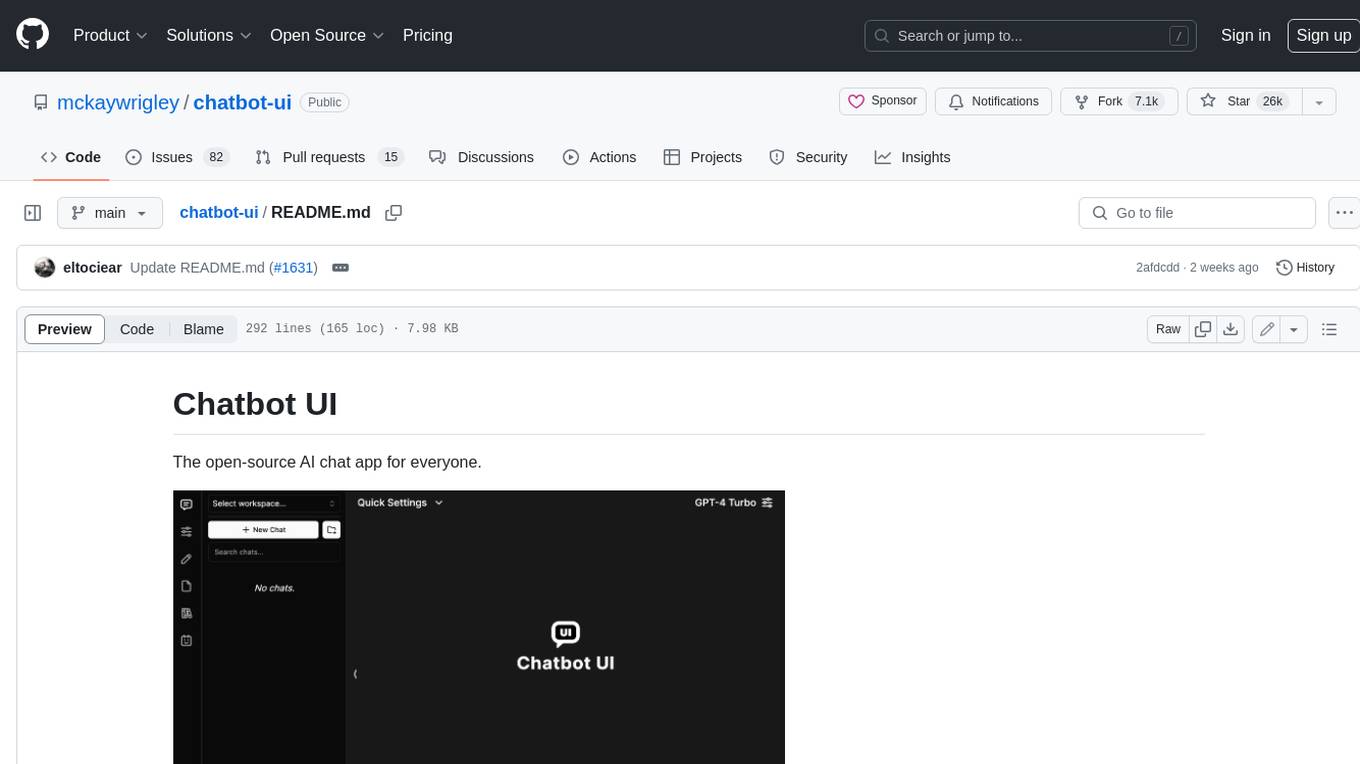
chatbot-ui
Chatbot UI is an open-source AI chat app that allows users to create and deploy their own AI chatbots. It is easy to use and can be customized to fit any need. Chatbot UI is perfect for businesses, developers, and anyone who wants to create a chatbot.
BricksLLM
BricksLLM is a cloud native AI gateway written in Go. Currently, it provides native support for OpenAI, Anthropic, Azure OpenAI and vLLM. BricksLLM aims to provide enterprise level infrastructure that can power any LLM production use cases. Here are some use cases for BricksLLM: * Set LLM usage limits for users on different pricing tiers * Track LLM usage on a per user and per organization basis * Block or redact requests containing PIIs * Improve LLM reliability with failovers, retries and caching * Distribute API keys with rate limits and cost limits for internal development/production use cases * Distribute API keys with rate limits and cost limits for students
uAgents
uAgents is a Python library developed by Fetch.ai that allows for the creation of autonomous AI agents. These agents can perform various tasks on a schedule or take action on various events. uAgents are easy to create and manage, and they are connected to a fast-growing network of other uAgents. They are also secure, with cryptographically secured messages and wallets.
griptape
Griptape is a modular Python framework for building AI-powered applications that securely connect to your enterprise data and APIs. It offers developers the ability to maintain control and flexibility at every step. Griptape's core components include Structures (Agents, Pipelines, and Workflows), Tasks, Tools, Memory (Conversation Memory, Task Memory, and Meta Memory), Drivers (Prompt and Embedding Drivers, Vector Store Drivers, Image Generation Drivers, Image Query Drivers, SQL Drivers, Web Scraper Drivers, and Conversation Memory Drivers), Engines (Query Engines, Extraction Engines, Summary Engines, Image Generation Engines, and Image Query Engines), and additional components (Rulesets, Loaders, Artifacts, Chunkers, and Tokenizers). Griptape enables developers to create AI-powered applications with ease and efficiency.