


denodo-ai-sdk
The Denodo AI SDK is an open-source software package that enables AI-powered application developers to develop and deploy their applications quickly, by streamlining all the data-related work in their development lifecycle enabling Denodo for higher AI accuracy and better performance.
Stars: 64
Denodo AI SDK is a tool that enables users to create AI chatbots and agents that provide accurate and context-aware answers using enterprise data. It connects to the Denodo Platform, supports popular LLMs and vector stores, and includes a sample chatbot and simple APIs for quick setup. The tool also offers benchmarks for evaluating LLM performance and provides guidance on configuring DeepQuery for different LLM providers.
README:

Denodo AI SDK helps you quickly build AI chatbots and agents that answer questions using your enterprise data, combining similarity search + LLMs for accurate, context-aware results.
It connects to the Denodo Platform, works with popular LLMs and vector stores, and ships with a ready-to-run sample chatbot and simple APIs to get started fast.
The complete user manual for the Denodo AI SDK is available here.
- A thinking model from either OpenAI/AWS Bedrock/Google Vertex (Not Ollama).
- An minimum allowance of minimum 50RPM OpenAI/AWS Bedrock/Google Vertex.
- Powerful thinking model with over 128k context length.
- Delete any previous vector store and virtual environment.
- Create a new virtual environment (
python -m venv venv), activate it (source venv/bin/activateor.\venv\Scripts\activate) and install the requirements.txt (python -m pip install -r requirements.txt)
Depending on your LLM provider, here's a guide on how to configure Denodo DeepQuery:
THINKING_PROVIDER=openai
THINKING_MODEL=o4-mini
THINKING_PROVIDER = bedrock
THINKING_MODEL = us.anthropic.claude-sonnet-4-20250514-v1:0

AWS_CLAUDE_THINKING = 1
AWS_CLAUDE_THINKING_TOKENS = 2048
Please note that AWS Bedrock requires the previously mentioned extra env variables in sdk_config.env to activate thinking.
THINKING_PROVIDER = google
THINKING_MODEL = gemini-2.5-pro

GOOGLE_THINKING = 1
GOOGLE_THINKING_TOKENS = 2048
Please note that Google requires the previously mentioned extra env variables in sdk_config.env to activate thinking.
We test our query-to-SQL pipeline on our propietary benchmark across the whole range of LLMs that we support. The benchmark dataset consists of 20+ questions in the finance sector. You may use this benchmark as reference to choose an LLM model.
Latest update: 03/31/2025 on AI SDK version 0.7
| LLM Provider | Model | 🎯 Accuracy | 🕒 LLM execution time (s) | 🔢 Input Tokens | 🔡 Output Tokens | 💰 Cost per Query |
|---|---|---|---|---|---|---|
| OpenAI | GPT-4o | 🟢 | 3.20 | 4,230 | 398 | $0.015 |
| OpenAI | GPT-4o Mini | 🟡 | 4.30 | 4,607 | 445 | $0.001 |
| OpenAI | o1 | 🟢 | 18.60 | 5,110 | 5,438 | $0.403 |
| OpenAI | o1-high | 🟢 | 28.21 | 3,755 | 6,220 | $0.429 |
| OpenAI | o1-low | 🟢 | 15.75 | 3,746 | 2,512 | $0.207 |
| OpenAI | o3-mini | 🟢 | 16.61 | 3,756 | 2,750 | $0.016 |
| OpenAI | o3-mini-high | 🟢 | 28.68 | 3,764 | 8,237 | $0.040 |
| OpenAI | o3-mini-low | 🟢 | 8.66 | 3,811 | 1,080 | $0.009 |
| OpenRouter | Amazon Nova Lite | 🟡 | 1.34 | 4,572 | 431 | <$0.001 |
| OpenRouter | Amazon Nova Micro | 🔴 | 1.29 | 5,788 | 668 | <$0.001 |
| OpenRouter | Amazon Nova Pro | 🟢 | 2.53 | 4,522 | 424 | $0.005 |
| OpenRouter | Claude 3.5 Haiku | 🟢 | 4.38 | 4,946 | 495 | $0.006 |
| OpenRouter | Claude 3.5 Sonnet | 🟢 | 5.02 | 4,569 | 435 | $0.020 |
| OpenRouter | Claude 3.7 Sonnet | 🟢 | 5.46 | 4,695 | 465 | $0.021 |
| OpenRouter | Deepseek R1 671b | 🟢 | 40.28 | 4,138 | 3,041 | $0.011 |
| OpenRouter | Deepseek v3 671b | 🟢 | 13.50 | 4,042 | 424 | $0.005 |
| OpenRouter | Deepseek v3.1 671b | 🟡 | 12.46 | 4,910 | 435 | $0.006 |
| OpenRouter | Llama 3.1 8b | 🔴 | 2.98 | 6,024 | 752 | <$0.001 |
| OpenRouter | Llama 3.1 Nemotron 70b | 🟡 | 9.76 | 5,110 | 892 | $0.001 |
| OpenRouter | Llama 3.3 70b | 🟡 | 10.46 | 4,681 | 402 | $0.001 |
| OpenRouter | Microsoft Phi-4 14b | 🟢 | 6.75 | 4,348 | 728 | <$0.001 |
| OpenRouter | Mistral Small 24b | 🟢 | 5.52 | 5,537 | 563 | <$0.001 |
| OpenRouter | Qwen 2.5 72b | 🟢 | 6.30 | 4,874 | 463 | $0.004 |
| Gemini 1.5 Flash | 🟡 | 2.18 | 4,230 | 398 | <$0.001 | |
| Gemini 1.5 Pro | 🟢 | 5.44 | 4,230 | 398 | $0.007 | |
| Gemini 2.0 Flash | 🟢 | 2.42 | 4,230 | 398 | $0.001 |
Please note that "Input Tokens" and "Output Tokens" is the average input/output tokens per query. Also, each color corresponds to the following range in terms of accuracy:
- 🟢 = 90%+
- 🟡 = 80–90%
- 🔴 = <80%
Finally, any model with its size in the name, i.e.: Llama 3.1 8b, represents an open-source model.
The Denodo AI SDK supports the following LLM providers:
- OpenAI
- AzureOpenAI
- Bedrock
- GoogleAIStudio
- Anthropic
- NVIDIA
- Groq
- Ollama
- Mistral
- SambaNova
- OpenRouter
Where Bedrock refers to AWS Bedrock, NVIDIA refers to NVIDIA NIM and Google refers to Google Vertex AI.
- OpenAI (text-embedding-3-large)
- AzureOpenAI (text-embedding-3-large)
- Bedrock (amazon.titan-embed-text-v2:0)
- Google (text-multilingual-embedding-002)
- Ollama (bge-m3)
- Mistral (mistral-embed)
- NVIDIA (baai/bge-m3)
- GoogleAIStudio (gemini-embedding-exp-03-07)
Where Bedrock refers to AWS Bedrock, NVIDIA refers to NVIDIA NIM and Google refers to Google Vertex AI.
Please see the file called LICENSE.
For Tasks:
Click tags to check more tools for each tasksFor Jobs:
Alternative AI tools for denodo-ai-sdk
Similar Open Source Tools
denodo-ai-sdk
Denodo AI SDK is a tool that enables users to create AI chatbots and agents that provide accurate and context-aware answers using enterprise data. It connects to the Denodo Platform, supports popular LLMs and vector stores, and includes a sample chatbot and simple APIs for quick setup. The tool also offers benchmarks for evaluating LLM performance and provides guidance on configuring DeepQuery for different LLM providers.
goodai-ltm-benchmark
This repository contains code and data for replicating experiments on Long-Term Memory (LTM) abilities of conversational agents. It includes a benchmark for testing agents' memory performance over long conversations, evaluating tasks requiring dynamic memory upkeep and information integration. The repository supports various models, datasets, and configurations for benchmarking and reporting results.
go-cyber
Cyber is a superintelligence protocol that aims to create a decentralized and censorship-resistant internet. It uses a novel consensus mechanism called CometBFT and a knowledge graph to store and process information. Cyber is designed to be scalable, secure, and efficient, and it has the potential to revolutionize the way we interact with the internet.
BizFinBench
BizFinBench is a benchmark tool designed for evaluating large language models (LLMs) in logic-heavy and precision-critical domains such as finance. It comprises over 100,000 bilingual financial questions rooted in real-world business scenarios. The tool covers five dimensions: numerical calculation, reasoning, information extraction, prediction recognition, and knowledge-based question answering, mapped to nine fine-grained categories. BizFinBench aims to assess the capacity of LLMs in real-world financial scenarios and provides insights into their strengths and limitations.
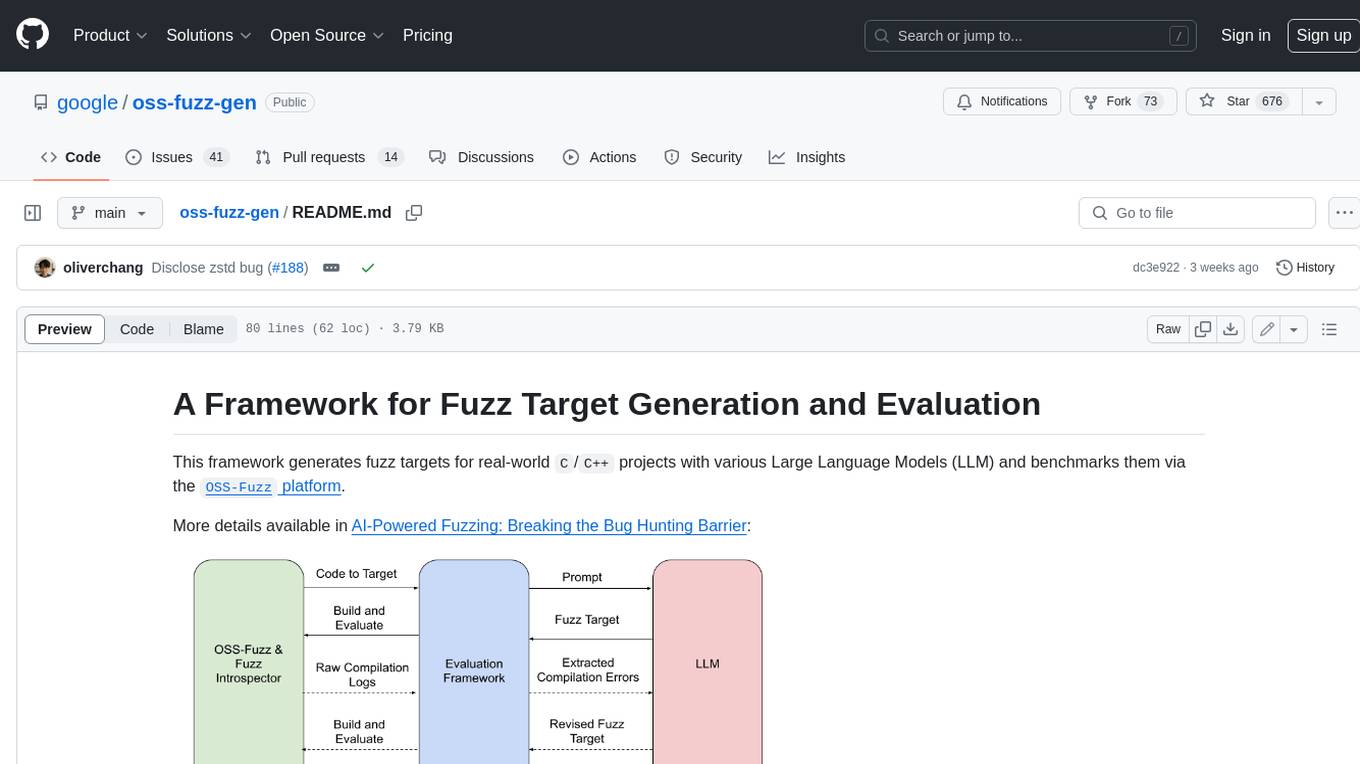
oss-fuzz-gen
This framework generates fuzz targets for real-world `C`/`C++` projects with various Large Language Models (LLM) and benchmarks them via the `OSS-Fuzz` platform. It manages to successfully leverage LLMs to generate valid fuzz targets (which generate non-zero coverage increase) for 160 C/C++ projects. The maximum line coverage increase is 29% from the existing human-written targets.
LLamaTuner
LLamaTuner is a repository for the Efficient Finetuning of Quantized LLMs project, focusing on building and sharing instruction-following Chinese baichuan-7b/LLaMA/Pythia/GLM model tuning methods. The project enables training on a single Nvidia RTX-2080TI and RTX-3090 for multi-round chatbot training. It utilizes bitsandbytes for quantization and is integrated with Huggingface's PEFT and transformers libraries. The repository supports various models, training approaches, and datasets for supervised fine-tuning, LoRA, QLoRA, and more. It also provides tools for data preprocessing and offers models in the Hugging Face model hub for inference and finetuning. The project is licensed under Apache 2.0 and acknowledges contributions from various open-source contributors.
nntrainer
NNtrainer is a software framework for training neural network models on devices with limited resources. It enables on-device fine-tuning of neural networks using user data for personalization. NNtrainer supports various machine learning algorithms and provides examples for tasks such as few-shot learning, ResNet, VGG, and product rating. It is optimized for embedded devices and utilizes CBLAS and CUBLAS for accelerated calculations. NNtrainer is open source and released under the Apache License version 2.0.
VoiceBench
VoiceBench is a repository containing code and data for benchmarking LLM-Based Voice Assistants. It includes a leaderboard with rankings of various voice assistant models based on different evaluation metrics. The repository provides setup instructions, datasets, evaluation procedures, and a curated list of awesome voice assistants. Users can submit new voice assistant results through the issue tracker for updates on the ranking list.
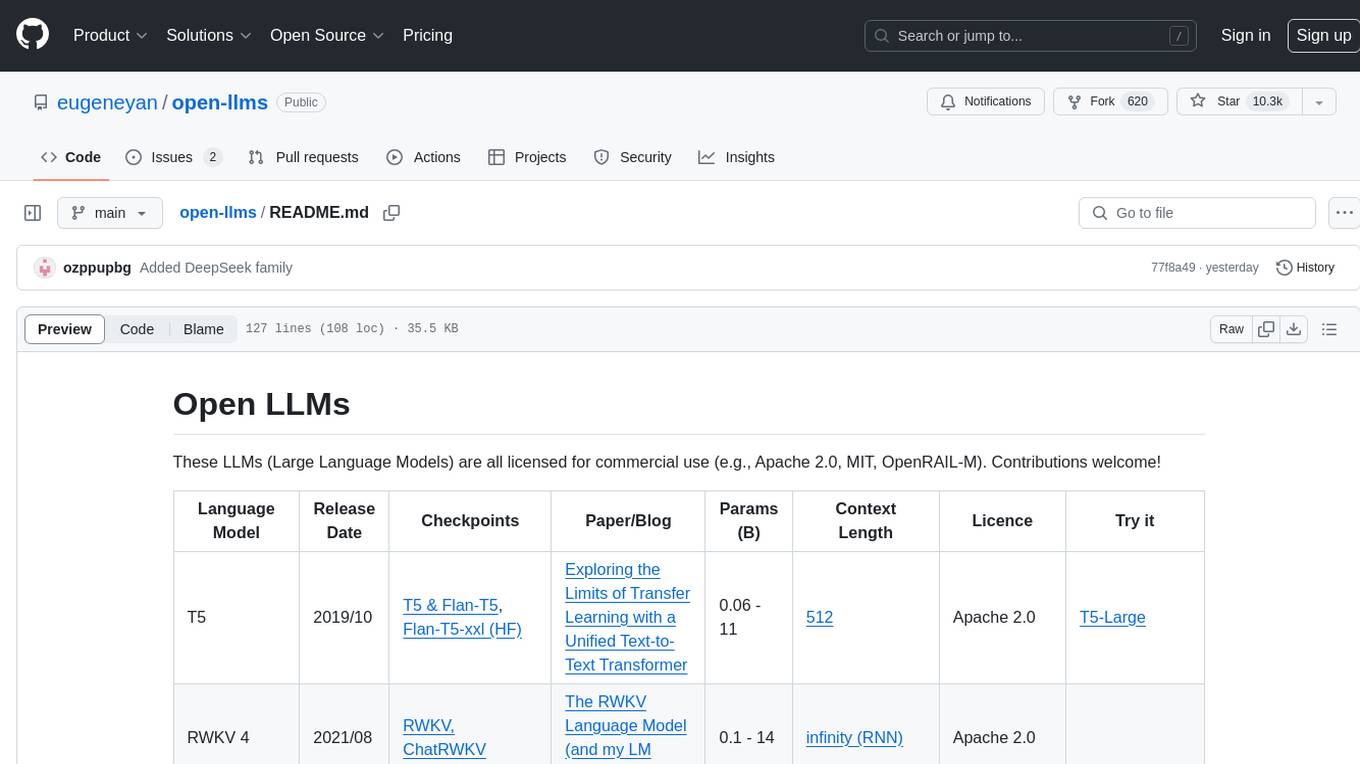
open-llms
Open LLMs is a repository containing various Large Language Models licensed for commercial use. It includes models like T5, GPT-NeoX, UL2, Bloom, Cerebras-GPT, Pythia, Dolly, and more. These models are designed for tasks such as transfer learning, language understanding, chatbot development, code generation, and more. The repository provides information on release dates, checkpoints, papers/blogs, parameters, context length, and licenses for each model. Contributions to the repository are welcome, and it serves as a resource for exploring the capabilities of different language models.
CogVLM2
CogVLM2 is a new generation of open source models that offer significant improvements in benchmarks such as TextVQA and DocVQA. It supports 8K content length, image resolution up to 1344 * 1344, and both Chinese and English languages. The project provides basic calling methods, fine-tuning examples, and OpenAI API format calling examples to help developers quickly get started with the model.
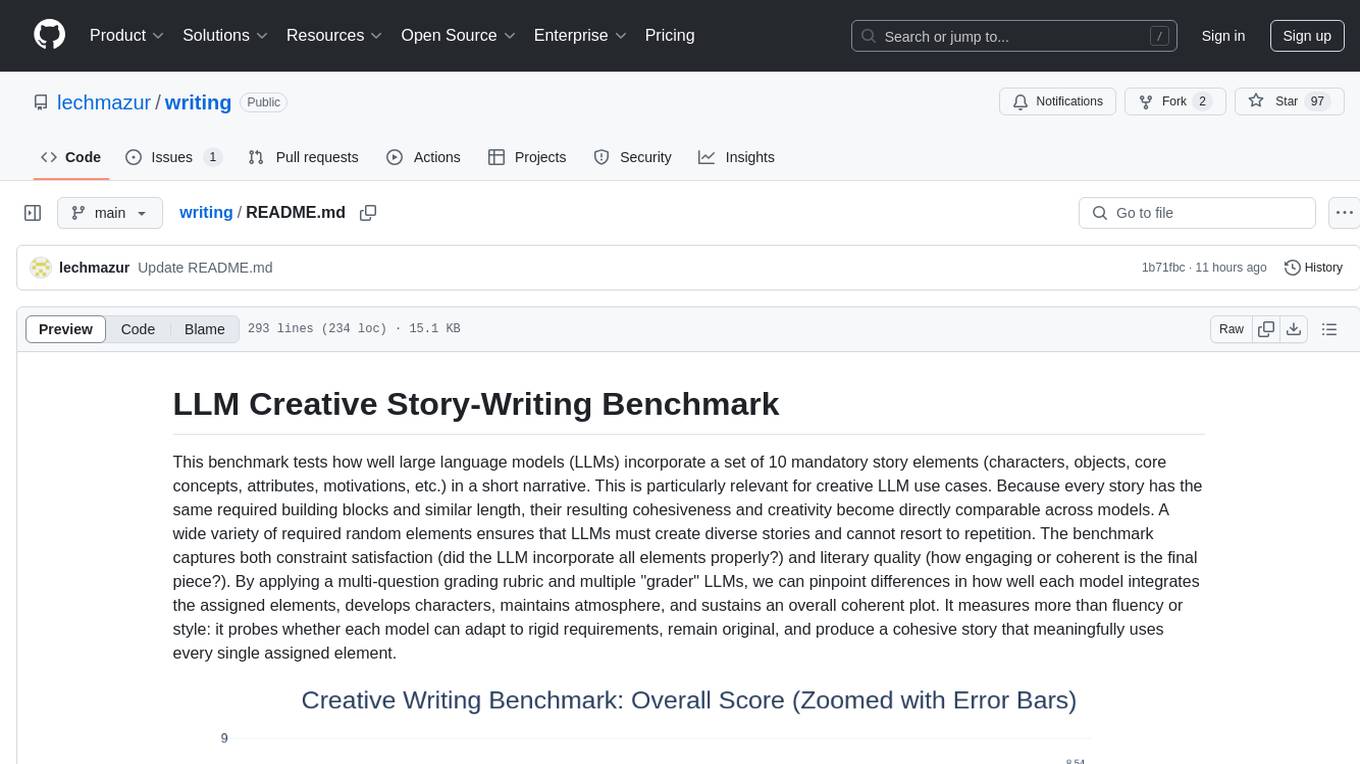
writing
The LLM Creative Story-Writing Benchmark evaluates large language models based on their ability to incorporate a set of 10 mandatory story elements in a short narrative. It measures constraint satisfaction and literary quality by grading models on character development, plot structure, atmosphere, storytelling impact, authenticity, and execution. The benchmark aims to assess how well models can adapt to rigid requirements, remain original, and produce cohesive stories using all assigned elements.
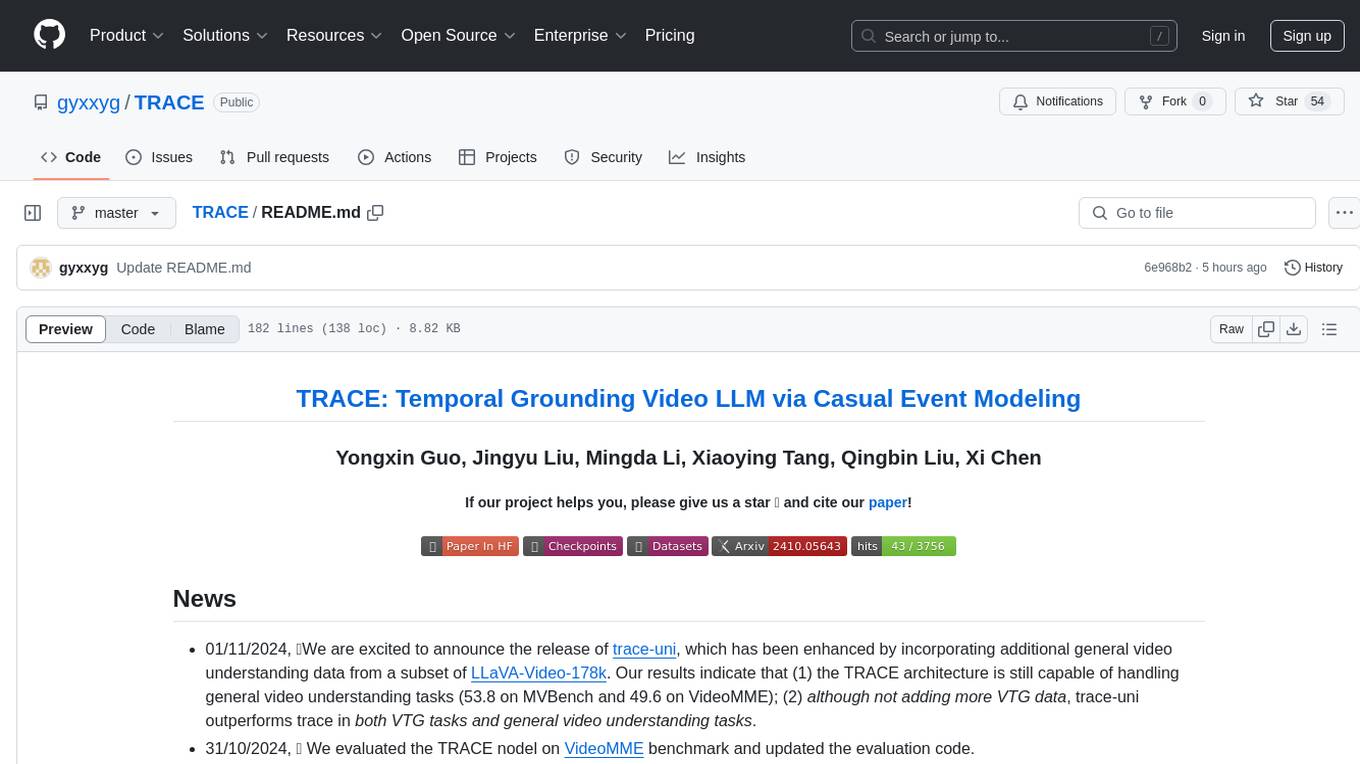
TRACE
TRACE is a temporal grounding video model that utilizes causal event modeling to capture videos' inherent structure. It presents a task-interleaved video LLM model tailored for sequential encoding/decoding of timestamps, salient scores, and textual captions. The project includes various model checkpoints for different stages and fine-tuning on specific datasets. It provides evaluation codes for different tasks like VTG, MVBench, and VideoMME. The repository also offers annotation files and links to raw videos preparation projects. Users can train the model on different tasks and evaluate the performance based on metrics like CIDER, METEOR, SODA_c, F1, mAP, Hit@1, etc. TRACE has been enhanced with trace-retrieval and trace-uni models, showing improved performance on dense video captioning and general video understanding tasks.
are-copilots-local-yet
Current trends and state of the art for using open & local LLM models as copilots to complete code, generate projects, act as shell assistants, automatically fix bugs, and more. This document is a curated list of local Copilots, shell assistants, and related projects, intended to be a resource for those interested in a survey of the existing tools and to help developers discover the state of the art for projects like these.
flute
FLUTE (Flexible Lookup Table Engine for LUT-quantized LLMs) is a tool designed for uniform quantization and lookup table quantization of weights in lower-precision intervals. It offers flexibility in mapping intervals to arbitrary values through a lookup table. FLUTE supports various quantization formats such as int4, int3, int2, fp4, fp3, fp2, nf4, nf3, nf2, and even custom tables. The tool also introduces new quantization algorithms like Learned Normal Float (NFL) for improved performance and calibration data learning. FLUTE provides benchmarks, model zoo, and integration with frameworks like vLLM and HuggingFace for easy deployment and usage.
inference-speed-tests
This repository contains inference speed tests on Local Large Language Models on various devices. It provides results for different models tested on Macbook Pro and Mac Studio. Users can contribute their own results by running models with the provided prompt and adding the tokens-per-second output. Note that the results are not verified.
LightMem
LightMem is a lightweight and efficient memory management framework designed for Large Language Models and AI Agents. It provides a simple yet powerful memory storage, retrieval, and update mechanism to help you quickly build intelligent applications with long-term memory capabilities. The framework is minimalist in design, ensuring minimal resource consumption and fast response times. It offers a simple API for easy integration into applications with just a few lines of code. LightMem's modular architecture supports custom storage engines and retrieval strategies, making it flexible and extensible. It is compatible with various cloud APIs like OpenAI and DeepSeek, as well as local models such as Ollama and vLLM.
For similar tasks
LLMStack
LLMStack is a no-code platform for building generative AI agents, workflows, and chatbots. It allows users to connect their own data, internal tools, and GPT-powered models without any coding experience. LLMStack can be deployed to the cloud or on-premise and can be accessed via HTTP API or triggered from Slack or Discord.
ai-guide
This guide is dedicated to Large Language Models (LLMs) that you can run on your home computer. It assumes your PC is a lower-end, non-gaming setup.
onnxruntime-genai
ONNX Runtime Generative AI is a library that provides the generative AI loop for ONNX models, including inference with ONNX Runtime, logits processing, search and sampling, and KV cache management. Users can call a high level `generate()` method, or run each iteration of the model in a loop. It supports greedy/beam search and TopP, TopK sampling to generate token sequences, has built in logits processing like repetition penalties, and allows for easy custom scoring.

jupyter-ai
Jupyter AI connects generative AI with Jupyter notebooks. It provides a user-friendly and powerful way to explore generative AI models in notebooks and improve your productivity in JupyterLab and the Jupyter Notebook. Specifically, Jupyter AI offers: * An `%%ai` magic that turns the Jupyter notebook into a reproducible generative AI playground. This works anywhere the IPython kernel runs (JupyterLab, Jupyter Notebook, Google Colab, Kaggle, VSCode, etc.). * A native chat UI in JupyterLab that enables you to work with generative AI as a conversational assistant. * Support for a wide range of generative model providers, including AI21, Anthropic, AWS, Cohere, Gemini, Hugging Face, NVIDIA, and OpenAI. * Local model support through GPT4All, enabling use of generative AI models on consumer grade machines with ease and privacy.
khoj
Khoj is an open-source, personal AI assistant that extends your capabilities by creating always-available AI agents. You can share your notes and documents to extend your digital brain, and your AI agents have access to the internet, allowing you to incorporate real-time information. Khoj is accessible on Desktop, Emacs, Obsidian, Web, and Whatsapp, and you can share PDF, markdown, org-mode, notion files, and GitHub repositories. You'll get fast, accurate semantic search on top of your docs, and your agents can create deeply personal images and understand your speech. Khoj is self-hostable and always will be.
langchain_dart
LangChain.dart is a Dart port of the popular LangChain Python framework created by Harrison Chase. LangChain provides a set of ready-to-use components for working with language models and a standard interface for chaining them together to formulate more advanced use cases (e.g. chatbots, Q&A with RAG, agents, summarization, extraction, etc.). The components can be grouped into a few core modules: * **Model I/O:** LangChain offers a unified API for interacting with various LLM providers (e.g. OpenAI, Google, Mistral, Ollama, etc.), allowing developers to switch between them with ease. Additionally, it provides tools for managing model inputs (prompt templates and example selectors) and parsing the resulting model outputs (output parsers). * **Retrieval:** assists in loading user data (via document loaders), transforming it (with text splitters), extracting its meaning (using embedding models), storing (in vector stores) and retrieving it (through retrievers) so that it can be used to ground the model's responses (i.e. Retrieval-Augmented Generation or RAG). * **Agents:** "bots" that leverage LLMs to make informed decisions about which available tools (such as web search, calculators, database lookup, etc.) to use to accomplish the designated task. The different components can be composed together using the LangChain Expression Language (LCEL).
danswer
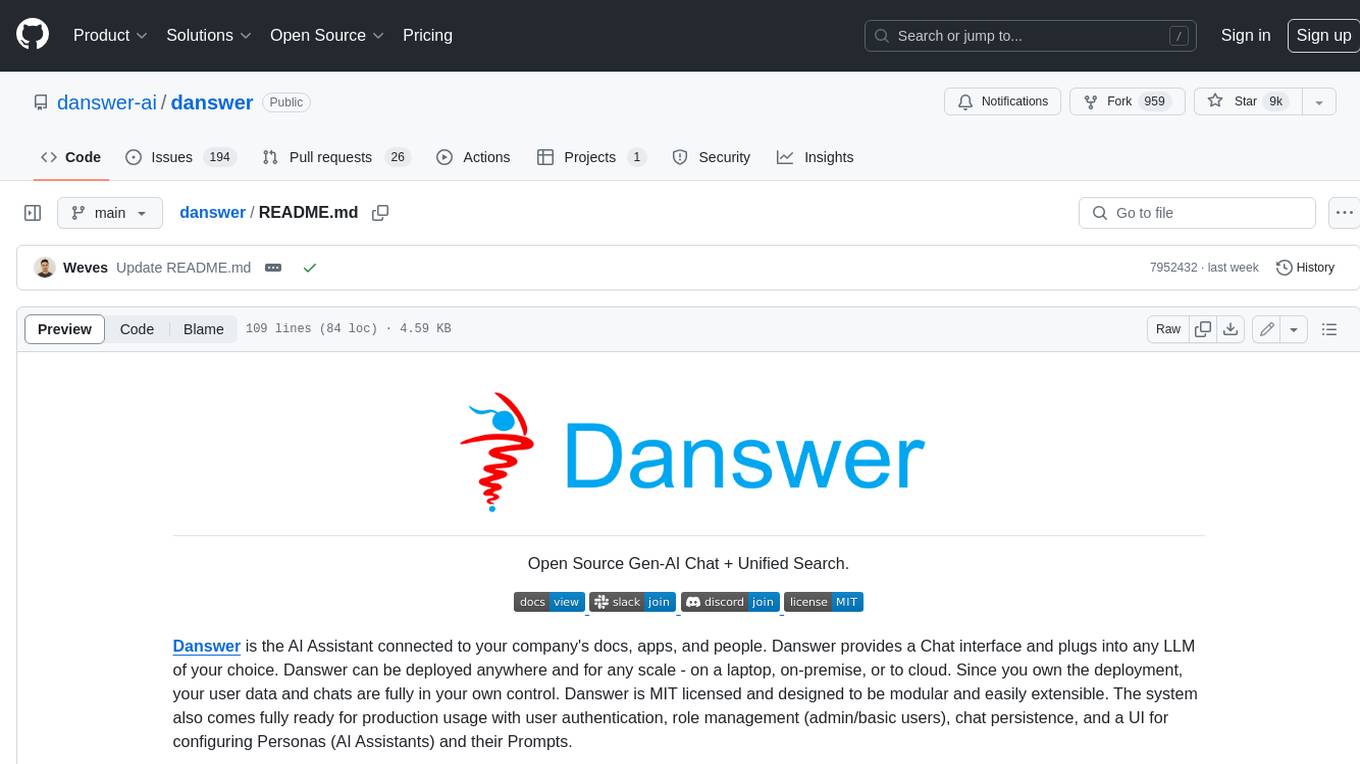
Danswer is an open-source Gen-AI Chat and Unified Search tool that connects to your company's docs, apps, and people. It provides a Chat interface and plugs into any LLM of your choice. Danswer can be deployed anywhere and for any scale - on a laptop, on-premise, or to cloud. Since you own the deployment, your user data and chats are fully in your own control. Danswer is MIT licensed and designed to be modular and easily extensible. The system also comes fully ready for production usage with user authentication, role management (admin/basic users), chat persistence, and a UI for configuring Personas (AI Assistants) and their Prompts. Danswer also serves as a Unified Search across all common workplace tools such as Slack, Google Drive, Confluence, etc. By combining LLMs and team specific knowledge, Danswer becomes a subject matter expert for the team. Imagine ChatGPT if it had access to your team's unique knowledge! It enables questions such as "A customer wants feature X, is this already supported?" or "Where's the pull request for feature Y?"

infinity
Infinity is an AI-native database designed for LLM applications, providing incredibly fast full-text and vector search capabilities. It supports a wide range of data types, including vectors, full-text, and structured data, and offers a fused search feature that combines multiple embeddings and full text. Infinity is easy to use, with an intuitive Python API and a single-binary architecture that simplifies deployment. It achieves high performance, with 0.1 milliseconds query latency on million-scale vector datasets and up to 15K QPS.
For similar jobs
sweep
Sweep is an AI junior developer that turns bugs and feature requests into code changes. It automatically handles developer experience improvements like adding type hints and improving test coverage.
teams-ai
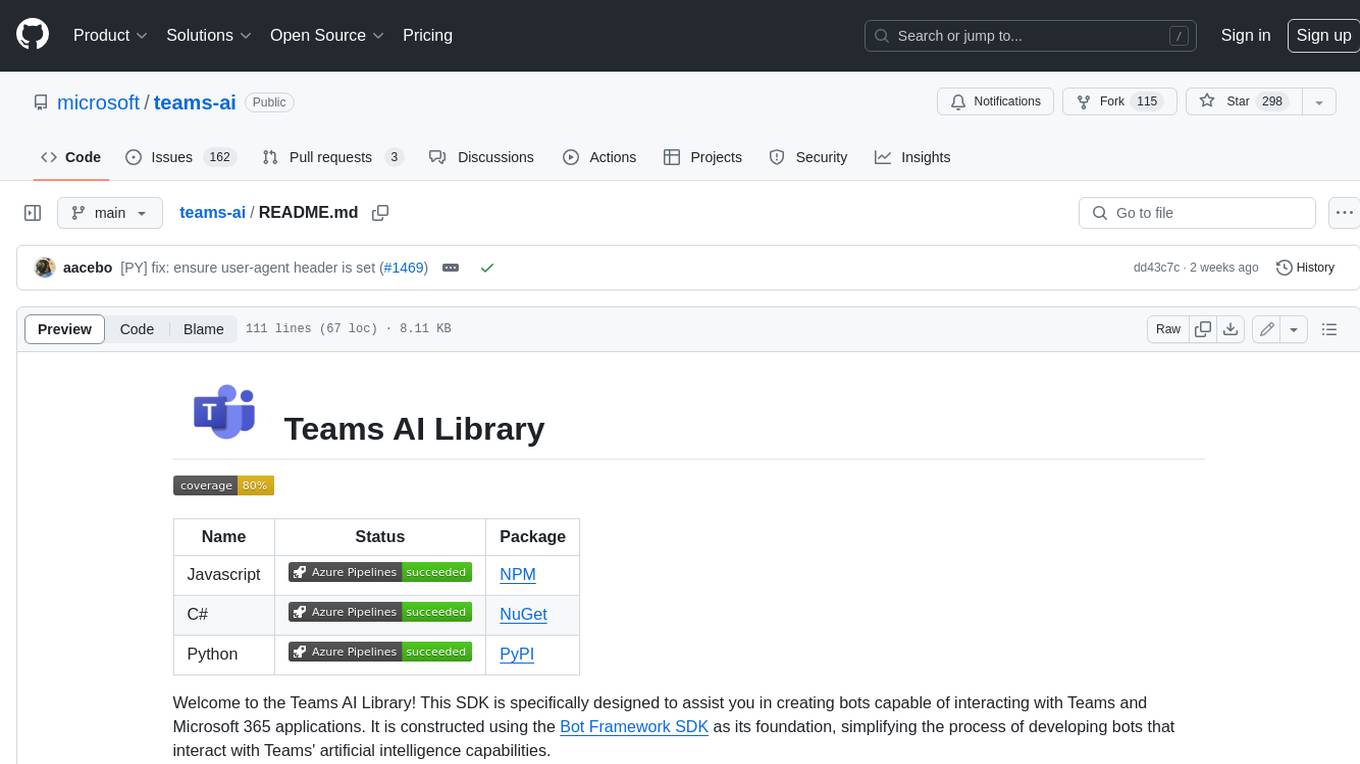
The Teams AI Library is a software development kit (SDK) that helps developers create bots that can interact with Teams and Microsoft 365 applications. It is built on top of the Bot Framework SDK and simplifies the process of developing bots that interact with Teams' artificial intelligence capabilities. The SDK is available for JavaScript/TypeScript, .NET, and Python.
ai-guide
This guide is dedicated to Large Language Models (LLMs) that you can run on your home computer. It assumes your PC is a lower-end, non-gaming setup.
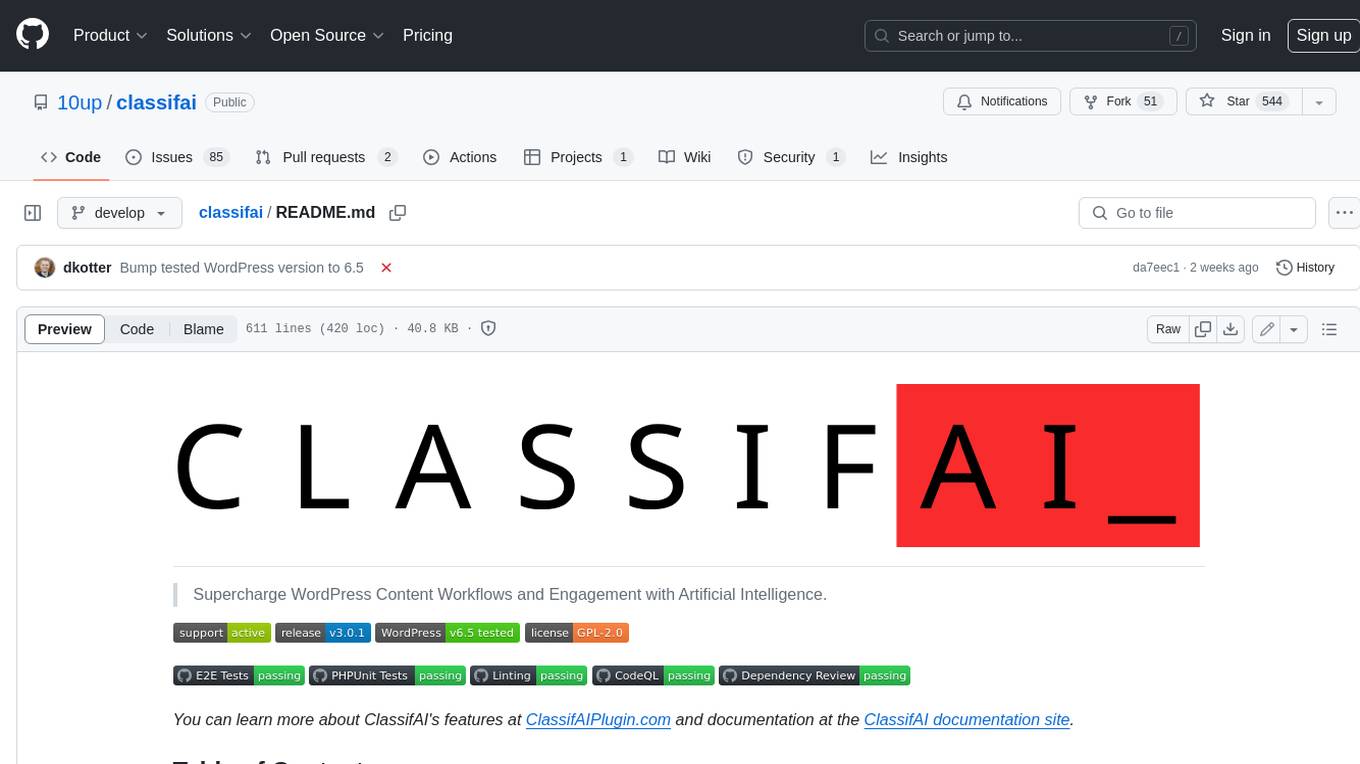
classifai
Supercharge WordPress Content Workflows and Engagement with Artificial Intelligence. Tap into leading cloud-based services like OpenAI, Microsoft Azure AI, Google Gemini and IBM Watson to augment your WordPress-powered websites. Publish content faster while improving SEO performance and increasing audience engagement. ClassifAI integrates Artificial Intelligence and Machine Learning technologies to lighten your workload and eliminate tedious tasks, giving you more time to create original content that matters.
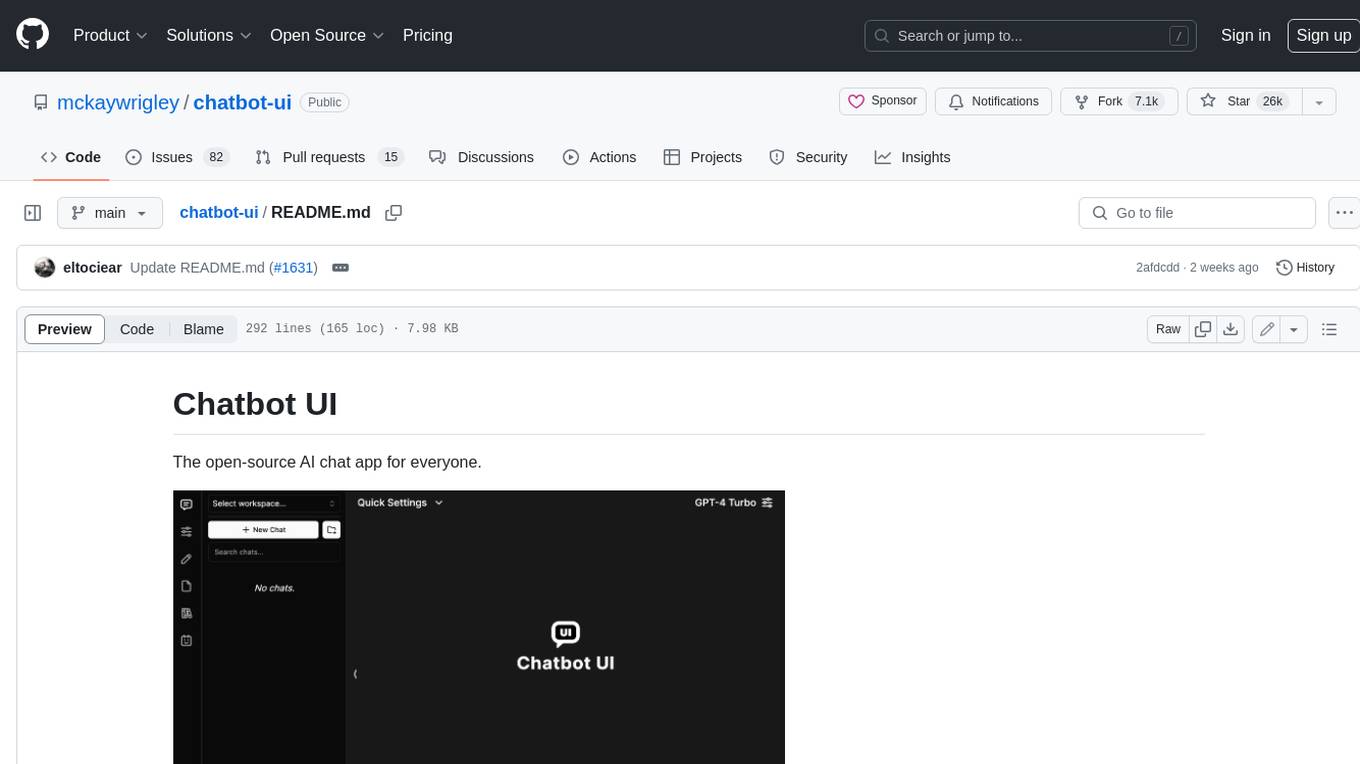
chatbot-ui
Chatbot UI is an open-source AI chat app that allows users to create and deploy their own AI chatbots. It is easy to use and can be customized to fit any need. Chatbot UI is perfect for businesses, developers, and anyone who wants to create a chatbot.
BricksLLM
BricksLLM is a cloud native AI gateway written in Go. Currently, it provides native support for OpenAI, Anthropic, Azure OpenAI and vLLM. BricksLLM aims to provide enterprise level infrastructure that can power any LLM production use cases. Here are some use cases for BricksLLM: * Set LLM usage limits for users on different pricing tiers * Track LLM usage on a per user and per organization basis * Block or redact requests containing PIIs * Improve LLM reliability with failovers, retries and caching * Distribute API keys with rate limits and cost limits for internal development/production use cases * Distribute API keys with rate limits and cost limits for students
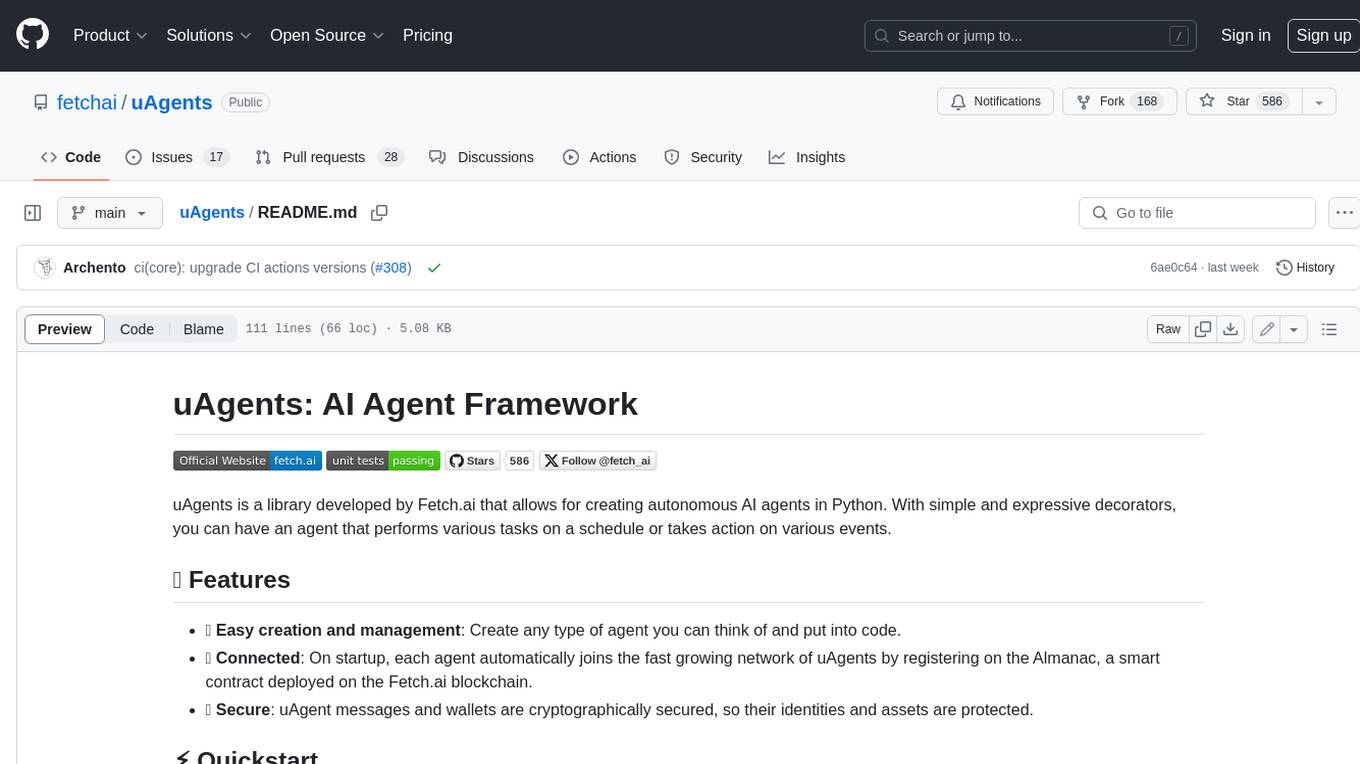
uAgents
uAgents is a Python library developed by Fetch.ai that allows for the creation of autonomous AI agents. These agents can perform various tasks on a schedule or take action on various events. uAgents are easy to create and manage, and they are connected to a fast-growing network of other uAgents. They are also secure, with cryptographically secured messages and wallets.
griptape
Griptape is a modular Python framework for building AI-powered applications that securely connect to your enterprise data and APIs. It offers developers the ability to maintain control and flexibility at every step. Griptape's core components include Structures (Agents, Pipelines, and Workflows), Tasks, Tools, Memory (Conversation Memory, Task Memory, and Meta Memory), Drivers (Prompt and Embedding Drivers, Vector Store Drivers, Image Generation Drivers, Image Query Drivers, SQL Drivers, Web Scraper Drivers, and Conversation Memory Drivers), Engines (Query Engines, Extraction Engines, Summary Engines, Image Generation Engines, and Image Query Engines), and additional components (Rulesets, Loaders, Artifacts, Chunkers, and Tokenizers). Griptape enables developers to create AI-powered applications with ease and efficiency.