


chronicle
A project to provide the simplest, self hosted route to get "I want AI to help me by passively observing me"
Stars: 56
Chronicle is a self-hostable AI system that captures audio/video data from OMI devices and other sources to generate memories, action items, and contextual insights about conversations and daily interactions. It includes a mobile app for OMI devices, backend services with AI features, a web dashboard for conversation and memory management, and optional services like speaker recognition and offline ASR. The project aims to provide a system that records personal spoken context and visual context to generate memories, action items, and enable home automation.
README:
Self-hostable AI system that captures audio/video data from OMI devices and other sources to generate memories, action items, and contextual insights about your conversations and daily interactions.
Quick Start → Get Started
Run setup wizard, start services, access at http://localhost:5173


[Mobile App - Screenshot coming soon]

- Mobile app for OMI devices via Bluetooth
- Backend services (simple → advanced with full AI features)
- Web dashboard for conversation and memory management
- Optional services: Speaker recognition, offline ASR, distributed deployment
- 📚 Setup Guide - Start here
- 🔧 Full Documentation - Comprehensive reference
- 🏗️ Project Overview - Architecture and vision
- 🐳 Docker/K8s - Container deployment
chronicle/
├── app/                     # React Native mobile app
│   ├── app/                # App components and screens
│   └── plugins/            # Expo plugins
├── backends/
│   ├── advanced/           # Main AI backend (FastAPI)
│   │   ├── src/           # Backend source code
│   │   ├── init.py        # Interactive setup wizard
│   │   └── docker-compose.yml
│   ├── simple/            # Basic backend implementation
│   └── other-backends/    # Example implementations
├── extras/
│   ├── speaker-recognition/  # Voice identification service
│   ├── asr-services/        # Offline speech-to-text (Parakeet)
│   └── openmemory-mcp/      # External memory server
├── Docs/                   # Technical documentation
├── config/                 # Central configuration files
├── tests/                  # Integration & unit tests
├── wizard.py              # Root setup orchestrator
├── services.py            # Service lifecycle manager
└── *.sh                   # Convenience scripts (wrappers)
┌─────────────────────────────────────────────────────────┐
│                    Chronicle System                      │
├─────────────────────────────────────────────────────────┤
│                                                           │
│  ┌──────────────┐    ┌──────────────┐   ┌────────────┐ │
│  │ Mobile App   │◄──►│   Backend    │◄─►│  MongoDB   │ │
│  │ (React       │    │   (FastAPI)  │   │            │ │
│  │  Native)     │    │              │   └────────────┘ │
│  └──────────────┘    └──────────────┘                   │
│                            │                             │
│                            ▼                             │
│       ┌────────────────────┴────────────────┐          │
│       │                                     │          │
│  ┌────▼─────┐  ┌───────────┐  ┌──────────▼──┐        │
│  │ Deepgram │  │  OpenAI   │  │   Qdrant    │        │
│  │   STT    │  │   LLM     │  │  (Vector    │        │
│  │          │  │           │  │   Store)    │        │
│  └──────────┘  └───────────┘  └─────────────┘        │
│                                                         │
│  Optional Services:                                     │
│  ┌──────────────┐  ┌──────────────┐  ┌─────────────┐ │
│  │  Speaker     │  │  Parakeet    │  │  Ollama     │ │
│  │  Recognition │  │  (Local ASR) │  │  (Local     │ │
│  │              │  │              │  │   LLM)      │ │
│  └──────────────┘  └──────────────┘  └─────────────┘ │
└─────────────────────────────────────────────────────────┘
# Interactive setup wizard (recommended for first-time users)
./wizard.sh

# Full command (what the script wraps)
uv run --with-requirements setup-requirements.txt python wizard.pyNote: Convenience scripts (*.sh) are wrappers around wizard.py and services.py that simplify the longer uv run commands.
# Start all configured services
./start.sh

# Restart all services (preserves containers)
./restart.sh

# Check service status
./status.sh

# Stop all services
./stop.sh
Full commands (click to expand)
# What the convenience scripts wrap
uv run --with-requirements setup-requirements.txt python services.py start --all --build
uv run --with-requirements setup-requirements.txt python services.py restart --all
uv run --with-requirements setup-requirements.txt python services.py status
uv run --with-requirements setup-requirements.txt python services.py stop --all# Backend development
cd backends/advanced
uv run python src/main.py
# Run tests
./run-test.sh
# Mobile app
cd app
npm start# Backend health
curl http://localhost:8000/health
# Web dashboard
open http://localhost:5173This fits as a small part of the larger idea of "Have various sensors feeding the state of YOUR world to computers/AI and get some use out of it"
Usecases are numerous - OMI Mentor is one of them. Friend/Omi/pendants are a small but important part of this, since they record personal spoken context the best. OMI-like devices with a camera can also capture visual context - or smart glasses - which also double as a display.
Regardless - this repo will try to do the minimal of this - multiple OMI-like audio devices feeding audio data - and from it:
- Memories
- Action items
- Home automation
- Action items detection (partial implementation)
- Home automation integration (planned)
- Multi-device coordination (planned)
- Visual context capture (smart glasses integration planned)
For Tasks:
Click tags to check more tools for each tasksFor Jobs:
Alternative AI tools for chronicle
Similar Open Source Tools
chronicle
Chronicle is a self-hostable AI system that captures audio/video data from OMI devices and other sources to generate memories, action items, and contextual insights about conversations and daily interactions. It includes a mobile app for OMI devices, backend services with AI features, a web dashboard for conversation and memory management, and optional services like speaker recognition and offline ASR. The project aims to provide a system that records personal spoken context and visual context to generate memories, action items, and enable home automation.
bumpgen
bumpgen is a tool designed to automatically upgrade TypeScript / TSX dependencies and make necessary code changes to handle any breaking issues that may arise. It uses an abstract syntax tree to analyze code relationships, type definitions for external methods, and a plan graph DAG to execute changes in the correct order. The tool is currently limited to TypeScript and TSX but plans to support other strongly typed languages in the future. It aims to simplify the process of upgrading dependencies and handling code changes caused by updates.
Agentic-ADK
Agentic ADK is an Agent application development framework launched by Alibaba International AI Business, based on Google-ADK and Ali-LangEngine. It is used for developing, constructing, evaluating, and deploying powerful, flexible, and controllable complex AI Agents. ADK aims to make Agent development simpler and more user-friendly, enabling developers to more easily build, deploy, and orchestrate various Agent applications ranging from simple tasks to complex collaborations.
observers
Observers is a lightweight library for AI observability that provides support for various generative AI APIs and storage backends. It allows users to track interactions with AI models and sync observations to different storage systems. The library supports OpenAI, Hugging Face transformers, AISuite, Litellm, and Docling for document parsing and export. Users can configure different stores such as Hugging Face Datasets, DuckDB, Argilla, and OpenTelemetry to manage and query their observations. Observers is designed to enhance AI model monitoring and observability in a user-friendly manner.
aiohomematic
AIO Homematic (hahomematic) is a lightweight Python 3 library for controlling and monitoring HomeMatic and HomematicIP devices, with support for third-party devices/gateways. It automatically creates entities for device parameters, offers custom entity classes for complex behavior, and includes features like caching paramsets for faster restarts. Designed to integrate with Home Assistant, it requires specific firmware versions for HomematicIP devices. The public API is defined in modules like central, client, model, exceptions, and const, with example usage provided. Useful links include changelog, data point definitions, troubleshooting, and developer resources for architecture, data flow, model extension, and Home Assistant lifecycle.
osmedeus
Osmedeus is a security-focused declarative orchestration engine that simplifies complex workflow automation into auditable YAML definitions. It provides powerful automation capabilities without compromising infrastructure integrity and safety. With features like declarative YAML workflows, multiple runners, event-driven triggers, template engine, utility functions, REST API server, distributed execution, notifications, cloud storage, AI integration, SAST integration, language detection, and preset installations, Osmedeus offers a comprehensive solution for security automation tasks.
kweaver
KWeaver is an open-source ecosystem for building, deploying, and running decision intelligence AI applications. It adopts ontology as the core methodology for business knowledge networks, with DIP as the core platform, aiming to provide elastic, agile, and reliable enterprise-grade decision intelligence to further unleash productivity. The DIP platform includes key subsystems such as ADP, Decision Agent, DIP Studio, and AI Store.
giztoy
Giztoy is a multi-language framework designed for building AI toys and intelligent applications. It provides a unified abstraction layer that spans from resource-constrained embedded systems to powerful cloud services. With features like native support for ESP32 and other MCUs, cross-platform app development, a unified build system with Bazel, an agent framework for AI agents, audio processing capabilities, support for various Large Language Models, real-time models with WebSocket streaming, secure transport protocols, and multi-language implementations in Go, Rust, Zig, and C/C++, Giztoy serves as a versatile tool for developing AI-powered applications across different platforms and devices.
ai-on-gke
This repository contains assets related to AI/ML workloads on Google Kubernetes Engine (GKE). Run optimized AI/ML workloads with Google Kubernetes Engine (GKE) platform orchestration capabilities. A robust AI/ML platform considers the following layers: Infrastructure orchestration that support GPUs and TPUs for training and serving workloads at scale Flexible integration with distributed computing and data processing frameworks Support for multiple teams on the same infrastructure to maximize utilization of resources
auto-paper-digest
Auto Paper Digest (APD) is a tool designed to automatically fetch cutting-edge AI research papers, download PDFs, generate video explanations, and publish them on platforms like HuggingFace, Douyin, and portal websites. It provides functionalities such as fetching papers from Hugging Face, downloading PDFs from arXiv, generating videos using NotebookLM, automatic publishing to HuggingFace Dataset, automatic publishing to Douyin, and hosting videos on a Gradio portal website. The tool also supports resuming interrupted tasks, persistent login states for Google and Douyin, and a structured workflow divided into three phases: Upload, Download, and Publish.
memsearch
Memsearch is a tool that allows users to give their AI agents persistent memory in a few lines of code. It enables users to write memories as markdown and search them semantically. Inspired by OpenClaw's markdown-first memory architecture, Memsearch is pluggable into any agent framework. The tool offers features like smart deduplication, live sync, and a ready-made Claude Code plugin for building agent memory.
vibium
Vibium is a browser automation infrastructure designed for AI agents, providing a single binary that manages browser lifecycle, WebDriver BiDi protocol, and an MCP server. It offers zero configuration, AI-native capabilities, and is lightweight with no runtime dependencies. It is suitable for AI agents, test automation, and any tasks requiring browser interaction.
lanhu-mcp
Lanhu MCP Server is a powerful Model Context Protocol (MCP) server designed for the AI programming era, perfectly supporting the Lanhu design collaboration platform. It offers features like intelligent requirement analysis, team knowledge base, UI design support, and performance optimization. The server is suitable for Cursor + Lanhu, Windsurf + Lanhu, Claude Code + Lanhu, Trae + Lanhu, and Cline + Lanhu integrations. It aims to break the isolation of AI IDEs and enable all AI assistants to share knowledge and context.
boxlite
BoxLite is an embedded, lightweight micro-VM runtime designed for AI agents running OCI containers with hardware-level isolation. It is built for high concurrency with no daemon required, offering features like lightweight VMs, high concurrency, hardware isolation, embeddability, and OCI compatibility. Users can spin up 'Boxes' to run containers for AI agent sandboxes and multi-tenant code execution scenarios where Docker alone is insufficient and full VM infrastructure is too heavy. BoxLite supports Python, Node.js, and Rust with quick start guides for each, along with features like CPU/memory limits, storage options, networking capabilities, security layers, and image registry configuration. The tool provides SDKs for Python and Node.js, with Go support coming soon. It offers detailed documentation, examples, and architecture insights for users to understand how BoxLite works under the hood.
Autopilot-Notes
Autopilot Notes is an open-source knowledge base for systematically learning autonomous driving technology. It covers basic theory, hardware, algorithms, tools, and practical engineering practices across 10+ chapters. The repository provides daily updates on industry trends, in-depth analysis of mainstream solutions like Tesla, Baidu Apollo, and Openpilot, and hands-on content including simulation, deployment, and optimization. Contributors are welcome to submit pull requests to improve the documentation.
anythingllm-docs
anythingllm-docs is a documentation repository for the AnythingLLM project. It contains detailed guides, setup instructions, and information on features and legal aspects of the project. The repository structure is organized into public, pages, components, and configuration files. Users can contribute by creating issues and pull requests following specific guidelines. The project is licensed under the MIT License and has been migrated to NextJS with the help of @ShadowArcanist.
For similar tasks
chronicle
Chronicle is a self-hostable AI system that captures audio/video data from OMI devices and other sources to generate memories, action items, and contextual insights about conversations and daily interactions. It includes a mobile app for OMI devices, backend services with AI features, a web dashboard for conversation and memory management, and optional services like speaker recognition and offline ASR. The project aims to provide a system that records personal spoken context and visual context to generate memories, action items, and enable home automation.
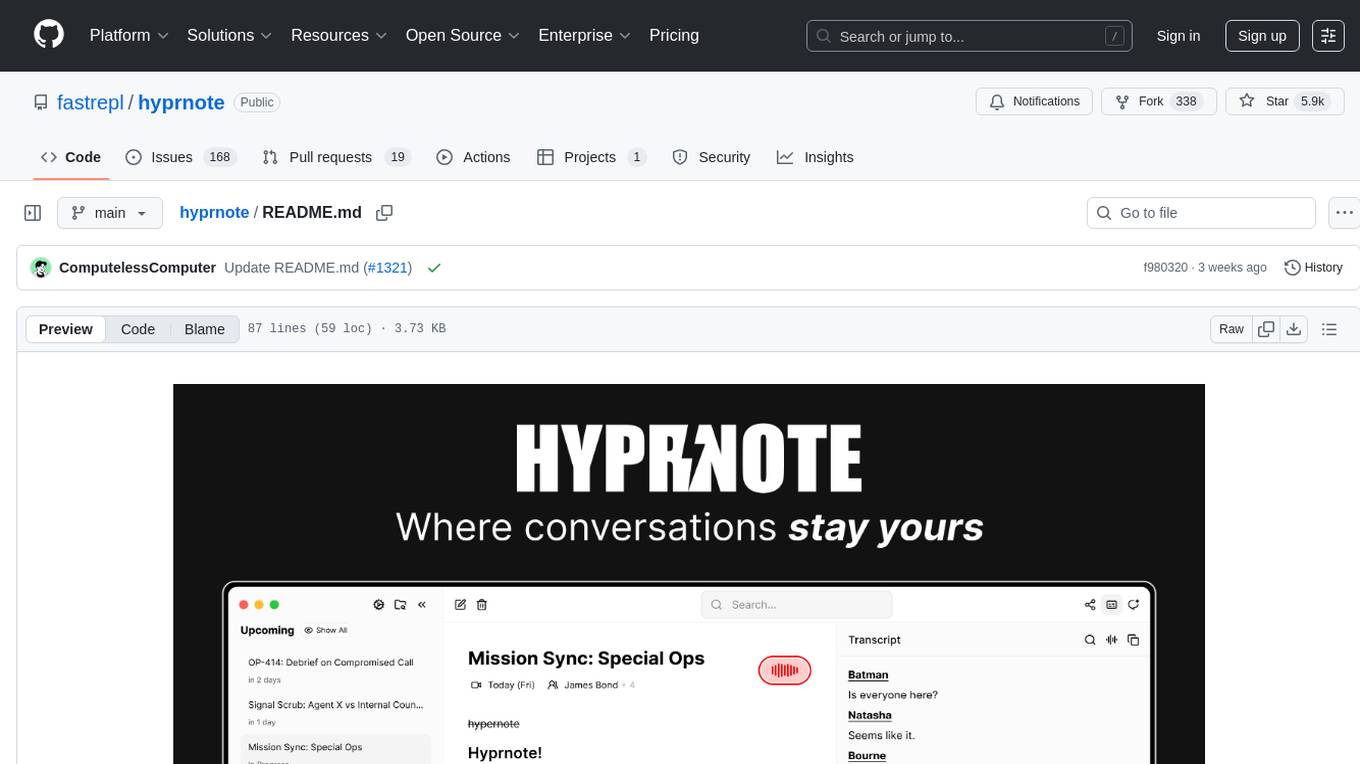
hyprnote
Hyprnote is a local-first AI notepad designed for people in back-to-back meetings. It listens to your meetings while you write, crafts smart summaries based on your quick notes, and runs completely offline using open-source models like Whisper or HyprLLM. With Hyprnote, users can have full control over their notes as not a single byte of data leaves their laptop/server.
hugging-chat-api
Unofficial HuggingChat Python API for creating chatbots, supporting features like image generation, web search, memorizing context, and changing LLMs. Users can log in, chat with the ChatBot, perform web searches, create new conversations, manage conversations, switch models, get conversation info, use assistants, and delete conversations. The API also includes a CLI mode with various commands for interacting with the tool. Users are advised not to use the application for high-stakes decisions or advice and to avoid high-frequency requests to preserve server resources.
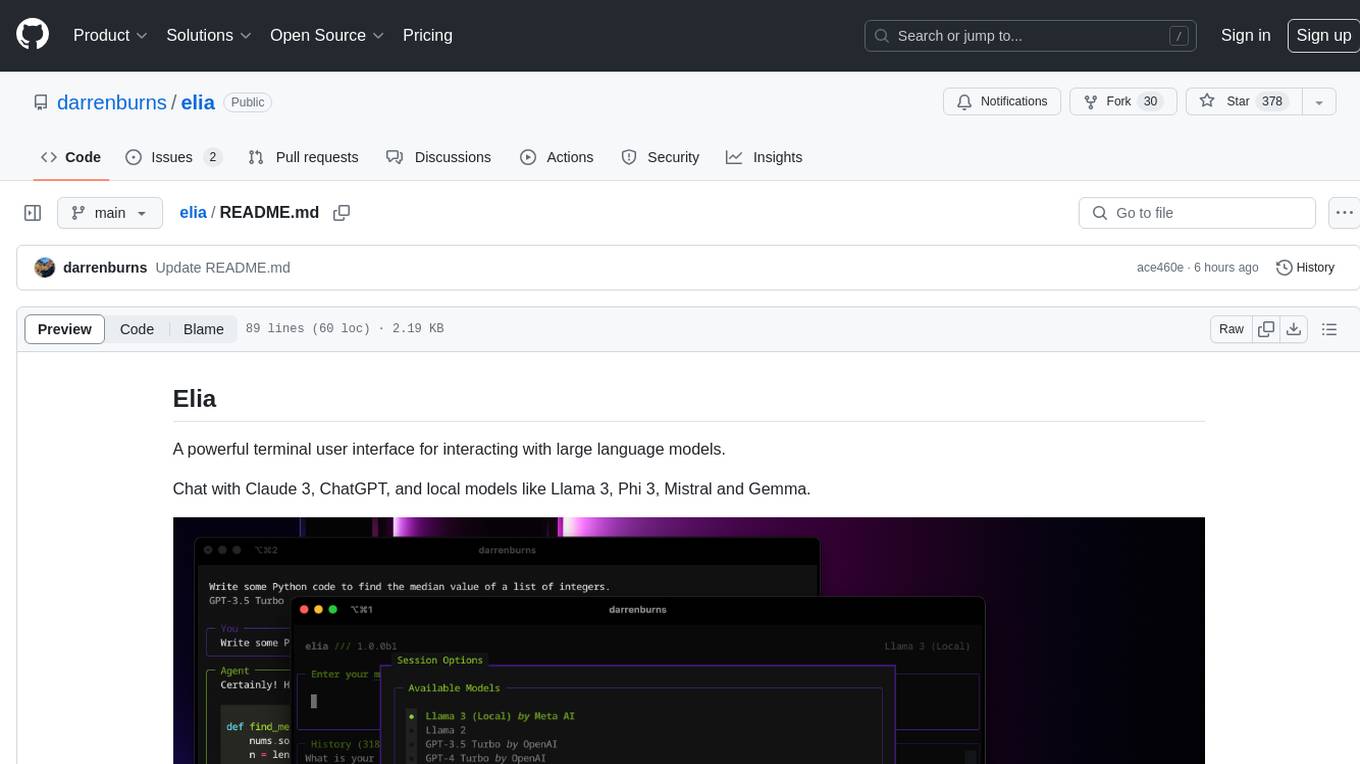
elia
Elia is a powerful terminal user interface designed for interacting with large language models. It allows users to chat with models like Claude 3, ChatGPT, Llama 3, Phi 3, Mistral, and Gemma. Conversations are stored locally in a SQLite database, ensuring privacy. Users can run local models through 'ollama' without data leaving their machine. Elia offers easy installation with pipx and supports various environment variables for different models. It provides a quick start to launch chats and manage local models. Configuration options are available to customize default models, system prompts, and add new models. Users can import conversations from ChatGPT and wipe the database when needed. Elia aims to enhance user experience in interacting with language models through a user-friendly interface.
EDDI
E.D.D.I (Enhanced Dialog Driven Interface) is an enterprise-certified chatbot middleware that offers advanced prompt and conversation management for Conversational AI APIs. Developed in Java using Quarkus, it is lean, RESTful, scalable, and cloud-native. E.D.D.I is highly scalable and designed to efficiently manage conversations in AI-driven applications, with seamless API integration capabilities. Notable features include configurable NLP and Behavior rules, support for multiple chatbots running concurrently, and integration with MongoDB, OAuth 2.0, and HTML/CSS/JavaScript for UI. The project requires Java 21, Maven 3.8.4, and MongoDB >= 5.0 to run. It can be built as a Docker image and deployed using Docker or Kubernetes, with additional support for integration testing and monitoring through Prometheus and Kubernetes endpoints.
multi-agent-orchestrator
Multi-Agent Orchestrator is a flexible and powerful framework for managing multiple AI agents and handling complex conversations. It intelligently routes queries to the most suitable agent based on context and content, supports dual language implementation in Python and TypeScript, offers flexible agent responses, context management across agents, extensible architecture for customization, universal deployment options, and pre-built agents and classifiers. It is suitable for various applications, from simple chatbots to sophisticated AI systems, accommodating diverse requirements and scaling efficiently.
gemini-next-chat
Gemini Next Chat is an open-source, extensible high-performance Gemini chatbot framework that supports one-click free deployment of private Gemini web applications. It provides a simple interface with image recognition and voice conversation, supports multi-modal models, talk mode, visual recognition, assistant market, support plugins, conversation list, full Markdown support, privacy and security, PWA support, well-designed UI, fast loading speed, static deployment, and multi-language support.
node-sdk
The ChatBotKit Node SDK is a JavaScript-based platform for building conversational AI bots and agents. It offers easy setup, serverless compatibility, modern framework support, customizability, and multi-platform deployment. With capabilities like multi-modal and multi-language support, conversation management, chat history review, custom datasets, and various integrations, this SDK enables users to create advanced chatbots for websites, mobile apps, and messaging platforms.
For similar jobs
sweep
Sweep is an AI junior developer that turns bugs and feature requests into code changes. It automatically handles developer experience improvements like adding type hints and improving test coverage.
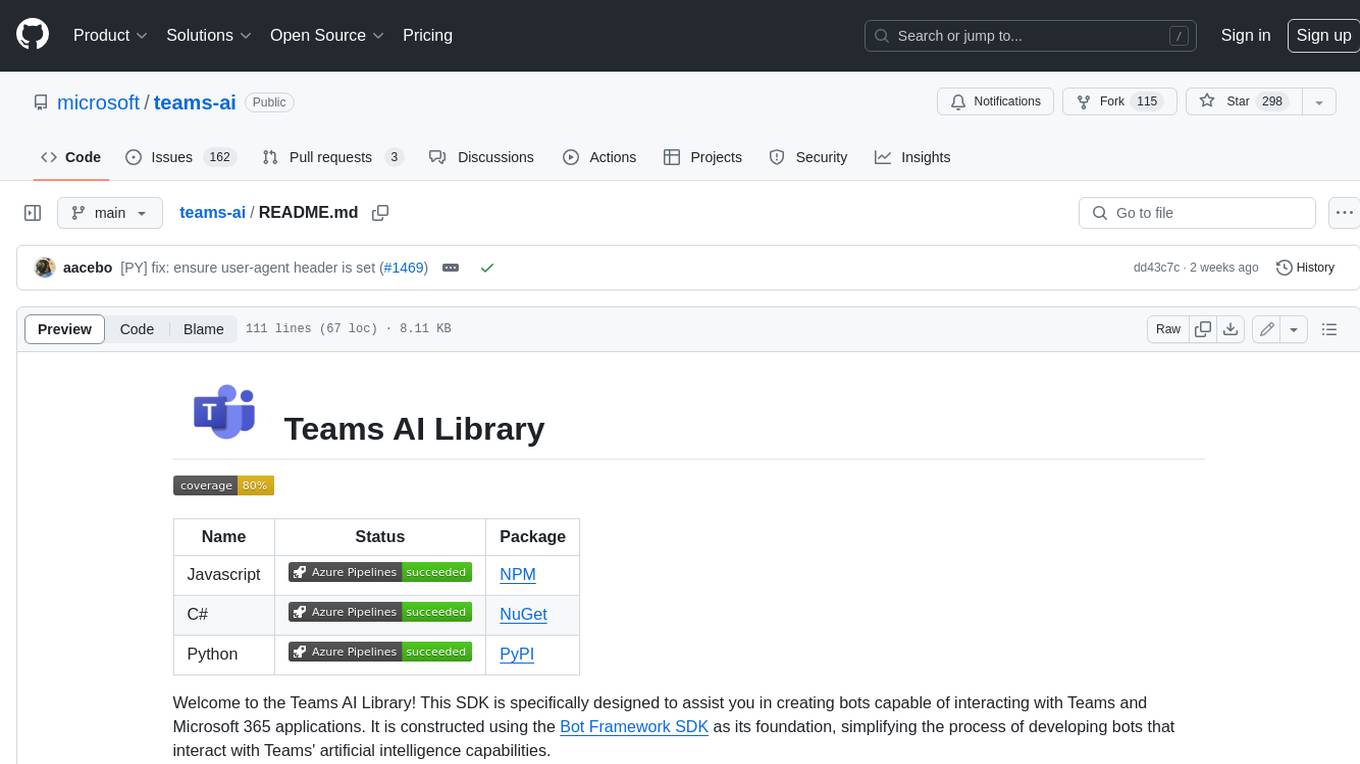
teams-ai
The Teams AI Library is a software development kit (SDK) that helps developers create bots that can interact with Teams and Microsoft 365 applications. It is built on top of the Bot Framework SDK and simplifies the process of developing bots that interact with Teams' artificial intelligence capabilities. The SDK is available for JavaScript/TypeScript, .NET, and Python.
ai-guide
This guide is dedicated to Large Language Models (LLMs) that you can run on your home computer. It assumes your PC is a lower-end, non-gaming setup.
classifai
Supercharge WordPress Content Workflows and Engagement with Artificial Intelligence. Tap into leading cloud-based services like OpenAI, Microsoft Azure AI, Google Gemini and IBM Watson to augment your WordPress-powered websites. Publish content faster while improving SEO performance and increasing audience engagement. ClassifAI integrates Artificial Intelligence and Machine Learning technologies to lighten your workload and eliminate tedious tasks, giving you more time to create original content that matters.
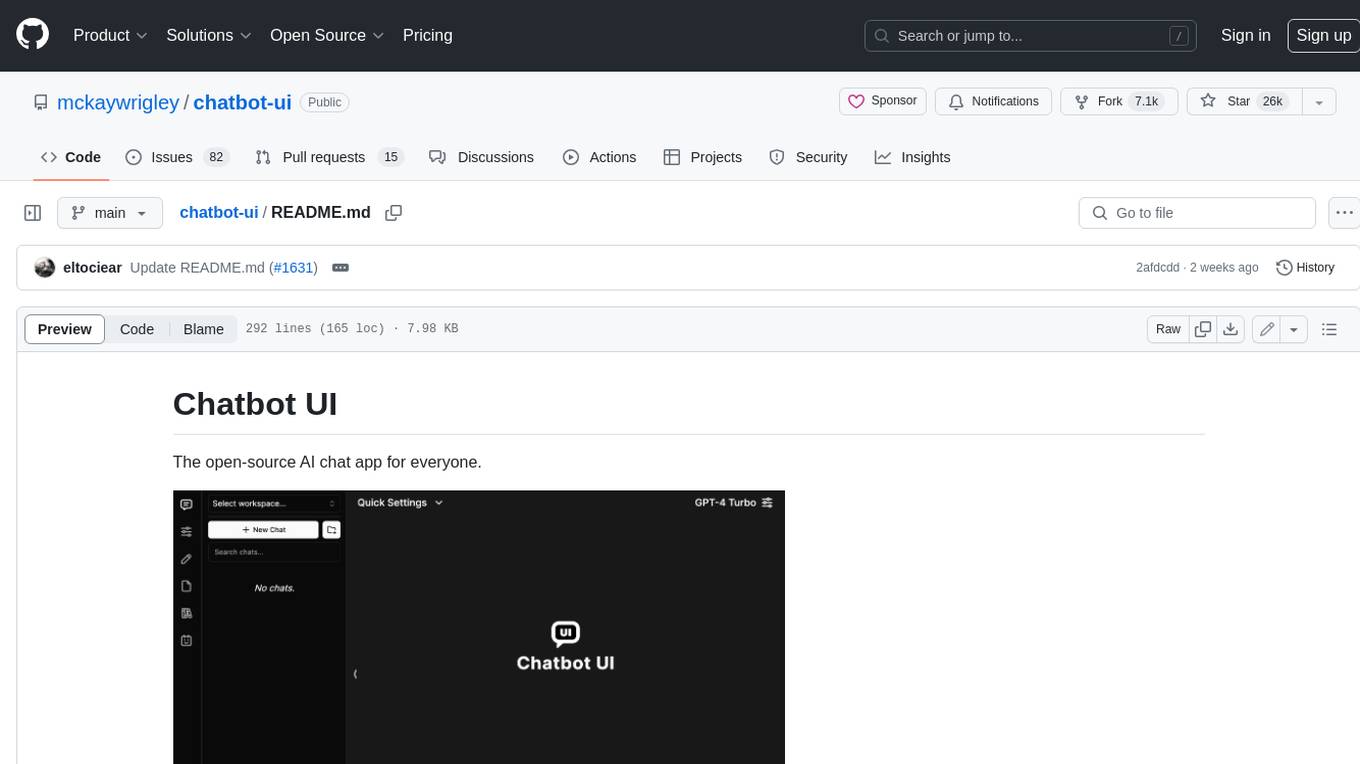
chatbot-ui
Chatbot UI is an open-source AI chat app that allows users to create and deploy their own AI chatbots. It is easy to use and can be customized to fit any need. Chatbot UI is perfect for businesses, developers, and anyone who wants to create a chatbot.
BricksLLM
BricksLLM is a cloud native AI gateway written in Go. Currently, it provides native support for OpenAI, Anthropic, Azure OpenAI and vLLM. BricksLLM aims to provide enterprise level infrastructure that can power any LLM production use cases. Here are some use cases for BricksLLM: * Set LLM usage limits for users on different pricing tiers * Track LLM usage on a per user and per organization basis * Block or redact requests containing PIIs * Improve LLM reliability with failovers, retries and caching * Distribute API keys with rate limits and cost limits for internal development/production use cases * Distribute API keys with rate limits and cost limits for students
uAgents
uAgents is a Python library developed by Fetch.ai that allows for the creation of autonomous AI agents. These agents can perform various tasks on a schedule or take action on various events. uAgents are easy to create and manage, and they are connected to a fast-growing network of other uAgents. They are also secure, with cryptographically secured messages and wallets.
griptape
Griptape is a modular Python framework for building AI-powered applications that securely connect to your enterprise data and APIs. It offers developers the ability to maintain control and flexibility at every step. Griptape's core components include Structures (Agents, Pipelines, and Workflows), Tasks, Tools, Memory (Conversation Memory, Task Memory, and Meta Memory), Drivers (Prompt and Embedding Drivers, Vector Store Drivers, Image Generation Drivers, Image Query Drivers, SQL Drivers, Web Scraper Drivers, and Conversation Memory Drivers), Engines (Query Engines, Extraction Engines, Summary Engines, Image Generation Engines, and Image Query Engines), and additional components (Rulesets, Loaders, Artifacts, Chunkers, and Tokenizers). Griptape enables developers to create AI-powered applications with ease and efficiency.