


Autopilot-Notes
自动驾驶笔记,以解析各模块知识点、整合行业优秀解决方案进行阐述,以帮助自己及有需要的读者;包含深度学习、deeplearning、无人驾驶、BEV、Transformer、ADAS、CVPR、特斯拉AI DAY、大模型、chatgpt等内容.
Stars: 765
Autopilot Notes is an open-source knowledge base for systematically learning autonomous driving technology. It covers basic theory, hardware, algorithms, tools, and practical engineering practices across 10+ chapters. The repository provides daily updates on industry trends, in-depth analysis of mainstream solutions like Tesla, Baidu Apollo, and Openpilot, and hands-on content including simulation, deployment, and optimization. Contributors are welcome to submit pull requests to improve the documentation.
README:


随着各大科技公司积极布局,自动驾驶成为新的技术风口。本仓库旨在系统性总结和分享自动驾驶技术方案,帮助开发者从入门到进阶全面掌握相关知识。
- 📚 体系完整 - 涵盖基础理论、硬件、算法、工具、实践等 10+ 章节
- 🔄 每日更新 - 技术日报 每日 9:00 自动推送行业最新动态
- 🏭 厂商方案 - 深度解析 Tesla、百度 Apollo、Openpilot 等主流方案
- 🛠️ 实战导向 - 包含仿真、部署、优化等工程实践内容
- 🤝 开源共建 - 欢迎提交 PR,一起完善文档
┌─────────────────────────────────────────────────────────┐
│                    自动驾驶学习路线                      │
├─────────────────────────────────────────────────────────┤
│  阶段1:基础 → 阶段2:硬件 → 阶段3:感知 → 阶段4:定位   │
│     ↓            ↓            ↓            ↓           │
│  阶段5:规划 → 阶段6:控制 → 阶段7:产品 → 阶段8:工具   │
└─────────────────────────────────────────────────────────┘
| 平台 | 链接 |
|---|---|
| 🐙 GitHub | github.com/gotonote/Autopilot-Notes |
| 🐱 Gitee | gitee.com/gotonote/Autopilot-Notes |
| 级别 | 名称 | 描述 | 人类参与 |
|---|---|---|---|
| L0 | 人工驾驶 | 无自动化 | 全程 |
| L1 | 辅助驾驶 | 单一功能辅助 | 主要 |
| L2 | 部分自动驾驶 | 组合功能辅助 | 监督 |
| L3 | 有条件自动驾驶 | 特定场景自动 | 待命 |
| L4 | 高度自动驾驶 | 大部分场景自动 | 可选 |
| L5 | 完全自动驾驶 | 全场景自动 | 无需 |
┌─────────────────────────────────────────────────────────┐
│                    自动驾驶系统架构                      │
├─────────────────────────────────────────────────────────┤
│  ┌─────────────┐  ┌─────────────┐  ┌─────────────┐     │
│  │   感知层    │→ │   决策层    │→ │   控制层    │     │
│  │ Perception │  │  Planning  │  │   Control   │     │
│  └─────────────┘  └─────────────┘  └─────────────┘     │
│        │                │                │              │
│   "看到了什么"      "要去哪里"      "怎么去"           │
└─────────────────────────────────────────────────────────┘
- 感知层:对车辆周边环境进行感知识别,获取环境信息
- 决策层:解决三个核心问题:"我在哪?我要去哪?我该如何去?"
- 控制层:保证硬件系统稳定运行在计算好的最佳设定值上
📖 点击展开完整目录
|---- 1.1 坐标系
|---- 1.2 参数
|---- 1.3 滤波
|---- 1.4 图像变换
|---- 1.5 三维重建
|---- 1.6 数据集
|---- 1.7 Transformer
|---- 1.8 NLP自然语言处理
|---- 1.9 神经网络结构搜索(NAS)
|---- 1.10 强化学习
2. 硬件
|---- 2.1 传感器
|---- 2.2 计算设备
|---- 2.3 辅助单元
|---- 2.4 传感器标定
3. 感知
|---- 3.1 2D目标检测
|---- 3.2 3D目标检测
|---- 3.3 BEV鸟瞰图
|---- 3.4 Occupany Network
4. 定位
|---- 4.1 SLAM基础
|---- 4.2 高精地图
|---- 4.3 多传感器融合定位
|---- 4.4 GNSS-INS组合导航
5. 策略规划
|---- 5.1 预测
|---- 5.2 路线规划
|---- 5.3 轨迹规划
6. 控制
|---- 6.1 PID控制
|---- 6.2 线性二次调节器(LQR)
|---- 6.3 模型控制预测(MPC)
7. 产品
8. 工具
|---- 8.1 可视化
|---- 8.2 仿真
|---- 8.3 TensorRT加速
|---- 8.4 SNPE
9. 厂商方案
|---- 9.1 特斯拉 AI Day2022
|---- 9.2 百度阿波罗 Apollo
|---- 9.3 Openpilot
10. 每日前沿
本仓库每日自动更新自动驾驶行业最新动态:
- 📰 日报 - 每日 9:00 自动推送 10 条核心价值信息
- 📊 周报 - 每周日生成技术趋势汇总
- 🏷️ 标签 - 按公司、技术领域、类型分类
🔗 查看最新日报:ch10_每日前沿
由于作者水平有限,欢迎大家积极提交改进意见
- Fork 本仓库
- 修改/新增 内容(请遵循文章撰写规范)
- 提交 PR,描述你的修改内容
- 等待审核 合并
感谢所有为本项目做出贡献的朋友!
本项目采用 MIT License 开源协议。
⭐ 如果本项目对你有帮助,欢迎 Star 支持!
For Tasks:
Click tags to check more tools for each tasksFor Jobs:
Alternative AI tools for Autopilot-Notes
Similar Open Source Tools
Autopilot-Notes
Autopilot Notes is an open-source knowledge base for systematically learning autonomous driving technology. It covers basic theory, hardware, algorithms, tools, and practical engineering practices across 10+ chapters. The repository provides daily updates on industry trends, in-depth analysis of mainstream solutions like Tesla, Baidu Apollo, and Openpilot, and hands-on content including simulation, deployment, and optimization. Contributors are welcome to submit pull requests to improve the documentation.
PaiAgent
PaiAgent is an enterprise-level AI workflow visualization orchestration platform that simplifies the combination and scheduling of AI capabilities. It allows developers and business users to quickly build complex AI processing flows through an intuitive drag-and-drop interface, without the need to write code, enabling collaboration of various large models.
auto-paper-digest
Auto Paper Digest (APD) is a tool designed to automatically fetch cutting-edge AI research papers, download PDFs, generate video explanations, and publish them on platforms like HuggingFace, Douyin, and portal websites. It provides functionalities such as fetching papers from Hugging Face, downloading PDFs from arXiv, generating videos using NotebookLM, automatic publishing to HuggingFace Dataset, automatic publishing to Douyin, and hosting videos on a Gradio portal website. The tool also supports resuming interrupted tasks, persistent login states for Google and Douyin, and a structured workflow divided into three phases: Upload, Download, and Publish.
lanhu-mcp
Lanhu MCP Server is a powerful Model Context Protocol (MCP) server designed for the AI programming era, perfectly supporting the Lanhu design collaboration platform. It offers features like intelligent requirement analysis, team knowledge base, UI design support, and performance optimization. The server is suitable for Cursor + Lanhu, Windsurf + Lanhu, Claude Code + Lanhu, Trae + Lanhu, and Cline + Lanhu integrations. It aims to break the isolation of AI IDEs and enable all AI assistants to share knowledge and context.
AIxVuln
AIxVuln is an automated vulnerability discovery and verification system based on large models (LLM) + function calling + Docker sandbox. The system manages 'projects' through a web UI/desktop client, automatically organizing multiple 'digital humans' for environment setup, code auditing, vulnerability verification, and report generation. It utilizes an isolated Docker environment for dependency installation, service startup, PoC verification, and evidence collection, ultimately producing downloadable vulnerability reports. The system has already discovered dozens of vulnerabilities in real open-source projects.
aiohomematic
AIO Homematic (hahomematic) is a lightweight Python 3 library for controlling and monitoring HomeMatic and HomematicIP devices, with support for third-party devices/gateways. It automatically creates entities for device parameters, offers custom entity classes for complex behavior, and includes features like caching paramsets for faster restarts. Designed to integrate with Home Assistant, it requires specific firmware versions for HomematicIP devices. The public API is defined in modules like central, client, model, exceptions, and const, with example usage provided. Useful links include changelog, data point definitions, troubleshooting, and developer resources for architecture, data flow, model extension, and Home Assistant lifecycle.
openakita
OpenAkita is a self-evolving AI Agent framework that autonomously learns new skills, performs daily self-checks and repairs, accumulates experience from task execution, and persists until the task is done. It auto-generates skills, installs dependencies, learns from mistakes, and remembers preferences. The framework is standards-based, multi-platform, and provides a Setup Center GUI for intuitive installation and configuration. It features self-learning and evolution mechanisms, a Ralph Wiggum Mode for persistent execution, multi-LLM endpoints, multi-platform IM support, desktop automation, multi-agent architecture, scheduled tasks, identity and memory management, a tool system, and a guided wizard for setup.
vibium
Vibium is a browser automation infrastructure designed for AI agents, providing a single binary that manages browser lifecycle, WebDriver BiDi protocol, and an MCP server. It offers zero configuration, AI-native capabilities, and is lightweight with no runtime dependencies. It is suitable for AI agents, test automation, and any tasks requiring browser interaction.
z.ai2api_python
Z.AI2API Python is a lightweight OpenAI API proxy service that integrates seamlessly with existing applications. It supports the full functionality of GLM-4.5 series models and features high-performance streaming responses, enhanced tool invocation, support for thinking mode, integration with search models, Docker deployment, session isolation for privacy protection, flexible configuration via environment variables, and intelligent upstream model routing.
memsearch
Memsearch is a tool that allows users to give their AI agents persistent memory in a few lines of code. It enables users to write memories as markdown and search them semantically. Inspired by OpenClaw's markdown-first memory architecture, Memsearch is pluggable into any agent framework. The tool offers features like smart deduplication, live sync, and a ready-made Claude Code plugin for building agent memory.
bumpgen
bumpgen is a tool designed to automatically upgrade TypeScript / TSX dependencies and make necessary code changes to handle any breaking issues that may arise. It uses an abstract syntax tree to analyze code relationships, type definitions for external methods, and a plan graph DAG to execute changes in the correct order. The tool is currently limited to TypeScript and TSX but plans to support other strongly typed languages in the future. It aims to simplify the process of upgrading dependencies and handling code changes caused by updates.
py-xiaozhi
py-xiaozhi is a Python-based XiaoZhi voice client designed for learning code and experiencing AI XiaoZhi's voice functions without hardware conditions. It features voice interaction, graphical interface, volume control, session management, encrypted audio transmission, CLI mode, and automatic copying of verification codes and opening browsers for first-time users. The project aims to optimize and add new features to zhh827's py-xiaozhi based on the original hardware project xiaozhi-esp32 and the Python implementation py-xiaozhi.
gin-vue-admin
Gin-vue-admin is a full-stack development platform based on Vue and Gin, integrating features like JWT authentication, dynamic routing, dynamic menus, Casbin authorization, form generator, code generator, etc. It provides various example files to help users focus more on business development. The project offers detailed documentation, video tutorials for setup and deployment, and a community for support and contributions. Users need a certain level of knowledge in Golang and Vue to work with this project. It is recommended to follow the Apache2.0 license if using the project for commercial purposes.
observers
Observers is a lightweight library for AI observability that provides support for various generative AI APIs and storage backends. It allows users to track interactions with AI models and sync observations to different storage systems. The library supports OpenAI, Hugging Face transformers, AISuite, Litellm, and Docling for document parsing and export. Users can configure different stores such as Hugging Face Datasets, DuckDB, Argilla, and OpenTelemetry to manage and query their observations. Observers is designed to enhance AI model monitoring and observability in a user-friendly manner.
Agentic-ADK
Agentic ADK is an Agent application development framework launched by Alibaba International AI Business, based on Google-ADK and Ali-LangEngine. It is used for developing, constructing, evaluating, and deploying powerful, flexible, and controllable complex AI Agents. ADK aims to make Agent development simpler and more user-friendly, enabling developers to more easily build, deploy, and orchestrate various Agent applications ranging from simple tasks to complex collaborations.
boxlite
BoxLite is an embedded, lightweight micro-VM runtime designed for AI agents running OCI containers with hardware-level isolation. It is built for high concurrency with no daemon required, offering features like lightweight VMs, high concurrency, hardware isolation, embeddability, and OCI compatibility. Users can spin up 'Boxes' to run containers for AI agent sandboxes and multi-tenant code execution scenarios where Docker alone is insufficient and full VM infrastructure is too heavy. BoxLite supports Python, Node.js, and Rust with quick start guides for each, along with features like CPU/memory limits, storage options, networking capabilities, security layers, and image registry configuration. The tool provides SDKs for Python and Node.js, with Go support coming soon. It offers detailed documentation, examples, and architecture insights for users to understand how BoxLite works under the hood.
For similar tasks
shandu
Shandu is an advanced AI research system that automates comprehensive research processes using language models, web scraping, and iterative exploration to generate well-structured reports with citations. It features intelligent state-based workflow, deep exploration, multi-source information synthesis, enhanced web scraping, smart source evaluation, content analysis pipeline, comprehensive report generation, parallel processing, adaptive search strategy, and full citation management.
Autopilot-Notes
Autopilot Notes is an open-source knowledge base for systematically learning autonomous driving technology. It covers basic theory, hardware, algorithms, tools, and practical engineering practices across 10+ chapters. The repository provides daily updates on industry trends, in-depth analysis of mainstream solutions like Tesla, Baidu Apollo, and Openpilot, and hands-on content including simulation, deployment, and optimization. Contributors are welcome to submit pull requests to improve the documentation.
For similar jobs
DriveLM
DriveLM is a multimodal AI model that enables autonomous driving by combining computer vision and natural language processing. It is designed to understand and respond to complex driving scenarios using visual and textual information. DriveLM can perform various tasks related to driving, such as object detection, lane keeping, and decision-making. It is trained on a massive dataset of images and text, which allows it to learn the relationships between visual cues and driving actions. DriveLM is a powerful tool that can help to improve the safety and efficiency of autonomous vehicles.
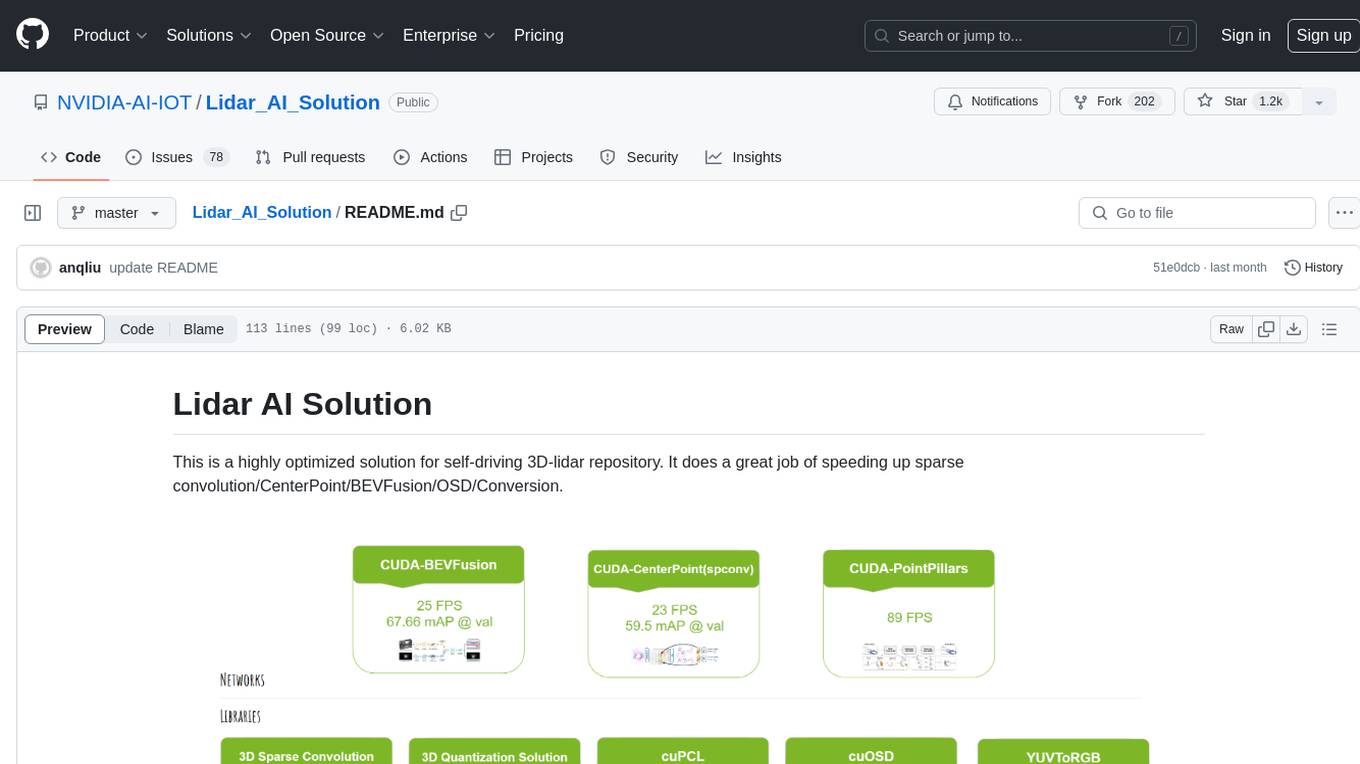
Lidar_AI_Solution
Lidar AI Solution is a highly optimized repository for self-driving 3D lidar, providing solutions for sparse convolution, BEVFusion, CenterPoint, OSD, and Conversion. It includes CUDA and TensorRT implementations for various tasks such as 3D sparse convolution, BEVFusion, CenterPoint, PointPillars, V2XFusion, cuOSD, cuPCL, and YUV to RGB conversion. The repository offers easy-to-use solutions, high accuracy, low memory usage, and quantization options for different tasks related to self-driving technology.
AirSLAM
AirSLAM is an efficient visual SLAM system designed to tackle short-term and long-term illumination challenges. It combines deep learning techniques with traditional optimization methods, featuring a unified CNN for keypoint and structural line extraction. The system includes a relocalization pipeline for map reuse, accelerated using C++ and NVIDIA TensorRT. Outperforming other SLAM systems in challenging environments, it runs at 73Hz on PC and 40Hz on embedded platforms.
sdk-examples
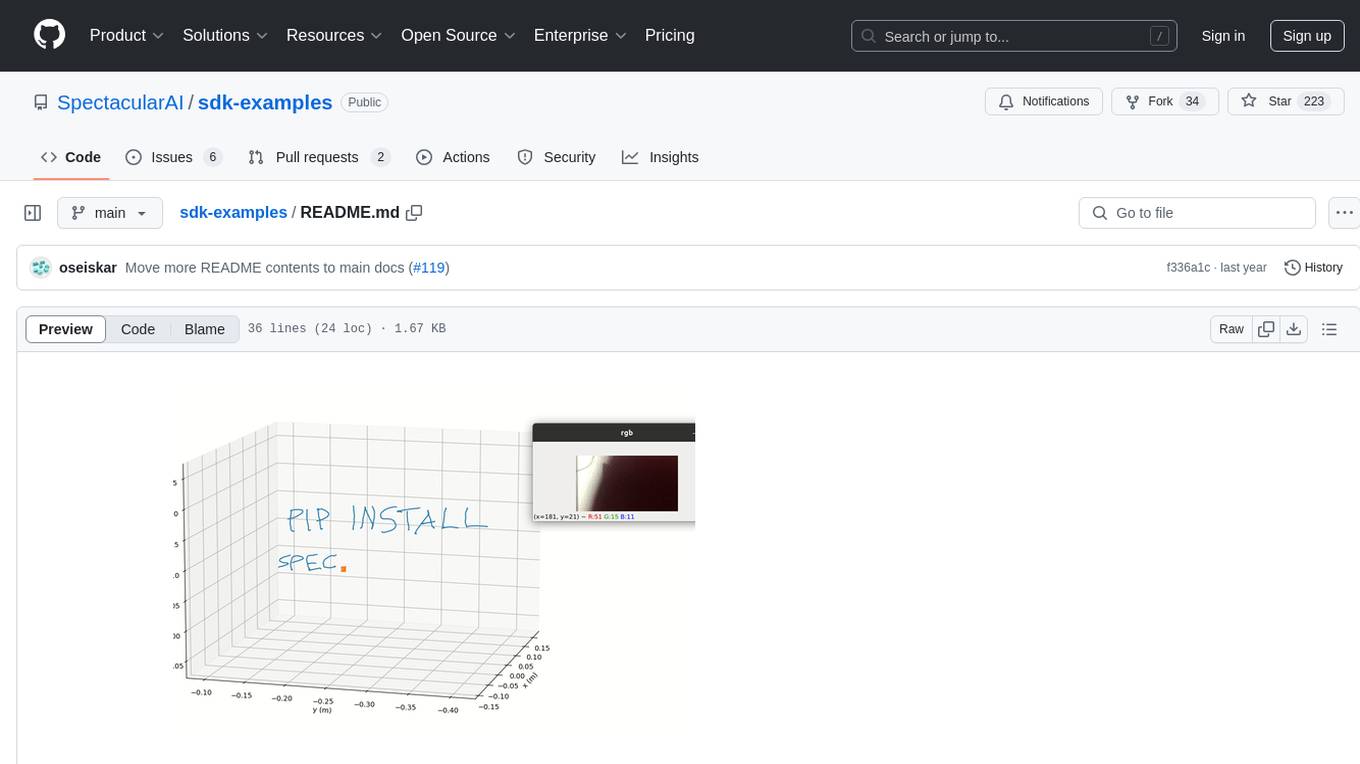
Spectacular AI SDK fuses data from cameras and IMU sensors to output an accurate 6-degree-of-freedom pose of a device, enabling Visual-Inertial SLAM for tracking robots and vehicles, as well as Augmented, Mixed, and Virtual Reality. The SDK includes a Mapping API for real-time and offline 3D reconstruction use cases.

awesome-and-novel-works-in-slam
This repository contains a curated list of cutting-edge works in Simultaneous Localization and Mapping (SLAM). It includes research papers, projects, and tools related to various aspects of SLAM, such as 3D reconstruction, semantic mapping, novel algorithms, large-scale mapping, and more. The repository aims to showcase the latest advancements in SLAM technology and provide resources for researchers and practitioners in the field.
retinify
Retinify is an advanced AI-powered stereo vision library designed for robotics, enabling real-time, high-precision 3D perception by leveraging GPU and NPU acceleration. It is open source under Apache-2.0 license, offers high precision 3D mapping and object recognition, runs computations on GPU for fast performance, accepts stereo images from any rectified camera setup, is cost-efficient using minimal hardware, and has minimal dependencies on CUDA Toolkit, cuDNN, and TensorRT. The tool provides a pipeline for stereo matching and supports various image data types independently of OpenCV.
Autopilot-Notes
Autopilot Notes is an open-source knowledge base for systematically learning autonomous driving technology. It covers basic theory, hardware, algorithms, tools, and practical engineering practices across 10+ chapters. The repository provides daily updates on industry trends, in-depth analysis of mainstream solutions like Tesla, Baidu Apollo, and Openpilot, and hands-on content including simulation, deployment, and optimization. Contributors are welcome to submit pull requests to improve the documentation.
weave
Weave is a toolkit for developing Generative AI applications, built by Weights & Biases. With Weave, you can log and debug language model inputs, outputs, and traces; build rigorous, apples-to-apples evaluations for language model use cases; and organize all the information generated across the LLM workflow, from experimentation to evaluations to production. Weave aims to bring rigor, best-practices, and composability to the inherently experimental process of developing Generative AI software, without introducing cognitive overhead.