


osmedeus
A Modern Orchestration Engine for Security
Stars: 6102
Osmedeus is a security-focused declarative orchestration engine that simplifies complex workflow automation into auditable YAML definitions. It provides powerful automation capabilities without compromising infrastructure integrity and safety. With features like declarative YAML workflows, multiple runners, event-driven triggers, template engine, utility functions, REST API server, distributed execution, notifications, cloud storage, AI integration, SAST integration, language detection, and preset installations, Osmedeus offers a comprehensive solution for security automation tasks.
README:

Osmedeus - A Modern Orchestration Engine for Security





Osmedeus is a security focused declarative orchestration engine that simplifies complex workflow automation into auditable YAML definitions, complete with encrypted data handling, secure credential management, and sandboxed execution.
Built for both beginners and experts, it delivers powerful, composable automation without sacrificing the integrity and safety of your infrastructure.
- Declarative YAML Workflows - Define reconnaissance pipelines using simple, readable YAML syntax
- Multiple Runners - Execute on local host, Docker containers, or remote machines via SSH
- Event-Driven Triggers - Cron scheduling, file watching, and event-based workflow triggers with deduplication and filter functions
- Template Engine - Powerful variable interpolation with built-in and custom variables
- Utility Functions - Rich function library with event generation, bulk processing, and JSON operations
- REST API Server - Manage, trigger, and cancel workflows programmatically
-
Distributed Execution - Scale with Redis-based master-worker pattern for parallel scanning (workers identified as
wosm-<uuid8>) - Notifications - Telegram bot and webhook integrations
- Cloud Storage - S3-compatible storage for artifact management
- LLM Integration - AI-powered workflow steps with chat completions, embeddings, and agentic tool-calling loops
- Agent Step Type - Agentic LLM execution with tool calling, sub-agents, and memory management
- SAST Integration - SARIF parsing for Semgrep, Trivy, Kingfisher, Bearer with database import and markdown reporting
- Language Detection - Auto-detect dominant programming language of source repositories (26+ languages)
- Preset Installation - Reproducible deployments from curated preset repositories
See Documentation Page for more details.
curl -sSL http://www.osmedeus.org/install.sh | bashSee Quickstart for quick setup and Installation for advanced configurations.
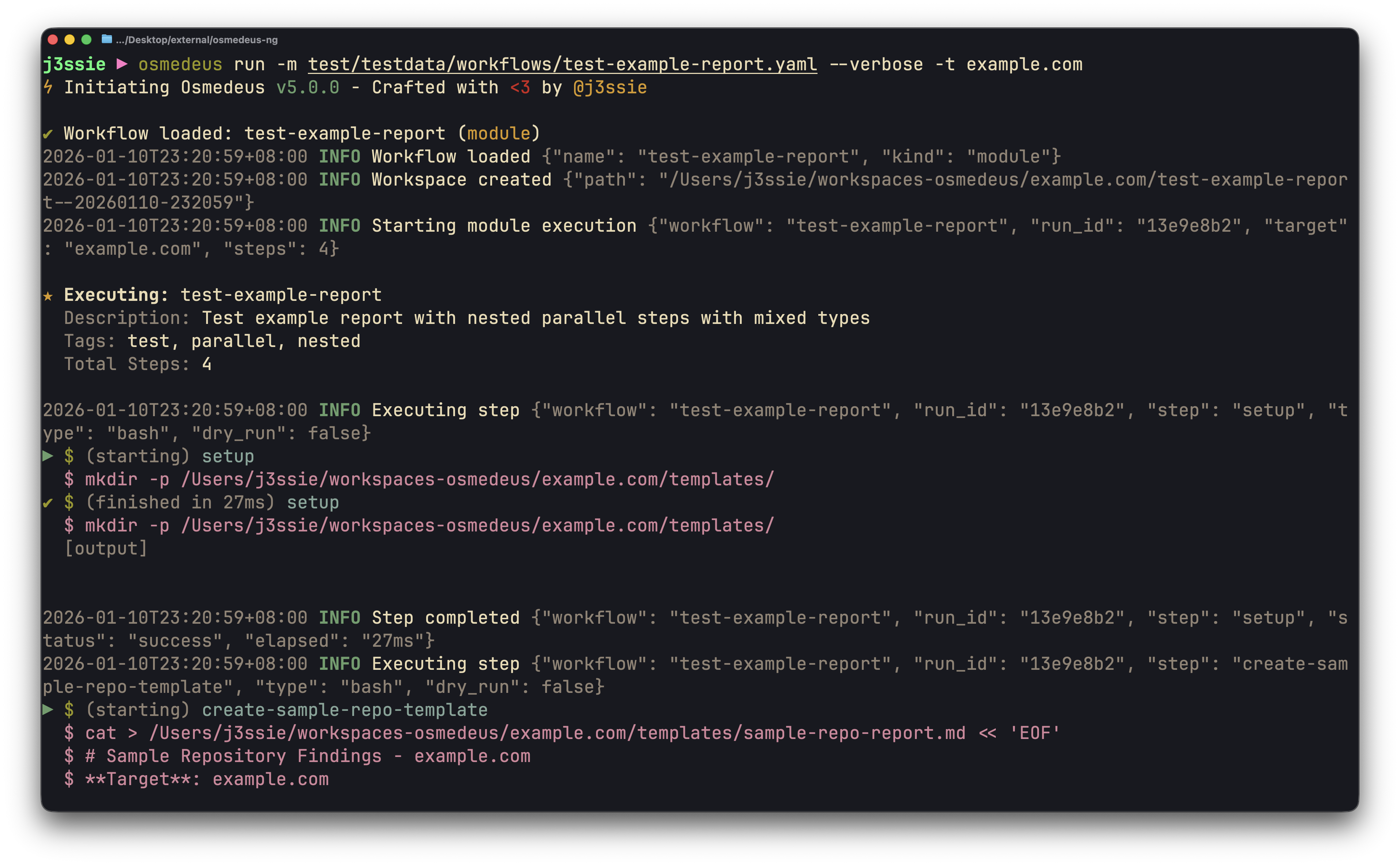
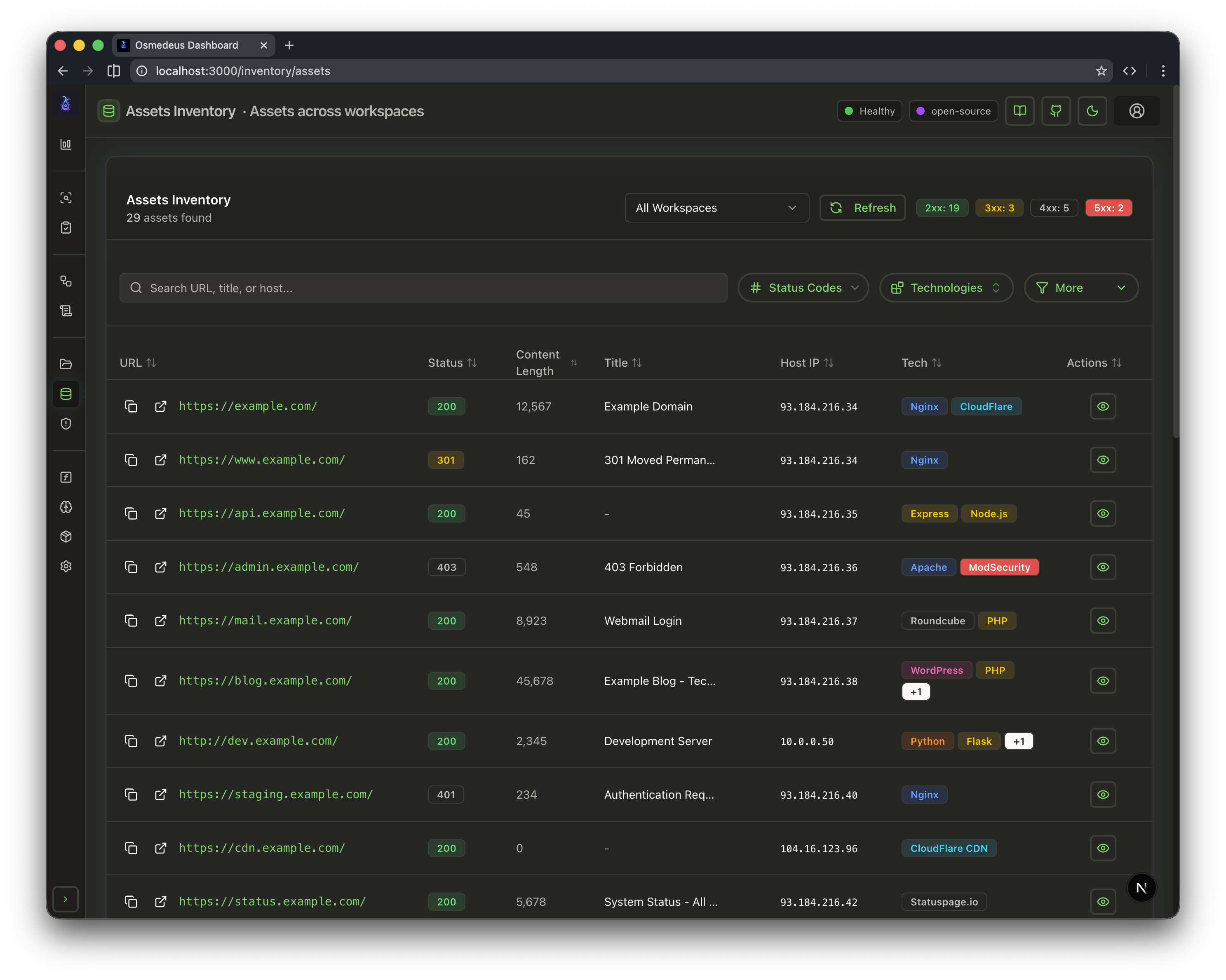
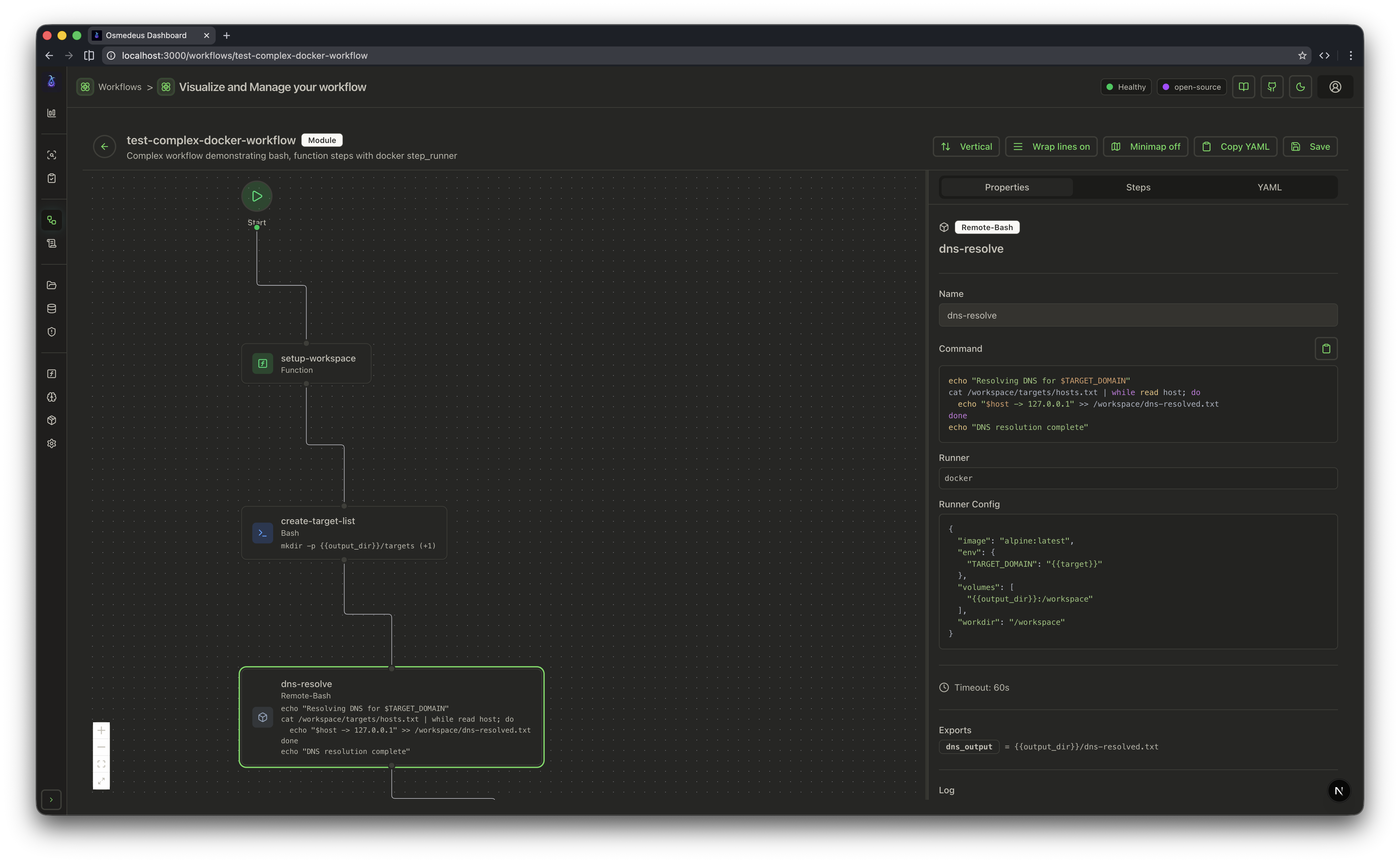
| CLI Usage | Web UI Assets | Workflow Visualization |
|---|---|---|
 |
 |
 |
# Run a module workflow
osmedeus run -m recon -t example.com

# Run a flow workflow
osmedeus run -f general -t example.com

# Multiple targets with concurrency
osmedeus run -m recon -T targets.txt -c 5

# Dry-run mode (preview)
osmedeus run -f general -t example.com --dry-run

# Start API server
osmedeus serve

# List available workflows
osmedeus workflow list

# Query database tables
osmedeus db list --table runs
osmedeus db list --table event_logs --search "nuclei"

# Evaluate utility functions
osmedeus func eval 'log_info("hello")'
osmedeus func eval -e 'http_get("https://example.com")' -T targets.txt -c 10

# Platform variables available in eval
osmedeus func eval 'log_info("OS: " + PlatformOS + ", Arch: " + PlatformArch)'

# Install from preset repositories
osmedeus install base --preset
osmedeus install base --preset --keep-setting   # preserve existing osm-settings.yaml
osmedeus install workflow --preset

# Show all usage examples
osmedeus --usage-example# Show help
docker run --rm j3ssie/osmedeus:latest --help
# Run a scan
docker run --rm -v $(pwd)/output:/root/workspaces-osmedeus \
j3ssie/osmedeus:latest run -f general -t example.comFor more CLI usage and example commands, refer to the CLI Reference.
┌───────────────────────────────────────────────────────────────────────────┐
│                        OSMEDEUS WORKFLOW ENGINE                           │
├───────────────────────────────────────────────────────────────────────────┤
│  ENTRY POINTS                                                             │
│  ┌──────────┐  ┌──────────┐  ┌──────────┐  ┌─────────────┐                │
│  │   CLI    │  │ REST API │  │Scheduler │  │ Distributed │                │
│  └────┬─────┘  └────┬─────┘  └────┬─────┘  └─────┬───────┘                │
│       └─────────────┴─────────────┴──────────────┘                        │
│                              │                                            │
│                              ▼                                            │
│  ┌─────────────────────────────────────────────────────────────────────┐  │
│  │ CONFIG ──▶ PARSER ──▶ EXECUTOR ──▶ STEP DISPATCHER ──▶ RUNNER       │  │
│  │                          │                                          │  │
│  │  Step Executors: bash | function | parallel | foreach | remote-bash │  │
│  │                  http | llm | agent | SARIF/SAST integration        │  │
│  │                          │                                          │  │
│  │  Runners: HostRunner | DockerRunner | SSHRunner                     │  │
│  └─────────────────────────────────────────────────────────────────────┘  │
└───────────────────────────────────────────────────────────────────────────┘
For more information about the architecture, refer to the Architecture Documentation.
The high-level ambitious plan for the project, in order:
| # | Step | Status |
|---|---|---|
| 1 | Osmedeus Engine reforged with a next-generation architecture | ✅ |
| 2 | Flexible workflows and step types | ✅ |
| 3 | Event-driven architectural model and the different trigger event categories | ✅ |
| 4 | Beautiful UI for visualize results and workflow diagram | ✅ |
| 5 | Rewriting the workflow to adapt to new architecture and syntax | ✅ |
| 6 | Testing more utility functions like notifications | ✅ |
| 7 | SAST integration with SARIF parsing (Semgrep, Trivy, etc.) | ✅ |
| 8 | Cloud integration, which supports running the scan on the cloud provider. | ❌ |
| 9 | Generate diff reports showing new/removed/unchanged assets between runs. | ❌ |
| 10 | Adding step type from cloud provider that can be run via serverless | ❌ |
| N | Fancy features (to be discussed later) | ❌ |
| Topic | Link |
|---|---|
| Getting Started | docs.osmedeus.org/getting-started |
| CLI Usage & Examples | docs.osmedeus.org/getting-started/cli |
| Writing Workflows | docs.osmedeus.org/workflows/overview |
| Event-Driven Triggers | docs.osmedeus.org/advanced/event-driven |
| Deployment | docs.osmedeus.org/deployment |
| Architecture | docs.osmedeus.org/concepts/architecture |
| Development | docs.osmedeus.org/development and HACKING.md |
| Extending Osmedeus | docs.osmedeus.org/development/extending-osmedeus |
| Full Documentation | docs.osmedeus.org |
Osmedeus is designed to execute arbitrary code and commands from user supplied input via CLI, API, and workflow definitions. This flexibility is intentional and central to how the engine operates.
Please refer to the Security Warning page for more information on how to stay safe.
Think twice before you:
- Run workflows downloaded from untrusted sources
- Execute commands or scans against targets you don't own or have permission to test
- Use workflows without reviewing their contents first
You are responsible for what you run. Always review workflow YAML files before execution, especially those obtained from third parties.
Osmedeus is made with ♥ by @j3ssie and it is released under the MIT license.
For Tasks:
Click tags to check more tools for each tasksFor Jobs:
Alternative AI tools for osmedeus
Similar Open Source Tools
osmedeus
Osmedeus is a security-focused declarative orchestration engine that simplifies complex workflow automation into auditable YAML definitions. It provides powerful automation capabilities without compromising infrastructure integrity and safety. With features like declarative YAML workflows, multiple runners, event-driven triggers, template engine, utility functions, REST API server, distributed execution, notifications, cloud storage, AI integration, SAST integration, language detection, and preset installations, Osmedeus offers a comprehensive solution for security automation tasks.
aiohomematic
AIO Homematic (hahomematic) is a lightweight Python 3 library for controlling and monitoring HomeMatic and HomematicIP devices, with support for third-party devices/gateways. It automatically creates entities for device parameters, offers custom entity classes for complex behavior, and includes features like caching paramsets for faster restarts. Designed to integrate with Home Assistant, it requires specific firmware versions for HomematicIP devices. The public API is defined in modules like central, client, model, exceptions, and const, with example usage provided. Useful links include changelog, data point definitions, troubleshooting, and developer resources for architecture, data flow, model extension, and Home Assistant lifecycle.
giztoy
Giztoy is a multi-language framework designed for building AI toys and intelligent applications. It provides a unified abstraction layer that spans from resource-constrained embedded systems to powerful cloud services. With features like native support for ESP32 and other MCUs, cross-platform app development, a unified build system with Bazel, an agent framework for AI agents, audio processing capabilities, support for various Large Language Models, real-time models with WebSocket streaming, secure transport protocols, and multi-language implementations in Go, Rust, Zig, and C/C++, Giztoy serves as a versatile tool for developing AI-powered applications across different platforms and devices.
kweaver
KWeaver is an open-source ecosystem for building, deploying, and running decision intelligence AI applications. It adopts ontology as the core methodology for business knowledge networks, with DIP as the core platform, aiming to provide elastic, agile, and reliable enterprise-grade decision intelligence to further unleash productivity. The DIP platform includes key subsystems such as ADP, Decision Agent, DIP Studio, and AI Store.
Agentic-ADK
Agentic ADK is an Agent application development framework launched by Alibaba International AI Business, based on Google-ADK and Ali-LangEngine. It is used for developing, constructing, evaluating, and deploying powerful, flexible, and controllable complex AI Agents. ADK aims to make Agent development simpler and more user-friendly, enabling developers to more easily build, deploy, and orchestrate various Agent applications ranging from simple tasks to complex collaborations.
observers
Observers is a lightweight library for AI observability that provides support for various generative AI APIs and storage backends. It allows users to track interactions with AI models and sync observations to different storage systems. The library supports OpenAI, Hugging Face transformers, AISuite, Litellm, and Docling for document parsing and export. Users can configure different stores such as Hugging Face Datasets, DuckDB, Argilla, and OpenTelemetry to manage and query their observations. Observers is designed to enhance AI model monitoring and observability in a user-friendly manner.
vibium
Vibium is a browser automation infrastructure designed for AI agents, providing a single binary that manages browser lifecycle, WebDriver BiDi protocol, and an MCP server. It offers zero configuration, AI-native capabilities, and is lightweight with no runtime dependencies. It is suitable for AI agents, test automation, and any tasks requiring browser interaction.
memsearch
Memsearch is a tool that allows users to give their AI agents persistent memory in a few lines of code. It enables users to write memories as markdown and search them semantically. Inspired by OpenClaw's markdown-first memory architecture, Memsearch is pluggable into any agent framework. The tool offers features like smart deduplication, live sync, and a ready-made Claude Code plugin for building agent memory.
pilot
Pilot is an AI tool designed to streamline the process of handling tickets from GitHub, Linear, Jira, or Asana. It plans the implementation, writes the code, runs tests, and opens a PR for you to review and merge. With features like Autopilot, Epic Decomposition, Self-Review, and more, Pilot aims to automate the ticket handling process and reduce the time spent on prioritizing and completing tasks. It integrates with various platforms, offers intelligence features, and provides real-time visibility through a dashboard. Pilot is free to use, with costs associated with Claude API usage. It is designed for bug fixes, small features, refactoring, tests, docs, and dependency updates, but may not be suitable for large architectural changes or security-critical code.
mesh
MCP Mesh is an open-source control plane for MCP traffic that provides a unified layer for authentication, routing, and observability. It replaces multiple integrations with a single production endpoint, simplifying configuration management. Built for multi-tenant organizations, it offers workspace/project scoping for policies, credentials, and logs. With core capabilities like MeshContext, AccessControl, and OpenTelemetry, it ensures fine-grained RBAC, full tracing, and metrics for tools and workflows. Users can define tools with input/output validation, access control checks, audit logging, and OpenTelemetry traces. The project structure includes apps for full-stack MCP Mesh, encryption, observability, and more, with deployment options ranging from Docker to Kubernetes. The tech stack includes Bun/Node runtime, TypeScript, Hono API, React, Kysely ORM, and Better Auth for OAuth and API keys.
chronicle
Chronicle is a self-hostable AI system that captures audio/video data from OMI devices and other sources to generate memories, action items, and contextual insights about conversations and daily interactions. It includes a mobile app for OMI devices, backend services with AI features, a web dashboard for conversation and memory management, and optional services like speaker recognition and offline ASR. The project aims to provide a system that records personal spoken context and visual context to generate memories, action items, and enable home automation.
vllm-mlx
vLLM-MLX is a tool that brings native Apple Silicon GPU acceleration to vLLM by integrating Apple's ML framework with unified memory and Metal kernels. It offers optimized LLM inference with KV cache and quantization, vision-language models for multimodal inference, speech-to-text and text-to-speech with native voices, text embeddings for semantic search and RAG, and more. Users can benefit from features like multimodal support for text, image, video, and audio, native GPU acceleration on Apple Silicon, compatibility with OpenAI API, Anthropic Messages API, reasoning models extraction, integration with external tools via Model Context Protocol, memory-efficient caching, and high throughput for multiple concurrent users.
boxlite
BoxLite is an embedded, lightweight micro-VM runtime designed for AI agents running OCI containers with hardware-level isolation. It is built for high concurrency with no daemon required, offering features like lightweight VMs, high concurrency, hardware isolation, embeddability, and OCI compatibility. Users can spin up 'Boxes' to run containers for AI agent sandboxes and multi-tenant code execution scenarios where Docker alone is insufficient and full VM infrastructure is too heavy. BoxLite supports Python, Node.js, and Rust with quick start guides for each, along with features like CPU/memory limits, storage options, networking capabilities, security layers, and image registry configuration. The tool provides SDKs for Python and Node.js, with Go support coming soon. It offers detailed documentation, examples, and architecture insights for users to understand how BoxLite works under the hood.
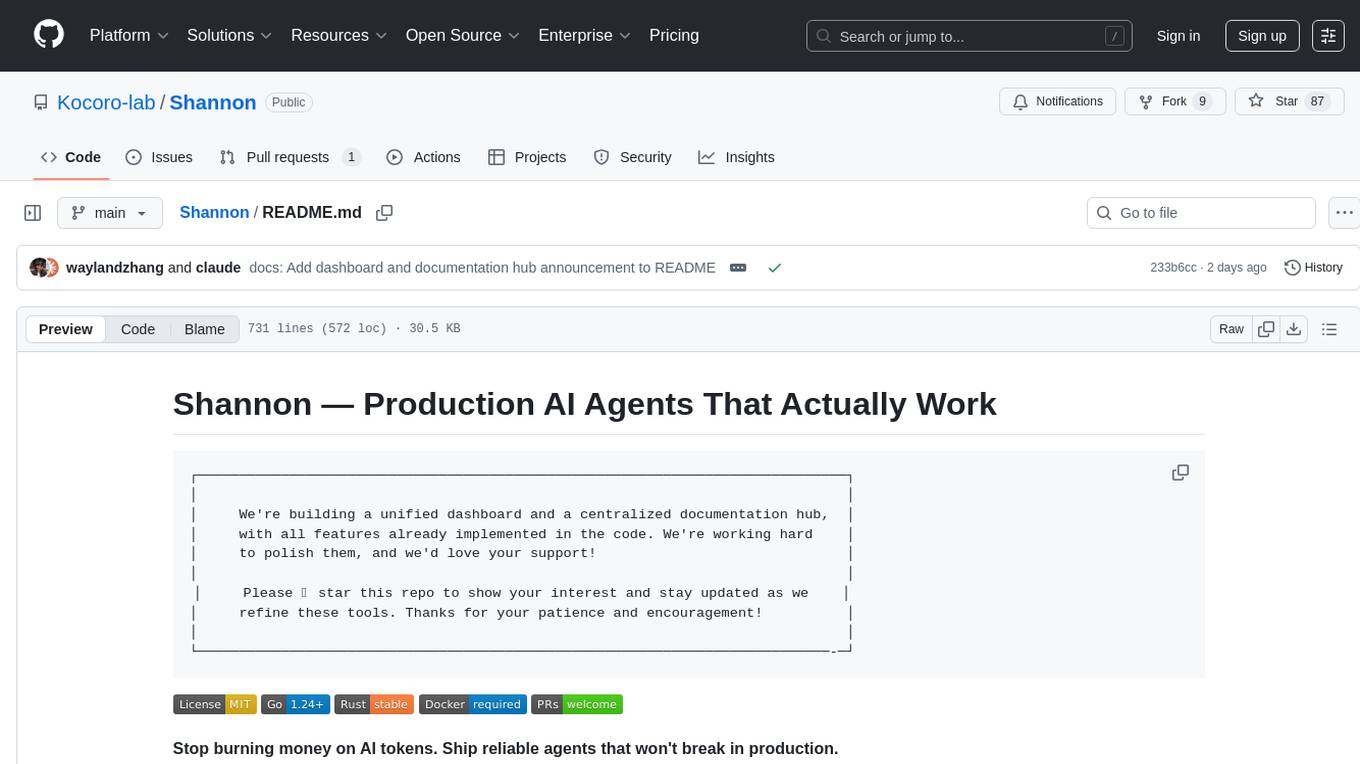
Shannon
Shannon is a battle-tested infrastructure for AI agents that solves problems at scale, such as runaway costs, non-deterministic failures, and security concerns. It offers features like intelligent caching, deterministic replay of workflows, time-travel debugging, WASI sandboxing, and hot-swapping between LLM providers. Shannon allows users to ship faster with zero configuration multi-agent setup, multiple AI patterns, time-travel debugging, and hot configuration changes. It is production-ready with features like WASI sandbox, token budget control, policy engine (OPA), and multi-tenancy. Shannon helps scale without breaking by reducing costs, being provider agnostic, observable by default, and designed for horizontal scaling with Temporal workflow orchestration.
helix
HelixML is a private GenAI platform that allows users to deploy the best of open AI in their own data center or VPC while retaining complete data security and control. It includes support for fine-tuning models with drag-and-drop functionality. HelixML brings the best of open source AI to businesses in an ergonomic and scalable way, optimizing the tradeoff between GPU memory and latency.
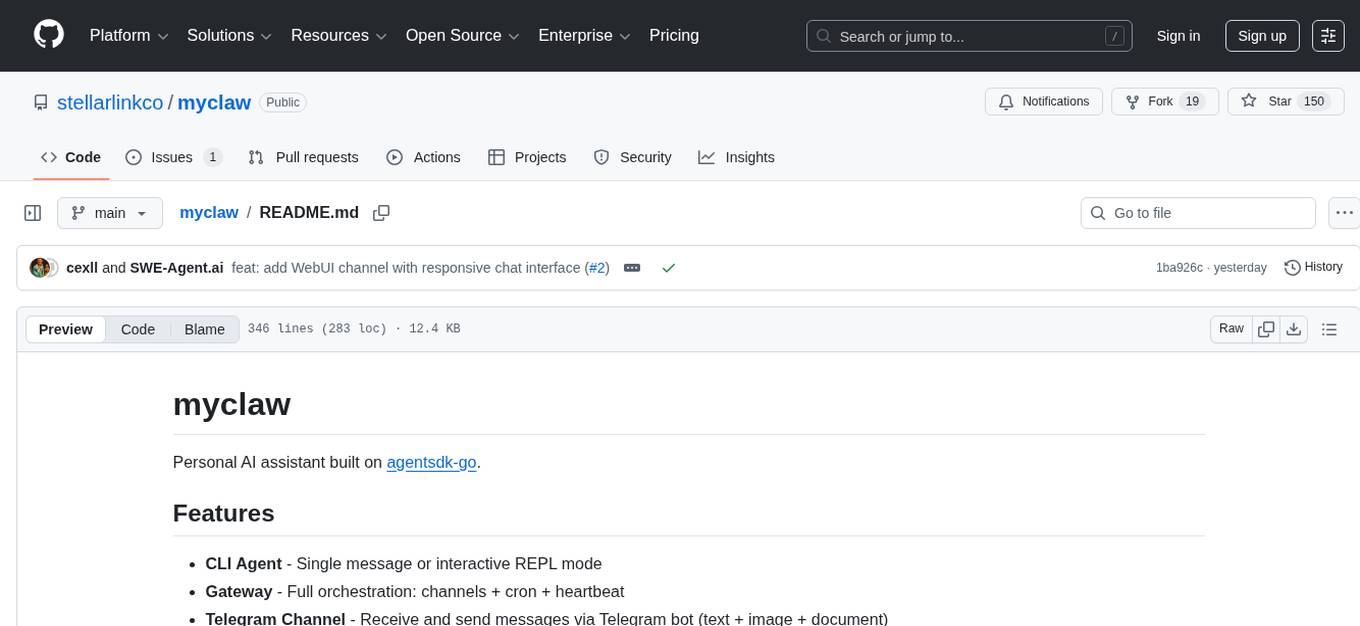
myclaw
myclaw is a personal AI assistant built on agentsdk-go that offers a CLI agent for single message or interactive REPL mode, full orchestration with channels, cron, and heartbeat, support for various messaging channels like Telegram, Feishu, WeCom, WhatsApp, and a web UI, multi-provider support for Anthropic and OpenAI models, image recognition and document processing, scheduled tasks with JSON persistence, long-term and daily memory storage, custom skill loading, and more. It provides a comprehensive solution for interacting with AI models and managing tasks efficiently.
For similar tasks
osmedeus
Osmedeus is a security-focused declarative orchestration engine that simplifies complex workflow automation into auditable YAML definitions. It provides powerful automation capabilities without compromising infrastructure integrity and safety. With features like declarative YAML workflows, multiple runners, event-driven triggers, template engine, utility functions, REST API server, distributed execution, notifications, cloud storage, AI integration, SAST integration, language detection, and preset installations, Osmedeus offers a comprehensive solution for security automation tasks.
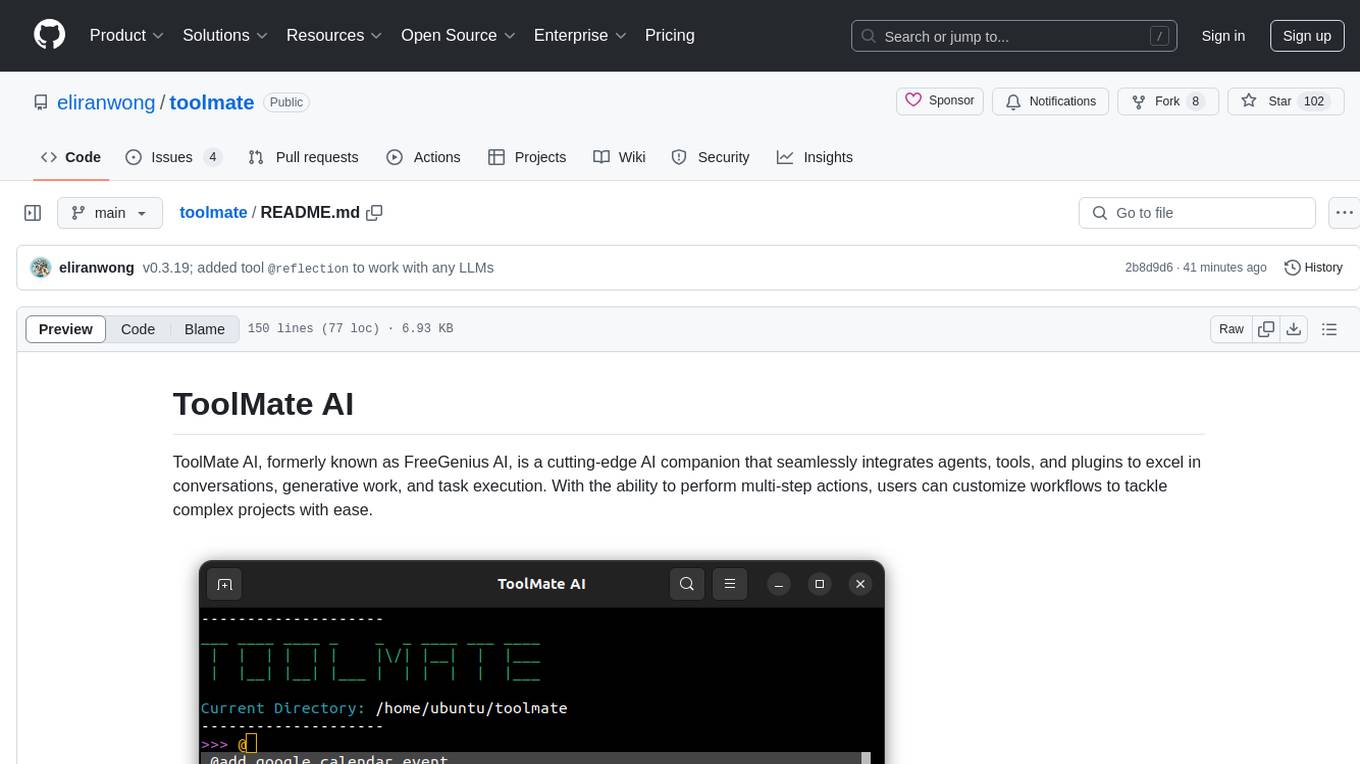
toolmate
ToolMate AI is an advanced AI companion that integrates agents, tools, and plugins to excel in conversations, generative work, and task execution. It supports multi-step actions, allowing users to customize workflows for tackling complex projects with ease. The tool offers a wide range of AI backends and models, including Ollama, Llama.cpp, Groq Cloud API, OpenAI API, and Google Gemini via Vertex AI. Users can easily switch between backends and leverage AI models like wizardlm2 and mixtral. ToolMate AI stands out for its distinctive features such as tool calling for any LLMs, running multiple tools in one go, highly customizable plugins, and integration with popular AI tools. It also supports quick tool calling using '@' notation and enables the execution of computing tasks on demand. With features like multiple tools in one go, customizable plugins, system command and fabric integration, GPU offloading support, real-time data access, and device information retrieval, ToolMate AI offers a comprehensive solution for various tasks and content creation.
ragna
Ragna is a RAG orchestration framework designed for managing workflows and orchestrating tasks. It provides a comprehensive set of features for users to streamline their processes and automate repetitive tasks. With Ragna, users can easily create, schedule, and monitor workflows, making it an ideal tool for teams and individuals looking to improve their productivity and efficiency. The framework offers extensive documentation, community support, and a user-friendly interface, making it accessible to users of all skill levels. Whether you are a developer, data scientist, or project manager, Ragna can help you simplify your workflow management and boost your overall performance.
For similar jobs
tracecat
Tracecat is an open-source automation platform for security teams. It's designed to be simple but powerful, with a focus on AI features and a practitioner-obsessed UI/UX. Tracecat can be used to automate a variety of tasks, including phishing email investigation, evidence collection, and remediation plan generation.
beelzebub
Beelzebub is an advanced honeypot framework designed to provide a highly secure environment for detecting and analyzing cyber attacks. It offers a low code approach for easy implementation and utilizes virtualization techniques powered by OpenAI Generative Pre-trained Transformer. Key features include OpenAI Generative Pre-trained Transformer acting as Linux virtualization, SSH Honeypot, HTTP Honeypot, TCP Honeypot, Prometheus openmetrics integration, Docker integration, RabbitMQ integration, and kubernetes support. Beelzebub allows easy configuration for different services and ports, enabling users to create custom honeypot scenarios. The roadmap includes developing Beelzebub into a robust PaaS platform. The project welcomes contributions and encourages adherence to the Code of Conduct for a supportive and respectful community.
admyral
Admyral is an open-source Cybersecurity Automation & Investigation Assistant that provides a unified console for investigations and incident handling, workflow automation creation, automatic alert investigation, and next step suggestions for analysts. It aims to tackle alert fatigue and automate security workflows effectively by offering features like workflow actions, AI actions, case management, alert handling, and more. Admyral combines security automation and case management to streamline incident response processes and improve overall security posture. The tool is open-source, transparent, and community-driven, allowing users to self-host, contribute, and collaborate on integrations and features.
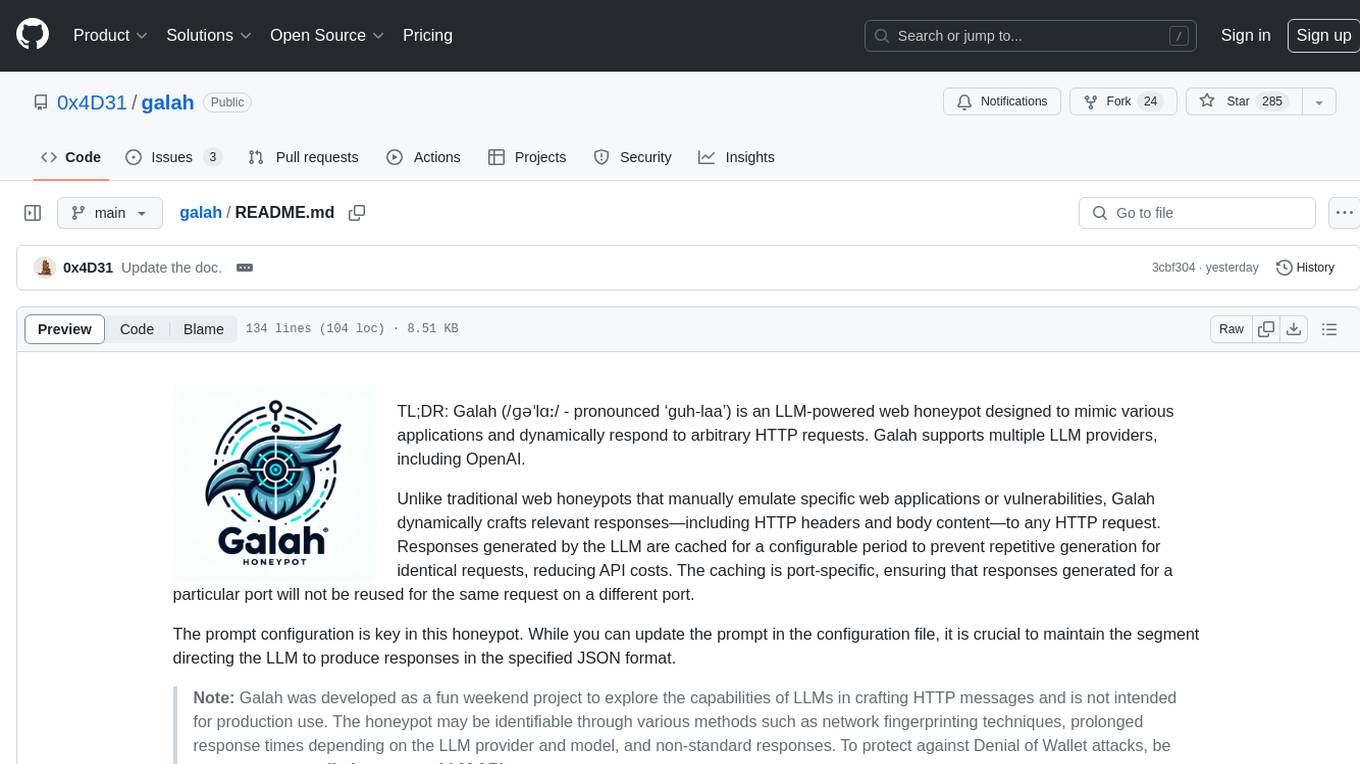
galah
Galah is an LLM-powered web honeypot designed to mimic various applications and dynamically respond to arbitrary HTTP requests. It supports multiple LLM providers, including OpenAI. Unlike traditional web honeypots, Galah dynamically crafts responses for any HTTP request, caching them to reduce repetitive generation and API costs. The honeypot's configuration is crucial, directing the LLM to produce responses in a specified JSON format. Note that Galah is a weekend project exploring LLM capabilities and not intended for production use, as it may be identifiable through network fingerprinting and non-standard responses.
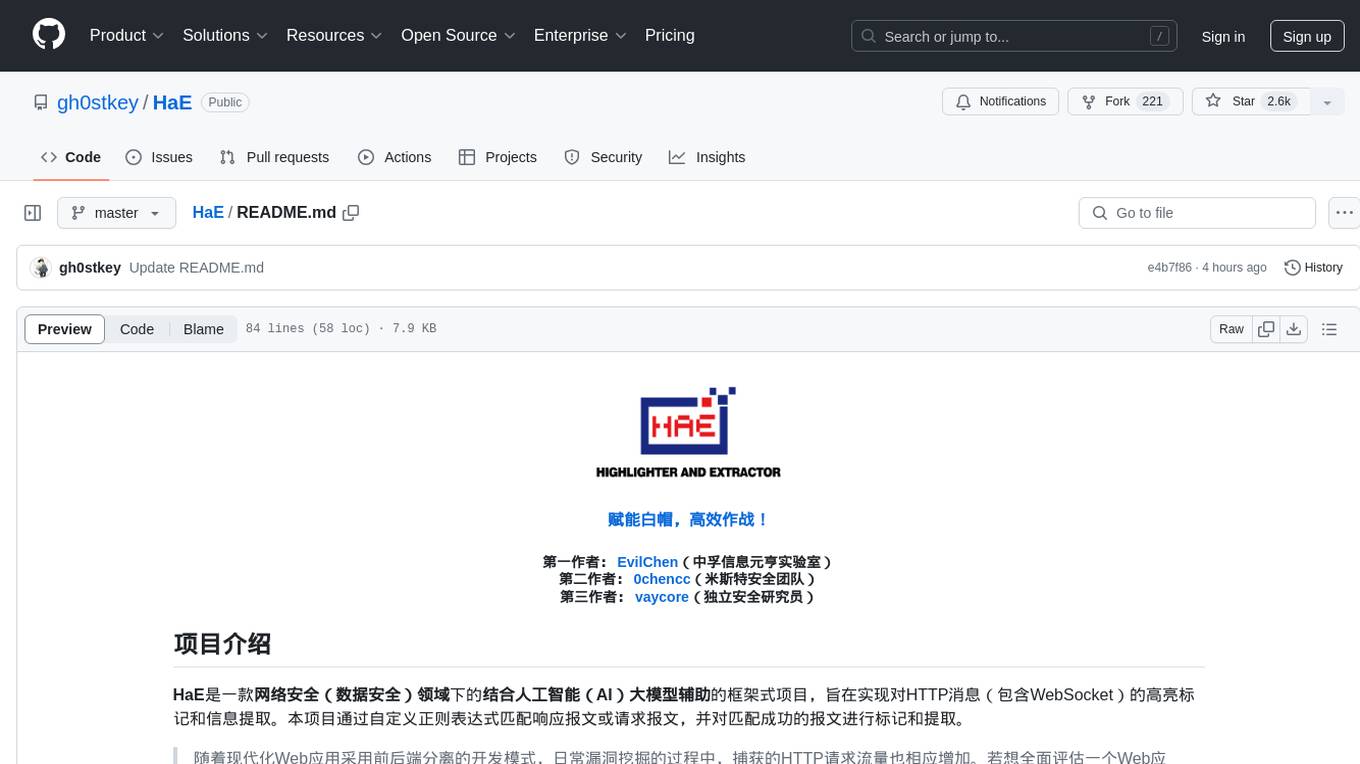
HaE
HaE is a framework project in the field of network security (data security) that combines artificial intelligence (AI) large models to achieve highlighting and information extraction of HTTP messages (including WebSocket). It aims to reduce testing time, focus on valuable and meaningful messages, and improve vulnerability discovery efficiency. The project provides a clear and visual interface design, simple interface interaction, and centralized data panel for querying and extracting information. It also features built-in color upgrade algorithm, one-click export/import of data, and integration of AI large models API for optimized data processing.
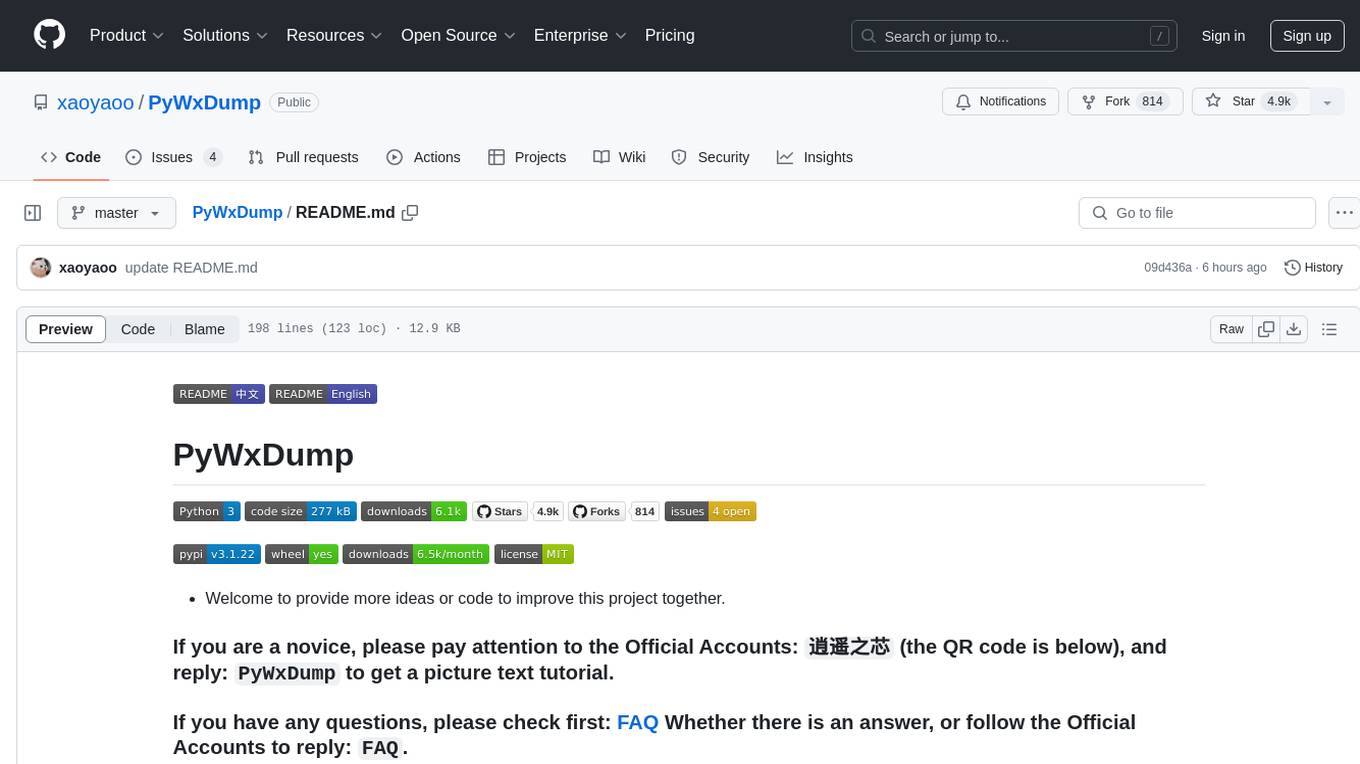
PyWxDump
PyWxDump is a Python tool designed for obtaining WeChat account information, decrypting databases, viewing WeChat chats, and exporting chats as HTML backups. It provides core features such as extracting base address offsets of various WeChat data, decrypting databases, and combining multiple database types for unified viewing. Additionally, it offers extended functions like viewing chat history through the web, exporting chat logs in different formats, and remote viewing of WeChat chat history. The tool also includes document classes for database field descriptions, base address offset methods, and decryption methods for MAC databases. PyWxDump is suitable for network security, daily backup archiving, remote chat history viewing, and more.
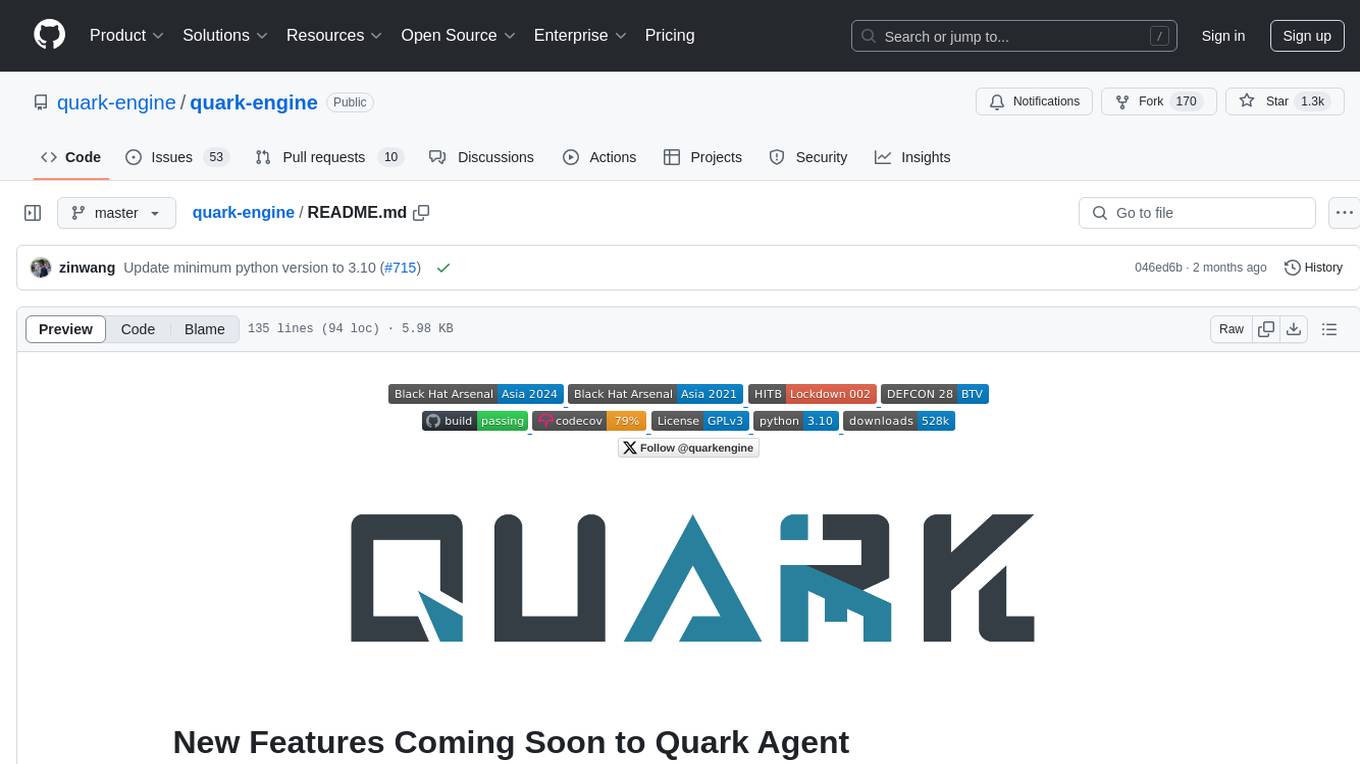
quark-engine
Quark Engine is an AI-powered tool designed for analyzing Android APK files. It focuses on enhancing the detection process for auto-suggestion, enabling users to create detection workflows without coding. The tool offers an intuitive drag-and-drop interface for workflow adjustments and updates. Quark Agent, the core component, generates Quark Script code based on natural language input and feedback. The project is committed to providing a user-friendly experience for designing detection workflows through textual and visual methods. Various features are still under development and will be rolled out gradually.
burpference
Burpference is an open-source extension designed to capture in-scope HTTP requests and responses from Burp's proxy history and send them to a remote LLM API in JSON format. It automates response capture, integrates with APIs, optimizes resource usage, provides color-coded findings visualization, offers comprehensive logging, supports native Burp reporting, and allows flexible configuration. Users can customize system prompts, API keys, and remote hosts, and host models locally to prevent high inference costs. The tool is ideal for offensive web application engagements to surface findings and vulnerabilities.