


decapod
Decapod is the daemonless, local-first control plane that agents call on demand to align intent, enforce boundaries, and produce proof-backed completion across concurrent multi-agent work. 🦀
Stars: 77
Decapod is a daemonless control plane for AI coding agents, providing a local-first state that can be verified. It is called on demand inside agent loops to lock intent, enforce boundaries, and prove completion with explicit gates. The tool shapes inference without doing inference, ensuring clear next actions, hard policy boundaries, and structured proof of completion criteria. State is stored locally in `.decapod/`, allowing shared context, decisions, and traces to persist across sessions. Decapod is agent-agnostic and safe for concurrent multi-agent execution.
README:
🦀
cargo install decapod && decapod init
Decapod
A daemonless control plane for AI coding agents.
Called on demand inside agent loops. No background process, no new workflow, local-first state you can verify.




AI coding agents are strong at generating code. Most failures happen before and after generation: unclear intent, fuzzy boundaries, and weak completion checks.
Decapod is the missing layer in that loop. Agents call it mid-run to lock intent, enforce boundaries, and prove completion with explicit gates. It shapes inference without doing inference.
Decapod is daemonless. There is no long-lived service. The binary starts when an agent calls it and exits immediately after the call.
"Just use Decapod" is literal:
cargo install decapoddecapod init
Then continue with Claude Code, OpenAI Codex, Gemini CLI, Cursor, or any tool that can invoke a CLI command. Decapod is agent-agnostic and safe for concurrent multi-agent execution.
State is local and durable in .decapod/: shared context, decisions, and traces persist across sessions and remain retrievable over time.
Related: Evaluating AGENTS.md (ETH SRI, 2026) on context-file quality and agent cost/performance.
☕ Like Decapod? Buy us a coffee on Ko-fi 💙
Decapod centers execution around three outcomes:
-
Advisory: clear next actions that tighten intent and reduce wasted loops. -
Interlock: hard policy boundaries that block unsafe or out-of-contract flow. -
Attestation: durable, structured proof that completion criteria actually passed.
Human Intent
    |
    v
AI Agent(s)  <---->  Decapod Runtime  <---->  Repository + Policy
                         |    |    |
                         |    |    +-- Interlock (enforced boundaries)
                         |    +------- Advisory (guided execution)
                         +------------ Attestation (verifiable outcomes)
- On-demand CLI/RPC control plane agents call during work, then exit.
- Early intent capture and explicit task boundaries before implementation commits.
- Deterministic policy gates that produce concrete pass/fail completion signals.
- Repo-native durable state in
.decapod/for historically retrievable traces and decisions. - Shared cross-agent context that survives sessions and handoffs.
- Multi-agent-safe coordination for concurrent Claude/Codex/Gemini/OpenCode workflows.
cargo install decapod
decapod init
Then keep using your agents normally. Decapod is called from inside those agent runs when control-plane decisions are needed.
Agent integration: If you use Claude Code / Codex / Gemini / Cursor / similar tools, see AGENTS.md and the tool-specific entrypoint files (CLAUDE.md, CODEX.md, GEMINI.md) for the exact operational contract.
Learn more about the embedded constitution via the CLI:
decapod docs show core/DECAPOD.mdOverride constitution defaults with plain English in .decapod/OVERRIDE.md.
git clone https://github.com/DecapodLabs/decapod
cd decapod
cargo build
cargo test
decapod validate- Development guide: CONTRIBUTING.md
- Security policy: SECURITY.md
- Release history: CHANGELOG.md
MIT. See LICENSE.
For Tasks:
Click tags to check more tools for each tasksFor Jobs:
Alternative AI tools for decapod
Similar Open Source Tools
decapod
Decapod is a daemonless control plane for AI coding agents, providing a local-first state that can be verified. It is called on demand inside agent loops to lock intent, enforce boundaries, and prove completion with explicit gates. The tool shapes inference without doing inference, ensuring clear next actions, hard policy boundaries, and structured proof of completion criteria. State is stored locally in `.decapod/`, allowing shared context, decisions, and traces to persist across sessions. Decapod is agent-agnostic and safe for concurrent multi-agent execution.
metta
Metta AI is an open-source research project focusing on the emergence of cooperation and alignment in multi-agent AI systems. It explores the impact of social dynamics like kinship and mate selection on learning and cooperative behaviors of AI agents. The project introduces a reward-sharing mechanism mimicking familial bonds and mate selection to observe the evolution of complex social behaviors among AI agents. Metta aims to contribute to the discussion on safe and beneficial AGI by creating an environment where AI agents can develop general intelligence through continuous learning and adaptation.
Trace
Trace is a new AutoDiff-like tool for training AI systems end-to-end with general feedback. It generalizes the back-propagation algorithm by capturing and propagating an AI system's execution trace. Implemented as a PyTorch-like Python library, users can write Python code directly and use Trace primitives to optimize certain parts, similar to training neural networks.
agentscript
AgentScript is an open-source framework for building AI agents that think in code. It prompts a language model to generate JavaScript code, which is then executed in a dedicated runtime with resumability, state persistence, and interactivity. The framework allows for abstract task execution without needing to know all the data beforehand, making it flexible and efficient. AgentScript supports tools, deterministic functions, and LLM-enabled functions, enabling dynamic data processing and decision-making. It also provides state management and human-in-the-loop capabilities, allowing for pausing, serialization, and resumption of execution.
zshot
Zshot is a highly customizable framework for performing Zero and Few shot named entity and relationships recognition. It can be used for mentions extraction, wikification, zero and few shot named entity recognition, zero and few shot named relationship recognition, and visualization of zero-shot NER and RE extraction. The framework consists of two main components: the mentions extractor and the linker. There are multiple mentions extractors and linkers available, each serving a specific purpose. Zshot also includes a relations extractor and a knowledge extractor for extracting relations among entities and performing entity classification. The tool requires Python 3.6+ and dependencies like spacy, torch, transformers, evaluate, and datasets for evaluation over datasets like OntoNotes. Optional dependencies include flair and blink for additional functionalities. Zshot provides examples, tutorials, and evaluation methods to assess the performance of the components.
fabrice-ai
A lightweight, functional, and composable framework for building AI agents that work together to solve complex tasks. Built with TypeScript and designed to be serverless-ready. Fabrice embraces functional programming principles, remains stateless, and stays focused on composability. It provides core concepts like easy teamwork creation, infrastructure-agnosticism, statelessness, and includes all tools and features needed to build AI teams. Agents are specialized workers with specific roles and capabilities, able to call tools and complete tasks. Workflows define how agents collaborate to achieve a goal, with workflow states representing the current state of the workflow. Providers handle requests to the LLM and responses. Tools extend agent capabilities by providing concrete actions they can perform. Execution involves running the workflow to completion, with options for custom execution and BDD testing.
neuron-ai
Neuron AI is a PHP framework that provides an Agent class for creating fully functional agents to perform tasks like analyzing text for SEO optimization. The framework manages advanced mechanisms such as memory, tools, and function calls. Users can extend the Agent class to create custom agents and interact with them to get responses based on the underlying LLM. Neuron AI aims to simplify the development of AI-powered applications by offering a structured framework with documentation and guidelines for contributions under the MIT license.
artkit
ARTKIT is a Python framework developed by BCG X for automating prompt-based testing and evaluation of Gen AI applications. It allows users to develop automated end-to-end testing and evaluation pipelines for Gen AI systems, supporting multi-turn conversations and various testing scenarios like Q&A accuracy, brand values, equitability, safety, and security. The framework provides a simple API, asynchronous processing, caching, model agnostic support, end-to-end pipelines, multi-turn conversations, robust data flows, and visualizations. ARTKIT is designed for customization by data scientists and engineers to enhance human-in-the-loop testing and evaluation, emphasizing the importance of tailored testing for each Gen AI use case.
OneKE
OneKE is a flexible dockerized system for schema-guided knowledge extraction, capable of extracting information from the web and raw PDF books across multiple domains like science and news. It employs a collaborative multi-agent approach and includes a user-customizable knowledge base to enable tailored extraction. OneKE offers various IE tasks support, data sources support, LLMs support, extraction method support, and knowledge base configuration. Users can start with examples using YAML, Python, or Web UI, and perform tasks like Named Entity Recognition, Relation Extraction, Event Extraction, Triple Extraction, and Open Domain IE. The tool supports different source formats like Plain Text, HTML, PDF, Word, TXT, and JSON files. Users can choose from various extraction models like OpenAI, DeepSeek, LLaMA, Qwen, ChatGLM, MiniCPM, and OneKE for information extraction tasks. Extraction methods include Schema Agent, Extraction Agent, and Reflection Agent. The tool also provides support for schema repository and case repository management, along with solutions for network issues. Contributors to the project include Ningyu Zhang, Haofen Wang, Yujie Luo, Xiangyuan Ru, Kangwei Liu, Lin Yuan, Mengshu Sun, Lei Liang, Zhiqiang Zhang, Jun Zhou, Lanning Wei, Da Zheng, and Huajun Chen.
mosec
Mosec is a high-performance and flexible model serving framework for building ML model-enabled backend and microservices. It bridges the gap between any machine learning models you just trained and the efficient online service API. * **Highly performant** : web layer and task coordination built with Rust 🦀, which offers blazing speed in addition to efficient CPU utilization powered by async I/O * **Ease of use** : user interface purely in Python 🐍, by which users can serve their models in an ML framework-agnostic manner using the same code as they do for offline testing * **Dynamic batching** : aggregate requests from different users for batched inference and distribute results back * **Pipelined stages** : spawn multiple processes for pipelined stages to handle CPU/GPU/IO mixed workloads * **Cloud friendly** : designed to run in the cloud, with the model warmup, graceful shutdown, and Prometheus monitoring metrics, easily managed by Kubernetes or any container orchestration systems * **Do one thing well** : focus on the online serving part, users can pay attention to the model optimization and business logic
mentals-ai
Mentals AI is a tool designed for creating and operating agents that feature loops, memory, and various tools, all through straightforward markdown syntax. This tool enables you to concentrate solely on the agent’s logic, eliminating the necessity to compose underlying code in Python or any other language. It redefines the foundational frameworks for future AI applications by allowing the creation of agents with recursive decision-making processes, integration of reasoning frameworks, and control flow expressed in natural language. Key concepts include instructions with prompts and references, working memory for context, short-term memory for storing intermediate results, and control flow from strings to algorithms. The tool provides a set of native tools for message output, user input, file handling, Python interpreter, Bash commands, and short-term memory. The roadmap includes features like a web UI, vector database tools, agent's experience, and tools for image generation and browsing. The idea behind Mentals AI originated from studies on psychoanalysis executive functions and aims to integrate 'System 1' (cognitive executor) with 'System 2' (central executive) to create more sophisticated agents.
CogAgent
CogAgent is an advanced intelligent agent model designed for automating operations on graphical interfaces across various computing devices. It supports platforms like Windows, macOS, and Android, enabling users to issue commands, capture device screenshots, and perform automated operations. The model requires a minimum of 29GB of GPU memory for inference at BF16 precision and offers capabilities for executing tasks like sending Christmas greetings and sending emails. Users can interact with the model by providing task descriptions, platform specifications, and desired output formats.
habitat-lab
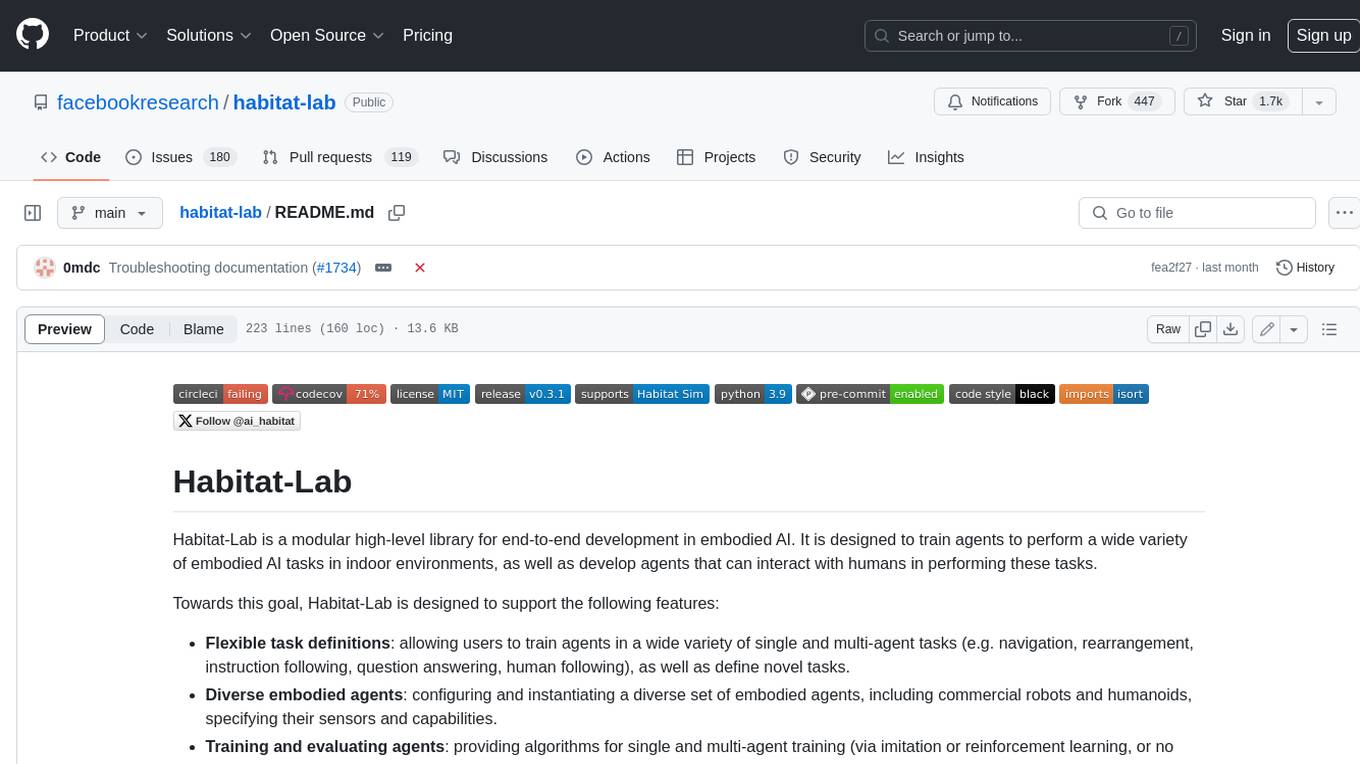
Habitat-Lab is a modular high-level library for end-to-end development in embodied AI. It is designed to train agents to perform a wide variety of embodied AI tasks in indoor environments, as well as develop agents that can interact with humans in performing these tasks.
langchain
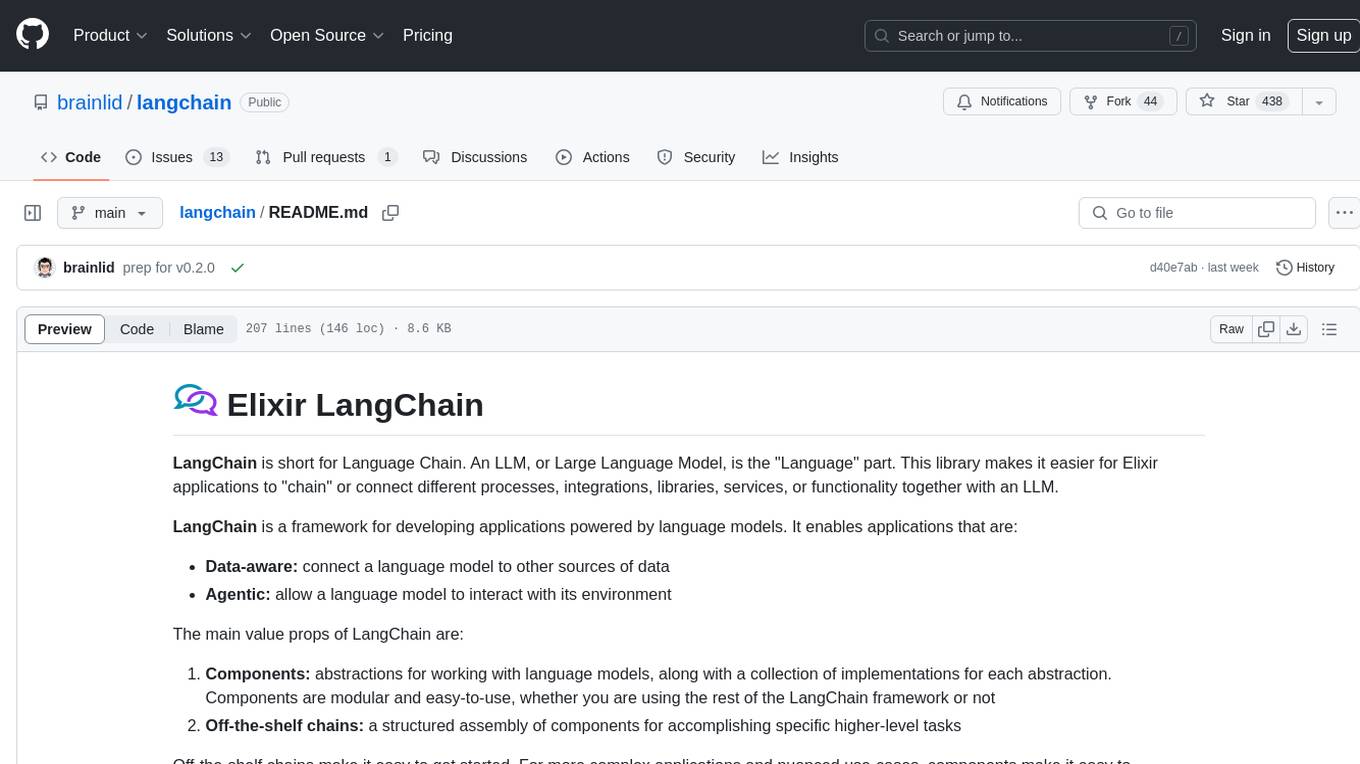
LangChain is a framework for developing Elixir applications powered by language models. It enables applications to connect language models to other data sources and interact with the environment. The library provides components for working with language models and off-the-shelf chains for specific tasks. It aims to assist in building applications that combine large language models with other sources of computation or knowledge. LangChain is written in Elixir and is not aimed for parity with the JavaScript and Python versions due to differences in programming paradigms and design choices. The library is designed to make it easy to integrate language models into applications and expose features, data, and functionality to the models.
deepeval
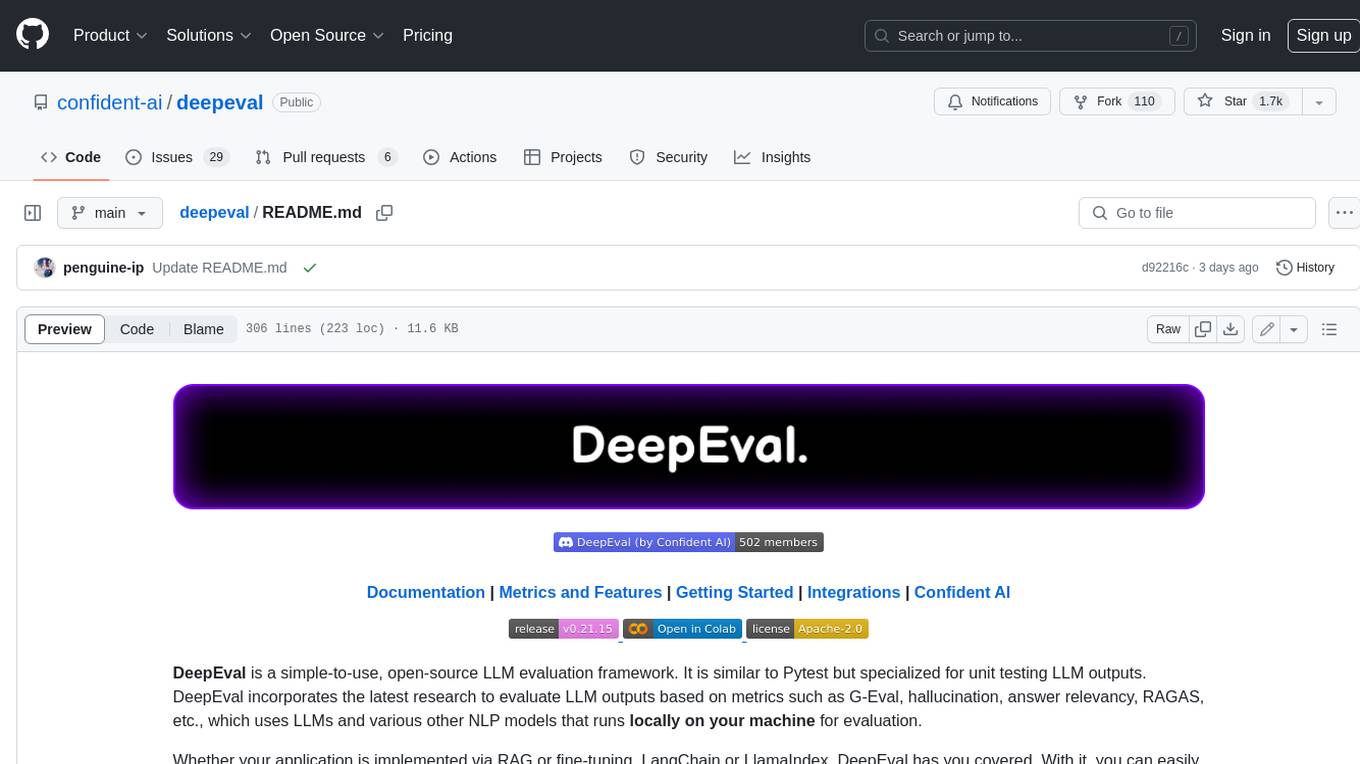
DeepEval is a simple-to-use, open-source LLM evaluation framework specialized for unit testing LLM outputs. It incorporates various metrics such as G-Eval, hallucination, answer relevancy, RAGAS, etc., and runs locally on your machine for evaluation. It provides a wide range of ready-to-use evaluation metrics, allows for creating custom metrics, integrates with any CI/CD environment, and enables benchmarking LLMs on popular benchmarks. DeepEval is designed for evaluating RAG and fine-tuning applications, helping users optimize hyperparameters, prevent prompt drifting, and transition from OpenAI to hosting their own Llama2 with confidence.
humanoid-gym
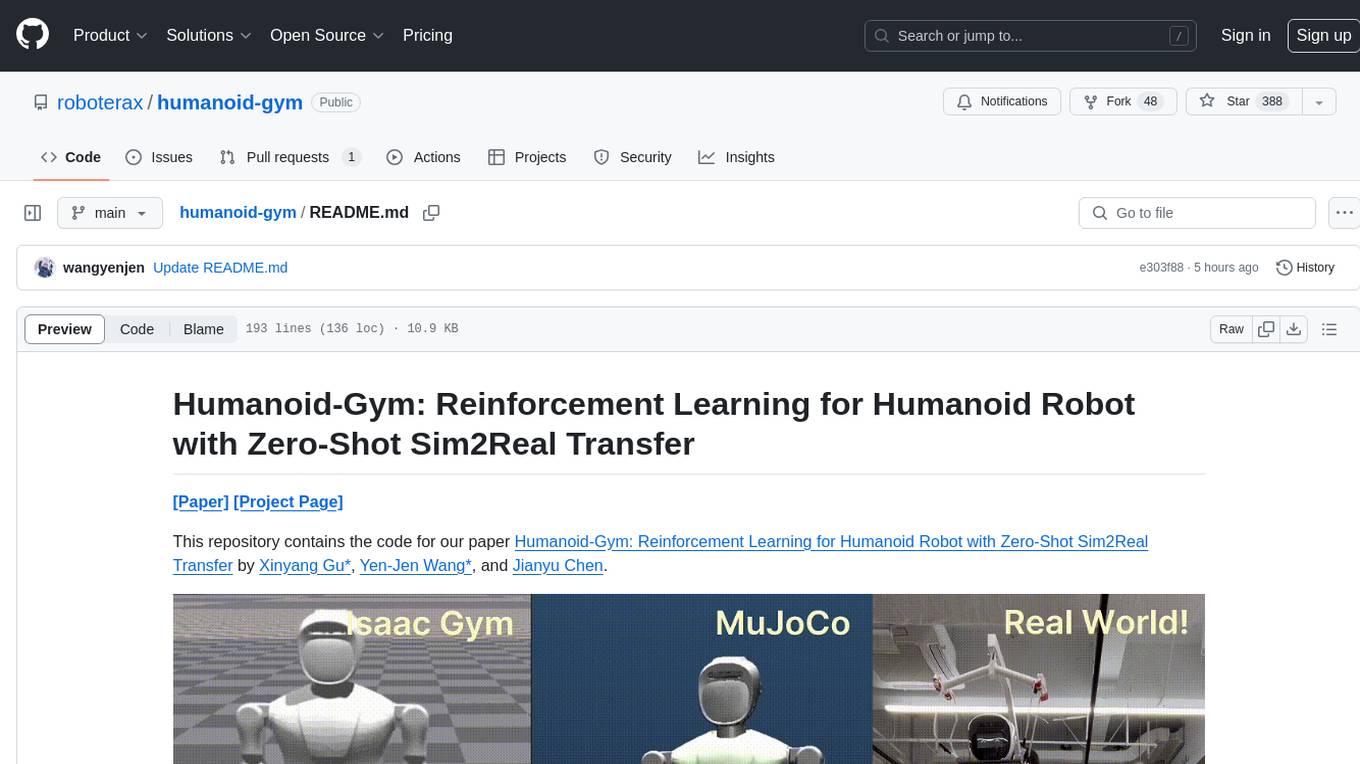
Humanoid-Gym is a reinforcement learning framework designed for training locomotion skills for humanoid robots, focusing on zero-shot transfer from simulation to real-world environments. It integrates a sim-to-sim framework from Isaac Gym to Mujoco for verifying trained policies in different physical simulations. The codebase is verified with RobotEra's XBot-S and XBot-L humanoid robots. It offers comprehensive training guidelines, step-by-step configuration instructions, and execution scripts for easy deployment. The sim2sim support allows transferring trained policies to accurate simulated environments. The upcoming features include Denoising World Model Learning and Dexterous Hand Manipulation. Installation and usage guides are provided along with examples for training PPO policies and sim-to-sim transformations. The code structure includes environment and configuration files, with instructions on adding new environments. Troubleshooting tips are provided for common issues, along with a citation and acknowledgment section.
For similar tasks
decapod
Decapod is a daemonless control plane for AI coding agents, providing a local-first state that can be verified. It is called on demand inside agent loops to lock intent, enforce boundaries, and prove completion with explicit gates. The tool shapes inference without doing inference, ensuring clear next actions, hard policy boundaries, and structured proof of completion criteria. State is stored locally in `.decapod/`, allowing shared context, decisions, and traces to persist across sessions. Decapod is agent-agnostic and safe for concurrent multi-agent execution.
flock
Flock is a workflow-based low-code platform that enables rapid development of chatbots, RAG applications, and coordination of multi-agent teams. It offers a flexible, low-code solution for orchestrating collaborative agents, supporting various node types for specific tasks, such as input processing, text generation, knowledge retrieval, tool execution, intent recognition, answer generation, and more. Flock integrates LangChain and LangGraph to provide offline operation capabilities and supports future nodes like Conditional Branch, File Upload, and Parameter Extraction for creating complex workflows. Inspired by StreetLamb, Lobe-chat, Dify, and fastgpt projects, Flock introduces new features and directions while leveraging open-source models and multi-tenancy support.
swarmgo
SwarmGo is a Go package designed to create AI agents capable of interacting, coordinating, and executing tasks. It focuses on lightweight agent coordination and execution, offering powerful primitives like Agents and handoffs. SwarmGo enables building scalable solutions with rich dynamics between tools and networks of agents, all while keeping the learning curve low. It supports features like memory management, streaming support, concurrent agent execution, LLM interface, and structured workflows for organizing and coordinating multiple agents.
pebble
Pebbling is an open-source protocol for agent-to-agent communication, enabling AI agents to collaborate securely using Decentralised Identifiers (DIDs) and mutual TLS (mTLS). It provides a lightweight communication protocol built on JSON-RPC 2.0, ensuring reliable and secure conversations between agents. Pebbling allows agents to exchange messages safely, connect seamlessly regardless of programming language, and communicate quickly and efficiently. It is designed to pave the way for the next generation of collaborative AI systems, promoting secure and effortless communication between agents across different environments.
agentpool
AgentPool is a unified agent orchestration hub that allows users to configure and manage heterogeneous AI agents via YAML and expose them through standardized protocols. It acts as a protocol bridge, enabling users to define all agents in one YAML file and expose them through ACP or AG-UI protocols. Users can coordinate, delegate, and communicate with different agents through a unified interface. The tool supports multi-agent coordination, rich YAML configuration, server protocols like ACP and OpenCode, and additional capabilities such as structured output, storage & analytics, file abstraction, triggers, and streaming TTS. It offers CLI and programmatic usage patterns for running agents and interacting with the tool.
For similar jobs
sweep
Sweep is an AI junior developer that turns bugs and feature requests into code changes. It automatically handles developer experience improvements like adding type hints and improving test coverage.
teams-ai
The Teams AI Library is a software development kit (SDK) that helps developers create bots that can interact with Teams and Microsoft 365 applications. It is built on top of the Bot Framework SDK and simplifies the process of developing bots that interact with Teams' artificial intelligence capabilities. The SDK is available for JavaScript/TypeScript, .NET, and Python.
ai-guide
This guide is dedicated to Large Language Models (LLMs) that you can run on your home computer. It assumes your PC is a lower-end, non-gaming setup.
classifai
Supercharge WordPress Content Workflows and Engagement with Artificial Intelligence. Tap into leading cloud-based services like OpenAI, Microsoft Azure AI, Google Gemini and IBM Watson to augment your WordPress-powered websites. Publish content faster while improving SEO performance and increasing audience engagement. ClassifAI integrates Artificial Intelligence and Machine Learning technologies to lighten your workload and eliminate tedious tasks, giving you more time to create original content that matters.
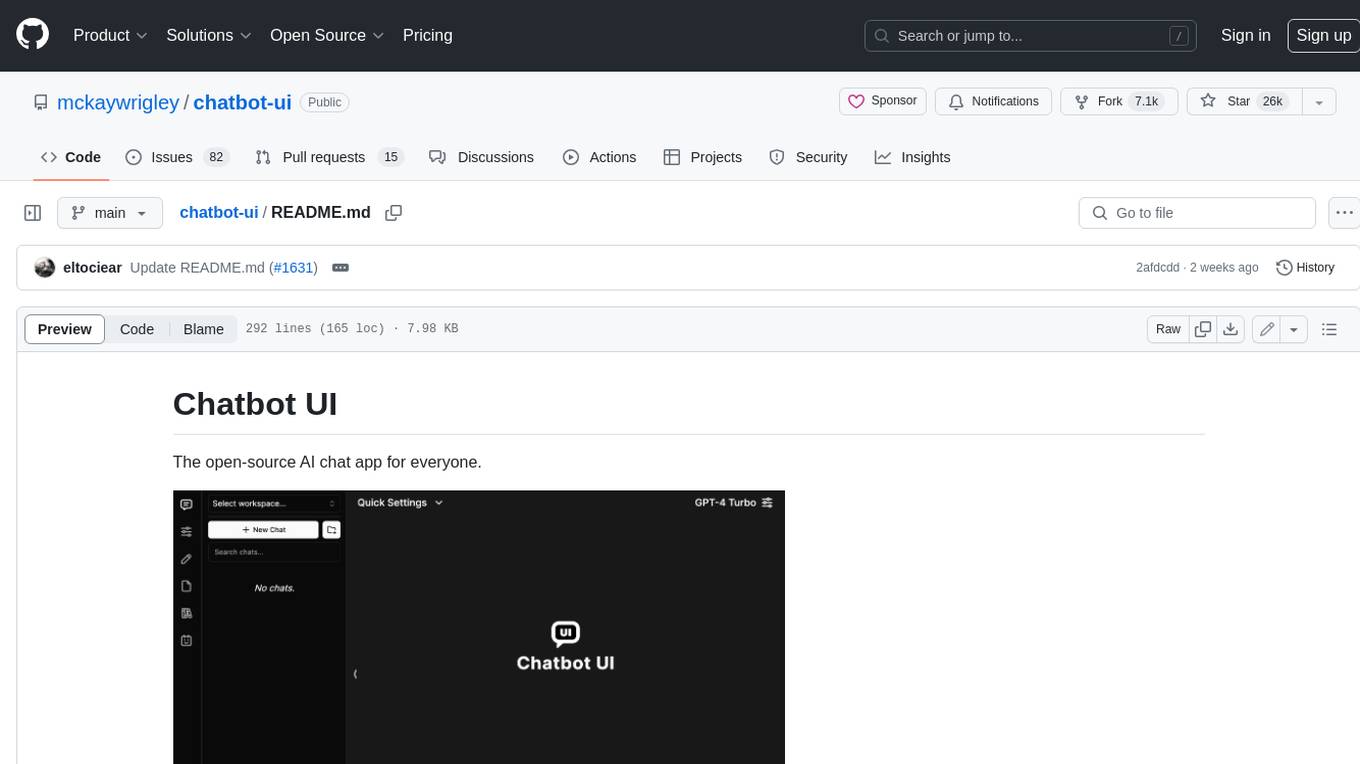
chatbot-ui
Chatbot UI is an open-source AI chat app that allows users to create and deploy their own AI chatbots. It is easy to use and can be customized to fit any need. Chatbot UI is perfect for businesses, developers, and anyone who wants to create a chatbot.
BricksLLM
BricksLLM is a cloud native AI gateway written in Go. Currently, it provides native support for OpenAI, Anthropic, Azure OpenAI and vLLM. BricksLLM aims to provide enterprise level infrastructure that can power any LLM production use cases. Here are some use cases for BricksLLM: * Set LLM usage limits for users on different pricing tiers * Track LLM usage on a per user and per organization basis * Block or redact requests containing PIIs * Improve LLM reliability with failovers, retries and caching * Distribute API keys with rate limits and cost limits for internal development/production use cases * Distribute API keys with rate limits and cost limits for students
uAgents
uAgents is a Python library developed by Fetch.ai that allows for the creation of autonomous AI agents. These agents can perform various tasks on a schedule or take action on various events. uAgents are easy to create and manage, and they are connected to a fast-growing network of other uAgents. They are also secure, with cryptographically secured messages and wallets.
griptape
Griptape is a modular Python framework for building AI-powered applications that securely connect to your enterprise data and APIs. It offers developers the ability to maintain control and flexibility at every step. Griptape's core components include Structures (Agents, Pipelines, and Workflows), Tasks, Tools, Memory (Conversation Memory, Task Memory, and Meta Memory), Drivers (Prompt and Embedding Drivers, Vector Store Drivers, Image Generation Drivers, Image Query Drivers, SQL Drivers, Web Scraper Drivers, and Conversation Memory Drivers), Engines (Query Engines, Extraction Engines, Summary Engines, Image Generation Engines, and Image Query Engines), and additional components (Rulesets, Loaders, Artifacts, Chunkers, and Tokenizers). Griptape enables developers to create AI-powered applications with ease and efficiency.