


stylekit
精选优质 Web 设计风格,提供文档、组件模板、代码片段, 以及可直接导出的 AI Rules。
Stars: 56
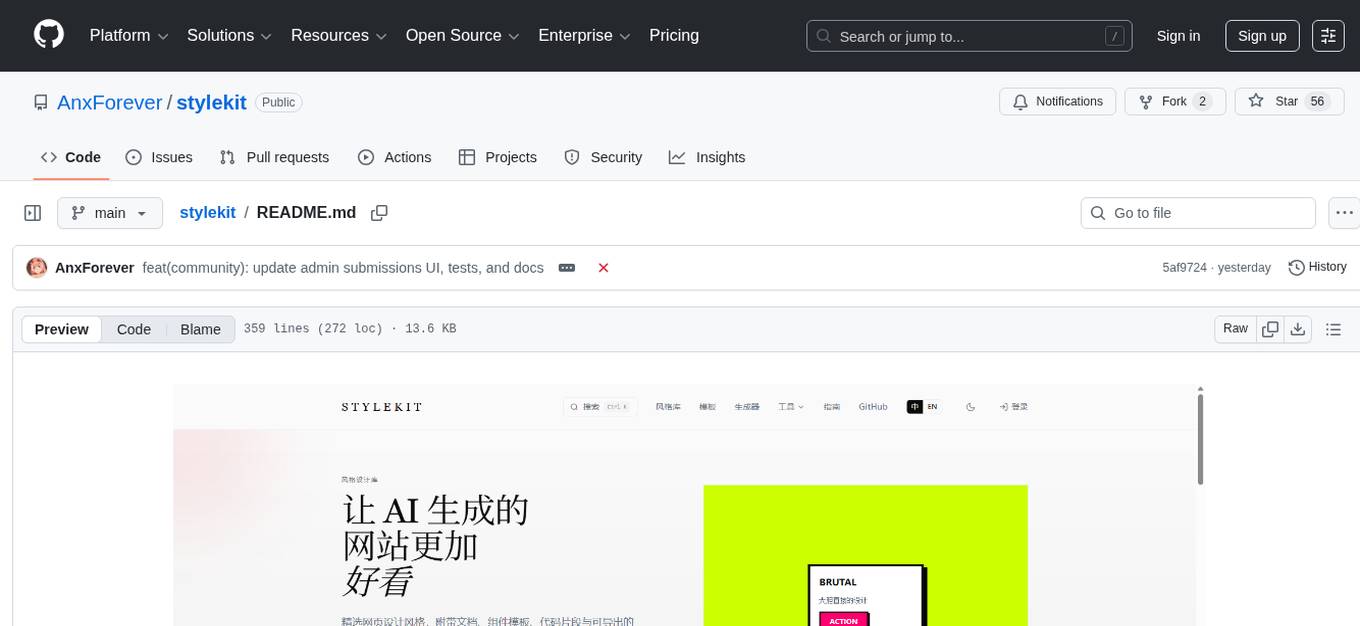
StyleKit is a comprehensive design system toolkit that helps both humans and AI generate consistent, high-quality UI code. It provides structured style specifications, design tokens, component recipes, prompt templates, and export tools — everything needed to go from 'I want a glassmorphism SaaS dashboard' to production-ready frontend code. With 90+ visual styles, 20+ page templates, 25+ UI components, and AI-powered tools like Prompt Builder, Smart Recommender, Style Linter, Style Analyzer, and Style Blender, StyleKit offers a platform with GitHub OAuth, ratings & comments, style submissions, instant community availability, favorites, bilingual support, PWA, and dark/light mode themes.
README:

The AI-Friendly Design System — 90+ Styles, 20+ Templates, One Toolkit





Features • Quick Start • Styles • Templates • API • Generator Hardening • AI Integration • Contributing
StyleKit is a comprehensive design system toolkit that helps both humans and AI generate consistent, high-quality UI code. It provides structured style specifications, design tokens, component recipes, prompt templates, and export tools — everything needed to go from "I want a glassmorphism SaaS dashboard" to production-ready frontend code.
- 90+ Visual Styles — From Neo-Brutalist to Glassmorphism, Cyberpunk Neon to Wabi-Sabi, covering modern, retro, artistic, and layout patterns
- 20+ Page Templates — Production-ready layouts: SaaS landing, admin panel, e-commerce, portfolio, blog, auth pages, and more
- 25+ UI Components — Built on Radix UI with full accessibility support, including brutalist and neumorphism variant libraries
- Design Tokens — Export as CSS variables, Tailwind presets, Figma tokens, shadcn themes, or IDE config files
- Prompt Builder — Generate structured AI prompts using the three-element framework (Surface, Context, Constraints)
- Smart Recommender — Context-aware design suggestions based on audience, device, mood, and brand
- Style Linter — Validate code against specific design style rules via CLI, API, or CI/CD
- Style Analyzer — Match existing code to the closest StyleKit style
- Style Blender — Mix multiple styles with adjustable weights
- Code Playground — Live editor with CodeMirror, instant preview, and built-in linting
- Style Creator — Build custom styles with color, typography, and border controls
- Style Comparison — Side-by-side visual and token diff between any two styles
- Design System Generator — Generate complete design systems from style selections
- GitHub OAuth — User authentication via Supabase
- Ratings & Comments — Community feedback on styles
- Style Submissions — Submit and review community styles
-
Instant Community Availability — Approved community styles are browseable at
/styles/{slug}without codebase registration - Favorites — Save and sync favorite styles
- Bilingual (EN/ZH) — Full internationalization support
- PWA — Installable with offline support via service worker
- Dark / Light Mode — Theme switching via next-themes
git clone https://github.com/AnxForever/stylekit.git
cd stylekit

# Install dependencies (project uses pnpm)
pnpm install

# Start development server
pnpm dev
Visit http://localhost:3000
For main-only AI development (no long-lived admin branch), use:
docs/workflows/cc-main-admin-playbook.mddocs/architecture/admin-independence-roadmap.mdAI_CONTEXT.md
To enable auth, ratings, and comments, create a .env.local:
NEXT_PUBLIC_SUPABASE_URL=https://your-project.supabase.co
NEXT_PUBLIC_SUPABASE_ANON_KEY=your-anon-key
SUPABASE_SERVICE_ROLE_KEY=your-service-role-key

# Recommended for production admin access control
ADMIN_USER_IDS=uuid-1,uuid-2

# Optional token for server-to-server admin API calls
ADMIN_API_TOKEN=replace-with-a-long-random-secret

# Optional local audit retention window (days, default 90)
ADMIN_AUDIT_RETENTION_DAYS=90

# Optional CSV export cap for admin audit download (rows, default 5000)
ADMIN_AUDIT_EXPORT_MAX_ROWS=5000

# Optional extra trusted origins for state-changing API routes
# (comma-separated, same-origin is already trusted by default)
CSRF_TRUSTED_ORIGINS=https://admin.stylekit.top90+ styles organized across multiple categories:
| Category | Examples |
|---|---|
| Modern / Tech | Glassmorphism, Neumorphism, Bento Grid, Liquid Glass, Fluent Design |
| Brutalist | Neo-Brutalist, Neo-Brutalist Playful, Neo-Brutalist Soft |
| Brand-Inspired | Apple Style, Notion Style, Stripe Style |
| Retro / Vintage | Art Deco, Vaporwave, VHS Aesthetic, Y2K, Outrun |
| Artistic | Watercolor, Impressionist Oil, Pop Art, Risograph, Surrealism |
| Japanese / Anime | Ghibli Style, Cyber Anime, Shoujo Manga, Visual Novel, Ukiyo-e |
| Cyberpunk | Cyberpunk Neon, Neon Samurai, Sci-Fi HUD, Mecha |
| Layout Patterns | Magazine Grid, Masonry Flow, Split Screen, Parallax Sections |
| Nature / Cozy | Cottagecore, Scandinavian, Wabi-Sabi, Natural Organic |
20 production-ready page templates:
| Template | Style |
|---|---|
| SaaS Landing | Modern Gradient |
| Admin Panel | Corporate Clean |
| E-commerce Product | Glassmorphism |
| Portfolio Gallery | Bento Grid |
| Editorial Blog | Editorial |
| Auth Pages | Neumorphism |
| Dashboard Charts | Dark Mode |
| Docs Site | Notion Style |
| Pricing Page | Stripe Style |
| Magazine Landing | Swiss Poster |
RESTful API for programmatic access to the entire design system:
# Styles
GET    /api/styles                    # List all styles
GET    /api/styles/{slug}             # Full style pack
GET    /api/styles/{slug}/tokens      # Design tokens
GET    /api/styles/{slug}/recipes     # Component recipes
POST   /api/styles/{slug}/rate        # Rate a style
GET    /api/styles/{slug}/comments    # Style comments

# AI / Knowledge
GET    /api/knowledge/search?q=...    # Search design knowledge
GET    /api/knowledge/smart           # Smart recommendations
GET    /api/knowledge/domains         # Knowledge domains
GET    /api/knowledge/stacks          # Tech stack guidelines

# Tools
POST   /api/lint                      # Lint code against style
POST   /api/accessibility             # Accessibility scoring
POST   /api/analyze-style             # Analyze existing style
POST   /api/match-style               # Match to closest style
POST   /api/submit/validate           # Validate AI submission manifest payload
POST   /api/submit/bundle             # Build and download submission bundle zip
GET    /api/generate-style            # Generator discovery metadata (ETag-supported)
POST   /api/generate/design-system    # Generate design system

# Export
GET    /api/styles/{slug}/claude-rules    # Export as Claude rules
GET    /api/styles/{slug}/cursorrules     # Export as .cursorrules
GET    /api/styles/{slug}/skill-pack      # Export as skill pack
GET    /api/styles/{slug}/md              # Export as Markdown

# Admin (requires admin session or ADMIN_API_TOKEN)
GET    /api/admin/analytics               # Admin analytics dataset
GET    /api/admin/audit                   # Admin action audit events
GET    /api/admin/generator               # Generator telemetry + trend + CSV export
GET    /api/admin/submissions             # Review queue
GET    /api/admin/submissions/{id}        # Submission detail
POST   /api/admin/submissions/{id}/review # Approve/reject submission
POST   /api/admin/submissions/{id}/register # Optional: archive approved submission into codebase files
DELETE /api/admin/submissions/{id}        # Delete submission
Audit query params:
-
limit(1-100),offset(>=0) -
action(submission.approve/submission.reject) -
days(e.g.1,7,30) -
search(slug / actor / target / ID keyword) -
format=csv(export filtered logs)- CSV cells are formula-safe escaped
- Export row count is capped by
ADMIN_AUDIT_EXPORT_MAX_ROWS
For server-to-server admin calls, pass:
Authorization: Bearer <ADMIN_API_TOKEN>
# or
x-admin-token: <ADMIN_API_TOKEN>
Security note: state-changing endpoints (POST/PUT/PATCH/DELETE) validate request Origin and reject untrusted cross-origin calls.
-
Strict input validation for generator APIs (
/api/generate-style,/api/generate/design-system) with stable error codes. -
Telemetry headers on generator responses:
x-stylekit-duration-ms,x-stylekit-status, andx-stylekit-error-code(error only). -
Admin telemetry endpoint at
/api/admin/generatorwith filters (minutes,endpoint,outcome,code), daily trends (trendDays), pagination, and CSV export (format=csv). - Client-side quality gates in the generator flow: config sanitization, validation checks, output quality checks, and user-visible warnings before download.
- Resilient ZIP export with worker fallback, retry with backoff, and a short-lived circuit breaker after repeated failures.
StyleKit ships with a Model Context Protocol server for direct AI assistant integration:
{
  "mcpServers": {
    "stylekit": {
      "command": "npx",
      "args": ["tsx", "/path/to/stylekit/tools/mcp/server.ts"]
    }
  }
}
9 tools available: search_knowledge, smart_recommend, get_style, list_styles, lint_code, get_stack_guidelines, compose_styles, generate_context_file, analyze_project_style
pnpm run cli -- lint src/app.tsx --style glassmorphism
pnpm run cli -- recommend --audience developers --mood professional
pnpm run cli -- export neo-brutalist --format tailwind-preset
pnpm run cli -- accessibility cyberpunk-neon
pnpm run cli -- compare glassmorphism neumorphismAI-discoverable documentation at /llms.txt and /llms-full.txt.
Export any style as: .cursorrules, claude-rules, windsurf-rules, tailwind-preset, shadcn-theme, figma-tokens, skill-pack
| Layer | Technology |
|---|---|
| Framework | Next.js 16 + Turbopack |
| UI | React 19, Radix UI, Lucide Icons |
| Styling | Tailwind CSS 4, CVA |
| Auth & DB | Supabase (OAuth, PostgreSQL) |
| Editor | CodeMirror 6 |
| Validation | Zod 4 |
| Data Fetching | SWR 2 |
| Analytics | Vercel Analytics |
| Testing | Vitest + Playwright |
| AI Protocol | MCP SDK |
app/                    # Next.js App Router
  ├── styles/           #   90+ style pages + showcases
  ├── templates/        #   20 page templates
  ├── api/              #   REST API endpoints
  ├── admin/            #   Admin dashboard
  ├── developers/       #   Developer portal
  ├── playground/       #   Live code editor
  ├── compare/          #   Style comparison
  ├── blend/            #   Style blender
  └── ...               #   Other pages
components/             # React components
  ├── ui/               #   25+ base components + variants
  ├── styles/           #   Style-specific components
  └── layout/           #   Layout components
lib/                    # Framework-agnostic logic
  ├── styles/           #   Style definitions & tokens
  ├── knowledge/        #   Design knowledge base
  ├── auth/             #   Supabase auth
  ├── export/           #   Export formatters
  └── ...               #   Other modules
tools/                  # Developer tooling
  ├── cli/              #   CLI entry point
  ├── mcp/              #   MCP server
  └── scripts/          #   Build & dev scripts
tests/                  # Test suites
  ├── unit/             #   Vitest unit tests
  └── e2e/              #   Playwright E2E tests
docs/                   # Documentation
public/                 # Static assets
pnpm dev                # Development server
pnpm build              # Production build
pnpm start              # Serve production build
pnpm lint               # ESLint
pnpm test               # Unit tests (Vitest)
pnpm e2e                # E2E tests (Playwright)
pnpm run cli            # CLI tool
pnpm run mcp            # MCP server
pnpm run security:secrets # Secret leak scanContributions are welcome! Please read the following before opening a PR:
-
docs/AGENTS.md— AI contribution contract and repository guidelines -
docs/CONTRIBUTING.md— Contribution guide -
docs/STYLE_ADDITION_CHECKLIST.md— Required for new styles
# Fork & clone
git checkout -b feat/your-feature

# Make changes, then validate
pnpm lint
pnpm test
pnpm build

# Commit with conventional format
git commit -m "feat: add your feature"
git push origin feat/your-feature
# Open PR on GitHubMIT License — see LICENSE for details.
Built by AnxForever
For Tasks:
Click tags to check more tools for each tasksFor Jobs:
Alternative AI tools for stylekit
Similar Open Source Tools
stylekit
StyleKit is a comprehensive design system toolkit that helps both humans and AI generate consistent, high-quality UI code. It provides structured style specifications, design tokens, component recipes, prompt templates, and export tools — everything needed to go from 'I want a glassmorphism SaaS dashboard' to production-ready frontend code. With 90+ visual styles, 20+ page templates, 25+ UI components, and AI-powered tools like Prompt Builder, Smart Recommender, Style Linter, Style Analyzer, and Style Blender, StyleKit offers a platform with GitHub OAuth, ratings & comments, style submissions, instant community availability, favorites, bilingual support, PWA, and dark/light mode themes.
Kubeli
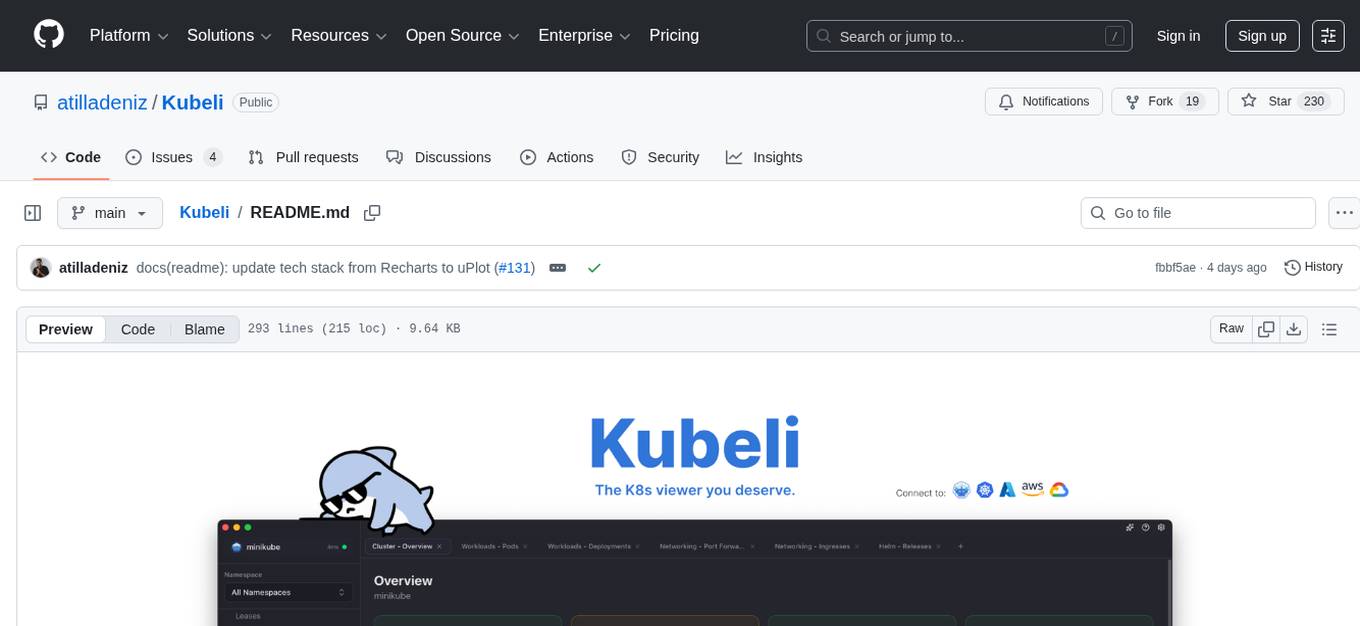
Kubeli is a modern, beautiful Kubernetes management desktop application with real-time monitoring, terminal access, and a polished user experience. It offers features like multi-cluster support, real-time updates, resource browser, pod logs streaming, terminal access, port forwarding, metrics dashboard, YAML editor, AI assistant, MCP server, Helm releases management, proxy support, internationalization, and dark/light mode. The tech stack includes Vite, React 19, TypeScript, Tailwind CSS 4 for frontend, Tauri 2.0 (Rust) for desktop, kube-rs with k8s-openapi v1.32 for K8s client, Zustand for state management, Radix UI and Lucide Icons for UI components, Monaco Editor for editing, XTerm.js for terminal, and uPlot for charts.
claude-code-mastery
Claude Code Mastery is a comprehensive tool for maximizing Claude Code, offering a production-ready project template with 16 slash commands, deterministic hook enforcement, MongoDB wrapper, live AI monitoring, and three-layer security. It provides a security gatekeeper, project scaffolding blueprint, MCP server integration, workflow automation through custom commands, and emphasizes the importance of single-purpose chats to avoid performance degradation.
everything-claude-code
The 'Everything Claude Code' repository is a comprehensive collection of production-ready agents, skills, hooks, commands, rules, and MCP configurations developed over 10+ months. It includes guides for setup, foundations, and philosophy, as well as detailed explanations of various topics such as token optimization, memory persistence, continuous learning, verification loops, parallelization, and subagent orchestration. The repository also provides updates on bug fixes, multi-language rules, installation wizard, PM2 support, OpenCode plugin integration, unified commands and skills, and cross-platform support. It offers a quick start guide for installation, ecosystem tools like Skill Creator and Continuous Learning v2, requirements for CLI version compatibility, key concepts like agents, skills, hooks, and rules, running tests, contributing guidelines, OpenCode support, background information, important notes on context window management and customization, star history chart, and relevant links.
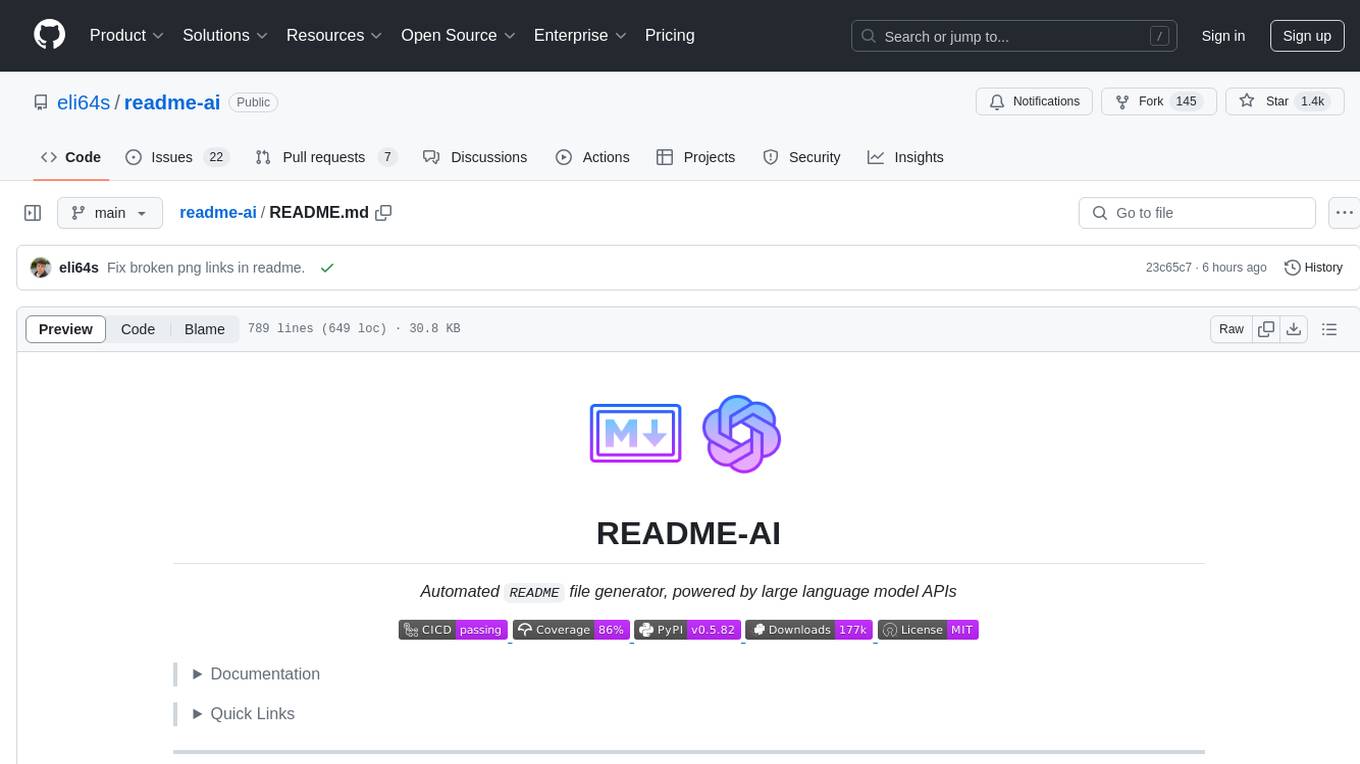
readme-ai
README-AI is a developer tool that auto-generates README.md files using a combination of data extraction and generative AI. It streamlines documentation creation and maintenance, enhancing developer productivity. This project aims to enable all skill levels, across all domains, to better understand, use, and contribute to open-source software. It offers flexible README generation, supports multiple large language models (LLMs), provides customizable output options, works with various programming languages and project types, and includes an offline mode for generating boilerplate README files without external API calls.
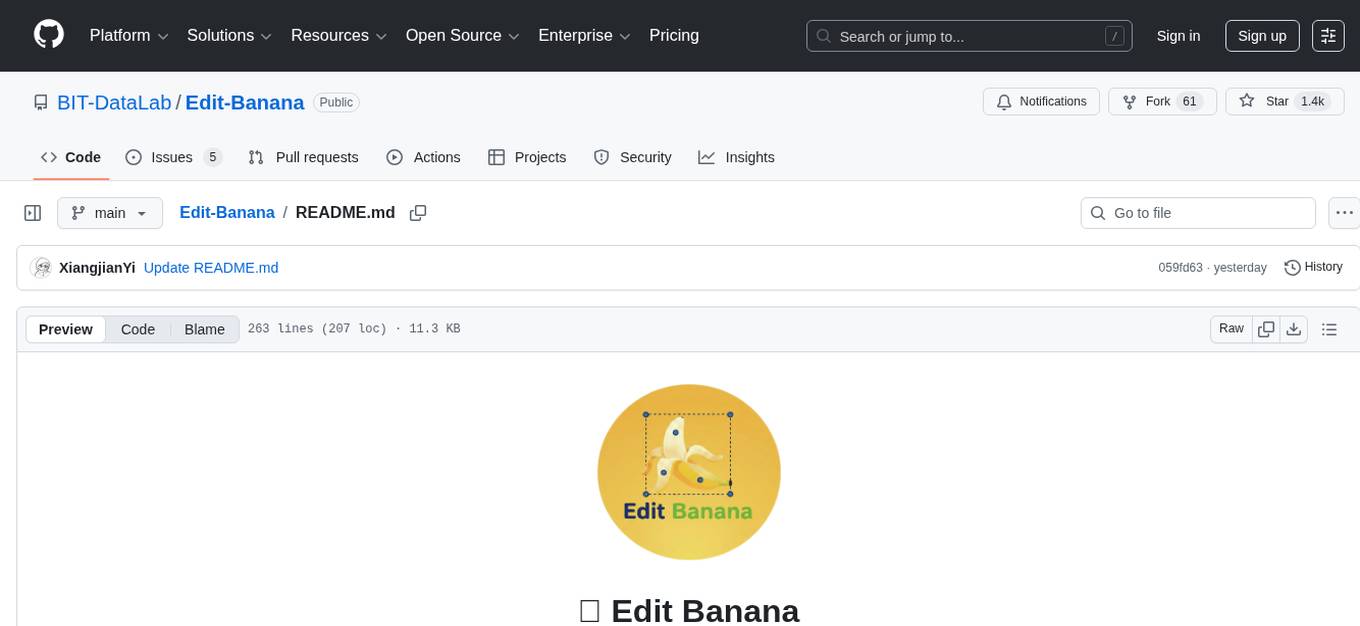
Edit-Banana
Edit Banana is a universal content re-editor that allows users to transform fixed content into fully manipulatable assets. Powered by SAM 3 and multimodal large models, it enables high-fidelity reconstruction while preserving original diagram details and logical relationships. The platform offers advanced segmentation, fixed multi-round VLM scanning, high-quality OCR, user system with credits, multi-user concurrency, and a web interface. Users can upload images or PDFs to get editable DrawIO (XML) or PPTX files in seconds. The project structure includes components for segmentation, text extraction, frontend, models, and scripts, with detailed installation and setup instructions provided. The tool is open-source under the Apache License 2.0, allowing commercial use and secondary development.
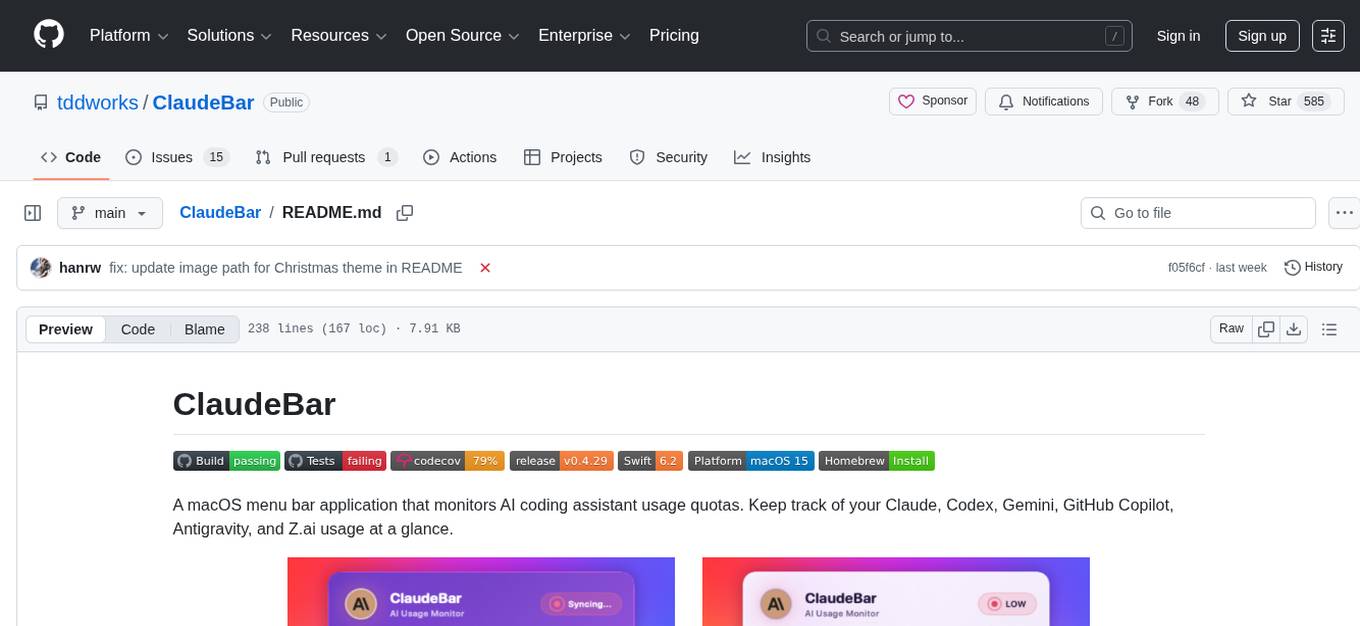
ClaudeBar
ClaudeBar is a macOS menu bar application that monitors AI coding assistant usage quotas. It allows users to keep track of their usage of Claude, Codex, Gemini, GitHub Copilot, Antigravity, and Z.ai at a glance. The application offers multi-provider support, real-time quota tracking, multiple themes, visual status indicators, system notifications, auto-refresh feature, and keyboard shortcuts for quick access. Users can customize monitoring by toggling individual providers on/off and receive alerts when quota status changes. The tool requires macOS 15+, Swift 6.2+, and CLI tools installed for the providers to be monitored.
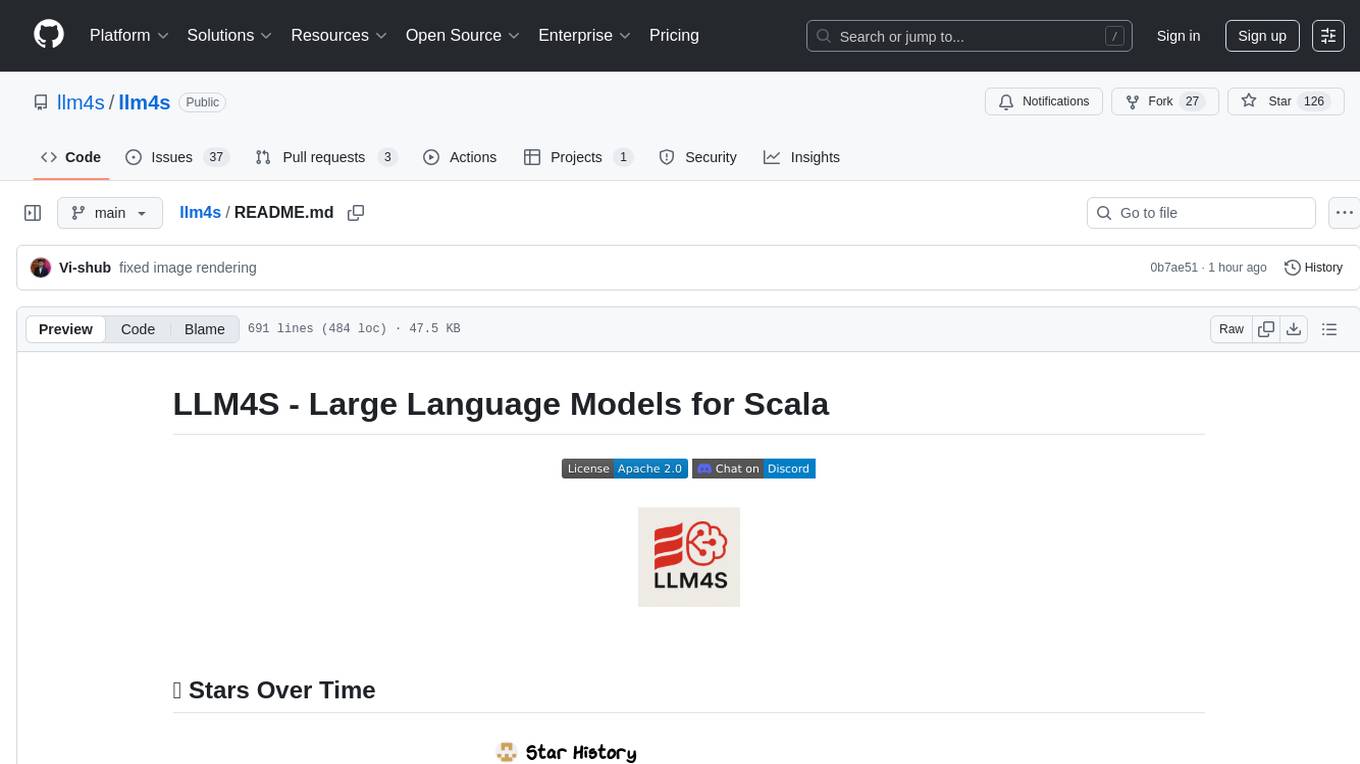
llm4s
LLM4S provides a simple, robust, and scalable framework for building Large Language Models (LLM) applications in Scala. It aims to leverage Scala's type safety, functional programming, JVM ecosystem, concurrency, and performance advantages to create reliable and maintainable AI-powered applications. The framework supports multi-provider integration, execution environments, error handling, Model Context Protocol (MCP) support, agent frameworks, multimodal generation, and Retrieval-Augmented Generation (RAG) workflows. It also offers observability features like detailed trace logging, monitoring, and analytics for debugging and performance insights.
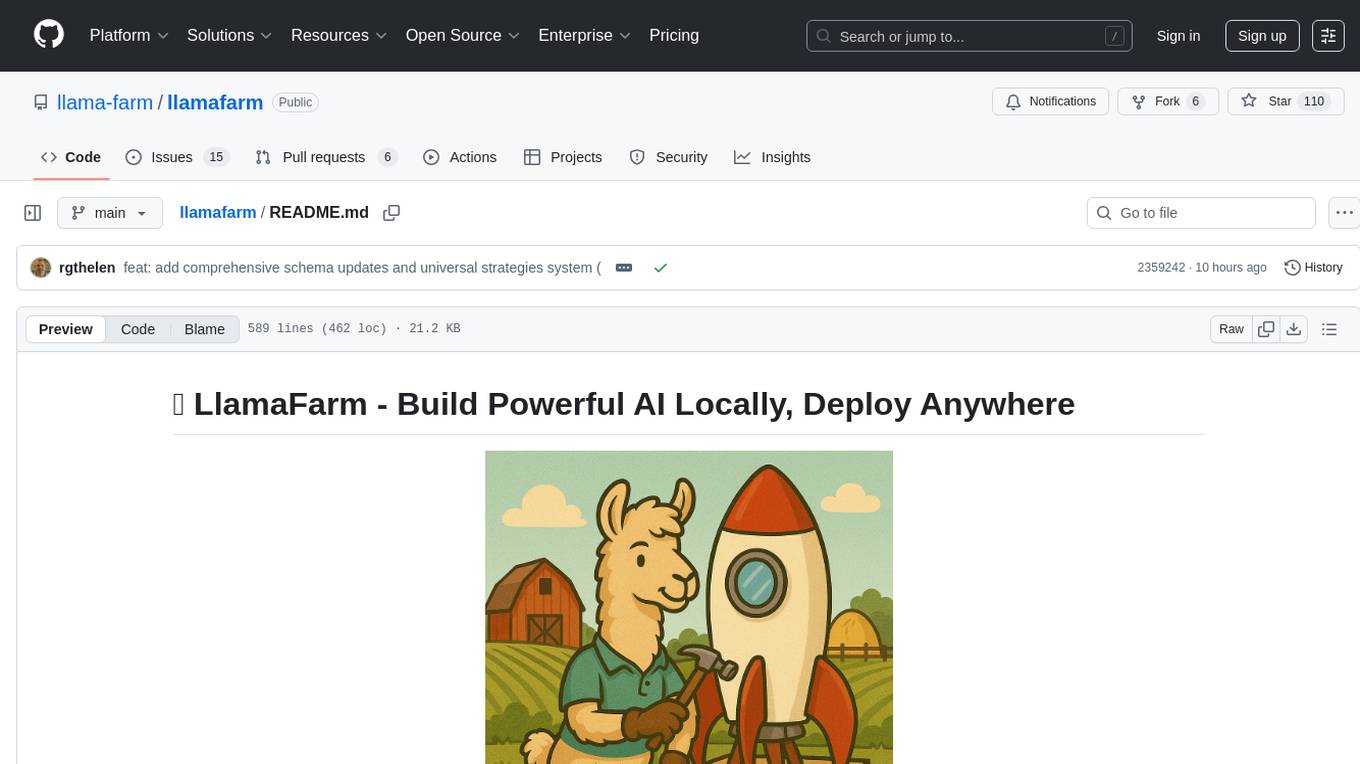
llamafarm
LlamaFarm is a comprehensive AI framework that empowers users to build powerful AI applications locally, with full control over costs and deployment options. It provides modular components for RAG systems, vector databases, model management, prompt engineering, and fine-tuning. Users can create differentiated AI products without needing extensive ML expertise, using simple CLI commands and YAML configs. The framework supports local-first development, production-ready components, strategy-based configuration, and deployment anywhere from laptops to the cloud.
claude-talk-to-figma-mcp
A Model Context Protocol (MCP) plugin named Claude Talk to Figma MCP that enables Claude Desktop and other AI tools to interact directly with Figma for AI-assisted design capabilities. It provides document interaction, element creation, smart modifications, text mastery, and component integration. Users can connect the plugin to Figma, start designing, and utilize various tools for document analysis, element creation, modification, text manipulation, and component management. The project offers installation instructions, AI client configuration options, usage patterns, command references, troubleshooting support, testing guidelines, architecture overview, contribution guidelines, version history, and licensing information.
mindnlp
MindNLP is an open-source NLP library based on MindSpore. It provides a platform for solving natural language processing tasks, containing many common approaches in NLP. It can help researchers and developers to construct and train models more conveniently and rapidly. Key features of MindNLP include: * Comprehensive data processing: Several classical NLP datasets are packaged into a friendly module for easy use, such as Multi30k, SQuAD, CoNLL, etc. * Friendly NLP model toolset: MindNLP provides various configurable components. It is friendly to customize models using MindNLP. * Easy-to-use engine: MindNLP simplified complicated training process in MindSpore. It supports Trainer and Evaluator interfaces to train and evaluate models easily. MindNLP supports a wide range of NLP tasks, including: * Language modeling * Machine translation * Question answering * Sentiment analysis * Sequence labeling * Summarization MindNLP also supports industry-leading Large Language Models (LLMs), including Llama, GLM, RWKV, etc. For support related to large language models, including pre-training, fine-tuning, and inference demo examples, you can find them in the "llm" directory. To install MindNLP, you can either install it from Pypi, download the daily build wheel, or install it from source. The installation instructions are provided in the documentation. MindNLP is released under the Apache 2.0 license. If you find this project useful in your research, please consider citing the following paper: @misc{mindnlp2022, title={{MindNLP}: a MindSpore NLP library}, author={MindNLP Contributors}, howpublished = {\url{https://github.com/mindlab-ai/mindnlp}}, year={2022} }
axonhub
AxonHub is an all-in-one AI development platform that serves as an AI gateway allowing users to switch between model providers without changing any code. It provides features like vendor lock-in prevention, integration simplification, observability enhancement, and cost control. Users can access any model using any SDK with zero code changes. The platform offers full request tracing, enterprise RBAC, smart load balancing, and real-time cost tracking. AxonHub supports multiple databases, provides a unified API gateway, and offers flexible model management and API key creation for authentication. It also integrates with various AI coding tools and SDKs for seamless usage.
orchestkit
OrchestKit is a powerful and flexible orchestration tool designed to streamline and automate complex workflows. It provides a user-friendly interface for defining and managing orchestration tasks, allowing users to easily create, schedule, and monitor workflows. With support for various integrations and plugins, OrchestKit enables seamless automation of tasks across different systems and applications. Whether you are a developer looking to automate deployment processes or a system administrator managing complex IT operations, OrchestKit offers a comprehensive solution to simplify and optimize your workflow management.
smart-ralph
Smart Ralph is a Claude Code plugin designed for spec-driven development. It helps users turn vague feature ideas into structured specs and executes them task-by-task. The tool operates within a self-contained execution loop without external dependencies, providing a seamless workflow for feature development. Named after the Ralph agentic loop pattern, Smart Ralph simplifies the development process by focusing on the next task at hand, akin to the simplicity of the Springfield student, Ralph.
models
A fast CLI and TUI for browsing AI models, benchmarks, and coding agents. Browse 2000+ models across 85+ providers from models.dev. Track AI coding assistants with version detection and GitHub integration. Compare model performance across 15+ benchmarks from Artificial Analysis. Features CLI commands, interactive TUI, cross-provider search, copy to clipboard, JSON output. Includes curated catalog of AI coding assistants, auto-updating benchmark data, per-model open weights detection, and detail panel for benchmarks. Supports customization of tracked agents and quick sorting of benchmarks. Utilizes data from models.dev, Artificial Analysis, curated catalog in data/agents.json, and GitHub API.
agentscope
AgentScope is a multi-agent platform designed to empower developers to build multi-agent applications with large-scale models. It features three high-level capabilities: Easy-to-Use, High Robustness, and Actor-Based Distribution. AgentScope provides a list of `ModelWrapper` to support both local model services and third-party model APIs, including OpenAI API, DashScope API, Gemini API, and ollama. It also enables developers to rapidly deploy local model services using libraries such as ollama (CPU inference), Flask + Transformers, Flask + ModelScope, FastChat, and vllm. AgentScope supports various services, including Web Search, Data Query, Retrieval, Code Execution, File Operation, and Text Processing. Example applications include Conversation, Game, and Distribution. AgentScope is released under Apache License 2.0 and welcomes contributions.
For similar tasks
stylekit
StyleKit is a comprehensive design system toolkit that helps both humans and AI generate consistent, high-quality UI code. It provides structured style specifications, design tokens, component recipes, prompt templates, and export tools — everything needed to go from 'I want a glassmorphism SaaS dashboard' to production-ready frontend code. With 90+ visual styles, 20+ page templates, 25+ UI components, and AI-powered tools like Prompt Builder, Smart Recommender, Style Linter, Style Analyzer, and Style Blender, StyleKit offers a platform with GitHub OAuth, ratings & comments, style submissions, instant community availability, favorites, bilingual support, PWA, and dark/light mode themes.
For similar jobs
sweep
Sweep is an AI junior developer that turns bugs and feature requests into code changes. It automatically handles developer experience improvements like adding type hints and improving test coverage.
teams-ai
The Teams AI Library is a software development kit (SDK) that helps developers create bots that can interact with Teams and Microsoft 365 applications. It is built on top of the Bot Framework SDK and simplifies the process of developing bots that interact with Teams' artificial intelligence capabilities. The SDK is available for JavaScript/TypeScript, .NET, and Python.
ai-guide
This guide is dedicated to Large Language Models (LLMs) that you can run on your home computer. It assumes your PC is a lower-end, non-gaming setup.
classifai
Supercharge WordPress Content Workflows and Engagement with Artificial Intelligence. Tap into leading cloud-based services like OpenAI, Microsoft Azure AI, Google Gemini and IBM Watson to augment your WordPress-powered websites. Publish content faster while improving SEO performance and increasing audience engagement. ClassifAI integrates Artificial Intelligence and Machine Learning technologies to lighten your workload and eliminate tedious tasks, giving you more time to create original content that matters.
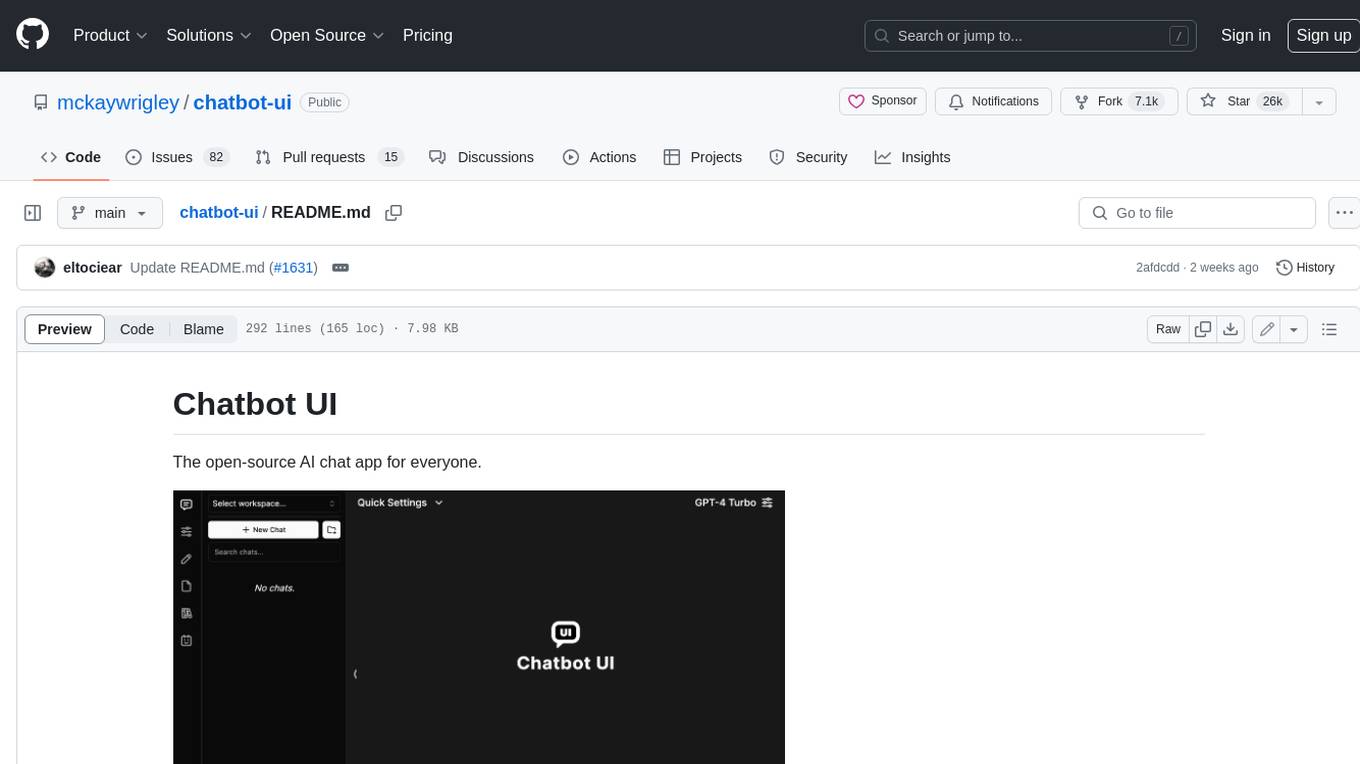
chatbot-ui
Chatbot UI is an open-source AI chat app that allows users to create and deploy their own AI chatbots. It is easy to use and can be customized to fit any need. Chatbot UI is perfect for businesses, developers, and anyone who wants to create a chatbot.
BricksLLM
BricksLLM is a cloud native AI gateway written in Go. Currently, it provides native support for OpenAI, Anthropic, Azure OpenAI and vLLM. BricksLLM aims to provide enterprise level infrastructure that can power any LLM production use cases. Here are some use cases for BricksLLM: * Set LLM usage limits for users on different pricing tiers * Track LLM usage on a per user and per organization basis * Block or redact requests containing PIIs * Improve LLM reliability with failovers, retries and caching * Distribute API keys with rate limits and cost limits for internal development/production use cases * Distribute API keys with rate limits and cost limits for students
uAgents
uAgents is a Python library developed by Fetch.ai that allows for the creation of autonomous AI agents. These agents can perform various tasks on a schedule or take action on various events. uAgents are easy to create and manage, and they are connected to a fast-growing network of other uAgents. They are also secure, with cryptographically secured messages and wallets.
griptape
Griptape is a modular Python framework for building AI-powered applications that securely connect to your enterprise data and APIs. It offers developers the ability to maintain control and flexibility at every step. Griptape's core components include Structures (Agents, Pipelines, and Workflows), Tasks, Tools, Memory (Conversation Memory, Task Memory, and Meta Memory), Drivers (Prompt and Embedding Drivers, Vector Store Drivers, Image Generation Drivers, Image Query Drivers, SQL Drivers, Web Scraper Drivers, and Conversation Memory Drivers), Engines (Query Engines, Extraction Engines, Summary Engines, Image Generation Engines, and Image Query Engines), and additional components (Rulesets, Loaders, Artifacts, Chunkers, and Tokenizers). Griptape enables developers to create AI-powered applications with ease and efficiency.