


NAISYS
Command shell driver for LLMs
Stars: 66
NAISYS Project is a monorepo containing NAISYS (Node.js Autonomous Intelligence System) and Supervisor, a web-based agent management interface. NAISYS allows LLMs to operate a standard Linux shell autonomously with built-in context management, multi-agent communication, and cost tracking. Supervisor provides a web interface for monitoring NAISYS agents, viewing logs, and managing inter-agent messaging. The project aims to streamline autonomous operations and agent management through Node.js technology.
README:
A monorepo containing NAISYS (Node.js Autonomous Intelligence System) and Supervisor (web-based agent management interface).
NPM | Website | Discord | Demo Video
npm install -g naisys- NAISYS - Allows LLMs to operate a standard Linux shell autonomously with built-in context management, multi-agent communication, and cost tracking
- Supervisor - Web interface for monitoring NAISYS agents, viewing logs, and managing inter-agent messaging
npm installnpm run buildCreate apps/naisys/.env file using the .env.example file as a guide.
cd apps/naisys
node dist/naisys.js ../../agents/assistant.yaml --supervisorNavigate to http://localhost:3001 in your browser to monitor your NAISYS agents.
- See apps/naisys/README.md for detailed NAISYS documentation
- See apps/supervisor/README.md for Supervisor documentation
- Node.js 18.0.0 or higher
- Linux or WSL (for Windows users)
- lynx browser:
apt install lynx(Linux) orbrew install lynx(macOS)
MIT
For Tasks:
Click tags to check more tools for each tasksFor Jobs:
Alternative AI tools for NAISYS
Similar Open Source Tools
NAISYS
NAISYS Project is a monorepo containing NAISYS (Node.js Autonomous Intelligence System) and Supervisor, a web-based agent management interface. NAISYS allows LLMs to operate a standard Linux shell autonomously with built-in context management, multi-agent communication, and cost tracking. Supervisor provides a web interface for monitoring NAISYS agents, viewing logs, and managing inter-agent messaging. The project aims to streamline autonomous operations and agent management through Node.js technology.
genassist
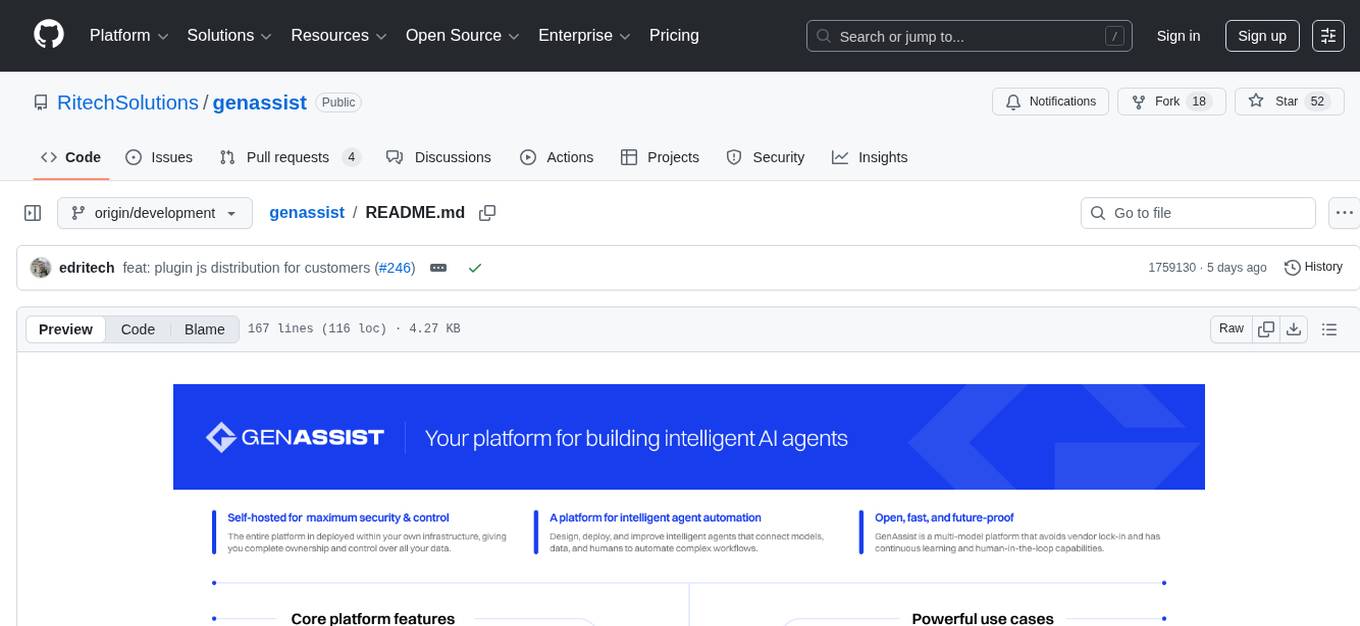
GenAssist is an AI-powered platform for managing and leveraging various AI workflows, focusing on conversation management, analytics, and agent-based interactions. It provides user management, AI agents configuration, knowledge base management, analytics, conversation management, and audit logging features. The platform is built with React, TypeScript, Vite, Tailwind CSS, FastAPI, SQLAlchemy ORM, and PostgreSQL database. GenAssist offers integration options for React, JavaScript Widget, and iOS, along with UI test automation and backend testing capabilities.

OmniSteward
OmniSteward is an AI-powered steward system based on large language models that can interact with users through voice or text to help control smart home devices and computer programs. It supports multi-turn dialogue, tool calling for complex tasks, multiple LLM models, voice recognition, smart home control, computer program management, online information retrieval, command line operations, and file management. The system is highly extensible, allowing users to customize and share their own tools.
CortexON
CortexON is an open-source, multi-agent AI system designed to automate and simplify everyday tasks. It integrates specialized agents like Web Agent, File Agent, Coder Agent, Executor Agent, and API Agent to accomplish user-defined objectives. CortexON excels at executing complex workflows, research tasks, technical operations, and business process automations by dynamically coordinating the agents' unique capabilities. It offers advanced research automation, multi-agent orchestration, integration with third-party APIs, code generation and execution, efficient file and data management, and personalized task execution for travel planning, market analysis, educational content creation, and business intelligence.
ApeRAG
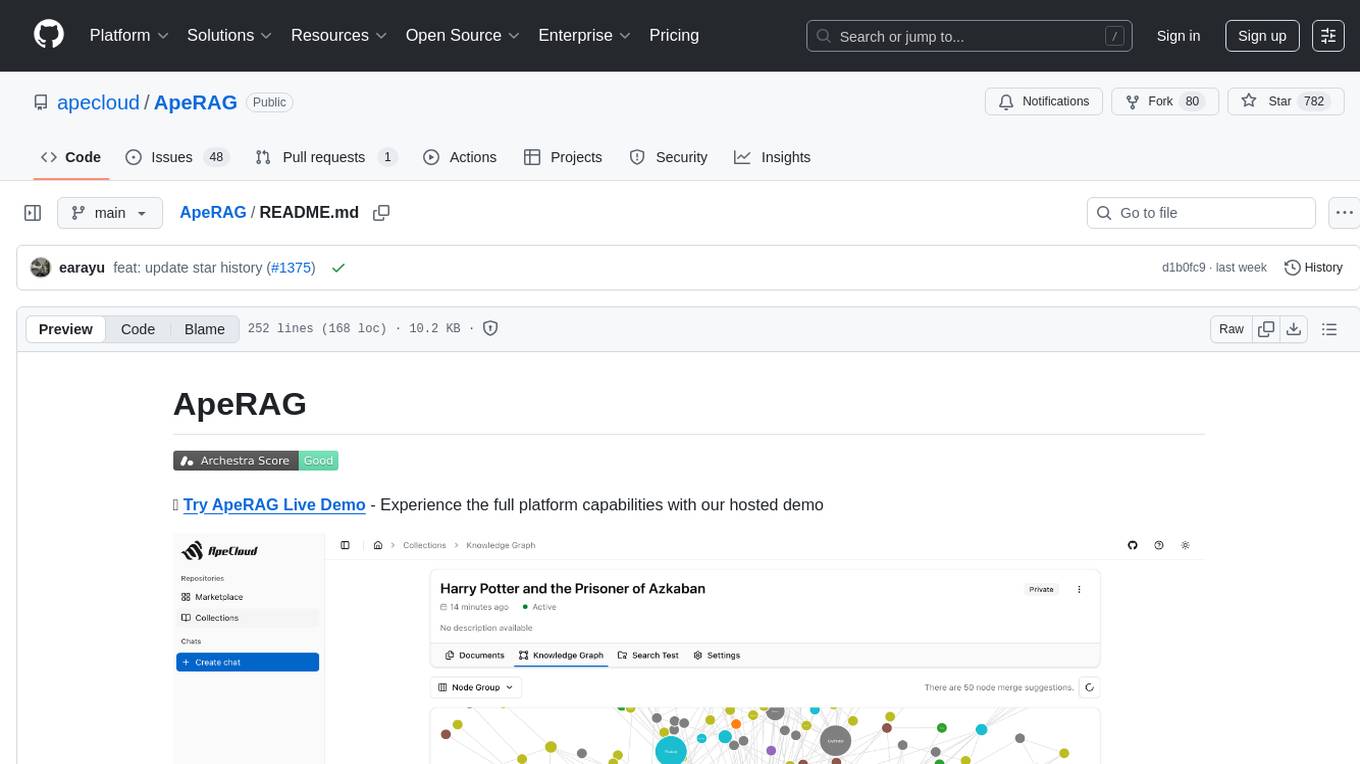
ApeRAG is a production-ready platform for Retrieval-Augmented Generation (RAG) that combines Graph RAG, vector search, and full-text search with advanced AI agents. It is ideal for building Knowledge Graphs, Context Engineering, and deploying intelligent AI agents for autonomous search and reasoning across knowledge bases. The platform offers features like advanced index types, intelligent AI agents with MCP support, enhanced Graph RAG with entity normalization, multimodal processing, hybrid retrieval engine, MinerU integration for document parsing, production-grade deployment with Kubernetes, enterprise management features, MCP integration, and developer-friendly tools for customization and contribution.
AppFlowy-Cloud
AppFlowy Cloud is a secure user authentication, file storage, and real-time WebSocket communication tool written in Rust. It is part of the AppFlowy ecosystem, providing an efficient and collaborative user experience. The tool offers deployment guides, development setup with Rust and Docker, debugging tips for components like PostgreSQL, Redis, Minio, and Portainer, and guidelines for contributing to the project.
batteries-included
Batteries Included is an all-in-one platform for building and running modern applications, simplifying cloud infrastructure complexity. It offers production-ready capabilities through an intuitive interface, focusing on automation, security, and enterprise-grade features. The platform includes databases like PostgreSQL and Redis, AI/ML capabilities with Jupyter notebooks, web services deployment, security features like SSL/TLS management, and monitoring tools like Grafana dashboards. Batteries Included is designed to streamline infrastructure setup and management, allowing users to concentrate on application development without dealing with complex configurations.
cossistant
Cossistant is an open source chat support widget tailored for the React ecosystem. It offers headless components for building customizable chat interfaces, real-time messaging with WebSocket technology, and tools for managing customer conversations. The tool is API-first, self-hosted, developer-friendly with TypeScript support, and provides complete integration flexibility. It uses technologies like Next.js, TailwindCSS, and WebSockets, and supports databases like PlanetScale for production and DBgin for local development. Cossistant is ideal for developers seeking a versatile chat solution that can be easily integrated into their applications.
fastapi-langgraph-agent-production-ready-template
A production-ready FastAPI template for building AI agent applications with LangGraph integration. This template provides a robust foundation for building scalable, secure, and maintainable AI agent services. It includes features like FastAPI for high-performance async API endpoints, LangGraph integration, structured logging, rate limiting, PostgreSQL for data persistence, Docker support, security measures like JWT-based authentication and input sanitization, developer-friendly features like environment-specific configuration and type hints, a model evaluation framework with automated metric-based evaluation and detailed JSON reports, and a configuration system with environment-specific settings.
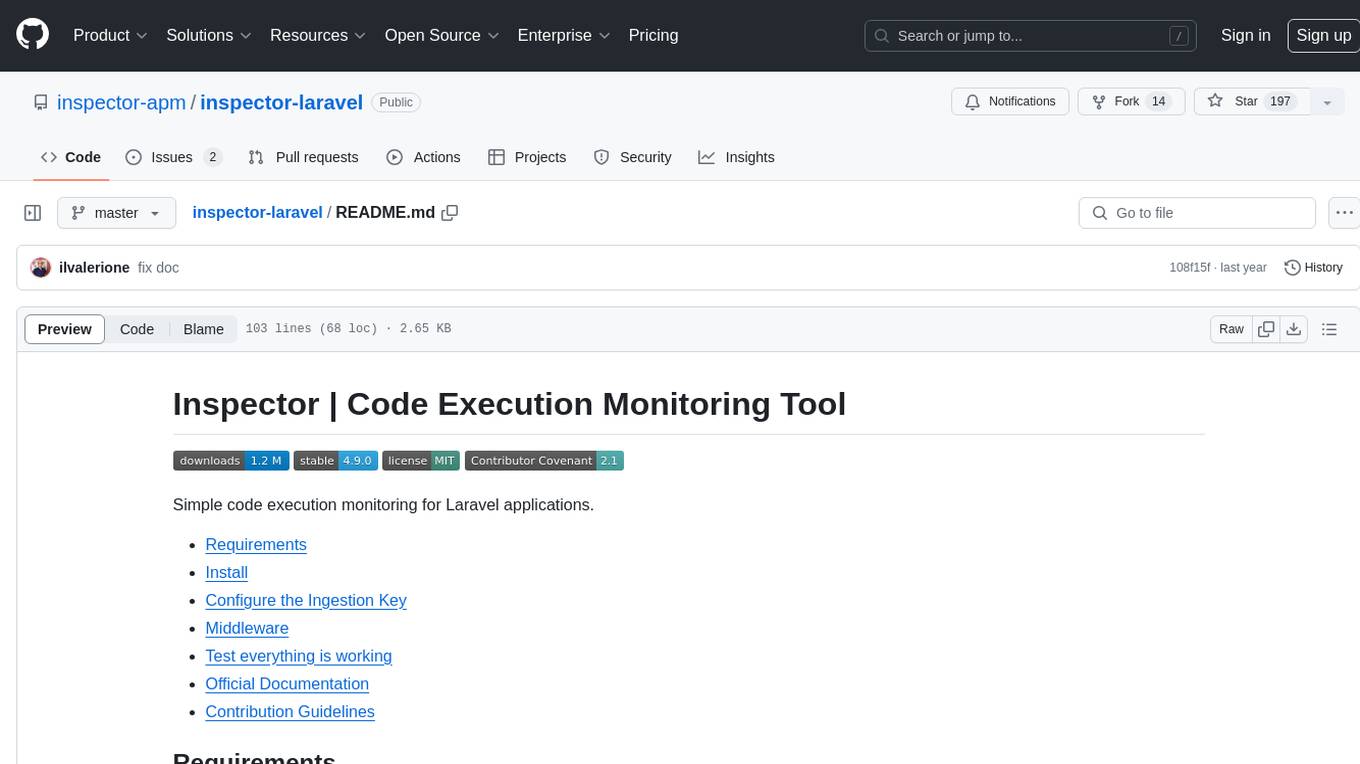
inspector-laravel
Inspector is a code execution monitoring tool specifically designed for Laravel applications. It provides simple and efficient monitoring capabilities to track and analyze the performance of your Laravel code. With Inspector, you can easily monitor web requests, test the functionality of your application, and explore data through a user-friendly dashboard. The tool requires PHP version 7.2.0 or higher and Laravel version 5.5 or above. By configuring the ingestion key and attaching the middleware, users can seamlessly integrate Inspector into their Laravel projects. The official documentation provides detailed instructions on installation, configuration, and usage of Inspector. Contributions to the tool are welcome, and users are encouraged to follow the Contribution Guidelines to participate in the development of Inspector.
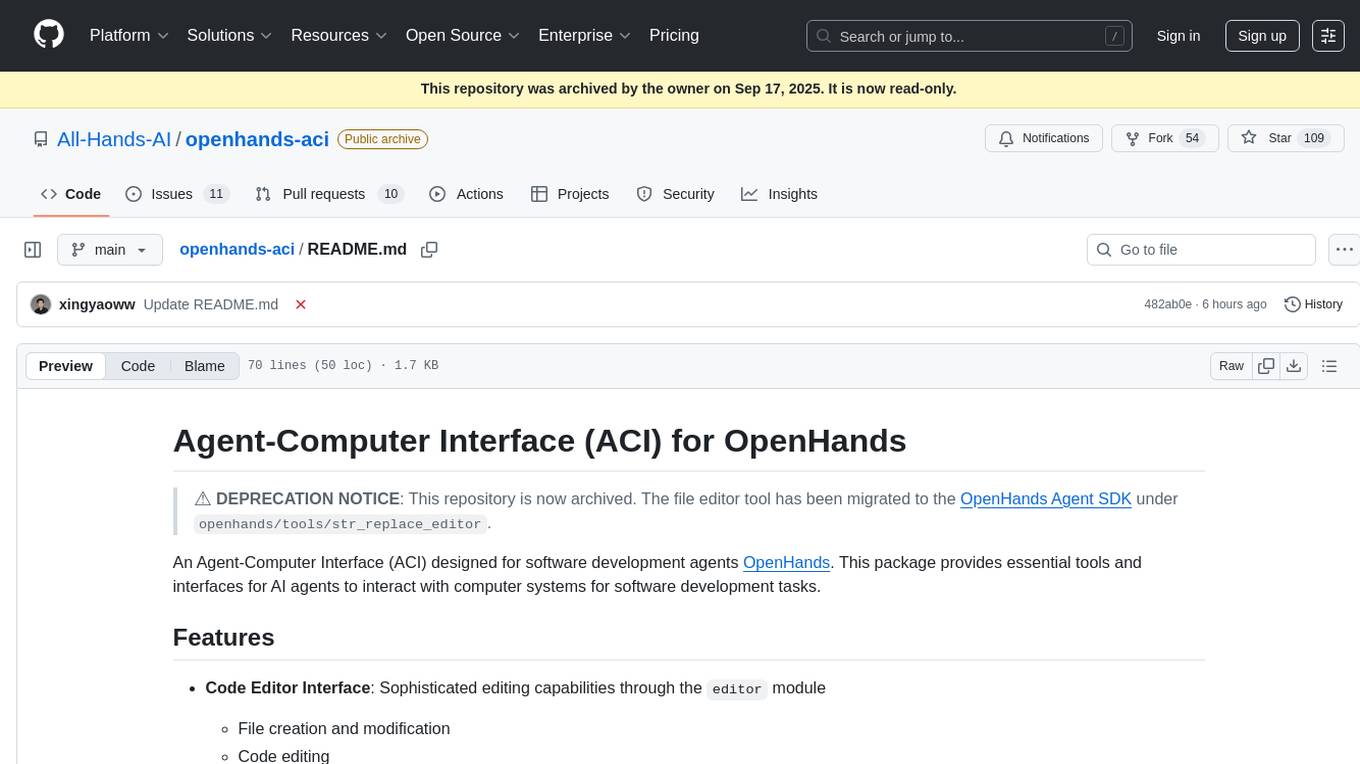
openhands-aci
Agent-Computer Interface (ACI) for OpenHands is a deprecated repository that provided essential tools and interfaces for AI agents to interact with computer systems for software development tasks. It included a code editor interface, code linting capabilities, and utility functions for common operations. The package aimed to enhance software development agents' capabilities in editing code, managing configurations, analyzing code, and executing shell commands.
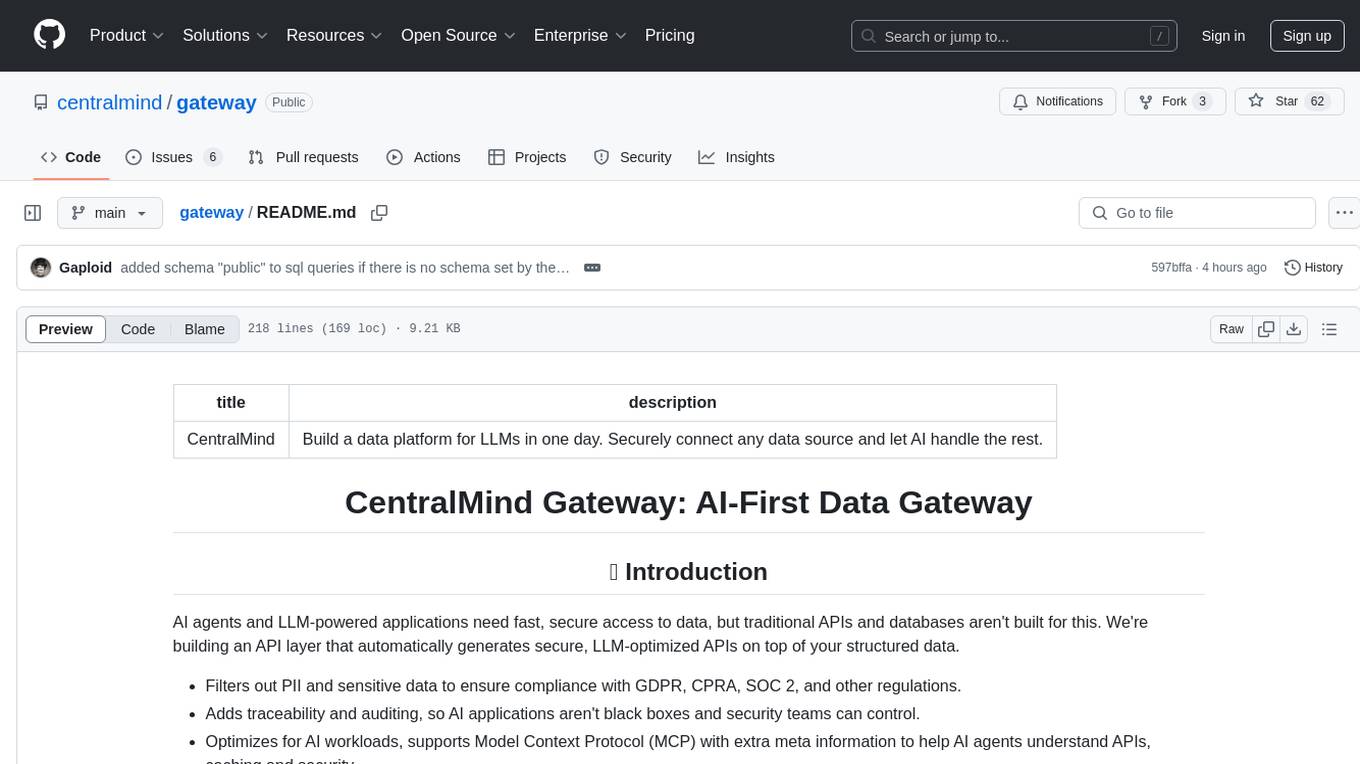
gateway
CentralMind Gateway is an AI-first data gateway that securely connects any data source and automatically generates secure, LLM-optimized APIs. It filters out sensitive data, adds traceability, and optimizes for AI workloads. Suitable for companies deploying AI agents for customer support and analytics.
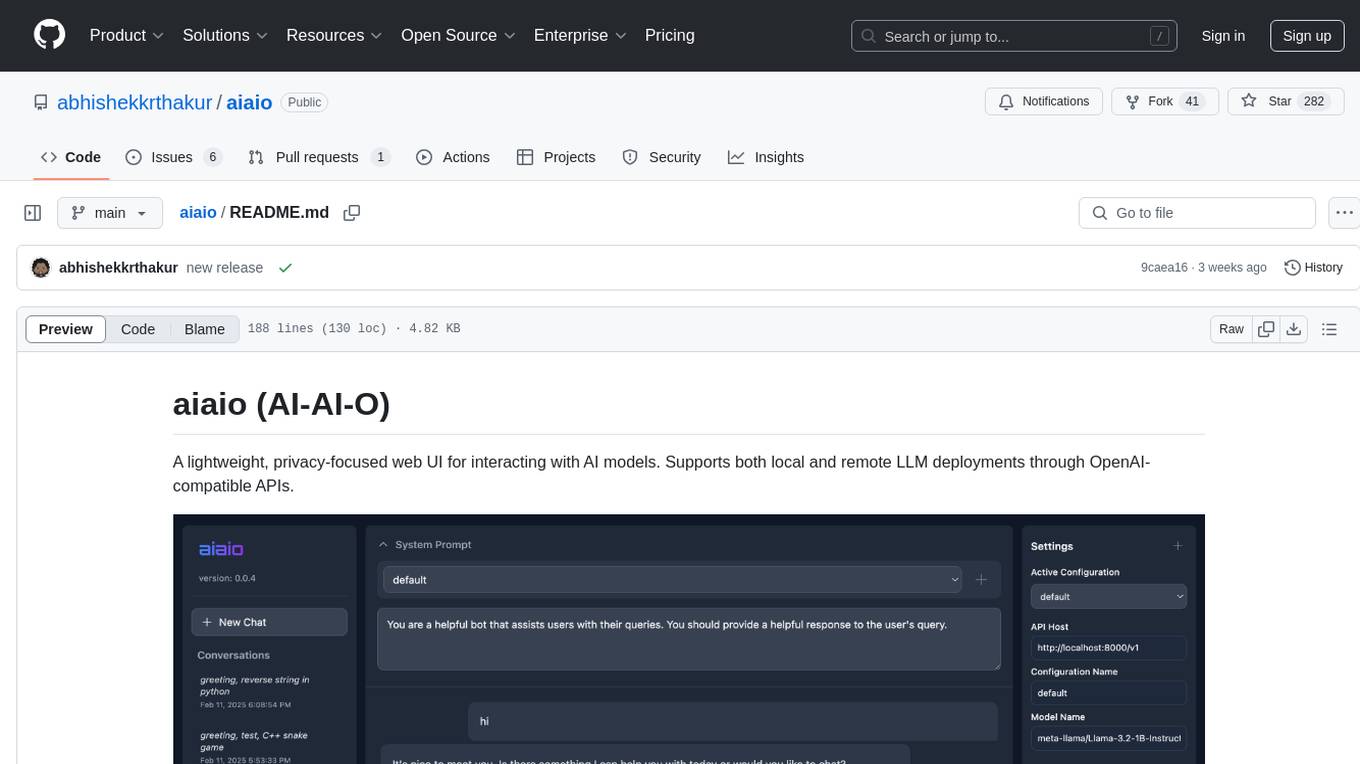
aiaio
aiaio (AI-AI-O) is a lightweight, privacy-focused web UI for interacting with AI models. It supports both local and remote LLM deployments through OpenAI-compatible APIs. The tool provides features such as dark/light mode support, local SQLite database for conversation storage, file upload and processing, configurable model parameters through UI, privacy-focused design, responsive design for mobile/desktop, syntax highlighting for code blocks, real-time conversation updates, automatic conversation summarization, customizable system prompts, WebSocket support for real-time updates, Docker support for deployment, multiple API endpoint support, and multiple system prompt support. Users can configure model parameters and API settings through the UI, handle file uploads, manage conversations, and use keyboard shortcuts for efficient interaction. The tool uses SQLite for storage with tables for conversations, messages, attachments, and settings. Contributions to the project are welcome under the Apache License 2.0.

WeKnora
WeKnora is a document understanding and semantic retrieval framework based on large language models (LLM), designed specifically for scenarios with complex structures and heterogeneous content. The framework adopts a modular architecture, integrating multimodal preprocessing, semantic vector indexing, intelligent recall, and large model generation reasoning to build an efficient and controllable document question-answering process. The core retrieval process is based on the RAG (Retrieval-Augmented Generation) mechanism, combining context-relevant segments with language models to achieve higher-quality semantic answers. It supports various document formats, intelligent inference, flexible extension, efficient retrieval, ease of use, and security and control. Suitable for enterprise knowledge management, scientific literature analysis, product technical support, legal compliance review, and medical knowledge assistance.
dstack
Dstack is an open-source orchestration engine for running AI workloads in any cloud. It supports a wide range of cloud providers (such as AWS, GCP, Azure, Lambda, TensorDock, Vast.ai, CUDO, RunPod, etc.) as well as on-premises infrastructure. With Dstack, you can easily set up and manage dev environments, tasks, services, and pools for your AI workloads.
paperless-ai
Paperless-AI is an automated document analyzer tool designed for Paperless-ngx users. It utilizes the OpenAI API and Ollama (Mistral, llama, phi 3, gemma 2) to automatically scan, analyze, and tag documents. The tool offers features such as automatic document scanning, AI-powered document analysis, automatic title and tag assignment, manual mode for analyzing documents, easy setup through a web interface, document processing dashboard, error handling, and Docker support. Users can configure the tool through a web interface and access a debug interface for monitoring and troubleshooting. Paperless-AI aims to streamline document organization and analysis processes for users with access to Paperless-ngx and AI capabilities.
For similar tasks
NAISYS
NAISYS Project is a monorepo containing NAISYS (Node.js Autonomous Intelligence System) and Supervisor, a web-based agent management interface. NAISYS allows LLMs to operate a standard Linux shell autonomously with built-in context management, multi-agent communication, and cost tracking. Supervisor provides a web interface for monitoring NAISYS agents, viewing logs, and managing inter-agent messaging. The project aims to streamline autonomous operations and agent management through Node.js technology.
kagent
Kagent is a Kubernetes native framework for building AI agents, designed to be easy to understand and use. It provides a flexible and powerful way to build, deploy, and manage AI agents in Kubernetes. The framework consists of agents, tools, and model configurations defined as Kubernetes custom resources, making them easy to manage and modify. Kagent is extensible, flexible, observable, declarative, testable, and has core components like a controller, UI, engine, and CLI.
adk-docs
Agent Development Kit (ADK) is an open-source, code-first toolkit for building, evaluating, and deploying sophisticated AI agents with flexibility and control. It is a flexible and modular framework optimized for Gemini and the Google ecosystem, model-agnostic, deployment-agnostic, and compatible with other frameworks. ADK simplifies agent development by making it feel more like software development, enabling developers to create, deploy, and orchestrate agentic architectures from simple tasks to complex workflows.
agent-framework
Microsoft Agent Framework is a comprehensive multi-language framework for building, orchestrating, and deploying AI agents with support for both .NET and Python implementations. It provides everything from simple chat agents to complex multi-agent workflows with graph-based orchestration. The framework offers features like graph-based workflows, AF Labs for experimental packages, DevUI for interactive developer UI, support for Python and C#/.NET, observability with OpenTelemetry integration, multiple agent provider support, and flexible middleware system. Users can find documentation, tutorials, and user guides to get started with building agents and workflows. The framework also supports various LLM providers and offers contributor resources like a contributing guide, Python development guide, design documents, and architectural decision records.
helicone
Helicone is an open-source observability platform designed for Language Learning Models (LLMs). It logs requests to OpenAI in a user-friendly UI, offers caching, rate limits, and retries, tracks costs and latencies, provides a playground for iterating on prompts and chat conversations, supports collaboration, and will soon have APIs for feedback and evaluation. The platform is deployed on Cloudflare and consists of services like Web (NextJs), Worker (Cloudflare Workers), Jawn (Express), Supabase, and ClickHouse. Users can interact with Helicone locally by setting up the required services and environment variables. The platform encourages contributions and provides resources for learning, documentation, and integrations.
openrouter-kit
OpenRouter Kit is a powerful TypeScript/JavaScript library for interacting with the OpenRouter API. It simplifies working with LLMs by providing a high-level API for chats, dialogue history management, tool calls with error handling, security module, and cost tracking. Ideal for building chatbots, AI agents, and integrating LLMs into applications.
Pulse
Pulse is a real-time monitoring tool designed for Proxmox, Docker, and Kubernetes infrastructure. It provides a unified dashboard to consolidate metrics, alerts, and AI-powered insights into a single interface. Suitable for homelabs, sysadmins, and MSPs, Pulse offers core monitoring features, AI-powered functionalities, multi-platform support, security and operations features, and community integrations. Pulse Pro unlocks advanced AI analysis and auto-fix capabilities. The tool is privacy-focused, secure by design, and offers detailed documentation for installation, configuration, security, troubleshooting, and more.
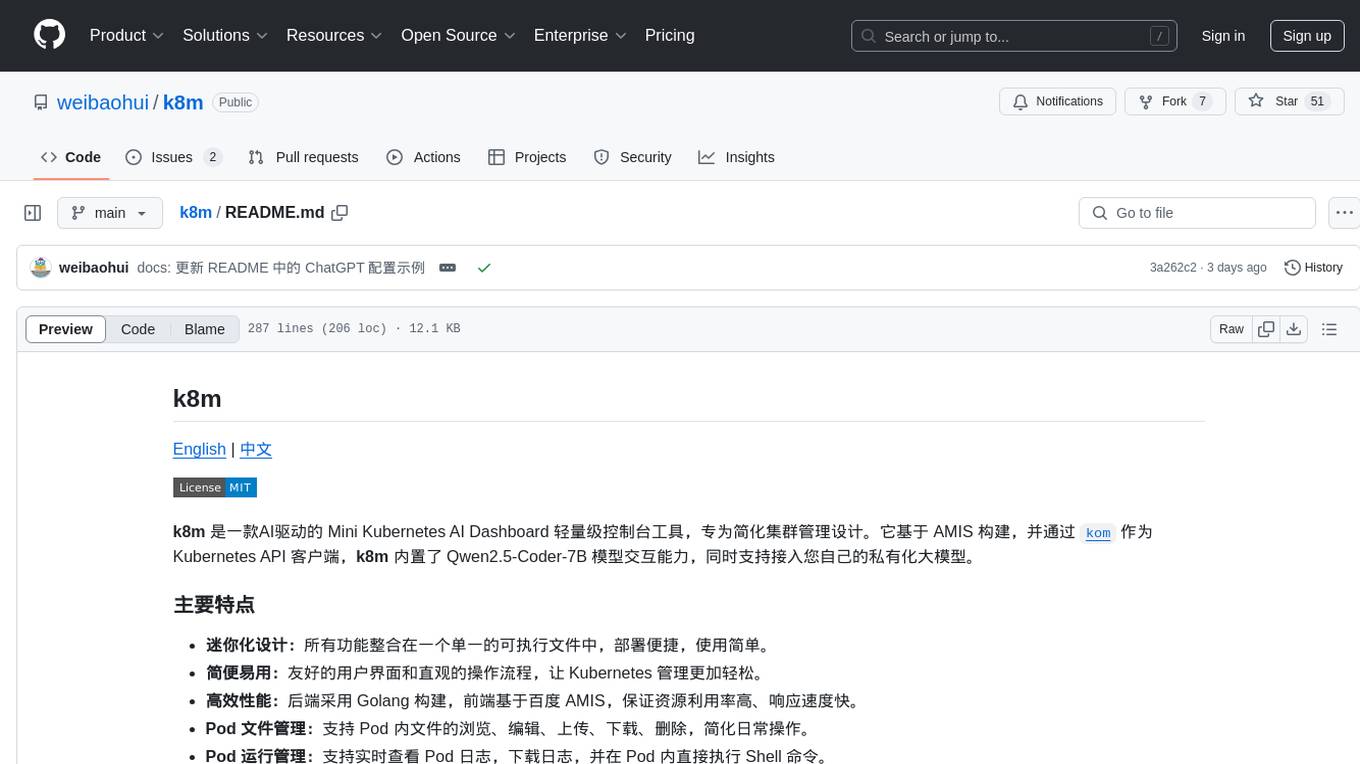
k8m
k8m is an AI-driven Mini Kubernetes AI Dashboard lightweight console tool designed to simplify cluster management. It is built on AMIS and uses 'kom' as the Kubernetes API client. k8m has built-in Qwen2.5-Coder-7B model interaction capabilities and supports integration with your own private large models. Its key features include miniaturized design for easy deployment, user-friendly interface for intuitive operation, efficient performance with backend in Golang and frontend based on Baidu AMIS, pod file management for browsing, editing, uploading, downloading, and deleting files, pod runtime management for real-time log viewing, log downloading, and executing shell commands within pods, CRD management for automatic discovery and management of CRD resources, and intelligent translation and diagnosis based on ChatGPT for YAML property translation, Describe information interpretation, AI log diagnosis, and command recommendations, providing intelligent support for managing k8s. It is cross-platform compatible with Linux, macOS, and Windows, supporting multiple architectures like x86 and ARM for seamless operation. k8m's design philosophy is 'AI-driven, lightweight and efficient, simplifying complexity,' helping developers and operators quickly get started and easily manage Kubernetes clusters.
For similar jobs
sweep
Sweep is an AI junior developer that turns bugs and feature requests into code changes. It automatically handles developer experience improvements like adding type hints and improving test coverage.
teams-ai
The Teams AI Library is a software development kit (SDK) that helps developers create bots that can interact with Teams and Microsoft 365 applications. It is built on top of the Bot Framework SDK and simplifies the process of developing bots that interact with Teams' artificial intelligence capabilities. The SDK is available for JavaScript/TypeScript, .NET, and Python.
ai-guide
This guide is dedicated to Large Language Models (LLMs) that you can run on your home computer. It assumes your PC is a lower-end, non-gaming setup.
classifai
Supercharge WordPress Content Workflows and Engagement with Artificial Intelligence. Tap into leading cloud-based services like OpenAI, Microsoft Azure AI, Google Gemini and IBM Watson to augment your WordPress-powered websites. Publish content faster while improving SEO performance and increasing audience engagement. ClassifAI integrates Artificial Intelligence and Machine Learning technologies to lighten your workload and eliminate tedious tasks, giving you more time to create original content that matters.
chatbot-ui
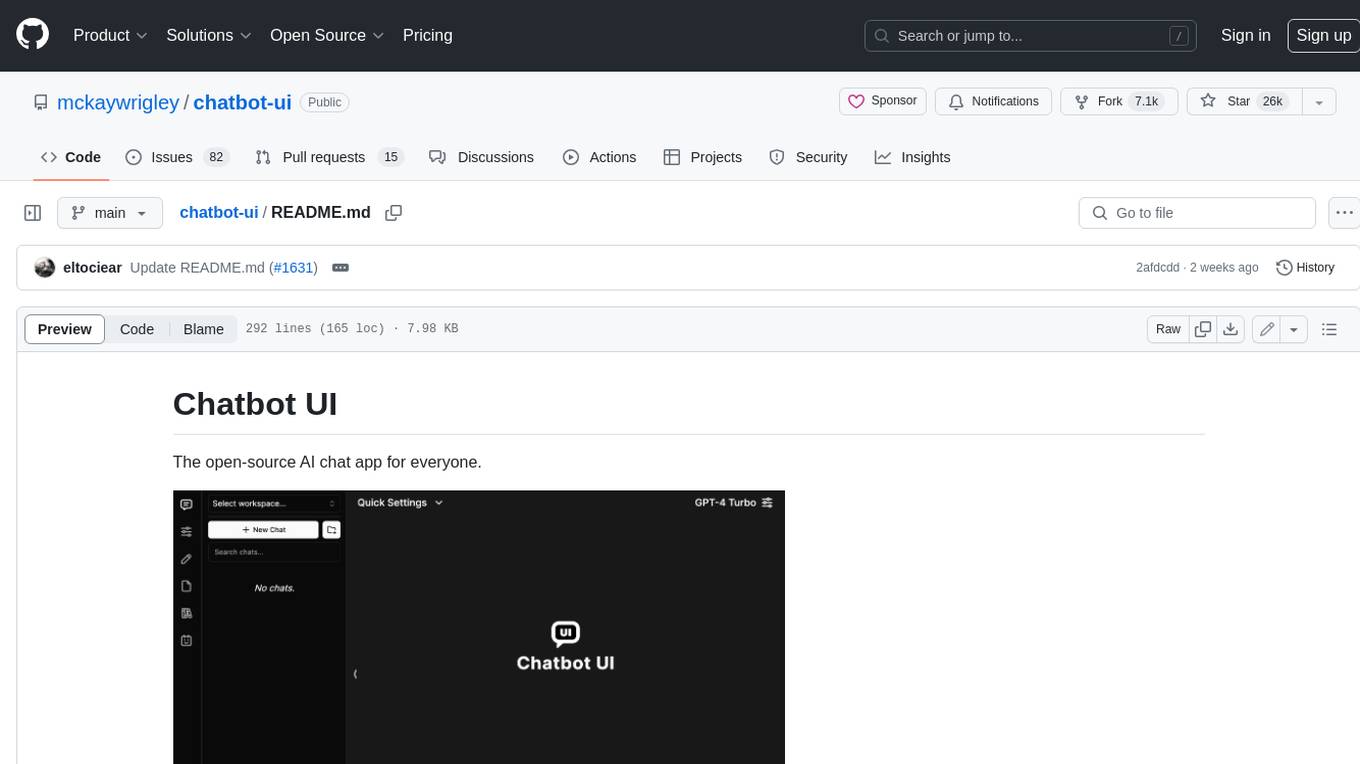
Chatbot UI is an open-source AI chat app that allows users to create and deploy their own AI chatbots. It is easy to use and can be customized to fit any need. Chatbot UI is perfect for businesses, developers, and anyone who wants to create a chatbot.
BricksLLM
BricksLLM is a cloud native AI gateway written in Go. Currently, it provides native support for OpenAI, Anthropic, Azure OpenAI and vLLM. BricksLLM aims to provide enterprise level infrastructure that can power any LLM production use cases. Here are some use cases for BricksLLM: * Set LLM usage limits for users on different pricing tiers * Track LLM usage on a per user and per organization basis * Block or redact requests containing PIIs * Improve LLM reliability with failovers, retries and caching * Distribute API keys with rate limits and cost limits for internal development/production use cases * Distribute API keys with rate limits and cost limits for students
uAgents
uAgents is a Python library developed by Fetch.ai that allows for the creation of autonomous AI agents. These agents can perform various tasks on a schedule or take action on various events. uAgents are easy to create and manage, and they are connected to a fast-growing network of other uAgents. They are also secure, with cryptographically secured messages and wallets.
griptape
Griptape is a modular Python framework for building AI-powered applications that securely connect to your enterprise data and APIs. It offers developers the ability to maintain control and flexibility at every step. Griptape's core components include Structures (Agents, Pipelines, and Workflows), Tasks, Tools, Memory (Conversation Memory, Task Memory, and Meta Memory), Drivers (Prompt and Embedding Drivers, Vector Store Drivers, Image Generation Drivers, Image Query Drivers, SQL Drivers, Web Scraper Drivers, and Conversation Memory Drivers), Engines (Query Engines, Extraction Engines, Summary Engines, Image Generation Engines, and Image Query Engines), and additional components (Rulesets, Loaders, Artifacts, Chunkers, and Tokenizers). Griptape enables developers to create AI-powered applications with ease and efficiency.