


CortexON
Open-source generalized AI agent for everyday task automations.
Stars: 251
CortexON is an open-source, multi-agent AI system designed to automate and simplify everyday tasks. It integrates specialized agents like Web Agent, File Agent, Coder Agent, Executor Agent, and API Agent to accomplish user-defined objectives. CortexON excels at executing complex workflows, research tasks, technical operations, and business process automations by dynamically coordinating the agents' unique capabilities. It offers advanced research automation, multi-agent orchestration, integration with third-party APIs, code generation and execution, efficient file and data management, and personalized task execution for travel planning, market analysis, educational content creation, and business intelligence.
README:

An Open Source Generalized AI Agent for Advanced Research and Business Process Automation
CortexON is an open-source, multi-agent AI system inspired by advanced agent platforms such as Manus and OpenAI DeepResearch. Designed to seamlessly automate and simplify everyday tasks, CortexON excels at executing complex workflows including comprehensive research tasks, technical operations, and sophisticated business process automations.

- What is CortexON?
- How It Works
- Key Capabilities
- Technical Stack
- Quick Start Installation
- Contributing
- Code of Conduct
- License
Under the hood, CortexON integrates multiple specialized agents that dynamically collaborate to accomplish user-defined objectives. These specialized agents include:
- Web Agent: Handles real-time internet searches, data retrieval, and web interactions.
- File Agent: Manages file operations, organization, data extraction, and storage tasks.
- Coder Agent: Generates, debugs, and optimizes code snippets across various programming languages.
- Executor Agent: Executes tasks, manages workflows, and orchestrates inter-agent communications.
- API Agent: Integrates seamlessly with external services, APIs, and third-party software to extend automation capabilities.
Together, these agents dynamically coordinate, combining their unique capabilities to effectively automate complex tasks.

- Advanced, context-aware research automation
- Dynamic multi-agent orchestration
- Seamless integration with third-party APIs and services
- Code generation, debugging, and execution
- Efficient file and data management
- Personalized and interactive task execution, such as travel planning, market analysis, educational content creation, and business intelligence
CortexON is built using:
- Framework: PydanticAI multi-agent framework
- Headless Browser: Browserbase (Web Agent)
- Search Engine: Google SERP
- Logging & Observability: Pydantic Logfire
- Backend: FastAPI
- Frontend: React/TypeScript, TailwindCSS, Shadcn
Create a .env file with the following required variables:
ANTHROPIC_MODEL_NAME=claude-3-7-sonnet-20250219ANTHROPIC_API_KEY=your_anthropic_api_key
Obtain your API key from Anthropic Console.
BROWSERBASE_API_KEY=your_browserbase_api_keyBROWSERBASE_PROJECT_ID=your_browserbase_project_id
Set up your account and project at Browserbase.
GOOGLE_API_KEY=your_google_api_keyGOOGLE_CX=your_google_cx_id
Follow the steps at Google Custom Search API.
LOGFIRE_TOKEN=your_logfire_token
Create your token at LogFire.
VITE_APP_API_BASE_URL=http://localhost:8000-
VITE_APP_VA_NAMESPACE=your_unique_namespace_id(format unrestricted, UUID recommended) VA_TOKEN=your_vault_authentication_tokenVA_URL=your_vault_service_endpointVA_TTL=24hVA_TOKEN_REFRESH_SECONDS=43200
This project uses HashiCorp Cloud Platform (HCP) Vault for secure secrets management. While you can either self-host Vault or use HCP Vault, we recommend using HCP Vault for the best managed experience. For HCP Vault Dedicated cluster setup, follow the official HashiCorp documentation.
VITE_WEBSOCKET_URL=ws://localhost:8081/ws
- Clone the CortexON repository:
git clone https://github.com/TheAgenticAI/CortexOn.git
cd CortexOn-
Setup environment variables
-
Docker Desktop Users (Optional): Enable host networking in Docker Desktop settings (Guide).
-
Build and run the Docker containers:
docker-compose build
docker-compose up- Frontend: http://localhost:3000
- CortexON Backend: http://localhost:8081 | API Docs: http://localhost:8081/docs
- Agentic Browser: http://localhost:8000 | API Docs: http://localhost:8000/docs
We welcome contributions from developers of all skill levels. Please see our Contributing Guidelines for detailed instructions.
We are committed to providing a welcoming and inclusive environment for all contributors. Please adhere to our Code of Conduct.
CortexON is licensed under the CortexON Open Source License Agreement.
For Tasks:
Click tags to check more tools for each tasksFor Jobs:
Alternative AI tools for CortexON
Similar Open Source Tools
CortexON
CortexON is an open-source, multi-agent AI system designed to automate and simplify everyday tasks. It integrates specialized agents like Web Agent, File Agent, Coder Agent, Executor Agent, and API Agent to accomplish user-defined objectives. CortexON excels at executing complex workflows, research tasks, technical operations, and business process automations by dynamically coordinating the agents' unique capabilities. It offers advanced research automation, multi-agent orchestration, integration with third-party APIs, code generation and execution, efficient file and data management, and personalized task execution for travel planning, market analysis, educational content creation, and business intelligence.
ApeRAG
ApeRAG is a production-ready platform for Retrieval-Augmented Generation (RAG) that combines Graph RAG, vector search, and full-text search with advanced AI agents. It is ideal for building Knowledge Graphs, Context Engineering, and deploying intelligent AI agents for autonomous search and reasoning across knowledge bases. The platform offers features like advanced index types, intelligent AI agents with MCP support, enhanced Graph RAG with entity normalization, multimodal processing, hybrid retrieval engine, MinerU integration for document parsing, production-grade deployment with Kubernetes, enterprise management features, MCP integration, and developer-friendly tools for customization and contribution.
Mira
Mira is an agentic AI library designed for automating company research by gathering information from various sources like company websites, LinkedIn profiles, and Google Search. It utilizes a multi-agent architecture to collect and merge data points into a structured profile with confidence scores and clear source attribution. The core library is framework-agnostic and can be integrated into applications, pipelines, or custom workflows. Mira offers features such as real-time progress events, confidence scoring, company criteria matching, and built-in services for data gathering. The tool is suitable for users looking to streamline company research processes and enhance data collection efficiency.
koog
Koog is a Kotlin-based framework for building and running AI agents entirely in idiomatic Kotlin. It allows users to create agents that interact with tools, handle complex workflows, and communicate with users. Key features include pure Kotlin implementation, MCP integration, embedding capabilities, custom tool creation, ready-to-use components, intelligent history compression, powerful streaming API, persistent agent memory, comprehensive tracing, flexible graph workflows, modular feature system, scalable architecture, and multiplatform support.

WeKnora
WeKnora is a document understanding and semantic retrieval framework based on large language models (LLM), designed specifically for scenarios with complex structures and heterogeneous content. The framework adopts a modular architecture, integrating multimodal preprocessing, semantic vector indexing, intelligent recall, and large model generation reasoning to build an efficient and controllable document question-answering process. The core retrieval process is based on the RAG (Retrieval-Augmented Generation) mechanism, combining context-relevant segments with language models to achieve higher-quality semantic answers. It supports various document formats, intelligent inference, flexible extension, efficient retrieval, ease of use, and security and control. Suitable for enterprise knowledge management, scientific literature analysis, product technical support, legal compliance review, and medical knowledge assistance.
Riona-AI-Agent
Riona-AI-Agent is a versatile AI chatbot designed to assist users in various tasks. It utilizes natural language processing and machine learning algorithms to understand user queries and provide accurate responses. The chatbot can be integrated into websites, applications, and messaging platforms to enhance user experience and streamline communication. With its customizable features and easy deployment, Riona-AI-Agent is suitable for businesses, developers, and individuals looking to automate customer support, provide information, and engage with users in a conversational manner.
eliza
Eliza is a versatile AI agent operating system designed to support various models and connectors, enabling users to create chatbots, autonomous agents, handle business processes, create video game NPCs, and engage in trading. It offers multi-agent and room support, document ingestion and interaction, retrievable memory and document store, and extensibility to create custom actions and clients. Eliza is easy to use and provides a comprehensive solution for AI agent development.
aigne-framework
AIGNE Framework is a functional AI application development framework designed to simplify and accelerate the process of building modern applications. It combines functional programming features, powerful artificial intelligence capabilities, and modular design principles to help developers easily create scalable solutions. With key features like modular design, TypeScript support, multiple AI model support, flexible workflow patterns, MCP protocol integration, code execution capabilities, and Blocklet ecosystem integration, AIGNE Framework offers a comprehensive solution for developers. The framework provides various workflow patterns such as Workflow Router, Workflow Sequential, Workflow Concurrency, Workflow Handoff, Workflow Reflection, Workflow Orchestration, Workflow Code Execution, and Workflow Group Chat to address different application scenarios efficiently. It also includes built-in MCP support for running MCP servers and integrating with external MCP servers, along with packages for core functionality, agent library, CLI, and various models like OpenAI, Gemini, Claude, and Nova.
databend
Databend is an open-source cloud data warehouse built in Rust, offering fast query execution and data ingestion for complex analysis of large datasets. It integrates with major cloud platforms, provides high performance with AI-powered analytics, supports multiple data formats, ensures data integrity with ACID transactions, offers flexible indexing options, and features community-driven development. Users can try Databend through a serverless cloud or Docker installation, and perform tasks such as data import/export, querying semi-structured data, managing users/databases/tables, and utilizing AI functions.
lyraios
LYRAIOS (LLM-based Your Reliable AI Operating System) is an advanced AI assistant platform built with FastAPI and Streamlit, designed to serve as an operating system for AI applications. It offers core features such as AI process management, memory system, and I/O system. The platform includes built-in tools like Calculator, Web Search, Financial Analysis, File Management, and Research Tools. It also provides specialized assistant teams for Python and research tasks. LYRAIOS is built on a technical architecture comprising FastAPI backend, Streamlit frontend, Vector Database, PostgreSQL storage, and Docker support. It offers features like knowledge management, process control, and security & access control. The roadmap includes enhancements in core platform, AI process management, memory system, tools & integrations, security & access control, open protocol architecture, multi-agent collaboration, and cross-platform support.
kestra
Kestra is an open-source event-driven orchestration platform that simplifies building scheduled and event-driven workflows. It offers Infrastructure as Code best practices for data, process, and microservice orchestration, allowing users to create reliable workflows using YAML configuration. Key features include everything as code with Git integration, event-driven and scheduled workflows, rich plugin ecosystem for data extraction and script running, intuitive UI with syntax highlighting, scalability for millions of workflows, version control friendly, and various features for structure and resilience. Kestra ensures declarative orchestration logic management even when workflows are modified via UI, API calls, or other methods.
omniscient
Omniscient is an advanced AI Platform offered as a SaaS, empowering projects with cutting-edge artificial intelligence capabilities. Seamlessly integrating with Next.js 14, React, Typescript, and APIs like OpenAI and Replicate, it provides solutions for code generation, conversation simulation, image creation, music composition, and video generation.
cline-based-code-generator
HAI Code Generator is a cutting-edge tool designed to simplify and automate task execution while enhancing code generation workflows. Leveraging Specif AI, it streamlines processes like task execution, file identification, and code documentation through intelligent automation and AI-driven capabilities. Built on Cline's powerful foundation for AI-assisted development, HAI Code Generator boosts productivity and precision by automating task execution and integrating file management capabilities. It combines intelligent file indexing, context generation, and LLM-driven automation to minimize manual effort and ensure task accuracy. Perfect for developers and teams aiming to enhance their workflows.
dotclaude
A sophisticated multi-agent configuration system for Claude Code that provides specialized agents and command templates to accelerate code review, refactoring, security audits, tech-lead-guidance, and UX evaluations. It offers essential commands, directory structure details, agent system overview, command templates, usage patterns, collaboration philosophy, sync management, advanced usage guidelines, and FAQ. The tool aims to streamline development workflows, enhance code quality, and facilitate collaboration between developers and AI agents.
dot-ai
Dot-ai is a machine learning library designed to simplify the process of building and deploying AI models. It provides a wide range of tools and utilities for data preprocessing, model training, and evaluation. With Dot-ai, users can easily create and experiment with various machine learning algorithms without the need for extensive coding knowledge. The library is built with scalability and performance in mind, making it suitable for both small-scale projects and large-scale applications. Whether you are a beginner or an experienced data scientist, Dot-ai offers a user-friendly interface to streamline your AI development workflow.
Vodalus-Expert-LLM-Forge
Vodalus Expert LLM Forge is a tool designed for crafting datasets and efficiently fine-tuning models using free open-source tools. It includes components for data generation, LLM interaction, RAG engine integration, model training, fine-tuning, and quantization. The tool is suitable for users at all levels and is accompanied by comprehensive documentation. Users can generate synthetic data, interact with LLMs, train models, and optimize performance for local execution. The tool provides detailed guides and instructions for setup, usage, and customization.
For similar tasks
CortexON
CortexON is an open-source, multi-agent AI system designed to automate and simplify everyday tasks. It integrates specialized agents like Web Agent, File Agent, Coder Agent, Executor Agent, and API Agent to accomplish user-defined objectives. CortexON excels at executing complex workflows, research tasks, technical operations, and business process automations by dynamically coordinating the agents' unique capabilities. It offers advanced research automation, multi-agent orchestration, integration with third-party APIs, code generation and execution, efficient file and data management, and personalized task execution for travel planning, market analysis, educational content creation, and business intelligence.
AGiXT
AGiXT is a dynamic Artificial Intelligence Automation Platform engineered to orchestrate efficient AI instruction management and task execution across a multitude of providers. Our solution infuses adaptive memory handling with a broad spectrum of commands to enhance AI's understanding and responsiveness, leading to improved task completion. The platform's smart features, like Smart Instruct and Smart Chat, seamlessly integrate web search, planning strategies, and conversation continuity, transforming the interaction between users and AI. By leveraging a powerful plugin system that includes web browsing and command execution, AGiXT stands as a versatile bridge between AI models and users. With an expanding roster of AI providers, code evaluation capabilities, comprehensive chain management, and platform interoperability, AGiXT is consistently evolving to drive a multitude of applications, affirming its place at the forefront of AI technology.
aiexe
aiexe is a cutting-edge command-line interface (CLI) and graphical user interface (GUI) tool that integrates powerful AI capabilities directly into your terminal or desktop. It is designed for developers, tech enthusiasts, and anyone interested in AI-powered automation. aiexe provides an easy-to-use yet robust platform for executing complex tasks with just a few commands. Users can harness the power of various AI models from OpenAI, Anthropic, Ollama, Gemini, and GROQ to boost productivity and enhance decision-making processes.
claude.vim
Claude.vim is a Vim plugin that integrates Claude, an AI pair programmer, into your Vim workflow. It allows you to chat with Claude about what to build or how to debug problems, and Claude offers opinions, proposes modifications, or even writes code. The plugin provides a chat/instruction-centric interface optimized for human collaboration, with killer features like access to chat history and vimdiff interface. It can refactor code, modify or extend selected pieces of code, execute complex tasks by reading documentation, cloning git repositories, and more. Note that it is early alpha software and expected to rapidly evolve.
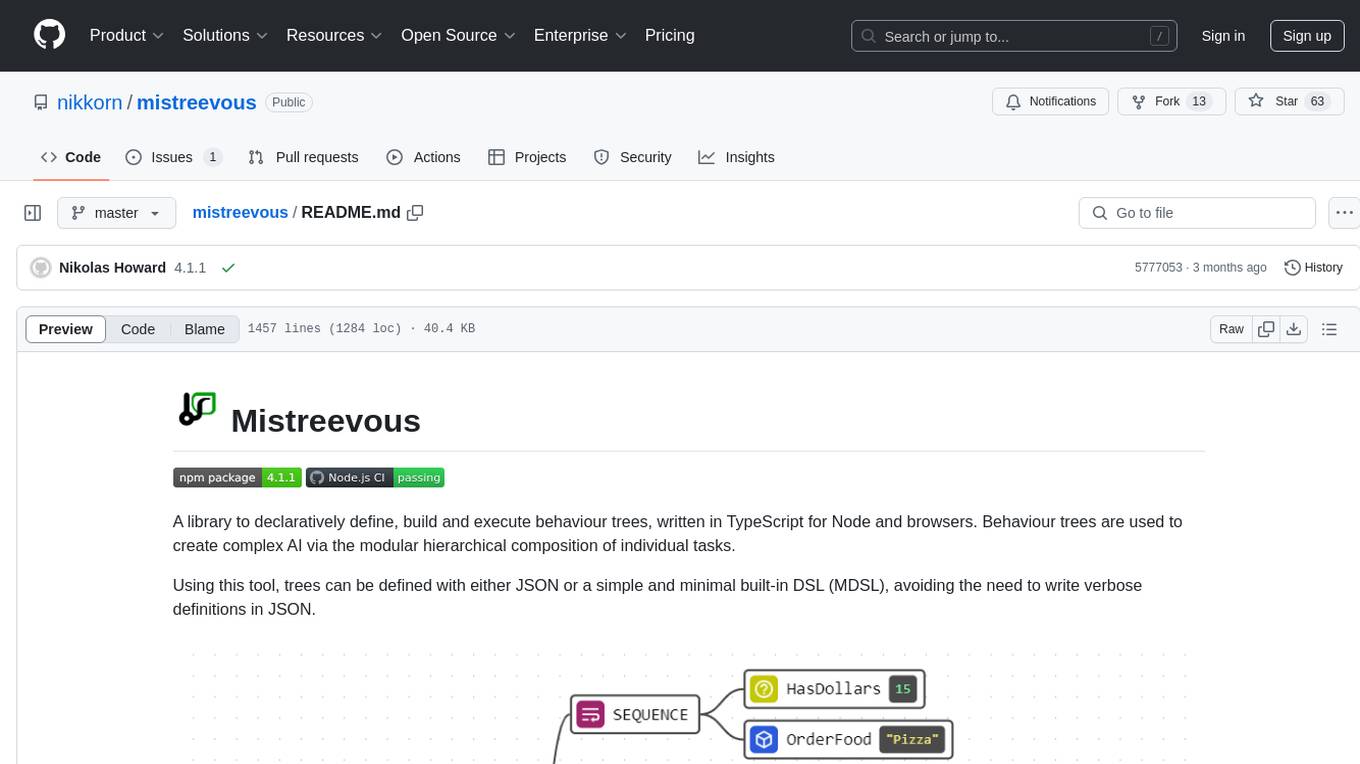
mistreevous
Mistreevous is a library written in TypeScript for Node and browsers, used to declaratively define, build, and execute behaviour trees for creating complex AI. It allows defining trees with JSON or a minimal DSL, providing in-browser editor and visualizer. The tool offers methods for tree state, stepping, resetting, and getting node details, along with various composite, decorator, leaf nodes, callbacks, guards, and global functions/subtrees. Version history includes updates for node types, callbacks, global functions, and TypeScript conversion.

project_alice
Alice is an agentic workflow framework that integrates task execution and intelligent chat capabilities. It provides a flexible environment for creating, managing, and deploying AI agents for various purposes, leveraging a microservices architecture with MongoDB for data persistence. The framework consists of components like APIs, agents, tasks, and chats that interact to produce outputs through files, messages, task results, and URL references. Users can create, test, and deploy agentic solutions in a human-language framework, making it easy to engage with by both users and agents. The tool offers an open-source option, user management, flexible model deployment, and programmatic access to tasks and chats.
flock
Flock is a workflow-based low-code platform that enables rapid development of chatbots, RAG applications, and coordination of multi-agent teams. It offers a flexible, low-code solution for orchestrating collaborative agents, supporting various node types for specific tasks, such as input processing, text generation, knowledge retrieval, tool execution, intent recognition, answer generation, and more. Flock integrates LangChain and LangGraph to provide offline operation capabilities and supports future nodes like Conditional Branch, File Upload, and Parameter Extraction for creating complex workflows. Inspired by StreetLamb, Lobe-chat, Dify, and fastgpt projects, Flock introduces new features and directions while leveraging open-source models and multi-tenancy support.
RoboMatrix
RoboMatrix is a skill-centric hierarchical framework for scalable robot task planning and execution in an open-world environment. It provides a structured approach to robot task execution using a combination of hardware components, environment configuration, installation procedures, and data collection methods. The framework is developed using the ROS2 framework on Ubuntu and supports robots from DJI's RoboMaster series. Users can follow the provided installation guidance to set up RoboMatrix and utilize it for various tasks such as data collection, task execution, and dataset construction. The framework also includes a supervised fine-tuning dataset and aims to optimize communication and release additional components in the future.
For similar jobs
aiscript
AiScript is a lightweight scripting language that runs on JavaScript. It supports arrays, objects, and functions as first-class citizens, and is easy to write without the need for semicolons or commas. AiScript runs in a secure sandbox environment, preventing infinite loops from freezing the host. It also allows for easy provision of variables and functions from the host.
askui
AskUI is a reliable, automated end-to-end automation tool that only depends on what is shown on your screen instead of the technology or platform you are running on.
bots
The 'bots' repository is a collection of guides, tools, and example bots for programming bots to play video games. It provides resources on running bots live, installing the BotLab client, debugging bots, testing bots in simulated environments, and more. The repository also includes example bots for games like EVE Online, Tribal Wars 2, and Elvenar. Users can learn about developing bots for specific games, syntax of the Elm programming language, and tools for memory reading development. Additionally, there are guides on bot programming, contributing to BotLab, and exploring Elm syntax and core library.
ain
Ain is a terminal HTTP API client designed for scripting input and processing output via pipes. It allows flexible organization of APIs using files and folders, supports shell-scripts and executables for common tasks, handles url-encoding, and enables sharing the resulting curl, wget, or httpie command-line. Users can put things that change in environment variables or .env-files, and pipe the API output for further processing. Ain targets users who work with many APIs using a simple file format and uses curl, wget, or httpie to make the actual calls.
LaVague
LaVague is an open-source Large Action Model framework that uses advanced AI techniques to compile natural language instructions into browser automation code. It leverages Selenium or Playwright for browser actions. Users can interact with LaVague through an interactive Gradio interface to automate web interactions. The tool requires an OpenAI API key for default examples and offers a Playwright integration guide. Contributors can help by working on outlined tasks, submitting PRs, and engaging with the community on Discord. The project roadmap is available to track progress, but users should exercise caution when executing LLM-generated code using 'exec'.
robocorp
Robocorp is a platform that allows users to create, deploy, and operate Python automations and AI actions. It provides an easy way to extend the capabilities of AI agents, assistants, and copilots with custom actions written in Python. Users can create and deploy tools, skills, loaders, and plugins that securely connect any AI Assistant platform to their data and applications. The Robocorp Action Server makes Python scripts compatible with ChatGPT and LangChain by automatically creating and exposing an API based on function declaration, type hints, and docstrings. It simplifies the process of developing and deploying AI actions, enabling users to interact with AI frameworks effortlessly.
Open-Interface
Open Interface is a self-driving software that automates computer tasks by sending user requests to a language model backend (e.g., GPT-4V) and simulating keyboard and mouse inputs to execute the steps. It course-corrects by sending current screenshots to the language models. The tool supports MacOS, Linux, and Windows, and requires setting up the OpenAI API key for access to GPT-4V. It can automate tasks like creating meal plans, setting up custom language model backends, and more. Open Interface is currently not efficient in accurate spatial reasoning, tracking itself in tabular contexts, and navigating complex GUI-rich applications. Future improvements aim to enhance the tool's capabilities with better models trained on video walkthroughs. The tool is cost-effective, with user requests priced between $0.05 - $0.20, and offers features like interrupting the app and primary display visibility in multi-monitor setups.
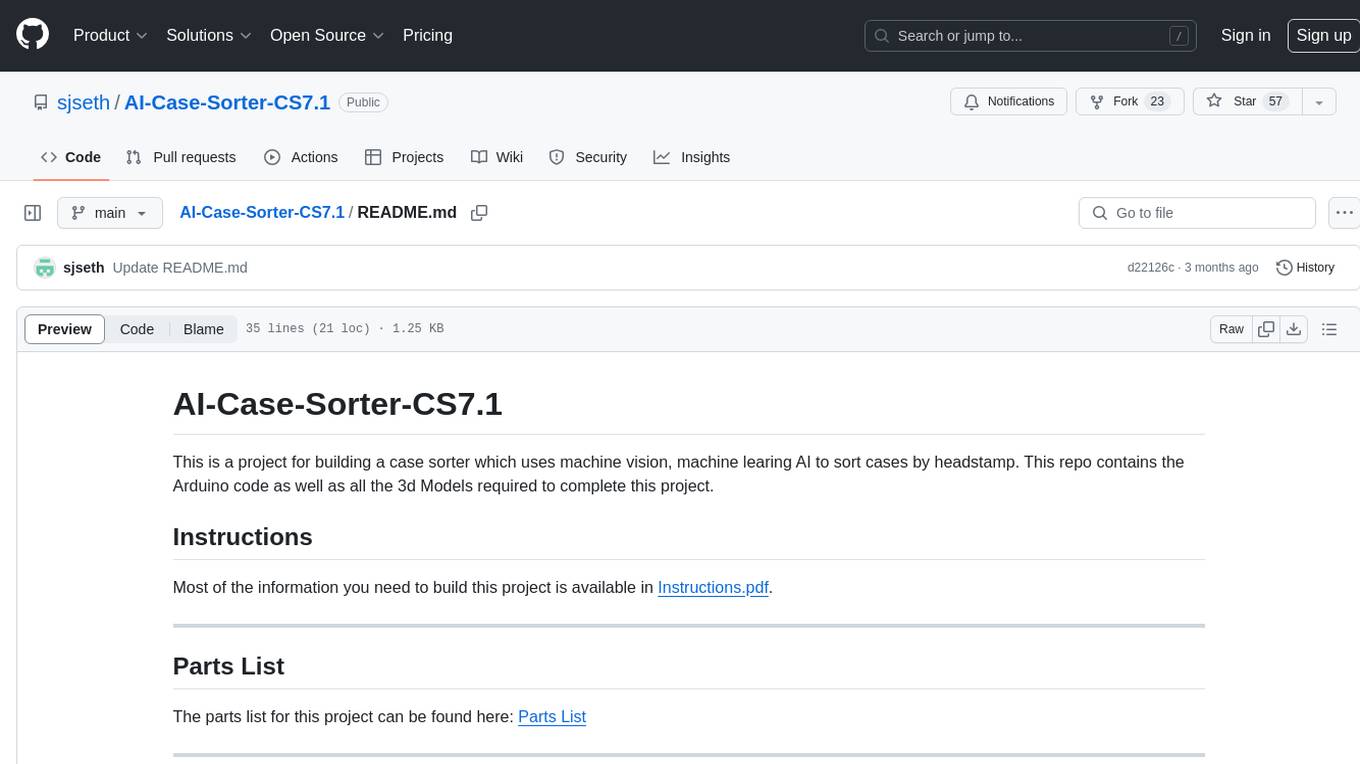
AI-Case-Sorter-CS7.1
AI-Case-Sorter-CS7.1 is a project focused on building a case sorter using machine vision and machine learning AI to sort cases by headstamp. The repository includes Arduino code and 3D models necessary for the project.