


universal
Large collection of number systems providing custom arithmetic for mixed-precision algorithm development and optimization for AI, Machine Learning, Computer Vision, Signal Processing, CAE, EDA, control, optimization, estimation, and approximation.
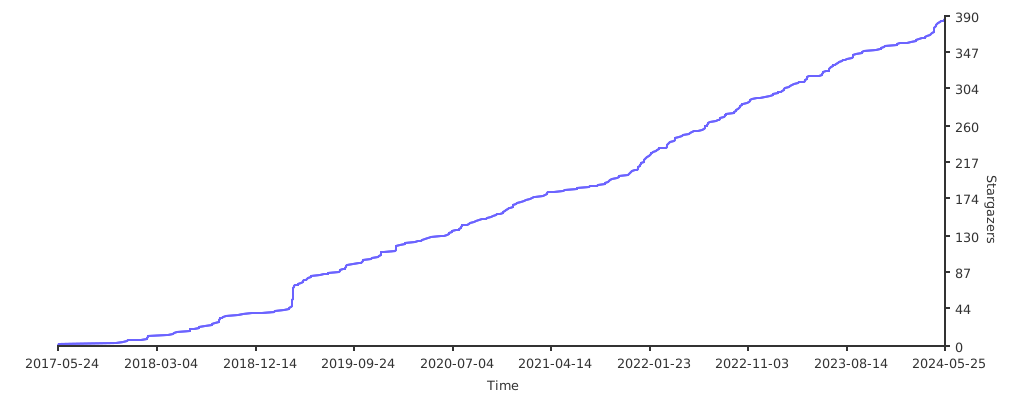
Stars: 467

The Universal Numbers Library is a header-only C++ template library designed for universal number arithmetic, offering alternatives to native integer and floating-point for mixed-precision algorithm development and optimization. It tailors arithmetic types to the application's precision and dynamic range, enabling improved application performance and energy efficiency. The library provides fast implementations of special IEEE-754 formats like quarter precision, half-precision, and quad precision, as well as vendor-specific extensions. It supports static and elastic integers, decimals, fixed-points, rationals, linear floats, tapered floats, logarithmic, interval, and adaptive-precision integers, rationals, and floats. The library is suitable for AI, DSP, HPC, and HFT algorithms.
README:
| System | Status | More information |
|---|---|---|
| Codacy Code Quality | Code Quality Assessment | |
| FOSSA Status |  |
Open-source license dependency scanner |
| GitHub Actions |  |
Latest Linux/MacOS/Windows builds and regression tests |
| Development Branch |  |
Development Branch |
| Regression Status |  |
Regression Status |
| Code Coverage |  |
Code coverage scanner |
| Docker Pulls |  |
Container pulls |
| Awesome C++ |  |
Awesome C++ Libraries |
| JOSS Markdown |  |
Journal of Open-Source Software paper |
| Zenodo |  |
Zenodo DOI Badge |
The goal of the Universal Numbers Library is to offer alternatives to native integer and floating-point for mixed-precision algorithm development and optimization. Tailoring the arithmetic types to the application's precision and dynamic range enables a new level of application performance and energy efficiency, particularly valuable for embedded applications that need autonomy through intelligent behavior.
Deep Learning algorithms in particular provide a core application vertical where alternative formats and precisions, such as half-precision floating-point and bfloat16, yield speed-ups of two to three orders of magnitude, making rapid innovation in AI possible.
The Universal Library is a ready-to-use header-only library that provides a plug-in replacement for native types and offers a low-friction environment to explore alternatives to IEEE-754 floating-point in AI, DSP, HPC, and HFT algorithms.
The basic use pattern is as simple as:
// bring in the parameterized type of interest, in this case
// a fixed-sized, arbitrary configuration classic floating-point
#include <universal/number/cfloat/cfloat.hpp>

// define your computational kernel parameterized by arithmitic type
template<typename Real>
Real MyKernel(const Real& a, const Real& b) {
    return a * b;  // replace this with your kernel computation
}

constexpr double pi = 3.14159265358979323846;

int main() {
    // if desired, create an application type alias to avoid errors
    using Real = sw::universal::half; // half-precision IEEE-754 floating-point

    Real a = sqrt(2);
    Real b = pi;
    // finally, call your kernel with your desired arithmetic type
    std::cout << "Result: " << MyKernel(a, b) << std::endl;
}
The library contains fast implementations of special IEEE-754 formats that do not have universal hardware implementations across x86, ARM, POWER, RISC-V, and GPUs. Special formats such as quarter precision, quarter, half-precision, half, and quad precision, quad, are provided, as well as vendor-specific extensions, such as NVIDIA TensorFloat, Google's Brain Float, bfloat16, or TI DSP fixed-points, fixpnt. In addition to these often-used specializations, Universal supports static and elastic integers, decimals, fixed-points, rationals, linear floats, tapered floats, logarithmic, interval and adaptive-precision integers, rationals, and floats. There are example number system skeletons to get you started quickly if you desire to add your own.
- GitHub Issue: bug reports, feature requests, etc.
- Forum: discussion of alternatives to IEEE-754 for computational science.
- Slack: online chats, discussions, and collaboration with other users, researchers and developers.
Please cite our work if you use Universal.
Research results using Universal arithmetic types are also available:
Lorenz System ODE solver using low-precision posits:

@article{Quinlan:2024,
    author     = {James Quinlan, E. Theodore L. Omtzigt},
    title      = {Iterative Refinement with Low-Precision Posits},
    journal    = {arXiv:2408.13400},
    year       = {2024},
}

@article{omtzigt2023universal,
  title={Universal Numbers Library: Multi-format Variable Precision Arithmetic Library},
  author={Omtzigt, E Theodore L and Quinlan, James},
  journal={Journal of Open Source Software},
  volume={8},
  number={83},
  pages={5072},
  year={2023}
}

@inproceedings{Omtzigt:2022,
  title        = {Universal: Reliable, Reproducible, and Energy-Efficient Numerics},
  author       = {E. Theodore L. Omtzigt and James Quinlan},
  booktitle    = {Conference on Next Generation Arithmetic},
  pages        = {100--116},
  year         = {2022},
  organization = {Springer}
}

@article{Omtzigt2020,
    author     = {E. Theodore L. Omtzigt and Peter Gottschling and Mark Seligman and William Zorn},
    title      = {{Universal Numbers Library}: design and implementation of a high-performance reproducible number systems library},
    journal    = {arXiv:2012.11011},
    year       = {2020},
}The following presentations describe Universal and the number systems it contained as of the time of publication.
Slides of a presentation at FPTalks'21
Presentation: Application-Driven Custom Number Systems
Slides of the presentation at CoNGA'22
Presentation: Universal: Reliable, Reproducible, and Energy-Efficient Numerics
A quick description of the structure of the number system parameterization can be found here.
If you just want to experiment with the number system tools and test suites and don't want to bother cloning and building the source code, there is a Docker container to get started:
> docker pull stillwater/universal
> docker run -it --rm stillwater/universal bash
stillwater@b3e6708fd732:~/universal/build$ ls
CMakeCache.txt       Makefile      cmake-uninstall.cmake  playground  universal-config-version.cmake
CMakeFiles           applications  cmake_install.cmake    tests       universal-config.cmake
CTestTestfile.cmake  c_api         education              tools       universal-targets.cmake
Here is a quick reference of what the command line tools have to offer.
If you do want to work with the code, the universal numbers software library is built using cmake version v3.23. Install the latest cmake. There are interactive installers for MacOS and Windows. For Linux, a portable approach downloads the shell archive and installs it at /usr/local:
> wget https://github.com/Kitware/CMake/releases/download/v3.23.1/cmake-3.23.1-Linux-x86_64.sh
> sudo sh cmake-3.23.1-Linux-x86_64.sh --prefix=/usr/local --exclude-subdir
For Ubuntu, snap will install the latest cmake, and would be the preferred method:
> sudo snap install cmake --classic
The Universal Library is a pure C++ template library without any further dependencies, even for the regression test suites to enable hassle-free installation and use.
Clone the GitHub repo, and you are ready to build the different components of the Universal library.
The library contains tools for using integers, decimals, fixed-points, floats, posits, valids, and logarithmic
number systems. It includes educational programs that showcase simple use cases to familiarize yourself with
different number systems and application examples to highlight the use of other number systems to gain performance
or numerical accuracy. Finally, each number system offers its own verification suite.
The easiest way to become familiar with all the options in the build process is to fire up the CMake GUI (or ccmake if you are on a headless server). The CMake output will summarize which options have been set.
The output will look something like this:
$ git clone https://github.com/stillwater-sc/universal
$ cd universal
$ mkdir build
$ cd build
$ cmake ..

 _____  _____  ____  _____  _____  ____   ____  ________  _______     ______        _       _____
|_   _||_   _||_   \|_   _||_   _||_  _| |_  _||_   __  ||_   __ \  .' ____ \      / \     |_   _|
  | |    | |    |   \ | |    | |    \ \   / /    | |_ \_|  | |__) | | (___ \_|    / _ \      | |
  | '    ' |    | |\ \| |    | |     \ \ / /     |  _| _   |  __ /   _.____`.    / ___ \     | |   _
   \ \__/ /    _| |_\   |_  _| |_     \ ' /     _| |__/ | _| |  \ \_| \____) | _/ /   \ \_  _| |__/ |
    `.__.'    |_____|\____||_____|     \_/     |________||____| |___|\______.'|____| |____||________|

-- The C compiler identification is GNU 9.4.0
-- The CXX compiler identification is GNU 9.4.0
-- The ASM compiler identification is GNU
-- Found assembler: /usr/bin/cc
-- Detecting C compiler ABI info
-- Detecting C compiler ABI info - done
-- Check for working C compiler: /usr/bin/cc - skipped
-- Detecting C compile features
-- Detecting C compile features - done
-- Detecting CXX compiler ABI info
-- Detecting CXX compiler ABI info - done
-- Check for working CXX compiler: /usr/bin/c++ - skipped
-- Detecting CXX compile features
-- Detecting CXX compile features - done
-- No default build type specified: setting CMAKE_BUILD_TYPE=Release
-- C++20 has been enabled by default
-- Performing Test COMPILER_HAS_SSE3_FLAG
-- Performing Test COMPILER_HAS_SSE3_FLAG - Success
-- Performing Test COMPILER_HAS_AVX_FLAG
-- Performing Test COMPILER_HAS_AVX_FLAG - Success
-- Performing Test COMPILER_HAS_AVX2_FLAG
-- Performing Test COMPILER_HAS_AVX2_FLAG - Success
--
-- PROJECT_NAME                = universal
-- PROJECT_NAME_NOSPACES       = universal
-- PROJECT_SOURCE_DIR          = /home/stillwater/dev/clones/universal
-- PROJECT_VERSION             = 3.68.1.80df9073
-- CMAKE_C_COMPILER            = /usr/bin/cc
-- CMAKE_CXX_COMPILER          = /usr/bin/c++
-- CMAKE_CURRENT_SOURCE_DIR    = /home/stillwater/dev/clones/universal
-- CMAKE_CURRENT_BINARY_DIR    = /home/stillwater/dev/clones/universal/build_gcc
-- GIT_COMMIT_HASH             = 80df9073
-- GIT_BRANCH                  = v3.68
-- include_install_dir         = include
-- include_install_dir_full    = include/universal
-- config_install_dir          = share/universal
-- include_install_dir_postfix = universal
--
-- ******************* Universal Arithmetic Library Configuration Summary *******************
-- General:
--   Version                          :   3.68.1.80df9073
--   System                           :   Linux
--   C++ Language Requirement         :   C++20
--   C compiler                       :   /usr/bin/cc
--   Release C flags                  :   -O3 -DNDEBUG -Wall -Wpedantic -Wno-narrowing -Wno-deprecated
--   Debug C flags                    :   -g -Wall -Wpedantic -Wno-narrowing -Wno-deprecated
--   C++ compiler                     :   /usr/bin/c++
--   Release CXX flags                :   -O3 -DNDEBUG   -Wall -Wpedantic -Wno-narrowing -Wno-deprecated -Wall -Wpedantic -Wno-narrowing -Wno-deprecated
--   Debug CXX flags                  :   -g   -Wall -Wpedantic -Wno-narrowing -Wno-deprecated -Wall -Wpedantic -Wno-narrowing -Wno-deprecated
--   Build type                       :   Release
--
--   BUILD_ALL                        :   OFF
--   BUILD_CI                         :   OFF
--
--   BUILD_DEMONSTRATION              :   ON
--   BUILD_NUMBERS                    :   OFF
--   BUILD_NUMERICS                   :   OFF
--   BUILD_BENCHMARKS                 :   OFF
--   BUILD_MIXEDPRECISION_SDK         :   OFF
--
--   BUILD_CMD_LINE_TOOLS             :   ON
--   BUILD_EDUCATION                  :   ON
--   BUILD_APPLICATIONS               :   ON
--   BUILD_PLAYGROUND                 :   ON
--
--   BUILD_NUMBER_INTERNALS           :   OFF
--   BUILD_NUMBER_NATIVE_TYPES        :   OFF
--   BUILD_NUMBER_ELASTICS            :   OFF
--   BUILD_NUMBER_STATICS             :   OFF
--   BUILD_NUMBER_CONVERSIONS         :   OFF
--
--   BUILD_NUMBER_EINTEGERS           :   OFF
--   BUILD_NUMBER_DECIMALS            :   OFF
--   BUILD_NUMBER_RATIONALS           :   OFF
--   BUILD_NUMBER_EFLOATS             :   OFF
--   BUILD_NUMBER_EPOSITS             :   OFF
--
--   BUILD_NUMBER_INTEGERS            :   OFF
--   BUILD_NUMBER_FIXPNTS             :   OFF
--   BUILD_NUMBER_BFLOATS             :   OFF
--   BUILD_NUMBER_CFLOATS             :   OFF
--   BUILD_NUMBER_DFLOATS             :   OFF
--   BUILD_NUMBER_AREALS              :   OFF
--   BUILD_NUMBER_UNUM1S              :   OFF
--   BUILD_NUMBER_UNUM2S              :   OFF
--   BUILD_NUMBER_POSITS              :   OFF
--   BUILD_NUMBER_VALIDS              :   OFF
--   BUILD_NUMBER_LNS                 :   OFF
--   BUILD_NUMBER_LNS2B               :   OFF
--   BUILD_NUMBER_SORNS               :   OFF
--
--   BUILD_NUMERIC_FUNCTIONS          :   OFF
--   BUILD_NUMERIC_QUIRES             :   OFF
--   BUILD_NUMERIC_CHALLENGES         :   OFF
--   BUILD_NUMERIC_UTILS              :   OFF
--   BUILD_NUMERIC_FPBENCH            :   OFF
--
--   BUILD_BENCHMARK_ERROR            :   OFF
--   BUILD_BENCHMARK_ACCURACY         :   OFF
--   BUILD_BENCHMARK_REPRODUCIBILITY  :   OFF
--   BUILD_BENCHMARK_PERFORMANCE      :   OFF
--   BUILD_BENCHMARK_ENERGY           :   OFF
--
--   BUILD_MIXEDPRECISION_ROOTS       :   OFF
--   BUILD_MIXEDPRECISION_APPROXIMATE :   OFF
--   BUILD_MIXEDPRECISION_INTEGRATE   :   OFF
--   BUILD_MIXEDPRECISION_INTERPOLATE :   OFF
--   BUILD_MIXEDPRECISION_OPTIMIZE    :   OFF
--   BUILD_MIXEDPRECISION_TENSOR      :   OFF
--
--   BUILD_LINEAR_ALGEBRA_BLAS        :   OFF
--   BUILD_LINEAR_ALGEBRA_VMATH       :   OFF
--
--
--   BUILD_C_API_PURE_LIB             :   OFF
--   BUILD_C_API_SHIM_LIB             :   OFF
--   BUILD_C_API_LIB_PIC              :   OFF
--   BUILD_DOCS                       :   OFF
--
-- Regression Testing Level:
--   BUILD_REGRESSION_SANITY          :   ON
--
-- Dependencies:
--   SSE3                             :   NO
--   AVX                              :   NO
--   AVX2                             :   NO
--   Pthread                          :   NO
--   TBB                              :   NO
--   OMP                              :   NO
--
-- Utilities:
--   Serializer                       :   NO
--
-- Install:
--   Install path                     :   /usr/local
--

 _____  _____  ____  _____  _____  ____   ____  ________  _______     ______        _       _____
|_   _||_   _||_   \|_   _||_   _||_  _| |_  _||_   __  ||_   __ \  .' ____ \      / \     |_   _|
  | |    | |    |   \ | |    | |    \ \   / /    | |_ \_|  | |__) | | (___ \_|    / _ \      | |
  | '    ' |    | |\ \| |    | |     \ \ / /     |  _| _   |  __ /   _.____`.    / ___ \     | |   _
   \ \__/ /    _| |_\   |_  _| |_     \ ' /     _| |__/ | _| |  \ \_| \____) | _/ /   \ \_  _| |__/ |
    `.__.'    |_____|\____||_____|     \_/     |________||____| |___|\______.'|____| |____||________|

-- Configuring done
-- Generating done
As you can see in the cmake output there are many build targets. Each build target is designed to provide focus and fast build turnarounds when working with different number systems. Each number system has its own build target allowing fast and efficient regression testing.
The build options are enabled/disabled as follows:
> cmake -DBUILD_EDUCATION=OFF -DBUILD_NUMBER_POSITS=ON ..
After building, issue the command make test to run the complete test suite of all the enabled components, as a regression capability when you are modifying the source code. This will take touch all the corners of the code.
> git clone https://github.com/stillwater-sc/universal
> cd universal
> mkdir build
> cd build
> cmake ..
> make -j $(nproc)
> make test
For Windows and Visual Studio, there are CMakePredefinedTargets that accomplish the same tasks:
    - ALL_BUILD will compile all the projects
    - INSTALL   will install the Universal library
    - RUN_TESTS will run all tests
Here is the layout of all the projects contained in V3.68 of Universal:

In the Applications section, you will find application examples to demonstrate the use of Universal arithmetic types to accomplish different numerical goals, such as reproducibility, accuracy, performance, or precision. These examples are great starting points for your own application requirements.

The Universal library contains hundreds of example programs to demonstrate the use of the arithmetic types and the enable new developers to get up to speed. In each number system type's regression suite there is an api/api.cpp that chronicles all the invokation and use cases to provide an executable example of how to use the type. In general, the api section of the regression tests has code examples how to use the different library components, such as manipulators, attributes, number traits, exceptions, and special cases.
In the education build target (BUILD_EDUCATION), there are individual test programs that demonstrate how to use the different types.
The docs directory contains the descriptions of the command line tools, a tutorial explaining the parameterization design of the arithmetic types in Universal, several conference presentations, FPTalks and CoNGA22, describing the arithmetic types. The docs directory also contains ready-to-use value tables and dynamic range comparisons of many key small arithmetic types of interest in AI and DSP applications.
Each number system comes with a complete regression suite to verify the functionality of assignment, conversion, arithmetic, logic, exceptions, number traits, and special cases. These regression suites are run for each PR or push to the version branch. Universal uses standard GitHub Actions for this, so add your branch to the workflow cmake yaml to trigger CI for your own branch.
The easiest way to get started is to pick up and copy the directory structure under ROOT/include/universal/number/skeleton_1param or ROOT/include/universal/number/skeleton_2params. They are configured to get you all the constituent pieces of a number system Universal-style.
After cloning the library, building and testing it in your environment, you can install it via:
> cd universal/build
> cmake .. -DCMAKE_INSTALL_PREFIX:PATH=/your/installation/path
> cmake --build . --config Release --target install -- -j $(nproc)
or manually via the Makefile target in the build directory:
> make -j $(nproc) install
The default install directory is /usr/local under Linux. There is also an uninstall command:
> make uninstall
If you want to use the number systems provided by Universal in your own project, you can use the following CMakeLists.txt structure:
project("my-numerical-experiment")

find_package(UNIVERSAL CONFIG REQUIRED)

add_executable(${PROJECT_NAME} src/mymain.cpp)
set_property(TARGET ${PROJECT_NAME} PROPERTY CXX_STANDARD 17)
target_link_libraries(${PROJECT_NAME} universal::universal)
The default build configuration will build the command line tools, a playground, educational and application examples. If you want to build the full regression suite across all the number systems, use the following cmake command:
cmake -DBUILD_ALL=ON ..
For performance, the build configuration can enable specific x86 instruction sets (SSE/AVX/AVX2). For example, if your processor supports the AVX2 instruction set, you can build the test suites and educational examples with the AVX2 flag turned on. This typically yields a 20% performance boost.
cmake -DBUILD_ALL=on -DUSE_AVX2=ON ..
The library builds a set of useful command utilities to inspect native IEEE float/double/long double types, as well as the custom number systems provided by Universal. Assuming you have build and installed the library, the inspection commands available are:
    ieee           -- show the components of the full set of IEEE floating point values
    quarter        -- show the components and traits of a quarter precision floating-point value (FP8)
    half           -- show the components and traits of a half precision IEEE-754 value (FP16)
    single         -- show the components and traits of a single precision IEEE-754 value (FP32)
    double         -- show the components and traits of a double precision IEEE-754 value (FP64)
    longdouble     -- show the components and traits of a native long double IEEE-754 value
    quad           -- show the components and traits of a quad precision IEEE-754 value (FP128)

    signedint      -- show the components and traits of a signed integer value
    unsignedint    -- show the components and traits of an unsigned integer value
    fixpnt         -- show the components and traits of a fixed-point value
    posit          -- show the components and traits of a posit value
    lns            -- show the components and traits of a logarithmic number system value

    float2posit    -- show the conversion process of a Real value to a posit

    propenv        -- show the properties of the execution (==compiler) environment that built the library
    propp          -- show numerical properties of a posit environment including the associated quire
    propq          -- show numerical properties of a quire
For example:
$ ieee 1.234567890123456789012
compiler              : 7.5.0
float precision       : 23 bits
double precision      : 52 bits
long double precision : 63 bits

Decimal representations
input value:             1.23456789012
      float:                1.23456788
     double:        1.2345678901199999
long double:    1.23456789011999999999

Hex representations
input value:             1.23456789012
      float:                1.23456788    hex: 0.7f.1e0652
     double:        1.2345678901199999    hex: 0.3ff.3c0ca428c1d2b
long double:    1.23456789011999999999    hex: 0.3fff.1e06521460e95b9a

Binary representations:
      float:                1.23456788    bin: 0.01111111.00111100000011001010010
     double:        1.2345678901199999    bin: 0.01111111111.0011110000001100101001000010100011000001110100101011
long double:    1.23456789011999999999    bin: 0.011111111111111.001111000000110010100100001010001100000111010010101101110011010

Native triple representations (sign, scale, fraction):
      float:                1.23456788    triple: (+,0,00111100000011001010010)
     double:        1.2345678901199999    triple: (+,0,0011110000001100101001000010100011000001110100101011)
long double:    1.23456789011999999999    triple: (+,0,001111000000110010100100001010001100000111010010101101110011010)

Universal triple representation (sign, scale, fraction):
input value:             1.23456789012
      float:                1.23456788    triple: (+,0,00111100000011001010010)
     double:        1.2345678901199999    triple: (+,0,0011110000001100101001000010100011000001110100101011)
long double:    1.23456789011999999999    triple: (+,0,001111000000110010100100001010001100000111010010101101110011010)
      exact: TBD
This ieee command is very handy to quickly determine how your development environment represents (truncates) a specific value.
The specific commands single, double, and longdouble focus on float, double, and long double representations respectively.
There is also a command posit to help you visualize and compare the posit component fields for a given value, for example:
$ posit 1.234567890123456789012
posit< 8,0> = s0 r10 e f01000 qNE v1.25
posit< 8,1> = s0 r10 e0 f0100 qNE v1.25
posit< 8,2> = s0 r10 e00 f010 qNE v1.25
posit< 8,3> = s0 r10 e000 f01 qNE v1.25
posit<16,1> = s0 r10 e0 f001111000001 qNE v1.234619140625
posit<16,2> = s0 r10 e00 f00111100000 qNE v1.234375
posit<16,3> = s0 r10 e000 f0011110000 qNE v1.234375
posit<32,1> = s0 r10 e0 f0011110000001100101001000011 qNE v1.2345678918063641
posit<32,2> = s0 r10 e00 f001111000000110010100100001 qNE v1.2345678880810738
posit<32,3> = s0 r10 e000 f00111100000011001010010001 qNE v1.2345678955316544
posit<48,1> = s0 r10 e0 f00111100000011001010010000101000110001011010 qNE v1.2345678901234578
posit<48,2> = s0 r10 e00 f0011110000001100101001000010100011000101101 qNE v1.2345678901234578
posit<48,3> = s0 r10 e000 f001111000000110010100100001010001100010110 qNE v1.2345678901233441
posit<64,1> = s0 r10 e0 f001111000000110010100100001010001100010110011111101100000000 qNE v1.2345678901234567
posit<64,2> = s0 r10 e00 f00111100000011001010010000101000110001011001111110110000000 qNE v1.2345678901234567
posit<64,3> = s0 r10 e000 f0011110000001100101001000010100011000101100111111011000000 qNE v1.2345678901234567
The fields are prefixed by their first characters, for example, "posit<16,2> = s0 r10 e00 f00111100000 qNE v1.234375"
- sign field = s0, indicating a positive number
- regime field = r10, indicates the first positive regime, named regime 0
- exponent field = e00, indicates two bits of exponent, both 0
- fraction field = f00111100000, a full set of fraction bits
The field values are followed by a quadrant descriptor and a value representation in decimal:
- qNE = North-East Quadrant, representing a number in the range "[1, maxpos]"
- v1.234375 = the value representation of the posit projection
The positive regime for a posit shows a very specific structure, as can be seen in the image blow:

To bootstrap any new mixed-precision algorithm development and optimization project quickly and robustly, there is a github template repo available that will set up a complete working development environment with dependent libraries, development containers, VS Code integration, and a Github CI workflow. The template repo can be found at mpadao-template.
The template repo is the easiest way to get started with mixed-precision algorithm development using Universal.
Modern Deep Learning AI applications are very demanding high-performance applications. Runtimes to train models are measured in terms of weeks, and target latencies for inference are 10-100msec. Standard double, and even single, precision IEEE-754 floating-point have been too expensive to use in addressing the performance and power requirements of AI applications in both the cloud and the edge. Both Google and Microsoft have jettisoned traditional floating-point formats for their AI cloud services to gain two orders of magnitude better performance. Similarly, AI applications for mobile and embedded applications are requantized to small integers to fit their very stringent power budgets. The AI domain has been researching better number systems to address both power and performance requirements, but all these efforts have worked in isolation, with results being difficult to reproduce.
AI applications are only some of the applications that expose the limitations of traditional hardware. Inefficiencies in numeric storage and operations also limit cloud scale, IoT, embedded, and HPC applications. A simple change to a new number system may improve the scale and cost of these applications by orders of magnitude.
When performance and power efficiency are the differentiating attributes for a use case, arithmetic systems that are tailored to the needs of the application are desired.
In particular, there are two concerns when using the IEEE-754 floating-point formats:
- inefficient representation of the real numbers
- irreproducibility in the context of concurrency
More specifically,
- Wasted Bit Patterns - 32-bit IEEE floating point has around eight million ways to represent NaN (Not-A-Number), while the 64-bit floating point has two quadrillion, which is approximately 2.251x10^15 to be more exact. A NaN is an exceptional value to represent undefined or invalid results, such as the result of a division by zero.
- Mathematically Incorrect - The format specifies two zeroes, a negative and positive zero, with different behaviors. - Loss of associative and distributive law due to rounding after each operation. This loss of associative and distributive arithmetic behavior creates an irreproducible result of concurrent programs that use the IEEE floating point. This is particularly problematic for embedded and control applications.
- Overflows to ± inf and underflows to 0 - Overflowing to ± inf increases the relative error by an infinite factor while underflowing to 0 loses sign information.
- Unused dynamic range - The dynamic range of double precision floats is a whopping 2^2047, whereas most numerical software is architected to operate around 1.0.
- Complicated Circuitry - Denormalized floating point numbers have a hidden bit of 0 instead of 1. This creates a host of special handling requirements that complicate compliant hardware implementations.
- No Gradual Overflow and Fixed Accuracy - If accuracy is defined as the number of significand bits, IEEE floating-point has fixed accuracy for all numbers except denormalized numbers because the number of signficand digits is fixed. Denormalized numbers are characterized by decreased significand digits when the value approaches zero due to having a zero hidden bit. Denormalized numbers fill the underflow gap (i.e., between zero and the least non-zero values). The counterpart for gradual underflow is gradual overflow which does not exist in IEEE floating points.
In contrast, the posit number system was designed to overcome these negatives:
- Economical - No bit patterns are redundant. There is one representation for infinity denoted as ± inf and zero. All other bit patterns are valid distinct non-zero real numbers. ± inf serves as a replacement for NaN.
- Preserves Mathematical Properties - There is only one representation for zero, and the encoding is symmetric around 1.0. Associative and distributive laws are supported through deferred rounding via the quire, enabling reproducible linear algebra algorithms in any concurrency environment.
- Tapered Accuracy - Tapered accuracy is when values with small exponents have more precision and values with large exponents have fewer digits of accuracy. This concept was first introduced by Morris (1971) in his paper ”Tapered Floating Point: A New Floating-Point Representation”.
- Parameterized precision and dynamic range - posits are defined by a size, nbits, and the number of exponent bits, es. This enables system designers the freedom to pick the right precision and dynamic range required for the application. For example, we may pick 5- or 6-bit posits without any exponent bits for AI applications to improve performance. For embedded DSP applications, such as 5G base stations, we may select a 16-bit posit with one exponent bit to improve performance per Watt.
- Simpler Circuitry - There are only two exceptional cases, Not a Real and Zero. No denormalized numbers, overflow, or underflow.
However as Deep Learning has demonstrated, there are many different requirements to optimize an arithmetic and tailor it to the needs of the application. Universal brings all the machinery together to experiment to facilitate efficient contrast and compare different arithmetic number system designs, before committing them to hardware.
The Universal library started as a bit-level arithmetic reference implementation of the evolving unum Type III (posit and valid) standard. However, the demands for supporting number systems, such as adaptive-precision integers to solve large factorials, adaptive-precision floats to act as Oracles, or comparing linear and tapered floats provided the opportunity to create a complete platform for numerical analysis and computational mathematics. With this Universal platform, we enable a new direction for optimizing algorithms to take advantage of mixed-precision computation to maximize performance and minimize energy demands. Energy efficiency is going to be the key differentiator for embedded intelligence applications.
As a reference library, Universal offers an extensive test infrastructure to validate number system arithmetic operations, and there is a host of utilities to inspect the internal encodings and operations of the different number systems.
The design space for custom arithmetic is vast, and any contribution to expanding the capability of the Universal library is encouraged.
We are happy to accept pull requests via GitHub. The only requirement is that the entire regression test suite passes.
Typically, the verification suite is run as part of the build directory's make test command. However, it is possible to run specific test suite components, for example, to validate algorithmic changes to more complex arithmetic functions, such as square root, exponent, logarithm, and trigonometric functions.
Here is an example:
>:~/dev/universal/build$  make posit_logarithm
[ 50%] Building CXX object static/posit/CMakeFiles/posit_logarithm.dir/math/logarithm.cpp.o
[100%] Linking CXX executable posit_logarithm
[100%] Built target posit_logarithm
>:~/dev/universal/build$ static/posit/posit_logarithm
posit logarithm function validation: results only
               4 -> log(4) =  1.3862943649292
0110000000000000 -> log(4) = 0100011000101110 (reference: 0100011000101110)   PASS

posit<2,0>                                                   log PASS
posit<3,0>                                                   log PASS
posit<3,1>                                                   log PASS
posit<4,0>                                                   log PASS
posit<4,1>                                                   log PASS
posit<5,0>                                                   log PASS
posit<5,1>                                                   log PASS
posit<5,2>                                                   log PASS
posit<8,4>                                                   log PASS
posit<8,4>                                                   log2 PASS
posit<8,4>                                                   log10 PASS
posit logarithm function validation: PASS
The universal library contains a set of functional groups to organize the development and validation of different number systems. Each number system type has a single include file that brings together the arithmetic number type and all the extensions that Universal has standardized so that working with numeric types is more productive. For example, facilities for number traits, an arithmetic exception hierarchy, number system attributes, manipulators, and finally, a math library specialized for the type.
The number system types are categorized as static or elastic. Static types are arithmetic types that have a constant, that is static size, and thus can be used for sharing composite data structures, such as matrices and tensors, between general-purpose CPUs and special-purpose hardware accelerators. Elastic types are arithmetic types that can grow and shrink during computation, typically to accommodate error-free, or closed computations.
In addition to the static and elastic classification, we also recognize that the base of the number system is a key parameter in the arithmetic and numerical traits of the type. In particular, the tree will specialize in binary and decimal forms of arithmetic.
Here is a complete list:
- universal/number/integer - arbitrary configuration fixed-size integer
- universal/number/fixpnt - arbitrary configuration fixed-size fixed-point number system
- universal/number/areal - arbitrary configuration fixed-size faithful floating-point with uncertainty bit
- universal/number/cfloat - arbitrary configuration fixed-size classic floating-point number system
- universal/number/posit - arbitrary configuration fixed-size posit number system, a tapered floating-point
- universal/number/valid - arbitrary configuration fixed-size valid number system, a tapered floating-point interval number system
- universal/number/unum - arbitrary configuration unum Type 1 number system
- universal/number/unum2 - arbitrary configuration unum Type 2 number system
- universal/number/lns - arbitrary configuration logarithmic number system with fixed-point exponent
- universal/number/dbns - double base number system with integer exponents
- universal/number/sorn - set of real numbers
- universal/number/dd - multi-component double-double floating-point format
- universal/number/qd - multi-component quad-double floating-point format
- universal/number/decimal - adaptive-precision decimal integer
- universal/number/einteger - adaptive-precision binary integer
- universal/number/erational - adaptive-precision rational number system
- universal/number/efloat - multi-digit adaptive-precision floating-point
- universal/number/ereal - multi-component adaptive-precision floating-point
- universal/number/elreal - multi-component exact lazy floating-point
- universal/number/quire - arbitrary configuration fixed-size super accumulator number system (add/sub/abs/sqrt)
- universal/number/float - contains the implementation of the IEEE floating point augmentations for reproducible computation
And each of these functionality groups has an associated test suite located in ".../universal/tests/..."
Universal numbers, unums for short, express real numbers and ranges of real numbers. There are two modes of operation, selectable by the programmer, posit mode and valid mode.
In posit mode, a unum behaves like a floating-point number of fixed size, rounding to the nearest expressible value if the result of a calculation is not expressible exactly. A posit offers more accuracy and a wider dynamic range than floats with the same number of bits.
In valid mode, a unum represents a range of real numbers and can be used to bound answers rigorously, much as interval arithmetic does.
Posit configurations have a specific relationship to one another. When expanding a posit, the new value falls 'between' the old values of the smaller posit. The new value is the arithmetic mean of the two numbers if the expanding bit is a fraction bit, and it is the geometric mean of the two numbers if the expanding bit is a regime or exponent bit. This page shows a visualization of the expansion of posit<2,0> to posit<7,1>:
The docs directory contains design documents and tutorials for the Universal library types.
The unum format is a public domain specification and a collection of web resources to manage information and discussions using unums.
The Matrix Template Library incorporates modern C++ programming techniques to provide an easy and intuitive interface to users while enabling optimal performance. The natural mathematical notation in MTL4 empowers all engineers and scientists to implement their algorithms and models in minimal time. All technical aspects are encapsulated in the library. Think of it as MATLAB for applications.
G+Smo (Geometry + Simulation Modules, pronounced "gismo") is a new open-source C++ library that brings together mathematical tools for geometric design and numerical simulation. It is developed mainly by researchers and PhD students. It implements the relatively new paradigm of isogeometric analysis, which suggests the use of a unified framework in the design and analysis pipeline. G+Smo is an object-oriented, cross-platform, template C++ library and follows the generic programming principle, with a focus on both efficiency and ease of use. The library is partitioned into smaller entities, called modules. Examples of available modules include the dimension-independent NURBS module, the data fitting and solid segmentation module, the PDE discretization module and the adaptive spline module, based on hierarchical splines of arbitrary dimension and polynomial degree.
FEniCS is a popular open-source (LGPLv3) computing platform for solving partial differential equations (PDEs). FEniCS enables users to quickly translate scientific models into efficient finite element code. With the high-level Python and C++ interfaces to FEniCS, it is easy to get started, but FEniCS offers also powerful capabilities for more experienced programmers. FEniCS runs on a multitude of platforms ranging from laptops to high-performance clusters.
Odeint is a modern C++ library for numerically solving Ordinary Differential Equations. It is developed in a generic way using Template Metaprogramming which leads to extraordinary high flexibility at top performance. The numerical algorithms are implemented independently of the underlying arithmetics. This results in an incredible applicability of the library, especially in non-standard environments. For example, odeint supports matrix types, arbitrary precision arithmetics and even can be easily run on CUDA GPUs.
Several AI and Deep Learning libraries are being reengineered to enable the use of posits for both training and inference. They will be announced as they are released.
For Tasks:
Click tags to check more tools for each tasksFor Jobs:
Alternative AI tools for universal
Similar Open Source Tools
universal
The Universal Numbers Library is a header-only C++ template library designed for universal number arithmetic, offering alternatives to native integer and floating-point for mixed-precision algorithm development and optimization. It tailors arithmetic types to the application's precision and dynamic range, enabling improved application performance and energy efficiency. The library provides fast implementations of special IEEE-754 formats like quarter precision, half-precision, and quad precision, as well as vendor-specific extensions. It supports static and elastic integers, decimals, fixed-points, rationals, linear floats, tapered floats, logarithmic, interval, and adaptive-precision integers, rationals, and floats. The library is suitable for AI, DSP, HPC, and HFT algorithms.
RTL-Coder
RTL-Coder is a tool designed to outperform GPT-3.5 in RTL code generation by providing a fully open-source dataset and a lightweight solution. It targets Verilog code generation and offers an automated flow to generate a large labeled dataset with over 27,000 diverse Verilog design problems and answers. The tool addresses the data availability challenge in IC design-related tasks and can be used for various applications beyond LLMs. The tool includes four RTL code generation models available on the HuggingFace platform, each with specific features and performance characteristics. Additionally, RTL-Coder introduces a new LLM training scheme based on code quality feedback to further enhance model performance and reduce GPU memory consumption.
PDEBench
PDEBench provides a diverse and comprehensive set of benchmarks for scientific machine learning, including challenging and realistic physical problems. The repository consists of code for generating datasets, uploading and downloading datasets, training and evaluating machine learning models as baselines. It features a wide range of PDEs, realistic and difficult problems, ready-to-use datasets with various conditions and parameters. PDEBench aims for extensibility and invites participation from the SciML community to improve and extend the benchmark.
Trace
Trace is a new AutoDiff-like tool for training AI systems end-to-end with general feedback. It generalizes the back-propagation algorithm by capturing and propagating an AI system's execution trace. Implemented as a PyTorch-like Python library, users can write Python code directly and use Trace primitives to optimize certain parts, similar to training neural networks.
FlexFlow
FlexFlow Serve is an open-source compiler and distributed system for **low latency**, **high performance** LLM serving. FlexFlow Serve outperforms existing systems by 1.3-2.0x for single-node, multi-GPU inference and by 1.4-2.4x for multi-node, multi-GPU inference.
Endia
Endia is a dynamic Array library for Scientific Computing, offering automatic differentiation of arbitrary order, complex number support, dual API with PyTorch-like imperative or JAX-like functional interface, and JIT Compilation for speeding up training and inference. It can handle complex valued functions, perform both forward and reverse-mode automatic differentiation, and has a builtin JIT compiler. Endia aims to advance AI & Scientific Computing by pushing boundaries with clear algorithms, providing high-performance open-source code that remains readable and pythonic, and prioritizing clarity and educational value over exhaustive features.
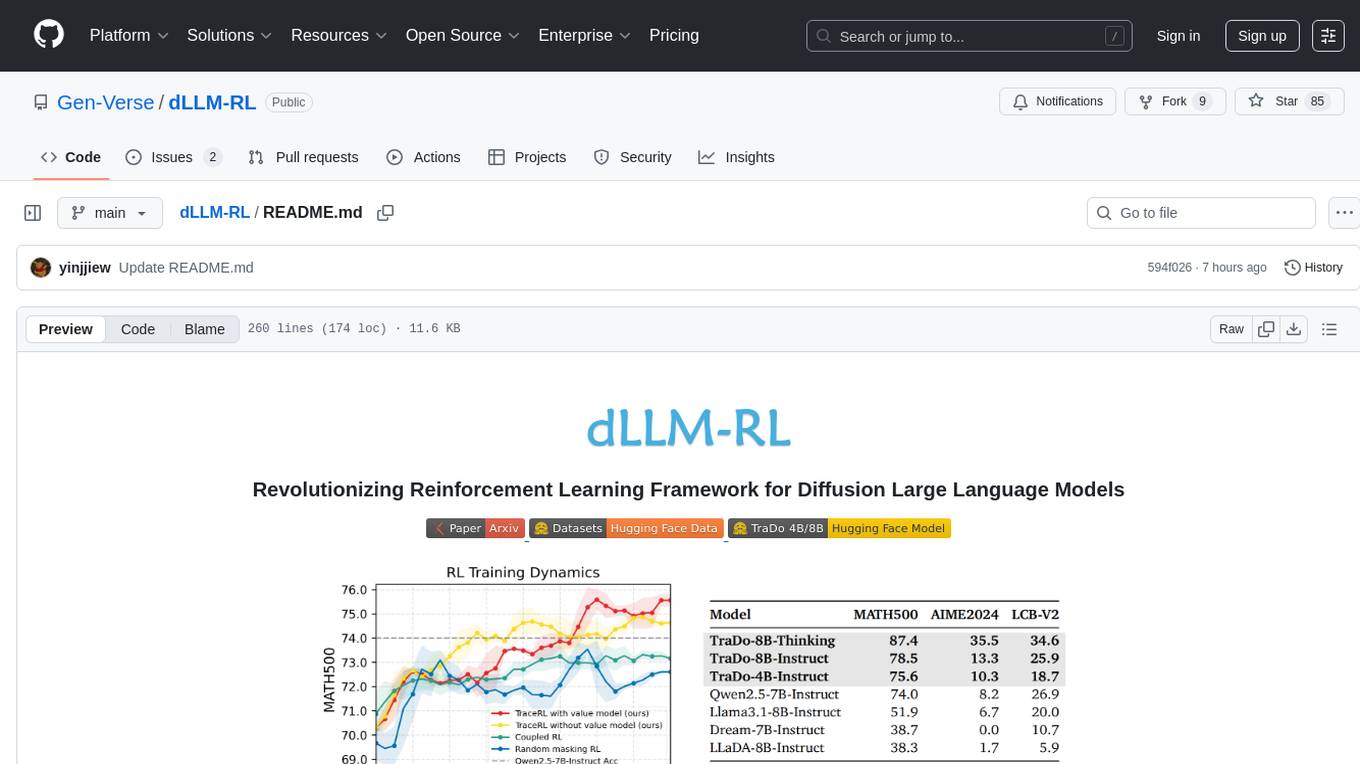
dLLM-RL
dLLM-RL is a revolutionary reinforcement learning framework designed for Diffusion Large Language Models. It supports various models with diverse structures, offers inference acceleration, RL training capabilities, and SFT functionalities. The tool introduces TraceRL for trajectory-aware RL and diffusion-based value models for optimization stability. Users can download and try models like TraDo-4B-Instruct and TraDo-8B-Instruct. The tool also provides support for multi-node setups and easy building of reinforcement learning methods. Additionally, it offers supervised fine-tuning strategies for different models and tasks.
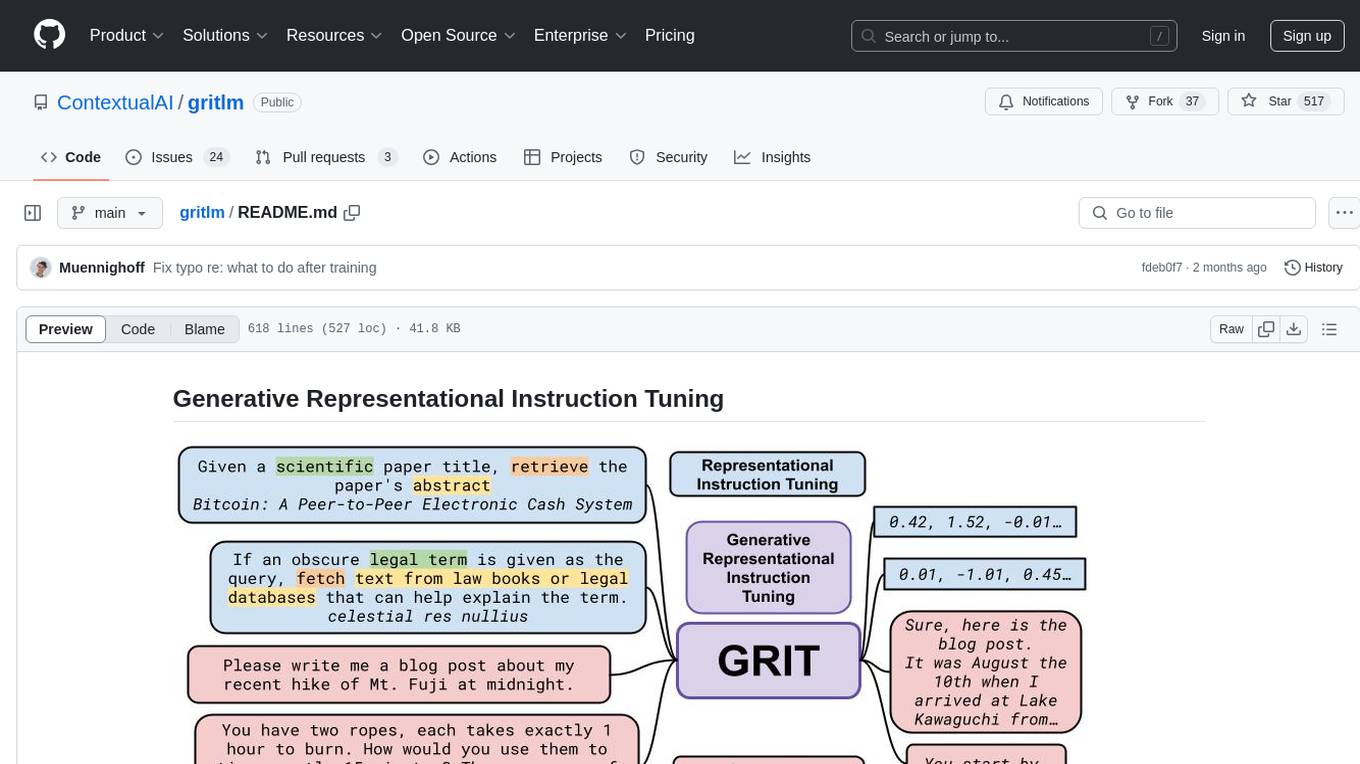
gritlm
The 'gritlm' repository provides all materials for the paper Generative Representational Instruction Tuning. It includes code for inference, training, evaluation, and known issues related to the GritLM model. The repository also offers models for embedding and generation tasks, along with instructions on how to train and evaluate the models. Additionally, it contains visualizations, acknowledgements, and a citation for referencing the work.
Pixel-Reasoner
Pixel Reasoner is a framework that introduces reasoning in the pixel-space for Vision-Language Models (VLMs), enabling them to directly inspect, interrogate, and infer from visual evidences. This enhances reasoning fidelity for visual tasks by equipping VLMs with visual reasoning operations like zoom-in and select-frame. The framework addresses challenges like model's imbalanced competence and reluctance to adopt pixel-space operations through a two-phase training approach involving instruction tuning and curiosity-driven reinforcement learning. With these visual operations, VLMs can interact with complex visual inputs such as images or videos to gather necessary information, leading to improved performance across visual reasoning benchmarks.
TokenFormer
TokenFormer is a fully attention-based neural network architecture that leverages tokenized model parameters to enhance architectural flexibility. It aims to maximize the flexibility of neural networks by unifying token-token and token-parameter interactions through the attention mechanism. The architecture allows for incremental model scaling and has shown promising results in language modeling and visual modeling tasks. The codebase is clean, concise, easily readable, state-of-the-art, and relies on minimal dependencies.
Easy-Translate
Easy-Translate is a script designed for translating large text files with a single command. It supports various models like M2M100, NLLB200, SeamlessM4T, LLaMA, and Bloom. The tool is beginner-friendly and offers seamless and customizable features for advanced users. It allows acceleration on CPU, multi-CPU, GPU, multi-GPU, and TPU, with support for different precisions and decoding strategies. Easy-Translate also provides an evaluation script for translations. Built on HuggingFace's Transformers and Accelerate library, it supports prompt usage and loading huge models efficiently.
codellm-devkit
Codellm-devkit (CLDK) is a Python library that serves as a multilingual program analysis framework bridging traditional static analysis tools and Large Language Models (LLMs) specialized for code (CodeLLMs). It simplifies the process of analyzing codebases across multiple programming languages, enabling the extraction of meaningful insights and facilitating LLM-based code analysis. The library provides a unified interface for integrating outputs from various analysis tools and preparing them for effective use by CodeLLMs. Codellm-devkit aims to enable the development and experimentation of robust analysis pipelines that combine traditional program analysis tools and CodeLLMs, reducing friction in multi-language code analysis and ensuring compatibility across different tools and LLM platforms. It is designed to seamlessly integrate with popular analysis tools like WALA, Tree-sitter, LLVM, and CodeQL, acting as a crucial intermediary layer for efficient communication between these tools and CodeLLMs. The project is continuously evolving to include new tools and frameworks, maintaining its versatility for code analysis and LLM integration.
py-llm-core
PyLLMCore is a light-weighted interface with Large Language Models with native support for llama.cpp, OpenAI API, and Azure deployments. It offers a Pythonic API that is simple to use, with structures provided by the standard library dataclasses module. The high-level API includes the assistants module for easy swapping between models. PyLLMCore supports various models including those compatible with llama.cpp, OpenAI, and Azure APIs. It covers use cases such as parsing, summarizing, question answering, hallucinations reduction, context size management, and tokenizing. The tool allows users to interact with language models for tasks like parsing text, summarizing content, answering questions, reducing hallucinations, managing context size, and tokenizing text.
aigverse
aigverse is a Python infrastructure framework that bridges the gap between logic synthesis and AI/ML applications. It allows efficient representation and manipulation of logic circuits, making it easier to integrate logic synthesis and optimization tasks into machine learning pipelines. Built upon EPFL Logic Synthesis Libraries, particularly mockturtle, aigverse provides a high-level Python interface to state-of-the-art algorithms for And-Inverter Graph (AIG) manipulation and logic synthesis, widely used in formal verification, hardware design, and optimization tasks.
For similar tasks
universal
The Universal Numbers Library is a header-only C++ template library designed for universal number arithmetic, offering alternatives to native integer and floating-point for mixed-precision algorithm development and optimization. It tailors arithmetic types to the application's precision and dynamic range, enabling improved application performance and energy efficiency. The library provides fast implementations of special IEEE-754 formats like quarter precision, half-precision, and quad precision, as well as vendor-specific extensions. It supports static and elastic integers, decimals, fixed-points, rationals, linear floats, tapered floats, logarithmic, interval, and adaptive-precision integers, rationals, and floats. The library is suitable for AI, DSP, HPC, and HFT algorithms.
LLM-as-HH
LLM-as-HH is a codebase that accompanies the paper ReEvo: Large Language Models as Hyper-Heuristics with Reflective Evolution. It introduces Language Hyper-Heuristics (LHHs) that leverage LLMs for heuristic generation with minimal manual intervention and open-ended heuristic spaces. Reflective Evolution (ReEvo) is presented as a searching framework that emulates the reflective design approach of human experts while surpassing human capabilities with scalable LLM inference, Internet-scale domain knowledge, and powerful evolutionary search. The tool can improve various algorithms on problems like Traveling Salesman Problem, Capacitated Vehicle Routing Problem, Orienteering Problem, Multiple Knapsack Problems, Bin Packing Problem, and Decap Placement Problem in both black-box and white-box settings.
open-ai
Open AI is a powerful tool for artificial intelligence research and development. It provides a wide range of machine learning models and algorithms, making it easier for developers to create innovative AI applications. With Open AI, users can explore cutting-edge technologies such as natural language processing, computer vision, and reinforcement learning. The platform offers a user-friendly interface and comprehensive documentation to support users in building and deploying AI solutions. Whether you are a beginner or an experienced AI practitioner, Open AI offers the tools and resources you need to accelerate your AI projects and stay ahead in the rapidly evolving field of artificial intelligence.
how-to-optim-algorithm-in-cuda
This repository documents how to optimize common algorithms based on CUDA. It includes subdirectories with code implementations for specific optimizations. The optimizations cover topics such as compiling PyTorch from source, NVIDIA's reduce optimization, OneFlow's elementwise template, fast atomic add for half data types, upsample nearest2d optimization in OneFlow, optimized indexing in PyTorch, OneFlow's softmax kernel, linear attention optimization, and more. The repository also includes learning resources related to deep learning frameworks, compilers, and optimization techniques.
data-scientist-roadmap2024
The Data Scientist Roadmap2024 provides a comprehensive guide to mastering essential tools for data science success. It includes programming languages, machine learning libraries, cloud platforms, and concepts categorized by difficulty. The roadmap covers a wide range of topics from programming languages to machine learning techniques, data visualization tools, and DevOps/MLOps tools. It also includes web development frameworks and specific concepts like supervised and unsupervised learning, NLP, deep learning, reinforcement learning, and statistics. Additionally, it delves into DevOps tools like Airflow and MLFlow, data visualization tools like Tableau and Matplotlib, and other topics such as ETL processes, optimization algorithms, and financial modeling.
ML-AI-2-LT
ML-AI-2-LT is a repository that serves as a glossary for machine learning and deep learning concepts. It contains translations and explanations of various terms related to artificial intelligence, including definitions and notes. Users can contribute by filling issues for unclear concepts or by submitting pull requests with suggestions or additions. The repository aims to provide a comprehensive resource for understanding key terminology in the field of AI and machine learning.
sciml.ai
SciML.ai is an open source software organization dedicated to unifying packages for scientific machine learning. It focuses on developing modular scientific simulation support software, including differential equation solvers, inverse problems methodologies, and automated model discovery. The organization aims to provide a diverse set of tools with a common interface, creating a modular, easily-extendable, and highly performant ecosystem for scientific simulations. The website serves as a platform to showcase SciML organization's packages and share news within the ecosystem. Pull requests are encouraged for contributions.
PHS-AI
PHS-AI is a project that provides functionality as is, without any warranties or commitments. Users are advised to exercise caution when using the code and conduct thorough testing before deploying in a production environment. The author assumes no responsibility for any losses or damages incurred through the use of this code. Feedback and contributions to improve the project are always welcome.
For similar jobs
weave
Weave is a toolkit for developing Generative AI applications, built by Weights & Biases. With Weave, you can log and debug language model inputs, outputs, and traces; build rigorous, apples-to-apples evaluations for language model use cases; and organize all the information generated across the LLM workflow, from experimentation to evaluations to production. Weave aims to bring rigor, best-practices, and composability to the inherently experimental process of developing Generative AI software, without introducing cognitive overhead.

LLMStack
LLMStack is a no-code platform for building generative AI agents, workflows, and chatbots. It allows users to connect their own data, internal tools, and GPT-powered models without any coding experience. LLMStack can be deployed to the cloud or on-premise and can be accessed via HTTP API or triggered from Slack or Discord.
VisionCraft
The VisionCraft API is a free API for using over 100 different AI models. From images to sound.
kaito
Kaito is an operator that automates the AI/ML inference model deployment in a Kubernetes cluster. It manages large model files using container images, avoids tuning deployment parameters to fit GPU hardware by providing preset configurations, auto-provisions GPU nodes based on model requirements, and hosts large model images in the public Microsoft Container Registry (MCR) if the license allows. Using Kaito, the workflow of onboarding large AI inference models in Kubernetes is largely simplified.

PyRIT
PyRIT is an open access automation framework designed to empower security professionals and ML engineers to red team foundation models and their applications. It automates AI Red Teaming tasks to allow operators to focus on more complicated and time-consuming tasks and can also identify security harms such as misuse (e.g., malware generation, jailbreaking), and privacy harms (e.g., identity theft). The goal is to allow researchers to have a baseline of how well their model and entire inference pipeline is doing against different harm categories and to be able to compare that baseline to future iterations of their model. This allows them to have empirical data on how well their model is doing today, and detect any degradation of performance based on future improvements.
tabby
Tabby is a self-hosted AI coding assistant, offering an open-source and on-premises alternative to GitHub Copilot. It boasts several key features: * Self-contained, with no need for a DBMS or cloud service. * OpenAPI interface, easy to integrate with existing infrastructure (e.g Cloud IDE). * Supports consumer-grade GPUs.
spear
SPEAR (Simulator for Photorealistic Embodied AI Research) is a powerful tool for training embodied agents. It features 300 unique virtual indoor environments with 2,566 unique rooms and 17,234 unique objects that can be manipulated individually. Each environment is designed by a professional artist and features detailed geometry, photorealistic materials, and a unique floor plan and object layout. SPEAR is implemented as Unreal Engine assets and provides an OpenAI Gym interface for interacting with the environments via Python.

Magick
Magick is a groundbreaking visual AIDE (Artificial Intelligence Development Environment) for no-code data pipelines and multimodal agents. Magick can connect to other services and comes with nodes and templates well-suited for intelligent agents, chatbots, complex reasoning systems and realistic characters.