


oreilly-llm-rl-alignment
This training offers an intensive exploration into the frontier of reinforcement learning techniques with large language models (LLMs). We will explore advanced topics such as Reinforcement Learning with Human Feedback (RLHF), Reinforcement Learning from AI Feedback (RLAIF), Reasoning LLMs, and demonstrate practical applications such as fine-tuning
Stars: 52
This repository contains Jupyter notebooks for the courses 'Aligning Large Language Models' and 'Reinforcement Learning with Large Language Models' by Sinan Ozdemir. It covers effective best practices and industry case studies in using Large Language Models (LLMs). The courses provide in-depth exploration of alignment techniques, evaluation methods, ethical considerations, and reinforcement learning concepts with practical applications. Participants will gain theoretical insights and hands-on experience in working with LLMs, including fine-tuning models and understanding advanced concepts like RLHF, RLAIF, and Constitutional AI.
README:

This repository contains Jupyter notebooks for the courses "Aligning Large Language Models" and "Reinforcement Learning with Large Language Models" by Sinan Ozdemir. Published by Pearson, the course covers effective best practices and industry case studies in using Large Language Models (LLMs).
- In-depth exploration of various alignment techniques with hands-on case studies, such as Constitutional AI
- Comprehensive coverage of evaluating alignment, offering specific tools and metrics for continuous assessment and adaptation of LLM alignment strategies
- A focus on ethical considerations and future directions, ensuring participants not only understand the current landscape but are also prepared for emerging trends and challenges in LLM alignment
This class is an intensive exploration into the alignment of Large Language Models (LLMs), a vital topic in modern AI development. Through a combination of theoretical insights and hands-on practice, participants will be exposed to various alignment techniques, including a focus on Constitutional AI, constructing reward mechanisms from human feedback, and instructional alignment. The course will also provide detailed guidance on evaluating alignment, with specific tools and metrics to ensure that models align with desired goals, ethical standards, and real-world applications.
- Jupyter notebooks can be run alongside the instructor, but you can also follow along without coding by viewing pre-run notebooks here.
-
Red Teaming Benchmark
-
Prompt Injection Examples - See how three kinds of prompt injection attacks can attempt to jailbreak an LLM
-
Scale Supervision Examples - Watch LLMs critique and revise their own responses given a "constitution"

- An immersive deep dive into advanced concepts of reinforcement learning in the context of LLMs.
- A practical, hands-on approach to fine-tuning LLMs, with a focus on real-world applications such as generating neutral summaries using T5.
- A unique opportunity to understand and apply innovative concepts like RLHF, RLAIF, and Constitutional AI in reinforcement learning.
This training offers an intensive exploration into the frontier of reinforcement learning techniques with large language models (LLMs). We will explore advanced topics such as Reinforcement Learning with Human Feedback (RLHF), Reinforcement Learning from AI Feedback (RLAIF), and Constitutional AI, and demonstrate practical applications such as fine-tuning open source LLMs like FLAN-T5 and Llama-3. This course is critical for those keen on deepening their understanding of reinforcement learning, its latest trends, and its application to LLMs.
- Jupyter notebooks can be run alongside the instructor, but you can also follow along without coding by viewing pre-run notebooks here.
-
FLAN-T5 PPO - Working with FLAN-T5 models using Reinforcement Learning
-
Reward Modeling - Training a reward model from human preferences
-
DPO - Direct Preference Optimization
-
RLOO - Reinforcement Learning with Leave-One-Out
-
GRPO - Fine-tuning with Group Relative Policy Optimization
-
Constitutional AI (CAI)
For Tasks:
Click tags to check more tools for each tasksFor Jobs:
Alternative AI tools for oreilly-llm-rl-alignment
Similar Open Source Tools
oreilly-llm-rl-alignment
This repository contains Jupyter notebooks for the courses 'Aligning Large Language Models' and 'Reinforcement Learning with Large Language Models' by Sinan Ozdemir. It covers effective best practices and industry case studies in using Large Language Models (LLMs). The courses provide in-depth exploration of alignment techniques, evaluation methods, ethical considerations, and reinforcement learning concepts with practical applications. Participants will gain theoretical insights and hands-on experience in working with LLMs, including fine-tuning models and understanding advanced concepts like RLHF, RLAIF, and Constitutional AI.
awesome-llms-fine-tuning
This repository is a curated collection of resources for fine-tuning Large Language Models (LLMs) like GPT, BERT, RoBERTa, and their variants. It includes tutorials, papers, tools, frameworks, and best practices to aid researchers, data scientists, and machine learning practitioners in adapting pre-trained models to specific tasks and domains. The resources cover a wide range of topics related to fine-tuning LLMs, providing valuable insights and guidelines to streamline the process and enhance model performance.
awesome-RLAIF
Reinforcement Learning from AI Feedback (RLAIF) is a concept that describes a type of machine learning approach where **an AI agent learns by receiving feedback or guidance from another AI system**. This concept is closely related to the field of Reinforcement Learning (RL), which is a type of machine learning where an agent learns to make a sequence of decisions in an environment to maximize a cumulative reward. In traditional RL, an agent interacts with an environment and receives feedback in the form of rewards or penalties based on the actions it takes. It learns to improve its decision-making over time to achieve its goals. In the context of Reinforcement Learning from AI Feedback, the AI agent still aims to learn optimal behavior through interactions, but **the feedback comes from another AI system rather than from the environment or human evaluators**. This can be **particularly useful in situations where it may be challenging to define clear reward functions or when it is more efficient to use another AI system to provide guidance**. The feedback from the AI system can take various forms, such as: - **Demonstrations** : The AI system provides demonstrations of desired behavior, and the learning agent tries to imitate these demonstrations. - **Comparison Data** : The AI system ranks or compares different actions taken by the learning agent, helping it to understand which actions are better or worse. - **Reward Shaping** : The AI system provides additional reward signals to guide the learning agent's behavior, supplementing the rewards from the environment. This approach is often used in scenarios where the RL agent needs to learn from **limited human or expert feedback or when the reward signal from the environment is sparse or unclear**. It can also be used to **accelerate the learning process and make RL more sample-efficient**. Reinforcement Learning from AI Feedback is an area of ongoing research and has applications in various domains, including robotics, autonomous vehicles, and game playing, among others.

awesome-generative-ai-guide
This repository serves as a comprehensive hub for updates on generative AI research, interview materials, notebooks, and more. It includes monthly best GenAI papers list, interview resources, free courses, and code repositories/notebooks for developing generative AI applications. The repository is regularly updated with the latest additions to keep users informed and engaged in the field of generative AI.
RecAI
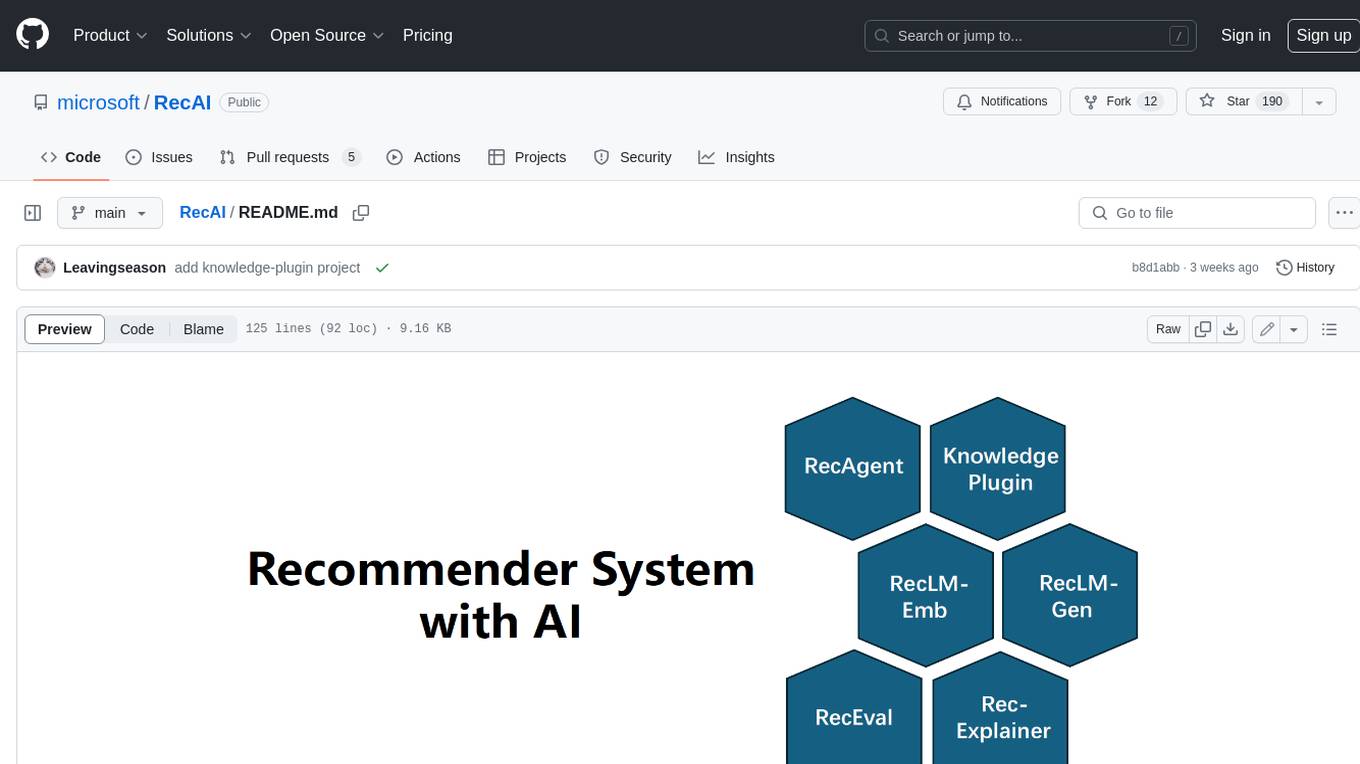
RecAI is a project that explores the integration of Large Language Models (LLMs) into recommender systems, addressing the challenges of interactivity, explainability, and controllability. It aims to bridge the gap between general-purpose LLMs and domain-specific recommender systems, providing a holistic perspective on the practical requirements of LLM4Rec. The project investigates various techniques, including Recommender AI agents, selective knowledge injection, fine-tuning language models, evaluation, and LLMs as model explainers, to create more sophisticated, interactive, and user-centric recommender systems.
tods-arxiv-daily-paper
This repository provides a tool for fetching and summarizing daily papers from the arXiv repository. It allows users to stay updated with the latest research in various fields by automatically retrieving and summarizing papers on a daily basis. The tool simplifies the process of accessing and digesting academic papers, making it easier for researchers and enthusiasts to keep track of new developments in their areas of interest.
ManipVQA
ManipVQA is a framework that enhances Multimodal Large Language Models (MLLMs) with manipulation-centric knowledge through a Visual Question-Answering (VQA) format. It addresses the deficiency of conventional MLLMs in understanding affordances and physical concepts crucial for manipulation tasks. By infusing robotics-specific knowledge, including tool detection, affordance recognition, and physical concept comprehension, ManipVQA improves the performance of robots in manipulation tasks. The framework involves fine-tuning MLLMs with a curated dataset of interactive objects, enabling robots to understand and execute natural language instructions more effectively.
AI-Engineer-Headquarters
AI Engineer Headquarters is a comprehensive learning resource designed to help individuals master scientific methods, processes, algorithms, and systems to build stories and models in the field of Data and AI. The repository provides in-depth content through video sessions and text materials, catering to individuals aspiring to be in the top 1% of Data and AI experts. It covers various topics such as AI engineering foundations, large language models, retrieval-augmented generation, fine-tuning LLMs, reinforcement learning, ethical AI, agentic workflows, and career acceleration. The learning approach emphasizes action-oriented drills and routines, encouraging consistent effort and dedication to excel in the AI field.
awesome-transformer-nlp
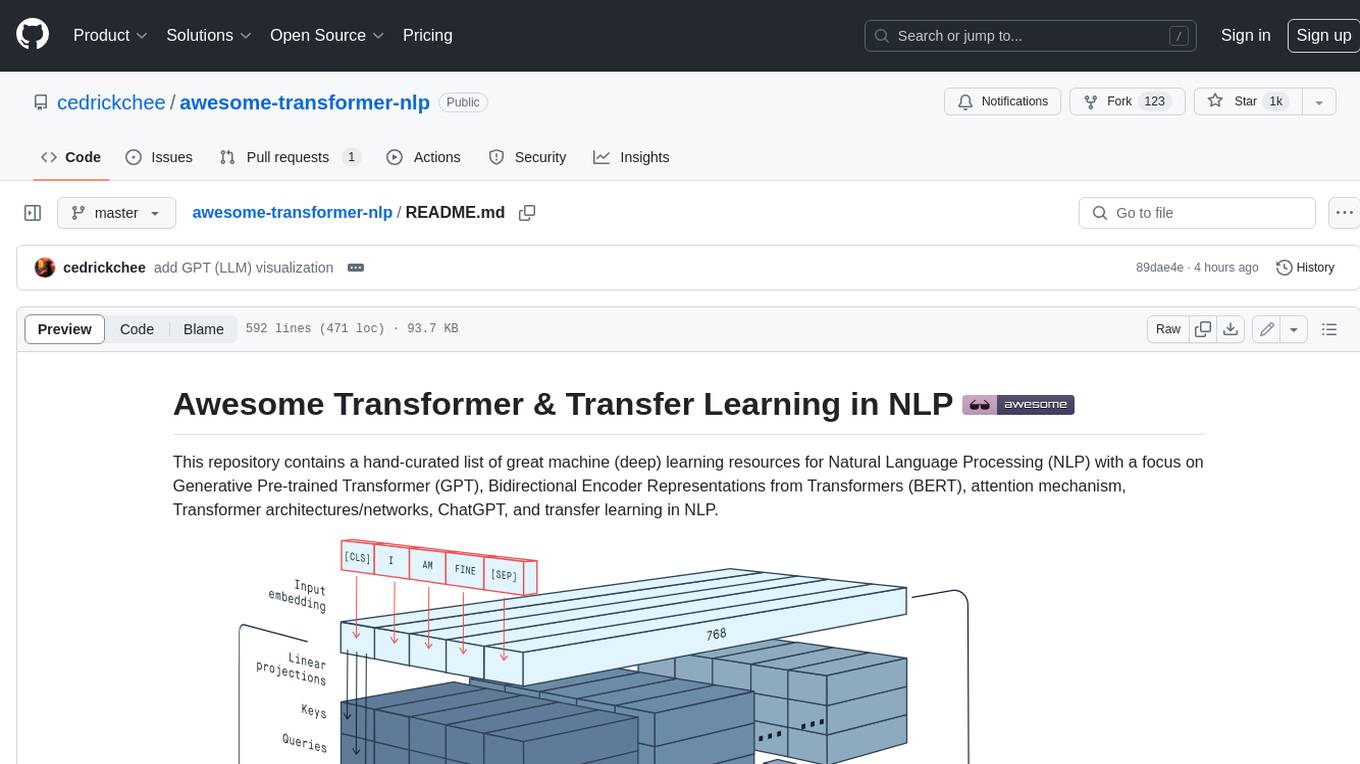
This repository contains a hand-curated list of great machine (deep) learning resources for Natural Language Processing (NLP) with a focus on Generative Pre-trained Transformer (GPT), Bidirectional Encoder Representations from Transformers (BERT), attention mechanism, Transformer architectures/networks, Chatbot, and transfer learning in NLP.

oreilly-hands-on-gpt-llm
This repository contains code for the O'Reilly Live Online Training for Deploying GPT & LLMs. Learn how to use GPT-4, ChatGPT, OpenAI embeddings, and other large language models to build applications for experimenting and production. Gain practical experience in building applications like text generation, summarization, question answering, and more. Explore alternative generative models such as Cohere and GPT-J. Understand prompt engineering, context stuffing, and few-shot learning to maximize the potential of GPT-like models. Focus on deploying models in production with best practices and debugging techniques. By the end of the training, you will have the skills to start building applications with GPT and other large language models.

Me-LLaMA
Me LLaMA introduces a suite of open-source medical Large Language Models (LLMs), including Me LLaMA 13B/70B and their chat-enhanced versions. Developed through innovative continual pre-training and instruction tuning, these models leverage a vast medical corpus comprising PubMed papers, medical guidelines, and general domain data. Me LLaMA sets new benchmarks on medical reasoning tasks, making it a significant asset for medical NLP applications and research. The models are intended for computational linguistics and medical research, not for clinical decision-making without validation and regulatory approval.
Mastering-NLP-from-Foundations-to-LLMs
This code repository is for the book 'Mastering NLP from Foundations to LLMs', which provides an in-depth introduction to Natural Language Processing (NLP) techniques. It covers mathematical foundations of machine learning, advanced NLP applications such as large language models (LLMs) and AI applications, as well as practical skills for working on real-world NLP business problems. The book includes Python code samples and expert insights into current and future trends in NLP.
hallucination-index
LLM Hallucination Index - RAG Special is a comprehensive evaluation of large language models (LLMs) focusing on context length and open vs. closed-source attributes. The index explores the impact of context length on model performance and tests the assumption that closed-source LLMs outperform open-source ones. It also investigates the effectiveness of prompting techniques like Chain-of-Note across different context lengths. The evaluation includes 22 models from various brands, analyzing major trends and declaring overall winners based on short, medium, and long context insights. Methodologies involve rigorous testing with different context lengths and prompting techniques to assess models' abilities in handling extensive texts and detecting hallucinations.
MediaAI
MediaAI is a repository containing lectures and materials for Aalto University's AI for Media, Art & Design course. The course is a hands-on, project-based crash course focusing on deep learning and AI techniques for artists and designers. It covers common AI algorithms & tools, their applications in art, media, and design, and provides hands-on practice in designing, implementing, and using these tools. The course includes lectures, exercises, and a final project based on students' interests. Students can complete the course without programming by creatively utilizing existing tools like ChatGPT and DALL-E. The course emphasizes collaboration, peer-to-peer tutoring, and project-based learning. It covers topics such as text generation, image generation, optimization, and game AI.
For similar tasks
oreilly-llm-rl-alignment
This repository contains Jupyter notebooks for the courses 'Aligning Large Language Models' and 'Reinforcement Learning with Large Language Models' by Sinan Ozdemir. It covers effective best practices and industry case studies in using Large Language Models (LLMs). The courses provide in-depth exploration of alignment techniques, evaluation methods, ethical considerations, and reinforcement learning concepts with practical applications. Participants will gain theoretical insights and hands-on experience in working with LLMs, including fine-tuning models and understanding advanced concepts like RLHF, RLAIF, and Constitutional AI.
mindsdb
MindsDB is a platform for customizing AI from enterprise data. You can create, serve, and fine-tune models in real-time from your database, vector store, and application data. MindsDB "enhances" SQL syntax with AI capabilities to make it accessible for developers worldwide. With MindsDB’s nearly 200 integrations, any developer can create AI customized for their purpose, faster and more securely. Their AI systems will constantly improve themselves — using companies’ own data, in real-time.
training-operator
Kubeflow Training Operator is a Kubernetes-native project for fine-tuning and scalable distributed training of machine learning (ML) models created with various ML frameworks such as PyTorch, Tensorflow, XGBoost, MPI, Paddle and others. Training Operator allows you to use Kubernetes workloads to effectively train your large models via Kubernetes Custom Resources APIs or using Training Operator Python SDK. > Note: Before v1.2 release, Kubeflow Training Operator only supports TFJob on Kubernetes. * For a complete reference of the custom resource definitions, please refer to the API Definition. * TensorFlow API Definition * PyTorch API Definition * Apache MXNet API Definition * XGBoost API Definition * MPI API Definition * PaddlePaddle API Definition * For details of all-in-one operator design, please refer to the All-in-one Kubeflow Training Operator * For details on its observability, please refer to the monitoring design doc.
helix
HelixML is a private GenAI platform that allows users to deploy the best of open AI in their own data center or VPC while retaining complete data security and control. It includes support for fine-tuning models with drag-and-drop functionality. HelixML brings the best of open source AI to businesses in an ergonomic and scalable way, optimizing the tradeoff between GPU memory and latency.
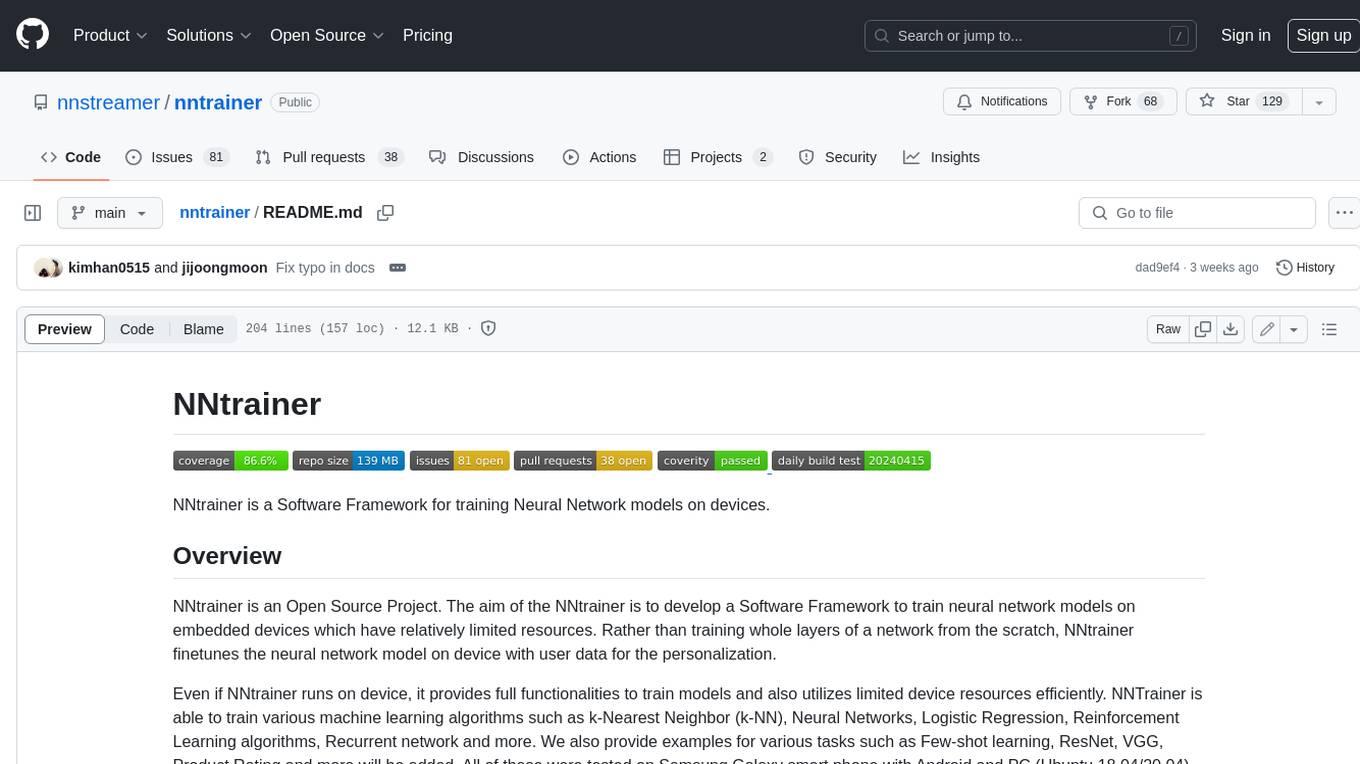
nntrainer
NNtrainer is a software framework for training neural network models on devices with limited resources. It enables on-device fine-tuning of neural networks using user data for personalization. NNtrainer supports various machine learning algorithms and provides examples for tasks such as few-shot learning, ResNet, VGG, and product rating. It is optimized for embedded devices and utilizes CBLAS and CUBLAS for accelerated calculations. NNtrainer is open source and released under the Apache License version 2.0.
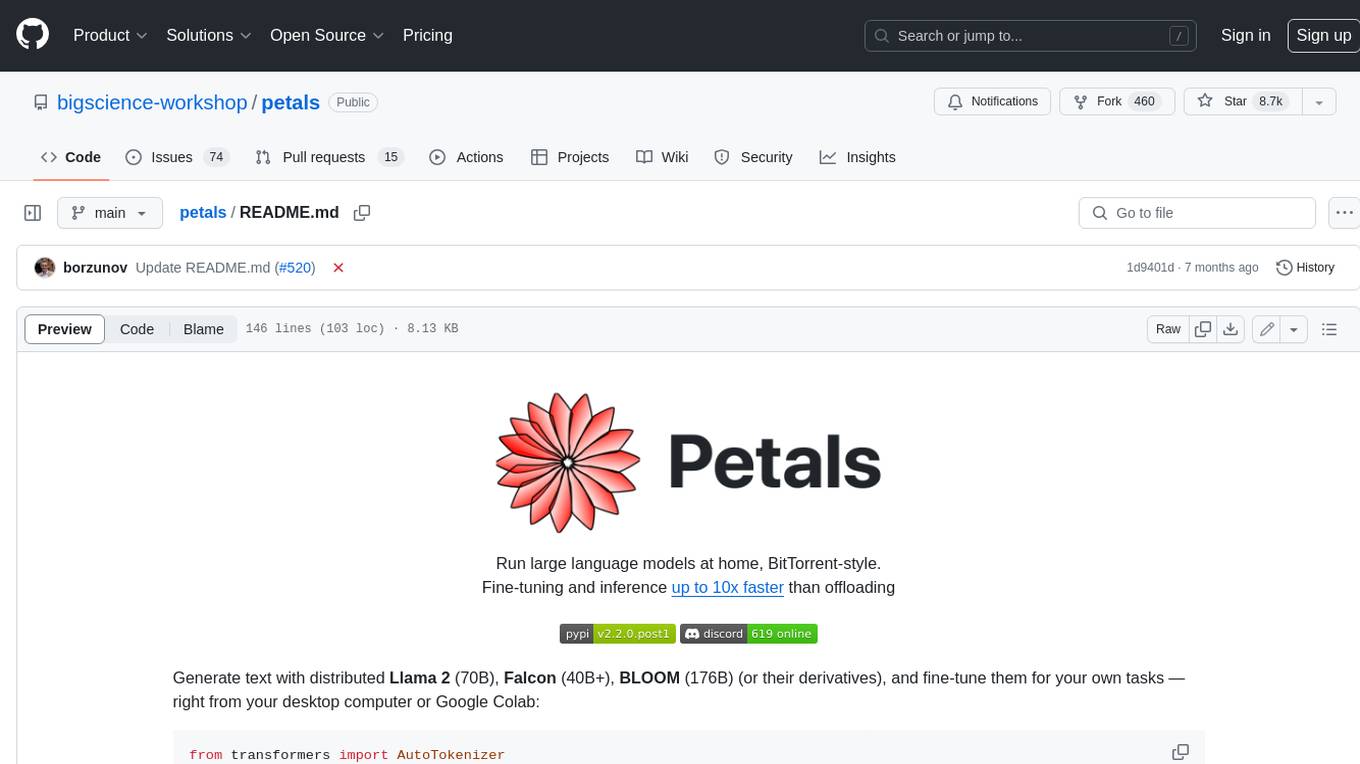
petals
Petals is a tool that allows users to run large language models at home in a BitTorrent-style manner. It enables fine-tuning and inference up to 10x faster than offloading. Users can generate text with distributed models like Llama 2, Falcon, and BLOOM, and fine-tune them for specific tasks directly from their desktop computer or Google Colab. Petals is a community-run system that relies on people sharing their GPUs to increase its capacity and offer a distributed network for hosting model layers.
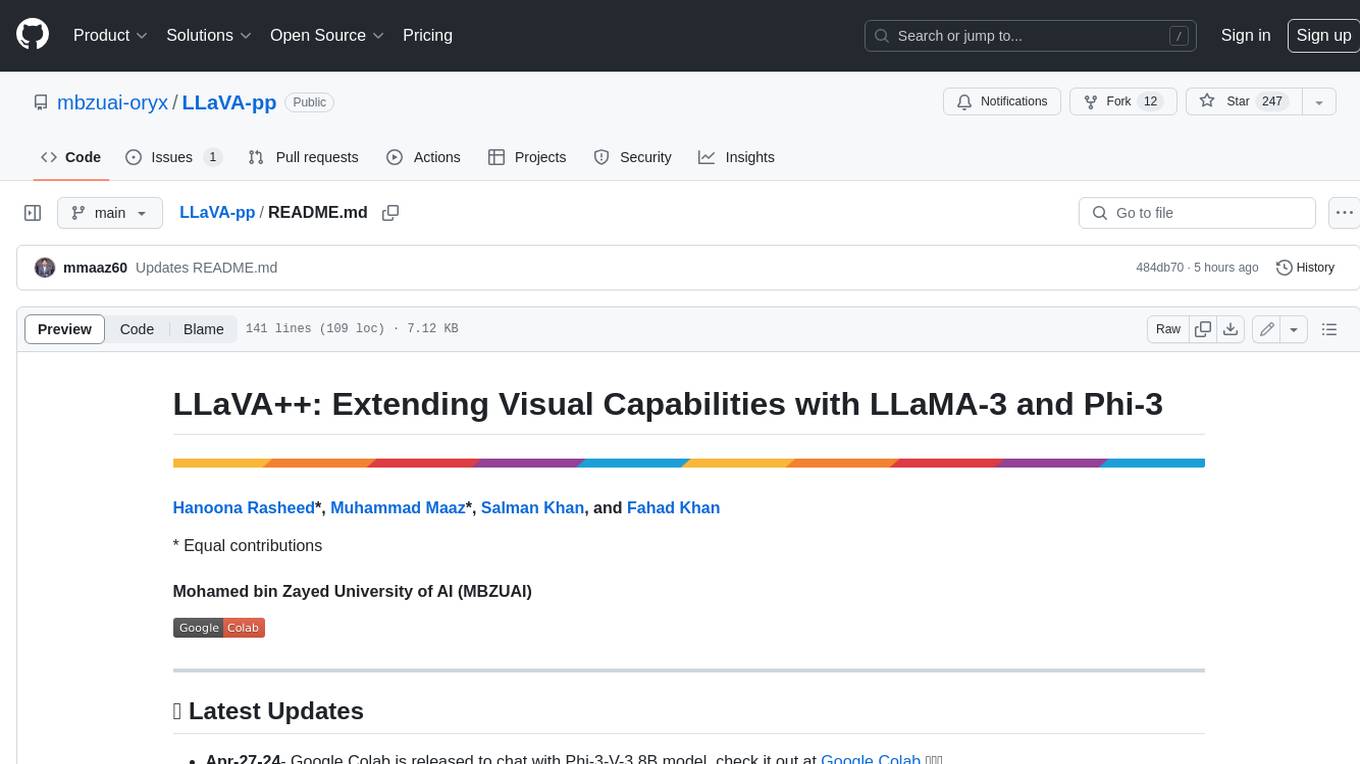
LLaVA-pp
This repository, LLaVA++, extends the visual capabilities of the LLaVA 1.5 model by incorporating the latest LLMs, Phi-3 Mini Instruct 3.8B, and LLaMA-3 Instruct 8B. It provides various models for instruction-following LMMS and academic-task-oriented datasets, along with training scripts for Phi-3-V and LLaMA-3-V. The repository also includes installation instructions and acknowledgments to related open-source contributions.
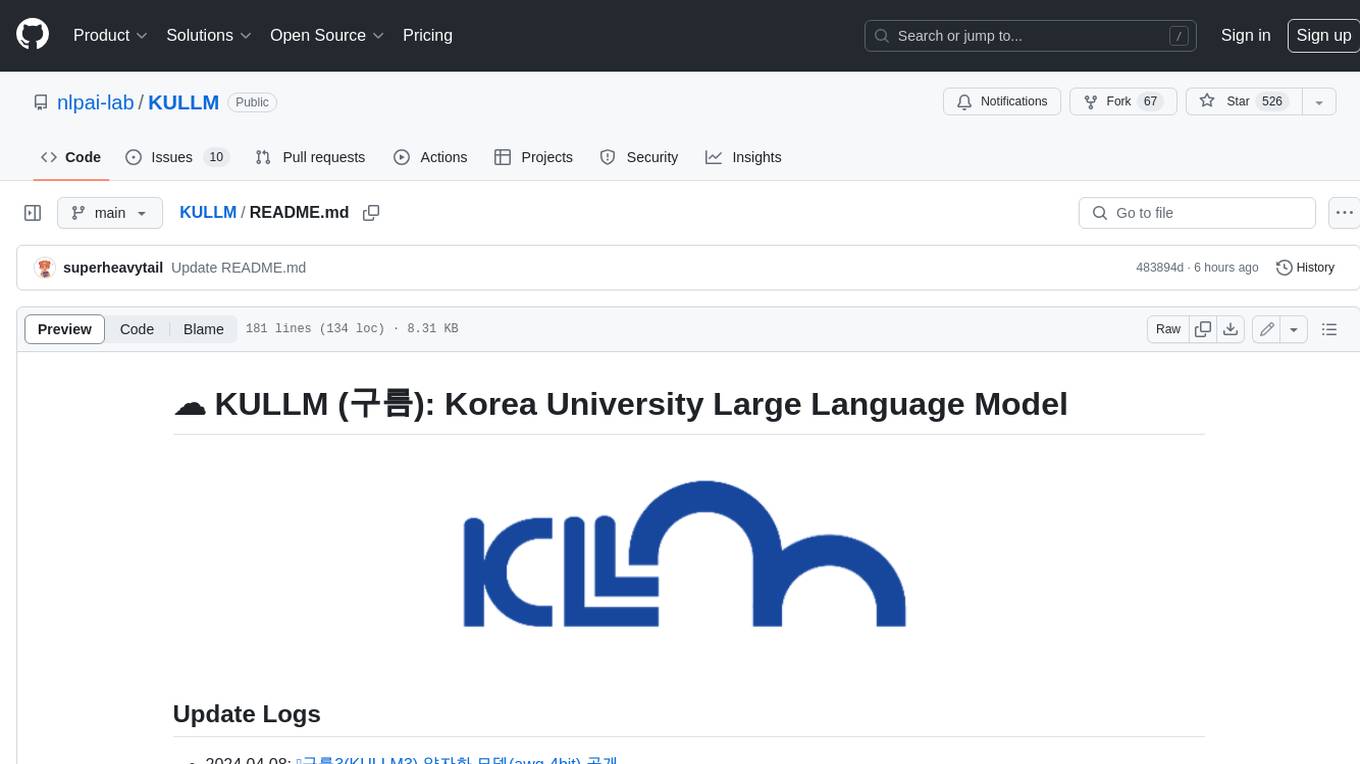
KULLM
KULLM (구름) is a Korean Large Language Model developed by Korea University NLP & AI Lab and HIAI Research Institute. It is based on the upstage/SOLAR-10.7B-v1.0 model and has been fine-tuned for instruction. The model has been trained on 8×A100 GPUs and is capable of generating responses in Korean language. KULLM exhibits hallucination and repetition phenomena due to its decoding strategy. Users should be cautious as the model may produce inaccurate or harmful results. Performance may vary in benchmarks without a fixed system prompt.
For similar jobs
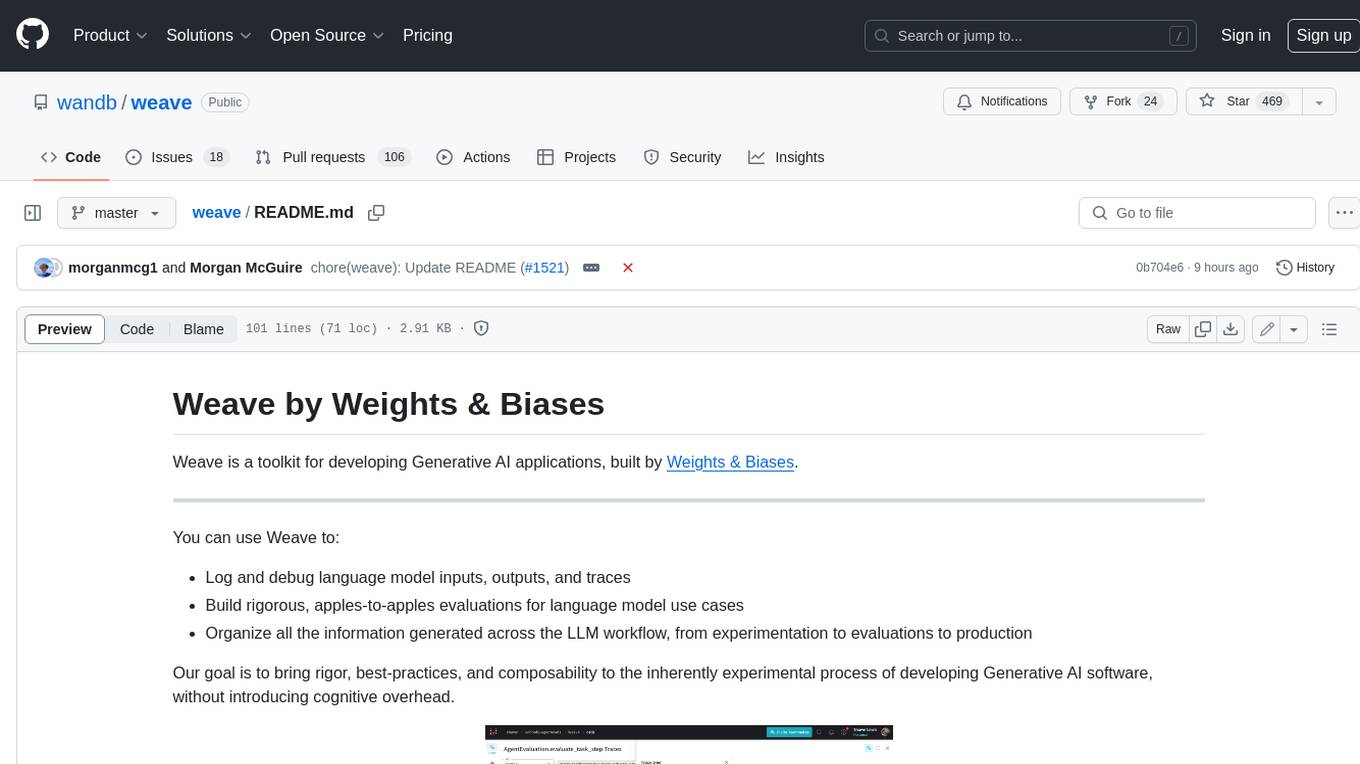
weave
Weave is a toolkit for developing Generative AI applications, built by Weights & Biases. With Weave, you can log and debug language model inputs, outputs, and traces; build rigorous, apples-to-apples evaluations for language model use cases; and organize all the information generated across the LLM workflow, from experimentation to evaluations to production. Weave aims to bring rigor, best-practices, and composability to the inherently experimental process of developing Generative AI software, without introducing cognitive overhead.
LLMStack
LLMStack is a no-code platform for building generative AI agents, workflows, and chatbots. It allows users to connect their own data, internal tools, and GPT-powered models without any coding experience. LLMStack can be deployed to the cloud or on-premise and can be accessed via HTTP API or triggered from Slack or Discord.
VisionCraft
The VisionCraft API is a free API for using over 100 different AI models. From images to sound.
kaito
Kaito is an operator that automates the AI/ML inference model deployment in a Kubernetes cluster. It manages large model files using container images, avoids tuning deployment parameters to fit GPU hardware by providing preset configurations, auto-provisions GPU nodes based on model requirements, and hosts large model images in the public Microsoft Container Registry (MCR) if the license allows. Using Kaito, the workflow of onboarding large AI inference models in Kubernetes is largely simplified.
PyRIT
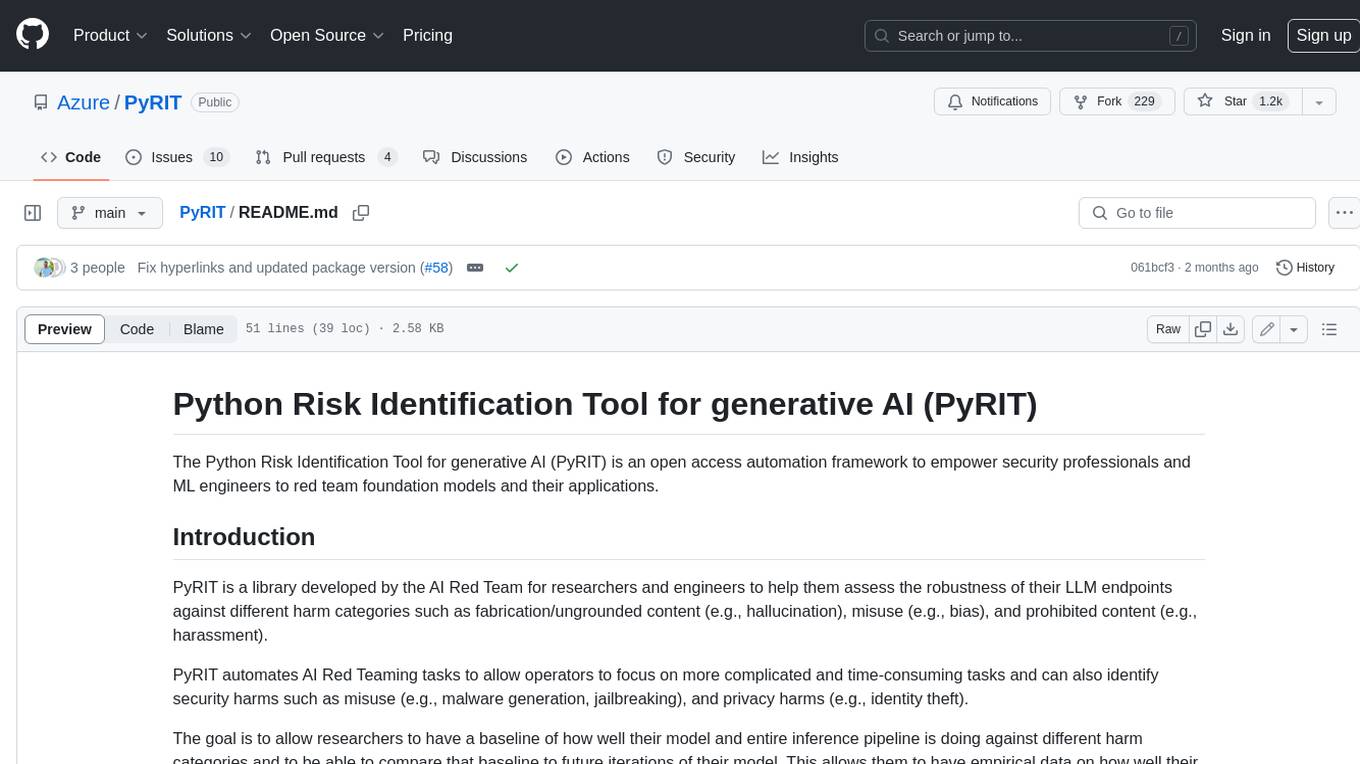
PyRIT is an open access automation framework designed to empower security professionals and ML engineers to red team foundation models and their applications. It automates AI Red Teaming tasks to allow operators to focus on more complicated and time-consuming tasks and can also identify security harms such as misuse (e.g., malware generation, jailbreaking), and privacy harms (e.g., identity theft). The goal is to allow researchers to have a baseline of how well their model and entire inference pipeline is doing against different harm categories and to be able to compare that baseline to future iterations of their model. This allows them to have empirical data on how well their model is doing today, and detect any degradation of performance based on future improvements.
tabby
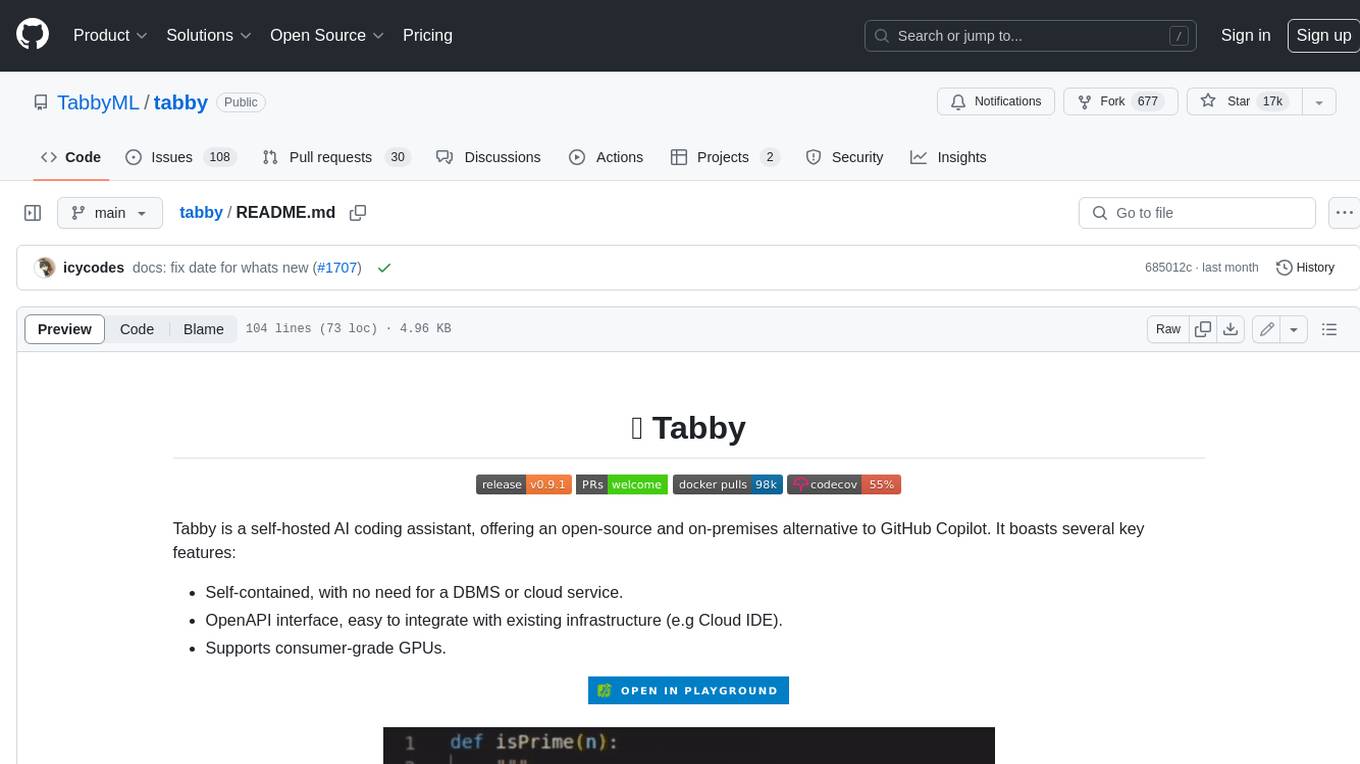
Tabby is a self-hosted AI coding assistant, offering an open-source and on-premises alternative to GitHub Copilot. It boasts several key features: * Self-contained, with no need for a DBMS or cloud service. * OpenAPI interface, easy to integrate with existing infrastructure (e.g Cloud IDE). * Supports consumer-grade GPUs.
spear
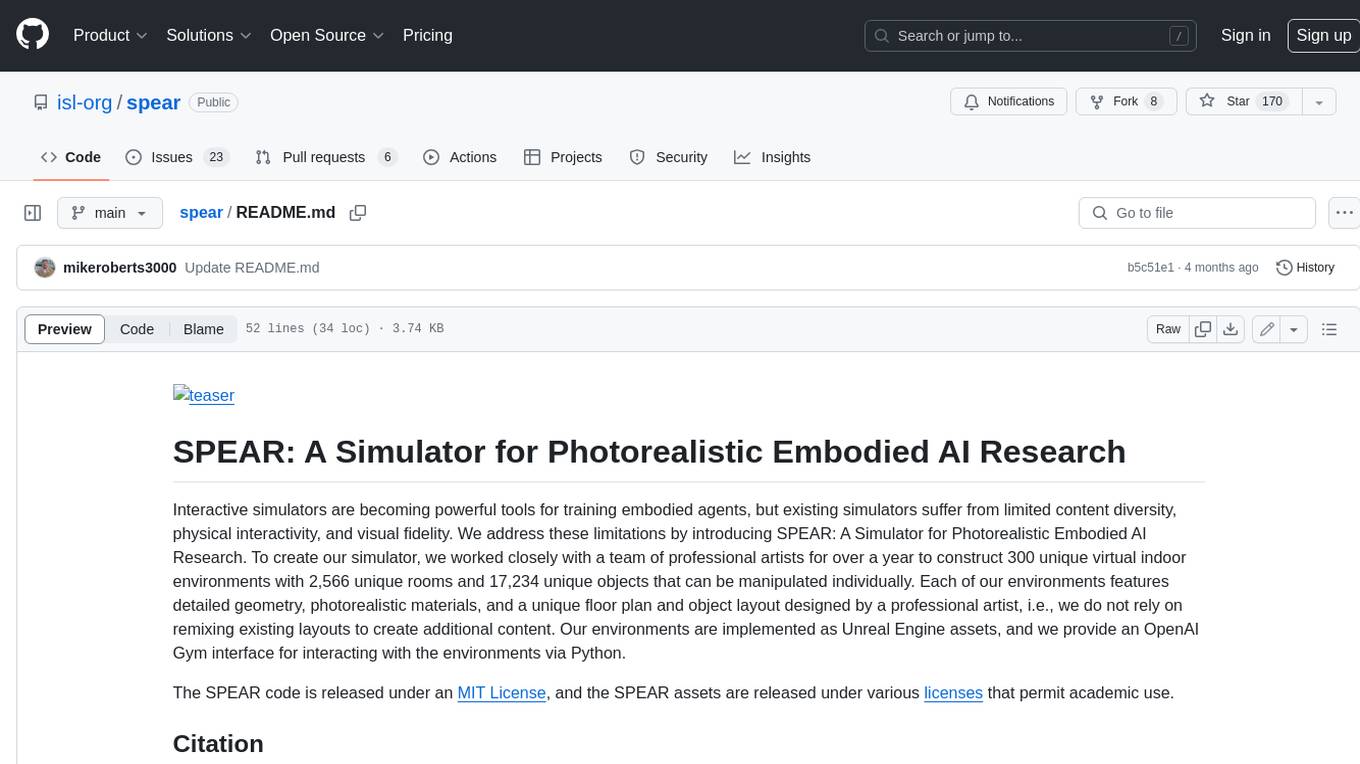
SPEAR (Simulator for Photorealistic Embodied AI Research) is a powerful tool for training embodied agents. It features 300 unique virtual indoor environments with 2,566 unique rooms and 17,234 unique objects that can be manipulated individually. Each environment is designed by a professional artist and features detailed geometry, photorealistic materials, and a unique floor plan and object layout. SPEAR is implemented as Unreal Engine assets and provides an OpenAI Gym interface for interacting with the environments via Python.
Magick
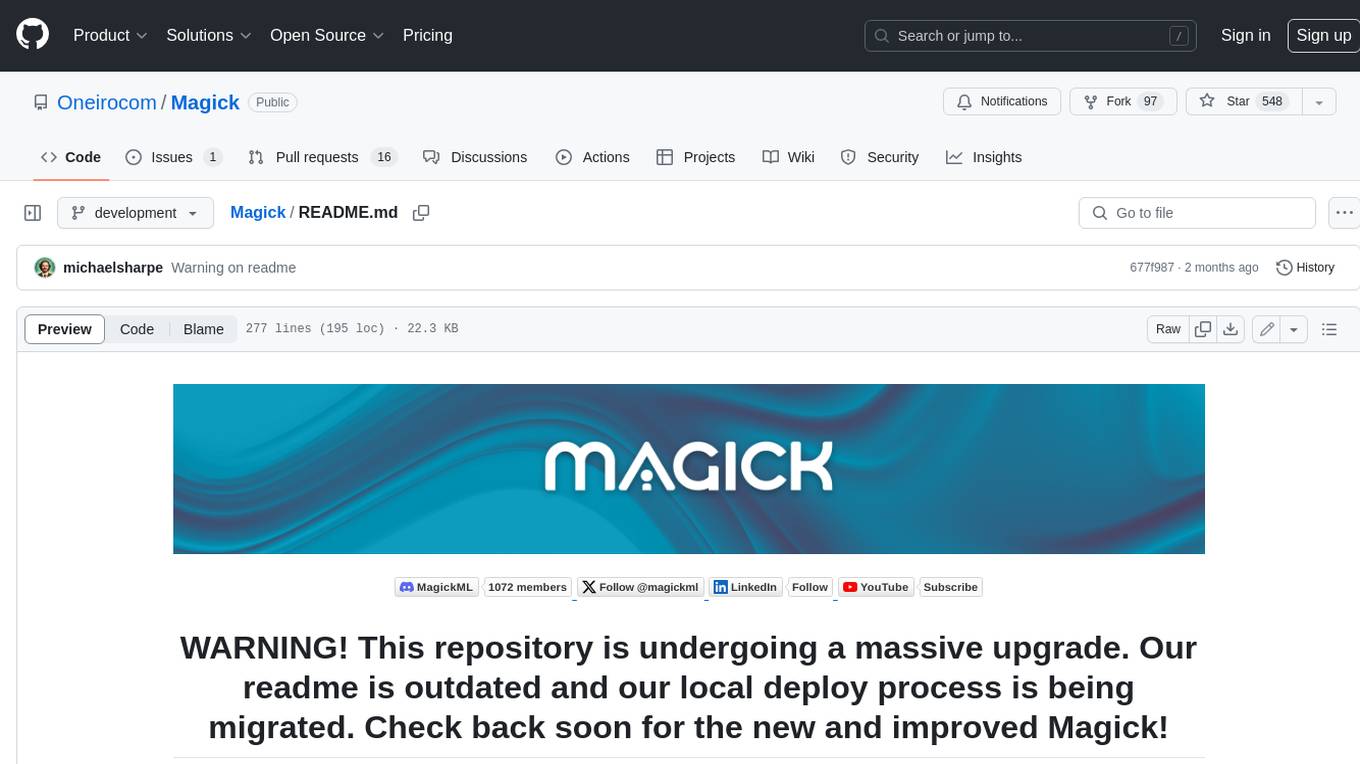
Magick is a groundbreaking visual AIDE (Artificial Intelligence Development Environment) for no-code data pipelines and multimodal agents. Magick can connect to other services and comes with nodes and templates well-suited for intelligent agents, chatbots, complex reasoning systems and realistic characters.