


ai4chem_course
EPFL CH-457 "AI for chemistry"
Stars: 241
The AI4Chemistry course is a hands-on course focusing on Artificial Intelligence (AI) for Chemistry. It covers topics such as Python programming, machine learning, cheminformatics toolkits, data science, deep learning for chemistry, and advanced AI topics. The course includes exercises using Google Colab and covers supervised and unsupervised machine learning, property prediction models, Bayesian optimization, and more. The course is created by the LIAC team and references open-source community examples. It aims to be accessible to learners with varying levels of experience in Python and ML.
README:
The Artificial Intelligence (AI) for Chemistry course will be taught in Spring 2023. It is a course with a lot of hands-on exercises. Experience in Python programming and machine learning (ML) will help you to get up to speed quickly, but we will try to make it as accessible as possible.
We will make use of Google Colab to run the code directly in your browser, as there is zero configuration required and we will have access to GPUs free of charge.
A lot of the examples and ideas in this course are taken from the open-source community, which we will properly reference.
This course is being created by the LIAC team. Many thanks to all the TAs:
And all the old TAs participating to the creation of the notebooks:
- Python Crash Course & essential libraries (matplotlib, numpy, pandas)
- Cheminformatics toolkits (rdkit)
- Introduction into data science
- Supervised machine learning (regression, classification)
- Unsupervised machine learning
- Data and standardisation
- Deep Learning for Chemistry
- Property prediction models
- Inverse Design [@sanchez2018inverse]
- Reaction prediction and retrosynthesis [@schwaller2022machine]
- Advanced topics in AI for Chemistry
- Bayesian optimisation for chemical reactions
| Week | Topic | Link to Colab |
|---|---|---|
| 1 | Python and Jupyter |  |
| Pandas | |
|
| Plotting data | |
|
| Intro to RDKit | |
|
| 2 | Supervised ML | |
| 3 | Introduction to Deep Learning | |
| Graph Neural Network | |
|
| GNN example - chemprop | |
|
| 4 | Dimensionality reduction | |
| Clustering | |
|
| Pd dimers discovery by kMeans | |
|
| 5 | De novo molecule generation (VAE) | |
| 6 | De novo molecule generation (SMILES-LSTM) | |
| 7 | Chemical reactions prediction: Template-free methods | |
| 8 | Retrosynthesis: Template-based methods | |
| 9 | Atom mapping | |
| Reaction fingerprints | |
|
| 10 | Bayesian Optimisation | |
| 11 | Model deployment: Git(hub) | |
| Model deployment: Streamlit | |
|
| 12 | Guest lecture: TBD | |
The solutions can be found in this GitHub repo. Don't forget to leave a star, if you find it useful.
The cheminformatics and ML for chemistry have a lively open source community. Here is a collection of inspirational blogs and webpages, from which we discuss examples:
- Andrew White's Deep Learning for Molecules & Materials book
- MolSSI Education Resources
- Greg Landrum's RDKit blog
- Esben Bjerrum's Cheminformania
- iwatobipens' blog
- Rocío Mercado's dl-chem-101
- Jan H. Jensen's Machine Learning Basics
- Pat Walter's Practical Cheminformatics With Open Source Software
- Kjell Jorner's blog
- Lewis Tunstall's Deep Learning for Particle Physicists
- Summer school on Statistical Physics & Machine learning organised by Florent Krzakala and Lenka Zdeborova, EPFL
- Practical Deep Learning
- MIT's Intro to Deep Learning
- Aurelien Geron's Hands-on Machine Learning
- Lewis Tunstall's Introduction to Data Science
- Natural Language Processing with Transformers by HuggingFace
Check them out and don't forget to leave a star on GitHub and follow the authors on Twitter, if you like the content. Those blogs and webpages have all helped me during the creation of this course (and also before, when I was learning about ML for Chemistry).
{{< tweet pschwllr 1629098793399472130 >}}
For Tasks:
Click tags to check more tools for each tasksFor Jobs:
Alternative AI tools for ai4chem_course
Similar Open Source Tools
ai4chem_course
The AI4Chemistry course is a hands-on course focusing on Artificial Intelligence (AI) for Chemistry. It covers topics such as Python programming, machine learning, cheminformatics toolkits, data science, deep learning for chemistry, and advanced AI topics. The course includes exercises using Google Colab and covers supervised and unsupervised machine learning, property prediction models, Bayesian optimization, and more. The course is created by the LIAC team and references open-source community examples. It aims to be accessible to learners with varying levels of experience in Python and ML.
generative-ai-with-javascript
The 'Generative AI with JavaScript' repository is a comprehensive resource hub for JavaScript developers interested in delving into the world of Generative AI. It provides code samples, tutorials, and resources from a video series, offering best practices and tips to enhance AI skills. The repository covers the basics of generative AI, guides on building AI applications using JavaScript, from local development to deployment on Azure, and scaling AI models. It is a living repository with continuous updates, making it a valuable resource for both beginners and experienced developers looking to explore AI with JavaScript.
AI-For-Beginners
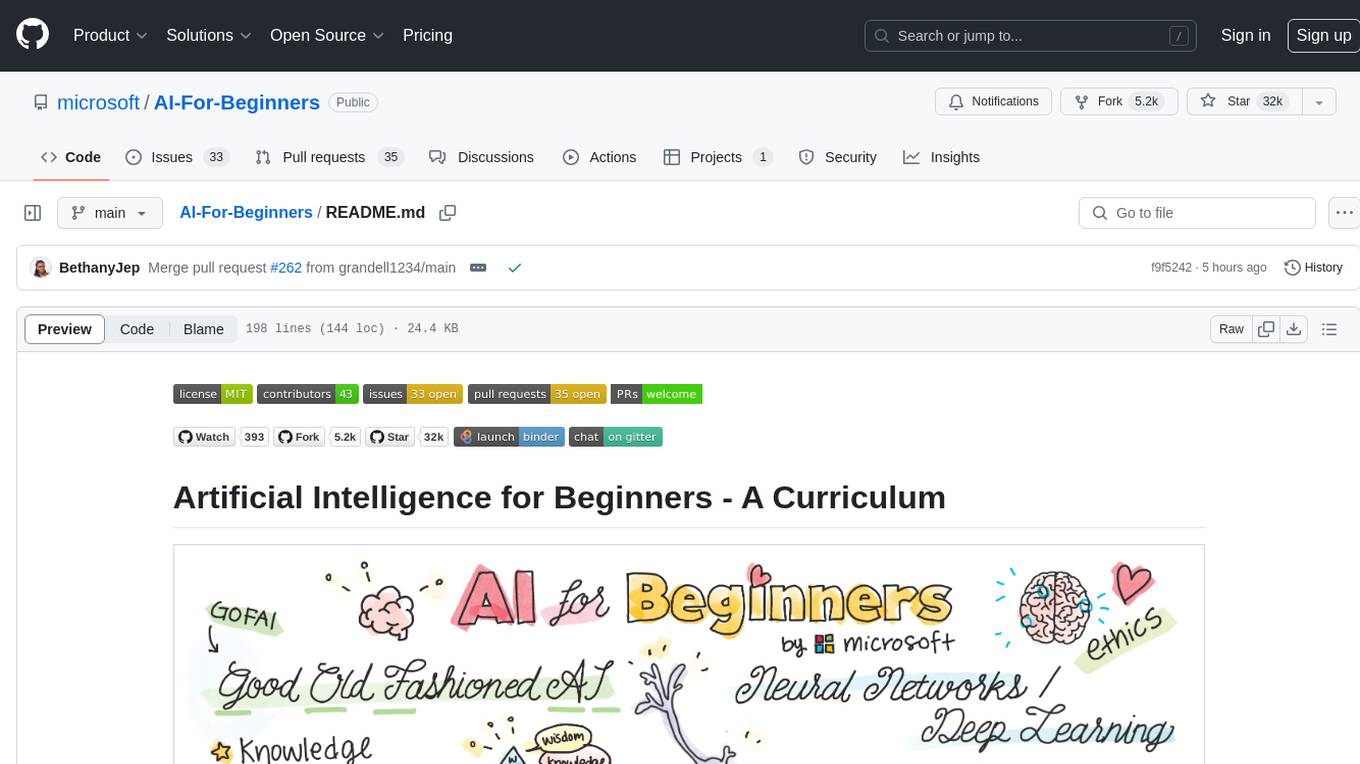
AI-For-Beginners is a comprehensive 12-week, 24-lesson curriculum designed by experts at Microsoft to introduce beginners to the world of Artificial Intelligence (AI). The curriculum covers various topics such as Symbolic AI, Neural Networks, Computer Vision, Natural Language Processing, Genetic Algorithms, and Multi-Agent Systems. It includes hands-on lessons, quizzes, and labs using popular frameworks like TensorFlow and PyTorch. The focus is on providing a foundational understanding of AI concepts and principles, making it an ideal starting point for individuals interested in AI.
ai-hands-on
A complete, hands-on guide to becoming an AI Engineer. This repository is designed to help you learn AI from first principles, build real neural networks, and understand modern LLM systems end-to-end. Progress through math, PyTorch, deep learning, transformers, RAG, and OCR with clean, intuitive Jupyter notebooks guiding you at every step. Suitable for beginners and engineers leveling up, providing clarity, structure, and intuition to build real AI systems.
intro_pharma_ai
This repository serves as an educational resource for pharmaceutical and chemistry students to learn the basics of Deep Learning through a collection of Jupyter Notebooks. The content covers various topics such as Introduction to Jupyter, Python, Cheminformatics & RDKit, Linear Regression, Data Science, Linear Algebra, Neural Networks, PyTorch, Convolutional Neural Networks, Transfer Learning, Recurrent Neural Networks, Autoencoders, Graph Neural Networks, and Summary. The notebooks aim to provide theoretical concepts to understand neural networks through code completion, but instructors are encouraged to supplement with their own lectures. The work is licensed under a Creative Commons Attribution-NonCommercial-ShareAlike 4.0 International License.
generative-ai-for-beginners
This course has 18 lessons. Each lesson covers its own topic so start wherever you like! Lessons are labeled either "Learn" lessons explaining a Generative AI concept or "Build" lessons that explain a concept and code examples in both **Python** and **TypeScript** when possible. Each lesson also includes a "Keep Learning" section with additional learning tools. **What You Need** * Access to the Azure OpenAI Service **OR** OpenAI API - _Only required to complete coding lessons_ * Basic knowledge of Python or Typescript is helpful - *For absolute beginners check out these Python and TypeScript courses. * A Github account to fork this entire repo to your own GitHub account We have created a **Course Setup** lesson to help you with setting up your development environment. Don't forget to star (🌟) this repo to find it easier later. ## 🧠 Ready to Deploy? If you are looking for more advanced code samples, check out our collection of Generative AI Code Samples in both **Python** and **TypeScript**. ## 🗣️ Meet Other Learners, Get Support Join our official AI Discord server to meet and network with other learners taking this course and get support. ## 🚀 Building a Startup? Sign up for Microsoft for Startups Founders Hub to receive **free OpenAI credits** and up to **$150k towards Azure credits to access OpenAI models through Azure OpenAI Services**. ## 🙏 Want to help? Do you have suggestions or found spelling or code errors? Raise an issue or Create a pull request ## 📂 Each lesson includes: * A short video introduction to the topic * A written lesson located in the README * Python and TypeScript code samples supporting Azure OpenAI and OpenAI API * Links to extra resources to continue your learning ## 🗃️ Lessons | | Lesson Link | Description | Additional Learning | | :-: | :------------------------------------------------------------------------------------------------------------------------------------------: | :---------------------------------------------------------------------------------------------: | ------------------------------------------------------------------------------ | | 00 | Course Setup | **Learn:** How to Setup Your Development Environment | Learn More | | 01 | Introduction to Generative AI and LLMs | **Learn:** Understanding what Generative AI is and how Large Language Models (LLMs) work. | Learn More | | 02 | Exploring and comparing different LLMs | **Learn:** How to select the right model for your use case | Learn More | | 03 | Using Generative AI Responsibly | **Learn:** How to build Generative AI Applications responsibly | Learn More | | 04 | Understanding Prompt Engineering Fundamentals | **Learn:** Hands-on Prompt Engineering Best Practices | Learn More | | 05 | Creating Advanced Prompts | **Learn:** How to apply prompt engineering techniques that improve the outcome of your prompts. | Learn More | | 06 | Building Text Generation Applications | **Build:** A text generation app using Azure OpenAI | Learn More | | 07 | Building Chat Applications | **Build:** Techniques for efficiently building and integrating chat applications. | Learn More | | 08 | Building Search Apps Vector Databases | **Build:** A search application that uses Embeddings to search for data. | Learn More | | 09 | Building Image Generation Applications | **Build:** A image generation application | Learn More | | 10 | Building Low Code AI Applications | **Build:** A Generative AI application using Low Code tools | Learn More | | 11 | Integrating External Applications with Function Calling | **Build:** What is function calling and its use cases for applications | Learn More | | 12 | Designing UX for AI Applications | **Learn:** How to apply UX design principles when developing Generative AI Applications | Learn More | | 13 | Securing Your Generative AI Applications | **Learn:** The threats and risks to AI systems and methods to secure these systems. | Learn More | | 14 | The Generative AI Application Lifecycle | **Learn:** The tools and metrics to manage the LLM Lifecycle and LLMOps | Learn More | | 15 | Retrieval Augmented Generation (RAG) and Vector Databases | **Build:** An application using a RAG Framework to retrieve embeddings from a Vector Databases | Learn More | | 16 | Open Source Models and Hugging Face | **Build:** An application using open source models available on Hugging Face | Learn More | | 17 | AI Agents | **Build:** An application using an AI Agent Framework | Learn More | | 18 | Fine-Tuning LLMs | **Learn:** The what, why and how of fine-tuning LLMs | Learn More |
together-cookbook
The Together Cookbook is a collection of code and guides designed to help developers build with open source models using Together AI. The recipes provide examples on how to chain multiple LLM calls, create agents that route tasks to specialized models, run multiple LLMs in parallel, break down tasks into parallel subtasks, build agents that iteratively improve responses, perform LoRA fine-tuning and inference, fine-tune LLMs for repetition, improve summarization capabilities, fine-tune LLMs on multi-step conversations, implement retrieval-augmented generation, conduct multimodal search and conditional image generation, visualize vector embeddings, improve search results with rerankers, implement vector search with embedding models, extract structured text from images, summarize and evaluate outputs with LLMs, generate podcasts from PDF content, and get LLMs to generate knowledge graphs.
haystack-tutorials
Haystack is an open-source framework for building production-ready LLM applications, retrieval-augmented generative pipelines, and state-of-the-art search systems that work intelligently over large document collections. It lets you quickly try out the latest models in natural language processing (NLP) while being flexible and easy to use.
llm4ad
LLM4AD is an open-source Python-based platform leveraging Large Language Models (LLMs) for Automatic Algorithm Design (AD). It provides unified interfaces for methods, tasks, and LLMs, along with features like evaluation acceleration, secure evaluation, logs, GUI support, and more. The platform was originally developed for optimization tasks but is versatile enough to be used in other areas such as machine learning, science discovery, game theory, and engineering design. It offers various search methods and algorithm design tasks across different domains. LLM4AD supports remote LLM API, local HuggingFace LLM deployment, and custom LLM interfaces. The project is licensed under the MIT License and welcomes contributions, collaborations, and issue reports.
txtai
Txtai is an all-in-one embeddings database for semantic search, LLM orchestration, and language model workflows. It combines vector indexes, graph networks, and relational databases to enable vector search with SQL, topic modeling, retrieval augmented generation, and more. Txtai can stand alone or serve as a knowledge source for large language models (LLMs). Key features include vector search with SQL, object storage, topic modeling, graph analysis, multimodal indexing, embedding creation for various data types, pipelines powered by language models, workflows to connect pipelines, and support for Python, JavaScript, Java, Rust, and Go. Txtai is open-source under the Apache 2.0 license.
MiniCPM-V-CookBook
MiniCPM-V & o Cookbook is a comprehensive repository for building multimodal AI applications effortlessly. It provides easy-to-use documentation, supports a wide range of users, and offers versatile deployment scenarios. The repository includes live demonstrations, inference recipes for vision and audio capabilities, fine-tuning recipes, serving recipes, quantization recipes, and a framework support matrix. Users can customize models, deploy them efficiently, and compress models to improve efficiency. The repository also showcases awesome works using MiniCPM-V & o and encourages community contributions.
camel
CAMEL is an open-source library designed for the study of autonomous and communicative agents. We believe that studying these agents on a large scale offers valuable insights into their behaviors, capabilities, and potential risks. To facilitate research in this field, we implement and support various types of agents, tasks, prompts, models, and simulated environments.
LLM-PowerHouse-A-Curated-Guide-for-Large-Language-Models-with-Custom-Training-and-Inferencing
LLM-PowerHouse is a comprehensive and curated guide designed to empower developers, researchers, and enthusiasts to harness the true capabilities of Large Language Models (LLMs) and build intelligent applications that push the boundaries of natural language understanding. This GitHub repository provides in-depth articles, codebase mastery, LLM PlayLab, and resources for cost analysis and network visualization. It covers various aspects of LLMs, including NLP, models, training, evaluation metrics, open LLMs, and more. The repository also includes a collection of code examples and tutorials to help users build and deploy LLM-based applications.
mage-ai
Mage is an open-source data pipeline tool for transforming and integrating data. It offers an easy developer experience, engineering best practices built-in, and data as a first-class citizen. Mage makes it easy to build, preview, and launch data pipelines, and provides observability and scaling capabilities. It supports data integrations, streaming pipelines, and dbt integration.
beeai-framework
BeeAI Framework is a versatile tool for building production-ready multi-agent systems. It offers flexibility in orchestrating agents, seamless integration with various models and tools, and production-grade controls for scaling. The framework supports Python and TypeScript libraries, enabling users to implement simple to complex multi-agent patterns, connect with AI services, and optimize token usage and resource management.
LLaVA-MORE
LLaVA-MORE is a new family of Multimodal Language Models (MLLMs) that integrates recent language models with diverse visual backbones. The repository provides a unified training protocol for fair comparisons across all architectures and releases training code and scripts for distributed training. It aims to enhance Multimodal LLM performance and offers various models for different tasks. Users can explore different visual backbones like SigLIP and methods for managing image resolutions (S2) to improve the connection between images and language. The repository is a starting point for expanding the study of Multimodal LLMs and enhancing new features in the field.
For similar tasks
marqo
Marqo is more than a vector database, it's an end-to-end vector search engine for both text and images. Vector generation, storage and retrieval are handled out of the box through a single API. No need to bring your own embeddings.
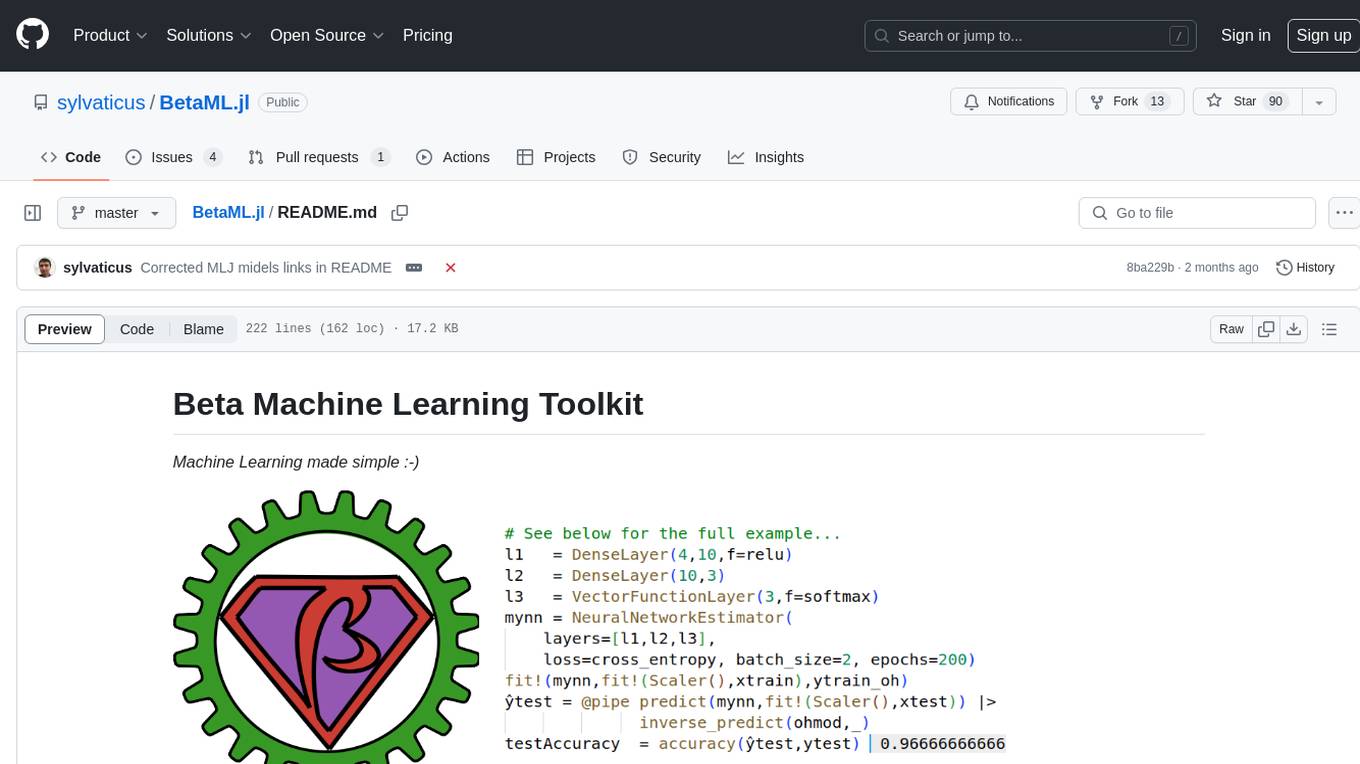
BetaML.jl
The Beta Machine Learning Toolkit is a package containing various algorithms and utilities for implementing machine learning workflows in multiple languages, including Julia, Python, and R. It offers a range of supervised and unsupervised models, data transformers, and assessment tools. The models are implemented entirely in Julia and are not wrappers for third-party models. Users can easily contribute new models or request implementations. The focus is on user-friendliness rather than computational efficiency, making it suitable for educational and research purposes.
smile
Smile (Statistical Machine Intelligence and Learning Engine) is a comprehensive machine learning, NLP, linear algebra, graph, interpolation, and visualization system in Java and Scala. It covers every aspect of machine learning, including classification, regression, clustering, association rule mining, feature selection, manifold learning, multidimensional scaling, genetic algorithms, missing value imputation, efficient nearest neighbor search, etc. Smile implements major machine learning algorithms and provides interactive shells for Java, Scala, and Kotlin. It supports model serialization, data visualization using SmilePlot and declarative approach, and offers a gallery showcasing various algorithms and visualizations.
aibydoing-feedback
AI By Doing is a hands-on artificial intelligence tutorial series that aims to help beginners understand the principles of machine learning and deep learning while providing practical applications. The content covers various supervised and unsupervised learning algorithms, machine learning engineering, deep learning fundamentals, frameworks like TensorFlow and PyTorch, and applications in computer vision and natural language processing. The tutorials are written in Jupyter Notebook format, combining theory, mathematical derivations, and Python code implementations to facilitate learning and understanding.
generative-ai-workbook
Generative AI Workbook is a central repository for generative AI-related work, including projects, personal projects, and tools. It also features a blog section with bite-sized posts on various generative AI concepts. The repository covers use cases of Large Language Models (LLMs) such as search, classification, clustering, data/text/code generation, summarization, rewriting, extractions, proofreading, and querying data.
WordLlama
WordLlama is a fast, lightweight NLP toolkit optimized for CPU hardware. It recycles components from large language models to create efficient word representations. It offers features like Matryoshka Representations, low resource requirements, binarization, and numpy-only inference. The tool is suitable for tasks like semantic matching, fuzzy deduplication, ranking, and clustering, making it a good option for NLP-lite tasks and exploratory analysis.
private-search
EXO Private Search is a privacy-preserving search system based on MIT's Tiptoe paper. It allows users to search through data while maintaining query privacy, ensuring that the server never learns what is being searched for. The system converts documents into embeddings, clusters them for efficient searching, and uses SimplePIR for private information retrieval. It employs sentence transformers for embedding generation, K-means clustering for search optimization, and ensures that all sensitive computations happen client-side. The system provides significant performance improvements by reducing the number of PIR operations needed, enabling efficient searching in large document collections, and maintaining privacy while delivering fast results.
ai4chem_course
The AI4Chemistry course is a hands-on course focusing on Artificial Intelligence (AI) for Chemistry. It covers topics such as Python programming, machine learning, cheminformatics toolkits, data science, deep learning for chemistry, and advanced AI topics. The course includes exercises using Google Colab and covers supervised and unsupervised machine learning, property prediction models, Bayesian optimization, and more. The course is created by the LIAC team and references open-source community examples. It aims to be accessible to learners with varying levels of experience in Python and ML.
For similar jobs
ai4chem_course
The AI4Chemistry course is a hands-on course focusing on Artificial Intelligence (AI) for Chemistry. It covers topics such as Python programming, machine learning, cheminformatics toolkits, data science, deep learning for chemistry, and advanced AI topics. The course includes exercises using Google Colab and covers supervised and unsupervised machine learning, property prediction models, Bayesian optimization, and more. The course is created by the LIAC team and references open-source community examples. It aims to be accessible to learners with varying levels of experience in Python and ML.
weave
Weave is a toolkit for developing Generative AI applications, built by Weights & Biases. With Weave, you can log and debug language model inputs, outputs, and traces; build rigorous, apples-to-apples evaluations for language model use cases; and organize all the information generated across the LLM workflow, from experimentation to evaluations to production. Weave aims to bring rigor, best-practices, and composability to the inherently experimental process of developing Generative AI software, without introducing cognitive overhead.
agentcloud
AgentCloud is an open-source platform that enables companies to build and deploy private LLM chat apps, empowering teams to securely interact with their data. It comprises three main components: Agent Backend, Webapp, and Vector Proxy. To run this project locally, clone the repository, install Docker, and start the services. The project is licensed under the GNU Affero General Public License, version 3 only. Contributions and feedback are welcome from the community.
oss-fuzz-gen
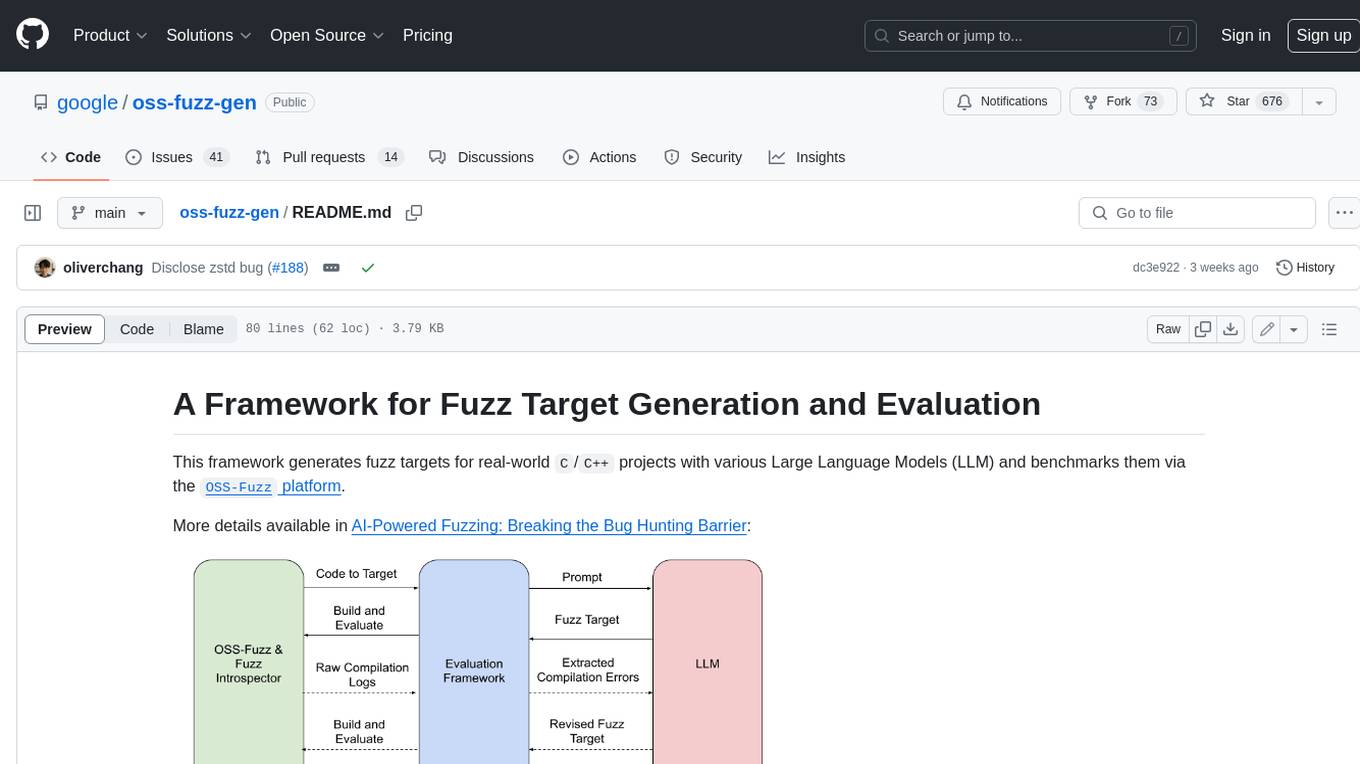
This framework generates fuzz targets for real-world `C`/`C++` projects with various Large Language Models (LLM) and benchmarks them via the `OSS-Fuzz` platform. It manages to successfully leverage LLMs to generate valid fuzz targets (which generate non-zero coverage increase) for 160 C/C++ projects. The maximum line coverage increase is 29% from the existing human-written targets.
LLMStack
LLMStack is a no-code platform for building generative AI agents, workflows, and chatbots. It allows users to connect their own data, internal tools, and GPT-powered models without any coding experience. LLMStack can be deployed to the cloud or on-premise and can be accessed via HTTP API or triggered from Slack or Discord.
VisionCraft
The VisionCraft API is a free API for using over 100 different AI models. From images to sound.
kaito
Kaito is an operator that automates the AI/ML inference model deployment in a Kubernetes cluster. It manages large model files using container images, avoids tuning deployment parameters to fit GPU hardware by providing preset configurations, auto-provisions GPU nodes based on model requirements, and hosts large model images in the public Microsoft Container Registry (MCR) if the license allows. Using Kaito, the workflow of onboarding large AI inference models in Kubernetes is largely simplified.
PyRIT
PyRIT is an open access automation framework designed to empower security professionals and ML engineers to red team foundation models and their applications. It automates AI Red Teaming tasks to allow operators to focus on more complicated and time-consuming tasks and can also identify security harms such as misuse (e.g., malware generation, jailbreaking), and privacy harms (e.g., identity theft). The goal is to allow researchers to have a baseline of how well their model and entire inference pipeline is doing against different harm categories and to be able to compare that baseline to future iterations of their model. This allows them to have empirical data on how well their model is doing today, and detect any degradation of performance based on future improvements.