


laravel-ai-translator
Automatic translate your language files into many languages using AI like Claude, GPT and etc.
Stars: 160
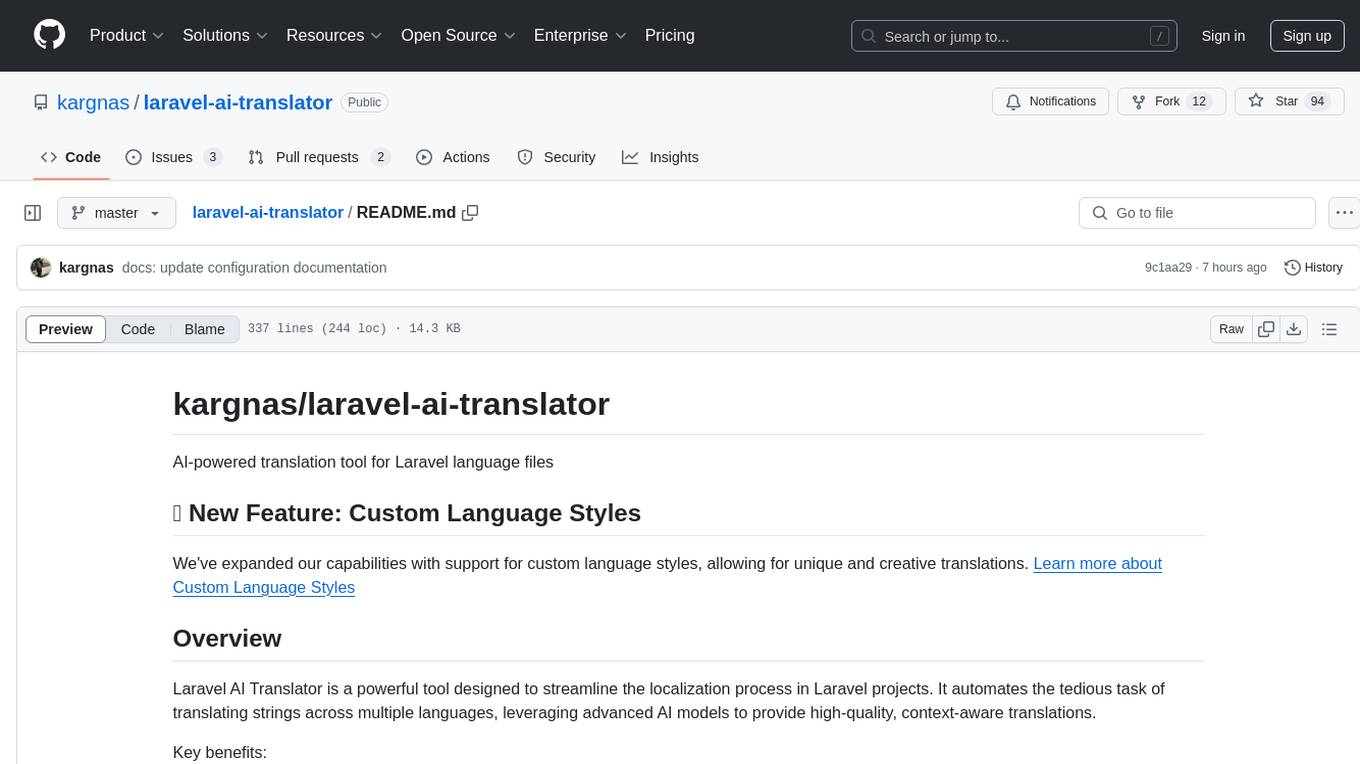
Laravel AI Translator is a powerful tool designed to streamline the localization process in Laravel projects. It automates the task of translating strings across multiple languages using advanced AI models like GPT-4 and Claude. The tool supports custom language styles, preserves variables and nested structures, and ensures consistent tone and style across translations. It integrates seamlessly with Laravel projects, making internationalization easier and more efficient. Users can customize translation rules, handle large language files efficiently, and validate translations for accuracy. The tool offers contextual understanding, linguistic precision, variable handling, smart length adaptation, and tone consistency for intelligent translations.
README:
AI-powered translation tool for Laravel language files
-
AI Enhancement: Added support for Claude 3.7's Extended Thinking capabilities
- Extended context window up to 200K tokens, output tokens up to 64K tokens
- Enhanced reasoning for complex translations
- Improved context understanding with extended thinking mode
-
Visual Logging Improvements: Completely redesigned logging system
- 🎨 Beautiful color-coded console output
- 📊 Real-time progress indicators
- 🔍 Detailed token usage tracking with visual stats
- 💫 Animated status indicators for long-running processes
- Performance Improvements: Enhanced translation processing efficiency and reduced API calls
- Better Error Handling: Improved error handling and recovery mechanisms
-
Code Refactoring: Major code restructuring for better maintainability
- Separated services into dedicated classes
- Improved token usage tracking and reporting
- Enhanced console output formatting
-
Testing Improvements: Added comprehensive test suite using Pest
- XML parsing validation tests
- Line break handling in CDATA
- XML comment tag support
- Multiple translation items processing
- XML Processing: Enhanced XML and AI response parsing system for more reliable translations
Laravel AI Translator is a powerful tool designed to streamline the localization process in Laravel projects. It automates the tedious task of translating strings across multiple languages, leveraging advanced AI models to provide high-quality, context-aware translations.
Key benefits:
- Time-saving: Translate all your language files with one simple command
- AI-powered: Utilizes state-of-the-art language models (GPT-4, GPT-4o, GPT-3.5, Claude) for superior translation quality
- Smart context understanding: Accurately captures nuances, technical terms, and Laravel-specific expressions
- Seamless integration: Works within your existing Laravel project structure, preserving complex language file structures
Whether you're working on a personal project or a large-scale application, Laravel AI Translator simplifies the internationalization process, allowing you to focus on building great features instead of wrestling with translations.
- Automatically detects all language folders in your
langdirectory - Translates PHP language files from a source language (default: English) to all other languages
- Supports multiple AI providers for intelligent, context-aware translations
- Preserves variables, HTML tags, pluralization codes, and nested structures
- Maintains consistent tone and style across translations
- Supports custom translation rules for enhanced quality and project-specific requirements
- Efficiently processes large language files, saving time and effort
- Respects Laravel's localization system, ensuring compatibility with your existing setup
- Chunking functionality for cost-effective translations: Processes multiple strings in a single AI request, significantly reducing API costs and improving efficiency
- String validation to ensure translation accuracy: Automatically checks and validates AI translations to catch and correct any errors or mistranslations
Also, this tool is designed to translate your language files intelligently:
- Contextual Understanding: Analyzes keys to determine if they represent buttons, descriptions, or other UI elements.
- Linguistic Precision: Preserves word forms, tenses, and punctuation in translations.
- Variable Handling: Respects and maintains your language file variables during translation.
- Smart Length Adaptation: Adjusts translation length to fit UI constraints where possible.
- Tone Consistency: Maintains a consistent tone across translations, customizable via configuration.
Do you want to know how this works? See the prompt in src/AI.
In addition to standard language translations, this package now supports custom language styles, allowing for unique and creative localizations.
The package includes several built-in language styles:
-
ko_kp: North Korean style Korean - Various regional dialects and language variants
These are automatically available and don't require additional configuration.
As an demonstration of custom styling capabilities, we've implemented a "Reddit style" English:
This style mimics the casual, often humorous language found on Reddit, featuring:
- Liberal use of sarcasm
- Internet slang and meme references
- Playful skepticism
Example configuration:
'locale_names' => [
    'en_reddit' => 'English (Reddit)',
],
'additional_rules' => [
    'en_reddit' => [
        "- Incorporate sarcasm and exaggeration",
        "- Use popular internet slang and meme references",
        "- Add humorous calls for sources on obvious statements",
    ],
],You can create your own custom language styles by adding new entries to the locale_names and additional_rules in the configuration. This allows you to tailor translations to specific audiences or platforms.
These custom styles offer creative ways to customize your translations, adding a unique flair to your localized content. Use responsibly to enhance user engagement while maintaining clarity and appropriateness for your audience.
- PHP 8.0 or higher
- Laravel 8.0 or higher
-
Install the package via composer:
composer require kargnas/laravel-ai-translator
-
Add the OpenAI API key to your
.envfile:OPENAI_API_KEY=your-openai-api-key-hereYou can obtain an API key from the OpenAI website.
(If you want to use Anthropic's Claude instead, see step 4 below for configuration instructions.)
-
(Optional) Publish the configuration file:
php artisan vendor:publish --provider="Kargnas\LaravelAiTranslator\ServiceProvider"This step is optional but recommended if you want to customize the package's behavior. It will create a
config/ai-translator.phpfile where you can modify various settings. -
(Optional) If you want to use Anthropic's Claude instead of OpenAI's GPT, update the
config/ai-translator.phpfile:'ai' => [ 'provider' => 'anthropic', 'model' => 'claude-3-7-sonnet-20250219', 'api_key' => env('ANTHROPIC_API_KEY'), ],
Then, add the Anthropic API key to your
.envfile:ANTHROPIC_API_KEY=your-anthropic-api-key-hereYou can obtain an Anthropic API key from the Anthropic website. For best results, we recommend using the Claude-3-5-Sonnet model for your translations rather than OpenAI GPT. This model provides more accurate and natural translations.
-
You're now ready to use the Laravel AI Translator!
To translate your language files, run the following command:
php artisan ai-translator:translateThis command will:
- Recognize all language folders in your
langdirectory - Use AI to translate the contents of the string files in the source language, English. (You can change the source language in the config file)
Given an English language file:
<?php

return [
    'notifications' => [
        'new_feature_search_sentence' => 'New feature: Now you can type sentences not only words. Even in your languages. The AI will translate them to Chinese.',
        'refresh_after_1_min' => 'Refresh after 1 minutes. New content will be available! (The previous model: :model, Updated: :updated_at)',
    ]
];
The package will generate translations like these:
- Korean (ko-kr):
<?php
return array (
  'notifications.new_feature_search_sentence' => '새로운 기능: 이제 단어뿐만 아니라 문장도 입력할 수 있어요. 심지어 여러분의 언어로도 가능해요.',
  'notifications.refresh_after_1_min' => '1분 후에 새로고침하세요. 새로운 내용이 준비될 거예요! (이전 모델: :model, 업데이트: :updated_at)',
);
- Chinese (zh-cn):
<?php
return array (
  'notifications.new_feature_search_sentence' => '新功能:现在你不仅可以输入单词,还可以输入句子。甚至可以用你的语言。',
  'notifications.refresh_after_1_min' => '1分钟后刷新。新内容即将到来!(之前的模型::model,更新时间::updated_at)',
);
- Thai (th-th):
<?php
return array (
  'notifications.new_feature_search_sentence' => 'ฟีเจอร์ใหม่: ตอนนี้คุณพิมพ์ประโยคได้แล้ว ไม่ใช่แค่คำเดียว แม้แต่ภาษาของคุณเอง',
  'notifications.refresh_after_1_min' => 'รีเฟรชหลังจาก 1 นาที จะมีเนื้อหาใหม่ให้ดู! (โมเดลก่อนหน้า: :model, อัปเดตเมื่อ: :updated_at)',
);
- 🤣 Korean (North Korea):
<?php
return array (
  'notifications.new_feature_search_sentence' => '혁명적 새로운 기능: 동무들! 이제 단어뿐만 아니라 문장도 입력하여 단어의 력사를 확인할 수 있습니다. 모국어로도 괜찮습니다. 인공지능이 중국어로 번역해드리겠습니다.',
  'notifications.refresh_after_1_min' => '1분후에 새로고침하십시요. 새로운 내용을 볼수 있습니다! (이전 모델: :model, 갱신: :updated_at)',
);
- 🤣 English (Reddit):
<?php
return array (
  'notifications.new_feature_search_sentence' => 'Whoa, hold onto your keyboards, nerds! We\'ve leveled up our search game. Now you can type entire sentences, not just measly words. Mind. Blown. And get this - it even works in your weird non-English languages! Our AI overlord will graciously translate your gibberish into Chinese. You\'re welcome.',
  'notifications.refresh_after_1_min' => 'Yo, hit that F5 in 60 seconds, fam. Fresh content incoming! (Previous model was :model, last updated when dinosaurs roamed the Earth at :updated_at)',
);
If you want to customize the settings, you can publish the configuration file:
php artisan vendor:publish --provider="Kargnas\LaravelAiTranslator\ServiceProvider"This will create a config/ai-translator.php file where you can modify the following settings:
-
source_directory: If you use a different directory for language files instead of the defaultlangdirectory, you can specify it here. -
ai: Configure the AI provider and model:'ai' => [ 'provider' => 'anthropic', 'model' => 'claude-3-5-sonnet-latest', 'api_key' => env('ANTHROPIC_API_KEY'), ],
This package supports Anthropic's Claude and OpenAI's GPT models for translations. Here are the tested and verified models:
Provider Model Extended Thinking Context Window Max Tokens anthropicclaude-3-7-sonnet-latest✅ 200K 8K/64K* anthropicclaude-3-5-sonnet-latest❌ 200K 8K anthropicclaude-3-haiku-20240307❌ 200K 8K openaigpt-4o❌ 128K 4K openaigpt-4o-mini❌ 128K 4K * 8K tokens for normal mode, 64K tokens when extended thinking is enabled
For available models:
- Anthropic: See Anthropic Models Documentation
- OpenAI: See OpenAI Models Documentation
⭐️ Strong Recommendation: We highly recommend using Anthropic's Claude models, particularly
claude-3-5-sonnet-latest. Here's why:- More accurate and natural translations
- Better understanding of context and nuances
- More consistent output quality
- More cost-effective for the quality provided
While OpenAI integration is available, we strongly advise against using it for translations. Our extensive testing has shown that Claude models consistently produce superior results for localization tasks.
-
Get your API key:
- Anthropic: Console API Keys
- OpenAI: API Keys
-
Add to your
.envfile:# For Anthropic ANTHROPIC_API_KEY=your-api-key # For OpenAI OPENAI_API_KEY=your-api-key
-
Configure in
config/ai-translator.php:'ai' => [ 'provider' => 'anthropic', // or 'openai' 'model' => 'claude-3-5-sonnet-latest', // see model list above 'api_key' => env('ANTHROPIC_API_KEY'), // or env('OPENAI_API_KEY') ],
-
locale_names: This mapping of locale codes to language names enhances translation quality by providing context to the AI. -
additional_rules: Add custom rules to the translation prompt. This is useful for customizing the style of the messages or creating entirely new language styles. -
disable_plural: Disable pluralization. Use ":count apples" instead of ":count apple|:count apples"
Example configuration:
<?php
return [
'source_directory' => 'lang',
'ai' => [
    'provider' => 'anthropic',
    'model' => 'claude-3-5-sonnet-latest',
    'api_key' => env('ANTHROPIC_API_KEY'),
],
'locale_names' => [
'en' => 'English',
'ko' => 'Korean',
'zh_cn' => 'Chinese (Simplified)',
// ... other locales
],
'disable_plural' => false,
'additional_rules' => [
'default' => [
"Use a friendly and intuitive tone of voice, like the service tone of voice of 'Discord'.",
],
'ko' => [
"한국의 인터넷 서비스 '토스'의 서비스 말투 처럼, 유저에게 친근하고 직관적인 말투로 설명하고 존댓말로 설명하세요.",
],
],
];Make sure to set your chosen AI provider's API key in your .env file.
Currently, this package only supports PHP language files used by Laravel. JSON language files are not supported, and there are no plans to add support for them in the future.
We recommend using PHP files for managing translations, especially when dealing with multiple languages. Here's why:
-
Structure: PHP files allow for a more organized structure with nested arrays, making it easier to group related translations.
-
Comments: You can add comments in PHP files to provide context or instructions for translators.
-
Performance: PHP files are slightly faster to load compared to JSON files, as they don't require parsing.
-
Flexibility: PHP files allow for more complex operations, such as using variables or conditions in your translations.
-
Scalability: When managing a large number of translations across multiple languages, the directory structure of PHP files makes it easier to navigate and maintain.
If you're currently using JSON files for your translations, we recommend migrating to PHP files for better compatibility with this package and improved manageability of your translations.
Note: We recommend Anthropic's Claude models for superior translation quality.
We're constantly working to improve Laravel AI Translator. Here are some features and improvements we're planning:
- [ ] Implement strict validation for translations:
- Verify that variables are correctly preserved in translated strings
- Ensure placeholders and Laravel-specific syntax are maintained
- Check for consistency in pluralization rules across translations
- [ ] Write test code to ensure reliability and catch potential issues
- [ ] Implement functionality to maintain the array structure of strings during translation
- [ ] Expand support for other LLMs (such as Gemini)
- [ ] Add context from previous translations:
- Use previously translated strings as reference for consistency
- [ ] Replace regex-based XML parser with proper XML parsing:
- Better handle edge cases and malformed XML
If you'd like to contribute to any of these tasks, please feel free to submit a pull request!
Contributions are welcome! Please feel free to submit a Pull Request.
The MIT License (MIT). Please see License File for more information.
- Created by Sangrak Choi
- Inspired by Mandarin Study
For Tasks:
Click tags to check more tools for each tasksFor Jobs:
Alternative AI tools for laravel-ai-translator
Similar Open Source Tools
laravel-ai-translator
Laravel AI Translator is a powerful tool designed to streamline the localization process in Laravel projects. It automates the task of translating strings across multiple languages using advanced AI models like GPT-4 and Claude. The tool supports custom language styles, preserves variables and nested structures, and ensures consistent tone and style across translations. It integrates seamlessly with Laravel projects, making internationalization easier and more efficient. Users can customize translation rules, handle large language files efficiently, and validate translations for accuracy. The tool offers contextual understanding, linguistic precision, variable handling, smart length adaptation, and tone consistency for intelligent translations.
code2prompt
Code2Prompt is a powerful command-line tool that generates comprehensive prompts from codebases, designed to streamline interactions between developers and Large Language Models (LLMs) for code analysis, documentation, and improvement tasks. It bridges the gap between codebases and LLMs by converting projects into AI-friendly prompts, enabling users to leverage AI for various software development tasks. The tool offers features like holistic codebase representation, intelligent source tree generation, customizable prompt templates, smart token management, Gitignore integration, flexible file handling, clipboard-ready output, multiple output options, and enhanced code readability.
bedrock-claude-chat
This repository is a sample chatbot using the Anthropic company's LLM Claude, one of the foundational models provided by Amazon Bedrock for generative AI. It allows users to have basic conversations with the chatbot, personalize it with their own instructions and external knowledge, and analyze usage for each user/bot on the administrator dashboard. The chatbot supports various languages, including English, Japanese, Korean, Chinese, French, German, and Spanish. Deployment is straightforward and can be done via the command line or by using AWS CDK. The architecture is built on AWS managed services, eliminating the need for infrastructure management and ensuring scalability, reliability, and security.
basic-memory
Basic Memory is a tool that enables users to build persistent knowledge through natural conversations with Large Language Models (LLMs) like Claude. It uses the Model Context Protocol (MCP) to allow compatible LLMs to read and write to a local knowledge base stored in simple Markdown files on the user's computer. The tool facilitates creating structured notes during conversations, maintaining a semantic knowledge graph, and keeping all data local and under user control. Basic Memory aims to address the limitations of ephemeral LLM interactions by providing a structured, bi-directional, and locally stored knowledge management solution.
playword
PlayWord is a tool designed to supercharge web test automation experience with AI. It provides core features such as enabling browser operations and validations using natural language inputs, as well as monitoring interface to record and dry-run test steps. PlayWord supports multiple AI services including Anthropic, Google, and OpenAI, allowing users to select the appropriate provider based on their requirements. The tool also offers features like assertion handling, frame handling, custom variables, test recordings, and an Observer module to track user interactions on web pages. With PlayWord, users can interact with web pages using natural language commands, reducing the need to worry about element locators and providing AI-powered adaptation to UI changes.
iloom-cli
iloom is a tool designed to streamline AI-assisted development by focusing on maintaining alignment between human developers and AI agents. It treats context as a first-class concern, persisting AI reasoning in issue comments rather than temporary chats. The tool allows users to collaborate with AI agents in an isolated environment, switch between complex features without losing context, document AI decisions publicly, and capture key insights and lessons learned from AI sessions. iloom is not just a tool for managing git worktrees, but a control plane for maintaining alignment between users and their AI assistants.
languagemodels
Language Models is a Python package that provides building blocks to explore large language models with as little as 512MB of RAM. It simplifies the usage of large language models from Python, ensuring all inference is performed locally to keep data private. The package includes features such as text completions, chat capabilities, code completions, external text retrieval, semantic search, and more. It outperforms Hugging Face transformers for CPU inference and offers sensible default models with varying parameters based on memory constraints. The package is suitable for learners and educators exploring the intersection of large language models with modern software development.
Trace
Trace is a new AutoDiff-like tool for training AI systems end-to-end with general feedback. It generalizes the back-propagation algorithm by capturing and propagating an AI system's execution trace. Implemented as a PyTorch-like Python library, users can write Python code directly and use Trace primitives to optimize certain parts, similar to training neural networks.
bigcodebench
BigCodeBench is an easy-to-use benchmark for code generation with practical and challenging programming tasks. It aims to evaluate the true programming capabilities of large language models (LLMs) in a more realistic setting. The benchmark is designed for HumanEval-like function-level code generation tasks, but with much more complex instructions and diverse function calls. BigCodeBench focuses on the evaluation of LLM4Code with diverse function calls and complex instructions, providing precise evaluation & ranking and pre-generated samples to accelerate code intelligence research. It inherits the design of the EvalPlus framework but differs in terms of execution environment and test evaluation.
marqo
Marqo is more than a vector database, it's an end-to-end vector search engine for both text and images. Vector generation, storage and retrieval are handled out of the box through a single API. No need to bring your own embeddings.
allms
allms is a versatile and powerful library designed to streamline the process of querying Large Language Models (LLMs). Developed by Allegro engineers, it simplifies working with LLM applications by providing a user-friendly interface, asynchronous querying, automatic retrying mechanism, error handling, and output parsing. It supports various LLM families hosted on different platforms like OpenAI, Google, Azure, and GCP. The library offers features for configuring endpoint credentials, batch querying with symbolic variables, and forcing structured output format. It also provides documentation, quickstart guides, and instructions for local development, testing, updating documentation, and making new releases.
LLMBox
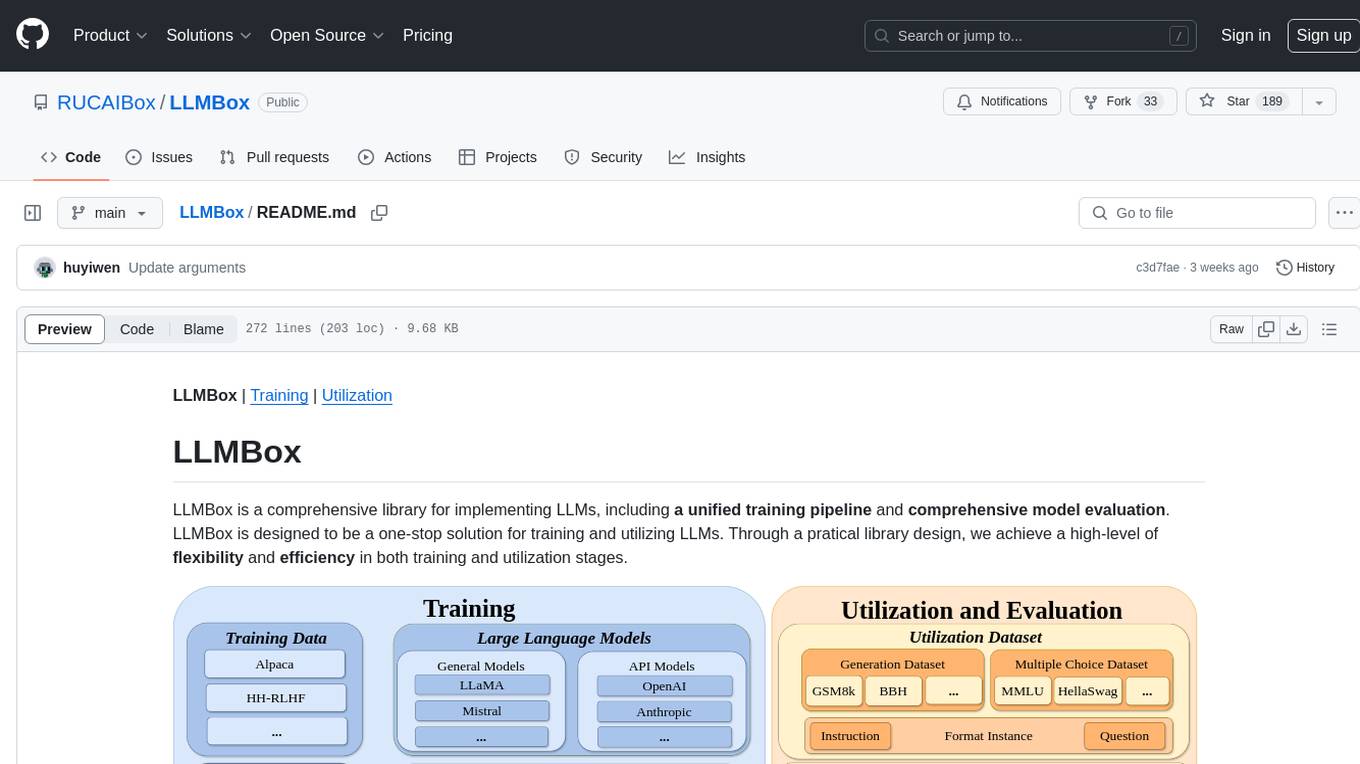
LLMBox is a comprehensive library designed for implementing Large Language Models (LLMs) with a focus on a unified training pipeline and comprehensive model evaluation. It serves as a one-stop solution for training and utilizing LLMs, offering flexibility and efficiency in both training and utilization stages. The library supports diverse training strategies, comprehensive datasets, tokenizer vocabulary merging, data construction strategies, parameter efficient fine-tuning, and efficient training methods. For utilization, LLMBox provides comprehensive evaluation on various datasets, in-context learning strategies, chain-of-thought evaluation, evaluation methods, prefix caching for faster inference, support for specific LLM models like vLLM and Flash Attention, and quantization options. The tool is suitable for researchers and developers working with LLMs for natural language processing tasks.
rag-chatbot
The RAG ChatBot project combines Lama.cpp, Chroma, and Streamlit to build a Conversation-aware Chatbot and a Retrieval-augmented generation (RAG) ChatBot. The RAG Chatbot works by taking a collection of Markdown files as input and provides answers based on the context provided by those files. It utilizes a Memory Builder component to load Markdown pages, divide them into sections, calculate embeddings, and save them in an embedding database. The chatbot retrieves relevant sections from the database, rewrites questions for optimal retrieval, and generates answers using a local language model. It also remembers previous interactions for more accurate responses. Various strategies are implemented to deal with context overflows, including creating and refining context, hierarchical summarization, and async hierarchical summarization.
lionagi
LionAGI is a robust framework for orchestrating multi-step AI operations with precise control. It allows users to bring together multiple models, advanced reasoning, tool integrations, and custom validations in a single coherent pipeline. The framework is structured, expandable, controlled, and transparent, offering features like real-time logging, message introspection, and tool usage tracking. LionAGI supports advanced multi-step reasoning with ReAct, integrates with Anthropic's Model Context Protocol, and provides observability and debugging tools. Users can seamlessly orchestrate multiple models, integrate with Claude Code CLI SDK, and leverage a fan-out fan-in pattern for orchestration. The framework also offers optional dependencies for additional functionalities like reader tools, local inference support, rich output formatting, database support, and graph visualization.
web-llm
WebLLM is a modular and customizable javascript package that directly brings language model chats directly onto web browsers with hardware acceleration. Everything runs inside the browser with no server support and is accelerated with WebGPU. WebLLM is fully compatible with OpenAI API. That is, you can use the same OpenAI API on any open source models locally, with functionalities including json-mode, function-calling, streaming, etc. We can bring a lot of fun opportunities to build AI assistants for everyone and enable privacy while enjoying GPU acceleration.
EasyInstruct
EasyInstruct is a Python package proposed as an easy-to-use instruction processing framework for Large Language Models (LLMs) like GPT-4, LLaMA, ChatGLM in your research experiments. EasyInstruct modularizes instruction generation, selection, and prompting, while also considering their combination and interaction.
For similar tasks
laravel-ai-translator
Laravel AI Translator is a powerful tool designed to streamline the localization process in Laravel projects. It automates the task of translating strings across multiple languages using advanced AI models like GPT-4 and Claude. The tool supports custom language styles, preserves variables and nested structures, and ensures consistent tone and style across translations. It integrates seamlessly with Laravel projects, making internationalization easier and more efficient. Users can customize translation rules, handle large language files efficiently, and validate translations for accuracy. The tool offers contextual understanding, linguistic precision, variable handling, smart length adaptation, and tone consistency for intelligent translations.
lingo.dev
Replexica AI automates software localization end-to-end, producing authentic translations instantly across 60+ languages. Teams can do localization 100x faster with state-of-the-art quality, reaching more paying customers worldwide. The tool offers a GitHub Action for CI/CD automation and supports various formats like JSON, YAML, CSV, and Markdown. With lightning-fast AI localization, auto-updates, native quality translations, developer-friendly CLI, and scalability for startups and enterprise teams, Replexica is a top choice for efficient and effective software localization.
For similar jobs
sweep
Sweep is an AI junior developer that turns bugs and feature requests into code changes. It automatically handles developer experience improvements like adding type hints and improving test coverage.
teams-ai
The Teams AI Library is a software development kit (SDK) that helps developers create bots that can interact with Teams and Microsoft 365 applications. It is built on top of the Bot Framework SDK and simplifies the process of developing bots that interact with Teams' artificial intelligence capabilities. The SDK is available for JavaScript/TypeScript, .NET, and Python.
ai-guide
This guide is dedicated to Large Language Models (LLMs) that you can run on your home computer. It assumes your PC is a lower-end, non-gaming setup.
classifai
Supercharge WordPress Content Workflows and Engagement with Artificial Intelligence. Tap into leading cloud-based services like OpenAI, Microsoft Azure AI, Google Gemini and IBM Watson to augment your WordPress-powered websites. Publish content faster while improving SEO performance and increasing audience engagement. ClassifAI integrates Artificial Intelligence and Machine Learning technologies to lighten your workload and eliminate tedious tasks, giving you more time to create original content that matters.
chatbot-ui
Chatbot UI is an open-source AI chat app that allows users to create and deploy their own AI chatbots. It is easy to use and can be customized to fit any need. Chatbot UI is perfect for businesses, developers, and anyone who wants to create a chatbot.
BricksLLM
BricksLLM is a cloud native AI gateway written in Go. Currently, it provides native support for OpenAI, Anthropic, Azure OpenAI and vLLM. BricksLLM aims to provide enterprise level infrastructure that can power any LLM production use cases. Here are some use cases for BricksLLM: * Set LLM usage limits for users on different pricing tiers * Track LLM usage on a per user and per organization basis * Block or redact requests containing PIIs * Improve LLM reliability with failovers, retries and caching * Distribute API keys with rate limits and cost limits for internal development/production use cases * Distribute API keys with rate limits and cost limits for students
uAgents
uAgents is a Python library developed by Fetch.ai that allows for the creation of autonomous AI agents. These agents can perform various tasks on a schedule or take action on various events. uAgents are easy to create and manage, and they are connected to a fast-growing network of other uAgents. They are also secure, with cryptographically secured messages and wallets.
griptape
Griptape is a modular Python framework for building AI-powered applications that securely connect to your enterprise data and APIs. It offers developers the ability to maintain control and flexibility at every step. Griptape's core components include Structures (Agents, Pipelines, and Workflows), Tasks, Tools, Memory (Conversation Memory, Task Memory, and Meta Memory), Drivers (Prompt and Embedding Drivers, Vector Store Drivers, Image Generation Drivers, Image Query Drivers, SQL Drivers, Web Scraper Drivers, and Conversation Memory Drivers), Engines (Query Engines, Extraction Engines, Summary Engines, Image Generation Engines, and Image Query Engines), and additional components (Rulesets, Loaders, Artifacts, Chunkers, and Tokenizers). Griptape enables developers to create AI-powered applications with ease and efficiency.