


perplexity-ai
Unofficial API Wrapper for Perplexity.ai + Account Generator with Web Interface
Stars: 339
Perplexity is a module that utilizes emailnator to generate new accounts, providing users with 5 pro queries per account creation. It enables the creation of new Gmail accounts with emailnator, ensuring unlimited pro queries. The tool requires specific Python libraries for installation and offers both a web interface and an API for different usage scenarios. Users can interact with the tool to perform various tasks such as account creation, query searches, and utilizing different modes for research purposes. Perplexity also supports asynchronous operations and provides guidance on obtaining cookies for account usage and account generation from emailnator.
README:
This module uses emailnator to generate new accounts. As you know, when you create a new account, you will have 5 pro queries. This module will generate you new gmails with emailnator and you will have unlimited pro queries.
Click to expand
- curl_cffi
- websocket-client
- patchright & playwright (if you are going to use web interface)
Install requirements with:
pip install -r requirements.txtor with single-line command:
pip install curl_cffi websocket-clientand patchright if you are going to use web interface
pip install patchright playwright && patchright install chromiumIf you're just a normal user who wants to use Perplexity Pro/Reasoning unlimited and not interested in using Perplexity API in python codes, then you can use Web Interface feature. It will simply create accounts in background for you and when you run out of copilots, the new account will automatically open in new tab. Patchright uses chrome user data directory to be completely undetected, it's mostly C:\Users\YourName\AppData\Local\Google\Chrome\User Data for Windows, as shown below,
import os
from perplexity.driver import Driver

cli = Driver()

cli.run(rf'C:\Users\{os.getlogin()}\AppData\Local\Google\Chrome\User Data')
https://github.com/user-attachments/assets/6862a53c-d574-4229-a203-0a47bba4af60
You can use your own chrome instance for Web Interface too. To do this, you need to add --remote-debugging-port=**** argument to chrome execution command as explained here. Ok, let's hammer it home for Windows 11. Type "Chrome" to your Windows search bar, right click to Chrome, click "Open file location". You will see the shortcut of Chrome, right click it, click "Properties" and add --remote-debugging-port=9222 to end of "target" section. It is "C:\Program Files\Google\Chrome\Application\chrome.exe" --remote-debugging-port=9222 in my end. After setting port, you can use "port" argument of Driver.run(),
import os
from perplexity.driver import Driver

cli = Driver()

cli.run(rf'C:\Users\{os.getlogin()}\AppData\Local\Google\Chrome\User Data', port=9222)
[!CAUTION] Using existing Chrome Instance isn't completely undetected. It may enter dead loop in Cloudflare verify page. The only way to bypass it is creating a new instance (so not using "port").
Below is an example code for simple usage, without using your own account or generating new accounts.
import perplexity

perplexity_cli = perplexity.Client()

# mode = ['auto', 'pro', 'deep research', 'r1', 'o3-mini']
# sources = ['web', 'scholar', 'social']
# files = a dictionary which has keys as filenames and values as file data
# stream = returns a generator when enabled and just final response when disabled
# language = ISO 639 code of language you want to use
# follow_up = last query info for follow-up queries, you can directly pass response from a query, look at second example below
# incognito = Enables incognito mode, for people who are using their own account
resp = perplexity_cli.search('Your query here', mode='auto', sources=['web'], files={}, stream=False, language='en-US', follow_up=None, incognito=False)
print(resp)

# second example to show how to use follow-up queries and stream response
for i in perplexity_cli.search('Your query here', stream=True, follow_up=resp):
    print(i)
And this is how you use your own account, you need to get your cookies in order to use your own account. Look at How To Get The Cookies,
import perplexity

perplexity_cookies = {
    <your cookies here>
}

perplexity_cli = perplexity.Client(perplexity_cookies)

resp = perplexity_cli.search('Your query here', mode='r1', sources=['web'], files={'myfile.txt': open('file.txt').read()}, stream=False, language='en-US', follow_up=None, incognito=False)
print(resp)
And finally account generating, you need to get cookies for emailnator to use this feature. Look at How To Get The Cookies,
import perplexity

emailnator_cookies = {
    <your cookies here>
}

perplexity_cli = perplexity.Client()
perplexity_cli.create_account(emailnator_cookies) # Creates a new gmail, so your 5 pro queries will be renewed.

resp = perplexity_cli.search('Your query here', mode='r1', sources=['web'], files={'myfile.txt': open('file.txt').read()}, stream=False, language='en-US', follow_up=None, incognito=False)
print(resp)import perplexity
labs_cli = perplexity.LabsClient()
# model = ['r1-1776', 'sonar-pro', 'sonar', 'sonar-reasoning-pro', 'sonar-reasoning']
# stream = returns a generator when enabled and just final response when disabled
print(labs_cli.ask('Your query here', model='r1-1776', stream=False))
for i in labs_cli.ask('Your query here', model='sonar-reasoning-pro', stream=True):
print(i)Below is an example code for simple usage, without using your own account or generating new accounts.
import asyncio
import perplexity_async

async def test():
    perplexity_cli = await perplexity_async.Client()

    # mode = ['auto', 'pro', 'deep research', 'r1', 'o3-mini']
    # sources = ['web', 'scholar', 'social']
    # files = a dictionary which has keys as filenames and values as file data
    # stream = returns a generator when enabled and just final response when disabled
    # language = ISO 639 code of language you want to use
    # follow_up = last query info for follow-up queries, you can directly pass response from a query, look at second example below
    # incognito = Enables incognito mode, for people who are using their own account
    resp = await perplexity_cli.search('Your query here', mode='auto', sources=['web'], files={}, stream=False, language='en-US', follow_up=None, incognito=False)
    print(resp)

    # second example to show how to use follow-up queries and stream response
    async for i in await perplexity_cli.search('Your query here', stream=True, follow_up=resp):
        print(i)

asyncio.run(test())
And this is how you use your own account, you need to get your cookies in order to use your own account. Look at How To Get The Cookies,
import asyncio
import perplexity_async

perplexity_cookies = {
    <your cookies here>
}

async def test():
    perplexity_cli = await perplexity_async.Client(perplexity_cookies)

    resp = await perplexity_cli.search('Your query here', mode='r1', sources=['web'], files={'myfile.txt': open('file.txt').read()}, stream=False, language='en-US', follow_up=None, incognito=False)
    print(resp)

asyncio.run(test())
And finally account generating, you need to get cookies for emailnator to use this feature. Look at How To Get The Cookies,
import asyncio
import perplexity_async

emailnator_cookies = {
    <your cookies here>
}

async def test():
    perplexity_cli = await perplexity_async.Client()
    await perplexity_cli.create_account(emailnator_cookies) # Creates a new gmail, so your 5 pro queries will be renewed.

    resp = await perplexity_cli.search('Your query here', mode='r1', sources=['web'], files={'myfile.txt': open('file.txt').read()}, stream=False, language='en-US', follow_up=None, incognito=False)
    print(resp)

asyncio.run(test())import asyncio
import perplexity_async
async def test():
labs_cli = await perplexity_async.LabsClient()
# model = ['r1-1776', 'sonar-pro', 'sonar', 'sonar-reasoning-pro', 'sonar-reasoning']
# stream = returns a generator when enabled and just final response when disabled
print(await labs_cli.ask('Your query here', model='r1-1776', stream=False))
async for i in await labs_cli.ask('Your query here', model='sonar-reasoning-pro', stream=True):
print(i)
asyncio.run(test())- Open Perplexity.ai website and login to your account.
- Click F12 or
Ctrl + Shift + Ito open inspector. - Go to the "Network" tab in the inspector.
- Refresh the page, right click the first request, hover on "Copy" and click to "Copy as cURL (bash)".
- Now go to the curlconverter and paste your code here. The cookies dictionary will appear, copy and use it in your codes.

- Open Emailnator website and verify you're human.
- Click F12 or
Ctrl + Shift + Ito open inspector. - Go to the "Network" tab in the inspector.
- Refresh the page, right click the first request, hover on "Copy" and click to "Copy as cURL (bash)".
- Now go to the curlconverter and paste your code here. The cookies dictionary will appear, copy and use it in your codes.
- Cookies for Emailnator are temporary, you need to renew them continuously.

| Coin | Wallet |
|---|---|
| BTC | 3A7zbQezyE8MhHtza6R9jWcNvvmYhRjY9z |
| ETH (ERC-20) | 0xA72e6306C4A4fA2d7Dc508c37Ccf863FB9Ec285D |
| USDT (TRC-20) | TQ3zGJC3ExFgbTUVhCbv81f3hVe1QbZLYL |
| LTC | LLj8NdzXQxG2pKHqpCPhva7bnWufPXEYVm |
| BCH | 17ViMunYyJbqndCnYwmhmCjNgVLX7qZHkS |
For Tasks:
Click tags to check more tools for each tasksFor Jobs:
Alternative AI tools for perplexity-ai
Similar Open Source Tools
perplexity-ai
Perplexity is a module that utilizes emailnator to generate new accounts, providing users with 5 pro queries per account creation. It enables the creation of new Gmail accounts with emailnator, ensuring unlimited pro queries. The tool requires specific Python libraries for installation and offers both a web interface and an API for different usage scenarios. Users can interact with the tool to perform various tasks such as account creation, query searches, and utilizing different modes for research purposes. Perplexity also supports asynchronous operations and provides guidance on obtaining cookies for account usage and account generation from emailnator.
simpleAI
SimpleAI is a self-hosted alternative to the not-so-open AI API, focused on replicating main endpoints for LLM such as text completion, chat, edits, and embeddings. It allows quick experimentation with different models, creating benchmarks, and handling specific use cases without relying on external services. Users can integrate and declare models through gRPC, query endpoints using Swagger UI or API, and resolve common issues like CORS with FastAPI middleware. The project is open for contributions and welcomes PRs, issues, documentation, and more.
langserve
LangServe helps developers deploy `LangChain` runnables and chains as a REST API. This library is integrated with FastAPI and uses pydantic for data validation. In addition, it provides a client that can be used to call into runnables deployed on a server. A JavaScript client is available in LangChain.js.
suno-api
Suno AI API is an open-source project that allows developers to integrate the music generation capabilities of Suno.ai into their own applications. The API provides a simple and convenient way to generate music, lyrics, and other audio content using Suno.ai's powerful AI models. With Suno AI API, developers can easily add music generation functionality to their apps, websites, and other projects.
vinagent
Vinagent is a lightweight and flexible library designed for building smart agent assistants across various industries. It provides a simple yet powerful foundation for creating AI-powered customer service bots, data analysis assistants, or domain-specific automation agents. With its modular tool system, users can easily extend their agent's capabilities by integrating a wide range of tools that are self-contained, well-documented, and can be registered dynamically. Vinagent allows users to scale and adapt their agents to new tasks or environments effortlessly.
neocodeium
NeoCodeium is a free AI completion plugin powered by Codeium, designed for Neovim users. It aims to provide a smoother experience by eliminating flickering suggestions and allowing for repeatable completions using the `.` key. The plugin offers performance improvements through cache techniques, displays suggestion count labels, and supports Lua scripting. Users can customize keymaps, manage suggestions, and interact with the AI chat feature. NeoCodeium enhances code completion in Neovim, making it a valuable tool for developers seeking efficient coding assistance.
phidata
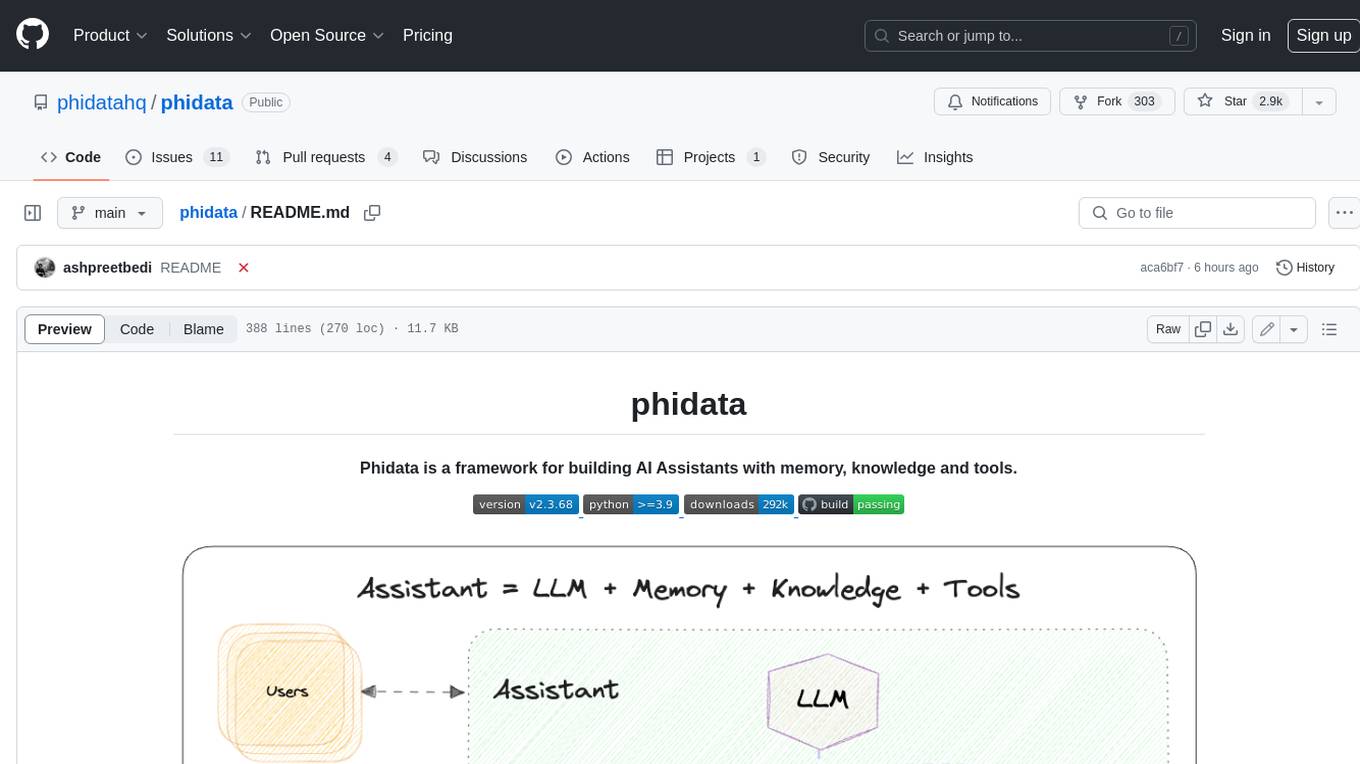
Phidata is a framework for building AI Assistants with memory, knowledge, and tools. It enables LLMs to have long-term conversations by storing chat history in a database, provides them with business context by storing information in a vector database, and enables them to take actions like pulling data from an API, sending emails, or querying a database. Memory and knowledge make LLMs smarter, while tools make them autonomous.
instructor
Instructor is a popular Python library for managing structured outputs from large language models (LLMs). It offers a user-friendly API for validation, retries, and streaming responses. With support for various LLM providers and multiple languages, Instructor simplifies working with LLM outputs. The library includes features like response models, retry management, validation, streaming support, and flexible backends. It also provides hooks for logging and monitoring LLM interactions, and supports integration with Anthropic, Cohere, Gemini, Litellm, and Google AI models. Instructor facilitates tasks such as extracting user data from natural language, creating fine-tuned models, managing uploaded files, and monitoring usage of OpenAI models.
awadb
AwaDB is an AI native database designed for embedding vectors. It simplifies database usage by eliminating the need for schema definition and manual indexing. The system ensures real-time search capabilities with millisecond-level latency. Built on 5 years of production experience with Vearch, AwaDB incorporates best practices from the community to offer stability and efficiency. Users can easily add and search for embedded sentences using the provided client libraries or RESTful API.
APIMyLlama
APIMyLlama is a server application that provides an interface to interact with the Ollama API, a powerful AI tool to run LLMs. It allows users to easily distribute API keys to create amazing things. The tool offers commands to generate, list, remove, add, change, activate, deactivate, and manage API keys, as well as functionalities to work with webhooks, set rate limits, and get detailed information about API keys. Users can install APIMyLlama packages with NPM, PIP, Jitpack Repo+Gradle or Maven, or from the Crates Repository. The tool supports Node.JS, Python, Java, and Rust for generating responses from the API. Additionally, it provides built-in health checking commands for monitoring API health status.
memobase
Memobase is a user profile-based memory system designed to enhance Generative AI applications by enabling them to remember, understand, and evolve with users. It provides structured user profiles, scalable profiling, easy integration with existing LLM stacks, batch processing for speed, and is production-ready. Users can manage users, insert data, get memory profiles, and track user preferences and behaviors. Memobase is ideal for applications that require user analysis, tracking, and personalized interactions.
swarmzero
SwarmZero SDK is a library that simplifies the creation and execution of AI Agents and Swarms of Agents. It supports various LLM Providers such as OpenAI, Azure OpenAI, Anthropic, MistralAI, Gemini, Nebius, and Ollama. Users can easily install the library using pip or poetry, set up the environment and configuration, create and run Agents, collaborate with Swarms, add tools for complex tasks, and utilize retriever tools for semantic information retrieval. Sample prompts are provided to help users explore the capabilities of the agents and swarms. The SDK also includes detailed examples and documentation for reference.
aiavatarkit
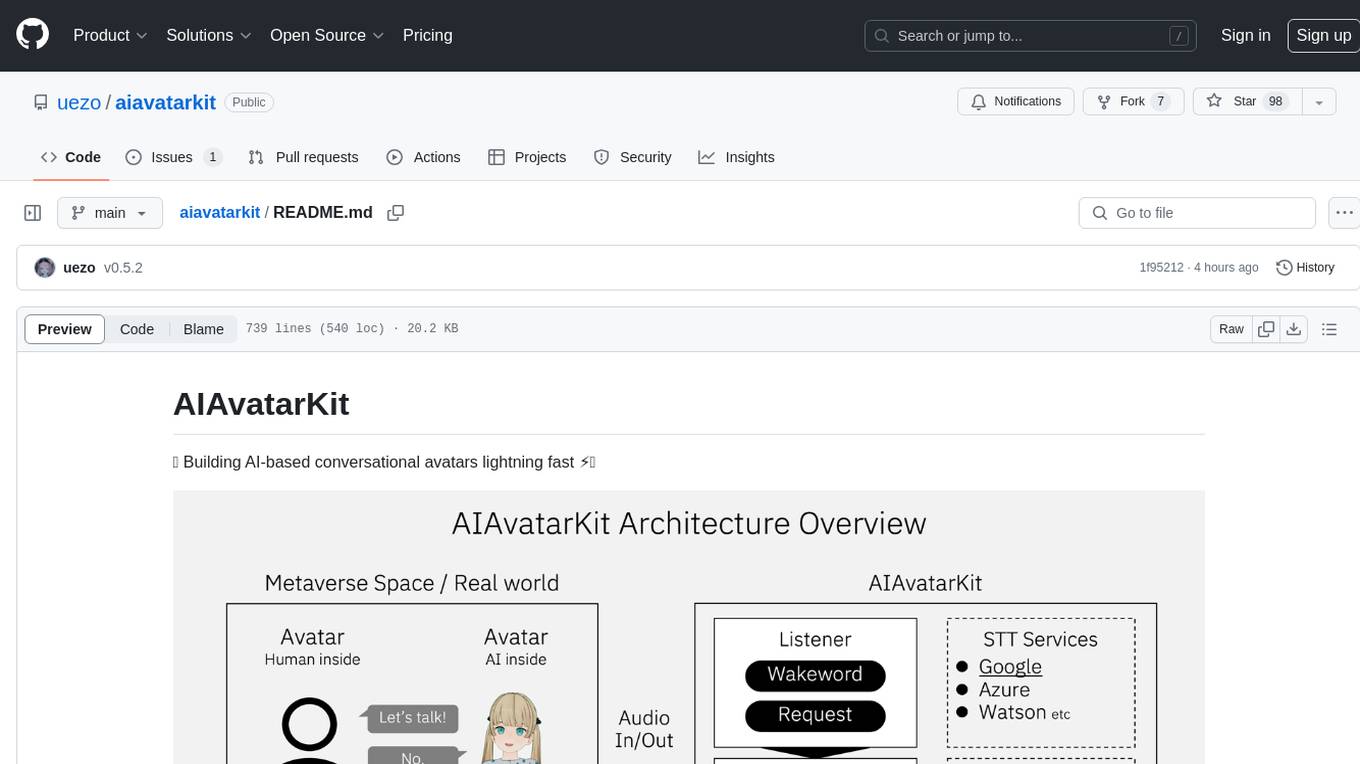
AIAvatarKit is a tool for building AI-based conversational avatars quickly. It supports various platforms like VRChat and cluster, along with real-world devices. The tool is extensible, allowing unlimited capabilities based on user needs. It requires VOICEVOX API, Google or Azure Speech Services API keys, and Python 3.10. Users can start conversations out of the box and enjoy seamless interactions with the avatars.

Gemini-API
Gemini-API is a reverse-engineered asynchronous Python wrapper for Google Gemini web app (formerly Bard). It provides features like persistent cookies, ImageFx support, extension support, classified outputs, official flavor, and asynchronous operation. The tool allows users to generate contents from text or images, have conversations across multiple turns, retrieve images in response, generate images with ImageFx, save images to local files, use Gemini extensions, check and switch reply candidates, and control log level.
openai
An open-source client package that allows developers to easily integrate the power of OpenAI's state-of-the-art AI models into their Dart/Flutter applications. The library provides simple and intuitive methods for making requests to OpenAI's various APIs, including the GPT-3 language model, DALL-E image generation, and more. It is designed to be lightweight and easy to use, enabling developers to focus on building their applications without worrying about the complexities of dealing with HTTP requests. Note that this is an unofficial library as OpenAI does not have an official Dart library.
parea-sdk-py
Parea AI provides a SDK to evaluate & monitor AI applications. It allows users to test, evaluate, and monitor their AI models by defining and running experiments. The SDK also enables logging and observability for AI applications, as well as deploying prompts to facilitate collaboration between engineers and subject-matter experts. Users can automatically log calls to OpenAI and Anthropic, create hierarchical traces of their applications, and deploy prompts for integration into their applications.
For similar tasks
starknet-agent-kit
starknet-agent-kit is a NestJS-based toolkit for creating AI agents that can interact with the Starknet blockchain. It allows users to perform various actions such as retrieving account information, creating accounts, transferring assets, playing with DeFi, interacting with dApps, and executing RPC read methods. The toolkit provides a secure environment for developing AI agents while emphasizing caution when handling sensitive information. Users can make requests to the Starknet agent via API endpoints and utilize tools from Langchain directly.
perplexity-ai
Perplexity is a module that utilizes emailnator to generate new accounts, providing users with 5 pro queries per account creation. It enables the creation of new Gmail accounts with emailnator, ensuring unlimited pro queries. The tool requires specific Python libraries for installation and offers both a web interface and an API for different usage scenarios. Users can interact with the tool to perform various tasks such as account creation, query searches, and utilizing different modes for research purposes. Perplexity also supports asynchronous operations and provides guidance on obtaining cookies for account usage and account generation from emailnator.
celery-aio-pool
Celery AsyncIO Pool is a free software tool licensed under GNU Affero General Public License v3+. It provides an AsyncIO worker pool for Celery, enabling users to leverage the power of AsyncIO in their Celery applications. The tool allows for easy installation using Poetry, pip, or directly from GitHub. Users can configure Celery to use the AsyncIO pool provided by celery-aio-pool, or they can wait for the upcoming support for out-of-tree worker pools in Celery 5.3. The tool is actively maintained and welcomes contributions from the community.
awesome-ml
Awesome ML is a curated list of resources and tools related to machine learning, covering a wide range of topics such as large language models, image models, video models, audio models, and marketing data science. It includes open LLM models, tools, GUIs, backends, voice assistants, code generation, libraries, fine tuning, data sets, research, image and video models, audio tasks like compression, speech recognition, and music generation, as well as resources for marketing data science. The repository aims to provide a comprehensive collection of resources for individuals interested in machine learning and its applications.
langchain-examples
This repository contains a collection of apps powered by LangChain, an open-source framework designed to aid the development of applications leveraging large language models (LLMs). It can be used for various tasks such as chatbots, text summarisation, data generation, code understanding, question answering, and evaluation. The repository showcases different applications built using LangChain and other tools like OpenAI, Chroma, Gemini, Helicone, Serper API, Pinecone, and Tavily Search API.
For similar jobs
ciso-assistant-community
CISO Assistant is a tool that helps organizations manage their cybersecurity posture and compliance. It provides a centralized platform for managing security controls, threats, and risks. CISO Assistant also includes a library of pre-built frameworks and tools to help organizations quickly and easily implement best practices.
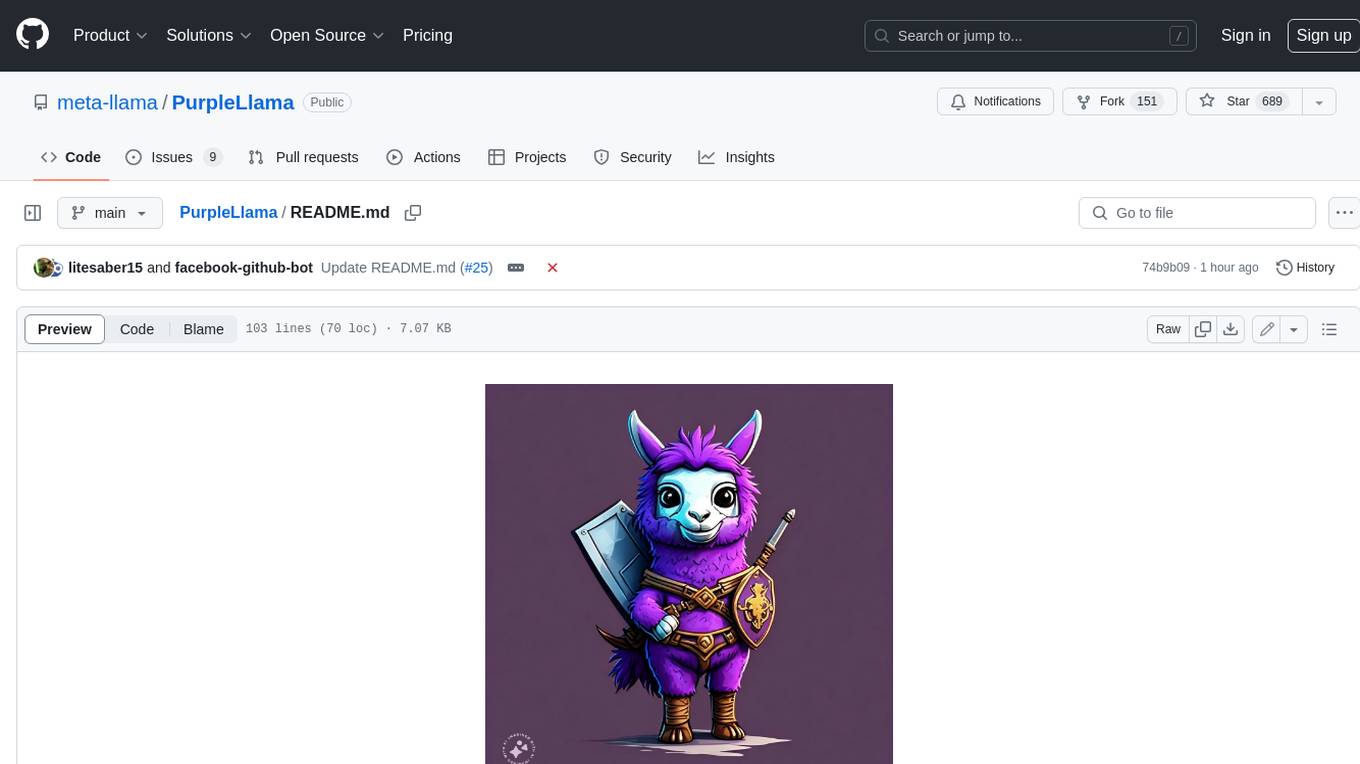
PurpleLlama
Purple Llama is an umbrella project that aims to provide tools and evaluations to support responsible development and usage of generative AI models. It encompasses components for cybersecurity and input/output safeguards, with plans to expand in the future. The project emphasizes a collaborative approach, borrowing the concept of purple teaming from cybersecurity, to address potential risks and challenges posed by generative AI. Components within Purple Llama are licensed permissively to foster community collaboration and standardize the development of trust and safety tools for generative AI.
vpnfast.github.io
VPNFast is a lightweight and fast VPN service provider that offers secure and private internet access. With VPNFast, users can protect their online privacy, bypass geo-restrictions, and secure their internet connection from hackers and snoopers. The service provides high-speed servers in multiple locations worldwide, ensuring a reliable and seamless VPN experience for users. VPNFast is easy to use, with a user-friendly interface and simple setup process. Whether you're browsing the web, streaming content, or accessing sensitive information, VPNFast helps you stay safe and anonymous online.
taranis-ai
Taranis AI is an advanced Open-Source Intelligence (OSINT) tool that leverages Artificial Intelligence to revolutionize information gathering and situational analysis. It navigates through diverse data sources like websites to collect unstructured news articles, utilizing Natural Language Processing and Artificial Intelligence to enhance content quality. Analysts then refine these AI-augmented articles into structured reports that serve as the foundation for deliverables such as PDF files, which are ultimately published.
NightshadeAntidote
Nightshade Antidote is an image forensics tool used to analyze digital images for signs of manipulation or forgery. It implements several common techniques used in image forensics including metadata analysis, copy-move forgery detection, frequency domain analysis, and JPEG compression artifacts analysis. The tool takes an input image, performs analysis using the above techniques, and outputs a report summarizing the findings.
h4cker
This repository is a comprehensive collection of cybersecurity-related references, scripts, tools, code, and other resources. It is carefully curated and maintained by Omar Santos. The repository serves as a supplemental material provider to several books, video courses, and live training created by Omar Santos. It encompasses over 10,000 references that are instrumental for both offensive and defensive security professionals in honing their skills.
AIMr
AIMr is an AI aimbot tool written in Python that leverages modern technologies to achieve an undetected system with a pleasing appearance. It works on any game that uses human-shaped models. To optimize its performance, users should build OpenCV with CUDA. For Valorant, additional perks in the Discord and an Arduino Leonardo R3 are required.
admyral
Admyral is an open-source Cybersecurity Automation & Investigation Assistant that provides a unified console for investigations and incident handling, workflow automation creation, automatic alert investigation, and next step suggestions for analysts. It aims to tackle alert fatigue and automate security workflows effectively by offering features like workflow actions, AI actions, case management, alert handling, and more. Admyral combines security automation and case management to streamline incident response processes and improve overall security posture. The tool is open-source, transparent, and community-driven, allowing users to self-host, contribute, and collaborate on integrations and features.