


language-ai-engineering-lab
Language AI Engineering Lab, a place where you can deeply understand and build modern Language AI systems, from fundamentals to production.
Stars: 81
The Language AI Engineering Lab is a structured repository focusing on Generative AI, guiding users from language fundamentals to production-ready Language AI systems. It covers topics like NLP, Transformers, Large Language Models, and offers hands-on learning paths, practical implementations, and end-to-end projects. The repository includes in-depth concepts, diagrams, code examples, and videos to support learning. It also provides learning objectives for various areas of Language AI engineering, such as NLP, Transformers, LLM training, prompt engineering, context management, RAG pipelines, context engineering, evaluation, model context protocol, LLM orchestration, agentic AI systems, multimodal models, MLOps, LLM data engineering, and domain applications like IVR and voice systems.
README:

Welcome to the Language AI Engineering Lab — a comprehensive, structured repository designed to guide you from human language fundamentals and NLP through Transformers, Large Language Models, and into production-ready Language AI systems.
Whether you are starting from the basics or aiming to build scalable, real-world Ganerative AI applications, this lab offers hands-on learning paths, practical implementations, and end-to-end projects that cover the entire Language AI engineering lifecycle — from text processing and model architectures to retrieval, agents, orchestration, evaluation, and deployment.

Generative AI is a class of artificial intelligence systems designed to create new content—such as text, images, code, audio, or video—based on patterns learned from data.
It is not the same as traditional Machine Learning, which typically focuses on prediction or classification tasks (e.g., forecasting values or assigning labels).
Generative AI models learn the underlying structure of data and use it to generate novel, coherent outputs, often in a flexible and interactive way.

In this repository, you will explore in-depth concepts of Generative AI, including diagrams, illustrations, code and notebook examples, references, and curated videos to support and accelerate your learning.
Important: This repository focuses on Generative AI. If you are looking to learn Machine Learning, you can find it in this Machine Learning repository.

It is important to understand the meaning and purpose of each section:
Foundations of NLP, NLU, and NLG: tokenization, embeddings, intent extraction, entity recognition, and text generation.
Deep dive into transformers: attention, embeddings, positional encoding, feedforward layers, and why transformers work.
Core LLM concepts, architectures, training strategies (fine-tuning, RLHF), and evaluation foundations.
Zero-shot, one-shot, few-shot prompting, reasoning patterns, prompt templates, and optimization techniques.
Managing LLM context windows, conversation state, memory, truncation strategies, and structured outputs.
End-to-end Retrieval-Augmented Generation pipelines: indexing, chunking, embedding, retrieval, reranking, grounding, and response synthesis.
Designing context as a system: instruction hierarchies, memory fusion, grounding strategies, safety constraints, and cost-aware assembly.
Metrics, prompt testing, regression testing, hallucination measurement, latency, cost tracking, and tracing.
Failure modes, hallucination taxonomy, detection strategies, grounding techniques, and mitigation patterns.
Standardized tool and data access via MCP, custom servers, and secure integrations.
Workflow orchestration with LangChain, LangGraph, Semantic Kernel, LangFlow, LangSmith, and LangFuse.
Autonomous agents, planning, reasoning loops, tool use, and multi-agent collaboration.
Vision-language models, audio-text models, multimodal fusion, and cross-modal reasoning.
CI/CD, deployment, monitoring, observability, scaling, and cost optimization.
Dataset lifecycle, cleaning, versioning, labeling, and synthetic data generation.
Speech-to-text, text-to-speech, dialogue management, and real-time IVR orchestration.
Practical and applied hands-on projects.
Jupyter notebooks for experiments and demonstrations.
Utility scripts and helper functions.

By the End of This Lab, You Will Be Able To:
- Apply foundational NLP techniques to process, understand, and generate human language
- Implement tokenization, normalization, embeddings, intent classification, and entity recognition pipelines
- Differentiate between NLP, NLU, and NLG tasks and understand where each fits in modern LLM systems
- Understand transformer internals including self-attention, multi-head attention, and feed-forward layers
- Explain positional encoding, embeddings, and context length constraints
- Build a mini GPT-style language model from scratch to solidify architectural understanding
- Master essential LLM terminology and architectural trade-offs
- Understand pretraining objectives such as causal language modeling and masked language modeling
- Apply fine-tuning strategies including supervised fine-tuning, instruction tuning, and RLHF
- Evaluate how training choices affect model behavior, bias, and generalization
- Design effective zero-shot, one-shot, and few-shot prompts
- Apply reasoning-oriented prompting techniques such as chain-of-thought and decomposition
- Iterate and optimize prompts using templates, constraints, and systematic testing
- Optimize context windows to maximize information density within token limits
- Track conversation state and history for coherent multi-turn interactions
- Implement short-term and long-term memory patterns
- Structure model outputs using schemas such as JSON, XML, and function-call formats
- Understand the full RAG pipeline from ingestion to retrieval and generation
- Design chunking, embedding, indexing, and retrieval strategies
- Ground model responses in external knowledge to improve factuality and reliability
- Evaluate retrieval quality and generation faithfulness
- Design context as a system rather than a single prompt
- Compose system prompts, developer instructions, retrieved documents, memory, and user input coherently
- Apply hierarchical instruction models (system > developer > user)
- Rank, filter, and constrain context to reduce noise and hallucinations
- Optimize token usage for cost, latency, and relevance
- Build robust, production-ready context assembly pipelines
- Measure model quality using metrics such as BLEU, ROUGE, and perplexity
- Detect and categorize hallucinations (factual, contextual, structural)
- Implement grounding, verification, and evidence-first strategies
- Track latency, cost, and quality regressions over time
- Understand MCP as a standard interface between LLMs, tools, and data sources
- Build custom MCP servers for controlled tool and data access
- Secure and validate model-tool interactions
- Integrate MCP into orchestration and agent systems
- Orchestrate complex LLM workflows using LangChain, LangGraph, and Semantic Kernel
- Design stateful, multi-step pipelines with branching and retries
- Debug, trace, and observe systems using LangSmith, LangFlow, and LangFuse
- Build autonomous agents capable of reasoning, planning, and tool usage
- Integrate APIs, databases, search engines, and custom tools
- Design single-agent and multi-agent collaboration patterns
- Manage agent memory, goals, and execution loops
- Understand how transformers extend beyond text to vision, audio, and video
- Work with multimodal inputs such as text+image or speech+text
- Design cross-modal reasoning and generation workflows
- Deploy LLM systems using CI/CD pipelines and automated testing
- Track experiments, prompts, and evaluations using MLflow
- Monitor production systems for latency, cost, drift, and failures
- Optimize performance and reliability at scale
- Collect and curate high-quality datasets for training and fine-tuning
- Clean, filter, and deduplicate data to maintain quality standards
- Format and version datasets for reproducible training
- Generate synthetic data to address data scarcity or privacy constraints
- Apply LLM techniques to Interactive Voice Response (IVR) systems
- Integrate speech-to-text (STT) and text-to-speech (TTS) components
- Manage real-time dialogue state and orchestration for voice-based applications


This is a recommended progressive learning path:
START
 ↓
01-Human-Language-and-NLP
 ↓
02-Transformer-Architecture
 ↓
03-LLM-Fundamentals
 ↓
04-Prompt-Engineering
 ↓
05-Context-Management
 ↓
06-RAG-Pipeline
 ↓
07-Context-Engineering
 ↓
08-Evaluation-and-Benchmarks
 ↓
09-Hallucinations-and-Factuality
 ↓
10-Model-Context-Protocol
 ↓
11-LLM-Orchestration
 ↓
12-Agentic-AI-Systems
 ↓
13-Multimodal-Models
 ↓
14-MLOps-and-Production
 ↓
15-LLM-Data-Engineering
 ↓
16-AI-IVR-Specifics

The repository is organized into numbered folders to reflect a progressive learning path:
language-ai-engineering-lab/
├── 01-Human-Language-and-NLP/
├── 02-Transformer-Architecture/
├── 03-LLM-Fundamentals/
├── 04-Prompt-Engineering/
├── 05-Context-Management/
├── 06-RAG-Pipeline/
├── 07-Context-Engineering/
├── 08-Evaluation-and-Benchmarks/
├── 09-Hallucinations-and-Factuality/
├── 10-Model-Context-Protocol/
├── 11-LLM-Orchestration/
├── 12-Agentic-AI-Systems/
├── 13-Multimodal-Models/
├── 14-MLOps-and-Production/
├── 15-LLM-Data-Engineering/
├── 16-AI-IVR-Specifics/
├── projects/
├── notebooks/
└── scripts/

For Tasks:
Click tags to check more tools for each tasksFor Jobs:
Alternative AI tools for language-ai-engineering-lab
Similar Open Source Tools
language-ai-engineering-lab
The Language AI Engineering Lab is a structured repository focusing on Generative AI, guiding users from language fundamentals to production-ready Language AI systems. It covers topics like NLP, Transformers, Large Language Models, and offers hands-on learning paths, practical implementations, and end-to-end projects. The repository includes in-depth concepts, diagrams, code examples, and videos to support learning. It also provides learning objectives for various areas of Language AI engineering, such as NLP, Transformers, LLM training, prompt engineering, context management, RAG pipelines, context engineering, evaluation, model context protocol, LLM orchestration, agentic AI systems, multimodal models, MLOps, LLM data engineering, and domain applications like IVR and voice systems.
data-scientist-roadmap2024
The Data Scientist Roadmap2024 provides a comprehensive guide to mastering essential tools for data science success. It includes programming languages, machine learning libraries, cloud platforms, and concepts categorized by difficulty. The roadmap covers a wide range of topics from programming languages to machine learning techniques, data visualization tools, and DevOps/MLOps tools. It also includes web development frameworks and specific concepts like supervised and unsupervised learning, NLP, deep learning, reinforcement learning, and statistics. Additionally, it delves into DevOps tools like Airflow and MLFlow, data visualization tools like Tableau and Matplotlib, and other topics such as ETL processes, optimization algorithms, and financial modeling.
atom
Atom is an open-source, self-hosted AI agent platform that allows users to automate workflows by interacting with AI agents. Users can speak or type requests, and Atom's specialty agents can plan, verify, and execute complex workflows across various tech stacks. Unlike SaaS alternatives, Atom runs entirely on the user's infrastructure, ensuring data privacy. The platform offers features such as voice interface, specialty agents for sales, marketing, and engineering, browser and device automation, universal memory and context, agent governance system, deep integrations, dynamic skills, and more. Atom is designed for business automation, multi-agent workflows, and enterprise governance.
ToolUniverse
ToolUniverse is a collection of 211 biomedical tools designed for Agentic AI, providing access to biomedical knowledge for solving therapeutic reasoning tasks. The tools cover various aspects of drugs and diseases, linked to trusted sources like US FDA-approved drugs since 1939, Open Targets, and Monarch Initiative.
llms-interview-questions
This repository contains a comprehensive collection of 63 must-know Large Language Models (LLMs) interview questions. It covers topics such as the architecture of LLMs, transformer models, attention mechanisms, training processes, encoder-decoder frameworks, differences between LLMs and traditional statistical language models, handling context and long-term dependencies, transformers for parallelization, applications of LLMs, sentiment analysis, language translation, conversation AI, chatbots, and more. The readme provides detailed explanations, code examples, and insights into utilizing LLMs for various tasks.
Zettelgarden
Zettelgarden is a human-centric, open-source personal knowledge management system that helps users develop and maintain their understanding of the world. It focuses on creating and connecting atomic notes, thoughtful AI integration, and scalability from personal notes to company knowledge bases. The project is actively evolving, with features subject to change based on community feedback and development priorities.
llm.hunyuan.T1
Hunyuan-T1 is a cutting-edge large-scale hybrid Mamba reasoning model driven by reinforcement learning. It has been officially released as an upgrade to the Hunyuan Thinker-1-Preview model. The model showcases exceptional performance in deep reasoning tasks, leveraging the TurboS base and Mamba architecture to enhance inference capabilities and align with human preferences. With a focus on reinforcement learning training, the model excels in various reasoning tasks across different domains, showcasing superior abilities in mathematical, logical, scientific, and coding reasoning. Through innovative training strategies and alignment with human preferences, Hunyuan-T1 demonstrates remarkable performance in public benchmarks and internal evaluations, positioning itself as a leading model in the field of reasoning.
tensorzero
TensorZero is an open-source platform that helps LLM applications graduate from API wrappers into defensible AI products. It enables a data & learning flywheel for LLMs by unifying inference, observability, optimization, and experimentation. The platform includes a high-performance model gateway, structured schema-based inference, observability, experimentation, and data warehouse for analytics. TensorZero Recipes optimize prompts and models, and the platform supports experimentation features and GitOps orchestration for deployment.
llmos
LLMos is an operating system designed for physical AI agents, providing a hybrid runtime environment where AI agents can perceive, reason, act on hardware, and evolve over time locally without cloud dependency. It allows natural language programming, dual-brain architecture for fast instinct and deep planner brains, markdown-as-code for defining agents and skills, and supports swarm intelligence and cognitive world models. The tool is built on a tech stack including Next.js, Electron, Python, and WebAssembly, and is structured around a dual-brain cognitive architecture, volume system, HAL for hardware abstraction, applet system for dynamic UI, and dreaming & evolution for robot improvement. The project is in Phase 1 (Foundation) and aims to move into Phase 2 (Dual-Brain & Local Intelligence), with contributions welcomed under the Apache 2.0 license by Evolving Agents Labs.
pipecat-examples
Pipecat-examples is a collection of example applications built with Pipecat, an open-source framework for building voice and multimodal AI applications. It includes various examples demonstrating telephony & voice calls, web & client applications, realtime APIs, multimodal & creative solutions, translation & localization tasks, support, educational & specialized use cases, advanced features, deployment & infrastructure setups, monitoring & analytics tools, and testing & development scenarios.
VisioFirm
VisioFirm is an open-source, AI-powered image annotation tool designed to accelerate labeling for computer vision tasks like classification, object detection, oriented bounding boxes (OBB), segmentation and video annotation. Built for speed and simplicity, it leverages state-of-the-art models for semi-automated pre-annotations, allowing you to focus on refining rather than starting from scratch. Whether you're preparing datasets for YOLO, SAM, or custom models, VisioFirm streamlines your workflow with an intuitive web interface and powerful backend. Perfect for researchers, data scientists, and ML engineers handling large image datasets—get high-quality annotations in minutes, not hours!
AiLearning-Theory-Applying
This repository provides a comprehensive guide to understanding and applying artificial intelligence (AI) theory, including basic knowledge, machine learning, deep learning, and natural language processing (BERT). It features detailed explanations, annotated code, and datasets to help users grasp the concepts and implement them in practice. The repository is continuously updated to ensure the latest information and best practices are covered.
learn-low-code-agentic-ai
This repository is dedicated to learning about Low-Code Full-Stack Agentic AI Development. It provides material for building modern AI-powered applications using a low-code full-stack approach. The main tools covered are UXPilot for UI/UX mockups, Lovable.dev for frontend applications, n8n for AI agents and workflows, Supabase for backend data storage, authentication, and vector search, and Model Context Protocol (MCP) for integration. The focus is on prompt and context engineering as the foundation for working with AI systems, enabling users to design, develop, and deploy AI-driven full-stack applications faster, smarter, and more reliably.
layra
LAYRA is the world's first visual-native AI automation engine that sees documents like a human, preserves layout and graphical elements, and executes arbitrarily complex workflows with full Python control. It empowers users to build next-generation intelligent systems with no limits or compromises. Built for Enterprise-Grade deployment, LAYRA features a modern frontend, high-performance backend, decoupled service architecture, visual-native multimodal document understanding, and a powerful workflow engine.
talkcody
TalkCody is a free, open-source AI coding agent designed for developers who value speed, cost, control, and privacy. It offers true freedom to use any AI model without vendor lock-in, maximum speed through unique four-level parallelism, and complete privacy as everything runs locally without leaving the user's machine. With professional-grade features like multimodal input support, MCP server compatibility, and a marketplace for agents and skills, TalkCody aims to enhance development productivity and flexibility.
transformerlab-app
Transformer Lab is an app that allows users to experiment with Large Language Models by providing features such as one-click download of popular models, finetuning across different hardware, RLHF and Preference Optimization, working with LLMs across different operating systems, chatting with models, using different inference engines, evaluating models, building datasets for training, calculating embeddings, providing a full REST API, running in the cloud, converting models across platforms, supporting plugins, embedded Monaco code editor, prompt editing, inference logs, all through a simple cross-platform GUI.
For similar tasks
llmops-duke-aipi
LLMOps Duke AIPI is a course focused on operationalizing Large Language Models, teaching methodologies for developing applications using software development best practices with large language models. The course covers various topics such as generative AI concepts, setting up development environments, interacting with large language models, using local large language models, applied solutions with LLMs, extensibility using plugins and functions, retrieval augmented generation, introduction to Python web frameworks for APIs, DevOps principles, deploying machine learning APIs, LLM platforms, and final presentations. Students will learn to build, share, and present portfolios using Github, YouTube, and Linkedin, as well as develop non-linear life-long learning skills. Prerequisites include basic Linux and programming skills, with coursework available in Python or Rust. Additional resources and references are provided for further learning and exploration.
start-machine-learning
Start Machine Learning in 2024 is a comprehensive guide for beginners to advance in machine learning and artificial intelligence without any prior background. The guide covers various resources such as free online courses, articles, books, and practical tips to become an expert in the field. It emphasizes self-paced learning and provides recommendations for learning paths, including videos, podcasts, and online communities. The guide also includes information on building language models and applications, practicing through Kaggle competitions, and staying updated with the latest news and developments in AI. The goal is to empower individuals with the knowledge and resources to excel in machine learning and AI.
scylla
Scylla is an intelligent proxy pool tool designed for humanities, enabling users to extract content from the internet and build their own Large Language Models in the AI era. It features automatic proxy IP crawling and validation, an easy-to-use JSON API, a simple web-based user interface, HTTP forward proxy server, Scrapy and requests integration, and headless browser crawling. Users can start using Scylla with just one command, making it a versatile tool for various web scraping and content extraction tasks.
nlp-zero-to-hero
This repository provides a comprehensive guide to Natural Language Processing (NLP), covering topics from Tokenization to Transformer Architecture. It aims to equip users with a solid understanding of NLP concepts, evolution, and core intuition. The repository includes practical examples and hands-on experience to facilitate learning and exploration in the field of NLP.
LTEngine
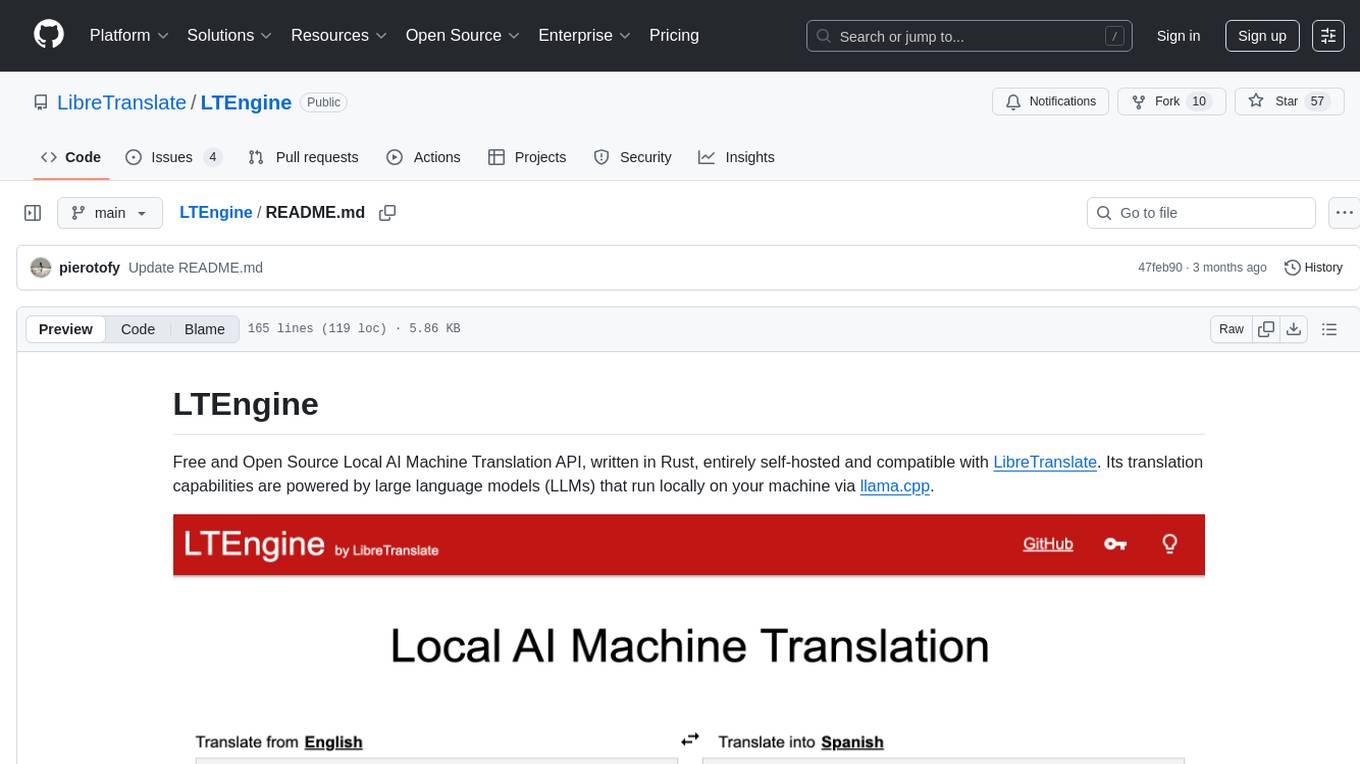
LTEngine is a free and open-source local AI machine translation API written in Rust. It is self-hosted and compatible with LibreTranslate. LTEngine utilizes large language models (LLMs) via llama.cpp, offering high-quality translations that rival or surpass DeepL for certain languages. It supports various accelerators like CUDA, Metal, and Vulkan, with the largest model 'gemma3-27b' fitting on a single consumer RTX 3090. LTEngine is actively developed, with a roadmap outlining future enhancements and features.
language-ai-engineering-lab
The Language AI Engineering Lab is a structured repository focusing on Generative AI, guiding users from language fundamentals to production-ready Language AI systems. It covers topics like NLP, Transformers, Large Language Models, and offers hands-on learning paths, practical implementations, and end-to-end projects. The repository includes in-depth concepts, diagrams, code examples, and videos to support learning. It also provides learning objectives for various areas of Language AI engineering, such as NLP, Transformers, LLM training, prompt engineering, context management, RAG pipelines, context engineering, evaluation, model context protocol, LLM orchestration, agentic AI systems, multimodal models, MLOps, LLM data engineering, and domain applications like IVR and voice systems.
Midori-AI
Midori AI is a cutting-edge initiative dedicated to advancing the field of artificial intelligence through research, development, and community engagement. They focus on creating innovative AI solutions, exploring novel approaches, and empowering users to harness the power of AI. Key areas of focus include cluster-based AI, AI setup assistance, AI development for Discord bots, model serving and hosting, novel AI memory architectures, and Carly - a fully simulated human with advanced AI capabilities. They have also developed the Midori AI Subsystem to streamline AI workloads by providing simplified deployment, standardized configurations, isolation for AI systems, and a growing library of backends and tools.
llamafarm
LlamaFarm is a comprehensive AI framework that empowers users to build powerful AI applications locally, with full control over costs and deployment options. It provides modular components for RAG systems, vector databases, model management, prompt engineering, and fine-tuning. Users can create differentiated AI products without needing extensive ML expertise, using simple CLI commands and YAML configs. The framework supports local-first development, production-ready components, strategy-based configuration, and deployment anywhere from laptops to the cloud.
For similar jobs
sweep
Sweep is an AI junior developer that turns bugs and feature requests into code changes. It automatically handles developer experience improvements like adding type hints and improving test coverage.
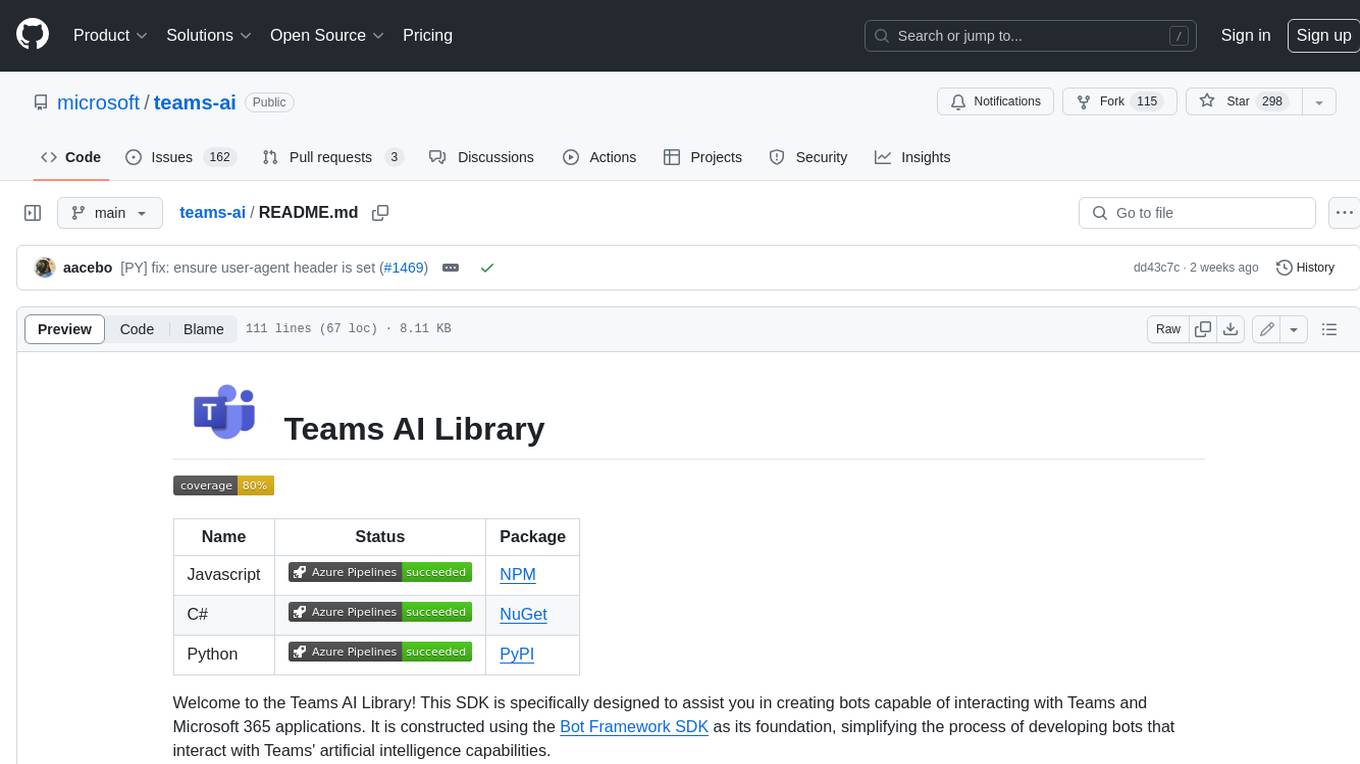
teams-ai
The Teams AI Library is a software development kit (SDK) that helps developers create bots that can interact with Teams and Microsoft 365 applications. It is built on top of the Bot Framework SDK and simplifies the process of developing bots that interact with Teams' artificial intelligence capabilities. The SDK is available for JavaScript/TypeScript, .NET, and Python.
ai-guide
This guide is dedicated to Large Language Models (LLMs) that you can run on your home computer. It assumes your PC is a lower-end, non-gaming setup.
classifai
Supercharge WordPress Content Workflows and Engagement with Artificial Intelligence. Tap into leading cloud-based services like OpenAI, Microsoft Azure AI, Google Gemini and IBM Watson to augment your WordPress-powered websites. Publish content faster while improving SEO performance and increasing audience engagement. ClassifAI integrates Artificial Intelligence and Machine Learning technologies to lighten your workload and eliminate tedious tasks, giving you more time to create original content that matters.
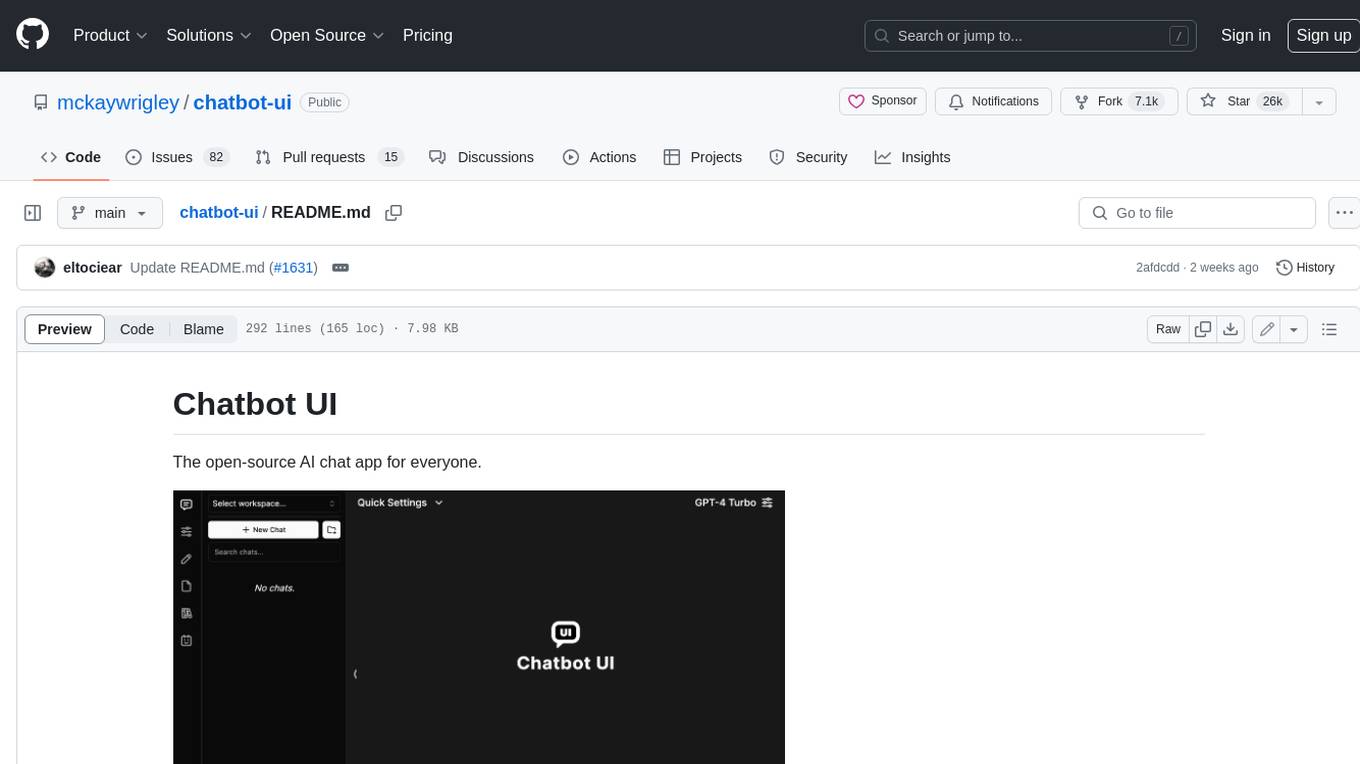
chatbot-ui
Chatbot UI is an open-source AI chat app that allows users to create and deploy their own AI chatbots. It is easy to use and can be customized to fit any need. Chatbot UI is perfect for businesses, developers, and anyone who wants to create a chatbot.
BricksLLM
BricksLLM is a cloud native AI gateway written in Go. Currently, it provides native support for OpenAI, Anthropic, Azure OpenAI and vLLM. BricksLLM aims to provide enterprise level infrastructure that can power any LLM production use cases. Here are some use cases for BricksLLM: * Set LLM usage limits for users on different pricing tiers * Track LLM usage on a per user and per organization basis * Block or redact requests containing PIIs * Improve LLM reliability with failovers, retries and caching * Distribute API keys with rate limits and cost limits for internal development/production use cases * Distribute API keys with rate limits and cost limits for students
uAgents
uAgents is a Python library developed by Fetch.ai that allows for the creation of autonomous AI agents. These agents can perform various tasks on a schedule or take action on various events. uAgents are easy to create and manage, and they are connected to a fast-growing network of other uAgents. They are also secure, with cryptographically secured messages and wallets.
griptape
Griptape is a modular Python framework for building AI-powered applications that securely connect to your enterprise data and APIs. It offers developers the ability to maintain control and flexibility at every step. Griptape's core components include Structures (Agents, Pipelines, and Workflows), Tasks, Tools, Memory (Conversation Memory, Task Memory, and Meta Memory), Drivers (Prompt and Embedding Drivers, Vector Store Drivers, Image Generation Drivers, Image Query Drivers, SQL Drivers, Web Scraper Drivers, and Conversation Memory Drivers), Engines (Query Engines, Extraction Engines, Summary Engines, Image Generation Engines, and Image Query Engines), and additional components (Rulesets, Loaders, Artifacts, Chunkers, and Tokenizers). Griptape enables developers to create AI-powered applications with ease and efficiency.