


labs-ai-tools-for-devs
An MCP server & prompt runner for all of Docker. Simple Markdown. BYO LLM.
Stars: 174
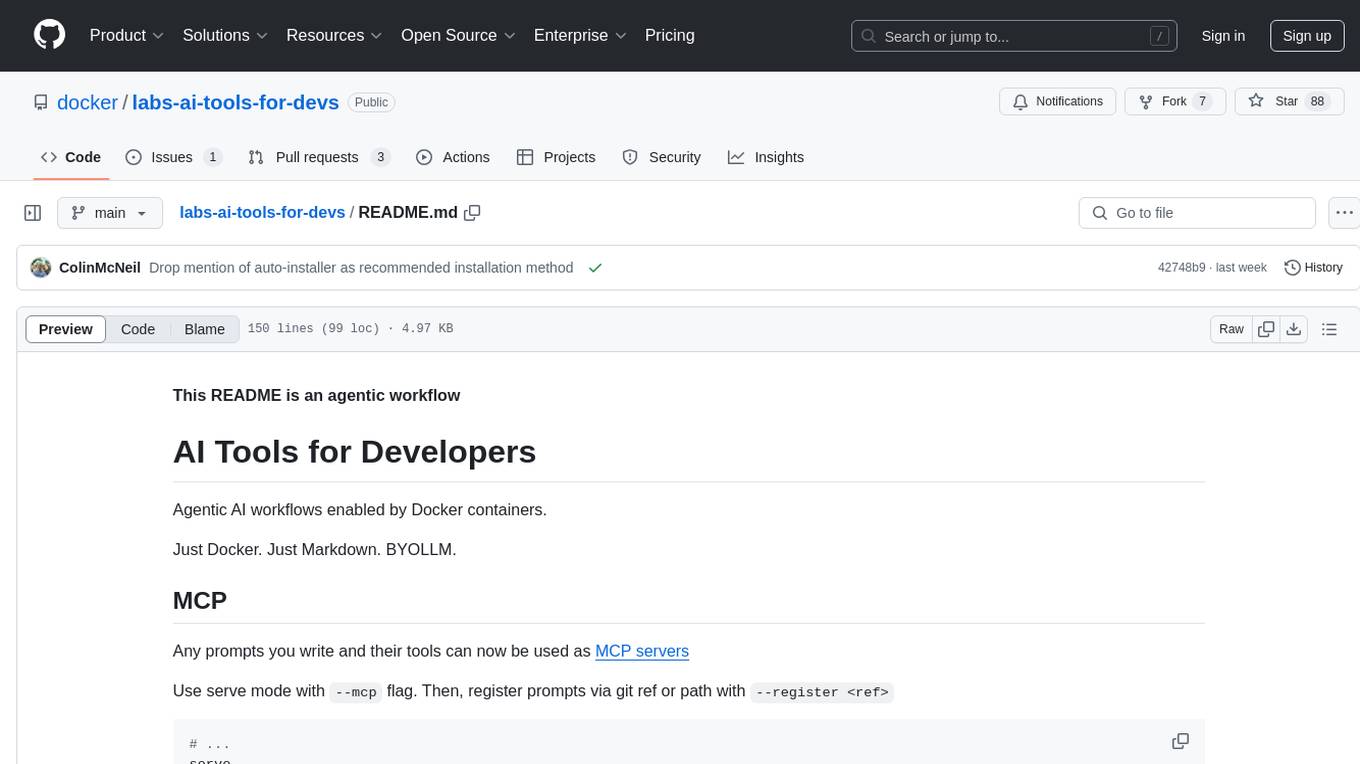
This repository provides AI tools for developers through Docker containers, enabling agentic workflows. It allows users to create complex workflows using Dockerized tools and Markdown, leveraging various LLM models. The core features include Dockerized tools, conversation loops, multi-model agents, project-first design, and trackable prompts stored in a git repo.
README:
This README is an agentic workflow
Agentic AI workflows enabled by Docker containers.
Just Docker. Just Markdown. BYOLLM.
Any prompts you write and their tools can now be used as MCP servers
Use serve mode with --mcp flag. Then, register prompts via git ref or path with --register <ref>
# ...
serve
--mcp
--register github:docker/labs-ai-tools-for-devs?path=prompts/examples/generate_dockerfile.md
--register /Users/ai-overlordz/some/local/prompt.md
# ...
Source for many experiments in our LinkedIn newsletter
This is a simple Docker image which enables infinite possibilities for novel workflows by combining Dockerized Tools, Markdown, and the LLM of your choice.
Humans already speak it. So do LLM's. This software allows you to write complex workflows in a markdown files, and then run them with your own LLM in your editor or terminal...or any environment, thanks to Docker.

OpenAI API compatiable LLM's already support tool calling. We believe these tools could just be Docker images. Some of the benefits using Docker based on our research are enabling the LLM to:
- take more complex actions
- get more context with fewer tokens
- work across a wider range of environments
- operate in a sandboxed environment
The conversation loop is the core of each workflow. Tool results, agent responses, and of course, the markdown prompts, are all passed through the loop. If an agent sees an error, it will try running the tool with different parameters, or even different tools until it gets the right result.
Each prompt can be configured to be run with different LLM models, or even different model families. This allows you to use the best tool for the job. When you combine these tools, you can create multi-agent workflows where each agent runs with the model best suited for that task.
With Docker, it is possible to have frontier models plan, while lightweight local models execute.
To get help from an assistant in your software development loop, the only context necessary is the project you are working on.

An extractor is a Docker image that runs against a project and extracts information into a JSON context.

Prompts are stored in a git repo and can be versioned, tracked, and shared for anyone to run in their own environment.
We highly recommend using the VSCode extension to get started. It will help you create prompts, and run them with your own LLM.
Install Extension
Get the latest release and install with
code --install-extension 'labs-ai-tools-vscode-<version>.vsix'Running:
- Open an existing markdown file, or create a new markdown file in VSCode.
You can even run this markdown file directly!
-
Run command
>Docker AI: Set OpenAI API Keyto set an OpenAI API key, or use a dummy value for local models. -
Run command
>Docker AI: Select target projectto select a project to run the prompt against. -
Run command
>Docker AI: Run Promptto start the conversation loop.
Instructions assume you have a terminal open, and Docker Desktop running.
- Set OpenAI key
echo $OPENAI_API_KEY > $HOME/.openai-api-keyNote: we assume this file exists, so you must set a dummy value for local models.
- Run the container in your project directory
docker run
  --rm \
  --pull=always \
  -it \
  -v /var/run/docker.sock:/var/run/docker.sock \
  --mount type=volume,source=docker-prompts,target=/prompts \
  --mount type=bind,source=$HOME/.openai-api-key,target=/root/.openai-api-key \
  vonwig/prompts:latest \
    run \
    --host-dir $PWD \
    --user $USER \
    --platform "$(uname -o)" \
    --prompts "github:docker/labs-githooks?ref=main&path=prompts/git_hooks"
See docs for more details on how to run the conversation loop.
#docker:command=build

docker build -t vonwig/prompts:local -f Dockerfile .
Now, for the agentic workflow...
You are an expert at reading readmes.
Use curl to get the readme for https://github.com/docker/labs-ai-tools-for-devs before answering the following questions.
What is this project?
For Tasks:
Click tags to check more tools for each tasksFor Jobs:
Alternative AI tools for labs-ai-tools-for-devs
Similar Open Source Tools
labs-ai-tools-for-devs
This repository provides AI tools for developers through Docker containers, enabling agentic workflows. It allows users to create complex workflows using Dockerized tools and Markdown, leveraging various LLM models. The core features include Dockerized tools, conversation loops, multi-model agents, project-first design, and trackable prompts stored in a git repo.
todoist-ai
Library for connecting AI agents to Todoist, enabling them to access and modify a Todoist account on the user's behalf. Tools can be used through an MCP server or integrated into other projects for AI conversational interfaces. Reusable tools allow for complete workflows, balancing flexibility and efficiency for LLMs. Early-stage project with more tools planned. Designed to provide a small set of tools for various AI interfaces.
jaison-core
J.A.I.son is a Python project designed for generating responses using various components and applications. It requires specific plugins like STT, T2T, TTSG, and TTSC to function properly. Users can customize responses, voice, and configurations. The project provides a Discord bot, Twitch events and chat integration, and VTube Studio Animation Hotkeyer. It also offers features for managing conversation history, training AI models, and monitoring conversations.
AgentIQ
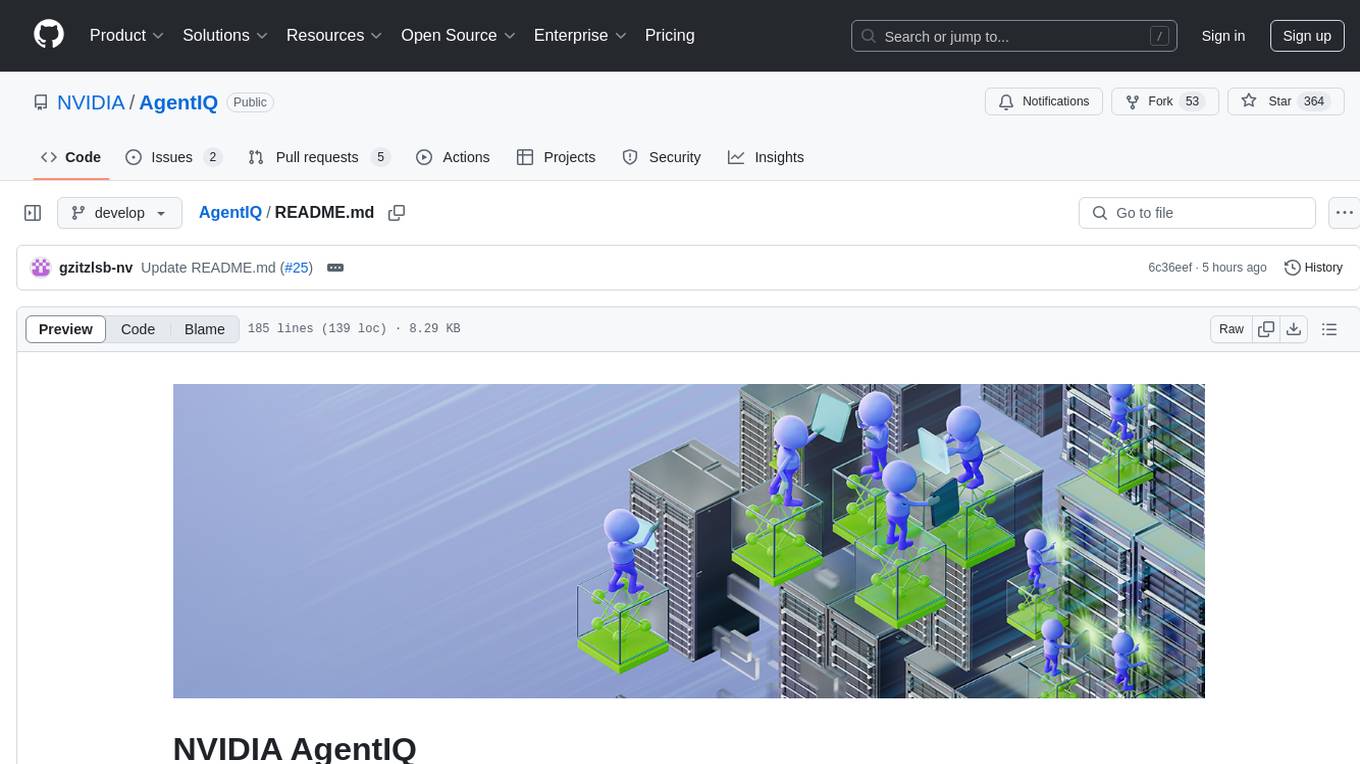
AgentIQ is a flexible library designed to seamlessly integrate enterprise agents with various data sources and tools. It enables true composability by treating agents, tools, and workflows as simple function calls. With features like framework agnosticism, reusability, rapid development, profiling, observability, evaluation system, user interface, and MCP compatibility, AgentIQ empowers developers to move quickly, experiment freely, and ensure reliability across agent-driven projects.
h2o-llmstudio
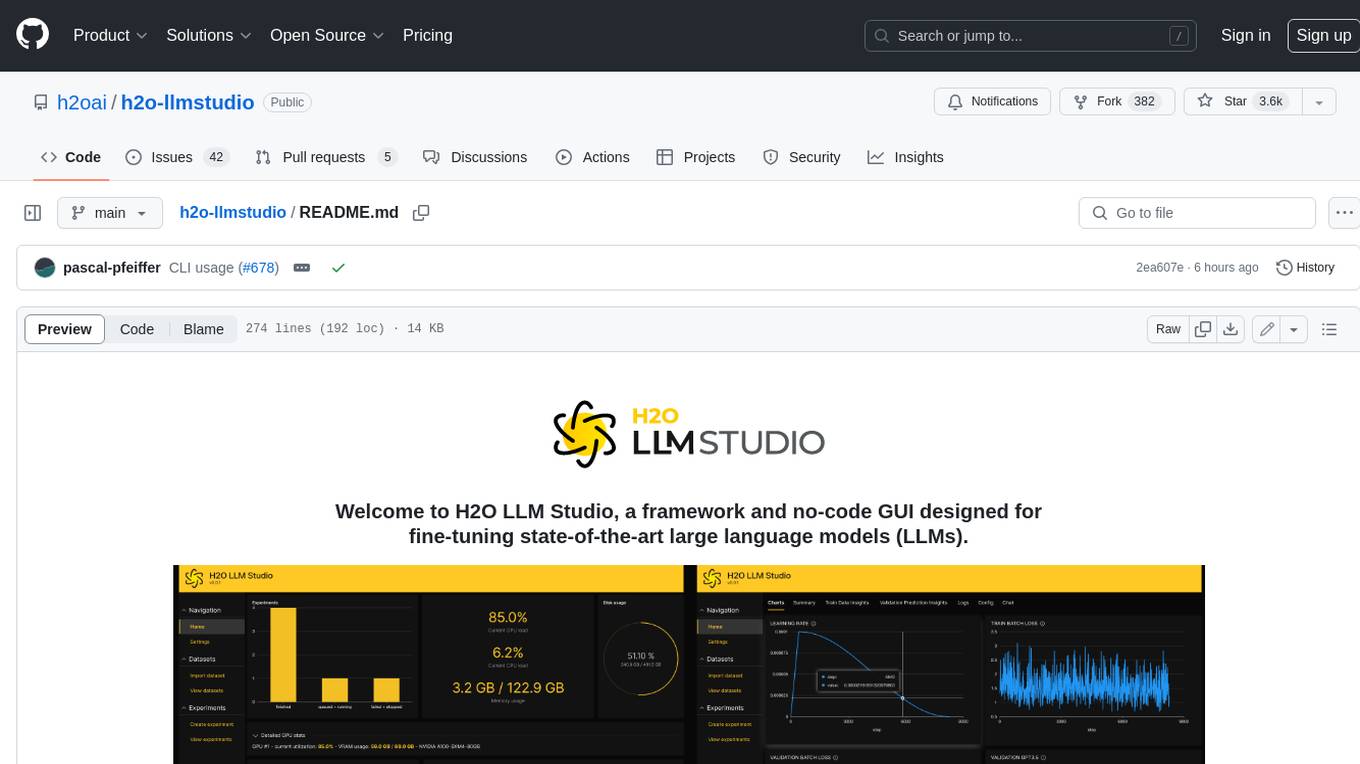
H2O LLM Studio is a framework and no-code GUI designed for fine-tuning state-of-the-art large language models (LLMs). With H2O LLM Studio, you can easily and effectively fine-tune LLMs without the need for any coding experience. The GUI is specially designed for large language models, and you can finetune any LLM using a large variety of hyperparameters. You can also use recent finetuning techniques such as Low-Rank Adaptation (LoRA) and 8-bit model training with a low memory footprint. Additionally, you can use Reinforcement Learning (RL) to finetune your model (experimental), use advanced evaluation metrics to judge generated answers by the model, track and compare your model performance visually, and easily export your model to the Hugging Face Hub and share it with the community.
openui
OpenUI is a tool designed to simplify the process of building UI components by allowing users to describe UI using their imagination and see it rendered live. It supports converting HTML to React, Svelte, Web Components, etc. The tool is open source and aims to make UI development fun, fast, and flexible. It integrates with various AI services like OpenAI, Groq, Gemini, Anthropic, Cohere, and Mistral, providing users with the flexibility to use different models. OpenUI also supports LiteLLM for connecting to various LLM services and allows users to create custom proxy configs. The tool can be run locally using Docker or Python, and it offers a development environment for quick setup and testing.
webwhiz
WebWhiz is an open-source tool that allows users to train ChatGPT on website data to build AI chatbots for customer queries. It offers easy integration, data-specific responses, regular data updates, no-code builder, chatbot customization, fine-tuning, and offline messaging. Users can create and train chatbots in a few simple steps by entering their website URL, automatically fetching and preparing training data, training ChatGPT, and embedding the chatbot on their website. WebWhiz can crawl websites monthly, collect text data and metadata, and process text data using tokens. Users can train custom data, but bringing custom open AI keys is not yet supported. The tool has no limitations on context size but may limit the number of pages based on the chosen plan. WebWhiz SDK is available on NPM, CDNs, and GitHub, and users can self-host it using Docker or manual setup involving MongoDB, Redis, Node, Python, and environment variables setup. For any issues, users can contact [email protected].
starter-monorepo
Starter Monorepo is a template repository for setting up a monorepo structure in your project. It provides a basic setup with configurations for managing multiple packages within a single repository. This template includes tools for package management, versioning, testing, and deployment. By using this template, you can streamline your development process, improve code sharing, and simplify dependency management across your project. Whether you are working on a small project or a large-scale application, Starter Monorepo can help you organize your codebase efficiently and enhance collaboration among team members.
OSWorld
OSWorld is a benchmarking tool designed to evaluate multimodal agents for open-ended tasks in real computer environments. It provides a platform for running experiments, setting up virtual machines, and interacting with the environment using Python scripts. Users can install the tool on their desktop or server, manage dependencies with Conda, and run benchmark tasks. The tool supports actions like executing commands, checking for specific results, and evaluating agent performance. OSWorld aims to facilitate research in AI by providing a standardized environment for testing and comparing different agent baselines.
ai-starter-kit
SambaNova AI Starter Kits is a collection of open-source examples and guides designed to facilitate the deployment of AI-driven use cases for developers and enterprises. The kits cover various categories such as Data Ingestion & Preparation, Model Development & Optimization, Intelligent Information Retrieval, and Advanced AI Capabilities. Users can obtain a free API key using SambaNova Cloud or deploy models using SambaStudio. Most examples are written in Python but can be applied to any programming language. The kits provide resources for tasks like text extraction, fine-tuning embeddings, prompt engineering, question-answering, image search, post-call analysis, and more.
polis
Polis is an AI powered sentiment gathering platform that offers a more organic approach than surveys and requires less effort than focus groups. It provides a comprehensive wiki, main deployment at https://pol.is, discussions, issue tracking, and project board for users. Polis can be set up using Docker infrastructure and offers various commands for building and running containers. Users can test their instance, update the system, and deploy Polis for production. The tool also provides developer conveniences for code reloading, type checking, and database connections. Additionally, Polis supports end-to-end browser testing using Cypress and offers troubleshooting tips for common Docker and npm issues.
dravid
Dravid (DRD) is an advanced, AI-powered CLI coding framework designed to follow user instructions until the job is completed, including fixing errors. It can generate code, fix errors, handle image queries, manage file operations, integrate with external APIs, and provide a development server with error handling. Dravid is extensible and requires Python 3.7+ and CLAUDE_API_KEY. Users can interact with Dravid through CLI commands for various tasks like creating projects, asking questions, generating content, handling metadata, and file-specific queries. It supports use cases like Next.js project development, working with existing projects, exploring new languages, Ruby on Rails project development, and Python project development. Dravid's project structure includes directories for source code, CLI modules, API interaction, utility functions, AI prompt templates, metadata management, and tests. Contributions are welcome, and development setup involves cloning the repository, installing dependencies with Poetry, setting up environment variables, and using Dravid for project enhancements.
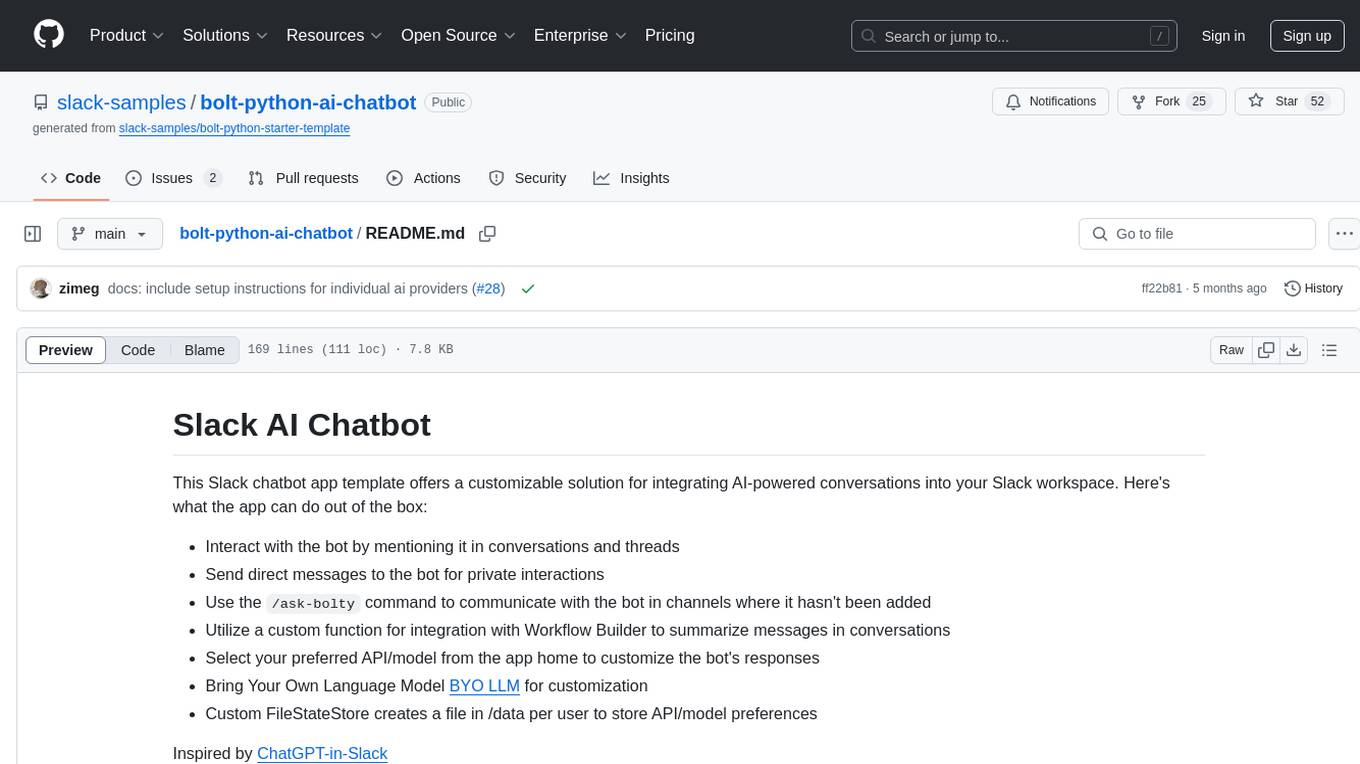
bolt-python-ai-chatbot
The 'bolt-python-ai-chatbot' is a Slack chatbot app template that allows users to integrate AI-powered conversations into their Slack workspace. Users can interact with the bot in conversations and threads, send direct messages for private interactions, use commands to communicate with the bot, customize bot responses, and store user preferences. The app supports integration with Workflow Builder, custom language models, and different AI providers like OpenAI, Anthropic, and Google Cloud Vertex AI. Users can create user objects, manage user states, and select from various AI models for communication.
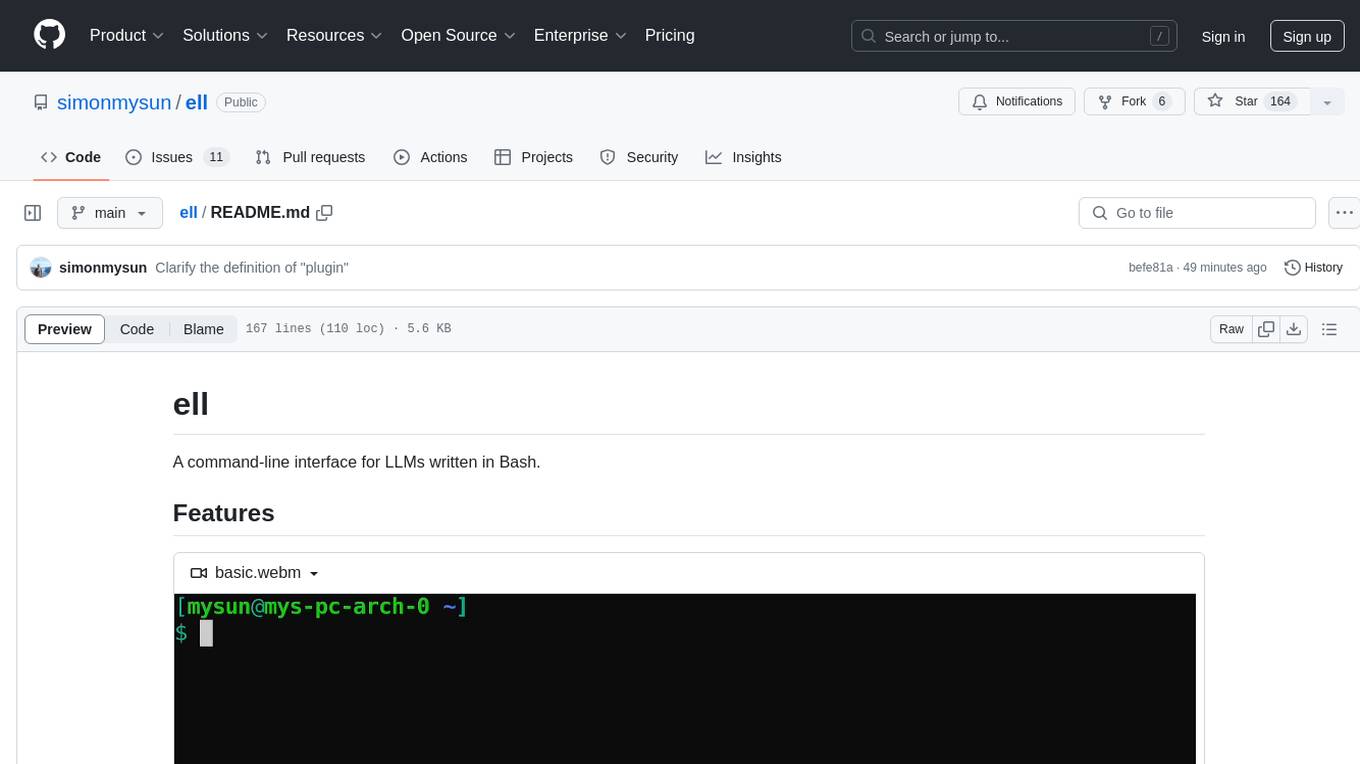
ell
ell is a command-line interface for Language Model Models (LLMs) written in Bash. It allows users to interact with LLMs from the terminal, supports piping, context bringing, and chatting with LLMs. Users can also call functions and use templates. The tool requires bash, jq for JSON parsing, curl for HTTPS requests, and perl for PCRE. Configuration involves setting variables for different LLM models and APIs. Usage examples include asking questions, specifying models, recording input/output, running in interactive mode, and using templates. The tool is lightweight, easy to install, and pipe-friendly, making it suitable for interacting with LLMs in a terminal environment.
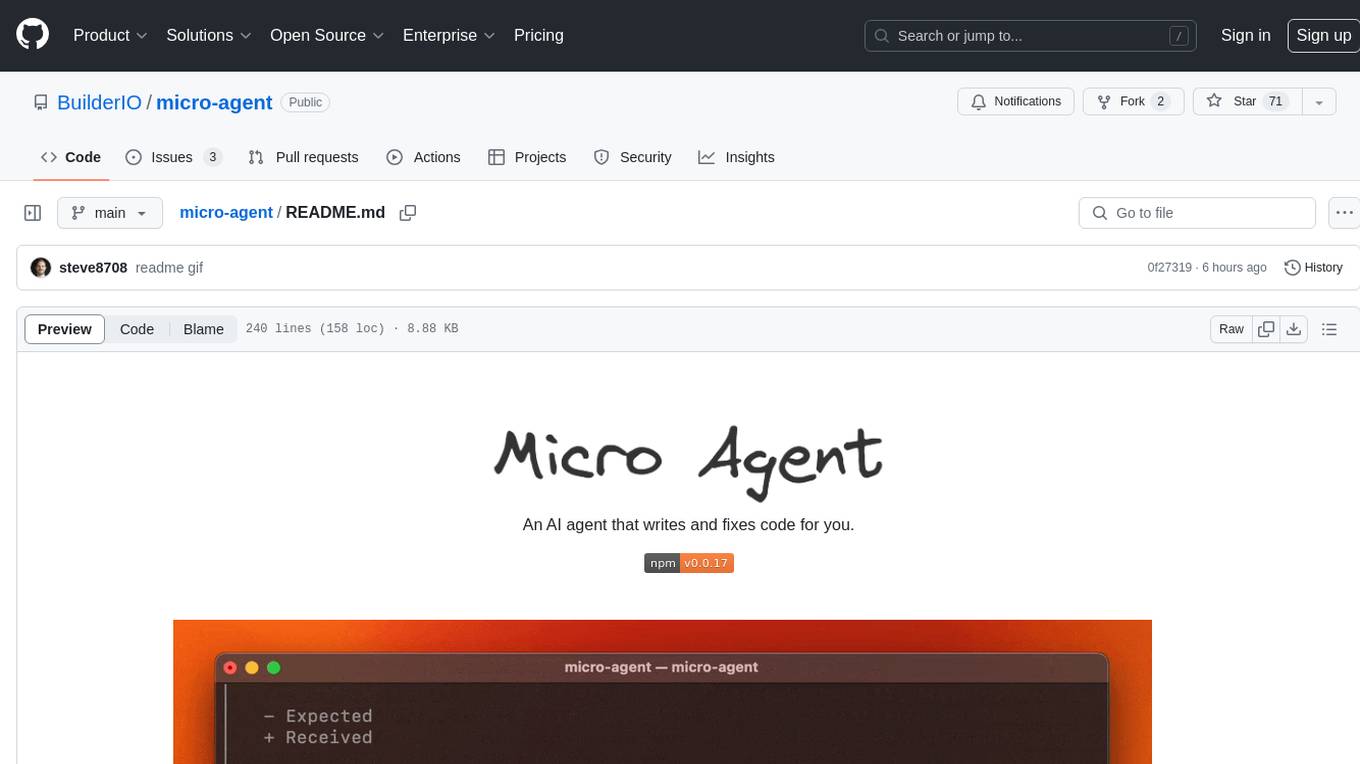
micro-agent
Micro Agent is an AI tool designed to write and fix code for users by generating code that passes specified tests or matches design screenshots. It aims to streamline the code generation process by leveraging AI capabilities to iterate and improve code until desired outcomes are achieved. The tool focuses on test-driven development and provides interactive features for user feedback. Micro Agent is not intended to be a comprehensive development tool but rather a specialized agent for code generation and iteration.
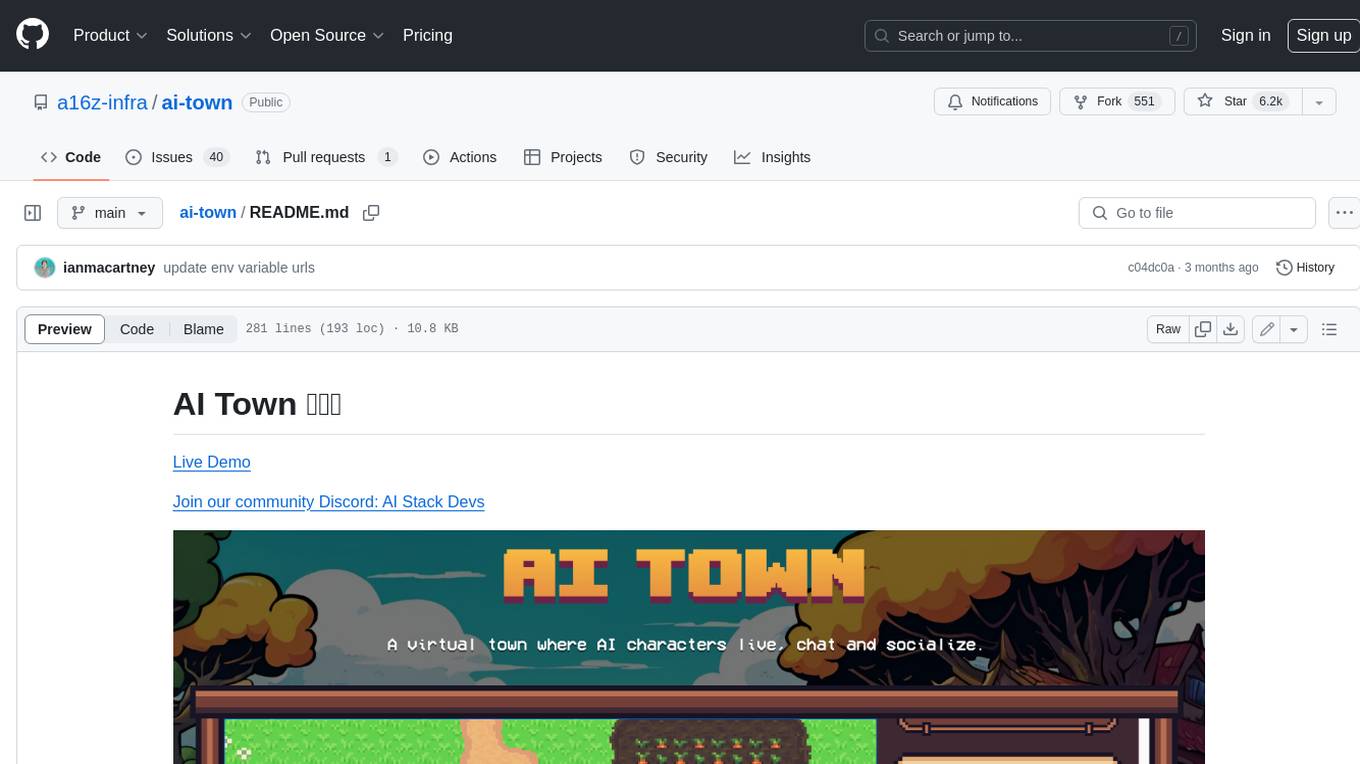
ai-town
AI Town is a virtual town where AI characters live, chat, and socialize. This project provides a deployable starter kit for building and customizing your own version of AI Town. It features a game engine, database, vector search, auth, text model, deployment, pixel art generation, background music generation, and local inference. You can customize your own simulation by creating characters and stories, updating spritesheets, changing the background, and modifying the background music.
For similar tasks
labs-ai-tools-for-devs
This repository provides AI tools for developers through Docker containers, enabling agentic workflows. It allows users to create complex workflows using Dockerized tools and Markdown, leveraging various LLM models. The core features include Dockerized tools, conversation loops, multi-model agents, project-first design, and trackable prompts stored in a git repo.
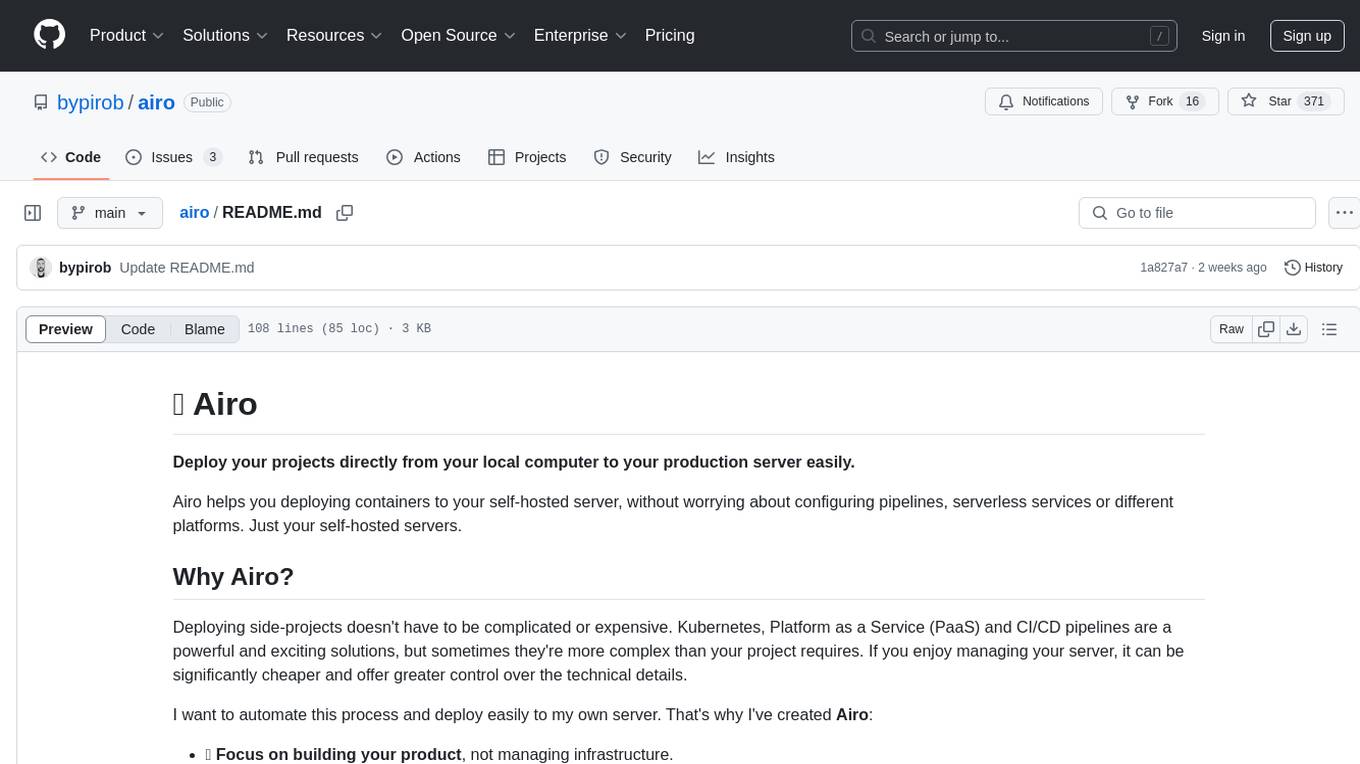
airo
Airo is a tool designed to simplify the process of deploying containers to self-hosted servers. It allows users to focus on building their products without the complexity of Kubernetes or CI/CD pipelines. With Airo, users can easily build and push Docker images, deploy instantly with a single command, update configurations securely using SSH, and set up HTTPS and reverse proxy automatically using Caddy.
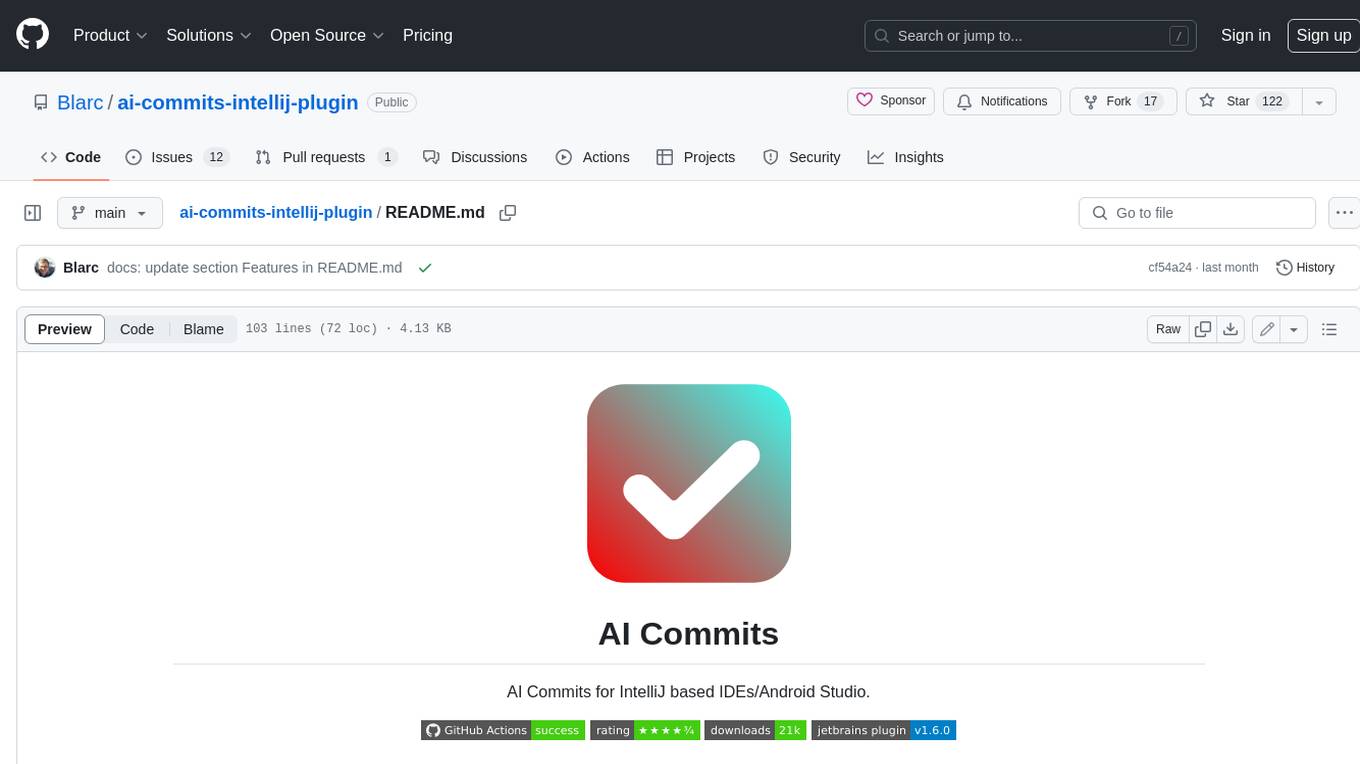
ai-commits-intellij-plugin
AI Commits is a plugin for IntelliJ-based IDEs and Android Studio that generates commit messages using git diff and OpenAI. It offers features such as generating commit messages from diff using OpenAI API, computing diff only from selected files and lines in the commit dialog, creating custom prompts for commit message generation, using predefined variables and hints to customize prompts, choosing any of the models available in OpenAI API, setting OpenAI network proxy, and setting custom OpenAI compatible API endpoint.
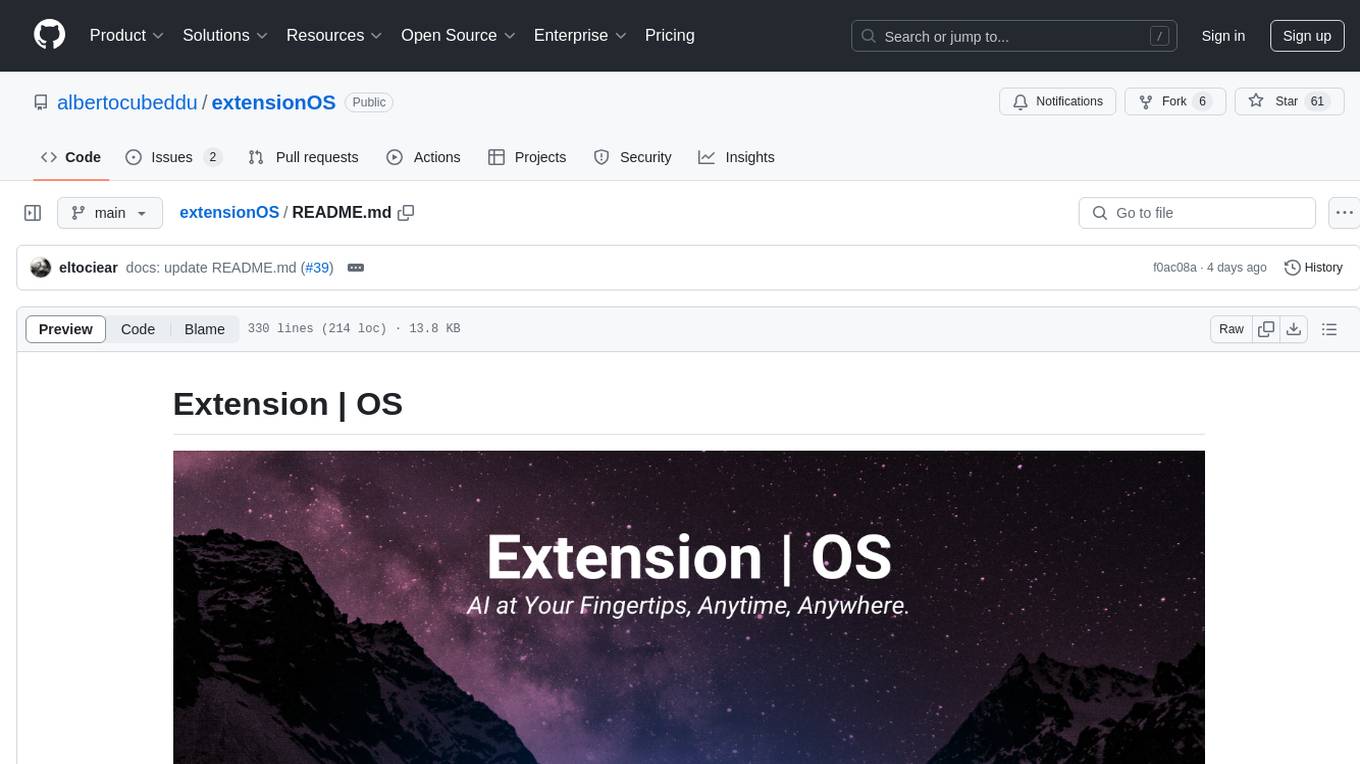
extensionOS
Extension | OS is an open-source browser extension that brings AI directly to users' web browsers, allowing them to access powerful models like LLMs seamlessly. Users can create prompts, fix grammar, and access intelligent assistance without switching tabs. The extension aims to revolutionize online information interaction by integrating AI into everyday browsing experiences. It offers features like Prompt Factory for tailored prompts, seamless LLM model access, secure API key storage, and a Mixture of Agents feature. The extension was developed to empower users to unleash their creativity with custom prompts and enhance their browsing experience with intelligent assistance.
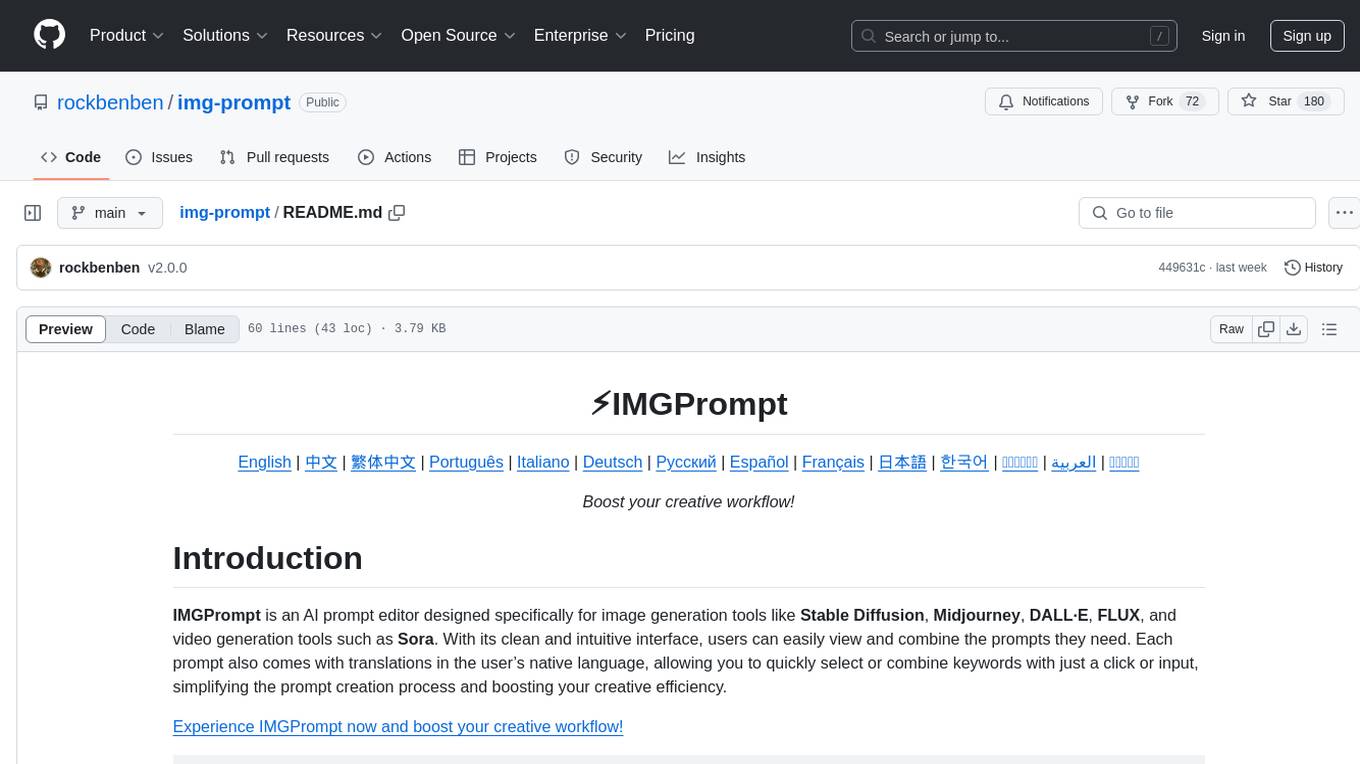
img-prompt
IMGPrompt is an AI prompt editor tailored for image and video generation tools like Stable Diffusion, Midjourney, DALL·E, FLUX, and Sora. It offers a clean interface for viewing and combining prompts with translations in multiple languages. The tool includes features like smart recommendations, translation, random color generation, prompt tagging, interactive editing, categorized tag display, character count, and localization. Users can enhance their creative workflow by simplifying prompt creation and boosting efficiency.
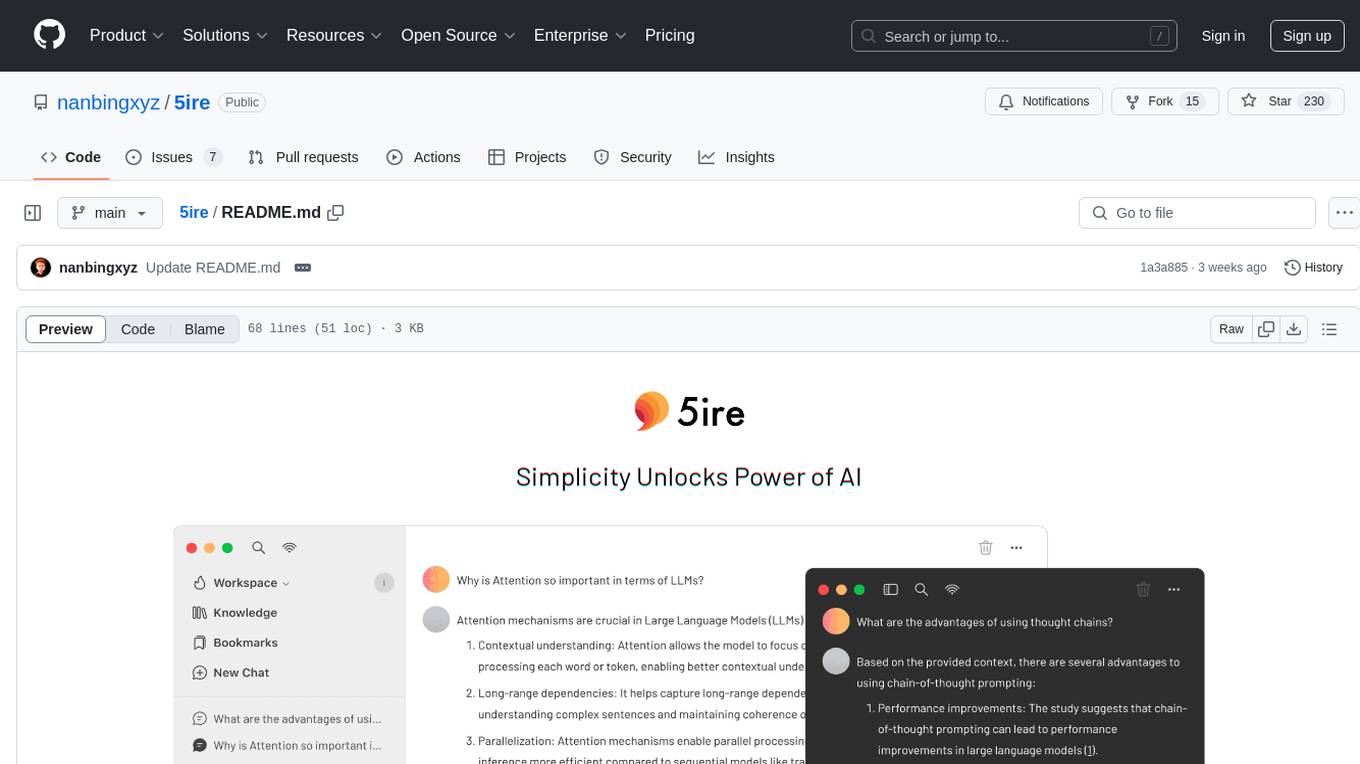
5ire
5ire is a cross-platform desktop client that integrates a local knowledge base for multilingual vectorization, supports parsing and vectorization of various document formats, offers usage analytics to track API spending, provides a prompts library for creating and organizing prompts with variable support, allows bookmarking of conversations, and enables quick keyword searches across conversations. It is licensed under the GNU General Public License version 3.
sidecar
Sidecar is the AI brains of Aide the editor, responsible for creating prompts, interacting with LLM, and ensuring seamless integration of all functionalities. It includes 'tool_box.rs' for handling language-specific smartness, 'symbol/' for smart and independent symbols, 'llm_prompts/' for creating prompts, and 'repomap' for creating a repository map using page rank on code symbols. Users can contribute by submitting bugs, feature requests, reviewing source code changes, and participating in the development workflow.
Prompt_Engineering
Prompt Engineering Techniques is a comprehensive repository for learning, building, and sharing prompt engineering techniques, from basic concepts to advanced strategies for leveraging large language models. It provides step-by-step tutorials, practical implementations, and a platform for showcasing innovative prompt engineering techniques. The repository covers fundamental concepts, core techniques, advanced strategies, optimization and refinement, specialized applications, and advanced applications in prompt engineering.
For similar jobs
sweep
Sweep is an AI junior developer that turns bugs and feature requests into code changes. It automatically handles developer experience improvements like adding type hints and improving test coverage.
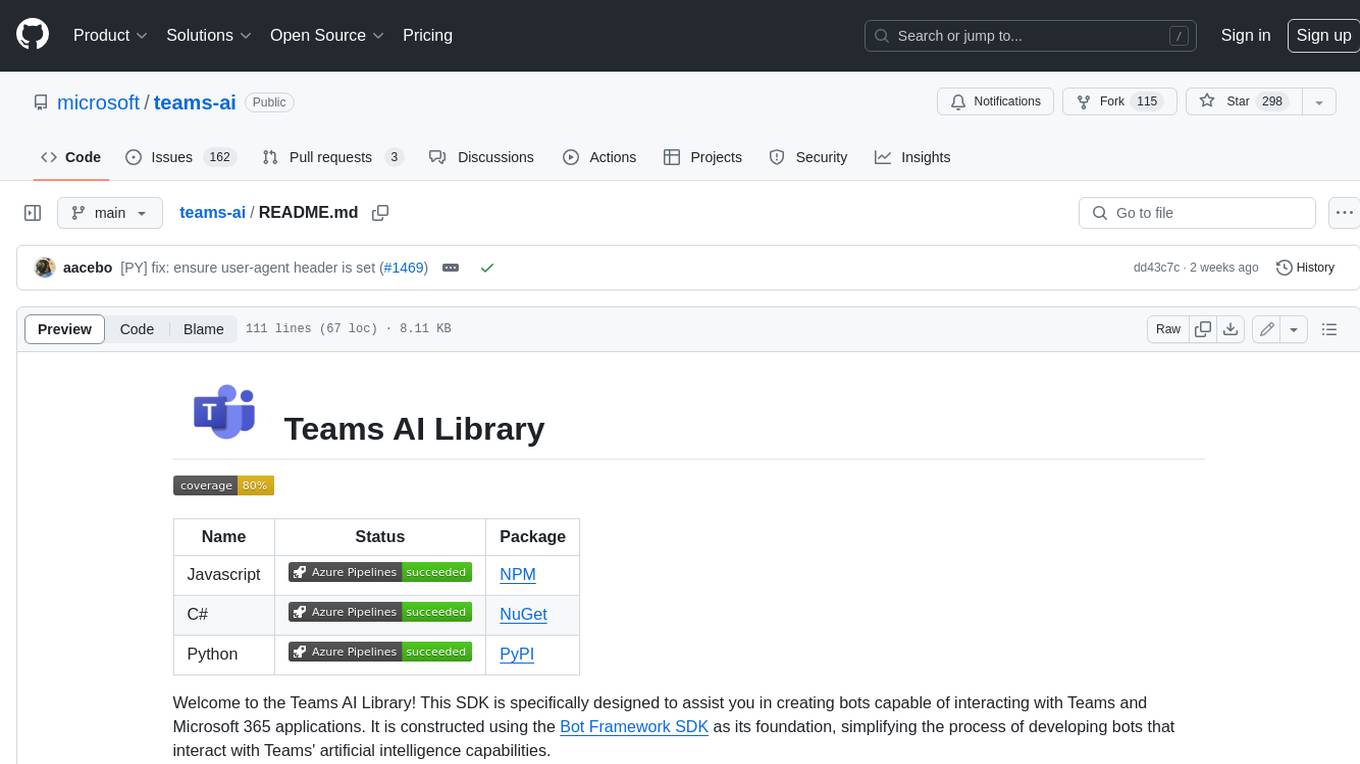
teams-ai
The Teams AI Library is a software development kit (SDK) that helps developers create bots that can interact with Teams and Microsoft 365 applications. It is built on top of the Bot Framework SDK and simplifies the process of developing bots that interact with Teams' artificial intelligence capabilities. The SDK is available for JavaScript/TypeScript, .NET, and Python.
ai-guide
This guide is dedicated to Large Language Models (LLMs) that you can run on your home computer. It assumes your PC is a lower-end, non-gaming setup.
classifai
Supercharge WordPress Content Workflows and Engagement with Artificial Intelligence. Tap into leading cloud-based services like OpenAI, Microsoft Azure AI, Google Gemini and IBM Watson to augment your WordPress-powered websites. Publish content faster while improving SEO performance and increasing audience engagement. ClassifAI integrates Artificial Intelligence and Machine Learning technologies to lighten your workload and eliminate tedious tasks, giving you more time to create original content that matters.
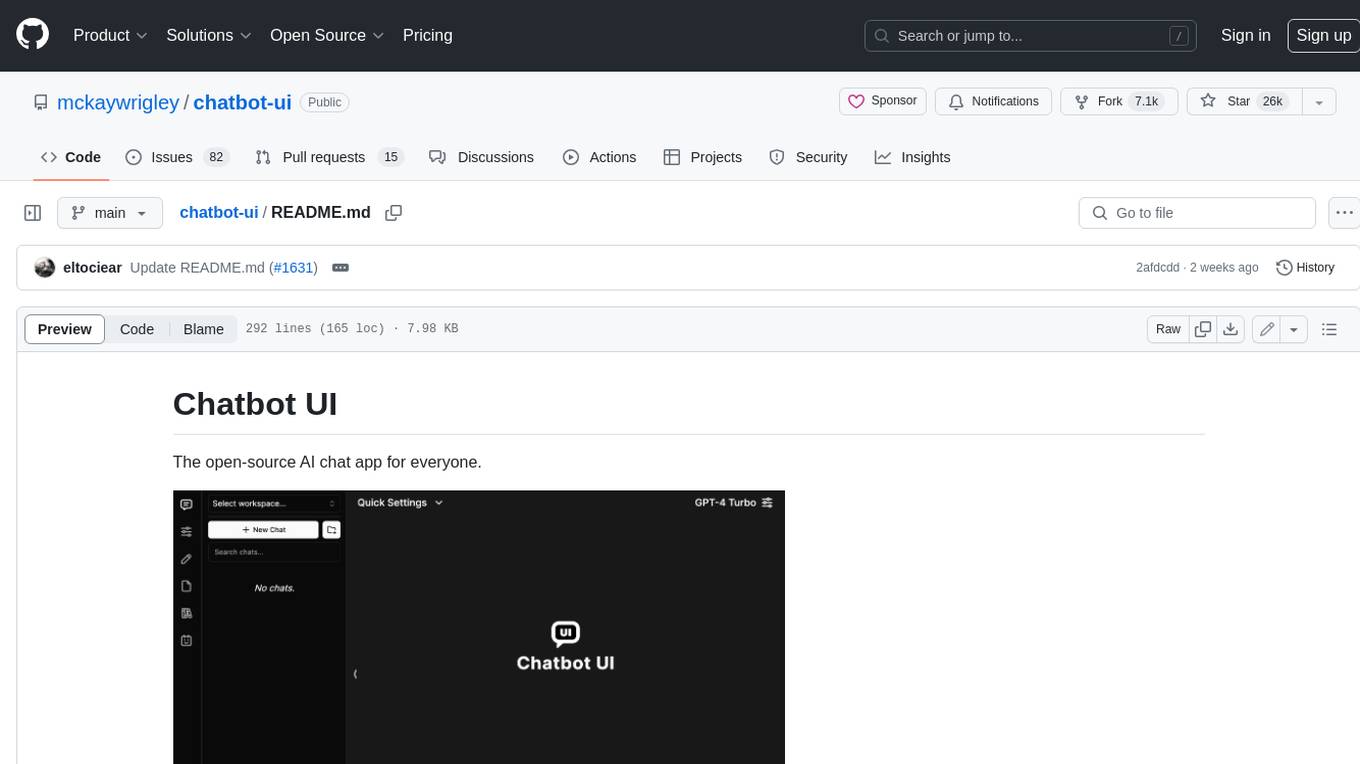
chatbot-ui
Chatbot UI is an open-source AI chat app that allows users to create and deploy their own AI chatbots. It is easy to use and can be customized to fit any need. Chatbot UI is perfect for businesses, developers, and anyone who wants to create a chatbot.
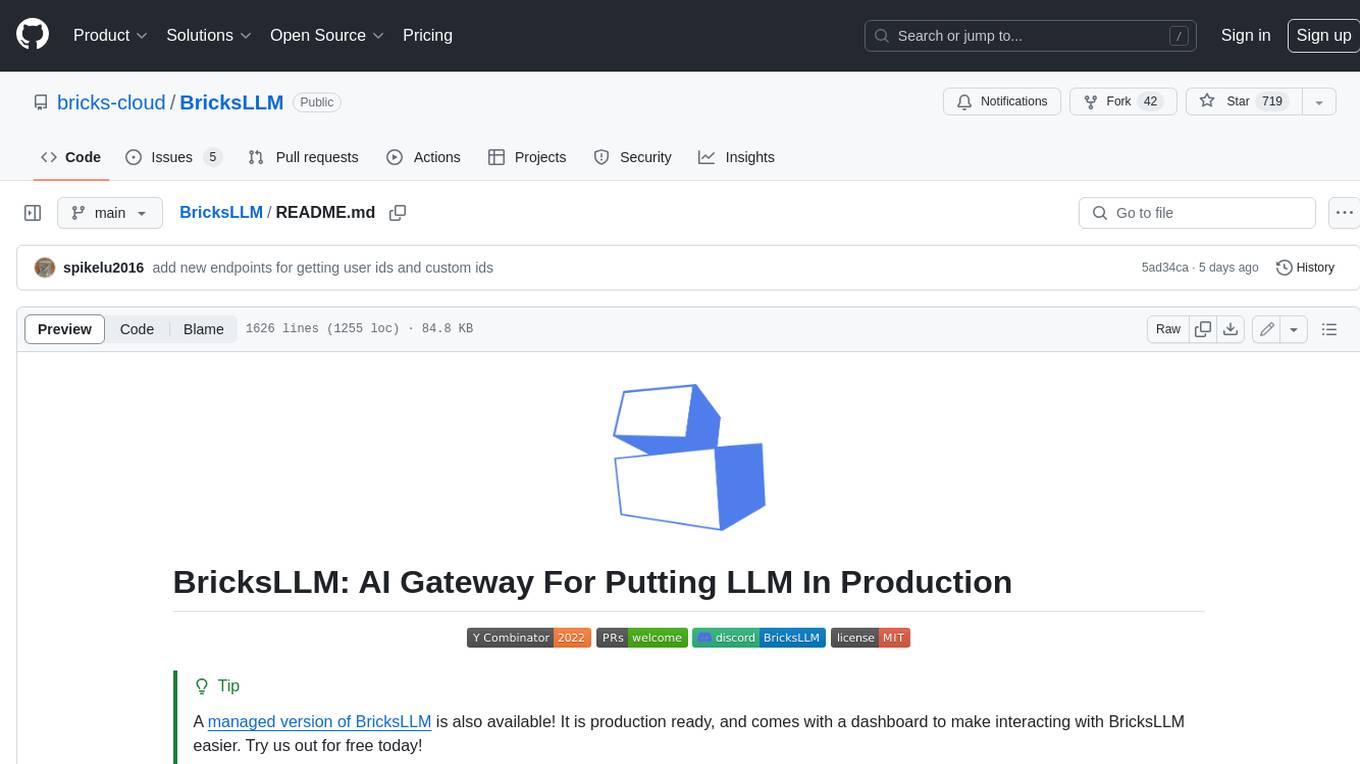
BricksLLM
BricksLLM is a cloud native AI gateway written in Go. Currently, it provides native support for OpenAI, Anthropic, Azure OpenAI and vLLM. BricksLLM aims to provide enterprise level infrastructure that can power any LLM production use cases. Here are some use cases for BricksLLM: * Set LLM usage limits for users on different pricing tiers * Track LLM usage on a per user and per organization basis * Block or redact requests containing PIIs * Improve LLM reliability with failovers, retries and caching * Distribute API keys with rate limits and cost limits for internal development/production use cases * Distribute API keys with rate limits and cost limits for students
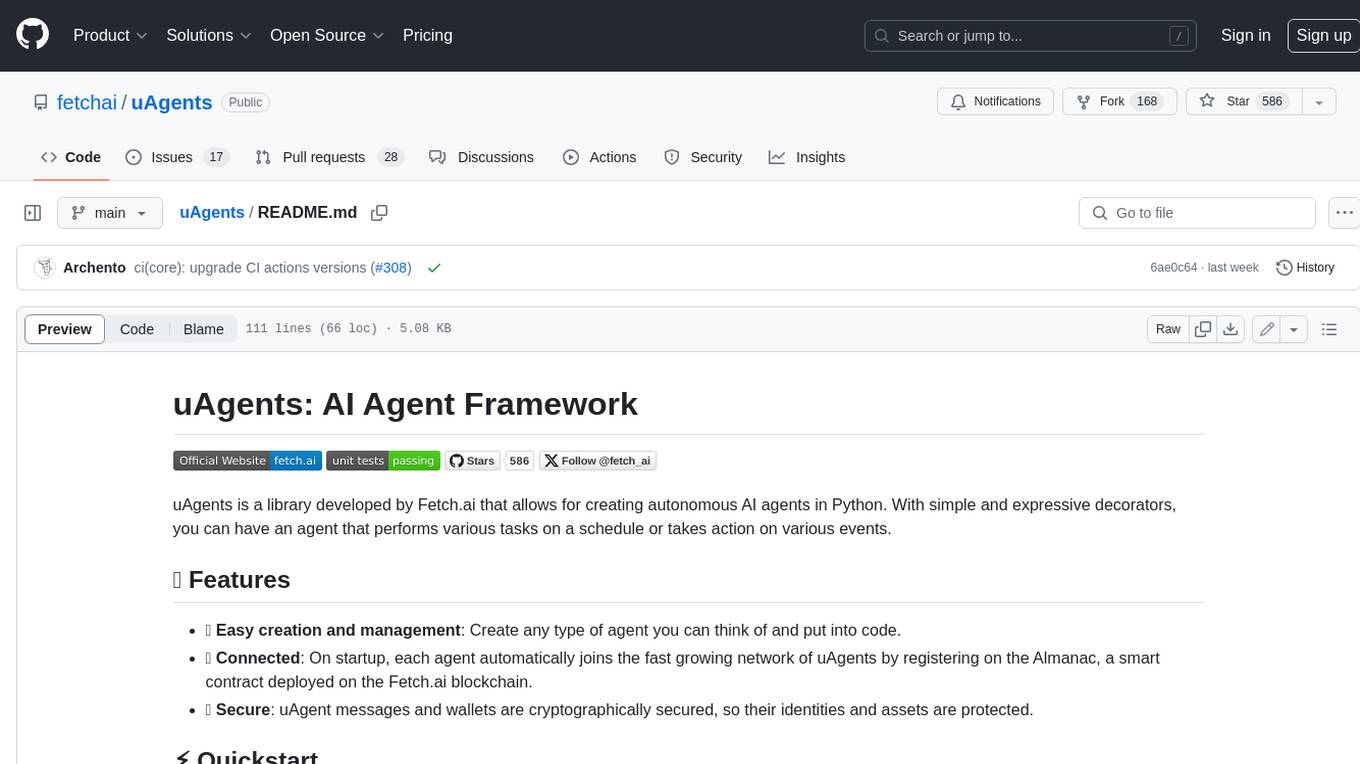
uAgents
uAgents is a Python library developed by Fetch.ai that allows for the creation of autonomous AI agents. These agents can perform various tasks on a schedule or take action on various events. uAgents are easy to create and manage, and they are connected to a fast-growing network of other uAgents. They are also secure, with cryptographically secured messages and wallets.
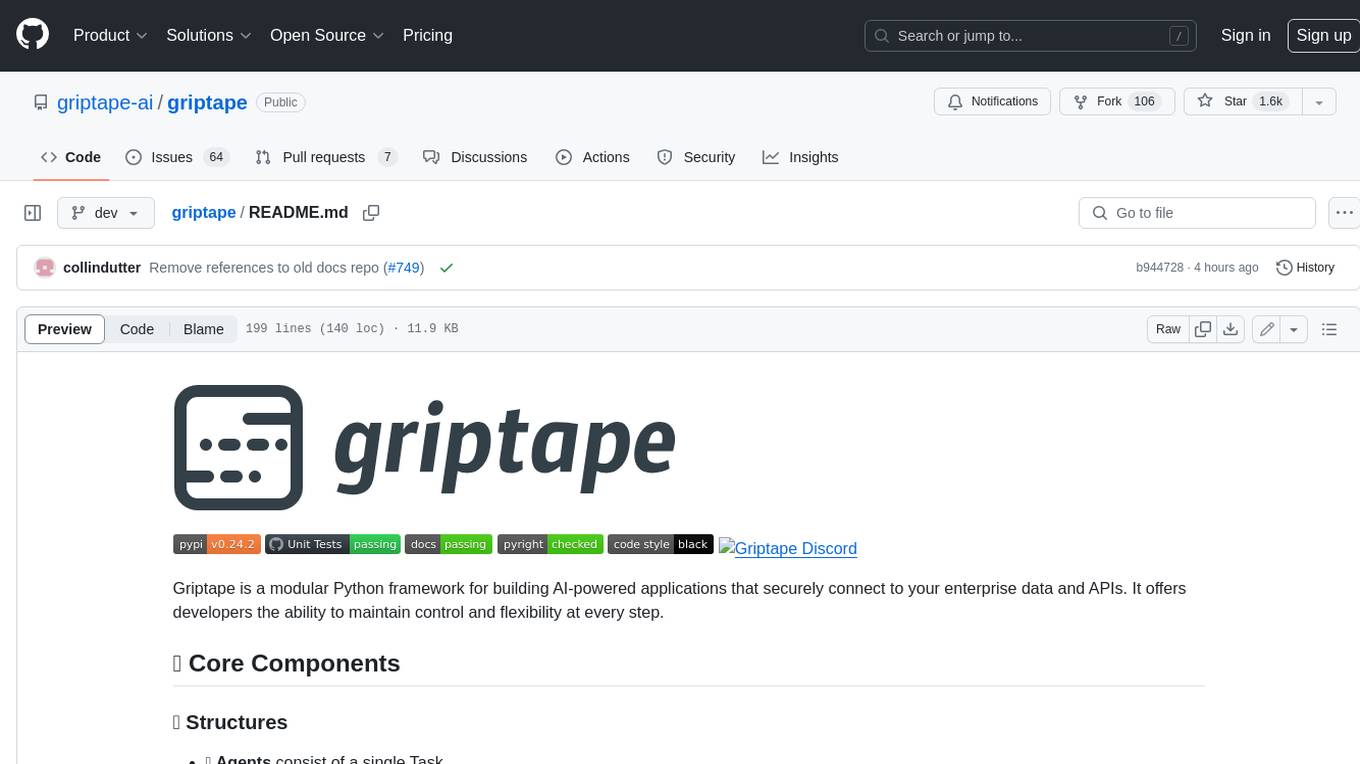
griptape
Griptape is a modular Python framework for building AI-powered applications that securely connect to your enterprise data and APIs. It offers developers the ability to maintain control and flexibility at every step. Griptape's core components include Structures (Agents, Pipelines, and Workflows), Tasks, Tools, Memory (Conversation Memory, Task Memory, and Meta Memory), Drivers (Prompt and Embedding Drivers, Vector Store Drivers, Image Generation Drivers, Image Query Drivers, SQL Drivers, Web Scraper Drivers, and Conversation Memory Drivers), Engines (Query Engines, Extraction Engines, Summary Engines, Image Generation Engines, and Image Query Engines), and additional components (Rulesets, Loaders, Artifacts, Chunkers, and Tokenizers). Griptape enables developers to create AI-powered applications with ease and efficiency.