


datachain
Analytics, Versioning and ETL for multimodal data: video, audio, PDFs, images
Stars: 2721
DataChain is a Python-based AI-data warehouse for transforming and analyzing unstructured data like images, audio, videos, text, and PDFs. It integrates with external storage to process data efficiently without duplication and manages metadata for easy querying. Use cases include ETL, analytics, versioning, and incremental processing. Key features include multimodal dataset versioning, Python-friendly operations, data enrichment, and processing. The tool allows for generating metadata using AI models, filtering, joining, and grouping datasets, and performing high-performance vectorized operations.
README:
|PyPI| |Python Version| |Codecov| |Tests| |DeepWiki|
.. |logo| image:: docs/assets/datachain.svg :height: 24 .. |PyPI| image:: https://img.shields.io/pypi/v/datachain.svg :target: https://pypi.org/project/datachain/ :alt: PyPI .. |Python Version| image:: https://img.shields.io/pypi/pyversions/datachain :target: https://pypi.org/project/datachain :alt: Python Version .. |Codecov| image:: https://codecov.io/gh/datachain-ai/datachain/graph/badge.svg?token=byliXGGyGB :target: https://codecov.io/gh/datachain-ai/datachain :alt: Codecov .. |Tests| image:: https://github.com/datachain-ai/datachain/actions/workflows/tests.yml/badge.svg :target: https://github.com/datachain-ai/datachain/actions/workflows/tests.yml :alt: Tests .. |DeepWiki| image:: https://deepwiki.com/badge.svg :target: https://deepwiki.com/datachain-ai/datachain :alt: DeepWiki



DataChain is a Python-based AI-data warehouse for transforming and analyzing unstructured data like images, audio, videos, text and PDFs. It integrates with external storage (e.g. S3) to process data efficiently without data duplication and manages metadata in an internal database for easy and efficient querying.
-
ETL. Pythonic framework for describing and running unstructured data transformations and enrichments, applying models to data, including LLMs.
-
Analytics. DataChain dataset is a table that combines all the information about data objects in one place + it provides dataframe-like API and vectorized engine to do analytics on these tables at scale.
-
Versioning. DataChain doesn't store, require moving or copying data. Perfect use case is a bucket with thousands or millions of images, videos, audio, PDFs.
-
Incremental Processing. DataChain's delta and retry features allow for efficient processing workflows:
- Delta Processing: Process only new or changed files/records
- Retry Processing: Automatically reprocess records with errors or missing results
- Combined Approach: Process new data and fix errors in a single pipeline
Visit Quick Start <https://docs.datachain.ai/quick-start>_ and Docs <https://docs.datachain.ai/>_
to get started with DataChain and learn more.
.. code:: bash
pip install datachain
Sometimes users only need to download a specific subset of files from cloud storage, rather than the entire dataset. For example, you could use a JSON file's metadata to download just cat images with high confidence scores.
.. code:: py
import datachain as dc

meta = dc.read_json("gs://datachain-demo/dogs-and-cats/*json", column="meta", anon=True)
images = dc.read_storage("gs://datachain-demo/dogs-and-cats/*jpg", anon=True)

images_id = images.map(id=lambda file: file.path.split('.')[-2])
annotated = images_id.merge(meta, on="id", right_on="meta.id")

likely_cats = annotated.filter((dc.Column("meta.inference.confidence") > 0.93) \
                               & (dc.Column("meta.inference.class_") == "cat"))
likely_cats.to_storage("high-confidence-cats/", signal="file")
This example shows how to use both delta and retry processing for efficient handling of large datasets that evolve over time and may occasionally have processing errors.
.. code:: py
import datachain as dc

def process_file(file: dc.File) -> tuple[str, str, str]:
    """Analyze a file, may occasionally fail."""
    try:
        # Your processing logic here
        content = file.read_text()
        result = content.upper()
        return content, result, ""  # No error
    except Exception as e:
        # Return an error that will trigger reprocessing next time
        return "", "", str(e)  # Error field will trigger retry

# Process files efficiently with delta and retry
# Run it many times, keep adding files, to see delta and retry in action
chain = (
    dc.read_storage(
        "data/",
        update=True,
        delta=True,              # Process only new/changed files
        delta_on="file.path",    # Identify files by path
        delta_retry="error",     # Process files with error again
    )
    .map(process_file, output=("content", "result", "error"))
    .save("processed-data")
)
In this example, we evaluate chatbot conversations stored in text files using LLM based evaluation.
.. code:: shell
$ pip install mistralai # Requires version >=1.0.0
$ export MISTRAL_API_KEY=_your_key_
Python code:
.. code:: py
import os
from mistralai import Mistral
import datachain as dc

PROMPT = "Was this dialog successful? Answer in a single word: Success or Failure."

def eval_dialogue(file: dc.File) -> bool:
     client = Mistral(api_key = os.environ["MISTRAL_API_KEY"])
     response = client.chat.complete(
         model="open-mixtral-8x22b",
         messages=[{"role": "system", "content": PROMPT},
                   {"role": "user", "content": file.read()}])
     result = response.choices[0].message.content
     return result.lower().startswith("success")

chain = (
   dc.read_storage("gs://datachain-demo/chatbot-KiT/", column="file", anon=True)
   .settings(parallel=4, cache=True)
   .map(is_success=eval_dialogue)
   .save("mistral_files")
)

successful_chain = chain.filter(dc.Column("is_success") == True)
successful_chain.to_storage("./output_mistral")

print(f"{successful_chain.count()} files were exported")
With the instruction above, the Mistral model considers 31/50 files to hold the successful dialogues:
.. code:: shell
$ ls output_mistral/datachain-demo/chatbot-KiT/
1.txt  15.txt 18.txt 2.txt  22.txt 25.txt 28.txt 33.txt 37.txt 4.txt  41.txt ...
$ ls output_mistral/datachain-demo/chatbot-KiT/ | wc -l
31
📂 Multimodal Dataset Versioning.
- Version unstructured data without moving or creating data copies, by supporting references to S3, GCP, Azure, and local file systems.
- Multimodal data support: images, video, text, PDFs, JSONs, CSVs, parquet, etc.
- Unite files and metadata together into persistent, versioned, columnar datasets.
🐍 Python-friendly.
- Operate on Python objects and object fields: float scores, strings, matrixes, LLM response objects.
- Run Python code in a high-scale, terabytes size datasets, with built-in parallelization and memory-efficient computing — no SQL or Spark required.
🧠 Data Enrichment and Processing.
- Generate metadata using local AI models and LLM APIs.
- Filter, join, and group datasets by metadata. Search by vector embeddings.
- High-performance vectorized operations on Python objects: sum, count, avg, etc.
- Pass datasets to Pytorch and Tensorflow, or export them back into storage.
Contributions are very welcome. To learn more, see the Contributor Guide_.
-
Docs <https://docs.datachain.ai/>_ -
File an issue_ if you encounter any problems -
Discord Chat <https://dvc.org/chat>_ -
Email <mailto:[email protected]>_ -
Twitter <https://twitter.com/DVCorg>_
DataChain Studio_ is a proprietary solution for teams that offers:
- Centralized dataset registry to manage data, code and dependencies in one place.
- Data Lineage for data sources as well as derivative dataset.
- UI for Multimodal Data like images, videos, and PDFs.
- Scalable Compute to handle large datasets (100M+ files) and in-house AI model inference.
- Access control including SSO and team based collaboration.
.. _PyPI: https://pypi.org/ .. _file an issue: https://github.com/datachain-ai/datachain/issues .. github-only .. _Contributor Guide: https://docs.datachain.ai/contributing .. _Pydantic: https://github.com/pydantic/pydantic .. _publicly available: https://radar.kit.edu/radar/en/dataset/FdJmclKpjHzLfExE.ExpBot%2B-%2BA%2Bdataset%2Bof%2B79%2Bdialogs%2Bwith%2Ban%2Bexperimental%2Bcustomer%2Bservice%2Bchatbot .. _SQLite: https://www.sqlite.org/ .. _Getting Started: https://docs.datachain.ai/ .. _DataChain Studio: https://studio.datachain.ai/
For Tasks:
Click tags to check more tools for each tasksFor Jobs:
Alternative AI tools for datachain
Similar Open Source Tools
datachain
DataChain is a Python-based AI-data warehouse for transforming and analyzing unstructured data like images, audio, videos, text, and PDFs. It integrates with external storage to process data efficiently without duplication and manages metadata for easy querying. Use cases include ETL, analytics, versioning, and incremental processing. Key features include multimodal dataset versioning, Python-friendly operations, data enrichment, and processing. The tool allows for generating metadata using AI models, filtering, joining, and grouping datasets, and performing high-performance vectorized operations.
datachain
DataChain is an open-source Python library for processing and curating unstructured data at scale. It supports AI-driven data curation using local ML models and LLM APIs, handles large datasets, and is Python-friendly with Pydantic objects. It excels at optimizing batch operations and is designed for offline data processing, curation, and ETL. Typical use cases include Computer Vision data curation, LLM analytics, and validation.
redisvl
Redis Vector Library (RedisVL) is a Python client library for building AI applications on top of Redis. It provides a high-level interface for managing vector indexes, performing vector search, and integrating with popular embedding models and providers. RedisVL is designed to make it easy for developers to build and deploy AI applications that leverage the speed, flexibility, and reliability of Redis.
req_llm
ReqLLM is a Req-based library for LLM interactions, offering a unified interface to AI providers through a plugin-based architecture. It brings composability and middleware advantages to LLM interactions, with features like auto-synced providers/models, typed data structures, ergonomic helpers, streaming capabilities, usage & cost extraction, and a plugin-based provider system. Users can easily generate text, structured data, embeddings, and track usage costs. The tool supports various AI providers like Anthropic, OpenAI, Groq, Google, and xAI, and allows for easy addition of new providers. ReqLLM also provides API key management, detailed documentation, and a roadmap for future enhancements.
continuous-eval
Open-Source Evaluation for LLM Applications. `continuous-eval` is an open-source package created for granular and holistic evaluation of GenAI application pipelines. It offers modularized evaluation, a comprehensive metric library covering various LLM use cases, the ability to leverage user feedback in evaluation, and synthetic dataset generation for testing pipelines. Users can define their own metrics by extending the Metric class. The tool allows running evaluation on a pipeline defined with modules and corresponding metrics. Additionally, it provides synthetic data generation capabilities to create user interaction data for evaluation or training purposes.

litdata
LitData is a tool designed for blazingly fast, distributed streaming of training data from any cloud storage. It allows users to transform and optimize data in cloud storage environments efficiently and intuitively, supporting various data types like images, text, video, audio, geo-spatial, and multimodal data. LitData integrates smoothly with frameworks such as LitGPT and PyTorch, enabling seamless streaming of data to multiple machines. Key features include multi-GPU/multi-node support, easy data mixing, pause & resume functionality, support for profiling, memory footprint reduction, cache size configuration, and on-prem optimizations. The tool also provides benchmarks for measuring streaming speed and conversion efficiency, along with runnable templates for different data types. LitData enables infinite cloud data processing by utilizing the Lightning.ai platform to scale data processing with optimized machines.
lionagi
LionAGI is a robust framework for orchestrating multi-step AI operations with precise control. It allows users to bring together multiple models, advanced reasoning, tool integrations, and custom validations in a single coherent pipeline. The framework is structured, expandable, controlled, and transparent, offering features like real-time logging, message introspection, and tool usage tracking. LionAGI supports advanced multi-step reasoning with ReAct, integrates with Anthropic's Model Context Protocol, and provides observability and debugging tools. Users can seamlessly orchestrate multiple models, integrate with Claude Code CLI SDK, and leverage a fan-out fan-in pattern for orchestration. The framework also offers optional dependencies for additional functionalities like reader tools, local inference support, rich output formatting, database support, and graph visualization.
agentpress
AgentPress is a collection of simple but powerful utilities that serve as building blocks for creating AI agents. It includes core components for managing threads, registering tools, processing responses, state management, and utilizing LLMs. The tool provides a modular architecture for handling messages, LLM API calls, response processing, tool execution, and results management. Users can easily set up the environment, create custom tools with OpenAPI or XML schema, and manage conversation threads with real-time interaction. AgentPress aims to be agnostic, simple, and flexible, allowing users to customize and extend functionalities as needed.
pixeltable
Pixeltable is a Python library designed for ML Engineers and Data Scientists to focus on exploration, modeling, and app development without the need to handle data plumbing. It provides a declarative interface for working with text, images, embeddings, and video, enabling users to store, transform, index, and iterate on data within a single table interface. Pixeltable is persistent, acting as a database unlike in-memory Python libraries such as Pandas. It offers features like data storage and versioning, combined data and model lineage, indexing, orchestration of multimodal workloads, incremental updates, and automatic production-ready code generation. The tool emphasizes transparency, reproducibility, cost-saving through incremental data changes, and seamless integration with existing Python code and libraries.
ShannonBase
ShannonBase is a HTAP database provided by Shannon Data AI, designed for big data and AI. It extends MySQL with native embedding support, machine learning capabilities, a JavaScript engine, and a columnar storage engine. ShannonBase supports multimodal data types and natively integrates LightGBM for training and prediction. It leverages embedding algorithms and vector data type for ML/RAG tasks, providing Zero Data Movement, Native Performance Optimization, and Seamless SQL Integration. The tool includes a lightweight JavaScript engine for writing stored procedures in SQL or JavaScript.

rl
TorchRL is an open-source Reinforcement Learning (RL) library for PyTorch. It provides pytorch and **python-first** , low and high level abstractions for RL that are intended to be **efficient** , **modular** , **documented** and properly **tested**. The code is aimed at supporting research in RL. Most of it is written in python in a highly modular way, such that researchers can easily swap components, transform them or write new ones with little effort.
curator
Bespoke Curator is an open-source tool for data curation and structured data extraction. It provides a Python library for generating synthetic data at scale, with features like programmability, performance optimization, caching, and integration with HuggingFace Datasets. The tool includes a Curator Viewer for dataset visualization and offers a rich set of functionalities for creating and refining data generation strategies.
GraphRAG-SDK
Build fast and accurate GenAI applications with GraphRAG SDK, a specialized toolkit for building Graph Retrieval-Augmented Generation (GraphRAG) systems. It integrates knowledge graphs, ontology management, and state-of-the-art LLMs to deliver accurate, efficient, and customizable RAG workflows. The SDK simplifies the development process by automating ontology creation, knowledge graph agent creation, and query handling, enabling users to interact and query their knowledge graphs effectively. It supports multi-agent systems and orchestrates agents specialized in different domains. The SDK is optimized for FalkorDB, ensuring high performance and scalability for large-scale applications. By leveraging knowledge graphs, it enables semantic relationships and ontology-driven queries that go beyond standard vector similarity, enhancing retrieval-augmented generation capabilities.
volga
Volga is a general purpose real-time data processing engine in Python for modern AI/ML systems. It aims to be a Python-native alternative to Flink/Spark Streaming with extended functionality for real-time AI/ML workloads. It provides a hybrid push+pull architecture, Entity API for defining data entities and feature pipelines, DataStream API for general data processing, and customizable data connectors. Volga can run on a laptop or a distributed cluster, making it suitable for building custom real-time AI/ML feature platforms or general data pipelines without relying on third-party platforms.
go-utcp
The Universal Tool Calling Protocol (UTCP) is a modern, flexible, and scalable standard for defining and interacting with tools across various communication protocols. It emphasizes scalability, interoperability, and ease of use. It provides built-in transports for HTTP, CLI, Server-Sent Events, streaming HTTP, GraphQL, MCP, and UDP. Users can use the library to construct a client and call tools using the available transports. The library also includes utilities for variable substitution, in-memory repository for storing providers and tools, and OpenAPI conversion to UTCP manuals.
instructor
Instructor is a tool that provides structured outputs from Large Language Models (LLMs) in a reliable manner. It simplifies the process of extracting structured data by utilizing Pydantic for validation, type safety, and IDE support. With Instructor, users can define models and easily obtain structured data without the need for complex JSON parsing, error handling, or retries. The tool supports automatic retries, streaming support, and extraction of nested objects, making it production-ready for various AI applications. Trusted by a large community of developers and companies, Instructor is used by teams at OpenAI, Google, Microsoft, AWS, and YC startups.
For similar tasks

HPT
Hyper-Pretrained Transformers (HPT) is a novel multimodal LLM framework from HyperGAI, trained for vision-language models capable of understanding both textual and visual inputs. The repository contains the open-source implementation of inference code to reproduce the evaluation results of HPT Air on different benchmarks. HPT has achieved competitive results with state-of-the-art models on various multimodal LLM benchmarks. It offers models like HPT 1.5 Air and HPT 1.0 Air, providing efficient solutions for vision-and-language tasks.
learnopencv
LearnOpenCV is a repository containing code for Computer Vision, Deep learning, and AI research articles shared on the blog LearnOpenCV.com. It serves as a resource for individuals looking to enhance their expertise in AI through various courses offered by OpenCV. The repository includes a wide range of topics such as image inpainting, instance segmentation, robotics, deep learning models, and more, providing practical implementations and code examples for readers to explore and learn from.
spark-free-api
Spark AI Free 服务 provides high-speed streaming output, multi-turn dialogue support, AI drawing support, long document interpretation, and image parsing. It offers zero-configuration deployment, multi-token support, and automatic session trace cleaning. It is fully compatible with the ChatGPT interface. The repository includes multiple free-api projects for various AI services. Users can access the API for tasks such as chat completions, AI drawing, document interpretation, image analysis, and ssoSessionId live checking. The project also provides guidelines for deployment using Docker, Docker-compose, Render, Vercel, and native deployment methods. It recommends using custom clients for faster and simpler access to the free-api series projects.
mlx-vlm
MLX-VLM is a package designed for running Vision LLMs on Mac systems using MLX. It provides a convenient way to install and utilize the package for processing large language models related to vision tasks. The tool simplifies the process of running LLMs on Mac computers, offering a seamless experience for users interested in leveraging MLX for vision-related projects.
clarifai-python-grpc
This is the official Clarifai gRPC Python client for interacting with their recognition API. Clarifai offers a platform for data scientists, developers, researchers, and enterprises to utilize artificial intelligence for image, video, and text analysis through computer vision and natural language processing. The client allows users to authenticate, predict concepts in images, and access various functionalities provided by the Clarifai API. It follows a versioning scheme that aligns with the backend API updates and includes specific instructions for installation and troubleshooting. Users can explore the Clarifai demo, sign up for an account, and refer to the documentation for detailed information.
horde-worker-reGen
This repository provides the latest implementation for the AI Horde Worker, allowing users to utilize their graphics card(s) to generate, post-process, or analyze images for others. It offers a platform where users can create images and earn 'kudos' in return, granting priority for their own image generations. The repository includes important details for setup, recommendations for system configurations, instructions for installation on Windows and Linux, basic usage guidelines, and information on updating the AI Horde Worker. Users can also run the worker with multiple GPUs and receive notifications for updates through Discord. Additionally, the repository contains models that are licensed under the CreativeML OpenRAIL License.
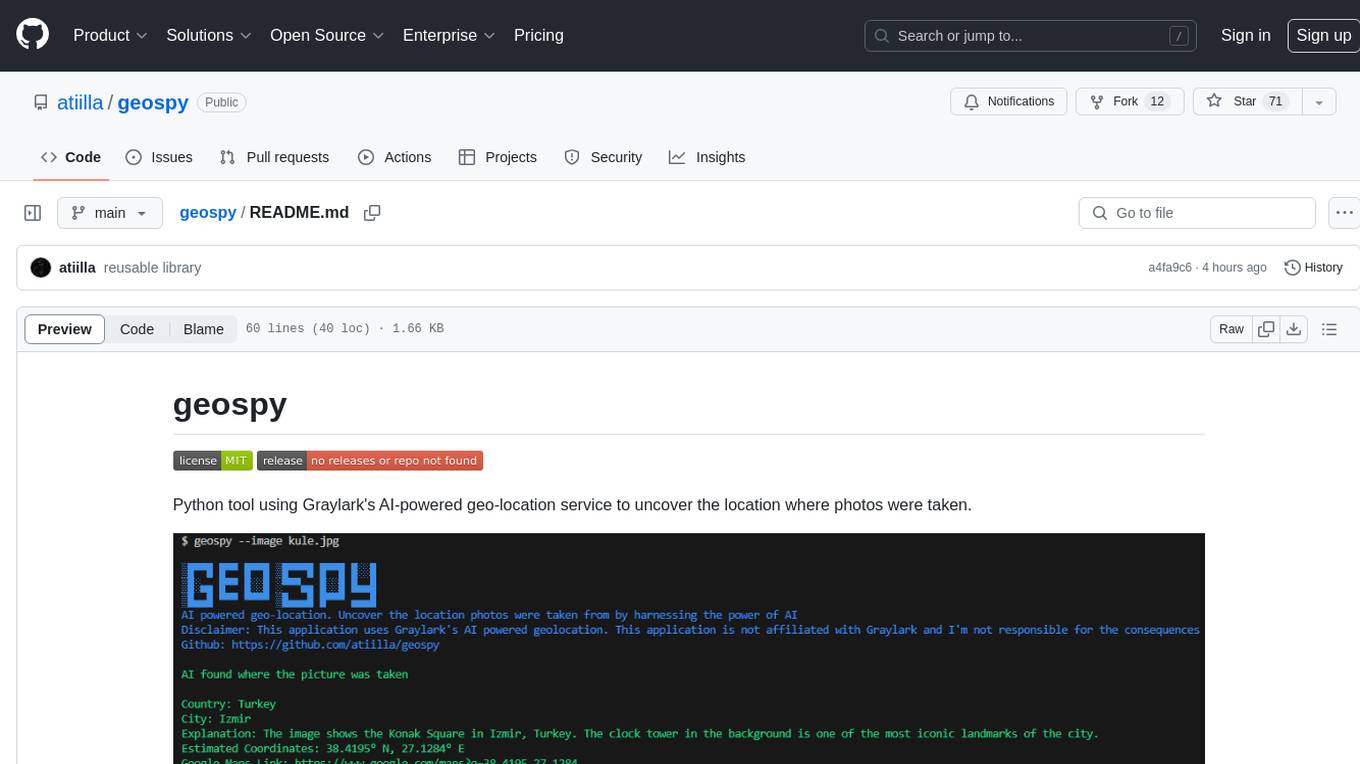
geospy
Geospy is a Python tool that utilizes Graylark's AI-powered geolocation service to determine the location where photos were taken. It allows users to analyze images and retrieve information such as country, city, explanation, coordinates, and Google Maps links. The tool provides a seamless way to integrate geolocation services into various projects and applications.
Awesome-Colorful-LLM
Awesome-Colorful-LLM is a meticulously assembled anthology of vibrant multimodal research focusing on advancements propelled by large language models (LLMs) in domains such as Vision, Audio, Agent, Robotics, and Fundamental Sciences like Mathematics. The repository contains curated collections of works, datasets, benchmarks, projects, and tools related to LLMs and multimodal learning. It serves as a comprehensive resource for researchers and practitioners interested in exploring the intersection of language models and various modalities for tasks like image understanding, video pretraining, 3D modeling, document understanding, audio analysis, agent learning, robotic applications, and mathematical research.
For similar jobs
weave
Weave is a toolkit for developing Generative AI applications, built by Weights & Biases. With Weave, you can log and debug language model inputs, outputs, and traces; build rigorous, apples-to-apples evaluations for language model use cases; and organize all the information generated across the LLM workflow, from experimentation to evaluations to production. Weave aims to bring rigor, best-practices, and composability to the inherently experimental process of developing Generative AI software, without introducing cognitive overhead.
LLMStack
LLMStack is a no-code platform for building generative AI agents, workflows, and chatbots. It allows users to connect their own data, internal tools, and GPT-powered models without any coding experience. LLMStack can be deployed to the cloud or on-premise and can be accessed via HTTP API or triggered from Slack or Discord.
VisionCraft
The VisionCraft API is a free API for using over 100 different AI models. From images to sound.
kaito
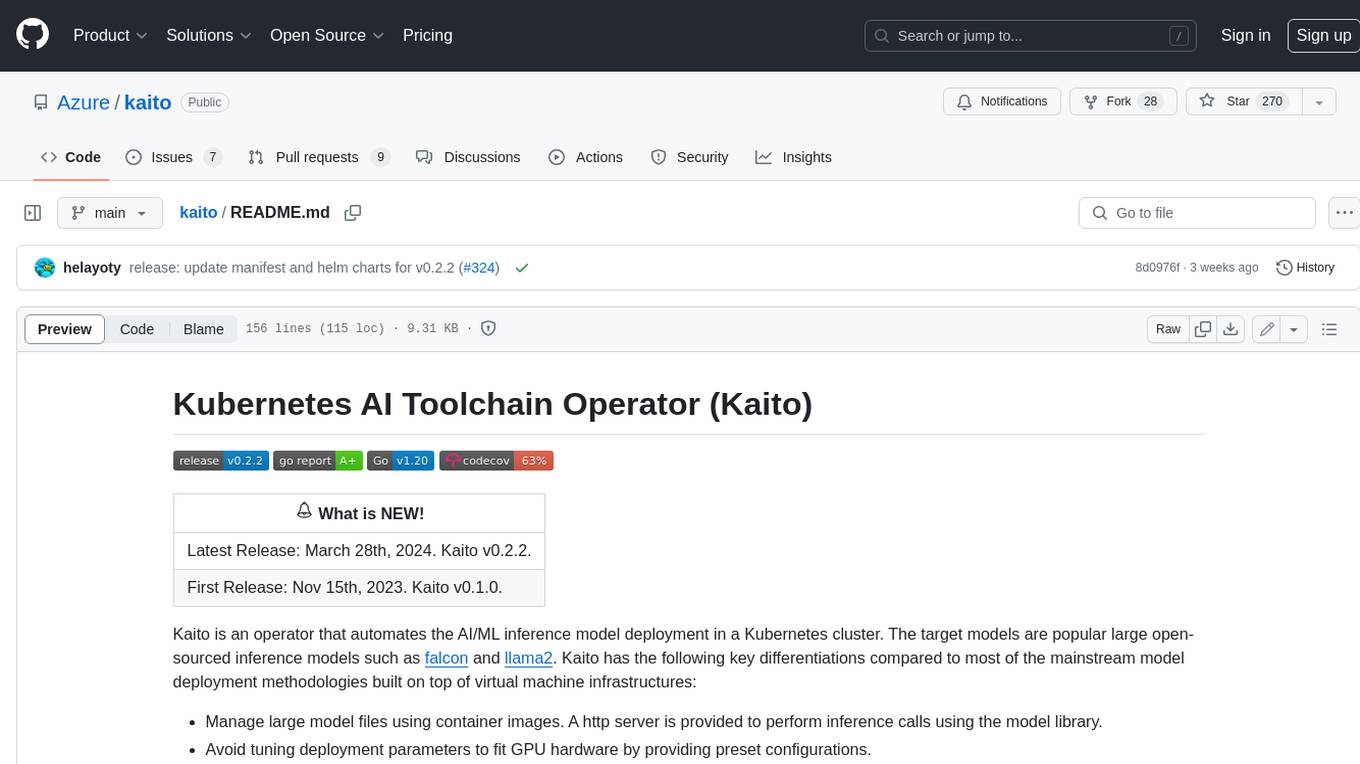
Kaito is an operator that automates the AI/ML inference model deployment in a Kubernetes cluster. It manages large model files using container images, avoids tuning deployment parameters to fit GPU hardware by providing preset configurations, auto-provisions GPU nodes based on model requirements, and hosts large model images in the public Microsoft Container Registry (MCR) if the license allows. Using Kaito, the workflow of onboarding large AI inference models in Kubernetes is largely simplified.
PyRIT
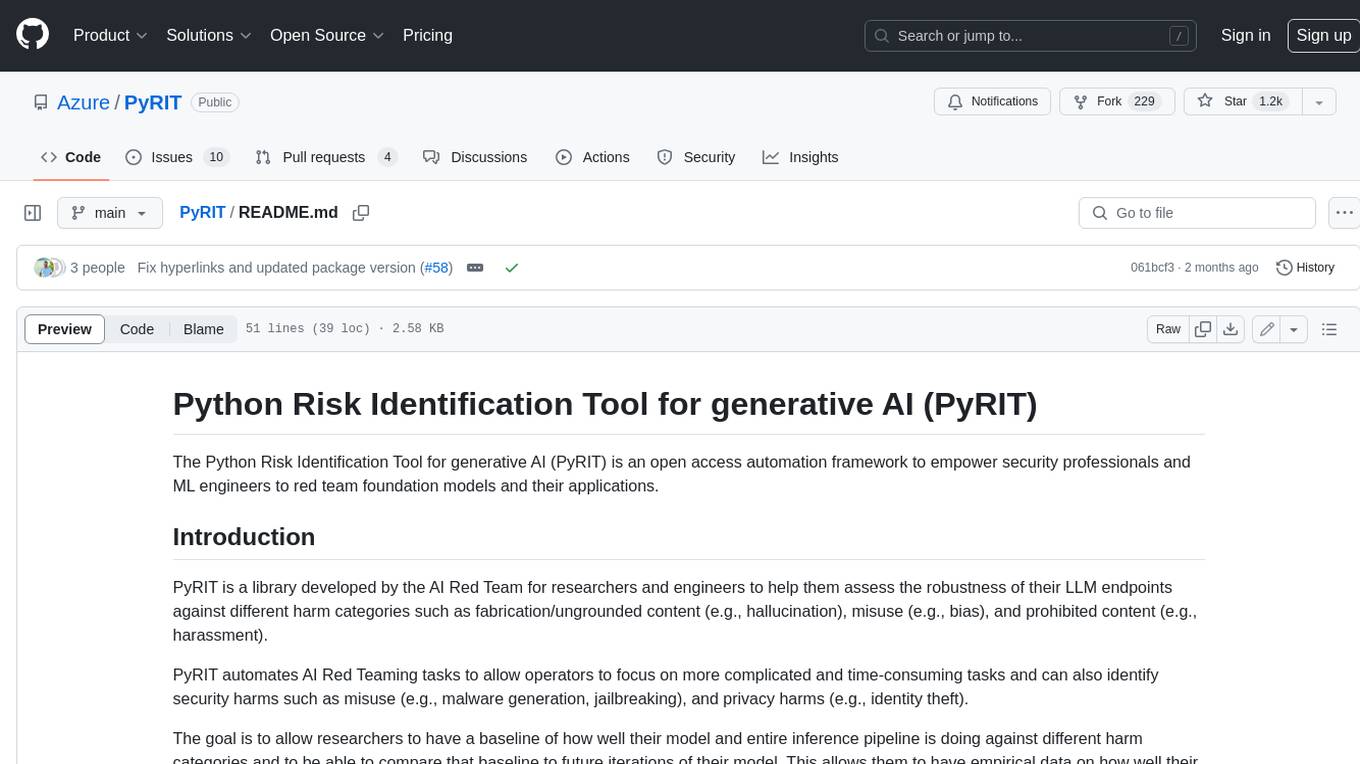
PyRIT is an open access automation framework designed to empower security professionals and ML engineers to red team foundation models and their applications. It automates AI Red Teaming tasks to allow operators to focus on more complicated and time-consuming tasks and can also identify security harms such as misuse (e.g., malware generation, jailbreaking), and privacy harms (e.g., identity theft). The goal is to allow researchers to have a baseline of how well their model and entire inference pipeline is doing against different harm categories and to be able to compare that baseline to future iterations of their model. This allows them to have empirical data on how well their model is doing today, and detect any degradation of performance based on future improvements.
tabby
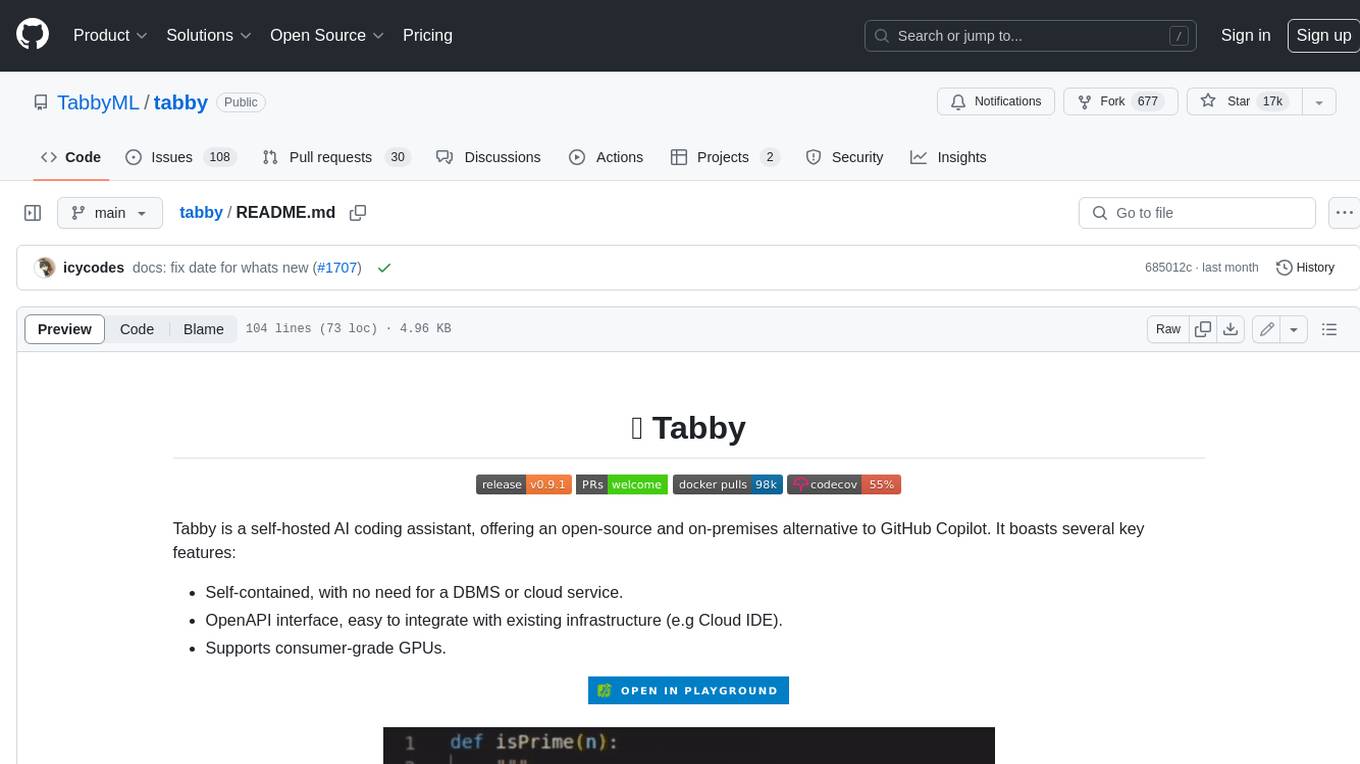
Tabby is a self-hosted AI coding assistant, offering an open-source and on-premises alternative to GitHub Copilot. It boasts several key features: * Self-contained, with no need for a DBMS or cloud service. * OpenAPI interface, easy to integrate with existing infrastructure (e.g Cloud IDE). * Supports consumer-grade GPUs.
spear
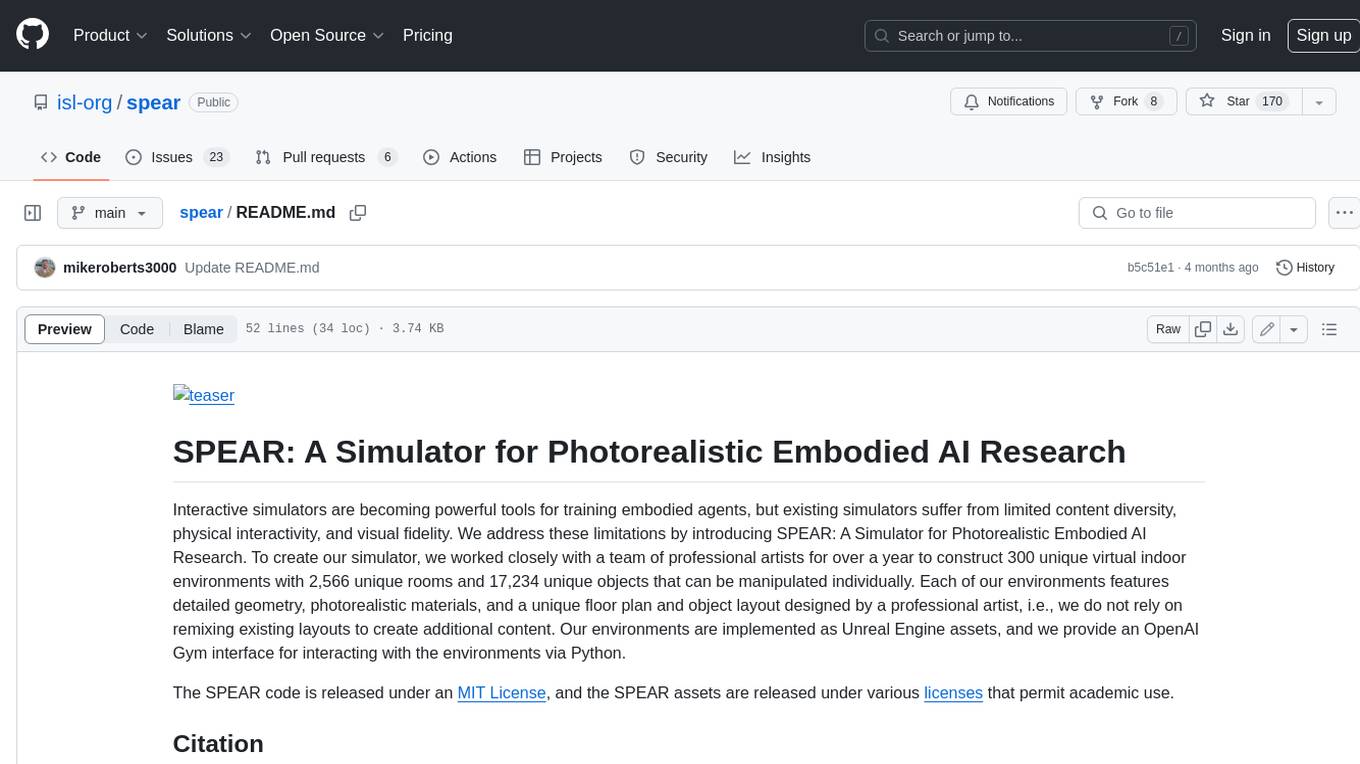
SPEAR (Simulator for Photorealistic Embodied AI Research) is a powerful tool for training embodied agents. It features 300 unique virtual indoor environments with 2,566 unique rooms and 17,234 unique objects that can be manipulated individually. Each environment is designed by a professional artist and features detailed geometry, photorealistic materials, and a unique floor plan and object layout. SPEAR is implemented as Unreal Engine assets and provides an OpenAI Gym interface for interacting with the environments via Python.
Magick
Magick is a groundbreaking visual AIDE (Artificial Intelligence Development Environment) for no-code data pipelines and multimodal agents. Magick can connect to other services and comes with nodes and templates well-suited for intelligent agents, chatbots, complex reasoning systems and realistic characters.