


lionagi
AGI SDK
Stars: 382
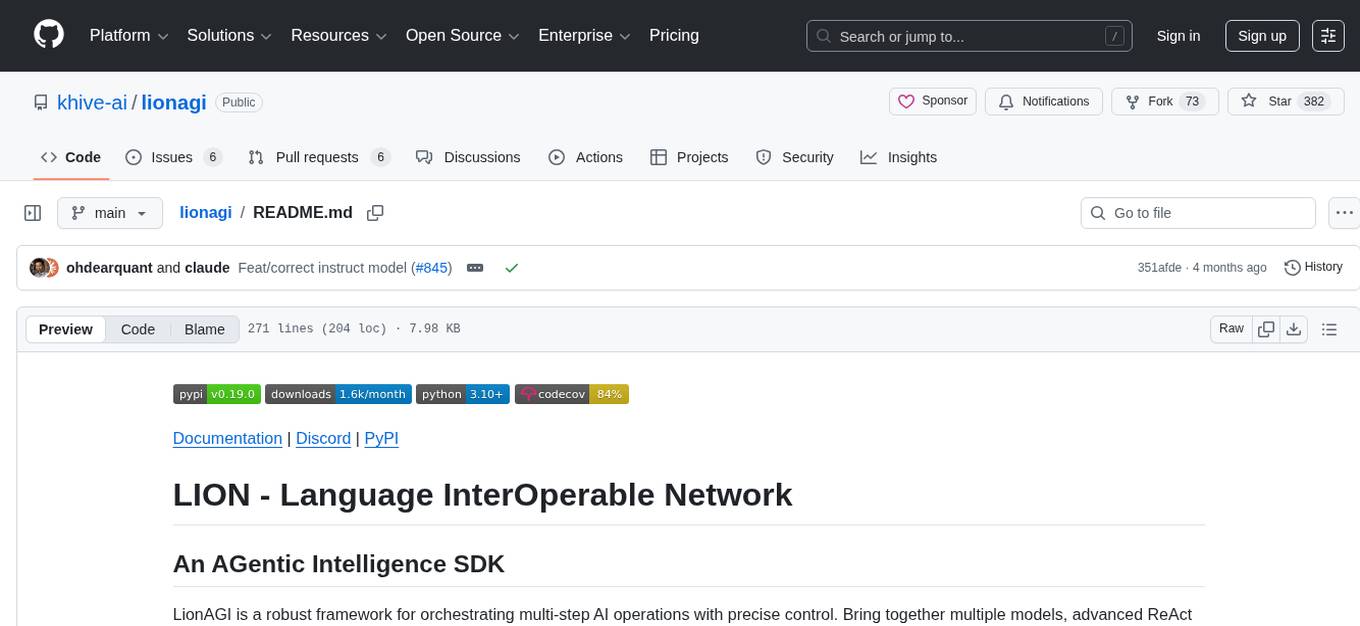
LionAGI is a robust framework for orchestrating multi-step AI operations with precise control. It allows users to bring together multiple models, advanced reasoning, tool integrations, and custom validations in a single coherent pipeline. The framework is structured, expandable, controlled, and transparent, offering features like real-time logging, message introspection, and tool usage tracking. LionAGI supports advanced multi-step reasoning with ReAct, integrates with Anthropic's Model Context Protocol, and provides observability and debugging tools. Users can seamlessly orchestrate multiple models, integrate with Claude Code CLI SDK, and leverage a fan-out fan-in pattern for orchestration. The framework also offers optional dependencies for additional functionalities like reader tools, local inference support, rich output formatting, database support, and graph visualization.
README:




Documentation | Discord | PyPI
LionAGI is a robust framework for orchestrating multi-step AI operations with precise control. Bring together multiple models, advanced ReAct reasoning, tool integrations, and custom validations in a single coherent pipeline.
- Structured: Validate and type all LLM interactions with Pydantic.
- Expandable: Integrate multiple providers (OpenAI, Anthropic, Perplexity, custom) with minimal friction.
- Controlled: Use built-in safety checks, concurrency strategies, and advanced multi-step flows like ReAct.
- Transparent: Debug easily with real-time logging, message introspection, and tool usage tracking.
uv add lionagi  # recommended to use pyproject and uv for dependency management

pip install lionagi # or install directly
from lionagi import Branch, iModel

# Pick a model
gpt4o = iModel(provider="openai", model="gpt-4o-mini")

# Create a Branch (conversation context)
hunter = Branch(
  system="you are a hilarious dragon hunter who responds in 10 words rhymes.",
  chat_model=gpt4o,
)

# Communicate asynchronously
response = await hunter.communicate("I am a dragon")
print(response)
You claim to be a dragon, oh what a braggin'!
Use Pydantic to keep outputs structured:
from pydantic import BaseModel

class Joke(BaseModel):
    joke: str

res = await hunter.operate(
    instruction="Tell me a short dragon joke",
    response_format=Joke
)
print(type(res))
print(res.joke)
<class '__main__.Joke'>
With fiery claws, dragons hide their laughter flaws!
LionAGI supports advanced multi-step reasoning with ReAct. Tools let the LLM invoke external actions:
pip install "lionagi[reader]"
from lionagi.tools.types import ReaderTool

# Define model first
gpt4o = iModel(provider="openai", model="gpt-4o-mini")

branch = Branch(chat_model=gpt4o, tools=[ReaderTool])
result = await branch.ReAct(
    instruct={
      "instruction": "Summarize my PDF and compare with relevant papers.",
      "context": {"paper_file_path": "/path/to/paper.pdf"},
    },
    extension_allowed=True,     # allow multi-round expansions
    max_extensions=5,
    verbose=True,      # see step-by-step chain-of-thought
)
print(result)
The LLM can now open the PDF, read in slices, fetch references, and produce a final structured summary.
LionAGI supports Anthropic's Model Context Protocol for seamless tool integration:
pip install "lionagi[mcp]"
from lionagi import load_mcp_tools

# Load tools from any MCP server
tools = await load_mcp_tools(".mcp.json", ["search", "memory"])

# Use with ReAct reasoning
branch = Branch(chat_model=gpt4o, tools=tools)
result = await branch.ReAct(
    instruct={"instruction": "Research recent AI developments"},
    tools=["search_exa_search"],
    max_extensions=3
)- Dynamic Discovery: Auto-discover and register tools from MCP servers
- Type Safety: Full Pydantic validation for tool interactions
- Connection Pooling: Efficient resource management with automatic reuse
- Inspect messages:
df = branch.to_df()
print(df.tail())- Action logs show each tool call, arguments, and outcomes.
- Verbose ReAct provides chain-of-thought analysis (helpful for debugging multi-step flows).
from lionagi import Branch, iModel

# Define models for multi-model orchestration
gpt4o = iModel(provider="openai", model="gpt-4o-mini")
sonnet = iModel(
  provider="anthropic",
  model="claude-3-5-sonnet-20241022",
  max_tokens=1000,                    # max_tokens is required for anthropic models
)

branch = Branch(chat_model=gpt4o)
analysis = await branch.communicate("Analyze these stats", chat_model=sonnet) # Switch mid-flow
Seamlessly route to different models in the same workflow.
LionAGI now supports Anthropic's Claude Code CLI SDK enabling autonomous coding capabilities with persistent session management. The CLI endpoint
directly connects to claude code, and is recommended, you can either use it via a proxy server or directly with query_cli endpoint, provided you have already logged onto claude code cli in your terminal.
from lionagi import iModel, Branch

def create_cc_model():
  return iModel(
      provider="claude_code",
      endpoint="query_cli",
      model="sonnet",
      verbose_output=True,  # Enable detailed output for debugging
  )

# Start a coding session
orchestrator = Branch(chat_model=create_cc_model())
response = await orchestrator.communicate("Explain the architecture of protocols, operations, and branch")

# continue the session with more queries
response2 = await orchestrator.communicate("how do these parts form lionagi system")# use structured outputs with claude code
from lionagi.fields import LIST_INSTRUCT_FIELD_MODEL, Instruct
response3 = await orchestrator.operate(
instruct=Instruct(
instruction="create 4 research questions for parallel discovery",
guidance="put into `instruct_model` field as part of your structured result message",
context="I'd like to create an orchestration system for AI agents using lionagi"
),
field_models=[LIST_INSTRUCT_FIELD_MODEL],
)
len(response3.instruct_model) # should be 4
async def handle_instruct(instruct):
sub_branch = Branch(
system="You are an diligent research expert.",
chat_model=create_cc_model(),
)
return await sub_branch.operate(instruct=instruct)
# run in parallel across all instruct models
from lionagi.ln import alcall
responses = await alcall(response3.instruct_model, handle_instruct)
# now hand these reports back to the orchestrator
final_response = await orchestrator.communicate(
"please synthesize these research findings into a final report",
context=responses,
)Key features:
- Auto-Resume Sessions: Conversations automatically continue from where they left off
- Tool Permissions: Fine-grained control over which tools Claude can access
- Streaming Support: Real-time feedback during code generation
- Seamless Integration: Works with existing LionAGI workflows
"lionagi[reader]" - Reader tool for any unstructured data and web pages
"lionagi[ollama]" - Ollama model support for local inference
"lionagi[rich]" - Rich output formatting for better console display
"lionagi[schema]" - Convert pydantic schema to make the Model class persistent
"lionagi[postgres]" - Postgres database support for storing and retrieving structured data
"lionagi[graph]" - Graph display for visualizing complex workflows
"lionagi[sqlite]" - SQLite database support for lightweight data storage (also need `postgres` option)
We welcome issues, ideas, and pull requests:
- Discord: Join to chat or get help
- Issues / PRs: GitHub
@software{Li_LionAGI_2023,
  author = {Haiyang Li},
  month = {12},
  year = {2023},
  title = {LionAGI: Towards Automated General Intelligence},
  url = {https://github.com/lion-agi/lionagi},
}
🦁 LionAGI
Because real AI orchestration demands more than a single prompt. Try it out and discover the next evolution in structured, multi-model, safe AI.
For Tasks:
Click tags to check more tools for each tasksFor Jobs:
Alternative AI tools for lionagi
Similar Open Source Tools
lionagi
LionAGI is a robust framework for orchestrating multi-step AI operations with precise control. It allows users to bring together multiple models, advanced reasoning, tool integrations, and custom validations in a single coherent pipeline. The framework is structured, expandable, controlled, and transparent, offering features like real-time logging, message introspection, and tool usage tracking. LionAGI supports advanced multi-step reasoning with ReAct, integrates with Anthropic's Model Context Protocol, and provides observability and debugging tools. Users can seamlessly orchestrate multiple models, integrate with Claude Code CLI SDK, and leverage a fan-out fan-in pattern for orchestration. The framework also offers optional dependencies for additional functionalities like reader tools, local inference support, rich output formatting, database support, and graph visualization.
lionagi
LionAGI is a powerful intelligent workflow automation framework that introduces advanced ML models into any existing workflows and data infrastructure. It can interact with almost any model, run interactions in parallel for most models, produce structured pydantic outputs with flexible usage, automate workflow via graph based agents, use advanced prompting techniques, and more. LionAGI aims to provide a centralized agent-managed framework for "ML-powered tools coordination" and to dramatically lower the barrier of entries for creating use-case/domain specific tools. It is designed to be asynchronous only and requires Python 3.10 or higher.
GraphRAG-SDK
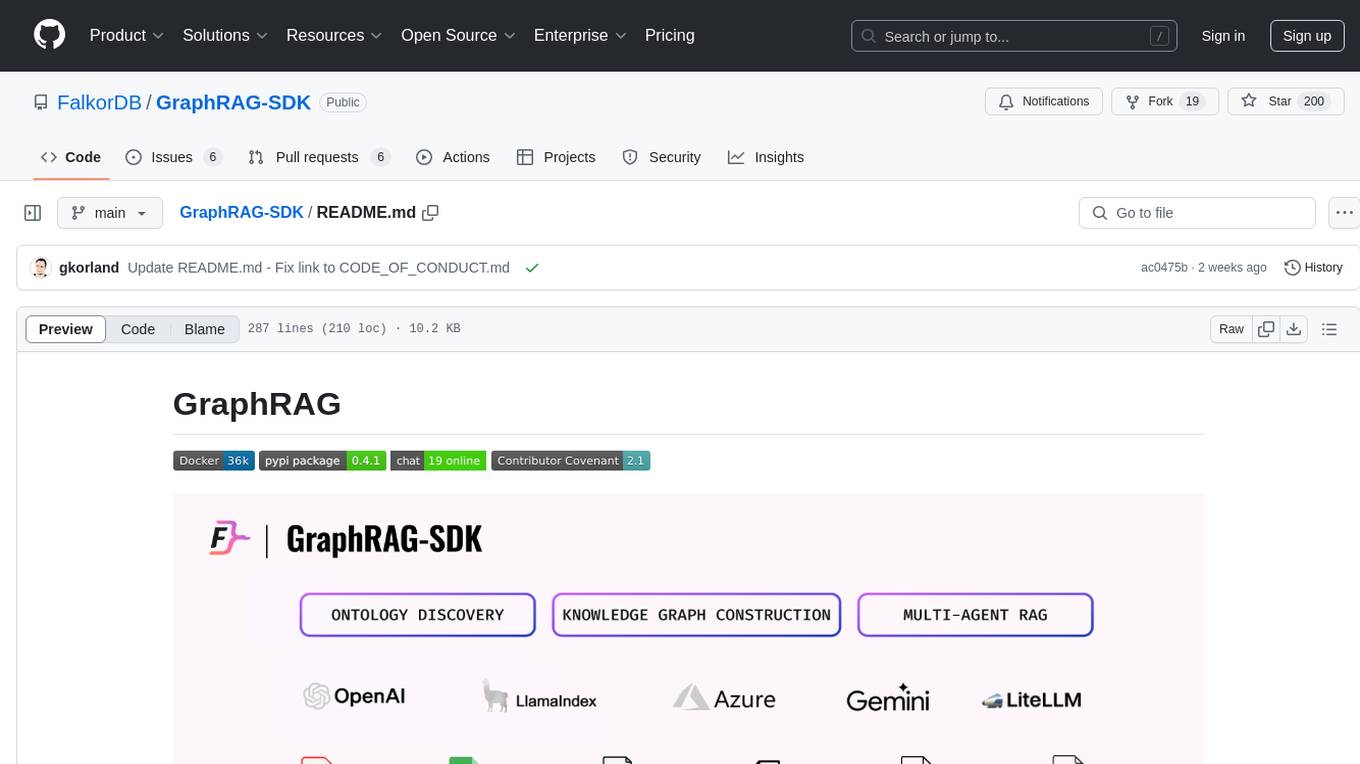
Build fast and accurate GenAI applications with GraphRAG SDK, a specialized toolkit for building Graph Retrieval-Augmented Generation (GraphRAG) systems. It integrates knowledge graphs, ontology management, and state-of-the-art LLMs to deliver accurate, efficient, and customizable RAG workflows. The SDK simplifies the development process by automating ontology creation, knowledge graph agent creation, and query handling, enabling users to interact and query their knowledge graphs effectively. It supports multi-agent systems and orchestrates agents specialized in different domains. The SDK is optimized for FalkorDB, ensuring high performance and scalability for large-scale applications. By leveraging knowledge graphs, it enables semantic relationships and ontology-driven queries that go beyond standard vector similarity, enhancing retrieval-augmented generation capabilities.
req_llm
ReqLLM is a Req-based library for LLM interactions, offering a unified interface to AI providers through a plugin-based architecture. It brings composability and middleware advantages to LLM interactions, with features like auto-synced providers/models, typed data structures, ergonomic helpers, streaming capabilities, usage & cost extraction, and a plugin-based provider system. Users can easily generate text, structured data, embeddings, and track usage costs. The tool supports various AI providers like Anthropic, OpenAI, Groq, Google, and xAI, and allows for easy addition of new providers. ReqLLM also provides API key management, detailed documentation, and a roadmap for future enhancements.
flow-prompt
Flow Prompt is a dynamic library for managing and optimizing prompts for large language models. It facilitates budget-aware operations, dynamic data integration, and efficient load distribution. Features include CI/CD testing, dynamic prompt development, multi-model support, real-time insights, and prompt testing and evolution.

rl
TorchRL is an open-source Reinforcement Learning (RL) library for PyTorch. It provides pytorch and **python-first** , low and high level abstractions for RL that are intended to be **efficient** , **modular** , **documented** and properly **tested**. The code is aimed at supporting research in RL. Most of it is written in python in a highly modular way, such that researchers can easily swap components, transform them or write new ones with little effort.
SimplerLLM
SimplerLLM is an open-source Python library that simplifies interactions with Large Language Models (LLMs) for researchers and beginners. It provides a unified interface for different LLM providers, tools for enhancing language model capabilities, and easy development of AI-powered tools and apps. The library offers features like unified LLM interface, generic text loader, RapidAPI connector, SERP integration, prompt template builder, and more. Users can easily set up environment variables, create LLM instances, use tools like SERP, generic text loader, calling RapidAPI APIs, and prompt template builder. Additionally, the library includes chunking functions to split texts into manageable chunks based on different criteria. Future updates will bring more tools, interactions with local LLMs, prompt optimization, response evaluation, GPT Trainer, document chunker, advanced document loader, integration with more providers, Simple RAG with SimplerVectors, integration with vector databases, agent builder, and LLM server.
agentpress
AgentPress is a collection of simple but powerful utilities that serve as building blocks for creating AI agents. It includes core components for managing threads, registering tools, processing responses, state management, and utilizing LLMs. The tool provides a modular architecture for handling messages, LLM API calls, response processing, tool execution, and results management. Users can easily set up the environment, create custom tools with OpenAPI or XML schema, and manage conversation threads with real-time interaction. AgentPress aims to be agnostic, simple, and flexible, allowing users to customize and extend functionalities as needed.
sdk-python
Strands Agents is a lightweight and flexible SDK that takes a model-driven approach to building and running AI agents. It supports various model providers, offers advanced capabilities like multi-agent systems and streaming support, and comes with built-in MCP server support. Users can easily create tools using Python decorators, integrate MCP servers seamlessly, and leverage multiple model providers for different AI tasks. The SDK is designed to scale from simple conversational assistants to complex autonomous workflows, making it suitable for a wide range of AI development needs.
curator
Bespoke Curator is an open-source tool for data curation and structured data extraction. It provides a Python library for generating synthetic data at scale, with features like programmability, performance optimization, caching, and integration with HuggingFace Datasets. The tool includes a Curator Viewer for dataset visualization and offers a rich set of functionalities for creating and refining data generation strategies.
orra
Orra is a tool for building production-ready multi-agent applications that handle complex real-world interactions. It coordinates tasks across existing stack, agents, and tools run as services using intelligent reasoning. With features like smart pre-evaluated execution plans, domain grounding, durable execution, and automatic service health monitoring, Orra enables users to go fast with tools as services and revert state to handle failures. It provides real-time status tracking and webhook result delivery, making it ideal for developers looking to move beyond simple crews and agents.
plexe
Plexe is a tool that allows users to create machine learning models by describing them in plain language. Users can explain their requirements, provide a dataset, and the AI-powered system will build a fully functional model through an automated agentic approach. It supports multiple AI agents and model building frameworks like XGBoost, CatBoost, and Keras. Plexe also provides Docker images with pre-configured environments, YAML configuration for customization, and support for multiple LiteLLM providers. Users can visualize experiment results using the built-in Streamlit dashboard and extend Plexe's functionality through custom integrations.
redisvl
Redis Vector Library (RedisVL) is a Python client library for building AI applications on top of Redis. It provides a high-level interface for managing vector indexes, performing vector search, and integrating with popular embedding models and providers. RedisVL is designed to make it easy for developers to build and deploy AI applications that leverage the speed, flexibility, and reliability of Redis.
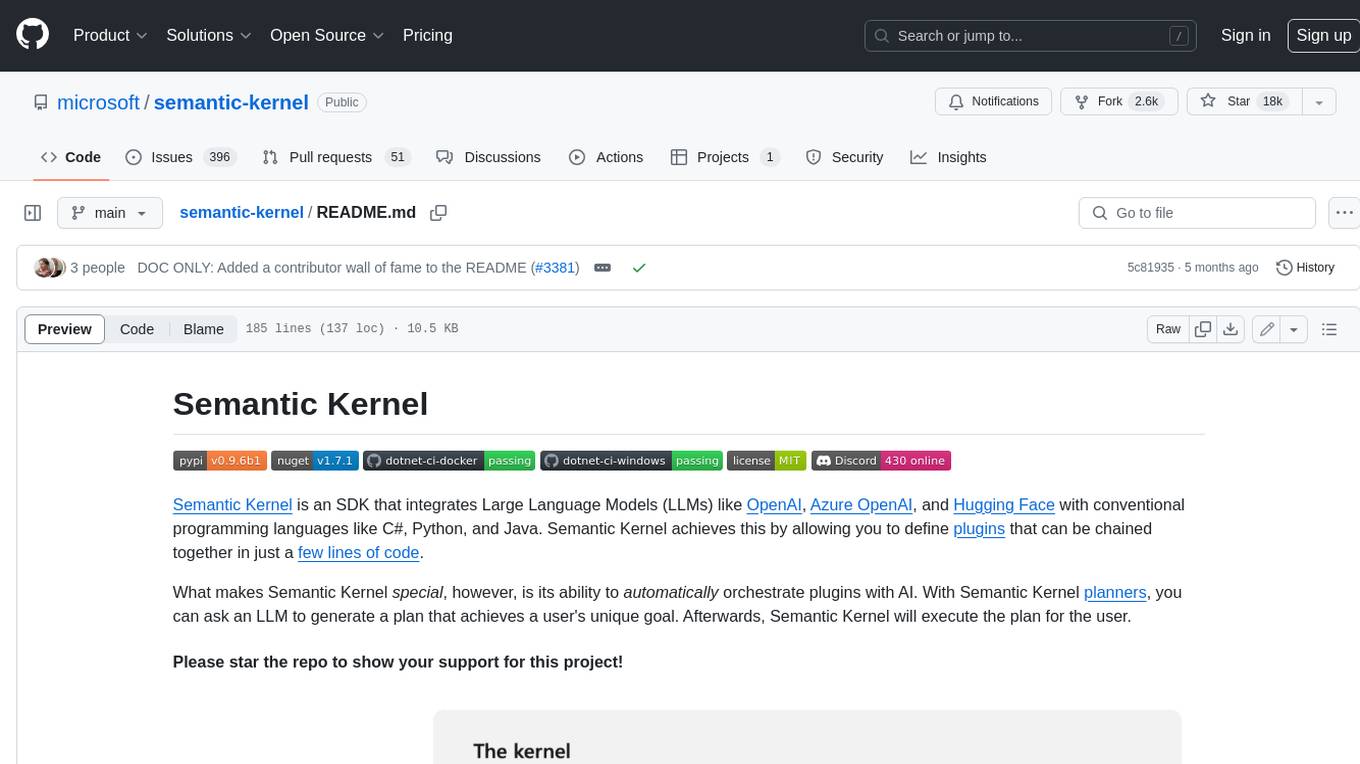
semantic-kernel
Semantic Kernel is an SDK that integrates Large Language Models (LLMs) like OpenAI, Azure OpenAI, and Hugging Face with conventional programming languages like C#, Python, and Java. Semantic Kernel achieves this by allowing you to define plugins that can be chained together in just a few lines of code. What makes Semantic Kernel _special_ , however, is its ability to _automatically_ orchestrate plugins with AI. With Semantic Kernel planners, you can ask an LLM to generate a plan that achieves a user's unique goal. Afterwards, Semantic Kernel will execute the plan for the user.
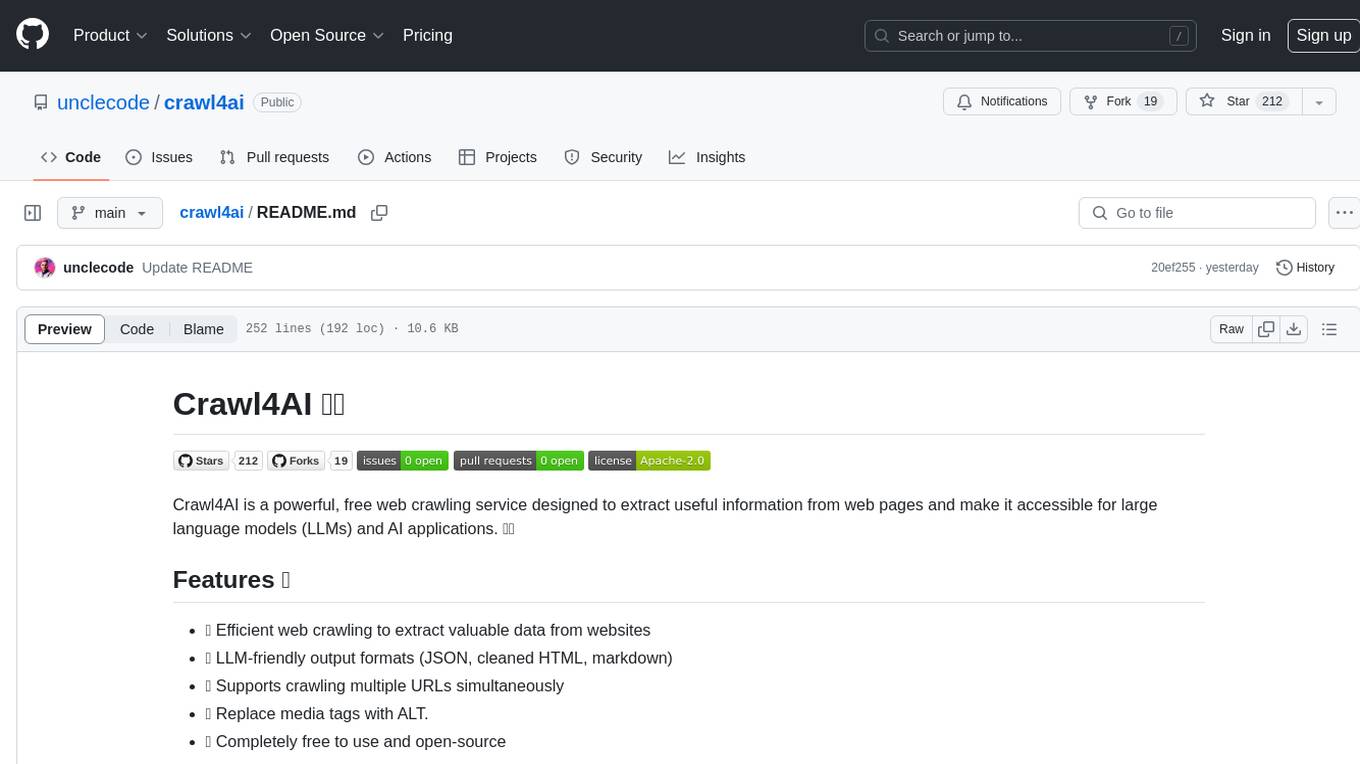
crawl4ai
Crawl4AI is a powerful and free web crawling service that extracts valuable data from websites and provides LLM-friendly output formats. It supports crawling multiple URLs simultaneously, replaces media tags with ALT, and is completely free to use and open-source. Users can integrate Crawl4AI into Python projects as a library or run it as a standalone local server. The tool allows users to crawl and extract data from specified URLs using different providers and models, with options to include raw HTML content, force fresh crawls, and extract meaningful text blocks. Configuration settings can be adjusted in the `crawler/config.py` file to customize providers, API keys, chunk processing, and word thresholds. Contributions to Crawl4AI are welcome from the open-source community to enhance its value for AI enthusiasts and developers.
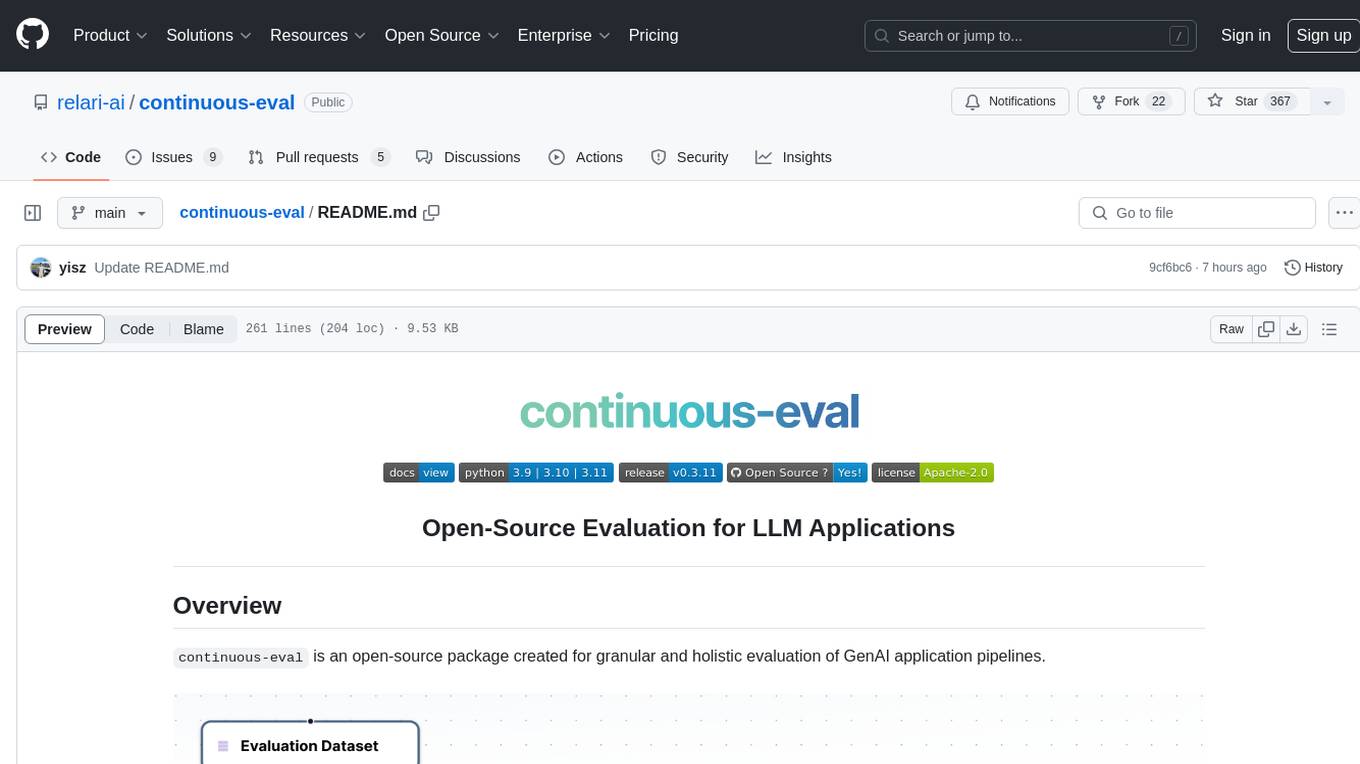
continuous-eval
Open-Source Evaluation for LLM Applications. `continuous-eval` is an open-source package created for granular and holistic evaluation of GenAI application pipelines. It offers modularized evaluation, a comprehensive metric library covering various LLM use cases, the ability to leverage user feedback in evaluation, and synthetic dataset generation for testing pipelines. Users can define their own metrics by extending the Metric class. The tool allows running evaluation on a pipeline defined with modules and corresponding metrics. Additionally, it provides synthetic data generation capabilities to create user interaction data for evaluation or training purposes.
For similar tasks
lionagi
LionAGI is a robust framework for orchestrating multi-step AI operations with precise control. It allows users to bring together multiple models, advanced reasoning, tool integrations, and custom validations in a single coherent pipeline. The framework is structured, expandable, controlled, and transparent, offering features like real-time logging, message introspection, and tool usage tracking. LionAGI supports advanced multi-step reasoning with ReAct, integrates with Anthropic's Model Context Protocol, and provides observability and debugging tools. Users can seamlessly orchestrate multiple models, integrate with Claude Code CLI SDK, and leverage a fan-out fan-in pattern for orchestration. The framework also offers optional dependencies for additional functionalities like reader tools, local inference support, rich output formatting, database support, and graph visualization.
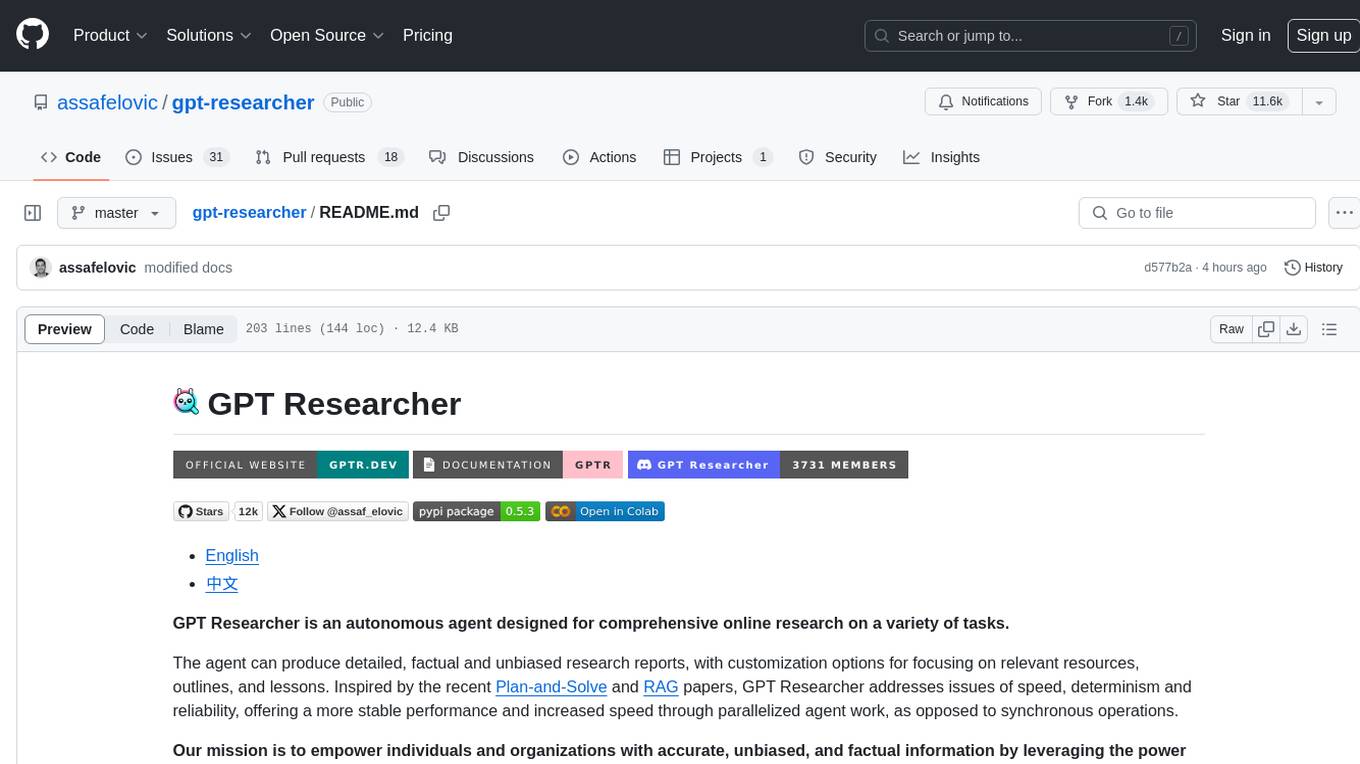
gpt-researcher
GPT Researcher is an autonomous agent designed for comprehensive online research on a variety of tasks. It can produce detailed, factual, and unbiased research reports with customization options. The tool addresses issues of speed, determinism, and reliability by leveraging parallelized agent work. The main idea involves running 'planner' and 'execution' agents to generate research questions, seek related information, and create research reports. GPT Researcher optimizes costs and completes tasks in around 3 minutes. Features include generating long research reports, aggregating web sources, an easy-to-use web interface, scraping web sources, and exporting reports to various formats.
For similar jobs
sweep
Sweep is an AI junior developer that turns bugs and feature requests into code changes. It automatically handles developer experience improvements like adding type hints and improving test coverage.
teams-ai
The Teams AI Library is a software development kit (SDK) that helps developers create bots that can interact with Teams and Microsoft 365 applications. It is built on top of the Bot Framework SDK and simplifies the process of developing bots that interact with Teams' artificial intelligence capabilities. The SDK is available for JavaScript/TypeScript, .NET, and Python.
ai-guide
This guide is dedicated to Large Language Models (LLMs) that you can run on your home computer. It assumes your PC is a lower-end, non-gaming setup.
classifai
Supercharge WordPress Content Workflows and Engagement with Artificial Intelligence. Tap into leading cloud-based services like OpenAI, Microsoft Azure AI, Google Gemini and IBM Watson to augment your WordPress-powered websites. Publish content faster while improving SEO performance and increasing audience engagement. ClassifAI integrates Artificial Intelligence and Machine Learning technologies to lighten your workload and eliminate tedious tasks, giving you more time to create original content that matters.
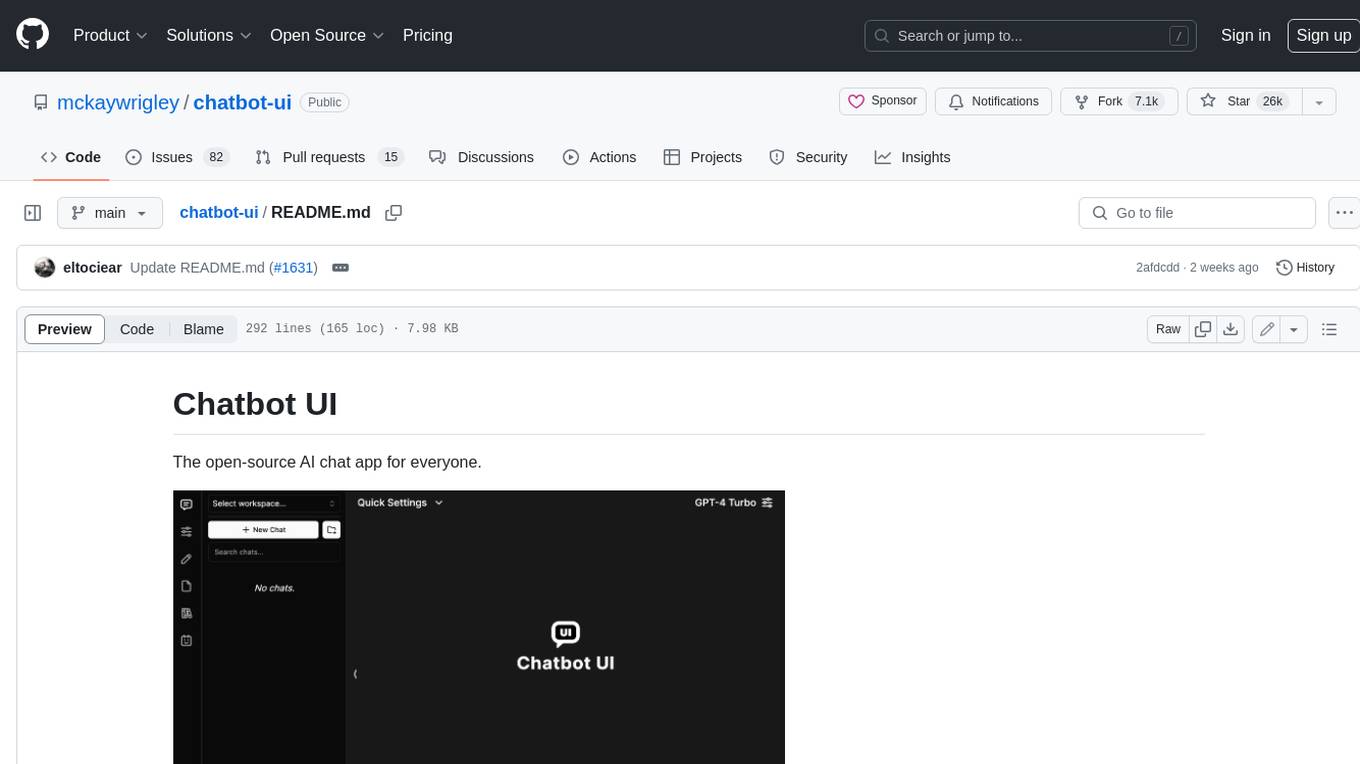
chatbot-ui
Chatbot UI is an open-source AI chat app that allows users to create and deploy their own AI chatbots. It is easy to use and can be customized to fit any need. Chatbot UI is perfect for businesses, developers, and anyone who wants to create a chatbot.
BricksLLM
BricksLLM is a cloud native AI gateway written in Go. Currently, it provides native support for OpenAI, Anthropic, Azure OpenAI and vLLM. BricksLLM aims to provide enterprise level infrastructure that can power any LLM production use cases. Here are some use cases for BricksLLM: * Set LLM usage limits for users on different pricing tiers * Track LLM usage on a per user and per organization basis * Block or redact requests containing PIIs * Improve LLM reliability with failovers, retries and caching * Distribute API keys with rate limits and cost limits for internal development/production use cases * Distribute API keys with rate limits and cost limits for students
uAgents
uAgents is a Python library developed by Fetch.ai that allows for the creation of autonomous AI agents. These agents can perform various tasks on a schedule or take action on various events. uAgents are easy to create and manage, and they are connected to a fast-growing network of other uAgents. They are also secure, with cryptographically secured messages and wallets.
griptape
Griptape is a modular Python framework for building AI-powered applications that securely connect to your enterprise data and APIs. It offers developers the ability to maintain control and flexibility at every step. Griptape's core components include Structures (Agents, Pipelines, and Workflows), Tasks, Tools, Memory (Conversation Memory, Task Memory, and Meta Memory), Drivers (Prompt and Embedding Drivers, Vector Store Drivers, Image Generation Drivers, Image Query Drivers, SQL Drivers, Web Scraper Drivers, and Conversation Memory Drivers), Engines (Query Engines, Extraction Engines, Summary Engines, Image Generation Engines, and Image Query Engines), and additional components (Rulesets, Loaders, Artifacts, Chunkers, and Tokenizers). Griptape enables developers to create AI-powered applications with ease and efficiency.