


Tegridy-MIDI-Dataset
Tegridy MIDI Dataset for precise and effective Music AI models creation.
Stars: 162
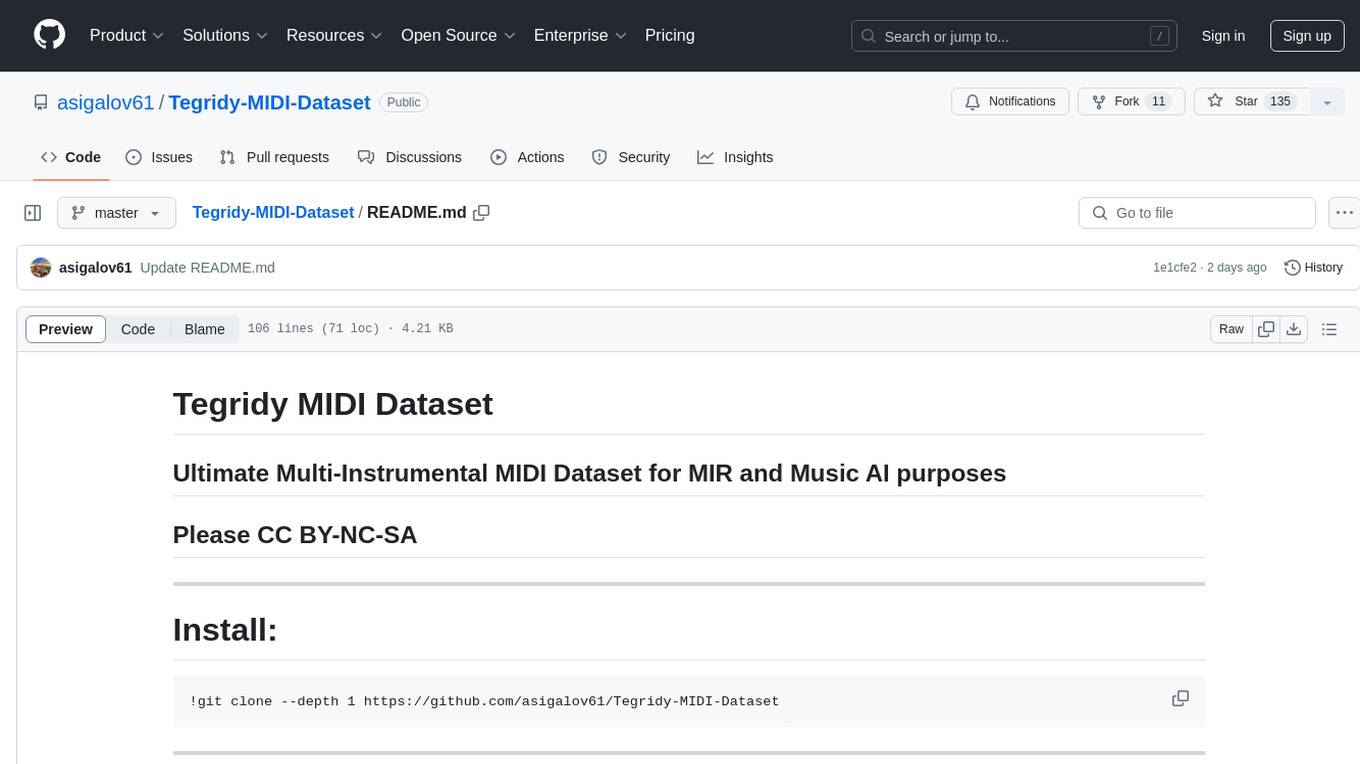
Tegridy MIDI Dataset is an ultimate multi-instrumental MIDI dataset designed for Music Information Retrieval (MIR) and Music AI purposes. It provides a comprehensive collection of MIDI datasets and essential software tools for MIDI editing, rendering, transcription, search, classification, comparison, and various other MIDI applications.
README:
!git clone --depth 1 https://github.com/asigalov61/Tegridy-MIDI-Dataset
[Online] Tegridy Code Advanced MIDI Renderer
[Online] MIDI Identification
[Online] Los Angeles MIDI Dataset Search
[Online] Advanced MIDI Search
[Online] Karaoke MIDI Search
[Online] Ultimate MIDI Classifier
[Online] Advanced MIDI Classifier
[Online] Intelligent MIDI Comparator
[Online] MIDI Melody
[Online] Harmonic Melody MIDI Mixer
[Online] Chords Progressions Generator
For Tasks:
Click tags to check more tools for each tasksFor Jobs:
Alternative AI tools for Tegridy-MIDI-Dataset
Similar Open Source Tools
Tegridy-MIDI-Dataset
Tegridy MIDI Dataset is an ultimate multi-instrumental MIDI dataset designed for Music Information Retrieval (MIR) and Music AI purposes. It provides a comprehensive collection of MIDI datasets and essential software tools for MIDI editing, rendering, transcription, search, classification, comparison, and various other MIDI applications.

ai-enablement-stack
The AI Enablement Stack is a curated collection of venture-backed companies, tools, and technologies that enable developers to build, deploy, and manage AI applications. It provides a structured view of the AI development ecosystem across five key layers: Agent Consumer Layer, Observability and Governance Layer, Engineering Layer, Intelligence Layer, and Infrastructure Layer. Each layer focuses on specific aspects of AI development, from end-user interaction to model training and deployment. The stack aims to help developers find the right tools for building AI applications faster and more efficiently, assist engineering leaders in making informed decisions about AI infrastructure and tooling, and help organizations understand the AI development landscape to plan technology adoption.
Drag-and-Drop-LLMs
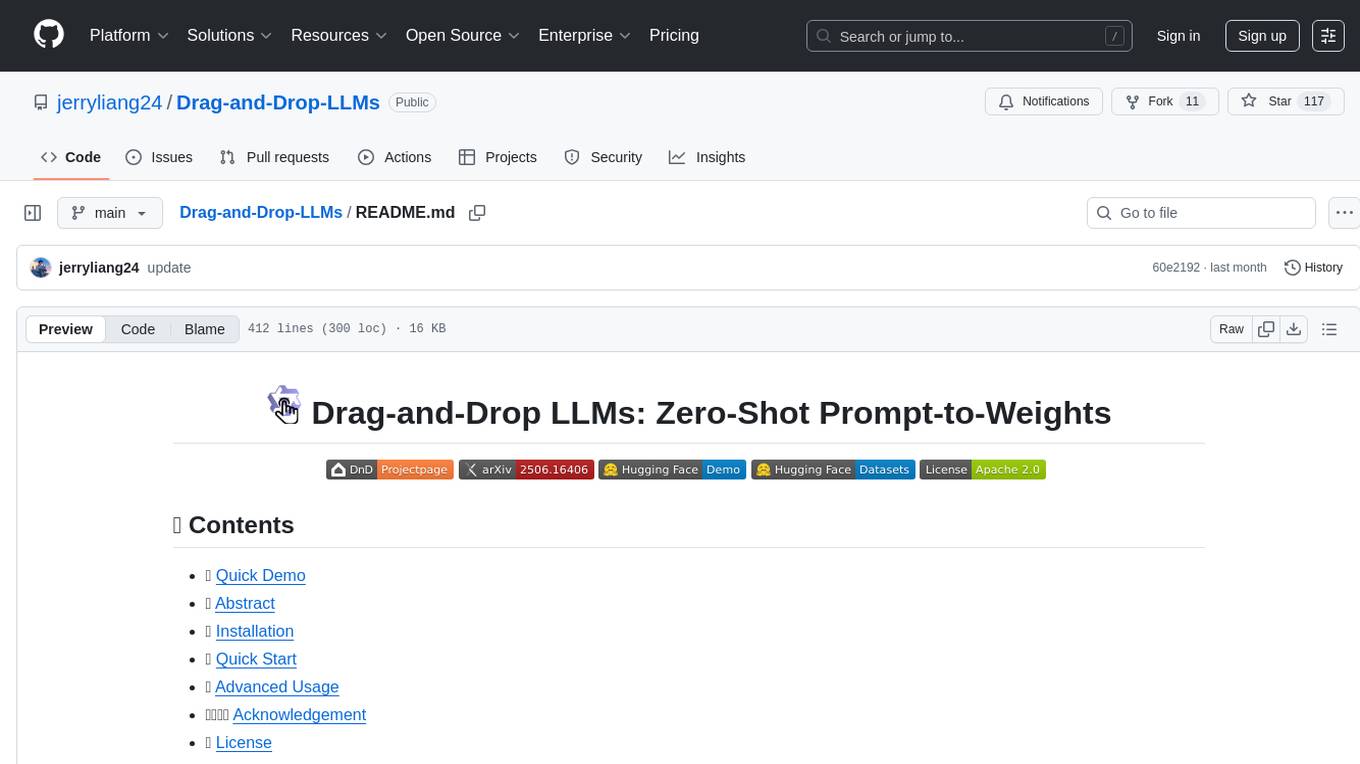
Drag-and-Drop LLMs (DnD) is a prompt-conditioned parameter generator that eliminates per-task training by mapping task prompts directly to LoRA weight updates. It uses a lightweight text encoder to distill prompt batches into condition embeddings, transformed by a cascaded hyper convolutional decoder into LoRA matrices. DnD offers up to 12,000× lower overhead than full fine-tuning, gains up to 30% in performance over strong LoRAs on various tasks, and shows robust cross-domain generalization. It provides a rapid way to specialize large language models without gradient-based adaptation.
llm-dev
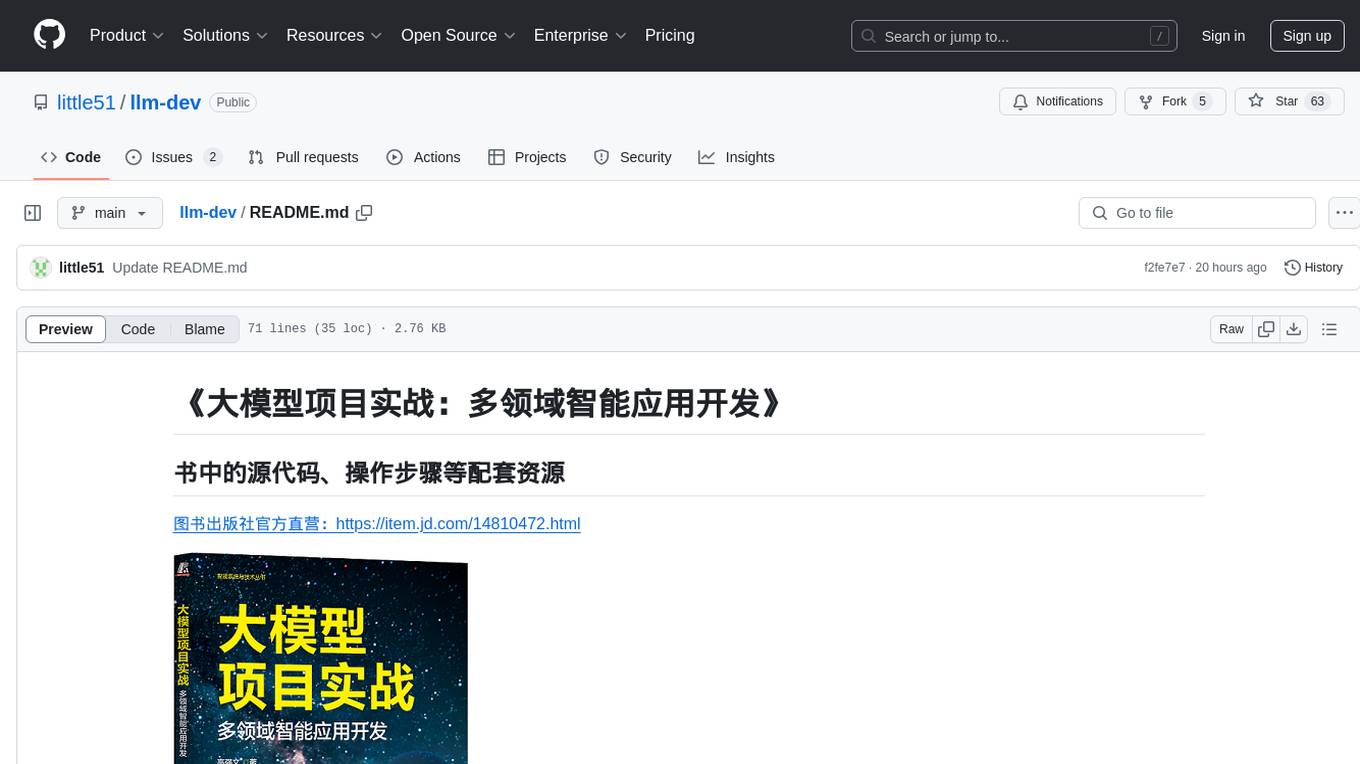
The 'llm-dev' repository contains source code and resources for the book 'Practical Projects of Large Models: Multi-Domain Intelligent Application Development'. It covers topics such as language model basics, application architecture, working modes, environment setup, model installation, fine-tuning, quantization, multi-modal model applications, chat applications, programming large model applications, VS Code plugin development, enhanced generation applications, translation applications, intelligent agent applications, speech model applications, digital human applications, model training applications, and AI town applications.
bedrock-book
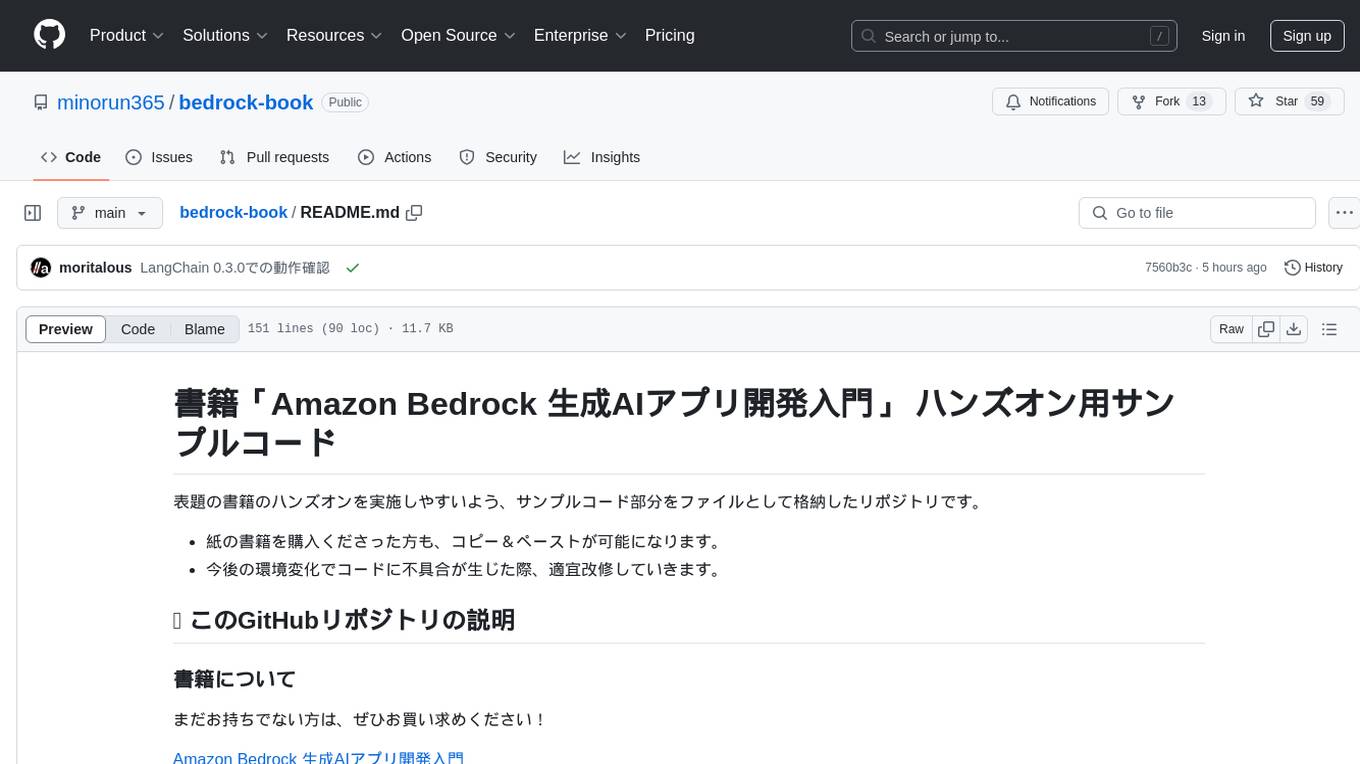
This repository contains sample code for hands-on exercises related to the book 'Amazon Bedrock 生成AIアプリ開発入門'. It allows readers to easily access and copy the code. The repository also includes directories for each chapter's hands-on code, settings, and a 'requirements.txt' file listing necessary Python libraries. Updates and error fixes will be provided as needed. Users can report issues in the repository's 'Issues' section, and errata will be published on the SB Creative official website.
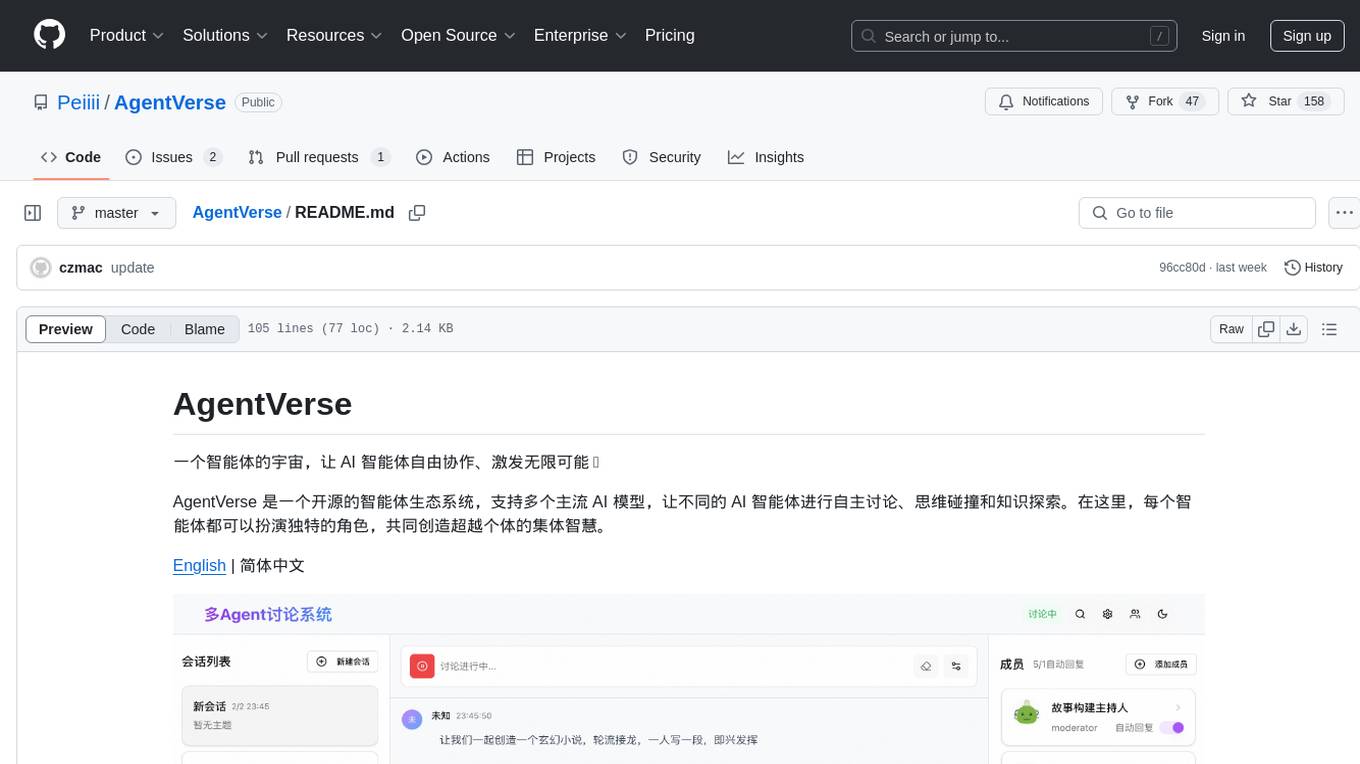
AgentVerse
AgentVerse is an open-source ecosystem for intelligent agents, supporting multiple mainstream AI models to facilitate autonomous discussions, thought collisions, and knowledge exploration. Each intelligent agent can play a unique role here, collectively creating wisdom beyond individuals.
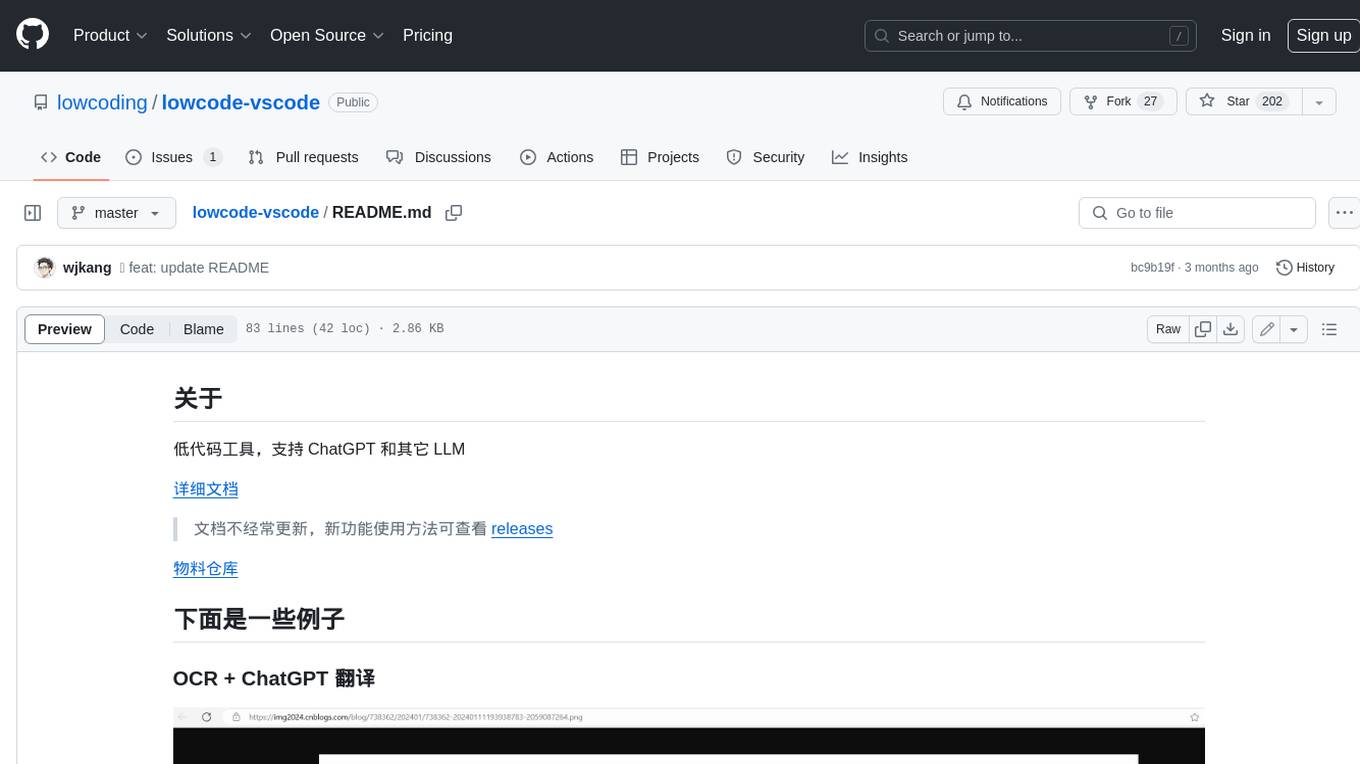
lowcode-vscode
This repository is a low-code tool that supports ChatGPT and other LLM models. It provides functionalities such as OCR translation, generating specified format JSON, translating Chinese to camel case, translating current directory to English, and quickly creating code templates. Users can also generate CURD operations for managing backend list pages. The tool allows users to select templates, initialize query form configurations using OCR, initialize table configurations using OCR, translate Chinese fields using ChatGPT, and generate code without writing a single line. It aims to enhance productivity by simplifying code generation and development processes.
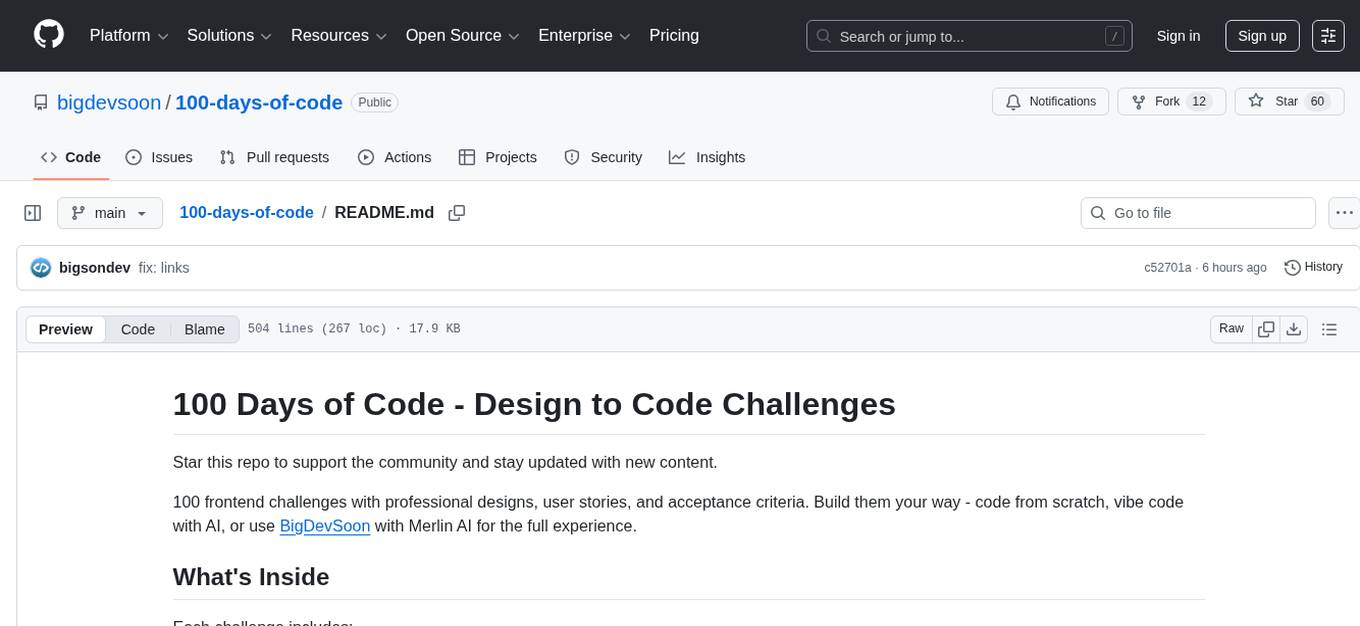
100-days-of-code
100 Days of Code is a repository containing 100 frontend challenges with professional designs, user stories, and acceptance criteria. It provides a platform for developers to practice coding daily, from beginner-friendly cards to advanced dashboards. The challenges are structured for AI collaboration, allowing users to work with coding agents like Claude, Cursor, and GitHub Copilot. The repository also includes an AI Collaboration Log template to document the use of AI tools and showcase effective collaboration. Developers can replicate design mockups, add interactivity with JavaScript, and share their solutions on social media platforms.
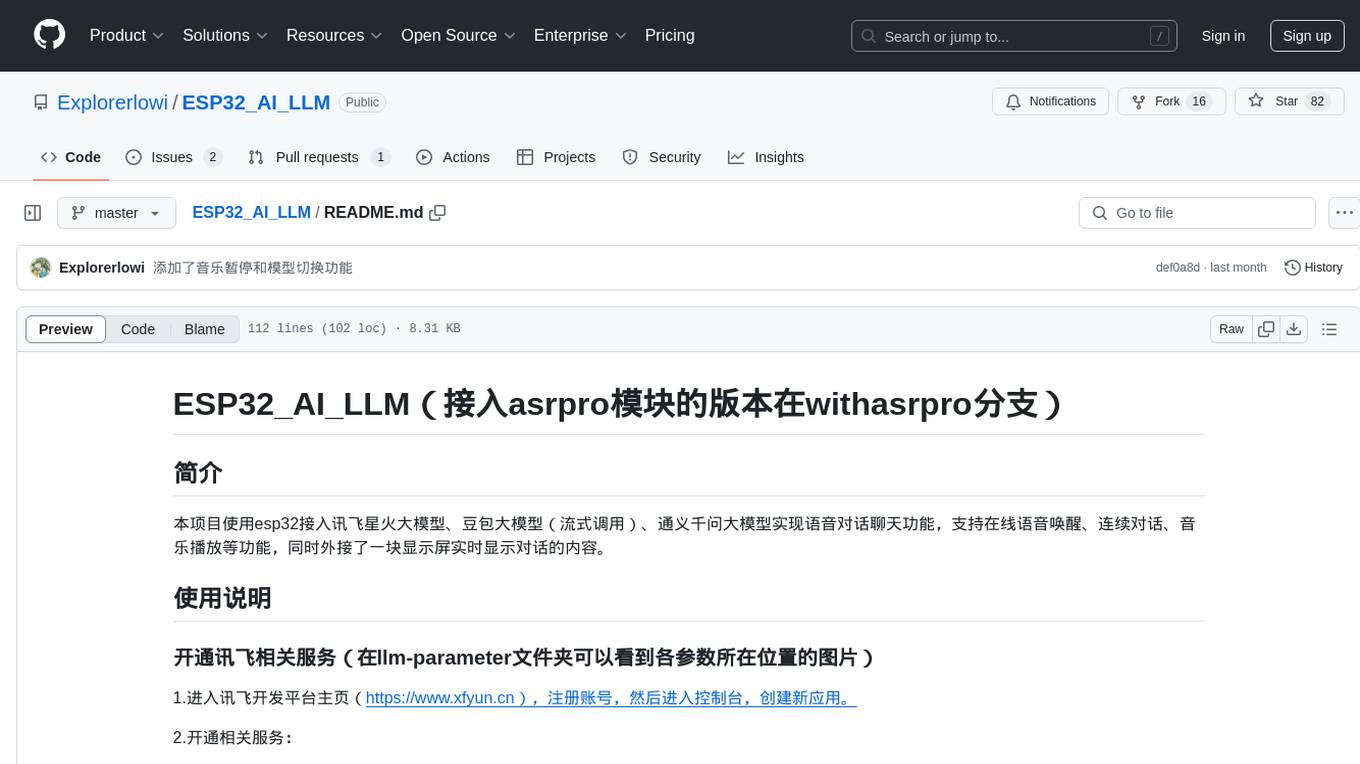
ESP32_AI_LLM
ESP32_AI_LLM is a project that uses ESP32 to connect to Xunfei Xinghuo, Dou Bao, and Tongyi Qianwen large models to achieve voice chat functions, supporting online voice wake-up, continuous conversation, music playback, and real-time display of conversation content on an external screen. The project requires specific hardware components and provides functionalities such as voice wake-up, voice conversation, convenient network configuration, music playback, volume adjustment, LED control, model switching, and screen display. Users can deploy the project by setting up Xunfei services, cloning the repository, configuring necessary parameters, installing drivers, compiling, and burning the code.
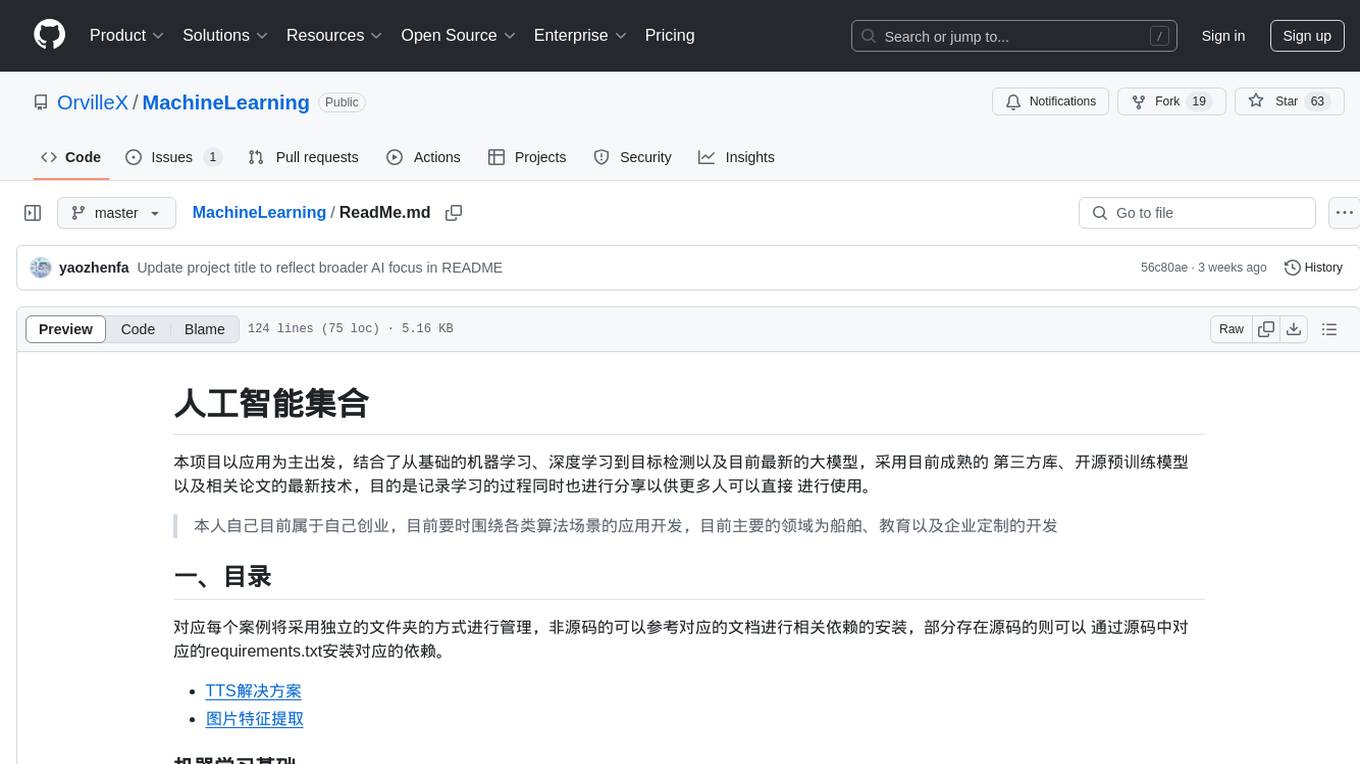
MachineLearning
MachineLearning is a repository focused on practical applications in various algorithm scenarios such as ship, education, and enterprise development. It covers a wide range of topics from basic machine learning and deep learning to object detection and the latest large models. The project utilizes mature third-party libraries, open-source pre-trained models, and the latest technologies from related papers to document the learning process and facilitate direct usage by a wider audience.
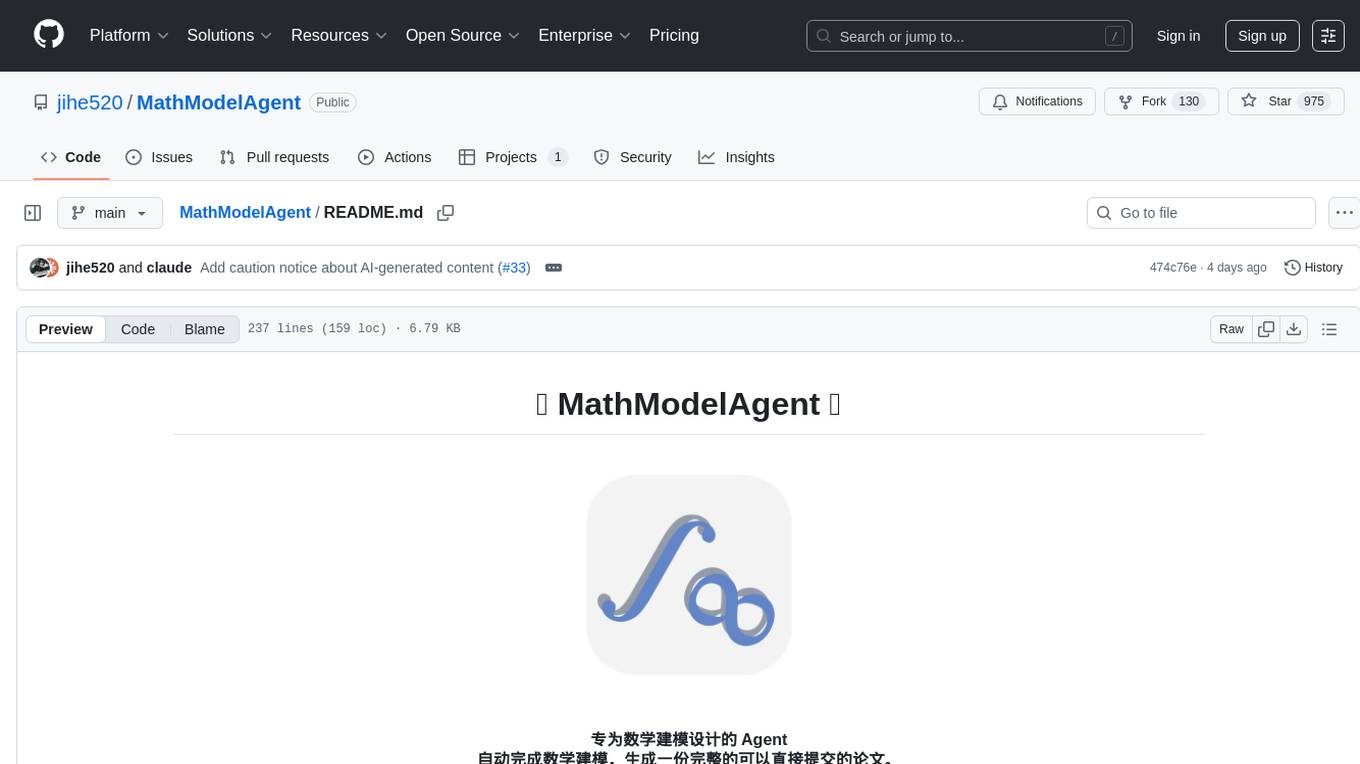
MathModelAgent
MathModelAgent is an agent designed specifically for mathematical modeling tasks. It automates the process of mathematical modeling and generates a complete paper that can be directly submitted. The tool features automatic problem analysis, code writing, error correction, and paper writing. It supports various models, offers low costs, and allows customization through prompt inject. The tool is ideal for individuals or teams working on mathematical modeling projects.
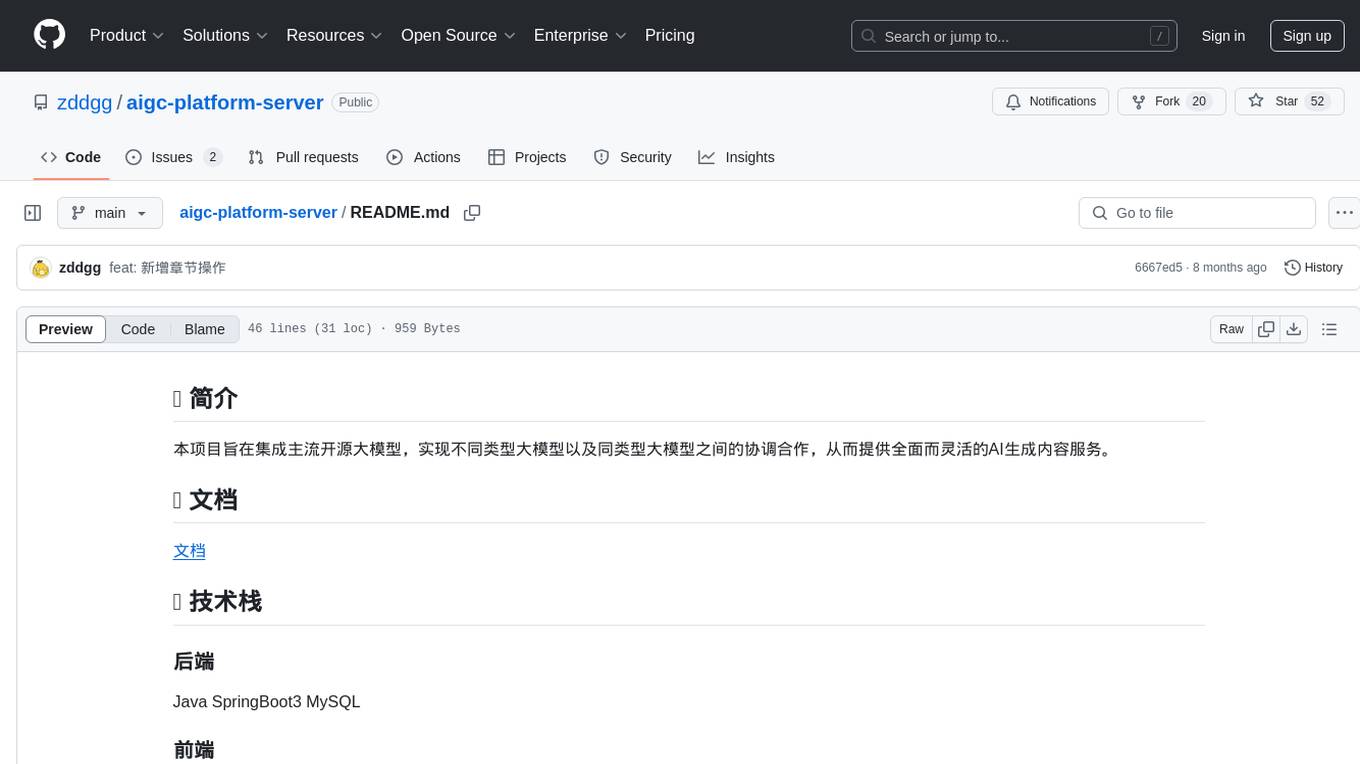
aigc-platform-server
This project aims to integrate mainstream open-source large models to achieve the coordination and cooperation between different types of large models, providing comprehensive and flexible AI content generation services.
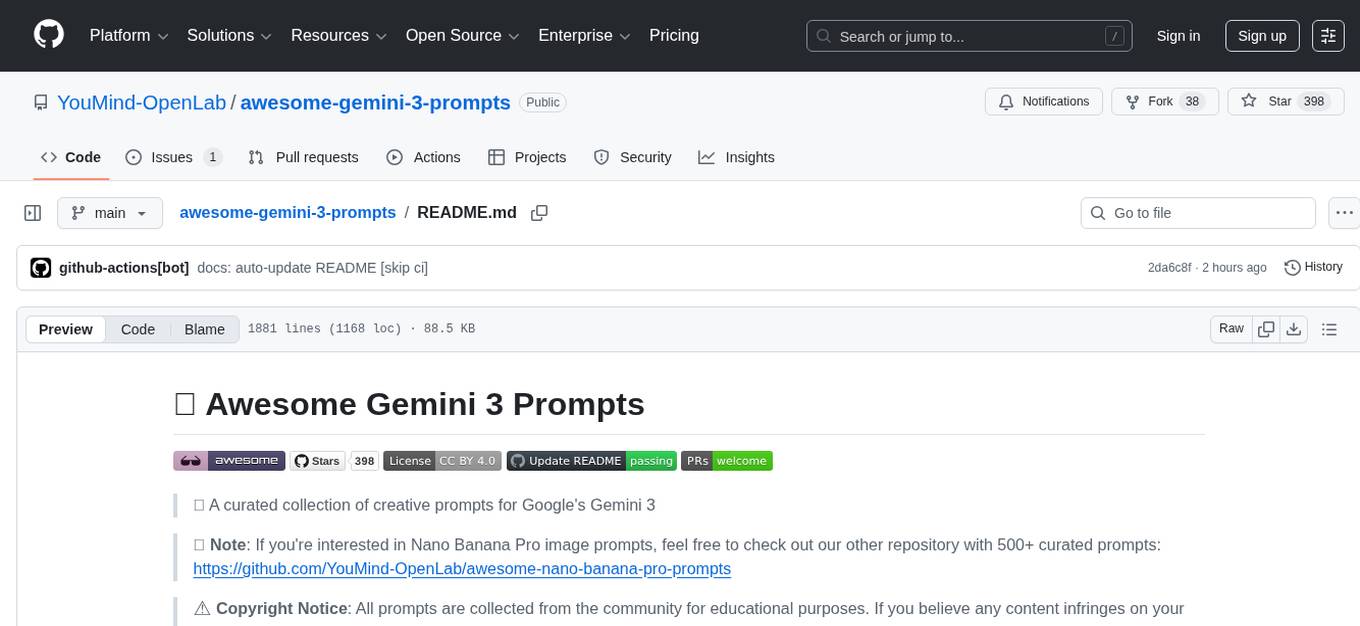
awesome-chatgpt-zh
The Awesome ChatGPT Chinese Guide project aims to help Chinese users understand and use ChatGPT. It collects various free and paid ChatGPT resources, as well as methods to communicate more effectively with ChatGPT in Chinese. The repository contains a rich collection of ChatGPT tools, applications, and examples.
AIMedia
AIMedia is a fully automated AI media software that automatically fetches hot news, generates news, and publishes on various platforms. It supports hot news fetching from platforms like Douyin, NetEase News, Weibo, The Paper, China Daily, and Sohu News. Additionally, it enables AI-generated images for text-only news to enhance originality and reading experience. The tool is currently commercialized with plans to support video auto-generation for platform publishing in the future. It requires a minimum CPU of 4 cores or above, 8GB RAM, and supports Windows 10 or above. Users can deploy the tool by cloning the repository, modifying the configuration file, creating a virtual environment using Conda, and starting the web interface. Feedback and suggestions can be submitted through issues or pull requests.
prose-polish
prose-polish is a tool for AI interaction through drag-and-drop cards, focusing on editing copy and manuscripts. It can recognize Markdown-formatted documents, automatically breaking them into paragraph cards. Users can create prefabricated prompt cards and quickly connect them to the manuscript for editing. The modified manuscript is still presented in card form, allowing users to drag it out as a new paragraph. To use it smoothly, users just need to remember one rule: 'Plug the plug into the socket!'
For similar tasks
Tegridy-MIDI-Dataset
Tegridy MIDI Dataset is an ultimate multi-instrumental MIDI dataset designed for Music Information Retrieval (MIR) and Music AI purposes. It provides a comprehensive collection of MIDI datasets and essential software tools for MIDI editing, rendering, transcription, search, classification, comparison, and various other MIDI applications.
LocalAI
LocalAI is a free and open-source OpenAI alternative that acts as a drop-in replacement REST API compatible with OpenAI (Elevenlabs, Anthropic, etc.) API specifications for local AI inferencing. It allows users to run LLMs, generate images, audio, and more locally or on-premises with consumer-grade hardware, supporting multiple model families and not requiring a GPU. LocalAI offers features such as text generation with GPTs, text-to-audio, audio-to-text transcription, image generation with stable diffusion, OpenAI functions, embeddings generation for vector databases, constrained grammars, downloading models directly from Huggingface, and a Vision API. It provides a detailed step-by-step introduction in its Getting Started guide and supports community integrations such as custom containers, WebUIs, model galleries, and various bots for Discord, Slack, and Telegram. LocalAI also offers resources like an LLM fine-tuning guide, instructions for local building and Kubernetes installation, projects integrating LocalAI, and a how-tos section curated by the community. It encourages users to cite the repository when utilizing it in downstream projects and acknowledges the contributions of various software from the community.
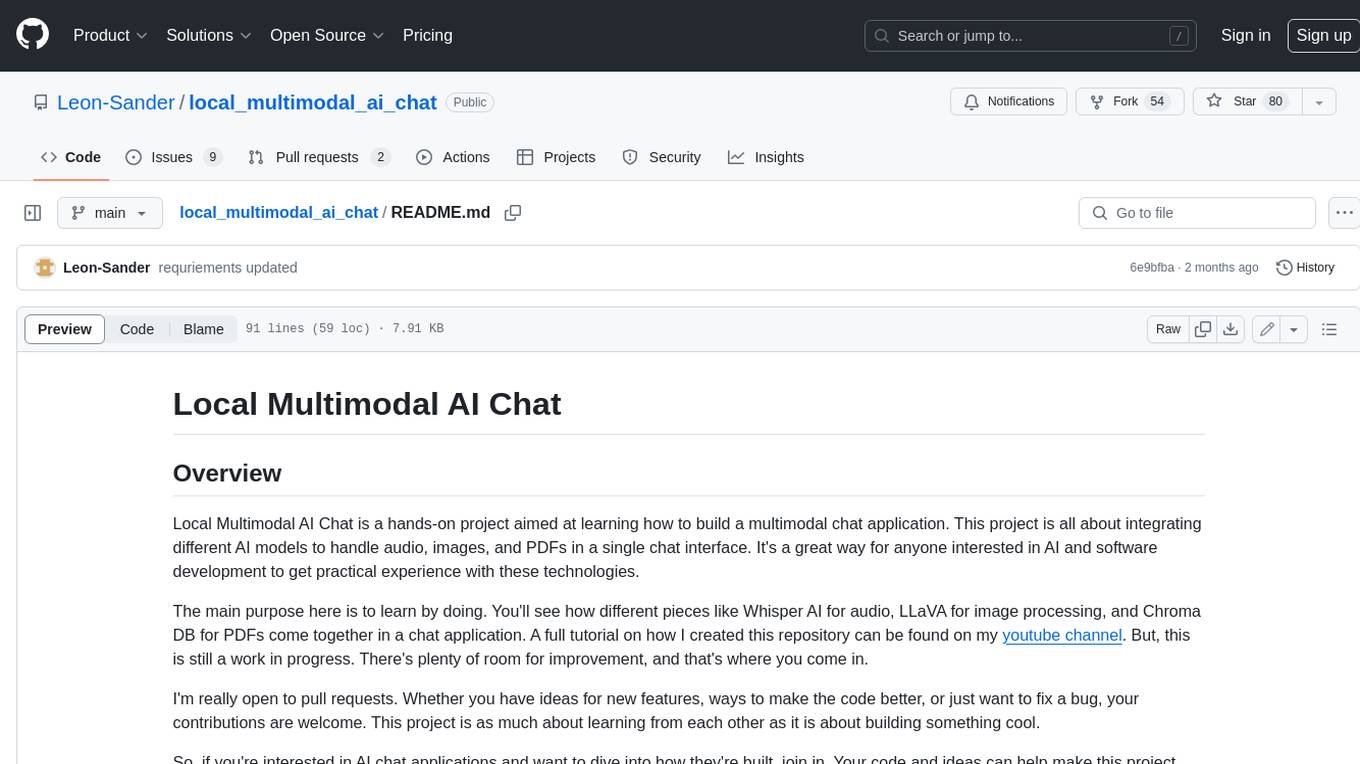
local_multimodal_ai_chat
Local Multimodal AI Chat is a hands-on project that teaches you how to build a multimodal chat application. It integrates different AI models to handle audio, images, and PDFs in a single chat interface. This project is perfect for anyone interested in AI and software development who wants to gain practical experience with these technologies.
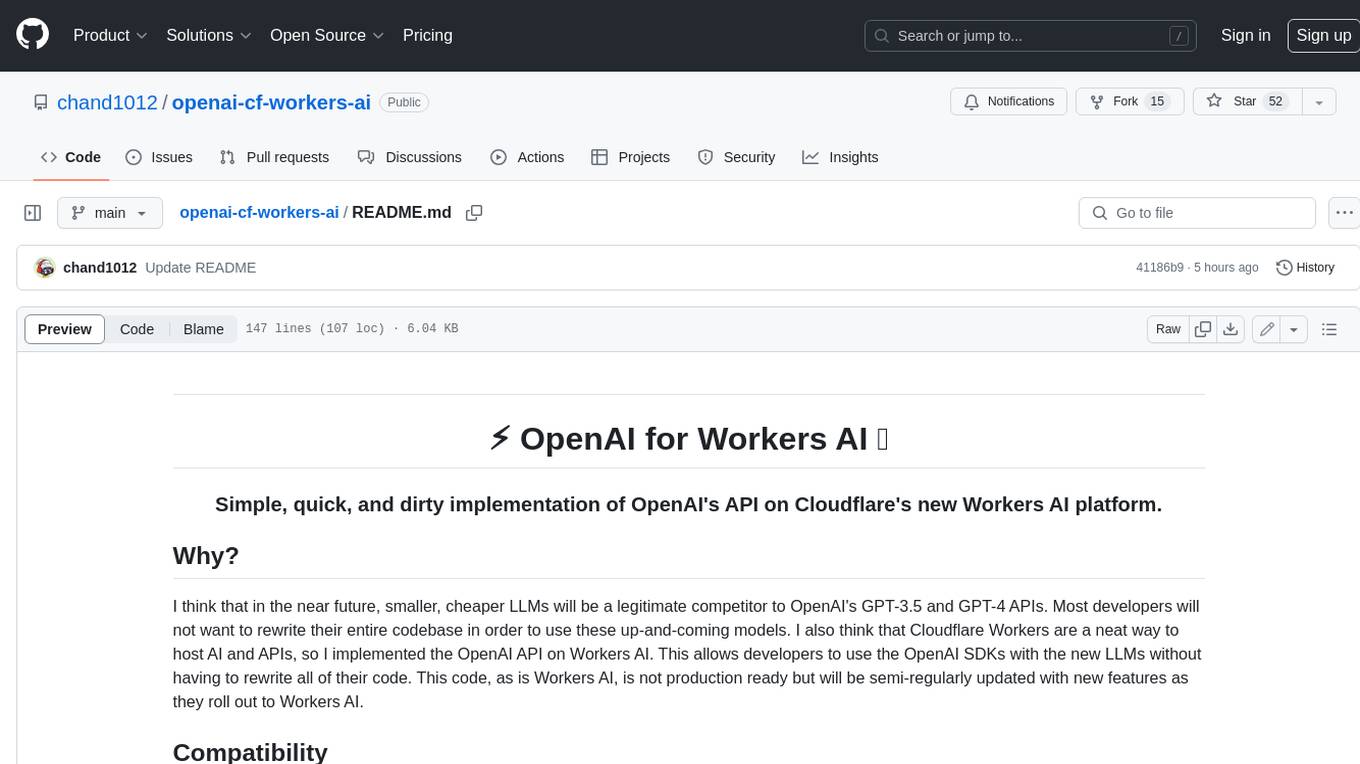
openai-cf-workers-ai
OpenAI for Workers AI is a simple, quick, and dirty implementation of OpenAI's API on Cloudflare's new Workers AI platform. It allows developers to use the OpenAI SDKs with the new LLMs without having to rewrite all of their code. The API currently supports completions, chat completions, audio transcription, embeddings, audio translation, and image generation. It is not production ready but will be semi-regularly updated with new features as they roll out to Workers AI.
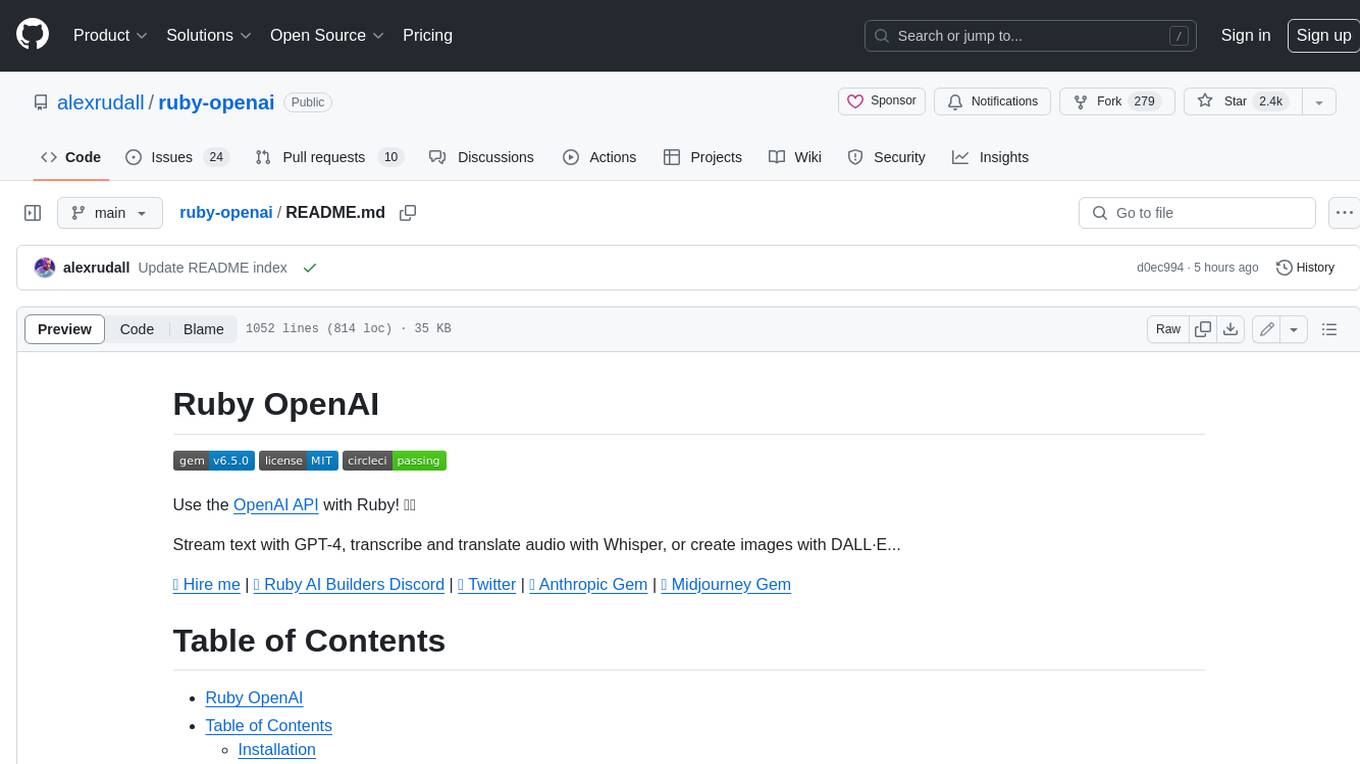
ruby-openai
Use the OpenAI API with Ruby! 🤖🩵 Stream text with GPT-4, transcribe and translate audio with Whisper, or create images with DALL·E... Hire me | 🎮 Ruby AI Builders Discord | 🐦 Twitter | 🧠 Anthropic Gem | 🚂 Midjourney Gem ## Table of Contents * Ruby OpenAI * Table of Contents * Installation * Bundler * Gem install * Usage * Quickstart * With Config * Custom timeout or base URI * Extra Headers per Client * Logging * Errors * Faraday middleware * Azure * Ollama * Counting Tokens * Models * Examples * Chat * Streaming Chat * Vision * JSON Mode * Functions * Edits * Embeddings * Batches * Files * Finetunes * Assistants * Threads and Messages * Runs * Runs involving function tools * Image Generation * DALL·E 2 * DALL·E 3 * Image Edit * Image Variations * Moderations * Whisper * Translate * Transcribe * Speech * Errors * Development * Release * Contributing * License * Code of Conduct
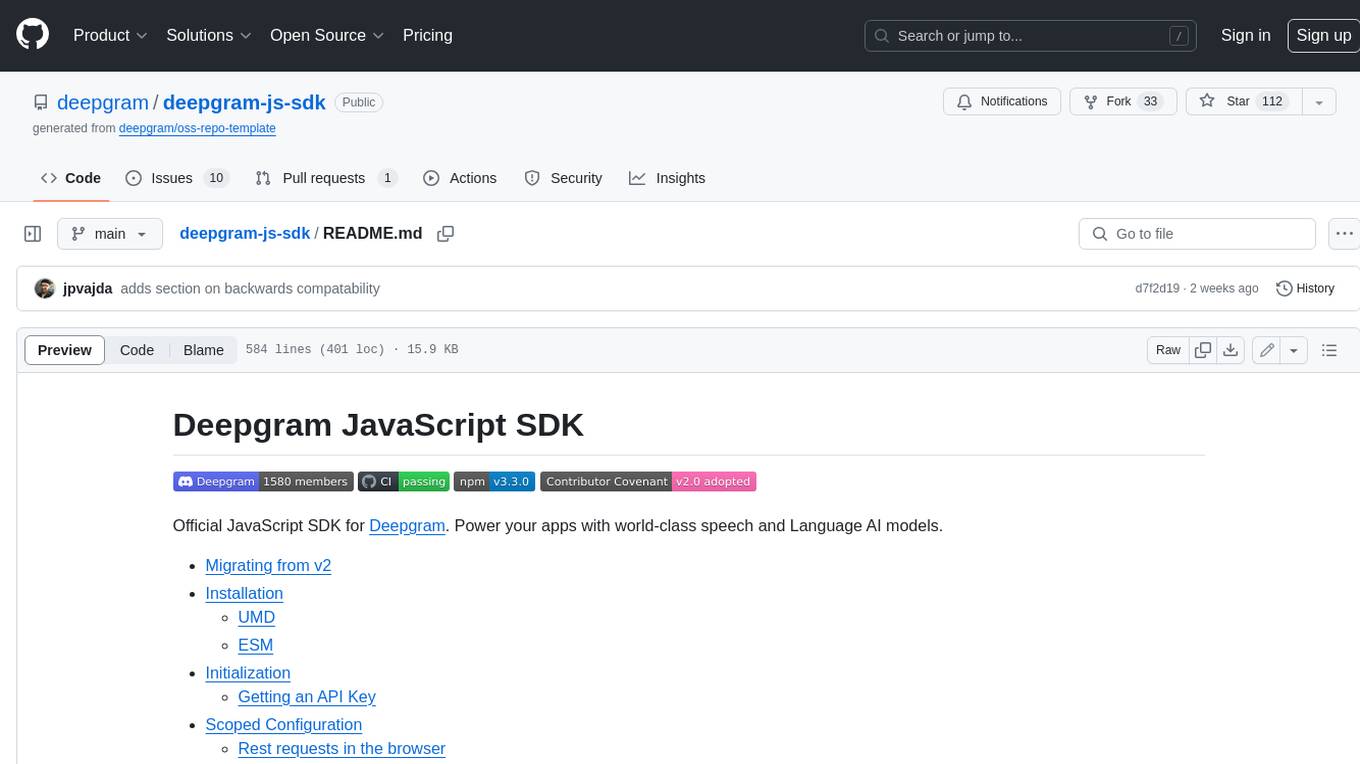
deepgram-js-sdk
Deepgram JavaScript SDK. Power your apps with world-class speech and Language AI models.
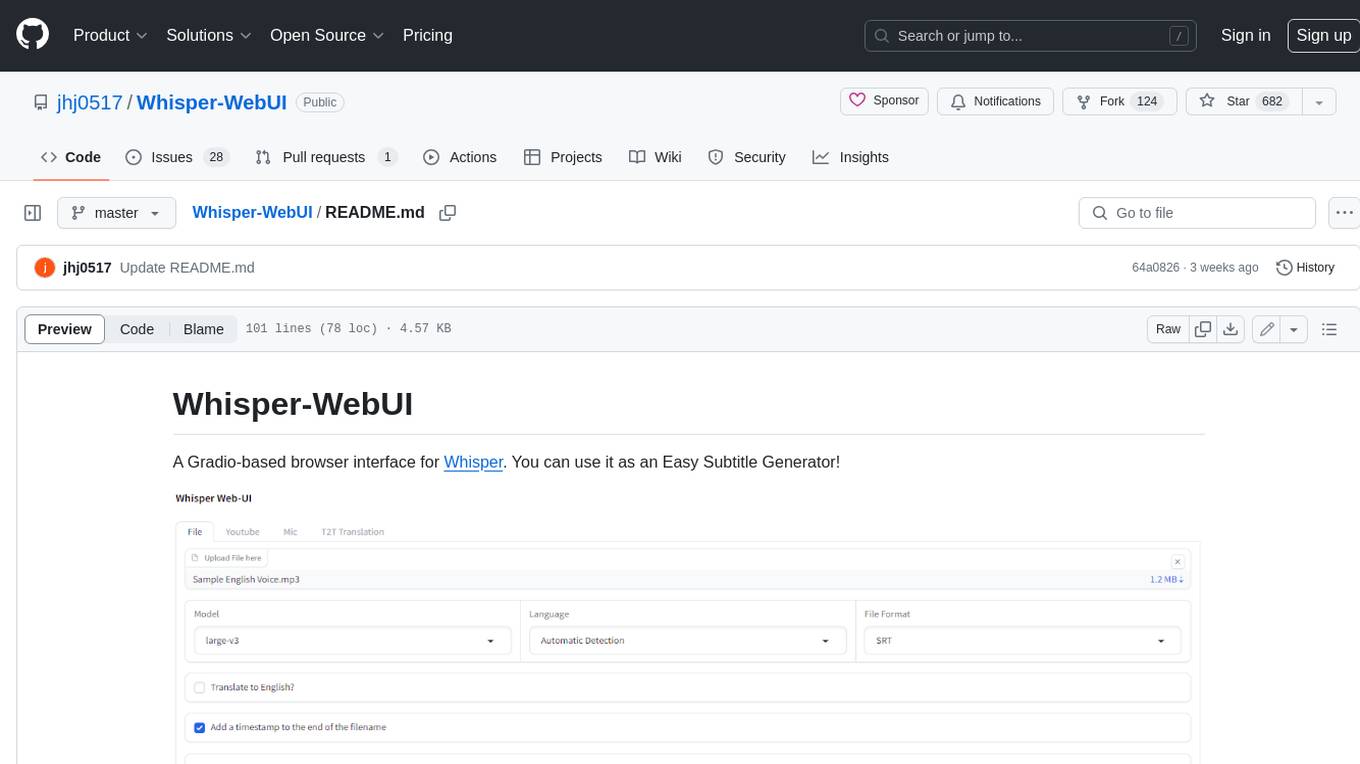
Whisper-WebUI
Whisper-WebUI is a Gradio-based browser interface for Whisper, serving as an Easy Subtitle Generator. It supports generating subtitles from various sources such as files, YouTube, and microphone. The tool also offers speech-to-text and text-to-text translation features, utilizing Facebook NLLB models and DeepL API. Users can translate subtitle files from other languages to English and vice versa. The project integrates faster-whisper for improved VRAM usage and transcription speed, providing efficiency metrics for optimized whisper models. Additionally, users can choose from different Whisper models based on size and language requirements.
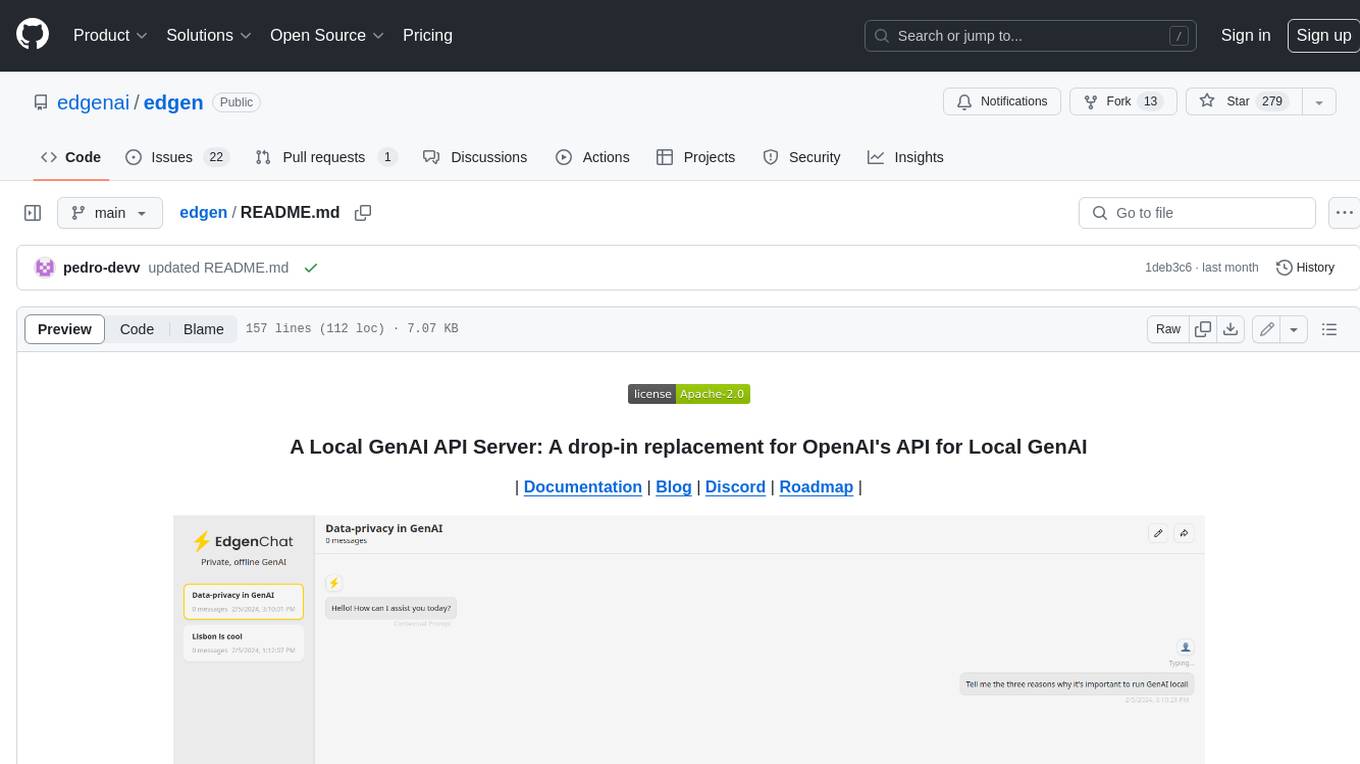
edgen
Edgen is a local GenAI API server that serves as a drop-in replacement for OpenAI's API. It provides multi-endpoint support for chat completions and speech-to-text, is model agnostic, offers optimized inference, and features model caching. Built in Rust, Edgen is natively compiled for Windows, MacOS, and Linux, eliminating the need for Docker. It allows users to utilize GenAI locally on their devices for free and with data privacy. With features like session caching, GPU support, and support for various endpoints, Edgen offers a scalable, reliable, and cost-effective solution for running GenAI applications locally.
For similar jobs
sweep
Sweep is an AI junior developer that turns bugs and feature requests into code changes. It automatically handles developer experience improvements like adding type hints and improving test coverage.
teams-ai
The Teams AI Library is a software development kit (SDK) that helps developers create bots that can interact with Teams and Microsoft 365 applications. It is built on top of the Bot Framework SDK and simplifies the process of developing bots that interact with Teams' artificial intelligence capabilities. The SDK is available for JavaScript/TypeScript, .NET, and Python.
ai-guide
This guide is dedicated to Large Language Models (LLMs) that you can run on your home computer. It assumes your PC is a lower-end, non-gaming setup.
classifai
Supercharge WordPress Content Workflows and Engagement with Artificial Intelligence. Tap into leading cloud-based services like OpenAI, Microsoft Azure AI, Google Gemini and IBM Watson to augment your WordPress-powered websites. Publish content faster while improving SEO performance and increasing audience engagement. ClassifAI integrates Artificial Intelligence and Machine Learning technologies to lighten your workload and eliminate tedious tasks, giving you more time to create original content that matters.
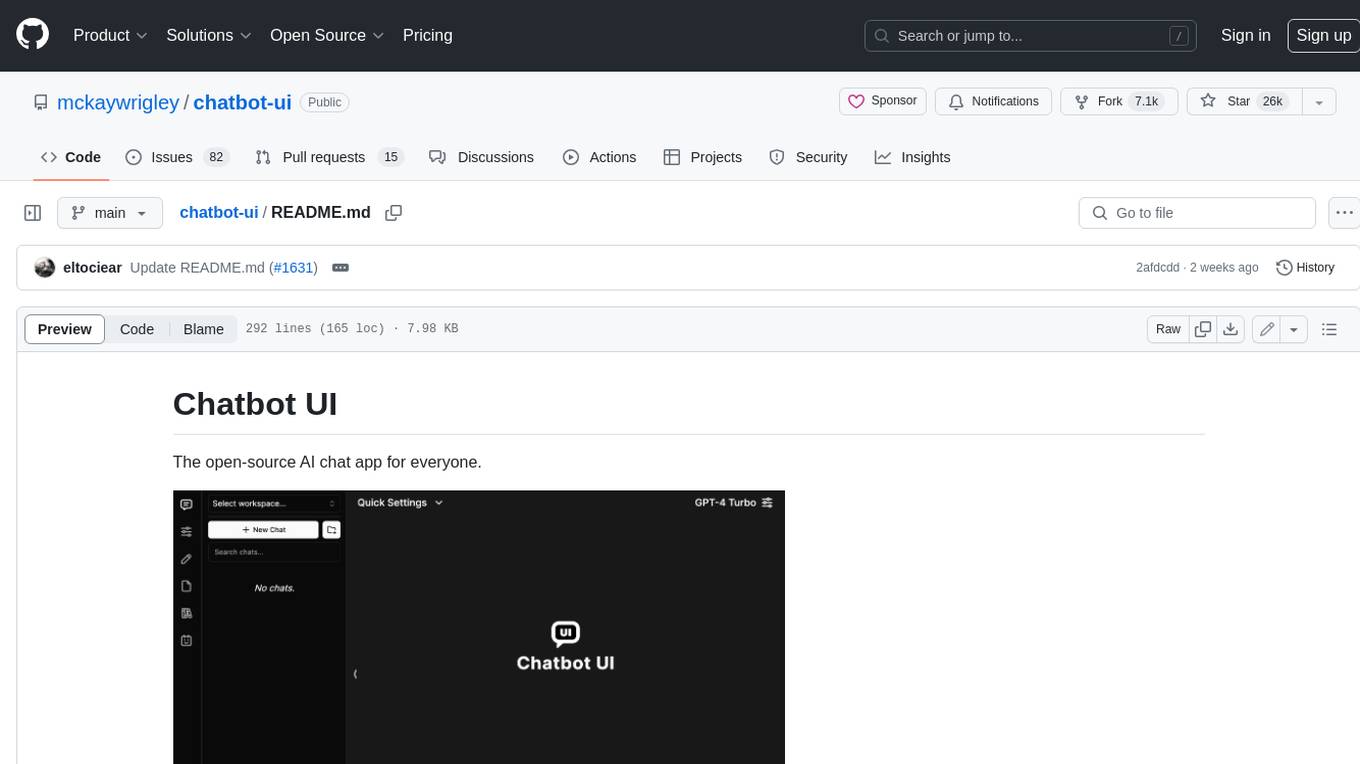
chatbot-ui
Chatbot UI is an open-source AI chat app that allows users to create and deploy their own AI chatbots. It is easy to use and can be customized to fit any need. Chatbot UI is perfect for businesses, developers, and anyone who wants to create a chatbot.
BricksLLM
BricksLLM is a cloud native AI gateway written in Go. Currently, it provides native support for OpenAI, Anthropic, Azure OpenAI and vLLM. BricksLLM aims to provide enterprise level infrastructure that can power any LLM production use cases. Here are some use cases for BricksLLM: * Set LLM usage limits for users on different pricing tiers * Track LLM usage on a per user and per organization basis * Block or redact requests containing PIIs * Improve LLM reliability with failovers, retries and caching * Distribute API keys with rate limits and cost limits for internal development/production use cases * Distribute API keys with rate limits and cost limits for students
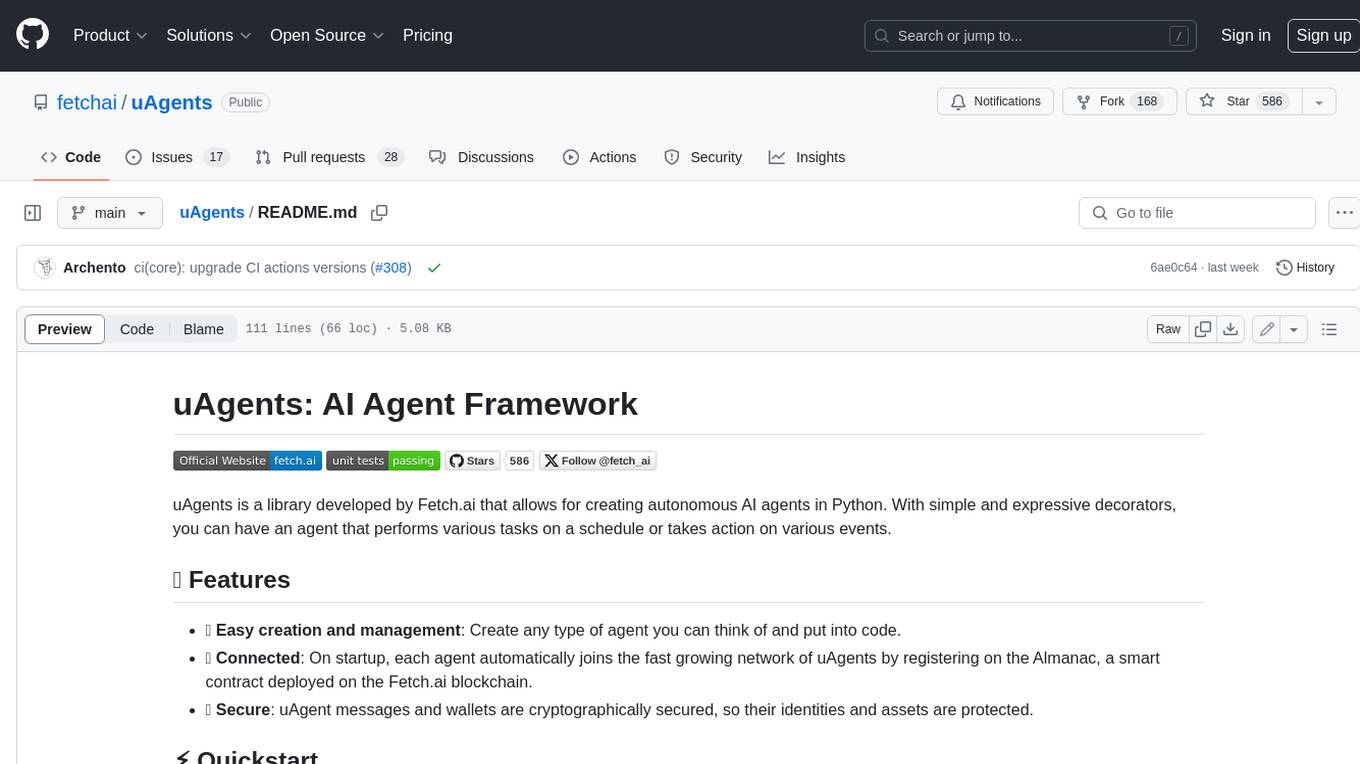
uAgents
uAgents is a Python library developed by Fetch.ai that allows for the creation of autonomous AI agents. These agents can perform various tasks on a schedule or take action on various events. uAgents are easy to create and manage, and they are connected to a fast-growing network of other uAgents. They are also secure, with cryptographically secured messages and wallets.
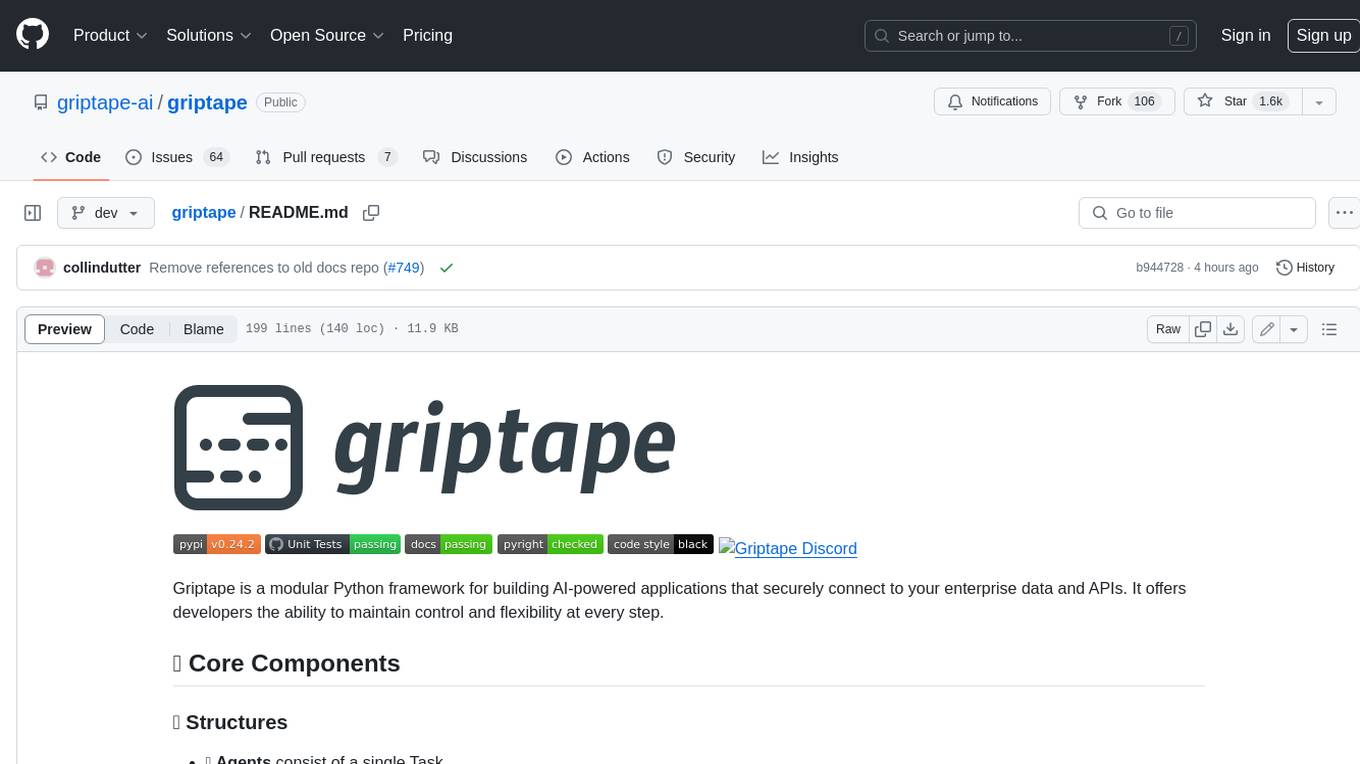
griptape
Griptape is a modular Python framework for building AI-powered applications that securely connect to your enterprise data and APIs. It offers developers the ability to maintain control and flexibility at every step. Griptape's core components include Structures (Agents, Pipelines, and Workflows), Tasks, Tools, Memory (Conversation Memory, Task Memory, and Meta Memory), Drivers (Prompt and Embedding Drivers, Vector Store Drivers, Image Generation Drivers, Image Query Drivers, SQL Drivers, Web Scraper Drivers, and Conversation Memory Drivers), Engines (Query Engines, Extraction Engines, Summary Engines, Image Generation Engines, and Image Query Engines), and additional components (Rulesets, Loaders, Artifacts, Chunkers, and Tokenizers). Griptape enables developers to create AI-powered applications with ease and efficiency.