


camp-1
AI Native Camp 1기 강의 자료
Stars: 51
AI Native Camp - 1기 is a 7-day intensive camp designed for non-developers to learn Claude Code skills. The curriculum includes hands-on learning experiences with Claude guiding, teaching, and practicing skills daily. Participants can install the entire curriculum or specific skills for each day using simple commands. The camp focuses on creating skills by learning how to make skills, and it aims to change participants' work methods permanently. Upon completion, participants become part of the Claude Code community, equipped with new skills and knowledge.
README:
7일 후, 당신의 업무 방식은 영구적으로 바뀐다.
비개발자를 위한 Claude Code 7일 집중 캠프. 2026-02-14 ~ 2026-02-21 (일요일 휴식), Naver D2SF.
npx skills add ai-native-camp/camp-1 --yes이 한 줄이면 모든 커리큘럼 스킬이 설치됩니다. 특정 Day만 설치하려면:
# Day 1만 설치
npx skills add ai-native-camp/camp-1 --skill day1-onboarding --yes

# Day 2만 설치
npx skills add ai-native-camp/camp-1 --skill day2-create-context-sync-skill --yes
설치 후 Claude Code에서
/day1-onboarding또는/day2-create-context-sync-skill로 시작하세요.
이 캠프의 커리큘럼은 Claude Code Skills 그 자체다.
슬라이드를 넘기며 듣는 강의가 아니다. /day1-onboarding을 실행하면 Claude가 직접 가르치고, 질문하고, 실습을 안내한다. 매일 새로운 Skill이 열리고, 어제 배운 것 위에 오늘을 쌓는다.
.claude/skills/
├── day1-onboarding/                  # 설치 + 7개 핵심 기능
├── day2-supplement-mcp/                        # MCP 딥다이브 (개념 ~ 서버 설치 ~ Plugin)
├── day2-create-context-sync-skill/   # 나만의 Context Sync 스킬 만들기
├── day3-clarify/       # 요구사항 명확화
├── day4-wrap/          # 마무리 + subagent
├── ...
└── day7-graduation/
Skill을 만드는 법을 Skill로 배운다. 이것이 이 캠프의 방식이다.
| Day | Skill | 주제 |
|---|---|---|
| 1 | day1-onboarding |
Claude Code 설치 + 7개 핵심 기능 (CLAUDE.md, Skill, MCP, Subagent, Agent Teams, Hook, Plugin) |
| 2 | day2-supplement-mcp |
MCP 딥다이브 — 개념 이해, 서버 설치, /mcp 명령어, 인기 서버, Plugin MCP |
| 2 | day2-create-context-sync-skill |
나만의 Context Sync 스킬 만들기 — 도구 선택 → MCP/API 연결 → 병렬 수집 → 완성 |
| 3 | coming soon | 요구사항 명확화 |
| 4 | coming soon | 마무리 + subagent |
| ... | ||
| 7 | coming soon | 졸업 |
수료가 아니라 시작이다. Claude Code라는 불을 다루는 신인류 커뮤니티의 일원이 된다.
For Tasks:
Click tags to check more tools for each tasksFor Jobs:
Alternative AI tools for camp-1
Similar Open Source Tools
camp-1
AI Native Camp - 1기 is a 7-day intensive camp designed for non-developers to learn Claude Code skills. The curriculum includes hands-on learning experiences with Claude guiding, teaching, and practicing skills daily. Participants can install the entire curriculum or specific skills for each day using simple commands. The camp focuses on creating skills by learning how to make skills, and it aims to change participants' work methods permanently. Upon completion, participants become part of the Claude Code community, equipped with new skills and knowledge.
azure-agentic-infraops
Agentic InfraOps is a multi-agent orchestration system for Azure infrastructure development that transforms how you build Azure infrastructure with AI agents. It provides a structured 7-step workflow that coordinates specialized AI agents through a complete infrastructure development cycle: Requirements → Architecture → Design → Plan → Code → Deploy → Documentation. The system enforces Azure Well-Architected Framework (WAF) alignment and Azure Verified Modules (AVM) at every phase, combining the speed of AI coding with best practices in cloud engineering.
hcaptcha-challenger
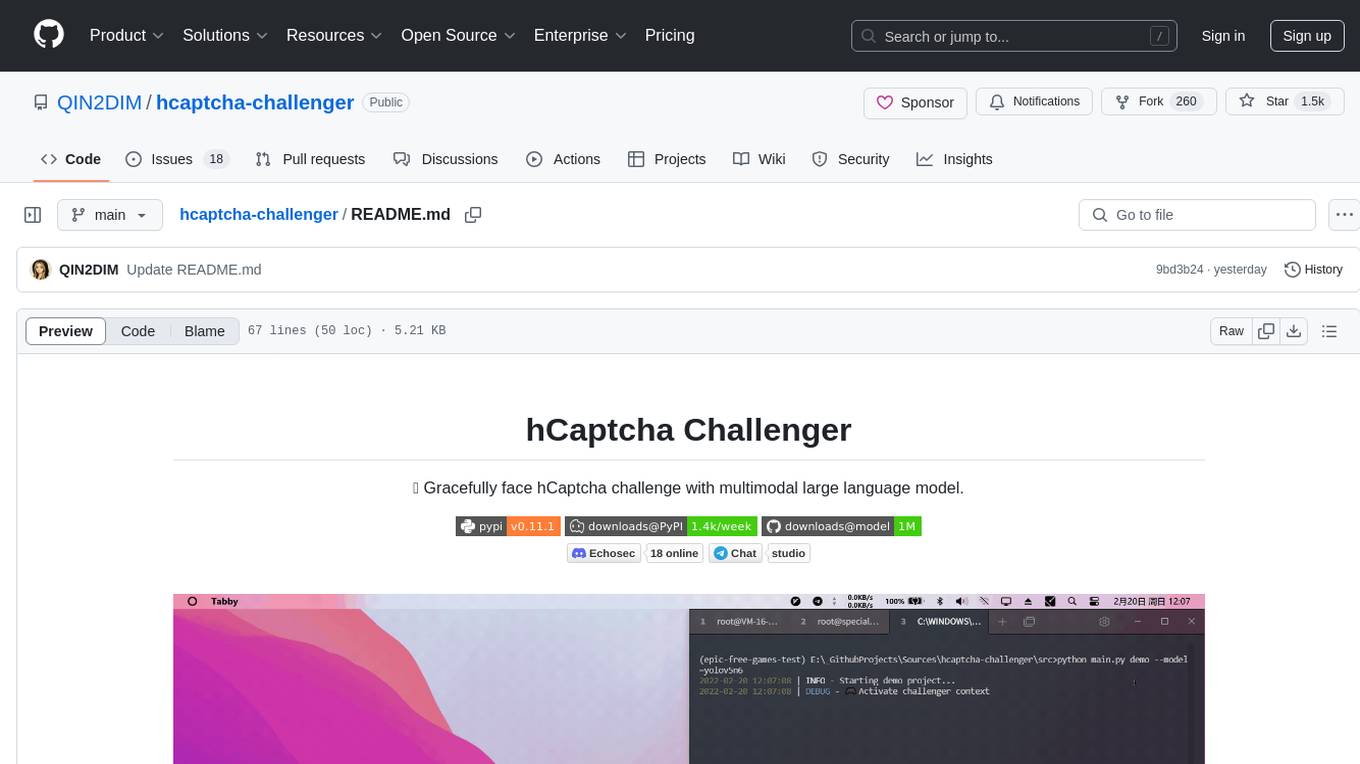
hCaptcha Challenger is a tool designed to gracefully face hCaptcha challenges using a multimodal large language model. It does not rely on Tampermonkey scripts or third-party anti-captcha services, instead implementing interfaces for 'AI vs AI' scenarios. The tool supports various challenge types such as image labeling, drag and drop, and advanced tasks like self-supervised challenges and Agentic Workflow. Users can access documentation in multiple languages and leverage resources for tasks like model training, dataset annotation, and model upgrading. The tool aims to enhance user experience in handling hCaptcha challenges with innovative AI capabilities.
EVE
EVE is an official PyTorch implementation of Unveiling Encoder-Free Vision-Language Models. The project aims to explore the removal of vision encoders from Vision-Language Models (VLMs) and transfer LLMs to encoder-free VLMs efficiently. It also focuses on bridging the performance gap between encoder-free and encoder-based VLMs. EVE offers a superior capability with arbitrary image aspect ratio, data efficiency by utilizing publicly available data for pre-training, and training efficiency with a transparent and practical strategy for developing a pure decoder-only architecture across modalities.
claude-craft
Claude Craft is a comprehensive framework for AI-assisted development with Claude Code, providing standardized rules, agents, and commands across multiple technology stacks. It includes autonomous sprint capabilities, documentation accuracy improvements, CI hardening, and test coverage enhancements. With support for 10 technology stacks, 5 languages, 40 AI agents, 157 slash commands, and various project management features like BMAD v6 framework, Ralph Wiggum loop execution, skills, templates, checklists, and hooks system, Claude Craft offers a robust solution for project development and management. The tool also supports workflow methodology, development tracks, document generation, BMAD v6 project management, quality gates, batch processing, backlog migration, and Claude Code hooks integration.
learn-claude-code
Learn Claude Code is an educational project by shareAI Lab that aims to help users understand how modern AI agents work by building one from scratch. The repository provides original educational material on various topics such as the agent loop, tool design, explicit planning, context management, knowledge injection, task systems, parallel execution, team messaging, and autonomous teams. Users can follow a learning path through different versions of the project, each introducing new concepts and mechanisms. The repository also includes technical tutorials, articles, and example skills for users to explore and learn from. The project emphasizes the philosophy that the model is crucial in agent development, with code playing a supporting role.
everything-claude-code
The 'Everything Claude Code' repository is a comprehensive collection of production-ready agents, skills, hooks, commands, rules, and MCP configurations developed over 10+ months. It includes guides for setup, foundations, and philosophy, as well as detailed explanations of various topics such as token optimization, memory persistence, continuous learning, verification loops, parallelization, and subagent orchestration. The repository also provides updates on bug fixes, multi-language rules, installation wizard, PM2 support, OpenCode plugin integration, unified commands and skills, and cross-platform support. It offers a quick start guide for installation, ecosystem tools like Skill Creator and Continuous Learning v2, requirements for CLI version compatibility, key concepts like agents, skills, hooks, and rules, running tests, contributing guidelines, OpenCode support, background information, important notes on context window management and customization, star history chart, and relevant links.
ai-dev-kit
The AI Dev Kit is a comprehensive toolkit designed to enhance AI-driven development on Databricks. It provides trusted sources for AI coding assistants like Claude Code and Cursor to build faster and smarter on Databricks. The kit includes features such as Spark Declarative Pipelines, Databricks Jobs, AI/BI Dashboards, Unity Catalog, Genie Spaces, Knowledge Assistants, MLflow Experiments, Model Serving, Databricks Apps, and more. Users can choose from different adventures like installing the kit, using the visual builder app, teaching AI assistants Databricks patterns, executing Databricks actions, or building custom integrations with the core library. The kit also includes components like databricks-tools-core, databricks-mcp-server, databricks-skills, databricks-builder-app, and ai-dev-project.
llumen
Llumen is a self-hosted interface optimized for modest hardware like Raspberry Pi, old laptops, and minimal VPS. It offers privacy without complexity, providing essential features with minimal resource demands. Users can enjoy sub-second cold starts, real-time token streaming, various chat modes, rich media support, and a universal API for OpenAI-compatible providers. The tool has a small footprint with a binary size of around 17MB and RAM usage under 128MB. Llumen aims to simplify the setup process and offer a user-friendly experience for individuals seeking a privacy-focused solution.
EasyEdit
EasyEdit is a Python package for edit Large Language Models (LLM) like `GPT-J`, `Llama`, `GPT-NEO`, `GPT2`, `T5`(support models from **1B** to **65B**), the objective of which is to alter the behavior of LLMs efficiently within a specific domain without negatively impacting performance across other inputs. It is designed to be easy to use and easy to extend.
Q-Bench
Q-Bench is a benchmark for general-purpose foundation models on low-level vision, focusing on multi-modality LLMs performance. It includes three realms for low-level vision: perception, description, and assessment. The benchmark datasets LLVisionQA and LLDescribe are collected for perception and description tasks, with open submission-based evaluation. An abstract evaluation code is provided for assessment using public datasets. The tool can be used with the datasets API for single images and image pairs, allowing for automatic download and usage. Various tasks and evaluations are available for testing MLLMs on low-level vision tasks.
VideoLLaMA2
VideoLLaMA 2 is a project focused on advancing spatial-temporal modeling and audio understanding in video-LLMs. It provides tools for multi-choice video QA, open-ended video QA, and video captioning. The project offers model zoo with different configurations for visual encoder and language decoder. It includes training and evaluation guides, as well as inference capabilities for video and image processing. The project also features a demo setup for running a video-based Large Language Model web demonstration.
Awesome-AI-GPTs
Awesome AI GPTs is an open repository that collects resources and fun ways to use OpenAI GPTs. It includes databases, search tools, open-source projects, articles, attack and defense strategies, installation of custom plugins, knowledge bases, and community interactions related to GPTs. Users can find curated lists, leaked prompts, and various GPT applications in this repository. The project aims to empower users with AI capabilities and foster collaboration in the AI community.
ReST-MCTS
ReST-MCTS is a reinforced self-training approach that integrates process reward guidance with tree search MCTS to collect higher-quality reasoning traces and per-step value for training policy and reward models. It eliminates the need for manual per-step annotation by estimating the probability of steps leading to correct answers. The inferred rewards refine the process reward model and aid in selecting high-quality traces for policy model self-training.
UMOE-Scaling-Unified-Multimodal-LLMs
Uni-MoE is a MoE-based unified multimodal model that can handle diverse modalities including audio, speech, image, text, and video. The project focuses on scaling Unified Multimodal LLMs with a Mixture of Experts framework. It offers enhanced functionality for training across multiple nodes and GPUs, as well as parallel processing at both the expert and modality levels. The model architecture involves three training stages: building connectors for multimodal understanding, developing modality-specific experts, and incorporating multiple trained experts into LLMs using the LoRA technique on mixed multimodal data. The tool provides instructions for installation, weights organization, inference, training, and evaluation on various datasets.
For similar tasks
claude-code-settings
A repository collecting best practices for Claude Code settings and customization. It provides configuration files for customizing Claude Code's behavior and building an efficient development environment. The repository includes custom agents and skills for specific domains, interactive development workflow features, efficient development rules, and team workflow with Codex MCP. Users can leverage the provided configuration files and tools to enhance their development process and improve code quality.
camp-1
AI Native Camp - 1기 is a 7-day intensive camp designed for non-developers to learn Claude Code skills. The curriculum includes hands-on learning experiences with Claude guiding, teaching, and practicing skills daily. Participants can install the entire curriculum or specific skills for each day using simple commands. The camp focuses on creating skills by learning how to make skills, and it aims to change participants' work methods permanently. Upon completion, participants become part of the Claude Code community, equipped with new skills and knowledge.
skillshare
One source of truth for AI CLI skills. Sync everywhere with one command — from personal to organization-wide. Stop managing skills tool-by-tool. `skillshare` gives you one shared skill source and pushes it everywhere your AI agents work. Safe by default with non-destructive merge mode. True bidirectional flow with `collect`. Cross-machine ready with Git-native `push`/`pull`. Team + project friendly with global skills for personal workflows and repo-scoped collaboration. Visual control panel with `skillshare ui` for browsing, install, target management, and sync status in one place.
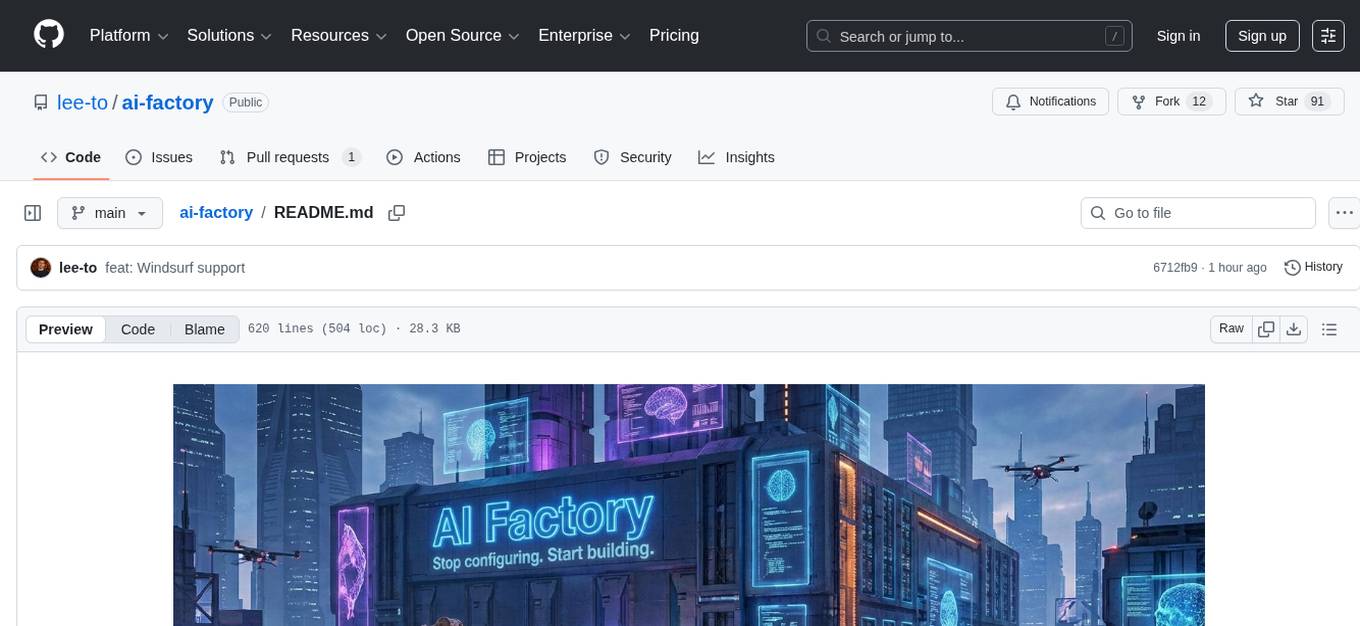
ai-factory
AI Factory is a CLI tool and skill system that streamlines AI-powered development by handling context setup, skill installation, and workflow configuration. It supports multiple AI coding agents, offers spec-driven development, and integrates with popular tech stacks like Next.js, Laravel, Django, and Express. The tool ensures zero configuration, best practices adherence, community skills utilization, and multi-agent support. Users can create plans, tasks, and commits for structured feature development, bug fixes, and self-improvement. Security is a priority with mandatory two-level scans for external skills. The tool's learning loop generates patches from bug fixes to enhance future implementations.
For similar jobs
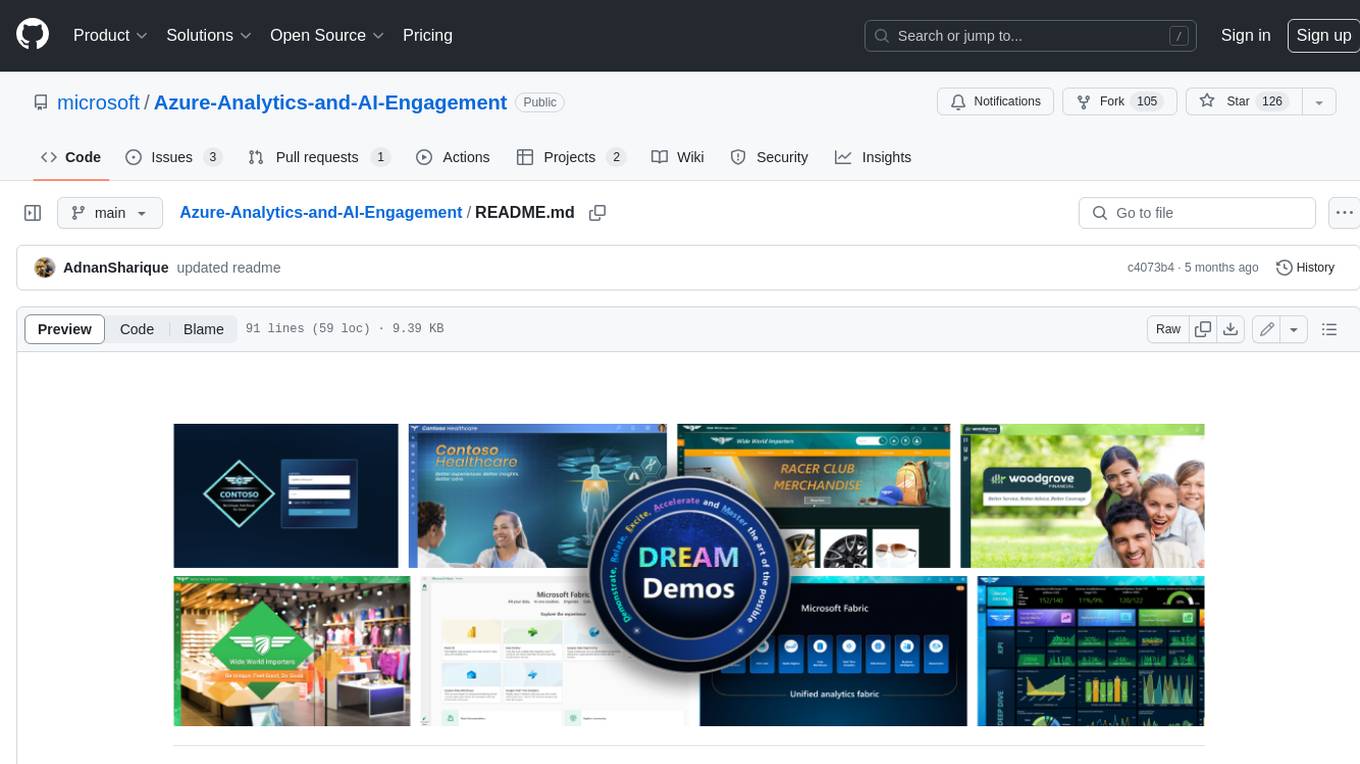
Azure-Analytics-and-AI-Engagement
The Azure-Analytics-and-AI-Engagement repository provides packaged Industry Scenario DREAM Demos with ARM templates (Containing a demo web application, Power BI reports, Synapse resources, AML Notebooks etc.) that can be deployed in a customer’s subscription using the CAPE tool within a matter of few hours. Partners can also deploy DREAM Demos in their own subscriptions using DPoC.
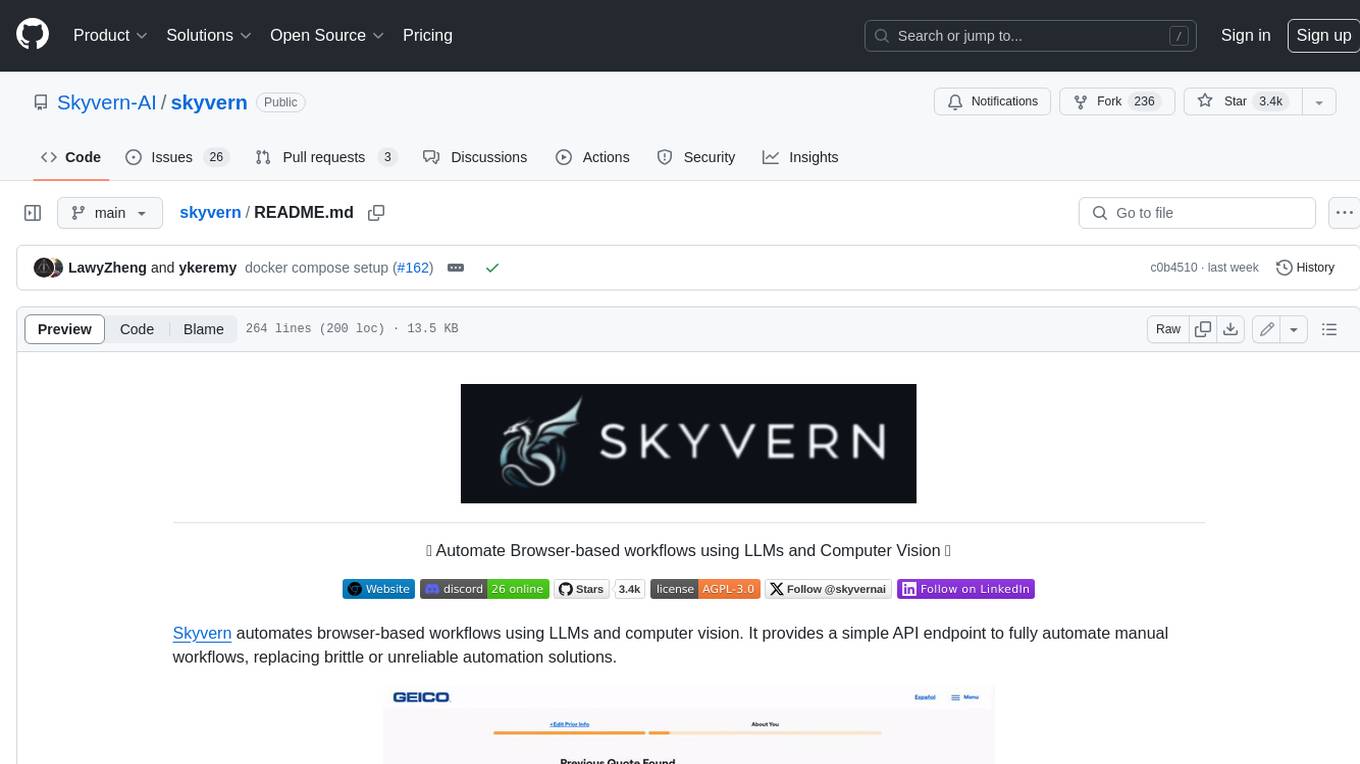
skyvern
Skyvern automates browser-based workflows using LLMs and computer vision. It provides a simple API endpoint to fully automate manual workflows, replacing brittle or unreliable automation solutions. Traditional approaches to browser automations required writing custom scripts for websites, often relying on DOM parsing and XPath-based interactions which would break whenever the website layouts changed. Instead of only relying on code-defined XPath interactions, Skyvern adds computer vision and LLMs to the mix to parse items in the viewport in real-time, create a plan for interaction and interact with them. This approach gives us a few advantages: 1. Skyvern can operate on websites it’s never seen before, as it’s able to map visual elements to actions necessary to complete a workflow, without any customized code 2. Skyvern is resistant to website layout changes, as there are no pre-determined XPaths or other selectors our system is looking for while trying to navigate 3. Skyvern leverages LLMs to reason through interactions to ensure we can cover complex situations. Examples include: 1. If you wanted to get an auto insurance quote from Geico, the answer to a common question “Were you eligible to drive at 18?” could be inferred from the driver receiving their license at age 16 2. If you were doing competitor analysis, it’s understanding that an Arnold Palmer 22 oz can at 7/11 is almost definitely the same product as a 23 oz can at Gopuff (even though the sizes are slightly different, which could be a rounding error!) Want to see examples of Skyvern in action? Jump to #real-world-examples-of- skyvern
pandas-ai
PandasAI is a Python library that makes it easy to ask questions to your data in natural language. It helps you to explore, clean, and analyze your data using generative AI.
vanna
Vanna is an open-source Python framework for SQL generation and related functionality. It uses Retrieval-Augmented Generation (RAG) to train a model on your data, which can then be used to ask questions and get back SQL queries. Vanna is designed to be portable across different LLMs and vector databases, and it supports any SQL database. It is also secure and private, as your database contents are never sent to the LLM or the vector database.
databend
Databend is an open-source cloud data warehouse that serves as a cost-effective alternative to Snowflake. With its focus on fast query execution and data ingestion, it's designed for complex analysis of the world's largest datasets.
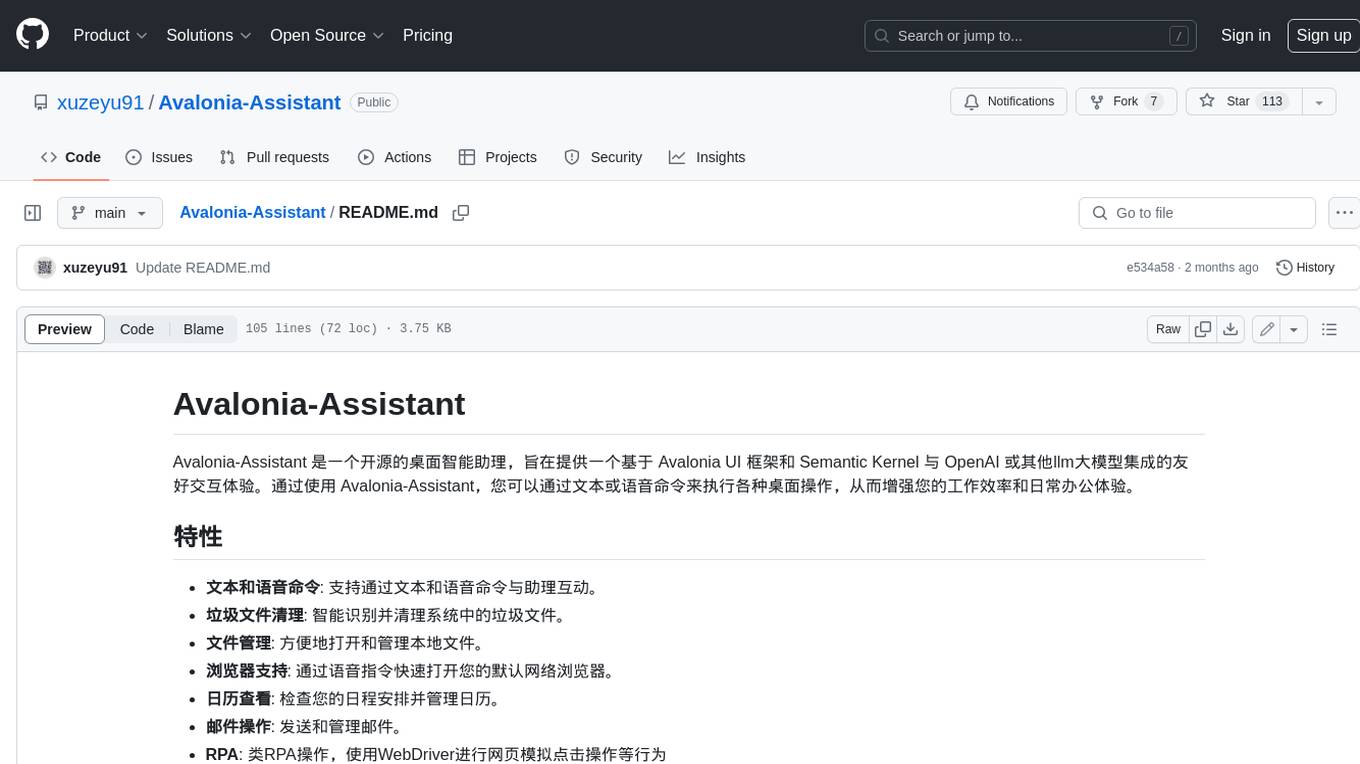
Avalonia-Assistant
Avalonia-Assistant is an open-source desktop intelligent assistant that aims to provide a user-friendly interactive experience based on the Avalonia UI framework and the integration of Semantic Kernel with OpenAI or other large LLM models. By utilizing Avalonia-Assistant, you can perform various desktop operations through text or voice commands, enhancing your productivity and daily office experience.
marvin
Marvin is a lightweight AI toolkit for building natural language interfaces that are reliable, scalable, and easy to trust. Each of Marvin's tools is simple and self-documenting, using AI to solve common but complex challenges like entity extraction, classification, and generating synthetic data. Each tool is independent and incrementally adoptable, so you can use them on their own or in combination with any other library. Marvin is also multi-modal, supporting both image and audio generation as well using images as inputs for extraction and classification. Marvin is for developers who care more about _using_ AI than _building_ AI, and we are focused on creating an exceptional developer experience. Marvin users should feel empowered to bring tightly-scoped "AI magic" into any traditional software project with just a few extra lines of code. Marvin aims to merge the best practices for building dependable, observable software with the best practices for building with generative AI into a single, easy-to-use library. It's a serious tool, but we hope you have fun with it. Marvin is open-source, free to use, and made with 💙 by the team at Prefect.
activepieces
Activepieces is an open source replacement for Zapier, designed to be extensible through a type-safe pieces framework written in Typescript. It features a user-friendly Workflow Builder with support for Branches, Loops, and Drag and Drop. Activepieces integrates with Google Sheets, OpenAI, Discord, and RSS, along with 80+ other integrations. The list of supported integrations continues to grow rapidly, thanks to valuable contributions from the community. Activepieces is an open ecosystem; all piece source code is available in the repository, and they are versioned and published directly to npmjs.com upon contributions. If you cannot find a specific piece on the pieces roadmap, please submit a request by visiting the following link: Request Piece Alternatively, if you are a developer, you can quickly build your own piece using our TypeScript framework. For guidance, please refer to the following guide: Contributor's Guide